







Abstract
The increasing use of mobile applications by travellers and the high adaption of tourism companies into this new contact and sales platform, made it necessary to comprehensively investigate the mobile application users’ behaviours. This research combines the Stimulus-Organism-Response (S-O-R) framework and Technology Acceptance Model (TAM) to develop a theoretical background in examining travel booking behaviour of mobile application users. The conceptual model suggests that mobile application quality (MAQ) directly affects perceived ease of use (PEOU) and perceived usefulness (PU) which influence the intention to use (IU) mobile applications. Moreover, the offline brand trust (BT) has been hypothesised as a moderator between PEOU and PU's impacts on IU mobile applications. Analyses results indicated that system and service quality dimensions of MAQ significantly affect IU mobile application via PEOU and PU. Moreover, offline BT had both direct and moderator influences on the formation of IU mobile application. The study findings contributed to the theory in understanding mobile application users’ behaviours and suggested valuable managerial strategies in the m-commerce context.
Keywords
Introduction
Fast Shifts in advanced technologies significantly changed people's behaviours in accessing in-depth information and spending time by using online or mobile appliances. The recent statistics (wearesocial, 2020) reveal that people spend an average of 3 h 40 min on a mobile device in a day, while 90% of that time is spent in using mobile applications (Wurmser, 2020). A mobile application (or app) is defined as “a software application that runs on a smartphone or other portable device” (Song et al., 2014). In recent years, smartphone users are increasingly using mobile apps as an easier and faster option to access internet services than traditional web browsers (Fuentes-Enriquez and Rojas-Romero, 2013). Reaching the total number of mobile applications to 8.93 million (Koetsier, 2020) reflects the importance of mobile apps by supplier companies as a contemporary communication touch-point and a platform in improving customers’ brand experiences (Kim et al., 2015). Such positive brand experiences lead to higher customer loyalty and maintain a competitive advantage to companies. Additionally, corporate mobile apps may significantly contribute to companies’ financial success in the context of m-commerce (Wang, 2020). As shown by a study, sales performance of the supplier companies is positively associated with continuous updates on app features or price, availability of free apps, and higher user feedback on apps (Lee and Raghu, 2014).
Nevertheless, the recent statistics show that user retention rates belong to travel-booking mobile apps are at 20% on the first day of downloading, while they are just 6% on the 30th day (Statista, 2020). Considering the increasing use of mobile devices and the status quo of mobile apps’ low retention rates, understanding the determinants of travel-related mobile application use behaviours is an important and promising research area. In contrast to scholarly interest in identifying of the antecedents of mobile application usage, a limited number of studies aimed to examine the impact of mobile application quality (MAQ) on user behaviours. In the meantime, a scholarly consensus seems to be developed on investigating MAQ from the users’ perspective rather than the supplier companies’ (Cho et al., 2019). However, more research is needed to support this approach.
Another component of the mobile application user behaviours is the supplier company's perceived brand trust (BT) since in previous studies it is shown that BT decreases perceived risk (Bilgihan, 2016) and facilitates the use of brand extensions in the online context. Despite that importance, BT has been rarely adapted to online user behaviour literature (e.g. Zhou et al., 2018), and no specific study attempts have been made yet to identify the role of offline BT on the use of travel-related mobile apps. Hence, identification of the role of offline BT on user behaviours towards travel-related mobile apps may provide new insights for a deeper understanding of BT.
Inspiring from the above-mentioned research needs and literature gaps; we asked three fundamental questions in this study: (1) What are the components of MAQ and how does MAQ impact the user perceptions, such as PEOU and PU?; (2) How do PEOU and PU affect IU mobile application?; (3) Is there a moderator role of offline BT between PEOU-IU and PU-IU relationships beside to its direct impact on IU mobile apps?. To answer these questions, a conceptual model was developed by combining the Stimulus-Organism-Response (S-O-R) Model (Mehrabian and Russell, 1974) and the Technology Acceptance Model (TAM) (Davis, 1986). While S-O-R model seeks to clarify behavioural processes under certain conditions, such as mobile devices, the TAM, on the other hand, helps to understand behaviours in technology use. By adapting a user-based research perspective, multi-variable relationships, proposed in the research model among the MAQ, PEOU, PU, BT, and IU mobile apps, were empirically tested in the case of travel-related mobile application users.
The present paper is structured as follows: the theoretical models that the research is based on and literature reviews related to research constructs are introduced in the next section. The following section develops the hypotheses with their theoretical backgrounds and proposes the research model. Section 4 provides the method of the study, and section 5 presents the findings. The theoretical and managerial implications of the findings are discussed in the next section. The paper is concluded with the study limitations and recommendations for future researches.
Literature Review
Mobile Application User Behaviours
There exists an extensive body of literature on the determinants of mobile application use. However, the researchers note a dearth of research regarding the user behaviours on travel-related mobile apps (Lu et al., 2015). In this section, following a literature review on mobile application use behaviours in various research areas, the motivation of this study targeting to investigate travel-related mobile apps is presented.
Previous studies show that the preference for using mobile apps is mainly based on utilitarian and experiential benefits (e.g. Wang, 2020), and the behaviour of continuing to use an application is closely related to PEOU, PU, convenience, and enjoyment factors (McLean, 2018). As the findings of a study revealed (Hsu et al., 2015), utilitarian expectations and perceptions of the users are significantly associated with their satisfaction with a mobile app. Hence, the researchers suggest that mobile app features should be determined based on the users’ expectations.
In previous studies, some scholars who attempted to clarify mobile app use behaviours tried to adapt previous models into the m-commerce context. The Technology Acceptance Model (TAM) and the Unified Theory of Acceptance and Use of Technology (UTAUT) Model have been the most widely used models by scholars. For example, intention to use mobile app determinants were investigated in the Muňoz-Leiva et al.'s study (2017), where an adaptation of the TAM is used in the mobile banking context. In another research, Mehra et al. (2020) combined TAM and Diffusion of Innovation models for examining the determinants of mobile apps adaption among young adults. The researchers showed that PEOU and PU were significant determinants of intention to use mobile apps. McLean (2018), who conducted a longitudinal study, asserted that PEOU, PU, convenience, and enjoyment had significant impacts on user engagement with a mobile application.
Hew et al. (2015), who adapted UTAUT2 (Venkatesh et al., 2012) into mobile apps, revealed that performance expectancy, effort expectancy, facilitating conditions, hedonic motivation, and habit, which are the main components of UTAUT2, play a determinant role in behavioural intention to use mobile apps. Similarly, by adapting UTAUT2, Thusi and Maduku (2020) examined mobile banking app acceptance of millennial retail banking customers. The findings indicated that performance expectancy, facilitating conditions, habit, perceived risk, and institution-based trust significantly affect intention to adapt mobile banking apps. In addition, facilitating conditions, perceived risk, and behavioural intention have a significant impact on mobile banking app use behaviour. Finally, in one of the rare studies in the tourism field, Thai users’ continuing usage behaviours were examined in the case of Agoda (Pitchayadejanant et al., 2019). The results indicated that e-service quality (ease of use, application design, responsiveness, information quality and assurance) is a determinant of use continuance.
It can be concluded that the tourism and travel literature does not contain in-depth information about the behaviour of those using travel-related mobile apps. Mainly, studies on the effect of brand trust on mobile application users’ behaviour are limited. Therefore, more research is needed in the travel and tourism context to understand the behaviour of mobile application users (e.g. usage intentions, perceptions on system features).
Mobile Application Quality (MAQ)
MAQ has been examined in different disciplines, and the scholars suggested various quality components that are specific to research areas. For example, Choi and Stvilia (2013) used the information quality and software quality dimensions to determine mobile wellness applications’ quality. In the mobile learning context, a study showed that quality of applications could be determined by availability, usability, dependability, performance, and functionality features (Sarrab et al., 2015). Jun and Palacios (2016), who adapted the critical incidents technique for exploring the mobile banking service quality dimensions, revealed that MAQ -as one of the dimensions of mobile banking service quality- was formed by content, accuracy, ease of use, speed, aesthetics, security, diverse mobile application service features, and mobile convenience.
In the context of mobile shopping, Al Dmour et al. (2014) suggested that content quality, specific content, appearance, and technical adequacy are the features of a user-focused MAQ. Recently, by conducting a systematic literature review, Dorcic et al. (2019) concluded that the travellers may select the useful, easy-to-use, and compatible mobile apps, enabling them to complete their tasks on information search, purchase of tourism services, and travel experience enhancement. In another study, Cho et al. (2019) investigated the quality of food delivery apps by collecting data from 311 Chinese shoppers. They used design, trustworthiness, price, food choices, and convenience, as the essential quality attributes of the food delivery applications.
Differing from other researchers, Hajiheydari and Ashkani (2018) pursued Delone and McLean; (2003) Information System Success (ISS) Model in identifying the determinants of MAQ. They used the components of MAQ (information quality, system quality, and service quality) to specify the relationships among subjective norms, attitude, perception (e.g. PEOU, PU), and quality. The results show that the system quality dimension of mobile app quality significantly affects PU, while service and system quality dimensions have influences on user satisfaction. In another research (Li, 2013), mobile banking app quality was measured by ISS Model and its effect on satisfaction, perceived innovativeness, and intention to continue using have been examined. The findings indicated that information quality significantly influences user satisfaction, while system quality has no impact.
To the best of the authors’ knowledge, there are limited studies specifically investigating user quality perceptions about a travel mobile app used for purchasing tourism and hospitality services. In the current study, MAQ was conceptualised as a formative and multi-dimensional construct similar to previous studies in the literature. It is determined by the quality components of the ISS Model (Delone and McLean, 2003).
Brand Trust (BT)
The term ‘trust’ was first introduced in social psychology as an essential element of social interactions (Delgado-Ballester and Luis Munuera-Alemán, 2001). In the literature on mobile apps, the user trust has been defined and searched by its abilities at “protecting the user privacy/security and usability” (Reddick and Zheng, 2017) and “meeting the users’ willingness to rely on provided information” (De Medeiros, 2020). In this study, brand trust has been considered as the willingness of the mobile app users to rely on the ability of a brand to perform its stated function by following Chaudhuri and Holbrook's (2001) definition. Since financial success of the companies depends on building long-lasting relationships with the customers, the researchers working on business management integrated ‘brand trust’ (BT) term into this area and considered it a determinant of brand loyalty. BT reflects the customer perceptions about the reliability and responsibility of a brand. The researchers are in consensus that any direct (e.g. consumption) and indirect (e.g. advertising) interactions with a company brand shape the BT of the customers (Naggar and Bendary, 2017).
By the increasing influence of the Internet on people's life after the 2000s, the researchers who work on the users’ behavioural drivers and consequences in the online platforms (Kim and Jones, 2009) began to examine the BT construct more closely. For example, the results of a study conducted in Malaysia showed that perceived risk, quality information, security/privacy, and brand reputation are the determinants of online BT (Alam and Yasin, 2010). In addition, a scarce number of studies target to explain how companies benefit from the value of their brand trust in the online contexts. For instance, in Kim and Jones’ (2009) study, BT is shown to moderate the influence of a retailer's website quality on the users’ online shopping intentions. In the multichannel retail context, the research results of Frasquet et al. (2017) revealed the positive influence of BT on both offline and online customer loyalties.
In a recent study (Tseng and Lee, 2018), affective brand benefits (e.g. functional, experiential, symbolic, and monetary benefits) and system characteristics (e.g. system and information quality) were revealed to impact users’ PU, which in turn affects loyalty towards a branded mobile app. The loyalty of the users was proposed to contain three components: in-app purchase intention, continuance intention, and word-of-mouth intention. This study is particularly valuable in proposing a multi-dimensional structure for system characteristics and showing their importance for consumers to judge the performance of branded apps. In a more recent study on branded mobile apps, Li and Fang (2019) aimed to predict users’ continuance intention toward mobile branded apps through satisfaction and attachment. In the case of MyStarbucks, significant relationships were found between brand attachment, satisfaction, continuance intention, and PU. This study is useful in highlighting the role of ‘attachment’ in branded mobile app usage behaviour. However, it fails to explain how offline BT may direct user behaviours in m-commerce.
Interestingly, a limited number of studies examine the role and importance of BT on mobile application user behaviours in the tourism and travel area. Although some studies examined the moderator role of BT in different sectors, such as m-finance (e.g. Zhou et al., 2018) and m-retailing (Bellman et al., 2011), there is no research attempt in the tourism and travel area. A recent literature review conducted by Movahedisaveji and Shaukat (2020) similarly underlines the need for more studies relating BT to mobile apps in m-commerce.
Stimulus-Organism-Response (S-O-R) Model
The S-O-R Model (Mehrabian and Russell, 1974) was first introduced for the retail industry to establish the relationship between servicescape factors (e.g. design factors, cleanliness), individual inner states and behaviours. This Model aims to explain how environmental factors (Stimulus) affect an individual's internal states (Organism), which in turn leads to behavioural reactions (Response) (Lee, 2018). The S-O-R perspective has been widely adapted by the researchers and used in various research contexts such as social media usage (Luqman et al., 2017), virtual reality (Kim et al., 2020), and hotel mobile apps (Lee, 2018).
Studies proved that the S-O-R is a suitable model in examining the consumer's behaviour in e-commerce (Molinillo et al., 2021). Stimulus elements are things that have an arouser impact on people (Eroglu et al., 2001). In the e-commerce setting, stimulus consists of elements of mobile application, which affect users’ emotion (Islam and Rahman, 2017). In addition, these attributes help users to interact with the application (Tak and Gupta, 2021). In this regard, we identified mobile application dimensions as the stimulus. Organism refers to cognitive and affective states (Molinillo et al., 2021) and users’ attitudes (Huang et al., 2017). Thus, perceived usefulness (PU), perceived ease of use (PEOU), and brand trust (BT) have been defined as the organism in this study. Lastly, intention to use represents the response in the model because it is the final behavioural outcome.
Technology Acceptance Model (TAM)
Fast developments in technology directed the researchers to investigate why people use new technological tools and platforms. Technology Acceptance Model (TAM) (Davis, 1986), as an adaption of the Theory of Reasoned Action (TRA) (Fishbein and Ajzen, 1975), has become one of the popularly used theories for clarifying the reasons that drive people to accept the new technology. In the TAM, behavioural intention for adapting the technology is formulated as an output of ‘perceived usefulness’ (PU) and ‘perceived ease of use’ (PEOU). While PU shows an individual's belief related to the usage of a particular system would increase his /her productivity, PEOU indicates the beliefs on how much the system usage will be free of effort. This model proposes that the users tend to prefer effective technologies. Many scholars used the TAM in various research areas to explain user behaviours, like mobile payment systems (Shaw and Kesharwani, 2019), social media (Veldeman et al., 2017), and e-commerce (Ashraf et al., 2014).
Combining The S-O-R and TAM Models in Explaining Mobile Apps User Behaviours
Scholarly attempts to expand the literature on information and communication technologies (ICT) are largely benefited from well-known theories such as TAM, TRA, UTAT2, and S-O-R models. In recent years, increasing number of the researchers began to integrate those models for better understanding the user behaviours in mobile apps context (e.g. Akram et al., 2020; Chen and Tsai, 2019; Do et al., 2020; Fang et al., 2017; Gupta et al., 2021; Tian et al., 2021). However, these attempts need to enhance or integrate the original models by proposing comprehensive perspectives. For example, in spite of its proven strength in predicting user behaviours and popular use in the ICT literature, TAM has been also criticised by some scholars in terms of its limited framework. Because, the TAM instrument groups together the multiple items (belonging to PEOU and PU) in explaining the IU (Davis and Venkatesh, 1996). It proposes that the impact of other external variables on IU is fully mediated by PEOU and PU (Yi and Hwang, 2003). Moreover, TAM fails to analyse the factors affecting adaption intentions beyond the user perceptions on convenience and usefulness (Lee and Jun, 2007). For overcoming these shortcomings of TAM and for gaining a more holistic perspective into mobile apps user behaviours, in the present study, TAM and S-O-R (which takes into account the interrelationships between external factors, individual internal states and behaviours) models are combined under a conceptual research model.
Hypotheses Development
Mobile Application Quality (MAQ) and Perceived Ease of Use (PEOU)
In contrast to the existence of numerous studies that test the influence of website quality on user behaviours, no scientific attempts made towards the measurement of MAQ's effect on the users’ PEOU. In one of the researches (Ha and Stoel, 2009) about the influence of website quality on the customers’ e-shopping acceptance behaviour, website quality is shown to determine the PEOU. In a study of mobile website adaption, Zhou; (2011) findings indicate that system, information, and service quality constitute the sub-dimensions of website quality, and significantly affect the users’ PEOU. The findings of Chi (2018), who investigated Chinese consumers’ adaption towards apparel m-commerce, also confirm the positive impact of website system quality and information quality on PEOU, whereas service quality has no significant effect. Zhu et al.'s research (2012) in the online game context similarly reveals the positive impacts of system quality and information quality on PEOU.
Based on the above-mentioned literature, the following hypotheses are proposed:
Mobile Application Quality (MAQ) and Perceived Usefulness (PU)
To date, the influence of MAQ on PU has been scarcely examined by scholars. In one of these studies (Hu and Zhang, 2016), analysis of the data collected from the students who use mobile library applications indicated that MAQ -consisting of the system, information, and service quality dimensions- has a significant impact on PU. Another research in the sample of Iranian mobile application users (Hajiheydari and Ashkani, 2018) confirmed the system quality's positive influence on PU, while information and service quality have no significant effect on PU. In the present study, a multi-dimensional MAQ approach is adapted similar to previous studies, and each quality dimension is hypothesised to affect PU of the users:
Perceived Ease of Use (PEOU) and Perceived Usefulness (PU)
Several empirical studies address that PU is affected by PEOU (e.g. Shaw and Kesharwani, 2019). For example, in a study related to the virtual world, Chow et al. (2012) showed that PEOU directly impacts PU. Recently, Shaw and Kesharwani (2019) revealed that PEOU significantly affects PU. More recently, Jin (2020), who investigated the antecedents of brand-sponsored application's acceptance by the users, highlighted the positive impact of PEOU on PU. Hence, the following hypothesis is proposed:
Perceived Ease of Use (PEOU) and intention to Use (IU)
Ease of use is one of the main functions of successful mobile apps (Choi et al., 2017). On the contrary, the mobile apps that are evaluated as complicated or difficult to use may face the user switch behaviours (Li et al., 2020). The role of PEOU on user behaviours has been revealed in many pieces of research. For example, IU is shown to be affected by PEOU in mobile banking in India (Singh and Srivastava, 2018). Chen and Tsai's study (2019) explored the factors affecting IU regarding location-based mobile tourism application and revealed that PEOU is a determinant of IU. Moreover, based on a literature review, Okumus and Bilgihan (2014) proposed a conceptual model where PEOU directly affects IU. Hence, we proposed the following hypothesis:
Perceived Usefulness (Pu) and Intention to Use (IU)
PU is one of the most commonly used criteria to understand an individual's acceptance of new technologies. In several studies and various research settings, PU is identified to have influence on behavioural outcomes. In one of these studies, Hew et al. (2018), who conducted a study among domestic tourists in Malaysia, revealed that PU positively affects mobile shopping intention towards tourism products and services. Recently, Sagnier et al. (2020) showed that people intend to use virtual reality technologies if they perceive them useful. In Jin's (2020) study, the positive effect of PU on user satisfaction has been proven, and it has been shown that this also motivates the intention to use an airline mobile application. In the light of these findings, we proposed the following hypothesis:
Offline Brand Trust (Bt) and Intention to Use (IU)
In the marketing literature, many research results indicated that BT positively influences the customers’ behavioural outcomes, such as purchase intention and loyalty. For example, Becerra and Korgaonkar's research (2011), in which an experimental design is used, revealed that BT significantly affects the customers’ online purchase intentions. In another study, Khan and Rahman (2016) showed that online BT, shaped by online retailing brand experience, is a strong determinant of brand loyalty. Recently, Khan et al.'s study (2020) confirmed the indirect effect of BT on brand loyalty via brand commitment in the sample of the customers using online service brands. BT also determines the IU of new product or service offers of the businesses (Kim and Jones, 2009), such as mobile apps. Thus, we proposed:
Moderating Effects of Offline Brand Trust (BT)
The researchers attempt to clarify the moderating role of BT on the consumer decision process since it decreases the perceived risks. For instance, in Kim and Jones's research (2009), where apparel retailer brands are examined, the moderator role of offline BT is exposed in the relationship between the customer attitude towards the Internet and website quality perceptions. Pintado et al. (2017) showed that BT plays a moderator role between perceived value and rejection intention towards an online advertisement. In Kim et al.'s study (2015) linear relationships were obtained between brand, user activity, and frequency of using features on the app. It is also revealed that the users’ adaption at branded apps positively affects their purchase behaviours. In another study, branded mobile hotel apps were shown to provide hedonic and cognitive benefits through their features (e.g. ease of use and usefulness), increasing the user engagement with apps (Lee and Lee, 2019). Hence, it can be predicted that offline BT plays a moderator role between the perceived performance of the mobile app features and user intentions. Based on these, it is hypothesised that:
Figure 1 presents the research model, where PU and PEOU are determined by MAQ, and are proposed to directly affect the IU mobile apps for travel booking. The direct and moderating impacts of offline BT on IU mobile apps are also integrated into the research model.
Method
Measures
The Scales used to measure research variables were adapted from previous researches. The MAQ scale with 14 items was adapted from Hsu et al.'s (2012) study. While PEOU construct was measured by four items (Rauniar et al., 2014), five items were used to measure PU (Ayeh et al., 2013). Two items derived from Min et al.'s (2019) research measured the IU mobile apps for travel booking. Four items, obtained from Menidjel et al.'s (2017) study, measured BT variable. All items were measured by a seven-point Likert-type scale. Scale items were translated from English to Turkish by one of the researchers, who have expertise in both languages. With the participation of 15 academics, a pilot test was conducted to ensure the wording of the items and test the internal consistency of the scales. Cronbach's Alpha values ranged between 0.814 and 0.988 reflected that the reliability of the measurement instrument is high.
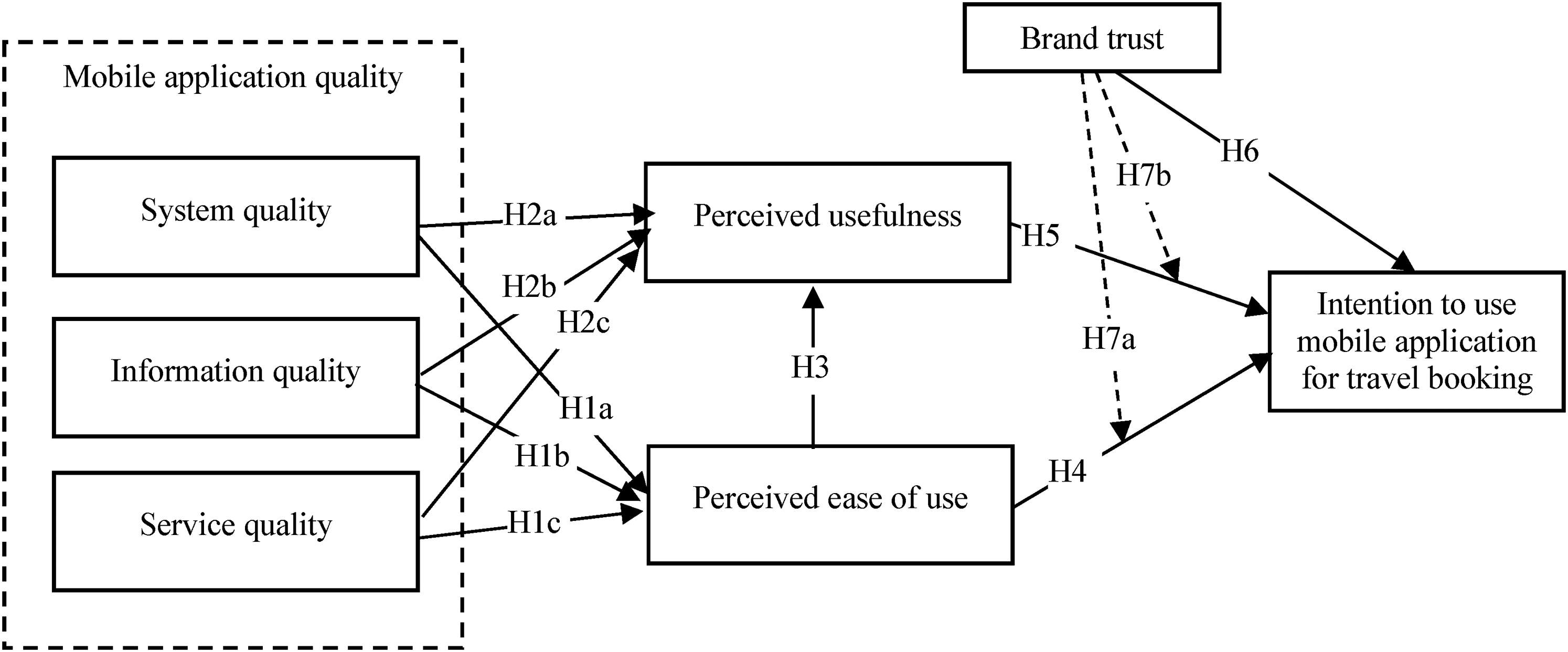
Research model.
Data Collection
The survey data were collected from the academics, since they use various technological tools in their professional life (Daniele and Mistilis, 1999; Murire and Cilliers, 2017) and frequently travel for attending scientific activities. Moreover, previous studies show that professionals –such as the academics- exhibit similar behaviours to general ICT users (King and He, 2006). An online questionnaire was designed to collect data because it is easy to complete the questionnaire by the participants and is cost-friendly for the researchers (Poulis and Wisker, 2016). The academics in Turkey have been contacted through an invitation letter, which was sent to their official e-mail addresses.
The invitation letter gave information about the purpose of the study and provided a link for survey participation. The participants who made at least one travel purchase on mobile apps in the last 12 months were allowed to continue the questionnaire. The data collection was performed between December 2019 and March 2020. At this period, 13,422 e-mails were sent to the academics, and 340 responses were obtained. Thus, the response rate is 2.5%, which is low but acceptable for online surveys as suggested in previous studies (e.g. Ozkara et al., 2017).
Data Analysis
A structural equation modelling (SEM) approach has been used for the analysis. While Partial Least Squares (PLS) is a composite-based structural equation modelling that focuses on maximising the explained variance of the endogenous construct, the Covariance-based SEM (CB-SEM) focuses on minimising the discrepancy between the theoretical covariance matrix and the empirical covariance matrix (Rigdon et al., 2017). Both approaches differ in their objectives and algorithms used.
Since the aim of the study is causal-predictive, PLS has been preferred for the analysis (Henseler, 2018). From the forecasting literature, strong evidence suggests that PLS modelling has strengths for prediction, and therefore is well suited for prediction, unlike the CB-SEM that is unsuited to prediction-oriented research due to factor indeterminacy problems (Rigdon, 2012). Moreover, the prediction capability of PLS is reinforced since the procedure employed for prediction is clear and transparent (Henseler, 2018). Furthermore, although the research model proposed is based partly on TAM theory, PLS is a suitable technique for confirmatory purposes when a research model contains one or more constructs operationalised as composites (Henseler, 2018) like in the current research model. Additionally, the sample size of 340 respondents is adequate for the study since with small samples, PLS performs poorly in terms of out-of-sample predictions (Hair et al., 2017; Rigdon et al., 2017).
The complexity of the research model in terms of mediating and moderator effects is another reason to justify the use of PLS. PLS-SEM is superior to regression analysis when assessing mediation. In fact, when testing model with latent variables as in CB-SEM, the regression analysis and Preacher and Hayes’ (2008) PROCESS method allow only for the sequential testing of model parts without taking into consideration the entire theoretical model in the estimation process as occurred in PLS-SEM (Hair et al., 2019). In addition, PLS poses a higher ability to detect and accurately estimate the strength of interaction effects than other analyses, as noticed by Chin et al. (2003). The two-stage approach has been employed for the moderating analyses since it outperforms the product-indicator and the orthogonalizing approach, and excels in terms of statistical power (Hair et al., 2019).
A three-stage approach was used for data analysis: (1) measurement model assessment (outer model), (2) structural model assessment (inner model), and (3) predictive performance test of the model, using holdout samples (Shmueli et al., 2016). In order to conduct the analysis, the software SmartPLS 3.2.7 was employed.
Results
Sample Characteristics
Females account for 55.9% of the total sample. The majority of the participants are aged between 31 and 40 (46.9%), and 25.5% are between 41 and 50. In terms of mobile usage, 48.1% of the participants use the Internet for 2–3 h daily. Nearly 52% of the participants used the mobile apps five and more times for travel planning purposes in the last 12 months. Almost one-third of the participants (33.5%) purchased travel-related services five and more times by using a mobile application in the last 12 months, while 44.2% between two and four times (see Appendix).
Measurement Model
The confirmatory composite analysis is conducted to test the external validity of the composites (Henseler, 2017). The standardised root mean square residual (SRMR) is also used as a model fit criterion (Hu and Bentler, 1998). The SRMR value for the saturated model is 0.064. This result supports the composite model since it is below than the recommended value of 0.08 by Hu and Bentler (1998).
All composites in the research model have been defined as composites Mode A since their indicators are correlated (Henseler, 2017). Thus, composites Mode A has been estimated using correlation weights, and therefore, the individual item reliability, composite reliability, convergent validity, and the discriminant validity of composites Mode A have been assessed. Indicators’ loadings are above 0.67 and composites reliability (CR) are greater than 0.70. The composites’ average variance extracted (AVE) is over 0.50. Therefore, all composites met the convergent validity criteria (Table 1).
Measurement model assessment.
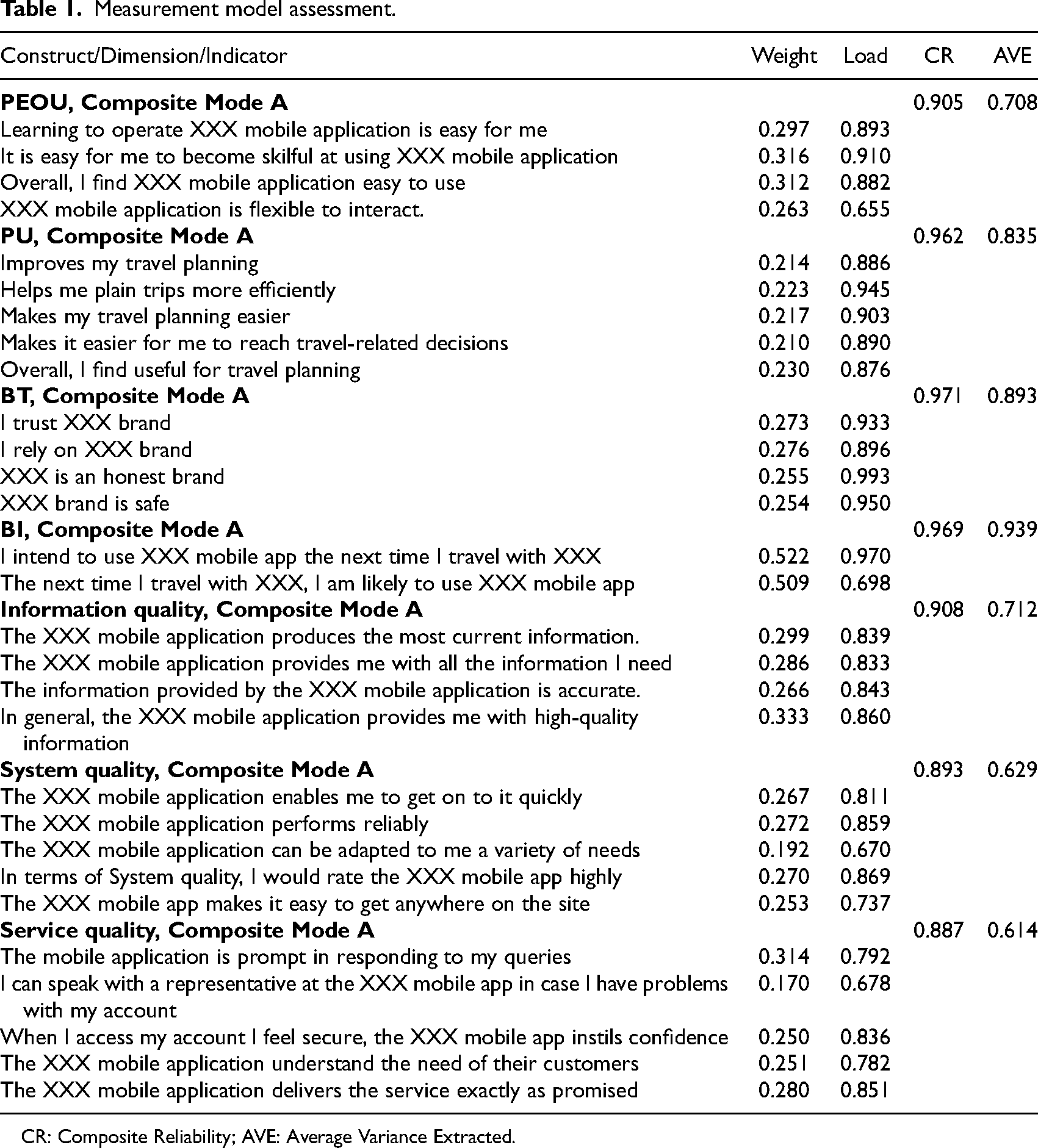
CR: Composite Reliability; AVE: Average Variance Extracted.
Moreover, both Fornell and Larcker (1981) and the Heterotrait-Monotrait Ratio (HTMT) (Henseler et al., 2015) criteria have been examined to assess the constructs’ discriminant validity. The square root of the AVE for each construct is higher than inter-construct correlations (Fornell and Larcker, 1981), while HTMTs are below the cut-off value of 0.90 (Table 2). Hence, it has been accepted that there is discriminant validity, and each construct is distinct from others.
Constructs’ discriminant validity.
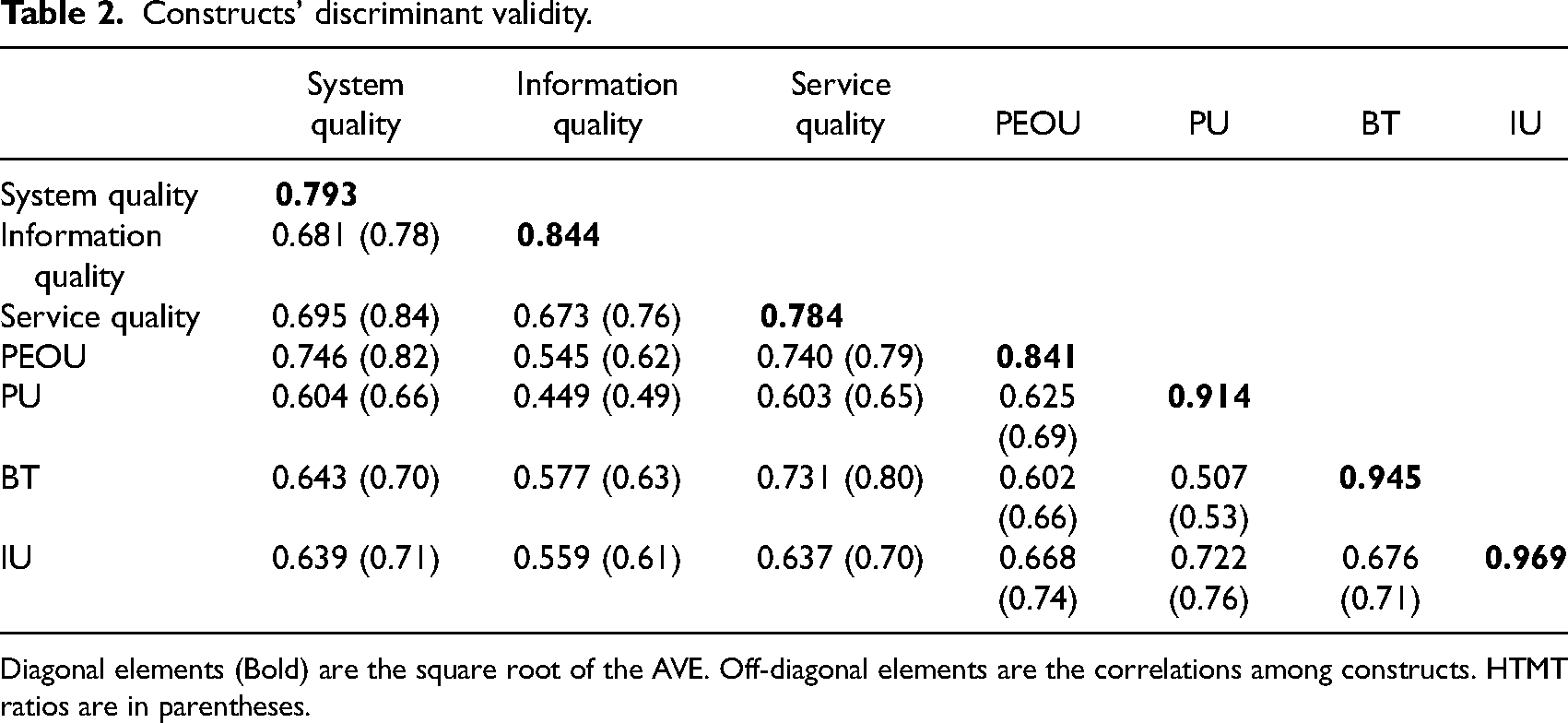
Diagonal elements (Bold) are the square root of the AVE. Off-diagonal elements are the correlations among constructs. HTMT ratios are in parentheses.
Structural Model
Estimation of the structural model was performed (inner model) by following Hair et al. (2019) recommendations. First, the assessment starts with the evaluation of the SRMR of the estimated model. It continues with the assessing the size and statistical significance of path coefficients (main and moderating effect), explanatory power (R2) of the model, the f2 values, and the Q2 test for predictive endogenous constructs’ relevance. Second, a post hoc assessment of indirect was performed. Next, the model's predictive performance is analysed to evaluate its capability to generate accurate predictions from new observations (out of the hold-in sample).
Assessment Of the structural model, main effects and moderating effects
The SRMR of the estimated model achieves a value of 0.071, which is below than the recommended cut-off value of 0.08 (Hu and Bentler, 1999) when deciding a good model fit.
Table 3 shows the path coefficients and the hypotheses testing with the use of 10,000 bootstraps resamples. The main (direct) effects described in Table 3 are significant except the main effect of information quality on PEOU and PU. Both system quality and service quality have a positive effect on PEOU (βSYSQ = 0.442, p < 0.001; βSERVQ = 0.409, p < 0.001), whereas information quality does not have any (βIQ = -0.031, p > 0.05). Thus, hypotheses H1a and H1c are supported; but H1b is not supported. Moreover, system quality and service quality positively affects PU (βSYSQ = 0.298, p < 0.05; βSERVQ = 0.205, p < 0.001), whereas information quality does not have a significant effect (βIQ = -0.031, p > 0.05). Therefore, hypotheses H2a and H2c are supported; and H2b is not supported. Furthermore, PEOU positively influences PU (βPEOU = 0.326, p < 0.001), which supports H3. PEOU, PU, and BT do have a positive and significant impact on IU mobile apps for travel booking (βPEOU = 0.296, p < 0.005; βPU = -0.426, p < 0.001; βBT = -0.258, p < 0.001). Thus, hypotheses H4, H5 and H6 are supported.
Structural model estimates: effects on the endogenous variables.
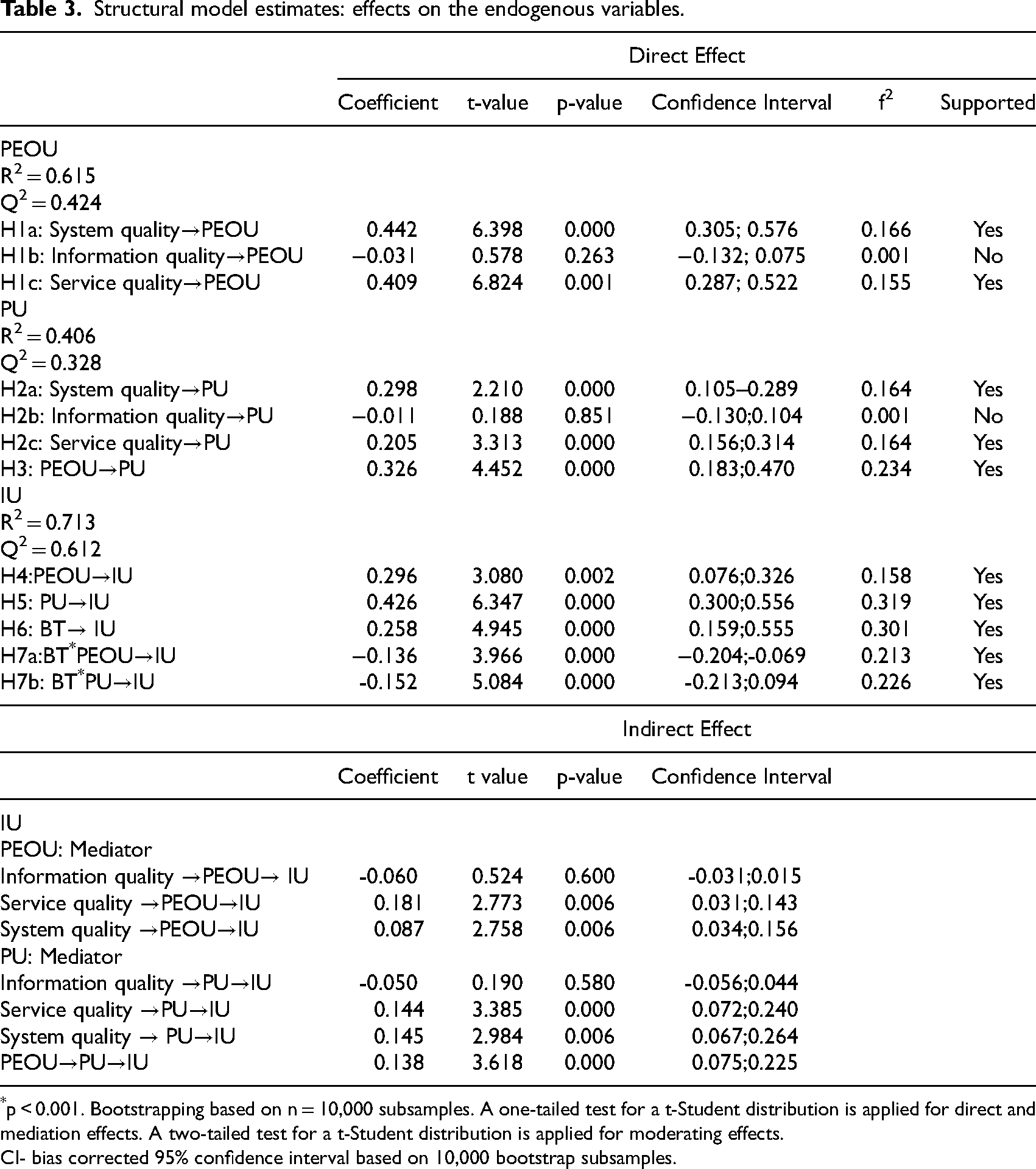
p < 0.001. Bootstrapping based on n = 10,000 subsamples. A one-tailed test for a t-Student distribution is applied for direct and mediation effects. A two-tailed test for a t-Student distribution is applied for moderating effects.
CI- bias corrected 95% confidence interval based on 10,000 bootstrap subsamples.
Moreover, the moderating effect of BT in the relationship between PEOU→IU and PU→IU are significant (βPEOU*BT = -0.136, p < 0.001; (βPU*BT = -0.152, p < 0.001). Therefore, hypotheses H7a and H7b are supported. Figure 2 displays the moderating effects of BT in these relationships, respectively.
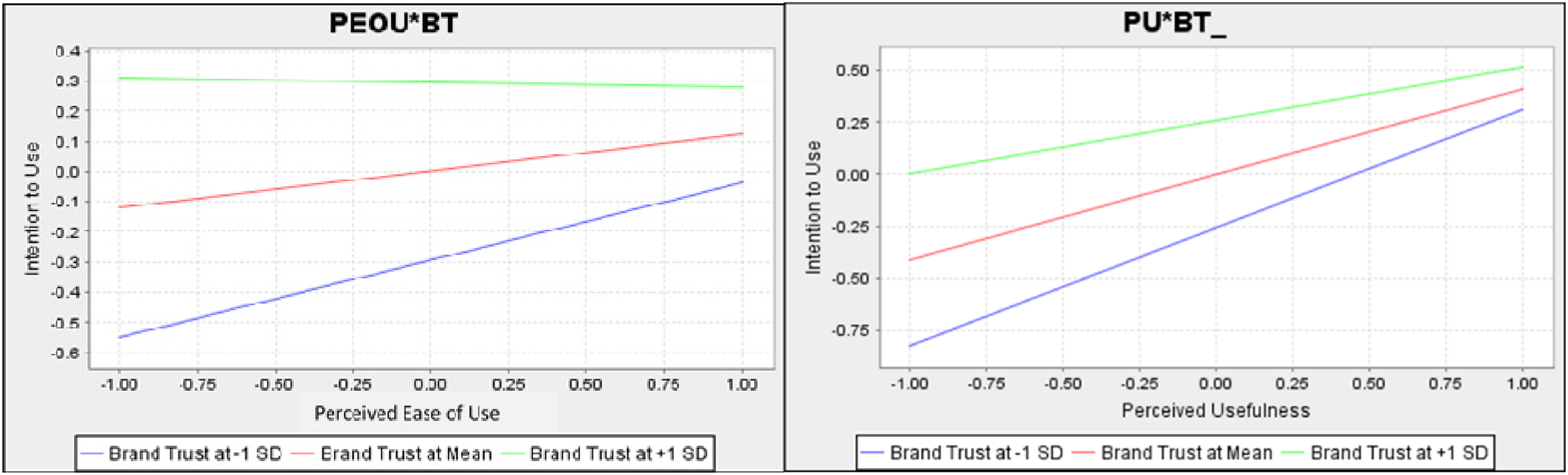
Moderator role of BT between PEOU and IU; and between PU and IU.
R2 values are 0.615 for PEOU, 0.406 for PU, 0.713 for IU. The f2 values for the main effects of service quality and system quality on PEOU and PU, and the main effects of PEOU on PU, the effects of PEOU, PU, and BT on IU are above 0.15, indicating the medium effects of the exogenous variable on the corresponding dependent variable (Cohen, 1988). However, the f2 values for the exogenous variable information quality are below the threshold of 0.02. Hence, information quality does have an insignificant influence on PEOU and PU.
The stone-Geisser's Q2 values have also been obtained, being 0.424 for PEOU, 0.406 for PU and 0.312 for IU. All Q2 values larger than zero indicate predictive relevance for endogenous constructs (Geisser, 1974).
Post Hoc assessment of indirect effects
The research model contains three mediating effects in the relationship PEOU and PU. The mediating effects of the PEOU and PU have been tested using the bootstrapping procedure (Hayes et al., 2011) and are reported in Table 3. All indirect effects on IU are significant, except the indirect effects of the mediating chains IQ→PEOU→IU (β = -0.06, p > 0.05) and IQ→PU→IU (β = -0.05, p > 0.05). Service quality has a significant and positive influence on IU through PEOU (β = 0.181, p < 0.05) and through PU (β = 0.144, p < 0.05). Likewise, system quality has also a significant and positive influence on IU both through PEOU (β = 0.087, p < 0.05) and PU (β = 0.145, p < 0.05). Moreover, PEOU has a significant influence on IU through PU (β = 0.138, p < 0.05).
Predictive Model assessment
The model's predictive capability has been assessed using cross validation with holdout samples (Shmueli et al., 2016). This was performed by employing the PLS predict algorithm in the SmartPLS software to generate k-fold cross-validated prediction errors and prediction error summary statistics. Following Shmueli's recommendation, 10-fold cross-validation was executed in the PLS predict routine. The Q2 values for constructs and their indicators, and the values for the root mean squared error (RMSE) and the mean absolute error (MAE) are presented in Table 4. Based on the results, Q2 values at the level of constructs, which compares the prediction errors of the PLS path model concerning the simple mean prediction, are all positive. Results reveal a lower prediction error (in terms of RMSE and MAE) and therefore greater Q2 in PLS than the prediction errors and Q2 in the linear regression model. Thus, the model reflects a satisfactory predictive performance both at the levels of endogenous constructs and at their indicators.
PLS predict assessment.
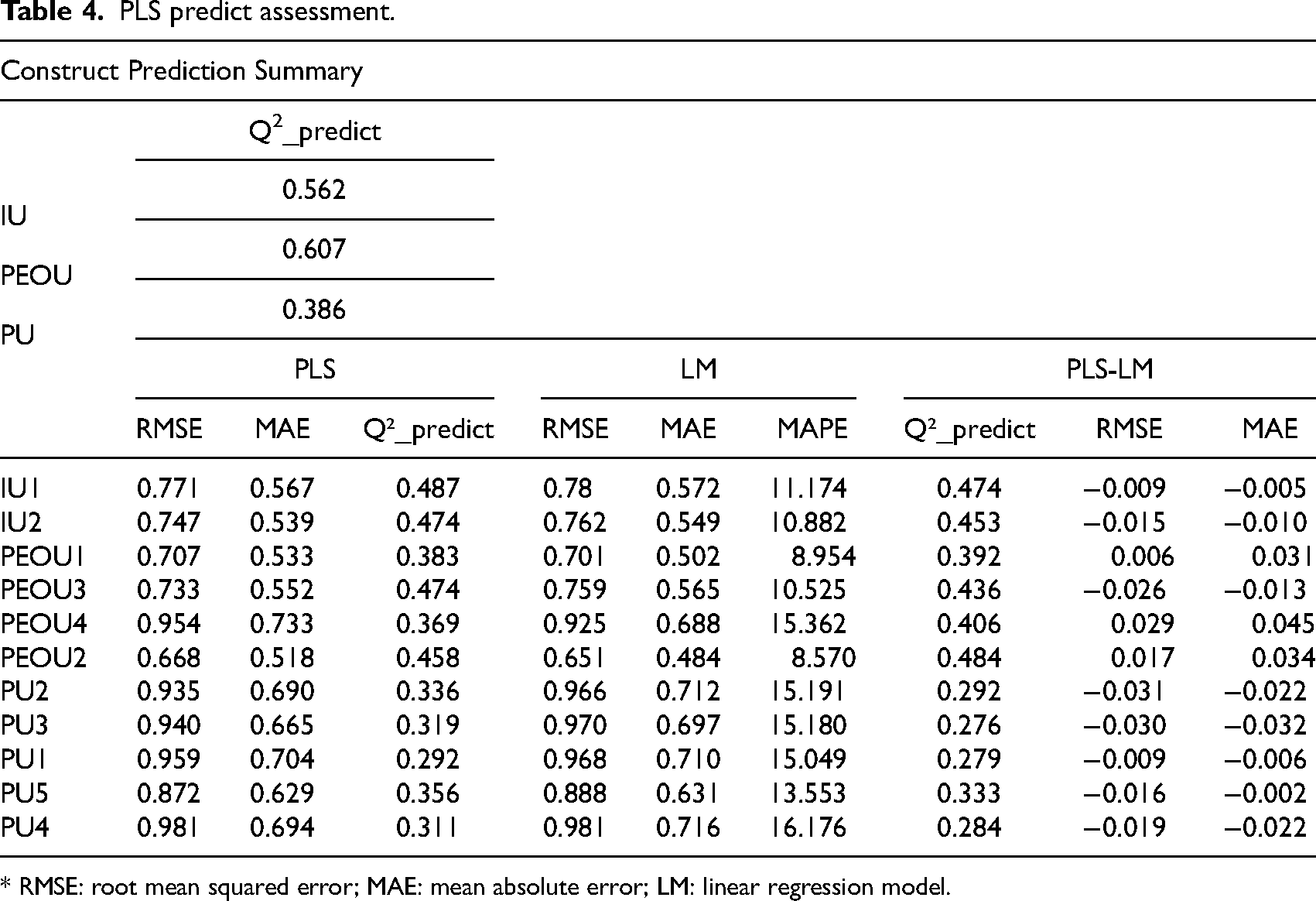
* RMSE: root mean squared error; MAE: mean absolute error; LM: linear regression model.
Discussion and Conclusion
This study is motivated considering the limited insight into the role of MAQ and offline BT in the IU mobile apps for travel booking. A research model was developed to examine the relationships among MAQ, PEOU, PU, offline BT, and IU mobile apps. The findings have several valuable theoretical and managerial implications, which are presented in the following sub-sections.
Theoretical Implications
The current study contributes to the scientific knowledge on mobile apps by integrating the S-O-R framework (Mehrabian and Russell, 1974) and the TAM (Davis, 1986). Although these models were previously used to investigate the behaviour of the mobile application users in different research settings (e.g. m-library, m-finance), few numbers of research were conducted on mobile apps used for travel booking.
The findings reveal a positive impact from system quality and service quality to PU of the mobile apps, which is in line with previous studies (Hu and Zhang, 2016). However, information quality has not such an influence on PU, similar to Hajiheydari and Ashkani; (2018) findings. A possible explanation for this is that the users tend to acquire travel-related information from various sources, such as websites or social media, but prefer to purchase from mobile apps. Further inspection of the standardised beta weights indicates that the influence of MAQ on PEOU is higher than PU. In other words, MAQ is closely associated with PEOU, and it is furthermore affecting PU of the users.
The results reveal that both PEOU and PU are the significant determinants of intention to use mobile apps for travel booking, while the latter variable has a stronger influence than the former. These findings are similar to other researchers’ results, who obtained the positive influence of PU on IU new technologies, such as virtual reality (Sagnier et al., 2020) and mobile shopping (Hew et al., 2018). In contrary to Hew et al.'s (2018) findings, who found out that PEOU does not influence mobile tourism shopping intention, the current research reflected a positive impact from PEOU to IU mobile apps in the case of travel booking behaviour. However, this finding supports Okumus and Bilgihan (2014), who theoretically defend the positive influence of PEOU on IU. Hence, another contribution of this study is to show the influence of PEOU on IU in the context of travel mobile apps. In addition, the results confirm that PU is affected by PEOU, as previously suggested by Davis (1986). Specifically, if the users perceive a mobile application as easy-to-use, they find the system useful since they can accomplish more tasks at a certain time (Chi, 2018).
Although the importance of brand trust is emphasized in the literature about online user behaviours, the research on its role in mobile application usage behaviour is still in its infancy. Therefore, another theoretical contribution of the current research is showing the direct influence of offline BT on IU mobile apps for travel booking. This outcome reveals that a strong BT may facilitate the users’ adaptation to mobile apps, which are considered as brand extensions. The findings additionally indicate that BT moderates the influences of both PEOU and PU on IU mobile apps for travel booking. Hence, this study also enriches BT related literature by exploring its moderating role in the user decision process. The mediation analyses offer detailed insight into the relationships among the MAQ, PEOU, PU, and IU variables in the example of mobile application usage for travel booking. Accordingly, MAQ, as an environmental stimulus in the S-O-R framework, affects people's internal states and then leads to IU mobile apps for travel booking. In other words, in parallel to previous studies (e.g. Hew et al., 2018), the findings of the present study support the argument that PEOU and PU are the mediators in the relationship between MAQ and IU.
Managerial Implications
The findings of this research may assist the managers trying to motivate potential tourists in using mobile apps for travel bookings. For example, the results highlight the system and service quality's vital roles in enhancing the PEOU and PU of mobile apps. Thus, to improve the advantages of using mobile apps in travel organisation, MAQ should be increased by including new or useful features, such as change/cancellation/refund functions. These functions must be so easy, trustable, and effective so that users may prefer to use mobile apps than online tour operators or brick-and-mortar travel agencies for their travel bookings. In addition, chatbot or live chat functions can be included in the mobile apps so that the users, who expect immediate feedback or direct connection with the supplier, will be satisfied with their usage experiences. Furthermore, positive and negative feedback obtained from the users may guide the service suppliers in their strategic decisions to improve user satisfaction.
This study's results show that BT directly affects IU mobile apps and moderates the effects of PEOU and PU on IU. This implies that the managers may benefit from the customers’ offline BT and target to transform these customers into active mobile application users. Particularly online travel agency managers must be aware of the importance of their offline practices (e.g. service quality) for influencing the customers’ BT, which further affects intention to use mobile tourism applications. Therefore, all company practices must be integrated. A high BT may also enable the travel and tourism companies to differentiate themselves from their competitors in the mobile commerce platform.
It should be noted that the data collection process of the research was completed at the beginning period of the global Covid-19 pandemic (December 2019 and March 2020). All societies and countries were experiencing the first stages of the crisis at that time. The respondents of this study were the actual or potential tourists who were using mobile apps to purchase travel products. However, their touristic mobility and travel plans were under risk since domestic or international travel restrictions had already begun. Hence, either the importance that the users give to mobile apps could have been significantly increased under these circumstances since there was an urgent need for accurate and updated information about tourism and travel services, or the users might have developed a negative approach towards tourism and travel-related mobile apps due to their general disappointments. Therefore, the study's findings should be carefully interpreted since this global pandemic crisis might have affected the decision-making systematics or future behavioural intentions of the travel-related mobile app users.
Limitations and Future Research Avenues
This study has some unavoidable limitations, although it offers several valuable insights into the role of MAQ and BT in the IU mobile apps for travel booking. The first limitation is related to the research sample, which contains only the academics who work in Turkey. Second, the Turkish to English back-translation of the scale items could not be performed due to budget constraints. Third, the academics who made at least one travel purchase on mobile apps in the last 12 months were selected and requested to recall their most recent travel booking experience with a mobile app when responding to the survey. This might have led to recall bias, since short and long-term memory differences were ignored. For these reasons, findings have to be carefully generalised. The proposed research model has to be also tested on different samples and other types of mobile apps rather than travel and tourism. This research made a preliminary attempt to understand the role of MAQ and offline BT in the use of mobile apps. In future studies, some other variables (e.g. flow experience and satisfaction) can be integrated into the research model developed in this study so that multi-variable relationships can be explored more in detail.
Supplemental Material
sj-docx-1-jvm-10.1177_13567667211066544 - Supplemental material for The Use of Mobile Applications for Travel Booking: Impacts of Application Quality and Brand Trust
Supplemental material, sj-docx-1-jvm-10.1177_13567667211066544 for The Use of Mobile Applications for Travel Booking: Impacts of Application Quality and Brand Trust by Tahir Albayrak, M. Rosario González-Rodríguez, Meltem Caber, Sezer Karasakalin Journal of Vacation Marketing
Footnotes
Declaration of conflicting interests
The author(s) declared no potential conflicts of interest with respect to the research, authorship, and/or publication of this article.
Funding
This research did not receive any specific grant from funding agencies in the public, commercial, or not-for-profit sectors.

Supplemental material
Supplemental material for this article is available online.
References
Supplementary Material
Please find the following supplemental material available below.
For Open Access articles published under a Creative Commons License, all supplemental material carries the same license as the article it is associated with.
For non-Open Access articles published, all supplemental material carries a non-exclusive license, and permission requests for re-use of supplemental material or any part of supplemental material shall be sent directly to the copyright owner as specified in the copyright notice associated with the article.
