







Abstract
Tourist decision-making is complex and understanding why some tourists may reject a cruise vacation is important for continued growth of the cruise sector. Image elicitation was employed in twenty interviews with cruisers and non-cruisers in the UK. Findings revealed risk perceptions influence cruise decision-making as vacation choices reflect self. Cruisers choose cruise vacations to reduce risk to self and affirm self-concept, and non-cruisers perceive social and psychological risk in cruising. Non-cruisers find social value in disassociation from and rejecting cruise vacations, illuminating how self-congruity influences cruise decision-making. Theoretical contributions and practical implications for industry are identified with specific recommendations.
Introduction
Prior to COVID-19, cruise tourism was one of the most dynamic and robust sectors of tourism (Delgado, 2017; Papathanassis, 2019), experiencing growth for nearly two decades (Peručić, 2020). The cruise sector was worth an estimated value of $150billion in 2019 and had been expected to reach a record level of 32 million passengers in 2020 (Cruise Lines International Association [CLIA], 2019). As the third largest passenger source market globally (CLIA, 2019), the UK was experiencing significant growth prior to COVID-19 (CLIA UK and Ireland, 2019). The pandemic has devastated the cruise sector with recent studies arguing the pandemic has changed the perception of a cruise as a safe vacation (Holland et al., 2021; Tapsall et al., 2022). This is particularly significant as many cruise tourists are considered to be risk averse (Tarlow, 2006).
For many tourists, considering a cruise for a vacation is a complex, highly involved and emotive decision-making process (Bahja et al., 2019; Petrick et al., 2007; Xie et al., 2012). A potential cruise passenger needs to consider several aspects including cruise brand, itinerary, transportation to and from the ship, type of cabin, cabin location, size of ship, mix of fellow passengers and reputation of the cruise line in addition to service elements such as prevailing norms about giving gratuities and dress-codes. As a result of the COVID-19 pandemic, potential cruisers also need to consider health protocols, potential outbreaks, onboard sanitation procedures, social distancing measures, possible quarantine and health screenings. All of this adds to the complexity and uncertainty associated with the decision to cruise.
Risk is a fundamental concept within consumer behavior due to it's influence on decision-making (Blum et al., 2014; Mitchell, 1999; Roselius, 1971; Sharifpour et al., 2014). There is a higher level of risk associated with travel products due to their intangibility, high cost and complex decision-making (Lin et al., 2009). Indeed, scholars acknowledge that risk is an unavoidable part of travel (Williams and Baláž, 2013; Yang et al., 2017). The perception of risk influences travel decision-making as if a tourist perceives too much risk, then they will either cancel the trip or take steps to mitigate the risk and uncertainty including choosing a different destination (Karl, 2018; Karl and Schmude, 2017; Mansfeld, 2006). Perceived risk affects travel intentions, information search and pre-purchase behavior (Fuchs and Reichel, 2011; Kim et al., 2016; Reisinger and Mavondo, 2005; Yang and Nair, 2014). How risk is perceived differs between individuals and depends on factors including personality attributes, demographics and past tourist experience (Bowen et al., 2014; Fuchs and Reichel, 2004; Lepp and Gibson, 2003).
Tourist decision-making is a complex process (see Karl and Schmude, 2017; Karl et al., 2015), but more research is needed on why destinations may be rejected (Gray and Wilson, 2009). Understanding why a tourist may reject a vacation choice is important to understand tourist decision-making more fully and can benefit practitioners with strategies for marketing and product development. As Perdue and Meng (2006) note, destinations are selected when they list higher in attributes the tourist wants, with an assumption other destinations are rejected as they are considered low on the same attributes, however this potentially ignores tourists’ attitudes and feelings about product attributes (Seddighi and Theocharous, 2002). A destination can be rejected due to unpleasant personal experiences or negative external feedback (Qiu et al., 2018). Reasons for rejection may be conceptually different from selection and not necessarily relate to the attributes (Crompton, 1992; Perdue and Meng, 2006; Sokolova and Krishna, 2016; Turley and LeBlanc, 1995), and instead may be in relation to other reasons, such as constraints (see Crawford et al., 1991; Karl et al., 2020), self-congruity (Liu and Chen, 2015) or perceived incongruity with destination image (Pratt and Sparks, 2014). Lawson and Thyne’s (2001) work on inept sets identified different aspects of risk influence inclusion into an inept set and how marketing can move destinations from the inept set into the evoked set. Risk influences travel decisions (Lepp et al., 2011), and the framework of self-congruity may explain why some tourists reject a cruise vacation.
Therefore, the aim of this study is to examine how self-congruity influences cruise decision-making for ocean cruising. This study provides a significant contribution to understanding choice rejection and adds to the tourist decision-making literature, particularly in adding knowledge to the concept of perceived value in disassociation. The study also contributes to developing a deeper understanding of self-congruity and the intersection with social and psychological risk, and how this impacts decision to cruise or not which provides both theoretical and practical implications.
Situating the research
The COVID-19 pandemic has brought attention to risks inherent in leisure travel and highlights the importance of risk perceptions on vacation decision-making. Risk has been an area of research for decades across a variety of disciplines, with many attempts to define, conceptualize and understand it (Aven, 2012; Sjöberg, 2000; Slovic, 2000). This paper adopts a constructivist perspective where risk is considered to be a multi-dimensional social construction situated in a particular historical and cultural context (Douglas and Wildavsky, 1982; Slovic, 2000).
Risk perceptions refer to how people judge, characterize, and evaluate uncertainty (Slovic et al., 1982), and perceived risk is the overall amount of uncertainty perceived by a consumer about a specific purchase (Kim et al., 2008). There have been limited attempts to define risk within a travel context, with calls to develop a model incorporating cognitive, affective, and motivational factors as predictors of individual risk perceptions and behavior (Chien et al., 2017). Perceived risk in tourism may be defined as “what is perceived and experienced by tourists during the process of purchasing and consuming traveling services and at the destination” (Reisinger and Mavondo, 2005: 213). Korstanje (2011) considers tourist risk to be any factor that can potentially affect the perception, experience, or integrity of tourists during or after their vacation. However, much of the tourism literature continues to conceptualize risk as a “crisis”, or a negative physical occurrence such as a terrorist attack or natural disaster (see Schroeder et al., 2016; Yang and Nair, 2014; Yang et al., 2017), thus overlooking the nuanced complexity and constructed nature of risk and often ignores other types of risk that may occur in leisure travel.
Tourist risk
Much of the conceptualization of tourist risk draws on the work of Jacoby and Kaplan (1972) and Roselius (1971), which has been fundamental for considering how risk perceptions influence consumer decision-making by identifying six perceived risks: financial, performance, physical, psychological, social and time-loss. Some researchers (Lee et al., 2001; Li and Zhang, 2002) have identified opportunity-loss as a seventh risk by suggesting time-loss is inadequate to fully explain the potential loss for a consumer.
Several typologies of tourist risks and hazards (see Gong and Liang, 2019; Lepp and Gibson, 2003; Simpson and Siguaw, 2008; Yang and Nair, 2014) are variations based on Jacoby and Kaplan’s (1972) typology and applied in a tourism context. For example, Roehl and Fesenmaier (1992) extended this categorization for vacations and added in an eight risk; equipment risk, which work was significant in understanding risk perceptions and leisure travel (Lepp and Gibson, 2003). Sönmez and Graefe (1998) extended Roehl and Fesenmaier's categorization further by identifying travel specific related risks including health, terrorism and political instability. Dolnicar (2005) further developed understanding of tourist perceived risk when she found evidence for five classifications of tourist risk: political, environmental, health, planning and property. Simpson and Siguaw (2008) draw on Jacoby and Kaplan’s (1972) work by identifying a travel-specific risk typology. This newer application sought to be more specific as categorizations of risk in travel and tourism are often argued to be too broad (Dolnicar, 2005; Simpson and Siguaw, 2008). This demonstrates the evolving literature of the many risks a tourist may navigate before and during a vacation, but also reveals the limitations of applying these typologies to cruise vacations. This is because a cruise includes not only the destinations visited and the transportation element, but also the “shipscape” (Kwortnik, 2008) consisting of the social, natural, and physical environment. This is in addition to the unique bounded and enclavic environment and inherent social practices unique to a cruise vacation including formal dining and socializing connected with maritime tradition and histories (Lester, 2017; Yarnal and Kerstetter, 2005). Thus, there are many potential social and psychological risks that may influence cruise decisions.
Social and psychological risk
Applying the consumer risk conceptualization put forward by Jacoby and Kaplan (1972), social risk refers to how a person may worry about what others will think of them for using a product, whereas psychological risk refers to how people will feel about themselves for using a product. Tran (2020) extends social risk to refer to the internal psychological frustration in making a purchase that does not correlate to self-concept.
There is little research on how social or psychological risk influences tourist decision-making beyond disapproval by family members, relating to anxieties about a destination being unsafe (Floyd et al., 2003) or by traveling alone (Karagöz et al., 2020). Previous studies on risk in tourism have suggested that social risk was either unrelated to leisure travel (Roehl and Fesenmaier, 1992) or of little significance to vacation decision-making (Sönmez and Graefe, 1998). Gong and Liang’s (2019) study on Chinese domestic cruisers found social and psychological risks including concerns relating to the potential that family and friends may view cruising negatively. However, the research did not focus on self-concept and potential incongruency with the self, illuminating the lack of empirical research on social and psychological risk in tourism. This is significant as vacation decisions are influenced by self-concept (Ahn et al., 2013; Beerli et al., 2007; Klipfel et al., 2014).
Self-congruity in tourist decision-making
Purchasing or consuming products allows consumers to define, maintain and enhance their self-concept (Hosany and Martin, 2012). Self-concept is a multi-dimensional construct (Boksberger et al., 2011; Sirgy and Su, 2000) containing the different images one holds about oneself. Self-concept consists of four distinct dimensions (Sirgy, 1982): (1) “actual self”, how a person sees themselves; (2) “ideal self”, how a person would like others to see them; (3) “social self”, how a person believes other people actually see them; and (4) “ideal social self”, how a person wants to be seen by others. This four-dimensional framework is widely accepted within consumer behavior (Hosany and Martin, 2012; Klipfel et al., 2014; Malär, Krohmer) and tourism (Boksberger et al., 2011; Sirgy and Su, 2000; Sirgy et al., 2018; Sop, 2020). Indeed, self-concept is not only the products and services consumed but the perceptions others have of that person for using the products (Todd, 2001).
The extent self-concept matches with the product image is self-congruity (Sirgy, 1982) and risk occurs when there is potential mismatch. Consumers prefer products that they believe more closely align with how they view themselves (Klipfel et al., 2014; Malär et al., 2011). Self-congruity in tourism refers to the process of matching tourists’ self-concept and the perceived image of a given product such as a destination (Sirgy and Su, 2000) and the more of a match between the destination image and the tourist's self-concept, the more likely a tourist is to choose to visit that destination (Beerli et al., 2007; Joo et al., 2020; Sirgy et al., 2018). Current understanding is limited to applications of self-congruity theory including intentions to visit destinations (Frias et al., 2020; Hung and Petrick, 2012; Pratt and Sparks, 2014), satisfaction (Chon, 1992), intention to recommend (Kastenholz, 2004) and choice (Beerli et al., 2007).
Self-congruity is useful for exploring intentions to cruise, in that when potential cruisers feel there is a match between their self-concept and the perceived image of a cruise, they are more likely to take the cruise (Hung and Petrick, 2011). Alternately, Park (2006) found non-cruisers view cruises as superficial and constraining, revealing potential social and psychological risk in not wanting to be seen by others as choosing this type of vacation. This highlights the emergence of perceived risk when there is a mismatch or incongruency between self-concept and product image, with more research needed to better understand how self-congruity influences cruise travel decisions.
Risk perceptions in cruising
Scholars have called for more research to better understand how tourists perceive risk in relation to cruise holidays (Bowen et al., 2014, Gong and Liang, 2019; Le and Arcodia, 2018; Liu-Lastres et al., 2018). Recent empirical studies have emerged (see Holland, 2020) particularly in response to the Covid-19 pandemic (see Choquet and Sam-Lefebvre, 2021; Holland et al., 2021, 2022; Quintal et al., 2021; Radic et al., 2021). As such, the existing understanding of risk in cruise vacations has been conceptualized overwhelmingly in relation to health, safety and physical well-being (see Holland et al., 2022), with little empirical research exploring other aspects of risk in relation to the cruise experience. For example, Weaver (2005) briefly addresses risk as health and safety considerations for cruise consumers, while Le and Arcodia (2018) proposed a conceptual model for perceptions of cruise-related risks, identifying five cruise-related risks: infection outbreaks, sexually transmissible infections, motion sickness, cruise accidents, and terrorism, piracy, crime. Holland (2020) found both cruisers and non-cruisers perceive a cruise as a safe vacation, but health risks are a significant concern. In a critical review of the cruise risk literature, Holland et al. (2022) identified most studies focus on risk as health and safety, identifying a gap in understanding how other risks may influence cruise decision-making.
A review of the literature has identified the following key research questions, which this study addresses:
How do tourists perceive social and psychological risk in ocean cruising? What insights do tourists’ self-congruity reveal about choice rejection for a cruise vacation?
By addressing these research questions, this study provides advances understanding of self-congruity in cruise decision-making and perceived social value in choice rejection.
Methodology
A qualitative research design was selected to explore how social and psychological risk may be interpreted for a cruise. Drawing on Douglas and Wildavsky (1982), all risk is considered to be socially constructed, and using a qualitative methodology fosters a pluralist interpretation of risk. This study was situated within an interpretivist ontology with epistemological assumptions from constructivism.
Data was collected from twenty interviews conducted in the UK between April 2017 and November 2017, prior to the Covid-19 pandemic. Twelve interviews were conducted face-to-face, six were conducted through online video conferencing, and two by telephone. Employing purposive sampling, twelve of the participants were cruisers (having completed at least 1 cruise) and eight were non-cruisers (never taken an ocean cruise and specifically expressed no interest in doing so) and ranged from 22 to 83 years old. Table 1 details the participant profiles, noting some cruiser participants had extensive “cruising careers” (multiple cruises over a sustained period of their lives).
Profile of interview participants.
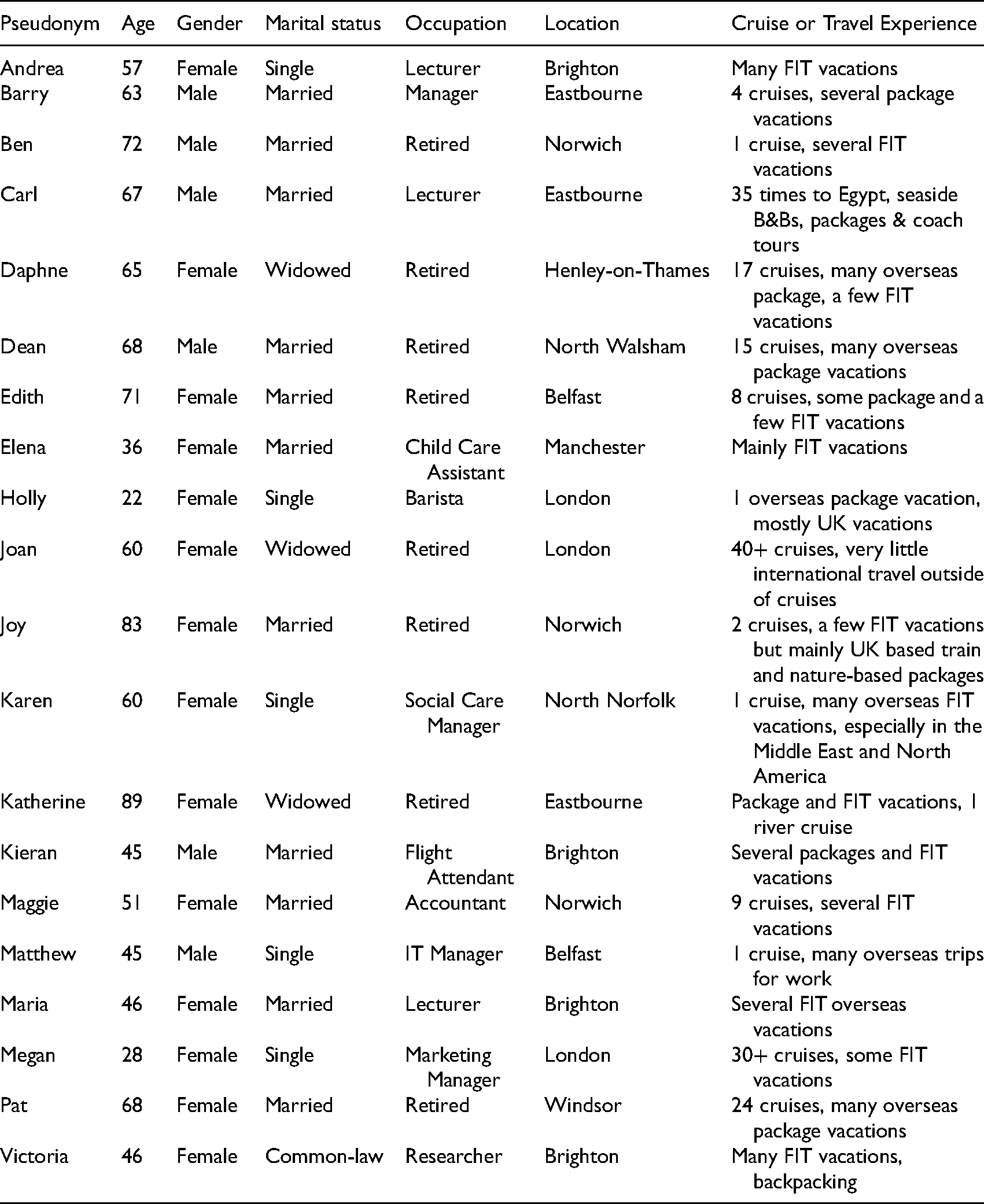
Participants were invited through invitations sent to the University staff directory, advertisements in the researcher's local community and through use of referral by participants. All participants resided in the UK, and there was eighteen cruise brands identified that the participants had sailed with. The criteria for participation was to be currently residing in the UK, having traveled at least once outside the UK for leisure in the past ten years, and either: (1) not having been on an ocean cruise and having no interest to do so at this time, or (2) having been on at least one ocean cruise.
Interviews lasted between forty minutes and two and a half hours. The interviews, data coding and analysis was conducted solely by the author. The interviews were semi-structured and image elicitation was employed during the interviews as a projective technique to evoke memories, stories, and feelings (Clark-Ibáñez, 2004; Harper, 2002; Westwood, 2007). Using image elicitation was a useful way to engage the participant with the topic and brought to the surface perceptions and nuances about risk in cruising. Projective techniques employing photography and photo elicitation assist in revealing thoughts rarely expressed in verbal social exchange and encourages dialogue and rapport. The technique allows access to deep-seated psychological factors, many subconscious or repressed, that are important determinants of complex tourist behavior (Cohen et al., 2014). Particularly for the non-cruisers, use of image elicitation revealed aspects of risk particularly regarding disassociation and choice rejection. Encouraging the participants to gather their own images reveals unconscious feelings and experiences without the participants being aware of doing so (Matteucci, 2013). Using images in an interview setting has been recognized as a valid and useful method for collecting data (Clark-Ibáñez, 2004; Ramjaun, 2021), and there has been a recent recognition of the value of using image elicitation in tourism research in particular to explore thoughts and feelings (Khoo-Lattimore and Prideaux, 2013; Matteucci, 2013) or complex experiences that are difficult to describe (Andersson et al., 2016).
Each participant was asked to share eight to ten images with the interviewer that reflected thoughts or feelings about a cruise vacation. This number of images was selected as an appropriate amount based on the use of images in interviews using the Zaltman metaphor elicitation technique [ZMET] (Coulter and Zaltman, 1995; Zaltman, 2003). The sharing of the images was incorporated into the question guide and woven through the interview. The images were from a variety of sources including newspaper advertisements, personal photographs, cruise line brochures and images from Internet searches. Most of the cruiser images were personal photographs reflecting a positive experience ashore and on the ship, whereas most of the non-cruisers shared what they perceived as negative images of cruise ships with visible emissions, crowded beaches or long lines of people waiting to board. Participants were asked to first describe each image, share why that image was chosen, discuss any images that the participant had wanted to share but was unable to find, and to select one image that was most representative of their feelings about cruise vacations.
Interviews were conducted until no new themes or theoretical insights emerged, resulting in data saturation (Bryman, 2016; Denzin & Lincoln, 2011). Analysis followed guidelines for analyzing qualitative data (Braun and Clarke, 2006) by looking for emergent patterns about risk perceptions. While computerized data analysis programs such as NVivo were considered, the researcher chose not to utilize them so as to remain immersed in the data and not potentially feel distanced from the research (Cresswell, 2007). The analysis process was iterative with the researcher moving through and between six phases of thematic analysis. The transcripts were coded to generate initial codes from identified phrases, words and ideas that related to how the participants perceived risk in relation to cruising and the cruise experience. This data was organized into an excel worksheet with each interview organized on a tab with four columns: aspect of risk, data extract, numeric assignment and participant name. The researcher then went through all the interviews again to check that the potential subthemes matched the initial codes and data extracts. Each extract in all interviews was assigned one of the potential subtheme numeric codes. The researcher then organized related aspects of risk into potential thematic groups by numeric code in order to begin to see patterns and similarities, with data saturation occurring when no new codes appeared after the 16th interview. An additional four interviews were conducted to confirm saturation. After reviewing all the initial codes and extracts from the interviews, a total of 32 potential subthemes were determined. Through the iterative process, the researcher continued to re-examine the data set and subthemes in order to see patterns emerging and similarities between potential subthemes to arrive at the final themes. Table 2 provides examples of the process of moving from raw data to initial codes to subthemes and final themes.
Examples from coding process.
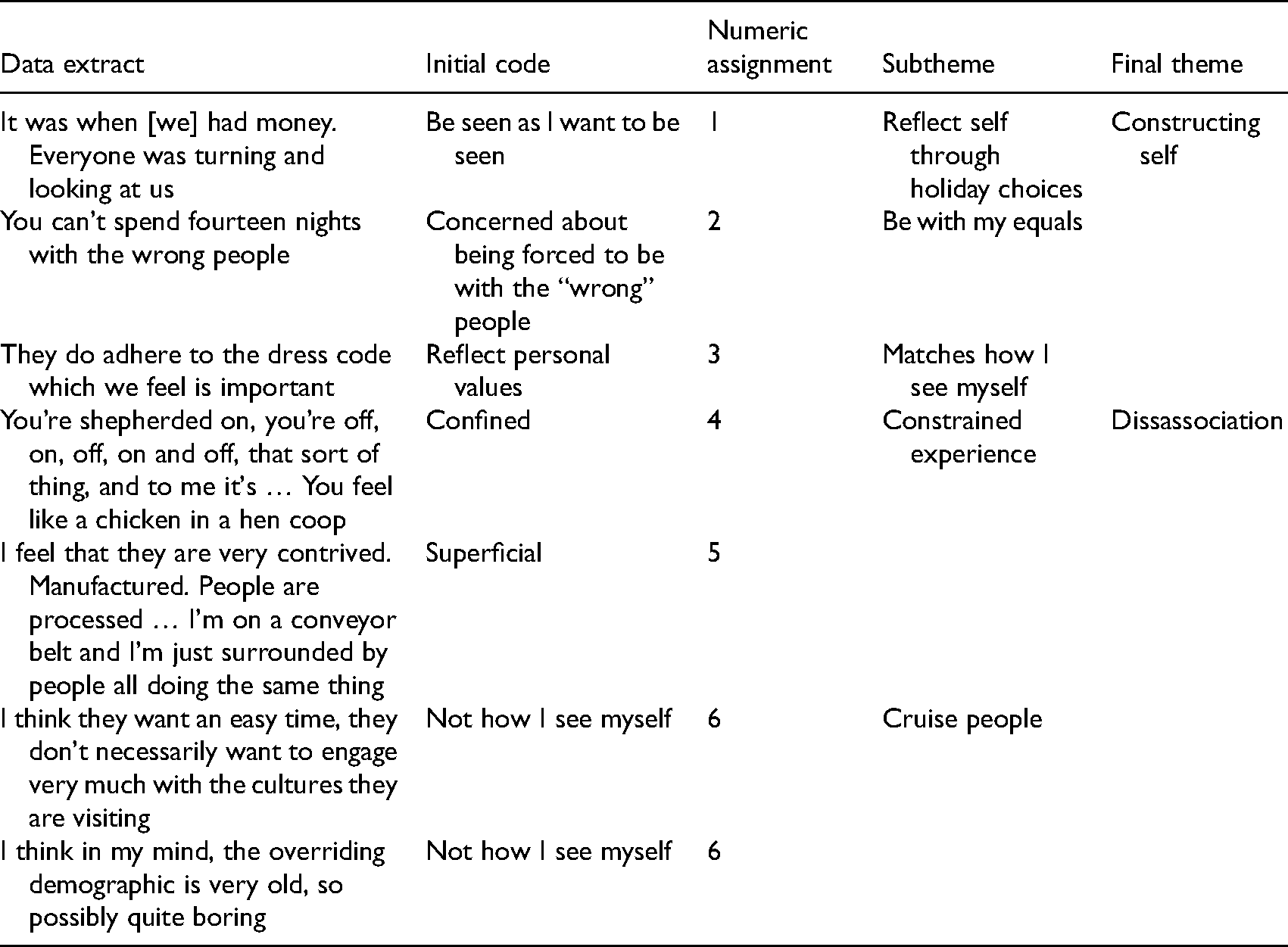
Two main themes related to self were revealed to be constructing self and disassociation and are discussed in the next section. Pseudonyms are used to ensure anonymity, with a notation to indicate whether the quote came from a cruiser or non-cruiser as this is significant at times to illustrate differences in perception.
Findings
The interviews revealed that for many participants, holiday choices are a means to reflect who they are, and how they want to be seen by others. A cruise vacation presents opportunities to affirm and construct self, particularly through interacting with other passengers. Many of the interviewees in this study appeared to choose cruise holidays to affirm their self-concept. For many cruisers, cruising was a way to reflect who they are to the world, as the experience matches with how they see themselves. For the non-cruisers, the cruise experience did not match with their self-concept, and many found value in actively disassociating themselves from the people they perceived to be “cruisers” and the cruise experience.
Constructing self
The images revealed how several of the cruisers wanted to be seen by others. For example, Ben described himself as someone who travels first class; a luxury-oriented international traveler used to staying in luxury hotels. He shared only two images, both different angles of the same setting, where he and his wife were on a cruise ship dressed up for a formal evening. When asked why he liked that photo and why he wanted to share it in the interview, he said “It was when Diana and I had money … everyone was turning and looking at us”. Interviews further revealed many of the cruisers revealed a desire to spend time with people who they viewed as having similar values and interests and extended to some choosing specific cruise lines in order to be with others who are similar economically. Dean highlighted how he enjoyed being with his “equals”, where he could discuss his travels and feel comfortable with those who share his values. Indeed, interviews revealed there was an underlying consciousness of social and economic status, with concern expressed by both cruisers and non-cruisers of being forced to interact with the “wrong” people. Daphne shared her experience of changing tables on a cruise because she did not want to sit with her assigned tablemates, “They had no interests in common with us. We just thought your evening meal is a highlight of the trip. We couldn't see that we could get 14 days conversation out of these people … You can't spend fourteen nights with the wrong people!” [cruiser]
Her comments revealed how important it was to her to spend time with people she had something in common with and whose company she thought she would enjoy. For some interviewees, adhering to rules and codes of behavior on a cruise was important, particularly for some cruisers, who wanted to uphold more traditional aspects of cruising. Dean pointed out one of the main features he liked about cruising with Cunard was “They do adhere to the dress code which we feel is important … The problem that I have is there is no dress code whatsoever [on other cruise lines]. You can turn up in the restaurants, in your pyjamas if you wanted”.
This revealed that the dressing up and formality of some cruise lines is attractive to some cruisers, however, this is not so much about maintaining tradition as it is about affirming who the participants see themselves as. For some participants, like Daphne, a cruise was an opportunity to have fun, with socializing and dressing up being a large part of that. Most of the photos Daphne shared in the interview were images of her dressed up, socializing and dining, further reflecting the image of herself she enjoyed portraying. The cruisers see dressing up as an opportunity to demonstrate how they “fit” in; as a physical expression of their self-concept. The ritual and sense of occasion in dressing in more formal attire is a way to reflect who she is. This was echoed in Yarnal and Kerstetter’s (2005) study, which found that cruisers use clothing to transition from daily life to become more liberated and carefree onboard, using clothing to better reflect self and how they wish to be seen. Dress has been recognized as a signifier of status, and a physical expression of self and identity particularly in relation to the cruise experience (Lester, 2017; Quartermaine and Peter, 2006) and this may explain why the cruisers in this study enjoyed the dressing up aspect of their vacations. It was a chance to show the world how they wanted to be seen and to reflect their social and economic status.
Self-concept is created through language, social interaction, and role-playing (Yarnal and Kerstetter, 2005). The cruisers were able to express their “true” selves both in terms of how they see themselves and how they want to be seen by others, supporting previous evidence leisure travel can shape and develop self-concept (Weaver, 2005), and relates to a desire to spend time with those considered “equal”. The findings here revealed the intense enjoyment of being with others that are familiar, a factor discussed in studies on cruise passengers by Papathanassis (2012). For the cruiser participants in this study, spending time with “equals” was significant as it helped affirm and construct a sense of self and identity that more closely matched what the participants thought of themselves. This minimized potential social risk through being surrounded and spending time with like-minded others.
Disassociation
By contrast, interviews with non-cruisers revealed a cruise was rejected as a vacation because it did not match how the participants viewed themselves and they desired to disassociate from both cruisers and the cruise experience. Elements of a cruise were seen as negative and incongruent with self-concept, denoting both social and psychological risk. Disassociation was revealed through two sub-themes: constrained experience, and cruise people.
Constrained experience
Interviews with the non-cruisers revealed a belief that a cruise was perceived as having a lack of freedom and choice in who you are forced to share your vacation with. Several participants spoke about the importance of spontaneity in their vacations and viewed a cruise as preventing them from feeling free to express themselves. A perception that a cruise is very structured and highly organized was noted by many interviewees, both cruisers and non-cruisers. An example of this is how Katherine shared her perception of a cruise to be too structured, “There is a certain time to have breakfast, and you’re regimented and I presume if you’re late you miss half the meal because you’ve got to get out because the next people are coming in … You’re shepherded on, you’re off, on, off, on and off, that sort of thing, and to me it's … You feel like a chicken in a hen coop … That is not a vacation to me.” [non-cruiser]
Interviewees also revealed perceptions that a cruise vacation is confining, and evoked feelings of being trapped. To illustrate, Kieran [non-cruiser] shared an image of a person trapped inside a box, “I would hate it! I would just be trapped there with all these people who I didn't really want to be with and have nothing in common with”. The sense of confinement appears to derive from being forced to be with others and having a lack of control over the experience. Non-cruiser Maria described a cruise as “It would be like being in a lift for your vacation”.
Several participants talked about the forced group experience. As non-cruiser Katherine put it, “You feel you’re being herded. It's that herded experience all the time.” Non-cruiser Kieran explained, “Some people don't mind being in hordes of people and being farmed and ferried around and told what to do all the time, but it's not what I want from my vacation.” Non-cruiser Andrea described how she perceived the passengers on a cruise as “they’re like sheep.”
Interviews with the non-cruisers also revealed a desire to express their individuality and self-identity, as opposed to being part of a group experience. Katherine [non-cruiser] described this by saying, “You’re cosseted. You feel you’re not a free spirit!” As non-cruiser Kieran explained, “Hordes of people, like looking out and seeing lots of maggots everywhere, just things moving around, just faceless people.” These comments suggested that non-cruisers perceived they would not be recognized or treated as individuals with differing desires and needs on vacation, that a cruise would be overly structured and standardized to the point that everyone was treated exactly the same. A further example from Kieran, “I feel that they are very contrived. Manufactured. People are processed … I’m on a conveyor belt and I’m just surrounded by people all doing the same thing. It's almost like a factory on the sea, a production line, they’re coming in and out, in and out, and it's just so impersonal.” [non-cruiser]
Non-cruisers perceived a lack of freedom in expressing who they were as an individual and in being forced to be part of a group experience and suggests psychological risk in this is not how they viewed themselves. This extended to the destination experience, where there was neither the time nor the opportunity to create meaningful interactions with local people in the destinations. Andrea described a cruise, “It's a hollow experience, just skates over the surface. It's all on the periphery of the experience of travel”. Katherine said “You can't say you’ve seen Barbados or something, St Kitts or wherever you’re going, you haven't seen them. You’ve just seen the port and a few shops and a taxi”. These comments from the non-cruisers reflects how they perceive a cruise experience to be manufactured and contrived, and points to the mismatch between the cruise experience and how they see themselves.
Many of the non-cruisers in this study did not want to be associated with cruising, as they felt this type of vacation was shallow and superficial, and they viewed themselves as different and wanting to fully engage with the destinations. The perceived superficiality of a cruise is echoed in other research on non-cruisers (Park and Petrick, 2009). The findings also support cruisers’ concerns about “being part of a ‘herd’” (Kwortnik, 2008: 300) and trapped by the physical confinement and the other passengers (Jaakson, 2004; Weaver, 2019). However, this study reveals evidence this was critically important to non-cruisers, where participants felt there was psychological risk in that cruising would not align with their self-concept so were not willing to consider this type of vacation.
Cruise people
Findings of this study revealed the non-cruisers’ desire to distance themselves from “cruise people”. Not only did they not want to go on a vacation with 2000 other people, but the non-cruisers also actively wanted to disassociate themselves from the people they perceived to be “cruisers”, denoting social risk. Andrea shared her perception, “I think the sort of people those vacations attract are people who want to play it safe. I think they want an easy time, they don't necessarily want to engage very much with the cultures they are visiting. They just want to be transported usually by coach, or whatever to their destination, picked up later that day, put back on … it's kind of like armchair travel.” [non-cruiser]
Andrea's comment suggests not only did she not view herself as this type of tourist, but she does not want to be associated with this type of holiday or fellow travelers. The overwhelming perception was how cruises appealed to individuals looking for a “passive” vacation. Maria summed up cruisers as “I think maybe older, maybe 60–75 something like that, almost invariably white … My impression is it's not very ethnically diverse … not the people who are looking for zest and adventure, but people who are looking for … entertainment to be given to them.” [non-cruiser]
Holly related, “I think in my mind, the overriding demographic is very old, so possibly quite boring … I think cruises sometimes are nice gentle things that people in retirement like to go and spend their time doing.” Further evidence of wanting to disassociate is how Maria believed that people who go on cruises were smug and self-entitled, and this was not how she saw herself or who she wanted to associate with. Her image illustrated what she believed to be a stereotypical cruise couple, “They have come out the other side of working life and their pockets are deep, filled with money and they’re happy spending it, with other people who have also generated lots of income in their lifetime, all onboard the ship, all congratulating themselves that they’ve done extremely well.” [non-cruiser]
Beyond the way in which non-cruisers viewed themselves as different from people who take cruises, they also thought their values were in opposition. For example, Maria thought cruise people to be wasteful and ostentatious consumers showing their wealth, “… whilst you’re having your three course meal that you don't need, and you’re drinking your bottles of water you don't need, and you’ve got heating in your room the whole 24 h, and hot water, because that's what you insist, because that's what you expect from these cruise ships, all of that, is making all of this disappear [shows image of Alaska].” [non-cruiser]
Interviews further revealed that non-cruisers perceived cruisers as being competitive, shallow and superficial. Indeed, several non-cruisers viewed “cruise people” to be materialistic and overly concerned about wealth. Carl explained, “[Cruise people are] … the couple that have probably got quite a big detached house somewhere in the Shire counties, who have got a fair bit of disposable income, and like to flaunt it, and one of the ways to do that would be on a cruise.” Victoria also commented, “The people I think of as going on cruises are … very money-orientated and showy and kind of looking down on people that haven't got as much as them.” Moreover, interviews revealed concerns about not fitting in with the other people due to anxiety about their wealth, “I perceive the other people to be affluent … I’m imagining them all to be a certain upper class … I could possibly talk to them but they might not be able to talk to me … They [cruisers] would be really wealthy … I’m assuming that they live behind a great big gated house … and you see them from afar … ” [Elena, non-cruiser]
These comments point to the mismatch between how the participants perceive cruise people and how this differs from how they see themselves. That is, non-cruisers felt that people who go on cruises were different in a negative way, and they did not want to be seen as the type of person who goes on a cruise. Findings echo previous studies’ findings that non-cruisers had social representations of a cruise as being for the elderly (Hur and Adler, 2013; Lebrun, 2015; Park and Petrick, 2009). The non-cruisers in this study did not want to be seen by others as old and needing structure or to be looked after on their vacations. They wanted to be seen by others as individuals, preferring spontaneity whilst on vacation, and reject notions of a mass, group experience.
Discussion
There are two main insights from the findings. First, the mismatch between how the non-cruisers perceived a cruise vacation and how they viewed themselves suggests both psychological and social risk. The non-cruisers perceived too much risk to self in choosing a cruise vacation, as the cruise experience did not match with how they viewed themselves. The risk for non-cruisers is not only in being unable to express themselves as individuals, but also in wanting to disassociate from cruising and “cruise people” to reflect how they saw themselves. The findings of this study are similar to Park and Petrick (2009), who found that both non-cruisers and cruisers had the desire to be free and not forced to dine or interact with others. Non-cruisers in this study see themselves as desiring a deeper experience and connection with locals in the destination. This is different from how they perceive cruisers, who they feel want a shallow experience. While previous research suggested social risk was unrelated to leisure travel (Roehl and Fesenmaier, 1992) or of little significance to vacation decision-making (Sönmez and Graefe, 1998); this study provides evidence to the contrary, pointing rather to the existence of both social AND psychological risk in cruise vacations, and how notions of self are significant to both cruisers and non-cruisers in vacation decision-making.
Second, this study reveals new insight into social value in rejecting a cruise vacation, where social value may be defined as “The utility derived from the product's ability to enhance social self-concept” (Sweeney and Soutar, 2001: 211). The non-cruisers in this study wanted to be seen by others as rejecting the artificial and manufactured experience of a cruise and thus avoid being associated with people who take cruises. There is scant reference to the issue of managing social risk through non-use or disassociation in the literature, beyond one study examining how consumers use tangible goods to disassociate from others and be unique (Merle et al., 2010). This highlights how some consumers use products to reflect self, yet this study highlights the role of perceived social value in rejecting cruise vacations. This adds a unique dimension to the current understanding of social value in cruising, as this study found non-cruisers perceived social value in disassociating from cruise vacations. The findings reveal the pride of some non-cruisers in being able to say they had not been on a cruise. Non-cruisers appeared to enjoy being able to “travel brag” in the interviews and to others about not having been on a cruise. There is evidence tourists “brag” to self-promote (Chen et al., 2020), and yet this study reveals the rejection of a cruise has a “reverse” social value and this is a significant and unique contribution to the tourism literature. There is remarkably little research on the value or perceived benefit to a consumer through rejecting or disassociating from a product or brand. Conscious rejection in decision-making has not been examined in cruising and this study illuminates the critical importance of risk perceptions and self-congruity.
Conclusions and future research
This study explores how risk is conceptualized in ocean cruising, using self-congruity as a framework for examining choice rejection. The qualitative nature of the study makes an invaluable contribution by adding depth to the existing understanding of risk in relation to cruise vacations, revealing tourists’ interpretation of risk in ocean cruising is nuanced and complex, embedded in constructs of self. This extends beyond physical risk and safety aspects and furthers understanding of the many dimensions of risk that may influence cruise decision-making.
This study has two theoretical contributions. First, this study reveals that self-congruity offers valuable insight into the interpretation of risk in cruising and is significant in the decision-making process. The research presented here suggests that the non-cruisers reject a cruise as the perception of a cruise vacation does not match with how they see themselves (actual and ideal) or want to be seen (social and ideal social). This is due to their mismatch with other people on the cruise; they perceive that they have nothing in common with “cruise people” through differences in age and interests but also values. This highlights that non-cruisers experience what Sirgy (1982) calls negative self-congruity, which occurs when there is a discrepancy or mismatch between what the consumer sees as their own positive self-image with a negative perception of the product. Thus, non-cruisers perceive that they have a positive self-concept and that the cruise product is a negatively perceived image. Additionally, findings of the cruisers suggest positive self-congruity, in that a cruise represents a positive image and matches the cruisers’ self-concept.
Second, this study contributes to the literature on choice rejection and perceived value by some tourists in rejecting or disassociating from certain types of holidays. While the non-cruisers in this study believed they were knowledgeable about the cruise experience and perceived benefits, the negative association with cruising was far greater and more meaningful to decision-making. The non-cruisers in this study clearly did not want to be associated with cruising because of incongruency with actual and social self, which results in dissonance leading to negative congruity. The risk to self in being associated with cruising was more than the non-cruisers are willing to consider and this is a significant contribution to understanding cruise decision-making.
Although this study makes significant contributions and adds to the discourse on tourist and cruise decision-making, there are a few notable limitations. This study was exploratory in nature, and while this adds to the evolving research on risk and tourist decision-making in cruising it also presents specific limitations as the findings and analysis are specific only to this group of participants and present UK residents’ views and is therefore limited in scope.
More empirical and theoretical research on self-congruity in cruising would provide deeper insight into the important role that self-concept plays in vacation decision-making. Indeed, risk to self, whether it be social or psychological, is far more significant than the literature suggests. Future research should seek to examine beyond health and safety risks and use a range of methods and methodological approaches. Additionally, further research should explore more in-depth about why some people choose to reject cruises after they have experienced a cruise. When the researcher first began the study, no participants were found that had been on a cruise and did not want to go again. Interviewing tourists who reject a cruise after experiencing one would provide valuable insight and help further understanding of how risk perceptions and self-congruity influence vacation decision-making.
Managerial implications
This study provides practical implications for marketing to better attract both previous cruisers and new potential customers, particularly as the industry rebuilds after COVID-19 (Choquet and Sam-Lefebvre, 2021). Developing marketing strategies that address self-congruity has the potential to increase sales and can be used by cruise lines to better position the cruise product as potentially attractive. This might include adapting the promotional material to focus less on the group and structured nature of a cruise, and focus on the experience of the destinations. Additionally, the cruise lines may find it beneficial to develop and focus on meaningful connections that cruise tourists can make while in destination, to move away from the perceived superficiality and manufactured contrived nature of a cruise holiday. Understanding disassociation provides insight not only into why some tourists reject cruising, but also into why some cruisers reject certain cruise brands. Understanding negative self-congruity can assist in brand switching and increase brand attachment by seeking a more positive self-congruity between the perception of the cruise brand with the self-concept of the potential cruisers. Fundamentally, consumers seek out congruence to enhance self-esteem and create a positive feeling and this leads to stronger brand attachment (Malär et al., 2011).
The research presented here provides a significant contribution to understanding how social and psychological risk influence choice rejection and the critical role of self-congruity. This study contributes to the risk, tourism and cruise literature by deepening understanding of risk in cruising and by identifying the reverse social value for some tourists in rejecting cruise vacations. Being aware of the importance of self-congruity on vacation decision-making can assist with more targeted and efficient marketing campaigns, and better positioning of the cruise product and product development. As risk exists in every purchase and influences all consumer decision-making, understanding how the perception of risk influences tourist decision-making cannot be overstated. This study contributes greatly to the discourse on how self-congruity intersects with social and psychological risk in ocean cruising and has illuminated the important influence of risk on tourist decision-making for a cruise vacation.
Footnotes
Acknowledgements
Thank you to Dr. Clare Weeden, Dr. Jo-Anne Lester and Dr. Cathy Palmer for sharing their expertise and knowledge with this research.
Author's note
Jennifer Holland has moved to a new institution since completing the research: Suffolk Business School, University of Suffolk, 19 Neptune Quay, Ipswich, IP4 1QJ.
Declaration of conflicting interests
The author declared no potential conflicts of interest with respect to the research, authorship, and/or publication of this article.
Funding
The author(s) received no financial support for the research, authorship and/or publication of this article.
