







Abstract
The tourism industry plays a pivotal role in the local economies of island communities and offers many attractive activities for tourists. As public transportation tends to be less developed in such island regions, one of the main modes of transportation is rental cars. The supply of rental cars is limited, and tourism demand tends to be seasonal in the island regions. In addition, there is a possibility that some customers may not use rental cars regardless of the price, and others may not make reservations if it is the season when rental cars can be rented without reservations. Therefore, car rental companies need to develop products that match the demand situation, such as peak season and off-season, and tourist characteristics during the seasons to improve profitability. However, little attention has been paid in the academic community to seasonal changes in customers’ car rental reservation behavior in islands. This study investigated the changes in customers’ rental car reservation behavior during the peak and off-peak seasons on Shodoshima Island, Japan, using a questionnaire survey. The results indicated that there are three factors that affect reservation behavior and that there are four patterns of reservation changes depending on the combination of these factors. By comparing the characteristics of segmented groups with different patterns of reservation change, it is suggested that a dynamic change in rental car reservation behavior occurs around retirement age in Japan. The results of this study provide insights into product development to improve the profitability of the tourism industry in island regions.
Introduction
The tourism industry is continuously developing in the world; the COVID-19 pandemic devastated the global tourism industry; however, it has recovered, with international tourist arrivals reaching 80% of pre-pandemic levels in the first quarter of 2023 (UNWTO, 2023).
On islands where tourism is a major industry, there are generally several activities. On smaller islands, as public transportation is not developed; so one of the main modes of transportation for tourists to participate in activities within an island is rental cars (Bursa et al., 2022; Martín et al., 2019). The car-rental business generates revenue by selling a perishable resource to meet seasonal demand within a limited capacity. This type of business shares common problems with the airline, hotel, and ferry industries. If car-rental companies always offer the same product in the same number of units, then many tourists intend to use rental cars but are not able to do so during the peak season, and unused rental cars remain during the off-season. Car-rental companies can develop and offer diversified products to increase revenues in such situations: developing rental car products for different customer segments and channels in different seasons and providing products that combine rental car services with other activities and transportation services. In order to develop products that effectively increase revenue, it is necessary to understand the characteristics of customers in the market and their reservation behavior. Since the 1990s, the application of revenue management in the car rental industry has progressed, and the analysis of customer reservation behavior has developed. However, in island regions, where strong seasonal fluctuations reduce management efficiency, there is a lack of operational management and marketing research, making it difficult to adopt a customer-oriented approach. Despite this, changes in customers’ reservation behaviors and their characteristics toward rental cars during the peak and off-seasons have not received much attention in the academic community.
To fill this research gap, we investigate the changes and patterns in the rental car reservation behavior of Japanese tourists on Shodoshima, a small island in Japan with a well-developed tourism industry. Because Shodoshima can be visited in a single day, it is assumed that a car is rented for only one day, not for several days in a row. We perform factor analysis on the binary data showing changes in reservation behavior for multiple seasons. In addition, by performing cluster analysis on the obtained factor scores, we are able to identify customer segments with different patterns of change in reservation behavior and the characteristics of these segments. Consequently, the pattern of change in reservation behavior among different seasons with different tourist demands is represented by three factors: preference for reservations in the peak season, preference for reservations in the off-peak season, and preference for reservations under uncertain circumstances. In addition, customers are segmented into four reservation patterns: a combination of the preference for peak season reservations and the preference for off-peak season reservations. These results of customer reservation behavior provide novel insights into the customer segmentation of car-rental product marketing in island regions.
The remainder of this paper is organized as follows. “Literature review” section provides the literature review. “Survey Data and Method” section presents the survey data and research methodology used in this study, “Result” section presents the results of the analysis, and “Discussions and Conclusions” section provides discussions and conclusions of the results. “Limitations and Future Directions” section presents limitations and future directions.
Literature review
An island is a peripheral region that is isolated by a sea barrier. A peripheral region is defined as an area with limited access by sea or mountain ranges from population and economic centers. The tourism industry constitutes a large part of the local economy and is a major source of income in small island regions (Archer and Fletcher, 1996; Cannonier and Burke, 2019). Tourism studies indicate that island regions that attract tourists are often affected by strong seasonality of tourism demand (Baum and Hagen, 1999; Butler, 2001; Chaperon and Bramwell, 2013). As seasonality is strong, that is, demand is highly skewed throughout the year, it leads to various problems in the tourism and hospitality industries, such as unstable employment, inefficient investment, and community exhaustion (Butler, 2001; Koenig-Lewis and Bischoff, 2005). Thus, addressing the strong seasonality of tourism demand is a challenge for island regions.
There are generally several activities on islands where tourism is one of the main industries. The transportation for tourists within the tourist area can be via public transportation (train and bus), rental cars, bicycles, or walking; however, the demand for rental cars tends to increase as the demand for tourism increases, partly because public transportation resources on the island are not as plentiful (Bursa et al., 2022; Martín et al., 2019; van Rensburg et al., 2023). Therefore, investment in the island’s transportation infrastructure is also related to the island's tourism demand (Khadaroo and Seetanah, 2007). Increasing tourism demand causes not only an increase in seasonality but also an increase in peak demand. Saito and Romão (2018) analyzed the accommodation sector in Spain and showed that peak demand had a significant impact on productivity; however, strategies to increase peak demand might not be sustainable if demand exceeds the capacity of a tourist destination. In the car rental industry, increasing the capacity to deal with peak demand corresponds to increasing the number of rental cars, which affects sustainability in the island region. In the island region, where tourists account for most of the rental car demand, an increase in the demand and seasonality of rental cars causes congestion, more traffic accidents, and an increase in emissions (Martín et al., 2019). Methods of taxing car-rentals have been proposed to address this issue. Palmer-Tous et al. (2007) proposed a fixed-rate tax on rental cars on the Spanish island of Mallorca to reduce congestion on the island. Regarding the emissions of rental cars, Gómez-Déniz et al. (2021) demonstrated how to internalize the cost of emissions of rental cars and reward customers who rent environmentally friendly cars and conducted a case study using data from visitors to the Canary Islands in Spain. While these approaches respond to the increasing demand for car-rentals through government intervention, it is also possible to consider other approaches in which car-rental companies identify customer segments with various reservation behaviors and efficiently operate the demand with a limited number of cars. van Rensburg et al. (2023) investigated the willingness to pay (WTP) for rental cars of fuel cell vehicles among inbound tourists in the Tenerife islands and showed that there were three different customer segments with different WTPs.
The field of managing reservation demand with a limited capacity to maximize revenue is called revenue management. The car-rental industry is a renowned traditional application of revenue management, and the analysis of reservation behavior and demand forecasting has developed (Geraghty and Johnson, 1997). In the academic field, Hong et al. (2007) and Oztaysi et al. (2023) use actual data to forecast revenue and demand of car rental companies. The local tourism industry on islands is small and tends to lack operational management and marketing research. As a result, businesses in the island tourism industry often take a product-oriented rather than a customer-oriented approach (Buhalis, 1999). In regions with strong seasonality, marketing research needs to identify the booking behavior of customers during different seasons. For car-rentals in island areas, in addition to strong seasonality, the uncertainty of weather and traffic congestion can be considered as factors affecting booking behavior; thus, there might be customers with several different booking behaviors in different seasons. However, academic studies dealing with rental cars in island areas have focused only on the peak season or treated the season as a dummy variable, that is, peak or off-season, and have not paid attention to changes in each customer's reservation behavior due to seasonality (Gómez-Déniz et al., 2021; Langbroek et al., 2019; Palmer-Tous et al., 2007).
This study focuses on Shodoshima, Japan, and considers only Japanese tourists, not international tourists. In the subsequent section, we describe the research framework, the case study island; Shodoshima, and the specific questionnaire survey.
Survey data and method
This study aims to clarify the patterns and characteristics of changes in customer reservation behavior for rental cars on islands according to season. The number of rental cars on the small island is limited, and during the peak season, they may be sold out by the day of travel. On the other hand, during the off-season, it is possible to rent a car on the day of travel without making a reservation. In addition, there are shoulder seasons between the peak and off-seasons, which means that there are different levels of difficulty in booking rental cars. Therefore, the probability of a rental car being sold out by the day of travel is considered to be the season, and the customer’s reservation behavior is whether or not to reserve a rental car by the day of travel in response to the probability of a rental car being sold out. We chose Shodoshima in Japan as a case study. Shodoshima is an island in the Setouchi area with an area of 153.3 km2 and is a famous island. There are about 3000 islands in the Seto Inland Sea, and Shodoshima is the largest island in the Seto Inland Sea that is not accessible by bridge (Gotoh et al., 2012). In the Setouchi area, a major art festival called the Setouchi Triennale is held every three years. Many tourists from Japan and overseas visit for the art festival. In 2019, it was held for 107 days and 1 178 484 people visited. In 2022, it was held for 105 days and 723 316 people visited, although it was held after the COVID-19 pandemic. According to a survey conducted at the art festival, 23.6% of visitors in 2019 and 1.3% in 2022 were international tourists (Setouchi Triennale Executive Committee, 2023). Shodoshima is the largest of the islands hosting the Setouchi Triennale (Qu and Funck, 2021). Therefore, Shodoshima, which has a strong tourism demand, is an island where it is possible to assume a wide range of rental car sellout probabilities.
This study considers only Japanese tourists, not international tourists. Ogasawara (2022) shows that most of the accommodation demand in Japan was for domestic tourists, the seasonality of domestic tourists was almost the same across Japan, and this pattern hardly changed between 2012 and 2019. In addition, it was also showed that the seasonality of inbound tourists in Japan was not large except for some regions, and not stable. Therefore, by targeting domestic tourism demand in Japan, which has stable and high seasonality, it is expected that the image of year-round seasonality associated with the difficulty of securing a reservation of a rental car would not change significantly among survey respondents. Most of the reservation websites provided by car rental companies in Shodoshima are not available in English, and it was not possible to make a reservation for a local car rental in Shodoshima through web services such as Expedia at the time of the survey. Therefore, it is difficult to assume the actual reservation behavior for rental cars for inbound tourists throughout the year.
If a tourist wants to rent a car for a longer period of time, one needs to reserve a car for the entire period, so the number of days one rents a car may change one's decision process. Palmer-Tous et al. (2007) assume that the car rental decision process is a two-step decision process: whether or not to rent a car, and if so, for how many days. In this study, the question of whether or not to rent a car was based on a one-day sightseeing trip. Shodoshima is accessible from several ports, and it takes approximately one hour by ferry from Takamatsu Port, the main port on the mainland. Bus is the mode of public transportation in Shodoshima. Other than public transportation, rental bicycles, cabins, and cars are available. The basic sightseeing course recommended by the Shodoshima Tourism Association takes 6–7 h by rental car and more than 10 h by bus. The recommended course is designed for a one-day trip on an official website provided by Shodoshima Tourism Association. Therefore, a rental car or cab is necessary to visit all recommended major tourist spots in a single day. The percentages of day trip tourists in 2019 and 2022 are approximately 60% and 70%, respectively. This means that more than half of the tourists were day-trip tourists (Shodoshima Tourist Association, 2023). Therefore, choosing to rent a car for a day trip to Shodoshima is a common option for tourists.
In the remainder of this section, we will discuss the specific content of the questionnaire and the method of analysis.
Survey data
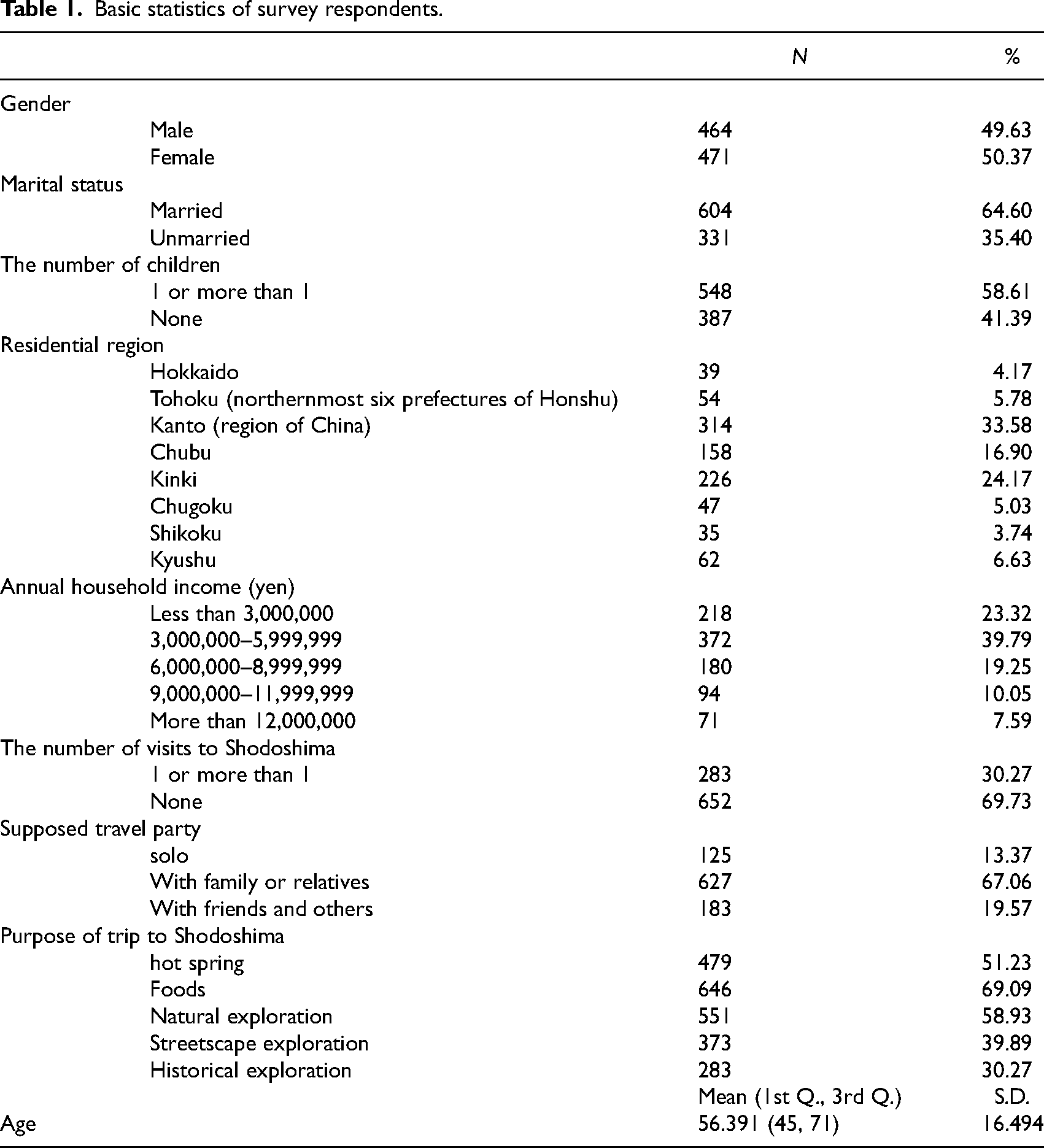
An online questionnaire survey was conducted by a research firm between October 25, 2022, and November 15, 2022. The research firm conducted a screening survey with 2000 potential respondents. The respondents were selected by random sampling, with the proportion of age-sex combinations adjusted to the demographics of Japan. The target population for this survey was Japanese citizens who were at least 18 years old, did not currently live in Shodoshima, intended to visit Shodoshima, had a driver's license, or did not have a driver's license but could assume a traveling companion who could drive, and did not give conflicting answers to the prepared questions. The prepared questions are two questions: whether to reserve a rental car for 10,000 yen with a 40–60% probability of rental cars being sold out, and whether to reserve rental cars for 20,000 yen with a 0–20% probability of rental cars being sold out. In general, the price will be higher when the probability of selling out is high, that is, when it is close to the peak season. If one does not rent a car at a low price in a season close to the peak season, but rents a car at a high price in the off-season, then this combination of answers does not make sense as a decision under the same conditions. Thus, the contradictory answer is a combination of “no” and “yes” for the first and second answers, respectively. To improve the reliability of the analysis results, respondents who answered with this combination were excluded. The survey was conducted on November 4, 2022. The screening revealed that 1009 people were eligible for the survey, of which 935 responded to the questionnaire survey and were used for analysis. The personal attributes of the respondents were age, prefecture of residence, gender, marital status, annual household income, number of children, experience visiting Shodoshima, supposed travel party, and assumed purpose of the trip when visiting Shodoshima. The basic statistics of personal attributes are listed in Table 1. As the assumed purpose of the trip is a multiple-response item, the percentage for each assumed purpose of the trip indicates the percentage of responses for that item among all respondents.
Basic statistics of survey respondents.
In the questionnaire, we asked respondents whether they would reserve a rental car in Shodoshima in advance, assuming that they would travel to Takamatsu City, where Takamatsu Port, one of the main ports to Shodoshima, is located, for a couple of nights, and use one day of that trip to Shodoshima. The behavior of whether to reserve a rental car was asked for each season with different demands; that is, the probability that rental cars are sold out before the day of the visit. The sellout probabilities of 0% and 100% were treated independently as special cases, and all other cases were considered as five patterns: greater than 0% and less than 20%, 20% or greater than 20% and less than 40%, 40% or greater than 40% and less than 60%, 60% or greater than 60% and less than 80%, and 80% or greater than 80% and less than 100%. No refund was provided in case of cancellation. The questionnaire in this study was administered without providing a specific car rental price for making a reservation. Car rental prices in Japan vary depending on the season, but basically the market price for car rental is determined by the size and grade of the car, and there are no extreme differences among car rental companies. When specific car rental prices are presented in a questionnaire, respondents may imagine the specific size and type of car. Since the respondents have different household income attributes and assumed travel parties, the grade of the rental car imagined from the specific price may affect the decision to book a rental car. Therefore, in this study, we assumed that Japanese respondents had some knowledge of the market price of rental cars and did not provide specific rental car prices. However, the price of a one-day unlimited bus ticket on the island was presented as the reference price for the public transportation, because the price of public transportation in Shodoshima may affect the respondents’ decision to rent a car or not. If the reservation behavior changed owing to the change in sellout probabilities, the respondent was asked to select from the following reasons: 1) because the reservation process is cumbersome, 2) because they want to decide whether to make a reservation after checking the local conditions on the day of the trip, and 3) because there is no refund in case of cancellation. If no reason was given, the respondent could select “no reason.” If there was a reason other than those listed above, the respondents were asked to write a free comment.
Method
The reservation behavior for a rental car is binary data representing whether to make a reservation. Therefore, the reservation behaviors of individuals for all seven patterns of sellout probabilities correspond to the seven dimensions of binary data. Because the reservation behaviors among the sellout probabilities can be correlated with each other and it is difficult to analyze the binary data as is, this study reduces the dimensions of this binary data vector using exploratory factor analysis, assuming that there are several factors that determine the reservation patterns. To segment respondents based on patterns of reservation behavior, cluster analysis was performed on the individual factor scores obtained by the factor analysis. A chi-square analysis was conducted to examine the characteristics of the individual attributes and reasons for changing the reservation behavior of each cluster, and a residual analysis was additionally conducted for items showing significant differences.
Result
In this section, we present the results of the factor, cluster, chi-square, and residual analyses of the reservation behavior data. From this section, the yen price will also be shown in US dollars for reference. The exchange rate used is 146 yen per dollar, based on the rate for August 2024.
Factor of changing booking behavior
Factor analysis was performed using the psych package (version 2.3.3) of R (version 4.2.3). There are three factors: two and three are the minimum numbers of factors for the MAP and BIC criteria, respectively. Factor analysis was performed using maximum likelihood with Promax rotation. Cronbach's alpha was greater than 0.7 for all items, and the Kaiser–Meyer–Olkin measure is 0.74. The three factors are as follows: a factor that encourages reservations when the probability of being sold out is high, that is, during the peak season; a factor that encourages reservations when the probability of being sold out is low, that is, during the off-season; and a factor that encourages reservations in highly uncertain situations with a 40–59% probability of being sold out. In this study, we refer to these factors as the preference for securing reservations during the peak season (RPS), the preference for securing reservations during the off-season (ROS), and the preference for securing reservations under uncertain situations (RUS). Table 2 presents the results of the factor analysis.
Factor analysis results.
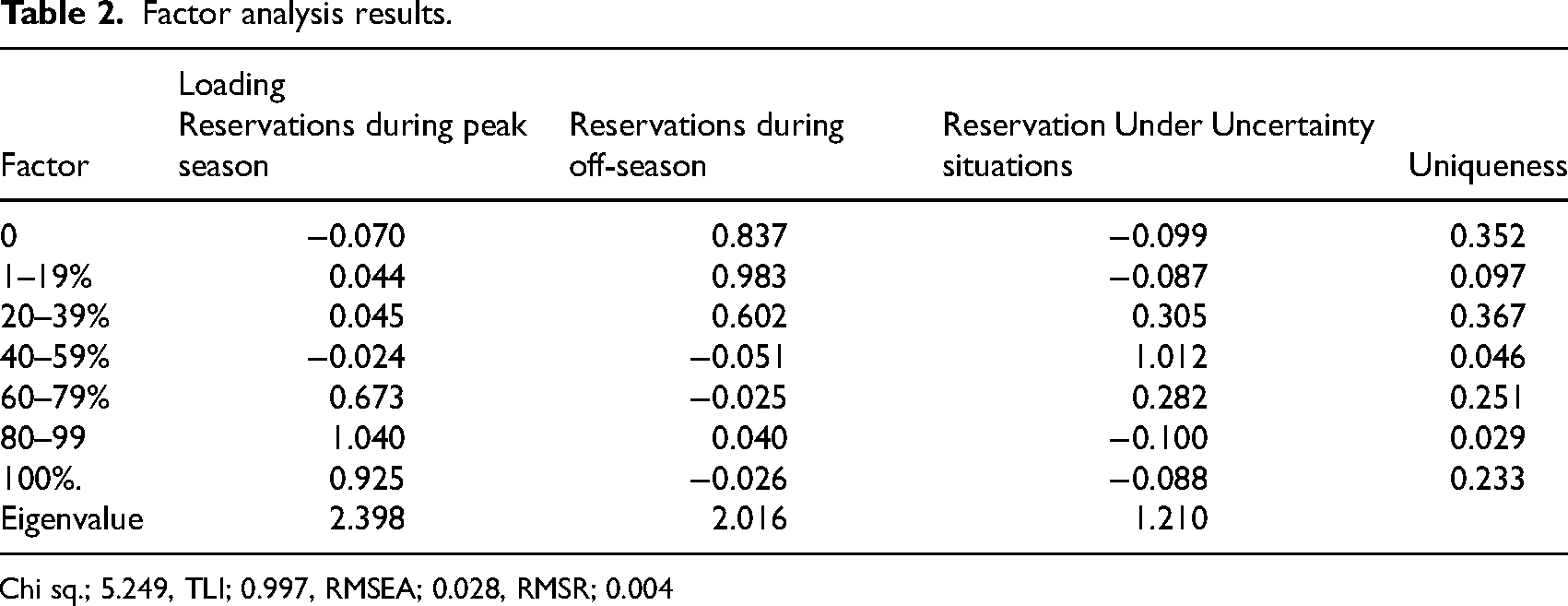
Chi sq.; 5.249, TLI; 0.997, RMSEA; 0.028, RMSR; 0.004
The correlations between RPS and ROS, RPS and RUS, and ROS and RUS are 0.049, 0.590, and 0.420, respectively. The relationship between RPS and ROS is low, whereas that between RPS/ROS and RUS was high. The degree of contribution of RUS is relatively lower than those of RPS and ROS.
Clustering factor scores
To segment the respondents, cluster analysis was performed on the scores of the three factors obtained from the factor analysis. Ward's method was used for the hclust function of R (version 4.2.3). In this study, the number of clusters was set to four. The four clusters were characterized by a combination of positive and negative factor scores of RPS and ROS. A cluster with positive values for both RPS and ROS is called high reservation (HR); a cluster with a positive value for RPS and a negative value for ROS is called high reservation during the peak season (HRP); a cluster with a negative value for RPS and a positive value for ROS is called high reservation during the off-season (HRO); and a cluster with negative values for both RPS and ROS is called low reservation (LR). Table 3 presents the mean of each factor in these four clusters and the number of respondents belonging to each cluster. Figure 1 shows the percentage of respondents who chose to reserve for each sellout probability in each cluster.
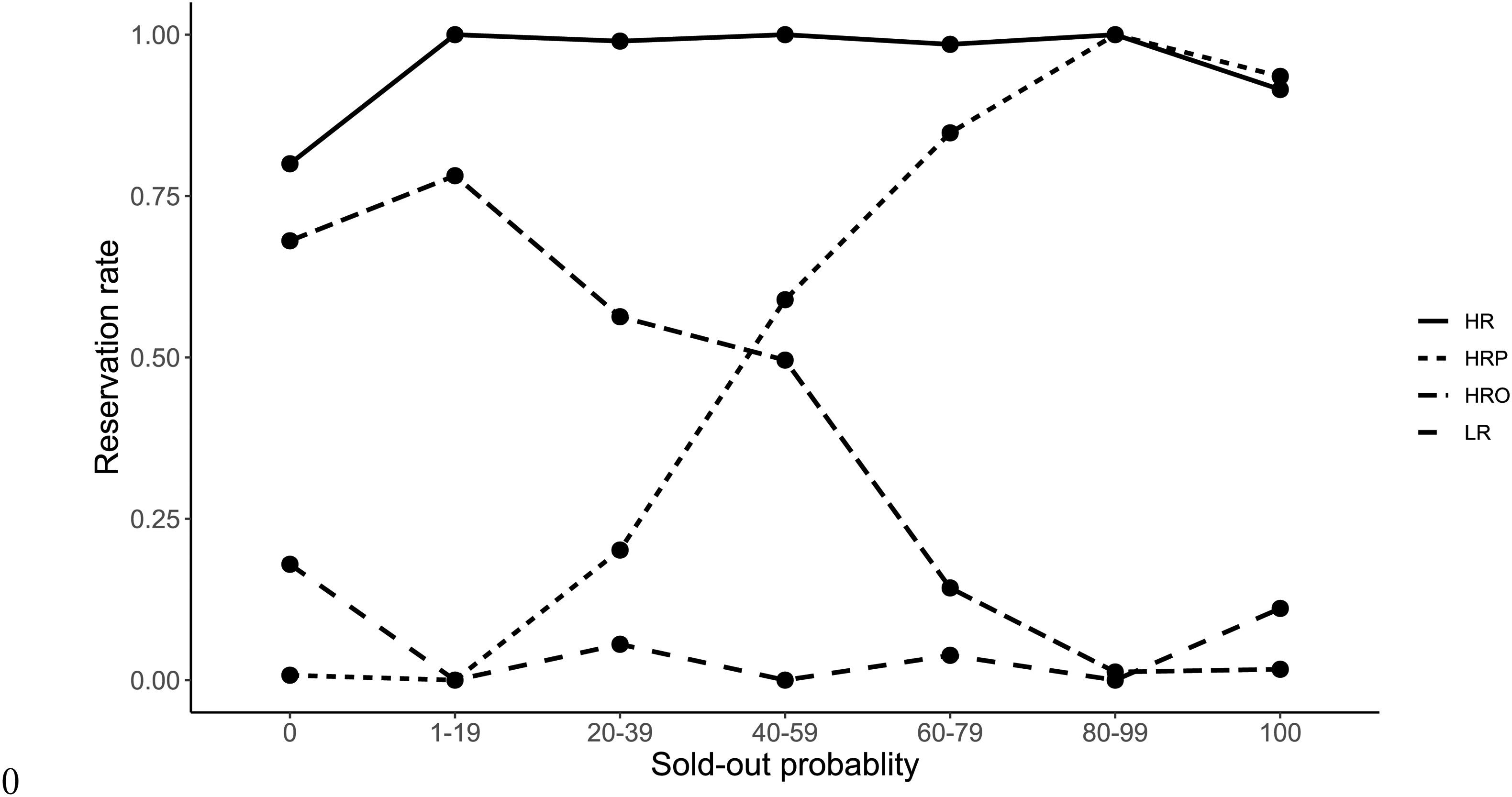
Reservation patterns of each clusters when sellout probability changes for each cluster.
Factor scores for clusters.

The number of respondents belonging to each cluster is similar, with each cluster constituting approximately 25% of the total number of respondents. Table 3 demonstrates that the clusters are not characterized by ROS but only by the combination of positive and negative values of RPS and ROS. In the 0% and 100% cases, which are special deterministic situations, there is a slight tendency for fewer respondents to make reservations than in the adjacent 1–19% and 80–99% situations, but this does not have enough impact to change the characterization of the overall clusters.
Characteristic of the clusters
To characterize the clusters, we used differences in the reasons for changing reservation behavior and individual characteristics among the clusters. The medians of the quantitative data, age, and annual household income were compared among clusters using the Kruskal-Wallis test. Since the original data for annual household income were categorical variables in the range of 1 million yen (6,849 US dollar) from 0 to 20 million yen (136,986 US dollar), quantitative data were made by the midpoint in each category. The upper limit of the maximum annual household income category was set at 22 million yen (150,685 US dollar). For the other categorical variables, including the reasons for the change in reservation behavior, a chi-squared test was used to examine the differences among the clusters. Table 4 presents the results of the study. In Table 4, the values for the purpose of traveling to Shodoshima and the reasons for changing reservations indicate the number of respondents who answered “yes” and the percentages of these respondents. The chi-squared values were calculated for the yes and no response data for these items.
Test results for variables across clusters.
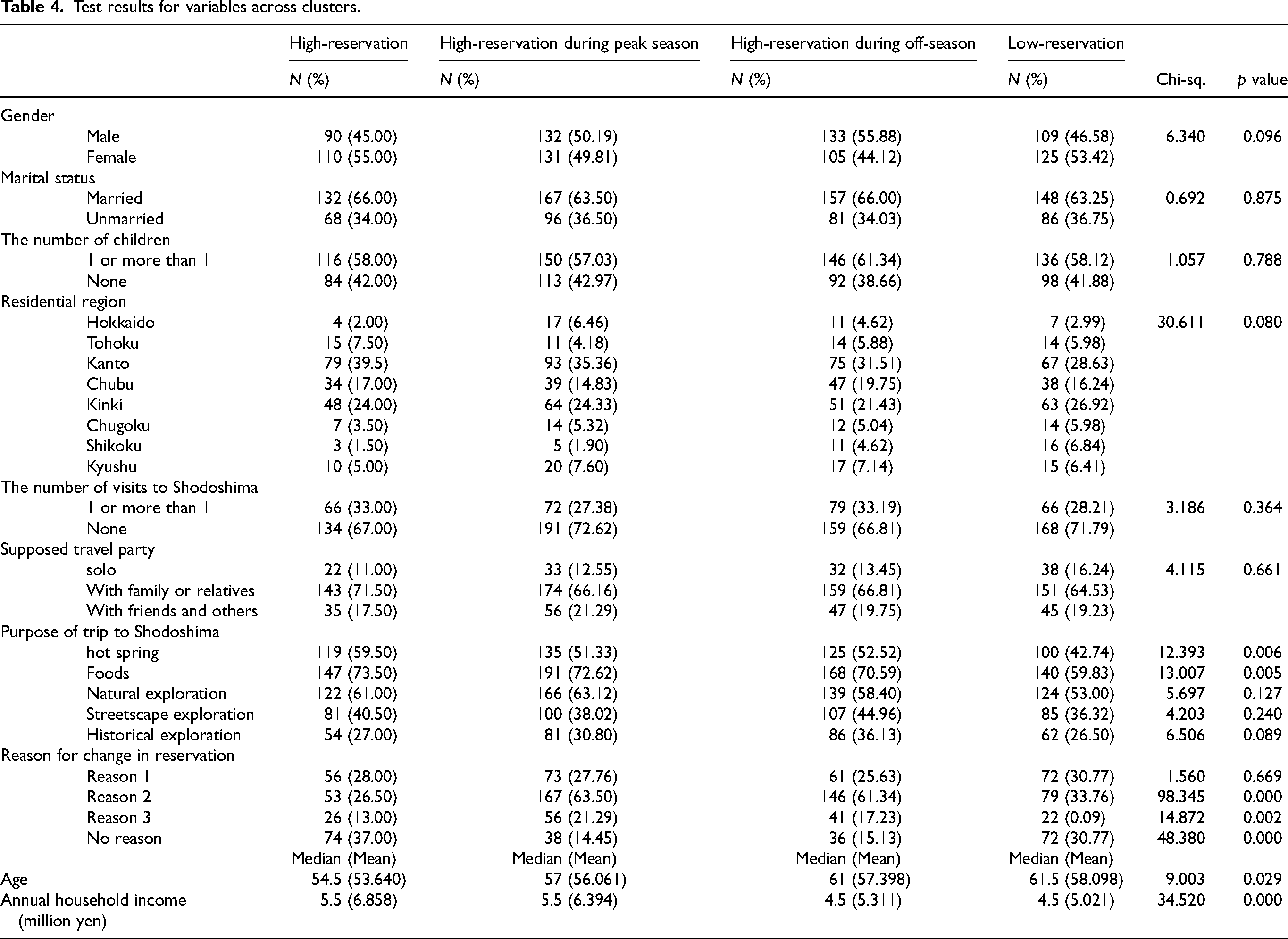
Multiple comparison tests with Bonferroni's correction for age and quantified annual household income at a 5% significance level in the Kruskal-Wallis test revealed significant differences at the 5% significance level between HR and LR for age and between HR/HRP and HRO/LR for annual household income. The medians of HR/HRP and HRO/LR were the same because the quantified variable for annual household income was constructed from the midpoint of the categorical variable for annual household income. Among the categorical variables of individual attributes for which chi-square tests were conducted, only hot springs and food as trip purposes showed differences at the 5% significance level. Residual analysis reveals that HR significantly answers “yes” to hot springs of trip purpose while HRP significantly answers “no.” For food of travel purpose, LR answers “no” at a 5% significant level. The reasons, except for Reason 1 (because of the complicated reservation process), showed significant differences. Residual analysis for the reasons shows that HR and LR significantly answer “no” to Reason 2 (because they wanted to see the local conditions before deciding), while HRP and HRO significantly answer “yes” to Reason 2. For Reason 3 (because there is no refund in case of cancellation), HRP answers “yes” while LR answers “no” at a 5% significant level. For no specific reason, HR and LR answer “yes” while HRP and HRO answer “no” at a 5% significant level.
Discussions and conclusions
Discussions
In this study, we observed three factors of reservation behavior for rental cars on Shodoshima under different sold-out probabilities, and four clusters composed of combinations of these factors. Furthermore, the results of this study suggest that the composition of clusters within the demand for rental cars changes dynamically when the probability of rental cars being sold out reaches 50%, that is, when uncertainty is at its highest. In existing research, seasonality is often expressed using simple dummy variables such as peak season and off-season. If the probability of rental cars selling out by the day of travel differs between respondents when they imagine the peak season, then the reservation behavior of tourists renting cars in the islands may also differ. Since the seasonality of domestic tourists in Japan does not vary much nationwide, and since the survey was conducted assuming only day-trip tourists, except for the decision-making process for the number of days to rent a car, this study may have shown the change in reservation behavior for car rentals and the change in demand composition for island regions when changing from the peak season to the off-season.
Focusing on the characteristics of each cluster, there were significant differences in the individual attributes of age and household income among the clusters. The medians of age for the clusters with HR to LR were 54.5, 57, 61, and 61.5 in the column order of Table 4, indicating that age tends to increase from HR to LR. The medians of HR/HRP and HRO/LR were the same, and the means of annual household incomes of HR, HRP, HRO, and LR were 6.858 million yen (46,973 US dollar), 6.394 million yen (43,795 US dollar), 5.311 million yen (36,377 US dollar), and 5.021 million yen (34,390 US dollar), respectively. This indicates that annual household income decreased from HR to LR.
Although there are small differences in age and household income between HR and HRP, reservation behavior in the off-season differs. This may be due to the inclusion of hot springs (Onsen in Japanese) for travel purposes. Onsen is the main purpose of domestic travel in Japan and is an activity aimed at relaxing and getting away from daily routines. HR, which is associated with a high preference for rental cars and Onsen, might require more leisure time when visiting Shodoshima on a day trip. The HRO and LR clusters did not differ significantly in terms of age or household income. LR cluster does not select “no refund in case of cancellation” as a reason for changing their reservation behavior, indicating that they might not have an obvious interest in the activities in Shodoshima and might have little preference for rental car reservations themselves. This implies that the LR cluster contributes little to the demand for rental cars.
Dynamic changes in reservation behavior occur in HRP and HRO. The differences in age and annual household income between these clusters are larger than those between other neighboring clusters in the columns of Table 4. In particular, the mean of annual household income changes by more than one million yen (6,849 US dollar) from HRP to HRO. This might be because the median age between HRP and HRO exceeds 60 years. Since the typical retirement age in Japan is 60 years and annual income often decreases significantly after the age of 60, even when working for the same company, it can be assumed that HR/HRP and HRO/LR correspond to the working and retired generations, respectively.
Working-age reservation holders in HRP might have no choice but to choose the summer and holiday seasons, which are expected to be crowded, to make a long-distance trip; the more crowded the season, the more they might want to secure a rental car to have more free time at the destination. Moreover, since respondents in HRP would decide whether to use a rental car based on local conditions when changing their reservation behavior, and they indicated that no refund in case of cancellation is one of the reasons for changing their reservation behavior, it is possible that during an off-peak season, they value the flexibility of their schedule and prefer to decide whether to use public transportation or a rental car based on the availability of rental cars, local traffic congestion, and weather conditions on the day of their visit without making a rental car reservation. Although there was no significant difference in annual household income between HR and HRP, the average annual household income of HR was approximately 0.46 million yen (3,151 US dollar) higher than that of HRP. This might be related to the fact that HR tends to choose to rent a car, which is more expensive than public transportation, even during the off-peak season. The HRO prefers to avoid renting a car during the peak season, does not want to check the local conditions before making a decision to rent a car, and does not cite no refund in case of cancellation as a reason to change their reservation behavior, suggesting that during the peak season, when transportation and tourist facilities on the island are crowded, they might prefer to avoid driving on unfamiliar roads and use public transportation.
Conclusions
In this study, we analyzed the changes in rental car reservation behavior in Shodoshima, Japan, depending on the season, with different demands on the island. This study reveals the patterns of reservation behavior, its factors, and segmented customers. The results suggest that there is a gradual change in booking behavior for car rentals on the island between peak and off-peak seasons, and that changes in demand do not occur uniformly across the board, but rather by combining clusters that exhibit completely opposite booking behavior in each season.
Older workers and retirees might be more active in off-season island tourism because they have more flexible travel time in exchange for a lower annual income (Alén et al., 2012; Mohamed et al., 2016). Kozak and Rimmington (2000) reported that in Majorca, Spain, many senior citizens visited the island for tourism during the off-season. Therefore, the demand for tourism by senior citizens may also be high during the off-season in Shodoshima. The demand for car-rentals is mainly composed of the working-age population during the peak season and a portion of the working-age population and retirees during the off-season. This is in line with the results of existing studies on seasonal tourism demand on islands and suggests that the proposed method of increasing product diversity, which is to develop tourism products for the senior market to stimulate demand in the off-season, is also effective for rental car products on islands (Alén et al., 2012). In terms of new product development, the fact that hot springs are selected for travel to Shodoshima by HR suggests that a bundled product combining rental car services and hot spring activities might be effective throughout the year. In the travel industry, bundled products that combine airline tickets with accommodation and multiple transportation services are offered. The optimization of the number and price of bundled products has been studied in the field of revenue management (Gürler et al., 2009). As rental car services on the islands can be combined with activities scattered around the islands and ferries that provide access to the islands to create products that stimulate demand, the analytical approach in this study could be effective in developing bundled products using rental cars on islands.
Limitations and future directions
There are limitations to this study in that the results were obtained only from Japanese respondents; that is, they did not include the reservation behavior of inbound tourists. Inbound tourists, except those from certain countries, require international driver's licenses to drive in Japan, and their decisions to reserve a rental car might be affected by differences in driving rules and habits in Japan compared to their home countries. For example, inbound tourists who are not accustomed to driving in Japan may avoid reserving a rental car during the peak or all seasons. In addition, this study did not present a specific season to the respondents, but rather the probability that rental cars would be sold out. This probability is determined by the customer's guess when they make a rental car reservation. The greater the variation in the image of the level of demand for a particular season among tourists, the more limited is the seasonal period during which a clear segmentation of reservation behavior can be observed. However, because the pattern of seasonality in Japan has not changed for a long time, the variation in the image might not be large.
Future work could include examining patterns of seasonal changes in the rental car reservation behavior of non-Japanese tourists and the reservation behavior of larger island tourists who primarily stay overnight. These analyses provide useful results for the further development of tourism products.
Footnotes
Declaration of conflicting interests
The author(s) declared no potential conflicts of interest with respect to the research, authorship, and/or publication of this article.
Funding
The author(s) disclosed receipt of the following financial support for the research, authorship, and/or publication of this article: This work is supported by a JSPS Grant-in-Aid for Scientific Research (C) (20K04976), Grant-in-Aid for Scientific Research (C) (23K04077), Grant-in-Aid for Scientific Research (C) (23K04279), JSPS Grant-in-Aid for Early-Career Scientists (20K20080), and JSPS Grant-in-Aid for Early-Career Scientists (24K21013).
