







Abstract
This study aims to examine the effects of social media influencers’ sponsorship disclosure on social media users’ behavioral outcomes (i.e., influencer avoidance and destination avoidance) and whether social media users’ expectancy violation mediates these relationships. One factor, two conditions, and between subjects experimental design is employed across three studies. Study 1 was conducted with a fictitious influencer, and Study 2 and Study 3 corroborated the results with a real influencer in cross-cultural contexts. Study 1 found that explicit sponsorship disclosures about promoting a tourism destination by travel influencers increased influencer and destination avoidance. Study 2 and Study 3 revalidated these relationships. All studies show that users’ expectancy violation mediated the relationships. Thus, this research extends the discussion from consumer marketing to the tourism domain by illuminating social media users’ negative behavioral outcomes (i.e., influencer avoidance and destination avoidance) toward travel influencers’ brand-paid promotions through the expectancy violation lens. Furthermore, this study contributes by examining the effect of influencer-destination brand sponsorship, presenting a novel amalgamation of consumer psychology and the tourism domain.
Keywords
Introduction
Social media influencers create content about various domains (like fashion, travel, and technology) and post them on online platforms such as Instagram, Facebook, Twitter, YouTube, etc. Thus, social media influencers engage and interact with users (Shuqair et al., 2024). Influencers are considered to be genuine and credible sources of information. Similarly, travel influencers are anticipated to be an authentic source of reviews and recommendations about a travel destination (Ameen et al., 2024; Jhawar, 2024). Followers on social media expect original and unbiased posts from the influencers they follow (Jhawar et al., 2023). Thus, social media influencers influence followers’ behavioral decisions throughout the relationship (Boerman et al., 2021). Similarly, travel influencers also influence the destination visit intentions of their followers (Kapoor et al., 2022). Further, as the popularity of these influencers grows, brands partner with them to create promotional posts/ content for themselves. These brand-sponsored and brand-controlled posts are intended to influence followers’ decision-making in favor of the tourist destinations or brands (Hughes et al., 2019; Roy and Attri, 2024). At times, influencers tend to conceal their brand associations. Similarly, travel influencers sometimes try to hide their post or blogs’ persuasive and commercial intent (De Veirman and Hudders, 2020). However, owing to the enhanced advertising literacy and increasing number of brand-sponsored social media posts, followers might recognize the persuasive nature of the content (Ameen et al., 2024). Thus, they might feel deceived by the influencers and sponsoring brands (Jhawar et al., 2024). Therefore, the expectancy of authentic and unbiased content or follower posts from the influencer is breached. We explain this using the expectancy violation theory (Burgoon, 1993). Subsequently, it aggravates followers’ concerns about the motives of the influencers and associated brands (Schouten et al., 2020). In the case of travel influencers, it creates doubt about the travel influencer's credibility and the destination suggestion. Thus, social media users’ trust in influencers is negatively affected, complicating the influencer-follower relationship (Jhawar et al., 2025).
To untangle the complicated relationship, travel influencers (and all other social media influencers) are now mandated by advertising regulating agencies to differentiate their genuine regular blogs/ posts from ones with brand sponsorship using explicit sponsorship disclosure tags (Leung et al., 2022). Sponsorship disclosure tags include #ad, #sponsored, #paid partnership, and included paid promotions, among others (Jhawar et al., 2025). The advertisement regulating agencies such as the Advertising Standards Council of India (ASCI), US Federal Trade Commission (US FTC), European Advertising Standards Alliance (EASA), etc., have issued mandatory sponsorship disclosure guidelines to protect social media users from deceptive influencer and brand persuasion (ASCI, 2021; FTC, 2019; WOMMA, 2017). However, several influencers and travel bloggers hide their brand partnerships and avoid using or camouflaging the mandatory disclosure tags in their social media posts (Boerman et al., 2021). Hence, social media users remain skeptical about influencers’ and the promoted brands’ credibility and authenticity, thereby developing a feeling of expectancy violation. Thus, social media users might avoid the influencers they doubt and avoid visiting the destinations they promote (Jhawar et al., 2025; Seçilmiş et al., 2022).
Although influencers’ adoption of mandatory sponsorship disclosure guidelines has increased the transparency of influencer-brand partnerships (Jhawar et al., 2023), it might not have nullified followers’ negative behavioral responses due to continued skepticism. The negative behaviors may behavior would be demonstrated in the form of negative word-of-mouth, unfollowing the influencer, avoiding the influencer's content, switching to another influencer, engaging in criticism about the influencer on social media platforms, or even discouraging others from trusting or following the influencer and the promoted destination. Such behaviors would negatively impact the influencer's followership and credibility and diminish the endorsed tourism destination's perceived authenticity and image. Hence, tourism marketers and social media influencers must create a balance of authenticity with veracity in sponsored social media content.
Followers might find it challenging to trust travel influencers’ destination recommendations, even with or without sponsorship disclosures, owing to the inherent commercial intentions behind social media posts (Belanche et al., 2021). Furthermore, the implementation of mandatory sponsorship disclosure guidelines is recent in the consumer industry, and its use and effectiveness in the tourism and hospitality industry still lack clarity. The literature also lacks clarity on the social media users’ behavioral responses (i.e., influencer avoidance and destination avoidance) toward travel influencer posts with or without sponsorship disclosures (Polat et al., 2024). This is supported by recent research calls to understand social media users’ responses toward brand-sponsored promotions in consumer and tourism contexts (Hugh et al., 2022; Polat et al., 2024). In other words, the subsequent effects of sponsorship disclosures on travel influencers and the partnering destination brands remain unanswered. So, this study examines the impact of travel influencers’ sponsorship disclosure on influencer avoidance and destination avoidance behavior of social media users.
Furthermore, followers might discern that travel influencers deliberately advertise the destination brands upon encountering sponsorship disclosures and travel destination-related posts. Hence, their expectation from the travel influencer for genuine feedback and review of the tourism destination might need to be upheld. Owing to this, they might feel irritated, annoyed, and tricked (Childers and Boatwright, 2021; Gholamhosseinzadeh, 2023). The agitated followers perceive that the travel influencers have violated their expectation of authentic content, condemning the influencers and the sponsoring destination brands (Jhawar et al., 2024). This follows the psychological mechanism of expectancy violation. Hence, influencers and destination brands must understand when and how social media users show disapproval and devise ways to tackle these situations. Therefore, to address this research gap, this study analyzes the effect of social media users’ expectancy violation as a mediator between travel influencers’ sponsorship disclosure and followers’ influencer avoidance and destination brand avoidance.
This study makes several critical contributions to the influencer marketing literature. First, we introduce and operationalize the concepts of influencer avoidance and destination avoidance, which have been sparsely studied in tourism literature. While studies have investigated avoidance behaviors in consumer studies that involve brand avoidance (Grégoire et al., 2009; Jhawar et al., 2025) and advertisement avoidance (De Jans et al., 2018), limited studies have explored avoidance behavior in the travel influencer context. Extant tourism studies have mainly focused on the inspirational or persuasive aspects of travel influencers (see Hughes et al., 2019; Kapoor et al., 2022) while ignoring the grey side of the influencer-follower relationship, which includes rejection or disengagement (Jhawar et al., 2024). Only a few recent studies have elucidated low destination visit intention or negative behavioral reactions triggered by influencer content (e.g., Jhawar, 2024; Jhawar et al., 2025; Seçilmiş et al., 2022). Hence, by introducing travel influencer and destination avoidance, this research extends consumer avoidance theory to the travel influencer–follower dynamics, thereby illuminating a new behavioral dimension of social media users’ responses to sponsored travel influencer content. Also, this study extends the findings of Childers and Boatwright (2021) on perceived brand control and consumer annoyance toward the travel and tourism horizon. Second, this study elucidates the effects of sponsorship disclosures on social media users’ behavioral outcomes (i.e., influencer avoidance and destination avoidance) in the tourism context through the psychological lens of follower's expectancy violation. Thus, this study extends the discussion on expectancy from an influencer in consumer marketing to tourism. Through this study, we also attempt to answer the call to investigate the underlying factors explaining consumers’ responses to sponsorship disclosures in the tourism context by Shuqair et al. (2024). Third, by conceptualizing the reactance of followers when their expectations from social media influencers are violated, this research draws on the Expectancy Violation Theory (EVT) (Burgoon, 1993). Expectancy Violation Theory posits that when the expectations of individuals from others’ behavior are breached, we feel emotional and cognitive dissonance. Similarly, social media users expect original, unbiased destination recommendations from travel influencers. However, when these influencers post commercially-driven, brand-sponsored content, followers experience a transgression of trust, which triggers negative behavioral reactions (Jhawar et al., 2025). By examining this within the travel influencer domain, this study not only leverages EVT to explain follower reactions but also extends its application by introducing novel behavioral outcomes—influencer avoidance and destination avoidance. Thus, this research contributes to the EVT literature by confirming its explanatory power in a tourism-centered, digital communication context. Also, this study extends the application of EVT from consumer psychology aspects to the travel influencer domain.
Literature review and theoretical background
Travel influencers’ sponsorship disclosure
Sponsorship disclosure represents revealing influencer-brand partnerships in social media posts via evident disclosure tags (such as #advertisment, #paidpartnership, #ad, #sponsored) and declaration statements (such as ‘Includes paid promotions’ or ‘This is a sponsored post’) (Jhawar et al., 2024). Such disclosures enable social media users to differentiate between influencers’ authentic opinion posts and brand-paid promotional posts, thereby adding to their persuasion knowledge (Jhawar et al., 2025). These mandatory disclosure guidelines also hold for travel social media influencers and are meant for sponsorship transparency, which otherwise has legal implications (ASCI, 2021; FTC, 2019). Furthermore, the guidelines aid the advertisement regulation agencies to identify the influencers who avert disclosing the commercial intent of their social media posts and travel blogs (Gholamhosseinzadeh, 2023; Jhawar et al., 2023).
However, despite the sponsorship disclosures being compulsory for all influencers (travel, fashion, beauty, etc.), several travel influencers and bloggers refrain from including these tags in sponsored travel posts and blogs, thereby indulging in covert promotions of several destinations (Conti and D’Amario, 2023). Thus, followers of such travel influencers develop negative attitudes fostering avoidance towards the influencer and the sponsoring destination brand (Jhawar et al., 2024). Moreover, influencer posts with disclosure tags also incur negative responses because of the evident self-interest of the influencer and unwarranted persuasiveness by the destination brands (De Jans et al., 2018). Along with the increase in the impact of travel influencer posts and influencer-destination brand partnerships in shaping social media users’ choices, the need for research on this crucial amalgamation of tourism domain and sponsorship disclosure, which alerts social media users has also evolved (Gholamhosseinzadeh, 2023; Jhawar et al., 2023). So, it is essential to comprehend the underlying psychological phenomenon when social media users exhibit travel influencer avoidance and destination avoidance behavior.
Influencer avoidance
Influencer avoidance is defined as “Social media users’ shunning or unfollowing of the influencers’ content (i.e., posts, photos, videos) on social media platforms” (Jhawar et al., 2025). Social media users expect unbiased, genuine, and honest opinion posts from influencers (Polat et al., 2024). However, when travel influencers post sponsored content about tourism destinations on their social media pages, the expectations of perceived trust and authenticity get violated upon followers’ recognition of the paid promotions. So, followers consciously distance themselves from the influencers (Jhawar et al., 2024). Following the consumer avoidance literature (Grégoire et al., 2009; Jhawar et al., 2025), followers’ influencer avoidance is outlined by responses like unfollowing the influencer, negative word-of-mouth (WOM), influencer switching, and lesser influencer-follower engagement. In the context of the travel influencer-follower relationship, such avoidance behavior illuminates a breach of the parasocial relationship, posing a significant triggering rejection of both travel influencers. Thus, we elucidate that identifying brand-sponsored posts by travel influencers would elicit influencer avoidance behavior (i.e., negative behavioral reactions) from followers (Seçilmiş et al., 2022).
Destination avoidance
Destination avoidance is when social media users consciously avoid visiting or considering destinations promoted by travel influencers perceived as biased or commercially oriented (Fan et al., 2024). While many extant studies in the tourism context emphasize the positive effects of influencers on destination marketing (Hughes et al., 2019; Kapoor et al., 2022), limited research has delineated the negative aspects of travel influencer promotions. In the context of influencer marketing, prior research shows that the identification of an influencer's brand sponsorships disclosure harmed the perceived credibility of the influencer and the associated brand, thereby leading to brand avoidance behavior by social media users (Childers and Boatwright, 2021; Jhawar et al., 2025). In the same light, unwanted persuasiveness by travel influencers through paid promotes of tourist destinations might also lead to negative behavioral consequences and behavioral disengagement toward both the influencer and the associated tourist destination (Conti and D’Amario, 2023; Seçilmiş et al., 2022). Thus, we elucidate that the explicit evidence of travel influencers’ social media posts about any sponsored destination would lead to negative evaluations, thereby leading social media users to avoid the promoted tourism destination (Polat et al., 2024).
Expectancy violation theory
The expectancy violations theory elucidates that people form expectations based on norms, past interactions, and contextual cues and then react to the unanticipated violations of these social norms and expectations (Burgoon, 1993). Expectancy violation theory has explained individual behaviors such as anger in consumer-chatbot interactions, individuals’ reactions to corporate social responsibility expectancy violation (Park et al., 2021), the effects of negative brand feedback on brand hate/love (Yang and Mundel, 2022), the impact of influencer-product congruence on advertisement attitude (De Cicco et al., 2021), and tourists’ reactions in fellow tourists’ misbehavior context (Jia et al., 2025). Tourism consumers are susceptible to expectancy mismatch because tourism involves financial, emotional, and time-related investments. So, violations of authentic feedback expectations due to the exaggerated portrayal of destination serenity by travel influencers or covert promotional motives can significantly affect tourists’ trust, intention, and behavior (Seçilmiş et al., 2022).
Furthermore, social media followers expect unbiased and genuine travel opinions from the travel influencers they follow (Kapoor et al., 2022). In influencer-social media user interaction, social media users expect influencers to offer genuine and unbiased recommendations based on their personal experiences (Jhawar et al., 2025; Kapoor et al., 2022). Hence, following the expectancy violation theory, this research posits that the expectancy of an authentic and genuine review and recommendation from a travel influencer would be violated when followers identify destination brand-sponsored posts promoting destinations due to the self-interest of the travel influencer (Jhawar et al., 2024). Consequently, when the expectancy of social media followers is negatively violated (i.e., travel influencers post destination brand-sponsored content unexpectedly), it fosters adverse behavioral outcomes such as influencer avoidance and destination avoidance (Ameen et al., 2024; De Cicco et al., 2021). So, this study builds upon the foundations of the expectancy violation theory to further examine the relationship between sponsorship disclosure by travel influencers and influencer avoidance and destination avoidance behavior of followers in the subsequent section, as conceptually presented in Figure 1. Thus, this research extends the scope of the expectancy violation theory by linking it to the travel influencer marketing domain, where managing tourists’ expectations and authenticity are central to tourism consumer's decision-making.
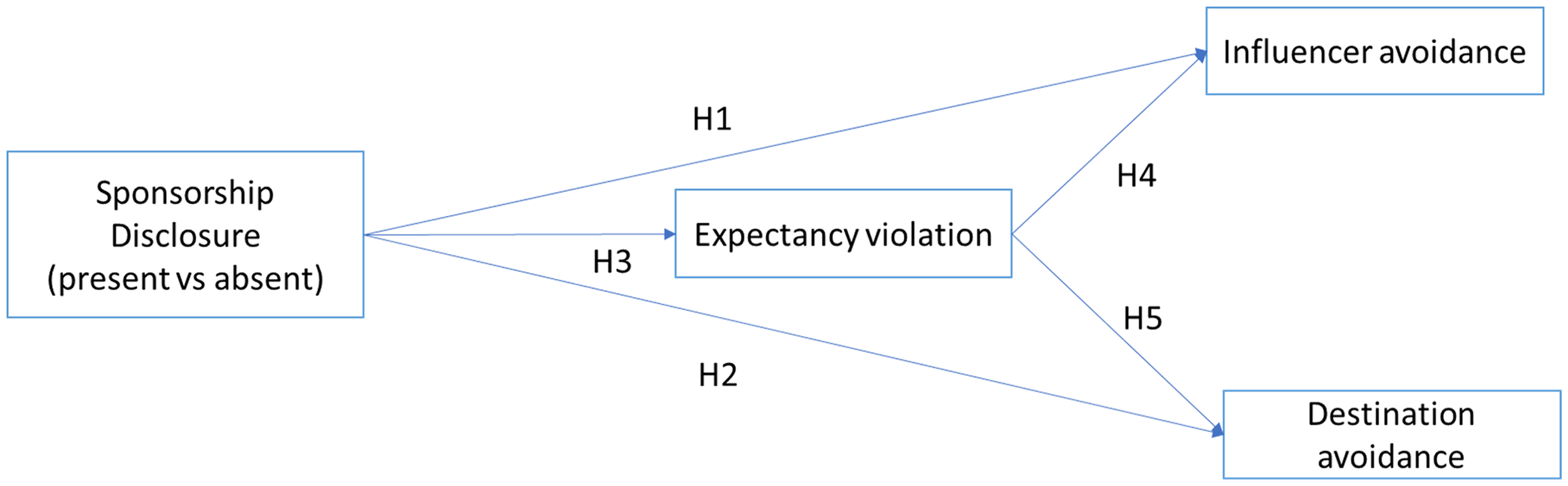
Conceptual model. Source: Author's own work
Hypotheses development
Direct effects of sponsorship disclosure on travel influencer avoidance, destination avoidance, and expectancy violation
Travel social media influencers’ destination brand-sponsored social media posts are considered unwarranted, intrusive, and not credible (Jhawar et al., 2023). Adding to this, the enhanced persuasion knowledge and advertising literacy of social media users have lessened the influence of influencers on consumer perceptions (De Jans et al., 2018). To tackle this, destination brands indulge in sponsored influencer marketing tactics (Conti and D'Amario, 2023; Jhawar et al., 2024). However, now, social media users are equipped with means (i.e., sponsorship disclosure tags and guidelines) to recognize the coercion by influencers and destination brands (Boerman et al., 2021). Upon identification of the deception (i.e., destination brand-paid advertisements), followers inculcate a sense of expectancy violation toward the travel influencer and the promoted destination (Roy and Attri, 2024). However, when disclosure tags are not explicitly mentioned, followers might interpret the post as honest opinions and discount the negative responses (De Veirman and Hudders, 2020).
As per the expectancy violation theory, when social media users come across sponsorship disclosures in travel influencer posts, they adjudge the influencer and associated destination brand to have breached the ethical norms and psychological contract in the communication (Lee et al., 2021). So, this study elucidates that when social media users identify the commercial orientation of travel influencer posts, they blame both the influencer and the sponsoring destination for infringing their expectations (Cocker et al., 2021). Hence, they adopt punitive measures like influencer avoidance and destination avoidance (Evans et al., 2019). So, the following hypotheses are posited:
Explicit sponsorship disclosure (vs. no disclosure) is more likely to cause influencer avoidance among tourism consumers.
Explicit sponsorship disclosure (vs. no disclosure) is more likely to cause destination avoidance among tourism consumers.
Explicit sponsorship disclosure (vs. no disclosure) is more likely to cause expectancy violation among tourism consumers.
Direct and mediation effects of expectancy violation
Prior literature suggests social media users expect influencers to follow ethical advertisement practices and guidelines (Boerman et al., 2021). Honest travel influencers are appreciated and considered credible sources of information by followers, building strong parasocial relationships (Gholamhosseinzadeh, 2023; Jhawar et al., 2025). However, influencers violate followers’ expectancy and infringe on the parasocial relationship when they engage in covert brand-paid promotions (Jhawar et al., 2024). Using travel influencers for paid promotions breaches the expectations of social media users, thereby leading to negative reactions on account of transgressions by the influencers and the destination brands (Jhawar, 2024). Therefore, the following hypotheses are proposed:
Expectancy violations by tourism consumers positively affect influencer avoidance.
Expectancy violations by tourism consumers positively affect destination avoidance.
Furthermore, upon identification of travel influencers’ persuasive intentions, evoked by the sponsorship disclosure tags in their posts, the expectancy violation of followers elicits negative behavioral responses towards the influencers and the associated destination brands (Ameen et al., 2024; Jhawar et al., 2025). So, this study posits that social media users will avoid travel influencers and destinations to vent the displeasure caused by the expectancy violation when they come across brand-sponsored, paid travel influencer posts about any destination (Gholamhosseinzadeh, 2023; Yang and Mundel, 2022). Thus, the following hypotheses are proposed:
Expectancy violation of tourism consumers mediates the relationship between sponsorship disclosure and a) influencer avoidance and b) destination avoidance.
Experimental studies
Two online experimental studies were conducted using a Qualtrics questionnaire. Study 1 (N = 191 participants) examines social media users’ behavioral reactions (i.e., influencer avoidance, destination avoidance, and expectancy violation) by manipulating the sponsorship disclosure condition (i.e., present vs. absent) (i.e., testing H1, H2, and H3). Also, the direct and mediating effect of expectancy violation is investigated (i.e., testing H4, H5, H6a, and H6b). Study 1 was conducted with a fictitious travel influencer to control for influencer familiarity. Study 2 (N = 215 participants) and Study 3 (N = 188 participants) attempt to replicate and generalize the result of Study 1 using a moderately known travel influencer in cross-cultural contexts. The adequacy of sample sizes for both studies was ascertained based on a priori power analysis via statistical analysis using G*Power 3.1 software. The analysis confirmed that for a between-subjects experimental design with two conditions, a sample size of approximately 158 is sufficient to detect a medium effect size (f = 0.25) with a power of 0.80 at a 5% significance level. The sample sizes of both studies exceeded this threshold. Also, these sample sizes are consistent with recent experimental research in influencer marketing and tourism contexts (e.g., Ameen et al., 2024; Evans et al., 2019; Jhawar, 2024; Jhawar et al., 2025), ensuring robust and generalizable findings.
Furthermore, Instagram is the most preferred social media platform for influencers (Schouten et al., 2020). So, for the studies, only Instagram users who follow at least one travel influencer are recruited using the Prolific platform (www.prolific.co). Thus, any confounding effect of platforms was minimized, and internal validity was established. Furthermore, the impact of social influencers was restricted by exposing male respondents to the stimulus of male travel influencers and female respondents to the stimulus of female travel influencers (see Schouten et al., 2020).
Study 1
Study 1 predicted that explicit sponsorship disclosure tags (vs. no disclosure) would increase influencer avoidance, destination avoidance, and expectancy violation amongst social media users. Also, this study examines the direct and mediating effects of expectancy violation in relationships. One-factor two conditions (sponsorship disclosure: present vs. absent) between-subjects design was used to investigate this. A scenario-based online experiment was used to ensure high internal validity and control for confounding influences. According to manipulation checks conducted on a sample size of 60 responses (as a part of a pre-test), the advertisement recognition was significantly greater for the sponsorship disclosure present condition (M = 5.31, Std. dev. = 0.88) than for the absent condition (M = 3.85, Std. dev. = 1.21). The results showed that participants considered the two conditions differently (F = 7.681, p < 0.001).
Participants
A total of 191 Instagram users (with 13 participants removed for static responses or failing to meet the attention check) from the USA (48.74% female, 51.26% male) between the ages of 18 years and 40 years (average age = 25.45 years), participated in an online study created in Qualtrics Platforms. They were paid a compensation of £0.5 per response and had an approval rate of 98% or higher to facilitate receiving high-quality responses. Prolific is used as it offers substantial payment to the respondents and provides high-quality data from a diverse sample (Jhawar et al., 2025).
Stimulus, procedure, and measures
The experiment was designed to investigate social media users’ responses to different Instagram posts by travel influencers. The final stimulus comprised a travel influencer's Instagram post with a description and a biography. The travel influencer's handle was fictitious: ‘travelsid’ (for male respondents) and ‘traveljoey’ (for female respondents). The manipulations for sponsorship disclosure (present vs. absent) were adopted from Jhawar et al. (2025). In the sponsorship disclosure present condition, the disclosure tags (such as ‘paid partnership,’ ‘#ad,’ and ‘#sponsored’) were prominently placed and visible in the travel influencer's Instagram post. The destination was also tagged in the post. On the other hand, in the no-disclosure condition, the disclosure tags were absent. A professional creative designer was employed to develop the stimulus material (refer to Appendix 1).
Respondents were initially briefed about the objective of the experiment and asked to sign an informed consent declaration. Screening questions about their Instagram usage, age, and gender followed. Accordingly, participants were randomly assigned to an Instagram post (sponsorship disclosure present or absent condition using the randomizer function in Qualtrics) consisting of the travel influencer's biography, image, and description. They were asked to go through the biography, contents of the post, and description for at least 30 s. The manipulations varied for men and women, with each gender exposed to a travel influencer of the same gender. The questionnaire started with questions about the control variables (i.e., advertisement recognition and travel influencer familiarity). Attention check questions and deployment of the expectancy violation, influencer avoidance, and destination avoidance scales followed this. The final section captured the demographic data.
Expectancy violation was measured using a 3-item scale adapted and rephrased from Stiegert et al. (2021). The items included, “Given my impression of the influencer [influencer name], he/she acts like I expected him/her to act,” “Given my impression of the influencer [influencer name]; I am negatively surprised by his/her behavior” and “Given my impression of the influencer [influencer name]; I am positively surprised by his/her behavior.” Influencer avoidance was measured using a 4-item scale adapted from Grégoire et al. (2009). The items included, “I would keep as much distance as possible between the influencer [influencer name] and myself,” “I would avoid following the Instagram page of the influencer [influencer name],” etc. A 3-item scale was adapted and rephrased from Grégoire et al. (2009) to measure destination avoidance behavior. Items included “I would not want to visit the destination shown in the post,” “I would avoid visiting the destination shown in the post,” and “I would rather visit any other destination than the destination shown in the post.” Further, advertisement recognition due to the presence or absence of sponsorship disclosure and influencer familiarity were measured using 1-item scales. For advertisement recognition, participants were to indicate their agreement with the item “The Instagram post was an advertisement.” For influencer familiarity, they were to indicate their agreement with the item, “I am familiar with the influencer [influencer name] following Evans et al. (2019).” All items were measured on a 7-point scale (1 = strongly agree, 7 = strongly disagree).
For each construct, Cronbach's alpha greater than 0.7 ensured internal consistency (Jhawar 2024). Composite reliability (CR) greater than 0.6 and average variance extracted (AVE) greater than 0.5 confirmed reliability and convergent validity, respectively (Gefen et al., 2000). The discriminant validity (Fornell-Larcker Criterion) showed that the Heterotrait–Monotrait (HTMT) ratio of correlation values is below the threshold of 0.85, confirming discriminant validity for all constructs. VIF (Variable Inflation Factors) was used to examine multicollinearity. All the VIF values were less than 4, suggesting the absence of multicollinearity and fortifying the lack of common method bias in the model (Sinan and Alkan, 2015).
Analysis and results
We tested the main effects using MANCOVA in IBM SPSS 23. Consistent with H1, we found a significant main effect of sponsorship disclosure on influencer avoidance, showing that influencer avoidance behavior increased in sponsorship disclosure present condition compared to no disclosure condition [Mpresent = 4.85, Std. Dev. = 1.366; Mabsent = 3.64, Std. Dev. = 1.512; F(1189) = 13.187, p = 0.000, ηp2 = 0.065 (indicating a medium effect size)]. Supporting H2, we found a significant main effect of sponsorship disclosure on destination avoidance, showing that social media users would exhibit destination avoidance behavior in sponsorship disclosure present condition compared to no disclosure condition [Mpresent = 5.02, Std. Dev. = 0.805; Mabsent = 3.98, Std. Dev. = 1.379; F(1189) = 8.658, p = 0.003, ηp2 = 0.044 (indicating the effect size is approaching medium)]. Supporting H3, the results illuminate a significant effect of sponsorship disclosure present condition (compared to no disclosure condition) on expectancy violation of social media users [Mpresent = 4.88, Std. Dev. = 1.027; Mabsent = 3.99, Std. Dev. = 1.098; F(1189) = 8.486, p = 0.000, ηp2 = 0.043 (indicating the effect size is approaching medium)]. Supporting H4, the results show a significant positive effect of expectancy violation on influencer avoidance behavior of social media users [Mpresent = 5.36, Std. Dev. = 1.23; Mabsent = 3.48, Std. Dev. = 1.41; F(1189) = 9.282, p = 0.002, ηp2 = 0.047 (indicating the effect size is approaching medium)]]. Furthermore, supporting H5 results show a significant positive effect of expectancy violation on destination avoidance behavior of social media users [Mpresent = 3.12, Std. Dev. = 0.73; Mabsent = 2.79, Std. Dev. = 1.14; F(1189) = 5.715, p = 0.000, ηp2 = 0.029 (indicating a small-to-medium effect size)]. Further, the Hayes Process macro (Model 4) was used to test the mediation model using 5000 bootstrap samples with a 95% confidence interval. Supporting H6a [Indirect: b = −0.948, SE = 0.191; 95% CI = (−1.322, −0.574); Direct: b = −0.924, SE = 0.202, 95% CI = (−1.319, −0.528)] and H6b [Indirect: b = −0.798, SE = 0.154; 95% CI = (−1.099, −0.496); Direct: b = −0.558, SE = 0.109; 95% CI = (−0.771, −0.344)], a significant mediating effect of expectancy violation was found. The covariates (influencer familiarity and age) had no significant effect. Refer to Table 1 for results of Study 1.
Study 1 results
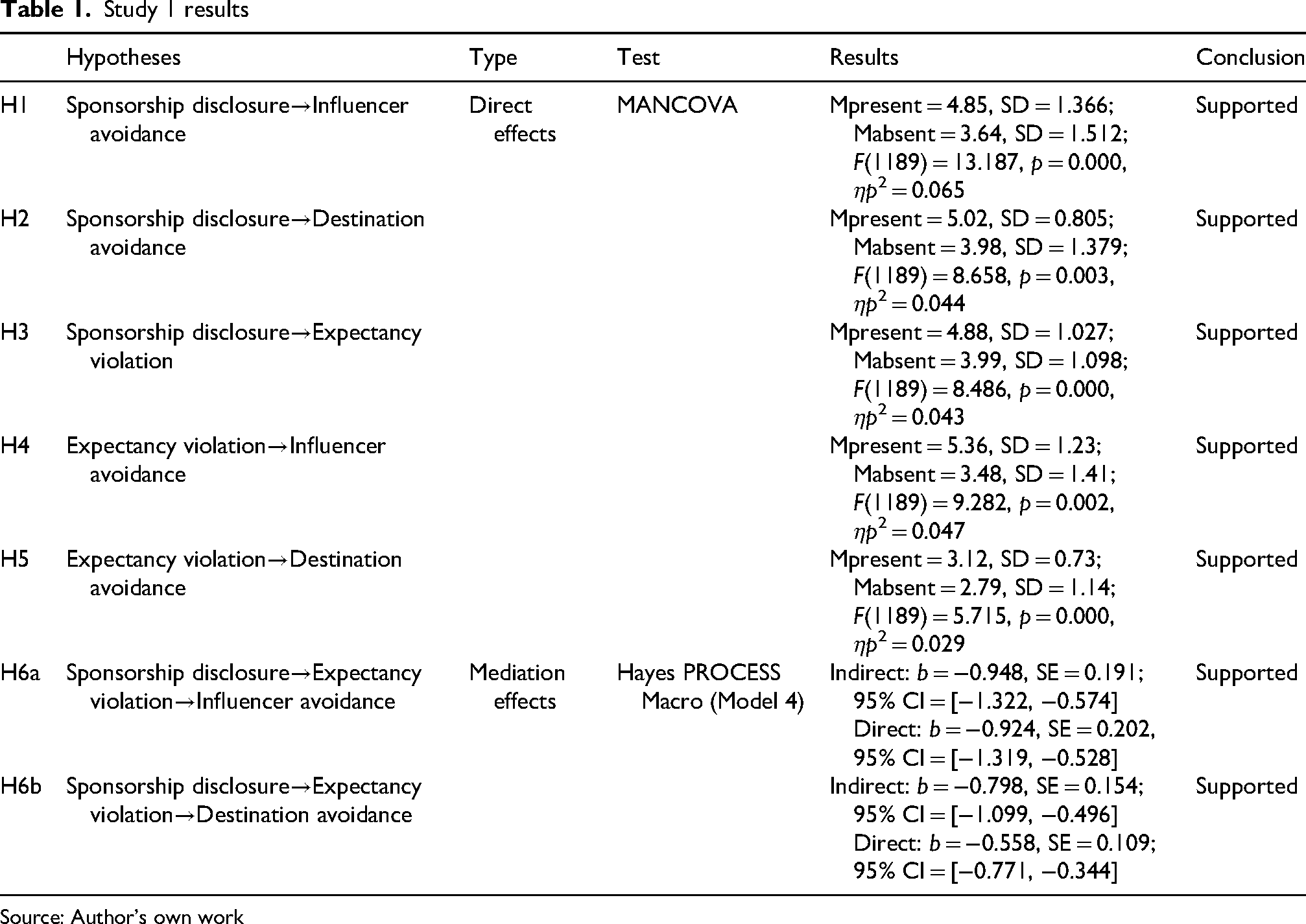
Source: Author's own work
Discussion
In sum, explicit sponsorship disclosure (compared to no disclosure) increases influencer avoidance and destination avoidance behavior and causes expectancy violations in social media users. This corroborates the findings of Jhawar et al. (2025) and resonates with Jia et al. (2025). The findings also illuminate that the novel psychological mechanism of expectancy violation underlies the influence of sponsorship disclosure on travel influencers’ follower's behavioral outcomes. Hence, social media users experience expectancy violation because of paid promotions by travel influencers, leading to the avoidance of the travel influencer and the promoted destination, extending the findings of Lee et al. (2021) in the brand consumerism domain to the tourism domain.
Study 2
The objective of this study was to revalidate the findings of Study 1 with a real influencer. The study design was similar to Study 1.
Participants
A total of 215 Instagram users (with 16 participants removed for static responses or failing to meet the attention check) from the USA (52.10% female, 47.90% male) between the ages of 18 years and 40 years (average age = 28.75 years), recruited from Prolific, participated in an online experiment created in Qualtrics Platforms. Each participant received compensation of £0.75 per response and had an approval rate of 98% or higher.
Stimulus, procedure, and measures
The stimulus material comprised an actual travel influencer's Instagram post with a biography and a description similar to Study 1. The male travel influencer was Drew Binsky (@drewbinsky on Instagram), and the female travel influencer was Kiki – The Blonde Abroad (@theblondeabroad on Instagram) (refer Appendix 2). The study procedure and measurement scales were the same as Study 1.
Analysis and results
The results showed that H1 was supported, showing that influencer avoidance behavior increased in sponsorship disclosure present condition compared to no disclosure condition [Mpresent = 5.66, Std. Dev. = 1.41; Mabsent = 3.84, Std. Dev. = 1.16; F(1213) = 5.39, p = 0.004, ηp2 = 0.025 (indicating a small-to-medium effect size)]. H2 was also found significant, showing a significant direct effect of sponsorship disclosure present (vs. absent) condition on destination avoidance behavior [Mpresent = 4.73, Std. Dev. = 1.11; Mabsent = 3.15, Std. Dev. = 1.62; F(1213) = 7.91, p = 0.000, ηp2 = 0.036 (indicating that the effect size is approaching medium)]. H3 was also supported, showing a significant direct effect of sponsorship disclosure present (vs. absent) condition on follower's expectancy violation [Mpresent = 5.24, Std. Dev. = 1.22; Mabsent = 4.12, Std. Dev. = 1.48; F(1213) = 6.63, p = 0.001, ηp2 = 0.030 (indicating a small-to-medium effect size)]. Further, H4 was supported by demonstrating a significant accentuating effect of expectancy violation on influencer avoidance [Mpresent = 5.61, Std. Dev. = 1.27; Mabsent = 3.83, Std. Dev. = 1.44; F(1213) = 8.24, p = 0.002, ηp2 = 0.037 (indicating a medium effect size)] and H5 was supported by demonstrating a significant accentuating effect of expectancy violation on destination avoidance among followers of travel influencers [Mpresent = 3.12, Std. Dev. = 0.73; Mabsent = 2.79, Std. Dev. = 1.14; F(1213) = 5.715, p = 0.000, ηp2 = 0.026 (indicating a small-to-medium effect size)]. Following Hayes Process Macro (Model 4), H6a [Indirect: b = −0.808, SE = 0.154; 95% CI = (−1.109, −0.506); Direct: b = −0.718, SE = 0.142, 95% CI = (−0.996, −0.440)] and H6b [Indirect: b = −0.415, SE = 0.092; 95% CI = (−0.595, −0.234); Direct: b = −1.103, SE = 0.158; 95% CI = (−1.41, −0.793)] were also supported, illuminating the mediating effect of expectancy violation in the relationships between sponsorship disclosure and (a) influencer avoidance and (b) destination avoidance. Table 2 gives an account of the results of Study 2.
Study 2 results
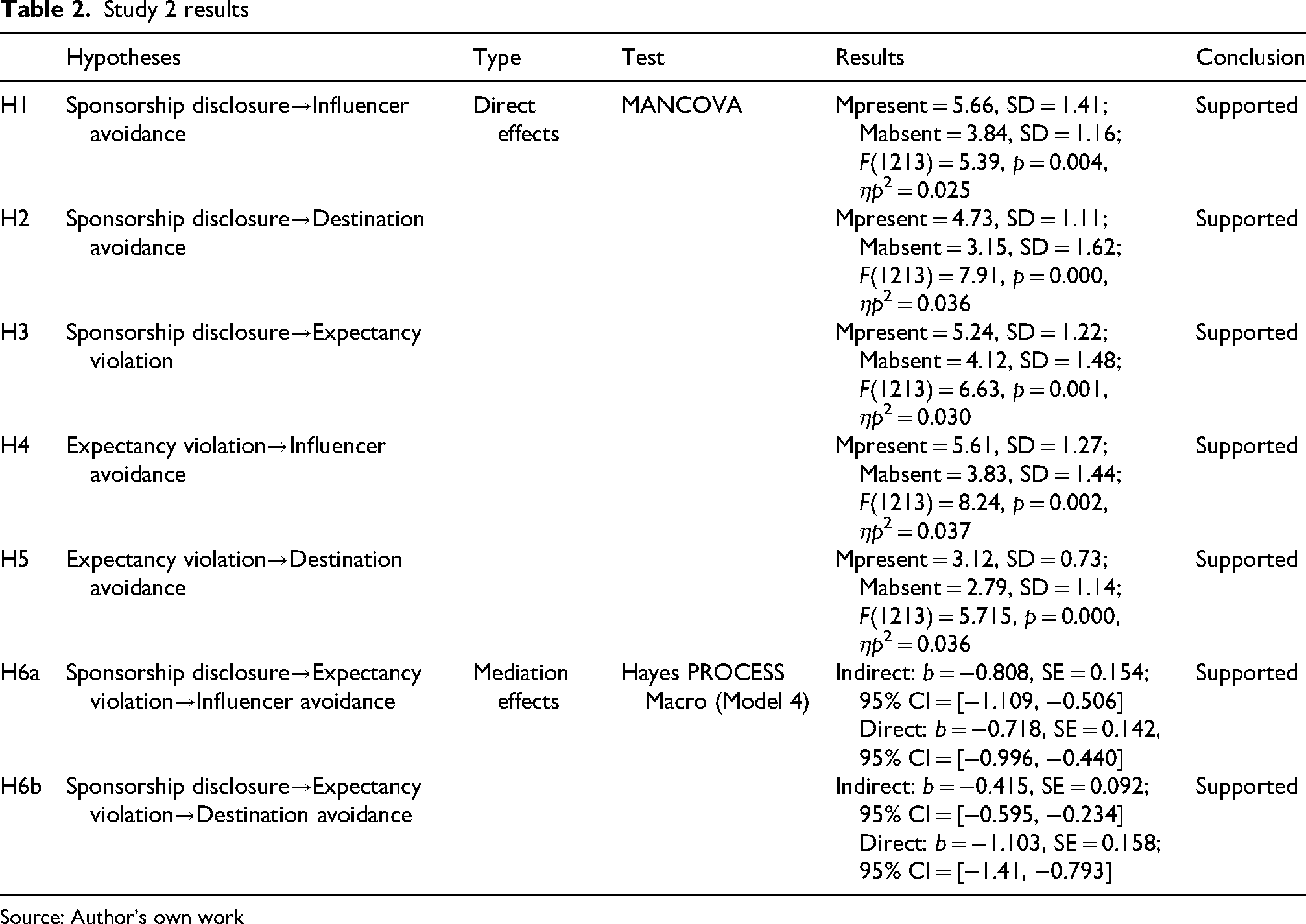
Source: Author's own work
Discussion
The results of Study 2 support the findings of Yan and Hua (2021) and revalidated the results of Study 1 to show that explicit sponsorship disclosure (vs. no disclosure) from a real and known travel influencer also affects social media users’ behavioral responses upon encountering paid promotions of tourism destinations. The mediating effects of followers’ expectancy violations were also re-established, elucidating that followers expect unbiasedness and honesty in travel influencers’ reviews and recommendations of tourism destinations. However, followers react adversely toward the influencers they follow when these expectations are transgressed and avoid traveling to the forcefully promoted destination. The results of this study further establish the generalizability and higher external validity of the findings.
Study 3
This study aims to conduct a cross-cultural insights validation of the findings of Study 1 and Study 2 with a real influencer. The study design was similar to Study 2.
Participants
A total of 188 Instagram users (with 11 participants removed for static responses or failing to meet the attention check) from India (47.34% female, 52.66% male), between the ages of 18 years and 40 years (average age = 26.85 years), participated in an online experiment created on Qualtrics Platforms. Each participant received compensation of INR 50.00 per response.
Stimulus, procedure, and measures
The participants were shown a stimulus of an actual travel influencer's Instagram post with a biography and a description similar to Study 2 (refer to Appendix 2). The study procedure and measurement scales were the same as in Study 2.
Analysis and results
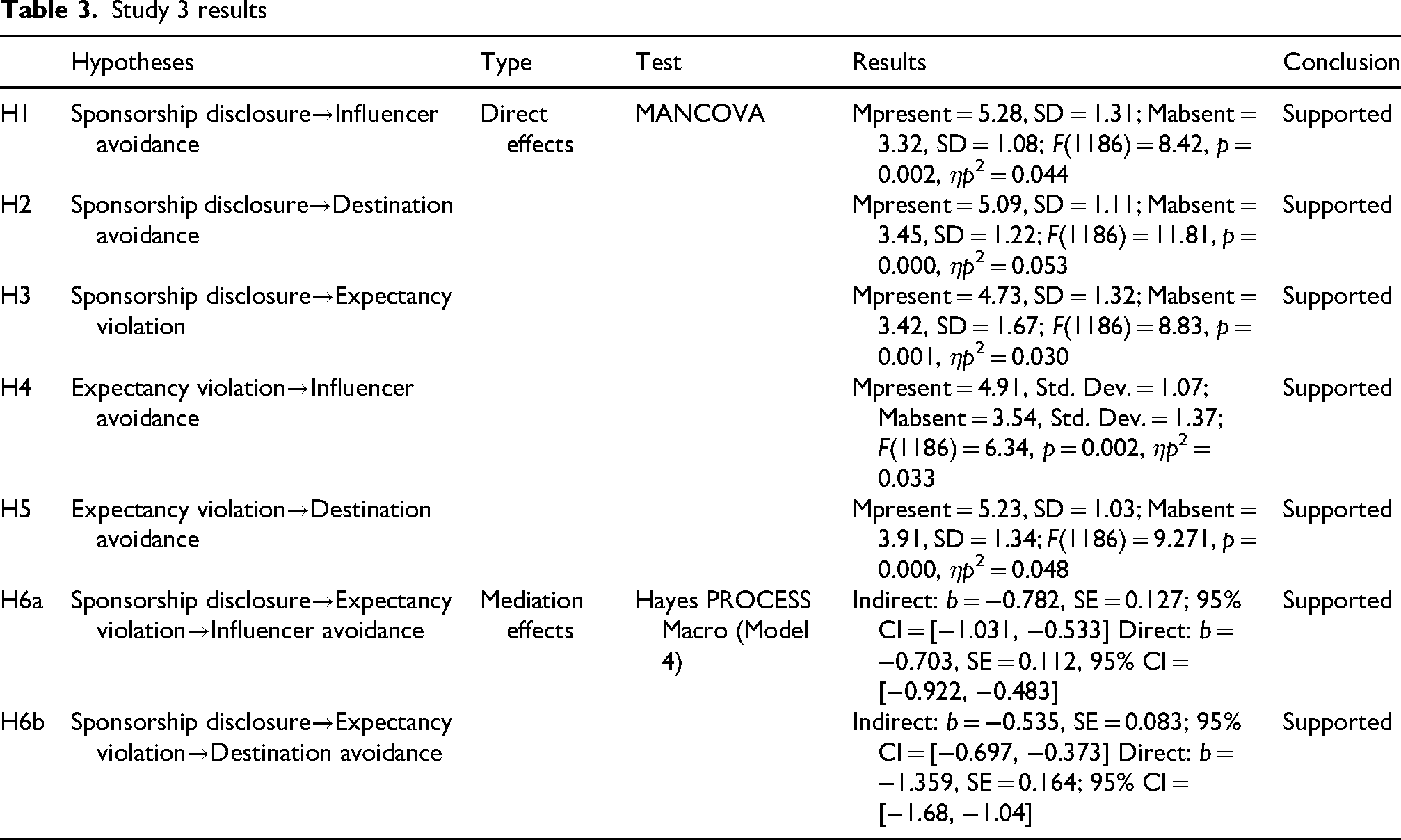
The data were tested using IBM SPSS 23 and employing Hayes Process Macro. The results demonstrated that influencer avoidance behavior increased in sponsorship disclosure present condition compared to no disclosure condition [Mpresent = 5.28, SD = 1.31; Mabsent = 3.32, SD = 1.08; F(1186) = 8.42, p = 0.002, ηp2 = 0.044 (indicating a small-to-medium effect size)]. Thus, H1 was supported. The direct effect of sponsorship disclosure present (vs. absent) condition on destination avoidance behavior was also found to be significant, supporting H2 [Mpresent = 5.09, SD = 1.11; Mabsent = 3.45, SD = 1.22; F(1213) = 11.81, p = 0.000, ηp2 = 0.053 (indicating a moderate effect size)]. The direct effect of sponsorship disclosure present (vs. absent) condition on follower's expectancy violation was also found significant, supporting H3 [Mpresent = 4.73, SD = 1.32; Mabsent = 3.42, SD = 1.67; F(1186) = 8.83, p = 0.001, ηp2 = 0.045 (indicating a small-to-medium effect size)]. Also, H4 was supported, showing a significant accentuating effect of expectancy violation on influencer avoidance [Mpresent = 4.91, Std. Dev. = 1.07; Mabsent = 3.54, Std. Dev. = 1.37; F(1186) = 6.34, p = 0.002, ηp2 = 0.033 (indicating a small-to-medium effect size)] and H5 was supported demonstrating a significant accentuating effect of expectancy violation on destination avoidance among followers of travel influencers [Mpresent = 5.23, SD = 1.03; Mabsent = 3.91, SD = 1.34; F(1186) = 9.271, p = 0.000, ηp2 = 0.048 (indicating medium effect size)]. Following Hayes Process Macro (Model 4), H6a [Indirect: b = −0.782, SE = 0.127; 95% CI = (−1.031, −0.533)]; Direct: b = −0.703, SE = 0.112, 95% CI = (−0.922, −0.483)] and H6b [Indirect: b = −0.535, SE = 0.083; 95% CI = (−0.697, −0.373); Direct: b = −1.359, SE = 0.164; 95% CI = (−1.68, −1.04)] were also supported, demonstrating the mediating effect of expectancy violation in the relationships between sponsorship disclosure and (a) influencer avoidance and (b) destination avoidance. Table 3 summarizes the results of Study 3.
Study 3 results
Discussion
The results of Study 3 corroborate and revalidate the findings of Study 1 and Study 2 in a cross-cultural context. The study illuminates that explicit sponsorship disclosure (vs. no disclosure) from a real and known travel influencer accentuates negative behavioral responses from social media users when they identify brand sponsorships of tourist destinations. Study 3 also adds to the generalizability of the mediating effects of followers’ expectancy violations in diverse cultural scenarios. Hence, the study establishes greater generalizability and external validity of the findings of the prior two studies.
General discussion and conclusion
The findings from the studies fortify that the identification of sponsorship disclosures leads to the recognition of paid promotions, thereby causing influencer and destination avoidance among social media users. Notable differences unfold between the fictitious and real influencer scenarios. Study 1 showed that sponsorship disclosure induced stronger avoidance behaviors in the case of a fictitious travel influencer. In the case of a moderately known real travel influencer in Study 2 and Study 3, avoidance behaviors were present but somewhat attenuated. These findings indicate that real travel influencers might benefit from pre-established trust and familiarity, which would somewhat offset the negative reactions from followers. However, the perceived breach in authenticity and originality would develop backlash from the followers of travel influencers and destination marketers.
Followers of travel influencers feel and respond negatively when influencers indulge in paid partnerships, violating their expectations and depleting the psychological contract between them. Thus, it is found that the nature of social media posts by travel influencers affects the attitudes and destination selection of their followers. This follows studies on brand consumerism (see Boerman et al., 2021; Evans et al., 2019; Jhawar et al., 2025). The study also indicates the importance of staying genuine as an influencer rather than trying to persuade followers toward unwarranted commercial transactions. Moreover, the considerations of credibility and authenticity in travel content are crucial because they affect multiple stakeholders in the traveler's household. Therefore, destination brands and travel influencers should focus on aligning and ensuring that sponsorships feel relevant and natural to the travel influencer's audience. Hence, a balance between brand partnership and content authenticity is essential for maintaining long-term influencer and destination attractiveness in tourism and destination marketing.
While Study 1 was conducted in the U.S. using a fictitious influencer to control for confounds, Studies 2 and 3 validated the findings using a real influencer across two different cultural contexts- the U.S. and in India respectively. By replicating the results across non-Western and Western cultures, this study confirms the generalizability of the individual's expectancy violation mechanism and the resulting avoidance behaviors (i.e., influencer and destination avoidance) across cultural settings. This cross-cultural insight is particularly relevant for the global nature of tourism marketing and adds to the digital marketing domain by delineating the responses of social media users from different cultural backgrounds toward influencer-brand collaborations in travel contexts.
Theoretical contributions
The research offers several theoretical contributions. First, this study contributes to prior literature by explaining the impact of brand-sponsored travel influencer promotions on social media users’ behavior. Studies in the influencer marketing domain have mainly emphasized either the effects of brand-controlled social media posts by influencers or the use of various disclosure techniques (such as disclosure timing, position, duration, etc.) (see De Jans et al., 2018; Jhawar et al., 2023). Furthermore, studies on consumer avoidance behavior have primarily focused on brands, products, and services domains. Contrastingly, this research examines the effects of the presence or absence of sponsorship disclosure tags on influencer avoidance and destination avoidance behavior of social media users, thereby illuminating the impact on newer horizons of tourism research. Thus, this study expands the discussion on avoidance behavior by amalgamating social media marketing in tourism. Hence, this study advances the comprehension of the impact of a degenerative episode (i.e., sponsorship disclosure) on interaction effectiveness in the social media-tourism interface.
Second, prior research indicates that social media users often need help distinguishing between organic and paid influencer recommendations (in travel, fashion, and other domains) (Audrezet et al., 2020; Cocker et al., 2021). Hence, sponsorship transparency becomes even more critical, highlighting the need for mandatory sponsorship disclosures for travel influencers. Moreover, ambiguous or hidden disclosures can harm the credibility of travel influencers. Also, paid promotion of tourist destinations induces adverse reactions as it might mislead travelers about the serenity and authenticity of the presented destination information.
Third, this study illuminates the underlying psychological mechanism of the travel influencer-follower relationship by elucidating that social media users’ expectancy violation fosters travel influencer and destination avoidance. Thus, this study investigates social media user expectancy violations in tourism, advancing the literary debate on influencer marketing-based consumer behavior in tourism. Furthermore, this study establishes the importance of travel influencer-follower trans-parasocial relationships and social exchange. The findings reveal that expectancy violations can diminish followers’ trust in the travel influencer's destination recommendations, further eroding the relational commitment. Thereby, this research unravels the nuances of the socio-emotive nature of the travel influencer-follower relationship, exploring tourism consumer disbandment from a psychological lens.
Fourth, the results present novel and intuitive findings showing that social media users are likelier to penalize sponsored travel influencers and promoted destinations. Thus, this research contributes by adopting tourism consumer behavior as a cornerstone to understanding the evolution of communication source-receptor connection in a tourism context. This study further enhances our understanding of the sparsely studied grey side of influencer marketing (i.e., the adverse effects of social media influencer recommendations and posts) in the tourism domain (Jhawar et al., 2024).
In sum, this research advances the influencer marketing literature across the tourism domain by focusing on the confluence of sponsored promotions by travel influencers, followers’ advertisement literacy, and communicator-recipient relationship value, thereby effectively elucidating the underlying psychological mechanisms of tourist's decision-making.
Managerial implications
This research offers several key insights for tourism managers who engage in influencer marketing. First, travel and tourism managers should appreciate that travel social media influencers are predominantly content creators. Followers value them for their genuine reviews and recommendations of tourist destinations. Therefore, creating authentic and informative travel content is essential for advocating tourist destinations.
Second, the findings elucidate that the recognition of explicit sponsorship disclosures triggers influencer avoidance and destination avoidance behavior in individuals due to the violation of expectancy of unbiased content from them. Therefore, destination marketing managers should partner with those travel influencers perceived as authentic and trustworthy. Also, the image of these travel influencers should be aligned with the destination brand image to lessen followers’ expectancy violation even when explicit sponsorship disclosures are present.
Third, since tourism consumers on social media are increasingly able to recognize brand-paid or covert advertisements owing to growing advertising literacy and mandatory sponsorship disclosure tags, destination brands should be wary of imposing excessive control over travel influencers’ social media posts. Therefore, the credibility of both the travel influencer and the destination brand should be prioritized over commercial benefits.
Fourth, travel influencers and tourism brand managers should comprehend that when tourism consumers encounter brand-sponsored content in social media posts, they might feel psychologically violated, instigating adverse behavioral consequences. This arises from expecting unbiased and genuine travel recommendations from the travel influencers they follow. If the influencer-follower relationship is perceived as compromised due to paid promotion of destinations, the influencer and the endorsed destination may face reactance and avoidance. So, travel and tourism managers need to ensure that the partnership does not appear as a violation of trust. For this, destination marketers must carefully frame the disclosure tags. For instance, tags like “#partnerdwith (destination name) instead of standard tags such as #sponsored, #paidpartnership, or #ad could help mitigate perceptions of pure brand control and commercial intent.
Fifth, travel and tourism managers must strictly adhere to the mandatory sponsorship disclosure guidelines to avoid penalties and ethical and legal complications. Openness and honesty in all social media communications would ascertain the integrity of the travel influencer and the destination brand.
Lastly, even though disclosing sponsored content is necessary for travel influencers to comply with advertising agency guidelines (such as FTC and ASCI), the manner of sponsorship disclosure matters. Managers should emphasize narrative authenticity (for example, honesty declarations or expressing genuine recommendations alongside “#sponsored or #ad” tags) in influencer's sponsored content by using personal experiences sharing or storytelling approach to mitigate avoidance and maintain influencer-follower trust. Also, sustainable influencer-follower relationships must be built on the grounds of transparency, authenticity, and emotional connection, which will garner positive WOM for destination brands despite the increasing advertising literacy.
In summary, this research illuminates that destination marketing managers and organizations must emphasize communication transparency and authenticity to maintain credence and mitigate unfavorable reactions from social media users. Also, they must manage influencer-follower relationships cautiously and proactively address follower concerns regarding influencer-brand partnerships.
Limitations and future research directions
This study is not devoid of some limitations. First, scenario-based online experiments restrict our control over respondents’ self-selection and biases. Future studies can opt for more robust research mechanisms like controlled lab experiments and lab-based facial or eye-tracking instruments that measure participants’ visual attention unobtrusively and accurately. Thus, greater generalizability of results can be established. Second, the hypotheses of this study have been tested using an experimental approach. Future research could employ exploratory or qualitative methods to understand the basic foundations of social media users’ responses toward social media posts by travel influencers. Third, this research is restricted to travel influencers’ Instagram posts. Future studies could compare social media users’ reactions to travel influencers’ posts on other platforms (such as YouTube, Facebook, Snapchat, Twitter, etc.). Fourth, this study investigates the phenomenon in the travel and tourism domain, which could be expanded and explored in the hospitality and hotel sector. Fifth, this study analyzes the impact of sponsorship disclosure tags on travel influencer avoidance and destination avoidance. Future studies could broaden the scope of investigation by examining other antecedents such as perceived travel influencer authenticity, perceived influencer-destination fit, perceived commercial orientation, etc., and exploring the effects on consequences like follower stickiness with the travel influencer, intention to follow, destination love/hate, etc. Sixth, the mediating impact of credibility, psychological contract violation, or symbolic incongruity could be examined further. Lastly, future studies could investigate intervention strategies to mitigate or subdue follower alienation from travel influencers and destinations.
Footnotes

Funding
The author received no financial support for the research, authorship, and/or publication of this article.
Declaration of conflicting interests
The author declared no potential conflicts of interest with respect to the research, authorship, and/or publication of this article.
Data availability
The data supporting this study's findings are available on reasonable request from the corresponding author.
Author biography
Appendix 1. Stimulus material for Study 1
Sponsorship disclosure present condition (female)
Sponsorship disclosure absent condition (female)
Sponsorship disclosure present condition (male)
Sponsorship disclosure absent condition (male)
Source: Author's own work
Appendix 2. Stimulus material for Study 2 and Study 3
Sponsorship disclosure present condition (female)
Sponsorship disclosure absent condition (female)
Sponsorship disclosure present condition (male)
Sponsorship disclosure absent condition (male)
Source: Author's own work