







Abstract
Local food, as a key tourism resource in agricultural heritage sites, reflects traditional lifestyles and human–nature relationships. The growing influence of social media, particularly TikTok, has transformed the interaction between local food and tourism, yet this transformation remains insufficiently understood. Using the Xinhua Ziquejie Terraces, a Globally Important Agricultural Heritage System (GIAHS) site in China, as a case, this study explores an emerging phenomenon: farmers acting as rural influencers who promote local food through social media. Adopting a qualitative case study design informed by ethnographic and netnographic principles, it draws on 107 TikTok videos, shadowing with an influencer and 22 interviews, employing multimodal discourse and reflexive thematic analysis to examine how local food is digital mediated and experienced in the heritage site. Findings reveal three interrelated processes. First, rural influencers derive legitimacy from local resources, positioning local food as the core material of digital production. Second, through multimodal curation involving text, image, sound, and interaction, the local food is mediated and transferred into emotional narratives, social identities, and tourism value. Third, audience engagement operates as a networked feedback mechanism that co-configures production practices, tourism imaginaries, and livelihood strategies, illustrating how tangible food products and intangible heritage meanings are relationally mobilized. The study advances understanding of agricultural heritage tourism by linking food and influencer studies, framing rural influencers as active agents in the co-creation of heritage. It also shows how social media can foster rural tourism transformation and destination marketing innovation through food heritage, digital storytelling, and community participation.
Introduction
The Food and Agriculture Organization of the United Nations (FAO) introduced the Globally Important Agricultural Heritage Systems (GIAHS) initiative at the 2002 World Summit on Sustainable Development (FAO, 2023; Min et al., 2016). Since the designation of the first pilot sites in 2005, 102 systems across 29 countries have been recognized for their adaptive management of biodiversity, ecosystems, and landscapes through traditional and evolving practices (FAO, 2025b). Framed within global heritage discourse, GIAHS not only safeguards biocultural diversity but also provides context-specific responses to sustainability challenges such as the UN Sustainable Development Goals (Zhao et al., 2021), agroecology (Wang et al., 2021), and agrobiodiversity (Agnoletti and Santoro, 2022). At the same time, these systems enhance community livelihoods and well-being by promoting rural tourism, strengthening heritage interpretation, and supporting the identification and conservation of cultural and ecological values (Su, Dong et al., 2020a; Sun et al., 2011). To ensure the sustainable and adaptive development of GIAHS, a dynamic conservation framework has been proposed (FAO, 2018; Koohafkan et al., 2011). This framework integrates the assessment of emerging threats, the active engagement of stakeholders (FAO, 2018), and the systematic unpacking of internal components to understand how these elements interact and evolve within processes of development and conservation.
Within the GIAHS framework, food is recognized as both a primary condition for site designation and a central component of heritage value, serving as a medium that links ecological practices, cultural traditions, and community livelihoods (FAO, 2017; Min et al., 2016; Tian et al., 2016). While the significance of food for food security and as a carrier of heritage values is widely acknowledged in research (Min et al., 2016; Yang et al., 2021), its role is often overlooked and marginalized under action plans that prioritize the marketing of agricultural products, the promotion of agro-tourism and eco-tourism, and the staging of cultural activities and local cuisines (FAO, 2018). In practice, however, food has been showcased as a distinctive dimension of agricultural heritage. For example, at the First FAO Global Exhibition From Seeds to Foods, food was presented as a core tangible component through cooking demonstrations, tastings, and cultural displays (FAO, 2025a). This highlighted the practical recognition of food as a gateway to heritage interpretation and innovation within living systems, while also demonstrating its potential for tourism development as both a pillar of destination marketing and a foundation for experience design at heritage sites. Nevertheless, although food has been examined in broader tourism contexts, particularly in relation to gastronomy (Kivela and Crotts, 2006), authenticity (Sims, 2009), destination branding (Du Rand and Heath, 2006), and visitor experience (Park and Widyanta, 2022), its specific role within agricultural heritage tourism has not been sufficiently theorized. Too often, food is addressed only implicitly or in a fragmented manner, embedded within broader discussions of biodiversity, landscape management, or rural livelihoods (Bai et al., 2024; Su et al., 2020a; Wang et al., 2021). Therefore, there is a need to re-examine and systematically conceptualize the role of food within agricultural heritage tourism.
In recent years, with the rapid rise of social media and digital platforms, new opportunities have emerged for destination marketing, heritage tourism management, and broader audience engagement (Ghermandi et al., 2020; Harrigan et al., 2017; Wei et al., 2025). In rural areas where GIAHS are rooted, digital influence is reshaping local practices and communication. On TikTok, through hashtags such as FarmTok or AgTok, farmers used the platform to showcase agricultural practices, promote local food, and represent rural identity (EuropeanCommission, 2025; Walling and Bickel, 2025). In China, the term “new farmers” describes entrepreneurial or returnee actors involved in rural revitalization (Duan et al., 2023), but it remains distinct from the broader phenomenon of rural influencers. Emerging studies highlight how farmers build digital empathy around climate change and how TikTok fosters new forms of farmer–consumer interaction, especially in promoting agricultural products (Jin et al., 2023; Unay-Gailhard et al., 2023). These developments show that farmers are increasingly acting as influencers. Moreover, younger digital engagement may help counter the challenges of aging farmers and rural youth outmigration, both of which threaten the sustainability of GIAHS (FAO, 2023; Nath et al., 2024; Unay-Gailhard and Brennan, 2023). Yet there is still no consensus or mature academic definition of “rural influencers,” with existing discussions largely descriptive and case-based. There is therefore a pressing need to conceptualize rural influencers as an emerging phenomenon within agricultural heritage tourism, particularly in relation to local food, heritage interpretation, and community sustainability.
This study investigates the Xinhua Ziquejie Terraces in China, a GIAHS site where the rural influencer uses TikTok to promote local food heritage. It conceptualizes rural influencers as cultural curators and examines how their digital food narratives mediate agricultural heritage tourism. Specifically, it asks: (1) Why does the rural influencer engage in promoting local food within agricultural heritage sites? (2) How is the local food narrative curated and communicated through social media? (3) How do digital food narratives created by the rural influencer shape the practices, perceptions, and outcomes of agricultural heritage tourism? By addressing these questions, the study contributes to the conceptualization of rural influencers, advances understanding of how local food heritage is digitally narrated, and offers practical insights for heritage conservation, rural livelihoods, and tourism management within agricultural heritage tourism.
Literature review
Food and residents in agricultural heritage sites
For centuries, farmers, herders, fishers, and foresters have developed diverse and locally adapted agricultural systems, sustained through time-tested and ingenious practices (FAO, 2018; Nath et al., 2024). As living testaments to the co-evolutionary relationship between humans and nature, these systems have gradually taken shape through centuries of cultural and biological interaction, providing essential social, cultural, ecological, and economic services for human societies (FAO, 2018; Howard et al., 2008; Koohafkan and Altieri, 2011). To address the threats of climate change and growing competition over natural resources, and in recognition of the extraordinary value of such traditional agricultural practices, GIAHS was launched (FAO, 2018, 2023). Central to these value systems is the acknowledgement that they contribute to food and sustain livelihood security for millions of smallholder farmers (FAO, 2017; Min et al., 2016; Yang et al., 2020).
Thus, within the nexus of GIAHS and broad agricultural practice, food serves multiple and interconnected functions that transcend its material role. Yet, the lack of systematic synthesis has meant that its significance is often fragmented in existing research. Drawing on current studies and practice, these roles can nevertheless be delineated across four key dimensions. Firstly, food functions as a fundamental resource that provides nutrition, meets dietary needs, sustains daily life, and supports the health and well-being of local populations (FAO, 2012; Min et al., 2016). Secondly, it constitutes the basis of rural livelihoods. Through production, sharing, exchange, and market transactions, food links farming households to local and regional economies, thereby reinforcing both income generation and community resilience (Nath et al., 2024; Su et al., 2020a; Yang et al., 2020). Thirdly, food embodies biodiversity, acting as a living gene bank that preserves traditional varieties and contributes to long-term food security in the face of global environmental change (FAO, 2018; Tian et al., 2016). Finally, food is embedded in cultural life, shaping agricultural festivals, ritual practices, and culinary traditions, while the cultivation and preparation of distinctive local crops and dishes reinforces cultural identity and provides attractive resources for tourism (FAO, 2025a; Nath et al., 2024).
Meanwhile, as the backbone of GIAHS, smallholder and family farmers are inseparable from the soil they cultivate (Che, 2015; FAO, 2018), and their practices reinforce the food relations that underpin heritage systems. However, existing research often treats food and residents in isolation—food is examined primarily as an ecological or cultural asset, while residents are framed merely as stakeholders or beneficiaries (Bai et al., 2024; Svensson et al., 2023). Although the importance of both food and residents is acknowledged in GIAHS selection criteria and dynamic conservation strategies (FAO, 2017; Koohafkan et al., 2011; Min et al., 2016), the ways in which residents’ identities and agencies shape the co-creation of heritage value around food remains largely overlooked. Studies on food memory further suggest that communities actively imbue food with cultural meaning through everyday culinary practices, emphasizing that residents are not passive participants but active interpreters and curators of heritage (Lee, 2023). Recognizing the inseparability of food and resident actors is therefore essential, which grounds heritage in lived practice and provides a more coherent basis for analyzing how food can be mobilized within agricultural heritage conservation and development.
Local food in agricultural heritage tourism
Food has long been recognized as a key driver of tourism development (Ellis et al., 2018; Rousta and Jamshidi, 2020). It functions as an essential motivation for destination choice, shapes visitor experiences and consumption practices, and serves as a vital tool for destination marketing (Choe and Kim, 2018; Seo et al., 2017; Shi et al., 2022). In recent years, food and culinary tourism have become prominent areas of research, describing not only tourists who travel primarily to experience the food of a specific culture or region, but also the diverse ways in which food contributes to tourism practices and potentials (Ellis et al., 2018; Sio et al., 2024). Within this literature, attention has been directed toward different types of food, such as local, traditional, or ethnic cuisines, each of which motivates distinct forms of tourism demand and destination development (Aziz et al., 2025; Bessiere and Tibere, 2013; Sims, 2009). Among these categories, local food, defined as food grown or produced in a local area (Kim and Choe, 2019), is recognized for its potential to contribute to sustainable tourism across economic, environmental, and social dimensions (Estrada et al., 2024; Sims, 2009). The place-based nature directly links local food to landscapes, farming practices, and biodiversity, making it not only a marker of destination identity but also closely connected to agricultural heritage systems and to terroir-based gastronomy.
The GIAHS Action Plan for Dynamic Conservation highlights several key components, including the marketing and promotion of agricultural products, the development of agro-tourism, eco-tourism, and cultural activities, and the involvement of local farmers in decision-making processes (FAO, 2017). While these measures are valuable, they remain insufficient for capturing the complex and multi-dimensional nature of agricultural heritage systems, particularly the constitutive role of food in shaping both tourism and community livelihoods. Tourism is widely regarded as a pathway for dynamic conservation in agricultural heritage systems (Min et al., 2016; Sun et al., 2011). Yet, disciplinary perspectives differ between agricultural scholars tend to view agricultural heritage tourism (AHT) as a strategy for economic diversification, whereas tourism researchers frame it primarily as an attraction (Sun et al., 2019; Tian et al., 2016). Theorization of AHT has primarily drawn on sustainability frameworks, the discourse of heritagization, and place-based approaches, positioning it at the intersection of biodiversity conservation, cultural transmission, and community livelihoods (Agnoletti and Santoro, 2022; Su, Sun et al., 2020b; Tian et al., 2016). To date, research has largely emphasized landscape value, traditional farming practices, and community participation as the central anchors of AHT (Farsani et al., 2019; Sun et al., 2011), while local food and its role as both a heritage and tourism resource have received comparatively less systematic attention.
Debates on strategies for AHT are shifting, as evidence shows that relying on heritage designation as a marketing tool is increasingly inadequate (Tian et al., 2016; Zhang, 2022). Under the lens of authorized heritage discourse, it has been questioned whether such recognition delivers tangible benefits to local communities. Emerging research further indicates that tourists are primarily drawn to resource-based attractions and scenic experiences, rather than the heritage label or brand per se (Zhang, 2022). Against this shift from label-driven marketing to recourse-based attraction, local food emerges as a tangible and experiential dimension of agricultural heritage, engaging tourists while enhancing community livelihoods. Evidence from GIAHS sites in Japan shows that farm-stay and agro-tourism activities have been strengthened by the availability of high-quality, organic, and locally distinctive foods, which are able to fetch premium prices (Nath et al., 2024). Similarly, at the Samba Rice Terraces in China, food-centered initiatives such as the sale of organic agricultural products, the tasting of local dishes, and farming experiences constitute the core of tourism business models for local operators (Zhang, 2022).
While local food clearly demonstrates potential for boosting tourism in agricultural heritage sites, it does not represent an uncontested or sufficient solution. It was found that GIAHS certification has not necessarily increased the value of agricultural products in terms of price or volume, particularly in sites located far from major consumer markets (Kohsaka and Uchiyama, 2016). This raises the unresolved question of whether food strategies should focus on pushing products outward to external markets or pulling consumers inward through tourism. Moreover, the involvement of residents in the food-related value chain of agricultural heritage tourism is uneven, with benefits often distributed unequally. For instance, the case of the Samba Rice Terraces illustrates that despite the considerable potential of food-centered initiatives, many local residents remain excluded from tourism activities due to limited initial investment, insufficient education, and restricted understanding of market opportunities (Zhang, 2022). Such exclusion contradicts the ideal of encouraging villagers to return and participate in heritage-based tourism. As a result, food alone has not provided adequate incentives for young people to remain in or return to farming, nor has it offered viable solutions to the widespread challenges of aging farmers and agricultural depopulation that GIAHS sites face globally (FAO, 2023; Nath et al., 2024; Zhang, 2022).
Thus, while acknowledging the crucial role of local food in agricultural heritage tourism, addressing the persistent challenges requires approaches that move beyond top-down strategies relying solely on certification-based branding or the resource-based attraction of food. What is needed is the active involvement of residents in shaping how food is narrated, mediated, and communicated. Such participation not only revitalizes food heritage and connects it with wider audiences but also embeds it within innovative forms of community engagement. Exploring these new spaces has the potential to improve local well-being and to empower residents to articulate the value of food. In doing so, it opens space for alternative heritage discourses that acknowledge traditions and concepts beyond the boundaries of authorized narratives, while also pointing to more inclusive and innovative pathways for the future development of agricultural heritage tourism.
Rural influencers, digital mediation and value network in agriculture heritage tourism
Social media has transformed the tourism industry by enabling destinations to reach broader audiences and engage with potential visitors in real time (Jansson, 2018; Zeng and Gerritsen, 2014). The visual affordances of social media platforms such as Instagram, TikTok and YouTube allow destinations to showcase landscapes, cultural practices, and local food through compelling imagery and short videos, thus reshaping how tourists imagine and select destinations (Babalou et al., 2025; Mele et al., 2021; Munar and Jacobsen, 2014). Within digital environments, two analytically distinct yet often overlapping categories of actors have emerged: content creator and online influencer (Kozinets et al., 2023). Content creators are individuals who use digital tools to produce and share original, stylistically distinctive media within specific domains of interest, such as fashion, gaming, or travel (Tafesse and Dayan, 2023; Valsesia et al., 2020). Their value lies in creativity, authorship, and niche expertise. Online influencers, in contrast, derive their value primarily from social capital. They influence audience attitudes, behaviors and consumption through relational trust and perceived authenticity (Leung et al., 2022; Wang and Chan-Olmsted, 2024). As opinion leaders in digital communities, influencers often engage in personality-centered content and brand collaboration. However, the boundaries between these two digital actors remain fluid and contingent upon platform structures and relational forms of engagement. While every influencer engages in content creation as part of their online presence, not every content creator functions as an influencer in the sense of cultivating relational influence or shaping audience behaviors (Kozinets et al., 2023; Tafesse and Dayan, 2023). The distinction lies not merely in activity but in intent, audience engagement, and the mechanisms of value generation. As creators accumulate substantial follower bases, many begin to adopt influencer-like practices, transitioning into hybrid roles that combine creative production with social influence. This convergence gives rise to what some scholars describe as a “creator–influencer” identity, reflecting the evolving dynamics of digital labor and self-branding (Chen and Hsieh, 2024; Libai et al., 2025).
Building on the general distinction between creators and influencers, such hybridity becomes particularly salient in rural settings where agricultural heritage intersects with tourism. Although the rural influencer has yet to be systematically conceptualized, it has already been defined in existing studies as a research object, referring to individuals from rural areas who build influence on social media by centering their content on rural, agricultural, or local lifestyles (Riley and Robertson, 2021; Shuang, 2023). Recent scholarship increasingly positions rural influencers as digitally empowered agents who reconfigure rurality through social media. Their practices span four interrelated dimensions. First, issue-oriented content often shared under hashtags like FarmTok and AgTok, frames farming as a site of environmental advocacy, mobilizing empathy and ecological awareness through affective storytelling (Phillips et al., 2021; Unay-Gailhard et al., 2023). Second, younger farmers use digital platforms to reconstruct professional identities and challenge outdated perceptions of agriculture. This engagement fosters pride, supports youth return migration, and enhances work motivation, though identity tensions remain (Holton et al., 2023; Unay-Gailhard et al., 2023). Third, short-video platforms like TikTok have reshaped agricultural marketing by enabling direct, real-time interaction between farmers and consumers. Livestreaming fosters trust and emotional connection, enhancing product visibility and rural market access (Al-Shaikh et al., 2023; Jin et al., 2023). While this digital commerce diversifies income and supports rural revitalization, it also introduces tensions between authenticity and performativity, raising concerns about sustainability and algorithmic dependency (Bhowal et al., 2022). Finally, rural influencers curate symbolic imaginaries of the countryside that portray it as natural, nostalgic, and morally pure, shaping how agricultural heritage is represented and consumed in digital tourism landscapes (Ma, 2023; Wang and Wang, 2025). Collectively, these dynamics position rural influencers as cultural intermediaries who rearticulate heritage, identity, economy, and representation in the digital age.
Although scholarship on rural influencers remains fragmented, existing research suggests that they should not be understood merely as extensions of influencer culture, but rather as actors embedded within broader processes of value creation in agricultural heritage tourism (Bonacchi et al., 2023; Ma, 2023). Concerns of food in agricultural heritage tourism, value has traditionally been conceptualized through a value chain logic (Porter and Advantage, 1985). Successful food tourism value chains depend on a consistent supply of local agricultural products (Wondirad et al., 2021), and their effectiveness relies heavily on the active participation of local farmers and communities (Agyeiwaah et al., 2019; Stone et al., 2019). Particularly in rural regions, the value chain approach has been regarded as a useful analytical tool for understanding how local actors engage in tourism value chain by providing agricultural and livestock products to tourism facilities, engaging in agro-processing, and showcasing local farming to tourists (Anderson, 2018). However, as scholarship tracing the evolution from value chains to value networks suggests (Ricciotti, 2020), contemporary value creation increasingly depends on collaboration, intangible assets, flexibility, and digitally mediated interactions rather than purely linear production processes. Digitalization and dematerialization reshape how value is generated, shifting attention from the transformation of tangible goods to the circulation of symbolic, relational, and experiential assets.
The growing role of social media and rural influencers further reconfigures traditional value structures. Rather than occupying a fixed promotional position at the end of a production chain, rural influencers operate as nodal participants within evolving value networks. Through food-centered storytelling and everyday agricultural practices, they connect agricultural production, cultural heritage, digital representation, tourism imaginaries, and livelihood strategies (Riley and Robertson, 2021; Shuang, 2023). Their ongoing interactions with farmers, consumers, local institutions, and digital platforms demonstrate that value emerges through collaboration, mediation, and reinterpretation rather than through sequential value addition alone (Al-Shaikh et al., 2023; Libai et al., 2025). Therefore, conceptualizing rural influencers within a value network framework therefore provides a more robust analytical lens for understanding how agricultural heritage, local food, and tourism are co-produced in digitally mediated environments. Meanwhile, responding to calls to develop media theory beyond persistent urban bias (Hobbis et al., 2023), rural influencers can be understood not merely as communicators, but as embedded actors within heritage value networks. This perspective accommodates the integration of tangible and intangible assets (Ricciotti, 2020), recognizes shifting actor roles, and foregrounds the co-creative dynamics that characterize contemporary agricultural heritage tourism. Through their practices, heritage is not only preserved but actively interpreted, circulated, and sustained within networked socio-digital systems.
Methodology
Research paradigm and design
This study is situated within an interpretivist paradigm, aiming to understand how rural residents engage with digital media to mediate agricultural heritage, food, and tourism. Rather than pursuing statistical generalization, the research adopts a qualitative case study design informed by ethnographic principles, privileging thick description, contextual insights, and interpretive depth (Denzin and Lincoln, 2011; Stake, 1995). Central to this approach is the recognition that digital and physical practices are deeply intertwined, thus, unpacking the interplay between online representations and offline lived experiences is essential for understanding how heritage and identity are co-constructed within rural socio-cultural and material conditions.
To address this, the study integrates netnography as a core analytical lens. Netnography extends traditional ethnography into digital spaces, treating online interactions, content, and communities as meaningful cultural texts (Kozinets and Gretzel, 2024; Mkono and Markwell, 2014). It enables researchers to engage with the virtual dimensions of everyday life, capturing how social media users participate in the circulation and reinterpretation of local foodways and agricultural heritage. Unlike passive observation, netnography involves immersive and reflexive engagement with digital environments, allowing for a nuanced reading of how online narratives both reflect and reshape offline realities (Mkono and Markwell, 2014).This is especially pertinent in rural tourism settings, where digital storytelling plays a key role in constructing place-based imaginaries and mobilizing community participation.
Complementing this digital orientation, the study draws on ethnographic strategies such as shadowing and interviews to ground the analysis in lived practice. Shadowing is a qualitative research method that involves closely observing participants while they engage in their everyday activities, with the researcher adopting a mobile, following position rather than conducting fixed interviews or observations (Czarniawska-Joerges, 2007). Unlike traditional participant observation, shadowing focuses on tracing the flow of actions, decisions, and interactions, allowing researchers to capture how practices unfold dynamically in context (McDonald, 2005). This method is particularly suited to resident influencers, whose online personas are not isolated performances but are deeply embedded in local rhythms, labor, and cultural values. Meanwhile, interviews provide dialogic spaces for eliciting multiple perspectives, enabling the study to move beyond the influencer's curated self-presentation and incorporate broader reflections on community, heritage, and tourism. Together, these methods foster a holistic understanding of how digital mediation operates within and contributes to the cultural ecology of rural life.
Case selection and justification
This study focused on the digital mediation of agricultural heritage, food, and tourism through the lens of a single influencer operating on TikTok (Douyin) within the agro-heritage landscape of the Xinhua Ziquejie Terraces, a mountainous rice-farming region in Hunan Province, China. The selection of this case is guided by both theoretical relevance and analytical depth, rather than representativeness or generalizability (Flyvbjerg, 2006; Seawright and Gerring, 2008).
Xinhua Ziquejie Terraces offer a compelling site for examining the intersection on heritage, food and tourism. Located in Xinhua County, Loudi City, Hunan Province, China (110°52′–111°00′E, 27°28′–27°45′N), Xinhua Ziquejie Terraces covering an area of 53.3 km2 and spanning the three towns of Shuiche, Fengjia, and Wentian. Built along the mountains, the terraces are primarily distributed at elevations between 500 and 1000 meters, with slopes ranging from 30° to 50° (see Figure 1). Recognized as GIAHS as a part of Rice Terraces in Southern Mountainous and Hilly areas by FAO and designated as a national AAAA tourist attraction (see Figure 1 (a)), the terraces embody a centuries-old rice cultivation system that integrates crop rotation (see Figure 1(b) and (c)) and livestock practice, which sustain both subsistence and commercial food production. In recent years, this region has undergone a significant transformation, with local livelihoods shifting from outmigration to tourism and food-related enterprises (see Figure 1(d)). This evolving socio-economic landscape makes Ziquejie a fertile ground for exploring how rural residents reframe the agricultural heritage and promote the sustainable development.
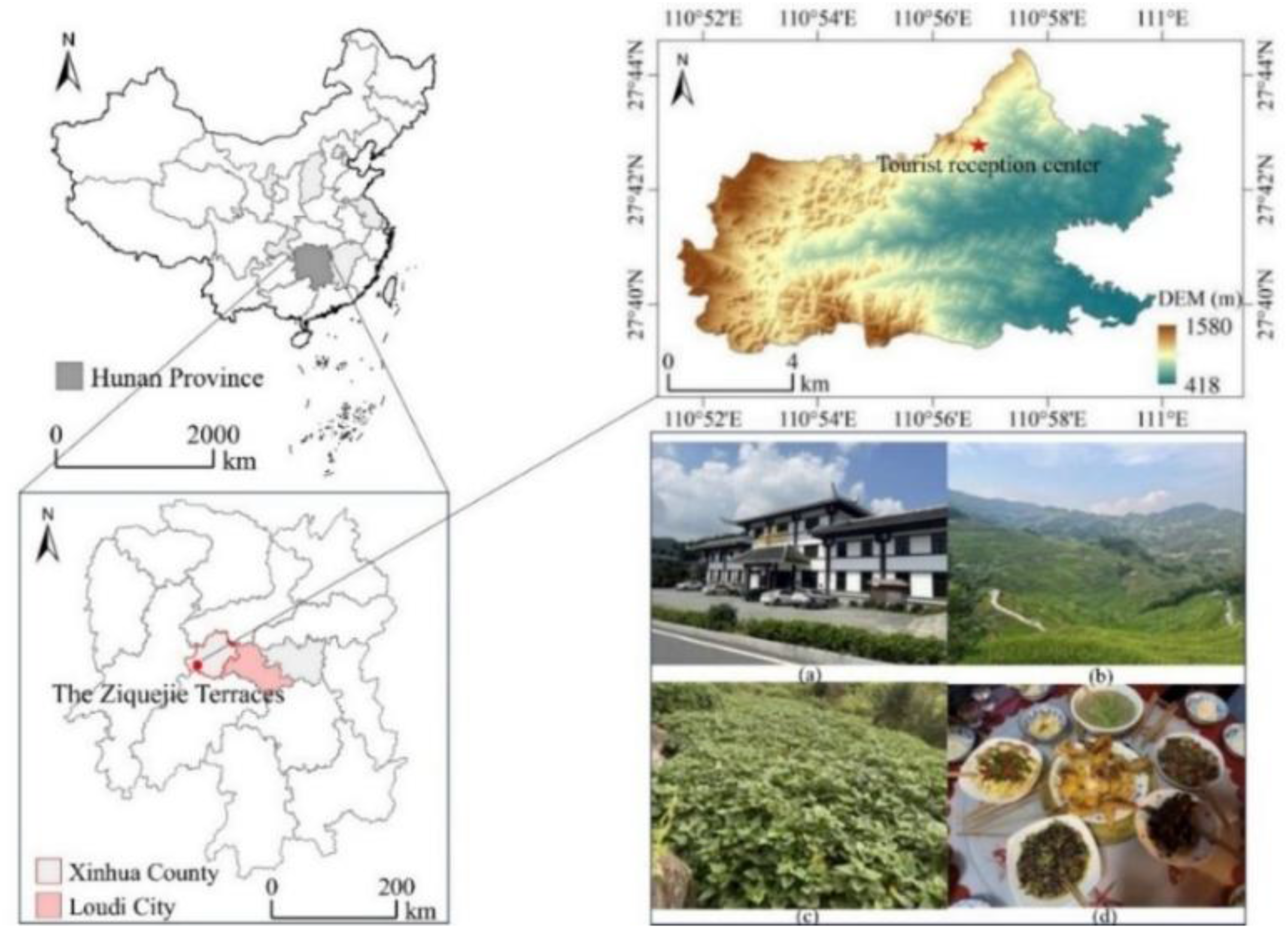
Geographic location of Xinhua Ziquejie Terraces.
This study is situated within a broader proliferation of rural short videos in China, where TikTok has emerged as the dominant platform. TikTok, domestically known as Douyin, was developed by ByteDance and launched in 2016. It has since become the dominant short video platform in China, with ∼766.5 million monthly active users in 2025 (Statistics, 2025), underscoring its central role in the country's mobile short-video ecosystem. TikTok functions as a digital infrastructure that integrates entertainment, e-commerce, live streaming, education, and brand marketing, and has become particularly influential in rural livelihood and media environments (Jin et al., 2023). Within the sannong (agriculture–rural–farmers) category, between September 2024 and September 2025, TikTok reported the release of 1.36 billion rural-related videos, more than 95,000 creators surpassing 10,000 followers, and 10.2 billion agricultural product sales through its e-commerce function—a 38% year-on-year increase. During the same period, 3.85 million rural destinations were featured on the platform (ByteDance, 2025). These figures demonstrate that rural creators have become central actors in shaping public narratives around food and heritage. TikTok's algorithmic visibility, interactive features, and commercial affordances make it an ideal platform for studying how rural content is produced, circulated, and consumed.
The growing use of digital platforms by rural actors to mediate heritage and tourism is also evident in the Ziquejie Terraces, where official accounts and local residents increasingly use TikTok to promote food practices, heritage, and tourism. Notably, the most influential account is not the official one, but a personal account managed by returning resident Mr Zou (see Figure 2). The decision to focus on a single influencer, Mr Zou, is both strategic and theoretically grounded. Created in November 2022, Zou's TikTok account garnered 124,000 followers and sustained engagement by August 2024, functioning as a macro-influencer (Campbell and Farrell, 2020) and most prominent digital voice in the Ziquejie region. His trajectory reflects the profile of the so-called “new farmers” (xin nongren), a popular term adopted by the Chinese government, state media, and e-commerce platforms to describe rural returnees who leverage digital technologies to create agriculture-related businesses. Zou returned from urban employment and became embedded in the growing ecology of rural creators on TikTok, positioning him as an exemplar of this national trend. Besides, his short-video practices have received official recognition, signaling the increasing visibility of rural influencers in policy and public discourse. Zou's content directly aligns with the study's core concerns, centering on food practices, agricultural heritage, and host–guest interactions. His visibility, recognition by local authorities, and embeddedness in the community position him as a critical case (Flyvbjerg, 2006), offering rich insights into the dynamics of rural digital influence.
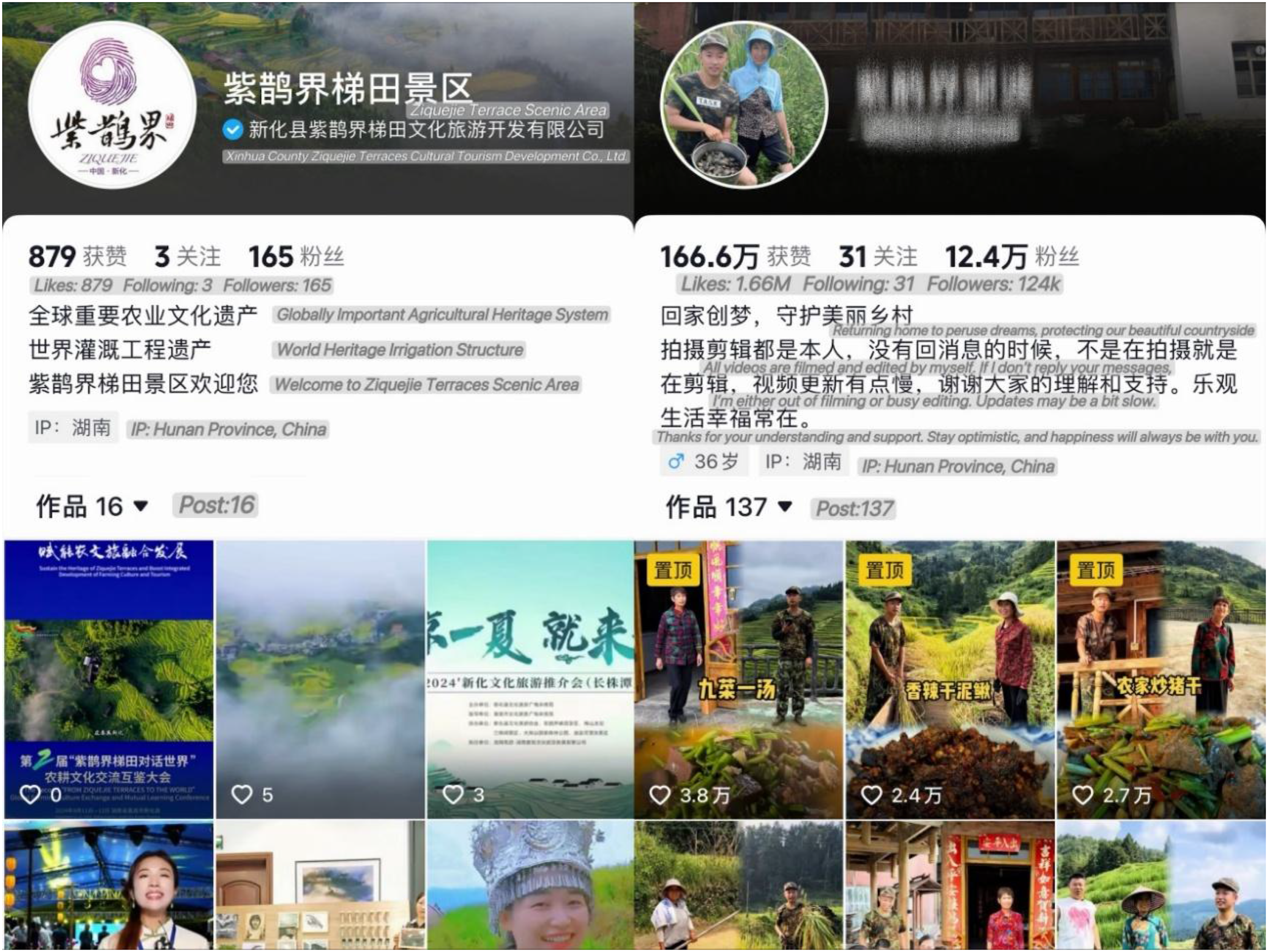
Comparison of official and individual accounts on TikTok. Note: The left image shows the Ziquejie Terraces (official account) TikTok page, with 879 likes, 165 followers, and 16 videos as of August 2024. The right image shows Zou's TikTok page, with 1.66 million likes, 124,000 followers, and 137 videos as of August 2024.
While basing the study on a single influencer account on one platform may appear limiting, this single-case design is intentionally adopted to enable ethnographic depth and contextual specificity. Rather than aiming for broad generalization, the study seeks to theorize the concept of “rural influencers” through a thick description of lived practices and digital mediation. The choice of Zou is not arbitrary but reflects a broader national trend, as thousands of similar creators emerge across rural China. However, Zou's case provides feasible, sustained access for immersive research, including online engagement and offline shadowing, which is essential for unpacking the entanglement of digital and physical practices. In line with calls in rural media studies to attend to regionally specific dynamics (Hobbis et al., 2023), this approach allows for a nuanced understanding of how digital storytelling intersects with heritage, livelihood, and community transformation.
Data collection
Data collection was conducted between March 2023 and August 2024, integrating digital documentation with on-site engagement to explore how food practices and agricultural heritage are mediated through social media in the Xinhua Ziquejie Terraces.
On the digital side, the netnography was conducted from March 2023 to August 2024. The research team, including the authors, acted as outsiders, gathering netnographic data from the videos posted on Zou's TikTok account. The long-term observation also revealed a strong user engagement on his account, with some regular users establishing familiarity through their avatars and usernames. The comment feature fosters an object-rich, interactive environment, contributing to the basic characteristics of an online community (Whalen, 2018). The study systematically documented the activities of Zou's TikTok account, focusing on content related to food, farming and tourism. In total, 107 publicly available short videos were collected (see Supplemental S1_S1.1), of which 80 were food-related (see Supplemental S1_S1.2). For each video, the following elements were recorded: (1) captions, hashtags, and embedded music or soundtrack; (2) patterns of content scheduling, thematic focus, and stylistic choice; (3) viewer engagement metrics, including likes, comments, and shares; and (4) user interactions, including recurring commenters and avatar-based familiarity.
On the offline side, the research team conducted two field visits to Xinhua Ziquejie Terraces in August and December 2023. The team consisted of three authors, two graduate students from Hunan Province fluent in the local dialect, and a local guide familiar with local cultural practices and agricultural systems. During these visits, the team engaged in shadowing the influencer across various activities, including food preparation, farming routines, and interactions with tourists and community members. In addition, an in-depth semi-structured interview was conducted with Zou to explore his motivations, content strategies, and reflections on digital engagement. Together, shadowing and the interview enabled the researchers to examine how digital content is produced, staged, and negotiated within everyday life, and how local rhythms, labor practices, and social relationships shape the process of content creation prior to its online circulation. Semi-structured interviews were also conducted with 21 local residents (see Table 1), including farmers, food vendors, and tourism operators. These interviews provided diverse perspectives on how digital media influences community narratives, tourism development, and heritage transmission. Fieldnotes were taken throughout the visits to document spatial settings, social interactions, agricultural practices, and everyday routines relevant to the influencer's digital production.
Interviewee profile.
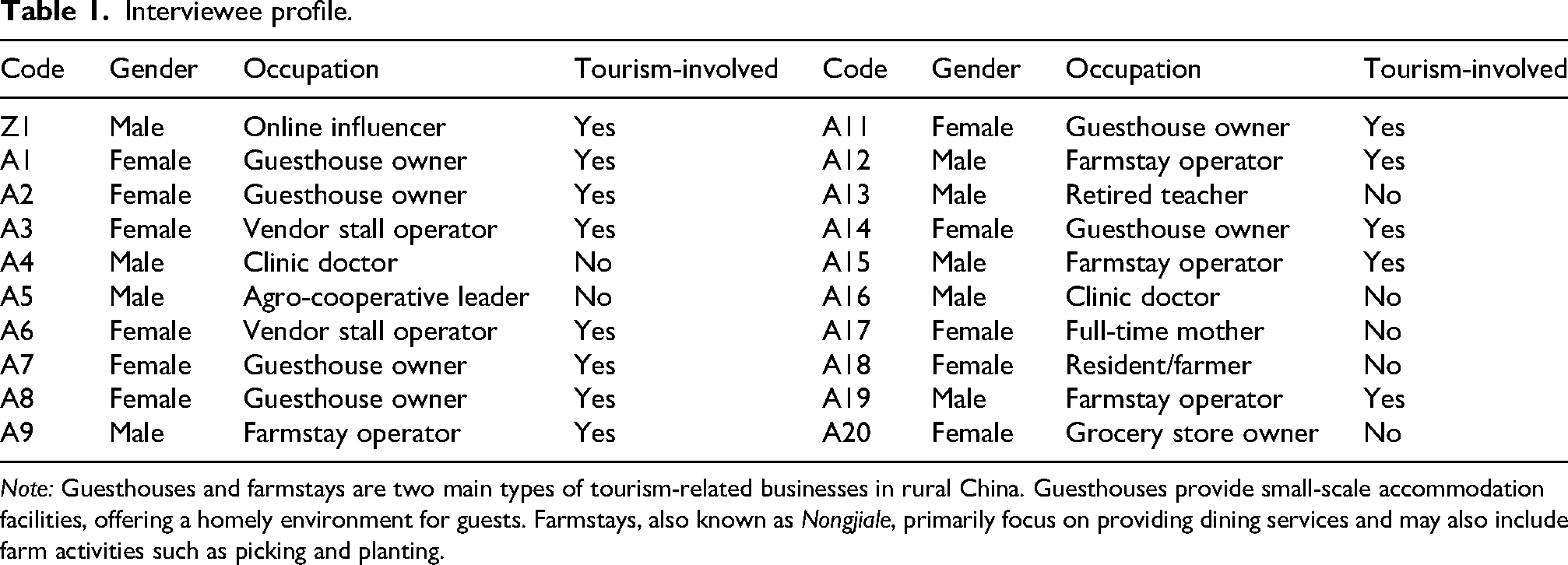
Note: Guesthouses and farmstays are two main types of tourism-related businesses in rural China. Guesthouses provide small-scale accommodation facilities, offering a homely environment for guests. Farmstays, also known as Nongjiale, primarily focus on providing dining services and may also include farm activities such as picking and planting.
Data analysis
Data analysis followed a two-stage, iterative strategy that combined multimodal discourse analysis (MDA) and reflexive thematic analysis (RTA) (Braun and Clarke, 2021; O’Halloran, 2011). The design ensured coherence between different data sources (video-based netnography and ethnographic-informed fieldwork) and transparency in the analytic process (coding, theme building and triangulation).
First, MDA was selected for its capacity to unpack how meaning is constructed across multiple semiotic modes, including text, image, sound, and interaction (O’Halloran, 2011). Within food and tourism studies, MDA enables a granular analysis of how cultural values, identities, and affect are encoded and circulated through audiovisual storytelling on platforms such as TikTok, as shown in studies that demonstrate how visual aesthetics, narrative cues, and audience engagement co-produce digital food imaginaries and shape consumption practices (Irimiás et al., 2024; Irimiás and Volo, 2022; Tan et al., 2025). Accordingly, TikTok videos were analyzed using MDA to examine how food heritage was mediated across four modalities. Textual elements were examined through clustering and word-frequency analysis. Specifically, video titles were analyzed using Python-based text-mining procedures (Supplemental S2). Titles were vectorized using TF–IDF, followed by dimensionality reduction and K-means clustering to identify latent thematic groupings. Cluster labels were generated based on top-weighted keywords, and representative titles were selected using cosine similarity to the cluster centroids. Visual frames were content-coded for food items, scenes, and actor roles; audio tracks were analyzed for identity and affective resonance; and interactional features were reviewed to explore engagement, expectations, and feedback. These complementary analyses enabled the reconstruction of multimodal food narratives and audience interaction dynamics.
Second, fieldwork materials were not treated as a separate dataset but integrated into the same analytical frame. These sources were coded to reveal the backstage practices of food production and content creation, situate creator and community perspectives within agricultural practices and local social relations, and provide spatial and temporal grounding for interpreting digital narratives. Then, both online and offline data were coded inductively and iteratively compared across modalities. Reflexive thematic analysis (Braun and Clarke, 2006, 2021) guided the process: (1) generating descriptive codes, (2) grouping into categories, (3) refining into themes, and (4) integrating them with the theoretical framing of agricultural heritage tourism. Triangulation across video and fieldwork sources strengthened validity by cross-checking online representations against offline observations.
Finally, the integrated process distilled three interpretive dimensions: motivation and food-centered content production, multimodal curation of food narratives, tourist expectation/consumer interaction and community transformation to answer the research questions accordingly. These dimensions directly align with the analytical framework visualized in Figure 3.
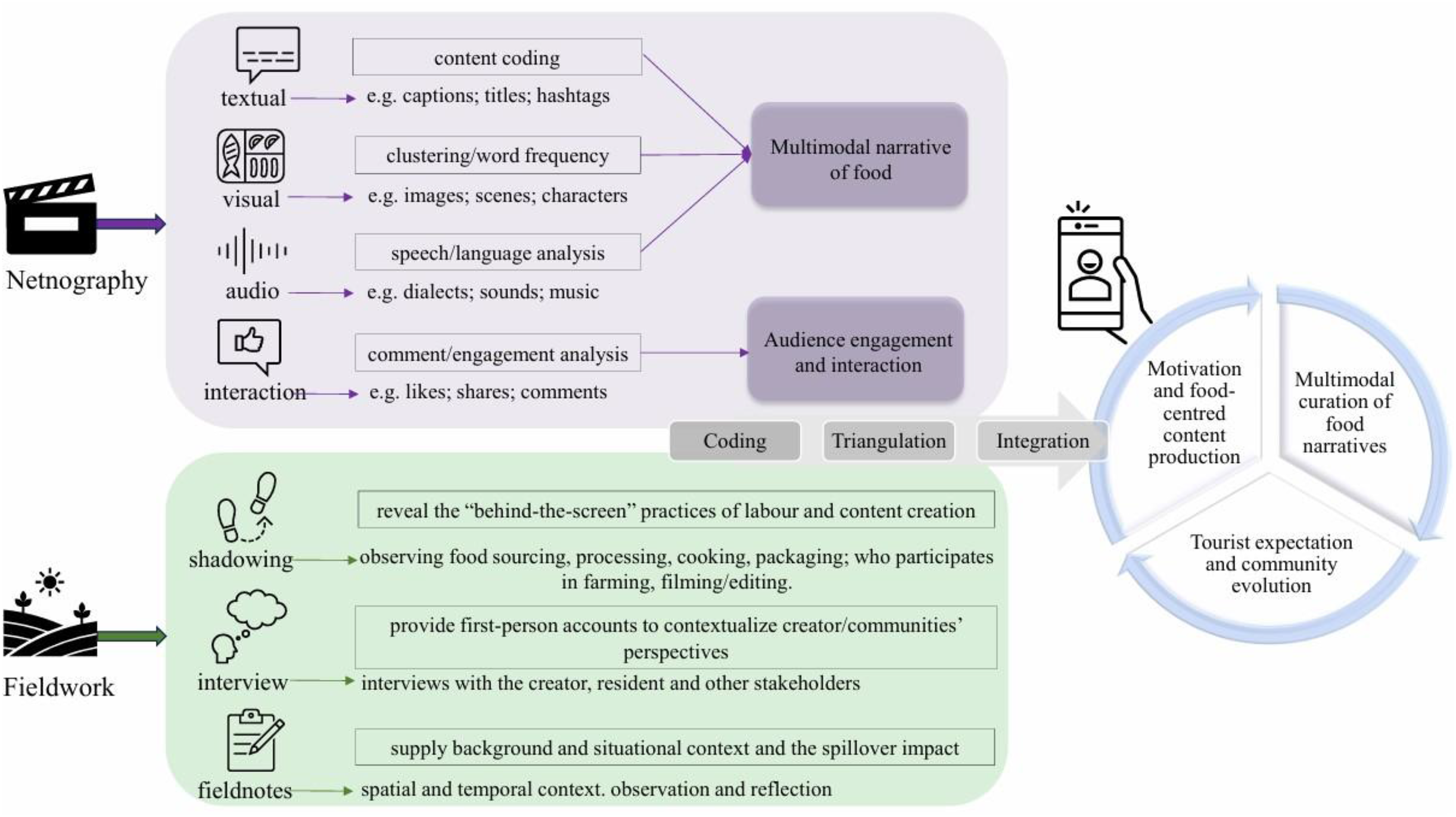
The framework of data analysis.
Findings
Uploading farmer life: Motivation and food-centered content production
The engagement of rural influencers in agricultural heritage tourism emerges from the intersection of structural shifts, cultural ethos, and local resource endowment. In the case of Ziquejie, this dynamic is exemplified by TikTok influencer Zou, who embodies the dual roles of farmer and digital creator.
Externally, prior to 2020, Zou was involved in a small-scale furniture manufacturing business in Guangdong Province, China. During the pandemic period, however, he experienced increasing difficulties in sustaining the business, particularly due to declining orders and cash flow constraints. As he (Z1) explained, “In 2019
Internally, the cultural ethos of “getting home” in Xinhua County emphasizes a cyclical return to the land. While younger generations often migrate for work, there is a prevailing expectation of eventual return. This sentiment was echoed in several interviews. A local homestay operator (A14) noted: “
Food resources further anchored this transition, providing both material content and symbolic resonance. The Ziquejie Terraces are characterized by rice cultivation integrated with poultry, livestock, aquatic products, and wild vegetables (see Appendix A). Local food resources constitute the core material basis of food-related video production and recur prominently in Zou's videos. This close alignment highlights how food videos are rooted in the region's culinary traditions and resource endowment, embodying a form of place-based specificity rather than generic food imagery. Beyond abundance, these foods are embedded in seasonal rhythms of agricultural life: spring planting, summer abundance, autumn harvest, and winter preservation. As shown in Figure 4, the composition of food elements appearing in Zou's videos varies systematically across seasons, reflecting shifts in agricultural labor, resource availability, and everyday food practices. This seasonal structuring demonstrates that food-related content production is grounded in local ecological rhythms rather than driven by arbitrary or purely platform-oriented choices. Such practices are not only subsistence activities but also cultural markers of time, structuring rural life and memory. As shown in Figure 4, the composition of food elements appearing in Zou's videos varies systematically across seasons, reflecting shifts in agricultural labor, resource availability, and food practices. This seasonal structuring further demonstrates how food-related content production is grounded in local ecological rhythms rather than driven by arbitrary or purely platform-oriented choices. It was also noted by Zou (Z1) in explaining his video-crafting philosophy: “
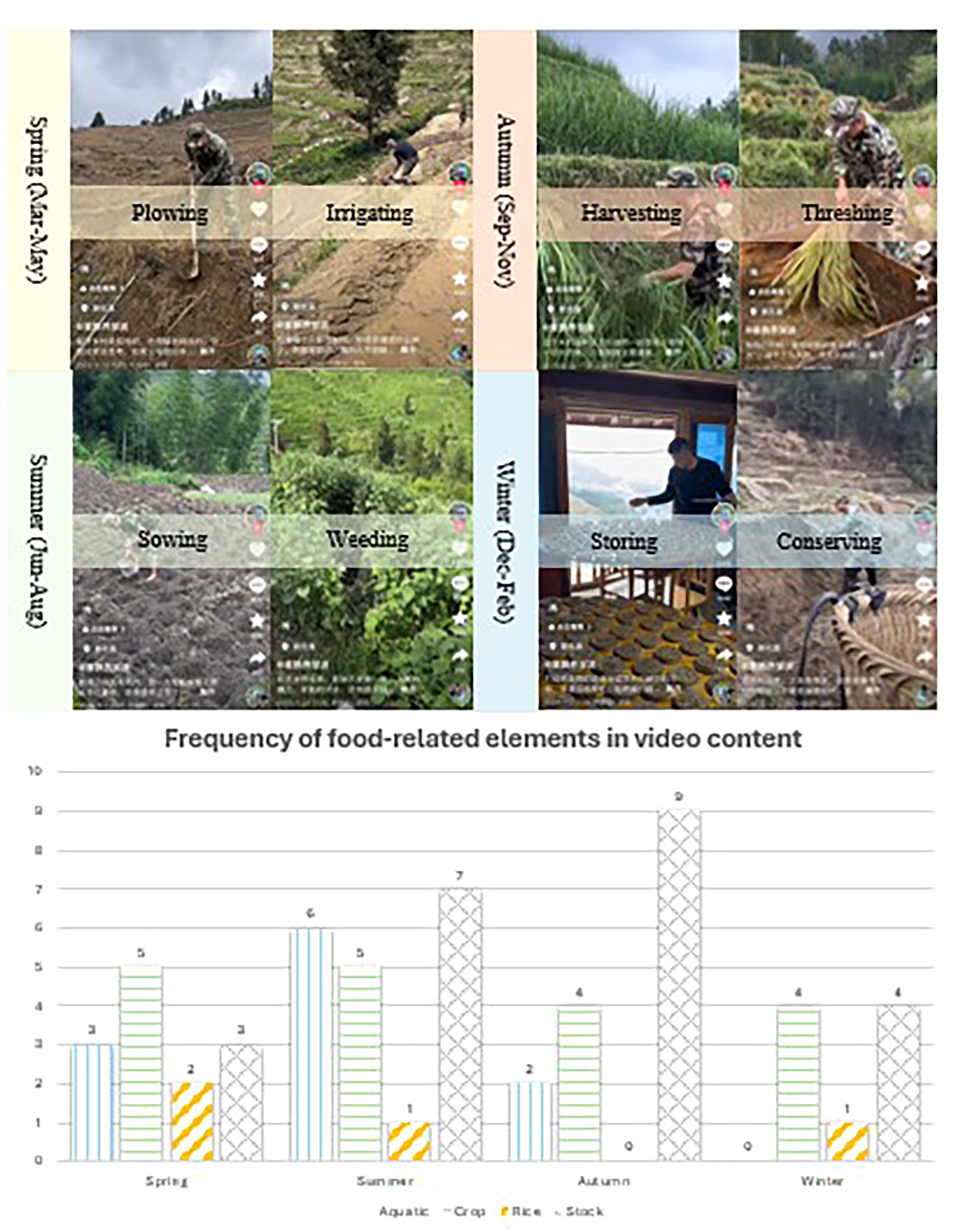
Seasonality of food-related content production rooted in local food resources. Note: Visual excerpts from Zou's short-video content illustrating seasonal labor practices in food and agricultural production. Quantitative distribution of food-related elements by resource type across seasons.
Staging the taste: Multimodal curation of heritage food narratives
Based on the multimodal discourse analysis of Zou's videos, food was curated through multimodal means, including text, visual and audio to construct local food narratives and to generate expressions of rural flavor with both emotional resonance and cultural depth.
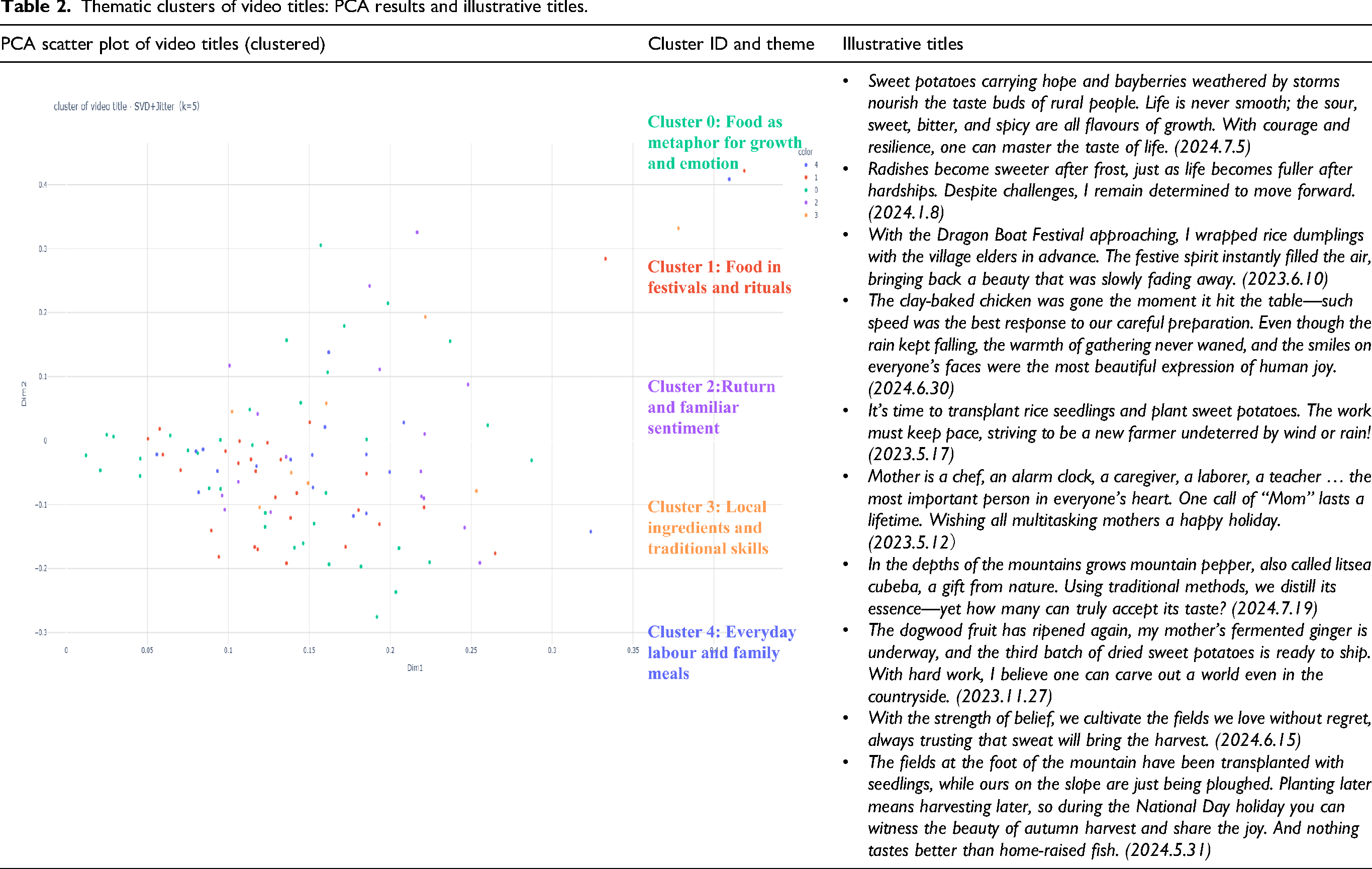
From the textual level, the videos titles and hashtags foreground staple foods and social practices as symbolic anchors of rural life. Based on the clustering analysis of video titles, five narrative themes cantered on food are identified (see Table 2) and revealed thematic distribution across the dataset (N = 107) (see Supplemental S2). Cluster 0 (33.6%, n = 36) emphasizes metaphorical expressions of growth, where ingredients such as sweet potatoes and bayberries symbolize the sweetness, bitterness, and resilience of life. Cluster 1 (26.2%, n = 28) revolves around festivals and rituals, in which foods associated with the Dragon Boat Festival and Spring Festival embody reunion and blessings. Cluster 2 (15.9%, n = 17) highlights return and family responsibility, positioning food as a medium of filial piety and local belonging. Cluster 3 (7.5%, n = 8) showcases local ingredients and traditional skills, such as the gathering and artisanal preparation of wood pepper and dried sweet potatoes. Cluster 4 (16.8%, n = 18) focuses on everyday labor and family meals, portraying rural life and social warmth through scenes of rice planting, field turning, and cooking. Furthermore, hashtags, when coupled with video titles, transform personal experiences into shared narratives. In Zou's videos, the 20 most frequently used hashtags not only reflect recurring content themes but also reveal how individual storytelling aligns with broader community identities and the logics of platformed dissemination (see Figure 5). Thematically, these hashtags cluster into three major categories. First, identity and lifestyle is represented by tags such as #MyRuralLife and #XinhuaDialect, which emphasize rural identity, regional belonging, and the everyday rhythms of countryside life. Second, food and culinary culture emerges as a dominant theme, with hashtags like #RuralCuisine, #DriedSweetPotato, #CuredMeat, #ClayRoastChicken, #PigBloodBall, #SmokedCuredMeat, and #VillageCuisine. These tags frame food not merely as sustenance, but as a cultural resource rooted in local specialties, traditional practices, and intergenerational knowledge. Third, platform campaigns and dissemination are reflected in tags such as #NewFarmerPlan2023 and #NewFarmerPlan2024, which indicate how creators strategically align their content with Douyin's official initiatives to enhance visibility and circulation.
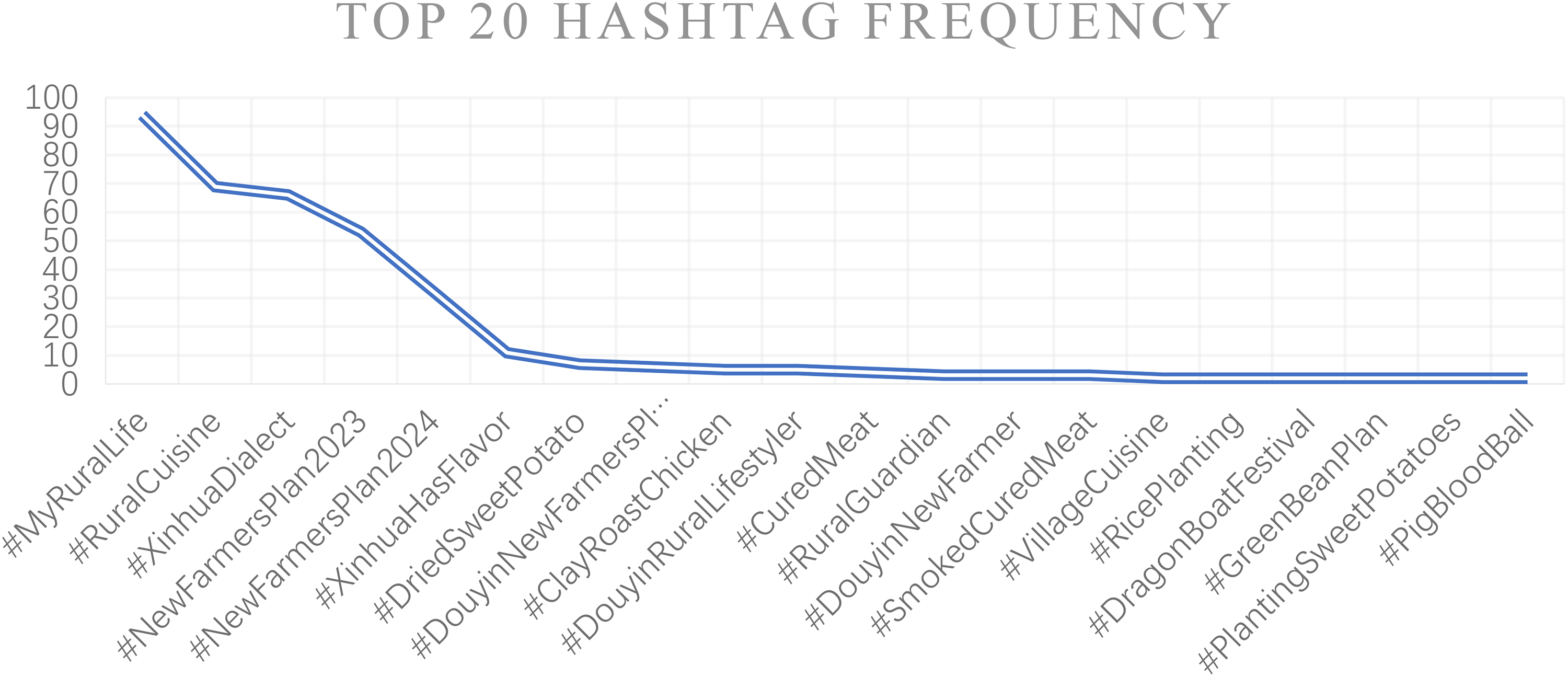
Top 20 most frequently used hashtags.
Thematic clusters of video titles: PCA results and illustrative titles.
From the visual level, 80 food-centered videos were systematically examined. And the following findings are derived from scanning and coding visual elements across four dimensions: food categories, cuisine, process scenes, and characters. These elements collectively construct a food-centric narrative space that reflects rural life, labor, and relationships. Firstly, food as cultural anchor. The videos prominently feature regionally distinctive ingredients such as cured pork, dried sweet potatoes, and bamboo-tube rice. These are not only culinary staples but also cultural symbols, deeply embedded in local traditions and seasonal rhythms. Secondly, labor and seasonality. Visual scenes frequently depict agricultural work and seasonal food practices, including rice transplanting, wild vegetable picking, and sweet potato drying. These scenes emphasize the connection between food and the land, highlighting the cyclical nature of rural life and the embodied knowledge of food production. Thirdly, relational intimacy and community. Zou's mother appears as the central figure in cooking and food preparation, symbolizing care, responsibility, and continuity. Neighbors and friends are shown participating in farming and harvesting, underscoring communal labor and mutual support. Tourists occasionally appear in hospitality scenes, pointing to the outward-facing dimension of rural food culture and its role in storytelling and dissemination.
From the audio level, food narratives are reinforced through dialect, environmental sounds, and music, which together create an immersive atmosphere and strengthen cultural identity. Attentionally, dialect as identity marker and site of negotiation. Local dialects, such as the Xinhua vernacular, are frequently used in narration and everyday conversations. While Zou primarily speaks Mandarin, but his mother and neighbors often communicate in dialect. Many viewers embrace dialect as the authentic voice of home and express emotional attachment, for example: “
At the interaction level, TikTok's algorithmic push mechanism creates subtle boundaries between insiders and outsiders within online communities. By using tags such as “new farmer” and “my farmer life,” Zou leverages the platform's precision targeting to ensure that videos reach users interested in rural life and local cuisine. In the comment section, community members quickly identify who contributes to the shared construction of meaning and who remains peripheral. Engagement data—likes, comments, and shares—functions as both feedback and input for the platform's traffic allocation system, reinforcing the visibility of insider participants. To assess interaction performance, this study analyzed data from 80 food-related videos posted by Zou between March 2023 and August 2024 using the Douyin Communication Index (DCI), which measures reach and influence through publication, interaction, and coverage metrics. The results show that peaks in engagement coincide with users’ interest in food consumption, tourism, and participation in the agricultural practices depicted in the videos (see Figure 6).
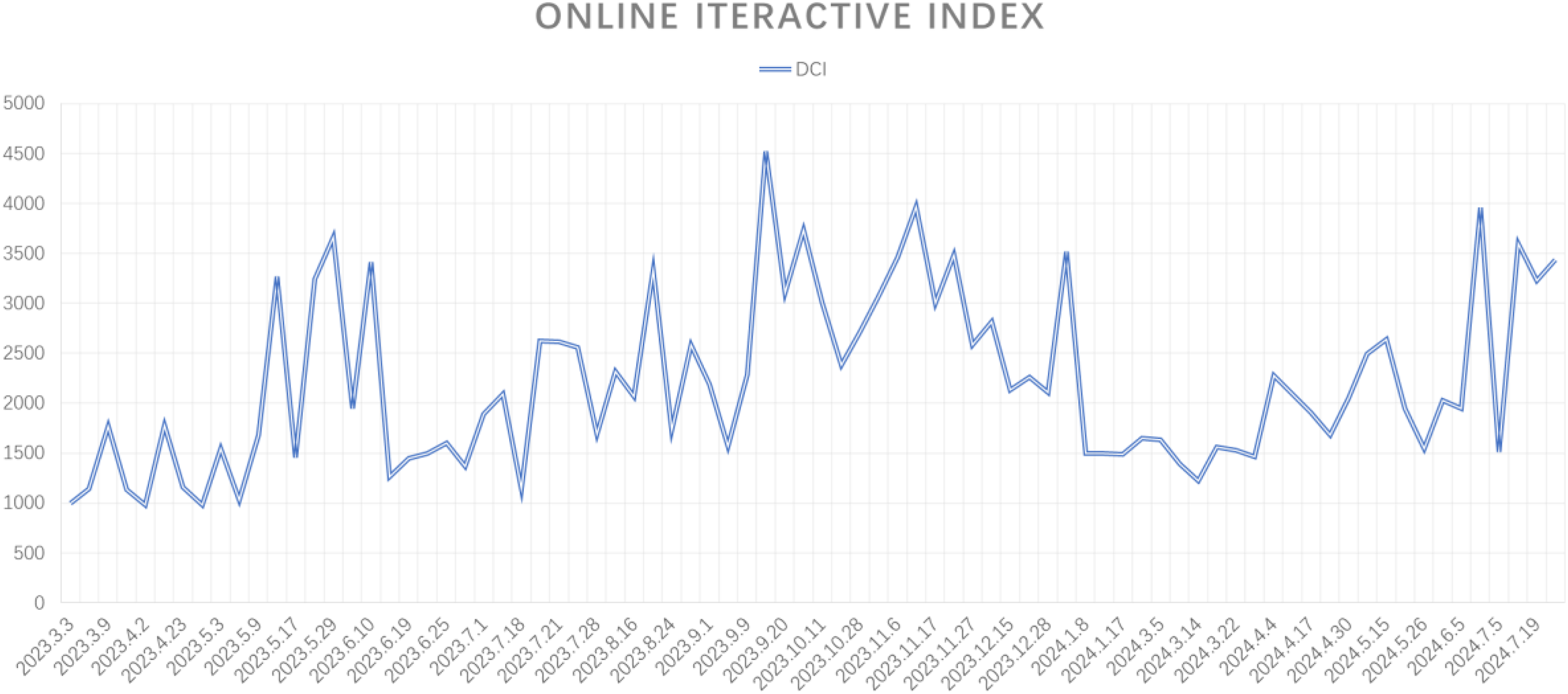
Douyin Communication Index (DCI) of food-related videos. Note: DCI (Interaction) = likes × 0.17 + comments × 0.37 + shares × 0.46.
Beyond the plate: Shaping the tourist expectation and evolving the rural community
Food narratives on TikTok function as digitally mediated spaces where asynchronous host–guest interactions contribute to anticipatory engagement and the co-construction of tourism expectations (Munar and Jacobsen, 2014; Wei et al., 2025). Short-form videos replace conventional brochures with curated glimpses into rural food culture and everyday life. In the comment sections of Zou's videos, queries about routes, accommodation, and product availability were frequent. For example: “
Importantly, these interactions extend beyond passive consumption. Viewer comments on packaging, hygiene, and delivery logistics prompt influencers like Zou to adjust production processes and content presentation (see Figure 7). For instance, concerns (e.g. “
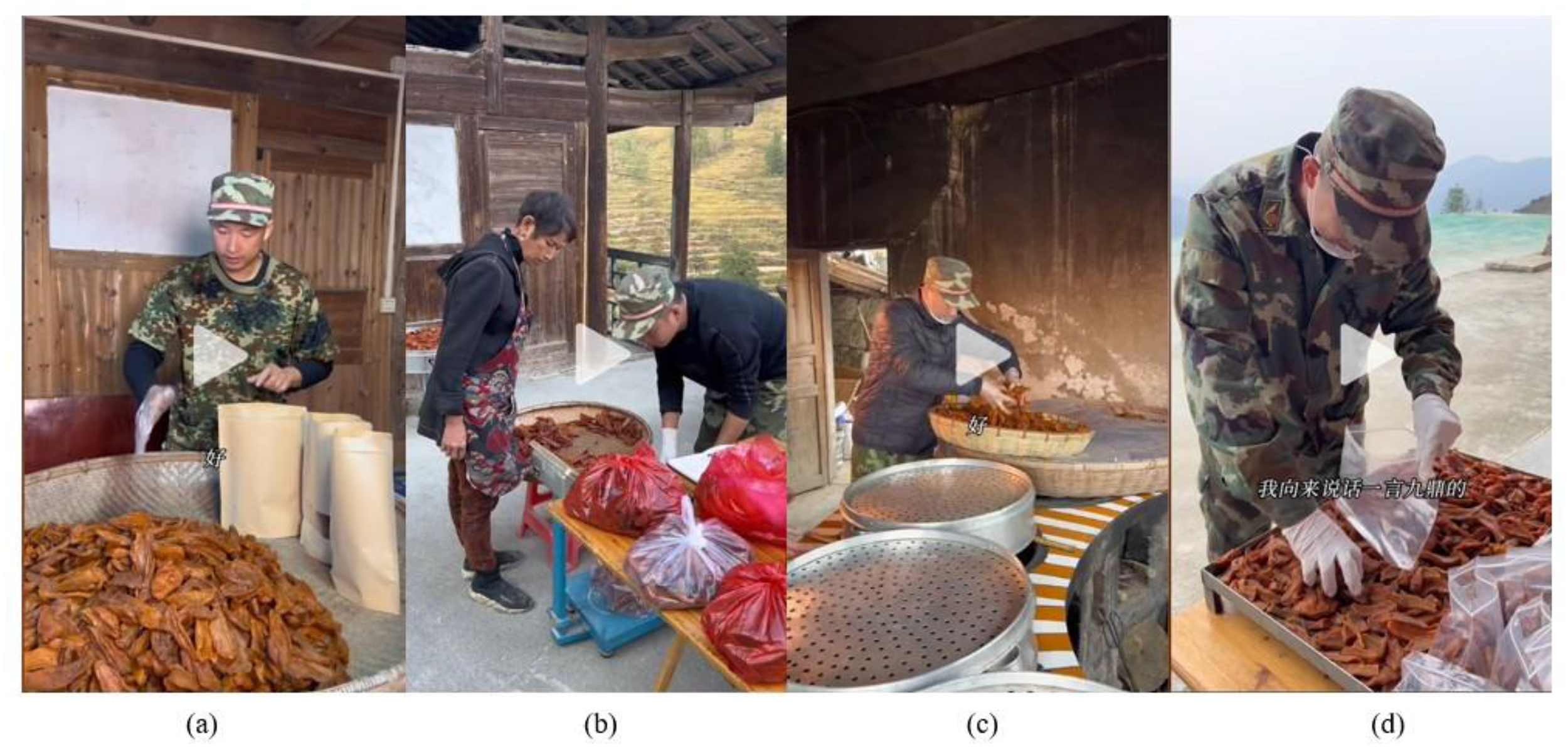
Visual evidence of hygiene improvement and packaging innovation prompted by consumer feedback. Note: Early videos (a and b) show informal food handling and packing without protective equipment. Last posts (c and d) depict the influencer adopting gloves, masks, and vacuum-sealed bags.
The digital production based on the local food also has the spill-over effect on the rural community. The embeddedness of social media significantly enhanced community livelihoods by expanding sales channels and creating job opportunities. Previously, local food was sold at a limited capacity, primarily as part of the tourism experience. Residents near the terraced fields’ viewing platforms participated in tourism by selling lightly processed agricultural products like rice, preserved meats, and dried sweet potatoes, foods that are convenient for tourists to purchase as souvenirs (see Figure 8 left). These products serve both as functional food items and as a way for tourists to engage with local culture. An interviewee (A6) in retail near the viewing platform mentioned, “
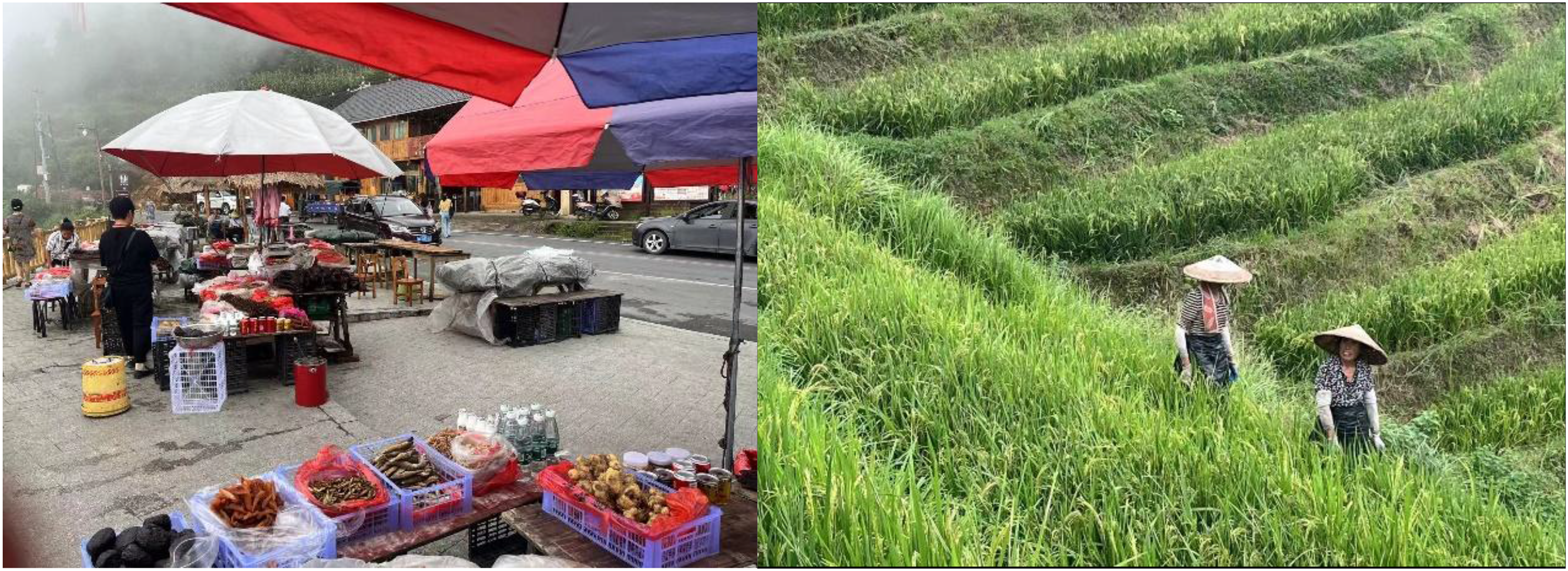
Local people and local food scenarios. Note: Left image shows vendor stalls selling local food; right image shows two female residents hired to weed the terraced fields; both of two were taken by authors in August 2023.
Finally, digital food narratives contribute to heritage preservation and cultural debate. Food visibility revalorized local resources: sweet potatoes, once considered ordinary, now became marketable heritage products, and previously abandoned land was cultivated again to meet rising demand. Viewer comments frequently highlighted traditional farming methods, sparking discussions about pesticide-free cultivation or the role of mechanization. One resident (A5) emphasized, “
Discussion and conclusion
It is a global emerging phenomenon that the rural resident and farmers participating in online content production as creator or influencer, the case of Zou reveals how rural influencers derive legitimacy not from celebrity status but from place-based embeddedness. Existing research on rural influencers has put forward fragmented arguments, emphasizing on the one hand the potential of social media to reconfigure rural development and agricultural promotion, and on the other the romanticization of rural authenticity as a source of influencer appeal (Jin et al., 2023; Wang and Wang, 2025). This study extends these debates by unpacking the story behind the screen through an in-depth single case analysis. Unique access to shadowing, interviews, and community observations underscores that rural influencers are more than agricultural laborers performing for the camera. The case of Zou demonstrates that participation is shaped by both internal motivations (identity and livelihood diversification) and external structures (state-led rural revitalization policies and Douyin's platform logics). Unlike generic lifestyle influencers, rural influencers operating within agricultural heritage settings derive their legitimacy from local resources: food, dialect, landscapes, and farming practices are not incidental backdrops but central productive assets. This insight advances the theorization of rural influencers as more than recorders of everyday life. They are place-based digital actors whose hybrid identity as creator–influencer combines creative labor with the cultivation of trust and social capital. By translating agricultural practices and rural imaginaries into legible narratives, they participate in a political economy where platform affordances (e.g. short video, livestreaming, and e-commerce) align with policy imperatives of rural revitalization. In this way, the rural influencer is co-produced by local heritage, creative labor, and platform–policy assemblages, advancing current debates by foregrounding the place-based attributes that distinguish rural influencers from other influencer types.
Local food plays a central role in the daily life of heritage communities and serves as a key element of agricultural heritage value, providing a foundation for online content production. While scholarship on agricultural heritage often frames local food in terms of food security and subsistence (Min et al., 2016; Yang et al., 2021), this study demonstrates that food in heritage systems functions as far more than dietary provision. Through a multimodal lens, local food emerges as both a cultural anchor and a digital heritage object, where everyday dietary practices are translated into affective narratives, social identity, and tourism value. At the textual level, video titles leverage food narratives to articulate rural daily life, emotions, and ethical values. Hashtags embed personal experiences into broader rural identities and regional cultures. Through algorithmic amplification and platform dissemination, food shifts from the sphere of household meals to that of communal labels and circulating symbols. At the visual level, food is not merely an object on screen but the narrative center. Through cooking scenes, the presence of family members, neighbors or tourists, and depictions of agricultural processes such as harvesting, drying or butchering, videos construct a composite portrayal of rural culinary culture, emotional intimacy and tourism attraction. At the audio level, the use of dialect, cooking sounds and background music confers both cultural identity and emotional resonance. Dialect grounds food in place-based authenticity, kitchen and field sounds highlight embodied labor, and recurring music enhances recognizability and affective engagement. The multimodal digital narrative curates local food as an affective, culturally thick and economically viable expression of rural taste. Food becomes a medium through which agricultural heritage is reinterpreted and valorized, not only as sustenance but as digital heritage that integrates cultural identity, commercial potential and touristic appeal.
The promotion of local food by rural influencers illustrates how digital platforms facilitate not only visibility but also the reconfiguration of agricultural heritage value within an emerging value network. What begins as food storytelling on screen evolves into a process of networked heritage reproduction, in which agricultural traditions are re-enacted in digital spaces and translated into tourism imaginaries. Rather than following a linear “field-to-table” progression, authenticity is relationally constructed through interactions among farmers, influencers, audiences, and digital infrastructures. Within this configuration, digital participation becomes a constitutive element of value creation. Viewers do not remain passive recipients of food content but engage as network participants through likes, comments, and shares. These interactions operate as feedback mechanisms that influence content production, shape quality standards, fuel algorithmic circulation, and open pathways to commercialization. Interaction data thus functions as both a symbolic and strategic resource, guiding adaptive production decisions and linking cultural storytelling to market practice. Value emerges not merely from the transformation of agricultural products but from the circulation of meanings, reputations, and expectations across interconnected actors. Such processes demonstrate how agricultural heritage tourism operates through collaborative interdependence rather than sequential coordination. Rural influencers act as nodal mediators connecting tangible assets, such as crops, cuisine, and farming labor with intangible assets, including heritage narratives, authenticity claims, and community identity. Through this integration, production, representation, and consumption become mutually constitutive domains within a broader heritage value network. The implications for heritage communities are substantial. By repositioning local food as both an economic commodity and a digital cultural asset, rural influencers contribute to livelihood diversification and resource activation. At the same time, digitally mediated debates over packaging, hygiene, or farming practices re-enter community life, prompting negotiation and collective adjustment. This networked model of value creation suggests potential pathways for addressing structural challenges faced by agricultural heritage systems, such as depopulation, aging demographics, and limited market access by leveraging collaborative, digitally mediated coordination rather than relying solely on traditional production chains (FAO, 2023; Nath et al., 2024; Zhang, 2022).
Theoretical contributions
This study contributes to the existing body of knowledge by enhancing the conceptual foundation and supplementing the theoretical framework in several keyways. First, it advances theoretical understanding of rural influencers by addressing a key gap in current research. While farmers and rural creators increasingly participate in social media as part of a global dialogue (Unay-Gailhard et al., 2023), their roles remain under-conceptualized. Existing work often highlights hashtag-based communities such as FarmTok and AgTok, which aggregate rural content but offer limited insight into the cultural and material foundations of influence in rural context (Holton et al., 2023; Riley and Robertson, 2021). By contrast, this study provides empirical and conceptual evidence to theorize rural influencers as place-based digital actors from agricultural heritage systems. Their influence is grounded in food practices, dialects, and landscapes that function as productive resources rather than aesthetic backdrops. Through the lens of creator–influencer hybridity, this study expands influencer theory to account for the intersection of cultural reproduction, digital participation, and economic transformation in rural settings. It highlights how rural influence is relational, situated, and materially embedded, offering a counterpoint to dominant models of influencer culture that prioritize visibility over substance.
Second, this study reconfigures the conceptualization of local food within agricultural heritage and tourism studies by moving beyond its conventional framing as nutrition, security or commodity. It conceptualizes food as a multimodal practice embedded in social, cultural, and spatial structures. Through textual, visual, and auditory modalities, everyday food practices are transformed into emotionally resonant, culturally embedded, and commercially viable narratives. The curatorial practices of rural influencers show how food is mediated and narrated in digital environments. These practices reflect foodscape theory, which views food as embodied cultural practice shaped by meaning, identity, knowledge and consumption (Vonthron et al., 2020). Shifting the focus from tourist narratives to resident curation, this perspective frames the destination foodscape as a co-produced space where local people actively interpret and promote food heritage within tourism development (Zhu et al., 2022). It also aligns with recent initiatives that position local food as a marketing dimension, emphasizing residents’ roles as active agents who shape and sustain the evolving foodscape (Björk and Kauppinen-Räisänen, 2019). By tracing how food is digitally curated and turned into cultural narratives and tourism attractors, this study underscores the dynamic reproduction and valorization of agricultural heritage in the digital age. It challenges static views of food as tradition and instead positions it as an evolving heritage practice shaped by digital storytelling, influencer engagement, and audience interaction.
Third, this study extends the intersection of tourism, media and rural development by examining the practice of rural influencer curating local food. This perspective provides a holistic view of how food heritage is performed and sustained across online and offline domains, where digital storytelling not only preserves agricultural traditions but also reconfigures them as tourism resources. Rural influencers turn everyday practices into cultural attractions, shaping tourist imaginaries and expectations before they materialize in visits or purchases. In this process, rural influencers also enrich the understanding of cultural intermediaries (Bourdieu, 1984; Warren and Dinnie, 2018). Acting as both insiders and performers, they emerge as new tourism agents who transmit local food culture while simultaneously participating in its reproduction and commodification. Their dual role positions them as cultural mediators who translate rural practices into narratives that resonate with external audiences while sustaining community livelihoods. Tourist engagement further operates as a mechanism of cultural negotiation, where authenticity, taste, and value are debated and recalibrated through comments, feedback, and purchases. Platform algorithms and hashtag structures amplify these dynamics, conditioning which narratives gain visibility and thereby influencing how rural heritage is consumed and experienced. In this way, the study demonstrates that mediation is no longer confined to institutions but increasingly enacted by rural influencers through digital practices that intertwine culture, commerce, and tourism.
Practical implications
The findings of this study offer several practical implications for fostering the active and sustainable stakeholder engagement and innovative marketing of agricultural heritage sites and other rural destinations.
Firstly, for rural communities and heritage conservation, digital food practices generate new livelihood opportunities and extend value of agricultural heritage into tourism and digital markets. Rather than treating content creators as peripheral promoters, communities and heritage institutions can recognize rural influencers as collaborative partners in heritage transmission, education, and rural development. Digital narratives not only disseminate local food traditions but also stimulate debates on authenticity, farming methods, and sustainability. Such dialogues can be channeled into heritage education, intergenerational knowledge transfer, and community engagement initiatives. Establishing inclusive benefit-sharing mechanisms and cooperative coordination structures can ensure that digitally mediated value creation contributes to both economic resilience and heritage safeguarding.
Second, for destination development and tourism marketing, the findings suggest important implications for vacation marketing in agricultural heritage destinations. Food-centered short videos demonstrate how social media reconfigures destination promotion from static attraction-based branding to network-oriented value orchestration. Rather than promoting food or landscapes in isolation, destination managers can adopt a value network approach that recognizes influencers, farmers, tourism operators, and digital audiences as interconnected actors within a shared marketing ecosystem. It also sheds light on the strategic tension identified earlier between pushing local food outward to external markets and pulling visitors inward through tourism. The findings suggest that, within a value network configuration, these strategies need not be mutually exclusive. Digitally mediated food narratives simultaneously expand external market reach through e-commerce while stimulating experiential demand for on-site visits. For destination marketers, this implies moving beyond a dichotomous push–pull model toward an integrated network strategy in which online food circulation reinforces destination attractiveness and vice versa. Such coordination enhances the overall impact of food tourism by aligning digital commerce, heritage storytelling, and experiential travel within a shared marketing ecosystem.
Third, for policymakers, platform features such as livestreaming and in-app commerce align closely with the promotion of local food and agricultural heritage within digitally mediated markets. Public policies that invest in digital literacy, logistics infrastructure, quality certification, and transparent governance mechanisms can improve rural communities’ access to high-value markets. At the same time, regulatory frameworks should balance commercial expansion with safeguards that protect cultural authenticity, community wellbeing, and long-term sustainability within agricultural heritage systems.
Limitations and future research
Despite the theoretical and practical contributions of this study, several limitations should be acknowledged. First, it is based on a single case study of one rural influencer in an agricultural heritage site in China. While the case provides rich insights, its specificity limits generalizability. Comparative studies across regions, platforms, and types of influencers would help capture the diversity of rural influencer practices and their impacts on agricultural heritage tourism. Across different national and cultural contexts, the distance between rural and urban life and the cultural connotations of the countryside vary significantly, suggesting that further research is needed to refine and broaden the theoretical framework of rural influencers. Second, the research relies on the data of short videos, comments and field observation. Although it reveals deep cultural and narrative dynamics, it does not capture broader patterns of audience engagement. Future studies could combine qualitative depth with large-scale digital trace data, surveys, or experimental designs to better understand how digital food narratives influence tourist behavior on a scale. Finally, future research should examine how digital transformation and governance shape rural influencers and heritage tourism. This includes exploring the effects of emerging technologies such as AI-driven personalization, algorithmic curation, and cross-platform dynamics, as well as addressing broader policy and ethical questions of authenticity, commodification, labor precarity, and platform dependency. In addition, building on the value network framework adopted in this study, future research could further explore how networked coordination among producers, influencers, platforms, and consumers may contribute to circular economy practices, resource recirculation, and sustainability transitions within agricultural heritage tourism systems. Such inquiries are essential to assess the long-term role of rural influencers in sustainable heritage management and rural development.
Supplemental Material
sj-xlsx-1-jvm-10.1177_13567667261433192 - Supplemental material for Digital food narratives and rural influencer: Rethinking the local food in agricultural heritage tourism
Supplemental material, sj-xlsx-1-jvm-10.1177_13567667261433192 for Digital food narratives and rural influencer: Rethinking the local food in agricultural heritage tourism by Jiayu Wang, Ming Ming Su, Menghan Wang and Mengzhen Zhang in Journal of Vacation Marketing
Footnotes
Author note
Due to the graduation, the affiliation of Menghan Wang is changed from Renmin University of China to the current updated address.
Acknowledgements
This research was supported by the National Natural Science Foundation of China (grant no. 42571284). We sincerely thank TikTok influencer Mr Zou and the 21 interviewees for their participation, as well as Master's students Lishan Ao and Yuan Yang from Hunan Normal University and tour guide Xiaohong Peng for their assistance during fieldwork. The authors would also like to thank Gary Chen from The University of Queensland for giving insightful comments on this work during the revision process. Our thanks are extended to anonymous reviewers and editors for their constructive feedback, which significantly improved the manuscript.

Funding
The authors disclosed receipt of the following financial support for the research, authorship, and/or publication of this article: This work was supported by the National Natural Science Foundation of China under Grant 42571284.
Declaration of conflicting interests
The authors declared no potential conflicts of interest with respect to the research, authorship, and/or publication of this article.
Supplemental material
Supplemental material for this article is available online.
References
Supplementary Material
Please find the following supplemental material available below.
For Open Access articles published under a Creative Commons License, all supplemental material carries the same license as the article it is associated with.
For non-Open Access articles published, all supplemental material carries a non-exclusive license, and permission requests for re-use of supplemental material or any part of supplemental material shall be sent directly to the copyright owner as specified in the copyright notice associated with the article.
