







Abstract
The notion of travel experience has been widely studied; however, little effort has been invested in understanding generational preferences for cruise experiences and cruisers’ happiness in relation to future time. This study thus examined generational effects on travel experiences and happiness derived from cruise travel based on a future time perspective (FTP). This lens offers a theoretical framework with which to appraise these relationships. Mixed methods and the difference measure were adopted to develop measurement scales and test hypotheses for Chinese senior cruisers. Quantitative results uncovered four dimensions containing 10 items tied to the ordinary–extraordinary cruise experience. Findings indicated that seniors with limited travel FTP were more likely to choose ordinary cruise experiences, whereas non-seniors with extensive travel FTP preferred extraordinary cruise experiences. Furthermore, senior cruisers were equally as happy as non-senior cruisers. Theoretical, methodological, and practical implications were also discussed.
Introduction
Despite cruise tourism's long history in North America and Europe, the Asian market is a young entrant but has made great progress over the last decade. Official statistics from the Cruise Lines International Association (CLIA) indicated that North America stood at the center of the worldwide cruise industry with 18.1 million passengers, followed by Western Europe (8.2 million passengers) and Asia (2.3 million passengers), as of 2023 (CLIA, 2024a). China was the largest regional source market in Asia and took up nearly half of the regional passenger volume before the COVID-19 pandemic (Hung, 2018). Over the past two decades, five key cruise regions have formed in China: the Bohai Bay region centered in Tianjin; the Yangtze River Delta region centered in Shanghai; the Strait on Both Sides of the Southeast Region centered in Xiamen; the Guangdong–Hong Kong–Macao Greater Bay Area centered in Shenzhen; and the South China Sea Region centered in Sanya (CCYIA, 2025).
Cruising remains the top choice for multi-generational travelers: 67% of global cruise tourists are Gen X or younger, and 33% of cruise passengers are Baby Boomers and older. The Chinese cruise market is also multi-generational. Mainland Chinese cruisers’ average age is 47.0 years; that of Hong Kong SAR cruisers is 54.4 years (CLIA, 2024b), higher than their international counterparts at 46.5 years (CLIA, 2025).
Among Chinese senior cruisers in general, many engage in multi-generational trips, where grandparents travel with their adult children and/or grandchildren (Wang et al., 2023). Meanwhile, younger generations with purchasing power constitute the group quickest to resume cruise travel after the COVID-19 pandemic. These young people, many of whom have ample discretionary time and are traveling with children, prefer the family-friendly vacation style that cruise ships offer (CCYIA, 2025). Even as multi-generational travel becomes increasingly popular in cruise tourism, comparative research is lacking on young and old passengers’ experiences on the same cruises. Identifying the cruise experiences of different generations, particularly among seniors, can enhance the cruise literature. Such information will help the industry better understand diverse travelers’ feelings and needs on board; services can then be tailored accordingly. This study addresses two questions in this vein: (1) What types of experiences do young and old cruisers prefer on their cruise vacations?; and (2) Are young and old cruisers equally happy with their cruise experiences?
Theoretically, little is known about how generations perceive their time and whether differing perspectives may affect individuals’ travel experiences and happiness. This study therefore explores generational views on cruise experiences and explains passengers’ reactions based on socioemotional selectivity theory (SST). SST is a lifespan theory that forecasts people's motivations and social goals, especially among mature adults (Carstensen et al., 1999). According to the theory, when one's remaining time is perceived as expansive, knowledge-related goals are preferred. Conversely, emotional goals are prioritized when one's remaining time is seen as limited. A key SST concept, future time perspective (FTP), may help rationalize passengers’ cruise-related preferences, experiences, and feelings. This study thus investigates older and younger cruisers’ desired cruise experiences and how these experiences influence post-trip happiness based on FTP. Seniors were defined as people aged 55 or above in this case, corresponding to the official retirement age for women in China (Hsu et al., 2007). Hypothesis testing broadens relevant research by elucidating how one's generation influences their travel experiences and happiness in light of FTP.
Although scholars have devised scales with which to monitor the Chinese cruise experience, no instrument exists to simultaneously gather responses from older and younger cruisers—particularly from an ordinary–extraordinary comparative angle. Conventional experience measures are one-sided: they address what has happened during trips without connecting it to travelers’ states of mind once back home. Without accounting for individuals’ experiences while traveling and in daily life, one cannot ascertain whether people's reported experiences were unique to trips or an extension of their everyday routines. Ordinary–extraordinary experience measures will further contextualize the meaning of travel by comparing people's experiences in both contexts. This study therefore constructs a measurement scale for evaluating tourists’ ordinary–extraordinary experiences as such.
Literature review
Tourism partly enables mature adults to stay active as they age. Travel is often seen as a reward for one's hard work in pre-retirement, with many people hoping to accumulate memorable experiences after leaving the workforce (Hung and Lu, 2016). Tourism scholarship over the last 30 years has explored several salient elements in later life: people's travel motivations and constraints (Fleischer and Pizam, 2002; Jang et al., 2009); determinants of trip-related decisions (Jang and Ham, 2009; Ryan, 1995; Zimmer et al., 1995); and how travel experiences affect personal life satisfaction and well-being (Kim et al., 2015; Milman, 1998; Mitas et al., 2012). Yet seniors’ thoughts about travel and related behavior can be difficult to interpret without group comparison. This paper leverages a generational lens to ponder different generations’ preferred cruise experiences and associated happiness based on FTP.
Multiple generations and ordinary–extraordinary experiences
Mannheim (1952) introduced generational theory upon publishing his essay “The Problem of Generations” in the early twentieth century. This essay has served as a foundation when exploring the sociology of generations. The theory's principles remain salient today (Connolly, 2019). Mannheim (1970) defined a generation as “a particular kind of identity of location” that includes relevant “age groups” rooted in a historical–social process (p. 170). Generational theory argues that people belonging to the same generation share similar experiences during their formative years (Mannheim, 1952). They are different from other generations in beliefs, interests, and behavior, all of which manifest from notable political, economic, social, cultural, and technological events (e.g. wars, political elections, technological progress) during the life cycle (Mannheim, 1952).
Generational theory has also been applied to tourism to understand people's travel-related attitudes, actions, and preferences (e.g. Alén et al., 2017; Cooper et al., 2019; Lewis et al., 2021). Generational analysis suggests that generations behave distinctly during trips (Chen and Shoemaker, 2014; Chung et al., 2016; Huang and Lu, 2017). Younger and older generations represent important markets, including for the cruise industry, although generational analysis has yet to be implemented in that setting. This study thus considers generational theory in relation to cruise tourism.
Scholars have explored ordinary and extraordinary experiences for the past three decades. Abrahams (1986, as cited in Carù and Cova, 2003) initially applied the ordinary–extraordinary dimension of experience types from a processional perspective. In brief, “ordinary experiences correspond to everyday life, routine, the past, and the passive acceptance of events. Extraordinary experiences correspond to ‘more intense, framed and stylized practices’” (p. 50). In this study, ordinary experiences refer to those that are common, frequent, and within the realm of daily life. Extraordinary experiences are comparatively rare and beyond the realm of everyday life (Bhattacharjee and Mogilner, 2014).
The ordinary–extraordinary dichotomy has been recognized in fields such as psychology (Sussman et al., 2015), consumer behavior (Minton and Liu, 2019; Sussman and Alter, 2012), marketing (Bhattacharjee and Mogilner, 2014), and leisure (Duerden et al., 2018; Zabriskie and McCormick, 2001). Regarding consumer behavior, Sussman and Alter (2012) noted that purchase types (ordinary vs. exceptional) could influence people's consumption, in that individuals are apt to spend more on extraordinary items. Minton and Liu (2019) found that extraordinary (vs. ordinary) experiences lead consumers to indulge more (e.g. eat more candy). Sussman et al. (2015) examined how perceptions of charitable donations influenced giving from a psychological perspective: when people saw donations as exceptional rather than ordinary expenses, their charitable behavior increased. In general, the literature suggests a more positive impact of extraordinary experiences on influencing consumer behavior compared to ordinary experiences. It is unknown if such an effect is consistent across generations.
Some research (Iso-Ahola, 1980; Lawton, 1985, as cited in Mobily et al., 1991) has indicated that the elderly decide whether to participate in an activity based on its familiarity, which evokes psychological comfort. The elderly often feel more comfortable with an activity they can competently perform. Mogilner et al. (2011) analyzed a set of blogs about the expression of happiness and aimed to determine if age crucially affects the types of happiness people seek. Young people are inclined to define happiness as excitement. As they age, they more frequently associate it with peacefulness. These results are consistent with those from Carstensen et al. (1999) and Bhattacharjee and Mogilner (2014), who observed that the elderly prefer to take part in calm, ordinary experiences. Younger generations are more attracted to extraordinary experiences, which are novel and exciting, so as to build their “experiential CV” (Anat and Ran, 2011). This study's first hypothesis is proposed accordingly:
H1: Generation is related to one's choice of ordinary–extraordinary cruise experiences. The older the members of a generation are, the less likely they are to choose extraordinary experiences and the more likely they are to choose ordinary experiences. The younger the members of a generation are, the more likely they are to choose extraordinary cruise experiences and the less likely they are to choose ordinary experiences.
Generation and FTP
FTP is a critical psychological variable useful for answering questions such as “How much time do individuals think they have left ahead of them, and how do they see that time?” (Cate and John, 2007: 186). It captures “one's perception of his/her remaining time to live and the opportunities within that time” (Kooij et al., 2018: 874). Lewin (1939) asserted that “the scope of time ahead influences present behavior” (p. 879), which implies that people at any age are affected by what they view as the future. Carstensen et al. (1999) published one of the most widely cited papers on this matter in which they incorporated FTP into SST, the latter of which predicts enhanced emotion regulation as people age (Carstensen, 1992, 1995; Carstensen et al., 1999). FTP, as the “cardinal tenet” of SST, has been classified as either expansive or limited (Carstensen et al., 1999: 167). In this study, expansive FTP suggests that one views their lifespan as open-ended; limited FTP applies to people approaching the end of life.
Studies have shown age and FTP to be negatively associated in various fields, such as gerontology (Stahl and Patrick, 2012) and organizational psychology (Gielnik et al., 2018; Kochoian et al., 2017). Older people may believe they are close to death and ponder their future time more seriously than younger people (Carstensen et al., 1999; Cate and John, 2007; Lang and Carstensen, 2002). That is, older people are more inclined than younger ones to see their future as limited (vs. expansive). Therefore, the generation to which one belongs is regarded as a signal of one's temporal focus, leading to the following hypotheses:
H2: Generation is related to FTP. H2a: Older generations are positively related to limited FTP. H2b: Younger generations are positively related to expansive FTP.
FTP and ordinary–extraordinary experiences
The impact of FTP on people's behavior has been widely discussed. For instance, Stahl and Patrick (2012) investigated how FTP predicted one's health behavior from a gerontological perspective. People who deemed their future expansive engaged in more frequent physical exercise and vice versa. Regarding consumer behavior, Kim and Jin (2019) examined the relationship between elderly women's FTP and their intentions to purchase environmentally sustainable apparel. Compared with elderly individuals who had limited FTP, those with expansive FTP were more likely to buy this type of apparel due to having long-term goals that focused on welfare. Kochoian et al. (2017) reported that occupational FTP positively influences one's motivation to learn: focusing on future opportunities (i.e. expansive FTP) was significant for learning self-efficacy and learning value, whereas limited FTP was negatively associated with learning self-efficacy. In business, Gielnik et al. (2018) examined how FTP affects the relationship between opportunity identification and entrepreneurial intention. Younger (vs. older) people with expansive FTP appeared more inclined to develop entrepreneurial intentions after identifying business opportunities. Yeung et al. (2012) concentrated on problem solving and reported that elderly and younger people used different strategies. These generation-based distinctions may be due to perceived FTP: the younger generation who saw a longer or even infinite future before them tended to directly and proactively solve problems. However, the older generation whose future seemed constrained generally favored passive emotion-focused strategies (e.g. avoidance and emotional suppression) when tackling problems.
In a tourism context, Kang (2018) examined how FTP affected mature adults’ travel behavior in the United States; open-ended travel FTP indirectly affected travel intention through novelty/knowledge motivation. Pham and Khanh (2021) studied more than 400 ecotourism participants in Vietnam and reported that FTP was significantly and positively related to environmental concerns and ecotourism intentions. Mogilner et al. (2011, 2012) performed marketing research and observed that FTP greatly affected the types of happiness individuals pursued and the choices they made. These results echoed those from Mogilner et al. (2012), holding that one's temporal focus (future vs. present) affects one's decisions (e.g. choosing exciting or calming options). However, it is unknown how young and old individuals’ perceived future time informs their travel experiences. Consistent with SST, people with expansive FTP are interested in future needs and thus more prone to engaging in future-related activities (e.g. learning, problem solving, physical activity, eco-friendly purchases, travel, and even entrepreneurship). Individuals with open-ended FTP also typically seek extraordinary, exciting experiences and products in the distant future. On the contrary, people with constrained FTP emphasize present needs and emotion regulation. They search for ordinary and calm experiences that are consistently associated with positive emotions. The third hypothesis is thus as follows:
H3: FTP is related to the extent of an extraordinary cruise experience. H3a: Limited FTP is negatively related to the extent of an extraordinary cruise experience; the more limited one's FTP, the less likely they are to choose extraordinary cruise experiences and vice versa. H3b: Expansive FTP is positively related to the extent of an extraordinary cruise experience; the more expansive one's FTP, the more likely they are to choose extraordinary cruise experiences and vice versa.
Happiness and ordinary–extraordinary experiences
Subjective well-being (SWB) encapsulates “all the various types of evaluations, both positive and negative, that people make of their lives” (Diener, 2006: 153). It involves reflective cognitive judgments (e.g. life satisfaction, work satisfaction, interest, engagement) as well as affective responses to life events (e.g. joy and sadness; Diener, 2006). It is basically “an umbrella term for the different valuations people make regarding their lives, the events happening to them, their bodies and minds, and the circumstances in which they live” (Diener, 2006: 153). According to Diener (2000), SWB entails “people's cognitive and affective evaluations of their lives.” It includes the cognitive appraisal of satisfaction and the affective appraisal of moods and emotions (Kesebir and Diener, 2008). Scholars have also referred to SWB as “happiness,” “life satisfaction,” and “quality of life” (Gilbert and Abdullah, 2004). “Happiness” is used in place of “SWB” in certain fields given its historical and popular roots (Chen, 2011; Diener, 2000). Happiness is regarded as an affective state in which positive feelings outweigh negative ones (Bradburn, 1969).
Scholars seem to have conflicting views on which types of experiences may affect people's happiness. On the one hand, extraordinary experiences appear positively correlated with happiness (Anat and Ran, 2011; Widschut et al., 2006). Mossberg and Sundqvist (2003, as cited in Mehmetoglu and Engen, 2011) treated an extraordinary experience as a combination of meaning and happiness. Zauberman et al. (2009) argued that extraordinary and meaningful life experiences profoundly affect people's self-definition, well-being, and life satisfaction, with more pronounced happiness and intensity accompanying special (vs. routine) experiences. Some researchers have conversely argued that happiness arises from simple, mundane experiences (DeVoe and House, 2012; Dunn et al., 2011; Jordi et al., 2010). Schmitt (1999, as cited in Carù and Cova, 2003) framed ordinary experiences as “the prediction for happiness,” which can enrich people's daily lives. Jordi et al. (2010) reported that people who could easily savor small pleasures were happier than those who could not. Individuals have therefore been encouraged to “stop and smell the roses” in everyday circumstances (DeVoe and House, 2012). Dunn et al. (2011) observed that simple, frequent purchases (e.g. lattes, pedicures, high-thread-count socks) can influence one's happiness more than grander spending (e.g. on a sports car, luxury vacation, or VIP concert ticket). Such conflicting views may be due to the failure to take generation into account when discussing the relationship between experiences and happiness.
The notion of self-definition shows promise in explaining why experiences produce more happiness than possessions. Carter and Gilovich (2012) examined how experiences are attached to the self, saying that “a person's experiences … live on ʻin here,' in their memories and narratives. They become parts of our autobiography and, hence, part of us” (p. 1304). Put another way, experiences constitute a larger part of self-definition than possessions and generate more experiential memories that contribute to greater happiness.
Self-definition is characterized by age-related differences (Bhattacharjee and Mogilner, 2014; Carstensen et al., 1999; Lambert-Pandraud and Laurent, 2010). Because younger people typically have a less clear and less stable self-concept than older people, the former group is more apt to define themselves based on novel experiences that bolster their experiential Curriculum Vitae (CV) (Anat and Ran, 2011; Bhattacharjee and Mogilner, 2014). Members of younger generations, who accumulate diverse experiences, may evaluate whether they have made the best use of their time. This appraisal can give way to a sense of progress and accomplishment. By contrast, members of older generations have already reached milestones and acquired rich life experience; these individuals define themselves mainly via ordinary experiences (Bhattacharjee and Mogilner, 2014).
In line with prior studies, extraordinary and ordinary experiences seem to be tied to personal happiness. However, researchers have mainly considered life experiences and happiness in one's usual environment. People may seek novelty via travel; this pursuit could add nuance to the relationship between trip experiences and happiness. The following hypotheses are put forth as a result:
H4: The extent of an extraordinary cruise experience is related to happiness. H4a: The extent of an extraordinary cruise experience is negatively related to happiness among passengers from older generations; that is, the lower the extent of an extraordinary experience (i.e. ordinary experience), the higher these cruisers’ happiness. H4b: The extent of an extraordinary cruise experience is positively related to happiness among passengers from younger generations; that is, the greater the extent of an extraordinary experience, the higher these cruisers’ happiness.
Importantly, the meaning of self-definition is not fixed; it transitions from unique to mundane experiences throughout one's life. Mogilner et al. (2012) stated that the definition of happiness likewise shifts as people age. Different from young consumers who define happiness based on excitement, older consumers mostly favor calm options. Anat and Ran (2011) predicted that younger people would actively seek and remember new experiences, whereas older people would nurture existing memories. Bhattacharjee and Mogilner (2014) highlighted that older consumers begin to obtain happiness from daily experiences but can enjoy ordinary and extraordinary experiences equally when their time is limited. Consequently, although older and younger tourists may pursue different types of experiences during a cruise, older passengers should be as happy as younger ones:
H5: Although travelers from different generations enjoy different extents of extraordinary cruise experiences, travelers from older generations are as happy as their younger-generation counterparts.
Given the preceding discussion, a conceptual model is proposed to identify the relationships among generation, FTP, ordinary–extraordinary experiences, and SWB in the context of cruise tourism (see Figure 1).
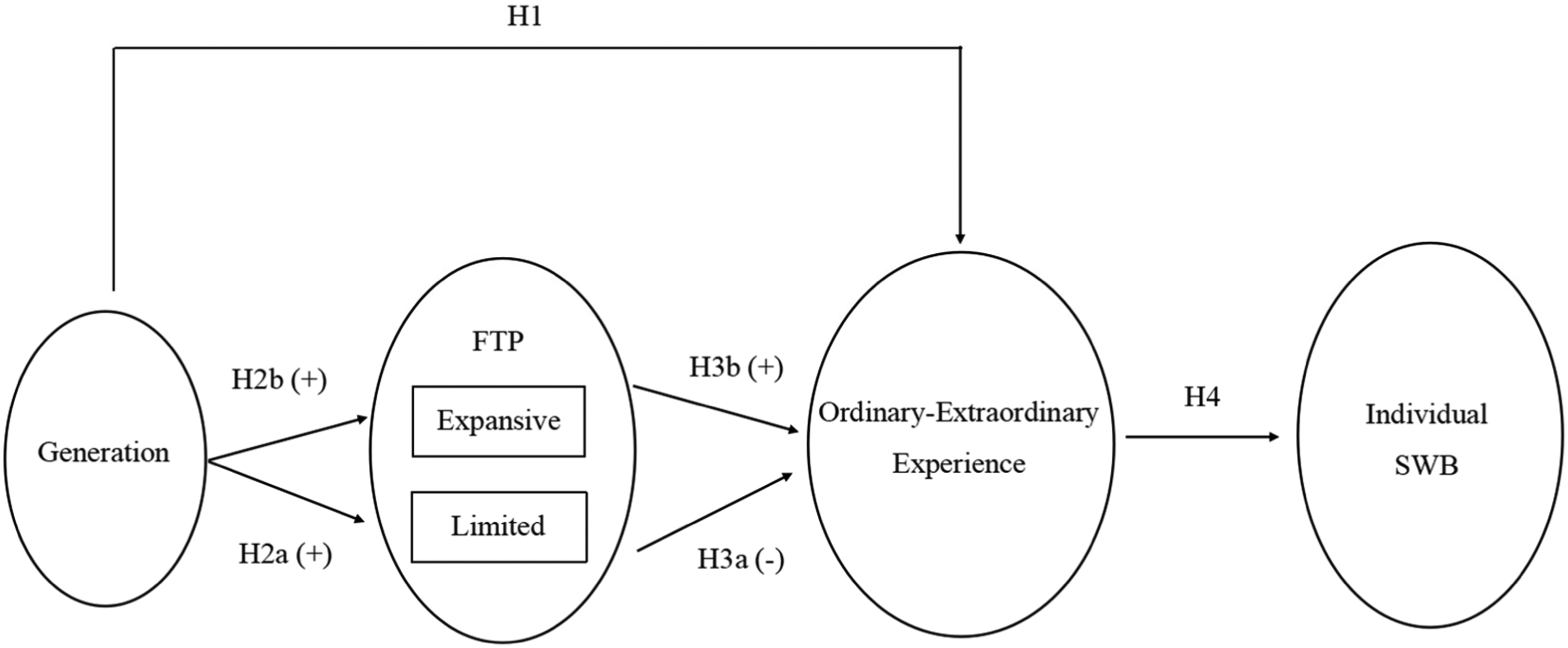
Hypothesized model.
Research methods
This research involved a two-phase approach. The first stage was qualitative: photo-interviewing was used to gather in-depth insights and develop a measurement scale on ordinary–extraordinary experiences in the cruise context based on senior and young travelers’ input. John Collier's (1957) article “Photography in anthropology: A report on two experiments” first described this technique in American Anthropologist. This interview strategy integrates photographs to elicit verbal and non-verbal data that yield an in-depth understanding of a topic. This method comes with less fatigue and repetition than conventional interviews, stimulates informants’ latent memory, and uncovers associated emotions (Collier, 1957).
This interview style was chosen for three reasons to derive a baseline experience-oriented measure. First, to the best of the authors’ knowledge, no studies have explored experiences from an ordinary–extraordinary perspective in cruise tourism, especially by soliciting the opinions of travelers from younger and older generations. In-depth interviews were therefore arranged to gather qualitative data. However, informants’ openness and their intentions to communicate with interviewers can affect data richness (Hung, 2018). Photo-interviewing can spur conversation and produce ample information (Collier, 1957) from Chinese seniors. Second, travel experiences are inherently subjective. Seniors’ travel experiences are also distinct from those of younger tourists. Photo-interviewing based on informants’ personal photographs can trigger unique emotions, thoughts, and reflections (Cederholm, 2004). This technique is well-suited to tourism research because photography is an integral part of tourism and a popular way to record travel experiences (Cederholm, 2004). Photos’ meanings can hence illuminate variation in older and younger cruisers’ desired experiences, along with specific cruise experiences that induce happiness. Third, photo-interviewing has several advantages over traditional interviews. This technique can spark informants’ recall, enhance the clarity of conversations through graphical clues, enhance interviews’ “serendipity,” and generate more precise data for researchers (Collier, 1957; Folkestad, 2000). The method was adopted here to obtain generational insights about Chinese tourists’ cruise experiences. Before commencing the interviews, all participants were asked to submit 5–10 highly meaningful photos that could best represent their experiences and feelings toward their recent cruise holidays. Each photo was subsequently enlarged and printed in A4 size to facilitate discussion during interviews (Hung, 2018). Participants were then guided through a semi-structured discussion using prompts such as “Please describe the scene in this photo,” “Why did you choose this image?,” and “What does it remind you of?” to explore experiences and emotions tied to the images.
All participants, who had previously taken cruises, were recruited via snowball sampling. As mentioned, seniors were defined as people aged 55 or above, corresponding to women's retirement age in China (Hsu et al., 2007). The sample was then divided into young and old generations (young: age 54 or below; old: age 55 or above) containing 10 people each. All participants came from first- or second-tier Chinese cities that represented the local cruise source market. Interviews lasted at least 30 min on average; all were documented via a voice recorder after acquiring informants’ approval.
An initial list of 66 cruise experience items was proposed based on interview findings and a literature review. An expert panel was coordinated after a tourism scholar confirmed the items’ content validity. The panel consisted of seven tourism researchers with cruise travel experience, along with two industry professionals. The panel was tasked with judging items’ applicability, redundancy, and representativeness (Hung and Petrick, 2010). For instance, some sample cruise activities were added to certain items to improve clarity and readability. Forty-six items with a representativeness criterion of 75% or higher were retained for further testing (Busser and Shulga, 2018).
The second research stage was quantitative: questionnaires were distributed to explore the relationships among variables, specifically generation, FTP, cruise experience choices, and SWB. Scholars have adopted various measurement scales to investigate cruising. For example, Hung and Wang (2021) tested Chinese cruisers’ experiences along three dimensions: direct experience, elevated experience, and ultimate experience. Based on Schmitt (1999), Lyu et al. (2018) concentrated on three other aspects when assessing Chinese cruisers: emotional experience, relational experience, and cognitive experience. Such measurements have two limitations relevant to this study. First, no empirical research appears to have concerned older cruisers specifically. Second, available experience measures do not take travelers’ daily life experiences (e.g. upon returning home) into account. Hence, current instruments only reflect tourists’ states of mind during trips without considering how tourists’ responses relate to their usual life experiences.
An ordinary–extraordinary dichotomy was applied to measure cruise experiences. This binary classification has been used to evaluate consumer behavior in psychology and marketing (Minton & Liu, 2019; Sussman & Alter, 2012; Sussman et al., 2015) but not yet in tourism. Churchill's (1979) recommended procedures were followed to develop a scale for comparing older and younger cruisers’ perceptions in this study. An ordinary–extraordinary dichotomy was applied to categorize cruise experiences and determine how older and younger cruisers choose cruise experiences relative to their leisure state in everyday life in the context of tourism. No existing scale dimensions have differentiated between ordinary and extraordinary experiences. Consistent with the past literature (Bhattacharjee and Mogilner, 2014; Minton and Liu, 2019), frequent experiences in comparison to leisure experiences in daily life are ordinary, whereas infrequent ones are extraordinary. Respondents were therefore asked how often they engaged in each experience item normally (e.g. “Based on the cruise experience described above, do you often have similar experiences in your daily life?”) after responding to the question regarding their cruise experiences.
The difference measure (D-measure) was used to evaluate the extent of an extraordinary experience by computing the absolute arithmetic difference between scores on a given cruise experience and daily experience using the same set of items (Hung and Petrick, 2010). The larger the difference, the more extraordinary (i.e. the less ordinary) the experience; the smaller the difference, the less extraordinary (i.e. the more ordinary) the experience. A baseline experience measure was first established to compare cruise experiences with daily experiences, so the D-measure could be generated.
A pilot test was carried out with 207 cruisers (103 seniors and 104 non-seniors) via convenience sampling. These participants met the following requirements: (1) 25 years old and above; (2) with cruise experience; and (3) from first- or second-tier cities in China. Exploratory factor analysis and principal component analysis with varimax rotation were conducted to identify potential dimensions of Chinese cruisers’ experiences. To ensure the reliability of items under each construct, Cronbach's alpha was examined via SPSS 26. The following criteria applied: (1) Kaiser–Meyer–Olkin values were no less than 0.7; (2) Bartlett's test of sphericity was significant at the 0.00 level; (3) communality was no less than 0.5; (4) factor loading was no less than 0.5; (5) cross-loaded items (i.e. both loadings greater than 0.5) were eliminated; (6) eigenvalues were greater than 1; and (7) Cronbach's alpha values ideally exceeded 0.7, although values of at least 0.6 were considered acceptable for further analysis (Hair et al., 2006).
Table 1 shows that these items were classified under four components. Component 1 was labeled “Social & Cognitive Experiences” and consisted of seven items with a reliability coefficient of 0.921. Component 2 was named “Reflective Experience,” containing six elements with a reliability coefficient of 0.930. Component 3, “Sensory Experience,” included six items related to cruise size, décor, atmosphere, environment, and cruisers’ emotions with an alpha value of 0.898. Component 4 was identified as “Functional Experience” with an alpha value of 0.679; its three items reflected the activities in which cruisers engaged during their trips.
Results of principal component analysis on cruise experiences in pilot test (N = 207).
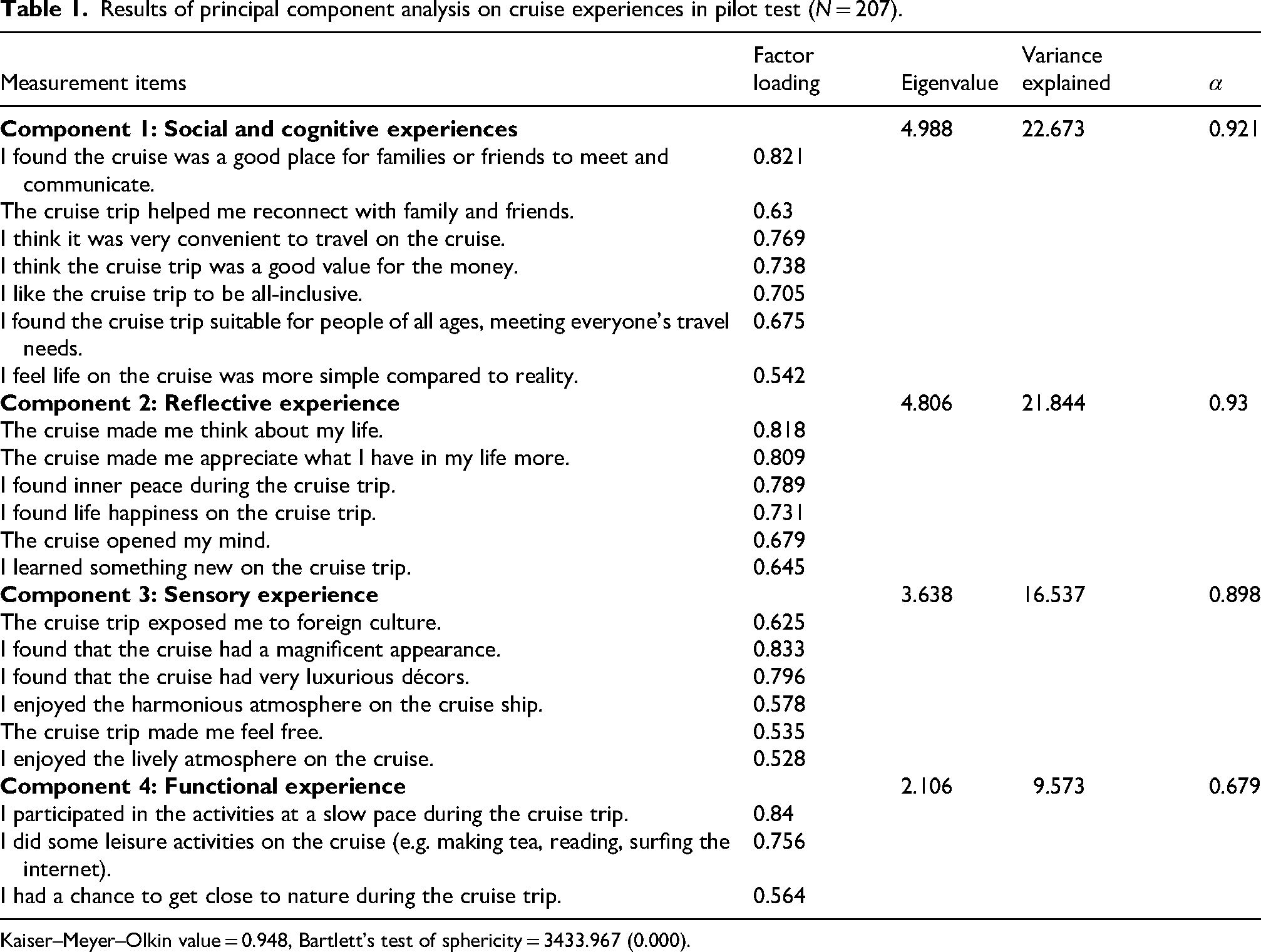
Kaiser–Meyer–Olkin value = 0.948, Bartlett's test of sphericity = 3433.967 (0.000).
The subsequent data collection process further validated the measurement scale of cruise experiences. A total of 806 respondents were recruited for the main study via on-site questionnaires at Kai Tak Cruise Terminal in Hong Kong. This terminal was the first port to resume cruise travel in China after the pandemic. Three versions of the questionnaire were made available for participants’ convenience (in English, simplified Chinese, and traditional Chinese). Disembarked cruisers were invited to complete the questionnaire either on paper or electronically (e.g. via iPad or iPhone). Incentives such as a mini fan or sports bottle were provided to qualified respondents as a token of appreciation upon questionnaire completion. The sampling criteria were consistent with those of the pilot test.
As with interviews, two broad generations were included in this study: younger travelers (≤54 years old) and older travelers (≥55 years old). The measurement scales on FTP and happiness were adopted from past studies, respectively, Kang's (2018) Travel FTP Scale and Lyubomirsky and Lepper's (1999) Subjective Happiness Scale. Both instruments have demonstrated satisfactory reliability in previous work (Kang, 2018).
Findings
Respondents’ demographics
Data from 806 respondents were valid after cleaning (402 younger people and 404 seniors; effective response rate: 93.4%). Less than half of respondents (42.3%) were men, and 57.7% were women; 49.2% were 55 years old or above, and 50.8% were aged 54 or below. Slightly more than half (52.7%) held a bachelor's degree. Most (83.1%) were married. In terms of monthly income, 66.7% of respondents earned HKD25,000 or more. Less than half (45.4%) had full-time employment, whereas 38.2% were self-employed. The majority of respondents (91%) came from Hong Kong. About 80% had taken one to three cruises. Because Hong Kong was the first city in China to reopen its cruise industry when data were obtained, all respondents’ cruise vacations took place in 2023. The most popular cruise companies reported were Star Cruises (37.2%) and Carnival (33.5%). The three most common destinations were the rest of Asia (43.5%), Hong Kong and Taiwan (36.7%), and Japan and South Korea (13.6%). Only 6.2% of cruisers visited destinations outside Asia. Roughly half (49.4%) of the itineraries lasted 9 days or longer, and nearly 40% of respondents took a 5- to 8-day trip. Most went on a cruise with their friends, spouse, or other family members.
Reliability and validity tests
Confirmatory factor analysis (CFA) was performed in AMOS 24.0 to evaluate the measurement scale's validity. The dataset was randomly split into two subsets via SPSS 26.0. The first subset (n = 406) was used to revise the experience measurement, and the second (n = 400) served to validate the measurement. When the 406-respondent sample was subjected to CFA, two items (“The cruise trip exposed me to foreign culture” and “The cruise opened my mind”) were removed due to low standardized factor loadings. Ten items were subsequently deleted because their modification indices exceeded 10, indicating that the items were strongly correlated with other factors (“I participated in the activities at a slow pace on the cruise”; “I enjoyed the harmonious atmosphere on the cruise”; “I found that the cruise had very luxurious décors”; “I found that the cruise had a magnificent appearance”; “I learned something new on the cruise trip”; “I found life happiness on the cruise trip”; “I found the cruise trip suitable for people of all ages”; “I found the cruise was a good place for families or friends to meet and communicate”; “I think the cruise trip was a good value for the money”; “I feel life on the cruise was more simple compared to reality”). The remaining 10 items were retained to further appraise the experience measure's validity.
The other sub-sample (n = 400) was submitted to CFA for model validation. The 10 items’ Cronbach's alpha values ranged from 0.781 to 0.843, showing good construct reliability (Table 2). Composite reliability values were between 0.781 and 0.845, all surpassing the 0.7 threshold. All items’ factor loadings were greater than 0.5. Sensory Experience (Component 3) and Functional Experience (Component 4) contained a pair of items each. A follow-up analysis was performed on these two-item experience factors to assess their compliance with Bollen's (2014) two-indicator rule. This rule suggests that a latent variable can be identified by two indicators if (1) each indicator's factor complexity is equal to 1 (i.e. each xi has only one moderate/high loading) and (2) the variance–covariance matrix Φ among exogenous factors contains no zero elements (Bollen, 2014: 244). Both items under Sensory Experience (0.787, 0.814) and Functional Experience (0.841, 0.840) showed moderate-to-high factor loadings, satisfying the two-indicator rule. These types of experiences could thus be assessed using their item pairs.
Measurement properties for scale of extraordinary cruise experiences (n = 400).
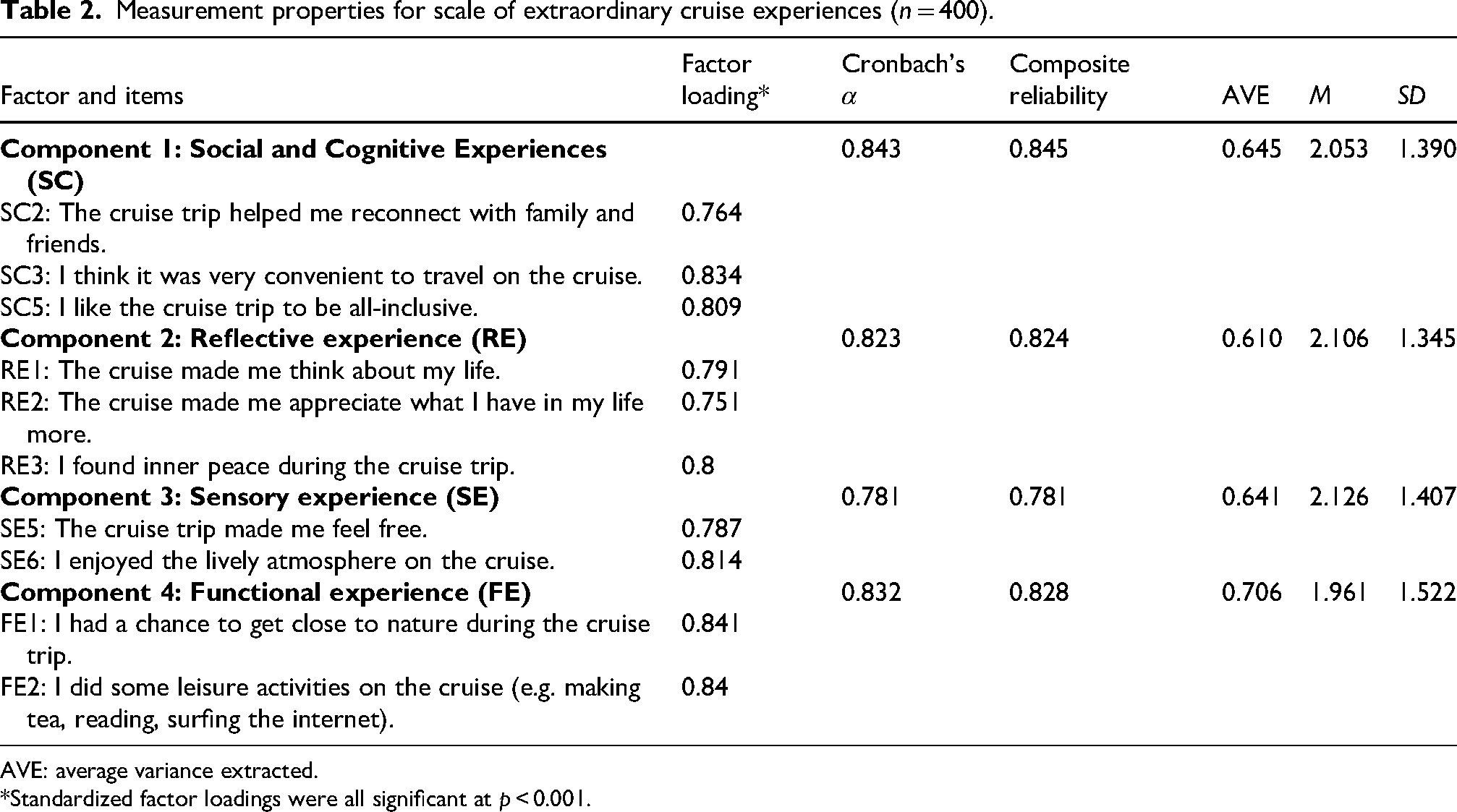
AVE: average variance extracted.
*Standardized factor loadings were all significant at p < 0.001.
As listed in Table 3, all average variance extracted values among the four constructs were larger than 0.5. The square roots of these values were greater than all correlation coefficients; that is, the cruise experience constructs possessed adequate discriminant validity.
Correlations of all constructs of cruise experiences (n = 400).
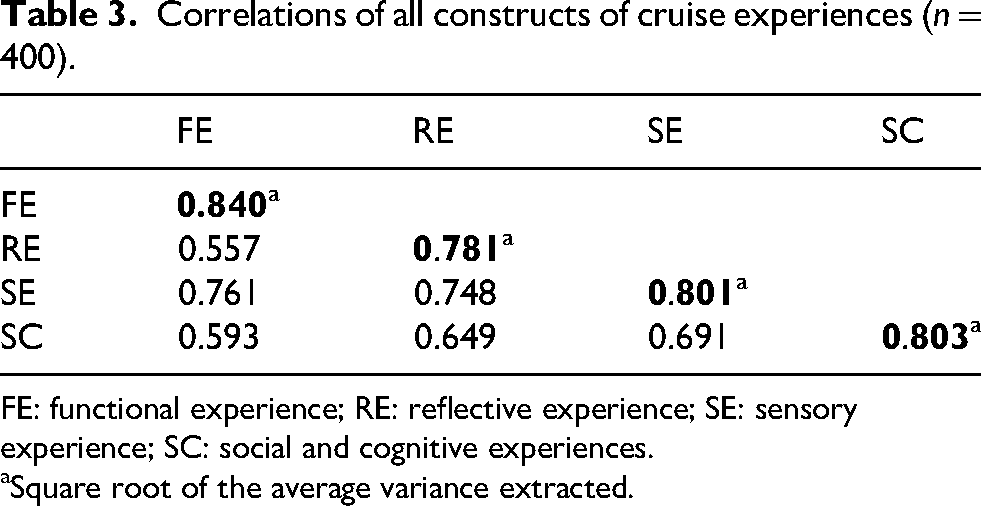
FE: functional experience; RE: reflective experience; SE: sensory experience; SC: social and cognitive experiences.
Square root of the average variance extracted.
Hypothesis testing
Bivariate correlations indicated that generation was negatively related to the extent of an extraordinary experience (β = −0.155, p = 0.000). That is, as people aged, they became less likely to choose extraordinary experiences and more likely to choose ordinary experiences. H1 was fully supported.
Respondents were required to report their chronological age and were then divided into two groups as noted: younger travelers (≤54 years old) and older travelers (≥55 years old). Bivariate correlations showed that belonging to an older generation was positively related to limited FTP (β = 0.598, p = 0.000) but negatively related to expansive FTP (β = −0.524, p = 0.000). In other words, older cruisers were more apt to perceive their travel FTP as limited, whereas younger cruisers were more inclined to see their travel FTP as expansive. H2, H2a, and H2b were thus supported.
In terms of the connection between FTP and the extent of an extraordinary cruise experience, expansive FTP was positively related to the extent of this type of experience (β = 0.154, p = 0.000), but limited FTP was negatively related to it (β = −0.231, p = 0.000). Additional investigation revealed that expansive FTP was positively related to social and cognitive experiences (β = 0.122, p < 0.01) but had no relationship with functional experience, sensory experience, or reflective experience (Table 4). Chinese younger cruisers mostly focused on social and cognitive experiences. However, limited FTP was negatively related to functional experience (β = −0.148, p < 0.001), sensory experience (β = −0.151, p < 0.001), reflective experience (β = −0.109, p < 0.001), and social and cognitive experiences (β = −0.111, p < 0.001); it contributed the most to sensory experience. Therefore, H3 was partially supported.
Hypothesis testing results on FTP and extraordinary experiences.
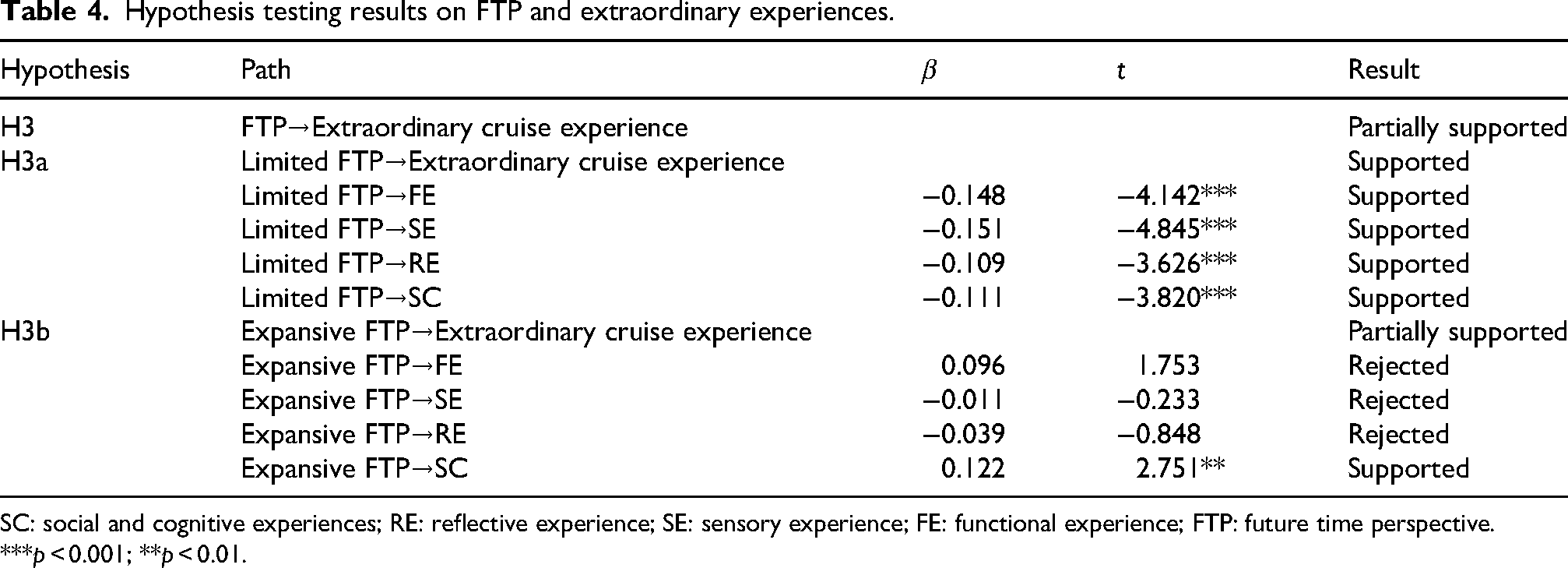
SC: social and cognitive experiences; RE: reflective experience; SE: sensory experience; FE: functional experience; FTP: future time perspective.
***p < 0.001; **p < 0.01.
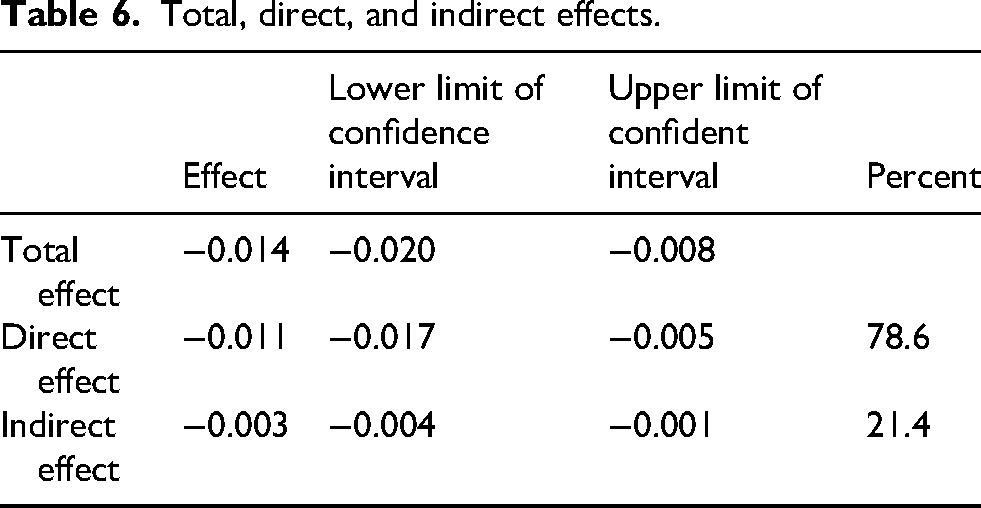
Regression analysis was employed to examine the indirect effects of generation on extraordinary cruise experiences through FTP. Table 5 shows that generation significantly influenced FTP (β = 0.0188, t = 8.0142, p = 0.000) and the extent of an extraordinary cruise experience (β = −0.0136, t = −4.4541, p = 0.000). FTP also significantly affected the extent of an extraordinary cruise experience (β = −0.1368, t = −2.9991, p = 0.0028). Bootstrapping results (Table 6) showed that the total effect was significant (95% confidence interval (CI): [−0.0195, −0.0076]), as were the direct effect (95% CI: [−0.0172, −0.0048]) and the indirect effect (95% CI: [−0.0044, −0.0008]). As such, FTP had a significant indirect impact on generation, with the extent of an extraordinary cruise experience serving as the mediator.
Process results.
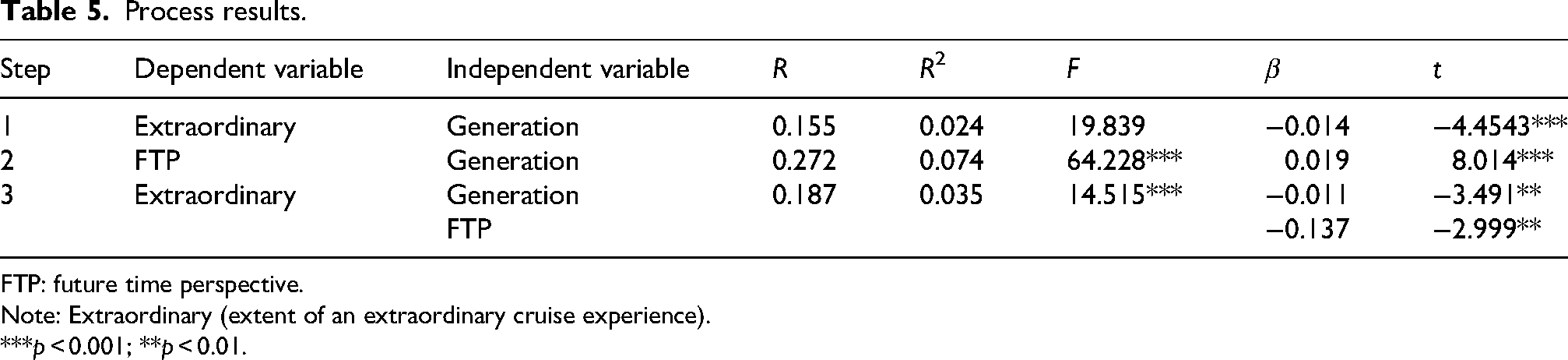
FTP: future time perspective.
Note: Extraordinary (extent of an extraordinary cruise experience).
***p < 0.001; **p < 0.01.
Total, direct, and indirect effects.
Invariance testing was used to compare the measurement model between the older and younger generations. This type of test evaluates the equivalence of structural weights across groups and has been widely applied in tourism research (Bollen, 1989; Hung and Petrick, 2012; Wassler, 2015). Both groups had satisfactory model fits (older cruisers: χ2 = 403, df = 210, Root Mean Square Error of Approximation (RMSEA) = 0.048, Comparative Fit Index (CFI) = 0.972; younger cruisers: χ2 = 423, df = 210, Root Mean Square Error of Approximation (RMSEA) = 0.050, Comparative Fit Index (CFI) = 0.964). The measurement model was also invariant between them. The relationship between the extent of an extraordinary cruise experience and SWB was then investigated further. Only social and cognitive experiences were positively related to cruisers’ happiness regardless of generation (older generation: β = 0.166, p < 0.01; younger generation: β = 0.170, p < 0.05). H4a and H4b were thus partially supported. Younger and older cruisers’ short-term happiness arose from the convenient and all-inclusive nature of cruise travel as well as bonding with familiar others.
A non-parametric test was carried out to compare older and younger cruisers’ happiness. A Mann–Whitney U test indicated the mean rank for younger cruisers was 409.74; that for older cruisers was 397.29. No significant difference emerged between groups in terms of happiness (U = 78,694.5, p = 0.439, two-tailed). Therefore, H5 was supported: older tourists appeared to be as happy as younger tourists despite their preferences for different extents of extraordinary cruise experiences. Findings for the hypothesized model are summarized in Table 7.
Results of hypothesized model.
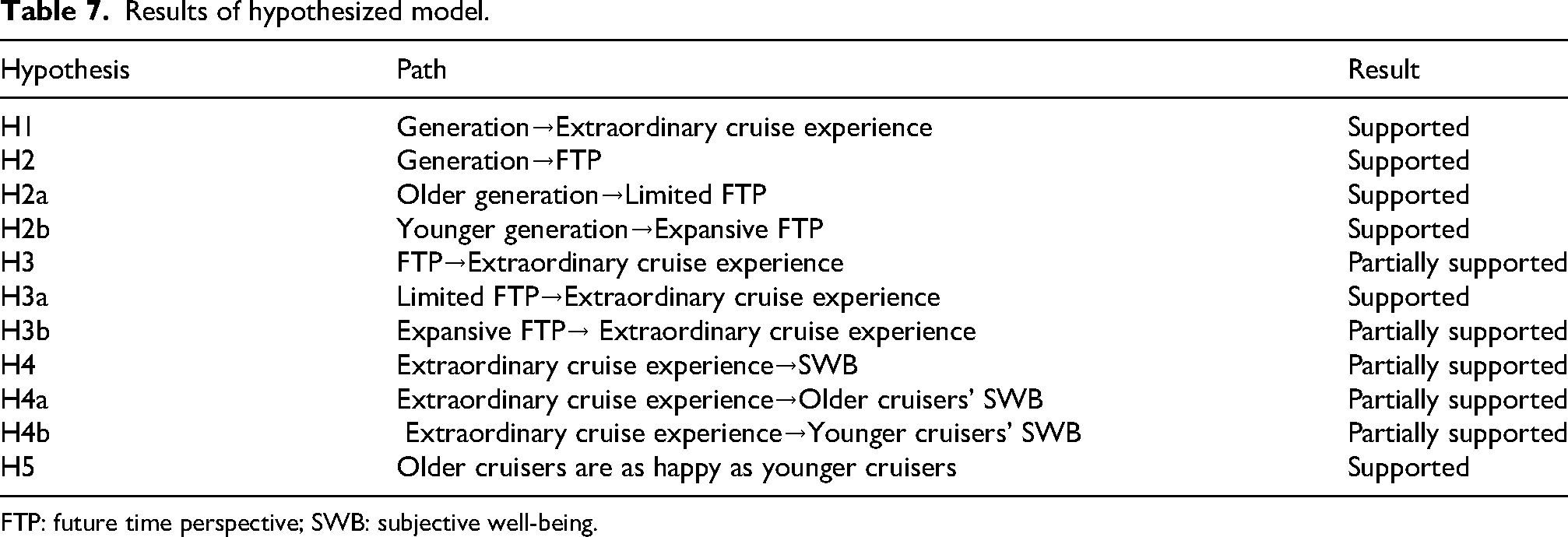
FTP: future time perspective; SWB: subjective well-being.
Discussion and implications
This study uncovered a negative association between generation and the extent of an extraordinary cruise experience (H1), such that older and younger cruisers sought different experiences: older cruisers tended to desire less extraordinary experiences (i.e. ordinary experiences) during their vacations, whereas younger cruisers yearned for more extraordinary experiences. This finding corroborates the literature on generation-related differences in preferred travel experiences (Horneman et al., 2002; Shoemaker, 1989; Sirgy and Su, 2000) and cruise experiences (Swain, 2008). This research further distinguished extraordinary and ordinary experiences based on the D-measure. To the best of the authors’ knowledge, this study is one of the earliest in the cruise literature to account for tourists’ everyday experiences when investigating travel experiences. Quantitative results indicated that senior cruisers preferred to take advantage of the ship's free and lively atmosphere, contact with nature, and leisure activities. Prior investigations similarly demonstrated that Chinese seniors enjoyed personal entertainment in daily life (e.g. from reading, surfing the internet, and engaging in outdoor activities; Tan, 2011). Seniors’ cruise experiences somewhat mirrored usual life and were thus considered ordinary. Conversely, non-seniors focused more on the cruise being convenient, all-inclusive, and social. Most young people were too busy working to socialize in everyday life. Associated cruise experiences were rare in everyday contexts and were hence extraordinary. These findings are consistent with the literature (Anat and Ran, 2011; Bhattacharjee and Mogilner, 2014), suggesting that younger people prefer to define themselves based on new experiences to enrich their travels. Seniors mainly derived their self-definition from more ordinary experiences.
Quantitative findings indicated that older and younger cruisers perceived their future time differently (H2). Generation was positively related to limited FTP but negatively related to expansive FTP. Older cruisers were thus more inclined to see their future time as limited, while younger cruisers viewed it as expansive (H2a and H2b). These perceptions are in line with those documented in other FTP investigations (Carstensen et al., 1999; Kang, 2018). For instance, in Kang's (2018) work, generation was positively associated with limited travel FTP but negatively associated with expansive travel FTP.
A negative relationship was observed between limited FTP and extraordinary cruise experiences (H3a), which contained four dimensions (functional experience, reflective experience, social and cognitive experiences, and sensory experience). Limited FTP contributed most to sensory experience (β = −0.151, p < 0.001), followed by functional experience (β = −0.148, p < 0.001), social and cognitive experiences (β = −0.111, p < 0.001), and reflective experience (β = −0.109, p < 0.001). Older people with limited FTP were less likely to choose extraordinary cruise experiences and sought more ordinary ones instead. Many of these senior cruisers were drawn to sensory experiences (i.e. the ship's free and lively atmosphere). Seniors felt liberated because cruise tourism did not present fixed schedules to follow compared with other travel options. Meanwhile, these cruisers felt invigorated rather than bored on the ship due to having access to rich, varied activities. Similar feelings arose in their daily lives. Tan (2011) indicated that Chinese seniors remain busy and engage in a range of everyday activities even after retiring. Therefore, seniors saw their cruise experiences as ordinary. The present study's quantitative outcomes further showed that seniors were more amenable than younger cruisers to functional experiences (e.g. leisure activities such as making tea, reading, and surfing the internet while on a cruise). Although these pastimes echoed those in daily life, Chinese seniors enjoyed doing them on board and viewed the cruise experience as ordinary. Horneman et al. (2002) similarly confirmed familiarity to be an important aspect of seniors’ destination choice.
Moreover, although expansive FTP was positively associated with social and cognitive experiences, it did not significantly influence other dimensions of extraordinary cruise experiences (H3b). Younger cruisers with highly expansive FTP were more apt to choose social and cognitive experiences, such as reconnecting with others or enjoying a convenient and all-inclusive trip. These findings coincided with the previous literature (Hung, 2018; Lyu et al., 2018). Younger Chinese people often grapple with intense work pressure and a fast-paced lifestyle, hence their preference for a relaxed vacation. Compared with other travel modes, the greatest advantage of cruise tourism is its integration of several functions (e.g. catering, accommodation, transportation, travel, entertainment, and even shopping) in a single space. This capacity met young Chinese tourists’ travel demands: during cruises, younger people could relax in addition to reconnecting with loved ones. These opportunities were seen as extraordinary for this age group.
Cruisers’ perceived future time had a significant indirect effect on age with cruise experience as the mediator (H4; 95% CI: [−0.0044, −0.0008]). Older cruisers whose FTP was limited were more inclined to choose ordinary experiences. Their younger counterparts with expansive FTP were more likely to seek extraordinary experiences. FTP provides a theoretical explanation for the relationship between age and people's behavior (Bhattacharjee and Mogilner, 2014; Gielnik et al., 2018; Kang, 2018; Stahl and Patrick, 2012).
When comparing older and younger cruisers, only social and cognitive aspects of extraordinary cruise experiences were positively related to happiness (H4). More specifically, the social factors, convenience, and all-inclusive nature of cruising contributed to cruisers’ happiness regardless of age. Lyu et al. (2018) discerned somewhat related trends in that emotional and relational experiences contributed to cruisers’ short-term happiness. In the present case, even though the two groups of cruisers chose different experiences, older passengers appeared equally as happy as their younger counterparts (H5). Ordinary cruise experiences could thus generate as much happiness as extraordinary ones for seniors, who genuinely enjoyed their own trips. As Bhattacharjee and Mogilner (2014) reported, older individuals gained as much pleasure from ordinary experiences as younger people did from extraordinary ones.
In terms of theoretical implications, this research tested the effects of generation on cruise experience choices and cruisers’ happiness using FTP. It represents the first empirical investigation of its kind in this context. Although travel experiences have been thoroughly documented, explanations are lacking on why people's trip experiences and leisure habits vary generationally. FTP provides a theoretical lens with which to explore travelers’ preferences and narrows this knowledge gap. In short, this study's findings expand the FTP and SST literature while offering a fresh view of individuals’ future travel choices and decision-making.
This research innovatively addressed seniors’ happiness with cruise travel compared with their younger counterparts. Despite some commonalities, younger and older travelers expressed distinctive preferences for cruise experiences. This angle has gone largely neglected in earlier work. The current research thus also contributes to the literature on cruise-related happiness and should draw researchers’ attention to happiness among different generations of tourists.
Methodologically, this study explored, for the first time, how older and younger cruisers perceived their experiences as extraordinary or ordinary based on generation and travel FTP. This binary classification guided model development and helped distinguish seniors’ and non-seniors’ cruise experiences with respect to their everyday experiences back home. The dichotomy also enabled the researchers to clarify how generations interpret the meaning of travel. Using the D-measure to construct a scale resolved concerns in evaluating extraordinary/ordinary experiences and represents a breakthrough in this stream of literature. Additional quantitative research can now be conducted in this vein. The scale's applicability should also be validated with populations from other regions of China.
This study's results yield practical implications as well. The findings clearly convey to practitioners that young and old cruisers have distinct travel needs and experience cruises differently. However, they are as happy as their counterparts with their preferred cruise experiences (i.e. extraordinary experiences for the young and ordinary experiences for the old) and time perspectives (i.e. expansive travel FTP for the young and limited travel FTP for the old). Cruise lines can market trips more effectively by understanding cruise tourism's passenger segments and positioning. To appeal to non-senior tourists, promotional campaigns should highlight the newness, adventure, uniqueness, and sociality that only cruises can provide. Messages should also emphasize various exotic itineraries, ports of call, and destinations and spotlight unique on-board recreational activities and facilities. Marketing materials could depict young tourists reveling in an adventurous, fun, worry-free journey. To attract older travelers, campaigns’ messaging should center on safety and calm: a cruise can be depicted as an extension of one's everyday routine, representing an opportunity to experience the world at one's own pace and in one's own way. Advertisements should also describe leisurely days, well-planned itineraries and destinations, and pampered journeys. Seniors should be shown warm, enjoyable scenarios involving families and friends.
Cruise operators should design products and services that cater to these groups. Non-seniors would appreciate nearby weekend getaways, niche locations, thrilling adventures, and exotic island discoveries. They should also be presented with social activities through which they can meet others, such as mystery games (e.g. “script-kill” games), board games, and Frisbee. On board, elderly people can simultaneously engage in activities that mirror daily life: healthy, high-fiber meals; intellectually stimulating workshops; and low-impact exercise (e.g. eight trigrams boxing, tai chi, square dancing). “Elderly park” areas could serve as spaces to chat, dance, make tea, and play Mahjong or cards. Special signs, menus, and other visual materials meant for these passengers should be large and easy to read.
In this study, Chinese seniors’ and non-seniors’ happiness was largely attributable to the convenient and all-inclusive nature of cruise travel as well as bonding with family and friends. Collectivism lies at the heart of traditional Chinese culture, and people look forward to spending travel time with their relatives and friends. Cruising brings people into a limited space and enables them to eat, sleep, and play together. These characteristics suit a cultural emphasis on togetherness. Cruise lines could therefore publicize cruise ships as suitable places for family reunions, friend gatherings, and company team building. Moreover, Chinese seniors typically value their grandchildren and are willing to spend money and time traveling with them (Wang, 2015; Yu, 2013). Convenience renders cruising a feasible way for seniors to take their grandchildren on trips independently. This segment is somewhat unique to China's cruise market and deserves attention from cruise lines, particularly international companies. Practitioners should also ponder how best to design related products, services, and itineraries to fulfill the travel needs of older cruisers and their grandchildren. In terms of room types, more family suites should be added to meet this segment's need for family bonding. Furthermore, senior-friendly services could be offered to relieve travel burdens among the elderly taking care of grandchildren: butlers, all-Chinese service, port pick-up and drop-off, luggage delivery, and in-room food delivery. To ensure the security and comfort of older cruisers and children, emergency medical support, childcare services, location wristbands, low-intensity grandparent–grandchild activities (e.g. handicraft courses, parent–child games, interactive performances), and gentle leisure itineraries should be offered as well.
Conclusion
China has become Asia's largest cruise market, appealing to many domestic travelers—seniors in particular. Chinese seniors’ cruise experiences merit exploration so that firms may devise products and services to meet their demands. Therefore, to better understand this consumer group, this research considered whether and how passengers’ happiness derived from cruise experiences differs across generations. A conceptual model was built to delineate the relationships among generation, FTP, cruise experience choices, and happiness.
The quantitative study phase unveiled four dimensions of the ordinary–extraordinary cruise experience: functional, sensory, reflective, and social and cognitive. Generation was negatively related to expansive travel FTP but positively related to limited travel FTP. In addition, FTP mediated the relationship between generation and cruise experiences. Seniors with limited travel FTP were more likely to choose ordinary cruise experiences, whereas non-seniors with expansive travel FTP preferred extraordinary cruise experiences. Social and cognitive experiences contributed to senior and non-seniors’ cruise-related SWB. Even though seniors and non-seniors chose different experiences on board, seniors were as happy as non-seniors. This research enriches the literature on FTP; enhances the understanding of cruising in terms of extraordinary and ordinary experiences, especially among Chinese seniors; and bolsters theoretical comprehension of travel experiences. Findings also point to practical implications for designing cruise products, services, and marketing.
Several limitations of this study should be acknowledged. First, most respondents were from Hong Kong. Cruisers from other regions may seek different experiences and sources of happiness. Cross-cultural comparisons should thus be conducted in the future: the FTP, cruise experiences, and happiness of passengers from Mainland China or Western countries should be compared with their Hong Kong counterparts. Also, although senior cruises generally prefer ordinary experiences while cruising, they may pursue extraordinary experiences in other travel settings as they pursue their “bucket list.” Subsequent studies could cover additional contexts to further deconstruct extraordinary–ordinary experiences. Second, this research endeavored to create a measurement scale specific to both senior and non-senior cruisers. Given the study's emphasis on Chinese senior cruisers, the scale was restricted to the Chinese population and the cruise setting. The measure's applicability should be evaluated with other populations. Third, young and older cruisers were distinguished based on chronological age rather than cognitive age given the former measure's objectivity (e.g. the stipulated retirement age for women in China). Future work can integrate cognitive age to understand how results may vary between the two perspectives. Finally, multi-generational cruise travel is likely to become a key source market. Only passengers older than age 25 were assessed here; children were not. Convenience renders cruising a feasible travel mode for seniors to take their grandchildren on trips independently. This segment is central to China's cruise market and deserves particular attention from cruise lines. Scholars should therefore explore grandparents’ and their grandchildren's cruise experiences moving forward.
Footnotes

Author contribution(s)
Funding
The authors received no financial support for the research, authorship, and/or publication of this article.
Declaration of conflicting interests
The authors declared no potential conflicts of interest with respect to the research, authorship, and/or publication of this article.