







Abstract
A jellyfish surrounds a plastic fragment, merging the synthetic material with its body; a water agency poster warns of dangerous plastic bottle ‘fish’ in the Mediterranean; marine organisms take shelter on and under synthetic materials. These are the denizens of a growing realm marine ecologists call the ‘plastisphere’, where sea life and plastics meet. Building upon multispecies ethnography, science and technology studies interrogations of nature/culture divides and the practical work of classification, this article explores the indeterminacy – the very plasticity – of the category of ‘species’ as it is engaged in seriousness and irony, with living and nonliving bodies. First, I draw on participant observation at a nonprofit marine institute laboratory in California to trace the travels of plastic-creatures through attempts to disentangle them in the pursuit of scientific knowledge. Here volunteers sort tiny plastic bits from animal ones under the microscope, enacting material boundaries as they decide what gets counted as life (not plastic) and what does not (plastic). Second, I follow movements of plastic-creatures through public education campaigns, paying particular attention to assumptions about belonging and agency enacted with assumptions about whether and when plastic-species should or should not meet. I argue that the ‘danger’ of plastic relationships lurks not in associations but in the very categories used to know and live with forms of plastic and forms of life, in the kinds of belonging that emerge with kinds of materials, and in the failure to recognize the impossibility of their separation.
Keywords
I was first introduced to the plastisphere while doing fieldwork on a plastic pollution research expedition in the middle of the North Pacific Ocean. Below deck on the racing sailboat turned research vessel, marine ecologist Dr Hank Carson was giving me a tour of the tiny improvised lab space where he was taking digital microscope photographs of invertebrates plucked from floating pieces of plastic waste. The plastisphere, he explained, is a term some scientists use when referring to communities of organisms that live attached to, or associated with, plastics. ‘It’s like the anthropocene for marine biology’, he continued, drawing comparison with the geological age defined by extreme human impact on the environment. Delving further into the scientific literature after the expedition, I learned that the plastisphere is made of the ‘associations’ and ‘novel interactions’ of life forms defined by their relationship to a human product in the ocean: eggs laid on a plastic bag, gooseneck barnacles burrowed into foam, bacteria nestled on synthetic fragments (Amaral-Zettler et al., 2013; Goldstein et al., 2012). The term emerged from studies of ‘rafting’, an area of marine biology concerned with how organisms not only flourish but also travel and potentially become invasive species by hitching rides on floating materials. Plastic in the ocean is not simply human-made ‘matter out of place’ (Douglas, 2002 [1966]); it is also a matter of life (and death) as bodies come to live, travel and die with plastic, and with plastic inside them.
As I became more familiar with these communities proliferating at sea, I began to notice plastic-bodies leaping from the water and into public education campaigns: birds with cigarette beaks, taxonomies of bottle fish, plastic bags described as agents with power to impact wildlife. Presented as ‘dangerous’ and ‘non-native species’, these images are meant to encourage the clean-up of plastic from the sea, the very possibility of their category-crossing existence positioned as an argument for untangling human materials from natural ones. In these commingled zones of science and culture, oceans and images, a lively politics of belonging is emerging with plastic entanglements that simultaneously threaten and reconstitute the boundaries between nature and culture, living and nonliving bodies. These boundaries have been extensively complicated by science and technology studies (STS) and body studies approaches that refuse binaries to insist on the relational ‘becomings with’ of humans and nonhumans, nature and culture (Haraway, 2008; Latimer and Miele, 2013; Latour, 1993; Venn, 2010), where bodies are always entangled material processes (Blackman and Venn, 2010; Hird, 2007). While others have considered bodily relationships between humans and other species (Game, 2001; Venn, 2010), and even the role of nonhuman animals in the production of scientific knowledge (Birke, 2012; Davies, 2012), I draw attention to relationships between living and nonliving bodies, positioning plastic-creatures among the emergent relations of beings and things, habitats (not just habit) as an example of what Grosz (2013: 235) calls the ‘inter-implications of forms of life with inorganic forms’. Further developing conceptions of material (dis)entanglement through multispecies ethnography and studies of the classification of the bio, I consider the indeterminacies of ‘species’ coming-in-to-being (Dahlberg et al., 2013) as plastic-creatures circulate with ocean currents, filter through the categories of laboratory science and elicit public cooperation in attempts to address ocean pollution. Together, these cases show the physical and conceptual indeterminacy of species as bounded bodies, logical types and playful kinds.
This article draws on the diverse convergences and attempted disentanglements of plastic, marine life, and those who study them as encountered during a year and a half of ethnographic fieldwork I conducted with Algalita Marine Research and Education, a California-based nonprofit dedicated to plastic pollution research and education. I also conducted interviews and visited the laboratories of university-based researchers in California, Oregon, Hawaii and Japan between July 2011 and 2014. While by no means formally trained as a marine biologist or ecologist, I incorporate my own experience with the plastisphere – helping to collect samples at sea and learning first-hand the challenges of sorting them as a volunteer at Algalita’s laboratory. Following these closely coupled tanglings and untanglings at sea, in the lab, and through nonprofit and government public education campaigns, the tensions between kinds of plastic and kinds of life become explicit arguments that position separation – cleaning up human materials from beaches and the sea – as the dominant course of action for addressing plastic pollution. Tracing these indeterminate bodies-in-motion shows how ontological entanglements, rather than leading to uncertainty or inaction, may come to inform particular courses of action as understandings of material associations between plastic and life depends on their separation into kinds of matter sorted, counted and weighed against one another. As plastic-species exceed classification and clean-up, I argue that the ‘danger’ of plastic–life relationships lurks not in associations but in the very categories used to understand and live with forms of plastic and forms of life, in the kinds of belonging that emerge with kinds of materials, and in the failure to recognize the impossibility of their separation.
Entanglements In and With Science
For scientists and activists working with plastic pollution in the ocean, entanglement is the technical term for marine life ensnared by plastic debris: fishing line slowly strangling seals, and plastic bottle rings giving hour glass figures to turtles. These are physical relationships – contact between animal bodies and plastic materials – that in the words of marine biologist David Laist (1987), ‘put animals at a survival disadvantage’. Entanglement causes ‘serious injury or death’ (EPA, 2013), as ‘ many animals, if not most so caught, find it difficult to escape entanglement and are doomed to drown or die from injury, starvation and general debilitation’ (Gregory, 2009: 2014). In marine debris science, entanglement is negative by definition; a matter of non-belonging. From an STS perspective, however, the plastisphere, with relationships that are supportive of life, not just in contact with it, complicates this formulation. Its associations inhabit the cracks between the very categories of plastic and animal, synthetic and natural, waste and life. I begin by extending this ambiguity to plastic–life relationships at sea more generally, rather than with assumptions of already ‘bad’ plastic threatening a ‘pristine’ ocean ‘environment’. 1 Similar to Gabrys et al. (2013), I understand the materiality – the very ‘plasticity’ of plastic – as ‘emergent and contingent, where plastics set in motion relationships between things that become sites of responsibility and effect’ (Gabrys et al., 2013: 5).
Approaching the plastisphere (broadly conceived) with an STS understanding of entanglement helps show how these categories, and with them, assumptions about whether plastic can or should be removed from the sea, emerge with processes of knowing life and plastic in the ocean. For STS, science is part of material entanglement. Scientific practices do not simply represent pre-existing conditions and characteristics, but are implicated in their ongoing formation. Karen Barad (2007) emphasizes such ‘intra-actions’, the constitutive relationships between matter and meaning, refusing to begin with boundaries already drawn or agency already attributed. As Astrid Schrader (2010) deftly demonstrates, ways of knowing, in her case scientific study of a marine microorganism’s toxicity, are inextricably entangled with ontology. The identity and agency of the organism in question cannot be determined independently of its experimental enactments: ‘how we get to know a species experimentally cannot be separated from the ontological question of what/who they are’ (Schrader, 2010: 277). Focusing more generally on the divisions between human and nonhuman species, Donna Haraway (2008) argues for interspecies dependencies where ‘the partners do not precede the meeting; species of all kinds, living and not, are consequent on a subject- and object-shaping dance of encounters’ (Haraway, 2008: 4). Here species, alive and dead, organic and not, are ‘becomings with’ of beings and categories, entities and systems for sorting. In the plastisphere, humans, disciplines and ocean creatures ‘become with’ plastic. As they travel, indeterminate plastic-species bodies not only ‘become-together’, but ‘become-apart’, in practices that sort kinds of materials and kinds of species, both living and nonliving. And plastics are named as potential species in return.
More recently, the entangled agencies of diverse human and nonhuman actors have been infiltrating cultural anthropology. Taken up by the emerging subfield of multispecies ethnography, a multitude of creatures from meerkats to microbes (Candea, 2010; Helmreich, 2009) are key figures in a ‘species turn’ that further problematizes the categories of nature and culture. The concept of species is itself understood to be multiple and even potentially dangerous if it reinscribes biological similarity and difference at the expense of diverse encounters (Kirksey and Helmreich, 2010). Similar boundary challenges are also appearing in studies of the classification of the bio as researchers are questioning how and when twitching strands of Petri-dish meat and other synthetic, fleshy matter encountered in the laboratory qualify as life (Zurr, 2013). Practices and categories of sorting along species and lifelines are not only political, they also arguably have a performative tendency to make the world in their own image. 2 Claire Waterton (2002) cautions, however, that this is not a simple, traceable process whereby social and political factors embedded into classifications are reflected directly back on the world: ‘classifications seem to take off in unanticipated directions, refusing to adhere to the stable groupings we think they are. This results in an evolving assemblage of meanings attaching themselves to classes…and transform[ing] both the discourses and the material objects being discussed’ (Waterton, 2002: 196). As the practices of scientific sorting are entangled with their objects and objectives, indeterminacies reach to the future, shaping ‘unformed’ multispecies relationships that not only are but may yet come to be.
Tangles of Waste and Life at Sea
On a sailboat, somewhere in the North Pacific, July 2011: After nearly a week of rough seas driving plastic below the surface, and nauseous novice crew below decks, a small sample net snagged a 2 meter diameter knot of plastic (Figure 1). The crew of Algalita’s research expedition had caught, or rather been caught by, a ‘netball’– a kind of ocean tumbleweed of escaped fishing nets and lines, known as ‘ghost nets’ for their tendency to keep fishing in the absence of humans. Dr Carson and a film crew dived into the still churning seas to investigate. The team returned with photographs and samples of a strangely beautiful tangle, shelter to a host of coastal species: coral reef fish, sea slugs and even a lone oyster. Though they are understood to belong in the ocean (unlike the plastic), they would not otherwise be found so far out to sea. Their existence here is precarious. Both shelter and snare, ghost nets are mobile habitats capable of killing their tenants in rough weather.
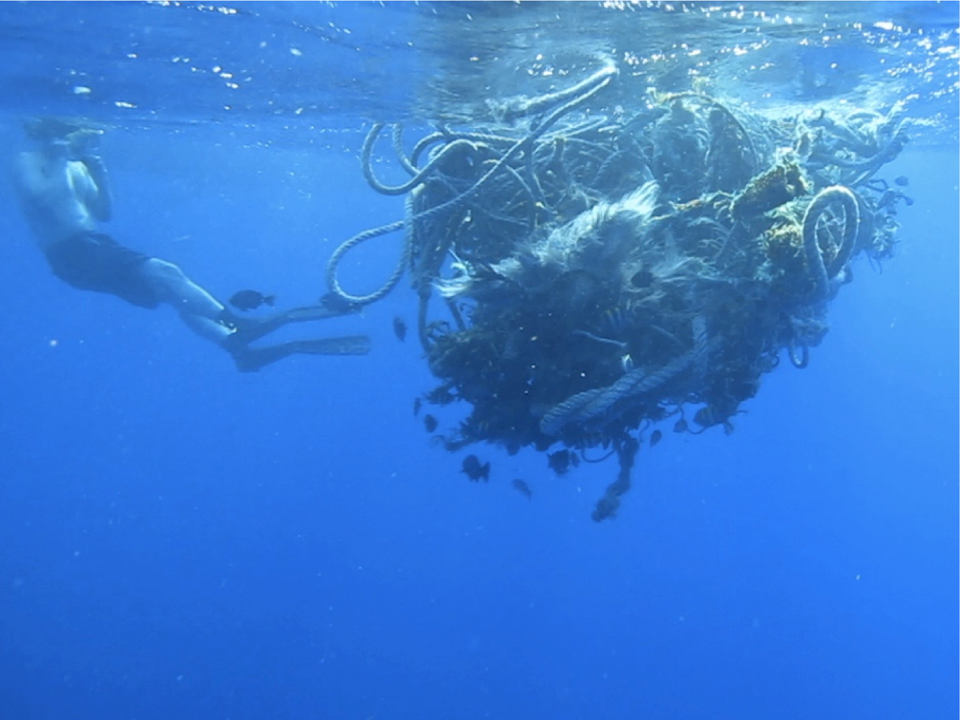
Ghost net with reef fish and human.
Entanglements with plastic can also be embodied in the most literal sense, as plastic materials become part of all kinds of bodies, including those of jellyfish. 3 Velella vellela, for example, are palm-sized jellyfish commonly found on the open seas of the North Pacific. They have a clear oval or round body, marked by visible concentric growth lines, like tree rings. This base supports a circle of short, blue-purple tentacles below, and a half circle ‘sail’ above, the distinguishing characteristic of its popular names: ‘by-the-wind-sailor’ or ‘sea raft’. Counting passing debris from the boat deck, I often confused velella with crumpled bits of plastic film. Over the course of the voyage, I honed my observation skills, learning with the other volunteers to visually distinguish jellies from plastic with a quick glance. But upon closer inspection this division does not always hold. Some velella may have incorporated synthetic materials right into their bodies. These plastic fragments are not only superficially attached to their outsides or temporarily ingested through their insides. Stuck to soft bodies, like a grain of sand in a pearl oyster, plastic bits can be completely enveloped into gelatinous flesh. They are both plastic and jellyfish.
Plastic and life not only exist together, they move together. In studies of ‘rafting’, where the term ‘plastisphere’ originates, marine biologists and ecologists seek to understand how specific species and their distribution are potentially altered with the plastic in their lives. Until recently, hard substrates – sturdy floating materials – available for travel were restricted to logs or mats of greenery that could only travel so far without human intervention before degrading or becoming waterlogged. Synthetic plastics provide new possibilities for long-distance travel, and with them, new concerns about invasive species as organisms move to new places. Marine creatures come to not belong in their relationships with plastic. But plastic also travels with life, as jellyfish and other bodies become the ‘raft’ for plastic; with birds and fish that ingest and transport small plastic pieces.
The entanglements that constitute the plastisphere cannot simply be undone. With the netball, removing waste from the water is not inherently good for those it shelters; with the jellyfish, it would involve precise, body-cutting surgery. But despite the proliferation of plastic–life alliances at sea, both scientific and popular practices surrounding plastic pollution in the ocean enact a familiar separation of nature and culture. The next two sections consider how these divisions are constituted physically and conceptually in the work of producing and sharing knowledge about plastic pollution in the ocean. I will then suggest that STS offers a constructive path past the scientific and popular imperative to purify nature and culture, a way of responding to plastic pollution that opens up space for these shelters and bodies. In doing so, this article pushes discussions of relational ontology and material agency out of the laboratory and toward responsibility, challenging the foundations of not only scientific knowledge production, but popular practices of dealing with ocean plastic pollution through clean-up.
‘Plastic versus Everything Else’: Separation as Scientific Knowledge
At Algalita’s Redondo Beach laboratory near Los Angeles, technicians and volunteers painstakingly process surface samples of mixed up plastic and organisms sifted from the open seas. With the aim of quantifying and monitoring the distribution of plastic in the ocean rather than studying the intricacies of life on plastic, Algalita researchers do not describe their work using the term ‘plastisphere’. They do, however, establish the quantity of plastic in relationship to the quantity life by establishing a plastic-to-plankton ratio. 4 In practice, this involves quite literally weighing one against the other. But first they must be separated; filtered through bounded categories as they circulate the space of the lab.
Working with forceps under dissecting microscopes, staff sort samples into two glass jars, most commonly labeled plastic and plankton (Figure 2). Variously described as plastic/manmade and plankton/animal/organic/natural/real, these categories for sorting culture matter from nature matter already contain assumptions about what belongs in the ocean or not. When I asked for clarification about the categories, the lab manager explained that the plastic-to-plankton ratio was a comparison between nutritive and nonnutritive materials floating in the open ocean, or the likeliness a body looking for a meal would get something it could (or should) digest. Continuing, she clarified, ‘Basically, it’s plastic versus everything else.’ These jars are not metaphorical boxes, but rather form the basis for a physical separation that ends with a material archive of dried plastic bits and dried plankton bits in separate plastic bags.
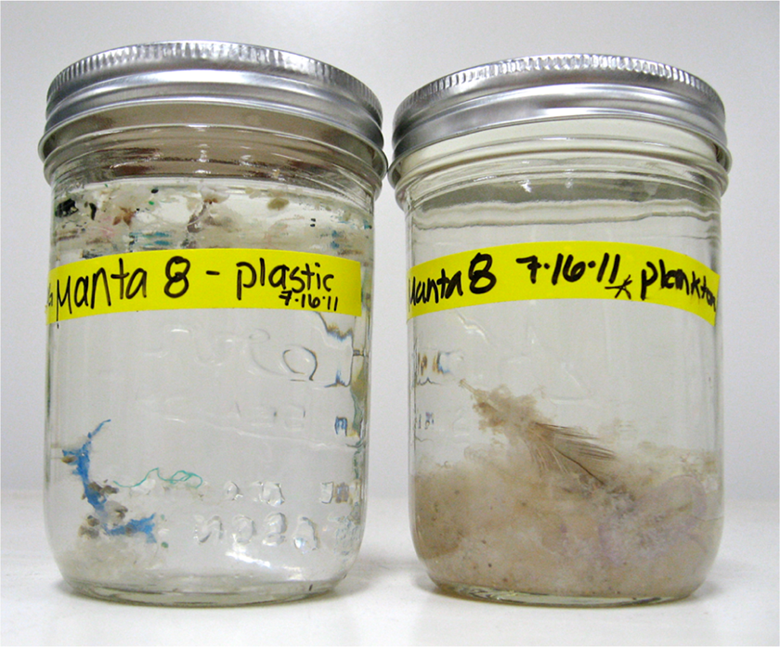
Ocean surface sample sorted into plastic and plankton.
This sounds relatively simple, but at both Algalita’s California lab and an affiliated lab in Hawaii, I observe staff and volunteers struggling to untangle plastic and life into separate containers. On a sunny winter afternoon, I listen as a volunteer describes the contents of her Petri dish as ‘a plant with legs on it’; moments later, another volunteer hesitates and confers with her colleague before depositing a fragment (or is it a fish tooth?) in a jar labeled plastic. Categories and boundaries are enacted in this work of classification intended to script material flows, to determine future movements of sample bits and pieces from jars into Petri dishes, archives and publishable figures. Yet lively plastic entanglements continue to exceed both practices and categories. As a veteran lab technician described in an interview, these kinds of incidents are a constant challenge, especially for those starting out: ‘Like everybody says in the beginning, is this plastic or is this real, is this plastic or is this real? And in the beginning you’re going, you’re looking at this huge amount of stuff and you don’t know what’s what.’ Even those with years of experience and marine biology training are quick to provide examples of specimens causing trouble for those sorting: pieces of plastic film camouflaged by algae that cannot be scraped off; or salps, a jelly-like filter feeder, with plastic on their insides (Figure 3). Should the plastic be removed? Was it already part of them, or were plastic and bodies merged by the force of water through the net used for sample collection? In which jar do they belong? The boundaries between what counts as life and what does not are constantly breaking down and being remade as lively encounters at sea meet the rigid containers of the laboratory.
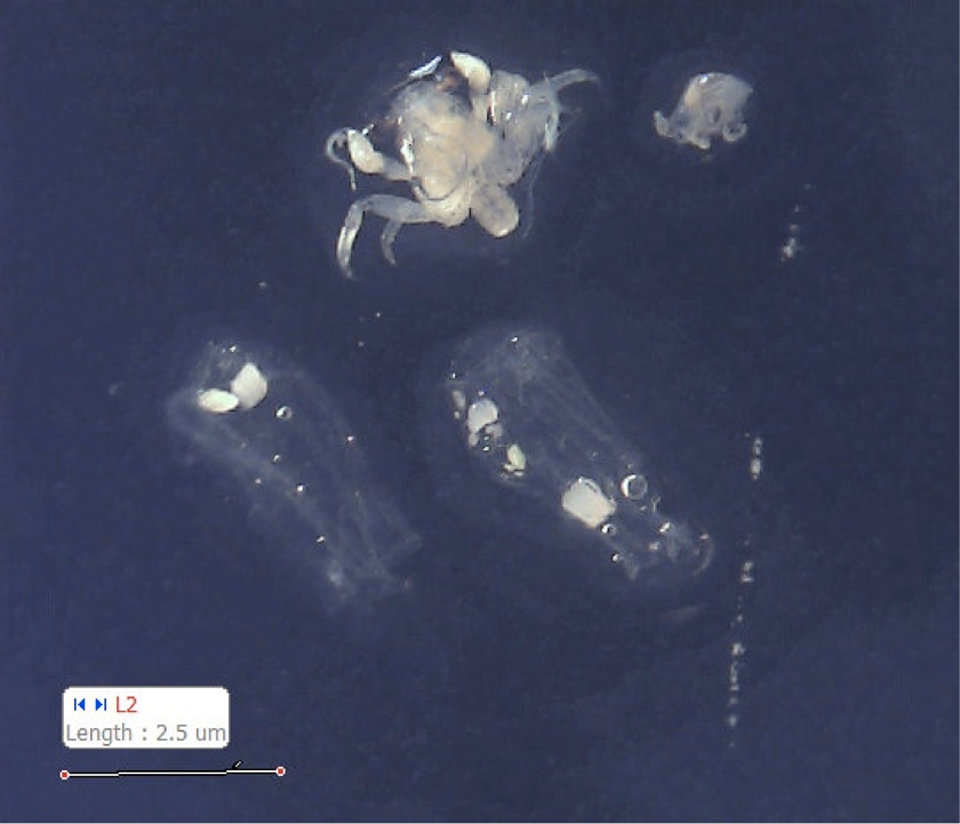
Two salps with plastic fragments (and a tiny crab).
There is also the sense, however, that this is simply science as usual. When asked in interviews, the lab manager, a marine biologist well versed in laboratory practice, explained that breaking down problems into smaller pieces is simply a necessary step in the production of scientific knowledge. An STS scholar, however, might be troubled by the practice of separating plastic and life in order to understand how they are connected; where practices of ordering are constitutive of more than knowledge, they produce plastic and marine life as ontologically distinct forms of matter that belong or not in bodies aquatic, organic or scholarly.
At the Scripps Institution of Oceanography in San Diego, then PhD candidate Miriam Goldstein gives me a tour of the small laboratory space where she also sorts samples of plastic and marine life. She is explicitly engaging with the plastisphere, looking for a possible relationship between halobates – marine water-skeeter and only true ocean insect – and the amount of plastic in the ocean. Though halobates skate across the water’s surface, their eggs need to be anchored to a floating platform. This means that the halobates population is limited by the availability of sturdy materials or ‘hard substrates’ on the ocean surface. This also means that it is possible that the proliferation of plastic is getting caught up with life at the level of populations. Though the calculations are more involved, here too, separation is necessary for establishing relationships. Researchers painstakingly pluck plastic pieces and halobates eggs, one by one, from samples under dissecting microscopes. With access to expensive equipment at a major research institute, plastic pieces can be quantified by ZooSCAN, an optical analysis system designed to count and classify plankton (no hand weighing of plastic bits here), but the halobates eggs still get counted and classified by hand and eye. To (the now Dr) Goldstein’s surprise, she found a very strong statistical correlation between the amount of plastic and the amount of eggs: halobates appear to be thriving. While plastic appears to be good for the marine insect, the implications for marine ecology and for humans are far more ambiguous.
In all her research Dr Goldstein only found one case where plastic was embedded in fleshy matter: a piece of plastic in a jellyfish tentacle. She insisted that the plastic-creature was a statistically insignificant one-in-thousands anomaly. While the situation was unlucky for the specific jelly involved, it was certainly not grounds for challenging established ways of understanding the ocean and its species. 5 She argued that in all the other cases, plastic was forced into bodies during the collection process, pointing out that the feeding tube of a salp was far too small to accommodate fragments visible to humans. Because she understood the symbolic power of such images, in her words, as ‘metaphors’, she was wary of sharing her photograph of the plastic-tentacle for fear of it being used to misrepresent the fate of life in the Pacific. With scientific practice itself implicated in its making, the material significance for science of this plastic–life entanglement was dismissed. What remained was the problem of (social) meaning, and the attempt to control it by controlling the circulation of images.
I first encountered the salp and velella images in a public presentation given by Captain Charles Moore, the Algalita founder credited with discovering what has become known as the Great Pacific Garbage Patch. Presented as part of Algalita’s efforts to raise awareness about plastic pollution in the ocean, plastic-studded jellies are a transgression of natural boundaries, evidence of human reach gone too far. ‘We are turning the creatures of the ocean into plastic’, Moore cautions. After continuing to explain how plastic and its associated toxins alter bodily systems, he concludes, by claiming that ‘Plastic is not an inert substance. It is bio-active.’ Here the relationships between kinds of bodies matter, the very entanglements that at times defy and at other times are simply denied by the project of sorting in the laboratory, are resolved by attributing to plastic the lively capacities of movement and transformation. Plastic becomes decidedly ‘vibrant matter’, performing with the kind of agency conventionally reserved for biological or even human entities alone (Bennett, 2010). But Moore’s resolution is replete with assumptions of legitimacy and belonging based on the very same categories of natural and synthetic material: ocean creatures should not become (with) plastic.
‘Dangerous Species’: Separation as Public Knowledge
Indeterminate bodies of plastic-creatures not only move through the space of the lab, ‘novel associations’ of plastic and marine life can also be found travelling in the poster and video campaigns of organizations, both government and nonprofit, aiming to educate the public about the problems of synthetic pollution. This section considers in turn the California Coastal Commission (CCC) poster series ‘Non-Native Species of the California Coast’, the widely circulated ‘Dangerous Species’ poster produced by the Catalan Water Agency, and the San Francisco-based organization Heal the Bay’s short mockumentary The Majestic Plastic Bag. Commonly casting plastic-creatures as lead characters, these productions at once award new kinds of agency to plastic objects while simultaneously discouraging relationships with biological life, a feat made possible by the indeterminacy of the ‘species’ concept itself.
The walls of the Algalita lab are covered with an array of written and visual materials: plastic identification flow charts, reminders not to wash people’s dishes with the science sponge, and advertisements for pollution-related events. One slightly faded poster in particular catches my attention each visit: labeled the ‘Cig Egret’ it features a mean-looking heron on the beach, head seamlessly transitioning to tubular white and orange tobacco-product prosthetic beak. 6 Produced by the California Coastal Commission the poster is an advertisement for the annual coastal clean-up day, part of a state-led public education program mandated to ‘engage the public in protection and restoration activities’ (CCC, 2012). 7 Framed by the worn edges of a well-thumbed trading card, the Cig Egret is presented as a distinct species, part of a series that includes the company of Spork Crab and Cola Bass. Titled ‘Non-Native Species of the California Coast’, the posters attempt to link the desire to collect with the imperative to clean up. 8 Their power, however, depends on public recognition that such plastic-crossed creatures are unnatural, an argument positioning bodily entanglements of plastic and animal life as a problem for which clean-up is the appropriate solution. To collect waste is to keep such illegitimate species from becoming reality.
In contrast to the shock tactic photographs of dead plastic-birds, like images of decomposing Laysan Albatross chicks revealing piles of ingested plastic that circulate elsewhere, the Cig Egret poster, described on the CCC website as ‘surreal’, plays with the possibility of equally disturbing ways to be alive. The concept of species is imbued with the irony of inanimate plastic waste coming to life, but at the same time implicated in the life and death politics of the work of conservation. Cig Egret acts as an anomalous animal ‘other’ defining what counts as acceptable through deviance from species as logical types and scientific categories. 9 The creatures featured in the posters embody divides between nature and culture, making entangled possibilities public where scientific work tends to enact divides through the separation or denial of indeterminate beings.
First appearing in 2005, the non-native species posters are part of a decade-long series of campaigns that themselves mark a transition from animal to plastic kinds. The 2003–04 clean-up day campaign features stylized local (read: native) animal species worthy of care, and free of trash: a cautious raccoon, a skinny-legged avocet, a bright red newt and a snappy crab. In 2005 the crab morphed into Spork Crab, and the avocet into the Cig Egret. 10 Modified in subsequent years, these suspect creatures lose their trading card frames. The images become sharper in resolution, more photographic in presentation, and decidedly less imaginary in effect. The updated posters prominently display the numbers of the items in question collected at clean-ups to date: 5,066,669 cigarette butts, 1,102,042 bottle caps. By 2010, when another new poster series makes its debut, coastal creatures are completely replaced by colorful photographs of artfully arranged plastic trash collected on Kehoe beach in northern California. ‘Help Reduce Trash’, reads the text above a gathering of bottle cap and other materials separated by type, collections of actual plastic materials from a named shoreline. In the course of six years, the posters mark a transition from coastal animal species worthy of protection, through trash–animal entanglements, to sorted plastic ‘types’ that are themselves problematic. United by the messy logic of species and the necessity of clean-up that provides continuity with each new series, kinds of coastal wildlife become kinds of trash. Always a social product (if always also material), the very concept of species itself becomes ‘plastic’, ethical and emergent, rather than fixed and immutable (Michael, 2013).
Plastic-species are not endemic to the posters of the Government of California. Moving from coastal encounters to the sea, a poster produced by the Catalan Water Agency in 2005, and widely circulated on the internet more recently, also crosses kinds of life and kinds of waste. Stamped across the top of the page in bold black font, the title reads ‘The Most Dangerous Species of the Mediterranean’. The contrasting stark white background is host to a diverse array of colorful ocean creatures that upon closer inspection reveal themselves as a diverse array of trash posing in animal form. Plastic bottle fish and cigarette sea stars take the place of the expected sharks and spiny fish. Each species is accompanied with a brief fact-sheet of defining characteristics. ‘The plastic bottle’, reads one caption, ‘Origins: beaches, city streets and boats. Behaviour: causes serious damage to marine flora and fauna. Average lifespan: 300–500 years.’ Human origins and synthetic properties are slotted into animal categories. Spelling out the connections between bottles and condoms, lobsters and fish, the tagline reads ‘Uncontrolled waste is a threat to the seas.’ Roaming free, plastic is a danger to the wellbeing of the ocean. The poster suggests the possibility of not only undesirable plastic–life mixtures, but possibilities for new kinds of undesirable agencies.
Well versed in STS traditions of distributing agency to any entity capable of making a difference, at first I read the poster as simply awarding agency to nonhuman things, drawing a parallel between animal and plastic capacities for performing dangerous acts. Imagining plastic-monster fish that swim around when we are not looking seemed like a productive way to remember the unintended consequences of synthetics, that they too have ‘lives’, and are active participants in the shaping of seascapes. Upon further consideration, however, I realized that the poster’s powers are also grounded in the ethico-political impossibility of just that: waste is not and should not be equated with wild creatures. Plastic trash might be bad for the environment, but it cannot sting like a jellyfish, or bite like a shark. These are species that (we) should not meet. The poster relies on and produces audiences that know that types of waste do not count as species; an audience that demonstrated this understanding by adding scare quotes around ‘species’ in the title of reposts.
The animal agency of plastic is explored more elaborately in The Majestic Plastic Bag, a 2010 ‘mockumentary’ produced by Los Angeles-based Heal the Bay, a nonprofit advocacy group dedicated to the protection of marine ecosystems. In this case, the organization is specifically supporting bill AB 298, which attempted to prohibit the distribution of single-use bags statewide (and failed to pass in 2012). A clever parody of wildlife documentaries, the film traces the migration of a humble disposable white T-shirt bag also known as the common grocery bag. Starting its life in a grocery store parking lot (store name obscured but still obvious behind a carefully placed tree), the bag is born on the ground but soon takes flight, learning to ride the wind. Narrowly escaping death in an urban park to join the inevitable path of water toward the sea, the bag displays the (un)expected characteristics of natural species as it flies, floats and swims toward its destiny: the garbage patch in the middle of the Pacific Ocean. Delivered with the deadpan third person narration of Jeremy Irons (the bag moves, but does not speak), and reinforced with a dramatic score, the film displays an impressive command of wildlife program tropes with Nature Channel accuracy. 11
If presenting the bag in this way awards it a kind of life, it is intentionally undermined by parody that relies on the very impossibility of just that. This is evident in the contradictions of a ‘plastic cycle of life’, in the jarring dissonance of ‘billions of other plastic-species’, as the video plays with the gap between natural and artificial, animate and inanimate kinds. The ‘helpless plastic’ persists despite the dangers of park services that clean up, branches that snag and types of sea life that consume plastic. But inverted by mockumentary form, plastic-species become the true danger. With the cultural impossibility of plastic bags being a ‘species’, it is humans, and not plastic, that have the power to control the bag’s destiny (in this case by voting). Heal the Bay reminds the public that ‘the plastic bag is not indigenous to the Pacific’, again calling up the power of the invasive. In the end, the bag is as artificial as the landscapes it traverses: the asphalt jungle, manicured parks and cement rivers of Los Angeles. The ‘thriving community’ in the middle of the ocean is one that should not thrive. In each of these three cases the boundaries distinguishing life and not life are again broken down only to be reconstituted in ways meant to motivate particular forms of responsibility. As with the scientific studies, the public images at once connect and separate organic bodies and plastic ones.
The Matter of Belonging
The assumptions about belonging that are at times only implicit in scientific practices – the ties between plastic and invasive species, the dismissal of plastic-jellyfish, the references to organic matter as ‘real’ – become explicit with the posters: danger lurks where plastic invades the spaces and species of natural life, spawning creatures that do not fit with existing categories and kinds. Denizens of the plastisphere ‘raft’ not only across oceans but also across cultural categories and time. These cautionary creatures hovering in a state of waiting at the edges of emergence are what Michelle Murphy (2013) calls ‘anticipatory objects’, as they are shaped by the ‘not-yet of the future’. This particular articulation of ‘danger’ marks a significant shift in the cultural history of plastic. According to Jeffrey Meikle (1997), as plastic proliferated in the mid-20th century, so did worries of plastic invading social life. Touted as overcoming the limitations of traditional materials, synthetic plastic was understood as a complete break between the social and natural worlds. The danger lay not in entanglement with nature-creatures, but in threatening to ‘liberate the human race from the millennia of its biological past’ (Meikle, 1997: 245).
The separations performed by the images are no less material than the manipulation of scientific samples. Very practical concerns surface when the imperative to purify, sort or cut indeterminate bodies is materialized as a solution to problems of pollution: clean-up – attempting to remove pieces of plastic from beaches and the sea – is the responsible action promoted by the posters, and the dominant response to plastic pollution in the ocean from the public more generally. Where scientific work poked and pried mixed samples into separate containers, the posters and video poke and pry apart entanglements with irony, humor and common understandings of lively boundaries. Plastic that acts independently of humans, that expresses plasticity independent of human intention, especially that which gets mixed up with life, is plastic not only out of place, but out of control. Restoring order requires diligent efforts to keep kinds of life matter and plastic matter where they belong.
At the April 2013 Earth Day beach clean-up on Oahu, I assisted volunteers sorting collected waste from the Pacific. Selected pieces deemed relatively free of ‘biofouling’ – free of life pollution – are destined for the Method Soap Company, where they will be magically transformed into brand new ‘ocean plastic’ bottles (the fine print clarifies that only 10% is post-consumer waste; even less is from the ocean). Here entangled traces of plastic life are reduced to rows of molded bumps suggesting sea urchin spines (Figure 4).
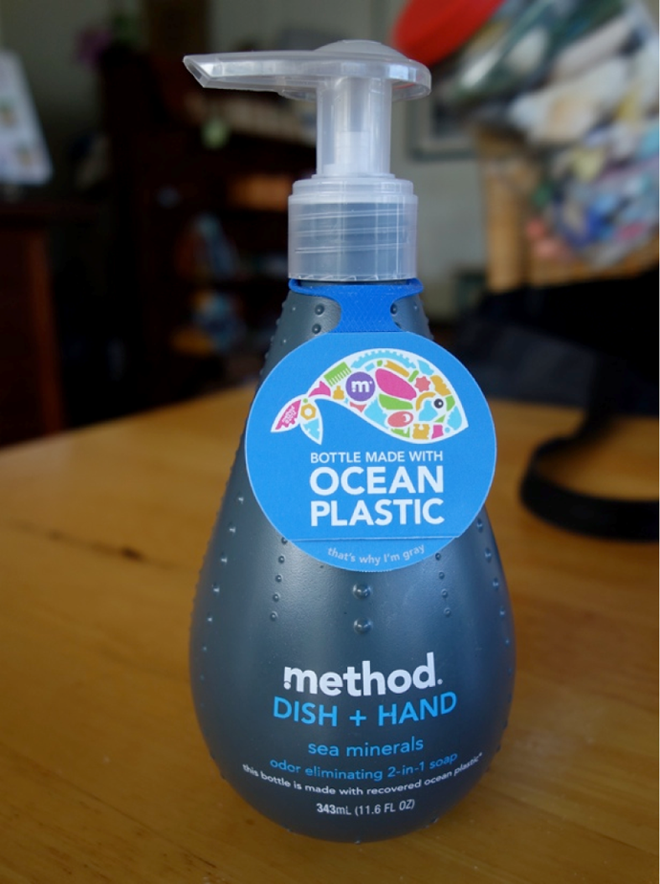
Method ‘ocean plastic’ soap bottle (fine print clarifies only 10% ocean and post-consumer recycled materials).
The relationships between plastic and life are transformed by the very practices of knowing them, merged in the sample nets, in the images, in the new plastic bottles produced by processes that are supposed to maintain separation. To use nature/culture divisions for the production and sharing of knowledge about plastic pollution is to base forms of belonging on the same divisions that preclude – while at the same time facilitating – the becomings that constitute the plastisphere in the first place. 12
Exercises in purification are not, of course, simply for the sake of maintaining categories (although after prolonged periods of meticulous sorting in the lab it certainly begins to feel this way). For scientists and policy makers, ordering and counting plastic is a way of monitoring threats to ocean resources – to marine life, fisheries and navigation – where measuring and establishing change over time becomes a kind of management in itself. Maintaining rigorous categories is especially critical for Algalita, as a nonprofit particularly invested in establishing their research as sound and legitimate science. 13 For the plastics industry and entrepreneurs, gathering plastics is a way to profit from untapped resources, recycling ocean plastics into new allegedly ‘green’ products. For others still, separating out plastics is a way of resolving the aesthetic dissonance of synthetics scattered across natural spaces, of caring for environments and the health of humans and other creatures.
For those doing research at sea, there is an unwritten rule that if you touch plastic waste you are then responsible for removing it from the ocean. Leaving or returning plastic is tantamount to polluting. Swimming in the Pacific mid-voyage in July 2011, a crewmember came across a blue plastic crate (Figure 5). Though the crate may once have held bottles of some sort, it is now coated in a fine layer algae and home to school of fish; an exciting find after days of seeing little more than scatterings of unrecognizable confetti-sized plastic bits. But as I watch my colleagues remove the crate from the water I cannot help but think of how to also care for the aptly named convict surgeonfish, newly liberated from plastic. Floundering about the boat deck, they are soon to be returned to the sea where they ‘belong’ but do not belong, hovering precariously at the precipice of potentiality and loss. Without their plastic shelter, the coastal reef fish now exposed in the open ocean will soon fall prey to other creatures.
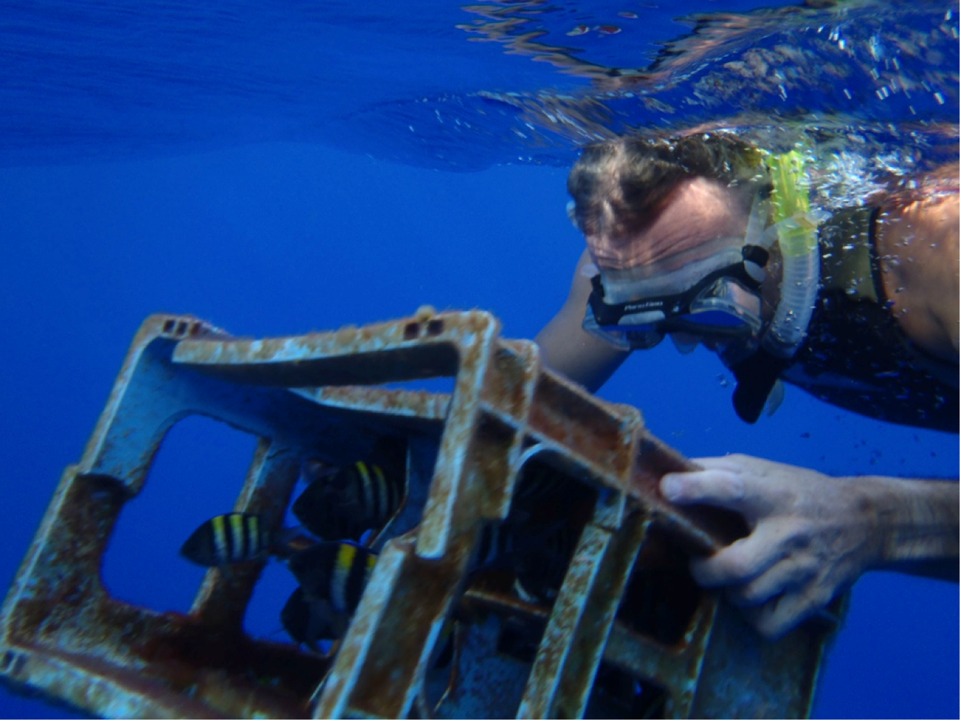
Crate of fish, North Pacific Ocean.
Even such a small act of clean-up embodies assumptions of belonging, of bad plastic, of responsibility for human products, assumptions that ignore the communities that live on and with pollution in the ocean. To enact categories of nature and culture in the pursuit of knowledge and action, is to underestimate the liveliness of matter: the capacity of plastic to circulate in ways unintended by humans and to form associations with all kinds of life. And it is to assume its place without respect for the indeterminacies of its entangled becomings.
Conclusion
Practices of scientific knowledge production, public education and clean-up all work to reconstitute indeterminate plastic–body relationships as kinds of ontologically distinct matter that are already tied to assumptions about what belongs in the sea. Plastic in the ocean becomes pollution; organisms that travel on plastic become invasive; and future plastic-creatures become transgressions of the very categories of material existence that do not belong anywhere. Responsibilities are inherent in rather than responses to these knowledge practices, as distinguishing between kinds of materials becomes the basis for awarding the status of belonging and even of living. Yet these efforts are always exceeded by the indeterminacies of plastic-species relationships, and with them the vibrancy of plastic matter. As ‘solutions’, clean-ups can only ensure that there will always be more plastic to separate: what is to keep recycled ocean plastic bottles from returning to the sea? These strange bodily entanglements are ones that we cannot simply undo with our science or with our clean-ups, with tiny forceps or litter lifter tongs.
Plastic–life entanglements like the crate fish further illustrate the limitations Gay Hawkins (2010) has illuminated with the moral problematization of plastic; in her case, plastic bags, classified as ‘already bad’, where materiality and ethics are essentialized, ambiguity and alternate responses precluded. Understanding the lively and generative materialities of plastic is one possible starting point for opening up new possibilities for material politics where nonhumans as well as humans participate in the making of ethical associations and responsibilities. With ocean plastic entanglements bound to proliferate, we need to award plastic more power in asking questions about where and how plastic belongs. And we need to do this, as Jennifer Gabrys (2013) suggests, through discourses less inclined to purification. Yet practices of separation that attempt to purify away plastic-species are endemic to the scientific research that social and cultural scholars so often cite to establish ocean plastic pollution as a matter of concern in the first place. These scientific studies, as I have shown, have a tendency to enact the very divisions we seek to preclude.
But rather than being dismissive, I would like to posit working with plastisphere science, emphasizing its definitional commitments to bodily associations and relationships in motion. Taking inspiration from the halobates and jellyfish that manage to live and even thrive with plastic, I suggest scientists and humanists alike approach the plastisphere in all its indeterminacies, without trying to disentangle it into material types that deny plastic its agency and its place in the ocean. Plastic is lively and already entangled with all kinds of bodies; plastic vital to everyday human life also becomes vital to and with other forms of life regardless of human desires. The persistence of these plastic entanglements shows the need for acting as if humans are, and will always be, connected to the ocean and how we come to know it, whether through the materials we produce or the actions we take in seeking to control them. Despite attempts to bring all kinds of actors into the account, and though the very existence of these fish mid-ocean only makes sense in relationship to plastic migrations, the crate must either be left in or removed from the sea. New kinds of human roles, such as those who study and sort and clean up plastic-creatures, also require attention, something that multispecies ethnography is well-equipped to trace. It is only by embracing rather than warning against or trying to undo entanglements already tangled that synthetic materials can be understood to have lives in relationships we cannot sever because we are part of them. And plastic can come to belong (or not) accordingly.