







Abstract
This article contributes to a more nuanced and contextual approach to women’s decision-making concerning their stored IVF (in vitro fertilisation) embryos through attempting to craft a space for the expression of the complex, and contradictory, emotions attached to these decisions, unhooked from any notion of abstract moral status inhering in the embryo itself. Women struggle to express the confounding nature of the relationship to the stored IVF embryo as something of-the-body but not within the body, neither self nor other, person nor thing. In order to try to address this sense of the ineffable, I draw in this article upon a series of images by German-born American artist, Kiki Smith. The article explores three major themes, each alongside one of Smith’s artworks connecting to an experience of discomfort or confounding unease.
Keywords
I feel like they are potential, there is the potential there for life. There is the potential there for a child, but at the moment they are just cells; cells hovering, waiting for their chance to come out of the freezer. (Rose) [D]o you say goodbye to them, is that an occasion, is that something to be marked? Should there be some ceremony? Every other culture probably would. I mean, no other culture would. (Ruby)
This article draws upon a series of artworks by German-born American artist Kiki Smith in order to explore the ways in which women speak of, and understand, their stored in vitro fertilisation (IVF) embryos. 1 I suggest that using these artworks as a framing device can assist to better understand the complexity of women’s decision-making around embryo disposition, including, but not limited to, the desire of some women to be physically and emotionally involved in the embryo destruction and discard process. Such involvement can run the gamut from a wish to be present in a clinic as embryos are unfrozen, to taking them away to engage in a private form of ceremony or ritual such as burial, to medical assistance in performing a return of embryos to the body in a manner not intended to cause pregnancy (sometimes referred to as ‘compassionate transfer’) (Ellison and Karpin, 2011; Karpin et al., 2013). These wishes and practices are still largely considered to be ‘fringe’ in current clinical and ethical thinking, and are rarely and reluctantly accommodated, if at all, by most fertility clinics (Gurmankin et al., 2004; Karpin et al., 2013). Indeed, some of these practices are expressly prevented by law in jurisdictions with prescriptive embryo storage and discard rules (e.g. in Victoria, Australia; see Karpin et al., 2013).
Taking up Sarah Franklin’s early insight that the IVF embryo has a ‘liminality in its contested location between science and nature’ (Franklin, 1995: 337), I explore in detail how women expressed that contested location both as an out-of-bodily process and as an emotional relation. David Ellison and Isabel Karpin have noted that disposing of stored embryos triggers another layer of liminality; one between life and death, as the not-quite-alive-embryo is discarded to a not-quite-death (Ellison and Karpin, 2011). I have eight in storage…it’s awful. It doesn’t bother [my husband] at all. I just talked about it again, I said, ‘What do you think’s happening with our embryos?’ He goes, ‘I don’t know, won’t they just die?’…He’s got no idea. It’s huge. He’s going, ‘What are you worried about?’ It’s the biggest thing in the world, eight potential children, what do you do with them? Do you just knock them off? It’s awful. It’s huge. (Ruby) I tell you what; having embryos, like, it’s a blessing, but…I cannot bear knowing there’s an embryo in a lab that’s frozen; it’s not just an egg, and it’s not just a sperm, it’s already a little person. I mean, it’s not a person, but it’s already our genetic coding combination, so – (Nikki)
Having written previously in legal fora about how law and policy in assisted reproduction should be reformed in numerous respects to be more responsive to IVF participants’ needs and concerns, I was left with the lingering sense that I had still failed to grapple with the intense complexity of participants’ experiences of disembodied relationality (Millbank, 2017). Here I return to these narratives to engage more deeply with the confounding nature of the relationship to the stored IVF embryo, as something of-the-body but not within the body, neither self nor other, person nor thing. I suggest that ex-utero embryos trigger an experience of relationality that is inevitably ineffable.
The article explores three major themes, each alongside one of Kiki Smith’s artworks. These themes all connect to an experience of discomfort or confounding unease, and reflect the struggle to express individual embodied meaning about one’s IVF embryos in socially intelligible ways. The first section explores women’s sense of the out-of-placeness of their ex-utero embryos; the second addresses women’s experience of chance in the selection and use of embryos; and in the third section, I explore feelings of waste and loss about the prospect of embryo destruction. First, I explain in more detail the choice of the visual arts, and Kiki Smith’s works in particular, as a framing device for exploring this experience of the ineffable.
Framing the Confounding and Unsayable
Siri Hustvedt has characterised Kiki Smith’s work as an experience of the: borderline where the articulated lines between inside and outside, whole and part, waking and sleeping, human and animal, ‘I’ and ‘not I’ are often in abeyance. It is a territory of metamorphoses…(Hustvedt, 2006: 73)
The visual arts provide a space of interpretation that allows for subjective meanings to collide and intermingle in a non-linear non-literal way (Lyotard, 2004). Scholars in law, culture and visual studies suggest that engagement in the visual arts shifts us away from the didactic, logical and propositional claims of law to allow space for reflection, latency, contradiction and, above all, emotion (Douzinas and Nead, 1999: 3–4; Sherwin, 2013: xxxiii). In order to try to engage with a sense of the ineffable in the space-in-between that exists with a woman and her ex-utero embryos, I draw upon Kiki Smith’s work as a particularly fertile oeuvre of liminality. A series of images by Kiki Smith are utilised as a framing device, within which I place a discussion of women’s relationality to their ex-utero embryos, their bodies and the IVF process, drawn from interview transcripts, in order to try to draw out the partly said, unsaid and unsayable.
Kiki Smith’s brilliant and diverse body of work has long concerned itself with the abject and the bodily. 3 Many of Smith’s early works represented internal organs and systems in uncanny detail (Edouard, 2004; Lima, 2014: 281) but in unlikely or discordant media, such as wax, glass, plaster, paper and ceramics. From the 1980s through to the early 2000s Smith addressed reproductive and maternal issues in numerous sculptures, prints and installations. (Smith has the rare honour of being reviewed in The Lancet: Edouard, 2004.) Maria Lima has noted that, ‘Smith’s interest in anatomy has less to do with the body’s appearance than with its processes, failures and traumas’ (Lima, 2014: 281).
These evocative and provocative artworks help us to explore, and hopefully better understand, women’s complex and shifting sense of connection or relatedness to their stored IVF embryos as both inside and outside their bodies, connected and distant, posing potentiality and loss. Engaging with these highly individualised, even idiosyncratic, and contradictory sensibilities is important to framing a more responsive system of legal regulation, ethical guidance and clinical practice concerning decision-making about IVF embryos.
One of Smith’s earlier screen prints, Black Flag (Figure 1), depicts, in exquisite detail, a disembodied human oocyte with its protective cells in place. The title of the piece juxtaposes the public claim of nation-state, the flag, with the image of something minutely personal, invisible to the naked eye, indisputably feminine: a human egg. A black flag is the opposite of the white symbol of surrender, evoking defiance and anarchy
4
as well as death. Death and life, the nation and the intimate, are counterposed. The Victoria & Albert Museum, which holds one of the prints of this work, describes this piece as appealing through its ‘combination of menace and beauty’ adding that:
Flag-waving can be about victory, fraternity and solidarity but also about protest and warning. Flags signal messages to those who have learned a special language, but can also communicate to people with no specialist knowledge beyond a fairly general cultural awareness. (Victoria & Albert Museum, n.d.)
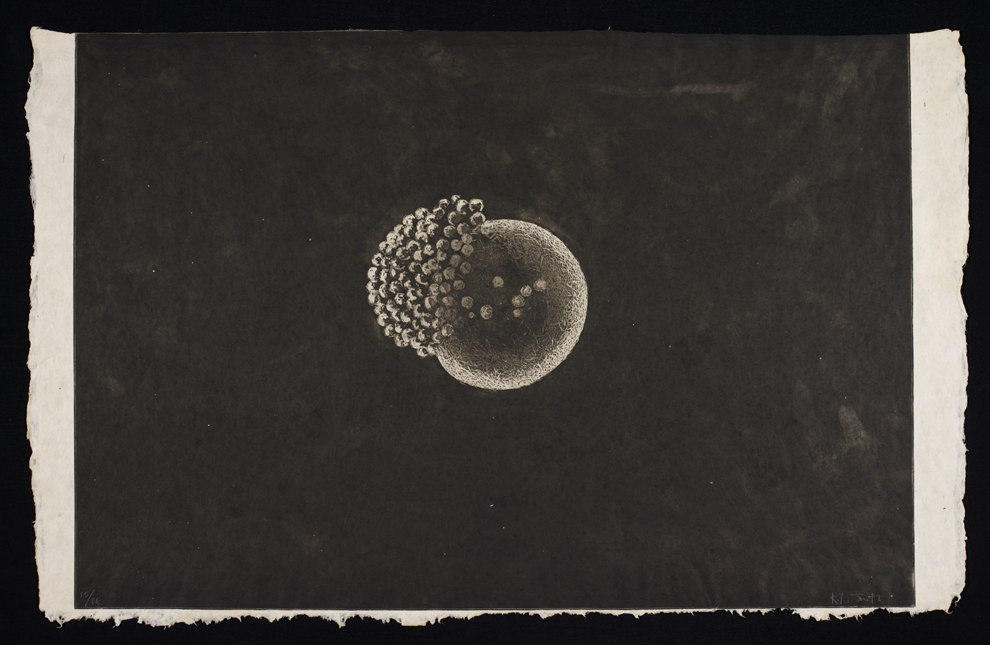
Black Flag, c. 1989, screen print.
The image also, if one tilts one’s head to the left to view it at an angle, looks somewhat comically like a tiny frowny-faced icon wearing a bumpy hat or curly hair. 5
Black Flag laid the groundwork for Smith’s oeuvre of reproductive works, involving a profound laying bare of (mostly female) bodies, crossing of borders and confrontations of disgust and respect. Helaine Posner has written that: Smith regards the female body as an entity that will not be contained, from which ‘Things naturally fall out.’…Most often these fragile sculptures refer to the vulnerability of the female body in regard to its reproductive possibilities…. For Smith, the female body, particularly in its biological role as related to the cycles and processes of reproduction, is in a perpetual state of instability or flux, always changing and constantly being made anew. (Posner, 2005: 17–18)
Displacement, Exposure and the Not Visible
A bronze sculpture (Figure 2) by Smith depicts a womb, but not in a typical medical illustration of a cross-section and/or with foetus in utero. Rather, it lies open, enlarged as if with pregnancy, but empty. The uterus is handled, literally and figuratively, and opens through an external metal hinge. Helaine Posner has written that this sculpture, while associated with conflict over abortion rights in the United States, also ‘suggests a votive offering presented with the hope of healing the afflicted body part’ (Posner, 2005: 15), while Siri Hustvedt writes that it evokes an archaeological relic, as it ‘resembles a vessel or bowl from a dig, and simultaneously unearths a host of container associations, including small coffins or tombs’ (Hustvedt, 2006: 72). Interestingly, these writers see the object as evocative of both life and death, creation and loss. In my view, this sculpture speaks to the disjuncture that women express between the ‘intimate’ and ‘personal’ experience of reproduction, within a highly mechanised and depersonalised IVF system. For example, in our study Jacqui described IVF as ‘quite an out of body experience’. Jacqui and many women referred to the IVF process as ‘invasive’ and ‘traumatic’ (Mariana), and characterised it as an intrusion, both physically and emotionally. Irina Aristarkhova has argued that ‘it is not useful to counterpose mother and machine when in fact the history of the life sciences has contributed to a “mechanization” of the material body, most especially in embryology’ (Aristarkhova, 2005: 45). This sculpture speaks to women’s embodied relation to the ‘unnatural’ in IVF processes; the machine is part of them and part of them is in a machine.
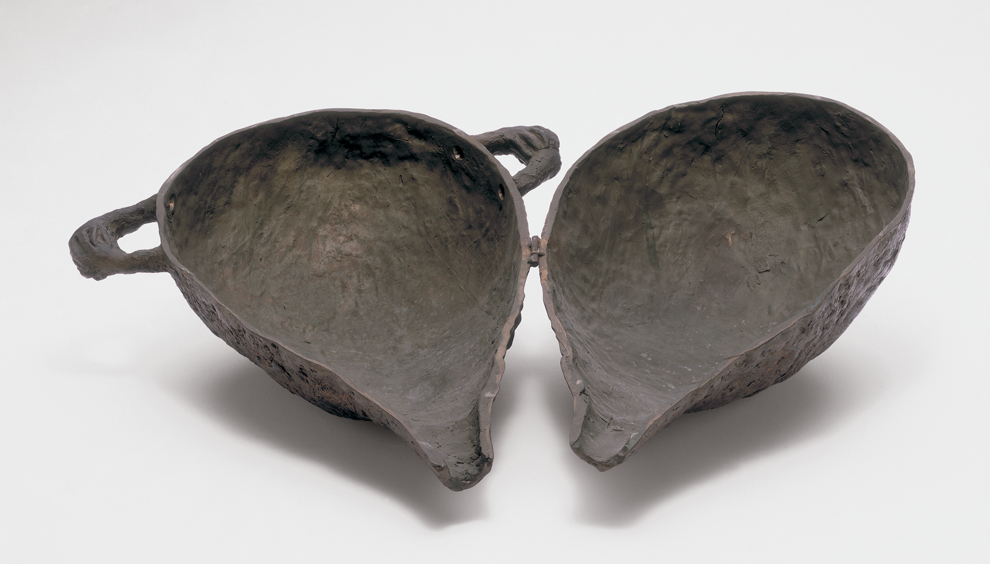
Womb, 1986, bronze.
This bronze womb is hard, cold and empty – evoking the wrongness and the out-of-placeness that women struggled to express about the location of their ex-utero embryos in cold storage. Embryos were created from, and of, the woman, and intended for return to her: at the time of generation these were steps in the process of a pregnancy-to-be, but return was interrupted and prolonged in unanticipated ways, for months, years, or possibly for ever; and it is this sense of both disembodiment and disjuncture that was experienced as deeply jarring. knowing that they’re just sitting there, sitting there, sitting there and I can’t use them, it creates a whole way of thinking around them that is different, I think, than it would otherwise be. (Danielle)
Laurie, whose six embryos had been destroyed a few years earlier, after she had been prevented from donating them for reproductive use, said of this out-of-body-ness: It’s really tough to try and make sense of – because I’ve not been in the situation of being pregnant and thinking about whether I should have an abortion or anything like that. But I imagine you can experience the sense of being pregnant, so there’s some kind of connection there about what you’re doing. But the embryos, they’re kind of there but they’re – they’re part of you, but they’re outside of you in a clinic with scientists, god forbid… I think like – their status external to me was a temporary status. The whole thing about IVF is that you go in for treatment. Embryos are implanted and some are put aside for the next round. The normal assumption is that they’re there waiting to be re-implanted. I don’t think there’s any separation that’s there, except…a clinical intervention that takes place. But here we’ve got a situation where their relationship to me is profoundly external over a period of time—[and] what you’ve now got is this other [agency] that’s saying, well this is how you’re going to use your body parts.
Smith’s sculpture of the bronze womb also speaks to the ways in which the technological process of IVF opens, makes visible and extends the experience of conception, and pregnancy loss. Feminist scholars have written about the ways in which the visualisation of the foetus during pregnancy has opened a space of identification and attachment (Petchesky, 1987) and also, by extension, the prospect of an intensified sense of loss in instances of early pregnancy loss (Cosgrove, 2004: 110). This process of visualisation extends also to embryos, which are now often shown to patients immediately prior to the transfer process, and are also materialised through their characterisation by staff in terms of their cell size or development, technical grade or more evocatively as ‘healthy’ or ‘beautiful’ looking embryos.
Many fertilised embryos are graded as not suitable for transfer or freezing in routine clinical processes (Ehrich et al., 2010). Some are tested and found to be affected by genetic conditions. Thus it is common for embryos to be discarded without any plan for embodiment. In our cohort of interviewees, only two, Jess and Juliet, questioned this external determination of viability and expressed discomfort about its accuracy. All of the other interviewees accepted that stored and transferred embryos were ‘potential babies’ while the other non-stored embryos did not have this potentiality. Relatedly, once embryos were characterised as useable and stored or transferred, women were much more likely to see the embryo as part of a pregnancy, even if no pregnancy subsequently arose.
Laurie said: most women who don’t go through fertility programs, they miscarry and they don’t even know. There’s this whole kind of technological interface that opens up all these spaces. I can count on both hands how many times I’ve miscarried, but sometimes it’s a very, very early stage. By the time any woman – as far as I understand it – has got a blastocyst in her womb – whether it’s a natural pregnancy or not – like that’s already a pregnancy. It’s already a live thing…like I gave myself a day to get over it each time it didn’t work and some people didn’t understand that. Like it was like, oh well there must have been something wrong with it – move on – you can try again. So I think – and that was an actual part of me by that time…I don’t think a lot of people would understand that… [IVF] is so invasive and it’s really quite traumatic. To go through this process, and you get these things at the end of it, right, and when they transfer them, they show you them on the screen. There’s just six cells or eight cells or whatever they are, and we actually saw Libby on the screen like that. Look at her now. There’s nine more of them frozen. Now, every single one of them has an opportunity to be a little person. (Mariana) [M]y feelings changed, I think, after the first transfer because you can actually see the embryo go in. They do an ultrasound while they’re inserting them and you can actually see on the screen the embryos go in which is quite an amazing process. I’ve also got a photo – a three-day cell photo – of Bianca. So that also kind of changed my thinking around what they meant. (Jasmine) Each time that we had an implantation they put a picture up on the screen from the – a little photo from the – in the other room…. [The embryologist] would always say ‘This is a lovely embryo, it’s divided this many times, see that.’…So she would personalise it. Then she’d say, ‘It’s a lovely embryo, good luck.’ That was really, really nice. It was very nice to feel a connection with the scientist who cared about me, not just the doctor. But I suppose people don’t – I know some people take photos of them, but after so many of them failed I thought: I’m not taking photos. But you know, I don’t like the idea that they’ll just dump them in the rubbish bin either. I’d rather go in and say, give me my embryos and I’ll take them home and have a little ceremony or plant a tree and put them under that. I know they must be minute, you probably can’t even see them with the naked eye but they’re mine and they have meaning to me. (Scoot)
Interchangeability and the Fates
It was quite rare for women to openly acknowledge the statistical unlikelihood of any one embryo eventuating in life, although many recounted at the outset of the interview (in response to the opening question ‘Where are you in your IVF journey?’) the number of stimulated and transfer cycles they had undertaken, numbers of eggs retrieved and fertilised, transferred, stored and not stored, thawed and failed to thaw, along the way. The language of death and survival seeped into these accounts, regardless of the views of the participants of embryos as entities. Jacqui described embryos as ‘the step you need to get through to get pregnant’ and said: Eight from the first egg collection which everyone was very positive about. But the first four didn’t take.…Then one other little one died in the dish. So five didn’t survive, one – anyway there’s one – maybe there were six. Six didn’t survive, one is now inside going really well [in her current pregnancy], and one’s in the freezer still. the scientists will choose the one in the dish that day that appears the strongest and it might die the next day. Whereas they could’ve chosen a little weakling which could’ve made the distance.…how do the scientists choose your child? Because they’re – you might run out of money and the next attempt would’ve been successful but you’ve just had to draw a line, but the scientist made that choice…
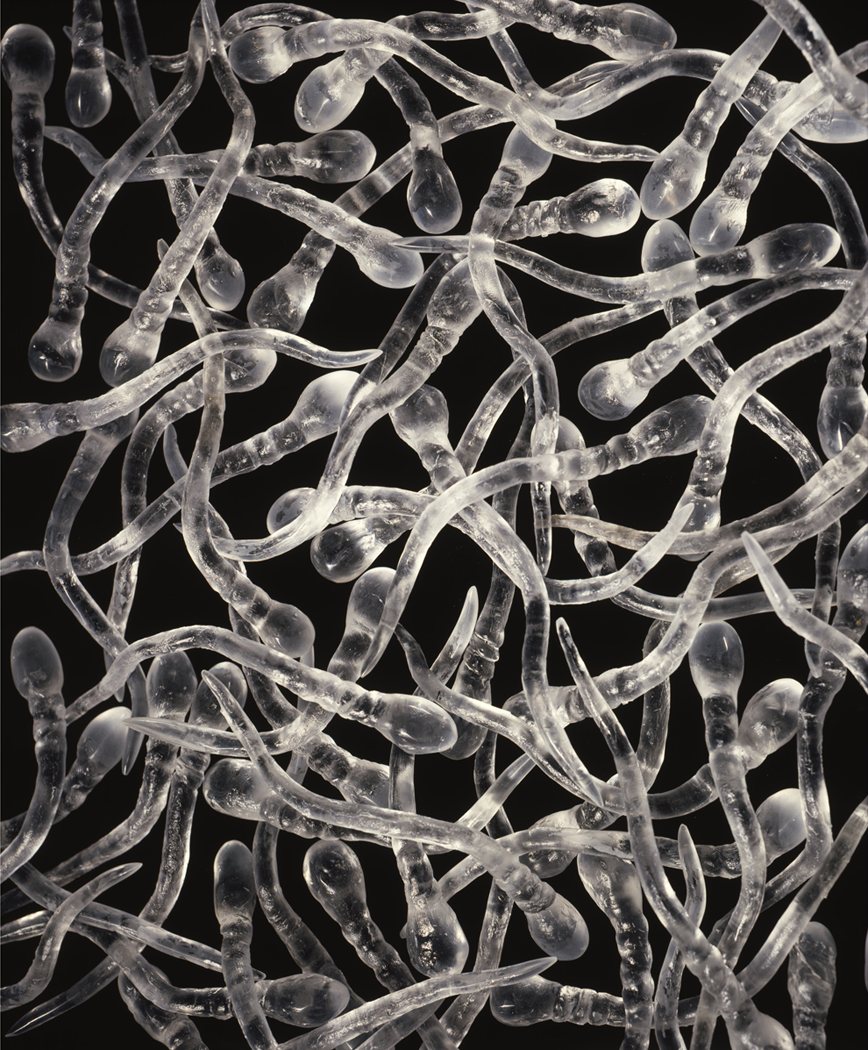
Untitled, 1989–90, Schott crystal and rubber.
Antoinette, who was determined to use all four of her stored embryos and not to generate extras in future cycles, said: one got chosen and that became my daughter. Then you think, gee imagine if they chose a different one and she was still frozen as an embryo. I don’t know, when I think about those sorts of things, I feel like – yeah, like I just feel connected to them and I would like to give them the chance to be who they might possibly be able to be. I think that, potentially, at age 13 the idea that there were six embryos and one got to be her and there’s another three, and we’re just going chuck them out might be hard for her…. It’s about the randomness, exactly. I don’t have an attachment to those embryos as such but about honouring something which, in a slightly different context, a random changing around of things, could easily have been someone like her. I’m quite comfortable with – if I wanted to discard them, I could do it quite pragmatically because I’m old enough to know where I stand on all those really hard shifting questions but she’s not. I look at my beautiful little daughter and I think she almost wasn’t given the opportunity to be born and she is just such a – what’s the word for it, she just has a real spark of life in her. Perhaps that’s one of the reasons why she survived being a frozen embryo and so on. It would be very sad that she wasn’t given an opportunity to be born because she’s a great little baby. if you’re a child conceived from my leftover embryos, one of the ways you could think about yourself is my real mother got the baby that she wanted and then got rid of me. You could also think of yourself as being discarded, unwanted, left over, forgotten…. Why didn’t she implant me? Why didn’t she keep going? Why didn’t she want me? She got the baby she wanted and then she what, didn’t care? If I had to defrost my embryos today, I would not cry about murder. There wouldn’t be any sense I was killing a baby, that’s not it at all. It would be a sense of grief for the potential children that they could have been, my potential children, but not in that framework of Christian thinking around the light of humanity. That’s not it at all, it’s about I wonder if that embryo would have looked like my daughter?
Waste and Loss
The final theme I wish to explore here is the difficulty that participants had in expressing a sense of waste, and loss, concerning discarded embryos (see Farsides and Scott, 2012, concerning clinical practitioners involved in IVF and PGD [pre-implantation genetic diagnosis], and Thompson, 2005: 264). Women were very reluctant to allow embryos to be wasted (de Lacey, 2007: 1755), and this feeling was especially acute if they were willing to donate for either reproduction or research use, but had been prevented from doing so (Millbank et al., 2017). This sense was deeply embodied for the women who had generated embryos and who characterised them as a rare and precious resource, regardless of their own religiosity.
Smith’s untitled 1990 sculpture (Figure 4), held in the Whitney Museum, depicts two life-sized figures, female and male, made of wax and presented on metal stands at some distance from each other. Each figure is forlorn, appears battered and bruised, and drips or leaks fluid associated with fecundity: from him, semen and from her, breastmilk. This sculpture encapsulates the ‘leaky’ boundaries of bodies in reproduction (Shildrick, 1997) in a manner that is highly evocative of loss, and waste. Posner describes the figures as ‘highly vulnerable’ but not ‘pathetic’, saying, ‘they remain stoic in their suffering, emotionally if not physically self-contained’ (Posner, 2005: 20). Kiki Smith said of this work that it was about being ‘psychologically thwarted. Her milk nourishes nothing, and his semen propagates nothing. It is about having all this potential and yet having no life’ (quoted in Posner, 2005: 20). The figures also appear to hover, somewhat awkwardly, just off the ground, neither here nor there; embodied and disembodied.
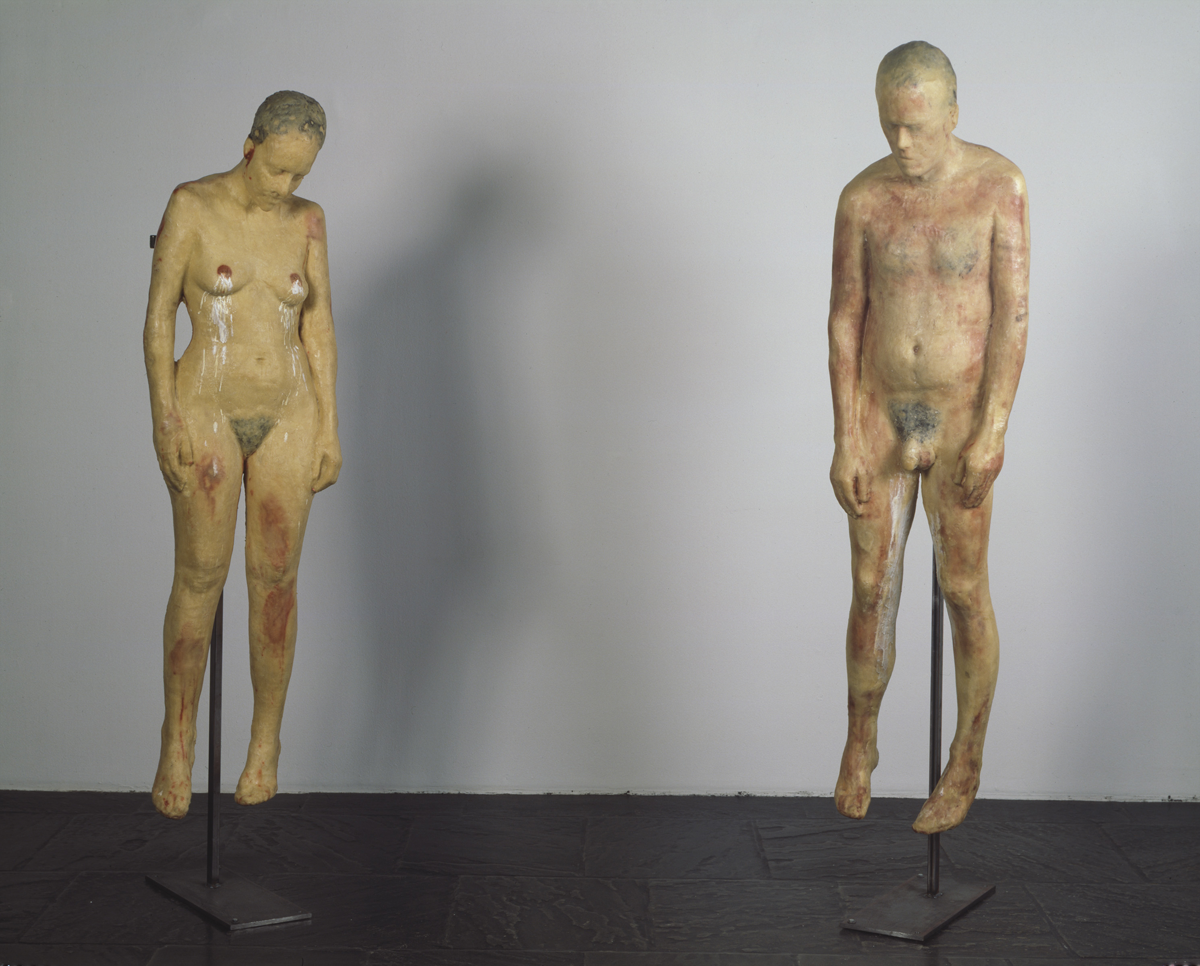
Untitled, 1990, beeswax and microcrystalline wax figures on metal stands.
Women in our study struggled to articulate what the loss of their embryos meant to them, often framing their feelings by reference to (and in contradistinction to) religious doctrine or to other kinds of reproductive loss (de Lacey, 2007: 1756). For example, Annalise somewhat hesitantly expressed the view that putting the embryos to use through donation to fertility research felt less sacrilegious to her than simply discarding, even though in either option the embryos would become non-viable: I just feel that I have a debt of gratitude to IVF – to science. Yes, because we wouldn’t have our kids without that, so I’d be comfortable with that. Like I’m Catholic, so I just don’t like to think about the whole – I’m not anti-abortion or anything – I’m not fanatical about the fact that that is a life or anything like that. But I would feel more comfortable using it for that cause than just discarding it. Well I probably would like them to get something out of it rather than nothing. Considering that we’re not going to use them, I don’t – I don’t know how to put it into words. But I still feel like they’re part of us. That’s our potential child there. I just don’t want to see it just be used for nothing. It’s a big decision to – which is why they’re still sitting there. We haven’t done anything with them. So because they just can’t – yes. It’s not really they’re rubbish. It’s not – you know.
For some women, the experience of waste was re-naturalised through reproductive metaphors as they analogised the lost potentiality in an IVF cycle with that of an ordinary menstrual cycle. As Jade said, ‘you get your period each month so you’re wasting that anyway’. Yet this analogy was almost instantly disavowed by Ruby even as she made it: [D]o I just need to be – to save myself – do I just need to be clinical about it and just go: ‘Don’t be silly, it’s just a –…every month, don’t I, I have a period and I don’t wail and cry and have a ceremony?’…but these aren’t just eggs at day five, they were blastocysts, are they blastocysts by day five? Something like that. (Ruby) just a part of – a piece of something in my body and when you have your periods you expel an egg, so it’s different and it’s only a part of me – it’s not a part of both of us.
7
Some sort of participation would be good, sort of mark a chapter so to speak. I don’t know if I’d want to take them somewhere, mainly because I’m not sure, like a cemetery, I don’t know, that seems a bit – well I suppose it’s appropriate…. Having said that, they’re not actually a life form, but anyway. [A] dilemma about what you do with that because they’re in a suspended state between life and death…. Obviously they’re fertilised so in that sense they’re viable, but they’re not alive alive. No, not really – yes – I prefer – I don’t want to think about it too much really. [Interviewer: Okay, we’ll move on.] Oh no, I’m happy to talk about it but I wouldn’t – it’d probably be a lot more real and you can kind of shove it away if you’re not – you know.
Isabel Karpin and David Ellison have referred to the use of ceremony and ritual associated with embryo disposal as a process of mourning lost possibility, in particular of the women’s desire for the imagined child: But these kinds of transition rituals dedicated to entities that have not yet lived should not be equated with ceremonies one would offer a lost child but rather, we suggest, might represent attempts to recognise and register value in women’s experience of the creation of these embryos; the physical and emotional effort that has gone into wanting and making them. In this way, both life and death for embryos are by no means objectively, scientifically, legally identifiable moments. Instead, they might be described as investments – made typically by women but also by other parental figures – in that which is desired. Seen this way it is the desire of these figures that should be considered as enabling the performance of this end scene – perhaps even just to mourn the loss of that desire. (Karpin and Ellison, 2011: 95) I don’t think I would want to take them because they’re minuscule, you can barely see them…. If I know what date they’re doing it, I might arrange for us to have a holiday and be somewhere so that it’s not just something where I’m vacuuming and suddenly go, oh, it’s 11 o’clock, this is what’s happening. I would want something different, out of the ordinary, just to give it a space of its own.
Conclusion
Embryos embody women’s hard-won efforts in often prolonged and painful fertility processes, and their relational ties, both real and imagined, to and through existing and longed-for children and themselves as mothers, mothers-to-be and, sometimes, mothers-never-to-be (Millbank, 2017). I argue here for increased regard for women’s own complex and contingent sense of value and connectedness to the embryos, both as ‘work objects’ (Ehrich et al., 2008; Farsides and Scott, 2012) and ‘love objects’ (Karpin, 2012: 142).
A sizable literature in bioethics has been devoted to the question of what to do with stored embryos (Lyerly et al., 2006, 2010), but much less has been written on how and why such decisions are made (Hammarberg and Tinney, 2006; Nachtigall et al., 2009), and particularly how women feel about these decisions (de Lacey, 2005, 2007; Svendsen, 2007). Provoost and Pennings say that, ‘feelings have generally been seen as mere side effects of the decisions related to embryos’ (2014: 189) and they note that ‘there have been no descriptions of multiple understandings [of human embryos] that may co-exist in the narratives provided by the actors involved’ (2014: 188). In the context of research conducted in the United States on decision-making by IVF patients about their stored embryos, Anne Lyerly and colleagues (2006) suggested a notion of procreative responsibility that can value a sense of a patient’s familial connection to embryos outside of the terms of life/personhood debates; a notion taken further by Elizabeth Roberts, who characterises stored embryos for some participants as ‘related instead of alive’ (Roberts, 2011: 244). This article aims to contribute to a more nuanced and contextual approach to women’s decision-making concerning their stored embryos through attempting to craft a space for the expression of the complex, and contradictory, emotions attached to these decisions, unhooked from any notion of abstract moral status inhering in the embryo itself.
Women in this study grappled with the profound difficulty of articulating any sense of the embryo as an entity or relation, in the face of limited language choices, culturally loaded meanings and closed frames of reference (including a genetically determinist frame in which both progenitors are ‘equal’ contributors: Lind, 2006; Sheldon, 2004; Van Der Ploeg, 2004). In the context of pregnancy loss, feminist thinkers such as Catherine Kevin and others have argued that abortion politics have silenced or stifled the ability of women to express their sense of connection and loss to their foetus/intended baby (Kevin, 2011); while others have noted that medical constructs of pregnancy loss as based on particular physical stages of pregnancy have silenced women’s individual experience of connection and grief (Frost et al., 2007). Foetal-life discourse and anti-abortion politics cast a long shadow over procreative practices of all kinds (Cohen, 2017; DiCaglio, 2017; Roberts, 2011), even in jurisdictions with comparatively liberal abortion access such as Australia.
The tension of ‘life debates’ was apparent in this research, as women struggled with the language of life and death, and the place of reproductive metaphors, unable to carve out a space or terminology that could capture their unique experience of connectedness. This included experiences of very early ‘chemical’ or ‘technical’ pregnancy loss that they only became aware of by virtue of being engaged in IVF processes (Cosgrove, 2004) but also the non-pregnant (Karpin, 2006) or never-to-be-pregnancy, involving loss of ex-utero embryos that were not, or were never to be, transferred back to their bodies. Thus many women instantly disavowed ‘life’ claims or overtly reaffirmed their own pro-abortion values if they used words such as ‘baby’ or ‘alive’ when trying to express their sense of relation with their ex-utero or intra-utero embryos. Sara DiCaglio, in her critique of embryonic development literature, argues for a more complex and entangled approach to embryonic existence in order to: [b]etter understand and value the intimate ecological connections between bodies, tissues, and worlds; moreover, and more specifically…to better understand how to make theoretical and lived space for the inevitable losses and complex decisions wrapped up in the process of reproduction. (DiCaglio, 2017: 18)
Recognition of feelings of connection to the human embryo, including to imagined future potentiality, need not, and should not, play into foetal-life discourse or be utilised to delimit women’s reproductive choices. I argue quite the reverse: proper recognition of, and regard for, these complex and contingent feelings of relationality should lead regulators and clinicians to accord women a broader range of options and practices concerning embryo storage, use and disposal, including return to the body, self-discard and forms of ceremony, if these are desired.
Footnotes
Acknowledgements
Thanks to my colleagues Isabel Karpin and Anita Stuhmcke for their long-standing collaboration on the project and to Isabel, Katherine Biber, Anthea Vogl and the reviewers and editors of this journal for their thoughtful comments on this article. Deep thanks also to all of the interviewees, and to Kiki Smith and the Pace Gallery. This research was supported by Discovery Project Grant DP 0986213 and DP 1510157 from the Australian Research Council.