







Abstract
In Brazil, anti-discrimination law has evolved under the 1988 Constitution creating positive obligations for the state to benefit historically discriminated groups. This article discusses the characteristics of this substantive and asymmetrical approach to anti-discrimination law, especially regarding the adoption of affirmative action policies against racial discrimination. After studying the constitutional and legal provisions that create positive obligations for the state to combat discrimination and reduce inequalities based on protected characteristics, the article develops a case study on the implementation of racial quotas in higher education, public service, and elections, focusing on the role played by the Federal Supreme Court in sustaining and expanding these affirmative action policies. Finally, the article provides empirical data on the effectiveness of these racial quotas and explores three factors that help to explain their different impact: the level of political agreement regarding each policy, the operation of monitoring mechanisms, and the characteristics of the benefited group.
Introduction
Despite the significant development of anti-discrimination law in the last decades, major controversies persist in the field. For some scholars, anti-discrimination law is grounded on freedom, 1 while others defend an equality-based conception 2 or even the absence of a unitary concept of discrimination. 3 In various jurisdictions, symmetric approaches place anti-discrimination measures under strict judicial scrutiny, 4 and there is no clear definition of the state’s positive duties to eliminate wrongful discrimination. 5 Many years after its inception, affirmative action remains a very contested policy, 6 and the addition of new protected characteristics or the recognition of indirect discrimination usually faces enforcement difficulties. 7
In Brazil, anti-discrimination law is mainly a creation of the 1988 Constitution and followed a path that avoided some of the above-mentioned controversies. Although previous constitutions provided for the right to equality, the number, scope and characteristics of the new constitutional provisions on this issue favoured an unprecedented development of anti-discrimination rules and policies in the country. In a few decades, Brazilian law has gone through what Fredman 8 calls the three phases in the development of equality: the country dismantled formal legal impediments against women, Indigenous Peoples and LGBT + people; put in force anti-discrimination laws applying both to individual acts of prejudice and structural barriers; and created affirmative action programs to benefit disadvantaged groups. In 2010, the Racial Equality Statute consolidated this approach, defining affirmative action measures as “public policies aiming at repairing social imbalances and inequalities and other discriminatory practices adopted in the public and private spheres during the social formation of the country” (Law No. 12.288/10, Article 4, sole paragraph).
What explains this development? 9 Why the implementation of affirmative action in Brazil has not faced the legal obstacles that appear in other countries? What role Brazilian courts have played in developing anti-discrimination law? These questions remain underexplored in the literature 10 and are barely discussed in the English-speaking world. However, the Brazilian experience deserves attention as a case of a substantive and asymmetrical approach to anti-discrimination law. This experience is characterized by using protected categories as an instrument to reduce inequalities between groups of people, leading to the creation of a broad set of affirmative action policies, including quotas for women, Blacks, and persons with disabilities.
This article discusses how anti-discrimination law in Brazil was built on creating positive obligations for the state to benefit historically discriminated groups, hence reducing the weight of legal arguments against affirmative action measures. This study follows two tracks: first, I analyse the characteristics of the constitutional and legal provisions that generated those obligations. In this part, I highlight how the successive adoption of legislation to favour the elderly, women, Blacks, and persons with disabilities established an asymmetric pattern of anti-discrimination rules in Brazil. Secondly, I develop a case study on the implementation of racial quotas in higher education, public service, and elections. In this part, I select the three main rulings of the Federal Supreme Court on the matter and conduct a content analysis to identify the Court’s opinions on three issues: the constitutionality of the asymmetric use of protected categories, the constitutionality of affirmative action measures, and the proportionality of these measures. Finally, I use data gathered in official reports to evaluate the impact of these racial quotas and discuss some of the limits they face in achieving social change.
Symmetry and asymmetry
The development of anti-discrimination law is closely related to the concept of equality adopted by each legal system. The literature usually presents equality and non-discrimination as the positive and negative statements of the same principle, 11 and, in many constitutions, the right to equality is directed against discrimination. 12 At international law, the right to non-discrimination has initially evolved as a negative right that prohibits the state to treat people unequally, but more substantive conceptions of equality further allowed for positive measures aiming to reduce discrimination against groups of people. 13
This relationship implies that the concept of equality plays a decisive role in defining anti-discrimination rules. A formal concept of equality, based on the idea that the likes should be treated alike, place the focus of anti-discrimination law on the prohibition to use protected categories, such as sex and race, to treat people differently. On the other hand, a substantive concept of equality, centred on the structural nature of social disadvantages, supports an anti-discrimination approach where differential treatment to benefit disadvantaged groups is necessary, and may be even mandatory, to change de facto inequality. 14 Instead of individuals, this second approach focus on groups and the historical and contextual differences between them.
A substantive approach to anti-discrimination law favours an asymmetric use of protected categories as well. 15 Despite their core function in anti-discrimination law, the mere definition of these categories does not decide how they should be protected. For Khaitan, 16 this is “the most vexed question” in anti-discrimination law, and legal systems have three options regarding the type of protection offered by protected categories: a complete symmetric protection, according to which no group of people can be discriminated against on the basis of this characteristic; a complete asymmetric protection, according to which only the group in relative disadvantage deserves protection; and a largely asymmetric protection, where all groups benefit, but deprivileged groups benefit more. 17
As other jurisdictions, Brazil’s anti-discrimination law follows the third model. Although protected categories may benefit all people, its focus are disadvantaged groups that have historically suffered discrimination and its main goal is the implementation of positive measures to guarantee access to rights to these groups. Although the legislation also provides for private parties' duties, the state bears the duty to achieve substantive equality to women, Blacks, elderly, and persons with disabilities, among other groups. Consequently, the state should treat people differently to fulfil its positive obligations.
This asymmetric protection in Brazil developed based on the 1988 Constitution, which was adopted after a long period of authoritarian rule (1964-1985). This democratic constitution enshrined new rights and changed the previously dominant formalistic view of the right to equality. 18 First, general constitutional rules prohibit discrimination (a); second, the Constitution mandates public authorities to enact anti-discrimination laws (b); third, the Constitution recognizes rights of historically discriminated groups and even allows the state to create affirmative action policies (c). The most relevant constitutional provisions on these issues are the following:
(a) Article 3 includes among the “fundamental goals of the Federal Republic of Brazil” two objectives regarding equality: “to eradicate poverty and marginalization, and to reduce social and regional inequalities” (Article 3, III), and “to promote the well-being of all, without prejudice as to origin, race, sex, colour, age and any other forms of discrimination” (Article 3, IV). Article 5, caput, declares that “All persons are equal before the law, without any distinction whatsoever” and grants a “right to equality” to everyone. As we shall see, this last provision has been interpreted by courts in a substantive way, that is, distinguishing the states’ positive duties regarding anti-discrimination from its negative duties regarding equality before the law. In addition, Article 5, I, states that “men and women have equal rights and duties” (Article 5, I), and, regarding work, Article 7, XXX, prohibits “any differences in salaries, in the performance of duties and in hiring criteria on grounds of sex, age, colour or marital status”, and Article 7, XXXI, forbids “any discrimination regarding salary and hiring criteria for persons with disabilities”;
(b) the Constitution mandates the legislature to enact a law punishing “any discrimination that violates fundamental rights and liberties” (Article 5, XLI) and declares racism a “non-bailable offense, with no limitation, punished with imprisonment, under the terms of the law” (Article 5, XLII);
(c) in addition to these general rules, the Constitution explicitly incorporates an asymmetric approach to anti-discrimination law in several provisions. Constitutional rules protect women in the workplace (Article 7, XX), create quotas in public service for persons with disabilities (Article 37, VIII), provide a minimum wage for persons with disabilities and elderly people who cannot guarantee their livelihoods (Article 203, V), recognize Indigenous Peoples’ social organization, customs, languages, creeds and traditions (Article 231), and the rights of slave-descendent communities, known as quilombolas (Article 68 of the Transitional Constitutional Provisions Act – Ato das Disposições Constitucionais Transitórias).
As we see, these provisions have empowered the legislature and the judiciary to develop anti-discrimination law in Brazil. But two other aspects of the constitutional text influenced the way these branches have exercised their powers:
(a) a broad non-exhaustive list: by using the phrase “any other forms of discrimination”, Article 3, IV, creates a non-exhaustive list of protected characteristics. However, the number of categories mentioned in this provision (origin, race, sex, colour, and age) limits legislative and judicial discretion in deciding which characteristics must be protected 19 and prevents discussion on hierarchies among them. 20 Courts have added to this list sexual orientation and gender identity. 21
Also importantly, this list grounds an argument that the constitutionalisation of protected characteristics aims to benefit those groups that have suffered discrimination throughout Brazilian history, as Blacks and women, 22 broadening the scope of government action beyond the protective rules above-mentioned;
(b) the constitutionalisation of positive obligations: as we shall see, the constitutional provisions on anti-discrimination have been interpreted in Brazil as imposing a duty on the state to legislate and adopt measures favouring historically discriminated groups. In addition to the specific provisions on affirmative action, the wording of Article 3, III and IV, has been used by courts to validate these measures not as an exception to a general rule of equality, but as a constitutional obligation of the same rank and relevance.
These characteristics of Brazilian anti-discrimination law contrasts with other jurisdictions that regard affirmative action as a breach or an exception to the right to equality 23 and place these measures under strict judicial scrutiny. 24 Moreover, this substantive and asymmetrical approach has not had to confront an established formal and symmetrical approach that would hinder its progress. 25 On the contrary, the legislative development of anti-discrimination law created a positive feedback process (Pierson, 2004), 26 where each law reinforced this approach and made it more difficult to reverse its trajectory.
However, it took more than a decade for the National Congress to begin to fulfil its duties regarding this issue. Two reasons may be given for this relative delay. In the first years after the promulgation of the 1988 Constitution, Congress was mainly involved with legislation on social rights, such as health, social security, and education, which demanded a complete reorganization of Brazilian public service to be implemented. In addition, it was the centre-left governments led by the Workers’ Party (Partido dos Trabalhadores – PT), from 2003 onwards, that pushed for the approval of anti-discrimination laws.
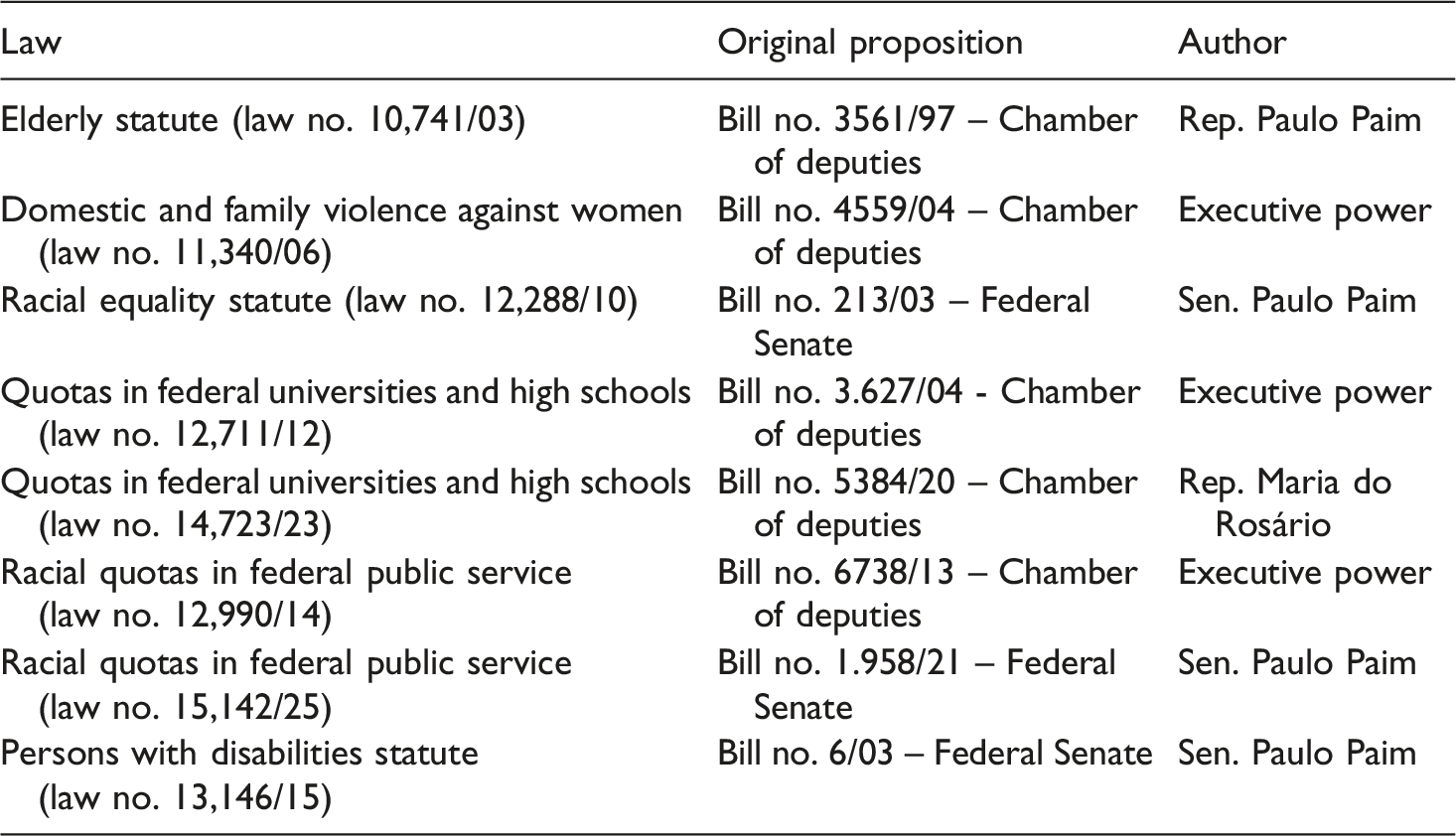
These laws have several features in common. First, they do not forbid the use of protected categories but aim to eliminate specific forms of discrimination and benefit historically discriminated groups. Thus, their focus is not creating general prohibitions and remedial measures against the use of protected categories as age, sex, and race, but establishing new rights for the elderly, women, Blacks, and persons with disabilities. Finally, these group rights create positive obligations for the state and private parties to prevent and eliminate discrimination, including the adoption of affirmative action policies. That is, despite some provisions aiming to remedy specific acts of discrimination, most provisions have a substantive character, as they seek to change the underprivileged access to valuable goods that affects certain groups in Brazilian society.
Since these laws are quite extensive, I present only some provisions that exemplify this common substantive and asymmetrical approach. Most part is composed of rights provisions aiming to overcome the barriers that discriminate against the elderly, women, Blacks, and persons with disabilities from accessing fundamental rights. To achieve this goal, these laws also create specific bodies to monitor these measures. Some examples are:
(a) Elderly Statute (Estatuto da Pessoa Idosa – Law No. 10,741/03): defining the elderly as those individuals aged 60 and above (Article 1), this law creates a state obligation to guarantee, together with family, community, and society, the “realization of the right to life, health, food, education, culture, sport, leisure, work, citizenship, freedom, dignity, respect and family and community life” for the elderly (Article 3). Each of these rights, plus social security, social assistance, housing, transport, and access to justice, are regulated in specific parts of the law. The state should give priority to the elderly, including the guarantee of immediate and individualized preferential assistance from public and private bodies; preference in the formulation and execution of specific public social policies; training and retraining of human resources in the fields of geriatrics and gerontology; priority in receiving income tax refunds (Article 3).
This statute also provides for criminal and administrative offenses against the elderly and creates a national Elderly Care Policy, defined as an “articulated set of governmental and non-governmental actions by the Union, the States, the Federal District and the Municipalities” (Article 46). The Public Prosecutor’s Office has authority to protect the rights of the elderly (Article 74).
(b) Domestic and Family Violence against Women (Lei Maria da Penha – Law No. 11.340/06): this law aims to “curb and prevent domestic and family violence against women”, based on the Convention on the Elimination of All Forms of Violence against Women and the Inter-American Convention on the Prevention, Punishment, and Eradication of Violence against Women (Article 1). Its enactment followed a decision of the Inter-American Commission of Human Rights. 27
In addition to criminal provisions, this law uses almost the same wording as the Elderly Statute. Article 3 guarantees to women the rights to life, safety, health, food, education, culture, housing, access to justice, sport, leisure, work, citizenship, freedom, dignity, respect, and family and community life. This Article also obliges the state to protect women “from all forms of neglect, discrimination, exploitation, violence, cruelty and oppression”.
Regarding public policies, Maria da Penha Law provides for an articulated set of actions by the Union, the States, the Federal District and the Municipalities, as well as non-governmental organizations (Article 8), and creates specialized courts and police stations on violence against women.
(c) Racial Equality Statute (Estatuto da Igualdade Racial – Law No. 12.288/10): this law aims to guarantee to Black population 28 “equal opportunities, defending individual, collective and diffuse ethnic rights and fighting discrimination and other forms of ethnic intolerance” (Article 1). 29 This law defines racial inequality as “any unjustified situation of differentiated access to and enjoyment of goods, services and opportunities, in the public and private spheres, due to race, color, descent or national or ethnic origin” (Article 1, sole paragraph, II).
As with the two previous laws, this statute provides for a set of rights, including health, education, culture, sports and leisure, freedom of conscience and religion, land access and housing, work, and communication. But the Racial Equality Statute creates an even more detailed set of positive obligations for the state. On Article 4, it expressly provides for affirmative action measures, programs and policies, aiming to modify the state’s “institutional structures” to confront and overcome ethnic inequalities. To achieve this goal, the state should adopt appropriate rules to fight discrimination “in all their individual, institutional and structural manifestations”, and eliminate “historical, socio-cultural and institutional obstacles that prevent the representation of ethnic diversity in the public and private spheres”. Regarding the right to work, the state should ensure equal opportunities in the labour market for the Black population, by implementing measures to promote equality in the public sector and “encouraging the adoption of similar measures by private companies and organisations” (Article 39).
The Racial Equality Statute also creates policies to foster diversity. According to Article 43, the media should value “the cultural heritage and participation of the Black population in the country’s history”, and Article 44 establishes that movies, tv shows, and propaganda pieces should give “employment opportunities for black actors, extras and technicians”. In addition, the law establishes the National System for the Promotion of Racial Equality to implement central government’s policies and services to overcome ethnic inequalities in the country (Article 47) and the National Policy for the Promotion of Racial Equality (Article 49).
(d) Quotas in Federal Universities and High Schools (Law No. 12,711/12): this law creates a 50% quota in federal universities to students who have completed their secondary education in public schools (Article 1), and the same quota in federal high schools to students who have completed their elementary education in public schools (Article 4). Half of these vacancies are reserved for students from households with income equal to or less than 1.5 minimum wage per capita (Article 1, sole paragraph, and Article 4, sole paragraph). In addition, the 50% quota must be fulfilled by Black and Indigenous people in a proportion at least equal to their relative populations within each state (Article 3 and Article 5). 30 In 2023, Law No. 14,723 improved educational quotas. Among other innovations, the legislation included quilombolas among the beneficiaries of the quotas, established that quota candidates compete for reserved places only if they do not achieve a passing score in the general competition, provided for affirmative action in master’s and doctoral programs, and lowered household income to 1 minimum wage per capita. The Ministries of Education, Human Rights and Citizenship, Racial Equality, and Indigenous Peoples are responsible for monitoring and evaluating this quota system (Article 6).
(e) Racial Quotas in Federal Public Service (Law No. 12.990/14): this law reserves 20% of vacancies in public service examinations for Black people, whenever the number of positions is equal to or greater than three (Article 1). Black candidates should apply both to general and reserved vacancies, but only those who are not approved at the broad competition can benefit from the quota (Article 3). Today, these quotas are regulated by Law No. 15,142/25, which increased the reserved slots to 30% of vacancies (Article 1), included indigenous and quilombola people among the beneficiaries (Article 1), and mandated the implementation of quotas when the number of positions is equal to or greater than two (Article 5). The Ministries of Public Service, Racial Equality, Indigenous Peoples, and Human Rights and Citizenship are responsible for monitoring this law (Article 10). 31
(f) Persons with Disabilities Statute (Estatuto da Pessoa com Deficiência – Law No. 13.146/15): based on the Convention on the Rights of Persons with Disabilities, this law defines these persons as “one who has a long-term physical, mental, intellectual or sensory impairment that, in interaction with one or more barriers, may obstruct their full and effective participation in society on an equal basis with other people” (Article 2).
Regarding rights, in addition to those already enshrined in the laws cited above, the Persons with Disabilities Statute creates new positive obligations for the state and private parties, providing for habilitation and rehabilitation, transport and mobility, accessibility, assistive technology, and participation in public and political life. This law also grants to persons with disabilities an equal right to exercise legal capacity, including marriage, sexual and reproductive rights, and family planning (Article 6).
Article 4 establishes that persons with disabilities have a right to equal opportunity and recognizes that discrimination can result from action or omission, as in the case of refusal of reasonable accommodation and provision of assistive technologies. However, this same provision states that persons with disabilities are not obliged to take advantage of “benefits arising from affirmative action”. Article 79 gives authority to both the Public Prosecutor’s Office and the Public Defender’s Office to guarantee persons with disabilities’ rights.
In just over a decade, Brazil created a broad set of anti-discrimination rules that generated new policies. During this period, the executive and the legislative branches worked in the same direction to advance this legislation. Presidents Lula da Silva (2003-2010) and Dilma Rousseff (2011-2016) initiated or boosted the legislative process that led to the adoption of anti-discrimination laws, which were also supported by opposition parties. At Congress, the Worker’s Party Senator Paulo Paim, a Black man, authored some of these bills and was also instrumental in the approval of other propositions, acting in concert with the government. 32
Moreover, these laws established a coherent framework for anti-discrimination policies in Brazil, based on constitutional and international rules and principles. This framework aims to promote substantive equality by defining an asymmetric approach to anti-discrimination law, establishing a broad range of rights, and creating positive obligations for the state to protect historically discriminated groups. These obligations take different forms, including the removal of barriers that prevent access to rights and the implementation of strongly distributive 33 affirmative action programs such as quotas. Anti-discrimination laws in Brazil also empower executive agencies and the Public Prosecutor’s Office to enforce these rules.
Despite these characteristics, this institutional framework might not have brought about significant change. After all, Brazilian history is full of examples of failed legal reforms. In the next section of this paper, I analyse in more detail the implementation of racial quotas in Brazil and the role played by the judiciary in supporting these policies.
The implementation of racial quotas
During the 1970s, Black social movements resurfaced in Brazil in the context of struggles for democratization. Founded in 1978, the Unified Black Movement (Movimento Negro Unificado – MNU) played a crucial role in bringing racial issues to public attention, elaborating the first proposals of affirmative action for Black people in Brazil. At the National Constituent Assembly (1987-1988), these movements had the opportunity to present their demands and contributed to the adoption of rules fighting racism and protecting quilombos. 34
Under the 1988 Constitution, the Brazilian state began to adopt policies for promoting racial equality. 35 The first steps were taken during Fernando Henrique Cardoso administration (1995-2002). In 1996, the National Human Rights Program recommended the creation of targeted policies for the Black population, and, at the 3rd World Conference Against Racism, held in Durban in 2001, the Brazilian government supported the adoption of quotas and other affirmative action policies for Black people. 36 After the Durban Conference, Presidential Decree No. 3952/01 created the National Council to Combat Discrimination, to proposing, monitoring and evaluating affirmative public policies to promote equality and protect the rights of individuals and social and ethnic groups affected by racial discrimination and other forms of intolerance. The following year, Presidential Decree No. 4228/02 created the National Affirmative Action Program, which provided for measures in favour of Blacks, women and persons with disabilities, including percentages of participation in filling commission positions and the inclusion of clauses for other government entities and private companies to join the program.
These actions reached a new level starting with Lula da Silva’s first administration (2003-2006), when the Black movement began to get directly involved in the formulation of racial public policies and to have representatives in the federal executive. 37 In 2003, Law No. 10,678 created the Secretariat for Policies to Promote Racial Equality (SEPPIR), whose responsibilities included, among others (Article 2): advising the President of the Republic on the formulation, coordination, and articulation of policies and guidelines for the promotion of racial equality; on the formulation, coordination, and evaluation of affirmative public policies for the promotion of equality and the protection of the rights of individuals and racial and ethnic groups, with an emphasis on the Black population; on the planning, coordination of the execution, and evaluation of the National Affirmative Action Program. In 2008, SEPPIR was elevated to ministerial status. Along with SEPPIR, Presidential Decree No. 4886/03 instituted the National Policy for the Promotion of Racial Equality, and Presidential Decree No. 4885/03 created the National Council for the Promotion of Racial Equality (CNPIR). Defined as a collegiate body of an advisory nature, the CNPIR’s main purpose is to propose policies to promote racial equality, focusing on the Black population and other ethnic segments of the population. Its composition is balanced between the government and civil society, and includes, among others, representatives of Black, Indigenous, Quilombola, Roma, and Jewish communities.
These advances within the executive did not immediately have an impact on the legislative branch. The first proposal of the Racial Equality Statute was presented to the National Congress in 2000, authored by Representative Paulo Paim. Having failed to advance its progress, Paim, now as a Senator, presented a new proposal in 2003. Although it was approved in 2005 in the Federal Senate, with the support of conservative lawmakers, the legislative process was subsequently halted in the Chamber of Deputies as a result of lobbying by private actors such as the Brazilian Association of Radio and Television Broadcasters, which was against the creation of quotas for black actors and technicians, and the National Confederation of Agriculture and Livestock of Brazil, which opposed the recognition of quilombola lands, along with the rural caucus in the National Congress. 38 It was not until 2009, already toward the end of the following legislative session, that the bill was approved by the Chamber of Deputies, though many affirmative action measures were removed, including provisions for racial quotas in universities. In a statement marking the tenth anniversary of the Racial Equality Statute, Paulo Paim admitted that it was necessary to abandon these measures in order to pass the bill 39 .
However, the general provisions on racial equality adopted in that law paved the way for the adoption of racial quotas in higher education two years later. Law No. 12,711/12 originated from a bill submitted by the executive branch in April 2004, whose legislative process was stalled for several years before it was finally passed in November 2008. The process was also lengthy in the Federal Senate, which approved the bill only in August 2012. In the meantime, several state and federal universities began implementing quota policies, including places reserved for the Black population. In 2012, the year the federal law was approved, 79 institutions applied some form of affirmative action in their admissions processes. 40 The inclusion of racial quotas within a broader system, aimed at public schools and low-income students, facilitated their approval, since these last two criteria enjoyed broad support in the National Congress. Furthermore, the Federal Supreme Court ruling on the constitutionality of racial quotas also contributed to easing the last remaining resistance in the Brazilian parliament.
The implementation of racial quotas in Brazil soon began to be challenged at the Federal Supreme Court. In summary, the plaintiffs’ main arguments were as follows: inequalities between White and Black people in Brazil are not caused by skin color, but by social status; Brazil’s multiracial society, marked by intense miscegenation, would make it impractical to use affirmative action programs based on the American “biracial” system, which only recognizes two “races”: White and Black; racial quotas could risk creating a “racialized state” or “institutionalized racism” in Brazil, similar to what is seen in the United States, South Africa, or Rwanda; and using race as a ground of differentiation violates the rights to equality before the law, causing reverse discrimination against poor White people and benefiting only the Black middle class.
Brazil adopts both diffuse and abstract forms of judicial review. However, Federal Supreme Court rulings on abstract review have erga omnes effects, affecting not only the parties but extending to everyone. These effects imply that cases brought to the Court for abstract review have a collective character, as judges assess the constitutionality of measures that benefit the entire historically discriminated group. 41
In the following cases, the Federal Supreme Court established with erga omnes effects its jurisprudence in favour of affirmative action. Three issues had to be decided by the Court in these cases: the constitutionality of the asymmetric use of protected categories, the constitutionality of affirmative action measures, and the proportionality of these measures. In deciding these issues, the Supreme Court affirmed that the Constitution mandates the Brazilian state to redress historical discrimination based on protected characteristics that still causes disadvantages to certain groups, that positive measures such as affirmative action protect the constitutional right to equality, and that these measures are suitable and necessary to achieve substantive equality.
Give these rulings’ length, I use extracts from the opinions that are representative of the Supreme Court jurisprudence. Unless indicated otherwise, all these decisions were unanimous.
Higher education quotas (Arguição de Descumprimento de Preceito Fundamental 186 - April 2012)
The difficulties faced by Black students to access higher education in Brazil, especially the most prestigious universities, was a priority agenda for the Black movement since the last decade of the 20th century. 42 In addition to the importance of higher education for social mobility in modern societies, this priority can be explained by some characteristics of the Brazilian education system. Since the 1970s, private institutions have offered more places in higher education than public universities, which are better qualified and tuition-free. This arrangement created a clear dichotomy in Brazilian public education: primary and secondary schools serve poor students while public universities serve middle- and upper-class students, especially in prestigious courses such as law, medicine, and engineering. Given the limited number of vacancies at those universities, students who attend private primary and secondary schools are better prepared to pass their very competitive admission exams, while most public-school graduates, including the majority of Black people, continue their studies at private institutions.
To confront this reality, some universities created quotas to benefit low-income public school graduates and the Black population. In 2001, the Legislative Assembly of Rio de Janeiro created a quota of 50% for students coming from public schools and a quota of 40% for black students in state universities, and other public universities followed suit. 43 In 2009, the University of Brasilia implemented a ten-year plan to offer 20% of its vacancies to Black students. Unlike other initiatives, this system used race, not income, as a criterion for admission, making it the subject of a great controversy that was decided by Brazil’s Supreme Court.
It is worth noting that, a few months before the racial quotas case, 44 the Supreme Court upheld the constitutionality of Maria da Penha Law (Ação Declaratória de Constitutionalidade 19 - February 2012). In this judgement, the Court recognized that the use of sex as a ground of differentiation is legitimate because of the history of discrimination, social and cultural, faced by women in Brazil. As the Constitution itself grants protective treatment to women, it is necessary, according to Judge R. Weber, a “positive action by the legislator, overcoming any merely formal conception of equality, in order to eliminate the obstacles, whether physical, economic, social or cultural that prevent its realization”.
In the University of Brasilia case, the Supreme Court developed these principles further. Regarding the asymmetric use of protected categories, the Court considered that the use of race by the legislation to benefit Black people is legitimate because of the blatant racial inequality in Brazilian society. Using different data, Judge R. Weber points out that Blacks have the “the lowest prospects of achieving the most basic opportunities”, while the White population hoard the best opportunities. Judge R. Lewandowski also emphasizes the inequality in higher education between Blacks and Whites to conclude that formally equal rules for accessing universities “end up consolidating or even exacerbating existing imbalances”.
In a second argumentative step, the Supreme Court ruled that, although the 1988 Constitution does not provide for racial quotas, Articles 3 and 5 impose a duty on the state to seek Black population’s “social inclusion”. For Judge M. Aurelio, affirmative action is based on Article 3, as the use of words as “to eradicate poverty and marginalization” and “to promote the well-being of all” denotes action and demands positive measures from the state, as “the only way to correct inequalities” is to favour those who are historically discriminated. Complementing this view, Judge R. Lewandowski states that affirmative action fulfils the principle of substantive equality enshrined on Article 5, caput, as this provision authorizes the state to implement policies that “target specific social groups, giving them certain advantages, for a limited time, in order to allow them to overcome inequalities arising from discrete historical situations”.
In addition, the Supreme Court uses a recognition-based argument to uphold affirmative action policies. For Judge R. Lewandowski, social justice requires both wealth redistribution and the incorporation of “diverse cultural values”, which makes it necessary to apply ethnic and racial criteria to affirmative action and not just economic ones. Judge L. Fux expresses the same view, arguing that racial injustice is not only a consequence of economic inequalities but is related to the “collective identity and self-esteem” of certain groups.
Finally, the Supreme Court recognizes the proportionality of racial quotas in higher education institutions. For Judge R. Weber, quotas are suitable and necessary to increase the number of Black students in universities, as financial investments in education take time to have an effect. Given the importance of college education to equalizes social opportunities between Black and White People, quotas are effective instruments to achieve substantive equality between those groups. The Court also argues that affirmative action policies, to be proportional, must be limited in time, in order to periodically assess their necessity.
This Supreme Court ruling had an impact on legislation. During the discussion of the Racial Equality Statute, the National Congress defeated the proposal to create racial quotas in higher education, arguing that they were unconstitutional. At that time, Congress considered Article 208, V, of the Constitution an obstacle to quotas, as this Article states that access to university should be based on each person’s ability. After the Supreme Court changed this interpretation, the Rousseff administration resumed the proposal and Congress approved Law No. 12,711/12, just four months after this sentence.
Public service quotas (Ação Declaratória de Constitucionalidade 41 - June 2017)
After Article 39 of the Racial Equality Statute provided for racial quotas in public service examinations, President Rousseff sent a bill to Congress to regulate this policy. In the bill’s explanatory memorandum, the government underscored that only 30% of civil servants in the public administration were Black, against 50% in the whole population. According to the government, this situation demanded affirmative action to redeem Brazil’s historical debt to Black people and guarantee “diversity in public administration, considering its role in the elaboration and implementation of public policies directed to all segments of society”. In addition, the memorandum cited the Supreme Court reasoning in ADPF 186 to support the idea that the government has a duty to expand affirmative action policies favouring Black population.
After several judicial decisions against Law No. 12,990/14, the Supreme Court was called to decide on its constitutionality, with erga omnes effects. In this ruling, the Court reinforced its opinion that affirmative action policies designed to tackle material inequalities between White and Black people are constitutional as long as they follow reasonable criteria. Thus, the Court limited its inquiry to the proportionality of the public service quotas adopted in Brazil.
For Judge R. Barroso, using race as a criterion in public examinations is in line with the principle of equality because of the “structural and institutional racism that still exists in Brazilian society”, as these quotas are necessary to promote a fairer distribution of vacancies in public service and the recognition of the afro descendant population. The constitutionality of this asymmetric use of race is confirmed by Judge A. de Moraes, for whom the distribution of opportunities in the country is “structurally unfair” and equalizing access to public office is a relevant step in promoting social change. In addition, Judge R. Barroso states that racial quotas foster the efficiency of public service, as they create a “representative bureaucracy” that guarantees that the views and interests of different groups are taken into account by the government.
For the Supreme Court, racial quotas attack the factors that prevent Blacks from competing on an equal basis in public service examinations, such as the lack of financial conditions to attend preparatory courses and the persistence of veiled and even unconscious prejudice against them. The Court also points out that quotas in higher education do not make public service quotas unnecessary because not all public jobs require a university degree, and the beneficiaries of affirmative action in public service may not have been beneficiaries of quotas at public universities. Finally, these quotas’ proportionality also lies in the ten-year duration of the measure and the limited number of reserved places (20%), less than half the percentage of Black people in Brazil.
Electoral funding quotas (Arguição de Descumprimento de Preceito Fundamental 738 - October 2020)
Differently from the previous cases, electoral funding quotas for Black candidates were created by courts. Using the same constitutional principles that upheld affirmative action in higher education and public service, the Supreme Court implemented this policy to reduce racial inequality in Brazilian elections. Almost a decade after its first rulings on anti-discrimination, the Court had a strong jurisprudence favouring quotas and used its authority to expand these measures to the political representation of historically discriminated groups.
However, legislation also played a role in this case. Electoral racial quotas stem from the gender quotas created by Law No. 9504/1997, which states a minimum of 30% and a maximum of 70% for candidates of each sex in legislative elections (Article 10, paragraph 3). Given that this provision had little impact on the composition of legislative bodies, the National Congress passed Law No. 13,165/15 establishing that a minimum of 5% and a maximum of 15% of the Party Fund should be used to finance female candidacies (Article 9).
Despite its intent to ensure funding to women, these percentages were below the legal minimum of candidates. In Ação Direta de Inconstitucionalidade 5,617, judged in March 2018, the Supreme Court ruled that these percentages were unconstitutional and that the mandatory proportion of resources allocated to the campaign of female candidacies should be equal to their number. In this decision, the Court applied once again its anti-discrimination jurisprudence. Based on the idea that quotas should remove obstacles to women’s participation in politics, 45 the Court recognized that if the resources for women’s candidacies are less than their number, the legislation would continue to discriminate on the basis of gender.
Two years later, the Superior Electoral Court 46 (Consultation No. 0600306-47) used this Supreme Court ruling to decide that campaign resources to female candidacies, including airtime propaganda, should be divided between Black and White women according to their number, and that the same criteria should be used to the funding of Black men candidates. This decision of the Electoral Court was upheld by the Supreme Court in Arguição de Descumprimento de Preceito Fundamental 738, 47 which confirmed the constitutionality of these electoral quotas using similar arguments as those applied to the racial quotas created by the legislator.
The Supreme Court points out that the political system in Brazil contributes to racial inequality as well. For Judge A. de Moraes, the under-representation of Blacks at the legislative and the executive branches is one of the main instruments for “perpetuating the extremely serious social inequality between Whites and Blacks”, and Judge R. Lewandowski considers that, as in other fields, the implementation of affirmative policies in elections is constitutional as they aim to overcome this inequality, guaranteeing electoral resources to Black candidates. In addition, Judge A. de Moraes states that racial quotas are proportional because they redress historical injustices and give Black population more opportunities to participate in prestigious political positions, reducing a “feeling of inferiority” caused by the small participation of Blacks in the parliament and increase the diversity of life experiences of political representation.
It is worth noticing that, in this ruling, the Supreme Court applies a loose scrutiny to the proportionality of electoral quotas. Based on its jurisprudence on racial discrimination, the Court takes for granted that affirmative action is suitable and necessary to promote substantive equality wherever Blacks face barriers to accessing valuable goods and positions in society. The aims of these measures are sufficient to validate them, as the huge racial inequalities in Brazilian society make it difficult to argue against a fairer distribution of opportunities.
After this ruling, the National Congress created another measure to stimulate women’s and Blacks’ participation in politics. According to Constitutional Amendment No. 111/21, votes given to women and Black candidates in the elections for the Chamber of Deputies that will take place until 2030 should be counted twice when calculating the distribution of resources from the Party Fund and the Special Fund for Campaign Financing. This Amendment resulted from the recognition that the 30% quota for female candidates had not generated greater gender equality in Brazil’s political representation. During the legislative process, and under the influence of the Federal Supreme Court ruling on ADPF n. 738, the same measure was extended to the candidacies of Black people.
Changes and limits
What was the impact of the implementation of racial quotas in Brazil? This question highlights a relevant dimension of anti-discrimination law, namely its capacity to achieve social change. My analysis has shown that the substantive and asymmetric approach used in Brazilian law imposes a duty on the state to adopt positive measures to benefit historically discriminated groups, aiming to modify the situation of subordination that these groups face in the country. Thus, affirmative action should be evaluated according to its established goals.
However, we must consider that a little over a decade is not enough time to transform a racist society such as Brazil. To approach the impact of affirmative action at this moment, we should use empirical data to identify changes in the access of Blacks to higher education, public service, and electoral candidacies that have resulted from the adoption of quotas while also trying to reveal some of the obstacles that stand in the way of achieving their anti-discrimination objectives.
Regarding higher education quotas, public institutions have undergone a profound change. Since 2014, all federal universities have adopted racial quotas and the percentage of vacancies for Black and Indigenous people have increased from 10% to 28%. 48 At the same time, many state institutions created quota systems based on state laws or their own resolutions. In 2021, the total number of Black and Indigenous students in public universities amounted to 52%, against 31% in 2001.
At public service, changes are not so significant. According to 2023 numbers from the Ministry of Management and Innovation in Public Services (Ministério da Gestão e Inovação em Serviços Públicos – MGI), 49 39.9% of civil servants were Black people, but only 31.6% in higher positions of leadership. Although this figure represents an increase compared to 2014 (24.7%), it is far below the number of Blacks in Brazil (55%). These data likely reflect the time it takes for public examinations quotas to produce results, given the comparatively smaller number of Black people who can compete for some positions. The limited number of reserved vacancies may also contribute to this result.
The results of electoral funding quotas are mixed. In 2022 general elections, the number of Black candidates (50.27%) exceeded for the first time the number of White candidates, but Blacks accounted for only 30% of those elected. 50 In the last general election before the adoption of quotas, held in 2018, these figures were 46.4% and 20.72%. Despite this increase, it is important to remember that Constitutional Amendment No. 111/21 created a financial incentive for parties to put forward candidates who are Black. As there is no control by the electoral justice over the racial declaration made by candidates, it is possible that parties have stimulate them to declare themselves as Blacks, inflating the numbers. 51 A recent study on the candidacies for the Chamber of Deputies and the Federal Senate in seven states has put in question the racial declaration of the majority of Black candidates 52 and some cases attracted media attention. 53
The different impact of racial quotas in Brazil demonstrates the importance of comparing these measures to assess how institutional design influences their success. This comparison highlights three relevant factors: the level of agreement between the three branches of government on the adoption of each policy, the operation of monitoring mechanisms on the implementation of quotas, and the characteristics of the benefited groups.
Regarding the first aspect, as we saw in the previous section, the creation of racial quotas in higher education and public service resulted from laws passed by the National Congress, with the support of the Presidency of the Republic. This political agreement was reinforced by the Federal Supreme Court, which unanimously ruled in favour of the constitutionality of affirmative action. Thus, the convergence between the three branches of government on this matter reduced opposition to quotas.
On the contrary, as electoral racial quotas were created by courts, the National Congress sought to take on its role in this matter. In 2024, Constitutional Amendment No. 133 established that political parties should apply 30% of the resources from the Special Campaign Financing Fund and the Party Fund to the candidacies of Black people. In addition, the parties that did not allocate resources to Black candidates according to their number in the 2020 and 2022 elections should apply, until the 2032 elections, the amount corresponding to that which was not allocated.
Constitutional Amendment No. 133/24 does not follow the rule established by the judiciary, as it sets a 30% quota regardless of the number of Black candidates. Since this number may exceed the quota, it will likely be challenged before the Supreme Court. This lack of definition regarding the criteria that should be used hinders the implementation of electoral quotas and makes it more difficult for political parties to organize their candidacies. Nevertheless, it is possible to reach an agreement on this issue, as the National Congress accepted this affirmative action and reinforced the principles of anti-discrimination law by constitutionalizing electoral racial quotas.
Comparing electoral funding quotas with the policies adopted in higher education and public service also draws attention to the relevance of monitoring mechanisms for adequately fulfilling the state’s positive duties. As proactive measures are “ongoing” and must be constantly evaluated (Fredman, 2022, p. 467), these mechanisms are necessary to check if quotas are achieving their inclusionary goals and to propose adjustments to improve their results.
Although the Superior Electoral Court and the Federal Supreme Court have based their decisions on existing rules on gender quotas, these initiatives lacked an appropriate assessment of their implementation conditions and have not provided mechanisms to evaluate them. 54 As mentioned above, the increase in Black candidacies may have resulted from political parties’ interest in receiving more campaign resources. 55 In a first step to address this problem, the Superior Electoral Court requested, in 2024, that the parties confirm their candidates’ changes in color declaration regarding previous elections or the data collected by the Electoral Register. The Court intends to scrutinize these changes, but the numbers are challenging: 19,900 candidates have changed their racial declaration from White to Brown, and 6300 from White to Black. 56
Monitoring mechanisms operate differently in public service examinations. Based on the Article 2, sole paragraph, of Law No. 12,990, hetero-identification commissions were set up in 2016. Currently, according to Normative Instruction No. 23/23, of the Ministry of Management and Innovation in Public Services, hetero-identification is defined as a “third-party identification procedure of the self-identification made by the person who opted to compete for the reserved vacancies”. This third-party identification is carried out in the presence of the candidate and shall use exclusively the phenotypic criterion to assess the condition declared by the candidate. According to Article 21, evidence based on ancestry is not allowed. In 2023, hetero-identification procedures have been applied in 211 federal public examinations. 57
Higher education institutions also adopt hetero-identification commissions, even in the absence of a legal obligation. As Law No. 12,711/12 has not defined any method to verify the candidates’ racial self-identification, each institution is free to create its own criteria. In 2021, 64 out of 68 federal universities had implemented some form of hetero-identification commission. 58
Some factors help to understand this expansion of hetero-identification procedures. When judging ADPF 186, the Federal Supreme Court recognized that racial discrimination in Brazil was based on phenotype and admitted using “physical and visible characteristics” to assess the candidates competing for reserved places. Afterward, the Court’s ruling on ADPF 41 stated that hetero-identification commissions are legitimate mechanisms to prevent fraud, provided that candidates are treated with dignity and their right to full defence is respected.
At the same time, Black students’ movements started to cast doubt on the authenticity of self-identifications, asking their institutions to create verification procedures. 59 Following some judicial rulings that required universities to adopt these procedures to combat fraud, 60 the National Council of the Public Prosecutor’s Office issued Recommendation No. 41/16, requesting their members to monitor the implementation of racial quotas in universities and public service and demand these bodies to create oversight mechanisms.
To address these concerns, most universities decided to use the hetero-identification commissions model, which had been in place since 2016 for public examinations. 61 Despite some variations, interviews are the mostly used procedure in universities, and there is a “growing use of filmed interviews that could be used in the event of an appeal against the commission’s decision”. 62 These commissions’ impact still needs further study, but the case of Federal University of Rio Grande do Sul (UFRGS) is worth noting. After the implementation of phenotypic hetero-identification, access for blacks decreased significantly at the University, probably because the commission thwarted fraud. 63 UFRGS is located in one the most important states in the country, where 78% of the population declare themselves White.
Although both racial quotas in public service and higher education provide monitoring mechanisms, the characteristics of the benefited group in each case help to understand the different impact these quotas have had in Brazil.
Distributive affirmative action, such as quotas, must be based on a careful analysis of the factors that limit the access of the group at stake to certain positions. This assessment provides the elements to define the scope of the measures and reinforce their proportionality. The success of quotas in higher education met an existing demand from Black people graduating from secondary public schools, whose access to public universities was hampered by the limited number of vacancies, despite those students’ scores being sufficient for admission. Furthermore, the law defined the percentage of vacancies for black students as a sub-quota, according to the population of each state. This design made it possible to favour the Black population while facilitating university access for other low-income people, reducing the resistance that possibly would occur if racial quotas were adopted alone. In 2023, Law No. 14,723 defined that black, indigenous, quilombolas, and persons with disabilities will occupy the reserved vacancies only if they do not achieve a score for admission in the places made available to the general public. This new rule aims to reduce the competition for reserved vacancies and tends to increase the number of students from these groups at federal universities. 64
On the other hand, the adoption of quotas in public service examinations has not produced the same effects, indicating that distributive measures may not be completely appropriate in scenarios where there are large gaps between discriminated and privileged groups. Regarding the federal public service, the most systematic study was carried out by the National School of Public Administration, which analysed public examinations held between 2014 and 2019. 65 This study concluded that, during this period, only 15.4% of the candidates appointed to the public service were Black, below the percentage of 20% provided for by law. One of the reasons is that not enough people were approved to fill the vacancies reserved for Blacks: of the total of 155,857 people approved in these examinations, only 19,155 were quota candidates. Therefore, even if all these candidates were appointed to the positions, the result would still be below 20%.
Despite these limits, quotas have contributed to maintain a minimum level of Black people in the federal public service, even if they have not guaranteed a continuous increase in the number of new Black officials. After their adoption, the percentage of new Black entrants (including quota and non-quota entrants) fluctuated between 36% and 38% from 2015 to 2019. In 2013, this percentage was 27%.
In the judiciary, where the number of black judges is quite low, 66 the National Council of Justice (Conselho Nacional de Justiça – CNJ) recently adopted a facilitative measure, by Resolution No. 531/23. In the Magistrates’ National Examination, which qualifies candidates for the examinations organized by courts throughout the country, Black candidates need a minimum of 50 percent of correct answers to be approved, while candidates from the general public need 70 percent of correct answers. This score is also applied to persons with disabilities and Indigenous people. In the first national examination held under these rules, 6761 candidates passed, including 1979 Black people, 642 persons with disabilities and 15 Indigenous candidates. This example call attention that distributive measures may be insufficient to guarantee access to valuable goods and positions for historically discriminated groups, making it necessary to combine with facilitative measures in a joint design.
As we saw, Law No. 15,142/25 replaced Law No. 12,990/14, which was to remain in effect for 10 years. Given Congress’s delay in passing a new legislation, the Supreme Court granted, in June 2024, a precautionary measure in Ação Direta de Inconstitucionalidade n. 7654 to keep the system working. Interpreting Article 6 “in conformity with the Constitution”, the Court decided that racial quotas shall not be abruptly extinguished, and these 10 years should be understood as a time frame for “evaluating the effectiveness of affirmative action, determining whether it should be extended and/or realigned and, if its objective is achieved, providing for measures to end it”. For the Court, ending this affirmative action would undermine the fulfilment of the Brazilian state’s constitutional obligations regarding the eradication of social inequalities and discrimination based on race and colour, as well as its international obligations as part of the Inter-American Convention against Racism, Racial Discrimination and Related Forms of Intolerance.
This recent development shows that racial quotas in public service continue to enjoy the support of all three branches of government. Given this agreement, these quotas can have a design more adjusted to the characteristics of the public benefiting from them, providing better results.
Conclusion
In the last decades, Brazil developed a set of rules and policies aimed at benefiting historically discriminated groups, namely women, Blacks, the elderly, and persons with disabilities. This paper studied some factors that explain this development of a substantive and asymmetrical approach to anti-discrimination law in Brazil. First, constitutional rules enshrined a substantive concept of equality that imposes both negative and positive duties on the state to redress historical discrimination. Further, the legislature regulated these duties, creating new positive rights for these groups and specific policies for them, including distributive affirmative action measures that the executive quickly implemented. For its part, the Federal Supreme Court upheld the constitutionality even of the most controversial policies, such as racial quotas, affirming that the Constitution mandates the Brazilian state to redress historical discrimination based on protected characteristics, that positive measures such as affirmative action protect the constitutional right to equality, and that these measures are suitable and necessary to achieve substantive equality.
This convergence between the three branches of government was decisive in reducing resistance against anti-discrimination policies and creating a coherent and stable framework to protect historically discriminated groups. Regarding racial discrimination, the implementation of quotas has improved the access of Blacks to higher education, public service, and elections in Brazil, although their impact was different. Three factors help to explain this variation: the level of agreement between the three branches of government on the adoption of each policy, the operation of monitoring mechanisms on the implementation of quotas, and the characteristics of the benefited groups.
The Brazilian case demonstrates that anti-discrimination law can be an effective tool for reducing inequality. However, some forms of structural discrimination can prove more resistant to change, especially in those scenarios where distributive measures are insufficient to guarantee access to valuable goods and positions for historically discriminated groups. In these situations, broadening the range of measures and creating efficient monitoring frameworks are equally relevant to achieving social change.
Footnotes
Acknowledgements
I conducted this research during my time as a visitor at the Bonavero Institute of Human Rights, University of Oxford (Hilary Term, 2024). I am grateful to the entire Bonavero community and especially to Prof. Shreya Atrey for her valuable comments on earlier drafts of this work.

Funding
This work was supported by the National Council of Scientific and Technological Development – CNPq, 310917/2020-4; 304940/2025-9.
Declaration of conflicting interests
The author declared no potential conflicts of interest with respect to the research, authorship, and/or publication of this article.