







Abstract
Despite the important role of cognitions in mindful awareness, research on the cognitive processes underlying mindfulness in young populations is scarce. This study explores the association between the core executive functions (i.e. inhibition, working memory, and shifting) and mindfulness within the same model in a sample of children. Seventy-two parent–child dyads participated in the study. Difficulties with executive functioning and child mindfulness level were assessed. Inhibition, working memory, and shifting were significantly correlated with mindfulness. Furthermore, moderate to good fit was found in a model testing the association between mindfulness and the latent executive function variable composed by the three executive functions, and individual executive functions demonstrated significant loadings in relation to the latent variable. In a model relating mindfulness to each individual executive function, mindfulness was uniquely associated with inhibition, working memory, and shifting. The application of current theoretical models of mindfulness to child populations and clinical implications are discussed.
Introduction
In a frequently cited definition, Kabat-Zinn (2003) defines mindfulness as “awareness that emerges through paying attention on purpose, in the present moment, and non-judgmentally to the unfolding of experience moment by moment” (p. 145). Mindfulness has been defined as both a trait, also referred to as dispositional mindfulness (Goodall, Trejnowska, & Darling, 2012; Lawlor, Schonert-Reichl, Gadermann, & Zumbo, 2014), and as a state (Kabat-Zinn, 2003), that, as such, could be trained. Indeed, mindfulness training has been associated with lower levels of depression, rumination, negative affect (Chambers, Lo, & Allen, 2008), anxiety (Baer, 2003; Hofmann, Sawyer, Witt, & Oh, 2010), and worry (Craigie, Rees, Marsh, & Nathan, 2008; Kabat-Zinn et al., 1992). Furthermore, in children, trait mindfulness has been positively associated with optimism, positive affect, and perceived autonomy in the classroom and negatively associated with depression, rumination, and anxiety (Lawlor et al., 2014).
It has been suggested that the association between mindfulness and healthier psychological states may be attributed to the fact that mindfulness reflects higher order cognitive processes linked to executive functioning as well as other behavioral and emotional processes (Chambers et al., 2008; Lyvers, Makin, Toms, Thorberg, & Samios, 2014). Complementary, Holas and Jankowski (2013) theorized that mindfulness consists of meta-awareness that is elicited and cultivated by a combined effort between executive functions (EFs) and attention. However, despite recognition that cognitive and metacognitive features are key elements of the mindfulness experience (Holas and Jankowski, 2013), little is known about the cognitive processes underlying it, especially in young populations. Given the advantages of cultivating mindful awareness from an early age (Lawlor et al., 2014), studying the association between EFs and mindfulness in young populations is warranted.
EFs refer to cognitive processes utilized when automatic responses are not enough for one to be successful in adapting to the environment and when more elaborated cognitions are needed (Mushtaq, Bland, & Schaefer, 2011). Lower levels of EF have been associated with behavioral problems such as substance abuse and aggression (Séguin & Zelazo, 2005), as well as with different disorders, including conduct disorder, autism, and attention deficit hyperactivity disorder (ADHD) (Willcutt, Doyle, Nigg, Faraone, & Pennington, 2005), and with excessive worry (Geronimi, Patterson, & Woodruff-Borden, 2016). Research suggests that three core EFs exist, inhibitory control, working memory, and shifting (e.g. Lehto, Juujärvi, Kooistra, & Pulkkinen, 2003), that relate to and complement each other (Diamond, 2013). EFs develop from early childhood up until adolescence or young adulthood (e.g. Huizinga, Dolan, & Van der Molen, 2006). During this early period, EFs mature and grow more efficient, though different EFs develop at different rates. Research by Huizinga and colleagues (2006) suggests inhibition and working memory reach adult levels around ages 11 and 12 years, respectively, while shifting does not approach adult-like levels until approximately age 15 years. Through these findings it appears that shifting may be more cognitively complex and, thus, require more time to reach an adult-like level of efficiency. Given the importance of EFs in eliciting and maintaining mindful awareness (Holas & Jankowski, 2013) and the fact that the childhood period is critical to the development of both mindful awareness and EFs (Greenberg & Harris, 2012; Huizinga et al., 2006), a deeper understanding of their association during this stage is warranted.
Most of the research relating mindfulness to EF has been conducted in adult populations and consists primarily of investigating the benefits of evidence-based mindfulness interventions to EFs (see Gallant, 2016, for a review). Gallant (2016) analyzed whether the effects of mindfulness interventions were general or specific to certain EFs. The results of this review show that the effect of mindfulness interventions was more consistent for inhibition than the other two EFs, which showed variable results. This is in line with findings of younger populations showing a solid association between inhibition and mindfulness and a weaker association between shifting and mindfulness (e.g. Riggs, Black, & Ritt-Olson, 2015). Below, aspects of inhibitory control, working memory, and shifting and literature on their association with mindfulness in children are detailed.
Mindfulness and inhibitory control
Inhibitory control consists of being able to manage one’s attention, behavior, emotions, and thoughts to overcome internal and external distractions and execute what is important at a given moment (Diamond, 2013). Mindfulness can be conceptualized as intentionally brining one’s attention to the present moment in an open and non-judgmental manner (Kabat-Zinn, 2003). At the same time, openness to experience provides the necessary information required to select the appropriate stimuli to focus on or respond to at a given point (Holas & Jankowski, 2013); thus, inhibitory control can be hypothesized to play a role in achieving mindful awareness. In fact, inhibitory control increases when mindfully approaching reality (Holas & Jankowski, 2013).
It has been suggested that inhibition, in mindful awareness, does not consist of simply suppressing unwanted thoughts and behaviors, but, rather, of letting go of distractions and immersing oneself in the present moment (Holas & Jankowski, 2013). Indeed, there is evidence to support a link between dispositional mindfulness and inhibitory control in fourth- and fifth-grade children (M age = 10.23 years; Oberle, Schonert-Reichl, Lawlor, & Thomson, 2012) as well as in early adolescence (M age = 12.9 years; Riggs et al., 2015). Riggs et al. (2015) found an association between mindfulness and a latent factor composed of the three main EFs. Furthermore, though all three EFs were found to be correlated with mindfulness, when testing a model considering the association of each EF and mindfulness concomitantly, only inhibition and working memory showed unique associations with mindfulness.
Mindfulness and working memory
Working memory is conceptualized as a limited resource that can be distributed flexibly for the storage and manipulation of information (Ma, Husain, & Bays, 2014). An important ability related to mindfulness is the capacity to keep and manipulate relevant information in mind, that is, information related to present moment experiences (Holas & Jankowski, 2013). Furthermore, Ruocco and Direkoglu (2013) argued that individuals with greater working memory efficiency might be better able to remember their intention to maintain present moment awareness and, thus, be more mindful.
To date, only two studies investigated working memory in relation to mindfulness in a sample of adolescents. Riggs et al. (2015) found that working memory is associated with mindfulness even when controlling for the other two core EFs. Quach, Mano, and Alexander (2016) investigated the effects of a mindfulness meditation intervention on working memory in middle school students (M age = 13.18). Those in the mindfulness meditation condition showed significant improvements in working memory whereas the control groups (i.e. hatha yoga and waitlist control) did not.
Mindfulness and shifting
Although many definitions of shifting exist, Moore (2013) asserts that its core features include adaptation to change, being able to consider several classifications and notions, and being able to appreciate a variety of points of view. Shifting is the most complex EF and requires elements of both inhibition and working memory (Diamond, 2013). That is, to change one’s perspectives, it is necessary to inhibit one’s previous perspectives while activating new points of view in working memory. Shifting is closely implicated in mindfulness because dedicating full attention and being aware of the present moment requires constantly switching attention between distractors and what emerges in the present moment (Brown & Ryan, 2003; Holas & Jankowski, 2013). Furthermore, it has been suggested that the nonjudgmental stance characteristic of mindfulness is connected to the creativity present in shifting (Moore, 2013).
In comparison to inhibitory control and working memory, there have been fewer studies on the relation between shifting and mindfulness. Riggs and colleagues (2015) examined the relation between mindfulness and the three core EFs in early adolescence (M age = 12.9 years). The researchers speculate that shifting incorporates aspects of inhibition and working memory that may weaken the association between shifting and mindfulness when testing multiple EFs within the same model, despite the fact that shifting shows a positive correlation with mindfulness. Evidence for the association between shifting and mindfulness also exists in older samples (e.g. Moore & Malinowski, 2009).
The present study
While research on middle childhood mindfulness is continuously growing (see Goodman, Madni, & Semple, 2017, for a review), our understanding of the cognitive underpinnings of mindfulness is limited. This study explores the association between all three of the core EFs and mindfulness within the same model in a sample of children. Based on theoretical models of mindfulness (e.g. Teper, Segal, & Inzlicht, 2013) and on adolescent (Riggs et al., 2015) and adult findings (e.g. Lyvers et al., 2014) showing an association between the three core EFs and mindfulness, we hypothesize that mindfulness will be negatively correlated with difficulties in inhibitory control, working memory, and shifting. Furthermore, when loaded into a latent factor, we expect a negative association between difficulties with EFs and mindfulness, similar to Riggs et al.’s (2015) findings in adolescents. Finally, based on the complexity of shifting and on the fact that it encompasses elements of both inhibitory control and working memory (Diamond, 2013), as well as on Riggs et al.’s (2015) findings, we hypothesize that, when examined within the same model, difficulties in inhibitory control and working memory, but not shifting, will be negatively associated with mindfulness.
Methods
Procedure
Participants for this study were recruited from local schools, after-school programs, mental health agencies, community self-help groups, and other community locations such as sport facilities. Parents and their biological child between ages 7 and 13 years were invited to participate in the study. Participation was limited to only one parent and one child per family. All participating parents lived with the participating child at the time of the assessment. Both parent informed consent and child assent were obtained from all individual participants prior to participation in the study. Recruitment and study materials were submitted and approved by the Institutional Review Board prior to use (reference 330127).
Participants
Demographic information is presented in Table 1. Participants were 88 parent–child dyads; 42 children were male and 46 were female. The mean age for child participants was 9.80 years (SD = 1.80). Ethnic composition of the sample was as follows: 78.4% (n = 69) European American, 14.8% (n = 13) African American, 2.3% (n = 2) Asian American, 2.3% (n = 2) Hispanic American, and 2.3% (n = 2) Other. Most parents were mothers (93.2%), were currently married (79.5%), had at least a college-level education (73.9%), and had a household income of over US$60,000 a year (65.9%).
Demographic Variables.
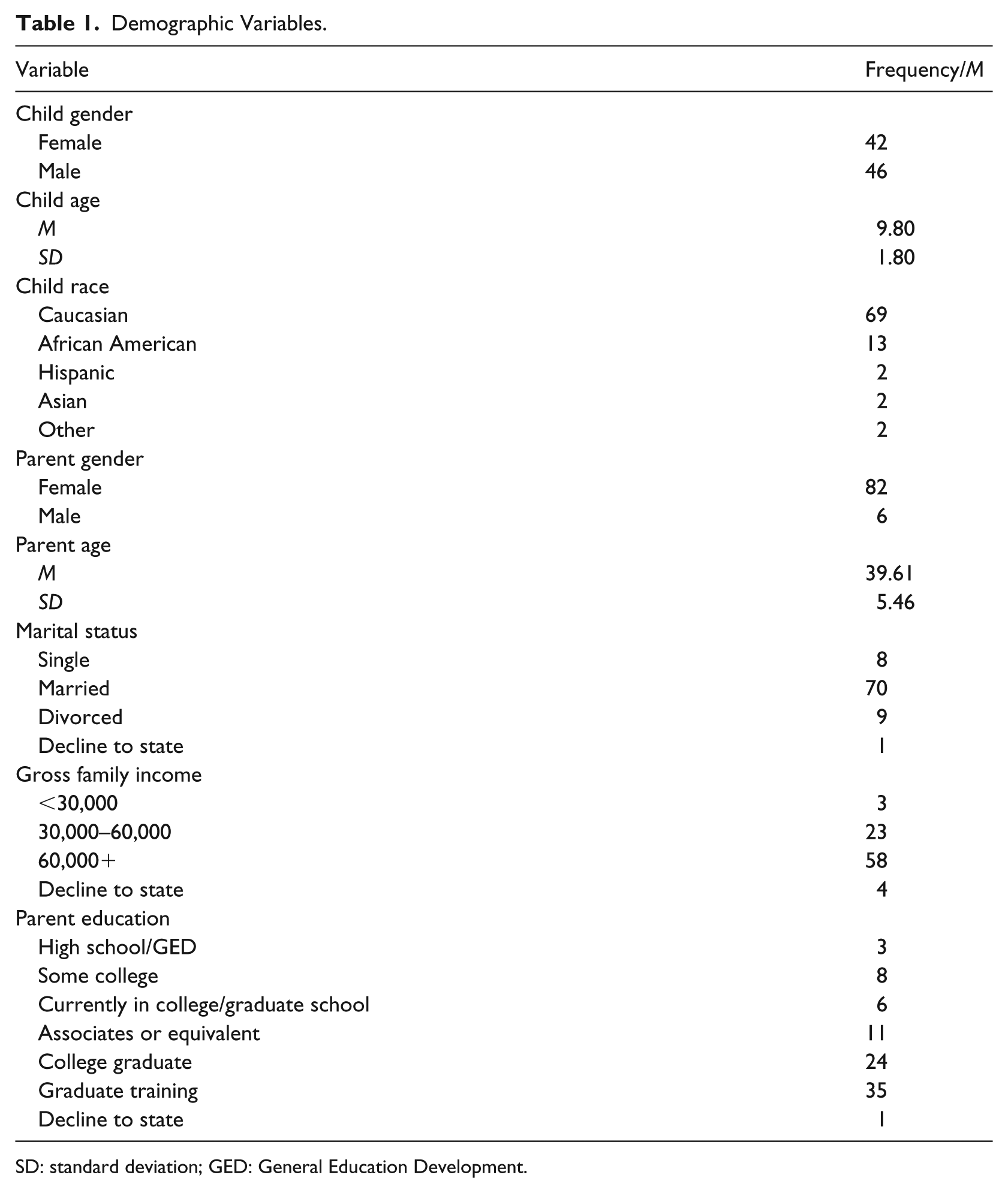
SD: standard deviation; GED: General Education Development.
Measures
Behavior Rating Inventory of Executive Function–P (BRIEF-P)
The BRIEF-P (Gioia, Isquith, Guy, & Kenworthy, 2000) is a questionnaire for parents of children 5–18 years of age. Parents are asked to rate how often each of the 86 items is a problem for their child; higher scores indicate that the child demonstrates greater difficulty with each of the different aspects of executive functioning. The measure includes eight subscales which correspond to eight facets of executive functioning: Inhibit, Shift, Emotional Control, Initiate, Working Memory, Plan/Organize, Organization of Materials, and Monitor. This study utilized the Inhibit, Shift, and Working Memory subscales. The Inhibition subscale contains items such as “acts wilder or sillier than others in groups,” while the Shift subscale contains items such as “resists or has trouble accepting a different way to solve a problem with school work, friends, chores, etc.,” and the Working Memory subscale has items such as “has a short attention span.” The Inhibition (α = .95), Shift (α = .81), and Working Memory (α = .92) subscales demonstrated high internal consistency in this sample. The measure has demonstrated good test–retest reliability (r = .76–.88), and good inter-rater reliability in previous samples (Gioia et al., 2000).
The Mindful Attention Awareness Scale–Children (MAAS-C)
The MAAS-C (Lawlor et al., 2014) is a 15-item mindfulness measure of children’s present moment experience and awareness. Higher scores on the MAAS-C indicate greater mindful awareness. The measure has shown high internal consistency and was related to several indicators in the expected direction such as emotional well-being and emotional disturbance (Lawlor et al., 2014).
Statistical analyses
First, bivariate correlations were conducted between mindfulness and each EF. Second, a model was conducted to test the association between mindfulness and an EF latent variable composed by the three EFs (this model is illustrated in Figure 1). Finally, the association between mindfulness and each EF was tested in the same model to identify whether specific EFs are uniquely associated with mindfulness (this model is illustrated in Figure 2).
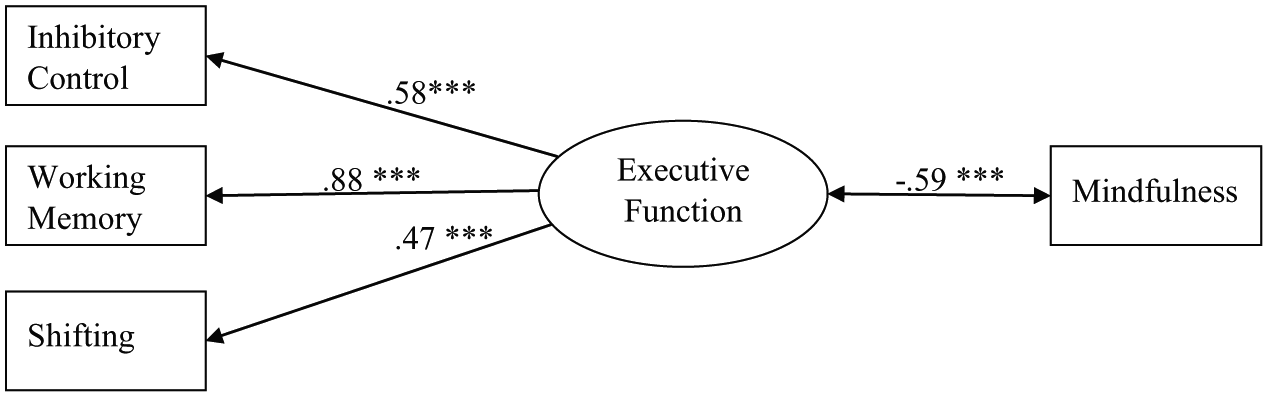
Association between the EF latent variable and mindfulness.
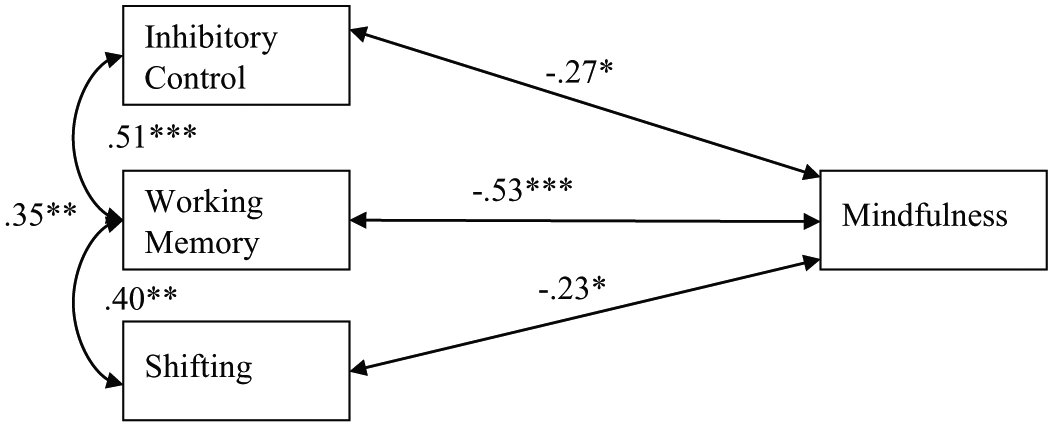
Association between each individual EF and mindfulness.
Results
Preliminary analyses
Study variables were analyzed in relation to demographic variables. In order to test for age effects, correlations were conducted between child age and the variables of interest. There was a significant correlation between age and inhibition, r(72) = −.24, p = .039; no other significant correlations emerged. T tests were conducted to analyze gender differences, but no significant differences between males and females were observed for any of the variables in the study. Between-group analyses of variance (ANOVAs) were used to determine whether there were significant differences in the measures between parents at each education level. No variables showed differences in relation to parental education level. Between-group ANOVAs were also conducted to determine whether there were significant differences in measures between different ethnicities. No significant effect of ethnicity was found on any study variable. Correlations were also conducted between the study measures and income but no significant association was found.
Hypotheses testing
Pearson bivariate correlations between mindfulness and EFs were significant for inhibition (r(88) = −.27, p = .012), working memory (r(88) = −.53, p < .001), and shifting (r(88) = −.23, p = .028; correlations between study variables are showed in Table 2).
Two-tailed bivariate correlations between mindfulness and executive functions.
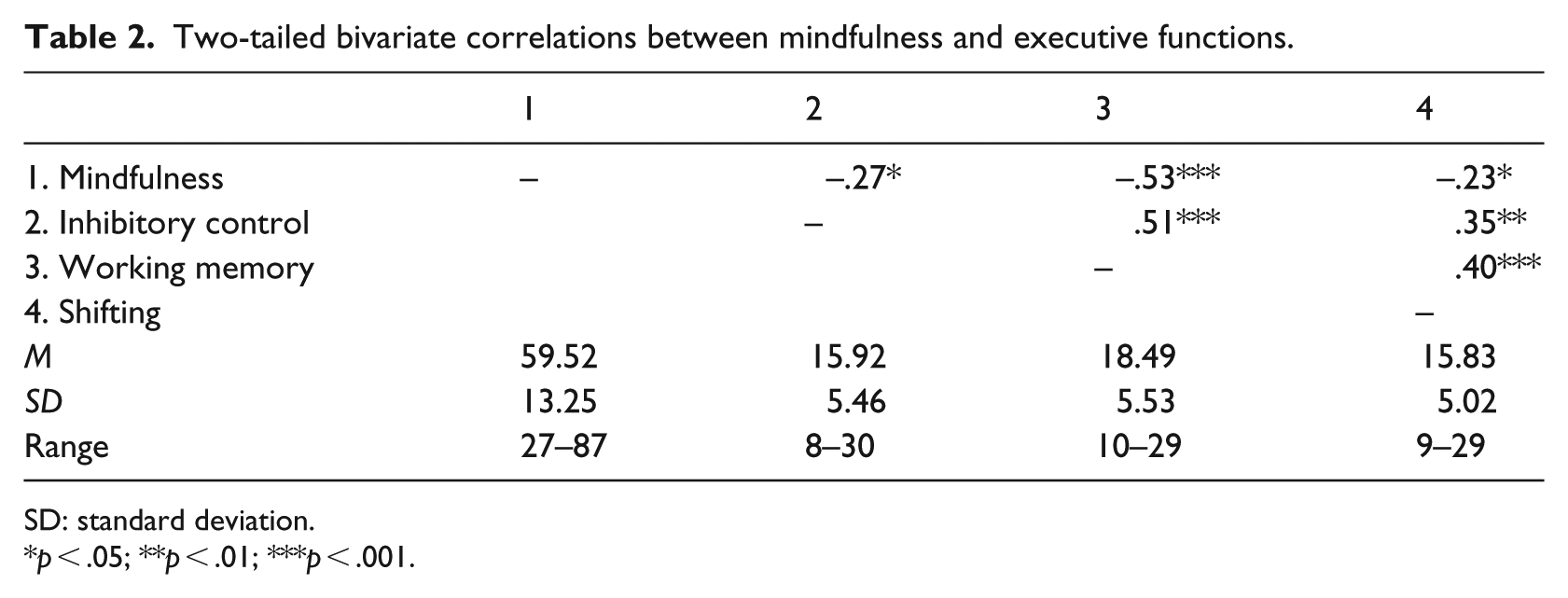
SD: standard deviation.
p < .05; **p < .01; ***p < .001.
Given the aforementioned association between inhibition and age, age was entered as a covariate in the two models tested. The model testing the association between mindfulness and the latent EF variable demonstrated moderate to good fit (χ2 = 7.01, df = 5, p = n.s.; comparative fit index (CFI) = .972; incremental fit index (IFI) = .974; root mean square error approximation (RMSEA) = .068). The three EFs demonstrated significant loadings in relation to the latent variable (inhibition: b = .58, p < .001; working memory: b = .88, p < .001; shifting: b = .47, p < .001). Furthermore, as expected, mindfulness and EF as represented by the latent variable were significantly associated, b = −.59, p < .001.
As the model relating mindfulness to each individual EF was saturated, no fit indices are provided. Mindfulness was significantly associated with inhibition (b = −.27, p = .017), working memory (b = −.53, p < .001), and shifting (b = −.23, p = .033).
Discussion
In this study, we examined the association between mindfulness—individually and concomitantly—and the core EFs (i.e. inhibition, working memory, and shifting) in a child sample based on theoretical models of mindfulness emphasizing the importance of EFs in mindful awareness. Our study is the first to explore the association between mindfulness and the three core EFs within the same study in a middle childhood sample. The results provide evidence for the extension of adult and adolescent findings (Gallant, 2016; Riggs et al., 2015) to children, suggesting an association between EFs and mindfulness is also present at a younger age. These findings posit that elements of metacognitive mindful models (e.g. Holas & Jankowski, 2013) may be present in children as evidenced by the link between EFs and mindfulness in this sample.
Our first hypothesis, concerning the correlation between mindfulness and individual EFs, was supported. Results indicate a negative correlation between mindfulness and difficulties with inhibition, working memory, and shifting. This suggests children who are more mindful are also less likely to experience difficulties with inhibition, working memory, and shifting. These findings are consistent with previous research suggesting a significant link between mindfulness and the core EFs during adolescence (Oberle et al., 2012; Riggs et al., 2015).
The second hypothesis was also supported. Specifically, when the three EFs (inhibition, working memory, and shifting) were loaded into a latent factor, the model examining the association between EF and mindfulness demonstrated moderate to good fit. These findings are consistent with Riggs et al.’s (2015) study and suggest that EFs relate to mindfulness not only in early adolescence but also as EFs are developing earlier in childhood. The current results also imply that the EFs have elements in common which in turn are associated with mindfulness in children. This association helps to lend support to previous conceptions of mindfulness that emphasize its association with higher order cognitive constructs such as EF (Holas & Jankowski, 2013; Lyvers et al., 2014). Specifically, adult cognitive models of mindfulness conceptualize it as requiring EFs and attention to maintain focus on present moment experiences and inhibit distractions (Holas & Jankowski, 2013). The current findings suggest though EFs undergo substantial maturation and change in childhood, they facilitate mindful experiences in children. Similar to adults and adolescents, it appears that mindful children also recruit higher order cognitive resources in the form of EFs to achieve and maintain mindful awareness.
Finally, when modeled simultaneously, inhibitory control, working memory, and shifting were all significantly associated with mindfulness; this finding partially supports the third study hypothesis. This departs from findings previously reported in adolescents (Riggs et al., 2015), thus emphasizing the importance of examining the relation between mindfulness and EFs at various developmental stages. Given that different aspects of EF are closely related (Miyake et al., 2000), examination of the association between each EF and mindfulness concomitantly provides an avenue to disentangle whether associations between mindfulness and individual EF processes are in fact due to features unique to individual EFs or rather due to variance shared with other EF processes.
The effect sizes of the associations between the EF variables and mindfulness were in the medium to high range. As effect size consists of the strength of a relationship between variables (Field, 2009), considering the model associating mindfulness to each EF, working memory appears to have the strongest effect. It is possible that, at this age, working memory is the overarching factor in the association between EFs and mindfulness, which, once established, allows other EFs to manifest. The association between inhibition and mindfulness suggests that maintaining mindful awareness may require the recruitment of inhibitory control mechanisms to manage competing thoughts and emotions (Davidson, Amso, Anderson, & Diamond, 2006). The association between mindfulness and working memory is in line with previous research suggesting mindful awareness recruits working memory to maintain awareness of moment to moment experiences (Holas & Jankowski, 2013). Although it was not hypothesized, an association between shifting and mindfulness emerged, suggesting mindful awareness in children requires the ability to flexibly switch away from distractors to stay focused on the present moment. Given the inconsistency between the present findings and adolescent (Riggs et al., 2015) and some adult studies (e.g. Gallant, 2016), future research is necessary to investigate potential moderators of the association between mindfulness and shifting. It is possible that age alters the relationship between these variables, but there could also be other cognitive or demographic variables affecting their association.
This study was not without limitations. First, the study was limited in that it used survey data. Although the BRIEF-P has demonstrated ecological validity (Gioia, Isquith, Retzlaff, & Espy, 2002), this measure is limited in that it is a parent-report of the child’s executive functioning. Previous research suggests weak correlations between questionnaires such as the BREIF-P and EF tasks (Anderson, Anderson, Northam, Jacobs, & Mikiewicz, 2010). This may indicate EF questionnaires and tasks may measure different aspects of EF processes. In light of this, future research should examine whether the present associations are also found when utilizing behavioral measures of EF (e.g. Stroop Task; MacLeod, 1992). Finally, because data were obtained cross-sectionally, this study cannot provide insights into the directionality of the associations. Interestingly, a number of studies show mindfulness training affects EFs (e.g. Crowe & McKay, 2016); however, studies testing the opposite path have not been conducted. Future research employing a longitudinal design is necessary to clarify potential directionality in the association between mindfulness and EFs.
Despite limitations, the present findings provide valuable clinical implications. Mindfulness has been found to be effective in the treatment of several disorders (e.g. Chambers et al., 2008; Hofmann et al., 2010), and thus understanding its underlying cognitive components will likely contribute to elaborating more specific and effective interventions. For instance, while mindfulness-based interventions have been found to improve EFs (e.g. Tang, Yang, Leve, & Harold, 2012), it is also possible that training EFs may be beneficial in improving children’s mindfulness. Furthermore, investigating EFs and mindfulness training interventions could help to establish the directionality of the relation between mindfulness and EFs. Given the differences between EFs and their distinct developmental trajectories (e.g. Best, Miller, & Jones, 2009), distinct associations could be established over time between specific EFs and mindfulness. Exploring these relations in children allows for an examination of EFs during an important developmental period in which they are malleable and maturing rapidly.
The current findings represent a significant contribution to the current literature on mindfulness and EFs in children. Although previous studies have examined the association between dispositional mindfulness and facets of EF, this study is the first to simultaneously model multiple facets of EF and their associations with mindfulness in a child sample. These findings help to deepen our understanding of the cognitive nature of mindfulness and elements of EF which may contribute to mindful awareness in children.
Footnotes
Declaration of conflicting interests
The author(s) declared no potential conflicts of interest with respect to the research, authorship, and/or publication of this article.
Funding
The author(s) received no financial support for the research, authorship, and/or publication of this article.
