







Abstract
Given the increase of depressive symptoms among adolescents, it is essential to investigate familial and temperamental correlates of depressive symptoms such as parental support, marital conflict, and stress. Thus, using a cross-sectional design, the current study examined whether parental support, marital conflict, and stress predicted depressive symptoms. Then, using structural equation modeling, this study tested whether stress mediated the relationships among parental support, marital conflict, and depressive symptoms among African American adolescents while controlling for sex (N = 883). Results suggest that maternal support negatively related to depressive symptoms in contrast to stress and marital conflict. However, paternal support and sex were not statistically associated with depressive symptoms. Mediation results suggest that stress explained the relationships among parental support, marital conflict, and depressive symptoms. Family therapy and depression reduction implications are discussed.
Depression is the leading mental health concern in the United States and is predicted to increase over time (Malhi & Mann, 2018). As depression is rare among children, depression is often common among adolescents (Kessler et al., 2001; Lewinsohn & Clarke, 1999). Symptoms of depression often differ between boys and girls. More specifically, adolescent girls are often more susceptible to developing depressive symptoms compared to boys (Hankin, 2009; Hamilton et al., 2015). In addition, adolescent depression is associated with educational difficulties (Powell et al., 2020), maladaptive coping (Horwitz et al., 2011; Spirito et al., 1996), and the occurrence of familial conflict (Sagrestano et al., 2003; Sheeber et al., 2001). Specifically, adolescents who are exposed to parental divorce and marital conflict often endorse depressive symptoms ( Rossman & Rosenberg, 1992; Schmidtgall et al., 2000).
Consistent with these results, various longitudinal studies suggest that familial conflict is related to depression over time (Cohen et al., 2015; Mazza et al., 2009). As prior literature supports the linkage between familial/marital conflict and depression, stress experienced from the conflict can also increase depressive symptoms (Hammack et al., 2004; Rose et al., 2017). One possible reason for this is that adolescents often blame themselves and internalize their parent’s conflict, which often stems from prolonged stress, and could increase depressive symptoms (Lucas-Thompson et al., 2017). Although stress often increases depressive symptoms, parental support often serves as a protective factor against depressive symptoms (Bokszczanin, 2008; Tsai et al., 2018).
Few studies have examined the cumulative relationships of parental support, marital conflict, stress, and adolescent depressive symptoms. Also, whether stress indirectly links these relationships. This limitation is important to address because, during the adolescence developmental stage, they are often more vulnerable to experience daily stress whether within the home or externally, which could influence depressive symptoms among other mental illness symptoms (Compas et al., 1993; Dumont & Provost, 1999; Ge et al., 2001; Silva et al., 2000). Thus, the current study examined whether parental support, marital conflict, and stress associated with adolescent depressive symptoms. Then, this study tested whether stress mediated the relationships between these variables while controlling for sex.
Marital conflict
Prior literature associates marital conflict with adolescent depressive symptoms (Keller et al., 2005; Smith et al., 2019). When adolescents observe marital conflict between their parents, they are more likely to develop mental illness symptoms such as anxiety (Cui et al., 2007; Buehler et al., 2009), eating disorder (George et al., 2014), and depression (Buehler & Welsh, 2009; Schoppe‐Sullivan et al., 2007).
Although numerous studies have shown that adolescents exposed to marital conflicts between parents are often more likely to develop mental illness symptoms, in some instances, marital conflict does not influence depressive symptoms. In fact, exposure to marital conflict can cultivate constructive problem-solving skills and adaptive coping within the family (Cummings et al., 2015; Grych & Fincham, 1990). Taken from these contrasting results, it is important to further explore whether marital conflict associate with internalizing problems among adolescents, more specifically depressive symptoms.
Parental Support
The link between parental support and better psychological functioning among adolescents is well documented (House et al., 1988; Needham & Austin, 2010). For example, adolescents who report having higher levels of emotional support from their parents often have better mental and physical health than those who report lower support (Moak & Agrawal, 2010). More specifically, mental health problems such as more likely to complete suicide (Flouri & Buchanan, 2002; Miller et al., 2015), anxiety (Mounts et al., 2006; Raufelder et al., 2015), and depression (Needham, 2008; Stice et al., 2004). One explanation of this stems from the attachment theory. The attachment theory postulates that adolescents and children who have a secure attachment from their parents often have better mental health and physical outcomes than individuals with an insecure attachment (Oldfield et al., 2016; Shorey et al., 2003). More specifically, adolescents who have an insecure attachment often endorse depressive symptoms than adolescents with a secure attachment (Chang et al., 2020; Vivona, 2000). These studies suggest that adolescents with supportive parents who have a secure attachment are often less likely to endorse depressive symptoms.
Few studies have examined the link between parental emotional support and stress among adolescents. For example, studies show that college students with less supportive parents are less likely to cope with college stress than those with supportive parents (Ong et al., 2006; Rice et al., 1990). In addition, prior studies have not explored the role of stress on the relationship between parental emotional support and depressive symptoms among African American Adolescents. Due to the complexity of stress and the important role of parental support among adolescents, it is essential to examine whether parental support from both parents decreases stress, which could relate to depressive symptoms.
Stress
During adolescence, stress often plays a role in developing mental illness symptoms and psychological functioning (Xu et al., 2019). Correlates of stress are related to environmental issues, temperament, and personality (Hewitt et al., 2014). Stress may increase when adolescents perceive their situation to be uncontrollable and have difficulties managing their emotions (Galla & Wood, 2015). For example, during parental conflicts, adolescents often have elevated stress levels due to their lack of control of the situation (Baer et al., 1987; Santiago et al., 2017). In line with this, when adolescents observe parental conflict, they often experience depressive and anxiety symptoms (Cummings et al., 2015; Timmons & Margolin, 2015). Due to the physical and psychological pernicious effects of stress, more studies are needed to examine whether observing marital conflict directly increases stress, as consistent with prior literature.
Purpose of the present study and hypotheses
Given the importance of parental support and the adverse effects of marital conflict on adolescent depressive symptoms, the current study used a cross-sectional design to replicate previous findings and examine the indirect effects of stress on the relationships among parental support and marital conflict predicting depressive symptoms. Because prior literature suggests that higher parental support often leads to lower depressive symptoms, it is predicted that parental support will negatively associate with depressive symptoms (H1). Pertaining to marital conflict, it is predicted that marital conflict will positively relate to depressive symptoms (H2). In addition, it is predicted that stress will be positively associated with depressive symptoms. Finally, due to limited studies examining the mediational effect of stress on the relationships among parental support, marital conflict, and depressive symptoms in the current study, these relationships were exploratory (RQ1).
Method
Sample
Data was drawn from the National Survey of American Life (NSAL-A) Caribbean Black adolescent sample (2003–2004), which consisted of 1170 adolescents ranging in age from 13 to 17 years. Respondents were either African American (n = 810) or Caribbean Black (n = 360) and who lived with a Black parent in the United States. There were more girls (54.2%) than boys (45.8%) in the sample. Within the Caribbean sample, 32% were from Jamaica, 18.7% Haiti, 10.5% Trinidad and Tobago, 5.6% Guyana, 4.7% Barbados, and 3.8% Puerto Rico. Approximately half of the families reported their income in the US$18, 000–US$54,999 range. Average household income was $38,829. Lastly, 27% reported as Catholic, 23.9% Protestant, 13.7% Pentecostal, and 3% as non-denomination.
Procedure
The NSAL-A was originally conducted as a multistage sample of African American, Black Caribbean, and non-Hispanic White adults by the Program for Research on Black Africans at the University of Michigan’s Institute for Social Research. The original authors received IRB approval from the University of Michigan’s research compliance department. For recruitment purposes, African Americans and Black Caribbean’s identified their ethnic heritage as Black and Caribbean but resided in the United States. Prior to interviewing adolescents, consent was obtained by their parents and assent by the adolescent. Then, 82% of adolescents and family members were interviewed face to face using a computer-assisted instrument in their homes. However, 18% of the interviews were conducted via telephone. The overall response rates were 80.6% for African Americans and 83.5% for Black Caribbean’s. After the interview, participants were compensated for their time. For review, please see (Jackson et al., 2004).
Measures
Depression.
Depressive symptoms were measured using the 12 items CES-D inventory (Radloff, 1977). This scale measures depressive symptoms over the past week, in which participants consider their past week depressive symptoms such as “I felt depressed” and “My sleep was restless” measured on a 4-point Likert scale ranging from 0(rarely or none of the time; less than 1 day) to 3(most or all the time; 5–7 days). Items were reverse coded, when necessary, combined together, which created one item (α = .71). Higher scores indicate greater depressive symptoms.
Marital Conflict.
Marital conflict was measured using a composite score of a 5-item scale asking adolescent how often they observe their mother and father argue and fight measured on a 4-point Likert scale ranging from 1(not often) to 4(very often). Items were reverse coded, when necessary, averaged together, which created one item (α = .71). Higher scores represent increased frequency of observed marital conflict.
Maternal Emotional Support.
Maternal support was measured using a composite score of a 7-item scale asking adolescents about their relationship with their mother, ranging from how close they are to comfortability, measured on a 5-point Likert scale ranging from 1(strongly disagree) to 5(strongly agree). An example item is, “My mom is always there when I need her.” Responses were averaged together, which created a single item (α = .89). Higher scores indicate stronger mother-child emotional connection.
Paternal Emotional Support.
Paternal support was measured using a composite score of a 7-item scale asking adolescents about their relationships with their father, ranging from how close they are to comfortability, measured on a 5-point Likert scale ranging from 1(strongly disagree) to 5(strongly agree). An example item is, “My dad is always there when I need him.” Responses were averaged together, which created a single item (α = .92). Higher scores indicate stronger father-child emotional connection.
Adolescent stress appraisal.
Adolescents’ stress was measured using the Cohen’s Perceived Stress scale, which measures stressful life events within the last month (Cohen et al., 1983). This scale comprises of 14 items, with an example item such as, “In the past month, how often have you felt nervous and “stressed”? Items were measured using a 5-point Likert scale ranging from 1(none) to 5(a lot); items were averaged together, which created a single item (α = .79). Higher scores represent more stress.
Analytical strategy
IBM SPSS Statistics 24 was used to calculate correlations and descriptive statistics of predictor variables and the dependent variable. Then a simultaneous linear regression was used to examine whether parental support, marital conflict, and stress associated with depressive symptoms. Finally, Amos 24.0.0 was used to test whether stress mediated the relationships among parental support, marital conflict, and depressive symptoms using structural equation modeling (SEM) and maximum likelihood estimation. Using SEM would enable estimation of all paths in the model while simultaneously assessing for goodness of fit. The goodness of fit indices criteria included chi-square distribution, comparative fit indices (CFI), Tucker Lewis fit indices (TLI), and root mean square error of approximation (RMSEA). To establish good fit indices, the chi-square should not exceed 3, the CFI and TLI should exceed 0.90, and RMSEA should not exceed 0.08 (Hooper et al., 2008). While estimating the indirect effects, it is suggested that 5000 bias corrected bootstrap with a 95% confidence interval should be used (Preacher & Hayes, 2004). Therefore, 5000 bias corrected bootstrap with 95% confidence interval were performed to test the mediating role of stress.
Results
Correlations, skew, and reliabilities.
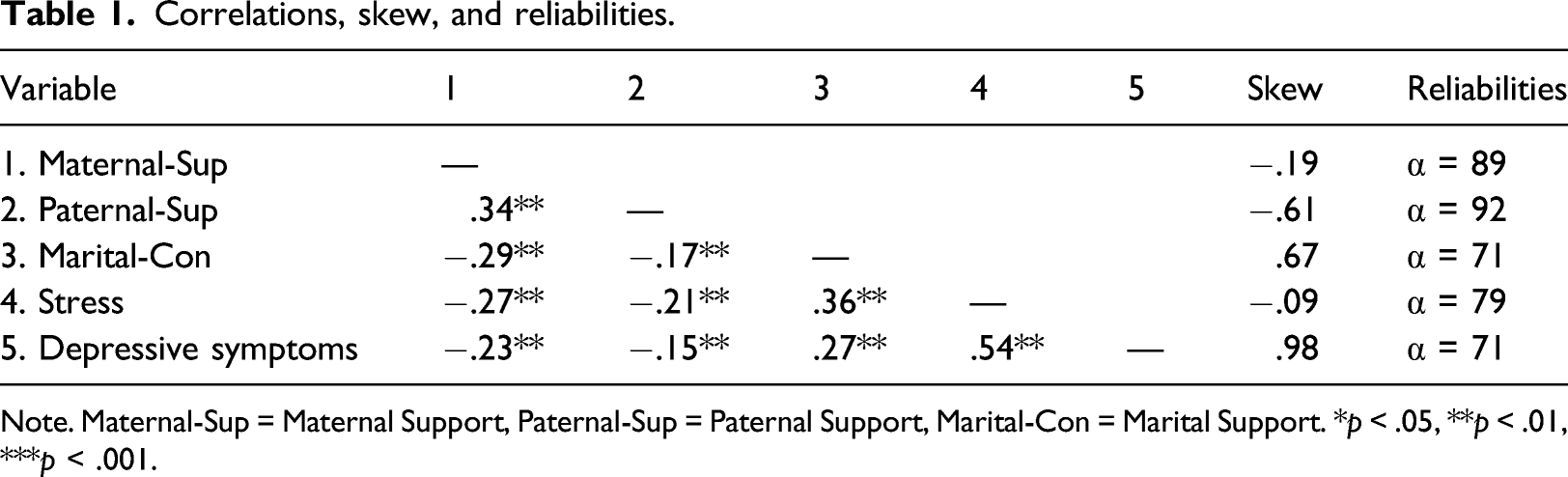
Note. Maternal-Sup = Maternal Support, Paternal-Sup = Paternal Support, Marital-Con = Marital Support. *p < .05, **p < .01, ***p < .001.
Bivariate analysis
Multiple regression coefficients, standard errors, and confidence interval (N = 883). Depressive symptoms.
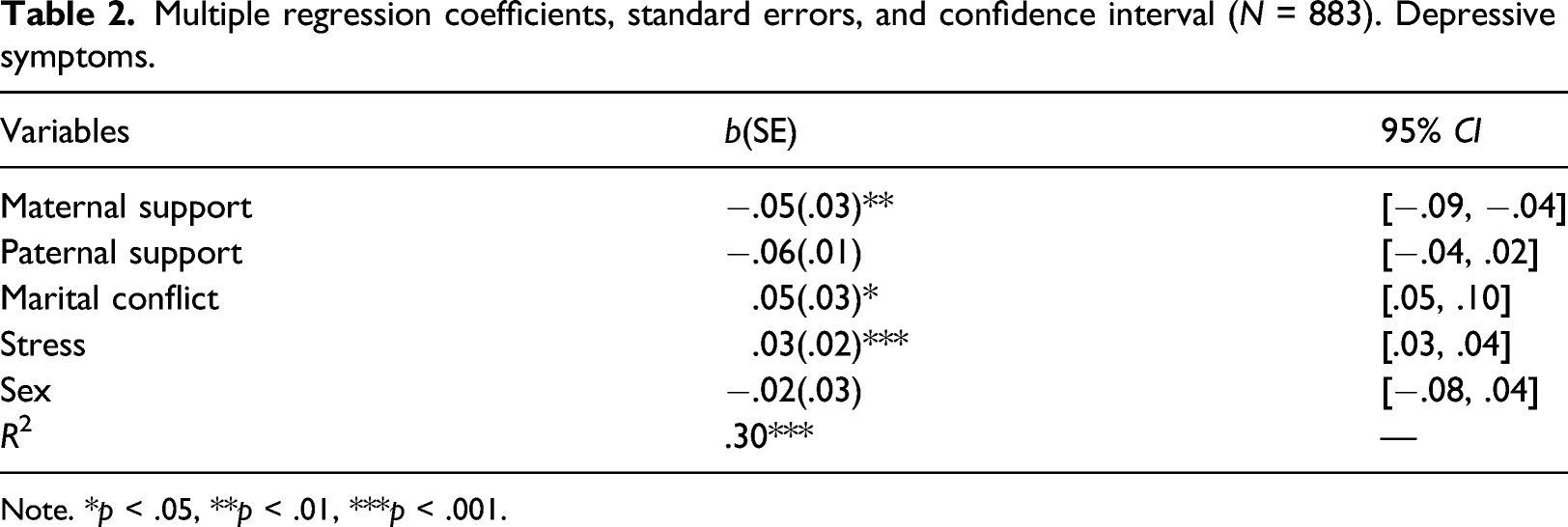
Note. *p < .05, **p < .01, ***p < .001.
Then using a multiple linear regression analysis, maternal support, paternal support, marital conflict, sex, and stress, were modeled to relate to depressive symptoms. The overall model was significant, R2 = . 30, F(5, 878) = 74.034, p < .001. Marital conflict, (β = .05, p = .03) and stress (β = .03, p < .001) were both positively related to depressive symptoms. However, maternal support, (β = −.05, p = .03) was negatively associated with depressive symptoms. Paternal support, (β = −06, p = .72) and sex, (β = −.02, p = .51 were both not statistically associated with depressive symptoms.
Indirect effects
To test the mediational effects of stress on maternal support, paternal support, and marital conflict on depressive symptoms, a structural equation model was used. Prior to the final analysis, model fit indices were examined, which suggested good model fit: X
2
(17) = 24.574, 6.144, p < 05, CFI = .97, TLI = .98, RMSEA = .05. In the first mediation path, stress explained the relationship between maternal support and depressive symptoms, (β = −05, p < .001). In the second mediation path, stress mediated the relationship between marital conflict and depressive symptoms, (β = .13, p < .001). Finally, in the last mediation path, stress mediated the relationship between paternal support and depressive symptoms, (β = −.03, p = .02). See Figure 1. This suggest that the relationships among maternal support, marital conflict, and paternal support can associate with depressive symptoms through increased stress while controlling for sex. Depicts the structural relationships among maternal support, marital conflict, paternal support, stress, and depressive symptoms and the mediating role of stress while controlling for sex (standardized coefficients; N = 883). Depressive-S = Depressive symptoms.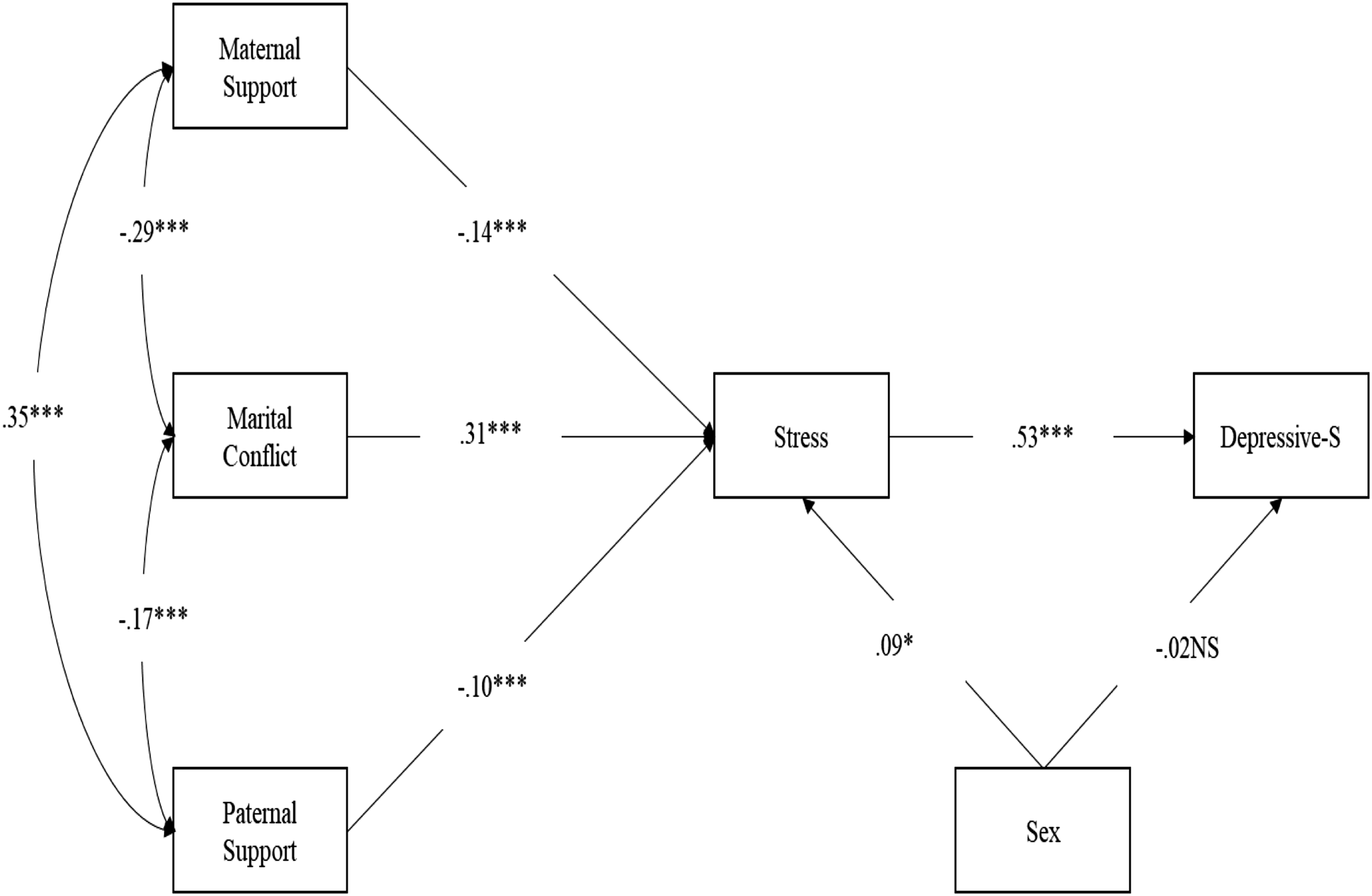
Discussion
There were two primary purposes of the current study. One goal was to test whether parental support, marital conflict, and stress relate to depressive symptoms. The second goal was to explore whether stress explained the relationships among parental support, marital conflict, and depressive symptoms among adolescents. Linear regression results suggest that marital conflict and stress were both positively related to depressive symptoms. In contrast, to maternal support. Finally, both paternal support and sex were not statically related to depressive symptoms. Pertaining to the mediation question, stress fully mediated the relationships among maternal/paternal support, marital conflict, and depressive symptoms. Hypothesis one stated that parental support would be negatively associated with depressive symptoms. This hypothesis was partially supported, revealing that maternal support was negatively related to depressive symptoms and paternal support was not. As prior literature suggested maternal support often serves as a protective factor against adolescents developing mental illness symptoms (Govender & Moodley, 2004; Van Loon et al., 2014); in this case, maternal support negatively related to depressive symptoms. Another reason could be as maternal support increased, it fostered a positive relationship with the adolescent, possibly increasing self-esteem which decreased the likelihood of experiencing depressive symptoms.
As maternal support negatively associated with depressive symptoms, paternal support was not statistically related to depressive symptoms. These findings may be attributed to increased paternal absence in African American households (Mandara et al., 2005; Thomas et al., 2008). Another reason for this could be that due to the preexisting negative relationship between the adolescent and the father, it is possible that the paternal supportive efforts did not make a difference in the adolescent life. Although this might be the case, other studies have suggested that paternal support often serves as a protective factor against depressive symptoms among adolescents (Barrera & Garrison-Jones, 1992; Calandri et al., 2019). Drawing from these studies, paternal support is still an essential factor in fostering a positive father-child relationship, which could then decrease the likelihood for an individual to develop depressive symptoms.
Pertaining to marital conflict and stress, they were both positively related to depressive symptoms. These relationships suggest that higher stress and the occurrence of marital conflict could increase depressive symptoms among adolescents. These relationships are consistent with prior literature, which suggested that marital conflict often leads to depression (Buehler & Welsh, 2009; Choi & Marks, 2008), and stress typically increases the likelihood of developing depression among adolescents (Davila et al., 1995). Taken together, when adolescents are exposed to marital conflict and have higher stress levels, they often endorse depressive symptoms.
Indirect effects discussion
Indirect effects suggested that stress mediated the relationships among maternal support, marital conflict, paternal support, and depressive symptoms. More specifically, in the path of maternal support, maternal support decreases stress, which then negatively relates to depressive symptoms. Then in the path of marital conflict, marital conflict increases stress, which then increases depressive symptoms. Lastly, in the path of paternal support, paternal support negatively associated with stress, which is then negatively associated with depressive symptoms. These results suggest that strong emotional support by both parents often decreases stress levels, then negatively relate to depressive symptoms. However, observing marital conflict increases stress, which then increases depressive symptoms.
Limitations
Like any other study, the present study has limitations, which future studies should address. First, although maternal support negatively predicted depressive symptoms, the adolescent and the mother could have had a positive relationship before participating in the study. Future studies should pretest the nature of their relationship and account for it while testing whether maternal support relates to depressive symptoms. Second, the nature of the marital conflict was broad and not specific. Future studies should examine whether adolescents who observe verbal and domestic violence differ in developing depressive symptoms. Third, this study used a cross-sectional design, which examines relationships among variables in a specific time period. This is a limitation because the roles of parental support, stress, and marital conflict on depressive symptoms could vary over time. Therefore, future studies should use a longitudinal design to better understand the effects of these variables on depressive symptoms among African American adolescents. Lastly, because the sample is mostly African Americans, the results may not be generalized to other races or ethnic groups. Future studies should examine whether the results obtained in this study are replicable within a more diverse sample.
Adolescent and family implications
As results showed that parental support, stress, and marital conflict often play a role in predicting depressive symptoms among adolescents, these results have several implications. First, parents should increase their supportive efforts by strengthening their relationships with their children, which could decrease daily life stressors and depressive symptoms. Ways to strengthen their relationship could be interacting with warmth, validating their feelings and emotions, and restoring a secure attachment base (Harach & Kuczynski, 2005). Second, as prior literature indicated that children often feel responsible and guilty for their parent’s conflict (Rohrlich et al., 1977), which could lead to the endorsement of mental illness symptoms (Fendrich et al., 1990; O’Hara et al., 2019); parents should explain to their children that their marital conflict is not their children’s fault. Doing so could decrease the adolescent’s chances of experiencing internalizing symptoms. Third, parents should identify their local mental health facility to engage in family therapy, which has been shown to facilitate better communication and decreases mental illness symptoms among adolescents (Carr, 2009; 2014; Sexton & Turner, 2010).
Fourth, parents should attempt to resolve their differences through couples therapy or any other adaptive therapeutic method. However, if their marital disagreements are beyond repair, parents should conceal their discord or arguments from their children due to noted adverse mental and social outcomes.
Although research suggests that adolescents are often susceptible to developing depressive symptoms, African Americans are often at a higher risk (Repetto et al., 2004; Tandon & Solomon, 2009). As such, studies have reported one consistent risk factor for depressive symptoms among African American adolescents, such as stress. More specifically, increased stress is often positively related to the development of depressive symptoms (Hammack et al., 2004; Lindsey et al., 2010). One possible reason for this is that African American adolescents are more likely to be exposed to stressful environmental events (McLeod & Nonnmaker, 2000; Voisin et al., 2016).
These results are partially consistent with the present study, such that stress is positively associated with depressive symptoms among African American adolescents. Perhaps to disrupt this pattern, mental health advocates should promote and implement less cost-effective mental health facilities in populated African American neighborhoods to address mental health needs, specifically depressive symptoms. Because a significant barrier for treatment among African American families is lack of affordability for therapy (Hall & Sandberg, 2012; Thompson et al., 2004), it is essential for community mental health providers to promote therapy and other mental health services in African American communities and provide services on a sliding scale.
Conclusion
This study provided new insight into the roles of parental support, marital conflict, and stress on depressive symptoms among African American adolescents. Maternal emotional support can decrease the likelihood of adolescents developing depressive symptoms in contrast to marital conflict and increased stress. It could be beneficial for parents to cultivate a supportive relationship and environment for adolescents even if there are marital conflicts within the home, which could decrease stress and the likelihood of developing depressive symptoms.
Footnotes
Declaration of conflicting interests
The author(s) declared no potential conflicts of interest with respect to the research, authorship, and/or publication of this article.
Funding
The author(s) received no financial support for the research, authorship, and/or publication of this article.
