







Abstract
Internet Gaming Disorder (IGD) has been placed under the conditions for further study segment in DSM-5. The purpose of the current study was to develop a preliminary psychosocial model as a reference for providing appropriate intervention, particularly for adolescents with IGD. A total of 5290 adolescents from secondary schools in seven states in Malaysia were recruited by using proportionate random sampling. A standardized set of validated questionnaires such as DASS-21, BIS-11, and IGDS9-SF were distributed to participants that fulfilled the inclusion criteria. The prevalence of IGD among Malaysian adolescents was 3.5%. The bivariate analysis summarized that factors such as stress, impulsivity, gender, time spent using the internet, and relationship with parents and friends; have statistically significant associations with IGD. The logistic regression model revealed that adolescents with IGD were 9 times more likely to experience extremely severe stress (p < 0.001). Several psychosocial factors were associated strongly with IGD in the current study, however, mental health shows the most significant issues among adolescents with IGD. Immediate intervention through a psychological approach to internet gaming is needed from parents, schools, and also respective stakeholders. IGD may become one of the addictions diseases that cause deterioration in many aspects of an adolescent’s future life without serious intervention.
Introduction
Globally, 1–10% of individuals who play online games suffers from compulsive addiction (Hull, 2021). A recent study that suggested the increasing percentage of adolescents playing online computer games has led to growing public concerns about potential detrimental effects, especially gaming addiction (Sugaya et al., 2019). Besides that, there is an increase in the prevalence of gaming addiction associated with problematic behaviors such as externalizing problem behaviors (e.g., substance use and sexual intercourse) and internalizing problem behaviors (e.g., depression and social anxiety) (Hu et al., 2017). This trend is worrying, in parallel to the statistics by the Malaysia Communications and Multimedia Commission (MCMC) in 2018 which indicates that the national percentage of Internet users climbed from 76.9% in 2016 to 87.4% in 2018 (Zul Kamal & Wok, 2020).
According to the Diagnostic and Statistical Manual of Mental Disorders, Fifth Edition Text Revision (DSM-5-TR), Internet gaming addiction (IGD) is defined as “persistent and recurrent use of the Internet to engage in games, often with other players, leading to clinically significant impairment or distress as indicated by five (or more) of the criteria in a one-to-2-month period” (American Psychiatric Association, 2022). The proposed criteria include preoccupation with Internet games, withdrawal symptoms, tolerance, unsuccessful attempts to control the participation in Internet games, loss of interest in previous hobbies and entertainment, continued excessive use of games despite knowledge of psychosocial problems, having deceived someone regarding the amount of Internet gaming, use of games to escape or relieve a negative mood, and having jeopardized or lost a significant relationship, job, or educational or career opportunity (American Psychiatric Association, 2022; Milani et al., 2018).
Upon the inclusion of IGD in the section measures of DSM-5, researchers have raised their arguments on whether IGD is fit to be included in DSM-5. Dullur and Starcevic (2018) publicly argued that problematic online gaming associated with interruption of functioning may not suggest the presence of mental disorder since it could only be a consequence of excessive gaming. They also argued that the unclear distinction between “high engagement” and problematic online gaming, as well as the low diagnostic threshold for IGD, could lead to overdiagnosing the condition besides pathologizing and stigmatizing average gamers. This could result in the utilization of inappropriate and potentially dangerous treatments, such as coercive techniques to modify gaming behaviour or some medications (Dullur & Starcevic, 2018).
However, King et al. (2018) counter argued that IGD should be qualified as a mental disorder since DSM-5 and ICD-11 both has referred IGD with the important concept of “loss of control” apart from other diagnosis criteria and considerations. King et al. (2018) also argued that when evaluating various functional impairments and evidence of impaired control over gaming, which would not be typical of normal gaming, evidence about the intensity and frequency of conduct is typically evaluated in parallel. An expert clinician should be able to distinguish between “normal” gaming and IGD based on the research done to date. The obvious needs of persons seeking therapy for gaming-related difficulties should not be put above the fictitious and actual fear of IGD misdiagnosis.
According to Fam (2018), the prevalence of IGD was prominent in 4.6% of adolescents. This result shows that the percentage is alarming, as IGD affects around one out of every 20 adolescents, and they are unaware of the adverse effects of IGD. Addictions to internet gaming cause detrimental mental health effects such as dysfunction in the individual’s capability to grasp their real-world relationships (social life), problematic behavior towards others, and poor time management (Aziz et al., 2018). Furthermore, internet gaming addictions also cause deterioration not only in the academic performance among adolescents, but also psychosocial impairment such as aggression, mental and physical health worsening, and weakening in family relationships (Karunanayake et al., 2020). According to the study by Karunanayake et al. (2020), the excessive use of mobile phone gaming resulted in poor academic performance and negatively impacted their mental health by reducing memory and attention and increasing laziness. Hence, this further suggests the need to investigate the psychological mechanisms of online gaming addiction among adolescents for locally relevant prevention and intervention plan.
Impulsiveness is an important psychological risk factor that is related to adolescents with IGD characteristics. For instance, several studies suggest higher impulsiveness in the IGD group as compared to the healthy control group (Ding et al., 2014; Du et al., 2016; Feng et al., 2013; Y. Wang et al., 2015). Moreover, in a study on the relationship between impulsivity and IGD, Ryu et al. (2018) found that IGD symptoms were positively related to sadness and impulsivity but negatively associated with interpersonal connection quality. Hence, identification of the impulsiveness risk may provide a better understanding of internet gaming addiction among adolescents for effective intervention program development (Arif Roslan et al., 2021; Ryu et al., 2018).
A systematic review study by Sugaya et al. (2019) suggests that internet gaming addiction appears to be an area in which additional research is needed. Furthermore, a local Malaysian study by Hanisshya et al. (2018) suggested for future research to develop a reference model of internet addictive behavior as guidelines for the health care provider working with children and adolescents, specifically in Malaysia. Therefore, this suggests a need for a fundamental study to identify the associated psychosocial risk factors among adolescents with addiction to internet gaming, particularly on mental health and impulsiveness.
Methods
Ethical Approval
The study was approved by the Ethics Committee.
Participants and Procedure
5290 adolescents from selected secondary schools from seven states in Malaysia were recruited through a proportionate random sampling method based on the total number of students per year of study. The data has been collected in July 2021. A set of validated questionnaires were distributed to the students, face-to-face, at the time arranged by the teachers to avoid disturbing the student’s class schedule. All participants have granted their consent to participate in the study.
Measures
The Internet Gaming Disorder Scale (Short Form) (IGDS9-SF) is a scale used to assess the severity of Internet gaming disorder (IGD) and its detrimental effects by examining both online and/or offline gaming activities occurring over 12 months (Pontes & Griffiths, 2015). The items were adapted from the criteria proposed by the American Psychiatric Association (APA) in DSM-5-TR. T’ng and Pau (2020) conducted a study to validate the Malay translation of IGDS9-SF. They found that the translated scale is psychometrically acceptable for the assessment of IGD among Malaysian adolescents T’ng and Pau (2020). The nine questions comprising the IGDS9-SF are answered using a 5-point Likert scale: 1 (Never), 2 (Rarely), 3 (Sometimes), 4 (Often), and 5 (Very Often). All the scores are summed up and the total scores can range from 9 to 45. Higher scores are indicative of higher degrees of gaming disorder. The IGD was defined based on the cut scores of 32, as in Qin et al. (2020). Malay version of IGDS9-SF has high Cronbach’s alpha values of 0.81 (T’ng & Pau, 2020), and 0.87 (Ling et al., 2021).
The 21-Item Depression, Anxiety, and Stress Scale (DASS-21) is a brief version of the 42-Item DASS. It is a self-reported questionnaire with three subscales that measure depression, anxiety, and stress over the previous week on a Likert scale of 0–3 (Parkitny & McAuley, 2010). The Malay version has high Cronbach’s alpha values of 0.75, 0.74, and 0.79 for depression, anxiety, and stress, respectively, with good construct validity (Ramli et al., 2009).
The Baratt Impulsiveness Scale (BIS-11) is an inventory designed to assess the personality and behavioral construct of impulsiveness. The items yielded six first-order factors: attention, motor, self-control, cognitive complexity, perseverance, and cognitive instability impulsiveness (Patton et al., 1995). They also yielded three second-order factors: attentional, motor, and non-planning impulsiveness. The BIS-11 consists of 30 items describing common impulsive or non-impulsive behaviors and preferences. The items are scored on a 4-point scale: 1 (Rarely/Never), 2 (Occasionally), 3 (Often), and 4 (Always). A high Cronbach’s alpha value of 0.81 was obtained in the current study for the Malay-translated version of BIS-11.
Statistical Analysis
For descriptive statistics, mean and standard deviation were calculated for numerical variables, whereas frequency and percentage were calculated for categorical variables. Chi-square was performed to examine the association between each independent variable and IGD. Lastly, multiple logistic regression was carried out to determine the associated factors of IGD with a stepwise method for selecting the important variables. A significant level of 0.05 was set for all statistical analyses. All the statistical analyses were done using STATA version 16.1.
Results
Sociodemographic background
Socio-demographic of the adolescents from secondary schools in Malaysia (n = 5290).
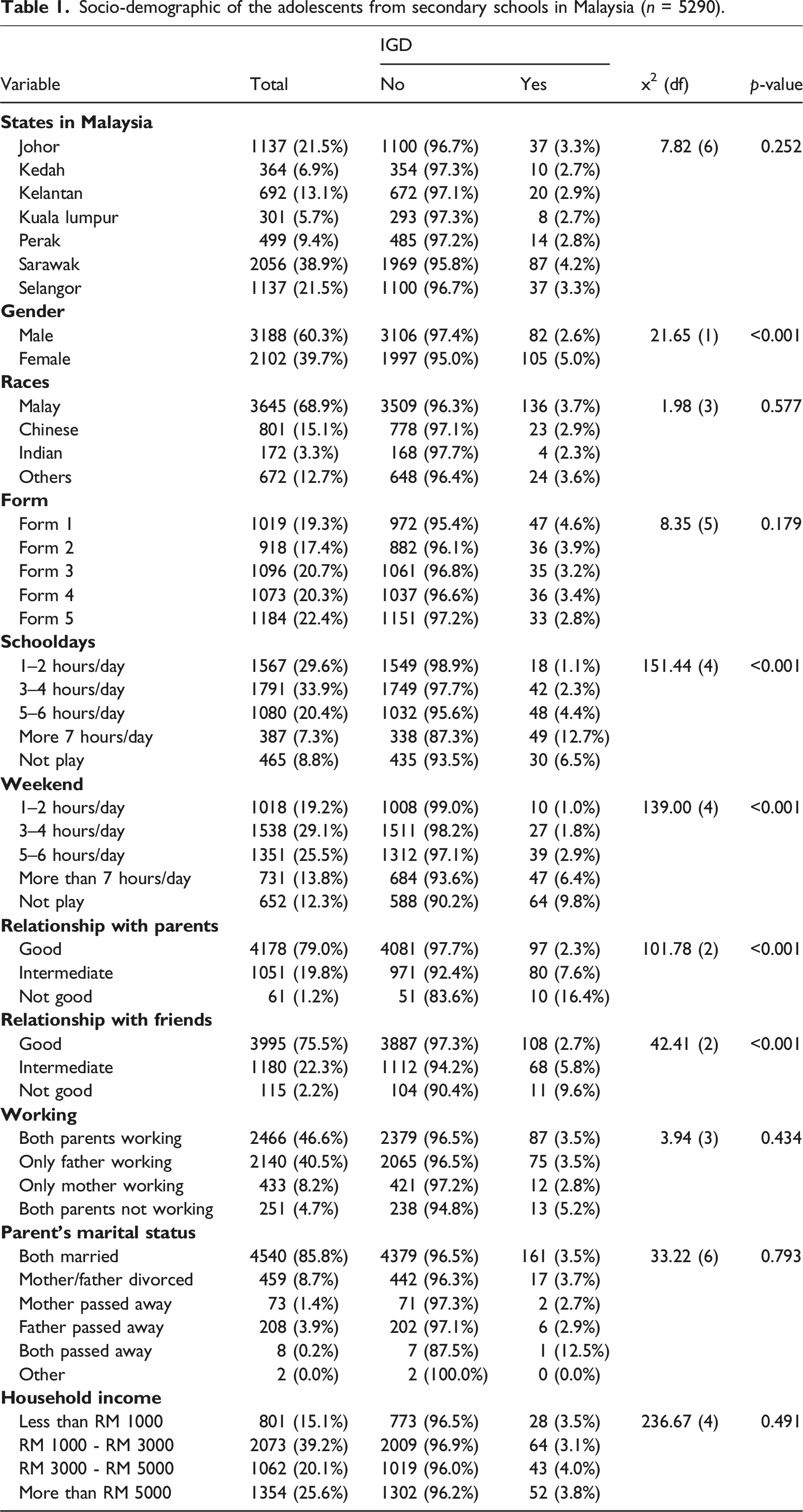
33.9% of students reported their duration of playing games was 3–4 hours per day during school days, whereas 29.1% of them played for the same duration on weekends. With regards to family matters, most of them (79.0%) have good relationships with their parents, and 46.6% of the samples reported that both of their parents are working.
Prevalence of Internet Gaming Disorder (IGD)
Among the 5290 students, 187 (3.5%) were diagnosed with IGD (Figure 1). Table 1 shows a higher prevalence of IGD among students staying in Selangor at 4.6%, followed by Sarawak (4.2%) and Johor (3.3%). The IGD prevalence increases by year of study, with males significantly higher than females (p value = <0.001). Regarding ethnicity, the prevalence of IGD was higher among Malays and Others ethnic groups at 3.7% and 3.6% respectively, however, the difference was not statistically significant. The prevalence of IGD was statistically higher among those who did not have a good relationship with their parents and friends. Prevalence of IGD among adolescents in Malaysia.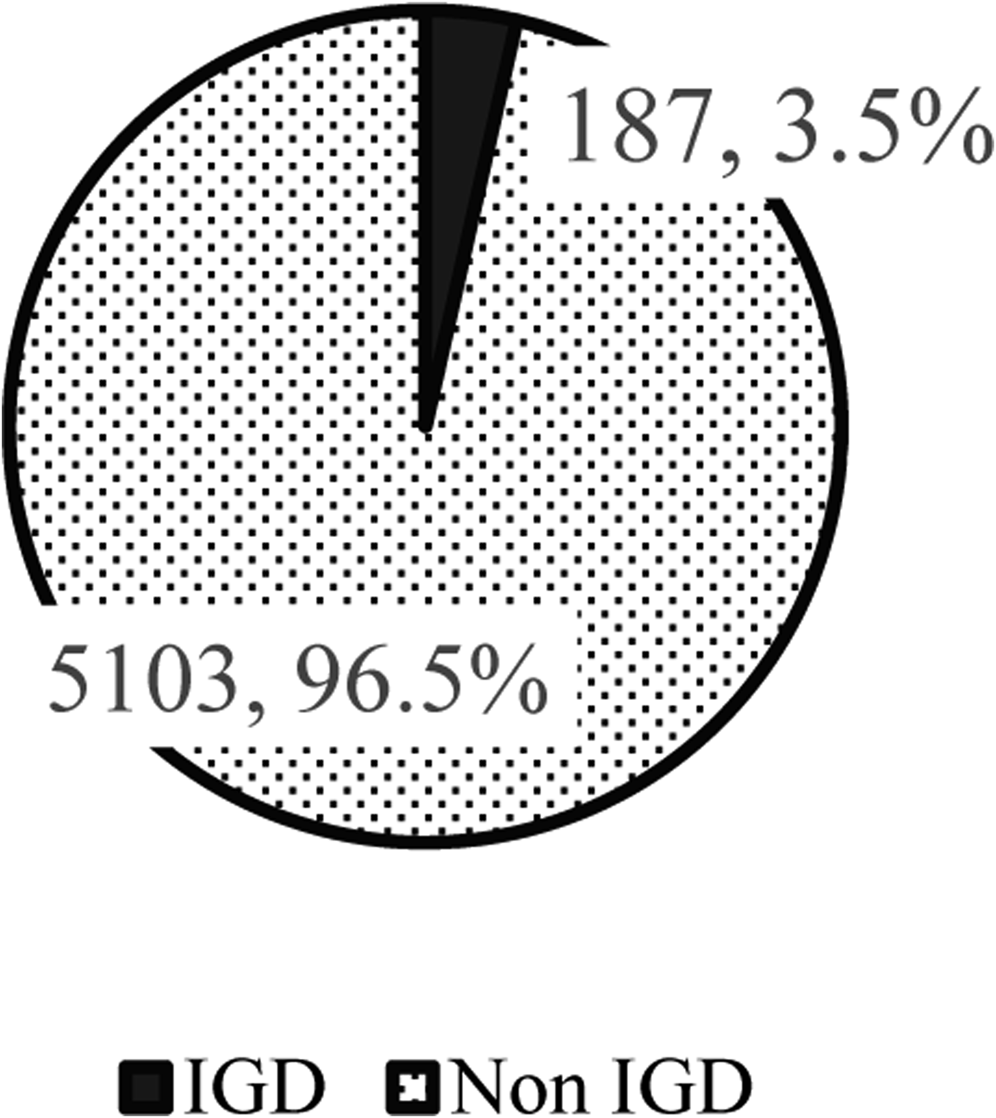
Prevalence of mental health issues
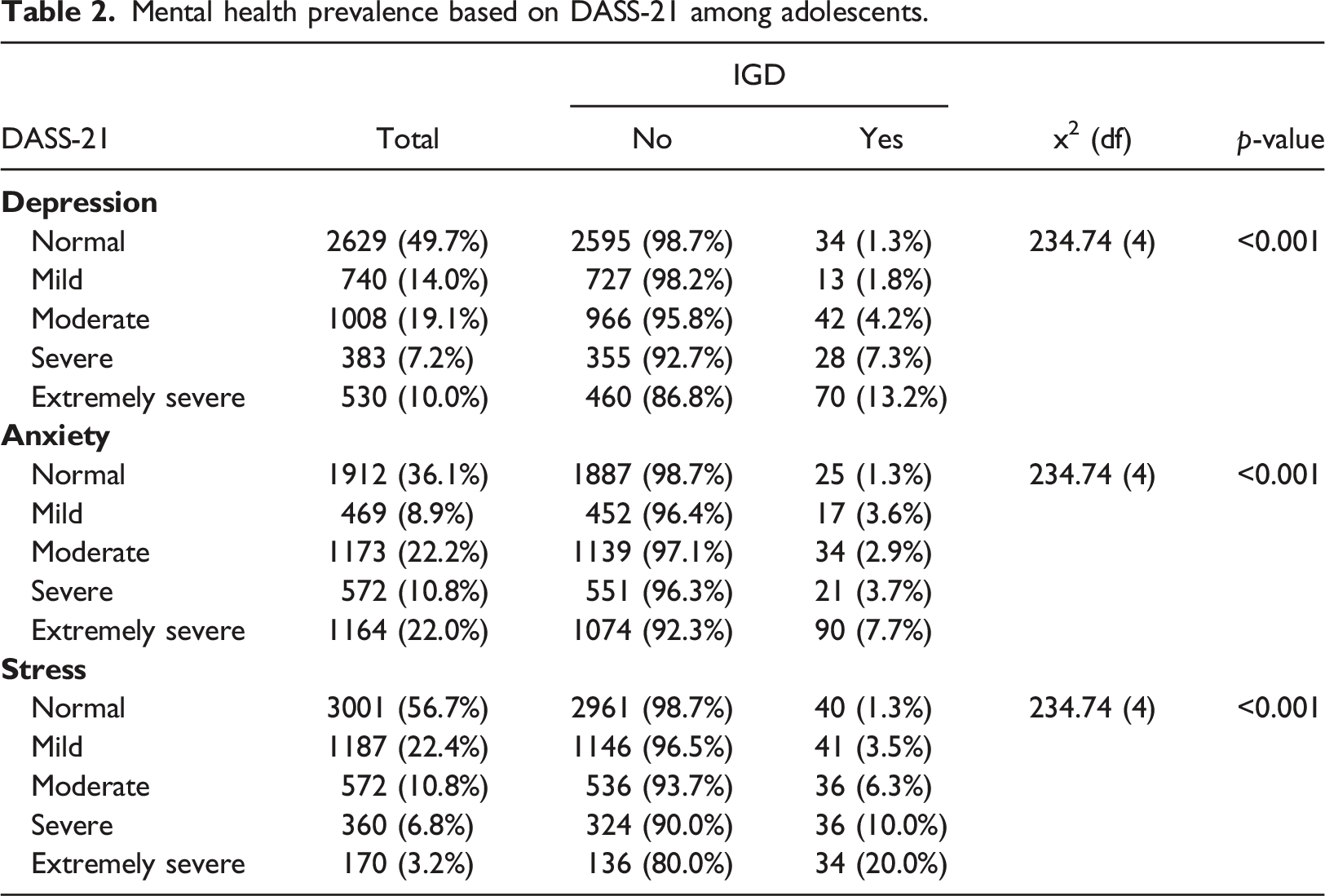
Mental health prevalence based on DASS-21 among adolescents.
Associated factors of IGD among adolescents in Malaysia
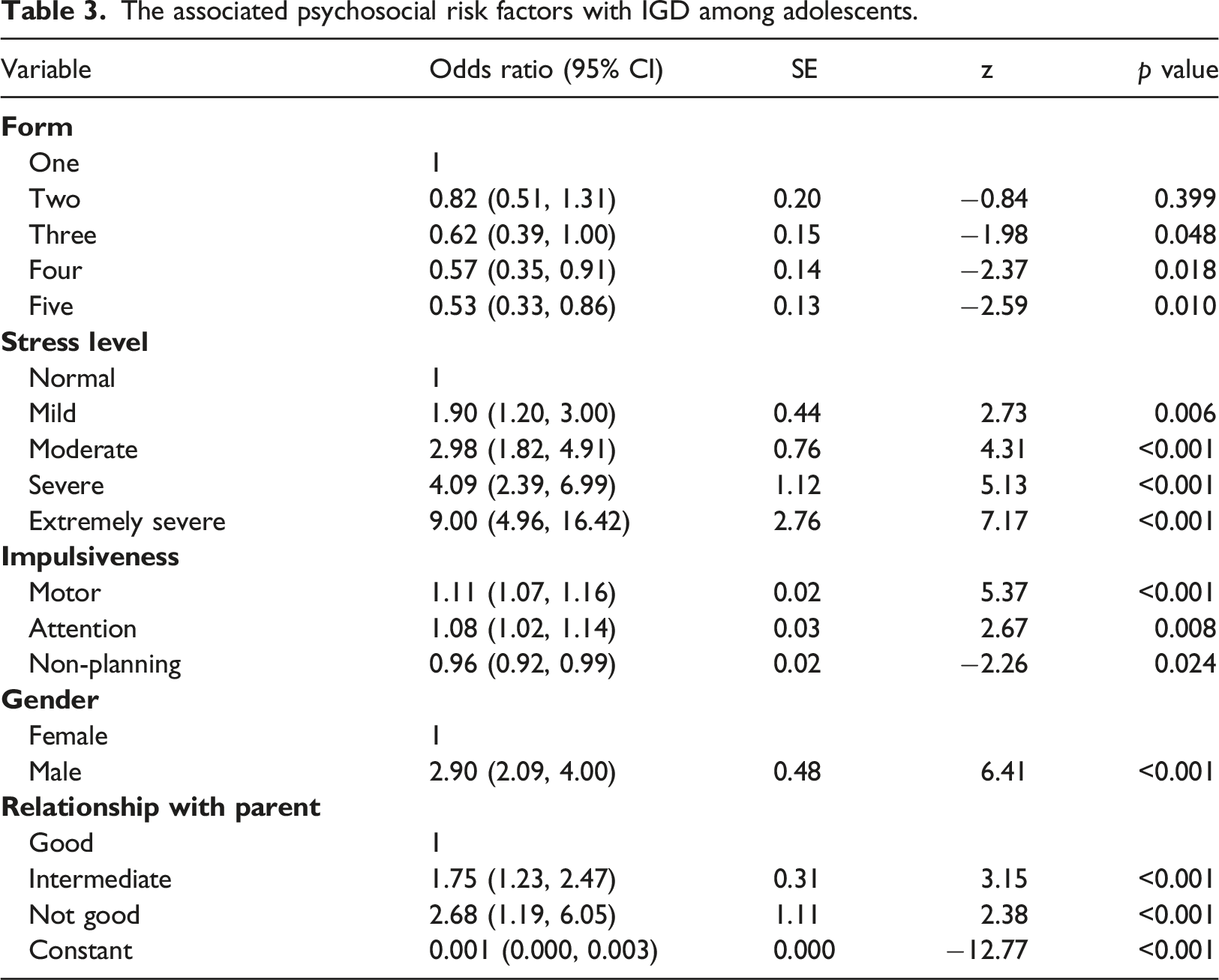
The associated psychosocial risk factors with IGD among adolescents.
Discussion
In the present study, self-report measures were administered to 5290 secondary school students across seven states in Malaysia namely Sarawak, Johor, Kelantan, Selangor, Perak, Kedah, and Kuala Lumpur to examine the association between mental health, impulsivity, and socio-demographic factors among adolescents with IGD. The findings obtained from bivariate analysis of chi-square revealed that there was a significant relationship between mental health (depression, anxiety, and stress) with IGD (X2 (4) = 237.74, p = < .001). Apart from that, the current study also reported that other variables have significant relationships with IGD including gender, time spent using the internet during schooldays and weekends, as well as relationships with parents and friends.
By using IGDS9-SF, descriptive statistics of the present study revealed that the prevalence of IGD among 5290 adolescents in Malaysian secondary schools was 3.5%. Similarly, the prevalence of IGD among adolescents from German (Wartberg et al., 2020) and India (Undavalli et al., 2020) were 3.5%. Interestingly, the prevalence is considered low as compared to the prevalence of IGD among adolescents in Thailand at 5.4% (Taechoyotin et al., 2020), China at 13.0% (Yang et al., 2020), Saudi Arabia at 29.3% (Alfaifi et al., 2022), and global prevalence which is 8.8% (Gao et al., 2022). Furthermore, in this study, the psychosocial model generated from logistic regression analysis has identified that factors such as stress, impulsiveness, year of study, gender, and relationship with parents were associated significantly with adolescents with IGD. In specific, factors such as stress, gender, and relationship with parents are mentioned the same as in the studies in Thailand (Taechoyotin et al., 2020), and China (Wu et al., 2022). However, risk factors such as mental health and impulsivity remained unexplored, particularly in Malaysian samples.
Zul Kamal and Wok (2020) reported a significant relationship between mental health and IGD among adult university students at a public university in Malaysia. Similarly, our findings in this study indicate that adolescents with IGD are nine times more likely to be associated with an extremely severe level of stress (but not anxiety and depression), as compared to non-IGD adolescents. These findings were corroborated by Yen et al. (2019), who contended that psychosocial problems and stress among individuals with IGD may not be resolved through gaming, but inversely, psychosocial distress was exhibited due to excessive gaming. Furthermore, a substantial body of research has demonstrated that internet gaming addiction was found to be associated with poor mental health conditions (Hu et al., 2017; Karunanayake et al., 2020; Sugaya et al., 2019; TL et al., 2020).
Impulsiveness was also significantly associated with IGD among adolescents in Malaysia. In agreement with these findings, a similar association was found in both adults with IGD (Ryu et al., 2018; Sariyska et al., 2017; Yan et al., 2021) and also adolescents with IGD (Tian et al., 2018; L. Wang et al., 2020; Yu et al., 2021). According to (Chung et al., 2021), individuals with IGD appeared to be more impulsive when making risky choices, especially when the rewards were anticipated. Hence, understanding the behavioral mechanism behind IGD such as identifying impulsiveness criteria in the adolescent with IGD is crucial because it may help in making the right diagnosis and planning effective behavioral interventions (Yu et al., 2021).
The risk of IGD appears to be highest in adolescent males, according to the DSM-5 Text Revised version (American Psychiatric Association, 2022), and the current study revealed that male gender is a significant associative factor with IGD. Previous studies also demonstrated an association between IGD and male adolescents (Alfaifi et al., 2022; Fam, 2018; Wartberg et al., 2019). However, according to Wu et al. (2022), the psychological vulnerability of female students in developing IGD should not be disregarded, given their higher levels of psychological distress and lower levels of mindful traits. Therefore, both sexes should be included in school-based prevention initiatives, and if sex-based segmentation is used, special consideration should be given to the effects of those sex-specific risk/protective factors (Wu et al., 2022).
In the current study, the adolescents' relationship with their parents was suggested to affect their risk of developing IGD. This is supported by findings and arguments reported by Wartberg et al. (2017) which interpreted that adolescents’ IGD may be seen as an effort to deal with their mental health issues or to make up for poor relationships with their parents. In addition, findings from the current study also revealed that relationships with friends are significantly associated with IGD among adolescents. According to Yang et al. (2020), peer influences play a significant role in shaping adolescent health-risk behaviors. Similarly, Long et al. (2018) identified that relationships with peers, including deviant peer affiliation, the proportion of gamers in friends' networks, and peer support, are strongly related to IGD. Therefore, adolescents’ problematic or low-quality of relationships with parents and friends were identified as significant risk factors for IGD.
The strengths of the current study were the large sample size and generalization of the sample which is adolescents in Malaysia, and this is the first study to observe variables discussed in the article. Besides, the current study also fulfilled the research gap addressed by Hanisshya et al. (2018), where a reference model of the internet addictive behavior should be developed to provide guidelines for the health care provider working with children and adolescents specifically in Malaysia. One of the major limitations of any online self-administered survey would be that participants may not exactly portray their honest answers in the survey, despite the anonymity being concealed. Other potential factors that were not investigated in this study are the personality traits such as neuroticism, sensation seeking, and trait or state anxiety. These factors were reported as significant factors that are associated with internet gaming addiction (Hu et al., 2017; Mehroof & Griffiths, 2010) and could be the key factors in managing IGD. Apart from that, Teng et al. (2021) argued that during the COVID-19 phases (April to May 2020), adolescents in their study reported significantly higher use of video games and IGD severity compared to the pre-pandemic phase (October to November 2019), as they cope with pandemic-related stress and mental health burden. Hence, the COVID-19 pandemic could be included as a potential confounding variable of this study. Teng et al. (2021) also suggested that adolescents, specifically, should be the targeted preventive initiatives to prevent addiction disorders related to technology usage. Future studies could also consider exploring the risk factors for IGD from the perspective of the parents using the qualitative method.
Conclusions
In conclusion, this is the first wide-scale study on IGD among adolescents in Malaysian secondary schools, and the results indicate the 3.5% prevalence of Internet Gaming Disorders among Malaysian adolescents. Psychosocial risk factors such as mental health (high-stress level) and impulsiveness trait behavior should be considered as important factors in designing effective interventions for adolescents with IGD in Malaysia; besides known psychosocial factors such as gender, and relationship with parents and friends. Integrating these risk factors as part of the intervention strategy may result in promising outcomes.
Footnotes
Acknowledgements
Wewould like to thank all participants and everyone who has contributed to this research. A warm appreciation to Izatul Farhana Mohd Senari, Syaza Aina Md Sabri, Muhammad Faiq Azman, and Iman Farhana Mohd Fadzil Muin for their notable contribution and commitments. In addition, the authors want to thank the journal’s editors and reviewers for their contribution to the revision of the paper.
Declaration of conflicting interests
The author(s) declared no potential conflicts of interest with respect to the research, authorship, and/or publication of this article.
Funding
The author(s) disclosed receipt of the following financial support for the research, authorship, and/or publication of this article: This research was funded by Universiti Pendidikan Sultan Idris, under the grant titled “Geran Penyelidikan Universiti Fundamental (GPUF) 2020”, grant number 2020-0171-106-01.
Ethical approval
The study was approved by the Universiti Pendidikan Sultan Idris’s Human Research Ethics Committee (approval code: 2020-0152-01), Malaysia’s Ministry of Education (reference code: KPM.600-3/2/3-eras (8955)), State Education Office in Kuala Lumpur (reference code: JPWKL.600-9/1/5 (11)); Kelantan (reference code: JPKn/SPS/.100-1/25.Jld 1 (77)); Perak (reference code: JPNPk.SPS.SMT6.600-1 (97)); Kedah (reference code: JPK.SPS.KAJ.100-1/9/1 (20)); Johor (reference code: JPNJ.PS.600-1/1/2 Jld 6 (6)); and Sarawak (reference code: JPNSW.SKPP.LAT.600-1/1/1 Jld.9 (34)).
