






Abstract
Background
Current theoretical models emphasize sadness as a functional and multifaceted emotion, yet research often neglects the heterogeneity of children’s co-occurring emotional responses to sad events.
Aim
This study investigated the heterogeneity in children’s emotional responses to sad events, moving beyond variable-centered approaches that assume uniform emotionality.
Method
Using a person-centered approach grounded in the core affect framework, the primary aim was to identify distinct configurations of sadness, anger, fear, and confusion in middle childhood. A secondary aim explored whether mother’s and father’s attachment security and loneliness predicted membership in emotional profiles. A total of 174 children (age range: 7–11 years-old; M = 8.79, SD = 1.03; 55.9% female) participated.
Results
Latent Profile Analysis identified four distinct profiles: Sadness-Focused Response, Anxious Sadness, Emotional Overwhelming, and Externalized Sadness. ANOVAs revealed that sadness-focused profile showed higher loneliness than Emotional Overwhelming. Furthermore, Externalized Sadness showed lower attachment security for both mother and father than Sadness-Focused Response and Anxious Sadness.
Conclusion
These findings underscore that sad events elicit qualitatively different emotional configurations, highlighting the need for tailored assessment and intervention strategies based on distinct emotional response patterns.
Plain Language Summary
Sadness is a normal part of growing up, but not every child experiences it the same way. While many think of sadness as a single feeling, it often mixes with other emotions like anger or fear. Researchers wanted to understand these different emotional “mixtures” in children because traditional studies often assume everyone reacts similarly. The research involved 174 children between the ages of 7 and 11 from schools in Italy. Each child was asked to describe a recent event that made them feel very sad. They then rated how much sadness, anger, fear, and confusion they felt during that event. The children also completed surveys about their relationships with their parents and how often they felt lonely. The study discovered four distinct ways children react to sad events: sadness-focused, the most common and “balanced” response, where children felt mostly sad but did not feel much anger, fear, or confusion; anxious sadness, in which children felt both sad and very fearful, seeing the event as threatening; emotional overwhelming, in which children felt high levels of anger, fear, and confusion all at once, making it hard for them to even identify their sadness; externalized sadness, in which instead of feeling sad, children reacted primarily with anger. The study also found that the type of sad event (like an injury or a fight with a friend) didn’t determine which group a child fell into. Instead, their personal relationships mattered more. For example, children who felt lonelier were more likely to feel “overwhelmed” rather than just “sad.” Children who felt very secure with their parents were much less likely to react with anger. These results show that sadness is not the same for everyone. A child’s emotional reaction depends heavily on their personal sense of security and social connection rather than just the event itself.
Introduction
Sadness is a fundamental emotional experience and a normative response to situations involving loss, separation, frustration, or unmet expectations (Saija, Pallini, Baiocco, & Ioverno, 2025, 2026; Verduyn et al., 2020). In childhood, sadness plays a crucial adaptive role, contributing to the development of emotional understanding, moral development, and social functioning (Karnaze & Levine, 2018; Lomas, 2018; Song et al., 2018). Rather than representing merely a negative or maladaptive state, sadness may foster reflective processing, empathy toward others’ suffering, and prosocial motivation, particularly when experienced within supportive relational contexts (Miller et al., 2016; Saija et al., 2024; Tuck et al., 2017). Often, sadness has been conceptualized primarily as a cue or precursor of depressive symptomatology (Kovacs et al., 2016; Zeman et al., 2001). However, several scholars have emphasized the conceptual and empirical distinction between normative sadness and depression (Arias et al., 2020; Horwitz & Wakefield, 2007; Saija et al., 2024). Sadness is typically context-dependent and time-limited, whereas depression is characterized by persistence, pervasiveness, and functional impairment (Leventhal, 2008). Overlapping these constructs risk obscuring the functional role of sadness in development and may lead to the over-pathologization of children’s emotional experiences.
Middle childhood represents a particularly salient developmental period for the study of sadness. During this phase, children acquire more sophisticated cognitive and linguistic abilities that allow them to identify, label, and report emotions with increasing accuracy, while regulatory capacities are still consolidating (Thompson, 2015). As a result, in middle-childhood sadness is rarely experienced solely but is often embedded within complex emotional episodes that include co-occurring emotions such as anger, fear, or confusion (Zeman et al., 2002, 2019). Understanding how children experience sadness in combination with other emotions is therefore essential for capturing its developmental meaning.
Discrete Emotion Perspectives
Although sadness is prototypically associated with experiences of loss or separation, sad events may elicit a wide range of affective responses in children (Stylianou & Zembylas, 2018). Painful events often give rise to differentiated configurations of co-occurring emotional states. Sadness may be accompanied by varying degrees of emotional activation or deactivation, depending on how the event is appraised, on the child’s regulatory capacities and individual differences, and on the relational context in which it occurs, as well as by different intensities of affective unpleasantness (Arias et al., 2020; Kreibig, 2010; Saija, Pallini, Lonigro, & Baiocco, 2025).
The conceptualization of children’s responses to sad events in terms of affective patterns, rather than isolated emotions, allows for a more fine-grained understanding of the developmental complexity of sadness and provides a theoretical rationale for person-centered analytic approaches (Saija et al., 2023). To address this complexity, the present study adopts the core affect framework proposed by Russell (2003). Core affect represents a basic, neurophysiological state that is always accessible to consciousness and serves as the experiential substrate upon which discrete emotions are constructed through cognitive appraisal and contextual interpretation (Barrett, 2017; Posner et al., 2005; Russell, 2003). Within the valence-arousal space, responses to sad events may occupy distinct regions, and affective experiences situate along two fundamental and continuous dimensions: valence (pleasure-displeasure) and arousal (activation-deactivation).
Within this framework, sadness is typically located in the unpleasant-low arousal quadrant, distinguishing it from high-arousal negative emotions such as anger or fear (Russell & Barrett, 1999). However, for some children, sad events may evoke a predominantly low-arousal, negative-valence state that is relatively circumscribed and reflective; for others, the same type of event may be associated with heightened arousal and the co-activation of emotions such as anger or fear, or with diffuse and poorly differentiated affective states marked by cognitive confusion (Sillars & Davis, 2018).
In the present study, further sadness, also other emotions differentiated in terms of both valence and arousal have been considered. Particularly, fear and anger, which have been classified as threat-related emotions, elicit distinct psychological and physiological profiles that determine individual’s adaptive strategies to danger (Manfredi, 2024; Pichon et al., 2009). Fear typically arises in response to ambiguous, potential danger, characterized by high levels of uncertainty and a perceived lack of control, triggering an avoidance-oriented motivation (Kapucu et al., 2024; Kreibig, 2010). In childhood, fear-related responses are associated with heightened physiological activation and attentional narrowing toward potential sources of danger, and they may co-occur with sadness when loss-related events are appraised as unpredictable or uncontrollable (Compas et al., 2017; Kreibig, 2010). Conversely, anger is mobilized by a direct and often interpersonal threat, resulting in confrontational, aggressive, or obstacle-overcoming behaviors (Peléšková et al., 2024; Pichon et al., 2009). In sad contexts, anger may emerge when children perceive loss or disappointment as unfair, externally caused, or preventable, thereby transforming a primarily deactivating emotional state into a more activated and outwardly directed response.
Although confusion is not a basic emotion, it represents a qualitatively different and more complex emotional experience relative to sadness, fear, and anger, which are commonly conceptualized as basic emotions. From a core affect perspective, confusion may be associated with variable levels of arousal and negative valence, indexing uncertainty and difficulty in meaning-making rather than a specific action tendency (Anninou, 2018; Noordewier & Gocłowska, 2023). Confusion is elicited by cognitive-affective appraisals involving novelty, complexity, ambiguity, or conflict related to sad events, particularly when individuals perceive limited understanding of the situation or uncertainty about how to proceed or when negative events are unexpected, poorly explained, or emotionally overwhelming (Anninou, 2018; Arguel et al., 2019; Vogl et al., 2020). Therefore, confusion is an emotion that can often recur in sad events such as bereavement and specifically it captures not only the affective intensity but also the cognitive complexity involved in processing such experiences (Muis et al., 2018, 2025).
Attachment Security and Loneliness
Attachment theory provides a framework for understanding individual differences in sadness experience and regulation (Bowlby, 1980). Through repeated interactions with caregivers, children develop internal working models concerning the availability and responsiveness of others, which guide emotional expression and coping strategies in times of distress (Cassidy, 1994; Kerns et al., 2007).
Evidence suggests that securely attached children are more likely to acknowledge and express sadness openly, while maintaining the capacity to regulate its intensity and duration (Brumariu et al., 2012; Thompson, 2015). In contrast, insecure attachment has been associated with less adaptive patterns, including the amplification of distress, emotional disorganization, or the displacement of sadness into secondary emotions such as anger or fear (Cassidy & Berlin, 1994; Kobak et al., 2016). Recent works on sadness specifically indicate that attachment security is linked to more integrated and less overwhelming sadness experiences, whereas insecurity may be associated with mixed or poorly differentiated emotional states (Saija et al., 2023; 2025b).
Beyond the caregiving system, peer relationships constitute another crucial relational context influencing sadness (Saija, Pallini, Baiocco, et al., 2025). Loneliness, defined as the subjective perception of social isolation or relational inadequacy (Russell, 1996), has been robustly associated with negative emotional outcomes in childhood, including low levels of happiness, and high levels of anxiety and internalizing difficulties (Asher & Paquette, 2003; Izzo et al., 2024; Li et al., 2024; Qualter et al., 2015). Lonely children often report greater emotional distress following negative events and show reduced access to social resources that could buffer the impact of sadness (Vanhalst et al., 2012). They often display heightened emotional reactivity, difficulty identifying and expressing emotions, and a tendency toward rumination and suppression, which can amplify distress and confusion during sad events, more likely experiencing sadness alongside fear, confusion, and dysregulated anger, rather than sadness alone (Bonvino et al., 2023; Larsen et al., 2020; Marryat et al., 2014; Reitsema et al., 2022; Weissman et al., 2019). Consequently, loneliness would not merely predict higher levels of sadness but would be associated with qualitative differences in emotional experience. Lonely children would report not only higher sadness but also increased emotional variability, instability, and intensity, especially for negative emotions like fear, anger, and anxiety.
The Present Study
The present study grounds in the consideration that sad events may give rise to multiple affective configurations in children. Sadness may be the dominant and relatively circumscribed response, or it may be accompanied by heightened anger, fear, or cognitive confusion, reflecting divergent regulatory strategies and appraisals of the same type of event (Aldao et al., 2016; Reitsema et al., 2022; Zeman et al., 2002).
Although previous research has highlighted the importance of sadness for children’s adjustment and well-being (Saija et al., 2024; 2025a), little is known about how children differ in their emotional configurations in response to sad events. Most existing studies have relied on variable-centered approaches, which implicitly assume homogeneity in emotional responding and may not be considered meaningful subgroups of children who experience sadness mixed with other emotions. To capture the heterogeneity among emotional arousing experiences, Latent Profile Analysis (LPA) is a methodology particularly well-suited to detecting non-uniform patterns of emotional responses across individuals. Using LPA, we examined children’s self-reported experiences of sadness, anger, fear, and confusion in relation to a significant sad event. Grounded in the core affect framework, this approach allows for the identification of distinct emotional response profiles that reflect different modes of sadness processing.
No studies explored sadness in children through the core affect framework using person-centered approaches. Given that, the first aim of the study was to identify discrete profiles of emotional responding to sad events in middle childhood. The second aim was to explore if different profiles vary according to events. The third aim was to investigate whether attachment security and loneliness were associated with profile membership.
We hypothesized that: (a) multiple profiles would emerge, ranging from relatively focused and differentiated sadness to more complex configurations characterized by heightened activation or emotional diffusion; (b) profiles characterized by sadness-focused responses would be associated with higher attachment security and lower loneliness. Conversely, profiles marked by the displacement of sadness into anger or fear were expected to be associated with lower perceived attachment security and higher loneliness. Finally, by examining emotional profiles independently of the objective type of sad event, the study aims to contribute to a more nuanced understanding of sadness as a subjective and relationally embedded emotional experience.
Method
Participants and Procedure
A total of 174 children between 7 and 11 years (M = 8.79, SD = 1.03; 55.9% female) participated in the study. The sample was recruited from four private elementary schools located in a large metropolitan area in Central Italy. The community context is characterized by a densely populated urban environment. Following a convenience sampling approach, schools were selected based on their availability and interest in the research project. Participants were enrolled from the second to fifth grades, an age range specifically chosen to ensure the consolidated literacy skills necessary for autonomous completion of the measures. Regarding the socio-economic status and ethnicity, although specific demographic data were not systematically collected at the individual level, the schools serve a population consisting primarily of middle-class families and reflect the ethnic composition of the local urban district, which is predominantly white. The recruitment process involved a formal invitation sent to the school directors. Once the schools agreed to participate, teachers distributed informative consent to the families. Participation was entirely voluntary, and no incentives or rewards were provided to the children or the schools.
The study protocol received approval from the Ethics Committee of the Roma Tre University. Written informed consent was obtained from parents (or legal guardians), and verbal assent was secured from all children prior to data collection. No specific inclusion or exclusion criteria were applied beyond the grade level and the presence of parental consent. Data were collected between January and April 2022 during regular school hours; children completed the questionnaire battery individually under the supervision of trained researchers. No significant attrition was recorded during the data collection phase.
Measures
Sadness Interview (Saija et al., 2023). Children were interviewed about events that made them feel sad. The experimenter said: “Let’s think about a time recently when you felt very sad and all of the little details you can remember about it. Would you like to describe it in writing?” Children were given a minute to think and then the children described the event in writing. Responses to open and closed questions were transcribed on a spreadsheet. The answers were coded by trained research assistants (first and second authors) into different categories: (a) Coronavirus related events, (b) Parental discord, (c) Imagination (memories of movies or fantasies evoking sad events), (d) Obligations (to do things that are annoying for the children), (e) Peer conflict (which includes bullying and rejection), (f) Mourning and illness, (g) Small accidents, and (h) Reproaches from parents or teachers. These data are already published and discussed in Saija et al. (2023) article.
Discrete Emotions. This scale was adapted from Russell (2003), that assessed core affect. Specifically, participants were asked how much they have felt sadness, anger, fear, and confusion during the events described before, from 1 (Not at all) to 10 (Very much).
Security Scale (Kerns et al., 1996). This scale measures perceptions of communication with, and accessibility and responsiveness of their parents using 30 items, 15 for each parent. The scale used the “some kids/other kids” format (i.e., “Some kids worry that their mom does not really love them while Other kids are really sure that their mom loves them”). Children selected the statement that they felt was most representative of them and subsequently indicated whether the phrase was “really true” or “sort of true” for them. Each item was scored on a scale from 1 to 4, with higher scores indicating greater attachment security. Two dimensions were assessed: mother security (ω = .81) and father security (ω = .82).
Loneliness Scale (Russell, 1996). This scale measures the dimension of loneliness and consists of five items (i.e., “How often do you feel that there is no one you can turn to?”), each rated on a 4-point scale (1 = Never; 4 = Always). In this sample, the scale’s internal consistency is acceptable (ω = .70).
Data Analysis
The analyses performed to test the hypotheses consisted of two steps. Firstly, LPA was conducted using four discrete emotions (sadness, anger, fear, confusion). Previously, z-scores were calculated for each indicator. Then, fit indices of measurement models were examined, incrementally adding classes until empirical under-identification or convergence issues were encountered. LPA was used over traditional clustering algorithms because it is a model-based approach that provides formal fit statistics for selecting the optimal number of profiles, probabilistic class assignments, and reproducible solutions grounded in finite mixture modeling theory. Although a sample size of N ≥500 has been traditionally recommended as a heuristic for mixture models (Finch & Bronk, 2011), simulation research has demonstrated that this threshold is not absolute: the adequacy of a sample depends critically on the quality and separability of the indicators used (Wurpts & Geiser, 2014). Specifically, Wurpts and Geiser (2014) showed that high-quality indicators (defined as those producing well-separated profiles) can compensate for the limitations of smaller samples, and that non-convergence rates with N ≈ 100-200 remain acceptable (below 15%) when indicator quality is high.
To thoroughly explore the underlying data structure and address potential model misspecification, we estimated solutions from one to six latent profiles across four different specifications typology: (a) Model 1: Equal variances and covariances fixed to 0 across profiles; (b) Model 2: Varying variances and covariances fixed to 0 across profiles; (c) Model 3: Equal variances and equal covariances across profiles; (d) Model 6: Varying variances and varying covariances across profiles (Rosenberg et al., 2018). Measurement models were examined by incrementally adding classes until empirical under-identification, degeneracy, or convergence issues were encountered.
The optimal model was selected based on relative fit indices, assessed using both descriptive measures and statistical tests. The descriptive measures included five information criteria (IC): the Akaike Information Criterion (AIC), the Consistent Akaike Information Criterion (CAIC), the Approximate Weight of Evidence (AWE), the Bayesian Information Criterion (BIC), and the Sample-size Adjusted Bayesian Information Criterion (ssBIC). Lower IC values indicate better model fit. BIC is useful for estimating the Schwarz Information Criterion (SIC), which serves as the basis for two additional descriptive measures of relative fit: the Approximate Bayes Factor (BF) and the Approximate Correct Model Probability (cmP). The BF compares two adjacent models (k and k+1), with the best model being the more parsimonious k-class model if BF >3. The cmP compares all models with any model having a cmP >.10 considered a candidate model; however, the best model is the one with the highest cmP value. Further, the inferential tests used to assess relative fit indices were the Bootstrapped Likelihood Ratio Test (BLRT), where a statistically significant p-value suggests that the k-class model fits the data significantly better; otherwise, the (k-1)-class model is preferred according to the parsimony criterion. Once the optimal model was selected, the classification quality was assessed (Masyn, 2013). Entropy (E) values closer to 1 indicate better classification accuracy, with value above .80 considered acceptable. Additional indicators considered included class proportion (CP or π), average posterior probability (avePP), and odds of correct classification (OCC), where avePP values are ≥.70, and OCC values exceed 5 (Masyn, 2013; Nagin, 2005; Nylund et al., 2007; Sorgente et al., 2019). Last, through chi-square we tested the association between sad events and profile membership, and through two separate ANOVAs we tested how mother security, father security and loneliness differ among profiles. LPA was performed using R, specifically tidyLPA package for the main analysis and mclust package for the BLRT. Chi-square and one-way ANOVAs were performed using jamovi.
Results
We estimated latent profile models from 1 to 6 profiles across Models 1, 2, 3, and 6. However, severe estimation and convergence issues emerged for the more complex parameterizations, consistent with the known limitations of estimating fluid covariance structures in small-to-medium samples. Specifically, Models 2 and 6 (which allow variances to vary freely across profiles) failed to converge for any solution beyond a single class due to the substantial increase in freely estimated variance parameters relative to the sample size. Model 3 (equal variances, equal covariances) successfully converged for the three-profile solutions; however, the two-profile solution was degenerate (BLRT p = 1.00, Entropy = .502), and the three-profile solution exhibited clear signs of model degeneracy (avePP = 1.000, OCC >10^8) attributable to an insufficient sample size to support freely estimated covariances. In contrast, Model 1 (equal variances, zero covariances across profiles) converged successfully across all profile solutions (1 through 6). Consequently, Model 1 results were selected as the only psychometrically stable framework for formal model selection.
Relative Model Fit Indices for Six Latent Profile Models
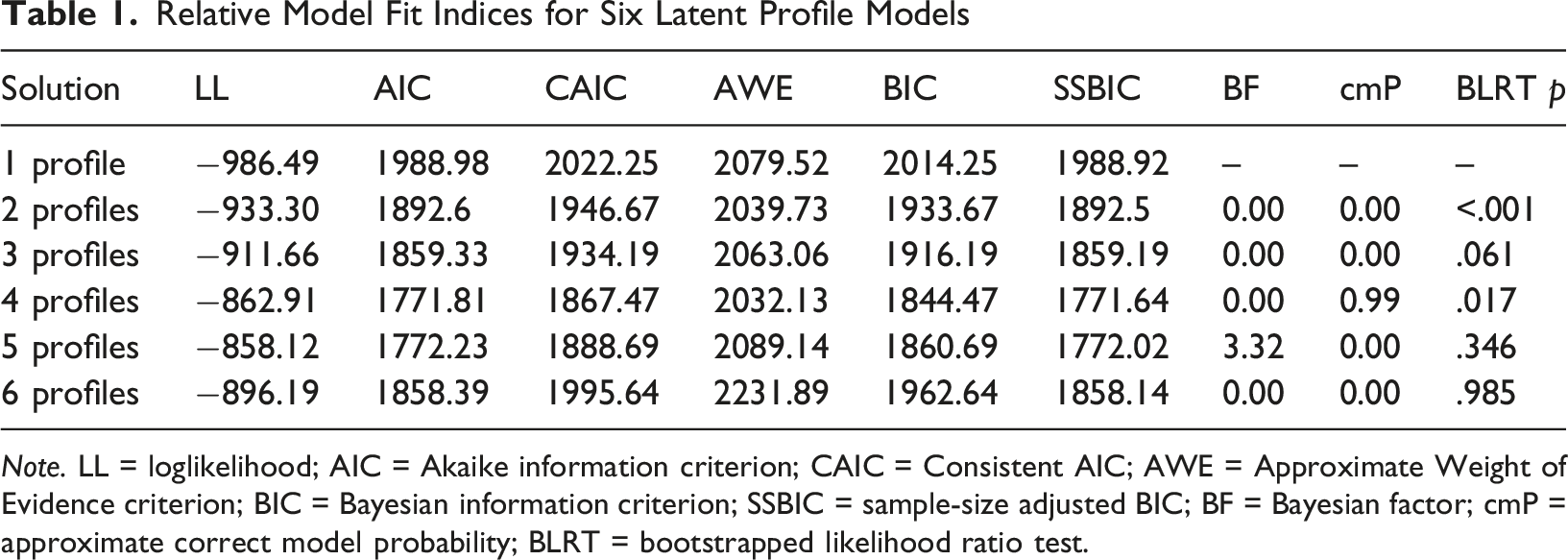
Note. LL = loglikelihood; AIC = Akaike information criterion; CAIC = Consistent AIC; AWE = Approximate Weight of Evidence criterion; BIC = Bayesian information criterion; SSBIC = sample-size adjusted BIC; BF = Bayesian factor; cmP = approximate correct model probability; BLRT = bootstrapped likelihood ratio test.
Classification Diagnostics for the Three-Class and 4-Profile Model
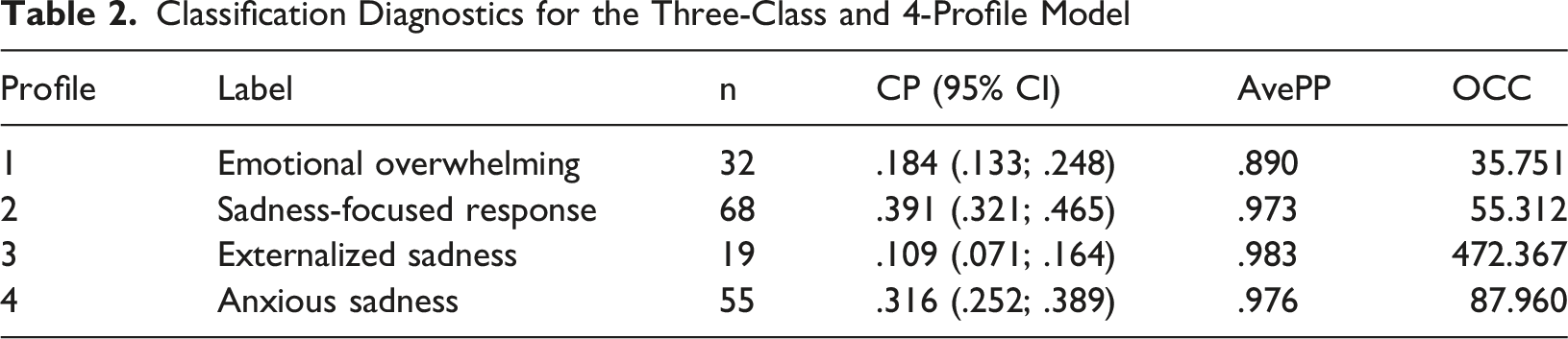
Examination of standardized emotion scores revealed four qualitatively distinct patterns of emotional responding to sad events (see Figure 1). Profile 1, labeled Emotional Overwhelming (n = 32, 18.4%), was characterized by high and concurrent levels of anger, fear, and confusion, in the absence of a clearly dominant experience of sadness, suggesting a broadly heightened emotional response in which discrete emotions are insufficiently differentiated. Rather than reflecting sadness as a focal affective state, the emotional response appears diffuse and overwhelming, indicating difficulties in parsing and organizing internal affective experiences, reflecting limited access to regulatory resources and challenges in integrating emotional information at a cognitive–representational level. Representation of the four sadness core profile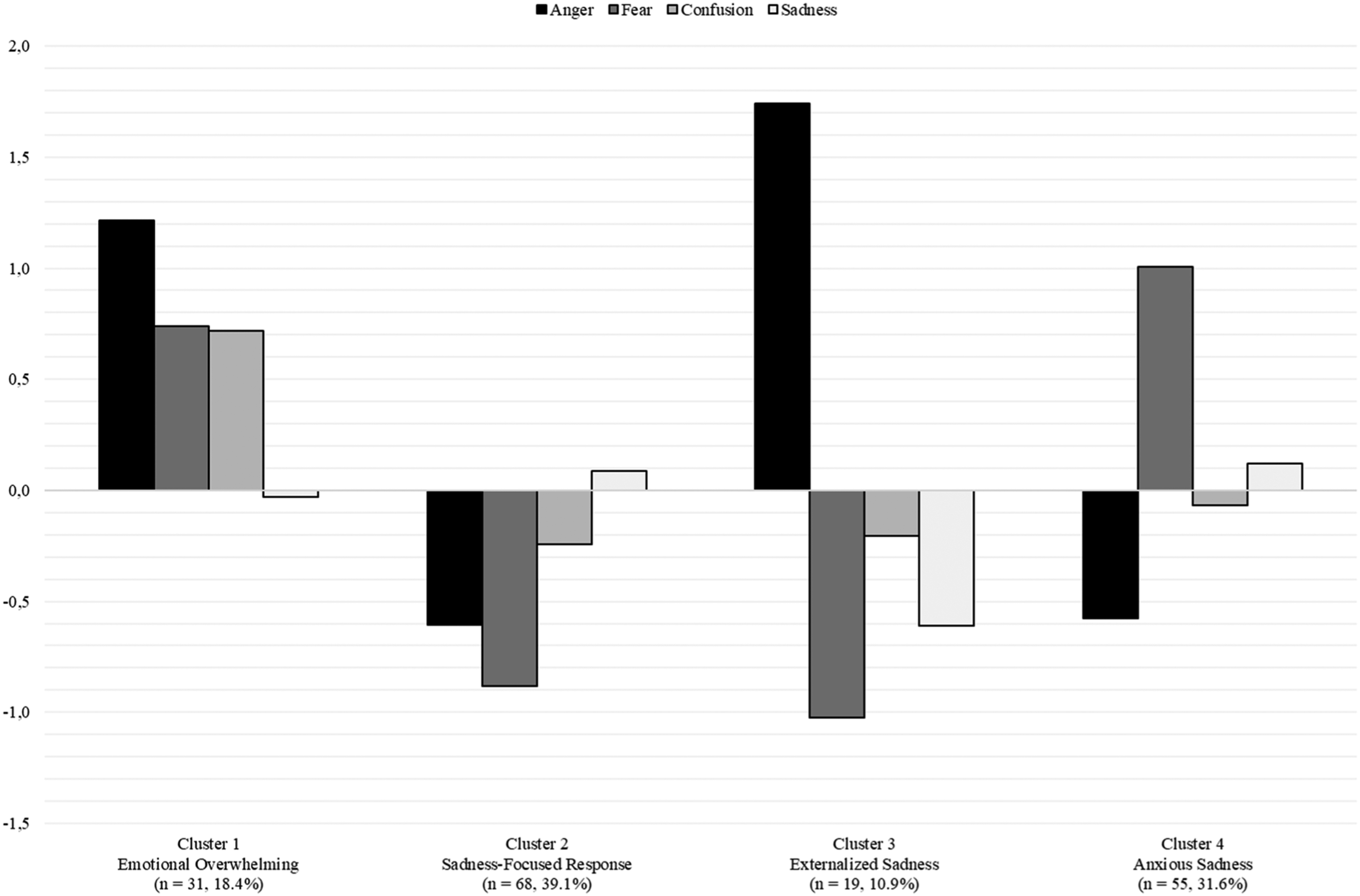
Profile 2, labeled Sadness-Focused Response (n = 68, 39.1%), exhibited the most delimited emotional response, marked by modest elevations in sadness accompanied by low levels of anger, fear, and confusion. Sadness is acknowledged without substantial interference from other negative emotional states, showing the capacity to identify and tolerate sadness while maintaining emotional equilibrium. Overall, this pattern represents the most regulated and developmentally normative response within the sample.
Profile 3, labeled Externalized Sadness (n = 19, 10.9%), displayed a different configuration, with pronounced elevation in anger alongside markedly reduced levels of sadness and fear, and confusion quite absent. The emotional profile suggests that distress associated with the sad event is expressed primarily through outward-directed affect, with anger functioning as the salient emotional response. The relative absence of sadness may indicate that vulnerability related emotions are minimized or displaced, giving way to a more activating and action-oriented affective state.
Profile 4, labeled Anxious Sadness (n = 55, 31.6%), was distinguished by elevated fear co-occurring with moderate sadness. Both anger and confusion were reduced relative to other profiles. This emotional configuration indicates that the sad event is experienced not only as a loss or disappointment but also as threatening or destabilizing. The prominence of fear suggests heightened sensitivity to uncertainty or perceived danger, with emotional processing oriented toward vigilance and anticipatory concern, reflecting an internalizing pattern in which sadness is accompanied by anxiety, potentially associated with increased emotional reactivity to perceived environmental unpredictability.
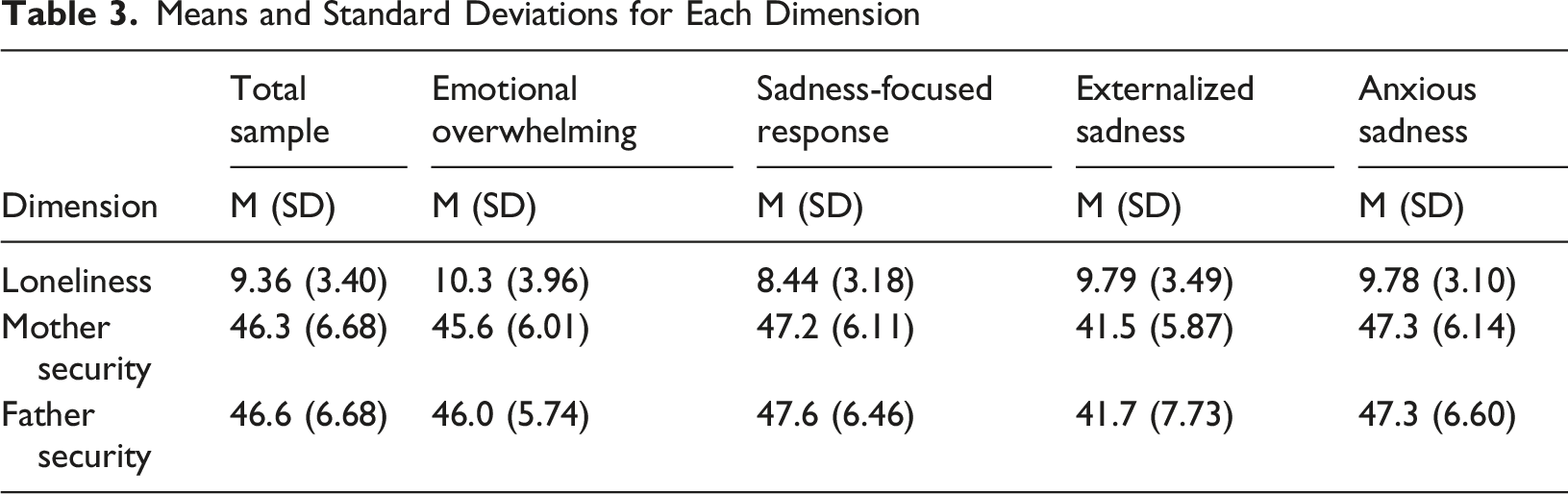
Means and Standard Deviations for Each Dimension
Tukey Post-Hoc Tests
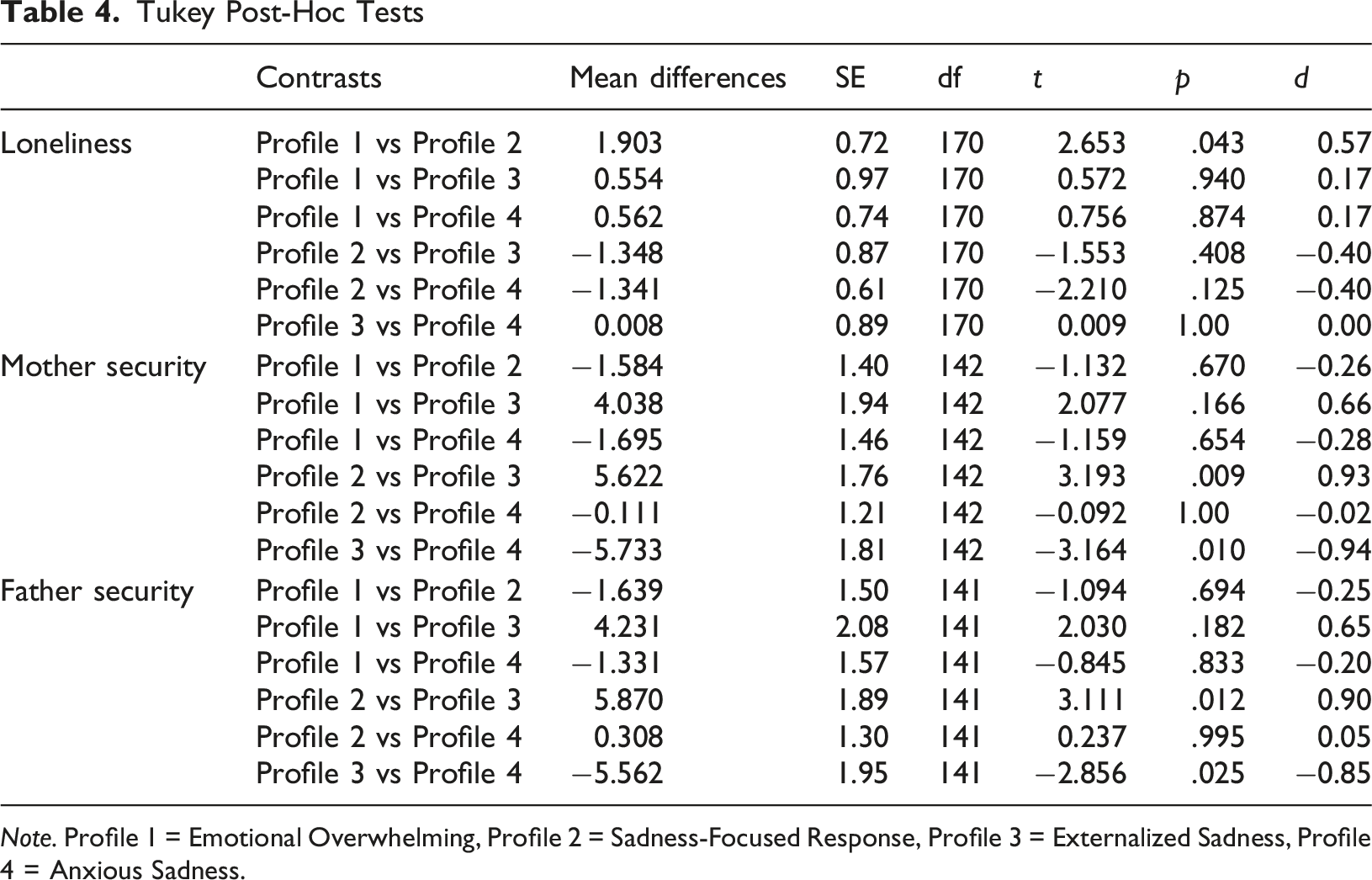
Note. Profile 1 = Emotional Overwhelming, Profile 2 = Sadness-Focused Response, Profile 3 = Externalized Sadness, Profile 4 = Anxious Sadness.
Discussion
Consistent with our first hypothesis, four profiles were identified, ranging from focused and differentiated sadness to more complex configurations characterized by heightened activation or emotional diffusion. The identification of four distinct emotional profiles provides empirical support for the conceptualization of sadness as a heterogeneous phenomenon. Rather than eliciting a uniform affective response, sad events in middle childhood have been found give rise to qualitatively different emotional configurations that are differently related to attachment security and loneliness (Aldao et al., 2016; Reitsema et al., 2022).
Children in the sadness-focused response profile appear capable of acknowledging and tolerating sadness without substantial interference from other negative emotional states. It can be speculated that this profile could be characterized by regulatory resources and a coherent cognitive-affective appraisal of the loss-related event (Saija et al., 2024). From a core affect perspective, this configuration occupies the unpleasant-low arousal quadrant, aligning with prototypical descriptions of sadness as a deactivating emotion that facilitates withdrawal, reflection, and internal processing (Kreibig, 2010; Russell & Barrett, 1999). This profile is prevalent within the sample indicates that, for a substantial proportion of children, sadness retains its adaptive, circumscribed quality even in the face of distressing life events.
Children in the anxious sadness profile show that sad events were experienced not only as losses but also as threatening or destabilizing (Compas et al., 2017). The prominence of fear suggests a style of emotional processing oriented toward vigilance and anticipatory concern rather than sadness feelings (Kapucu et al., 2024). This configuration reflects an internalizing pattern consistent with models of anxiety-related affect in childhood, wherein negative events are appraised as unpredictable and potentially dangerous (Sillars & Davis, 2018).
Children in the emotional overwhelming profile show a diffuse and undifferentiated affective state, suggesting that children experienced sad events as overwhelming and cognitively disorganizing (Anninou, 2018; Noordewier & Gocłowska, 2023). Rather than reflecting a focused emotional response to loss, the profile could be associated with difficulties in parsing discrete emotional experiences and consequently, a difficulty in the organization of affective information at a representational level (Farb et al., 2010). Such patterns could be consistent with models of emotional dysregulation in which heightened arousal and poor emotion differentiation interfere with adaptive coping (Lennarz et al., 2018). Children experiencing Emotional Overwhelming would perceive sad events as novel, ambiguous, or inconsistent with their existing understanding, thereby triggering ruminative and self-focused processing that overwhelms cognitive resources, that could scaffold emotional processing (Vogl et al., 2020).
Children in the externalized sadness profile show that distress associated with sad events is channeled into outward-directed affect, with anger functioning as the dominant emotional response (Peléšková et al., 2024; Pichon et al., 2009). It could be speculated that the dominance of the anger on sadness fear, and confusion may indicate defensive processes in which vulnerability related emotions are minimized or displaced, giving way to a more activating and action-oriented affective state (Cassidy & Berlin, 1994; Kobak et al., 2016). This pattern would align with developmental models in which expressions of distress are transformed into externalizing emotional responses, potentially as a strategy to maintain perceived control or avoid the experience of helplessness associated with loss (Kapucu et al., 2024). From a core affect perspective, anger is characterized by high arousal and approach motivation, fundamentally diverging from the deactivating quality of prototypical sadness (Kreibig, 2010; Russell & Barrett, 1999). The transformation of a loss-related event into an anger-dominant response may reflect the perception of unfair treatment or external causation, whereby children attribute the sad event to blameworthy factors out of their control. Such appraisals shift the emotional experience from internal reflection and withdrawal toward confrontation and obstacle-directed behavior.
Regarding the second aim of the study, no significant association between the type of sad event and profile membership has been found. This finding would suggest that the observed emotional profiles were not primarily determined by the objective characteristics of the sad event but rather by individual differences in how such events are subjectively appraised and processed, consistently with recent work emphasizing the subjective and relationally embedded nature of sadness experiences in childhood (Saija et al., 2023). Although appraisal theories traditionally posit that specific situational features elicit corresponding emotional responses (Lazarus, 1991), the absence of event-type effects in the present study underscores the importance of individual regulatory capacities, cognitive schemas, and relational histories in shaping emotional outcomes. Similar types of sad events can give rise to markedly different emotional configurations across children. It is plausible that factors such as prior experiences with loss, family emotional socialization practices, and broader contextual variables contribute more substantially to emotional responding than the specific category of sad event encountered (Thompson, 2015; Zeman et al., 2019). Future research with larger samples would benefit from more fine-grained assessments of situational appraisals, including perceived controllability, predictability, and social context, to better understand the mechanisms linking objective events to subjective emotional experiences.
In partial support of our third aim, profiles were differently associated with mothers’ and fathers’ attachment security and loneliness. Children in emotional overwhelming profile reporting higher levels of loneliness than children who belong to the sadness-focused response profile. This finding suggests that perceived social isolation would be associated with a diffuse and overwhelming emotional responses to sad events, consistent with theoretical models proposing that peer relationships are related to the ability to experience focused and regulated sadness during emotional distress (Asher & Paquette, 2003; Butler et al., 2022; Glickman et al., 2021; Qashmer, 2023; Qualter et al., 2015). Children who do not perceive themselves as lonely may access the social support systems that typically buffer the impact of negative events and facilitate adaptive emotional processing (Vanhalst et al., 2012). In the absence of supportive peer relationships, sad events would be experienced as more emotionally disorganizing and overwhelming, as children have fewer external resources to scaffold meaning-making and emotional regulation (Zeman et al., 2019). The association between loneliness and emotional overwhelming suggests that socially isolated children may be at heightened risk for experiencing a poorly differentiated and difficult to manage sadness, potentially contributing to longer-term internalizing difficulties (Vanhalst et al., 2012).
However, contrary to our hypothesis, higher levels of loneliness was not associated with the anxious sadness or externalized sadness profiles than to sadness-focused response profile. It is plausible that the relationship between loneliness and emotional responding is moderated by additional factors such as temperament, coping strategies, or the specific quality of peer relationships, and future studies could observe this phenomenon.
Consistent with attachment theory and prior empirical work, the present study found that mothers’ and fathers’ attachment security was significantly associated with profile membership. Specifically, sadness-focused response and anxious sadness profiles showed higher attachment security for both mother and father than externalized sadness profile. This pattern suggests that children with low levels of secure attachment are more prone to be characterized by anger-dominant responses during sad events. These findings align with theoretical models proposing that insecurely attached children, who have experienced inconsistent or rejecting responses to emotional expressions may learn to suppress sadness and instead express distress through anger (Brumariu, 2015; Brumariu et al., 2012; Brumariu & Kerns, 2010; Cassidy, 1994). The displacement of sadness into anger serves a defensive function, protecting the children to perceive themselves vulnerable while maintaining a sense of agency and control (Cassidy, 1994). The finding that attachment security specifically differentiates externalized sadness from other profiles underscores the relevance of caregiving quality for the development of externalizing emotional responses. Attachment relationships serve as the primary context through which children learn which emotions are acceptable to express and how to modulate emotional intensity in accordance with relational expectations (Kerns et al., 2007).
Contrary to our hypothesis, sadness-focused response did not show higher security than to the emotional overwhelming and anxious sadness profiles. This unexpected finding may reflect the complexity of secure attachment manifestations in emotional responding. While secure attachment is theoretically associated with the capacity to acknowledge and regulate sadness effectively, it is possible that contextual factors, peer relationships, or other unmeasured variables contribute substantially to the emotional overwhelming or anxious sadness (Cassidy, 1994; Saija et al., 2024, 2025a; Thompson, 2015; Ştefan et al., 2017). Alternatively, the emotional overwhelming and anxious sadness profiles may reflect distinct pathways of emotional processing that are differentially influenced by attachment-related factors not fully captured by the global security measure employed in this study.
Limitations and Future Directions
Several limitations must be acknowledged in interpreting the present findings. First, the sample size was relatively modest and drawn from a specific demographic context. Berlin et al. (2014) noted that “small samples can be sufficient depending on several factors such as model complexity and missing data” (p. 175) and that the critical factor determining class recovery accuracy is class separation rather than sample size per se. In the present study, the 4-profile LPA solution yielded high classification accuracy (Entropy = .930; AvePP = .89–.98; OCC = 35.75–472.37), providing empirical evidence of strong profile separation consistent with the conditions under which reduced sample sizes have been shown to produce reliable solutions (Berlin et al., 2014; Wurpts & Geiser, 2014). Despite indices supporting the validity of this profile solution, replication in larger and more diverse samples is necessary to confirm the stability and generalizability of the identified profiles.
Second, the cross-sectional design precludes causal inferences regarding the directionality of associations between relational factors and emotional profiles. Longitudinal research is needed to examine whether attachment security and loneliness prospectively predict changes in emotional responding over time or whether bidirectional influences are operating. Third, the study relied exclusively on self-report measures, which may be subject to social desirability biases or developmental limitations in emotional awareness and articulation. Future research would benefit from multi-method approaches incorporating observational, physiological, and caregiver-report data to triangulate findings and capture emotional processes that may not be fully accessible through self-report alone.
Moreover, examination of specific attachment dimensions, such as avoidant and anxious attachment patterns separately, may yield more differentiated predictions regarding emotional response profiles than global security measures. Finally, the present study focused exclusively on children’s retrospective reports of discrete emotions following sad events. Future research should examine real-time emotional dynamics using experience sampling or ecological momentary assessment methods to capture the temporal unfolding of emotional responses and potential fluctuations between different affective states within the same individual over time.
Despite these limitations, the present findings have important implications for understanding sadness as a developmentally heterogeneous phenomenon. The identification of distinct emotional response profiles challenges the assumption that sad events uniformly elicit sadness as a discrete, isolated emotion in childhood. Instead, the results support a more nuanced view in which sad events give rise to qualitatively different configurations of co-occurring emotions that reflect meaningful individual differences in regulatory capacities, appraisal processes, and relational contexts.
From a practical standpoint, the findings highlight the importance of assessing not merely the intensity of sadness but also the broader emotional configuration within which sadness is embedded when evaluating children’s emotional functioning. Interventions aimed at supporting children’s emotional development may benefit from targeting specific emotional profiles rather than adopting a one-size-fits-all approach: emotional overwhelming children may require interventions focusing on emotion differentiation skills and cognitive reappraisal (Farb et al., 2010); externalized sadness children may require approaches that validate vulnerable emotions and reduce defensive processing (Cassidy & Berlin, 1994); anxious sadness children may require strategies that enhance perceived control and reduce hypervigilance to threat cues (Compas et al., 2017).
Moreover, the associations between attachment security, loneliness, and emotional response profiles underscore the fundamentally relational nature of emotional development. Supporting children’s capacity to experience and regulate sadness effectively requires attention to the quality of both caregiver and peer relationships. Interventions that strengthen attachment security and reduce social isolation may have downstream effects on children’s emotional responding to sad events, promoting more differentiated and manageable experiences of sadness.
In conclusion, the present study demonstrates that sadness in middle childhood is best understood as a multifaceted and relationally embedded phenomenon rather than as a unitary emotional state. By adopting a person-centered approach, the research identifies meaningful heterogeneity in how children experience and process sad events, with important implications for theory, assessment, and intervention in developmental affective science. Future research should continue to examine the longitudinal trajectories of these emotional profiles and the mechanisms through which relational factors shape children’s emotional lives.
Footnotes

Ethical Considerations
The study was conducted according to the guidelines of the Declaration of Helsinki and approved by the Ethics Committee of the Department of Education Science, Roma Tre University.
Consent to Participate
Informed consent was obtained from all individual participants included in the study.
Author Contributions
Conceptualization: Edoardo Saija, and Susanna Pallini; Data Curation: Edoardo Saija; Formal Analysis: Edoardo Saija; Investigation: Edoardo Saija; Methodology: Edoardo Saija; Project administration: Susanna Pallini; Resources: Susanna Pallini; Supervision: Susanna Pallini; Validation: Susanna Pallini; Visualization: Edoardo Saija; Writing—original draft: Edoardo Saija; Writing—review and editing: Susanna Pallini.
Funding
The authors received no financial support for the research, authorship, and/or publication of this article.
Declaration of Conflicting Interests
The authors declared no potential conflicts of interest with respect to the research, authorship, and/or publication of this article.
Data Availability Statement
Data and materials will be made available to the corresponding author upon reasonable request.