






Abstract
This study investigated the psychometric properties of the Body Image Questionnaire (QÜIC) in Spanish adolescents. The sample comprised 254 girls and 189 boys, aged 12–15. Principal component analyses showed that the 18 satisfaction items could be summarized using two moderately interrelated dimensions, torso and head/limbs, with satisfaction with chest/breast and genitals loading on a different factor for boys (torso) and girls (head/limbs). The QÜIC measures of body satisfaction, body problems, general physical appearance and conformity with weight and height presented satisfactory test-retest reliability, internal consistency and convergent validity. Our findings support the use of the QÜIC when assessing body image.
The altered perception of, and dissatisfaction with, body image are among the most common features of patients with eating disorders (ED). However, numerous studies have shown that body image disturbance is not only present in ED patients, but also occurs in the general population (eg, Neumark-Sztainer et al., 2006; Striegel-Moore et al., 2009; Tiggemann, 2004). The assessment of body image disturbance in adolescents is especially important because, at this stage, there are significant physical and psychological changes in self-image that play a unique role in the construction of identity and gender role. In adolescence, a high percentage of individuals (60% of girls and 30% of boys) state that they want to change their height and weight (Ricciardelli and McCabe, 2001); almost 30 percent having developed low body satisfaction (Neumark-Sztainer et al., 2006), and nearly 25 percent of girls showing a clinically significant level of body dissatisfaction (Stice and Whitenton, 2002). Therefore, body dissatisfaction constitutes an important factor of risk and maintenance not only for dieting, unhealthy weight-control behaviours and binge eating in adolescents (Jacobi et al., 2004; McCabe and Ricciardelli, 2001; 2003; Stice, 2002), but also for depressed moods, low self-esteem, low physical activity, substantial morbidity, stress, substance abuse, and obesity (Neumark-Sztainer et al., 2006; Paxton et al., 2006; Stice and Peterson, 2007). Although such symptoms may not culminate in an ED, they do interfere with the development of children and adolescents (Levine and Smolak, 2006). Body image dissatisfaction, therefore, is considered an important predictor of maladaptive eating attitudes and behaviours within the general population (Kichler et al., 2008).
In addition, socio-cultural influences that may contribute to a negative body image are family, peers, and media, with an overall pressure to be thin. The cultural messages on the importance of appearance are experienced at an early age (Grogan, 2006; Hargreaves and Tiggemann, 2006) and the attempts to achieve this ideal body are a factor that interacts in the development of an ED (Martínez-González et al., 2003). The tripartite influence model (Thompson et al., 1999) also details that the internalization of the thin ideal yields body dissatisfaction, which can be a risk factor for ED.
Since the DSM-IV-TR (APA, 2000) includes over-concern with weight and shape as a criterion for the diagnosis of anorexia nervosa and bulimia nervosa, it is essential to properly assess this ED component. Several self-report questionnaires have been developed to assess body dissatisfaction (for a detailed revision, see Thompson and van den Berg, 2002). Most of these instruments present text items with a closed response format or use different whole schematic silhouettes of the body (mainly a frontal view of the female body) to be rated globally and without an anchor point. On the other hand, Stanford and McCabe (2002) concluded that it was an advantage to examine specific body parts, rather than examining the overall body. Between such tools, a popular measure is the Body Areas Satisfaction Scale (BASS; Cash, 1997; Cash and Henry, 1995), which is used to rate how dissatisfied or satisfied respondents are with their overall appearance and with eight specific areas/attributes (face, hair, lower torso, mid torso, upper torso, muscle tone, height, and weight). The validity of the BASS and its revised version (BASS-R) is supported by their significant relationships with most variable criteria for both sexes (Giovannelli et al., 2008), including dysfunctional eating attitudes measured with EAT.
Moreover, the body image construct includes an affective/evaluative component and a cognitive/investment component (Cash, 2002; Cash et al., 2004). The former refers to self-ideal discrepancies and body satisfaction-dissatisfaction, whereas the latter refers to the importance of cognitive-behavioural salience of one’s appearance (Cash, 2002). The literature often includes only the evaluative dimension and neglects body image investment. But it is important to study both dimensions (Cash, 2002; Cash et al., 2004), since each of these dimensions can have a different effect on eating disturbances (Allen et al., 2008). Specifically, cognitive/investment dimension appears to be more powerful in predicting eating attitudes and behaviours (Cash et al., 2004; Espinoza et al., 2010). In addition, Giovannelli et al. (2008) encourage researchers and clinicians to measure both dimensions with comprehensive, empirically validated assessments.
To date, only two Spanish self-report questionnaires assessing body image have been validated in adolescents (Gómez-Peresmitré and Acosta Garcia, 2002; Maganto and Cruz, 2008), and usually adult versions have been used (Miró, 2006). Both instruments present different body shapes: the discrepancy between the figures selected as current and ideal figure is interpreted as the degree of body satisfaction-dissatisfaction, and the discrepancy between the current figure selected and the figure corresponding to the real BMI is a measure of distortion. However, none of these questionnaires assess the body satisfaction of certain parts of the body, which is especially relevant for adolescents because particular areas are often which determine the overall dissatisfaction level of each person (Maganto and Cruz, 2008; Stanford and McCabe, 2002).
The present study investigated the psychometric validation of the QÜIC (Qüestionari d’Imatge Corporal or ‘Body Image Questionnaire’ in English). This self-report instrument includes both affective (through body satisfaction items) and cognitive (through body problem items) dimensions, as suggested by Giovannelli et al. (2008), with one single figure which is adapted for girls and boys and includes several parts of the body, as proposed by Maganto and Cruz (2008) and Stanford and McCabe (2002). The QÜIC was initially developed in Catalan (Miró, 2006) from clinical experience to assess body image aspects considered in the DSM. Like the BASS, it includes several sections (overall appearance, satisfaction with different parts of the body, height, and weight), but introducing the drawing of a body shape, rather than just text items, and taking into account the cognitive/investment dimension.
The aim was to evaluate the validity and reliability of the QÜIC in a Spanish sample of adolescent girls and boys. The specific objectives were fourfold: a) to evaluate the factor structure of the body satisfaction items; b) to present data on the internal consistency and test-retest reliability of the derived scores; c) to examine the convergent and divergent validity with other disordered eating questionnaires adapted to the Spanish population; and d) to provide validity evidence in relation to sex and age. With respect to convergent validity, we expected influences of the aesthetic body ideal, shape concern, and disordered eating attitudes to be directly associated with total body problems and negatively related to body satisfaction, general physical appearance, and conformity with weight and height. These hypotheses were based on the notion that exposure to mass media, and specially interiorization of the body ideal, is related to body dissatisfaction, both in girls and boys (Ahern et al., 2011; Barlett et al., 2008; Cafri et al., 2005; Jones, 2004; Lawler and Nixon, 2011; Levine and Murnen, 2009), and that body image dissatisfaction is associated to more dysfunctional eating attitudes (Giovannell et al., 2008; Kichler et al., 2008; Maganto & Cruz, 2008).
Method
Participants
Participants were recruited from second-year compulsory secondary education from three urban state and four state-subsidized schools in the city of Terrassa, located in the Barcelona area (Catalonia, Spain), selected by means of incidental sampling. Of 478 initial participants, data were obtained from 443 adolescents (92.7%; 254 girls and 189 boys), the drop in sample size being due to some of the questionnaires not being fully answered. The mean age for the final sample was 13.5 years (SD = 0.4). Mean body mass index, based on in situ measurements of height and weight, was 21.2 (SD = 3.8) for girls and 21.2 (SD = 3.5) for boys. Weight status, according to international criteria that consider sex and age (Cole et al., 2000; Cole et al., 2007) was: 4.8 percent underweight, 63.4 percent normal-weight, 27.3 percent overweight, and the remaining 4.5 percent being classified as obese. The distribution of participants in terms of origin was: 91.5 percent from Spain/Europe, 4.3 percent from Central and South America, 2.9 percent from Morocco, and 1.3 percent from other countries. Therefore, the majority of participants were Caucasian, reflecting the ethnicity of the school populations from which participants were drawn.
A second and a third assessment were conducted one month (T2) and seven months (T3) later in the same way, in one of the three urban state schools and two of the four state-subsidized schools randomly selected. Thus, 190 (116 girls and 74 boys) and 195 (118 girls and 77 boys) adolescents were included at T2 and T3, respectively, who were essentially the same at both time points (181 participants responded both at T2 and T3, nine only at T2, and 14 only at T3).
Instruments
Body Image Questionnaire/Qüestionari d’Imatge Corporal (QÜIC; Miró, 2006)
The Spanish version of the QÜIC assesses body image in children and adolescents. The QÜIC contains three sections. 1 First, on the basis of the figure of a girl or a boy, the participants rate their level of satisfaction (affective dimension) with each of the 18 parts of the body that appear in a drawing (0–10), and whether each of these parts of the body constitutes a problem (cognitive dimension) (yes/no). For the former, body image satisfaction scores are derived from the average of the corresponding items, and for the latter, body image problem scores are obtained through the sum of the number of body parts that are considered a problem by the respondent. Items are un-weighted, since scales that equally average evaluations across all attributes seem as valid and reliable as measures that take into account the subjective importance of body areas (Giovannelli et al., 2008). Second, participants rate the level of their own general physical appearance (‘In general, how do you score your physical appearance (0 to 10)?’); the higher, the better. And third, participants also rate two more questions about their conformity with their current weight and height (conformity, wish for more, or wish for less). For conformity with weight, participants choose between one of the following three options: ‘I would like to weigh more’, ‘I would like to weigh less’, or ‘I’m happy with my weight’. For conformity with height, participants choose one of the three following options: ‘I would like to be taller’, ‘I would like to be shorter’, or ‘I’m happy with my height’.
Eating Attitudes Test (EAT-40; Garner and Garfinkel, 1979)
This 40-item self-report questionnaire assesses attitudes, feelings and behaviors that are characteristic of individuals with ED, and is therefore considered a good screening tool for assessing and identifying people at risk of having an ED. We applied the Spanish adaptation, which has adequate psychometric properties (Castro et al., 1991). In this study, the total score was used, which showed satisfactory internal consistency (Cronbach’s α = .86).
Questionnaire on Influences of Aesthetic Body Ideal/Cuestionario de Influencias del Modelo Estético Corporal (CIMEC-26: Toro et al., 2005; CIMEC-V: Toro et al, 1994)
This 26-item self-report questionnaire evaluates the impact that different social agents (advertising, verbal messages, social models and social situations) can have on the development of attitudes to one’s body in adolescents and young men and women aged 12–24. The CIMEC was developed and validated in the same geographic area of Spain as that of this study, and has shown satisfactory psychometric properties in girls, with Cronbach’s alpha value of .93 for the total score, sensitivity of 83.1 percent and specificity of 64.4 percent for a cut-off point of 17 (CIMEC-26; Toro et al., 1994). This also occurs in boys, discriminating significantly between clinical ED patients and non-clinical groups (CIMEV-V; Toro et al., 2005). Participants rate items on a 3-point Likert-type scale from 0 (never) to 2 (always), and higher scores reflect a greater influence of the aesthetic body ideal. The wording of some items is adapted to the sex of the respondent (for example, for girls/boys, respectively: ‘When you are watching a film, are you especially interested in the actress/actor’s body?’). In the present sample the internal consistency was satisfactory (Cronbach’s α = .92).
Eating Disorder Examination Questionnaire (EDE-Q; Fairburn and Beglin, 1994)
The Spanish adaptation of the EDE-Q-4 was used, which has shown satisfactory psychometric properties in female college students (Villarroel et al., 2011) and male college students (Penelo et al., 2011). It includes 22 attitudinal items on ED psychopathology over the past 28 days, with higher scores indicating more concern. For the present study, we used the Shape Concern (EDE-Q-SC) score (eight items), which showed satisfactory internal consistency in our sample (Cronbach’s α = .94).
Procedure
The study was approved and mediated by the Terrassa Municipal Institute of Health and Social Welfare. Informed written consent from parents and oral consent from adolescents were obtained. After conformity with teachers, the questionnaires were voluntarily administered in class, as part of a larger assessment conducted by two members of our team and with the presence of the teacher in charge. Students who chose not to participate were asked to leave the class. Confidentiality was assured, as well as the possibility of getting feedback through a mnemonic code. Two team members were responsible for weighing and measuring the adolescents individually and confidentiality, to maintain the confidentiality of this information, which might otherwise have proved embarrassing for the students when shown. Data from the first assessment were collected during the fall of 2005.
Statistical analysis
Statistical analyses were conducted with PASW17 for Windows (SPSS Inc., Chicago, IL, USA). Items on body satisfaction were analysed separately for each sex, using principal components analysis, with direct oblimin-oblique rotation. Listwise deletion was applied. For both analyses, solutions based on 1 to 4 factors were considered final candidates. Only components with an eigenvalue higher than 1 were retained and the Cattell’s scree test for the number of factors was applied (Cattell, 1966). A minimum of 50 percent of the explained variance was required to select a final model, which should also explain a relevant percentage of variance in comparison with the rejected ones. Items showing cross-loading were allocated to the factor with the highest loading, when the difference with respect to the second highest value (in absolute value) was above .10. In contrast, when the difference between factor loadings was below .10, the contribution of the item to the internal consistency of each scale was taken into account, based on Cronbach’s α if item deleted coefficient.
Next, Cronbach’s α for quantitative items (body satisfaction) or Kuder-Richardson Formula 20 (KR20) for dichotomous items (body problems) evaluated the internal consistency of the resulting scales. Pearson’s correlations for quantitative measures or Cohen’s Kappa for categorical measures were calculated to study the one month and seven month test-retest reliability. Results for girls and boys were compared with t-Student tests for quantitative measures and chi-square tests for categorical measures. Finally, depending on the measurement scale, Pearson or biserial correlation coefficients also evaluated the relation between QÜIC measures and age, EAT-40, CIMEC, and EDE-Q-SC scores.
Results
Factor structure and internal consistency
Mean (and standard deviation) values for the 18 body satisfaction items ranged from 6.04 (SD = 2.70; thighs) to 8.33 (SD = 1.96; eyes) for girls, and from 6.49 (SD = 2.38; skin) to 8.17 (SD = 1.84; eyes) for boys. Median (in absolute value, for girls and boys, respectively) of skewness was 0.7 and 0.9, and median of kurtosis was 0.4 and 0.6, which is adequate to factorization. The Kaiser-Meyer-Olkin (KMO) index of sampling adequacy was also satisfactory (.88 for girls and .90 for boys), and the Bartlett sphericity test was statistically significant (p < .001).
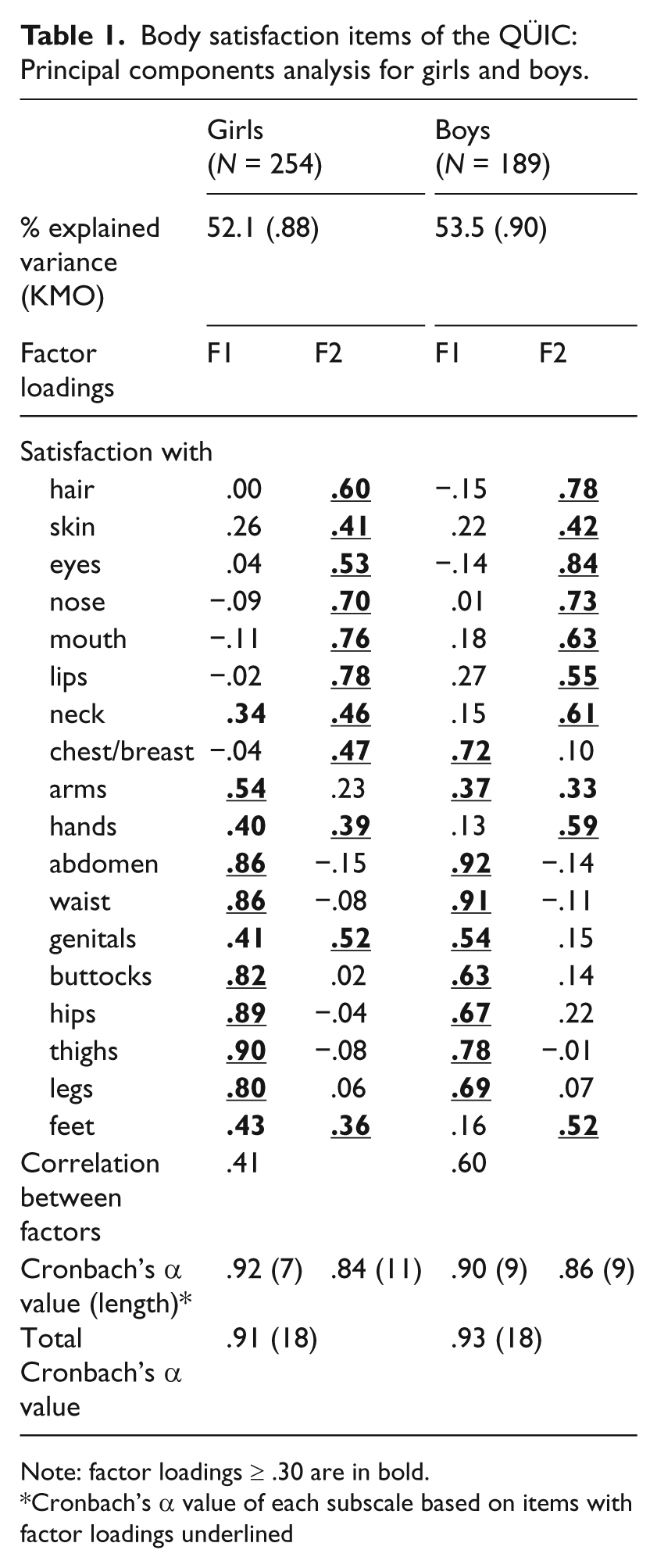
Table 1 shows the rotated factor loadings for the pattern matrices. In girls, the 2-factor model explained 52.1 percent of the variance. Factor 1 included seven items (arms, abdomen, waist, buttocks, hips, thighs, and legs), and can be labelled ‘torso’. Therefore, factor 2 consisted of the remaining 11 items (hair, skin, eyes, nose, mouth, lips, neck, chest/breast, hands, genitals, and feet) and can therefore be labelled ‘head and limbs’. Both factors correlated moderately (r = .41). Cronbach’s alpha values were excellent for factor 1 (α = .92), factor 2 (α = .84), and the total score (α = .91).
Body satisfaction items of the QÜIC: Principal components analysis for girls and boys.
Note: factor loadings ≥ .30 are in bold.
Cronbach’s α value of each subscale based on items with factor loadings underlined
In boys, the 2-factor model explained 53.5 percent of the variance and the 2-factor structure was almost the same, with few exceptions: satisfaction with chest/breast and genitals. Hence, the solution for boys differed slightly from that obtained for girls, but the factors can also be labelled ‘torso’ (factor 1, which included chest/breast, arms, abdomen, waist, genitals, buttocks, hips, thighs, and legs) and ‘head and limbs’ (factor 2, which included hair, skin, eyes, nose, mouth, lips, neck, hands, and feet). Both factors correlated highly (r = .60). Cronbach’s alpha values were excellent for factor 1 (α = .90), factor 2 (α = .86), and the total score (α = .93). Total body satisfaction scores correlated highly with general physical appearance (r = .74; p < .001).
Percentages of endorsement for the 18 parts of the body being problematic ranged from 1.59 percent (lips) to 25.30 percent (abdomen) for girls and from 2.75 percent (eyes and neck) to 19.13 percent (abdomen) for boys. Internal consistency was acceptable for the total score both for girls and boys (KR20 = .74). Total body problem scores correlated moderately and negatively with total body satisfaction (r = −.42; p < .001) and general physical appearance (r = −.40; p < .001).
Test-retest reliability
The 1-month and 7-month test-retest reliability was high, with coefficients ranging, respectively, from .66 and .54 (conformity with height) to .85 and .76 (satisfaction with torso in girls and boys) (Table 2).
Test-retest reliability of the measures of QÜIC one and seven months later (left) and correlation coefficients between the measures of QÜIC and eating attitudes (EAT-40), influences of aesthetic body ideal (CIMEC), and shape concern (EDE-Q-SC) scores (right).

all p values < .001; Pearson’s correlations for quantitative measures. Kappa for categorical measures (in italics)
*p < .05; ** p < .001; Pearson’s correlations for quantitative measures. Point biserial correlations for dichotomous measures (in italics) (conformity: yes versus no)
Convergent and divergent validity
Table 2 also presents the correlation coefficients valuing the convergent and divergent validity between QÜIC measures and EAT-40, CIMEC, and EDE-Q-SC scores. Influences of the aesthetic body ideal and shape concern correlated highly and negatively with total body satisfaction, satisfaction with torso (factor 1), general physical appearance, and conformity with weight (r between −.38 and −.53; p < .001), and highly and positively with the number of body parts being problematic (r between .53 and .55; p < .001). The same pattern was found for correlations with eating attitudes, the magnitudes being slightly lower (r from /.23/ to /.45/ in absolute value; p < .001). Conformity with height also correlated negatively and moderately with EAT-40 (r = −.33; p < .001) and CIMEC (r = −.24; p < .001) scores, while the correlation with EDE-Q-SC was null (r = −.14; p = .084).
The correlations involving satisfaction with head and limbs (factor 2) were low and non-statistically significant (r between −.03 and −.21; p > .05), except with CIMEC in boys (r = −.22; p = .002).
Relation to sex and age
Girls showed less body satisfaction (6.92 versus 7.31; p = .007; 95% CI [0.11; 0.66]), less general physical appearance (6.61 versus 7.15; p = .003; 95% CI [0.19; 0.90]), and more body parts being problematic (2.23 versus 1.34; p < .001; 95% CI 95% [0.44; 1.34]) than boys. More than half of the girls wished to weigh less, whereas only a third of the boys did (53.9% versus 34.7%; p < .001). No differences were found for conformity with height (54.2% in girls versus 48.5% in boys; p = .388), regarding sex. 2
Age only correlated positively with total body satisfaction (r = .14; p = .003), satisfaction with head and limbs in girls (r = .18; p = .003), and general physical appearance (r = .13; p = .007), but the magnitudes were low.
Discussion
The QÜIC satisfaction items presented an adequate 2-factor structure, with two components that can be broadly summarized as ‘torso’ and ‘head and limbs’. Only two noticeable differences emerged between girls and boys: the items about satisfaction with chest/breast and satisfaction with genitals loaded higher on factor 1 (torso) in boys and on factor 2 (head and limbs) in girls. It seems that, for girls, the factor ‘head and limbs’ (face elements, neck, hair, hands, and feet) is extended to chest/breast, including the cleavage. And the factor ‘torso’ includes only the elements from waist to legs, and arms, but not genitals. In contrast, for boys the factor ‘torso’ also includes satisfaction with chest/breast, the same areas covered by the BASS (Cash, 1997; Cash and Henry, 1995) as upper, mid, and lower torso, and it also includes satisfaction with genitals; and the factor ‘head and limbs’ is restricted to facial elements, neck, and hair. This result agrees with the issue that satisfaction with chest size is a more important aspect of body image and self-esteem for men than satisfaction with breast size is for women (Tantleff-Dunn and Thompson, 2000). Therefore, in our case, satisfaction with chest/breast loaded on one or the other factor according to its ‘importance’ for body image in each group of respondents: greater importance for boys yields to load on the factor ‘torso’, while less importance for girls yields to load on the factor ‘head and limbs’. It seems that a similar rule underlies the allocation of satisfaction with genitals. In fact, genital perception varies as a function of gender, and females tend to be more neutral than males toward their genitalia (Morrison et al., 2005). As a result, the item on satisfaction with genitals loaded higher on the most important factor for body image (‘torso’) only in boys.
In addition, a brief mention should be made of the two items asking about satisfaction with hands and feet, which loaded higher on factor 2 (‘head and limbs’) in boys and showed cross-loadings in girls. Both refer to the two most extreme elements of limbs or extremities, and both contributed further to the internal consistency of this less important component of body image, rather than to factor 1 (‘torso’).
Beyond the use of an anatomic criterion to label the underlying dimensions of the QÜIC satisfaction items following Cash (Cash, 1997; Cash and Henry, 1995), another approach can be considered, based on the possibility of control over one’s appearance. Thus, items loading on factor 1 would mainly refer to body parts that are disguised or concealed with clothing in Western cultures, while modifiable with dieting, compared to the body part items loading on factor 2 that are not.
Despite the fact that the bidimensional factor structure of body satisfaction is slightly different for girls and boys, the single total score for the 18 items can be also used, which allows direct comparability between both genders. Total body satisfaction and body problems were moderately and inversely correlated, supporting the existence of both dimensions (affective and cognitive, respectively) of the body image construct (Cash, 2002; Cash et al., 2004). General physical appearance was more related to body satisfaction than to body problems, thus the general evaluation of oneself seems to be closer to the affective dimension than the cognitive one.
Reliability of QÜIC measures was satisfactory, in terms of test-retest after one and seven months. As expected, one month test-retest coefficients were slightly higher than seven month ones. Internal consistency was also good, above .70 (Nunnally and Bernstein, 1994).
The highest correlation coefficients (in absolute value) between QÜIC measures and the other questionnaires administered corresponded to influences of the aesthetic body ideal and shape concern: a direct relationship with total body problems and an inverse relationship with satisfaction with torso (factor 1) and conformity with weight. These results are aligned with the fact that interiorization of the body ideal is related to body dissatisfaction in both genders (Barlett et al., 2008; Cafri et al., 2005; Jones, 2004; Lawler and Nixon, 2011; Levine and Murnen, 2009). In addition, the low or null correlations involving satisfaction with head and limbs (factor 2) and the other questionnaires also provide evidence of divergent validity.
Regarding sex, girls showed more dissatisfaction than boys, as in previous research (see, for example, Anderson and Bulik, 2004; Bearman et al., 2006; Lawler and Nixon, 2011; Neumark-Sztainer et al., 2006), whereas boys reported low levels of overall body image investment or concern (Hargreaves and Tiggemann, 2006). Girls were also less conformable with their current weight than boys, as in Lawler and Nixon (2011), but there were no differences regarding conformity with height between both sexes. Although ours is not a random sample, the percentages of conformity with these two questions were similar to those reported by Ricciardelli and McCabe (2001), who found that 60 percent of girls and 30 percent of boys wish to change their weight and height. In relation to age, correlations with QÜIC measures were almost small or null, as reported by Lawler and Nixon (2011).
The usual cautions about generalizing beyond the sample used should be exercised. Using a community sample does not ensure the inclusion of only non-clinical participants. Another limitation could be the absence of an item on muscularity, which is especially relevant for boys (eg, Grogan, 2006; Hargreaves and Tiggemann, 2006; McCabe et al., in press; McCabe and Ricciardelli, 2001; McCabe et al., 2006; Shomaker and Furman, 2010; Yanover and Thompson, 2010). Finally, we were not able to include EDI-2 body dissatisfaction assessment, to evaluate convergent validity with QÜIC.
To conclude, the QÜIC appears to be an easily administrated and brief self-report questionnaire with satisfactory psychometric properties in our community sample. It includes the evaluation of both affective and cognitive components of body image, by means of a female or male figure, specially adapted for children and adolescents. The QÜIC makes it possible to assess satisfaction and concern for the overall body and for different parts of it, which may be an advantage over the test of silhouettes that limit the assessment of body dissatisfaction to aspects involving body size (Holmqvist and Frisén, 2010). Moreover, the fact that it comprises the assessment of 18 different parts of the body enables the inclusion of items that are not usually considered, such as head hair and genitals, which are also sources of concern for men (Tiggemann et al., 2008).
Thus, the availability of a valid and reliable Spanish version of this new questionnaire may benefit not only research conducted in Spain, but also in other Spanish-speaking countries. The assessment of body image will contribute to the diagnosis, prevention and intervention in body image disorders in adolescent girls and boys, who are the population at risk of ED. Knowledge of body image satisfaction and body image problems can help to identify high-risk groups for selective preventive intervention and to develop the required preventive strategies. In future research of the Spanish QÜIC we propose the incorporation of a clinical sample, in order to obtain evidence of the predictive validity of the questionnaire, in terms of appearance and maintenance of eating disturbances.
Footnotes
Acknowledgements
This work was partly supported by the Spanish Ministerio de Ciencia y Tecnología (grant number CBS02002-03689) and the Spanish Ministerio de Educación y Ciencia (grant number SEJ2005-07099).