







Abstract
This study tested the utility of the Theory of Planned Behaviour (TPB) to predict mothers’ decisions to ensure their child engages in sun-protective behaviours. Mothers (N = 162) of children aged four or five years completed standard TPB items (attitude, subjective norm, perceived behavioural control, intention) and additional variables of role construction, mothers’ own sun safe behaviour, planning and past behaviour. One week later, participants (N = 116) reported their behaviour. Results found support for the TPB constructs, role construction, past behaviour and the mediating role of planning. These findings can inform strategies to prevent skin cancer.
Australia is recognized as having the highest rates of melanoma in the world despite the fact that most skin cancers can be prevented (Australian Institute of Health and Welfare, 2008; Ferlay et al., 2010) by simple and effective sun-protective measures (Cancer Council Australia, 2007). Skin cancers are predominantly caused by excessive exposure to ultraviolet (UV) radiation from the sun and develop from cumulative and episodic exposure over the lifespan (World Health Organization, 2009).
The protection of young children against harmful sun exposure is especially important as excessive sun exposure during the first 10 to 20 years of life greatly increases an individual’s risk of skin cancer in adulthood (Truhan, 1991). Pre-school age children spend a considerable amount of time in the sun and generally do not have the capability of implementing sun-protective behaviours themselves (Zinman et al., 1995). For this reason, children up to the age of five are highly dependent on the lifestyle behaviours, such as sun protection, that their parents/caregivers, especially their mothers, enforce (Bourdeaudhuij, 1997). Current evidence suggests that there is a high incidence of sunburn in children and that and the level of sun protection provided by parents is often infrequent and/or insufficient (Turner and Mermelstein, 2005). Johnson et al. (2001) found that fewer than half of the parents in their study reported they were providing regular sun protection for their child. A study by Stanton et al. (2000) in Queensland, Australia found that one-third of children had been sunburnt by six months of age, and by three years of age 82% had been sunburnt.
A number of intervention programmes have been introduced with the aim of improving the sun-protective behaviours of children. For instance, a US-based study showed an increase in the sun-protective behaviours demonstrated by young adolescents by educating parents on risky sun behaviours and how they could relay information regarding skin cancer prevention to their children (Turrisi et al., 2007). In their review of sun protection programmes, Buller and Borland (1999) found that parent-based programmes, using strategies such as delivering sun safety promotion materials (e.g. newsletters, tip cards) to parents by direct mail, conducting educational/discussion programmes about sun safety and providing interactive booklets and sunscreen samples, have shown a positive effect on increasing the sun protection that parents provide for their children (e.g. Buller et al., 1998; Glanz et al., 1998, 1999; Rodrigue, 1996). As well as these initiatives, community-wide programmes, involving strategies such as public campaigns, lectures and children’s workbooks, have shown to be effective in improving the sun-protective behaviours of community members, including young children (Buller et al., 1998).
The majority of parent-based and community programmes that exist, however, have been implemented in North America and Europe. In Australia, there is an absence of documented intervention strategies which target parents despite the fact that parents who are more knowledgeable and engage in sun protection practices themselves are more likely to protect their children from the sun (Olson et al., 1997). A shift in focus is necessary in Australia as the majority of intervention strategies concentrate on young children themselves and school care-takers (Milne et al., 2000) even though research has found initiatives which concentrate on modifying the attitudes and behaviours of parents are important to increase programme efficacy (O’Riordan et al., 2003).
The Theory of Planned Behaviour
One well validated decision making model commonly used to examine people’s attitudes and behaviours is the Theory of Planned Behaviour (TPB; Ajzen, 1991). The TPB proposes that intentions influence behaviour, with intentions being influenced by attitude (appraisal of the behaviour as favourable/unfavourable), subjective norm (perceived social pressure to perform/not perform the behaviour) and perceived behavioural control (PBC; perceived ease/difficulty with performing the behaviour), with PBC further predicting behaviour directly (Ajzen, 1991). Within the TPB, past behaviour is also often included as an additional predictor of people’s intentions and behaviours (Conner and Armitage, 1998). The TPB has been applied successfully to examine sun safety (Jackson and Aiken, 2000; Myers and Horswill, 2006; White et al., 2008).
Proposed additional variables in the context of parental decision making
Despite the empirical support for the TPB, the model does not account for all the variance in people’s decision making. Based on the findings from previous studies, additional psychosocial factors may influence mothers’ decisions, including role construction, mothers’ own sun safe behaviour and the extent of planning undertaken in anticipation of ensuring one’s child performs sun-protective behaviours.
In their model of parental decision making, Hoover-Dempsey and Sandler (1995, 1997) identified role construction as a fundamental variable that influences parents’ decisions. Role construction relates to how accountable or responsible a parent views him or herself to be in terms of the behaviour of their child. Hoover-Dempsey and Sandler (1997) propose that parents’ construction of the parental role is largely influenced by their definition of the parental role and their beliefs about child development, child-rearing and what is expected of a parent. As parents are more aware of the dangers of sun exposure to young children and the associated risk of skin cancer (Stanton et al., 2004), it is proposed that parents will consider themselves significant figures who are responsible for providing sun protection for their children.
While young children at the age of four to five years are primarily dependent on adults for decisions about their health, parents’ actions can impact on the behaviours displayed by children and adolescents at later stages in their life when they are able to make their own decisions about their health (Bennetts et al., 1991; Fisher et al., 1996). Research also suggests that parents’ own sun-protective behaviour can reflect the extent to which parents ensure their child engages in sun-protective behaviour (Foltz, 1993). For this reason, it is important to examine mothers’ own behaviour and it is proposed that the sun-protective behaviours demonstrated by mothers will influence the decisions they make about their child’s sun safe practices.
Making plans is another psychosocial variable suggested to play a role in the prediction of mothers’ decisions. Planning refers to the mental representation of the ‘where’, ‘when’ and ‘how’ of performing a behaviour (Norman and Conner, 2005). In examining the intention–behaviour gap (whereby intentions to engage in a specific behaviour do not always translate into action), researchers have differentiated between a motivational phase, where an intention is formed, and a volitional phase where a range of self-regulatory strategies are enacted to ensure an intention is realized (Gollwitzer, 1999). Planning has been identified as a key self-regulatory activity in the volitional phase, exhibiting a mediating role between intentions and behaviour, and has been supported in a number of previous studies investigating health behaviours including sunscreen use (Jones et al., 2001). Given the demands of parenthood, mothers may need to make plans to ensure they are able to provide adequate sun protection if their child is to be in the sun. Investigating the mediating role of planning on mothers’ decisions to provide sun protection for their child, then, appears justified in this context.
The present study
Our purpose was to draw from a well-validated decision making model to identify factors which influence mothers’ decisions about their child’s sun-protective behaviours ultimately to inform parent-based and community programmes in Australia, a high risk skin cancer region where there is a paucity of theory- based sun safe initiatives targeting parents. We focused on mothers with children aged four or five years as research shows that preschool years (in Australia, below six years of age) are the final years in which mothers have the most control over their child’s health behaviours (Irwin et al., 2005).
In accordance with the TPB (Ajzen, 1991), we hypothesized that attitude, subjective norm and PBC would predict mothers’ intentions to ensure their child engaged in sun-protective behaviours (Hypothesis 1) and that intention and PBC would directly influence their decisions (behaviour) (Hypothesis 2). For the additional factors, we expected that mothers who hold a more active role construction and perform sun-protective behaviours themselves would have stronger intentions (Hypothesis 3) and that the past behaviour of mothers would influence their intentions and decisions about their child’s sun-protective behaviours (Hypothesis 4). Finally, we proposed that planning would mediate the intention–behaviour relationship (Hypothesis 5).
Method
Participants
The sample comprised of 162 Australian mothers ranging in age from 17 to 49 years (M = 35.19 years; SD = 5.39) who had at least one child aged four or five years usually residing in the same household as their mother. The majority of the mothers were married (86.2%), over half had a personal or familial history of cancer (63.6%) and approximately half were currently working (54.5%) and were university educated (50.3%).
One week later, 116 (71.6%) of the mothers participated in the follow-up questionnaire. Participants were recruited via online advertising (e.g. forums on parenting websites, university and parenting email newsletters), face-to-face (swim schools, indoor play centres) and snowball sampling methods. Entering a prize draw was offered (i.e. to win one of three children’s sun hats or one of two $50 (AUD) supermarket gift cards) on completion of both questionnaires.
Design and procedure
This study was part of a larger project investigating factors which influence mothers’ decisions to ensure their child engages in a range of cancer-preventative behaviours. Ethical clearance was obtained and a prospective design with two waves of data collection was adopted. The main questionnaire comprised the standard TPB items in addition to measures of role construction, mothers’ own sun safe behaviour, planning and past behaviour as well as demographic variables. Participants completed either a paper-based or on-line version of the main questionnaire. One week later, consenting participants completed a follow-up telephone questionnaire which assessed the decisions they had made regarding their child’s sun-protective behaviours during the previous week.
Measures
The target behaviour of sun protection was defined by the adoption of the five steps as outlined by the Cancer Council Australia (2007) every time a child was outdoors in direct sunlight: (1) wearing sun protective clothing (collar and sleeves, long shorts or skirt and sunsuits for swimming); (2) applying SPF 30+ sunscreen; (3) wearing a hat; (4) seeking shade; and (5) wearing sunglasses. The TPB variables were assessed using Ajzen’s (1991) recommendations, on seven-point Likert scales, with the exception of attitude which was measured using semantic differential scales. None of the items employed reverse scoring as initial pilot testing of the questionnaire revealed that reversed scaling for some of the items was undetected until the final stages of the questionnaire. For this reason, all items in the questionnaire were worded in a positive direction. The target behaviour for the items below refers to the wording ‘my child follows all of the five SunSmart steps every time they are in the sun in the next week’.
Intention
Two items assessed intention: ‘I intend to ensure that [target behaviour]’ and ‘I plan to ensure [target behaviour]’; [1] strongly disagree to [7] strongly agree. The two items were highly correlated (r = .94, p < .001).
Attitude
Attitude was measured using two items in a seven-point semantic-differential format: ‘For me to ensure that [target behaviour] would be:’; unfavourable–favourable, bad–good. The two attitude scale items were highly correlated (r = .93, p < .001).
Subjective norm
Subjective norm was measured using two items: ‘The people in my life whose opinions I value would approve of me ensuring that [target behaviour]’ and ‘Most people who are important to me think that I should ensure [target behaviour]’; [1] strongly disagree to [7] strongly agree. The two items were highly correlated (r = .94, p < .001).
Perceived behavioural control
PBC was assessed using two items: ‘I have complete control over whether [target behaviour]’ and ‘I am confident that I could ensure [target behaviour]’; [1] strongly disagree to [7] strongly agree. The two PBC scale items were significantly correlated (r = .70, p < .001).
Role construction
One item adapted from Green and Hoover-Dempsey (2007) measured role construction: ‘I believe it is my responsibility as a parent to ensure that [target behaviour]’; [1] strongly disagree to [7] strongly agree.
Mothers’ own sun-protective behaviour
Given that the Cancer Council Australia (2007) recommends adults also follow the five SunSmart steps, mothers’ own sun-protective behaviour was measured by the following item: ‘In the previous week, to what extent did you follow all of the five SunSmart steps every time you were in the sun?’; [1] not at all to [7] a large extent.
Planning
Mothers’ planning behaviour was assessed using one item adapted from Norman and Conner (2005): ‘To what extent have you thought about and planned how you would ensure that your child follows all of the five SunSmart steps every time they are in the sun in the next week?’; [1] not thought about this to [7] clear plans.
Past behaviour
One item measured past behaviour: ‘In the previous week, to what extent did you ensure that your child followed all of the five SunSmart steps every time they were in the sun?’; [1] not at all to [7] a large extent.
Reported behaviour
One week later, participants reported their behaviour in the previous week: ‘In the past week, to what extent did you ensure your child followed all of the five SunSmart steps every time they were in the sun?’; [1] not at all to [7] a large extent.
Results
Two hierarchical multiple regression analyses were conducted to predict mothers’ (1) intentions and (2) behaviour to ensure their child engages in sun-protective behaviours. Means, standard deviations and correlations of the study’s variables are reported in Table 1. On average, mothers were ensuring that their children were performing the recommended sun-protective behaviours to a moderate degree over seven days, with a mean score of 4.46 (on a seven-point scale), indicating that the majority of mothers were not employing all five sun- protective behaviours on a regular basis. As shown in Table 1, all variables were significantly correlated with intention and behaviour, with intention and past behaviour emerging as the strongest behavioural correlates. Multivariate analysis of variance analyses (MANOVAs) established that there were no significant differences on any of the demographic and predictor variables (TPB and additional) for mothers who completed both questionnaires and those who completed the first questionnaire only. There also were no significant differences on any of the demographic and predictor variables (TPB and additional) for those mothers who completed the first questionnaire online and those who completed the paper-based version of the survey.
Means, standard deviations, and bivariate correlations for the predictor variables and target behaviour (N = 162)
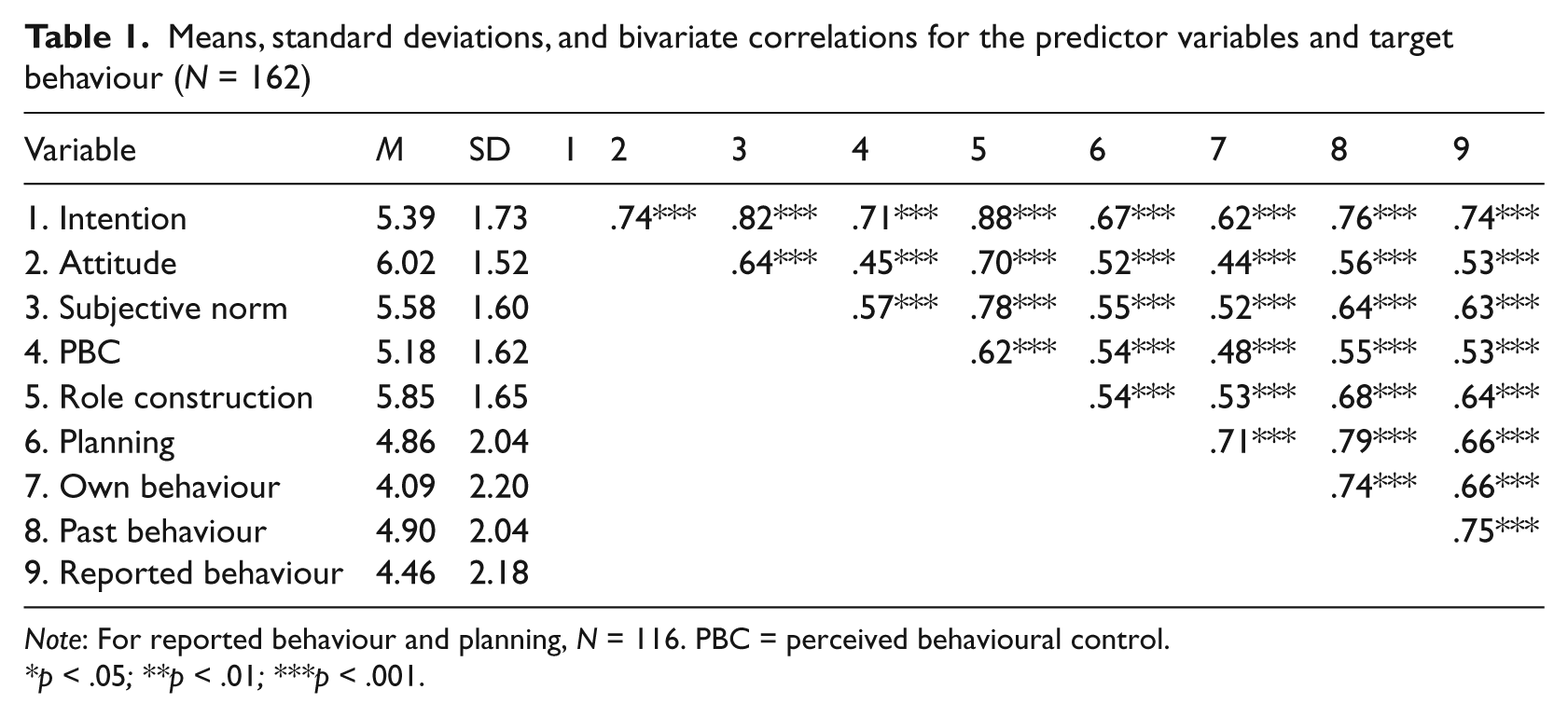
Note: For reported behaviour and planning, N = 116. PBC = perceived behavioural control.
p < .05; **p < .01; ***p < .001.
Regression analysis predicting mothers’ intentions and behaviour
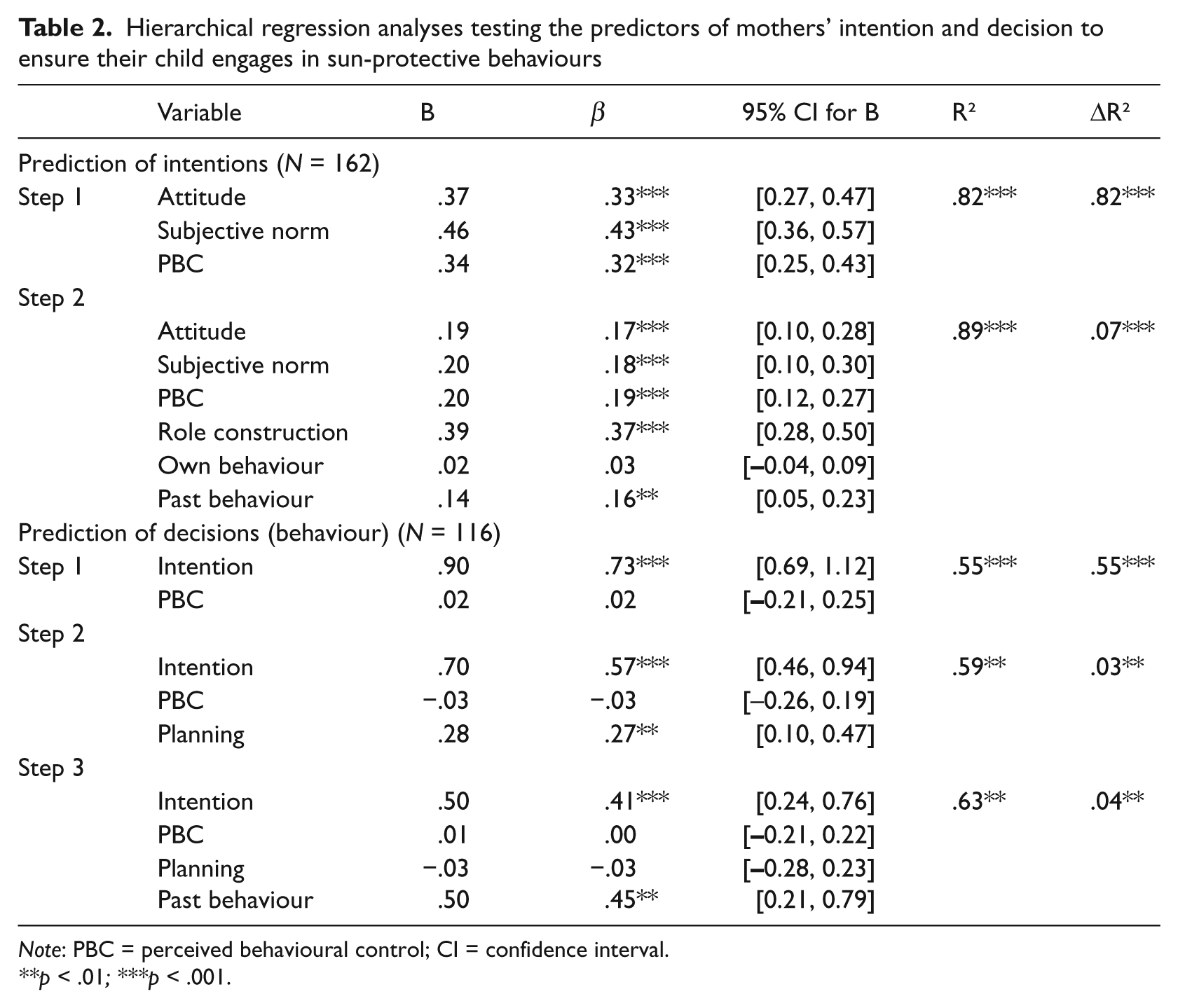
A hierarchical multiple regression analysis was performed predicting mothers’ sun protection intentions. The standard TPB constructs of attitude, subjective norm and PBC were entered at Step 1 with the additional variables of role construction, mothers’ own sun-protective behaviour and past behaviour entered at Step 2. As shown in Table 2, the TPB variables accounted for 82% (81% adjusted) of the variance in mothers’ intentions, F(3, 158) = 235.22, p < .001. Entry of the additional variables in Step 2 significantly increased prediction by 7%, Fchange(3, 155) = 34.99, p < .001, so that 89% (89% adjusted) of the variance in mothers’ intentions was explained, F(6, 155) = 211.02, p < .001. In the final model, the significant predictors were attitude, subjective norm, PBC, role construction and past behaviour.
Hierarchical regression analyses testing the predictors of mothers’ intention and decision to ensure their child engages in sun-protective behaviours
Note: PBC = perceived behavioural control; CI = confidence interval.
p < .01; ***p < .001.
The second hierarchical multiple regression analysis was performed to predict mothers’ behaviour to ensure their child engaged in sun-protective behaviours. Intention and PBC were entered at Step 1 with planning entered at Step 2 and past behaviour at Step 3. As shown in Table 2, intention and PBC accounted for a significant 55% (55% adjusted) of the variance in behaviour, F(2, 113) = 70.22, p < .001. At Step 2, planning significantly increased prediction by 3.4%, Fchange(1, 112) = 9.14, p = .003 and the beta weight for intention decreased from.90 (β = .73) to .70 (β = .57), suggesting partial mediation. Past behaviour at Step 3 significantly increased prediction by 3.9% (after step 2), Fchange(1, 111) = 11.72, p = .001, so that the full model accounted for 63% (61% adjusted) of the variance in behaviour, F(4, 111) = 46.68, p < .001. In the final model, mothers’ intentions and past behaviour significantly predicted their decisions to ensure their child engaged in sun-protective behaviours.
Mediational analysis
A non-parametric bootstrapping procedure was used to assess the meditational relationship between intention and planning, as there was a small sample size (Preacher & Hayes, 2004). The indirect effect was tested using a resampling of 5000 bootstrap samples. An examination of the bootstrap results of indirect effects revealed that planning was a significant partial mediator of the relationship between mothers’ intentions and their decision to ensure their child engages in sun protective behaviour, B = .26, β = .21, SE = .09, p < .001, 95% CI = 0.06 to 0.51.
Discussion
We sought to identify important factors which underlie mothers’ decision making about their child’s sun-protective behaviours. The results support the TPB in that attitude, subjective norm and PBC predicted mothers’ intentions to ensure their child engages in sun-protective behaviours (Hypothesis 1). These findings suggest that mothers with a more favourable attitude towards their child performing sun-protective behaviours, who feel more pressure from important others to ensure their child performs the behaviours and who perceive higher levels of control regarding their ability to ensure their child performs sun-protective behaviours are more likely to intend to ensure their child engages in sun-protective behaviours. These findings are consistent with a number of studies which have found the TPB to be effective in explaining people’s sun protection intentions (Jackson and Aiken, 2000; White et al., 2008).
In the prediction of mothers’ behaviour, the TPB was partially supported (Hypothesis 2) as intention, but not PBC, predicted mothers’ decisions to ensure their child engages in appropriate sun-protective behaviours. This finding suggests that mothers who have stronger intentions to ensure their child engages in sun- protective practices are more likely to make decisions to ensure their child does engage in this behaviour. The finding that PBC was not a significant predictor of mothers’ behaviour is consistent with Ajzen’s (1991) proposal that PBC becomes less useful in predicting behaviour as volitional control over behaviour increases. It is possible that mothers are not accurate in judging how much control they actually have over ensuring sun safe behaviours are enacted for their child because of factors outside of the mothers’ control such as child refusal behaviour (pulling off hats and sunglasses) or a feeling of diminished control while outside of the home in others’ care.
Partial support was found for Hypothesis 3 as the additional variables of role construction and past behaviour, but not mothers’ own sun protection behaviour were found to predict significantly mothers’ intentions. The emergence of role construction as a predictor of mothers’ intentions is consistent with previous research in the educational sphere (Hoover-Dempsey and Sandler, 1997) and suggests that mothers who view themselves as being an active and responsible facilitator of their child’s adoption of sun-protective behaviours are more likely to ensure their child engages in such behaviours. Mothers’ own sun protection behaviour was not identified as a significant predictor of their intentions to ensure their child engages in sun-protective behaviours, suggesting that mothers hold different expectations for their own, as opposed to their child’s, sun safety actions and may relate to the significant findings for role construction where one’s responsibilities as a parent are paramount for the health of their child irrespective of their own health practices (Turner and Mermelstein, 2005). Past behaviour emerged as a significant predictor of mothers’ intentions (Hypothesis 3) and decisions (Hypothesis 4) to ensure their child engaged in sun-protective practices, suggesting that mothers may make decisions in a habitual fashion about their child’s health behaviour. Planning was found to mediate partially the intention–behaviour relationship (Hypothesis 5), consistent with other health-based literature (Norman and Conner, 2005) and indicates that an element of planning is involved to enable mothers’ sun safe intentions to translate into action for their child’s protection.
Given that attitudes predicted mothers’ intentions, future parent-based strategies encouraging sun safety should aim to emphasize the favourable and valuable aspects of sun protection and reinforce the negative consequences of failing to adopt sun-protective behaviours (such as skin cancers, removal of sun spots). As subjective norm was also significant, by creating a greater awareness of sun safety among significant others, mothers may consequently feel a greater pressure to ensure their child engages in sun-protective behaviours. PBC was also a significant predictor of intentions, suggesting that future strategies should target mothers’ perceptions of effort and control by focusing on the idea that ensuring their child performs sun-protective practices every day is easy by encouraging simple steps at home such as positioning hat racks and sunscreen at the entrance to outdoor areas. As role construction was a significant predictor, encouraging mothers to identify themselves as a mother who is actively responsible for ensuring that their child adopts sun-protective practices may increase the number of mothers who actively adopt this position. From a health promotion perspective, endorsing slogans such as ‘I am the proud mother of a Sun Smart Kid!’ could help mothers to embrace such an identity. Given past behaviour predicted both intentions and behaviour, strategies should foster the idea that sun-protective behaviours are an everyday lifestyle practice. Finally, planning was found to be a significant mediator of the intention–behaviour relationship; thus, future interventions should emphasize the benefit of forethought and planning (e.g. preparing to-do lists of necessary sun safe resources) prior to exposing children to sunny environments.
Our findings are beneficial in that they can assist in the development of parent-based and community programmes promoting sun protection in Australia. Based on effective interventions from other countries (Buller et al., 1998; Glanz et al., 1998; Rodrigue, 1996), the results from this study could be incorporated into educational presentations, lectures and group discussions for parents, potentially in the context of postnatal, child care, kindergarten and pre-school educational sessions, as well as community- based sun protective messages delivered through various media outlets (e.g. television, radio and newspapers), interactive booklets and brochures.
The study’s strengths include it being one of the first to use the TPB to investigate the predictors of mothers’ decision making about their young child’s sun-protective behaviours. Limitations include the use of self-report measures of behaviour and the use of one-item scales for the additional variables to reduce the length of the questionnaire for time-pressed mothers. Further research is required to validate the results from the present study for mothers and carers (including fathers and extended family), preferably with multiple item scales. In addition, although multiple methods of questionnaire delivery (i.e. paper-based and on-line) were adopted to reduce potential sample bias, the majority of participants were recruited from proactive parenting sources, potentially attracting mothers who show more interest in their child’s health and well-being.
A further limitation was the telephone follow-up survey which possibly created demand characteristics and, although selected to reduce participant attrition, a follow-up paper-based or online survey may have been preferable. Combining the five sun-protective behaviours may also limit the study’s findings as the intention and behaviour of mothers for each individual behaviour may have varied. It is recommended that future research examine each of the sun protection behaviours separately so that the specific actions which are employed by mothers can be more readily identified. A final limitation is that participants may have not interpreted the questionnaire items as intended by the researchers as misinterpretation of items can be one of the greatest problems encountered with TPB questionnaires (Darker and French, 2009), further supporting the notion that, in future research, various sun safe actions should be examined as separate behaviours to avoid any ambiguity.
Overall, the present study provides support for the efficacy of the TPB in understanding the decision making processes involved for mothers to ensure their child engages in sun-protective behaviours. Encouraging mothers to ensure their child engages in sun-protective behaviours is imperative given that the rates of cancer are continuing to reach unprecedented levels in many countries despite the fact that skin cancer can largely be prevented by regular sun safe practices.
Footnotes
Competing Interests
None declared.