







Abstract
We investigated the effects of gain-framed versus loss-framed messages and motivational orientation on calcium consumption. After completing a motivational orientation scale (behavioral inhibition system/behavioral activation system), undergraduate women (N = 141) were randomly assigned to read a gain-framed or loss-framed pamphlet promoting calcium consumption. Calcium consumption was assessed 1 month later. For calcium supplement behavior, a gain-framed advantage was observed for behavioral activation system–oriented individuals, whereas a loss-framed advantage was observed for behavioral inhibition system–oriented individuals. For dietary calcium intake, a gain-framed advantage was observed among behavioral activation system–oriented individuals; however, no framing effect emerged for behavioral inhibition system–oriented individuals. The success of framed messages depends on the message recipient’s motivational orientation.
Persuasive messages play an important role in motivating people to improve their health behavior. Equivalent messages framed in terms of either gains or losses have been shown to differentially affect people’s health-related decisions and behavior (Rothman et al., 2006; Rothman and Salovey, 1997). Gain-framed messages emphasize the benefits of engaging in a health behavior whereas loss-framed messages emphasize the costs of not engaging in the health behavior. Although seemingly subtle, message framing is an effective health communication strategy for promoting behavior change across a wide variety of health behaviors (Gallagher and Updegraff, 2012; Rothman et al., 2006). The purpose of the present study was to examine the interactive effects of message framing and motivational orientation—an individual difference that reflects people’s underlying sensitivity to rewards and punishments—on young women’s calcium consumption.
Rothman and Salovey (1997) developed a framework for predicting the relative effectiveness of gain-framed versus loss-framed messages in motivating health behavior. The crux of this framework rests on the extent to which the behavior advocated in the message is perceived to involve risk or uncertainty. Drawing on prospect theory (Kahneman and Tversky, 1979), Rothman and Salovey (1997) proposed that gain-framed messages should be most effective in promoting behaviors associated with a sense of safety and certainty, whereas loss-framed messages should be most effective in promoting behaviors associated with risky or uncertain outcomes. Moreover, they argued that the function of the health behavior advocated in the message—whether it is aimed at preventing or detecting disease—can serve as a cue to whether the behavior will be perceived as safe/certain versus risky/uncertain. Specifically, gain-framed messages should be most effective for promoting preventive health behaviors (e.g. using sunscreen) because those behaviors are typically associated with safe and certain outcomes. In contrast, loss-framed messages should be most effective for promoting disease detection or screening behaviors (e.g. HIV testing) because such behaviors can be viewed as psychologically risky (because the test could reveal bad news). Support for this framework has been relatively mixed (Gallagher and Updegraff, 2011; Hevey et al., 2010; Hwang et al., 2012; McGregor et al., 2012; O’Keefe and Jensen, 2007, 2009; Rothman et al., 2006; Rothman and Updegraff, 2011).
Emerging evidence suggests that aside from the type of behavior being advocated in a message, the effectiveness of framed messages depends upon the message recipient’s motivational orientation (e.g. Mann et al., 2004; Shermanet al., 2006). Researchers have identified two primary motivational systems—the behavioral activation system (BAS) and the behavioral inhibition system (BIS)—which reflect people’s underlying sensitivity to rewards and punishments (Gray, 1990). Individuals whose BAS is particularly active tend to be highly sensitive to reward cues and seek to approach positive outcomes. In contrast, people whose BIS is particularly active tend to be highly sensitive to threat cues and seek to avoid negative outcomes. Accordingly, theorists have proposed that BAS-oriented individuals (given their focus on benefits and action) should be especially responsive to gain-framed messages whereas BIS-oriented individuals (given their focus on costs and inaction) should be especially responsive to loss-framed messages (Rothman and Updegraff, 2011).
Although several studies have explored BIS/BAS motivational orientation as a moderator of message framing effects (e.g. Gerend and Shepherd, 2007; Nan, 2012), only three studies have investigated the effects on actual health behavior (Mann et al., 2004; Sherman et al., 2006; Updegraff et al., 2007). Two of the three studies (Mann et al., 2004; Sherman et al., 2006) found that framed messages were more effective at promoting behavior change when they were “matched” (versus “mismatched”) to the message recipient’s motivational orientation. That is, BAS-oriented individuals were most responsive to gain-framed messages whereas BIS-oriented individuals were most responsive to loss-framed messages. The authors (Mann et al., 2004; Sherman et al., 2006) referred to this pattern of results as “the congruency effect.” The third study (Updegraff et al., 2007), which also manipulated argument strength, did not find evidence for the predicted congruency effect on behavior.
Notably, all three studies focused on the same health behavior: dental flossing. Thus, behavioral evidence for the congruency effect is limited to a single health behavior. In addition, the follow-up period for the studies was 1 week. The present study sought to expand this line of work to another important preventive health behavior: consuming sufficient calcium for proper bone growth and prevention of osteoporosis. We also extended the follow-up period from 1 week to 1 month to investigate longer term effects of message framing and motivational orientation on health behavior.
Osteoporosis is a disease that causes one’s bones to become fragile and susceptible to fracture and is particularly prevalent among women (National Institutes of Health (NIH, 2011)). Sufficient calcium intake throughout the life-span plays a critical role in preventing or delaying the onset of the disease. Adequate calcium intake is especially important during the first three decades of life when bone mass is still accumulating (NIH, 2011). Calcium is found in dairy products, dark green leafy vegetables, and a variety of calcium-fortified foods (e.g. orange juice and cereals), as well as supplements. Many college-aged women do not meet recommended dietary allowances for calcium (Bailey et al., 2010), which are 1300 mg per day for 14–18-year-old individuals and 1000 mg per day for 19–50-year-old individuals (Food and Nutrition Board, 2011).
The present study investigated the effects of gain-framed versus loss-framed messages and BIS/BAS motivational orientation on young women’s calcium consumption. Participants were randomly assigned to read either a gain-framed or loss-framed message and subsequently reported their calcium consumption behavior 1 month later. Our primary outcome variables included one indicator of calcium supplement behavior and two indicators of dietary calcium intake. We predicted that framed messages would be most effective when they matched the message recipients’ motivational orientation. More specifically, gain-framed messages (as compared to loss-framed messages) should be especially persuasive for individuals with a relatively high BAS orientation whereas loss-framed messages (as compared to gain-framed messages) should be especially persuasive for individuals with a relatively high BIS orientation.
Method
Participants
Female students from a large southeastern university in the United States were compensated for their participation with course credit. A total of 141 participants completed the baseline session, of whom 126 (89%) completed the follow-up survey 1 month later. The mean age of the sample was 18.45 years (standard deviation (SD) = .86; range = 17–23). Sixty-six percent of the sample was ≤18 years of age. The majority of participants were freshmen (74%). Eighteen percent were Hispanic or Latina. Most participants self-identified as White (82%) and the remainder identified themselves as Black or African American (9%), multi-racial (3%), Asian/Asian American (1%), or Native Hawaiian/Pacific Islander (<1%). Race was unknown or not reported for 5 percent of the sample.
Procedure
The study was approved by the University Human Subjects Committee. Participants were run in groups of up to five individuals in a laboratory on campus. After providing informed consent, participants completed a baseline survey that assessed demographics, calcium supplement use, dietary calcium intake, motivational orientation, and osteoporosis knowledge. Participants were then randomly assigned to read either a gain-framed or loss-framed pamphlet about osteoporosis and calcium consumption that was based on the information from the NIH “Osteoporosis Overview” website (NIH, 2011). Afterward, participants completed a survey that assessed their evaluations of the pamphlet, a framing manipulation check, and posttest osteoporosis knowledge. Before dismissal, participants scheduled their 1-month follow-up session and received a condition-appropriate handout that included either a gain-framed or loss-framed statement about calcium consumption at the top of the page, along with a list of 30 calcium-rich foods. Approximately 1 month later, participants returned to the laboratory to complete a survey that assessed their calcium supplement behavior and dietary calcium intake over the past month.
Materials
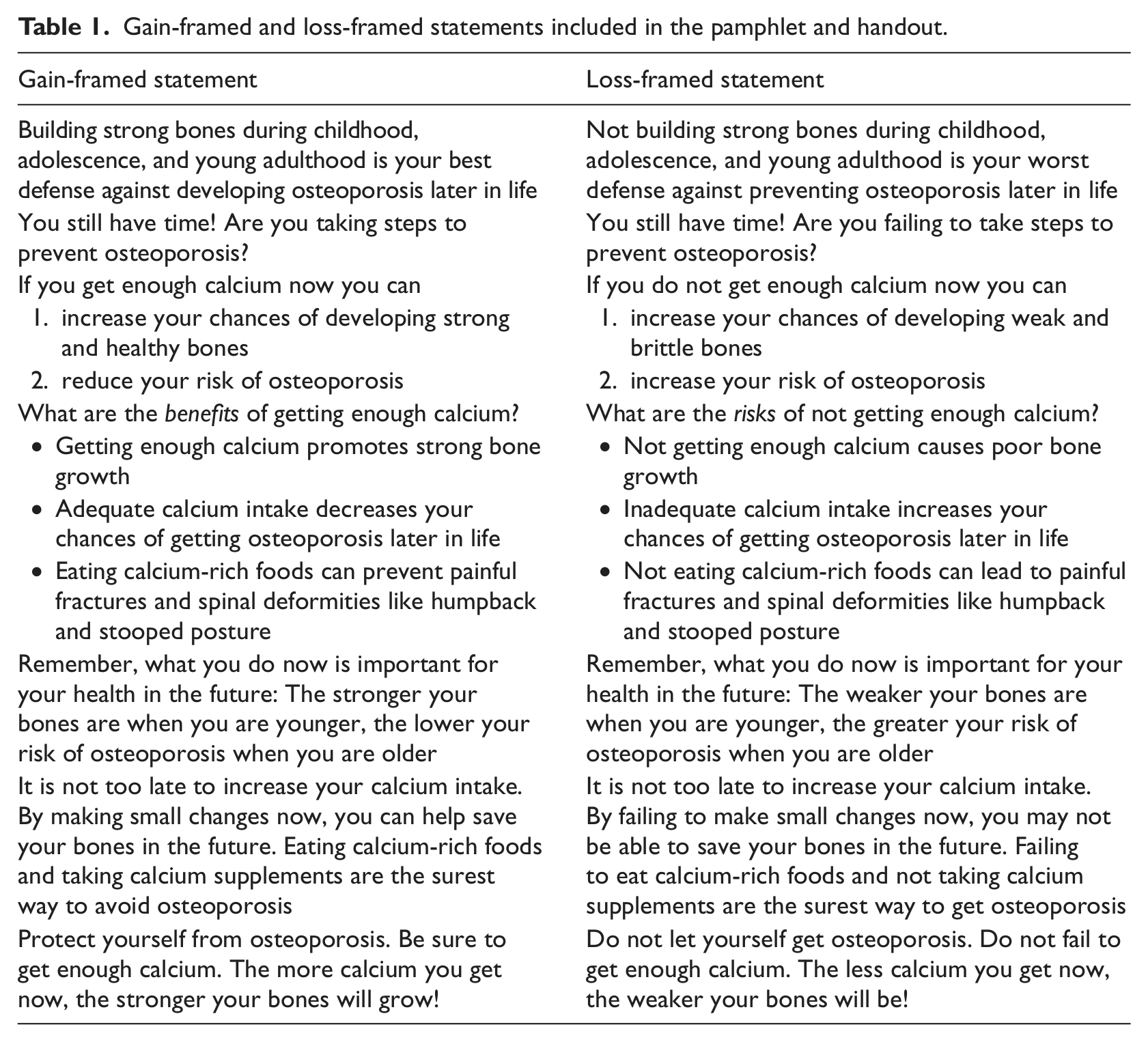
Participants were given 6 minutes to read a pamphlet titled “Osteoporosis: An important issue for young women’s health.” Independent of framing, both pamphlets provided a detailed description of osteoporosis along with its prevalence, consequences, symptoms, and risk factors. The remainder of the pamphlet discussed osteoporosis prevention via adequate calcium consumption using either gain-framed or loss-framed statements. Participants in the gain-framed condition read about the benefits of consuming calcium (“Getting enough calcium promotes strong bone growth”) whereas participants in the loss-framed condition read about the risks of not consuming calcium (“Not getting enough calcium causes poor bone growth”). See Table 1 for a complete list of gain-framed and loss-framed statements contained in the pamphlets.
Gain-framed and loss-framed statements included in the pamphlet and handout.
Measures
Motivational orientation
At baseline, motivational orientation was assessed with the 20-item BIS/BAS scales (Carver and White, 1994), rated on a 1 = disagree strongly to 6 = agree strongly scale. Coefficient α for the BIS (e.g. “I worry about making mistakes.”) and BAS (e.g. “I will go out of my way to get things I want.”) subscales were .78 and .87, respectively. Following Mann et al. (2004), we computed a measure of motivational orientation by subtracting participants’ BAS score from their BIS score (BIS − BAS) with higher scores representing a higher BIS orientation.
Daily calcium intake
At baseline and follow-up, participants reported their dietary behavior over the past month using a 55-item Food Frequency Questionnaire (FFQ) developed by Ilich et al. (1998). The FFQ is a reliable measure of dietary calcium consumption that has been validated against 3-day dietary records (Ilich et al., 1998). The questionnaire includes common foods and beverages—many of which contain large amounts of calcium—that are divided into six categories: fruits/vegetables (8 items), meat/beans (7 items), dairy (12 items), desserts/sweets (8 items), bread/grains (5 items), and combination/fast foods (15 items). A portion size (e.g. cup, ounce, or each) was given for each item, and participants reported whether they consumed each food or beverage on a daily, weekly, or monthly basis and how many portions they consumed. Participants were instructed not to count the same food more than once. Before completing the questionnaire, the experimenter presented several detailed examples and showed participants a one-cup measuring cup to help them estimate the portion size. A daily calcium intake score (mg/day) was calculated for each participant at baseline and follow-up.
Monthly calcium intake
At follow-up, participants completed five questions summarizing their dietary calcium intake behavior during the 1-month follow-up period: “I’ve tried to eat/drink more (a) calcium-rich foods, (b) calcium-rich beverages, (c) dairy products, (d) dark green leafy vegetables, and (e) calcium-fortified foods since session one of this experiment.” (1 = disagree strongly to 6 = agree strongly). The five items were combined into a composite (α = .86) to represent participants’ monthly calcium intake.
Calcium supplement behavior
At follow-up, participants completed two questions about their calcium supplement behavior during the 1-month follow-up period: “I’ve (a) tried to take and (b) purchased some kind of calcium supplement since session one of this experiment.” (1 = disagree strongly to 6 = agree strongly). The two items were combined into a composite (α = .88) to represent participants’ calcium supplement behavior over the past month.
Pamphlet evaluations and manipulation check
After reading the pamphlet, participants rated the extent to which they thought the pamphlet was interesting, easy to understand, and helpful (1 = disagree strongly to 6 = agree strongly). As a manipulation check, participants also rated the pamphlet’s relative emphasis on the benefits of getting enough calcium (6) versus the costs of not getting enough calcium (1).
Osteoporosis knowledge
Knowledge about osteoporosis was assessed with a 10-item true/false scale that was adapted from Anderson et al. (2005). Participants completed the knowledge scale before and after they read the pamphlet. Items centered on osteoporosis risk and protective factors and general facts about the disease (e.g. “Cigarette smoking can lead to osteoporosis” and “Osteoporosis is more common in women than in men.”). To discourage guessing, we included an “unsure” option. Knowledge summary scores were computed by assigning one point for each correct response and zero points for incorrect and “unsure” responses. Points were summed to create a knowledge summary score at pretest and posttest (maximum score = 10).
Statistical analyses
Our preliminary analyses included an attrition analysis, manipulation check analysis, and an examination of participants’ evaluations of the pamphlet by experimental condition. We used t-tests and chi-square analyses to compare participants who completed versus did not complete the follow-up on the following variables: demographic characteristics, calcium supplement use, daily calcium intake, motivational orientation, and rates of attrition by experimental condition. We conducted multiple regression analyses to assess the effects of the framing manipulation, motivational orientation (the BIS − BAS difference score), and their interaction on both the manipulation check item and pamphlet evaluations. We also compared participants’ osteoporosis knowledge scores before and after reading the pamphlet and examined whether differences were dependent on framing condition, motivational orientation, or their interaction using a mixed-model analysis of covariance (ANCOVA).
We tested our primary hypotheses with a series of multiple regression analyses in which each outcome variable (calcium supplement behavior, daily calcium intake, and monthly calcium intake) was predicted from framing condition (gain vs loss), motivational orientation, and their interaction. Significant interactions were probed following Aiken and West (1991).We also conducted two additional analyses in which we controlled for baseline values when predicting (a) calcium supplement behavior at follow-up and (b) daily calcium intake at follow-up. Two participants were excluded from the primary analyses because they reported extremely high calcium intake on the baseline FFQ (more than five standard deviations above the mean). Of note, the pattern of results is identical whether these two participants are included or excluded from the analysis.
Results
Attrition analysis
Of the 141 participants who completed the baseline session, 15 (11%) failed to complete the 1-month follow-up. Non-completers were similar to completers on all demographics (age, race, ethnicity, and year in college), calcium supplement use, daily calcium intake, osteoporosis knowledge, and motivational orientation. Comparable attrition rates were observed for participants in the gain (n = 5) versus loss-framed (n = 10) conditions, χ2 (1, N = 141) = 1.79, p = .181.
Manipulation check, pamphlet evaluations, and osteoporosis knowledge
As expected, participants in the gain-framed condition (M = 2.98, SD = 1.13), relative to the loss-framed condition (M = 2.34, SD = 1.25), reported that the pamphlet focused more on the benefits of getting enough calcium than on the costs of not getting enough calcium, β = −.27, p = .001, and partial r = −.28. Neither the main effect of motivational orientation nor the interaction was significant. We observed a significant framing condition by motivational orientation interaction on the extent to which participants found the pamphlet interesting, β = .24, p = .006, and partial r = .24. Follow-up analyses revealed that exposure to the gain-framed message (vs loss-framed) led relatively BAS-oriented participants to rate the pamphlet as significantly more interesting, β = −.23, p = .062, and partial r = −.16, whereas exposure to the loss-framed message (vs gain-framed) led relatively BIS-oriented individuals to rate the pamphlet as significantly more interesting, β = .25, p = .037, and partial r = .18. No effects were observed for the extent to which the pamphlet was rated as easy to understand or helpful. Participants in the gain-framed (M = 5.20, SD = 1.57) and loss-framed (M = 5.29, SD = 1.36) conditions had equivalent osteoporosis knowledge scores at baseline, t(1, 136) = −.348, p= .729. We observed a significant increase in osteoporosis knowledge from pretest (M = 5.25,SD = 1.46) to posttest (M = 8.88, SD = 0.84),F (1, 131) = 747.36, p < .001. The observed increase in osteoporosis knowledge did not vary by framing condition, motivational orientation, or the interaction of these terms.
Primary analyses
Calcium supplement behavior
We observed a significant framing condition by motivational orientation interaction on calcium supplement behavior, β = .29, p = .001, and partial r = .30 (see Figure 1). Neither the main effect of framing condition nor motivational orientation was significant. Follow-up analyses revealed that among relatively BAS-oriented individuals, exposure to the gain-framed message led to greater calcium supplement purchase and use than did exposure to the loss-framed message, β = −.31, p = .013, and partial r = −.23. The reverse pattern was observed for relatively BIS-oriented individuals such that exposure to the loss-framed message led to greater calcium supplement purchase and use than did exposure to the gain-framed message, β = .27, p = .032, and partial r = .20. The pattern of findings was identical when we controlled for baseline calcium supplement use.
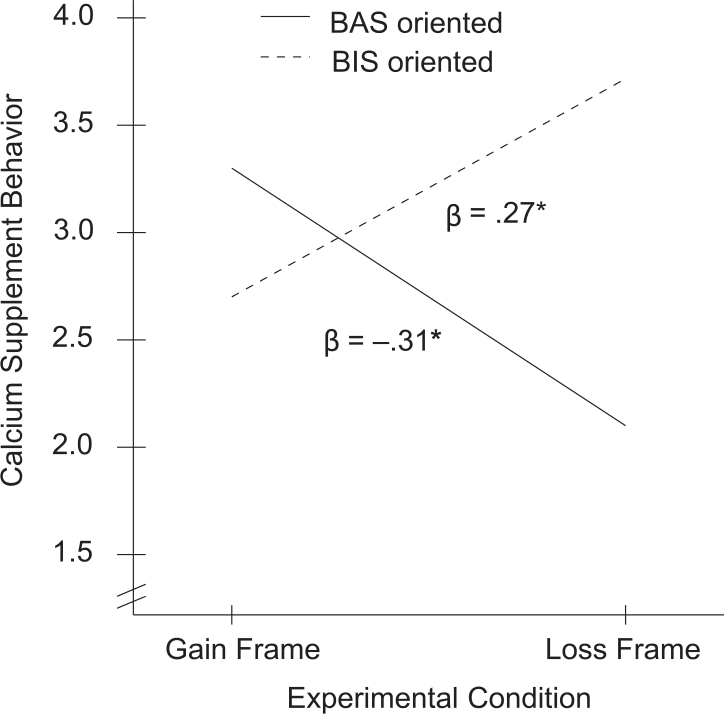
Effects of message frame and motivational orientation on calcium supplement behavior 1 month after exposure to the framing intervention. Among BAS-oriented participants, exposure to the gain-framed message led to higher supplement behavior than did exposure to the loss-framed message. Among BIS-oriented participants, exposure to the loss-framed message led to higher supplement behavior than did exposure to the gain-framed message. Standardized regression coefficients are reported.
Daily calcium intake
We observed a significant framing condition by motivational orientation interaction on daily calcium intake as assessed with the FFQ, β = .18, p = .039, and partial r = .18 (see Figure 2). Neither the main effect of framing condition nor motivational orientation was significant. Follow-up analyses indicated that exposure to the gain-framed message led to greater daily calcium intake than did exposure to the loss-framed message, but this effect was limited to relatively BAS-oriented individuals, β = −.26, p = .034, and partial r = −.18. Among relatively BIS-oriented individuals, no differences in daily calcium intake were observed for those exposed to the gain-framed versus loss-framed message, β = .10, p = .426, and partial r = .07. The pattern of findings was identical when we controlled for baseline daily calcium intake.
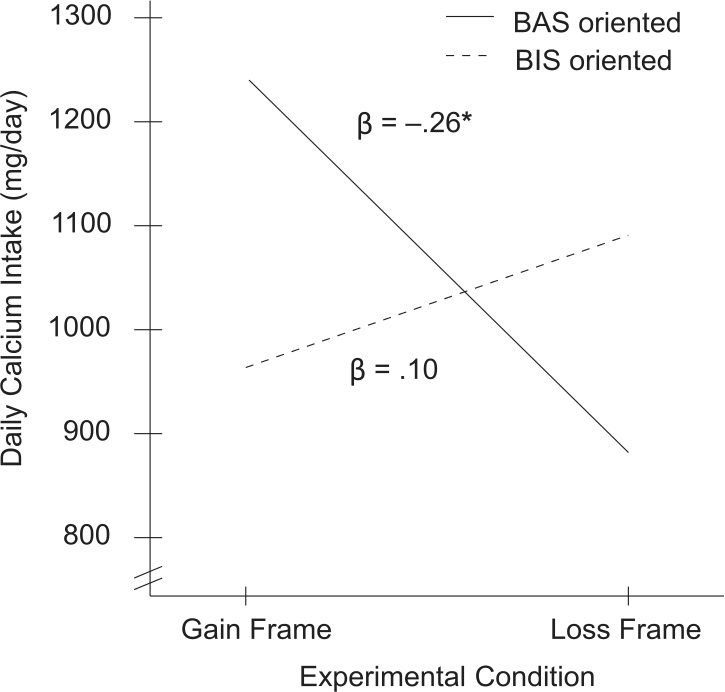
Effects of message frame and motivational orientation on daily calcium intake 1 month after exposure to the framing intervention. Among BAS-oriented participants, exposure to the gain-framed message led to higher daily calcium intake than did exposure to the loss-framed message. No effect of message frame was observed among BIS-oriented participants. Standardized regression coefficients are reported.
Monthly calcium intake
We observed a significant main effect of framing condition on monthly dietary calcium intake such exposure to the gain-framed message (compared to the loss-framed message) resulted in greater monthly calcium intake, β = −.21, p = .022, and partial r = −.21. This main effect, however, was qualified by a significant interaction between framing condition and motivational orientation, β = .19, p = .032, and partial r = .20 (see Figure 3). Follow-up analyses indicated that exposure to the gain-framed message led to higher monthly calcium intake than did exposure to the loss-framed message, but again this effect was limited to relatively BAS-oriented individuals, β = −.40, p = .002, and partial r = −.28. Among relatively BIS-oriented individuals, no differences in monthly calcium intake were observed for those exposed to the gain-framed versus loss-framed message, β = −.02, p = .889, and partial r = −.01.
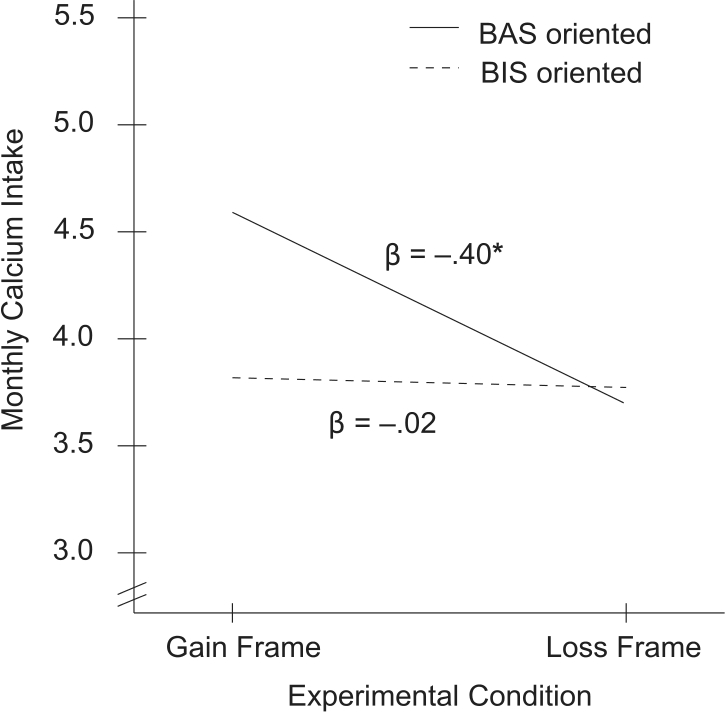
Effects of message frame and motivational orientation on monthly calcium intake 1 month after exposure to the framing intervention. Among BAS-oriented participants, exposure to the gain-framed message led to higher monthly calcium intake than did exposure to the loss-framed message. No effect of message frame was observed among BIS-oriented participants. Standardized regression coefficients are reported.
Discussion
The present findings suggest that the success of gain-framed versus loss-framed messages depends on the motivational orientation of the individual receiving the message. BIS/BAS motivational orientation moderated the effect of framed messages on young women’s calcium consumption behavior over the period of 1 month following exposure to the framing intervention. Although full support for the congruency effect was observed for calcium supplement behavior, the hypothesis received only partial support for dietary calcium intake. Of the studies demonstrating an interactive effect of message framing and BIS/BAS motivational orientation on health behavior, the current study is the first to examine a health behavior other than dental flossing and it includes the longest follow-up period.
The observed pattern of findings for calcium supplement behavior provides strong support for the congruency effect. As predicted, BAS-oriented individuals reported higher calcium supplement behavior when exposed to a gain-framed message (as compared to a loss-framed message) and BIS-oriented participants reported higher calcium supplement behavior when exposed to a loss-framed message (as compared to a gain-framed message). Along with the previous research (Mann et al., 2004; Sherman et al., 2006), these findings suggest that matching a framed appeal to the message recipient’s general motivational style is more likely to prompt health behavior than when the two are mismatched.
In contrast, only partial support for the congruency effect was found for dietary calcium behavior. For both measures of dietary calcium intake, exposure to a gain-framed (vs loss-framed) message resulted in greater dietary calcium intake for BAS-oriented individuals, but gain-framed and loss-framed messages were equally effective in promoting dietary calcium intake among BIS-oriented individuals. This pattern of findings is partially consistent with both the Rothman and Salovey (1997) and congruency effect perspectives (Mann et al., 2004; Sherman et al., 2006). The framework proposed by Rothman and Salovey would predict a gain-framed advantage because eating a calcium-rich diet is a preventive health behavior that is generally associated with construals of safety and certainty. The congruency effect perspective would predict that this gain-framed advantage should be seen only among people with a BAS-oriented motivational style. Indeed, this moderating effect was observed in the current study. Yet, the congruency perspective would also predict a loss-framed advantage among BIS-oriented individuals; this portion of the prediction was not supported.
Why did we find only partial support for the congruency effect for dietary calcium intake but full support for supplement behavior? One possibility is that taking a supplement is a more intentional and specific method of increasing calcium intake relative to dietary behavior, which could reflect a variety of goals beyond calcium consumption (e.g. general nutrition and wanting to lose or maintain weight). Those additional goals could obscure effects of message framing and motivational orientation while, conversely, effects may be more pronounced for health behaviors governed by a specific goal targeted in the message. Another possibility could stem from differences in how the two behaviors (healthy eating versus taking a supplement) are typically construed (Rothman et al., 2008; Rothman and Updegraff, 2011). By construals, we mean people’s beliefs about the safety/risk and certainty/uncertainty of the health behavior advocated in the message. When strong construals about a behavior are present, the effectiveness of framed messages may depend primarily on the type of behavior in the message, as outlined by Rothman and Salovey (1997). In contrast, for behaviors that do not elicit strong construals, framing effects may depend primarily on the motivational orientation of the message recipient (Rothman and Updegraff, 2011).
Although both healthy eating and taking supplements are preventive health behaviors, the strength of people’s construals of these two behaviors may differ. Because eating is such a familiar behavior, people may strongly construe eating a high calcium diet as relatively safe and risk-free. On the other hand, because people may be less familiar with taking supplements (relative to eating healthy foods), the behavior of taking a calcium supplement may be less likely to generate strong construals of safety versus risk. The absence of such construals may leave greater room for motivational orientation to influence framing effects (Rothman and Updegraff, 2011).
Some evidence for this reasoning comes from a study by Latimer et al. (2008), whose data closely resemble our findings for dietary calcium intake. Latimer et al. (2008) found that exposure to a promotion-focused message (similar to a gain-framed message) led to greater rates of physical activity at 2-week follow-up than did exposure to a prevention-focused (loss-framed) message, but this advantage was observed only among promotion-oriented individuals (i.e. individuals oriented toward accomplishment and positive outcomes). Prevention-focused and promotion-focused messages were equally effective in promoting physical activity among prevention-oriented individuals (i.e. individuals oriented toward security needs and negative outcomes). Like physical activity, people may associate eating a high calcium diet with safety and certainty (Rothman et al., 2008). If such construals are salient, people’s responses to gain-framed versus loss-framed appeals may depend to a larger extent on those construals than their motivational orientation. Because we did not assess women’s perceptions of eating a calcium-rich diet and calcium supplement use, we can only speculate about the role of construals. Further research is needed to understand when construals of the behavior versus motivational orientation are more influential in determining the effectiveness of gain-framed and loss-framed messages.
Findings from the present study have important implications for interventions aimed at increasing calcium intake in adolescent and young adult women. Tailoring a health promotion message to the motivational orientation of the message recipient could serve to boost the impact of the message, particularly when frame of the message and the motivational orientation of the message recipient are congruent with one another. This may be especially important for those interventions focused on the use of dietary supplements for increasing the calcium consumption. Findings from a recent study by Jung et al. (2011) suggest that in addition to manipulating the frame of the message, highlighting the consequences of adequate calcium intake for outcomes beyond health (e.g. appearance and physique) may be a particularly effective strategy for promoting calcium intake in this population. In addition to diet and supplements, osteoporosis interventions can also stress the importance of weight-bearing exercise for healthy bone development and maintenance (Schmiege et al., 2007). Overall, findings from the present study provide additional evidence for the efficacy of tailored health communications in promoting health behavior (Noar et al., 2007).
Limitations of the present study provide useful directions for the future research. First, although the follow-up period was longer than many framing studies, 1 month is nevertheless a relatively short time frame, particularly for a preventive health behavior like calcium consumption, which should be engaged in regularly on a long-term basis. Future studies with longer follow-up periods are needed to examine the long-term effects of framing and motivational orientation on health behavior. Second, our indicators of calcium consumption relied on self-reported measures. Third, the study included adolescent and young adult women attending college, and thus, generalizability of the findings may be limited. Fourth, a broader limitation of this research is that we examined only one preventive health behavior. To assess the extent to which dispositional factors such as motivational orientation are responsible for framing effects, future research should examine a range of health behaviors, including disease detection and screening behaviors. Fifth, we did not examine the mediators of the observed effects. Additional research is needed to identify mechanisms underlying the message framing effects.
In closing, although evidence is emerging for the important moderating role of motivational orientation on message framing effects, the majority of this research has centered on a single health behavior and used a relatively short follow-up period. Findings from the present study provide further support for the congruency effect in the domain of osteoporosis prevention behavior. Effects of gain-framed versus loss-framed messages depended on the motivational orientation of the message recipient such that stronger effects were observed when message frame matched participants’ motivational orientation. Furthermore, results held as long as1 month after exposure to the framing intervention. Findings suggest that motivational orientation plays an important role in determining the effectiveness of framed health messages. Further research is needed to more fully understand when these effects are most likely to occur.
Footnotes
Acknowledgements
We thank the members of the Women’s Health research team (Niki Acosta, Christine De Jesus, Megan Ranger, Jennifer Santacruz, Brittany Schubert, Jenna Tew, and Cecilia Wilson) for their assistance with data collection and Saira Bari for her help with data preparation.
Funding
This research received no specific grant from any funding agency in the public, commercial, or not-for-profit sectors.