






Abstract
In this article, we present an idiographic analysis of a couple’s experience of living and coming to terms with age-related macular degeneration. Interpretative phenomenological analysis was used to explore three joint interviews, conducted over an 18-month period, with a married couple (aged 82 and 77 years) both living with age-related macular degeneration. Three themes are discussed: the disruption of vision impairment, managing mutual deterioration and resilience through togetherness. We discuss the existential challenges of vision impairment and consider the applicability of Galvin and Todres’ typology of well-being as a means of understanding well-being in older adults.
Keywords
Introduction
Age-related macular degeneration (AMD) is the leading cause of blindness in old age in the developed world (Bunce and Wormald, 2006). Cases are expected to increase by 50 per cent to 2.95 million worldwide by 2020 (Friedman et al., 2004). There are two types of AMD, dry and wet. Dry AMD is most common and involves a slow deterioration of vision, while wet AMD, without treatment, can quickly result in severe vision loss. Degradation of central vision resulting from AMD can be both disabling and distressing (Bennion, Shaw and Gibson, 2012).
Previous research has identified links between AMD and decreased quality of life (e.g. Mitchell et al., 2008), increased prevalence of depression (Brody et al., 2001) and disruption of activities of daily living (Cahill et al., 2005). Despite these impacts, health-care professionals (HCPs) and members of the general public can greatly underestimate the impact of AMD on health-related quality of life and well-being (Stein et al., 2003). In addition, clinician–patient communication and patient awareness of non-medical support are poor (Burton, Shaw and Gibson, 2013), and current practice guidelines produced by the Royal College of Ophthalmologists (2009) offer little detail on how patients might be supported in living with AMD long term.
The majority of well-being research is individualistic, with little attention paid to patients’ familial or environmental context. One environmental aspect that may aid AMD patients’ well-being is involvement in supportive relationships which can help buffer the negative impact of stressors in later life (Bookwala, 2011). This is supported by evidence that married older adults have better quality of life than their unmarried counterparts (e.g. Bookwala and Fekete, 2009). However, there is a paucity of research using a couple – or dyad – as the unit of study (Benyamini et al., 2009; Koren, 2011; Shepperd et al., 2010). The experience of couples with vision loss is particularly important given that vision impairment in one partner can impact the other’s health and well-being irrespective of their own vision ability (Strawbridge et al., 2007).
Galvin and Todres (2011) challenge the dominant deficit model of ageing and argue that well-being is a complex phenomenon involving the interplay of many aspects of a patient’s life, not just the absence of illness. They propose a conceptual framework to illustrate the multiplicity of kinds of well-being drawing on Heidegger’s (1962/1927) ontological writings on homelessness and homecoming. The framework is structured around two factors which make up the experience of well-being; dwelling (feeling at home with what has been given) and mobility (the feeling of possibility and a sense of adventure; Todres and Galvin, 2010) and the six phenomenological–philosophical lifeworld constituents that make up human experience (spatiality, temporality, intersubjectivity, mood, identity and embodiment). Todres and Galvin (2010) emphasize the interwoven relationship between well-being and the lifeworld:
When dwelling is experienced in a spatial way, one has a sense of being at home; when mobility is experienced in a spatial way, one has a sense of adventure. When dwelling is experienced in a temporal way, there is a sense of being grounded in the present moment; when mobility is experienced in a temporal way, there is a sense of temporal ‘flow’ and forward movement. (p. 5)
Therefore, the deepest possibility of well-being involves a paradoxical unity of dwelling and mobility (Dwelling–Mobility) in which an individual feels both at home with what has been given and experiences the opportunity of exploring new existential possibilities. This is supported by Koren’s (2011) work illustrating that well-being is related to the simultaneous occurrence of change and continuity as we age (Koren, 2011).
In this article, we follow Koren (2011) and Galvin and Todres (2011) in taking a holistic and multifaceted approach to well-being. We investigate the experiences of an older couple living together with AMD and explore how Galvin and Todres’ (2011) conceptual framework can be used to make sense of their experiences. We then go on to consider how this new understanding could be applied to improve clinical practice.
Method
Design
To preserve the depth of experience, we adopt a case study design using joint interviews over time (Allan, 1980; Arskey, 1996) and interpretative phenomenological analysis (IPA; Smith et al., 2009). The idiographic analysis of a case study offers concrete, context-rich knowledge which is better suited to research questions which demand the exploration of nuance, fluidity of meaning-making and a changing sense of identity in a particular context (Flyvberg, 2006).
We worked within a hermeneutic phenomenological framework (Heidegger, 1962/1927; Smith et al., 2009). Heidegger argued that we are thrown into the world and must learn to live within the constraints of it. This means our analysis was led by an interest in the historical and social context of people’s lived experience, their interpersonal relationships, the fluidity of time and our ‘being-toward-death’, for example, coming to terms with our own mortality.
Participants
This case study was selected as a ‘critical case’ (Flyvberg, 2006) from a larger mixed method study investigating the impact of AMD on quality of life (Burton, 2013). Across the larger sample, we had observed the significance of patients’ living circumstances in how they managed AMD; those who lived alone struggled and sometimes felt socially isolated. We therefore wanted to explore in-depth the experience of those living with a partner. Jack and Sally were selected as a critical case as they were the only couple in the sample who both had AMD.
Jack and Sally were both White British and had been married 60 years. Jack, aged 82 years, had been diagnosed with dry AMD in one eye and wet AMD in the other which had become a scar. His wife, Sally, aged 77 years, had been diagnosed with dry AMD since the age of 55, but had recently been told at clinic that her vision had deteriorated significantly. Both had co-morbidities – Jack was diagnosed with chronic obstructive pulmonary disease (COPD) and Sally with diabetes, osteoporosis and glaucoma.
Data collection
We interviewed the couple in their home three times: soon after Jack’s diagnosis, after 9 months and after 18 months. Interviews lasted 1–2 hours, were audio-recorded and transcribed verbatim. Questions were open ended to investigate the complexity of the couple’s experience. We asked about the following: diagnosis, daily activities, relationships and thoughts about the future (for example: ‘tell me about when you were diagnosed’, ‘What would you do in a typical week?’, ‘What do you think things will be like in the future?’). Follow-up interviews began as follows: ‘how have things been since the last time we met?’ to ensure interviews were led by participants’ perceptions and concerns.
Data analysis
IPA (Smith et al., 2009) was employed with the dyad as the unit of analysis. The joint interviews were analysed as a co-constructed account because they told one meshed together story of the couples’ life together (i.e. often finishing each other’s sentences).
Preliminary analysis of the initial interview was undertaken before conducting the second and third which meant specifics in Jack and Sally’s account could be examined again at 9 and 18 months. Themes identified in later interviews were added to those established from the first to develop the themes. Several iterations of themes across interviews were discussed within the research team in order to develop the final super-ordinate themes. We used Yardley’s (2000) criteria to judge the quality of this empirical work.
Ethics
Ethical approval for this research was granted by a University Ethics Committee and the relevant National Health Service (NHS) Ethics Committee.
Results
Here, we present three themes: the disruption of vision impairment, managing mutual deterioration and resilience through togetherness.
‘It chops your life in half’: the disruption of vision impairment
In this theme, we see Jack and Sally trying to make sense of the impact of AMD. Sally struggled to make sense of AMD as an age-related condition because she was diagnosed so young (at 55 years) and perhaps because of this, as she aged, she could not distinguish between AMD and what we might call ‘normative ageing’. ‘[T]his macular degeneration’ did not exist in Sally’s consciousness as something discernible from the ageing process per se and the identification of a diagnosed condition as the cause of her vision impairment did not help her make sense of it:
But a lot of people we meet, they’re all in the same position. Because when I had this macular degeneration, I’d never heard of it. I suppose it’s what they used to call old age years ago. They didn’t give it a name, not to people anyway.
We expect too much, don’t we, really? (Interview 1)
Jack’s response revealed cynicism to the promised progress of medical science. The introduction of a diagnosed condition brought with it hope of a cure, yet Jack had been told treatment would not cure it (‘They said it won’t cure it but it’ll stop it getting worse’). Perhaps knowing the effects of AMD cannot be reversed is what makes this couple assume the condition to be something indistinguishable from ageing. Hence, if we expect things to improve, we are expecting too much. In this way, Jack was attempting to accept his condition and its implications, but there was a sense in this first interview that he was not ready to do that. Sally identified why: frustration:
[to Jack] I think frustration is one of the biggest things, isn’t it? You get really mad at yourself, you know, that you can’t do these things. (Interview 1)
Sally’s frustration was directed at inabilities which threatened her sense of self because she was unable to continue to do previously taken-for-granted activities. For example, Sally described having kept a cashbook to manage the household finances and keep her brain active, but had to give it up due to poor vision. Jack directed his frustration at the vision aids supplied to help manage everyday tasks:
Well, everything seems more difficult. Like, we’ve got so many things with batteries in for a start.
Oh yes.
You know? If you’ve got to put a battery in anything, you can’t see inside the …
I mean, even the magnifying glasses have got a battery in. So you’ve got to get another one. (Interview 1)
Aids such as magnifying glasses should help the couple to put their vision impairment to the back of their minds and maintain coherent senses of self through engaging with activities they had always enjoyed. Instead, at this first interview, the presence of AMD had disrupted the flow of their everyday lives and forced itself to the forefront of their minds.
Despite the frustration described, stoicism was evident in their co-constructed reality. Instead of allowing loss and frustration to dominate, they kept things in perspective by comparing themselves to others:
I don’t say we worry. It’s not on our mind all the while.
You just have to think well we’re not the only ones. There are people a lot worse off. (Interview 1)
Jack was keen to stress that AMD did not dominate their lives, but it is difficult to accept this statement at face value as in interview 3 Jack suggested that having AMD ‘chops your life in half’. This phrase shone through in analysis and illustrated how AMD had infiltrated all aspects of their lives and had challenged their senses of self by revealing their inadequacies. The couple attempted to rationalize this by attributing these inadequacies to the ageing process, something they could not change (Jack: ‘It’s not so much my vision, more because of my age really’). This presented the opportunity for coherence through the maintenance of an ‘ageing self’ rather than submitting to a passive ‘sick-role’ (Parsons, 1951).
Managing mutual deterioration
Despite the difficulties caused by AMD, Jack and Sally continued to display autonomy. They described a typical week which demonstrated how they shared out tasks and where they sought support:
Well, we do a bit of, Monday starts off with me going shopping while Sally gets the dinner [ready]. And Tuesday …
It’s wash day.
My daughter does the washing and Sally does the drying […]
And I had two lots of, when, I was in hospital for a quite a bit wasn’t I?
Yeah.
And so my daughter did it. She does it twice a week for us. But I, I’ve got a dryer and I do a bit of hand washing.
I do the hand washing.
Oh, he does the hand washing, yes. Wednesday is our quietest day, isn’t it?
Yes.
Thursday, hairdresser comes. Friday, a lady comes and does some vacuuming for us. And does the kitchen and toilet.
You have to move out of the way.
Saturday is another wash day. Sunday is a proper …
Dinner, roast …
Dinner. Mind you. We can’t eat a big full dinner every day, like we used to. (Interview 1)
Even though this extract illustrates the couple’s ability to plan and take charge of household duties, their description felt monotonous and dull. There was no reference to enjoyment or social engagement and this felt symptomatic of enforced changes to their life as a result of AMD and their co-morbidities.
There was a coexistence of autonomy, dependency and increasing disabilities in this couple’s account. These competing forces continued to ebb and flow throughout the course of the 18 months when these interviews took place. One example of this was Jack’s account of his interactions with his ophthalmologist:
They keep saying if it gets any worse, go to the A&E, well I don’t want to just go and see anybody, I want to see people in the proper places. So if I wanted to go the only way round it is to ask my doctor to refer me back to them, but it seems, it seems, what annoys me is Sally gets an appointment every so often to see the doctor and I don’t! […]
But I’ve told him when he sees the optician this week to try and see if he can see the doctor every so often like I do.
I feel as though really, like Sally might feel as though she’s getting some attention, but I’m not getting none. (Interview 2)
Jack’s dissatisfaction appeared to arise from a misunderstanding of his condition – there was a possibility that the dry AMD in Jack’s second eye could become wet, which if not identified and treated quickly could lead to a second scarred macula, and consequently severely impaired vision in both eyes. In such situations, patients are told that if they notice a worsening of vision to go to the emergency department at hospital to get fast-tracked for treatment. Clearly, this message was either not conveyed in his consultation or not received by Jack, which led to this confusion. This example illustrates another source of frustration for Jack – his frame of reference in which to make sense of the information he received from the clinical team was Sally’s experience. Sally’s co-morbidities (particularly diabetes which may also lead to vision impairment) made her eligible for regular check-ups, which left Jack feeling neglected and uncared-for (‘I am diagnosing myself, in a way’). Jack’s application of his understanding of Sally’s AMD to his own meant he did not challenge or seek additional information about his condition and as a result he came away without the full story. This may not be related to age, many of us will have experienced similar frustration on leaving a situation and thinking of the perfect question or comment several hours later. However, to Jack, it was another symbol of his depleting agency.
Similarly, Sally described a situation which revealed her struggle with depleting agency. After agreeing to pay by monthly installments for her gas supply, Sally noticed an error on the bill (‘I looked at the bill and I thought it was £65, when I looked again £650, well I knew that possibly […] Couldn’t be right, and so I had to, I rang them up and told them and they did send someone Friday, and it was definitely way out’); instead of having confidence in this observation she revealed a feeling of self-doubt (‘I’d probably worry a bit more about things like that, otherwise I wouldn’t have let that, I’d have known I was right and that was it’). As she described, the experience she began to realize that her independence may be under threat. Sally’s faith in her ability to make sense of the finances was now dependent on her ability to trust her senses; something she no longer felt able to do. This was a feeling with which Jack could empathize (‘you start to get unsure of everything’). Such thinking was unwelcome and felt incongruous.
There were other signs of an increasing awareness of challenges to their independence (Jack: ‘I worry about shopping and it, just managing the basic things you know? I don’t think any farther than that really’). When thinking about such matters across the interviews, Jack’s use of humour was a self-confessed coping mechanism.:
If you really took it on board and let it get you, you would really feel very sad. […] You know, you’ve got to have a terrific sense of humour, to offset it really. (Interview 2)
The banality of everyday life seems to have been overtaken by a feeling that everything is a struggle and instead of ‘just tak[ing] it in your stride’ like they did ‘at one time’ (Sally) it has become a source of concern. Like the use of humour another source of solace this couple had was each other.
‘We’ve never really gone anywhere separate have we?’: resilience through togetherness
Throughout, we have seen Jack and Sally’s talk merge into one account illustrating that their experience of AMD is a joint one. They use ‘we’ more than ‘I’, complete each other’s sentences, and empathize with each other’s feelings. One example of this interdependence was illustrated in the way that Sally’s immobility meant that Jack did the shopping, while she focused on tasks within the home like managing meals and writing the shopping list. Since requiring the magnifying glass to read, they joked about needing an extra pair of hands to keep hold of everything and be able to read the shopping list:
And I do try to write things, but when we’ve written things down we can’t see what we’ve wrote! I write the shopping list, but he has to take the magnifying glass, that means when he goes around the supermarket he’s got the supermarket trolley, the shopping trolley, the shopping list and the magnifying glass …
And a thing to tick them off (S: laughs) I’m like an octopus (laughs). (Interview 2)
This again illustrates the humour this couple used perhaps to make light of their disabilities and prevent them from dominating their world, or perhaps to keep despair at bay, as we saw above with Jack. Another key source of positivity was the comfort Jack and Sally found in each other:
You know I was, well what’s everybody worrying about, you know? But now, now it seems to come on really, it’s a lot more difficult. […] but I think you realise that that’s it isn’t it really? (S: well) I don’t seem to do anything (inaudible).
We are not on our own so. (Interview 2)
Over time, Jack’s AMD had progressed and his central vision had become severely impaired which made everyday tasks more difficult. Jack began to realize that he had passed the point of no return, as there was no cure, which made him think, ‘that’s it’, the end. Sally’s interjection (‘well’) seemed to signify a more positive outlook. This may be because she had lived with AMD for many years and had been able to come to terms with its implications over time. In her response, Sally’s position appeared to be that she could deal with anything so long as she was not alone. Having lived all their adult lives together, Jack and Sally’s identities had been knitted together illustrating the importance of understanding older adults’ experience of living with long-term conditions within the context of home life, the interdependence between partners and the impact of co-morbidities.
Sharing their experience of living with AMD and of ageing over the years seemed to fit their story of togetherness. However, this was not always straightforward because as we have seen, their different diagnoses of AMD challenged their understanding of each other and their shared experience. One advantage of both having AMD was that they were both able to benefit from Jack’s experience. At the earlier interviews, the couple had not considered registering as partially sighted because Sally was under the impression that it would not do anything for them. By the third interview, both had registered:
We are both on the partially blind register now. […] they asked me a long time ago to be registered, and I said, ‘well is there any point?’ and they said ‘no’, but since he was registered he’s been … they’ve helped him, given him a white stick and they’ve given him a watch he can see and he’s got a code to ring [telephone service provider] unless we can’t see to get a number. (Interview 3)
This extract is reminiscent of Jack’s dissatisfaction with the clinical team: Sally based her refusal to register partially sighted on the memory of an interaction with a HCP years ago. It may have been true that there was little benefit 20 years ago when Sally was first diagnosed with AMD, but it was surprising that even with her regular check-ups that she had not been advised or taken advice to register until Jack did it first. Nevertheless, taking this step had led to an intervention which to Sally’s mind had ‘helped’ Jack and perhaps afforded him the luxury of looking forward to the future rather than thinking ‘that’s it’.
The central purpose of this theme was to pull together the facets of this couple’s account which emphasized their resilience through togetherness. Doing this also brought to light the eventuality of them not being together anymore:
When one of us dies, I think it will, when you’re the two of you together, but I should hate to be without Jack and I think he’d hate to be without me wouldn’t you?
Not worried about you the pension will go! (laughs) (S: laughs) That’s why you’ve got to keep living to draw your pension.
Hang about, we should miss one another’s company I mean, I mean we’ve been married 60 years this year, so and it’s a long time.
Yes, I suppose it’s a bit of a mistake in a way, but we’ve never really gone anywhere separate have we? (Interview 2)
Beginning to contemplate life alone was uncomfortable. Sally struggled to complete her thoughts about life apart (‘I think it will …’ what? And ‘when you’re the two of you together …’ you’re what?); she settled for hating the idea of being without Jack. In comparison, Jack again used humour to avoid imagining life without Sally. Nevertheless, he then revealed the depth of his connection to his wife with a sentiment which absolutely crystallized their sense of togetherness: ‘we’ve never really gone anywhere separate have we?’ Throughout their life together, Jack and Sally acted as one unit, which could be considered ‘a bit of a mistake’ perhaps because it did not prepare them for life alone. Yet rather than error or regret, Jack’s statement is filled with love for his wife, signified by his offer to Sally to confirm it (‘have we?’).
In summary, these findings have provided insight into Jack and Sally’s experience of living together with AMD. We have seen how vision impairment can disrupt a couple’s everyday lived experience by forcing them to develop new ways of dealing with previously taken-for-granted tasks in order to maintain a sense of well-being. Managing mutual deterioration in vision proved challenging for this couple; however, we saw that Jack and Sally found solace in their togetherness. Despite this their lives were intertwined and impossible to separate, which led to fears for a future alone with AMD.
Discussion
This case study has demonstrated the need to understand people’s lived experience of health and illness within the social networks in which they live (Charmaz, 1991). There were protective effects of marriage in old age for this couple which confirmed previous research findings (e.g. Bookwala, 2011; Bookwala and Fekete, 2009; Koren, 2011). Practical and emotional support for each other meant they were able to share the load of living with AMD which worked to protect them, to some extent, against the debilitating effects of isolation and loneliness (Cornwell and Waite, 2009). However, Jack and Sally told a story of isolated togetherness in which they were dependent on each other.
A blanket attribution of negative connotations to change as we age perpetuates the deficit model of ageing and prevents us from exploring possibilities for positive change. Koren’s (2011) notion of continuity, maintenance of the status quo, may seem appealing to older adults, but emphasizes what is lost rather than what might be gained through moving forward in a different way and embracing change. Attaching these concepts of change and continuity to different experiential domains within Galvin and Todres’ (2011) well-being framework (see Table 1) helps us to make sense of Jack and Sally’s experience of living together with AMD.
‘Dwelling–Mobility’ lattice adapted from Galvin and Todres (2011).
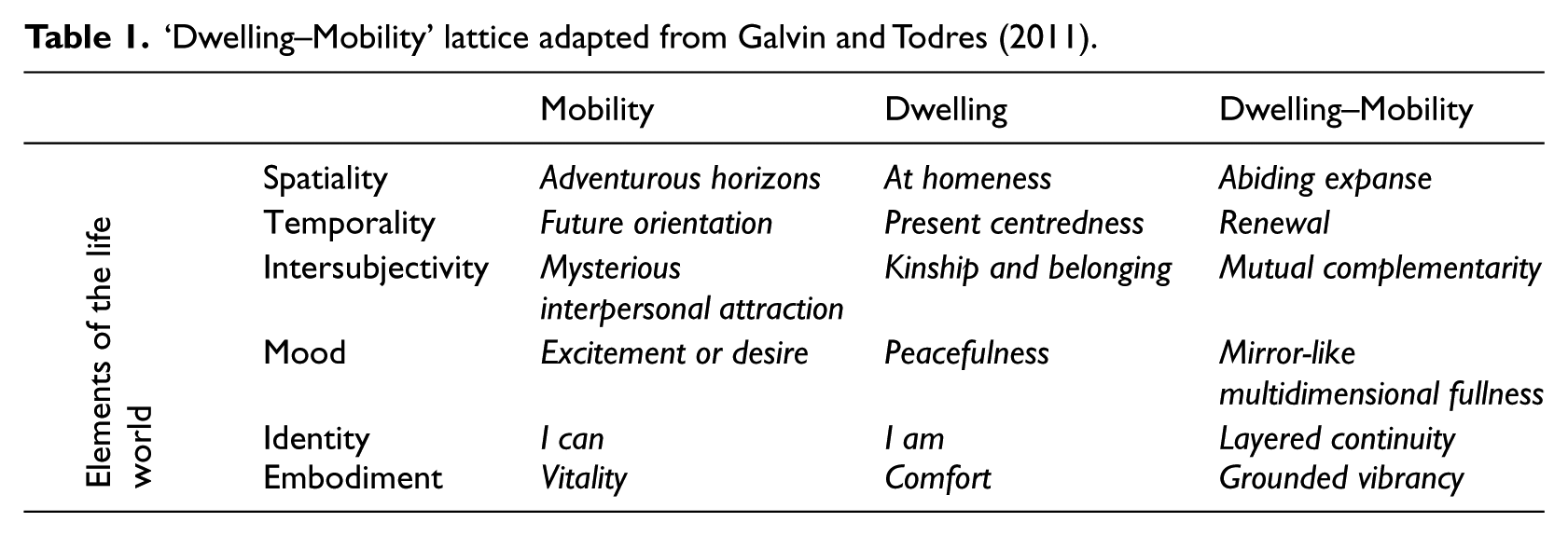
We can relate the couple’s account to various elements within the typology. Sally described a spatial sense of ‘at homeness’ brought about by the feelings of continuity afforded by her lifelong relationship with Jack. It is evident that if Sally lost Jack the sense of well-being this afforded would also be lost. In addition, in terms of temporality, there was an overwhelming sense of present centredness within the couples’ account and apprehension about the future for fear of increasing disability. Well-being in terms of a positive future orientation was therefore profoundly challenging for them. However, the stress this caused was eased by their intersubjectivity; the kinship Jack and Sally felt was the central source of their peaceful mood. There were also clear signs of mutual complementarity as while their togetherness signified a deep loving bond, their difference meant they could complement each other and often did in terms of their household chores and also in Jack’s potential to focus on frustration while Sally appeared more optimistic. These issues highlight the risk to well-being which comes with bereavement and separation. Ensuring support is provided to patients at this life transition should be a priority for professionals working with all older people.
Jack’s experience of support, in terms of provision of low vision services, illustrates how services can provide opportunities for mobility in the form of adventurous horizons. Facilitating new ways of living beneficial to well-being can be achieved by expanding patients’ horizons. For example, once registered partially sighted Jack was given a white stick and a new watch which helped him navigate the world around him.
In terms of identity, the couple’s account was dominated by ‘I can’t’ rather than ‘I can’. This issue, not uncommon in older people with sensory loss, could be addressed by counselling services designed to enhance individuals’ sense of self-efficacy through setting small relevant goals and building up to a feeling of ‘I can’ in place of ‘I can’t’.
In terms of their embodied experience of well-being, Sally’s account offered more potential for grounded vibrancy; she had lived with AMD and restricted mobility for some time and seemed to be at peace as well as open to future possibilities. In contrast, Jack’s lack of bodily well-being was symbolized by a feeling of discomfort which emphasized his ‘homelessness’ in relation to coming to terms with his condition. Indeed, Jack’s experience of living with AMD is fairly represented by Toombs’ definition of illness as ‘a state of dis-harmony, dis-equilibrium, dis-ability, and dis-ease which incorporates a loss of the familiar world’ (1993: 96).
Implications for practice
The couple was uncertain about the differences between their clinic appointments with HCPs, the possibilities of dry AMD becoming wet and about the benefits of registering partially sighted. These misconceptions highlight the potential for wet AMD to be missed and left untreated and years’ postponement in seeking non-medical support. Declining support because it is tantamount to defeat and dependence is not uncommon among older adults (e.g. Ells, 2001). Society’s unchallenged view of dependency as the antithesis of autonomy (Fine and Glendenning, 2005) has meant that older adults living with disabilities view themselves as weak if they seek support because it destroys their sense of agency. From Galvin and Todres’ (2011) typology of well-being and Koren’s (2011) continuity-change continuum, we have learned that multiple, layered identities exist and that positive–negative attributions are unhelpful for making sense of the ambiguity experienced in older age. Jack and Sally displayed decisional autonomy and maintained a level of independence but were reticent about handing over executional autonomy to others.
The Royal College of Ophthalmologists (2009) guidelines focus on making a clear diagnosis and communicating treatment options. HCPs are asked to inform patients of interventions which might help them come to terms with their vision loss, retain independence and improve their well-being and quality-of-life. The guidance also suggests that emotional support or counselling options should be offered. However, Jack and Sally exhibited lack of awareness of non-medical support available to them. Failure to adequately adhere to guidelines may result from stretched resources (i.e. time) within NHS practices and discontinuity in services which are spread across sectors. In the United Kingdom, the NHS provides ophthalmology clinics to which patients are usually referred by private high street optometrists. In addition, there are a variety of third-sector organizations offering support (i.e. Royal National Institute of Blind People; RNIB). This disparate source of non-medical support means that patients need to be proactive in seeking it, but it also means they cannot access aids and support to which they may be entitled if they have not been informed about them. Thus, without a coordinated and accessible formalized network of information, people living long term with AMD may struggle in isolation.
Limitations
The case study has been criticized because it cannot be used to make generalizations to the population. This criticism wrongly assumes a nomothetic stance to be the only option for science. Nomothetic research depends on representative samples to make predictions based on hypotheses tested; idiography enables rigorous analysis of data at the individual level leading to conceptual generalization (Yardley, 2000) and transferability (Lincoln and Guba, 1985), and both are needed in the study of human behaviour (Harre, 1984). The idiographic analysis of a case study offers concrete, context-rich knowledge (Flyvberg, 2006). It also allows an in-depth analysis of the historical and social context of the lived experience of AMD, that is, how a couple adapts to AMD within the restricted freedom of their socio-cultural situation (Spinelli, 1989).
Concluding remarks
This case study has identified a potential gap in the communication between AMD patients and HCPs; messages might not have been received as intended. We have also identified a lack of awareness and postponement of support seeking which might have been prevented. While these experiences themselves might differ for other individuals, these data suggest that improvements in how AMD is diagnosed and support offered are needed. In addition, through this in-depth lifeworld-led analysis of a couple’s experience of ageing with AMD, we have been able to experiment with a new typology which promises a holistic and experience-contingent explanation of well-being.
Footnotes
Funding
This work was supported by a studentship provided by Aston Research Centre for Healthy Ageing (ARCHA), Aston University.