






Abstract
Depression and diabetes have been linked in a variety of ways, and the presence of depression in those with diabetes can negatively affect adherence to care recommendations. A sample of 201 participants with Type 2 Diabetes completed a cross-sectional survey that assessed depressive symptoms, adherence, self-efficacy, social support, and personal characteristics. Multiple regression analysis was used to test whether self-efficacy and social support mediate the relationship between depressive symptoms and adherence. The findings suggest complete mediation via self-efficacy and some types of social support. Intervening to bolster self-efficacy and social support may decrease the negative effect of depression on adherence.
Introduction
Depression, a serious mood disorder associated with significant reductions in physical and social functioning (Clark et al., 1999), is experienced by patients with diabetes at a considerably higher rate than the general population (Ali et al., 2006; Holt et al., 2009). Clinically relevant depression has been found in 31 percent of patients with diabetes (Anderson et al., 2001), and this rate may actually be higher given more recent findings that undiagnosed depression is present in nearly half (about 45%) of patients diagnosed with diabetes (Li et al., 2009). Although the initiating factor is often debated, depression increases the risk of developing diabetes (Holt et al., 2009; Pan et al., 2010; Rubin et al., 2008) and having diabetes increases the risk of developing depression (Hellman, 2008). Patients with diabetes and concomitant depression tend to have worse health behaviors and health outcomes, reduced quality of life, increased health-care costs (Lustman and Clouse, 2005), and greater risk of mortality from any cause (Egede et al., 2005; Katon et al., 2005). The link between depression and diabetes is not clearly understood, but given the major individual and population health implications, investigations that offer more insight into these mechanisms are needed to inform strategies to improve health outcomes in this population.
Adherence plays an important role in the relationship between depression and diabetes outcomes (Gonzalez et al., 2008b). Patients with diabetes and depression have decreased adherence to treatment recommendations and diabetes self-management activities (Gonzalez et al., 2008a), including poorer diet and exercise (Fenton and Stover, 2006), decreased adherence to medication (Kalsekar et al., 2006), and poorer glycemic control (Richardson et al., 2008) than their nondepressed counterparts, all of which contribute to their worse health outcomes. In general, depressed patients are three times more likely to be nonadherent with medical treatment recommendations than nondepressed patients (DiMatteo et al., 2000). This statistic coupled with the fact that patients with diabetes already have the lowest adherence rates compared to other chronic conditions such as pulmonary and cardiovascular diseases (DiMatteo, 2004) suggests that patients with diabetes and depression as comorbidities may have some of the lowest adherence rates among all patient populations. Because poor adherence is associated with worse health outcomes (Delamater, 2006; Shrivastava et al., 2013), it is essential that we better understand the relationship between nonadherence and depression and apply this understanding to interventions targeting adherence.
Recent research suggests that self-efficacy and social support are two important variables that mediate the relationship between adherence and depression (Osborn and Egede, 2012; Sacco and Yanover, 2006; Soskolne et al., 2011). Self-efficacy, the confidence that one has in performing a behavior or a skill, is critical for adherence to prescribed diabetic treatment plans (Bandura, 1994). Diabetes self-efficacy is strongly associated with self-care behaviors (Soskolne et al., 2011), such that as self-efficacy increases, diet and exercise adherence also increases and these associations remain consistent across race/ethnicity and health literacy levels (Sarkar et al., 2006). However, how self-efficacy influences depression is still largely unknown. Information supporting a positive influence could direct interventions for patients with diabetes and assist in developing evidence-based care.
Social support, independent of self-efficacy, is also an important variable in understanding the mechanisms of depression. The relationship between social support and depression is well documented and there is evidence to support that this relationship is bidirectional in that depression is associated with lower social support and lower social support is associated with depression (Sacco and Yanover, 2006). In addition, less social support is associated with worse adherence (Osborn and Egede, 2012). Interventions that focus on increasing support for disease management have shown positive effects on adherence and decreased depression (Fortmann et al., 2011). Family support appears to be the most important type of support to improve adherence (Glasgow and Toobert, 1988; Toljamo and Hentinen, 2001); just a relatively small amount of social support from family is associated with high rates of adherence to diet and exercise (Schwartz, 2005). Although not demonstrating the same affect, support from health-care professionals is also important and, along with support from family and friends, has been found to be a significant and consistent predictor of diabetes self-management behaviors (Whittemore et al., 2005).
While previous studies have identified social support (Osborn and Egede, 2012) and self-efficacy (Sacco and Yanover, 2006) as important mediators in the relationship between depression and adherence in patients with diabetes, studies with larger samples specifically evaluating these relationships are needed and would offer additional insight into these relationships. Therefore, the purpose of this study is to evaluate the relationships between adherence, social support, self-efficacy, and depression in a larger population of adults with Type 2 diabetes (N = 201). The specific research question guiding the study is “Does self-efficacy and/or social support mediate the relationship between depressive symptoms and adherence?”
Methods
Design
The data presented in this article were collected as part of a larger study evaluating a conceptual model to examine factors that affect adherence among patients with diabetes (Gressle-Tovar, 2007). The design of the primary study was a cross-sectional descriptive correlational study.
Participants and procedures
Using convenience sampling techniques, nonhospitalized adults with Type 2 diabetes were recruited from outpatient clinics and community settings in Southeast Texas and Central North Carolina from 24 April 2006 to 16 March 2007. A total of 207 participants completed the survey; six of them were members of racial/ethnic groups besides Caucasian, African American, and Hispanic. The number of participants in other racial/ethnic categories was too small to allow between-group comparisons so they were excluded from this analysis, resulting in an effect sample size of 201. Participants completed a series of brief, anonymous surveys assessing demographic and personal information and study variables (described in the following section). Permission for recruitment at each site was obtained from the Institutional Review Boards associated with each site.
Measures
The survey contained standard demographic and personal characteristics, including age (in years) gender, race/ethnicity (Caucasian, African American, and Hispanic were retained for this analysis), marital status (married or with life partner, divorced, widowed, and never married), and education (five ordered categories, ranging from “Some high school” to “Graduate degree”).
Health indicators
The number of comorbidities was determined using an instrument with the prompt “Have you ever been told by a health-care professional that you have or have had,” followed by a checklist of 20 items; total morbidities score was the number of items checked for each participant. Sample comorbidities on the checklist included cardiovascular disease, diabetes, high blood pressure, and stroke. The larger the score, the greater the number of comorbidities. The years since diabetes diagnosis were assessed with the open-ended question “For how many years have you been diagnosed with diabetes?” Types of medications prescribed were assessed with 4 yes/no items: “Are you currently being treated with medication for (1) diabetes or (2) depression?” “Are you currently taking any of the following medications: (1) insulin or (2) diabetic medications by mouth?”
Heart disease knowledge
Knowledge of heart disease was assessed using the Heart Disease Fact Questionnaire (HDFQ; Wagner et al., 2005). This scale, comprising 25 items with possible responses of “True,” “False,” and “Don’t know,” was scored so that 1 point was given for each correctly answered item, with each incorrect or “Don’t know” response receiving a 0. The total score was the number of correct responses with a potential range of 0–25, so that higher scores are indicative of greater knowledge of cardiovascular disease. Two sample items are “Being overweight increases a person’s risk for heart disease” (true is correct) and “People with diabetes rarely have high cholesterol” (false is correct). The Kuder–Richardson 20 for the scored version of this scale with this sample was 0.72.
Depressive symptoms
Depressive symptoms score was assessed using the Center for Epidemiologic Studies–Depression (CES-D) instrument, a 20-item scale (Radloff, 1977). The CES-D items are designed to measure depressed mood and psychophysiologic indicators of depression; the 4 items with a positive polarity are reverse-scored prior to being added to form the total score. Each item is rated according to how frequently it was experienced in the past week, with ordinal response options ranging from 0 = “Rarely or none of the time” to 3 = “Most or all of the time.” The total score has the potential to range from 0 to 60, with higher scores indicating a greater degree of depressive symptoms. A score of 16 or above on the CES-D has been identified as a high level of depressive symptoms (Comstock and Helsing, 1976); this cutoff was used to indicate high depressive symptoms in this study. Two CES-D items are “I thought my life had been a failure” and “I felt hopeful about the future,” the latter item is one of the four that is reverse-coded prior to inclusion in the summary score. Both the reliability and validity for the CES-D as a measure of depressive symptoms have been established in multiple studies. Cronbach’s alpha for the CES-D scale in this sample was 0.90.
Self-efficacy
The self-efficacy scale used in this study was one of the scales taken from the Multidimensional Diabetes Questionnaire–Self-Efficacy (MDQ-SE; Talbot et al., 1997) subscale. The scale comprises 7 items that assess aspects of diabetes self-care, including the 2 items “How confident are you in your ability to exercise regularly?” and “How confident are you in your ability to follow your diet?” Each of the 7 items was rated by the participants on an ordinal scale ranging from 1 = “Not at all” to 4 = “Very confident.” The scale total had a possible range of 7–28; higher scores on the scale total are indicative of a greater degree of self-efficacy related to diabetes self-care. Cronbach’s alpha for this scale was 0.86 in this sample.
Social support
The social support items were taken from the Multidimensional Diabetes Questionnaire–Social Support (MDQ-SS; Talbot et al., 1997) subscale; 3 items were used to assess degree of support or help from different sources. The format of each question was the same, with the only variation due to which social support was being assessed: “To what extent does your spouse (or significant other) support you or help you with your diabetes?” with an ordinal set of response options ranging from 1 = “Never” to 4 = “Always.” In addition to the “spouse (or significant other)” item, two others measured the level of support from “doctor or health-care team” and “family and friends.” These items were kept as individual ordinal indicators of support from various sources, with higher scores indicating a greater degree of support.
Adherence
Adherence to diabetes self-care recommendations was assessed using a 13-item scale (Hernandez, 1997); items pertained to diet, exercise, medication, and other self-care behaviors. Sample items include “I test my blood sugar as often as suggested by my educator” and “I try to keep my weight within the range suggested by my educator.” Each item was rated by participants based on an ordinal scale ranging from 1 = “Never” to 4 = “Always.” The total scale score is the sum of the scores from the individual items, with a possible range from 13 to 52 and higher scores indicating a greater degree of adherence. Cronbach’s alpha for this sample was 0.82.
Analysis
Descriptive statistics, including means and standard deviations (SDs) or frequency distributions, were used to summarize the study data and to look for missing or out-of-range values. Mean substitution was used to fill in missing values in multi-item scales for those participants missing at most 25 percent of the items for the given scale. Comparisons of the social support rating for doctor/health-care team with each of spouse/significant other and family/friends were accomplished using paired t-tests. Multiple regression analysis was used to test whether self-efficacy or social support mediated the relationship between depressive symptoms and adherence, using the four-step method described by Baron and Kenny (1986). The Sobel test was performed to assess the statistical significance of the indirect effect of the mediator in each mediation model (Sobel, 1982). This test determines the significance of the reduction in the effect of the independent variable on the dependent variable when the mediator is included in the regression. For each test of mediation, the Preacher and Hayes (2008) bootstrapping algorithm for the estimation of the p-value for Sobel test was used with 5000 iterations specified. Each regression model contained the following demographic and personal characteristics as controls: age, gender, race/ethnicity, marital status (married vs other), education (at most high school vs at least some post-secondary education), number of comorbidities, knowledge of heart disease facts, and number of years since diabetes diagnosis. Data analysis was conducted using SAS, v. 9.3; an alpha level of .05 was used throughout.
Results
Descriptive data
The majority of participants were female (67%), Caucasian (65%), and married or with life partner (60%; see Table 1). The average age was 58.0 years (SD = 13.5 years), and those who completed the survey ranged in age from 18 to 85 years. Most participants had at least some post-secondary education (71%). The average number of comorbidities was 5.6 (SD = 2.9), with a range from 1 to 17, out of a maximum possible score of 20. The mean number of years since diabetes diagnosis was 11.7 years (SD = 11.2 years), with a range from 0.1 to 62.0 years. As evidenced by a score of 16 or higher on the CES-D scale, 38 percent of the sample had high depressive symptoms. About one-fourth was taking medication for depression (28%). Nearly all were taking at least one type of medication for diabetes (94%). Almost three-quarters were taking oral medication for diabetes (74%), and nearly half were on insulin (46%).
Categorical demographic and personal characteristics (N = 201).
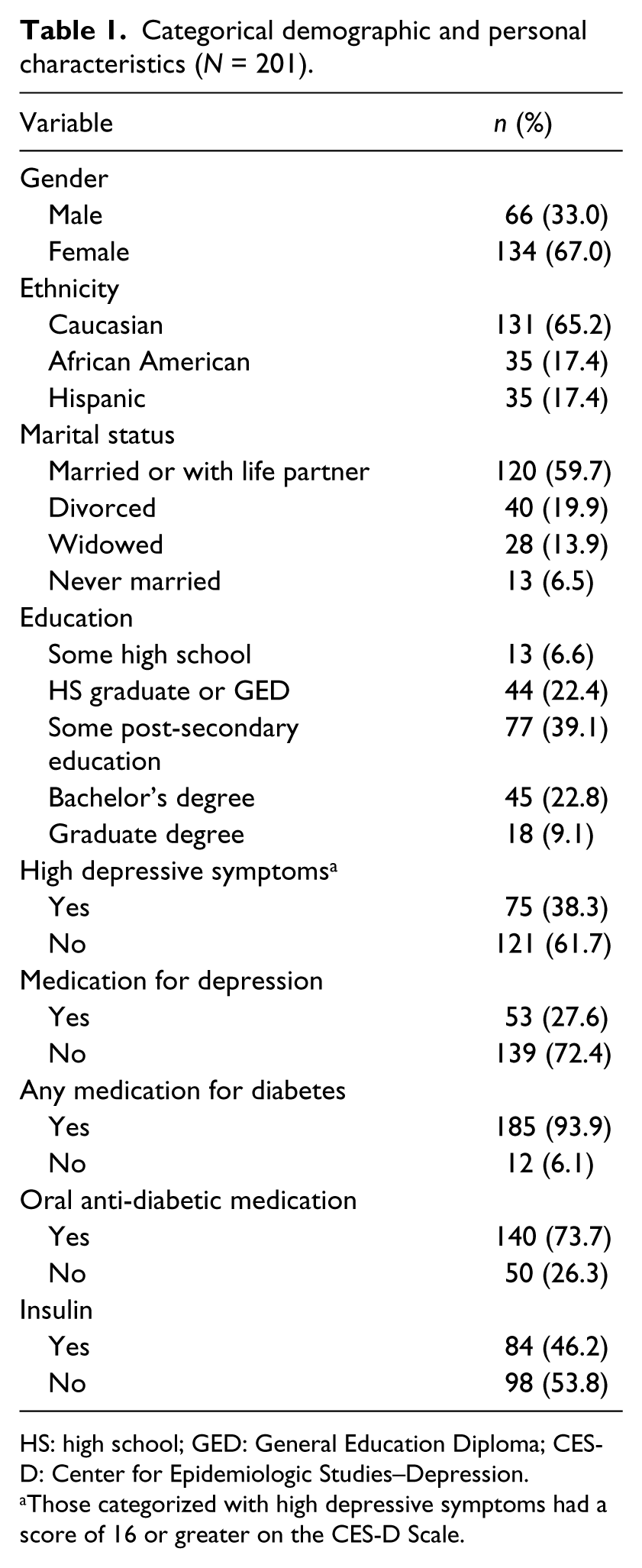
HS: high school; GED: General Education Diploma; CES-D: Center for Epidemiologic Studies–Depression.
Those categorized with high depressive symptoms had a score of 16 or greater on the CES-D Scale.
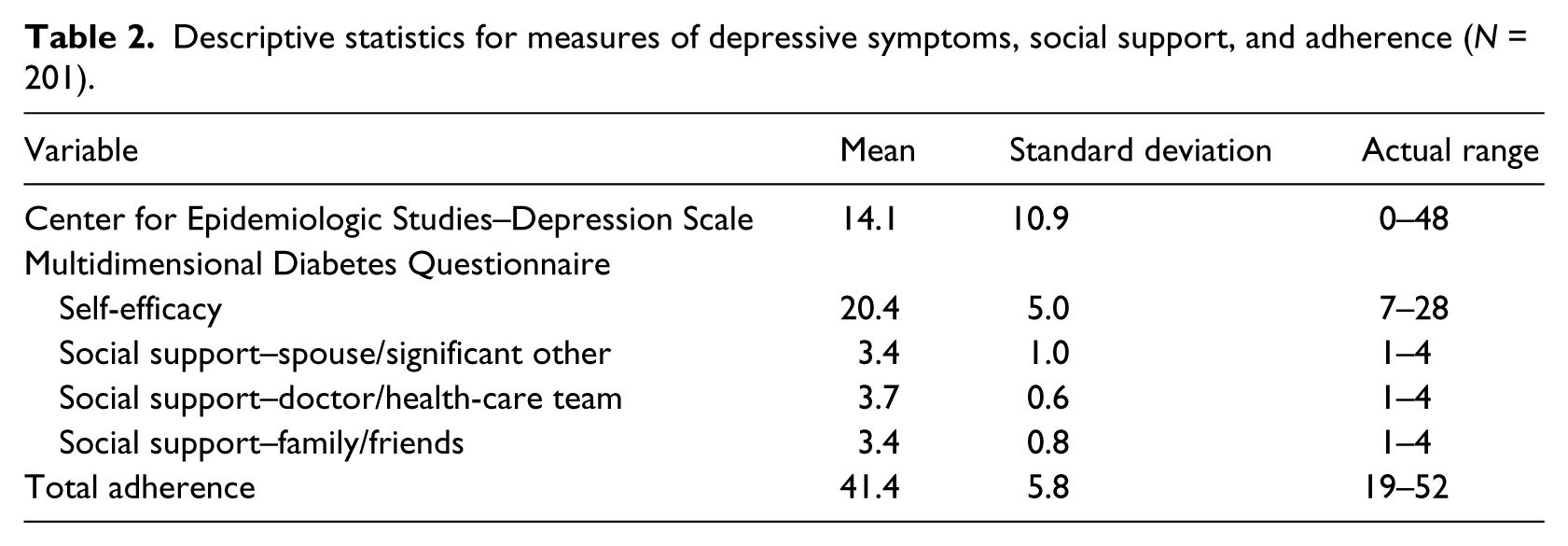
The descriptive summary of the independent, dependent, and potential mediator variables is shown in Table 2. The average score on the CES-D scale was 14.1, and the highest score as 48 (out of a maximum possible total of 60). In the sample of 201 participants with diabetes, 76 had CES-D scores of 16 or greater (38%). The average self-efficacy score was 20.4 (SD = 5.0), with a range of 7–28, which coincides with the possible range of scores. The 3 social support items suggest that all three sources were perceived as supportive by the participants, with mean scores ranging from 3.4 (for both spouse/significant other and family/friends) to 3.7 (for doctor/health-care team), out of a possible maximum of 4. Paired t-tests comparing rating on the doctor/health-care team item with each of the other 2 items were significant (p = .001 for the comparison to spouse/significant other and p < .0001 for the comparison to family/friends). Mean adherence was 41.4 (SD = 5.8), with individual scores ranging from 19 to 52, out of a possible maximum score of 52.
Descriptive statistics for measures of depressive symptoms, social support, and adherence (N = 201).
Self-efficacy as a potential mediator
As shown in the first block of Table 3, CES-D predicts both self-efficacy and adherence. In addition, self-efficacy is predictive of adherence. In the model with adherence on both CES-D and self-efficacy, the latter is a significant predictor while the former is not. This series of outcomes meets the criteria for complete mediation: self-efficacy mediates the relationship between CES-D and adherence since the inclusion of self-efficacy in the model decreases the significance of CES-D as a predictor of adherence to p = .2. The percent decrease in the absolute value of the standardized beta for CES-D between the first model and the model with self-efficacy added is 58 percent, underscoring the decrease in significance of CES-D when self-efficacy is included. The Sobel test for this mediation model has a very small p-value (p < .0001), suggesting a very strong indirect effect between CES-D and adherence, via self-efficacy as the mediator.
Test of mediation of the relationship between depressive symptoms and total adherence (n = 178). a
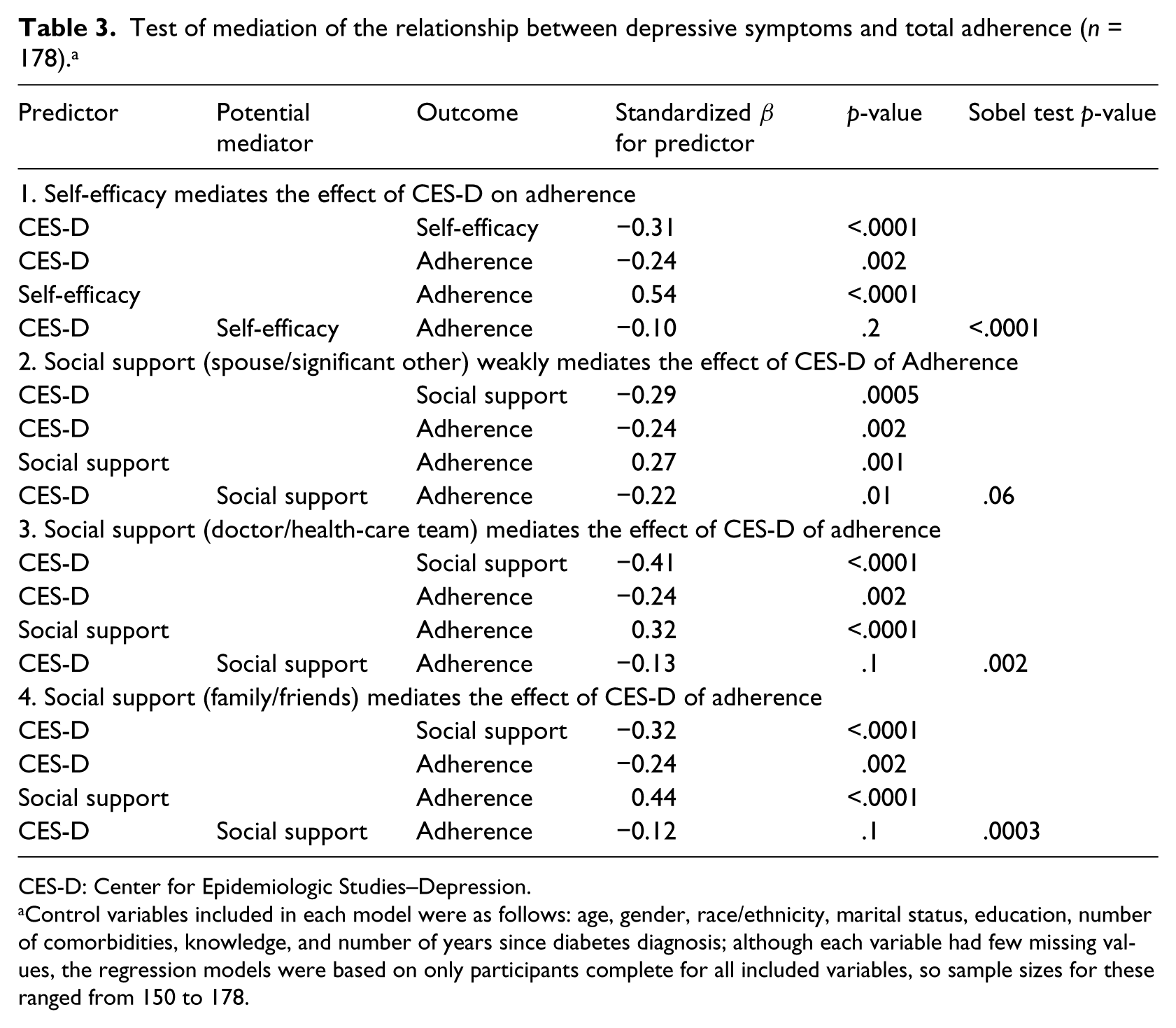
CES-D: Center for Epidemiologic Studies–Depression.
Control variables included in each model were as follows: age, gender, race/ethnicity, marital status, education, number of comorbidities, knowledge, and number of years since diabetes diagnosis; although each variable had few missing values, the regression models were based on only participants complete for all included variables, so sample sizes for these ranged from 150 to 178.
Social support of spouse/significant other as potential mediator
CES-D predicts this measure of social support and spouse/significant other support predicts adherence (see second block of Table 3). In the model with adherence on both CES-D and social support (of spouse or significant other), CES-D remains a significant predictor, even when this indicator of social support is added to the regression, suggesting weak mediation. The p-value for CES-D decreased slightly from .002 to .01 when social support from spouse/significant other was added to the model, compared to CES-D alone. The percent decrease in the absolute value of the standardized beta for CES-D when social support from spouse/significant other is added to the model is only 8 percent. This finding of only weak mediation is confirmed with the results of the Sobel test; the p-value for the indirect effect between CES-D and adherence via spouse/significant other social support is not significant (p = .06).
Support of doctor/health-care team as potential mediator
The results displayed in the third block of Table 3 indicate that the support of doctor or health-care team mediates the relationship between CES-D and adherence. In particular, the significance of CES-D as a predictor of adherence decreased from .002 to .1 when the item measuring support of doctor/health-care team was added to the model. The percent decrease in the absolute value of the standardized beta when social support from doctor/health-care team is 46 percent, consistent with the finding that this measure of social support mediates the relationship between CES-D and adherence. The Sobel test of this mediation effect confirms that there is a significant indirect effect between CES-D and adherence via the social support provided by doctor or health-care team (p = .002).
Support of family and friends as potential mediator
The last block of Table 3 details this test of mediation. When the social support from family and friends measure is added to the model containing CES-D as a predictor of adherence, the significance of CES-D as a predictor decreases to p = .1 (from p = .002 in the model without this measure of social support). This suggests complete mediation by social support from friends and family, given the diminished p-value for CES-D with social support from friends/family included in the model. There is a 50 percent decrease in the absolute value of the standardized beta for CES-D when social support from friends and family is added to the model. The Sobel test is consistent with this finding; the small p-value for this test indicates a strong indirect effect of CES-D as a predictor of adherence via social support from family and friends.
Discussion
This study demonstrates that self-efficacy is a strong mediator of the well-established relationship between depressive symptoms and adherence. This has important clinical implications as interventions designed to bolster self-efficacy may be more effective than those which target depressive symptoms alone. These findings are consistent with previous findings by Sacco et al. (2005, 2007), which found similar relationships. Future studies should aim to further refine our understanding of the interactions between self-efficacy and adherence and the role that depression plays. It is possible that adherence failure leads to lower self-efficacy which leads to higher depressive symptoms (Sacco et al., 2005). In this vein, improving self-efficacy may improve adherence which in turn could improve depressive symptoms.
This study also provides a preliminary indication for the potential of social support to affect outcomes, particularly that provided by family and friends or health-care providers. Social support mediates the relationship between depression and adherence, with support from friends and family and support from doctor/health-care team having a stronger relationship than from a spouse/significant other. This finding is similar to previous findings (Glasgow and Toobert, 1988; Toljamo and Hentinen, 2001) but provides additional direction for interventions targeting enhancement of diabetes adherence; interventions that include not only the patient with diabetes but also those who provide support to them may be the most effective way to increase adherence. This finding provides health-care providers with important information that authenticates including all members of a patient’s support system when educating the patient on the treatment of care.
This study’s findings also provide evidence for the importance of support from the health-care team with the significant indirect effect found between depression and adherence. Participants in this study felt the most support from the health-care team, compared to support from family/friends or their significant other. This finding coupled with the significant effects of this type of support on adherence and depression underscores the important role that health-care providers can play in helping patients improve their self-management which can lead to better health outcomes, including decreased depressive symptoms. Efforts to improve health-care professionals’ abilities to provide self-management support should also be considered when designing interventions to improve adherence.
Interestingly, support from spouse/significant other was only a weak mediator of the relationship between social support and adherence. This suggests that compared with family and friends as a whole, and even the physician or health-care team, social support of a spouse may have less of an impact on how depressive symptoms impact adherence in patients with diabetes. This may have been related to the fact that 40 percent of the sample was divorced, widowed, or never married.
Interventions grounded in a collaborative care model for chronic illness, which bolster self-efficacy through self-management support and incorporate both social support from family and friends and members of the health-care team, have been found to be very effective in improving diabetes self-care adherence (Delamater, 2006). Self-management support training is a particularly effective approach to improving self-efficacy and adherence and in this way could lead to improvements in depressive symptoms. In fact, the more depressive symptoms a patient with depression and another chronic illness has, the greater self-efficacy gain they experience from chronic illness self-management training (Jerant et al., 2008). Collaborative care interventions have also been effective in improving depression while also increasing self-efficacy. For example, in a recent study by Ludman et al. (2013), an intervention that focused on self-management support for patients with depression and a chronic illness led to increased self-efficacy for adhering to treatment recommendations and improved depressive symptoms. Furthermore, they found that as self-efficacy increased, depressive symptoms decreased. This evidence suggests that future studies targeting adherence in patients with diabetes and comorbid depression may be more successful if grounded in a collaborative care model approach.
This study has some limitations. Because we used a convenience sampling method, our findings are not generalizable outside of this study population. In addition, this sample’s gender distribution is not representative of the population of diabetes since most were female (67%), whereas nationally men have higher rates of diabetes than women (Centers for Disease Control and Prevention (CDC), 2011). Another limitation is the assessment of social support; in particular, the use of single-item measures of social support from the three sources identified in this study. Future work in this area may provide a stronger test of social support as a potential mediator if a more detailed instrument for this measure is used. In addition, some of the participants were excluded from the analysis to determine whether social support provided by spouse or significant other was a mediator due to lack of a person of that description in their life. The models for this test of mediation had the largest number of missing values because of this limitation. The use of cross-sectional data is another limitation, particularly with regard to social support because of the possible inconsistencies in support from family and friends over time.
An additional limitation was the choice of adherence measure used; while it was chosen for its brevity and ease of understanding, the small number of items limited the ability to accurately assess the separate aspects of adherence, including diet, exercise, medication adherence, and other self-care behaviors, such as blood sugar testing and foot care; instead the global measure of adherence to all these aspects of diabetes self-care was used. Studies that build on this research will benefit from more in-depth assessment of the various dimensions of adherence. Finally, given that depressive symptoms, self-efficacy, social support, and adherence were all measured via self-reported instruments, there is the potential that shared method variance may have increased the degree of association among these variables beyond what would have been expected if they had been measured using different strategies. Future research in this area would benefit from the inclusion of objective and/or clinical measures, such as the use of Medication Event Monitoring Systems (MEMS) for measuring medication adherence or a clinical assessment for the diagnosis of depression.
Despite the limitations, this study provides support for the use of interventions to increase self-efficacy and social support, particularly from family and friends and the health-care team, as a way to bolster adherence to treatment recommendations for patients with diabetes and comorbid depression. Self-efficacy is the strongest mediator of the relationship between depression and adherence, and targeting self-efficacy rather than depressive symptoms is likely to yield greater improvements in adherence in patients with diabetes and depression. Although the effect was not quite as strong as self-efficacy, targeting social support from family and friends as well as the health-care team may also be more effective in improving adherence than targeting depression alone. Interventions using strategies grounded in a collaborative care model are recommended.
Footnotes
Funding
This research received no specific grant from any funding agency in the public, commercial, or not-for-profit sectors.