







Abstract
This study examined the effect of the audience’s similarity to, and parasocial identification with, spokespersons in obesity public service announcements, on perceived source credibility, and diet and exercise self-efficacy. The results (N = 200) indicated that perceived similarity to the spokesperson was significantly associated with three dimensions of source credibility (competence, trustworthiness, and goodwill), each of which in turn influenced parasocial identification with the spokesperson. Parasocial identification also exerted a positive impact on the audiences’ diet and exercise self-efficacy. Additionally, significant differences were found between overweight viewers and non-overweight viewers on perceived similarity, parasocial identification with the spokesperson, and source credibility.
Introduction
Obesity is a growing health issue, due to the incidence of obesity-related health problems, including Type II diabetes, stroke, heart disease, and hypertension. Obesity rates have doubled worldwide since 1980, and in 2008, more than 1.4 billion (approximately 35%) adults, 20 years and older, were overweight, with over 500 million (11%) classified as obese (World Health Organization (WHO), 2013). Perhaps more troubling is the fact that at least 2.8 million people die each year from obesity-related causes (WHO, 2013). To curb this impending health epidemic, health organizations in many countries, including the United States, United Kingdom, and Australia, have initiated mass media campaigns to raise awareness about the dangers of obesity. Drawing on parasocial interaction (PSI), associative network model of memory, match-up hypothesis, and source credibility, this study examined the effect of perceived similarity to, and parasocial identification with, spokespersons in obesity public service announcements (PSAs), on viewers’ diet and exercise self-efficacy.
Endorser attributes play an important role in audience evaluations of persuasive health messages (Salmon and Atkin, 2003). The associative network model of memory argues that when a spokesperson endorses a brand, two unconnected nodes become linked in the viewer’s memory through associative learning (Anderson and Bower, 1972; Collins and Quillian, 1969; Till and Shimp, 1998). The viewer’s feelings toward, and perceived image of, the endorser, are then transferred to the brand, strengthening with repeated exposure (Collins and Loftus, 1975; Furstenberg et al., 1987; Nelson et al., 1985).Prior research investigating the effect of endorsers on brand evaluations has found that endorsers transfer their distinct personalities onto brands with consumers’ perceptions of the endorser influencing this relationship (Amos et al., 2008; McCracken, 1989; Thwaites et al., 2012). The match-up hypothesis, meanwhile, argues that when a “fit” exists between an endorser’s characteristics and an endorsee, viewers will be more positive toward the endorsed message (Kahle and Homer, 1985; Kamins, 1990). In prior research, brand messages were most effective when endorsers were matched to brands based on perceived expertise (Biswas et al., 2006; Westover and Randle, 2009) and congruency between endorser and brand (Koernig and Page, 2002; Lynch and Schuler, 1994).
Source credibility is the positive characteristics of spokespersons that influence viewers’ acceptance of persuasive messages in advertisements (Hovland and Weiss, 1951; McCroskey and Teven, 1999). Prior studies have found that selection of appropriate advertising spokespersons can enhance persuasiveness and accelerate attitude change (Baker and Churchill, 1977; Chaiken, 1979; Ohanian, 1990; Whitehead, 1968). In research focusing on changing health behaviors, source credibility has been linked to effectiveness of HIV/ AIDs prevention messages (Major and Coleman, 2012), online health information-seeking (Dutta-Bergman, 2003; Hu and Sundar, 2010; Spence et al., 2013), online social support (Wright and Rains, 2013), and smoking cessation (Byrne et al., 2012). Studies on obesity prevention have found positive impact of source credibility on persuasive exercise and fitness messages (Berry and Shields, 2013; Jones et al., 2003; Kozak et al., 2013). While early theoreticians (e.g. Hovland and Weiss, 1951) identified source credibility under the rubric of trustworthiness, along with expertise, more recent research (e.g. McCroskey and Teven, 1999) added goodwill (or caring) as a third, distinct factor influencing social persuasion and attitude change.
Similarity between a spokesperson and the consumer can have a strong influence on source credibility. Previous research has found that similarities based on race (Morimoto and LaFerle, 2008; Spence et al., 2013; Whittler and DiMeo, 1991), gender (Flanagin and Metzger, 2003), sexual preference (Atkinson et al., 1981), and language (Aune and Kikuchi, 1993) significantly impact spokesperson credibility. We hypothesize that viewers’ perceived similarity to the spokesperson would significantly impact each source credibility factor.
H1: Similarity to the spokesperson will positively influence perceived (a) competence, (b) trustworthiness, and (c) goodwill, of the spokesperson.
PSI refers to a one-sided personal relationship between a viewer and a media character (Horton and Wohl, 1956). During PSI, the viewer believes the media character is directly communicating to him or her, resulting in a one-sided feeling of intimacy (Giles, 2002; Hoffner, 1996; Rubin et al., 1985). Parasocial identification (Cohen, 2001) focuses on viewers sharing media characters’ perspective and feelings and is therefore distinct from feelings of similarity to the media character. We hypothesize that viewers who perceive the spokesperson as being more competent, trustworthy, and caring would be more likely to engage in PSI with the spokesperson.
H2: Perceived (a) competence, (b) trustworthiness, and (c) goodwill of the spokesperson will positively influence parasocial identification with the spokesperson.
Furthermore, the study also hypothesizes that parasocial identification with the spokesperson would lead to increased dieting and exercise self-efficacy for viewers. Self-efficacy (Bandura, 2001) is a person’s perceived behavioral control that develops through his or her observations of others in his or her social group and relates to the ability to carry out particular tasks. When a person has high self-efficacy, he or she is able to face challenges competently, leading to greater ability to act upon, and reach behavioral goals. In prior research on health behaviors, when identification is high, one is more likely to learn from observations of role models (Fishbein and Cappella, 2006; Phua, 2013). This form of vicarious learning results in increased self-efficacy beliefs, specifically in the form of instruction and guidance on performing a desired behavior (Ajzen, 1991). Specifically, viewers who parasocially identify more strongly with the spokesperson are expected to be more highly motivated to engage in diet and exercise due to their internalization of the spokesperson’s health issue as their own.
H3: Parasocial identification with the spokesperson will positively influence (a) diet self-efficacy and (b) exercise self-efficacy.
Based on these hypotheses, a structural model linking perceived similarity to the spokesperson to the three dimensions of source credibility (competence, trustworthiness, and goodwill), parasocial identification, and diet and exercise self-efficacy was proposed and tested (Figure 1).
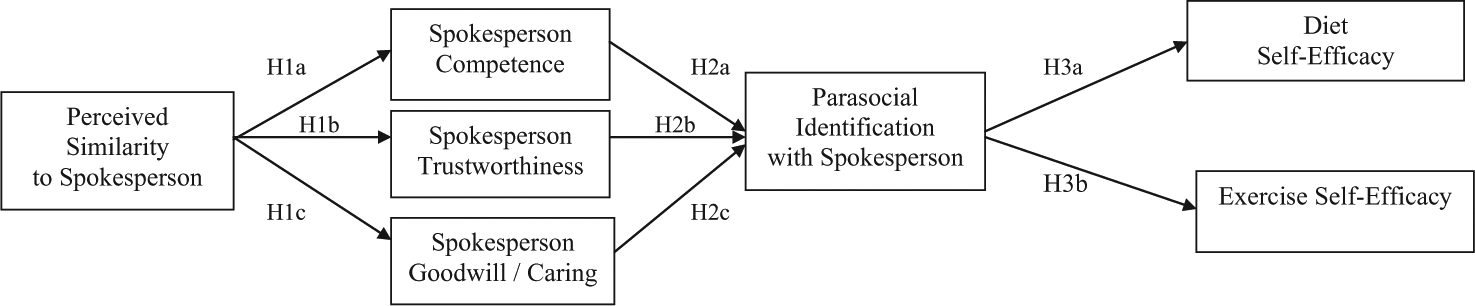
Theoretical model for the effect of perceived similarity to spokesperson on source credibility, parasocial identification, and diet and exercise self-efficacy (N = 200).
Additionally, since obesity PSAs often feature spokespersons who may be overweight or obese themselves, this study attempted to find out whether viewers’ own weight would have an impact on their perceptions of their similarity to, and parasocial identification with, the spokesperson, as well as on their ratings of the spokesperson’s source credibility (competence, trustworthiness, and goodwill). The following research question was posed:
RQ1: Does viewer weight category (whether overweight or not overweight) significantly influence (a) perceived similarity to, (b) parasocial identification with, and (c) perceived competence, (d) trustworthiness, and (e) goodwill of, the spokesperson?
Method
Participants
In total, 200 participants were recruited for the study. Seventy-four (37%) were 18–21 years old, 81 (40.5%) 22–34 years old, 15 (7.5%) 35–44 years old, 18 (9%) 45–54 years old, 9 (4.5%) 55–64 years old, and 3 (1.5%) 65 and older. Eighty-four (42%) were male, and 116 (58%) female. A total of 128 (64%) were single, 36 (18%) married, 20 (10%) divorced/separated, 2 (1%) widowed, and 14 (7%) other. For race/ethnicity, 102 (51%) were Caucasian, 70 (35%) Black, 6 (4%) Asian, 8 (4%) Latino/Hispanic, and 14 (7%) Mixed/Other. Among them, 111 (55.5%) earned <US$20,000 per year, 43 (21.5%) earned US$20,001–US$40,000, 31 (15.5%) earned US$40,001–US$60,000, 8 (4%) earned US$60,001–US$80,000, 2 (1%) earned US$80,001–US$100,000, and 5 (2.5%) earned >US$100,000. Participants also reported their weight and height, and based on these, body mass index (BMI) was calculated. Eleven (5.5%) were underweight (BMI < 18.5), 89 (44.5%) were normal weight (BMI 18.5–24.9), and 100 (50%) were overweight (BMI > 25).
Measures
Similarity to spokesperson
Similarity was measured using six items from Whittler and DiMeo (1991), assessing viewers’ perceived similarity to the spokesperson in overall lifestyle, cultural background, appearance, basic values, body size/shape, and dressing style, using 7-point Likert-type scales ranging from “Not similar at all” to “Very similar,” summed to create a similarity scale (Cronbach’s α = .87).
Credibility of spokesperson
Credibility was measured using McCroskey and Teven’s (1999) source credibility scale, which included three sub-scales assessing perceptions of the spokesperson’s competence, trustworthiness, and caring/goodwill, on 7-point semantic differential scales. Competence (six items) included the following: “Inexpert/Expert,” “Unintelligent/Intelligent,” and “Uninformed/Informed,” summed to create a competence scale (Cronbach’s α = .88). Trustworthiness (six items) included the following: “Dishonest/Honest,” “Untrustworthy/Trustworthy,” and “Phony/Genuine,” summed to create a trustworthiness scale (Cronbach’s α = .92). Caring/goodwill (six items) included the following: “Doesn’t care about me/Cares about me,” “Insensitive/Sensitive,” and “Self-centered/Not self-centered,” summed to create a caring/goodwill scale (Cronbach’s α = .89).
Parasocial identification with spokesperson
Parasocial identification was measured using 10 items from Cohen’s (2001) identification with media characters scale, on 7-point Likert-type scales, ranging from “Strongly disagree” to “Strongly agree.” Items included the following: “I was able to understand the problem faced by the spokesperson in the way she understood it,” “After viewing the PSA, I could feel the emotions the spokesperson portrayed,” and “At key moments during the PSA, I knew exactly what the spokesperson was going through,” summed to create a parasocial identification scale (Cronbach’s α = .92).
Diet self-efficacy
Diet self-efficacy was measured using 20 items from the eating habits confidence survey (Sallis et al., 1988), assessing confidence to change eating habits, on 7-point Likert-type scales, ranging from “Definitely not” to “Definitely yes.” Examples include the following: “I can eat smaller portions at dinner,” “I can eat smaller portions of food at a party,” and “I can cook smaller portions so there are no leftovers,” summed to create a diet self-efficacy scale (Cronbach’s α = .82).
Exercise self-efficacy
Exercise self-efficacy was measured using 12 items from the exercise confidence survey (Sallis et al., 1988), assessing ability to participate in exercise under specific conditions, on 7-point Likert-type scales, ranging from “Definitely not” to “Definitely yes.” Examples include the following: “I can stick to my exercise program after a long, tiring day at work,” “I can set aside time for a physical activity program for at least 30 minutes, 3 times a week,” and “I can get up early, even on weekends, to exercise,” summed to create an exercise self-efficacy scale (Cronbach’s α = .96).
Procedure
Data for the study were collected through a central intercept interviewing method at a shopping mall in the Southeastern United States. Trained interviewers recruited participants (N = 200) by intercepting shoppers at a prominent mall location. Participants received $5 gift cards as incentive. Each participant viewed the study stimulus (the obesity PSA) on a computer and completed an online questionnaire assessing perceived source credibility, parasocial identification with, and similarity to, the spokesperson, and post-exposure diet and exercise self-efficacy. The study stimulus was a 30-second Strong4Life obesity campaign PSA featuring an overweight African-American teenager, along with a voiceover by her mother describing how her daughter’s weight led to health problems, including Type II diabetes. The PSA was chosen for its scenario depicting a parent–child discussion of obesity’s negative consequences.
Results
Confirmatory factor analysis
Confirmatory factor analysis (CFA) was conducted to test the measurement model. To test for common method variance (CMV), the seven variables were loaded as one single factor to examine the fit of the one-factor measurement model versus the full seven-factor model. According to Harman (1976), the one-factor measurement model would fit the data well if CMV was present. The CFA results revealed that the one-factor model did not fit the data well (χ2(28) = 183.97, p < .001, goodness-of-fit index (GFI) = .63, adjusted goodness-of-fit index (AGFI) = .67, root mean square error of approximation (RMSEA) = .09), compared to the seven-factor model (χ2(11) = 8.72, p = .69, GFI = .99, AGFI = .98, RMSEA = .01). Therefore, CMV was not considered a threat, and unlikely to confound interpretation of the results.
Structural equation modeling
Following CFA, structural equation modeling (SEM) analysis was conducted to test the structural model. A sample size of 10 for each free parameter, and a critical sample size of 200, was needed to provide sufficient statistical power (Hoe, 2008). With seven free parameters estimated, and a sample size of 200, the study fulfilled SEM requirements. The structural model addressed viewers’ perceived similarity to the spokesperson exerting an effect on source credibility (competence, trustworthiness, and goodwill), each of which influenced parasocial identification, with parasocial identification impacting viewers’ diet self-efficacy and exercise self-efficacy. The structural model was tested using the maximum likelihood estimation procedure in LISREL. Error term for each endogenous variable was set at a mean of 0 and a variance of 1. We assessed model fit through a nonsignificant χ2 statistic, GFI, and AGFI of .90 and above, and RMSEA equal or less than .06 (Byrne, 1998).
The results of the SEM analysis indicated that the structural model was a good fit to the data. The χ2 goodness-of-fit test was not significant (χ2(11) = 8.72, p = .69, RMSEA = 0.01, GFI = .99, AGFI = .98). Therefore, the predicted mechanisms put forth were supported. The complete model is shown in Figure 2.
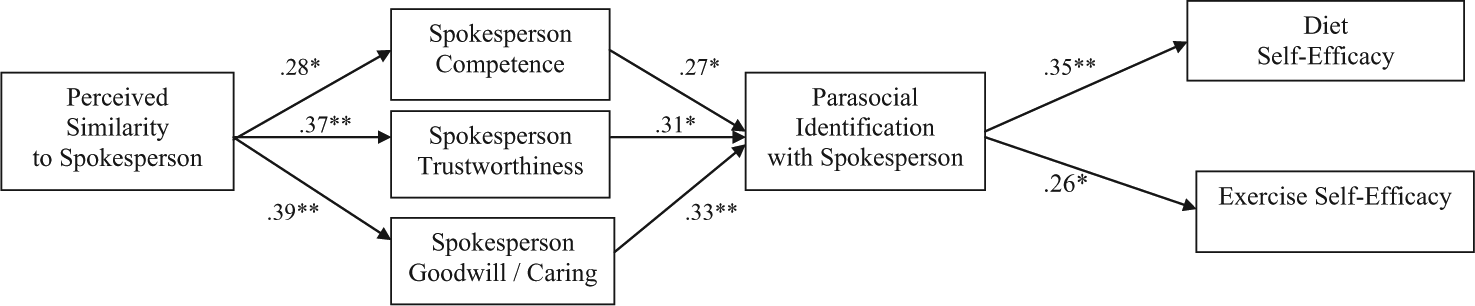
Theoretical model for the effect of perceived similarity to spokesperson on source credibility, parasocial identification, and diet and exercise self-efficacy (standardized solution, N = 200).
Perceived similarity was significantly associated with competence (β = .28, p < .05), trustworthiness (β = .37, p < .01), and goodwill (β = .39, p < .01), supporting H1a, b, and c. Competence (β = .27, p < .05), trustworthiness (β = .31, p < .05), and goodwill (β = .33, p < .01) were significantly associated with parasocial identification, supporting H2a, b, and c. Parasocial identification significantly predicted diet self-efficacy (β = .35, p < .01) and exercise self-efficacy (β = .26, p < .05), supporting H3a and b.
Multivariate analysis of variance and analysis of variance tests
One-way multivariate analysis of variance (MANOVA) and analysis of variance (ANOVA) tests were conducted to test for significant differences between overweight and non-overweight viewers on perceived similarity to, and identification with, the spokesperson, as well as source credibility (competence, trustworthiness, and goodwill). Viewer weight was re-coded with two categories: overweight and non-overweight (which combined normal weight and underweight participants). There were 100 participants in each of the re-coded categories. This was entered in the tests as the “Factor” variable.
To reduce experiment-wise Type I error, an omnibus MANOVA test was conducted. The one-way MANOVA revealed a significant multivariate main effect for viewer weight, F(8,112) = 108.52, p < .001, Wilks’ λ = .450, partial η2 = .321. There were significant differences between overweight and non-overweight viewers on perceived similarity to, and identification with, the spokesperson, and source credibility (competence, trustworthiness, and goodwill). Five separate ANOVA tests were then conducted to examine univariate main effects, with a confidence interval of .01 set to protect against inflated alpha error. For perceived similarity, a significant main effect was found for viewer weight, F(1,198) = 121.81, p < .001, partial η2 = .285. Tukey’s honest significant difference (HSD) post hoc test revealed that similarity was significantly higher for overweight (M = 5.97, standard deviation (SD) = .95) than non-overweight viewers (M = 3.29, SD = .87). For identification, a significant main effect was found for viewer weight, F(1,198) = 108.72, p < .001, partial η2 = .316. Tukey’s HSD post hoc test revealed that identification was significantly higher for overweight (M = 5.86, SD = .89) than non-overweight viewers (M = 3.23, SD = .98). For competence, a significant main effect was found for viewer weight, F(1,198) = 132.96, p < .001, partial η2 = .211. Tukey’s HSD post hoc test revealed that competence was significantly higher for overweight (M = 5.28, SD = .76) than non-overweight viewers (M = 3.16, SD = .63). For trustworthiness, a significant main effect was found for viewer weight, F(1,198) = 132.96, p < .001, partial η2 = .285. Tukey’s HSD post hoc test revealed that trustworthiness was significantly higher for overweight (M = 6.01, SD = .83) than non-overweight viewers (M = 3.49, SD = .76). Finally, for goodwill, a significant main effect was found for viewer weight, F(1,198) = 119.12, p < .001, partial η2 = .236. Tukey’s HSD post hoc test revealed that goodwill was significantly higher for overweight (M = 5.69, SD = .82) than non-overweight viewers (M = 3.28, SD = .91).
Discussion
The results of this study suggest that in obesity PSAs, viewers’ perceived similarity to the spokesperson wields a strong influence on the three dimensions of source credibility. Viewers who saw the spokesperson as being more similar to them rated the spokesperson significantly higher on competence, trustworthiness, and goodwill. In viewers’ minds, the spokesperson was imbued with characteristics that rendered him or her as being more informed and expert on the health issue, while at the same time, being more honest, honorable, and moral; therefore, the statements he or she made about the health issue were more likely to be believed (McCroskey and Teven, 1999). Additionally, a spokesperson who was more similar to the viewer was also perceived as being more caring, understanding of, and sensitive toward the health issue, and as such exerted a greater persuasive impact through the health message. As the associative network model of memory posited, endorser characteristics have a powerful influence on audiences’ evaluations of persuasive health messages (Salmon and Atkin, 2003). The association between the endorser and his or her perceived personality that is triggered and linked in the audience’s minds over a period of time creates a more receptive frame of mind for the persuasive effect of the health message to take place. In this study, the viewer’s feelings toward the spokesperson, based on his or her similarity in lifestyle, cultural background, appearance, basic values, dressing style, and body shape, are transferred over to the viewer’s evaluations of the spokesperson’s credibility in advocating the health message. A practical implication for social marketers and brand advertisers is that in order for endorsers to be most effective in persuasion, it is preferable to hire and cast spokespersons who are similar, both physically and culturally, to their target audience (Larson et al., 2005; Westover and Randle, 2009). People often choose to apply schema from their prior experiences, and self-concepts, to evaluating endorsers in advertising (Forehand et al., 2002), and therefore, it is imperative that when designing persuasive health messages, health organizations should incorporate source characteristics that are maximally appealing to their targeted viewers.
A second major finding is that when viewers saw the spokesperson as being more credible, they also reported higher parasocial identification with the spokesperson. As the PSI literature states, viewers develop one-sided relationships with media characters based on perceived positive traits exhibited by the characters (Cohen 2001; Hoffner, 1996). Viewers who saw the spokesperson as being competent, trustworthy, and caring therefore began to parasocially identify with, and adopt the spokesperson’s perspective. Additionally, greater identification with the spokesperson resulted in higher diet and exercise self-efficacy. As the match-up hypothesis (Kamins, 1990) suggests, a fit between an endorser and an endorsed brand will result in more positive consumer evaluations of the endorsed brand. In previous studies, persuasive messages are more effective and more easily accepted when viewers see the message endorser(s)’ personality and physical characteristics as being more congruent with their own (Dutta-Bergman, 2003; Hu and Sundar, 2010). When viewers relate to the spokesperson parasocially, they incorporate the spokesperson’s problems as their own, resulting in greater impact on their own health outcomes. As prior research found, exercise and fitness self-efficacy can be effectively primed by appropriate endorsers (Berry and Shields, 2013; Kozak et al., 2013). In this study, parasocial identification acted as an effective means for viewers to enact positive diet and exercise self-efficacy, in accordance with the PSA’s persuasive message.
Another major contribution of this study is that viewers’ weight exerted a significant impact on perceived source characteristics, including similarity to, and parasocial identification with, the spokesperson, and source credibility (competence, trustworthiness, and goodwill). In persuasive health PSAs aiming to reduce negative health behaviors, such as obesity, tobacco, and alcohol use, it is important to illustrate negative consequences of engaging in such behaviors, so as to encourage positive behavioral change (Salmon and Atkin, 2003). At the same time, it is also imperative for health organizations to reach the appropriate target audiences in accordance with the type of health behavior the persuasive message is trying to change (Perse et al., 1996). This study showed that in obesity PSAs, viewers’ own weight had an important influence on the way in which they viewed the spokesperson. Specifically, overweight viewers were more likely to see the spokesperson as being similar to them, competent to advocate the health message, trustworthy for the health message to be believed, caring and concerned about them with regard to the health problem advocated, and thus more likely to adopt the spokesperson’s perspective regarding obesity. This finding establishes the need for health organizations to design persuasive media messages through a framework that incorporates a “fit” between the endorser, endorsee, and the endorsed message, as stipulated in the associative network model of memory and the match-up hypothesis. The structural model tested and supported provides evidence for viewers’ perceived source (spokesperson) characteristics in persuasive health PSAs exerting a strong influence on their diet and exercise self-efficacy.
There are some limitations to this study. First, the study was cross-sectional, and data collected may be subject to self-reporting biases. Future studies should be longitudinal to further establish causality. Second, study participants were adults while the PSA featured a teenager and her mother in a voiceover, so future studies should recruit more age-appropriate participants. Third, additional data analyses, including multiple group modeling, may help further identify moderators and ensure invariance of latent construct measurements plus validity of theoretical models across different subpopulations. Fourth, future studies should include PSAs targeting other health issues to establish generalizability of the results. Fifth, the study examined diet and exercise self-efficacy rather than actual behavioral change, which future studies should address.
Conclusion
This study’s findings suggest that viewers’ perceived similarity to spokespersons in obesity PSAs exerts a strong influence on source credibility (competence, trustworthiness, goodwill). Each dimension of source credibility, in turn, impacts viewers’ parasocial identification with spokespersons, with identification having a strong positive effect on diet and exercise self-efficacy. Overweight viewers are more likely than non-overweight viewers to rate spokespersons as being more similar to themselves, more trustworthy, competent, and caring, and report higher parasocial identification. By matching endorsers’ physical, cultural, and other salient characteristics to those of their intended target audience, persuasive health messages in obesity PSAs can be more easily and effectively disseminated. This is especially important considering obesity is an increasingly serious health epidemic, with millions of dollars spent each year on persuasive health campaigns to raise awareness about obesity-related health problems (WHO, 2013). To effectively curb obesity rates, it is imperative to design and implement mass media campaigns that can most effectively appeal to overweight and obese individuals. By taking the target audience’s expectations of source (endorser) characteristics into consideration when designing public health campaigns, health organizations can ensure greater compliance with health messages and positive behavioral change for health issues.
Footnotes
Declaration of conflicting interests
The author(s) declared no potential conflicts of interest with respect to the research, authorship, and/or publication of this article.
Funding
The author(s) disclosed receipt of the following financial support for the research, authorship, and/or publication of this article: This research was funded by the University of Georgia Research Foundation (UGARF), and the University of Georgia’s Center for Health and Risk Communication (CHRC).