







Abstract
The purpose of this study was to examine happiness and social determinants across age cohorts in Taiwan. The data were obtained from the 2011 Taiwan Social Change Survey (aged 18 +, n = 2,199). The social determinants of happiness included socioeconomic status and social connection. Happiness was not different across the age groups. Receiving less family support, less formal support, more social trust and more control over life were significant for the younger group. Being married and having more social participation were significant for the middle-aged. Receiving less family support and having a higher economic status were significant for the older group.
Introduction
Security and social connection are basic human needs (Maslow, 1943). Psychological research has explored the factors related to happiness, including social dimensional factors, such as socioeconomic status (Bishop et al., 2010; Oishi et al., 2011; Waldinger and Schulz, 2010), social network, social contact, social support, and social capital (Cooper et al., 2011a, 2011b; Litwin and Shiovitz-Ezra, 2011). Research also suggests that a U-shaped relationship exists between age and happiness (Blanchflower and Oswald, 2008; De Ree and Alessie, 2011). Socioeconomic status and social connection in different age cohorts may be very different because of the life course transitions. However, there is little research exploring the relationship between social determinants and happiness across different age cohorts. The aim of this study was to examine the relationship between happiness and social determinants across younger, middle, and older aged cohorts of Taiwanese adults.
Social determinant and theoretical explanations
There are several theoretical explanations of happiness: (1) Seligman’s trinity: Seligman (2003) indicates that happiness is feeling positive about life, and happiness is composed of three desirable lives: the pleasant life, the good life, and the meaningful life. (2) Rank income hypothesis: Boyce et al. (2010) found that the rank positions of income, not absolute income or reference income, affected happiness. This can be explained by the results of social comparison. (3) Social contagion effect: Clark and Etilé (2011) found that an individual’s subjective wellbeing was positively related to his/her BMI at the beginning up to a certain threshold, and at which point BMI turned negatively correlated with subjective wellbeing. Such threshold increases with partner’s BMI if the individual is overweight. Thus, the social contagion effect accounts for this relationship between subjective wellbeing and weight. (4) Social capital: Social capital includes the accessible or mobilized resources through purposeful actions in the social structure. There are three forms of social capital: the obligation, expectation and trust; the information tunnel; and the norm and effective punishment (Coleman, 1988). Health may be promoted by strengthening the individual’s social capital and collective social capital (Eriksson, 2011). Thus, psychological wellbeing, including happiness, is positively related to social capital. Empirical studies have found that happiness is related to greater social support, a larger social network, and higher social trust (Calvo et al., 2012; Nyqvist et al., 2008; Oishi et al., 2011). This is also true for the population in East Asia (Yamaoka, 2008). A diverse social network and broader social contact are related to happiness (Cooper et al., 2011a, 2011b; Litwin and Shiovitz-Ezra, 2011). (5) Marital status (social causation and social selection): Social causation theory and social selection theory were used to explain the relationship between marital status and happiness (Joung et al., 1997; Mastekaasa, 1992). Marriage provides emotional support, financial support, the care of physical health, and social integration for married individuals; thus, marriage is beneficial to physical and psychological health (Stack and Eshleman, 1998). Studies have found that marital status and marital satisfaction are related to happiness (Giordano and Lindström, 2011; Murray et al., 2011; Peiró, 2006; Waldinger and Schulz, 2010).
Empirical studies also support the above explanations. Based on the Happiness trinity framework, meeting the basic needs of life is related to happiness, which is consistent with the findings of a positive relationship between socioeconomic status and happiness (Bishop et al., 2006; Boyce et al., 2010; Oishi et al., 2011; Waldinger and Schulz, 2010). The trinity framework also proposes that individuals are more likely to be happy when they find their life meaningful. Empirical studies have also demonstrated that individuals who participate in social participation, work, or volunteering (Borgonovi, 2008; Waldinger et al., 2010) are more likely to be happy. Supporting others (Dunn et al., 2008) may make an individual happy, particularly when spending money on those with whom they have strong social ties (Aknin et al., 2011). Thus, it is hypothesized that individuals are more likely to feel happy if (a) they are satisfied with their economic status; (b) they are able to provide support to other individuals; and (c) they participate in social groups or volunteer for activities that are beneficial for others. Based on the rank income hypothesis and the social contagion effect, when individuals are with other individuals with higher income status than their own, they are less likely to be happy. In contrast, if they are with individuals with a lower income status, they are more likely to be happy. Thus, it is hypothesized that individuals are happier if their social class ranking is higher than others. From the perspective of social capital, it is hypothesized that individuals with higher social capital, i.e., a larger social network, receiving more social support, or having a higher general trust towards the community or society are more likely to be happy.
There may be cultural difference in happiness. Lu and Shih (1997) explored the sources of happiness for Taiwanese individuals in a qualitative study and found that Taiwanese individuals emphasize interpersonal or external evaluation, which is related to social relations, and being at ease with life, which is related to socioeconomic status. In another study, Lu and her colleagues (Lu et al., 2001) indicated that social integration and human heartedness had a culturally dependent effect on happiness among Taiwanese students compared with British students. These studies emphasize the relationship between happiness and both social connectedness and socioeconomic status for Taiwanese people. Thus, social determinants may be an essential component of happiness, particularly for Taiwanese people.
Age and happiness
Studies have found a U-shaped relationship between age and happiness (Blanchflower and Oswald, 2008; De Ree and Alessie, 2011; Schatz et al., 2012). Thus, it is hypothesized that happiness level would be higher for younger individuals and older individuals but lower for middle–aged individuals. Due to the different life courses that the individuals in each group experience, the factors related to happiness are hypothesized to differ among different age cohorts.
Other factors related to happiness
Other diverse variables are related to happiness in the existing research, such as living in a rural area (Mair and Thivierge-Rikard, 2010), a coping and positive mind (Kim et al., 2012) and personality (Moltafet et al., 2010), religiosity and attending religious activities (Cooper et al., 2011b; Lewis et al., 2005; Stavrova et al., 2013), the environment and politics (Boehnke and Wong, 2011; Summers et al., 2012), life events (Ballas and Dorling, 2007), daily activities (Oerlemans et al., 2011), physical health (Bishop et al., 2006, 2010), and leading a healthy lifestyle, such as not smoking, drinking alcohol, and exercising (Nyqvist et al., 2008; Peiró, 2006; Shahab and West, 2009; Zander et al., 2013). In addition, internet use has been the main pathway of social interaction recently, particularly for the younger generations. For the older population, internet use can be a good approach to social connection (Beringer and Smixsmith, 2013). Yet, the effect of online friends or social media on happiness is not consistent in the existing research (Grabowicz et al., 2012; Helliwell and Huang, 2013). Internet access in Taiwan has achieved 70% or above (Sixsmith et al., 2013). Some studies have also shown positive influences of internet use on happiness among the elderly in Korea, where there is a quickly developing internet network (Seo, 2014; Yoo and Son, 2012).
Social determinants occupy an important role for all factors related to happiness for Taiwanese people. Although related factors associated with happiness were examined in previous research, differences among age groups have not been previously compared. Social factors related to happiness may show different effects on happiness across the life course. Thus, the purpose of this study was to examine the social factors related to happiness across younger, middle-aged, and older cohorts of Taiwanese individuals. The findings regarding the relationship between social factors and happiness in the different age groups are expected to provide implications for further research about happiness and subjective wellbeing.
Methods
Data and samples
The data were obtained from the 2011 Taiwan Social Change Survey (TSCS), which was first initiated by the National Science Council in 1985. Since 1990, the TSCS has utilized two annual survey modules: one aims to repeat major research topics, such as family, social stratification, mass communication, and religion, every five years; the other one is designed for other social phenomena important in social science and Taiwan’s society. The data used in this study were from the 2011 TSCS Health questionnaire module, and 2,199 individuals completed the survey.
Measures
Happiness
The dependent variable assessed if the participants lived a happy life in general. The item was coded from 1 to 5, indicating very unhappy to very happy, respectively.
Age group
The samples were divided by age into 3 cohort groups: young (aged 18 to 39), middle-aged (aged 40 to 64), and elderly (aged 65 or more).
Social determinants
The social determinants were divided into two groups: socioeconomic status and social connection.
Socioeconomic status included educational years, working status (no/yes), subjective economic status (from insufficient to very sufficient, scored from 1 to 5), as well as social class and life control. Social class referred to how the respondents rated their social status from 1 to 10. A higher score indicated a higher social status. Life control quantified the degree to which individuals felt free to choose and control aspects of their life and was scored from 1 to 10. A higher score indicated more choice.
Social connection included marital status (having a spouse or not), social support, social group participation, and social trust. Social support referred to how often the participants received emotional, monetary, or instrumental help from family/relatives, friends/colleagues/neighbors, and support from formal providers (such as social workers, therapists, or home helpers). The score for each item was coded from 1 to 5, representing received help from none to always, respectively. The total score for each category of social support ranged from 3 to 15. Social group participation referred to the frequency of participating in social groups and ranged from 1 to 5, indicating never to often, respectively. Social trust was a general trust feeling towards individuals. The score ranged from 1 to 4, which indicated always being cautious to always trustful, respectively.
Other factors. Other factors related to happiness included:
Demographics: Gender (male/female), living environment (urban/town/rural), living arrangement (alone/with others), and religious belief (no/yes).
Health and lifestyle-related factors included body mass index (BMI), chronic diseases, self-rated health, negative affect, smoking, drinking alcohol, regular exercise, internet use, and quality of life. BMI was defined as the weight (Kg) divided by the square of the height (m). Chronic disease was coded as having a chronic disease or not having a chronic disease (yes/no). Self-rated health was rated from poor to excellent and was coded good/poor. Negative affect was measured by the frequency, in the past month, of the following feelings: pain, depression, low confidence, unable to conquer a difficulty, low and blue, and peaceful. Each item was rated by the frequency of each feeling, which ranged from never to always (score 1 to 5, respectively), and the “peaceful” item score was reversed. Then, the total scores of the 6 items were summed as negative affect and scored from 6 to 30. Smoking (never/quit/current smoking) and drinking alcohol were coded as never, social (once a month or less), light (couple times a month), or heavy (several times a week or every day). Regular exercise was coded as no (less than once per week) or yes (several times per week or every day). Internet use was coded as no/yes. Quality of life was defined by how satisfied an individual felt with life.
Analysis
The data were analyzed by descriptive analysis, Chi-square tests and one-way ANOVA tests by age group and a linear regression analysis of happiness by all samples and 3 age groups. All continuous independent variables were centered in the regression models. The analysis was weighted by the sampling proportion.
Results
Table 1 shows the sample descriptions of the three age groups. Most characteristics were significantly different across the age groups. However, happiness was not different.
Description of the samples.
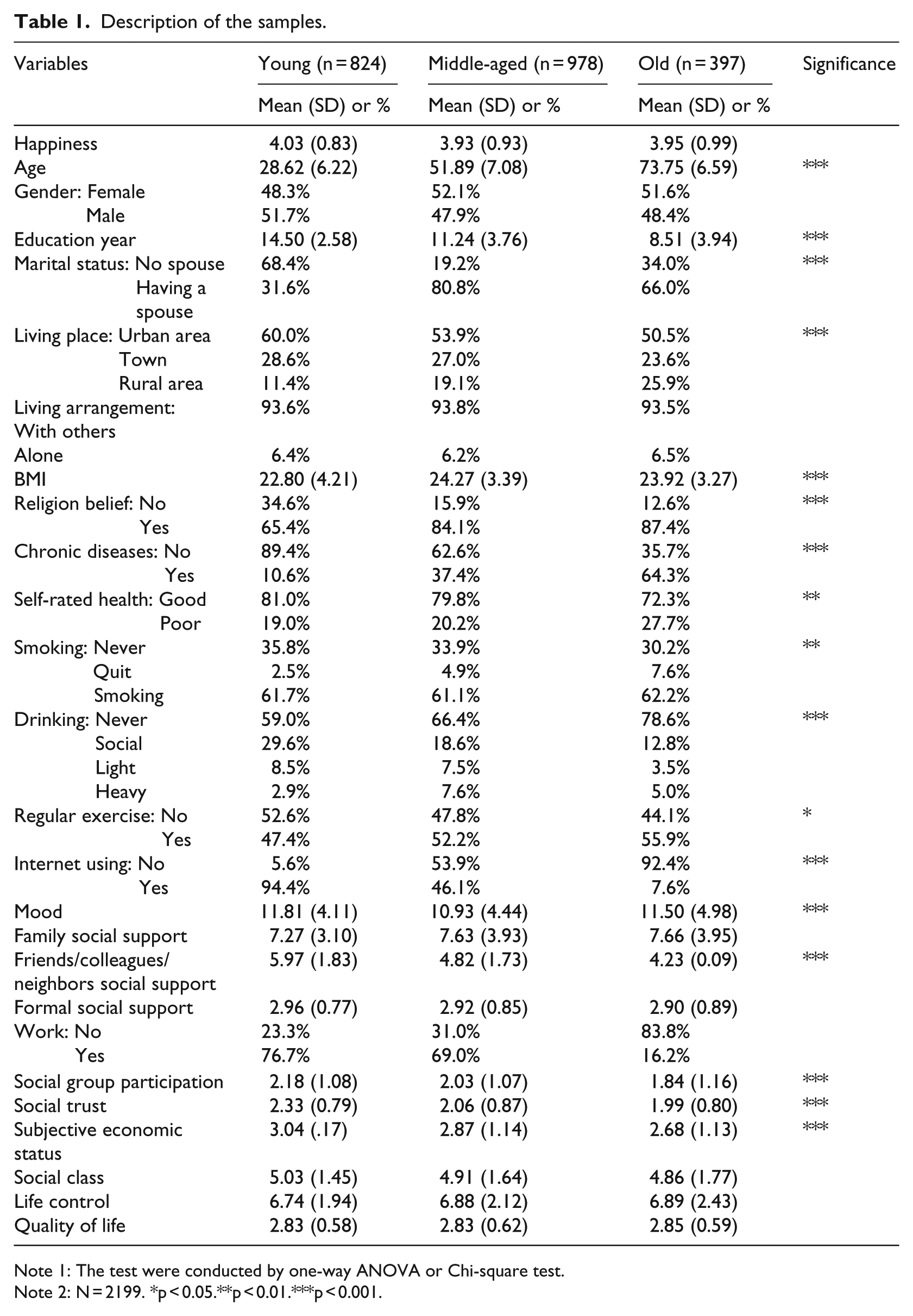
Note 1: The test were conducted by one-way ANOVA or Chi-square test.
Note 2: N = 2199. *p < 0.05.**p < 0.01.***p < 0.001.
Table 2 shows the linear regression analysis of all samples, including the young group, the middle-aged group, and the older group. In the total sample model, being younger, less educated, a non-smoker, a social drinker or a light drinker, having less negative affect, receiving less social support from family, more participation of social groups, more social trust, a higher subjective economic status, more life control, and a higher quality of life were related to higher happiness. Gender, marital status, living place, living arrangement, BMI, chronic disease, self-rated health, support from friends and formal providers, and working status were not significant.
Happiness and social determinants by age groups.
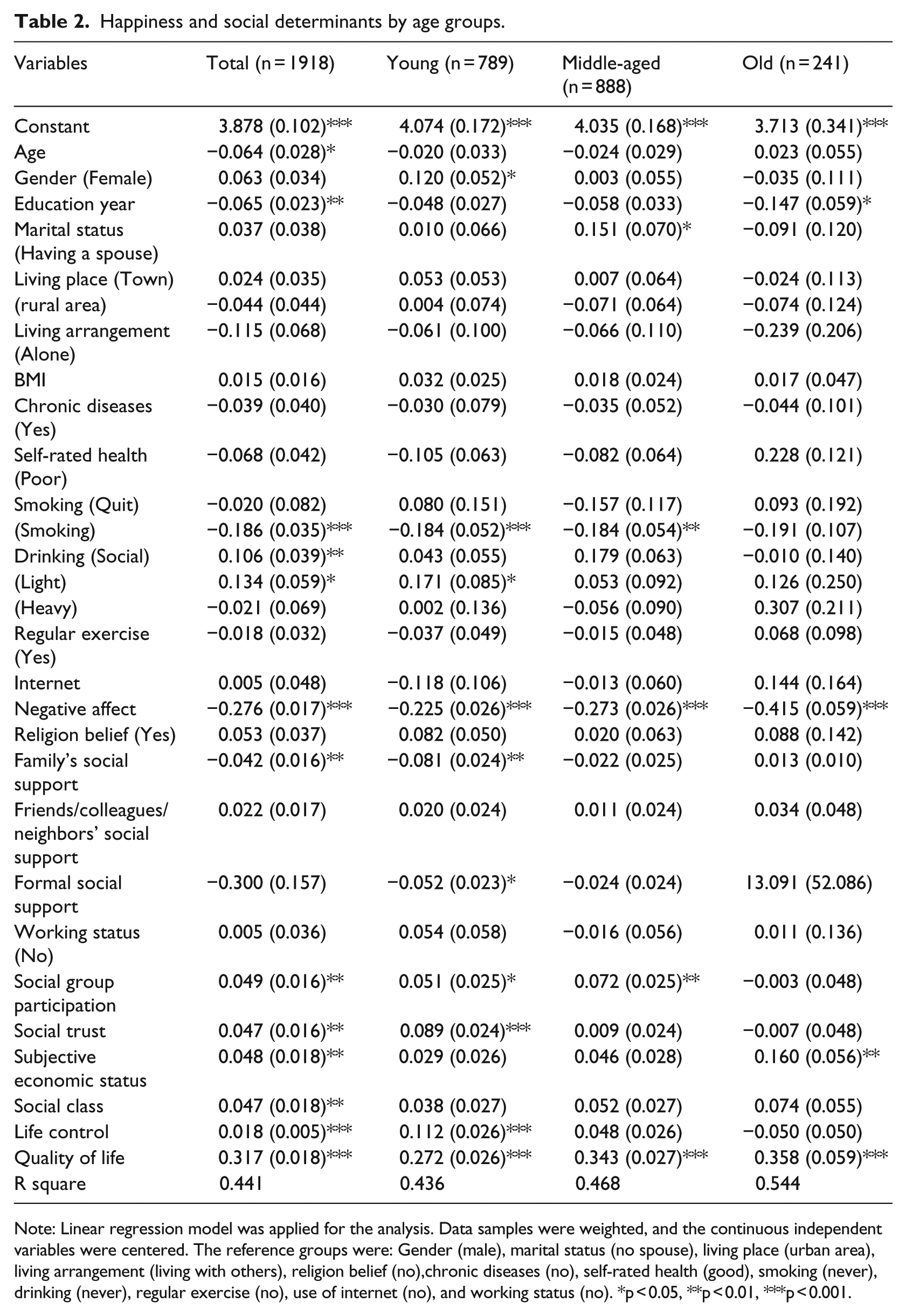
Note: Linear regression model was applied for the analysis. Data samples were weighted, and the continuous independent variables were centered. The reference groups were: Gender (male), marital status (no spouse), living place (urban area), living arrangement (living with others), religion belief (no),chronic diseases (no), self-rated health (good), smoking (never), drinking (never), regular exercise (no), use of internet (no), and working status (no). *p < 0.05, **p < 0.01, ***p < 0.001.
In the younger group model, being female, a non-smoker, a light drinker, less negative affect, receiving less support from family and formal providers, more social participation, a higher social trust, a higher social control and a higher quality of life were related to more happiness for the younger group. Compared with the total samples, age, education, subjective economic status, and social class were not significant factors.
In the middle-aged group, being a non-smoker, and having a spouse, less negative affect, more social participation, and a higher quality of life were related to more happiness for the middle-aged participants. Social support, social trust, social class, or life control were not significant.
In the older participants, being less educated and having less negative affect, a higher subjective economic status, and a higher quality of life were related to higher happiness. Health-related variables, social support, social trust or social participation were not significant.
Discussion
This study used cross-sectional survey data to examine the factors related to happiness for different age cohorts in Taiwan. In general, the consistent predictors of happiness across the three age cohort groups were negative affect and quality of life. Healthy behaviors, social capital (receiving social support, social group participation, and social trust) and the degree of life control had larger effects for the younger and the middle-aged groups. Marital status was particularly important for the middle-aged group. Education and subjective economic status were more important to determine happiness for the older group. Thus, social connection factors seemed to be more related to happiness among the younger and middle-aged generations than the older cohort, while socioeconomic status determined happiness for the elderly.
The relationship between social connection and happiness showed different patterns across the three age groups. Receiving social support from family and formal providers was negatively related to happiness only for the younger group, whereas receiving any category of social support was not significant for the other two groups. It is possible that receiving support from formal providers may represent a vulnerability for the younger group, and the support provided by family may not always be positive (Krause, 2001). However, for the older generation, receiving formal support may be recognized differently than by the younger generation. Although receiving formal support was not significant for the older individuals, the relationship was positive and the coefficient was large. This finding implies that providing formal support for older individuals is not just a service but also has a function of emotional care. Through visits by formal service workers, older individuals would feel cared for and happier. This result is very similar to previous Asian studies, which have found that formal support has positive effects on positive psychological wellbeing among the elderly (Yoo and Son, 2012). Marital status is also viewed as a type of social support. However, having a spouse was only positively related to happiness for the middle-aged group. It is possible that the number of married individuals in the younger group was lower (please see Table 1) and being a family caregiver for a spouse in the older group is more similar to a burden and less related to happiness.
In addition to social support, the second indicator of social connection is social participation. Social participation has been related to subjective wellbeing and happiness (Borgonovi, 2008; Waldinger et al., 2010). In this study, working status was not significant, and participation in social groups was positively related to happiness for the younger and middle-aged groups but not for the older group. It is possible that participation in social networks and social groups means more for younger and middle-aged individuals compared with the elderly. Individuals obtain social capital and the chance to prove their own value when they are engaged with social participation. Older Taiwanese individuals are less likely to participate in social groups because in the traditional society, individuals think that wellness for the elderly means not work or not being involves social matters (Hsu, 2007). The percentage of social group participation was not high for the current Taiwanese elderly cohort. However, this concept is changing (Hsu and Jones, 2012); more individuals accept the idea of active aging and have become more willing to volunteer or participate in social groups when they grow older. It is expected that social group participation will be more prevalent and more related to happiness in older individuals in the future.
Another indicator of social capital is social trust. Past research has found that general trust is related to self-rated health (Mansyur et al., 2008; Nyqvist et al., 2008) and subjective wellbeing (Calvo et al., 2012; Nyqvist et al., 2008; Oishi et al., 2011). In this study, social trust was positively related to happiness in the whole population, but it was significant only for the younger group. It is possible that social trust and social capital are different across age groups (Cooper et al., 2011b); the younger group had higher trust than the middle-aged group and the older group. There has been little discussion about age differences in social trust in previous studies. If social trust decreases over time, then social capital would also decrease when the individuals grow older. Furthermore, there will be fewer social connections among older individuals, and therefore the happiness from social connections is expected to be much less for the elderly.
While social connection was significantly related to happiness for the younger and middle-aged groups, socioeconomic status was more important for the older cohort. The older cohort has usually experienced a poor and insecure youth because of previous wars, and economic security has been reported as a component of successful aging for the Taiwanese elderly (Hsu, 2007). However, older individuals with higher education were less happy. It is possible that the individuals with a higher education expect more in life, but they are not satisfied with their current status. The statement “contentment is happiness” (Zhang et al., 2014) is most likely true. Further research about the relationship between education and happiness is suggested.
The subjective rating of quality of life showed the biggest effect on happiness of all the predictors in all three age groups. Quality of life can be measured as an overall subjective rating, which is similar to the concept of subjective wellbeing. Past research has indicated that happiness is a component of subjective wellbeing (Bishop et al., 2010). Quality of life can also be measured in different dimensions of life, such as physical, psychological, social, environment, etc. (WHOQOL Group, 1995), which involves more practical issues in social policy and health/social services. If all the objective dimensions of quality of life were improved, then subjective wellbeing (as well as the happiness) would also be increased. Policy makers should work on these quality-of-life issues in social policy to improve the subjective wellbeing of the people.
Happiness is usually viewed as the maximum of positive affect. Diener et al. (1991) argued that happiness is the frequency of positive affect versus negative affect. In this study, negative affect was significantly related to happiness, which is consistent with previous research (Moreno et al., 2014). Furthermore, the centered effect of negative affect was larger in the older group than the younger and the middle-aged groups. Negative affect or psychological distress may be a more serious problem for older individuals and may thus effect their happiness to a larger extent.
Past studies have found that living a healthy lifestyle is related to happiness (Nyqvist et al., 2008; Peiró, 2006; Shahab and West, 2009; Zander et al., 2013). In this study, we found that the smokers of all age groups were less happy. Smoking is sometimes a coping strategy for individuals when they are under stress or feel depressed (Kleinke et al., 1982). Research has also demonstrated that smoking may be related to depressive symptoms (Kendler et al., 1993; Patton et al., 1998). This study found that the social and light drinkers were more likely to be happy than the non-drinkers, particularly for the middle-aged group; heavy drinkers reported less happiness, although the finding was not significant. Research has found that moderate drinking is related to better psychological wellbeing (Ferreira and Weems, 2008). In addition, social drinking is drinking for positive social outcome (Foster and Neighbors, 2013). Thus, social drinking may represent an active social life, which is the actual reason for happiness. Regular exercise was not significantly related to happiness as expected. However, regular exercise was positively related to happiness for the older group, even when the health indicators (self-rated health and chronic disease morbidity) were controlled. This finding implies that doing regular exercise not only promotes physical health but also may be beneficial for emotional health in older individuals. The use of the internet was not significantly related to happiness for any age group. However, using the internet was negatively related to happiness for the younger group and the middle-aged group, but positively related to happiness in the older group. In Taiwan, almost all young individuals use the internet for study, work, leisure or social networking. It is also common for middle-aged individuals to use the internet for work and leisure. Determining whether there is an internet addiction problem for the younger and middle-aged groups, and therefore less connection with the real world needs further research.
There are some limitations of this study. First, the data were cross-sectional; thus, a causal relationship between happiness and the related factors cannot be confirmed. Second, secondary data were used for the analyses, and thus, some of the variables, such as personality and an evaluation of the social environment, were unavailable in these data. Third, the sample only included Taiwanese individuals. There may be cultural differences in the expression of happiness and related factors. Thus, the results may not generalize to individuals in other areas.
Conclusion
Happiness was not different across different age cohort groups in Taiwanese people. However, the social factors related to happiness showed different relationships with happiness across the age groups. Socioeconomic status was more significant in determining happiness among older individuals, while a social relationship was more important for the younger and middle-aged individuals. The findings suggest that dynamic changes in social relationships in the life course may affect psychological wellbeing. These dynamic changes in social factors across the life course and their effects on happiness should be investigated in future research. It is also suggested that to maintain social support, encourage social engagement, and reduce the social disparity, it is important to have policies that aim to improve psychological wellbeing.
Footnotes
Acknowledgements
The research was supported by grants from the Ministry of Science and Technology, Taiwan, Republic of China (MOST 103-2410-H-468-013-MY2), and by the National Research Foundation of Korea Grant funded, Republic of Korea (NRF-2013S1A3A2054886). The data was provided by the Survey Research Data Archive, Academic Sinica, Taiwan ROC.
Declaration of conflicting interests
The author(s) declared no potential conflicts of interest with respect to the research, authorship, and/or publication of this article.
Funding
The author(s) received no financial support for the research, authorship, and/or publication of this article.