







Abstract
We evaluated the participants’ negative affect, positive affect, post-traumatic stress disorder, and depression symptoms before and after a peacekeeping mission. Depression symptoms and positive affect after mission were significantly associated with exposure to stressful events during the mission, controlled by the respective characteristics before mission. Negative affect and post-traumatic stress disorder symptoms after mission had a tendency to be associated with exposure to stressful events during the mission, controlled by the respective characteristics before mission. In conclusion, even in healthy and physically active male peacekeepers, those more exposed to stressful events could be more vulnerable to present negative outcomes.
Introduction
Peacekeepers are members of the armed forces who work to aid countries threatened by conflict and to help create the conditions necessary to establish peace. Despite the deployment differences between peacekeeping and combat missions, peacekeepers are also often exposed to potentially traumatic stressors that involve threats to their physical safety or that of others, eliciting fear, horror, or helplessness (McNally et al., 2003). Studies have shown that the frequency of exposure to traumatic situations is an important predictor of post-traumatic stress disorder (PTSD) (Litz et al., 1997) and/or other stress-related symptoms (Mehlum and Weisaeth, 2002). Besides that, one of the main risk factors for stress symptoms in peacekeepers is having more deployment-related exposures (Hotopf et al., 2003). Therefore, exposure to stressful events during a peacekeeping mission represents an external factor that could promote a non-adaptive pattern of physiological and psychological responses. In addition to the potentially traumatic stressors experienced during peacekeeping missions, negative personality traits represent internal factors that can also promote a non-adaptive physiological response. In this context, trait of negative affect (NA) is characterized by a variety of aversive mood states including anger, contempt, disgust, guilt, fear, and nervousness (Watson et al., 1988). In a previous study, we showed that salivary cortisol responses to an acute stress task can be increased by negative emotional context and by high trait of NA (Mendonca-de-Souza et al., 2007). On the other hand, heart rate can be recovered faster from an acute stress task by positive emotional context and low trait of NA (Souza et al., 2007). These two studies indicated that both external and internal factors are able to change a physiological response in a non-adaptive or an adaptive pattern, respectively. Moreover, some studies have proposed that negative personality traits in peacekeepers are associated with an increased risk for developing stress-related symptoms (Bramsen et al., 2000; Souza et al., 2008). The relatively stable tendencies to respond with negative emotions to threat, frustration, or loss is a psychological trait of profound public health significance (Lahey, 2009).
As negative personality traits can be vulnerability psychological markers, positive personality traits can be protective markers. Positive affect (PA) reflects the extent to which a person feels enthusiastic, active, and alert. High PA is a state of high energy, full concentration, and pleasurable engagement, whereas low PA is characterized by sadness and lethargy (Watson et al., 1988). The mechanisms by which PA is associated with health outcomes is not fully known. Pressman and Cohen (2005) proposed that the experience of PA might impact directly on physiological processes and health behaviors associated with healthy functioning. Alternatively, the authors suggested that PA is associated with good health because it protects against the pathogenic consequences of psychological stress. An epidemiological follow-up study with 8542 participants aged 32–86 years (Okely et al., 2017) showed that a standard deviation increase in PA was associated with a 16 percent reduction in mortality risk among participants who reported high levels of stress. The authors found no significant association between PA and mortality risk among participants who reported low levels of stress. Schaubroeck et al. (2011) studied PA related with psychological resilience among soldiers of the US Army who participated in Iraq war. The work revealed significant associations of PA and indexes of psychological and physical health, which were found to be mediated by cognitive appraisals. Moreover, the relationships between positive trait and health symptoms were stronger in units with higher rated exposures to more potentially traumatic events, and the indirect influence on symptoms through cognitive appraisals was also stronger among soldiers assigned to these units.
In the present study, we aimed to investigate the association of the exposure to stressful events during a peacekeeping mission with the trait of NA and PA and mental health (indexed by PTSD and depression symptoms) in healthy and physically active male peacekeepers after mission. We hypothesized that the trait of PA and NA as well as the PTSD and depression symptoms after the peacekeeping mission will be associated with the exposure to stressful events experienced during the mission, controlling by the respectively characteristics before mission (trait of PA and NA and PTSD and depressive symptoms).
Materials and methods
Participants
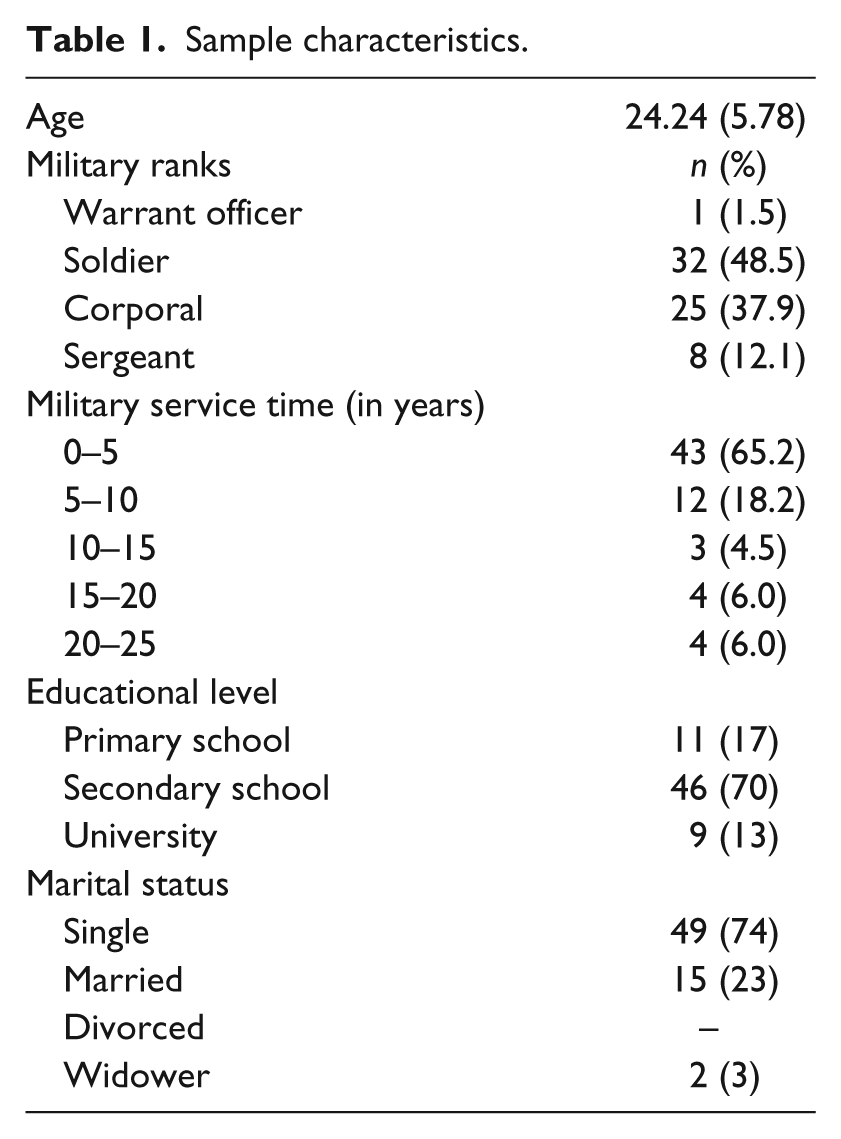
The study was conducted with 66 young male Brazilian Army militaries (privates, corporals, and sergeants) who volunteered for the United Nations Mission for Stabilization in Haiti (MINUSTAH). All participants were healthy and received exactly the same physical and preparatory training before deployment to Haiti from the Brazilian Army Physical Fitness Research Institute. The experiments were performed before and after a 6-month period of peacekeeping mission. The participants’ age, military ranks, military service time, educational level, and marital status are shown in Table 1.
Sample characteristics.
Participants were all non-smokers, reported no mental disorders, and were not taking any medication at the time of the experiment. This study was carried out in accordance with the recommendations of the Local Institutional Review Board with written informed consent from all participants. All participants gave written informed consent in accordance with the Declaration of Helsinki. The protocol was approved by the Local Institutional Review Board.
Psychometric measures
Military Peace Force Stressor Inventory (MPFSI) (Monteiro da Silva et al., 2005) was developed at the Centre for Personnel Studies of the Brazilian Army, to be used with Brazilian peacekeepers. The instrument identifies the most intense and frequent contingent stressors on a military peace mission to the United Nations. It comprises 46 items covering different stressful situations (e.g. witnessing atrocities and aggressions committed against civilians, see starving people and be vulnerable or subject to incidents and cannot react with firepower). For each stressor, participants were requested to identify whether they had experienced it or not. If they had experienced, they rated the intensity of each stressor on a 1–5 scale (1, “no stressful” to 5, “extremely stressful”). The authors showed high internal consistency (Cronbach’s alpha = 0.90) and satisfactory construct and convergent validity. A factorial analysis indicated a solution of six factors: 1—lack of information and power (alpha = 0.81); 2—impotence to aggression (alpha = 0.76); 3—cultural shock (alpha = 0.70); 4—fear of unknown situations and diseases (alpha = 0.61); 5—confinement and cohabitation at the base; (alpha = 0.76); and 6—subsistence and family support infrastructure (alpha = 0.53). One solution explained 40 percent of the total variance. They concluded that the internal consistency of total MPFSI and most of the factors were satisfactory. For the present study, we calculated the total number of stressful situations experienced during the mission by each peacekeeper.
Positive and Negative Affect Schedule-trait version (PANAS-T) (Watson et al., 1988) is a 20-item scale consisting of adjectives that describe PA and NA mood traits. Participants are asked to rate the degree to which they feel each emotion in general. They rated each mood adjective on a 1–5 scale (1, “very slightly or not at all” to 5, “extremely”).
To investigate possible PTSD symptoms, we used the PTSD Checklist—Civilian Version (PCL-C) (Weathers, 1991). It consisted of 17 items of post-traumatic stress symptoms. Participants indicated what degree they have been distressed by these symptoms during the last month, rating them from 1 to 5 (1, “not at all,” to 5, “very much”). Based on these authors, a score of 50 out of a maximum score of 85 is associated with diagnosis of PTSD. We used the PCL-C rather than Military Version because before deployment to Haiti we would like to evaluate the general symptoms of PTSD and not only the military symptoms. Therefore, after deployment, we used the same version to compare.
Beck Depression Inventory (BDI) (Beck et al., 1961) is a measure of self-assessment of behavioral manifestations of the depression. It consisted of 21 items and participants indicated what they are felling during this week, rating the items from 0 to 3. The score on the scale refers to the sum of the values scored in each of the statements.
Statistical analysis
To test the hypothesis that exposure to stressful events during a peacekeeping mission could be associated with PTSD symptoms, depression symptoms, and trait of PA and NA controlling by these parameters before mission, we used multiple linear regression models with exposure to stressful events and each of variables before mission as independent variables and each of these variables after mission as dependent variable (in different multiple linear regression models).
Data were analyzed using the Stata12 software (StatSoft, Inc.). In all analyses, we considered p < 0.05 as statistical significance and p between 0.05 and 0.1 as statistical tendency.
Results
The descriptive statistics for PA, NA, PTSD symptoms, and depressive symptoms before and after mission are described in Table 2.
Mean and standard deviation before and after mission.
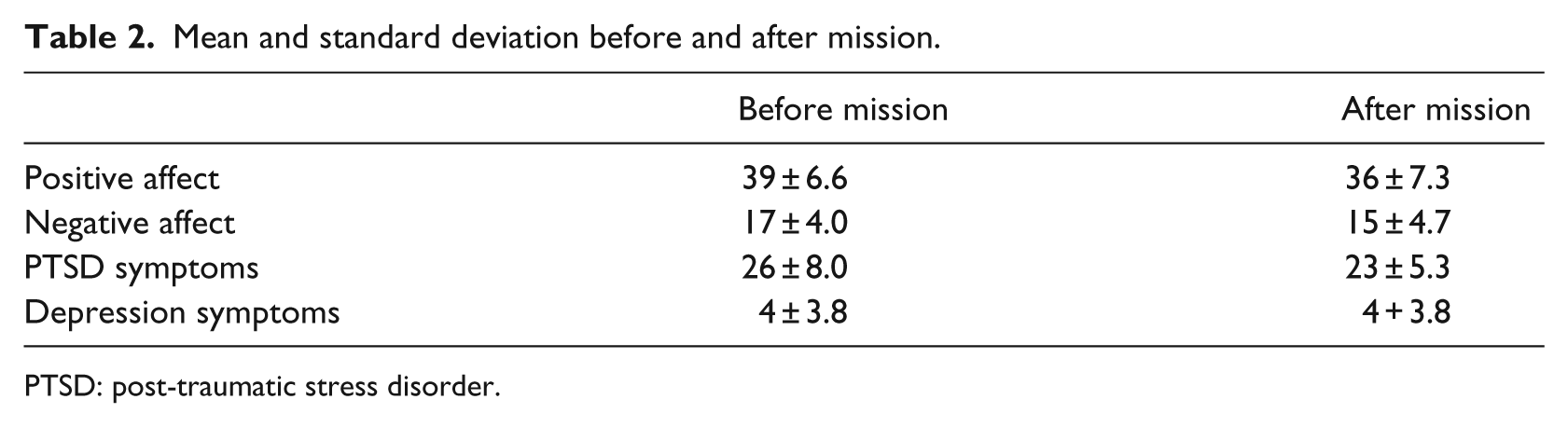
PTSD: post-traumatic stress disorder.
One of the multiple linear regression models to investigate the influence of exposure to stressful events on mental health shows that depression symptoms after mission (dependent variable) was associated with exposure to stressful events during the mission, controlled by depression symptoms before mission (independent variables). The other regression model showed that PTSD symptoms after mission (dependent variable) had a tendency to be associated with exposure to stressful events during the mission, controlled by PTSD symptoms before mission (independent variables) (see details in Table 3).
Models of multiple linear regressions to investigate the influence of stressful events on mental health.
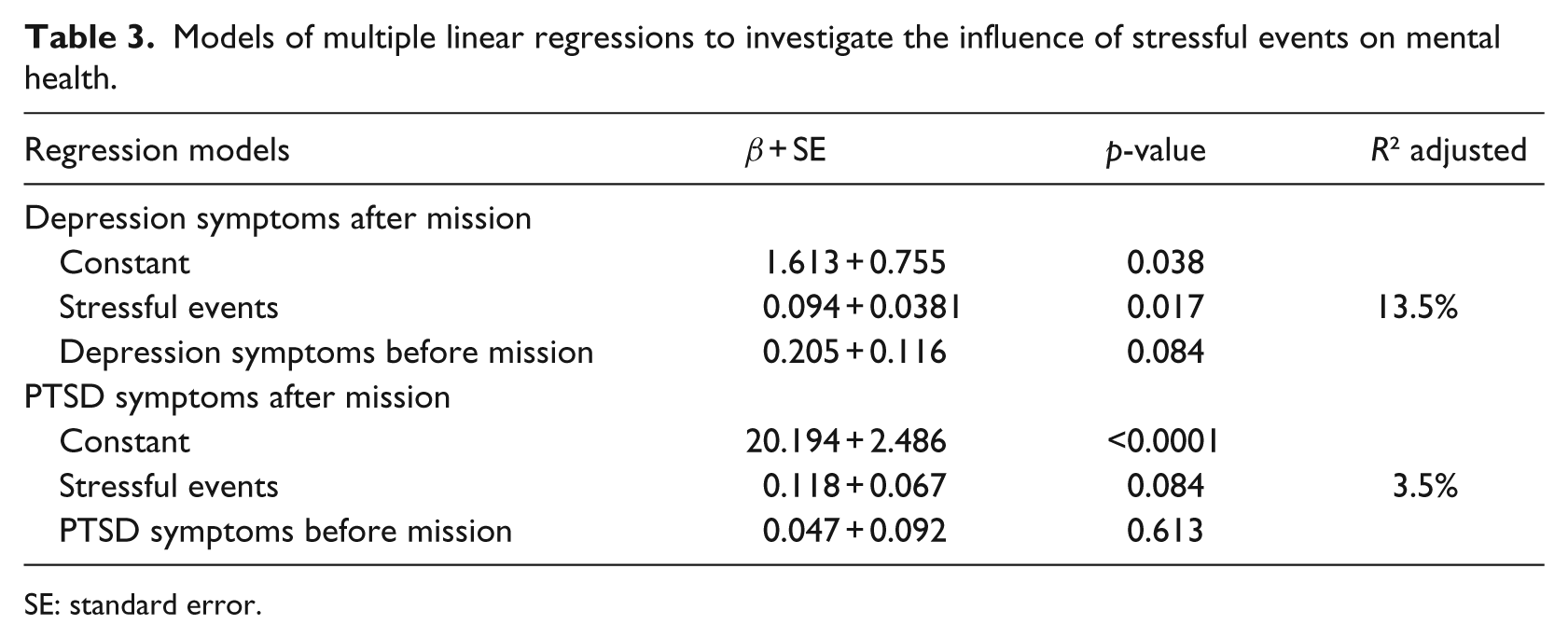
SE: standard error.
One of the multiple linear regression models to investigate the influence of exposure to stressful events on affect traits shows that trait of PA after mission (dependent variable) could be associated with exposure to stressful events during the mission, controlled by PA before mission (independent variables). Trait of NA after mission (dependent variable) had a tendency to be associated with exposure to stressful events during the mission, controlled by trait of NA before mission (independent variables) (see details in Table 4).
Models of multiple linear regressions to investigate the influence of stressful events on affect traits.
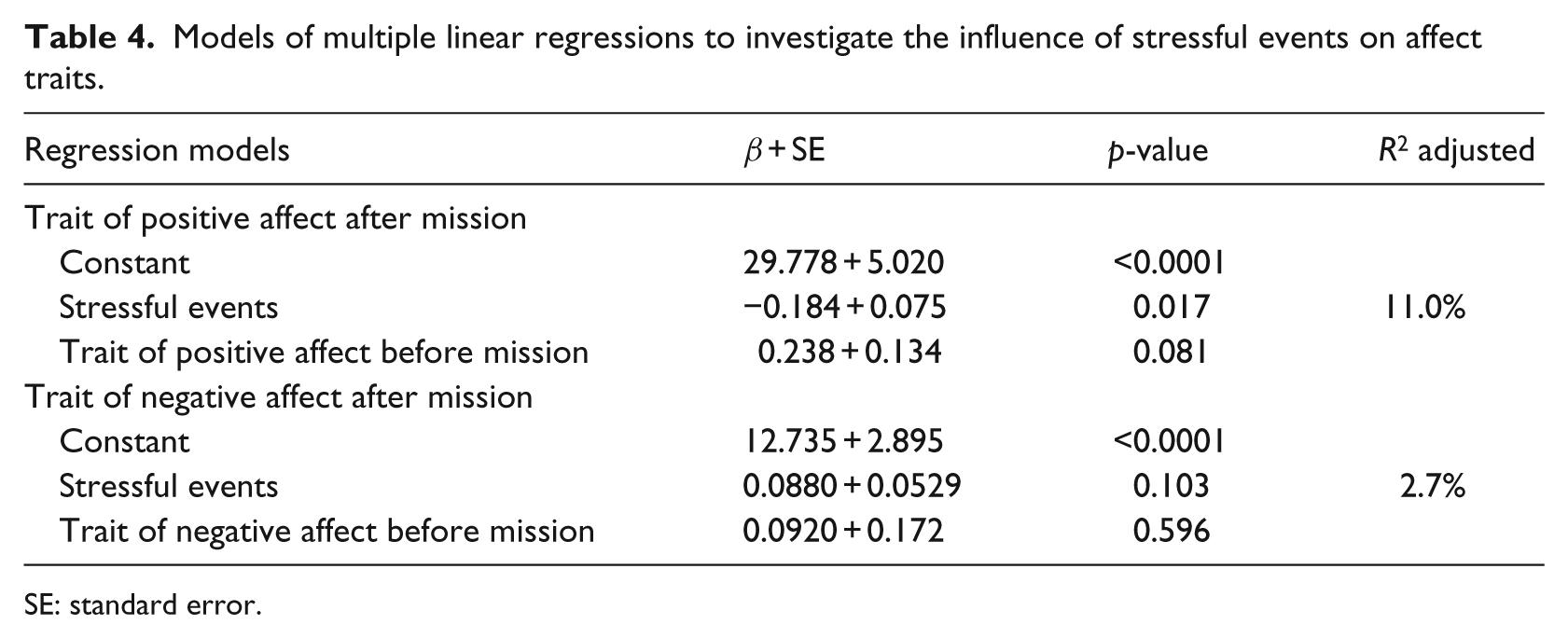
SE: standard error.
Discussion
The present study investigated if a higher exposure to stressful events during a peacekeeping mission could increase PTSD and depression symptoms and trait of NA and decrease trait of PA of healthy and physically active male peacekeepers after the return of the mission. Depression symptoms and trait of PA after mission were significantly associated with exposure to stressful events during the mission, controlled by the respective characteristics before mission. Besides that, trait of NA and PTSD symptoms after mission had a tendency to be associated with exposure to stressful events during the mission, controlled by the respective characteristics before mission.
Studies have shown that exposure to combat and violent situations are significantly associated with the prevalence of mental disorders (Sareen et al., 2007, 2008) and in particular with post-traumatic symptoms (Dirkzwager et al., 2005; Litz et al., 1997) among peacekeeping soldiers. In the present study, we showed that the Brazilian militaries that were exposed to higher stressful events presented higher depression and a trend to higher PTSD symptoms after mission, probably demonstrating that even peacekeepers that are physically and mentally healthy, both before and after the mission, can suffer with the chronic contact with death, poverty and atrocities experienced during their deployment.
A study by Phillips et al. (2010) with US marine males, who were serving in the Iraq and Afghanistan operations, is in agreement with our findings. They aimed to explore the relationship between the exposure to traumatic events during combat and the development of PTSD. The military who experienced traumatic exposures in combat were more likely to develop PTSD showing a dose–response relationship.
In our study, peacekeepers who were exposed to more stressful events during mission presented lower trait of PA and trend to higher trait of NA after mission. Previous work from our group showed that the trait of NA and the number of different intense traumatic events during mission were able to significantly predict the symptoms of post-traumatic stress in peacekeepers after returning from mission. (Souza et al., 2008). Taken together, the work by Souza et al. (2008) and the present results can have potential public health implications inasmuch as NA—and related constructs such as neuroticism—is a predictor of many different mental and physical disorders, quality of life, mortality, and the frequency of mental and general health service use (Lahey, 2009).
In an investigation of autonomic and self-report reactivity to pictures of mutilated bodies, after reading a text about the art of mimicking injuries in the movies, participants that scored high in trait of PA showed attenuated autonomic reactions to the mutilation pictures (Oliveira et al., 2009). The authors suggested that high trait of PA facilitated engagement in safety cues and modulated reflexive reactions of the brain’s defense system. Reduction of trait of PA associated with higher exposure to stressful events in a peacekeeping mission could impair the ability to engage in safety cues after deployment. Indeed, patients diagnosed with PTSDs were shown to present reduced PA trait (Rocha-Rego et al., 2012) and deficient safety learning was pointed as a possible biomarker of this disorder (Jovanovic et al., 2012).
Conclusion
We concluded that even in a healthy and physically active male peacekeepers, those more exposed to stressful events could be more vulnerable to present higher trait of NA, depression and PTSD symptoms and lower trait of PA after mission. These results reinforce the role of chronic stress—even in a healthy sample—in promoting in the long-term an allostatic load/overload. This process could increase risk factors for several physical and mental diseases in the professionals involved in risk-taking activities, as in the case of peacekeepers. Therefore, our findings can have future implications on selection, training, and treatment of these professionals.
Footnotes
Declaration of conflicting interests
The author(s) declared no potential conflicts of interest with respect to the research, authorship, and/or publication of this article.
Funding
The author(s) received the following financial support for the research, authorship, and/or publication of this article: This work was supported by National Council for Scientific and Technological Development (CNPq); Carlos Chagas Filho Foundation of Research Support in Rio de Janeiro (FAPERJ); Coordination for the Improvement of Higher Education Personnel (CAPES); and Foundation of Research Support in Minas Gerais (FAPEMIG).
