







Abstract
Research on the psychology of eating behavior often treats vegetarians as a monolithic group. Yet, a considerable proportion of people (17% in Study 1) who self-identify as vegetarian are actually pescatarians—those who forgo all meats except fish. Research on the psychology of pescatarianism is profoundly lacking, which may hinder future interventionists’ efforts to improve diet. Through two preregistered studies of adults from the United States recruited via Amazon Mechanical Turk (total N = 490), we investigated pescatarianism with respect to dietary identity, motivation, and attitudes toward animals. Results suggest that future research may benefit from studying pescatarians as a distinct dietary group and paying greater attention to whether or not pescatarians self-identify as vegetarian.
A rapidly expanding line of research has investigated the motivations that vegetarians (people who refrain from eating meat) and vegans (people who refrain from eating any animal product)—collectively referred to as veg*ns—have for following their diets and the impacts their food choices have on phenomena related to identity, morality, and health attitudes (Piazza et al., 2015; Rosenfeld, 2018; Rothgerber, 2017; Ruby, 2012). As eating less meat offers an effective strategy for improving human health (McMichael et al., 2007), understanding the psychology of meat avoidance is critical. Some people who self-identify as veg*n, however, actually include some types of meat in their diets, which may introduce easily avoidable—and theoretically explainable—error in the study of veg*n eating behavior. How might these dietary variations obscure research on meat avoidance?
Typically, participants in research on meat avoidance are individuals who self-identify as veg*n—that is, they label themselves as vegetarian or vegan. Yet, significant proportions of people who self-identify as vegetarian do not follow a strictly vegetarian diet (Barr and Chapman, 2002; Dietz et al., 1995; Rothgerber, 2017; Stiles, 1998). In fact, several surveys (e.g. Barr and Chapman, 2002; Dietz et al., 1995; National Institute of Nutrition, 1997) suggest that many self-identified vegetarians may truly be pescatarians—people who eschew red meat and poultry but eat fish (sometimes referred to as pesco-vegetarians). For example, one survey by the National Institute of Nutrition (1997) found that 78 percent of self-identified vegetarians sometimes consume fish or seafood, and another survey by Barr and Chapman (2002) found that 41 percent of self-identified vegetarians (in a sample of women) follow pescatarian diets.
Some of the current literature on vegetarianism, thus, might be based on samples comprised predominantly of people who self-identify as vegetarian but follow pescatarian diets. At the same time, this body of literature includes studies that consider pescatarians to be a type of omnivore, separating them categorically from vegetarians (e.g. Ang et al., 2019). This inconsistency highlights the need to investigate how proximal pescatarians are psychologically to vegetarians—that is, is there value in distinguishing whether participants, specifically, follow a vegetarian or pescatarian diet? Given that pescatarians eat fish (a type of meat), we reasoned that they construe their eating behaviors and relations with animals divergently from vegetarians who eschew all forms of meat. Might the different types of meat one avoids consuming shape, and be shaped by, one’s moral and health attitudes?
Despite there being a number of studies reporting within-group heterogeneity among meat-avoiders—for example, those comparing vegetarians with vegans (e.g. Filippi et al., 2010; Kessler et al., 2016; Rosenfeld, 2019a; Rothgerber, 2014a, 2015b) or vegetarians with flexitarians who eat a meat-reduced diet (e.g. De Backer and Hudders, 2014)—psychological research distinguishing pescatarians from other types of meat-avoiders is lacking. Moreover, the limited research existing in this domain has provided evidence that warrants follow-up testing. For example, Haverstock and Forgays (2012) found that pescatarians did not differ from vegetarians in terms of their health, environmental, or political dietary motivations. Having only 22 pescatarian participants, however, this study may have missed effects due to low statistical power. Not only does research on other forms of meat avoidance suggest that differences between vegetarian and pescatarian dieters’ dietary motivations may indeed exist, but theoretical perspectives from cognitive dissonance and motivated reasoning also suggest that these dieters may vary in their attitudes toward animals. Grouping vegetarians and pescatarians together into a singular category, thus, may overlook meaningful variance and reduce the power of empirical tests. With considerations of the potential health benefits yet environmental unsustainability of fish consumption prevailing (Béné et al., 2015; Buttriss, 2016; US Department of Health Human Services, 2015), it may become increasingly critical to understand the underlying psychological elements that separate pescatarians from vegetarians.
In the current research, we set two main aims: (1) to distinguish pescatarians psychologically from vegetarians who eschew all forms of meat and (2) to highlight the role of identity in pescatarian dieting. In the following sections, we review the theoretical and empirical basis for our investigation.
Pescatarians versus vegetarians
Dietary motivation
People can have a variety of motivations for eating less meat, and different motivations may influence social perception in distinct ways. People’s dietary motivations—namely, whether they avoid meat for ethics or health—shape their perceptions of dietary in-groups and out-groups, their feelings of disgust toward meat, and the meaning they ascribe to their dietary identity (Rosenfeld, 2019b; Rothgerber, 2014b; Rozin et al., 1997; Stiles, 1998). What motivations a vegetarian proclaims can even shape how other people view him or her. Omnivores have more negative attitudes toward ethically motivated than health-motivated vegetarians (MacInnis and Hodson, 2017), which makes it unsurprising that many vegetarians choose to emphasize the health, rather than ethical, aspects of their diets publicly (Wilson et al., 2004). As such, understanding differences in motivation between vegetarians and pescatarians may explain differences in not only these two groups’ attitudes and behaviors but also other people’s perceptions of them.
Health-motivated eaters may be particularly likely to follow a pescatarian diet, as national dietary guidelines recommend regular fish consumption for optimal health (Buttriss, 2016; US Department of Health, 2015). Research on other meat-avoiders’ motivations suggests a trend that likewise predicts pescatarians as largely motivated by health: The less restrictive a form of animal-product avoidance is, the more likely it is to be spurred by health, rather than ethical, motivations (Rosenfeld, 2018). For example, vegans express stronger dietary ethical motivations concerning animals and the environment than vegetarians do (Fiestas-Flores and Pyhälä, 2018; Rosenfeld, 2019a; Ruby, 2008). Given that pescatarians follow a less restrictive diet than vegetarians do, we hypothesized that a greater proportion of pescatarians than vegetarians would be health-motivated.
Attitudes toward animals
Even if pescatarianism were to be a predominantly health-motivated behavior, it may still be intertwined with moral processes. In particular, we posited that attitudes toward animals would distinguish pescatarians from vegetarians. Unlike vegetarians, who eschew all forms of animal flesh, pescatarians discriminate between which animals they will and will not eat: aquatic animals (i.e. fish, seafood) but not terrestrial animals (i.e. cows, chickens, and pigs). Research on cognitive dissonance processes related to meat consumption (e.g. Loughnan et al., 2014) can suggest that the act of eating fish in itself may lead pescatarians to withdraw moral concern for fish. As such, we hypothesized that pescatarians would exhibit greater speciesism—which entails “the assignment of different moral worth based on species membership” (Caviola et al., 2019: 1)—than vegetarians do.
The decision to eat seafood may in turn shape pescatarians’ perceptions of fish mind: the extent to which they believe that fish experience mental states. Debate exists as to whether or not fish are able to feel pain (Braithwaite, 2010; Key, 2016; Rose et al., 2014), highlighting that perceived pain capacity of fish exhibits significant variance. People are motivated to withdraw moral concern for animals they consume, and one way of withdrawing moral concern may be to deny the animal mind, namely, the capacity to suffer (Loughnan et al., 2010). Thus, we hypothesized that pescatarians perceive fish as possessing less capacity to experience pain than vegetarians do.
Similar motivated reasoning may manifest itself in pescatarians’ perceptions of fish healthfulness. On the one hand, dietary attitudes may precede dietary behavior: Some pescatarians, for example, likely follow their diets because they view fish as a healthful food. Yet, other pescatarians—perhaps ones who are morally motivated, in particular—may come to believe that fish is healthful as a result of following this diet. That is, based on self-perception theory (Bem, 1972) and cognitive dissonance theory (Festinger, 1957), even individuals who lack any health motivation to choose a pescatarian diet may become more inclined to believe that fish is healthful once they subscribe to pescatarianism. Upon committing to pescatarianism, viewing fish as a healthful food would promote consistency in one’s beliefs and behaviors, thus avoiding dissonance. As such, we hypothesized that pescatarians are motivated to believe that eating fish is healthful, as doing so would reinforce their preexisting belief that this diet is ideal.
Self-identification
Discrepancies exist in whether or not pescatarians are a type of vegetarian. Given that vegetarians are people who do not eat any animal flesh, and that fish is a type of animal flesh, it would follow that pescatarians are not vegetarians (Vegetarian Society, 2016). Nevertheless, some pescatarians consider themselves vegetarian, an apparent contradiction that has instigated both confusion and vehement debate (Rohrer, 2009). This discrepancy highlights that labeling oneself as a vegetarian and following a meatless diet are distinct phenomena that may, at times, diverge (Rosenfeld and Burrow, 2017a). Furthermore, this discrepancy can obfuscate the parameters of research on vegetarianism, namely, should investigators classify pescatarians as vegetarians? Moreover, should investigators classify pescatarians who self-identify as vegetarian differently from pescatarians who do not? Depending on what outcomes associate with each dietary pattern and way of self-identifying, investigators may strategically choose one method or the other in order to increase the sensitivity of their empirical tests. For research questions related specifically to the causes or effects of what foods people eat, an appropriate method would be to categorize people on dietary pattern. In contrast, self-identification may provide a more suitable grouping variable when investigating the role of identity, beyond simply diet, in veg*nism. Here, to provide an initial step toward addressing these inquiries with empirical evidence, we estimated the proportion of pescatarians who self-identify as vegetarian and evaluated psychological correlates of this identification.
Pescatarians who self-identify as vegetarian versus pescatarians who do not
As Rosenfeld and Burrow (2017a) highlight, one can classify individuals as vegetarian or pescatarian based on either what dietary pattern they follow or how they self-identify. We grounded our comparison of pescatarians and vegetarians in dietary pattern, classifying individuals who eschew red meat and poultry but consume fish as pescatarians and individuals who eschew all three of these meats as vegetarians (based on Rosenfeld and Burrow’s (2017a, 2018) framework of dietary patterns). This methodology, however, overlooks the fact that many pescatarian dieters may subjectively consider themselves vegetarian. Given that participants’ statuses as vegetarian or not in many studies is determined by their self-identification—irrespective of their dietary pattern—it would behoove investigators to understand more clearly what types of pescatarians are likely to self-identify as vegetarian.
A second aim of this article, accordingly, is to compare pescatarians who self-identify as vegetarian with pescatarians who do not. That is, why might some pescatarians adopt this social categorical label, whereas others refrain from doing so? What psychological consequences might arise when pescatarian dieters label themselves as vegetarian? In particular, we sought to compare vegetarian-identifying and non-identifying pescatarians along dimensions of dietarian identity (Rosenfeld and Burrow, 2018).
Dietarian identity characterizes how people see themselves when it comes to eating or not eating animal products (Rosenfeld and Burrow, 2018). That is, regardless of whether people are full-on meat-eaters or strict vegans, they all engage in an eating pattern, one that may or may not underlie an identity salient to them. Several constructs comprising dietarian identity may illuminate psychological differences between vegetarian-identifying and non-identifying pescatarians. Three of these constructs—centrality, private regard, and public regard—are core features of social identification (Luhtanen and Crocker, 1992). In the current research, centrality can refer to the extent to which following a pescatarian diet is a predominant feature of one’s self-concept. We hypothesized that people who view meat avoidance as a more central part of their identity would be more inclined to refer to themselves as vegetarians. By proclaiming a lexicalized label—such as self-identifying as vegetarian–people express a meaningful facet of their identity, situate themselves within a social category, and portray this group membership as a central and temporally stable aspect of who they are (Gelman and Heyman, 1999).
Private regard refers to one’s personal feelings toward following a pescatarian diet and toward other pescatarians, whereas public regard refers to one’s feelings about how non-pescatarians and the larger society evaluate pescatarians (Rosenfeld and Burrow, 2018). People are inclined to define themselves by identity domains they hold in high regard (Stryker and Serpe, 1982), and adopting a vegetarian label communicates that this identity domain is a strong basis for self-definition. As such, we hypothesized that pescatarians with high private regard would be particularly likely to self-identify as vegetarian. This self-identification may in turn influence their sense of public regard. Omnivores (Kellman, 2000; Minson and Monin, 2012) and even vegans (Rothgerber, 2014b) may hold negative stereotypes about vegetarians, and one’s decision to label oneself as a vegetarian might lead one to become a target of these attitudes. Indeed, vegetarians feel that more negative attitudes exist toward vegetarians than omnivores feel exist toward omnivores (Rosenfeld and Burrow, 2018). We reasoned that vegetarian self-identification would be likely to lower public regard, rather than the reverse. As adopting a negatively stereotyped group membership voluntarily would be counterintuitive for maintaining a high self-esteem, it is unlikely that having a lower public regard would motivate pescatarians to label themselves as vegetarian. Instead, it is more probable that pescatarians who self-identify as vegetarian come to internalize negative stereotypes about their dietary group and subsequently develop a lower public regard.
In addition to centrality, private regard, and public regard, dietary strictness—or the extent to which one adheres to one’s pescatarian diet (Rosenfeld and Burrow, 2018)—may also interact with vegetarian social identification. In identifying with a social category (such as one for vegetarians), people can experience identity threats should they violate that category’s norms (Hornsey and Jetten, 2003; Rothgerber, 2014a). By forgoing a vegetarian self-label, pescatarians can evade these dilemmas, and perhaps as a consequence even eat other types of meat from time to time. Support for this reasoning comes from the finding that conscientious omnivores (people who eat meat only from humanely raised animals) follow their diets less strictly than vegetarians following their diets (Rothgerber, 2015a). Pescatarians, like conscientious omnivores, avoid meat to a lesser degree than vegetarians do and may or may not adopt a social identity label for their diets. Thus, we hypothesized that pescatarians who self-identify as vegetarian would exercise greater strictness than do those who do not.
Study 1
In this first study, we aimed to expand the literature on pescatarianism through two means: first, by comparing pescatarians’ dietary motivations and attitudes toward animals to those of vegetarians and, second, by estimating the proportion of pescatarians who self-identify as vegetarian. Regarding this first aim, we hypothesized that, compared to vegetarians, pescatarians would be more likely to emphasize health over ethical motivation, exhibit greater speciesism, perceive fish as possessing less capacity to experience pain, and perceive fish as more healthful to consume.
Method
Participants
A power analysis, assuming equal numbers of pescatarians and vegetarians, indicated that 100 pescatarians and 100 vegetarians would provide 80 percent power to detect small-medium effect sizes of d = 0.4 between these groups at a significance threshold of p = .05. However, unsure what number of participants in our sample would report each diet—and considering our plan to exclude participants who failed an attention check—we set to cease data collection once our sample contained at least 110 pescatarians and 110 vegetarians, rather than setting a total sample size a priori.
Three hundred and eighty-five meat-avoiding participants from the United States took part in this study through an online survey via Amazon Mechanical Turk (MTurk). Of these participants, 255 indicated that they followed either pescatarian (n = 110) or vegetarian (n = 145) diets and were retained in this study. 1 Then, after excluding 15 participants who failed an attention check and 1 participant who reported being an impossible age, 239 participants (63% female) between the ages of 20 and 77 (Mage = 38.34, standard deviation (SD) = 12.37) were retained for analyses. Of these remaining participants, 104 were pescatarians and 135 were vegetarians. This final sample provided 80 percent power to detect small-medium effect sizes (d = 0.37) between pescatarians and vegetarians at a significance threshold of p = .05.
Materials
This study’s sample size, materials, and analyses were preregistered via the Open Science Framework (OSF) (see https://osf.io/43vgk/?view_only=0f663ab3f79f422cb895167a406ae739 for preregistration).
Dietary pattern
Dietary pattern was assessed with the statement, “Which of the following describes your diet most accurately?” Participants were able to select one of four responses. Participants who selected first response, “I eat fish, but I do not eat red meat or poultry (pescatarian diet),” were categorized as pescatarians; the second response, “I do not eat any meat or fish (vegetarian diet),” as vegetarians; the third response, “I do not eat any animal products (vegan diet),” as vegans; and the fourth response, “None of the above describe my diet accurately,” as other dieters.
Dietary motivation
Drawing upon research on what motivates people to eschew meat (Rosenfeld and Burrow, 2017b), we focused on two dimensions of dietary motivation: ethical and health. We computed a variable reflecting the extent to which participants emphasized health over ethical motivation. Health motivation was assessed with the statement, “I follow this diet for health reasons,” and ethical motivation with the statement, “I follow this diet for ethical reasons.” Responses ranged from 1 (Strongly Disagree) to 7 (Strongly Agree). The extent to which participants emphasized health over ethical motivation was operationalized by their health motivation score minus their ethical motivation score.
Speciesism
Speciesism was assessed with Caviola et al.’s (2019) 6-item Speciesism Scale (α = .83). An example item on this scale was “Morally, animals always count for less than humans.” Responses ranged from 1 (Strongly Disagree) to 7 (Strongly Agree).
Perceived capacity of fish to feel pain
Perceived capacity of fish to feel pain was assessed using the question “Are fish able to feel pain?” to which responses ranged from 1 (Definitely No) to 5 (Definitely Yes).
Perceived healthfulness of consuming fish
Perceived healthfulness of consuming fish was assessed using a 3-item scale (α = .88), which included the items “Eating fish provides many health benefits,” “Fish is a key part of a healthy diet,” and “A diet that includes fish is healthier than a diet without any fish,” to which responses ranged from 1 (Strongly Disagree) to 7 (Strongly Agree).
Procedure
After consenting to take part in this research, participants first indicated their dietary pattern and dietary motivations. Next, participants completed the three other materials in a random order. Finally, participants completed demographic questions, wherein they indicated whether or not they consider themselves to be vegetarian. This study protocol (IRB#18-001495) was approved by the Institutional Review Board at the University of California, Los Angeles, and informed consent was obtained from all study participants.
Results
Data and analysis scripts are available at https://osf.io/8rhkt/?view_only=e360d070d61149998b64c1a773e6391a.
First, we tested whether homogeneity of variance—an assumption underlying independent-samples t-tests—existed between pescatarians and vegetarians for all outcome variables. Levene’s tests for equality of variance revealed that variances were equal for dietary motivation, speciesism, and perceived capacity of fish to feel pain (all ps >.05), and unequal for perceived healthfulness of consuming fish (p < .001). Accordingly, we conducted unadjusted t-tests for dietary motivation, speciesism, and perceived capacity of fish to feel pain and a Welch-adjusted t-test for perceived healthfulness of consuming fish. Compared to vegetarians, pescatarians were more likely to emphasize health over ethical motivation, exhibited greater speciesism, perceived fish as possessing less capacity to experience pain, and perceived fish as more healthful to consume (see Tables 1 and 2).
Differences between pescatarians and vegetarians on Study 1 outcomes.
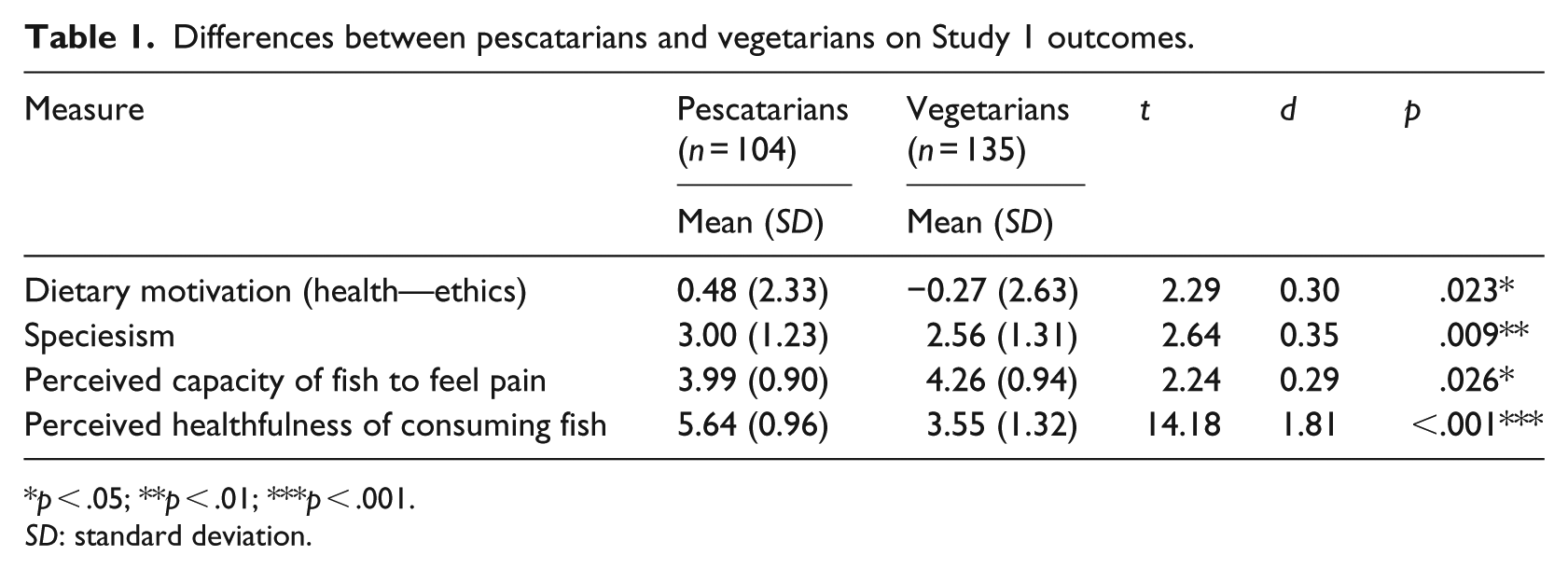
p < .05; **p < .01; ***p < .001.
SD: standard deviation.
Intercorrelations between Study 1 outcomes, n = 239.
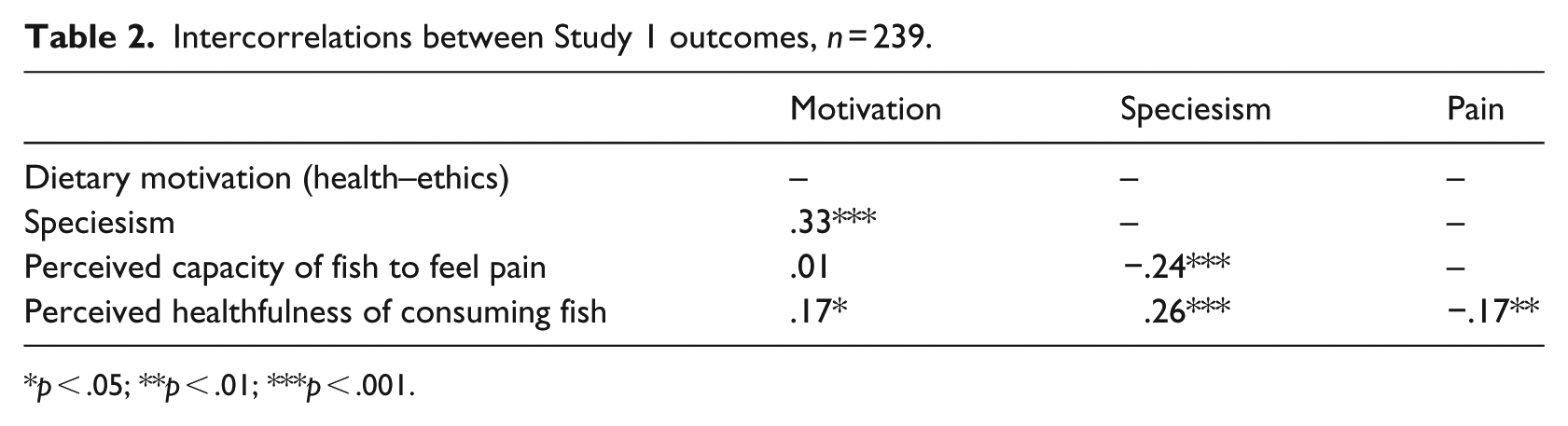
p < .05; **p < .01; ***p < .001.
As we expected, pescatarians were mixed in whether or not they self-identified as vegetarian: 36.54 percent (95% confidence interval (CI): 27.28%, 45.79%) of pescatarians considered themselves vegetarian, whereas 63.46 percent (95% CI: 54.21%, 72.72%) did not. In contrast, 99 percent of vegetarians self-identified as vegetarian.
Discussion
In the first study, we found support for all four of our hypotheses. Effects for the differences in dietary motivation, speciesism, and perceived capacity of fish to feel pain between pescatarians and vegetarians were small to medium, whereas the difference between these groups on perceived healthfulness of consuming fish was very large. Moreover, we observed that approximately 37 percent of pescatarians considered themselves vegetarian. Thus, the remaining 63 percent of pescatarians eschewed this vegetarian label, seeing themselves as categorically distinct from vegetarians.
Study 2
In the second study, we examined dietarian identity differences between pescatarians who do and do not self-identify as vegetarian. We hypothesized that pescatarians who self-identify as vegetarian would exhibit higher dietarian identity centrality, higher private regard, lower public regard, and higher strictness. We also set to explore potential differences on other dimensions of dietarian identity—including out-group regard (how pescatarians evaluate non-pescatarians for their food choices) and motivational orientations (the extents to which pescatarians are prosocially, personally, and morally motivated to follow their diets) (Rosenfeld and Burrow, 2018)—between vegetarian-identifying and non-identifying pescatarians.
Method
This study’s sample size, materials, and analyses were preregistered via OSF (see https://osf.io/6ugt5/?view_only=ce692707eefe4601a1cc8b099eb94f4d for preregistration).
Participants
A power analysis, assuming that we were to observe a similar proportion of pescatarians who self-identify as vegetarian in this study as in Study 1, indicated that 278 participants would provide 80 percent power to detect small-to-medium effect sizes of d = 0.35 at a significance threshold of p = .05. As such, and considering our plan to exclude participants who fail an attention check or indicate that they do not follow a pescatarian diet, we set to recruit a total of 340 participants.
Three hundred and forty participants from the United States took part in this study through an online survey on pescatarianism via MTurk. Of the total 340 participants, 273 indicated that they followed a pescatarian diet and were retained in this sample. Then, after excluding 22 participants who failed an attention check, 251 participants (53% female) between the ages of 18 and 75 (Mage = 35.66, SD = 11.12) were retained for analyses. Of these remaining participants, 64 self-identified as vegetarian whereas 187 did not. This final sample provided 80 percent power to detect small-medium effect sizes (d = 0.41) between vegetarian-identifying and non-identifying pescatarians at a significance threshold of p = .05.
Materials
Dietarian identity
Dietarian identity was assessed using Rosenfeld and Burrow’s (2018) Dietarian Identity Questionnaire (DIQ). The DIQ began with an initial item that assessed which of the following animal products participants eat or do not eat: red meat, poultry, fish, egg, and dairy. Below this item was a prompt highlighting that, for the rest of the survey, a participant’s “dietary pattern” referred to those foods he or she indicated eating and/or not eating.
Following this dietary pattern item, the DIQ included 33 items assessing centrality; private, public, and out-group regards; prosocial, personal, and moral motivations; and strictness. Each of these eight subscales exhibited strong internal consistency (Cronbach’s α ranging from .85 to .97). An example item for centrality (α = .94) included “My dietary pattern defines a significant aspect of who I am.” An example item for private regard (α = .85) included “People who follow my dietary pattern should take pride in their food choices.” An example item for public regard (α = .94) included “Following my dietary pattern is associated with negative stereotypes” (reverse-scored). An example item for out-group regard (α = .97) included “I judge people negatively for eating foods that go against my dietary pattern” (reverse-scored). An example item for prosocial motivation (α = .95) included “Concerns about social issues motivate me to follow my dietary pattern.” An example item for personal motivation (α = .86) included “I follow my dietary pattern because I am concerned about the effects of my food choices on my own well-being.” An example item for moral motivation (α = .93) included “I follow my dietary pattern because eating this way is the morally right thing to do.” An example item for strictness (α = .92) included “From time to time, I eat foods that go against my dietary pattern” (reverse-scored). Responses to all items ranged from 1 (Strongly Disagree) to 7 (Strongly Agree).
Categorization of fish as meat
Categorization of fish as meat was assessed by the question “Do you consider fish to be a type of meat?” with responses including “yes” and no.” We reasoned that a possible explanation as to why some pescatarians would self-identify as vegetarian is that they simply do not consider fish to be a type of meat. Thus, they see themselves as following a meatless (vegetarian) diet. We administered this question so that we could enter participants’ categorizations of fish as meat as a covariate in comparing dietarian identity between vegetarian-identifying and non-identifying pescatarians to see whether any differences between these groups would persist when controlling for this factor.
Procedure
After consenting to take part in this research, participants first indicated whether or not they consider fish to be a type of meat. Then, participants completed the DIQ. At the end of the survey, participants completed demographic questions and indicated whether or not they consider themselves to be vegetarian. This study protocol (IRB#18-001495) was approved by the Institutional Review Board at the University of California, Los Angeles, and informed consent was obtained from all study participants.
Results
Data and analysis scripts are available at https://osf.io/q3sd4/?view_only=a2da0c3aabc946b194ef12cb7fae17f8.
First, we tested whether homogeneity of variance existed between vegetarian-identifying and non-identifying pescatarians for all eight dietarian identity variables. Levene’s tests for equality of variance revealed that variances were equal for all variables (all ps >.05). Independent-samples t-tests revealed that, compared to pescatarians who do not self-identify as vegetarian, pescatarians who do self-identify as vegetarian reported a higher private regard, lower public regard, higher prosocial motivation, and higher moral motivation. There were no significant differences between vegetarian-identifying and non-identifying pescatarians on centrality, out-group regard, personal motivation, or strictness (Tables 3 and 4).
Dietarian identity differences between pescatarians who self-identify as vegetarian and pescatarians who do not (Study 2).
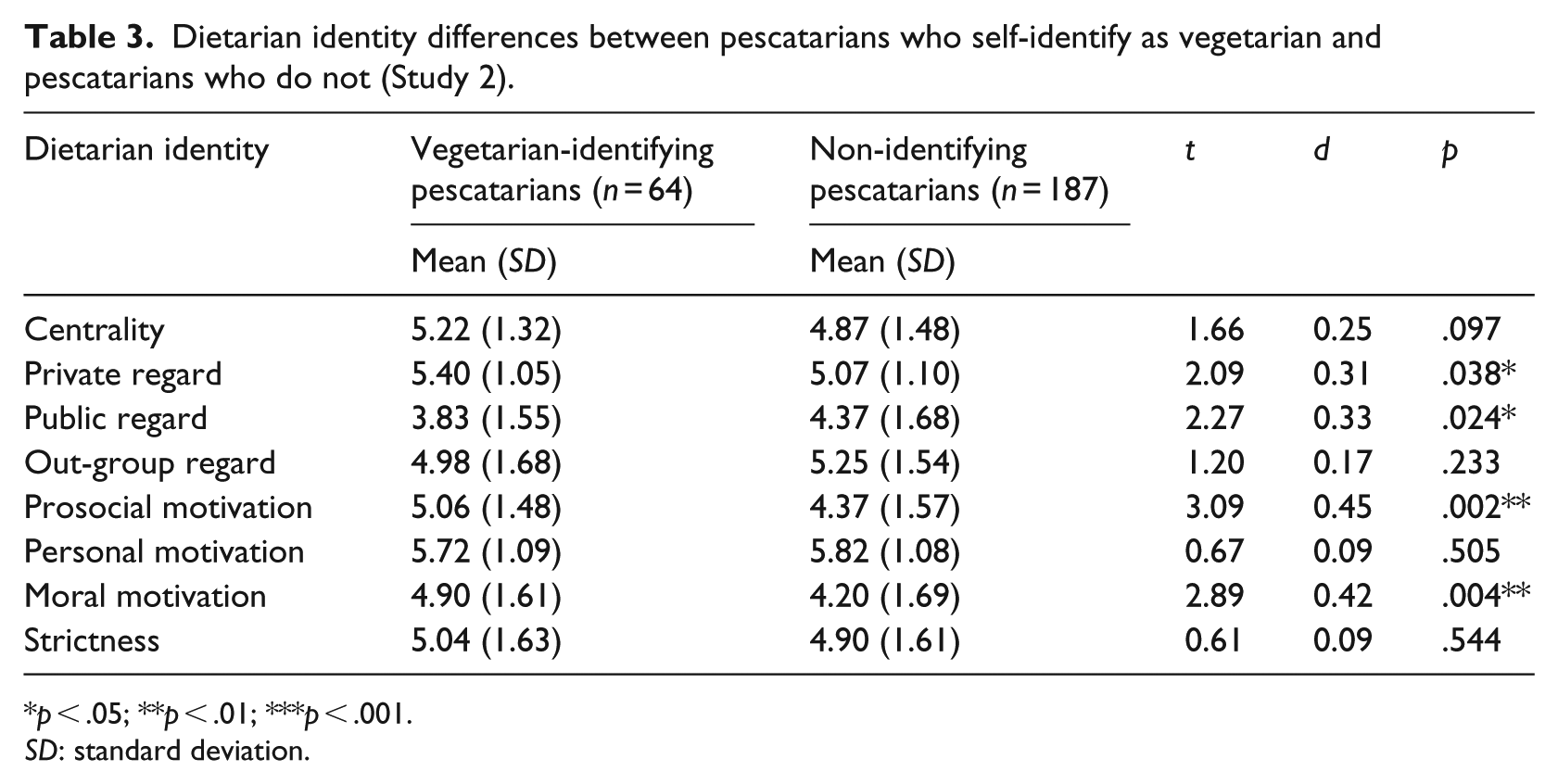
p < .05; **p < .01; ***p < .001.
SD: standard deviation.
Intercorrelations between dietarian identity dimensions among pescatarians, n = 251 (Study 2).
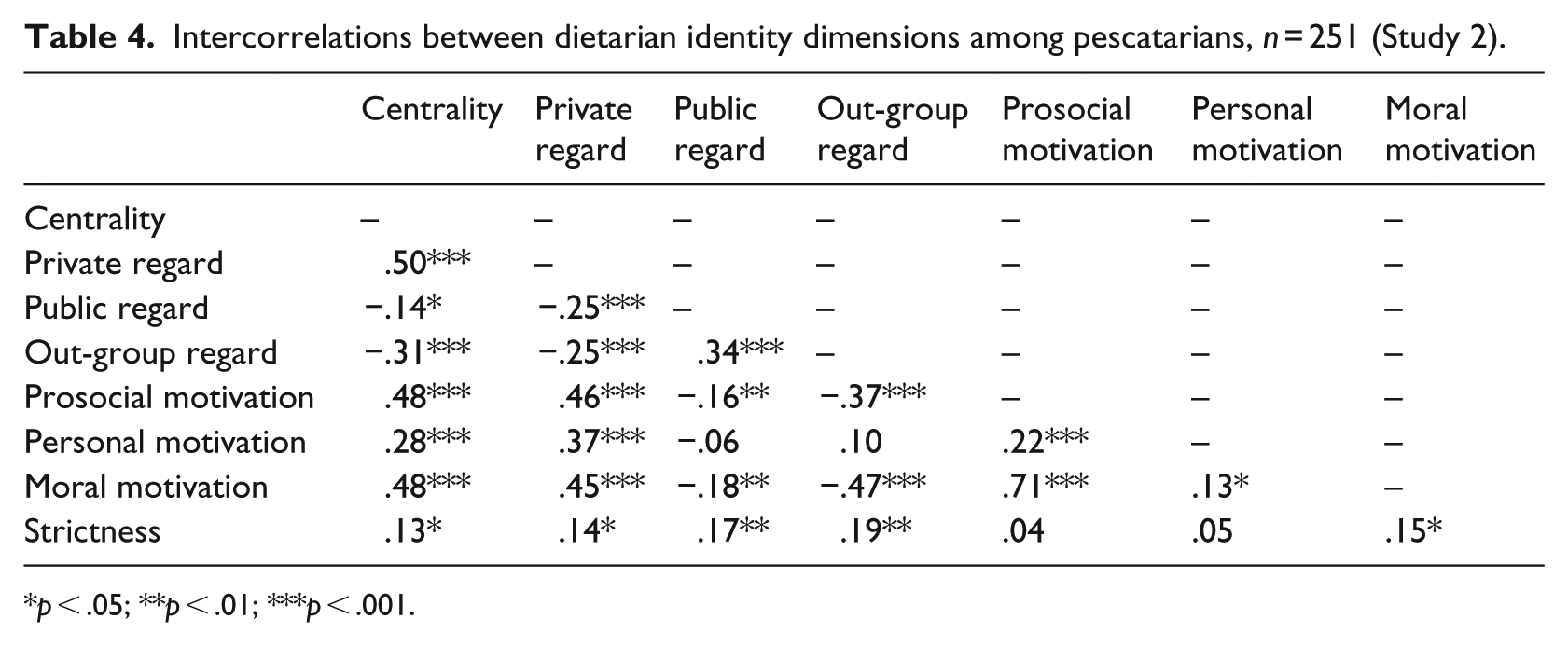
p < .05; **p < .01; ***p < .001.
Might these differences be explained by the fact that some pescatarians consider fish to be a type of meat whereas others do not? To rule out this alternative explanation, we tested whether participants’ categorizations of fish as meat associated with their self-identifications as vegetarian and whether observed differences between vegetarian-identifying and non-identifying pescatarians would persist when controlling for fish-meat categorization as a covariate. Of the total 251 pescatarians, 149 (59%) considered fish to be meat, whereas 102 (41%) did not. Pescatarians who considered fish to be meat (18%) were less likely than were pescatarians who did not consider fish to be meat (36%) to self-identify as vegetarian, χ2 (1) = 9.57, p = .002. Analyses of covariance (ANCOVAs), controlling for participants’ categorizations of fish as meat, yielded the same results we observed from our independent-samples t-tests.
Exploratory analyses: gender as a covariate
Because the majority of vegetarians are women (Forestell and Nezlek, 2018; Pfeiler and Egloff, 2018; Rosenfeld, 2018; Ruby, 2012), one might wonder whether gender is driving our observed results. Indeed, gender covaried with our grouping variable, self-identification: Pescatarian women (32%) were more likely than pescatarian men (18%) were to self-identify as vegetarian, χ2(1) = 6.21, p = .013. As such, we tested whether observed differences between vegetarian-identifying and non-identifying pescatarians would persist when controlling for gender as a covariate. ANCOVAs controlling for gender yielded the same results we observed in our previous two tests: Pescatarians who self-identify as vegetarian reported higher private regard, lower public regard, higher prosocial motivation, and higher moral motivation (all ps <.05) but did not report significantly different levels of centrality, out-group regard, personal motivation, or strictness (all ps >.05).
Discussion
We found support for two of our four hypotheses in the second study. As predicted, compared to pescatarians who do not self-identify as vegetarian, pescatarians who do self-identify as vegetarian reported higher dietarian identity private regard and lower public regard. Thus, they take more pride in following their dietary pattern yet feel more stigmatized for eating this way. These differences were of small-to-medium effect sizes. Contrary to our predictions, however, vegetarian-identifying pescatarians did not report higher centrality or higher strictness, suggesting that they define themselves by their diets and follow their diets with similar degrees of adherence as do pescatarians who do not consider themselves vegetarian.
Preregistered exploratory analyses indicated that vegetarian-identifying pescatarians were more prosocially and morally, but not personally, motivated to follow their diets than were non-identifying pescatarians. These differences on prosocial and moral motivations were of medium effect sizes. Still, important to note is that both vegetarian-identifying and non-identifying pescatarians were predominantly personally, rather than prosocially or morally, motivated.
Our results suggest that whether pescatarians categorize fish as meat did not explain observed dietarian identity differences between vegetarian-identifying and non-identifying pescatarians. These differences were not explained by gender either.
General discussion
Our data highlight the value in distinguishing between varying degrees of animal-product avoidance (e.g. pescatarian versus vegetarian dieting) and conceiving dietary pattern versus label (i.e. self-identification) as distinct constructs. In Study 1—centering our participant grouping on what dietary pattern they followed—we found that, relative to vegetarians, pescatarians are more likely to emphasize health over ethical motivation, exhibit greater speciesism, perceive fish as possessing less capacity to experience pain, and believe that fish is more healthful to consume. The largest difference between these groups emerged with respect to perception of fish healthfulness, a finding that we see as in accordance with research on the food-choice process: People’s perception of a food’s healthfulness is a leading determinant of whether or not they will eat that food (Sobal and Bisogni, 2009). We also speculate that motivated reasoning may exaggerate the magnitude of this effect. However, our correlational data cannot allow for any inferences about causality.
In Study 2—grouping pescatarian dieters by whether or not they self-identified as vegetarian—we found that pescatarians who self-identify as vegetarian think and feel about their diets differently from pescatarians who do not self-identify as vegetarian. Our results suggest that, relative to non-identifying pescatarians, vegetarian-identifying pescatarians hold their dietary in-group in a more positive light (higher private regard), feel as if they are judged more negatively for following their dietary pattern (lower public regard), and are more strongly motivated by matters that extend beyond themselves (higher prosocial motivation) and are rooted in their moral principles (higher moral motivation).
Taken together, results from these two studies converge to suggest that pescatarianism is a dietary pattern spurred predominantly by health reasons rather than ethical principles. This emphasis on personal health over ethical motivation, moreover, appears to be particularly large among pescatarians who do not self-identify as vegetarian. Our finding that pescatarians who are more morally and prosocially, but not personally, motivated are more likely to self-identify as vegetarian can be valuable in considering social identity aspects of vegetarianism. A goal for future research should be to understand why dietary motivation would affect dietary social identification. For example, do people view vegetarianism as an inherently ethically oriented identity more so than one related to personal health and well-being, and might this stereotypical association lead some health-motivated meat-avoiders to eschew a vegetarian label? Evidence exists to suggest that ethically motivated vegetarianism more closely resembles veganism than health-motivated vegetarianism does and thus may be a more extreme deviation from socially normative omnivorous eating (Rothgerber, 2014b). Accordingly, the regard in which pescatarians hold various meat-avoiding social groups may influence their social identifications.
Our finding that pescatarians who self-identify as vegetarian feel more stigmatized and negatively judged for eating this way than non-identifying pescatarians do suggest that simply self-categorizing as vegetarian may shape how one perceives oneself and one’s social world. Notably, Rosenfeld and Burrow’s (2018) measure of dietarian identity—employed in Study 2—assesses how people reflect on their dietary pattern, without any mention of how they self-identify with any label such as vegetarian. Thus, our data highlight that variations in social identification can predict discrepancies in how two people construe the same eating behavior. Considering this phenomenon may inform best practices in healthcare settings and public health research. For example, when healthcare providers and nutritionists are interested in their patients’ eating behaviors, asking specifically about what foods people do and do not eat—rather than how they self-identify or label their diets—may provide more accurate insights. Moreover, in conducting epidemiological research or designing public health campaigns related to meat consumption, investigators may benefit from noting that the behavior of forgoing meat is different from the identity of being a vegetarian.
We advance that differences in identity regard and dietary motivation between pescatarians who do and do not self-identify as vegetarian are meaningful when investigators consider how to define “vegetarian” in their work. As scholars have noted previously (Rosenfeld and Burrow, 2017a; Ruby, 2012), discrepant definitions exist to characterize vegetarian dieting. Should investigators classify pescatarians as vegetarians, or should the fact that pescatarians eat fish preclude them from such categorization? Moreover, should individuals’ self-identifications trump their dietary patterns in determining vegetarian status, such that pescatarians who consider themselves vegetarian are indeed to be deemed vegetarian? More broadly, a timeless question for which these matters have implications is how investigators should estimate the prevalence of vegetarianism within a culture, as this figure is of interest to professionals—such as social scientists and marketers—and who focus on food and eating.
We believe that categorizing individuals based on dietary pattern may be advantageous in certain cases while categorizing on label (i.e. self-identification) may reign superior in others. In researching the physical health correlates of meat avoidance, knowing participants’ dietary patterns would likely be more valuable than knowing how they self-identify. On the other hand, in studying diet-based stigma, one might see value in focusing on people who self-identify as vegetarian, given our finding that this self-identification is associated with feeling more stigmatized for following one’s diet. Likewise, in evaluating social justice aims of vegetarianism, one would benefit from focusing on self-identified vegetarians, as self-identifying as vegetarian appears to be associated with greater prosocial and moral motivations for eschewing meat. Whether investigations determine vegetarian status based on participants’ dietary patterns or self-identifications will likely lead toward different results. Ultimately, any catchall guideline on how to define “vegetarian” would neglect insights that could be gained from evaluating variances in what food choices people make or in how they self-categorize. In many cases, investigators may derive greatest value from considering both dietary pattern and label in tandem in order to test for discrepant results. Insights gained from pescatarians’ diet-label discrepancies may help inform policies aimed at encouraging health-promoting and sustainable eating patterns.
A notable finding that adds to a well-developed literature on gender and veg*nism (Rosenfeld, 2018; Ruby, 2012) was that pescatarian women were nearly twice as likely as were pescatarian men to self-identify as vegetarian. Thus, gender may inform how meat-avoiders construct and manage their veg*n identities. Additional research is needed to explain why women might be more receptive to labeling themselves as vegetarian. One reason for this may be that women tend to look more favorably upon vegetarianism than men do (Rosenfeld, 2018). Other reasons may relate to the idea that openly rejecting meat consumption may be incongruent with maintaining a masculine identity (Rothgerber, 2012). Might this greater inclination among women to self-identify as vegetarian overinflate the estimated prevalence of women in the veg*n population? Studies recurrently find that the majority of veg*ns are women (Rosenfeld, 2018; Ruby, 2012), yet the current findings raise questions about the magnitude of such gendered effects.
Finally, we found that slightly fewer than half—approximately 41 percent—of pescatarians did not consider fish to be a type of meat. These pescatarians, furthermore, were twice as likely to self-identify as vegetarian, compared to pescatarians who considered fish to be meat. Thus, one reason as to why many pescatarians paradoxically consume animal flesh yet consider themselves vegetarian is that they simply do not view fish as a type of meat. We speculate that viewing fish as distinct from other meat may be a strategy for reducing cognitive dissonance and threats to one’s moral self-concept one might feel from viewing oneself as a meat-eater (Bastian et al., 2012). Moreover, people may perceive mammals as more proximal to humans and fish as more distal, which may shape the extent to which people define the flesh of certain animals as “meat” and the extent to which cultures normalize eating particular species of animals. Additional research is needed to understand whether people’s categorizations of fish as meat vary depending on what type of dietary pattern they follow, in what culture they live, and the degree to which they endorse speciesism, among other relevant individual, moral, and sociocultural factors.
One limitation of our research is that its generalizability may be limited to adults living in the United States. Sociocultural norms surrounding meat avoidance vary greatly, and there may be more or less pronounced differences between vegetarians and pescatarians and between vegetarian-identifying and non-identifying pescatarians among children and in various cultures beyond the United States. Even within the United States and in other countries, for instance, fish consumption may be driven by coastal geography and availability. Future research on cultural differences in pescatarianism can be informative. A second limitation of our research reflects our methodology for assessing dietary pattern in Study 1. This methodology of asking participants to select which diet describes their eating behavior most accurately is self-reported and does not consider the frequencies with which people eat foods or the extent to which they adhere to their reported dietary pattern. Future research may benefit from using more comprehensive measures of actual food consumption, such as food frequency questionnaires (e.g. Willett et al., 1985), food diaries, or the Remote Food Photography Method (e.g. Martin et al., 2012).
The social and psychological nature of pescatarianism represents an understudied domain within the literature on eating behavior, one that has direct implications for public health, environmental sustainability, and food security (Béné et al., 2015; McMichael et al., 2007). In this article, we have provided evidence to suggest that pescatarians differ from vegetarians in terms of their dietary motivations, moral beliefs, and health attitudes; that pescatarians are mixed in whether or not they consider themselves to be vegetarian; and that pescatarians who do self-identify as vegetarian differ from pescatarians who do not, with respect to social identity and motivational aspects of their dietary patterns. As such, future research may benefit from studying pescatarians as a distinct dietary group and paying greater attention to whether or not pescatarians self-identify as vegetarian. An additional topic of inquiry that remains open for future research is how pescatarians compare to omnivores—specifically, in which domains do pescatarians resemble vegetarians more closely and in which do they resemble omnivores? Ultimately, by considering both dietary pattern and social identity aspects of meat avoidance in tandem, investigators can advance this area of eating behavior through a more insightful lens.
Footnotes
Declaration of conflicting interests
The author(s) declared no potential conflicts of interest with respect to the research, authorship and/or publication of this article.
Funding
The author(s) received no financial support for the research, authorship, and/or publication of this article.
