






Abstract
This study aimed to elucidate the shared and non-shared behavioral, sociocultural, and personal risk factors underlying binge eating and binge drinking among a sample (n = 1764) of participants from Project EAT at baseline and 10-year follow-up. Longitudinal and cross-sectional analyses revealed a range of risk factors associated with binge eating and binge drinking at 10 years, which varied by gender. The results revealed that risks associated with binge eating and binge drinking often differed, and thus full-scale dual preventive interventions for concurrent binge eating and binge drinking may be less effective. However, general prevention and intervention programs may emphasize shared risk factors.
Risk factors of binge eating and binge drinking from adolescence to young adulthood
Developmental and contextual prevention theories (Levine, 2014) suggest that correlated health risk behaviors arise from shared risk factors across behavioral, sociocultural, and personal domains. Of interest, binge eating and binge drinking are common among young adults (Eisenberg et al., 2011; Grucza et al., 2009) and result in psychiatric health consequences (Briere et al., 2014). Binge eating is defined as consuming an objectively large amount of food in a short period of time with a sense of loss of control (American Psychiatric Association, 2013), whereas binge drinking is defined as consuming more (⩾4) alcoholic beverages in one sitting among women and (⩾5) alcoholic beverages in one sitting for men (Wechsler et al., 1995). Binge eating and binge drinking often co-occur (Ferriter and Ray, 2011), which is associated with more severe psychiatric consequences than with either behavior alone (Franko et al., 2005). The tendency for binge behaviors to co-occur may be explained by shared behavioral features (e.g. loss of control) and affective characteristics (e.g. negative affect; Ferriter and Ray, 2011). From a functional contextual perspective (Hayes et al., 1999), maladaptive behaviors are likely to emerge to suppress or avoid internal experiences such as negative thoughts or sensations. An additional theory suggests that binge behaviors may emerge to help individuals return to a homeostatic balance internally (e.g. reducing negative affect) and socially (e.g. enhancing social affiliation (Marks, 2018). Some evidence exists linking binge eating and binge drinking to similar risk factors (Patrick and Schulenberg, 2014; Rush et al., 2009); however, no known studies have conducted a comprehensive analysis of shared risk and protective factors for both binge eating and binge drinking.
Behavioral factors
Among adolescents and young adults, alcohol consumption and eating behaviors are often intertwined (Nelson et al., 2009). Individuals may engage in unhealthy weight control behaviors (UWCBs) and dieting to account for caloric intake from alcoholic beverages, termed drunkorexia (Barry and Piazza-Gardner, 2012). Indeed, research has indicated that UWCBs (Neumark-Sztainer et al., 2006) and dieting (Krahn et al., 2005) predict binge eating (Nelson et al., 2009) and binge drinking (Barry and Piazza-Gardner, 2012; Khaylis et al., 2009).
Personal factors
Theoretical models suggest that personal factors, such as heightened negative affect and emotion dysregulation, may predispose individuals to binge behaviors to cope with unwanted negative internal experiences (Cook et al., 2014; Marks, 2018). Consistent with these theories, past research found that depressive symptoms (Wilsnack et al., 2018), impulse control (Bodell et al., 2019), and avoidant coping (e.g. alcohol use as a coping mechanism) are associated with binge eating (Puhl and Luedicke, 2012) and binge drinking (Evans and Dunn, 1994). Thus, negative affect and impulsive tendencies are likely associated with both binge behaviors. Similarly, binge behaviors are associated with weight concerns (Sehm and Warschburger, 2018; Warren et al., 2013), body dissatisfaction (Stice, 2001), and self-esteem (Patrick and Schulenberg, 2014).
Sociocultural factors
Social contextual factors may also drive maladaptive behaviors such as binge eating and binge drinking (Hayes et al., 1999). Specifically, discrimination (Hatzenbeuhler et al., 2009) or societal pressures (Stice, 2001) may increase risk of binge behaviors. In contrast, perceived social support (Field et al., 2008; Khaylis et al., 2009) may serve as a protective factor. For example, individuals who experience discrimination may initiate maladaptive behaviors (e.g. binge eating; Puhl and Luedicke, 2012) to suppress or avoid their internal reaction to the experience. However, individuals who have more social support from friends or family may have greater access to adaptive coping responses.
Gender differences
Gender differences in binge eating and binge drinking risk and protective factors have been identified (Lee-Winn et al., 2016). For example, weight concerns predict binge eating among men but not women, and self-esteem is protective against binge eating among women but not men (Sehm and Warschburger, 2018). Additional gender differences have been identified in alcohol use expectancies (Bartholow et al., 2000) and binge drinking risk factors (Evans-Polce et al., 2018). Yet, prior work in this area has focused largely on prevalence differences or has been cross-sectional in nature (Wilsnack et al., 2018).
This study
Past research has examined risk factors related to both binge eating and binge drinking. An important limitation of this literature is that risk and protective factors are often examined in separate studies with differing samples, measures, and methodologies, which limit the reliability and generalizability of the findings. This study aims to address this gap. Guided by a functional contextual perspective, the overarching goal was to elucidate the behavioral, sociocultural, and personal risk and protective factors in adolescence that associated with both binge eating and binge drinking through a comprehensive gender-specific analysis within the same sample. The first aim of the study was to identify baseline behavioral, personal, and sociocultural risk and protective factors of binge eating and binge drinking in young adulthood at 10-year follow-up. The second aim was to identify factors in young adulthood associated with concurrent binge eating and binge drinking in young adulthood. The results will elucidate malleable targets for preventive interventions, and will shed light on the utility of targeting binge eating and binge drinking in a single prevention program and whether men and women would benefit from similar preventive efforts.
Method
Study design and population
Data for this study were drawn from baseline (1998–1999) and 10-year follow-up (2008–2009) of Project EAT, a longitudinal study of eating, weight-related health, and personal factors associated with these outcomes among a racially/ethnically and socioeconomically diverse sample of young people. A total of 53 public middle and high schools from school districts serving socioeconomically and racially/ethnically diverse communities in the Minneapolis, St. Paul, and Osseo metropolitan areas were invited to participate in the study; of this 31 schools agreed to participate, and permission was obtained from the School Research Board and the Principal from each school. Each school was compensated for their participation in the study. Participants completed baseline surveys during the school day and 10-year follow-up surveys by mail or online. More details on data collection procedures have been previously published (Larson et al., 2011; Neumark-Sztainer et al., 2002). The University of Minnesota’s Institutional Review Board Human Subjects Committee approved all protocols.
Of the original 4746 Project EAT participants, 3442 participants were invited to complete follow-up surveys and 1304 (27.5%) were lost to follow-up. There were 138 participants who did not respond to either the binge eating or the binge drinking variables and were removed from analyses. The final sample size was 1764 (56.5% women). The sample demographics are presented in Table 1. Inverse probability weighting was used to account for attrition (Little, 1986). This process minimizes the potential response bias due to missing data and allows for extrapolation back to the original school-based sample.
Sample demographic characteristics.
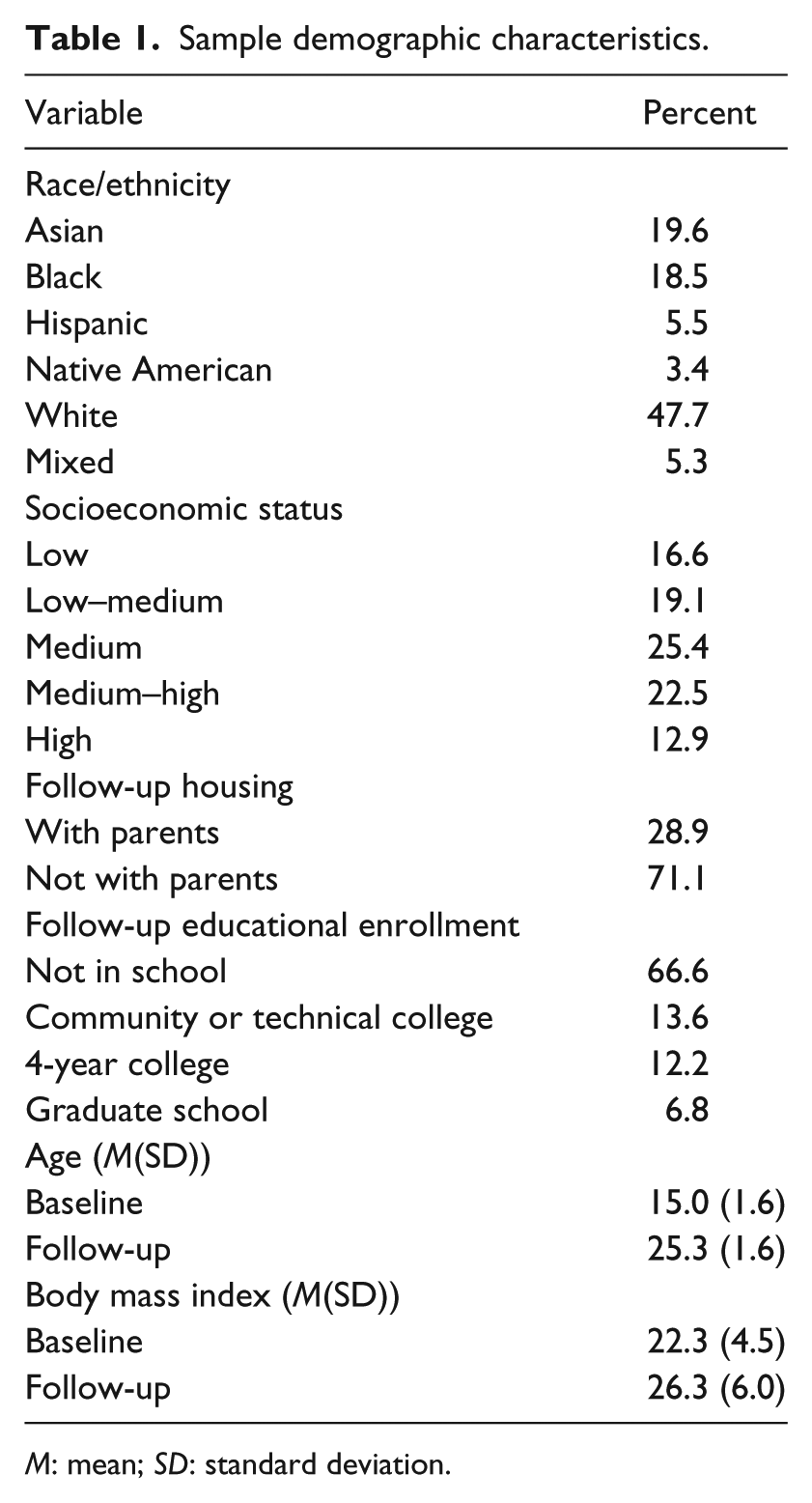
M: mean; SD: standard deviation.
Measures
The original Project EAT survey was developed to assess determinants of weight status and dietary intake among adolescents (Neumark-Sztainer et al., 2002). Most measures in the present analyses were consistent across both the study waves, however, some were only available at baseline or follow-up. Test–retest reliability was assessed in a diverse adolescent sample at baseline and at 10-year follow-up (Larson et al., 2011). Risk factor slassification types (e.g., behavioral, sociocultural, or personal) for each predictor are presented in a figure included in the Supplemental material.
Measures included in longitudinal analyses
Binge eating within the past year was measured with two items from the Questionnaire on Eating and Weight Patterns-5 (QEWP-5; Yanowski, 1993). The two items include, (1) “In the past year, have you ever eaten so much food in a short period of time that you would be embarrassed if others saw you (binge-eating)?” and (2) “During the times when you ate this way, did you feel you couldn’t stop eating or control what or how much you were eating?” Response options include yes or no. Binge eating was characterized as answering “yes” to both the items (test–retest agreement = 92% for overeating, 84% for loss of control).
Binge drinking frequency was assessed with an item derived from the Monitoring the Future National Survey (Johnston et al., 2001): “Think back over the last two weeks. How many times have you had five or more drinks at a sitting? (A drink is defined as the equivalent of a bottle of beer, a glass of wine, a wine cooler, a shot glass of liquor, or a mixed drink.).” The response options include (1) I do not drink alcohol, (2) none, (3) once, (4) twice, (5) 3–5 times, and (6) 6–9 times. Participants who reported one or more episodes were categorized as engaging in binge drinking (test–retest r = 0.82). This study is limited to a non-gender-specific binge drinking measure of binge drinking, which is consistent with recent binge drinking research (Evans-Polce et al., 2018; Patrick and Schulenberg, 2014).
UWCB was measured with a modified version of the Pound of Prevention Survey (Jeffrey and French, 1999), including extreme and less-extreme UWCB subscales. The extreme UWCBs items include (1) took diet pills, (2) made myself vomit, (3) used laxatives, and (4) used diuretics to control or lose weight. Participants who reported one or more of the items were categorized as engaging in extreme UWCBs (test–retest agreement = 97%). The less-extreme UWCBs items include (1) fasted, (2) ate very little food, (3) used a food substitute (powder or a special drink), (5) skipped meals, and (6) smoked more cigarettes to control or lose weight. Participants who reported one or more of the less-extreme UWCBs were categorized as engaging in less-extreme UWCBs (test–retest agreement = 83%).
Dieting was captured with one item: “How often have you gone on a diet during the last year? By ‘diet’ we mean changing the way you eat so you can lose weight.” Response options include (1) never, (2) 1–4 times, (3) 5–10 times, (4) more than 10 times, or (5) I am always dieting. Participants were coded as engaging in dieting if they reported any dieting during the past year (test–retest agreement: non-dieter versus dieter = 82%).
Weight concerns were measured with two items (Neumark-Sztainer et al., 2003): “I think a lot about being thinner” and “I am worried about gaining weight.” Response options range from 1 (strongly disagree) to 4 (strongly agree). This measure retained adequate reliability (Cronbach’s α = 0.85; test–retest r = 0.72–0.77).
Depressive symptoms were measured using the seven-item Kandel and Davies Depressive Mood Scale (Kandel and Davies, 1982). Participants reported how often they were bothered or troubled by specific depressive symptoms over the past year on a three-point scale. Sample items include “feeling hopeless about the future” and “feeling too tired to do things.” Response items include (1) not at all, (2) somewhat, and (3) very much. The scale retained adequate reliability (Cronbach’s α = 0.82; test–retest r = 0.31–0.72).
Discrimination was assessed with slightly different scales at baseline and 10-year follow-up. At baseline, participants responded to four discrimination items. Sample items include: “You are treated with less respect than other people,” and “You are called names or insulted.” Response options range from 1 (never) to at least once a week (5). Baseline discrimination scale had adequate reliability (Cronbach’s α = 0.85; test–retest r = 0.47–0.59). At follow-up, discrimination was measured with two items: “You are teased about your appearance,” and “You are teased about your weight.” Response options range from 1 (never) to 5 (at least once a week). This scale had adequate reliability (Cronbach’s α = 0.79).
Self-esteem was measured with six items from the Rosenberg Self-Esteem scale (Rosenberg, 1965). Sample items include: “On the whole, I am satisfied with myself,” and “I feel that I have a number of good qualities.” Responses ranged from (1) “strongly disagree” to (4) “strongly agree.” The scale maintained good reliability (Cronbach’s α = 0.79; test–retest r = 0.40–0.59).
Magazine viewing specific to magazines with weight-related content was assessed with one item. The question reads, “How often do you read magazine articles in which dieting or weight loss are discussed?” This item retained adequate test–retest reliability (r = 0.81).
Baseline only measures
Several variables were only available at baseline, and thus were included in only the longitudinal analyses.
Mother support and father support were captured with four items adapted from the Minnesota Adolescent Health Survey (Blum et al., 1989). Mother and Father support were measured separately with the items: “How much do you feel your mother/father cares about you?” and “How much do you feel you can talk to your mother/father about your problems?” Responses range from 1 (not at all) to 5 (very much). Mother and father support items retained adequate test–retest reliability (r = 0.74 and 0.72, respectively).
Friend support was assessed with the question, “Do you have one or more close friends who you can talk to about your problems?” Response options include (1) yes, always, (2) yes, sometimes, and (3) no. This measure retained adequate test–retest reliability (r = 0.65).
Perceived invulnerability refers to the extent participants believe that they do not have to worry about certain harms. Items included, “At this point in my life, I am not very concerned about my health” and “Teenagers don’t need to worry about their health.” Responses range from 1 (strongly disagree) to 4 (strongly agree). This measure retained adequate reliability (Cronbach’s α = 0.65, test–retest r = 0.19–0.24).
10-year follow-up only measures
One variable was only available at 10-year follow-up, and thus it was only included in the cross-sectional analyses at 10-year follow-up.
Sensation seeking captures the extent to which participants enjoy risky behaviors. Participants responded to one item: “Do you like to do things that are a little dangerous (for example, skydiving, bungee jumping, gambling)?” Responses range from 1 (not at all) to 4 (very much). This measure retained adequate test–retest reliability (r = 0.80).
Statistical analyses
Two sets of logistic regression analyses were conducted to identify shared risk factors of binge drinking and binge eating. First, the longitudinal association between baseline variables and binge eating and binge drinking at the 10-year follow-up were tested. Second, cross-sectional associations between variables at 10-year follow-up and concurrent binge eating and binge drinking at 10-year follow-up were examined. Each set of models was run separately by gender and by binge eating or drinking outcome. Longitudinal models controlled for the corresponding behavior at baseline and other potentially confounding variables (age, ethnicity/race, and socioeconomic status). For example, a longitudinal logistic regression for binge eating controls for binge eating at baseline and binge drinking at 10-year follow-up. Because attrition did not occur at random, all analyses were weighted using the response propensity method (Little, 1986), in which the inverse of the estimated probability that an individual responded at time points was used as the weight.
Results
At 10-year follow-up, 5.9 percent of men reported both binge eating and binge drinking, 1.5 percent reported binge eating only, 55.8 percent reported binge drinking only, and 36.8 percent reported neither behavior. Furthermore, 6.2 percent of women reported both binge eating and binge drinking, 10.0 percent reported binge eating only, 35.3 percent reported binge drinking only, and 48.6 percent reported neither behavior.
Shared longitudinal predictors of concurrent binge eating and binge drinking
Results from the longitudinal analyses are presented in Table 2. The results from the longitudinal analyses found no shared predictors of binge eating nor binge drinking among adolescent boys. However, adolescent girls who reported perceived invulnerability at baseline reported a greater likelihood of binge eating and binge drinking (all p ⩽ 0.026) at 10-year follow-up.
Longitudinal associations among study variables and binge drinking and binge eating.

BMI: body mass index; UWCB: unhealthy weight control behavior; Bold values = Significant value.
Reference group = no UWCBs.
Reference group = no dieting.
Reference group = no friend support.
Non-shared longitudinal predictors of binge eating
A number of longitudinal predictors of binge eating at 10-year follow-up that were not predictors of binge drinking were identified. Both adolescent boys and girls who reported higher weight concern, higher depressive symptoms, and lower self-esteem at baseline were more likely to report binge eating at 10-year follow-up (all p < 0.05). Additional longitudinal predictors of binge eating varied by gender. Among boys, those who reported less-extreme UWCB at baseline had a greater likelihood of reporting binge eating at 10-year follow-up compared with those who reported no UWCB (p = 0.003). Among girls, those who reported a higher body mass index (BMI), lower body satisfaction, lower friend support, and reading more diet- and weight-related magazines at baseline had a greater likelihood of reporting binge eating at 10-year follow-up (all p ⩽ 0.020).
Non-shared longitudinal predictors of binge drinking
A number of longitudinal predictors of binge drinking at 10-year follow-up that were not predictors of binge eating were also identified. Boys who reported no dieting, more body satisfaction, more support from their father, and more support from friends at baseline were more likely to report binge drinking at 10-year follow-up (all p ⩽ 0.046). There were no significant non-shared longitudinal predictors of binge drinking among girls.
Shared cross-sectional factors related to binge eating and binge drinking
The results for cross-sectional analysis at 10-year follow-up are presented in Table 3. Among both men and women, more weight concern was associated with concurrent binge eating and binge drinking (all p ⩽ 0.032). The results revealed additional cross-sectional factors related to concurrent binge eating and binge drinking varied by gender. Specifically, among men, increased depressive symptoms were associated with concurrent binge eating and binge drinking (all p ⩽ 0.011). Among women, use of less-extreme UWCBs and dieting were associated with concurrent binge eating and binge drinking (all p ⩽ 0.011).
Cross-sectional associations among study variables and binge drinking and binge eating.
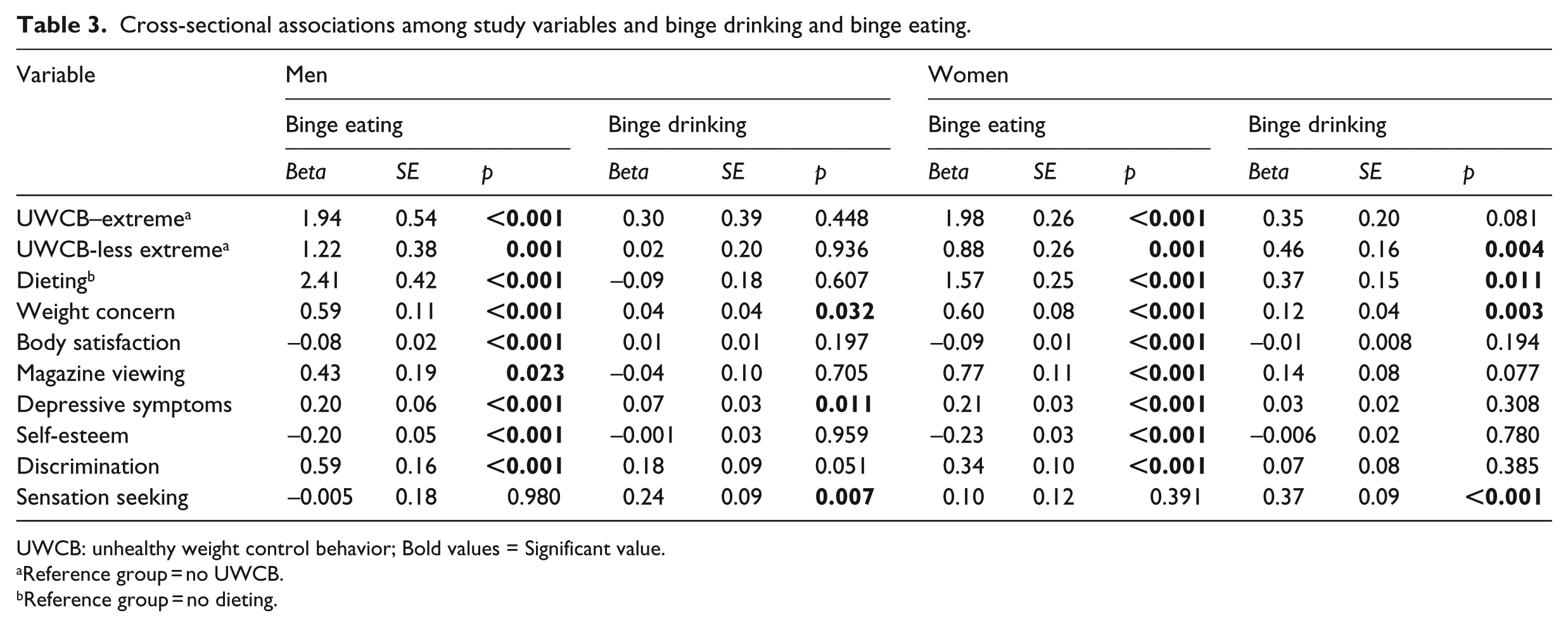
UWCB: unhealthy weight control behavior; Bold values = Significant value.
Reference group = no UWCB.
Reference group = no dieting.
Non-shared cross-sectional factors related to binge eating
The results also identified a number of cross-sectional predictors of binge eating at 10-year follow-up that were not associated with binge drinking. Specifically, among both men and women, more-extreme UWCBs, less body satisfaction, reading more diet- and weight-related magazine articles, lower self-esteem and more discrimination were associated with greater likelihood of binge eating (all p ⩽ 0.023). Among men, less-extreme UWCBs, dieting, and more weight concern were associated with binge eating only (all p ⩽ 0.001). Among women, more depressive symptoms were associated with binge eating only (p < 0.001).
Non-shared cross-sectional factors related to binge drinking
Cross-sectional analyses revealed only one unique factor related to binge drinking but not binge eating. Specifically, among men and women, heightened sensation seeking was associated with more binge drinking (p ⩽ 0.007).
Discussion
Binge eating and binge drinking are characterized by a lack of control over behaviors (i.e. eating or drinking) and frequently co-occur. This study aimed to identify shared longitudinal and cross-sectional factors of binge eating and binge drinking using gender-specific analyses. In general, the results suggest that behavioral, personal, and sociocultural factors are associated with binge eating and binge drinking among men and women. More specifically, the findings suggest that binge eating and binge drinking may both function to suppress unwanted internal experiences (e.g. depressive symptoms; Cook et al., 2014) or to maintain social affiliation (Marks, 2018); however the specific form of internal thoughts vary by binge behavior and gender.
The results from this study revealed that shared risk factors of binge eating and binge drinking vary by gender both longitudinally and cross-sectionally. Specifically, while no significant longitudinal shared risk factors of binge eating and binge drinking emerged among men, higher perceived invulnerability in adolescence predicted both binge eating and binge drinking among young adult women. This finding is congruent with other research demonstrating perceived invulnerability as a risk factor for health risk behaviors (Lapsley et al., 2005; Marks, 2018). School health professionals and counselors should talk with adolescent girls about the long-term impacts of participating in risky behaviors (e.g. binge eating and binge drinking). Because adolescents have a tendency to believe that they will not experience the harms of risky health behaviors, specific conversations about adolescent’s risks may reduce perceived invulnerability, and ultimately prevent concurrent binge eating and binge drinking.
Cross-sectional analyses revealed gender differences in shared risk factors as well. Among young adult men, depressive symptoms in young adulthood served as a risk factor for both binge eating and binge drinking, suggesting that binge eating and binge drinking may arise to serve the same function (e.g. to avoid or suppress depressive symptoms) among men. In contrast, among women, less-extreme UWCBs, dieting, and weight concern were associated with concurrent binge eating and binge drinking. Thus, women may use binge behaviors and weight control methods (e.g. dieting) to avoid or suppress unwanted weight-related concerns. Several studies have linked dieting and UWCBs to binge eating (Neumark-Sztainer et al., 2007; Stice, 2001). Individuals may engage in binge eating after dieting and restricting food consumption as a result of depleted will power. For example, a dieting individual refraining from certain foods (e.g. donuts), may overeat when reintroducing that food back into their diet. In another example, women may restrict food intake during the day to allow for the caloric consumption associated with binge drinking (e.g. drunkorexia; Barry and Piazza-Gardner, 2012).
Women report more sociocultural binge eating risk and protective factors than men. Women who report reading more body dissatisfaction, more diet- and weight-related magazines and higher BMIs are at increased risk of binge eating. Moreover, friend support was longitudinally protective against binge eating in girls. Programs designed to increase body esteem, promote friend support, and reduce internalization of thin ideals are imperative to preventing binge eating (Lew et al., 2007), and may be particularly useful for prevention in adolescent girls. In contrast, behavioral factors, such as more frequent less-extreme UWCBs at baseline, were found to longitudinally predict binge eating among men.
Among men, increased friend support and father support, more body satisfaction, and less dieting in adolescence were longitudinally predictive of increased likelihood of binge drinking. Men who are socially and psychologically apt in adolescence may be more likely to become involved in the social drinking culture in young adulthood to gain or maintain social affiliation (Marks, 2018). Social activities such as fraternity membership (Capone et al., 2007) and drinking games (Zamboanga et al., 2014) are related to harmful drinking. Programs in late adolescence and young adulthood designed to promote responsible drinking may be effective at reducing binge drinking and reducing the negative consequences of drinking among men. For example, interventions focusing on the use of protective behavioral strategies (e.g. strategies to reduce excessive drinking and alcohol-related harms such as trying to out-drink others) may help lower binge drinking (Martens et al., 2008). Results allude to the importance of clinicians screening for drinking behaviors, discussing safe alcohol consumption practices, educating teens on dangers of binge drinking, and encouraging parents of teens to communicate with their children about drinking.
In general, findings suggest that men and women may use binge behaviors to avoid or suppress negative internal experiences; however, risk domains often vary by gender. Gender differences in binge drinking risk have broad implications for whether gender-specific binge drinking prevention programs should be developed. Reducing negative mood among men may have an impact on health behaviors more broadly. It might be that men may be more apt to use drinking as a mechanism to cope with depressive symptoms, while women may be more consumed by and avoiding of weight-related concerns. Alternatively, women may use weight control strategies to reduce their food-related caloric intake when binge drinking because of their concerns around the caloric intake of alcohol (Barry and Piazza-Gardner, 2012).
Finally, gender similarities in non-shared predictors of binge eating and binge drinking were identified. Depressive symptoms, lower self-esteem, and weight concern, in adolescence were found to longitudinally predict binge eating in young adulthood for both men and women. Screening during routine clinic visits and offering support for teens with depressive symptoms and low self-esteem may be an important preventive action. Moreover, sensation seeking was cross-sectionally associated with binge drinking among both men and women. This finding differs from past research, which identified sensation seeking as a risk factor of binge drinking only among women (Evans-Polce et al., 2018). The current findings suggest that binge drinking may be related to impulsive tendencies among men and women (Marks, 2018). Preventive efforts may consider screening for sensation seeking and other impulsive tendencies to identify target populations for intervention efforts.
Strengths and limitations
The strengths of this study include the large and diverse population of young adults; the broad array and theoretically driven selection of behavioral, sociocultural, and personal variables; the assessment of different behavioral outcomes; and the long follow-up period that captured major transitional stages during adolescence. Some limitations, however, should be noted. First, this study used a non-gender-specific measure of binge drinking. Yet, past research suggests that the number of drinks per sitting to meet the criteria for binge drinking criteria differ by gender (Wechsler et al., 1995), and some research questions the validity of these criteria altogether (Pearson et al., 2016). Specifically, women are equally as likely to experience drinking-related consequences when consuming ⩾4 alcoholic beverages in one sitting as men who consume ⩾5. Thus, binge drinking among women may be negatively biased. Most measures were brief; short measures were imperative to avoid respondent overburden and assess a wide range of constructs, but may limit the reliability and validity of the measures.
In this study, sensation seeking was not available at baseline. Future studies should examine the longitudinal relationship between sensation seeking and binge drinking to determine the temporal effects. The field would benefit from additional studies that examine potential mediators of exogenous risk factors and binge eating and binge drinking. For example, cognitive expectancies (e.g. belief that eating or drinking will improve one’s mood) may mediate the association between emotional and personality variables and binge eating and binge drinking. Moreover, longitudinal studies should explore the developmental processes that link heightened negative affect, impulsive tendencies, and concurrent binge eating and binge drinking among men and women to identify the early risk factor(s).
Conclusion
This research identified a number of shared and non-shared risk and protective factors for binge eating and binge drinking across the adolescence and young adult developmental periods among men and women. The findings from this study suggest that binge eating and binge drinking may both function as a way to suppress unwanted internal thoughts, feelings, or experiences; however, the specific form of internal thoughts appear to vary by specific binge behavior and gender. The findings of this study should be used to develop more effective intervention and prevention programs for binge eating and binge drinking. Our results show that full-scale dual prevention and intervention programs targeting both binge drinking and binge eating may not be worth pursing given the differences in associated factors. However, some general health programs could emphasize shared risk factors in prevention efforts. Prevention and intervention programs in young adulthood for binge eating and binge drinking could address perceived invulnerability and weight control behaviors as shared risk factors in women and depressive symptoms and discrimination as shared risk factor in men.
Supplemental Material
Supplemental_files – Supplemental material for Shared and non-shared risk and protective factors of binge eating and binge drinking from adolescence to young adulthood
Supplemental material, Supplemental_files for Shared and non-shared risk and protective factors of binge eating and binge drinking from adolescence to young adulthood by Melissa Simone, Jennifer Scodes, Tyler Mason, Katie Loth, Melanie M Wall and Dianne Neumark-Sztainer in Journal of Health Psychology
Footnotes
Acknowledgements
M.S. is supported by Grant No. T32 MH082761 from the National Institute of Mental Health. The dataset analyzed in this study was supported by Grant No. R01HL084064 from the National Heart, Lung, and Blood Institute. The content is solely the responsibility of the authors and does not necessarily represent the official views of the National Institute of Mental Health or the National Heart, Lung, and Blood Institute or the National Institutes of Health.
Declaration of conflicting interests
The author(s) declared no potential conflicts of interest with respect to the research, authorship, and/or publication of this article.
Funding
The author(s) disclosed receipt of the following financial support for the research, authorship and/or publication of this article: This study was supported by grants from two institutes within the National Institutes of Health: the National Institute of Mental Health and the National Heart, Lung, and Blood Institute.
Supplemental material
Supplemental material for this article is available online.

References
Supplementary Material
Please find the following supplemental material available below.
For Open Access articles published under a Creative Commons License, all supplemental material carries the same license as the article it is associated with.
For non-Open Access articles published, all supplemental material carries a non-exclusive license, and permission requests for re-use of supplemental material or any part of supplemental material shall be sent directly to the copyright owner as specified in the copyright notice associated with the article.
