







Abstract
Guided by vested interest theory, the impact of educating potential organ donors about the beneficial experiences afforded to families of deceased donors was assessed. Participants were informed about these benefits by taking a survey that asked them to indicate both their awareness, and the appeal, of numerous existing benefits (e.g. grief services). We employed a double-sided mixed design. Both the true experimental design and the quasi-experimental repeated assessment indicated increased registration intentions. Only the quasi-experimental design indicated significant attitude change. This study provides evidence supporting the potential utility of focusing interventions on the benefits afforded to donor families.
Keywords
More than 115,000 people in the United States are on the waiting list for a life-enhancing transplant and approximately 20 people die each day due to a lack of transplantable organs (United Network for Organ Sharing, 2017). Our research, guided by vested interest theory (VIT; Sivacek and Crano, 1982), uses a double-sided mixed design to assess whether informing potential registrants about benefits afforded to donor families can increase donor registration intentions, as well as influence attitudes. The experimental stimulus is a survey instrument that serves as a persuasive tool (e.g. Bridge et al., 1977) while simultaneously assessing participants’ knowledge of donor family benefits and the self-reported influence of each benefit on intentions to register as a donor.
Myriad studies have sought to understand and alleviate the donor shortage (see Falomir-Pichastor et al., 2013 for a review). Some of the psychological theories that have guided these inquiries include the theory of planned behavior (Hyde and White, 2009), social cognitive theory (Brug et al., 2000), and the framework that informed this study—VIT (e.g. Siegel et al., 2008b). Interventions have been implemented in contexts such as churches (Arriola et al., 2005) and departments of motor vehicles (e.g. Quick et al., 2019). The appeals associated with these endeavors often focus on altruistic motives (e.g. Siegel et al., 2008a). Although some of these appeals have found success, the ongoing need for transplantable organs warrants continued exploration of other persuasive approaches, particularly as appeals focused on social responsibility and altruism have occasionally been shown to underperform (e.g. Cleiren and Van Zoelen, 1999).
One common finding across studies is that low registration rates are not consistent with the positive attitudes typically held toward donor registration. Research across numerous contexts generally indicates that people primarily possess favorable attitudes (e.g. Feeley, 2007; Reynolds-Tylus and Quick, 2017). Accordingly, researchers have noted that a central challenge for organ donor scholars and practitioners is fully understanding the lack of attitude-behavior consistency and making attitudes more in line with behavior (e.g. Cossé and Weisenberger, 2000; Siegel et al., 2010). VIT (Sivacek and Crano, 1982), a social-psychological framework that arose in response to the specific need to understand the conditions under which behavior becomes more consistent with attitudes, is particularly well suited for this task.
Vested interest (VI) has been referred to as a “more constrained variant” of self-interest (Crano, 1997: 485). People are considered vested in an attitude-object when it is both important and has consequences for the individual (e.g. Crano and Prislin, 1995; Lehman and Crano, 2002). For an issue in which most participants have similar attitudes, such as organ donation registration, people who are the most vested will be most likely to behave in line with their attitudes (see Crano, 1997). In support of VIT, Donaldson et al. (2016) presented data indicating that among participants with favorable attitudes toward prescription stimulants, those with moderate or high levels of VI have higher intentions to act on their favorable attitudes than participants who have low VI.
Some studies have explored the possibility that self-interest may motivate organ donation registration, even though “… research that considers the unique potential of self-interest to motivate organ donation is rare” (Cohen and Hoffner, 2013: 128). Some of these efforts have been guided by VIT (e.g. Anker et al., 2010; Siegel et al., 2008b) and operationalized VI as being able to save a life or being seen as a hero. These studies found that those who are vested have stronger intentions to donate than those who are not. Other studies, albeit not directly guided by VIT, also have addressed self-benefits. Cohen and Hoffner (2013) provide a list of ways people receive self-benefit from becoming an organ donor, including the opportunity to save lives, enhanced self-worth, and feelings of pride. Illustrative of an approach along one of these lines, Downing and Jones (2010) evaluated a campaign that used the tagline, “Be a hero.”
This study complements and extends these prior efforts. According to VIT, positive attitudes toward donor registration should be predictive of behavior to the extent that potential registrants see the act as important and personally consequential. With these criteria in mind, we focus on the benefits afforded to donor families, thereby imbuing organ donation with more importance and personal consequence. Research indicates that people’s actions are influenced by their VI, regardless of whether they benefit directly or indirectly. Johnson et al. (2014) found that when an individual’s close others are impacted by an attitude-object, attitude–behavior consistency increases just as if the individual was directly affected.
Although the number of studies examining family benefit appeals as a means of increasing donor registration rates is limited, this approach has been explored (e.g. Ahn and Park, 2016; Sanner et al., 1995). For example, references to donor family benefits have been included in global lists of benefits (e.g. Flemming et al., 2020), attitude questionnaires (e.g. Brug et al., 2000), and part of larger campaigns using multiple appeals (Hansen et al., 2018; Rodrigue et al., 2015). Results have been mixed when the effectiveness of family benefit appeals were assessed. In Rodrigue and colleagues’ (2014) online study, participants were asked to evaluate a set of five different donor videos—including one focused on family benefits. Results indicated that, while rated favorably, it was not the most well-received of the set. Cleiren and Van Zoelen (1999) found that a message focused on registered donors protecting their families from having to make a difficult decision had higher rates of donor registration than an altruistic message (see Sanner et al., 1995 for an initial study using this appeal). However, even though only one other appeal resulted in as many registrations as the difficult decision approach, the difficult decision appeal did not significantly outperform the neutral appeal.
We seek to complement these prior efforts by investigating the influence of educating potential donors about a broad range of family benefits on their intentions toward organ donor registration, as well as on registration attitudes. We will also add to prior efforts by assessing participants’ awareness, and the perceived appeal, of the benefits afforded to donor families. Some of these donor family benefits reflect those expressly offered to families by organ procurement organizations (OPOs), such as grief support referrals, guides for funeral planning, events that celebrate the lives of donors, and memorial keepsakes honoring donors (e.g. Donate Life New Mexico, 2019). We also focus on intangible benefits afforded to donor families. In addition to the intangible benefit of not having to make a difficult decision, other intangible benefits included feelings of comfort and pride in the knowledge that their loved one was able to help others (Stouder et al., 2009), feelings of relief at honoring the wishes of loved ones who died (De Groot et al., 2012), and feelings of comfort at the thought of a loved one living on (Hogan et al., 2013).
The approach we took in developing our experimental stimulus was inspired by prior studies that use surveys to change attitudes, increase interest, and influence behavior (e.g. Clausen, 1968; Fritzsimmons and Williams, 2000; Sherman, 1980; Sprott et al., 2006). As Bridge et al. (1977) describe, the act of merely asking questions could change attitudes or lead to specific issues becoming salient, thus placing the survey researcher into “… the role of an agent, as well as a reporter, of social change” (p. 56). Recent research along these lines often assesses how surveys asking about intentions influence behavior (see Wood et al., 2016 for a meta-analysis). These studies led us to write our survey in such a way that would allow us to assess the extent to which participants’ intentions, as well attitudes, were influenced by learning about benefits afforded to donor families. This approach also allowed us to simultaneously assess participants knowledge of these benefits, as well as participants’ thoughts as to whether each benefit influences their intentions to donate.
The current study
The central goal of the current investigation was to learn whether educating potential donors about the range of benefits afforded to donor family members increases organ donor registration intentions. We hypothesized that when participants were exposed to information about the positive experiences afforded to the families of organ donors, they would have increased intentions to register as a donor. Although correlational studies examining VIT typically investigate the interaction between attitudes and VI on intentions or behavior (e.g. Donaldson et al., 2016), similar to other studies using VI as a persuasive appeal (e.g. Adame and Miller, 2015; De Dominicis et al., 2014; Thorton and Knox, 2002), we assessed the main effect of the experimental stimulus on intentions. Moreover, as we considered it possible that information about family benefits could lead to even more favorable attitudes toward organ donation, we also measured attitudes (see Adame and Miller, 2015 for a similar approach). As a secondary goal, we sought to learn the extent to which participants were aware of these benefits prior to being informed of them through the taking of the survey. Futhermore, we assessed the extent to which individuals reported that these benefits influenced their likelihood of registering as a donor.
Method
Participants and procedure
Data were collected via Amazon Mechanical Turk (MTurk), a crowdsourcing marketplace where potential respondents can view different human intelligence tasks and decide which they would like to complete for a small payment. MTurk can provide affordable, reliable, and quality data (Paolacci and Chandler, 2014). In line with recent recommended practices (Siegel et al., 2015), a screener survey was administered to determine eligible participants. All aspects of this study were reviewed by an Institutional Review Board, and all participants completed informed consent prior to participating. A total of 2000 participants completed the screener survey. Eligible participants were those who were 18 years or older, not already registered as an organ donor, believed they were eligible to be a donor, residing in the United States, and fluent in English. Eligible participants were invited to participate in a second survey 1 week later. A power analysis conducted with G*Power, with two groups and two covariates, an alpha of .05, a beta of .1, and a small effect size of f = .20 suggested 265 participants were required.
Of the 655 respondents deemed eligible and invited to participate in the second survey, 458 (69.92%) completed it. Of the participants who completed this survey, 129 (28.17%) were removed for failing a rigorous attention check requiring respondents to correctly identify the instructions for the task. The removal of approximately 28 percent of the sample for failing attention checks falls within the typical exclusion rate, 3 to 40 percent, of MTurk participants (Berinksy et al., 2014; Chandler et al., 2014). We also removed 36 participants who indicated they were not eligible in the main study. A total of 20 participants who indicated that they did not have family members with whom they felt close were removed due to an a priori assumption that the family benefits appeal would not be relevant to these individuals.
Of the final participant sample (N = 273) 55.68 percent were female; ages ranged from 18 to 74 (M = 38.01, standard deviation [SD] = 12.38), and 18.68 percent were 50 or older. The sample was predominantly White (72.16%) but also included 31 (11.36%) African Americans, 25 (9.16%) Latinos, 3 (1.10%) Native Americans, 1 (0.37%) Pacific Islander, and 4 (1.47%) who indicated that none of these categories represented them. A majority of participants had a higher education degree (65.20%).
Study design
The design began with a true experimental posttest-only control group design. This allowed us to circumvent pretest sensitization issues (Crano et al., 2015). However, we were concerned that if the control group did not take the survey, the equivalence of the two groups might be compromised due to the experimental group being engaged in a longer task, possibly increasing the number of dropouts, and having to pass a greater number of attention checks. As a solution and enhancement to the study design, we combined the posttest-only design with a quasi-experimental repeated measure design. Participants in the control group of the posttest assessment were then exposed to the experimental stimulus (i.e. the survey) and again completed posttest outcome measures. We will refer to this approach as a double-sided mixed design (i.e. a true experimental posttest-only control group design, with a complementary quasi-experimental repeated assessment; see Figure 1).
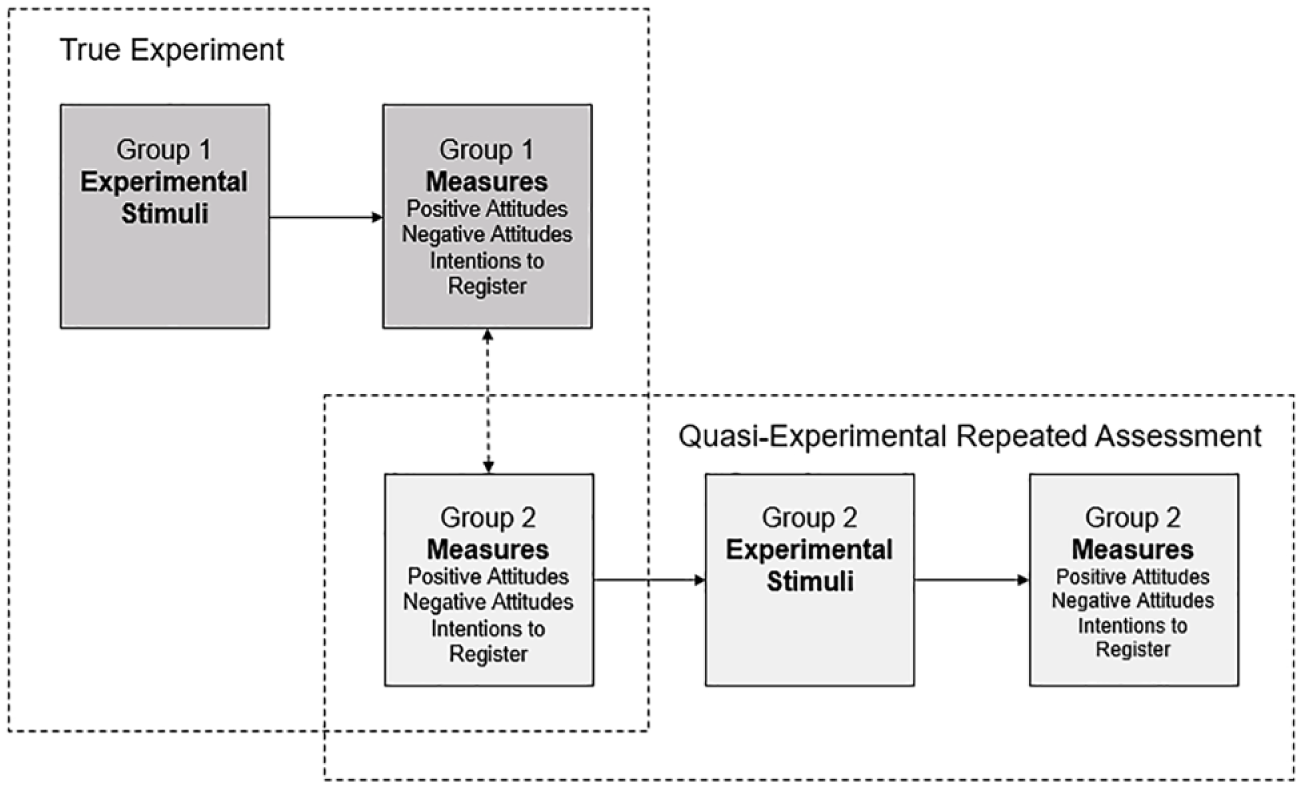
Visualization of the double-sided mixed design (i.e. a true experimental posttest-only control group randomized control trial with a complementary quasi-experimental repeated assessment).
Experimental stimulus
A questionnaire consisting of one open-ended item, and several closed-ended items, served as the experimental stimulus. The questions were created with the central goal of informing the participants of the range of family benefits afforded the families of organ donors. We used focus groups to help inform development of the initial survey and pilot tested survey items prior to data collection. As discussed previously, this approach was inspired by prior studies indicating that asking participants about their intentions can change behavior (e.g. Sherman, 1980). The survey began with an open-ended question inquiring about the participants’ awareness of donor family benefits. Next, as part of the survey-as-information approach, participants were informed that they would be shown a list of services that are often offered by some organ donor organizations to families of organ donors. We inquired about participants’ awareness of these concrete benefits that are often provided by OPOs. They were then asked to report the extent to which each benefit increased the likelihood they would register as an organ donor. Next, they were informed that they would be provided a list of intangible benefits that some donor families report experiencing. This was followed by inquiry about the extent to which each benefit influenced their donor registration intentions.
Open-ended assessment of prior donor family benefit knowledge
The open-ended question began with the following text: Many people know that organ donors help to save lives. But, many people do not know that by registering to be an organ donor, the family of the registered donor also benefits. We are curious if you were aware of this.
Participants were then asked to list any benefits that they believed their family might receive if they were registered as an organ donor at the time of their passing.
Awareness of OPO donor family benefits
Participants were provided a list of “several benefits that organ donor organizations actually provide to the families of registered organ donors.” We asked participants to indicate (i.e. yes or no) whether they were aware of the existence of 10 specific benefits prior to taking the survey. Examples of such items include “online grief support,” “coordinated communication,” “literature about grief and the grieving process,” and “a step-by-step guide of what to expect in the weeks and months after a loved one dies.” Items for this instrument were developed based on information found on OPO websites from across the United States (e.g. Donate Life New Mexico, 2019). An inclusive list of these benefits was created and shown to two OPO coordinators who confirmed the veracity of the list.
Self-reported influence of OPO donor family benefits on likelihood to register
Following self-reported awareness of 10 family benefits, participants were reminded that “each of the benefits listed is a real benefit that donor organizations actually provide to the families of organ donors.” They were asked to rate the extent to which each benefit increased the likelihood that they would register (1 = much less likely to register, 7 = much more likely to register), M = 5.44, SD = 1.15, Cronbach’s alpha coefficient was calculated, α = .94.
Endorsement of intangible donor family benefits
Items representing intangible benefits to donor families were developed based on research that reported cognitive and emotional benefits to donor families (e.g. De Groot et al., 2012). As these benefits are not experienced by all organ donor families, the question wording was adjusted accordingly: “Some people think families do not experience these emotional benefits, some people think families do experience these emotional benefits. We are curious as to whether you think donor families might receive these benefits.” Participants were given four specific, intangible benefits that families of organ donors might experience (e.g. “feeling comforted knowing a loved one helped save a life”; see Table 3 for the full list), and asked to indicate the extent to which they agreed that these benefits were received by donor families on a 7-point scale (1 = strongly disagree, 7 = strongly agree), M = 5.17, SD = 1.13. Cronbach’s alpha coefficient was calculated, α = .80.
Self-reported influence of intangible donor family benefits on likelihood to register
Participants were presented with the same four intangible benefit items and asked to rate the extent to which each benefit made them more or less likely to register as an organ donor. Responses were given on a 7-point scale (1 = much less likely to register, 7 = much more likely to register), M = 4.96, SD = 1.28 Cronbach’s alpha coefficient was calculated, α = .91.
Dependent measures
Positive and negative attitudes toward registering as an organ donor
Two three-item scales adapted from Siegel et al. (2014) separately assessed positive and negative attitudes toward registering as an organ donor. Positive attitude items included questions inquiring whether registering as an organ donor would be a “rewarding act,” “useful act,” and “good act.” Negative attitude items inquired whether registering as an organ donor would be a “worthless act,” “useless act,” and “bad act.” Participants indicated the extent of their agreement from 1 “strongly disagree” to 100 “strongly agree.” For positive attitudes, Cronbach’s alpha coefficient was calculated, in the pretest (α = .84) and the posttest (α = .89); for negative attitudes, internal consistency was calculated in the pretest (α = .88) and the posttest (α = .93).
Intention to register as an organ donor
A three-item, 7-point Likert-type scale, adapted from Siegel et al. (2014), assessed intentions to register as an organ donor. The items included “I intend to register as an organ donor,” “I plan on becoming a registered organ donor the next chance I get,” and “It is likely I will register to become an organ donor.” Cronbach’s alpha coefficient was calculated in both the pretest and the posttest, α = .98.
Demographics
Age, gender, and ethnicity were measured for descriptive and analytical purposes.
Results
All analyses were conducted on SPSS version 24. No univariate outliers were identified. For correlations, see Table 1.
Correlations.
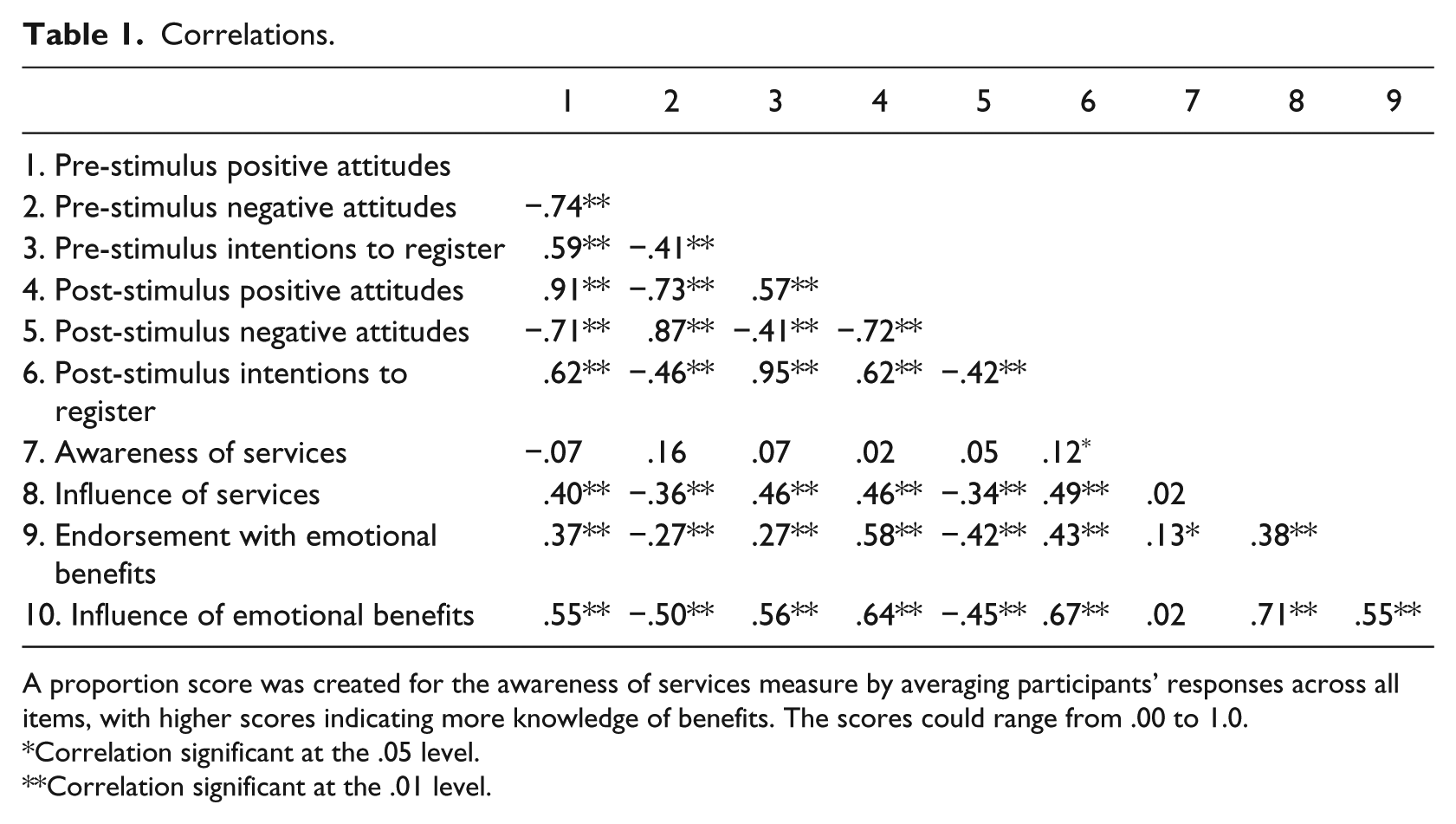
A proportion score was created for the awareness of services measure by averaging participants’ responses across all items, with higher scores indicating more knowledge of benefits. The scores could range from .00 to 1.0.
Correlation significant at the .05 level.
Correlation significant at the .01 level.
True experimental posttest-only design
Controlling for gender and age, which were not statistically significant at p < .05, an analysis of covariance (ANCOVA) indicated that intentions to register were significantly higher in the experimental group, F(1, 268) = 4.25, p = .04 as a result of being exposed to the experimental stimulus (i.e. family benefits survey). However, no significant differences between groups for either positive attitudes, F(1, 268) = .015, p = .90, or negative attitudes, F(1, 268) = .05, p = .83 were identified. This pattern of results was the same with and without the covariates included in these analyses (see Table 2).
Means and standard deviations (SDs) of attitudes and intention toward registering as a donor.
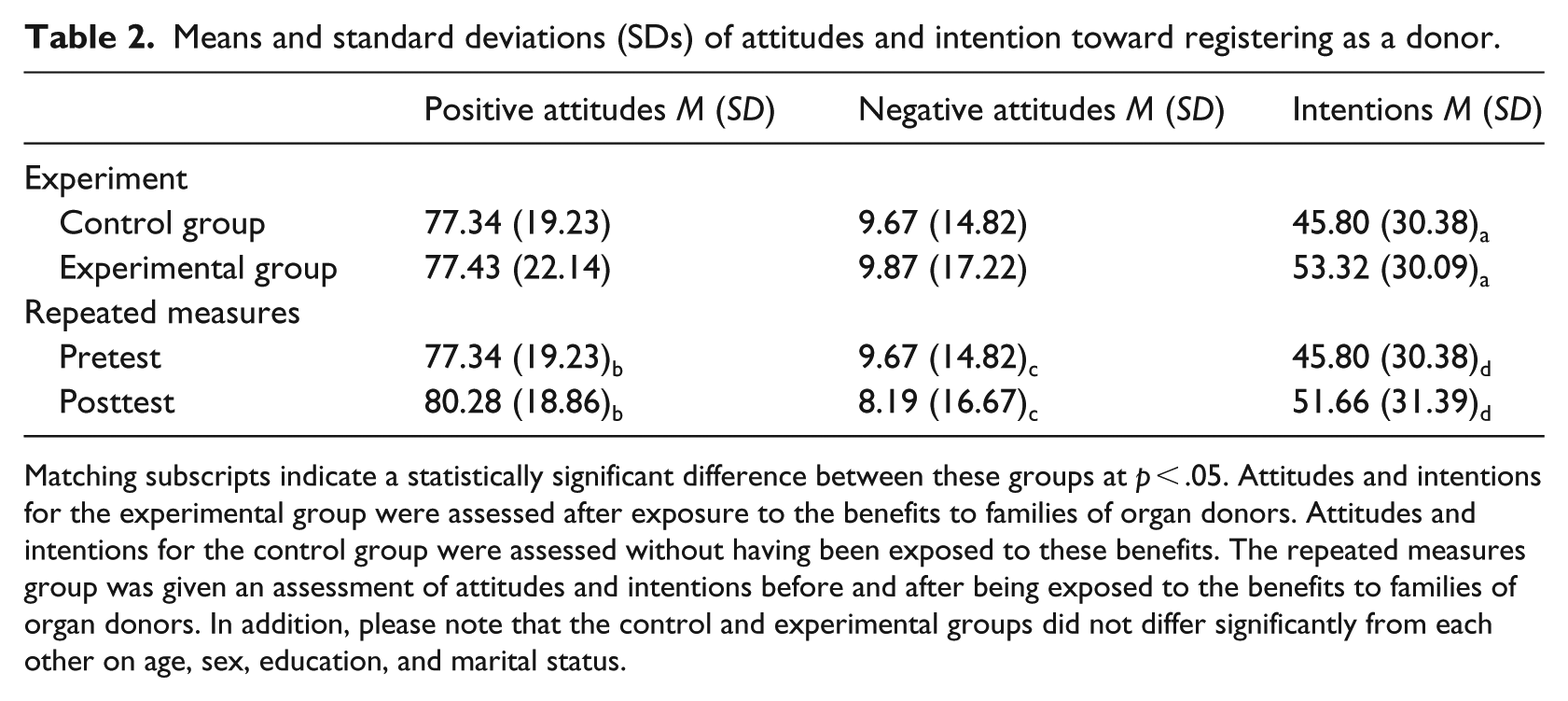
Matching subscripts indicate a statistically significant difference between these groups at p < .05. Attitudes and intentions for the experimental group were assessed after exposure to the benefits to families of organ donors. Attitudes and intentions for the control group were assessed without having been exposed to these benefits. The repeated measures group was given an assessment of attitudes and intentions before and after being exposed to the benefits to families of organ donors. In addition, please note that the control and experimental groups did not differ significantly from each other on age, sex, education, and marital status.
Quasi-experimental repeated measure design
After serving as the control group for the posttest-only experimental design, the participants were presented with the experimental stimulus and then had their attitudes and intentions regarding organ donor registration reassessed. Paired t-tests revealed significant differences in mean scores for positive attitudes, t(146) = –4.31, p < .001, negative attitudes, t(146) = 2.15, p = .03, and intentions to register, t(146) = –7.08, p < .001 (see Table 2).
Exploratory analysis
As noted, a secondary research goal was to explore the extent to which survey participants were aware of the benefits afforded organ donor families, and the benefits perceived as most influential on their decision to register as a donor.
Open-ended responses
An inductive approach to content analysis within a realist paradigm was conducted to find semantic evidence of explicit concepts within these short responses (Braun and Clarke, 2006). Interrater reliability between the second and third authors was calculated for major themes. Cohen’s kappa ranged between very strong (κ = .94) to strong (κ = .67, p < .001). We observed that even though most respondents proposed some kind of benefit, real or imagined (80.22%), 33.93 percent of all participants mentioned non-existent benefits such as being able to donate organs to family members. Many respondents mentioned intangible benefits such as positive feelings at the thought of helping others (46.52%). Far fewer mentioned a benefit that was actually provided by OPOs (10.62%). Of the 52.75 percent of respondents who mentioned a valid benefit, 29.86 percent indicated that they were somewhat uncertain about their answer, saying things like “I have no idea, I’ve never heard of such a thing before.”
Awareness and influence of OPO donor family benefits (closed-ended responses)
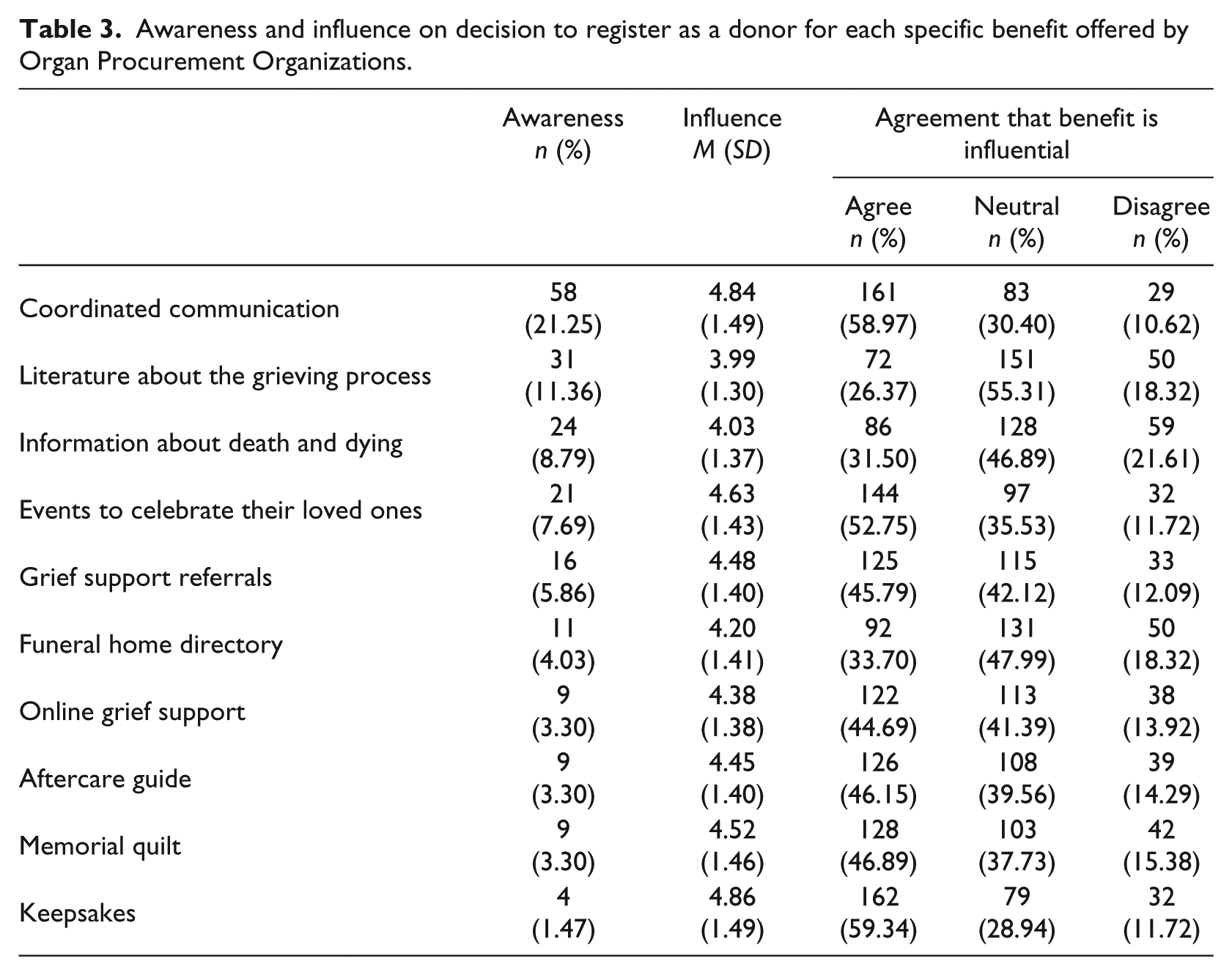
Overall, 34.43 percent of participants indicated that they were aware of at least 1 of the 10 concrete benefits that we listed. As seen in Table 3, no OPO benefit was recognized by more than approximately 20 percent of participants.
Awareness and influence on decision to register as a donor for each specific benefit offered by Organ Procurement Organizations.
Awareness and influence of intangible donor family benefits (closed-ended responses)
More than 90 percent of participants agreed that at least one of the listed emotional benefits existed (e.g. feeling “comforted knowing a loved one helped save a life”) and 79.12 percent indicated that at least one of these benefits would make them more likely to register as an organ donor (see Table 4).
Endorsement and influence of intangible benefits on decision to register as a donor (N = 273).
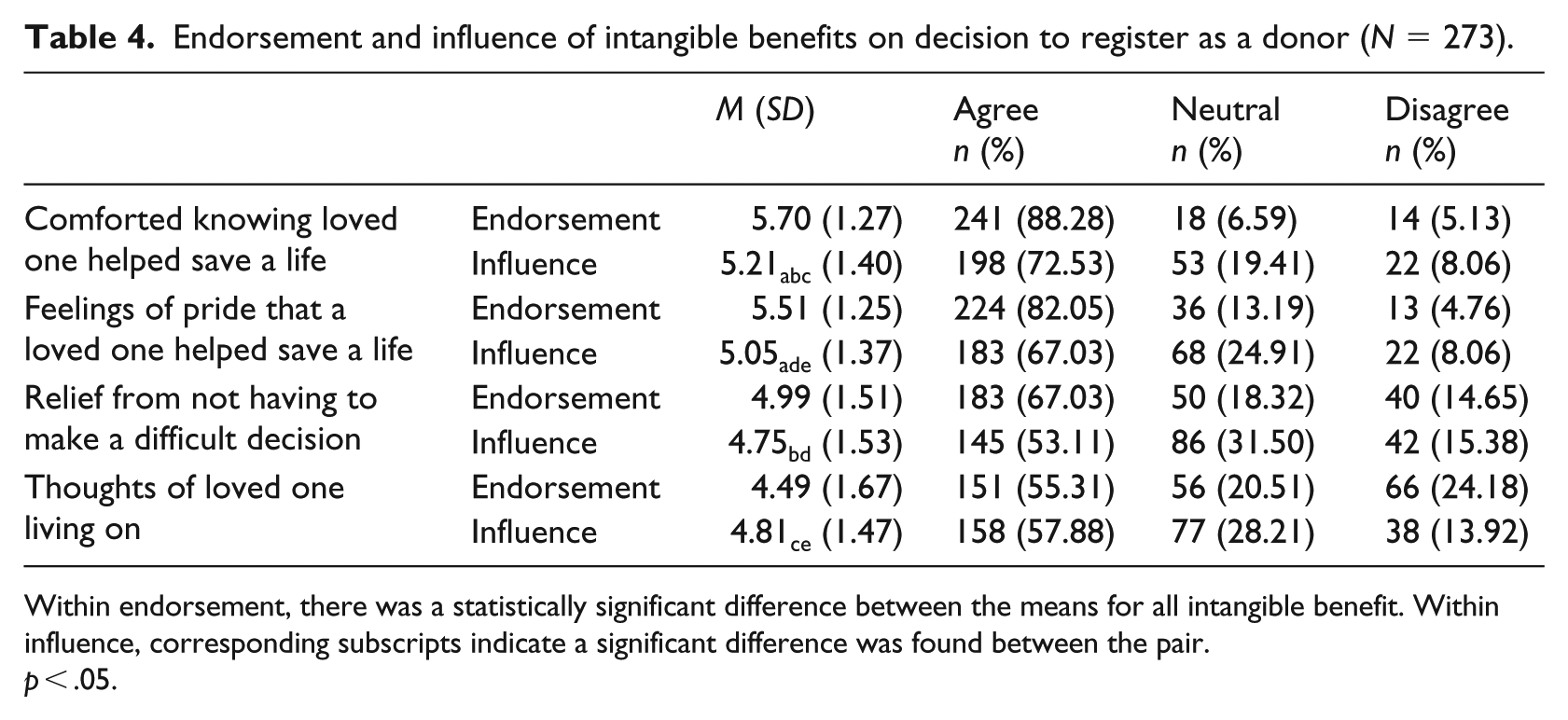
Within endorsement, there was a statistically significant difference between the means for all intangible benefit. Within influence, corresponding subscripts indicate a significant difference was found between the pair.
p < .05.
Discussion
Guided by VIT, we predicted that educating participants about the benefits afforded to donor families would lead to increased donor registration intentions and possibly more favorable attitudes toward registering as an organ donor. In line with the question-behavior effect (Sprott et al., 2006), we used the survey instrument itself as means of influence. This approach allowed us to investigate secondary research goals; namely, participants’ overall awareness of family benefits and the self-reported influence of these benefits on donor registration. A double-sided mixed design was used to detect the influence of the experimental stimulus.
As predicted, exposure to a broad range of donor family benefits had a significant influence on donor registration intentions in both arms of the study. That VI can increase behavioral intentions is in line with studies that targeted VI in other domains, such as disaster preparedness (e.g. Adame and Miller, 2015). This study adds to the organ donor literature by offering a rare experimental assessment of the influence that educating potential donors about a broad range of donor family benefits can have on registration intentions.
There were mixed results regarding the influence of exposure to donor family benefits on attitudes. Results of the posttest-only arm of the double-sided mixed design does not indicate a significant difference in attitudes as a result of the experimental stimulus. However, the complementary quasi-experimental repeated measure design revealed a statistically significant increase in positive attitudes and decrease in negative attitudes. The mixed results for attitudes, but not for intentions, is in line with a pattern of results in national and region campaigns finding changes in organ donor registration behavior, but not attitudes (Cossé and Weisenberger, 2000 ; Sanner et al., 1995). In these studies, and in ours, attitudes of the respondents were already highly favorable, making positive attitude change difficult.
Another contribution of this research is that it offers a rare assessment of the awareness and perceived influence of a broad range of donor family benefits. Overall, there was relatively low awareness of donor family benefits. Only one in 10 participants responded to an open-ended question by naming an OPO benefit. Similarly, low awareness was observed when participants were informed about actual OPO benefits and asked about their awareness of them through closed-ended items. For example, the most well-known benefit, known by 21 percent of respondents, was coordinated communication with recipients; less than 8 percent were aware of events to celebrate loved ones, and only 3 percent were aware of online grief support. Not all benefits were seen as equally influential; agreement that OPO benefits would influence donor registration intentions ranged from 26 to 59 percent. The most well-known (i.e. coordinated communication) and the least well-known service (i.e. keepsakes, known by 2%) happened to have the two highest ratings regarding the influence that such services would have on registration intentions.
Regarding intangible benefits, nearly half (47%) of the participants responded to the open-ended question by mentioning a beneficial thought or feeling that donor families would experience. It is noteworthy that many participants indicated uncertainty when putting forth responses. Responses to closed-ended questions indicated that certain intangible benefits were both plausible and compelling. Feelings of comfort were endorsed by 88 percent of respondents, and 72 percent of respondents reported these feelings as influential to their registration decision. These findings indicate that it could be useful to extend the range of family benefits that are the focus of intervention efforts. Such an expansion might be important given that previous studies on family benefits have focused on relief from not having to make a difficult decision (e.g. Cleiren and Van Zoelen, 1999), a benefit not seen as the most influential by our participants.
Limitations
This study indicates that focusing future interventions on the benefits afforded to donor families may be effective; nevertheless, the limitations of this research should guide next steps. For example, we did not compare the family-benefits approach to other approaches (e.g. saving lives). This decision was made so we could focus our efforts exclusively on the influence, and awareness, of donor family benefits; however, it remains unknown whether the family benefit approach would be better or worse than commonly-used appeals. A second limitation is that we used a survey to inform participants of the benefits experienced by donor families. The advantage of this approach is that it allowed us to educate participants about a broad range of benefits, while simultaneously assessing participant awareness and self-reported influence of each benefit. However, it is not known whether a different approach would yield the same success. That our sample was derived exclusively from an online platform should also be considered. Although MTurk audiences have been identified as being diverse regarding occupation, geography, and age (Huff and Tingley, 2015), and although the attitude–intention association in this study (r = .59) is akin to that of other populations (e.g. Australian university students; r = .67; Hyde and White, 2009), tests of ecological validity using samples recruited in real-world settings could increase confidence in the validity of the results. Finally, the lack of a behavioral measure is a limitation of this study. Although intentions have long served as a proxy for behavior, they are imperfect predictors of behavior (e.g. Fishbein and Ajzen, 1975), therefore a follow-up study using actual registration as an outcome would bolster our confidence in the findings.
Future directions
In addition to the next steps indicated by the limitations just described, other aspects of the topic should be researched. One possibility is that interventions that combine approaches (e.g. VI with information about registration eligibility) could be the most successful. Such a possibility is in line with VIT, in that the theory posits that increased levels of self-efficacy enhance VI (Crano and Prislin, 1995). Furthermore, it is possible that the impact of a campaign focused on family benefits might be most beneficial for older audiences (e.g. 50 years of age or older), given the tendency of people in this age group to express greater concern for future generations (McAdams, 2018). In addition, it would be useful to consider in which contexts a VIT-based family-benefits approach would be most persuasive, especially since prior studies have indicated that certain appeals work better in different contexts (Siegel et al., 2008a). It would also be extremely useful to conduct an extensive qualitative investigation of how potential donors think and feel about the benefits their families may receive. Lastly, the double-sided mixed design used in this research effort served the study well. Its utility for other contexts should be explored.
Conclusion
Guided by VIT, this study investigated whether educating participants about the broad range of benefits afforded to donor families could increase donor registration intentions, as well as make attitudes even more favorable and less negative. A double-sided mixed design indicated that informing non-registered individuals of a range of benefits experienced by donor families has the potential to increase donor registration intentions. The favorable influence of the experimental stimulus on attitudes was indicated in the quasi-experimental repeated measure design but not the true experimental posttest-only design. The results also indicated that current knowledge of the benefits experienced by families was relatively limited, and that the intangible benefits were perceived as influential. This offers evidence of the potential utility of focusing donor registration interventions on the benefits experienced by donor families, and hopefully, will spur further efforts to determine the most effective means of educating potential registrants of the benefits afforded to donor families.
Footnotes
Acknowledgements
The authors wish to thank Maria Sanders (New Mexico Donor Services) and Sara Pace Jones (Donor Network of Arizona) for their assistance in survey development.
Declaration of Conflicting Interests
The author(s) declared no potential conflicts of interest with respect to the research, authorship, and/or publication of this article.
Funding
The author(s) disclosed receipt of the following financial support for the research, authorship, and/or publication of this article: This article was supported by Grant R39OT29877 from the Health Resources and Services Administration’s Division of Transplantation, United States Department of Health and Human Services. The contents of this article are solely the responsibility of the authors and do not necessarily represent the views of the funders.
