







Abstract
Value-affirming activities have been linked to positive health outcomes and improved ability to cope. For cancer survivors who regularly play video games, might the games have potential to affirm values? We surveyed gameplaying survivors and included an open-ended question asking about values and the extent to which they perceived gameplaying as supporting values. A content analysis of responses (N = 533) using Schwartz’s value typology revealed that a majority perceived gameplaying as supporting values or offering other benefits. Self-transcendence followed by openness to change were the most frequently coded higher-order categories. The results contribute to a richer understanding of survivors who gameplay.
This study addresses the underexplored intersection of two areas: the potential for recreational video gameplay to have positive effects and the values of people who have faced extraordinary physical and mental challenges. In this study, we explore this intersection in the context of cancer survivors, who are more likely than those not diagnosed to face mental health issues including depression, worry, fatigue, and isolation (Stanton et al., 2015). For people coping with these issues, recreational games may provide readily available distraction or reprieve, whether at home or in other settings. For some people, playing games may even serve to support beliefs and values that are deeply meaningful to them. In general, there is growing interest in video games as meaningful experiences (Oliver et al., 2016; Rogers et al., 2017), and some games are intentionally designed to foster empathy (Belman and Flanagan, 2010) and support social values (Flanagan et al., 2007). Focusing on these more meaningful and value-supporting experiences is important because affirmation of values has been linked to positive health outcomes (Sherman et al., 2000; Steele and Spencer, 1992). Therefore, from a survivorship perspective, if gameplaying is viewed as an activity that affirms values, it may support survivors’ health and improve quality of life.
Initial qualitative evidence from a small sample of survivors indicates that playing games affirms values, particularly for cultivating social connections, helping others, and experiencing alternate realities (Francis et al., 2016). This study builds on those findings, examining responses among a large sample of gameplaying cancer survivors. We apply the Schwartz value typology (Schwartz, 1992), a well-established framework that has not yet been used in this context to our knowledge. Furthermore, in contrast to other studies that examine motivations for playing games (Przybylski et al., 2010; Sherry et al., 2006), we asked first what people value (independent of the game or any other context), and then asked to what extent gameplaying supports what they named as a value. The findings have potential to provide insight into health professionals, some of whom may disparage gaming (Reinecke et al., 2014).
Background
Recreational games
We define recreational video and computer games as digital games that have been designed primarily for entertainment, without explicit behavior change goals (Francis et al., 2016). Studies of these types of games have often focused on potential negative effects such as increases in aggression after exposure to violent games (Anderson et al., 2010). Increasingly, however, research is turning to the positive effects of games on relationships, personal satisfaction, and well-being (Jones et al., 2014; Schott and Hodgetts, 2006).
The prevalence of recreational gaming among adults is growing: 65 percent of US households own a device used for playing, and most who play say the games help them connect with friends and family (Lofgren, 2017). Some games require little time to learn and are often played on “smart” phones and frequently within social networks (Powley et al., 2016), such as Candy Crush and Words With Friends; the increasing popularity of these simple games has changed the demographics of the gaming community, increasing the number of gamers over 30 years of age (Lofgren, 2017). At the same time, more complex games such as World of Warcraft continue to engage audiences. Studies of such games show their promise in treatment of illnesses as serious as psychosis and depression through the mastery of complex cognitive skills that can transfer to increased competence in managing illness (Thorens et al., 2016).
Cancer survivors, especially those in older age groups, are a key audience for the study of the positive impact of digital recreational games. Older survivors, who comprise a large portion of the survivor population, may experience functional decline, social isolation, and diminished quality of life (Snyder et al., 2009; Stanton et al., 2015). At the same time, clinicians have recognized the potential benefits of a therapeutic playful activity that can increase social ties and feelings of competence (Martela and Ryan, 2016). Studies of digital gameplay among older adults have shown that gaming improves social functioning and well-being (Allaire et al., 2013), as well as cognitive control (Anguera et al., 2013). Furthermore, the use of pleasant virtual environments as an intervention among older adults was found to elevate joy and relaxation among users (Baños et al., 2012). More generally, researchers have identified four areas in which digital games may be of particular benefit to older adults: providing means to relax, socialize, sharpen cognitive skills, and have positive, meaningful experiences (Ijsselsteijn et al., 2007). We argue that the challenges of survivorship may intensify needs in these areas among older adults; therefore, the potential for recreational video games to improve the lives of survivors should be more fully explored.
Values and self-affirmation
Although values have been studied in several disciplines, we focus on conceptualizations developed by Rokeach and colleagues in the field of psychology (Rokeach, 1973) and later extensions of this work by Schwartz (Bardi and Schwartz, 2003; Schwartz, 1992, 1994). This body of research defines values as desirable goals, varying in importance, that serve as guiding principles in the life of a person; furthermore, they are trans-situational (as opposed to needs, which are tied to specific situations) and culturally transmitted (as opposed to traits, which have biological determinants). Values are superordinate constructs that organize lower-order constructs of attitudes and cognitions (Rohan, 2000). The power of values to predict behavior in multiple domains has been well-established, although the link between values and behavior is stronger in some domains relative to others (Bardi and Schwartz, 2003).
In terms of value domains, the model developed by Schwartz includes 10 values arranged in a circular fashion, with the items categorized into five higher-order constructs: self-enhancement (achievement and power), conservation (security, conformity, and tradition), self-transcendence (universalism and helpfulness), openness to change (stimulation and self-direction), and hedonism (Schwartz, 1992, 1994). Distinct from other value frameworks, Schwartz position values on the circle such that more similar values are adjacent to each other and contrasting values are on opposite sides of the circle (e.g. the self-transcendence values are on the opposite side from the self-enhancement values). Schwartz has argued that this conceptualization provides a richer description of the relationships among values and thus provides a more substantive theoretical grounding for values, relative to other frameworks; furthermore, the factor structure has been tested and validated in 97 samples and 44 countries (Schwartz, 1994). The “universal” factor structure of the Schwartz typology and the general conceptualization of values as trans-situational together suggest that the typology is appropriate to use in this study (which had potential to include participants from different backgrounds, at different stages of life, and at different stages of health post-diagnosis). Although studies employing this typology typically measure values using closed-ended questions (Hinz et al., 2005), this study posed an open-ended question and then content-analyzed the responses using the value categories as codes.
Because values encapsulate what a person views as centrally important in life, values are integral to the self-concept (Hitlin, 2003). Self-affirmation theory (Steele and Spencer, 1992) holds that a person strives to maintain integrity of the self, and when under threat, integrity can be restored by affirming things that one highly values. Research has shown that giving people an opportunity to self-affirm values makes them less defensive toward potentially threatening information in numerous domains such as health (Sherman and Cohen, 2002), consumer behavior (Lisjak et al., 2012), and social-issue decision-making (Correll et al., 2004).
Self-affirmation is typically operationalized by asking participants to reflect on or write about something they value if part of an intervention (Sherman et al., 2000) or to self-report the extent to which they think about something they value to help them cope with anxiety or stress (Emanuel et al., 2018). Given the interconnectedness of value domains, affirmation in one domain (e.g. affirming one’s love of art) can increase the ability to cope with threats in another (e.g. accepting a health risk and taking action); in other words, an affirmation need not be directly related to an incoming threat. Furthermore, spontaneous self-affirmation (engaging in self-affirming thoughts in response to a threat) is positively related to psychological well-being (Emanuel et al., 2018). From a survivorship perspective, there are many potential threats to integrity of self and well-being, from initial diagnosis through treatments and transition to life post-treatment (Allen et al., 2009; Archer et al., 2018). Research examining the self-affirming capacity of expressive writing among early-stage breast cancer survivors showed that expressive writing was associated with fewer physical symptoms at follow-up (Creswell et al., 2007).
We propose that engagement with recreational digital games may, for some survivors, play a similar role: for those who view playing the game as a means of expressing something they highly value in life, the activity may enhance health and well-being. As suggested by the self-affirmation theory, having the opportunity to express values and reinforce them through activity may increase the capacity to deal with threats to the self. Furthermore, research among breast cancer survivors has shown that one’s perceived ability to deal with threats is a key factor in initiating coping, which in turn leads to well-being (Raque-Bogdan et al., 2019). As a first step in exploring whether gameplay might enhance this mechanism for survivors, we aimed to determine the extent to which survivors who are also gamers view their gameplaying as supporting something they value.
Cancer survivors and values
We define “survivor” as anyone who has faced a diagnosis of cancer, regardless of amount of time since receiving the initial diagnosis (American Cancer Society, 2017). Thus, the definition includes those who are in-treatment and post-treatment. Long-term survival has become more likely with the advent of sophisticated screening and treatment techniques, increasing the number of people who have faced serious illness or disability; a cancer survivor may have lived decades since an initial diagnosis, but the impact can be lifelong because they are at increased risk of experiencing poor physical and mental health, relative to those not diagnosed (Stanton et al., 2015; Weaver et al., 2012). The effects of cancer-related stressors can accumulate over time and result in lower quality of life over the survivorship trajectory (Rebholz et al., 2018).
Only a few studies have specifically examined the values of cancer survivors. In one study (Greszta and Siemińska, 2011), breast cancer patients completed the Rokeach Values Survey at 1 and 6 months after diagnosis, and researchers found increases in the relative importance of some values (e.g. religious morality and family security) and decreases in others (e.g. self-expansion and competence). An interpretive study of breast cancer survivors’ experiences likewise found shifts in values that included expanded consciousness, increased openness to the environment, and increased appreciation of life (Arman and Rehnsfeldt, 2003). Other research has found that survivors grapple with existential issues, which include thinking about meaning in life and being aware of values (Posluszny et al., 2016).
From a health promotion perspective, we argue that it is important to understand the values of cancer survivors because these insights have potential to inform the design of games that could be used therapeutically; this would be in line with efforts from game designers to better integrate human principles in the design process (Flanagan et al., 2007). Beyond gameplay, insights on the values of survivors could also be used to develop more effective health messages, given that framing messages in terms of a person’s values and valued identities can increase persuasiveness (Comello and Farman, 2016; Gollust et al., 2013).
In summary, the research suggests that the values of cancer survivors can be further explored, and this study contributes to a better understanding by analyzing survivors’ stated values in terms of the Schwartz value typology. Just as important, although, is the extent to which they believe an activity they have chosen to engage in regularly is congruent with their values. The need to explore this aspect is suggested by the self-affirmation theory, which posits that affirming one’s values preserves integrity of self and confers psychological benefits. This study explored the intersection of these ideas in the context of cancer survivors who are also regular gamers. Thus, we asked the following research questions:
RQ1. What are the expressed values of survivors?
RQ2. To what extent is gameplaying viewed as supporting values?
Methods
Design and sample
We performed a content analysis of free responses to an open-ended question about values included in a larger online survey designed to explore gameplay and psychological outcomes among cancer survivors (Comello et al., 2016). For this study, the unit of analysis was each response, although we describe below the participants who provided these responses.
To be eligible to participate in the survey, a person had to (1) be at least 18, (2) have received a diagnosis of cancer at any time in their lives, and (3) play a computer or online game at least once a week. Recruitment materials stated that we were interested in players of any recreational video game or computer game (“everything from ‘World of Warcraft’ to ‘Words With Friends’”). Informed consent was obtained prior to participation. The survey was approved by the Institutional Review Board (13-2894) at the university with which the first author is affiliated.
We analyzed free responses to the open-ended question we posed in the survey asking participants to tell us about something they really valued in life, as well as the extent to which playing the game (named earlier as the one they spent the most time playing) supports this value. Of the 794 respondents to the survey, 656 replied to the question. The data were further screened to ensure that responses addressed both parts of the prompt, further reducing the number to 582 responses. As a final step to determine inclusion, two independent coders were instructed to read the answer in its entirety and to consider the content holistically in light of the prompt; an item was eligible if it provided content that explicitly addressed both parts of the question. This study includes only those cases both coders agreed should be included (N = 533). All cases were then submitted to content analysis.
Cases included in this study were more likely to be written by participants who identified as female (90% of the cases), white (90%), and older (M = 54.69 years, standard deviation (SD) = 10.39). Fifty-seven percent of cases were from participants who were post-treatment, while 43 percent were from in-treatment. Average hours of daily gameplay among participants whose responses were included as cases was 1.60 (SD = 1.11). Table 1 summarizes characteristics of participants whose responses were included. These characteristics were similar to those of participants in the full data set.
Characteristics of participants whose responses were included as cases (N = 533).
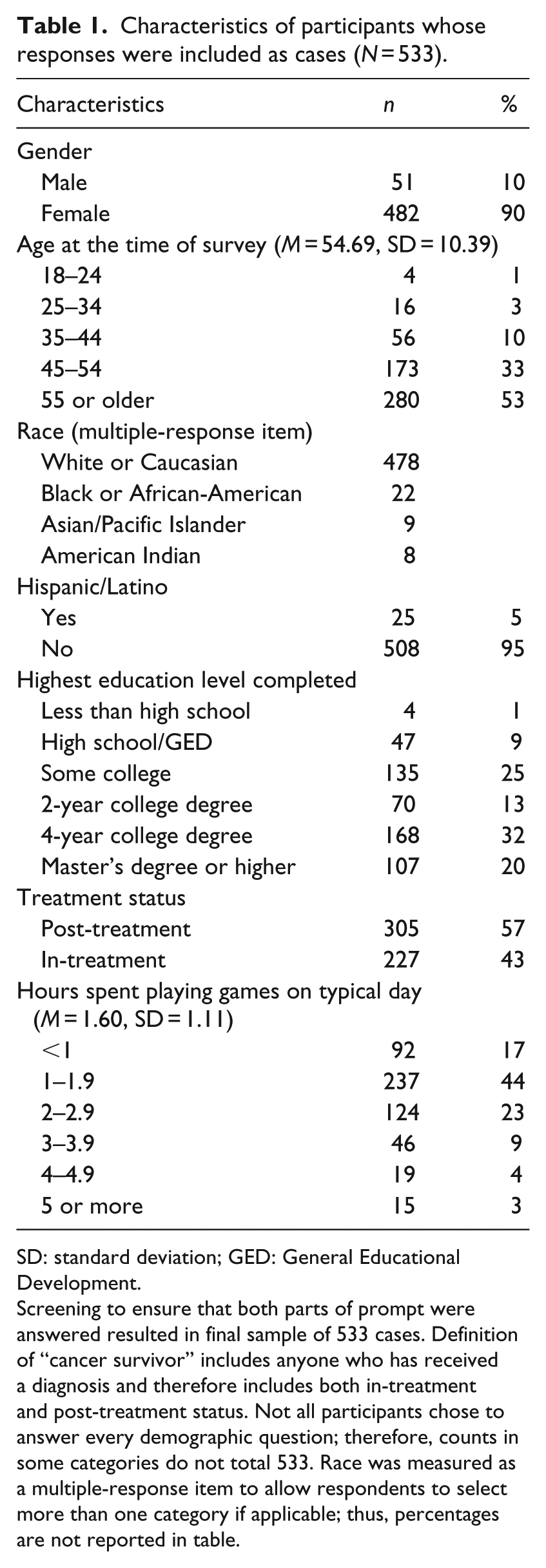
SD: standard deviation; GED: General Educational Development.
Screening to ensure that both parts of prompt were answered resulted in final sample of 533 cases. Definition of “cancer survivor” includes anyone who has received a diagnosis and therefore includes both in-treatment and post-treatment status. Not all participants chose to answer every demographic question; therefore, counts in some categories do not total 533. Race was measured as a multiple-response item to allow respondents to select more than one category if applicable; thus, percentages are not reported in table.
Coding
Value category
The coding scheme was defined by 11 mutually exclusive categories, consisting of the 10 value types identified by Schwartz: helpfulness, universalism, stimulation, self-direction, security, tradition, conformity, hedonism, achievement, and power. An eleventh category was included to capture content that did not neatly fit any of the codes but was nevertheless still a desirable goal.
Two independent raters coded each case against the verbatim descriptions of each value provided by Schwartz (Bardi and Schwartz, 2003), with instructions to code for the most dominant value. After one round of training, reliability on a sample of cases showed that inter-coder agreement was 74 percent, and Krippendorff’s alpha was .65 on this variable. After a second round of training, the final inter-coder agreement was 99 percent, and Krippendorff’s alpha was .99. Table 2 provides value descriptions, as well as examples of full responses that were coded as congruent with each category.
Definitions and example quotes for values and value support.
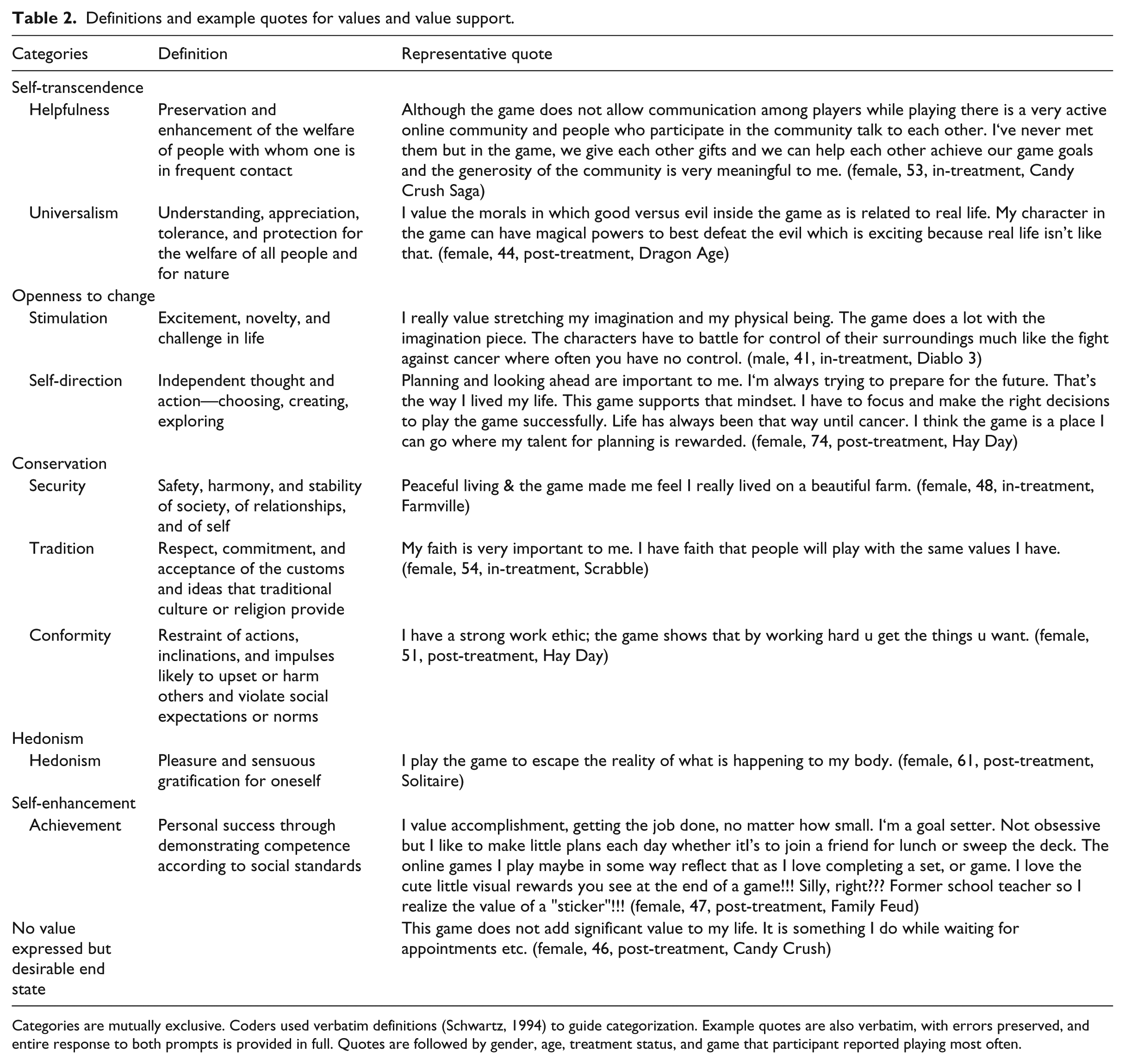
Categories are mutually exclusive. Coders used verbatim definitions (Schwartz, 1994) to guide categorization. Example quotes are also verbatim, with errors preserved, and entire response to both prompts is provided in full. Quotes are followed by gender, age, treatment status, and game that participant reported playing most often.
For ease in reporting of results, the values were also collapsed into the higher-order value domains in the Schwartz typology, with each domain encompassing the values in parentheses: (1) self-transcendence (helpfulness and universalism), (2) openness to change (stimulation and self-direction), (3) conservation (security, tradition, and conformity), (4) hedonism, and (5) self-enhancement (achievement and power). The lower-order values in each grouping are considered conceptually similar because they have shared emphases; thus, they may intermix rather than emerge in distinct regions (Schwartz, 1994).
Value support
We also coded each case for the extent to which the participant reported that gameplaying supported the stated value. There were three mutually exclusive categories: that gameplaying supports the value, neither supports nor undermines, and undermines. The final inter-coder agreement was also 99 percent. Krippendorff’s alpha was .98.
For all coding, discrepancies were resolved by discussion between coders and, if necessary, with the two study directors.
Results
RQ1
This question explored what participants said they valued. A majority (N = 486, 91%) mentioned a value in response to this question. Self-transcendence (n = 192, 36%) and openness to change (n = 186, 35%) were the higher-order value domains coded most frequently, followed by conservation, (n = 61, 11%), hedonism (n = 29, 5%), and self-enhancement (n = 18, 3%). Nine percent (n = 47) did not state a specific value but instead indicated a desirable end state (e.g. to pass the time).
To gain further insight, we performed supplementary analysis to explore whether categorization into any one higher-order value category was associated with treatment status (in- vs. post-treatment). The two variables were not associated (chi-square = 6.2, df = 5, p = .29). Table 3 provides the breakdown by treatment status across categories.
Values present in responses (N = 533).
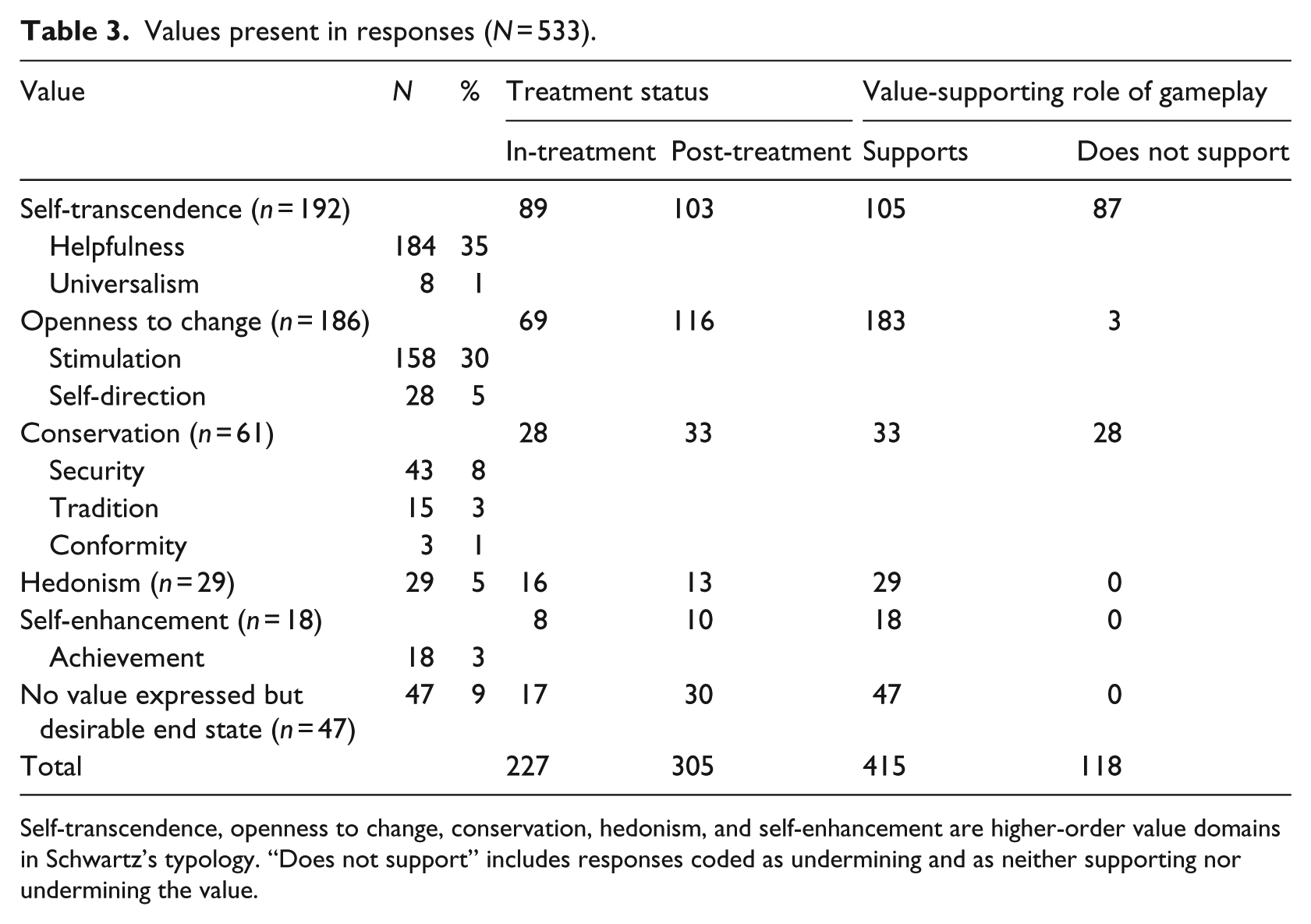
Self-transcendence, openness to change, conservation, hedonism, and self-enhancement are higher-order value domains in Schwartz’s typology. “Does not support” includes responses coded as undermining and as neither supporting nor undermining the value.
RQ2
We asked whether gameplaying supported participants’ reported value or desirable state. In many cases (n = 415, 78%), participants said that gameplaying supported their values. Fewer than 1 percent were coded as undermining values. The remaining cases were coded as neither supporting nor undermining values.
To probe further, we conducted supplementary analysis to examine whether there was an association between higher-order value categorization and whether the response was coded as gameplaying supporting the value or not. There was a significant association (chi-square = 151.99, df = 5, p < .001), suggesting that the distributions of responses differed across categories. For self-transcendence and conservation, no more than 55 percent were coded as supporting values, whereas for all other higher-order values, virtually all responses were coded as supporting. Table 3 displays the breakdown by values support across categories.
Finally, within each higher-order value domain, we conducted further analysis to better understand the specific values mentioned and how they may or may not be supported by gameplay.
Self-transcendence
Within this value category, many responses were coded as helpfulness, or the preservation and enhancement of the welfare of others (n = 184, 35%). Many responses mentioned family, friends, and relationships as important. For a majority, games were seen as a way to enhance relationships with loved ones close by or far away. For example: “Being a mentor. My youth likes to play games as well and we can bond while we play” (male, 53, in-treatment, Left 4 Dead 2 (game participant reported playing most frequently)). However, valuing family and friends was often juxtaposed with gameplaying as not supportive, with over a third of responses (n = 84) stating that playing undermined or did not support that value.
A small number of participants gave responses coded as universalism, which relates to being broadminded, showing tolerance, valuing wisdom, and appreciating nature (n = 8, 1%). Four of the six respondents who gave responses consistent with universalism indicated gameplaying supported their values. For example, one participant said, “I value nature. Most of the puzzles are of natural items and places I can vicariously see” (female, 58, in-treatment, JigZone). On the contrary, another respondent noted, “I value the charities I work with and helping others. The games have absolutely nothing to do with my value” (female, 66, in-treatment, Candy Crush).
Openness to change
A dominant theme in responses categorized in this domain was valuing stimulation, characterized by seeking excitement, novelty, and enjoying challenge in life (n = 158, or 30%). For many, the game provided stimulation to keep their minds sharp and active; avoiding “chemo brain” was specifically mentioned by 13 participants. Other responses highlighted the gratifying nature of imaginative ideation. For example, one person said, I really value stretching my imagination and my physical being. The game does a lot with the imagination piece. The characters have to battle for control of their surroundings much like the fight against cancer where often you have no control. (male, 41, in-treatment, Diablo 3)
Among those who valued stimulation, only one person said that gameplaying did not support their value.
Qualities such as valuing independent thought and action, as well as choosing one’s own goals were also mentioned by cancer survivors (classified as self-direction, n = 28, 5%). Participants said they valued “investing time and energy into something,” “decision making,” and “trying to be self-sufficient.” Playing video games supported this value for all participants whose answers were placed in this category: I value my ability to think clearly and make my own decisions. This game makes me focus on scrambled letters to make words. I can either decide to make the words or not an (sic) no one else cares but me. I am challenging myself. (female, 66, in-treatment, Word Whomp)
Conservation
Eight percent of the responses (n = 43) noted various aspects of security, including “life itself,” “being healthy and happy,” or have a “new appreciation for life.” A little less than a third of the security responses (n = 11) indicated gameplaying undermines this aspect of their life.
Responses valuing tradition (n = 15, 3%) typically mentioned the importance of God or faith in people’s lives. Five out of the 15 indicated that playing games did not support this value. “I value my faith, my family and my friends. The game has no bearing on those values” (female, 58, post-treatment, Farmville 2: Country Escape).
Also, under the higher-order value of conservation, conformity describes commitment to honesty, dedication, and a strong work ethic in one’s life (n = 3, 1%). Unlike those who valued tradition, all of those who valued conformity said playing video games supported their values. One participant said, “I have a strong work ethic; the game shows that by working hard u get the things u want” (female, 51, post-treatment, Hay Day).
Hedonism
Participants described how they liked “relaxing and enjoying life” or having a “fun and interactive time” or “time for me.” In that way, 5% (n = 29) of the responses indicated valuing hedonism. Given that the purpose of many video games is to be fun and enjoyable, it is not surprising that almost all said that playing video games supported their values. For example, one person said, “I like to have fun and relax with family and friends. This game is fun and relaxing to play” (female, 53, post-treatment, Frozen).
Self-enhancement
Under this domain, participants showed that they valued achievement (n = 18, 3%) in several ways, including through “winning” and “accomplishing a task.” One person said, I value accomplishment, getting the job done, no matter how small. I‘m a goal setter. Not obsessive but I like to make little plans each day whether it’s to join a friend for lunch or sweep the deck. The online games I play maybe in some way reflect that as I love completing a set, or game. I love the cute little visual rewards you see at the end of a game!!! Silly, right??? Former school teacher so I realize the value of a "sticker"!!! (female, 47, post-treatment, Family Feud)
All of those who valued achievement said that gameplaying supported their values.
No value expressed but desirable end state
Several responses did not indicate a specific value but sill reflected a desirable end state (n = 47, 9%). In these cases, participants said they played the game as something to pass time, keep busy, or take their minds off other things. To illustrate, one person said, “This game does not add significant value to my life. It is something I do while waiting for appointments etc.” (female, 46, post-treatment, Candy Crush).
Discussion
The ability of recreational video games to enhance the quality of life and well-being of players has been underexamined among cancer survivors. The key finding was that a large percentage of responses indicated that gameplaying supports a value. Although different values were expressed, from altruistic to hedonistic, gameplaying provided an opportunity to support or reinforce that value in many cases, based on participants’ perceptions. This is an interesting finding in light of prior work showing self-affirming effects from activities as simple as writing a paragraph about an important value (Cohen et al., 2000) or picking a value from a list of options (Correll et al., 2004). If these limited tasks can strengthen the integrity of the self, it is likely that a more involved activity such as gameplaying might also have benefits, provided the activity is viewed as consistent with values.
Interesting findings also emerged regarding the types of values held by participants. Helpfulness and stimulation (under the higher-order domains of self-transcendence and openness to change, respectively) were the most frequently appearing values. This finding is consistent with prior work showing that survivors value exploring alternate realities, cultivating social connections, and helping others (Francis et al., 2016). It is also in line with research on positive changes among survivors, such as feeling greater empathy toward others and prioritizing their families’ needs (Horgan et al., 2011).
A potentially life-changing diagnosis presents many survivors with existential challenges (Posluszny et al., 2016). It might then be expected that survivors would mention values related to religion or spirituality, which may offer ways to cope with existential questions about life and death (Greszta and Siemińska, 2011; Johnson and Spilka, 1991). In the Schwartz typology (Schwartz, 1994), these might be captured in the values of tradition (which includes the practices associated with religion) or universalism (which encompasses ideals of world peace, wisdom, and social justice). However, these values appeared rarely (fewer than 1% of responses for both). Similarly, a study of unmet needs among survivors that also used open-ended survey prompts found only 1 percent of responses mentioning spiritual needs (Burg et al., 2015). Other methods such as in-depth interviews might be better suited for gaining richer insights into spirituality and related topics among survivors.
The findings should be considered in light of recent theoretical work on media enjoyment, which posits that people use media to manage challenges to the self, with higher levels of challenge associated with more motivation to engage in narrative media (Slater et al., 2014). Within this framework, narrative media may play a self-affirming role (Johnson et al., 2016). Among the different types of games reported by participants, some do have a story component (e.g. League of Legends) and could serve in this manner. Future research should examine the potential effects of narrative games in greater depth.
From a clinical perspective, our findings may encourage health professionals to have a more nuanced view of the roles of gameplay in the lives of anyone coping with serious health challenges. Games may serve as a simple mental break for some people but may also provide opportunity to exercise autonomy, competence, social connection, and creative ideation. However, for some people, there was perceived conflict between stated values and gameplay. Awareness of the range of roles can be useful to clinicians as they work with patients to improve quality of life. In addition, this study encourages a more nuanced view of games themselves. For example, although games involving shooting have attracted much negative attention, some comments from our participants indicate that these types of games can be played with a community orientation (e.g. bonding with others who play either online or offline) and can provide a meaningful experience, consistent with arguments from other researchers (Schott and Hodgetts, 2006).
Finally, an intriguing area for future research is the extent to which games can be purposely designed to support values and what role they might have in improving quality of life among survivors. Among game designers, there is interest in examining human values more closely and incorporating them into game design (Flanagan et al., 2007). Organizations such as Games for Change encourage the development of games that have social impact by increasing players’ awareness of social issues and by broadening perspectives. For example, the game Tree transforms the player into a tree to experience the cycle of life, with the goal of developing greater appreciation of nature and the environment (http://www.gamesforchange.org/game/tree/). Although this study looked only at games that people were already playing, it would be worthwhile to examine the potential for social-impact games to affirm values. The strongly prosocial aspect of these games may speak to values of helpfulness and universalism, while novelty or engrossing scenarios could help affirm values for stimulation. Future research should explore this possibility further, as well as impact on quality of life among survivors.
This study has important limitations. First, because participants self-selected into the study from which our cases were drawn, participants may not represent all gameplaying survivors, some of whom may be unable or unwilling to participate. Second, the open-ended question we posed may have generated some content that was not easily categorizable according to the definition of value in the literature. While this made coding challenging, we believe the comments also revealed what may have been most accessible to cancer survivors. The Schwartz value typology, although well-established across multiple domains (Schwartz, 1994), may miss distinctions in values that are especially important to survivors, such as dimensions specific to health (Allicock et al., 2008). Finally, the study is not intended to show causal relationships; future research should formally explore psychological mechanisms involved, including the self-affirmation mechanism suggested here.
In summary, this study revealed the values that are important to gameplaying cancer survivors and showed that in many cases, games are viewed as supporting those values. From a self-affirmation perspective, the findings suggest that gameplay has potential to enhance well-being and quality of life. This should be considered by health professionals and others who might be too quick to dismiss gameplay as detrimental to health.
Footnotes
Acknowledgements

Declaration of conflicting interests
The author(s) declared no potential conflicts of interest with respect to the research, authorship, and/or publication of this article.
Funding
The author(s) disclosed receipt of the following financial support for the research, authorship, and/or publication of this article: This study was supported by a Junior Faculty Development Grant to the first author from the University of North Carolina at Chapel Hill.