







Abstract
The study focuses on families raising a child with cerebral palsy to investigate family strengths and their association with family and parent demographic characteristics in Greece and Italy. Participants were 120 parents raising a biological child with cerebral palsy. Data collection used a self-report questionnaire and the Family Strengths Inventory. According to the findings, families share a high sense of family strengths, which is mainly represented in the high sense of ‘pride’ and ‘accord’. In addition, demographic characteristics seem to be important predictors of well-being and strengthen parents and families raising a child with cerebral palsy.
Introduction
Cerebral palsy (CP) is a group of permanent, but not unchanging, disorders of movement and/or posture and of motor function, which are due to a non-progressive interference, lesion, or abnormality of the developing/immature brain. This definition specifically excludes progressive disorders of motor function, defined as a loss of previously acquired skills in the first 5 years of life. CP is the most common severe motor disability in childhood affecting about 2 per 1000 live-born children. The severity of CP is defined by severe impairment of the gross motor function (The Gross Motor Function Classification System (GMFCS) III–V) or an associated cognitive impairment (defined by an intellectual quotient (IQ) <50; Kinsner-Ovaskainen et al., 2017). The impact of CP on most individuals and their families is usually substantial. Because there is no cure for CP, treatment is supportive, long term and complex. It usually includes physical and occupational therapy, special education, orthopaedic surgery and assistive devices. Frequently, further treatments are applied and the emotional and financial costs on the children, their families and the social health services (Aran, 2010).
CP has a great impact on the affected person’s life, on the family’s life, on society and, on public services, as it represents a chronic and complex condition associated with high economical health-care cost (O’Shea, 2008; Rosenbaum et al., 2007).
The care and upbringing of a child with CP may affect the functioning of parents and the whole family (Kołtuniuk et al., 2019). CP impacts the entire family in a manner that is long term, complex and multifactorial. The birth of a child with CP may precipitate complex care responsibilities, financial hardship, limits to occupational attainments, relationship distress, grief and social isolation, all of which have further flow-on effects for the parents, child and family (Rentinck et al., 2007). Moreover, caregivers of children with CP face unique demands and challenges, with a potential negative impact on psychological wellbeing and consequences for both caregiver and child (Irwin et al., 2019).
Parents of children with CP are faced with the same parenting tasks as typically developing children. However, parenting a child with CP presents greater and more complex challenges at both a physical, practical and emotional level (Plant and Sanders, 2007) and all aspects of the parents’ life are affected (Jinming and Jianjun, 2010). For parents, raising a child with CP, can be a challenging and complex experience and usually requires a significant amount of energy from them and the entire family over a long period of time as CP poses unique demands with high levels of perceived burden, stress and time pressure. Parents of children with CP report facing frequent challenges with sleeping, eating, communication, behavior and health complications (Boucaut et al., 2014; Bunning et al., 2014; Wijesinghe et al., 2015). Research continues, but given our present state of knowledge, it may be misleading to draw firm conclusions on parenting a child with CP. The presence of a child with a disability may impose multiple and profound effects on a family (Seligman and Darling, 2007; Tsibidaki et al., 2019). Reviews of research on families present a mixed picture of the findings concerning the impact of CP on family life and parents. On one hand, parents caring for a child with CP commonly experience an ongoing grieving process, with grief intensifying during transitions and major child and family life events (Whittingham et al., 2013), and they – especially mothers – tend to suffer from high parenting stress (Wang et al., 2017). On the other hand, the care of a child with CP constitutes an additional challenge in the family’s daily life and requires further skills, to effectively deal with all the daily issues that arise (Iversen et al., 2009). Parenting a child with CP and optimizing its development involves forward thinking, scaffolding abilities, a commitment to supervision, patience, compassion, behavioural management skills and effort above and beyond the optimal parenting of typically developing children. Further, all of that requires a strong and loving emotional bond and parental psychological resilience (Whittingham et al., 2016) and family strengths.
In the literature review, there is a core question implied by the redefined ‘disability paradox’ which has been put forward by different authors, who were interested in explaining why (or how) some parents adapt better than others to specific demands imposed by the responsibility of caring for a child with a disability (Carona et al., 2013).
A way of answering this core question is through a family strengths perspective. On its basis is that every family has problems, but the ability and willingness to recognize and cope with their problems are the keys to differentiating functional from unfunctional families. Family strengths and characteristics of a functional family are studied by scholars around the world. Most of the research on families has focused primarily on the problems or the weaknesses of families. Recently, however, researchers have studied families from a strengths-based perspective. Around the world researchers have found that families are amazingly similar. The similarities point to a set of qualities that describe the characteristics of strong families. These qualities are showing appreciation and affection, commitment, positive communication, enjoyable time together, spiritual well-being and the ability to manage stress and crisis effectively. The focus on family strengths brings into a more reasonable balance our understanding of how families succeed in the face of life’s inherent difficulties. By concentrating only on a family’s problems and a family’s failings, we ignore the fact that it takes a positive approach in life to succeed. In addition, researchers looking at couples and families from a strengths perspective have developed a number of propositions derived from their work around the world, such as (1) all families have strengths, (2) it’s not about structure, it’s about function, (3) strong marriages are the centre of many strong families, (4) strong families tend to produce great kids, (5) if you grew up in a strong family as a child, it will probably be easier for you to create a strong family of your own as an adult, (6) The relationship between money and family strengths is tenuous, (7) strengths develop over time, (8) strengths are often developed in response to challenges, (9) strong families don’t tend to think much about their strengths, they just live them, (10) strong families, like people, are not perfect, (11) when seeking to unite groups of people, communities and even nations, uniting around the cause of strengthening families can be a powerful strategy and (12) human beings have the right and responsibility to feel safe, comfortable, happy and loved (DeFrain and Asay, 2007b: 6–7).
Several social background and demographic variables were found to have a significant correlation with family strengths from earlier studies, such as age, marriage, childhood, employment, social class or socioeconomic status and so on (Conger et al., 2010). As far as CP, there is a controversy regarding the findings of the association of sociodemographic characteristics on the condition of CP (Forthun et al., 2018).
On one hand, research findings have reported an increasing risk of CP with decreasing socioeconomic status (Emerson and Hatton, 2009; Lima et al., 2016). A socioeconomic gradient in CP risk could change over time, with changes in educational attainment, parental age, income, social policy and health behaviour, and improvements in antenatal, obstetric and neonatal care (Durkin et al., 2015; Hjern and Thorngren-Jerneck, 2008). In addition, socioeconomic inequalities in the risk of CP have been repeatedly documented (Solaski et al., 2014). Forthun et al. (2018) suggest that there is a strong trend of decreasing risk of CP with additional education of both the mother and the father; when both parents had high education, risk of CP was further reduced. Moreover, women with partners have a reduction in risk compared with single mothers overall, and household income is not associated with the risk of CP.
On the other hand, studies have found that sociodemographic characteristics seem to be important predictors of well-being or confounders of the relationship between having a child with a disability and parental well-being (Ha et al., 2008). Nevertheless, the strengths of families from culture to culture, when compared with each other, are remarkably similar and give us common ground around the world upon which to unite and develop a mutual understanding (DeFrain and Asay, 2007a).
Most recent research has focused on the condition of CP and mainly on sociodemographic characteristics and the risk of CP (Durkin et al., 2015; Forthun et al., 2018; Hjern and Thorngren-Jerneck, 2008; Solaski et al., 2014) and not on family and parent characteristics.
This study
CP has a great impact on the entire family and parents in a manner that is long term, complex and multifactorial (Rentinck et al., 2007; Whittingham et al., 2016). Parents and families of children with CP have often been thought to differ from parents and families of children without disability. More recently, expert opinion has shifted towards the view that parents and families of children with CP are not at increased psychosocial risk and they develop strengths. The purpose of this study is twofold: On one hand, to explore the degree of family strengths of Greek and Italian families raising a child with CP and if there are any differences between Greece and Italy, and, on the other hand, to find out the association of family strengths with family and parent demographics.
The hypothesis of the study is the following: Since families face a lot of challenges, risks and problems derived from the condition of CP, they turn to their own dynamics and strengths to cope and function well and the family strengths seem to have a significant difference between some categories of demographic characteristics.
We considered our stated research parameters important because they have not been sufficiently answered by existing research on Greek and Italian population, even though in both Greek and Italian culture, the family stands high and is valued by the community, as both are the most traditional (family-orientated) in Europe (Eurofound, 2014). Besides that, given the unique challenges on parents of children with CP, it is important to view these parents from a positive perspective, that is, the family strengths. The family strengths perspective is a worldview or orientation towards life and families that is positive and optimistic, grounded in research conducted around the world (DeFrain and Asay, 2007b). Applying a strengths-based practice approach in working with people with disabilities and their families has been documented to have positive results as far as a strength-based approach is designed to enhance the strengths of specific populations and has an emphasis on capacity and intentionality (Hirst et al., 2011).
Methods
Participants
The sample of the study consisted of 120 Greek and Italian parents of children with CP belonging to nuclear and intact families. All parents had a biological child with CP, which was under continuous medical treatment and was a candidate for an orthopaedic operation. The demographics of the parents, their families and children are presented in Table 1.
The demographics of the parents who participated in the study (N = 120).
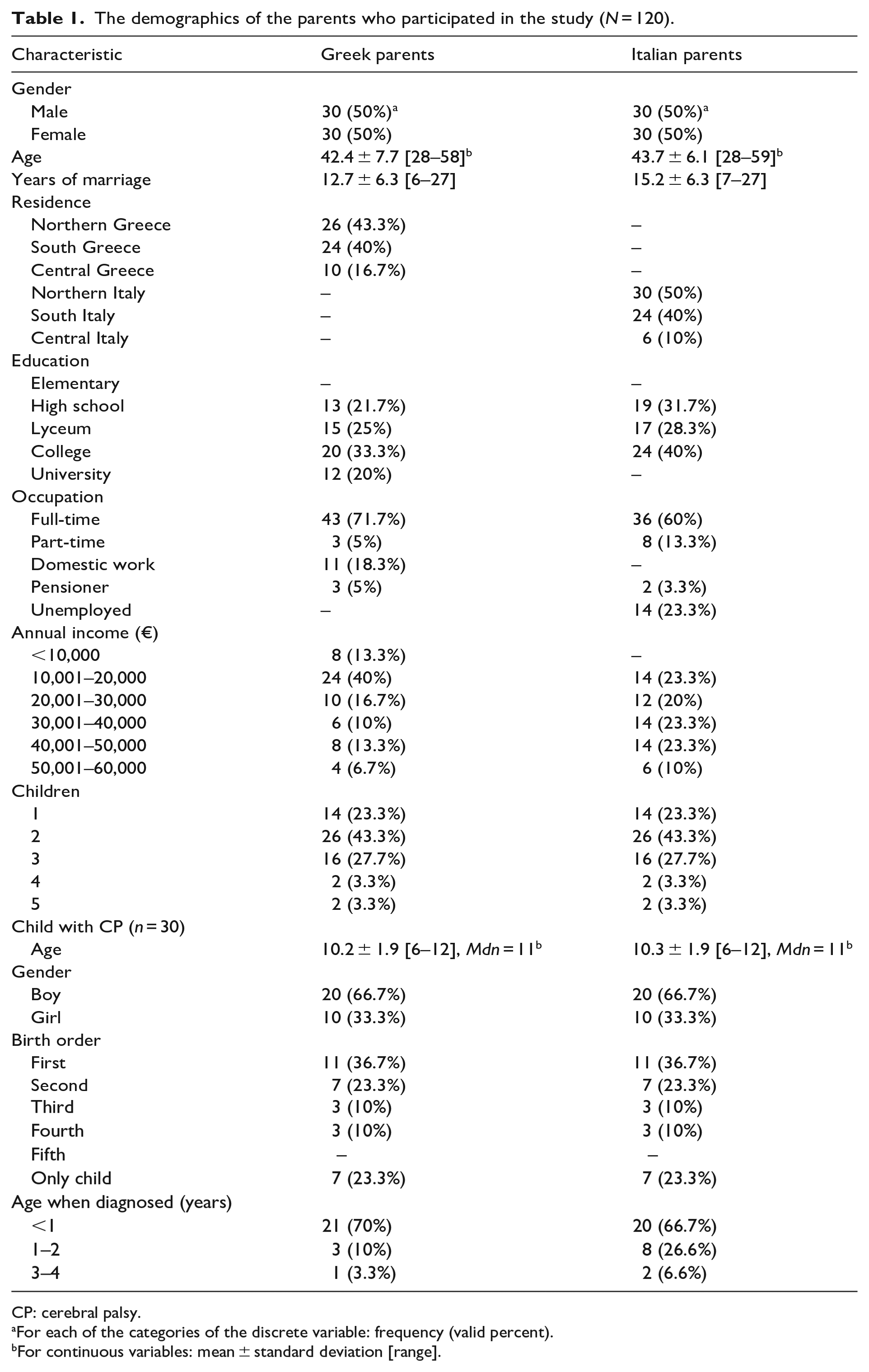
CP: cerebral palsy.
For each of the categories of the discrete variable: frequency (valid percent).
For continuous variables: mean ± standard deviation [range].
The families were randomly selected. The selection took place in two phases: First, Greek families raising a child with CP were randomly selected from archives and catalogues of the University Hospital of Athens, Attikon (Athens) and second, Italian families were randomly selected from Humanitas Research Hospital, Rozzano (Milan). The sample composed of families with a disabled child by the following criteria: (1) all familieswere intact and nuclear, (2) the age of the disabled child varied between 4 and 12 years old, (3) the child with CP lived under the same roof with his/her family, (4) all the families of the sample were permanent residents of Greece and (5) the child with CP was the only individual in the family who presented the disability.
After completing the collection of the Greek population, we proceeded to the selection of the 30 Italian families raising a child with CP. The sampling between Greek and Italian families followed the criteria of comparability: (1) sex, birth order and age of the child with CP, (2) number of family members and (3) sex and age of siblings (with deviation ±2 years).
Measures
Data were collected using a self-report questionnaire and the Family Strengths Inventory. More specifically:
A self-report questionnaire of 25 questions was conducted for the purposes of the study to obtain socio-demographic information such as age, educational level, employment status, family income and so on, as well as characteristics of family and children. For instance, participants were asked the following questions: ‘How would you describe your family’, ‘To what degree are you satisfied with your family?’, ‘How would you evaluate your performance in regard of caring your child with CP?’ and so on.
Family Strengths Inventory: Family Strengths is a brief, 12-item self-report scale developed by Olsen, Larsen and McCubbin (Schrodt, 2009). Family Strengths is intended to provide a measure of two characteristics or dimensions demonstrated by families that seem able to cope with the inevitable problems and conflicts that arise in family living. The two dimensions are pride and accord. Family Strengths is an instrument easy to administer and score. The subject responds to each item by checking a 5-point scale responses ranging from ‘strongly disagree’ to ‘strongly agree’ with ‘neither agree nor disagree’ as the mid-point. The score ranges from 12 to 60: pride (seven items; thus, resulting to a potential range from 7 to 45) and accord (five items; thus, resulting to a potential range from 5 to 25). The higher the score, the higher the perceived family strengths. The scale’s developers demonstrated construct validity, test–retest reliability (r = 0.76) and internal consistency reliability (a = 0.83; Goulding et al., 2008). The Cronbach’s alpha was 0.83 and the test–retest reliability coefficient was 0.58 among their sample of adolescents and young adults. In this study, the coefficient alpha was 0.92 (Greek adaptation) and 0.90 (Italian adaptation). Hence, the translation to Greek and Italian version appears to bear good psychometrics, being in general in line with the original questionnaire. (The construct validity of the translation to Greek and Italian versions of the questionnaire was investigated through Principal Axis Factoring (Varimax Rotation).)
Procedure
Parents were at first informed about the research by an orthopaedic doctor. After parental consent was obtained a meeting with each parent was arranged (at a time indicated by the parents). All meetings took place within a week at a silent and comfortable hospital office (in Greece and in Italy) during a 10-month period (April 2017–January 2018). The instruments were administered by the researcher and the duration was approximately 1.5 hours for each parent. Consent forms were signed by all parents at the initial meeting. After the completion of the research, a summary of the study and a thank-you note were sent to each family for their participation.
Analysis
The statistical analysis of the empirical data was performed by the SPSS for Windows v.25 (IBM SPSS Statistics, 2019). Quantitative data analysis was based on descriptive statistics (mean, percentages, etc.), on comparisons between the research groups with the t-test criterion for two independent samples, on Mann–Whitney and on factorial analysis of variance (ANOVA; with two independent factors).
Results
Family strengths in Greece and Italy
With regard to family strengths, the nonparametric deviation of a sample revealed the statistically significant higher family strengths (whole) of parents in Greece (p = 0.001; Μdn = 42, compared with the theoretical Μdn = 36), as well as parents in Italy (p = 0.001; Mdn = 41.5, compared with the theoretical Mdn = 36). At the same time, Mann–Whitney non-parametric control revealed the non-statistically significant differentiation between parents in Greece and Italy (p = 0.756; Greece Μdn = 42, Italy Mdn = 41.5). Consequently, parents in Greece and Italy declare greater family strengths than the theoretical median, but they do not differ statistically significantly from each other. The same applies to the two subcategories of the test: pride and accord (Table 2).
Factors of family strengths in Greece and Italy.
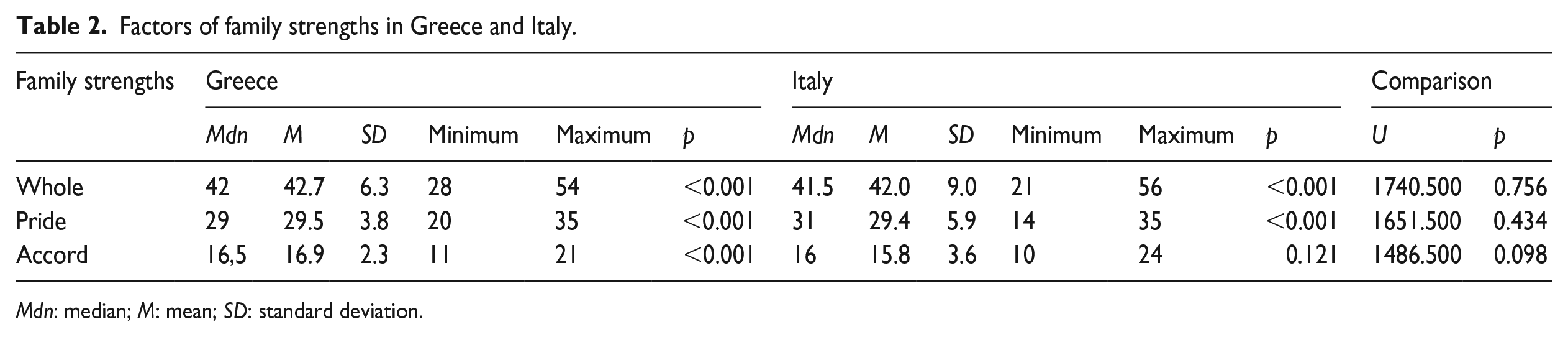
Mdn: median; M: mean; SD: standard deviation.
Factors of family strengths in relation to family demographics: country of origin, annual family income
Country of origin
There are no statistically significant differences in the average values of Greece and Italy as regards the values of family strengths (whole, pride and accord). It appears that the participants share a high sense of family strengths, which is mainly represented in the high sense of ‘pride’ and ‘accord’.
Annual family income
There are statistically significant differences in the average values of parents’ income scales in the total sample in the accord (F = 3.200, p = 0.01) and in the whole (F = 3.183, p = 0.01). The pairs that identified these differences according to post hoc tests are: (1) for the whole: those with 30,000€–40,000€ annual income (their average value is highest) with those who have from 10,001€ to 20,000€ and (2) for the accord: those with 30,001€–40,000€ annual income (their average value is higher) with those who have from 10,001€ to 20,000€ and from 20,001€ to 30,000€.
There are statistically significant differences in the average values of parents’ income scales in the sample of parents that live in Greece, for the whole (F = 4.809, p = 0.001) and for both factors: pride (F = 3.887, p = 0.004) and accord (F = 3.073, p = 0.016). The pairs that identified these differences according to post hoc tests are: (1) For whole: we have those with less than 10,000€ annual income (their average value is lower) with those who have from 40,001€ to 50,000€ and from 50,001€ to 60,000€; and those with 30,001–40,000€ (their average value is lower) with those who have 40,001€–50,000€ and 50,001€–60,000€. (2) For pride: those with 30,000€–40,000€ annual income (their average value is lower) with those who have from 40,001€ to 50,000€ and from 50,001€ to 60,000€. (3) For accord: we have those from 40,001€ to 50,000€ annual income (their average value is higher) with those who have less than 10,000€ and from 10,001€ to 20,000€.
There are statistically significant differences in the average values of parents’ income scales in the sample of parents that live in Italy for whole (F = 6.017, p = 0) and for both factors of family strengths (pride: F = 3.202, p = 0.02 and accord: F = 3.200, p = 0). The pairs that identified these differences according to post hoc tests are: (1) For the whole: those with 30,001€–40,000€ annual income (their average value is highest) with those who have from 10,001€ to 20,000€; from 40,001€ to 50,000€; and from 50,001€ to 60,000€. (2) For the pride: those with 30,001€–40,000€ annual income (their average value is lower) with those who have from 50,001€ to 60,000€. (3) For the accord: those with 30,001€–40,000€ annual income (their average value is higher) with those who have from 10,001€ to 20,000€; from 20,001€ to 30,000€; from 40,001€ to 50,000€; and from 50,001€ to 60,000€.
Factors of family strengths in relation to parents’ demographics: gender, age, education level, occupational status and profession
Parents’ gender and age
There are no statistically significant differences between mean values as regards parents’ gender, as well as parents’ age (<39, 40–49, 50–59 years) on the whole and on the two factors: pride and accord, neither in the total sample nor by country (Greece, Italy).
Education level
There are statistically significant differences in the mean values of parental education levels and in whole (F = 5.278, p = 0.002) and in both factors (pride and accord: F = 4.630, p = 0.004 and F = 3.243, p = 0.025, respectively). High school graduates show lower percentages in whole, pride and accord.
In addition, there are no statistically significant differences in the average values of parental education levels in Greece. However, there are statistically significant differences between mean values of parent education levels in Italy (F = 13.559, p = 0) and in both two factors (F = 10.114, p = 0 and F = 6.005, p = 0.004). High school graduates in Italy show lower rates in whole, pride and accord.
Occupational status
There are statistically significant differences in the mean values of parental occupation in the total sample and in whole (F = 4.058, p = 0.004) and in both factors (pride and accord: F = 5.072, p = 0.001 and F = 3.769, p = 0.006, respectively).
As regards the country of origin: (1) there are no statistically significant differences between mean values of occupation in Greece sample and (2) there are statistically significant differences between mean values of occupation in Italian sample for the whole (F = 4.362, p = 0.008) and for both factors (F = 5.394, p = 0.002 and F = 2.896, p = 0.043). In particular, they show lower mean values: (1) for whole: part-time employees, (2) for pride: part-time employees and (3) for accord: unemployed.
There are statistically significant differences in the average values of parents’ profession in the sample as well as in the total (F = 10.515, p = 0) for both factors of family resistance (F = 10.699, p = 0 and F = 5.349, p = 0.002).
As far as the country of origin: (1) there are no statistically significant differences in the average mean values of parents’ occupation in the Greek sample and (2) there are statistically significant differences between mean values of parents’ occupation in Italian sample in the whole (F = 12.896, p = 0) and in the two factors resistance (F = 11.170, p = 0 and F = 5.832, p = 0.002). The pairs in which these differences are identified according to the post hoc tests are:
For whole: (1) Manual workers with regard to scientific and free professions, (2) manual workers with regard to technicians, office workers and service providers and (3) manual workers with regard to pensioners – students – unemployed with regard to the manual workers have the lowest price mean values in all the above cases.
For pride: (1) manual workers with regard to scientific and free professions, (2) manual workers with regard to technicians, office workers and service providers and (3) manual workers with regard to pensioners – students – unemployed with regard to the manual workers have the lowest price mean values.
For accord: (1) manual workers with regard to scientific and free professions and (2) manual workers with regard to technicians, office workers and service providers with regard to the manual workers have the lowest price mean values.
In addition, the factorial (two factors) ANOVA (parents education level and annual family income) showed that there is no significant effect for the level of education (F3,102 = 2.28, p = 0.084, partial η2 = 0.06) nor the annual family income (F5,102 = 1.08, p = 0.373, partial η2 = 0.05) but there is significant effect for their interaction (F9,102 = 2.56, p = 0.011, partial η2 = 0.18). More specifically, for the Greek sample the factorial (two factors) ANOVA (parents education level and annual family income) showed that there is significant effect for the level of education (F3,45 = 5.23, p = 0.004, partial η2 = 0.26) and the same is valid for the annually family income (F5,45 = 7.74, p = 0.000, partial η2 =0.46), as well as for their interaction (F6,45 = 2.95, p = 0.016, partial η2 = 0.28). However, for the Italian sample, the factorial (two factors) ANOVA (parents education level and annual family income) showed that there is significant effect of the level of education (F2,49 = 4,49, p = 0.016, partial η2 = 0.15) but there is no significant effect for the annual family income (F4,49 = 1.07, p = 0.383, partial η2 = 0.08) as well as for their interaction (F4,49 = 0.92, p = 0.458, partial η2 = 0.07).
Discussion
This research aimed to depict (1) family strengths in Greece and Italy, (2) factors of family strengths in relation to family demographics: country of origin, annual family income and (3) factors of family strengths in relation to parents’ demographics: gender, age, education level, occupational status and profession.
Parents in Greece and Italy display a higher score on family strengths than the theoretical median and the same applies to the two subcategories of the test: pride and accord. Concurrently, there are no statistically significant differences in the average values of Greece and Italy as regards the values of family strengths (whole, pride and accord). It appears that the participants share a high sense of ‘family strengths’, which is mainly represented in the high sense of ‘pride’, which is defined as family attributes relating to trust and loyalty within the family and ‘accord’, which is defined as a family’s sense of mastery and competency. These family strengths are considered as family resources related to characteristics and dynamics that enable families to demonstrate resilience and deal with family problems (Olson and Gorall, 2003). Moreover, this finding suggests that families raising a child with CP are able to cope with the inevitable problems and conflicts that arise in family living and it verifies the position that families have strengths (Tsibidaki et al., 2017). More specifically, all families have challenges and areas of potential growth. If one looks only for problems in a family, one will see only problems. If one also looks for strengths, one will find strengths (DeFrain and Asay, 2007a). This finding does not argue that these families do not have problems and multiple challenges to parents, but that they have the ability and willingness to recognize and cope with their problems. In addition, parents present a positive reinterpretation, which appears to be an adaptive coping strategy (Cheshire et al., 2010). It is noteworthy to mention that there is no relevant research on family strengths in Greece and Italy, either on families raising a child with CP or on families with ordinary children.
The results related to the sociodemographic characteristics confirm those of other studies which suggest that demographics seem to be important predictors of well-being or confounders of the relationship between having a child with a disability and parental well-being (Ha et al., 2008). Especially, we found that there are no statistically significant differences between mean values as regards parents’ gender and parents’ age, neither in the total sample nor by country (Greece, Italy). This confirms that the strengths of families from culture to culture, when compared with each other, are remarkably similar and give us common ground around the world upon which to unite and develop mutual understanding (DeFrain and Asay, 2007a), and do not verify the research findings which report that raising a child with a disability, such as CP, poses a significant risk to parents’ physical and emotional well-being, however, this risk may vary across different racial and ethnic groups, given diverse cultural norms (Magana and Smith, 2006).
In addition, this study found that there are statistically significant differences in the average values of family annual income, parental education levels, occupation and profession. More specifically, both in Greece and Italy, the families with higher annual income score higher in family strengths. Moreover, there are no statistically significant differences in the average values of parental education levels, occupation and parent’s profession in Greece. However, there are statistically significant differences between mean values of the above parameters in Italy, in which high school graduates, part-time employees and unemployed, as well as manual workers show lower percentages of family strengths. This finding proposes that families and parents with a higher level of annual income, education, occupation and profession demonstrate higher scores in family strengths. In addition, the factorial (two factors) ANOVA (parents’ education level and annual family income) showed that there is no significant effect for the level of education nor for the annual family income but there is significant effect for their interaction. These findings are consistent with the findings of other studies which have indicated that as far as CP is concerned, there is a controversy regarding the findings of the association of sociodemographic characteristics on the condition of CP. Research has shown that household income is not associated with risk of CP, that there is a strong trend of decreasing risk of CP with additional education of both the mother and the father, when both parents have high education, risk of CP is further reduced (Forthun et al., 2018).
Limitations of the study
The results of this study should be cautiously treated since they are based on a specific group derived from the Greek and Italian populations. It is a survey-based study, and the results come solely from the questionnaires. A mixed method combining both quantitative and qualitative data could give more profound evidence on family strengths and their association with family and parent demographics. Furthermore, the number of participants in each group is small, which may affect the accuracy of the results. In addition, the results portray an overly positive view of families raising a child with CP. The positive view we found may be due to the following: (1) the sample of the study consists exclusively of those who responded to our call and were therefore more open and ready to share their experience (more flexible). Also, the results do not apply to other families who are likely to function with more or less closed boundaries; (2) the members of the Greek and Italian families support each other a lot because their relationships are based on collective values and (3) all families of the study were intact and therefore much more functional than other types of families (single-parent families). Moreover, the study’s sample inclusion criteria indicated that only one child in the family was diagnosed with CP; results may vary if more than one member presents with a disability. In addition, the sample inclusion criteria (intact families) suggests that the families under study are supported not only by their structure (both parents are present) but also by their culture (they function collectively). Finally, the results of the study cannot be generalized to apply to families with different structure (single-parent families, stepfamilies, remarried families, etc.).
Conclusion and implications for practice
The findings of the study suggest that:
Parents in Greece and Italy display a high score on family strengths.
Sociodemographic characteristics seem to be important predictors of family strengths.
There are no statistically significant differences between mean values as regards parents’ gender and parents’ age, neither in the total sample nor by country (Greece, Italy).
There are statistically significant differences in the average values of family annual income, parental education levels, occupation and profession.
Our findings provide several practical suggestions for specialists and health practitioners who work with families raising a child with CP:
First, the finding that parents raising a child with CP displays high levels of family strengths, leads us to view parents of children with CP from a positive and optimistic perspective. The family strengths perspective does not ignore family problems but restores them to their proper place in life: As vehicles for testing our capacities as families and reaffirming our vital human connections with each other (DeFrain and Asay, 2007b) and this is vital for a family raising a child with CP.
Second, the findings highlight that families raising a child with CP are complex systems whose functions depend on many factors and, therefore, when we work with them we should not adopt a pathological model, but we should equally explore their strengths and have an individualized perspective in every attempt of research and work.
Finally, specialists’ additional concern must be to support parents raising a child with CP by providing information and guidance. They should also adapt their role to parents’ needs for information, communication and partnership and facilitate them in becoming more empowered and strengthened.
Footnotes
Acknowledgements
The author acknowledges the generous help and support in data collection provided by the Department of Orthopaedics Paediatrics and Paediatrics Department, University of Athens, University Hospital of Athens, Attikon (Athens), Greece and the Department of Orthopaedics paediatrics and Neuro-orthopaedics, University of Milan, Humanitas Research Hospital, Rozzano (Milan), Italy. The author also acknowledges the families who participated in the study.
Declaration of Conflicting Interests
The author(s) declared no potential conflicts of interest with respect to the research, authorship and/or publication of this article.
Funding
The author(s) received no financial support for the research, authorship and/or publication of this article.
