







Abstract
The objective of this study is to verify the relevance of motivational and emotional factors, as well as dietician presence in relation to the optimization of the dietary pattern-change process. This study was carried out with an on-line survey, including 341 respondents, almost half of whom were consulted by a dietician. Two measures were applied to evaluate the effectiveness of the dietary pattern-change among participants. The first of these measures refers to subjective evaluations of diet improvement, while the second refers to weight loss. The results show that autonomous motivation and dietician presence are associated with positive anticipatory emotions, and diet improvements. Extrinsic regulation, dietician presence, and lack of negative emotional experiences are related to greater weight loss.
Introduction
The World Health Organization (2020) documents that obesity tripled across the world between the years 1975 and 2016. This global prevalence of obesity is a major health concern (Buchanan et al., 2019), which can yet be solved by dietary pattern-change (Buchanan and Sheffield, 2017). However, it is difficult for individuals to initiate and maintain such change (Chapman and Ogden, 2009), and it is similarly difficult to cope with the emotions and stress related to the process (Ntoumanis et al., 2009; Scheier and Carver, 2003).
Dietary pattern-change (DPC) and its effectiveness is a complex phenomenon, in which cognitive, motivational, and emotional factors facilitate the process and determine its outcomes (Blackman and Kvaska, 2011; Chapman and Ogden, 2009; Marks, 2015a).
Models of self-regulation view the behavior-change process as comprising of goal- setting, motivation, and emotions (Biber and Ellis, 2019; Carver and Scheier, 1998; Chapman and Ogden, 2009). Goal-setting is the first necessary condition for effective behavior change (Spahn et al., 2010). Yet, goals underlying DPC may be unique and variable (Buchanan et al., 2019; Ntoumanis et al., 2009; O’Brien et al., 2007), and the motivation required to achieve DPC can be related to various levels of self-regulation.
In their Self-Determination Theory (SDT), Ryan and Deci (2000, 2017) propose that the highest level of self-regulation takes place when goal-definition results from individuals’ values (Cosme and Berkman, 2020; Reeve et al., 2008). The motivation to obtain such a goal is labeled as intrinsic. If the goal-definition refers to external benefits, the level of self-regulation is lower and the motivation is extrinsic. Extrinsic motivation comprises of four regulatory styles that differ in the degree of self-regulation (Ryan and Deci, 2000, 2017). These are: integrated regulation, identified regulation, introjected regulation, and external regulation—with the first two being considered as the most self-regulating styles, and as autonomous forms of extrinsic motivation (Levesque et al., 2007), otherwise referred to as autonomous motivation. Ryan and Deci (2000, 2017) complete the categorization of intrinsic and extrinsic motivations by the inclusion of amotivation, which is the lack of self-regulation (Poraj-Weder et al., 2021).
Alongside goal-setting, individuals’ motivation is the second key factor determining behavior-change effectiveness (Ryan et al., 2011; Silva et al., 2011; Webber et al., 2010). There is strong evidence that autonomous motivation is related to long-term weight loss and successful weight-management in general (Pelletier et al., 2004; Ryan et al., 2011; Teixeira et al., 2005, 2012; Webber et al., 2010). In our study we hypothesize that the higher the autonomous motivation, the greater the effectiveness of the DPC process (H1). We also verify the role of other styles of regulation, reflecting upon extrinsic motivation, and other styles listed by SDT.
The emotions accompanying the process of DPC are rarely discussed. Nevertheless, in general debate researchers indicate two relevant phenomena: (a) emotions are related to goals activation and motivation to behave and (b) behavior directed toward goal-pursuit evokes specific emotions (Cohen et al., 2008; Kiviniemi and Brown-Kramer, 2015). On this basis we formulated the second and twofold objective of our study, which was to investigate the significance of emotions on the effectiveness of the DPC process.
In our study we focus firstly on anticipatory emotions, which Baumgartner et al. (2008), as well as Bagozzi and Pieters (1998) view as an integral part of goal-setting. These are “emotions that are currently experienced due to the prospect of desired or undesired future events” (Baumgartner et al., 2008: 381), and may have positive and negative consequences for behavior. We hypothesize that positive anticipatory emotions facilitate a higher effectiveness of the DPC process, and negative anticipatory emotions decrease the effectiveness (H2).
Secondly, we investigate emotional experiences evoked during dietary pattern-change. We base our arguments on the two theoretical models, which connect self-regulation and emotions with (a) feedback control and (b) stress coping. According to Carver and Scheier (1998); see also Carver (2004); Scheier and Carver (2003) self-regulation occurs in response to the evaluation of action undertaken to achieve a goal. The evaluation, labeled “feedback control,” takes place automatically and simultaneously alongside behavior and evokes emotions. The second argument comes from the Cognitive-Motivational-Relational Theory of coping with stress (CMRT) by Lazarus (1991), as well as from the theoretical model of coping with stress in the health domain by Ntoumanis et al. (2009). Within Lazarus’ (1991) theory emotions both precede the efforts to cope with stressful situations, and result from the process. The sign of emotions depends upon the relevance of the stressful situation to personal goals, and upon the evaluation of the progress made in goal-attainment. Positive emotions occur when a person makes progress toward a goal. Ineffective acting may lead to negative emotions (Ntoumanis et al., 2009). Ntoumanis et al. (2009) integrate components of SDT and components of CMRT in order to facilitate research in the health domain. We follow their approach while holding the assumption that DPC is a stressful process, and we therefore examine in our study, beyond anticipatory emotions, also positive and negative emotional experiences that are parallel to the DPC process. Our third hypothesis is that positive emotional experiences in the DPC process increase its effectiveness, and negative emotional experiences decrease the effectiveness of the DPC process (H3).
Researchers have confirmed the importance of dietician’s presence in the process of DPS’s effectiveness (Sun et al., 2017; Williams et al., 2019). Moreover, it has been found out that the emotional support facilitates coping with stressful situations (Ryan et al., 2005), and that satisfaction of psychological needs throughout the cooperation between the patient and the health professional facilitates autonomous motivation (Vansteenkiste and Sheldon, 2006; Webber et al., 2010). On these bases we assume that the role of dietician presence (DP) in the process of DPC cannot be underestimated, however, the matter has been understudied. Our third objective was therefore to widen the knowledge on the importance of dietician presence (DP) in the process for its effectiveness. We hypothesize that dietician presence in DPC increases the effectiveness of the process (H4). Moreover, we explore the potential interactions of DP with motivation types, anticipatory emotions, and emotions experienced in the process of change, which potentially predict DPC-process effectiveness. Having insufficient background to formulate hypotheses we stick to three research questions: does dietician presence moderate the relationship between: motivation to change and the effectiveness of the process (Q1), anticipatory emotions and the effectiveness of the process (Q2), and emotional experiences in the process of change and the effectiveness of the process (Q3)?
Figure 1 depicts the study design.
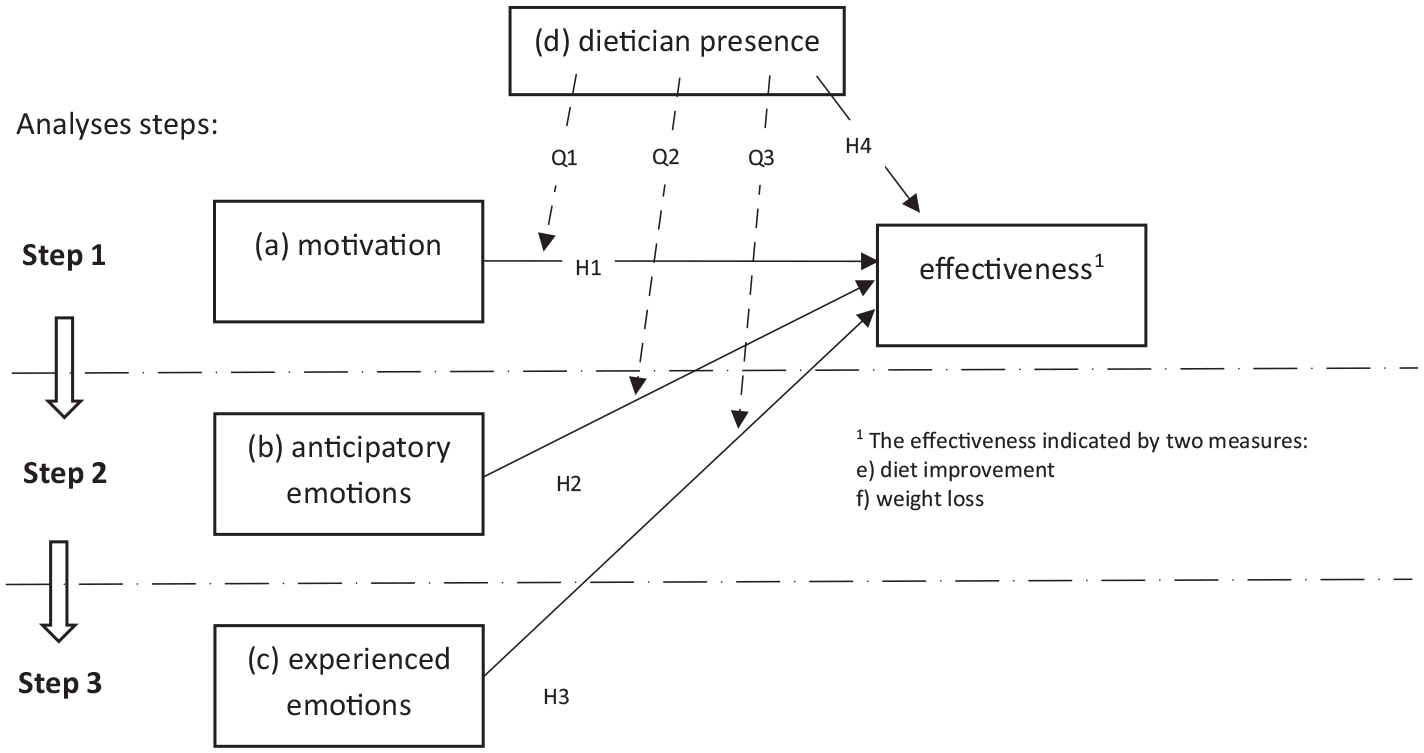
Model of hypothesized (H) and explored (Q) relations between variables.
Method
Participants
Three hundred forty-one respondents participated in this study (199 women, or 58.4%, and 142 men, or 41.6%), aged 18–70 (M = 36.45, SD = 11.85), with their BMI ranging from 16 to 43 (M = 24.68, SD = 4.26). All participants reported being in the process of DPC for longer than 1 month. Dieticians consulted 117 respondents (34.3%) who were undergoing the DPC process. Assuming a power of 0.80, the sample of 350 subjects included 40% of respondents being supported by a dietician, which allows for the detection of interaction effects when ∆ slope equals to 0.076 or more, under conditions of acquiring a minimal standard deviation of 2 in analyzed variables if standard deviation of residual is equal to 0.5.
Due to the aim to interview specific groups of subjects, we invited a research agency to recruit participants and to collect data online. Participants expressed their opinions voluntarily. This study was conducted in Poland (October 2018), in accordance with the Declaration of Helsinki. The Research Ethics Committee of the Faculty of Psychology, University of Warsaw, approved the protocol. All subjects gave written informed consent.
Measures
Treatment Self-Regulation Questionnaire (Diet) (TSRQ) (Levesque et al., 2007) measures the strength of amotivation, autonomous motivation, and two other regulatory styles that are considered as reflective of extrinsic motivation. The amotivation scale measures a lack of motivation and control over given situations (Poraj-Weder et al., 2021; Vansteenkiste and Deci, 2003). Autonomous motivation measured within the TSRQ comprises of integrated and identified regulation, and thus the scale measures the extent to which the activity is motivated by the self, and to what extent the individual accepts the values and standards that govern the given behavior. The introjected regulation scale refers to behaviors motivated by the need to avoid or reduce anxiety or guilt, or the need to maintain a feeling of worth. The external regulation scale measures the extent to which a given behavior is motivated by the need to obtain external benefits, or to obey requirements from the environment (Poraj-Weder et al., 2021). Introjected and external regulations are two forms of motivation considered to be resulting from pressure, which is internal in the former case (ego is involved) and external in the latter case (pressure from the environment).
Cronbach’s alpha coefficients in the current study equals: for amotivation 0.81; for autonomous motivation 0.84; for introjected regulation 0.63; and for external regulation 0.80.
Scale of Anticipatory Emotions was created for the purposes of the study with reference to Bagozzi and Pieters (1998). Two sub-scales refer to positive and negative emotions, of three items each: I am excited about having a new diet; With my changed eating habits, I feel calm about my health; I feel satisfied with having finally started a healthful diet.
And: I am tense about having to change my diet; I feel tense when thinking about the necessity of changing my eating habit; I am distressed about the need to introduce restrictions to my diet.
The pilot test of both sub-scales (N = 245) showed good values of internal consistency: Cronbach alpha at 0.79 and 0.91 to the positive and negative scales respectively. In the current study they equal to 0.80 and 0.91.
Scale of Positive and Negative Experiences (Diener et al., 2010). Participants declared whether, while changing their diet for 4 weeks preceding the data collection, they experienced positive (e.g. glad) and negative emotions (e.g. sad). Cronbach’s alpha coefficients in the current study equal to 0.90 and 0.94, respectively.
Participants expressed their answers on a 6-point scale, from 0—The statement is not true of me at all, to 5—The statement is very true of me. The sum of points served as indicators of the measured variables.
Effectiveness of dietary pattern change
Scientists and practitioners apply several indicators of behavior change effectiveness. They include, for example, changes in weight, BMI (Millstein, 2014), consumed food, and ability to manage emotional distress (Johnson et al., 2008). The indicators refer to a short- or long-term perspective, and may be based on objective data (e.g. metabolic parameters) or subjective evaluation (e.g. declared food consumption). Due to the exploratory nature of the study, and to the method of online data collection, we limited the measures of the effectiveness to self-reported evaluation of diet improvement (DI: Some changes in my diet toward more healthful food consumption occurred over the past 4 weeks) and weight loss (WL: How much weight (in kilograms) have you lost over the last 4 weeks?) (open ended question).
Analysis of the data
In the analyses we applied a hierarchical regression analysis (entry method) with interaction terms (Darlington and Hayes, 2017) and bootstrapping (the distribution of variables differed from the normal distribution; see Hayes, 2012). Variables were centered prior to analysis. We separately built regression models for the two indicators of effectiveness: DI and WL.
The reasons for selecting this approach were threefold. Firstly, we intended to test the main effects of motivation, anticipated emotions, and experienced emotions on the effectiveness, following the logic that motivation triggers behavior, and anticipated emotions appears before the behavior takes place, and thereafter experienced emotions occur during the behavior performance.
In the first step of the analyses we introduced motivation types and dietician presence into regression analysis (H1, H4). In step 2 we added positive and negative anticipatory emotions (H2), and in the step 3—positive and negative emotions experienced during the process of change (H3). At each step we tested interaction between motivational and emotional variables and dietician presence (Q1–Q3). We tested dietician presence (or lack thereof) as a moderator of relations between motivational and emotional variables and the two indicators of effectiveness.
Results
In this chapter we present a description of results for each step, and of the final models (Table 1). Supplemental Material contains detailed results for each step.
Predictors of the effectiveness measured by diet improvement and weight loss in hierarchical regression analysis—final models.
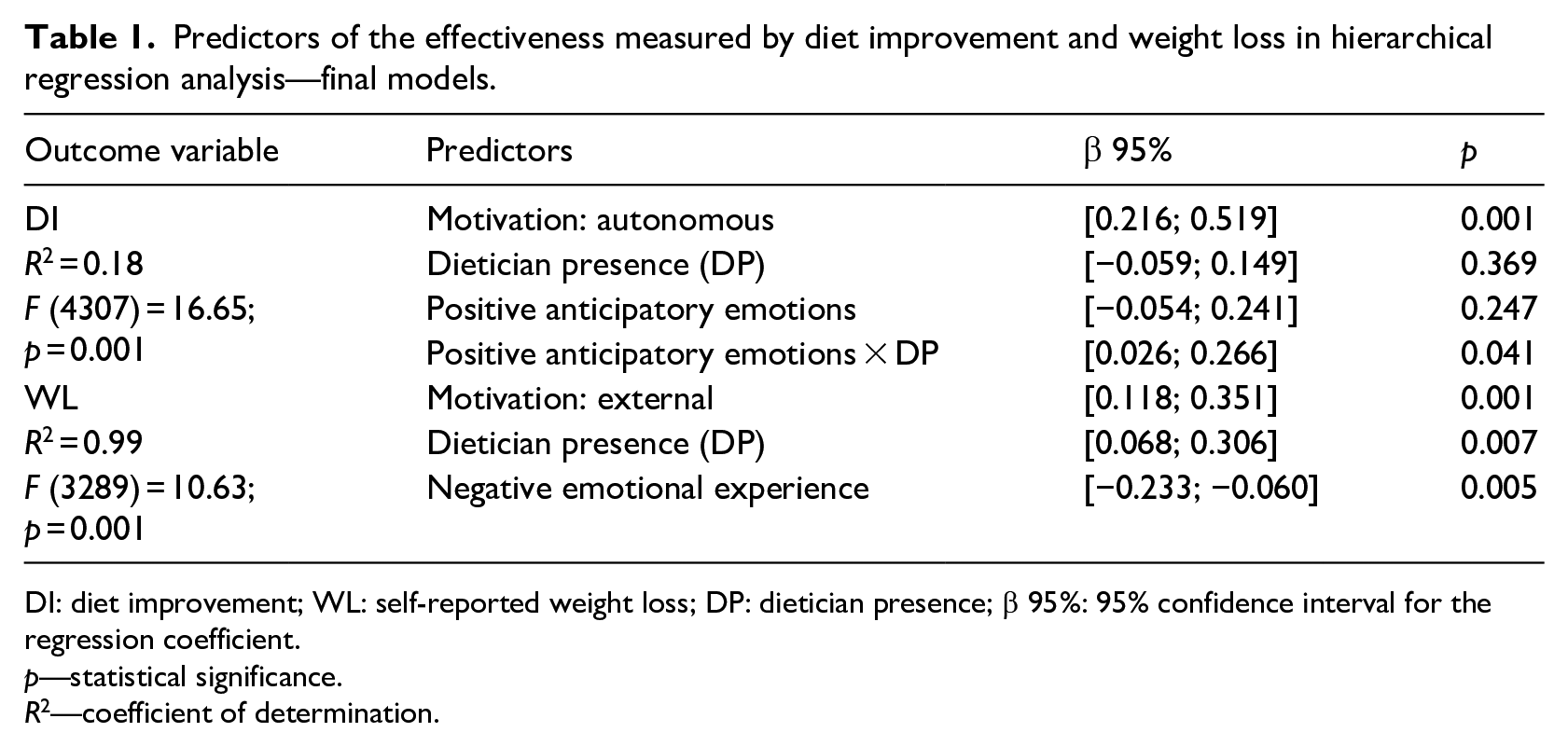
DI: diet improvement; WL: self-reported weight loss; DP: dietician presence; β 95%: 95% confidence interval for the regression coefficient.
p—statistical significance.
R2—coefficient of determination.
The analysis devoted to predictors of subjectively evaluated diet improvement (DI) conducted in the first step showed that if types of motivation and dietician presence (or lack thereof) are the only variables considered, autonomous motivation (β 95% = 0.229 ÷ 0.498; p = 0.001) would be a significant predictor of DI. We controlled for this variable in step 2. When analyses took into account anticipatory emotions, autonomous motivations was again a statistically significant predictor of effectiveness (β 95% = 0.150 ÷ 0.462; p = 0.001), alongside the factors of the interaction effect of positive anticipatory emotions and dietician presence (β 95% = 0.017 ÷ 0.252; p = 0.046). The same effect remained after introducing positive and negative emotional experiences into regressions in step 3. Autonomous motivation (β 95% = 0.191 ÷ 0.505; p = 0.001) and interaction between positive anticipatory emotions and dietician presence (β 95% = 0.022 ÷ 0.394; p = 0.034) were statistically significant predictors of DI.
In the final model the same two variables predicted the effectiveness indicated by DI: autonomous motivation, and interaction between positive anticipatory emotions with dietician presence. The model fitted the data well and explained 17.8% of the variance in diet improvement.
Analysis of simple effects showed that the final model was significant both in the group of participants with dieticians present in the process (β 95% = 0.177 ÷ 0.570; p = 0.001), and without dieticians presence (β 95% = 0.054 ÷ 0.345; p = 0.007). Both models fit the data well: for the former group F(1, 115) = 14.422, p = 0.001; and for the latter one F(1, 220) = 9.966, p = 0.002. In both groups positive anticipatory emotions were linked to a greater effectiveness in the adoption of DI. However, in the group with dietician present in the process, the relation proved stronger, and the model explained higher percentages of the variance of the effectiveness (∆R2first group = 11.1%, ∆R2second group = 4.3%).
The results of the analyses devoted to self-reported loss of weight (WL) in the first step showed that DP (β 95% = 0.076 ÷ 0.310; p = 0.003) and external regulation (β 95% = 0.067 ÷ 0.374; p = 0.004) were statistically significant predictors of WL. We controlled for these variables in step 2, in which the calculations revealed three significant predictors of WL: external regulation (β 95% = 0.113 ÷ 0.367; p = 0.003), DP (β 95% = 0.042 ÷ 0.283; p = 0.010), and positive anticipatory emotions (β 95% = 0.011 ÷ 0.242; p = 0.036). In step 3 we found statistically significant main effects for external regulation (β 95% = 0.094 ÷ 0.326; p = 0.001), DP (β 95% = 0.073 ÷ 0.328; p = 0.006), positive anticipatory emotions (β 95% = 0.016 ÷ 0.290; p = 0.050), and negative emotional experience (β 95% = −0.275 ÷ −0.047; p = 0.010).
In the final model the following variables proved to be significant predictors of the effectiveness indicated by WL: external regulation (β 95% = 0.118 ÷ 0.351; p = 0.001), DP (β 95% = 0.068 ÷ 0.306; p = 0.007), and negative emotional experiences during the process of change (β 95% = −0.233 ÷ −0.060; p = 0.005). For the first two the relationship is positive, and for the latter—negative. The model fit the data well and explained 9.9% of the variance in weight loss.
Discussion
This study evaluated the relevance of motivational and emotional factors, as well as dietician presence, for the effectiveness of the dietary pattern-change process. The results show the importance of dietician presence in the process (H4 is confirmed) and allow for the general conclusion that the role of the remaining tested variables differs, depending on the effectiveness measures.
Consistent with conclusions reached by other researchers (Pelletier et al., 2004), we show that autonomous motivation is associated with greater effectiveness, which confirms H1. This observation, however, is only relevant to the effectiveness measure that refers to declared diet improvement, as weight loss turned out to be related to external regulation only (and not to autonomous motivation). Both results show that motivation is important for the effectiveness of dietary pattern change, and they also confirm predictions based on SDT (Ryan and Deci, 2000, 2017). Depending on a goal that triggers the change in dietary patterns, which may be the goal to improve diet or to lose weight, the behavior may be more or less self-regulated. The relation between autonomous motivation and effectiveness measured by diet improvement indicates that change in diet is related to higher levels of self-regulation, and, likely, to acceptance of the values and standards that govern the given behavior. On the other hand, weight loss as a goal has been shown to be related to external rewards and to lower levels of self-regulation (Teixeira et al., 2012), which could also be observed in the current study.
In the study we observed associations between anticipated positive emotions and the effectiveness indicated by diet improvement (H2 is partially confirmed), and the moderating role of dietician presence between positive anticipatory emotions and the effectiveness indicated by diet improvement. According to SDT (Ryan and Deci, 2000, 2017) when social context is emotion supportive, higher levels of self-regulation arise, which may lead to better outcomes of behavior. Bagozzi and Pieters (1998) and Baumgartner et al. (2008) stress the motivational power of anticipatory emotions that influence the energy invested in pursuing a goal. The results therefore suggest that a dietician’s presence in the process may facilitate positive anticipatory emotions, which can influence better results in achieving the goal to improve diet.
Our analysis show that emotional experiences is associated with the effectiveness indicated by weight loss (H3 is partially confirmed). In past decades, many scientists emphasized the importance of affectual processes for the change of health-related behavior (Williams and Evans, 2014), as well as of the role of food consumption in the regulation of negative emotions (Nicholls et al., 2016), which recently has pointed toward the impact of diet and nutrition on individuals’ mental health (Holt et al., 2014; Kalantari et al., 2016; Owen and Corfe, 2017). Numerous studies have shown that negative emotions provoke non-compliance with dietary recommendations (Van Strien et al., 2007), which in turn leads to difficulties in weight regulation (Van Strien et al., 2013). Negative affection poses an important element of the subtle psychological system that controls weight gain (Marks, 2015b). Hence, the results suggests that the lack of negative emotions during the DPC process can make the goal to lose weight easier.
The study did not show a moderating role of dietician presence on the relationship between motivation and dietary pattern change effectiveness. This result may imply that dieticians perform primarily to control functions and do not facilitate changes in the level of regulation. And yet, it is precisely the change of regulation from external to internal that determines the effectiveness and persistence of change (Deci and Ryan, 2000; Poraj-Weder et al., 2021; Teixeira et al., 2012). More to that, failure in showing moderating effects between emotional experiences in the process of change and the effectiveness of the process may suggest the conclusion that dieticians do not provide sufficient emotional support to their patients, which is postulated as an important part of psychological needs satisfaction (Ryan et al., 2005).
Novelty of the study, the limitations of the present study, and directions for further research
An abundance of research indicates that emotions are related to food behavior, however they are studied in the context of emotional eating. Theories of behavior change (which focus on cognitive and emotional factors) and research do not analyze the emotions accompanying motivation and coping with the process within one theoretical framework. Moreover, the role of a health professional in the entire process of dietary pattern-change has been understudied (even within the framework of the nutritional processes approach). The study provides therefore new results, which can serve as a basis for further hypothesizing and for further studies.
The study has some limitations. Namely, targeted recruitment was used—thus the possibility of generalizing results is limited. Furthermore, the study’s + and the dynamics of the change. Empirical verification of the hypothesized causal relationship would require a longitudinal and/or experimental study, as well as indicators of the dietary pattern-change effectiveness that would take into account objective and subjective measures. In order to better describe the role of dietician presence data collected in patient-dietician dyads would contribute. Finally, stronger measures of effectiveness should be applied, which would take into account both subjective evaluation and objective indicators of the effectiveness.
Research Data
sj-pdf-1-hpq-10.1177_13591053211042064 – Supplemental material for Dreaming of effective diet change? Motivation, emotions, and dietician presence can all matter
Supplemental material, sj-pdf-1-hpq-10.1177_13591053211042064 for Dreaming of effective diet change? Motivation, emotions, and dietician presence can all matter by Grażyna Wąsowicz, Magdalena Poraj-Weder and Christophe Matthys in Journal of Health Psychology
Research Data
sj-docx-2-hpq-10.1177_13591053211042064 – Supplemental material for Dreaming of effective diet change? Motivation, emotions, and dietician presence can all matter
Supplemental material, sj-docx-2-hpq-10.1177_13591053211042064 for Dreaming of effective diet change? Motivation, emotions, and dietician presence can all matter by Grażyna Wąsowicz, Magdalena Poraj-Weder and Christophe Matthys in Journal of Health Psychology
Research Data
sj-docx-3-hpq-10.1177_13591053211042064 – Supplemental material for Dreaming of effective diet change? Motivation, emotions, and dietician presence can all matter
Supplemental material, sj-docx-3-hpq-10.1177_13591053211042064 for Dreaming of effective diet change? Motivation, emotions, and dietician presence can all matter by Grażyna Wąsowicz, Magdalena Poraj-Weder and Christophe Matthys in Journal of Health Psychology
Research Data
sj-docx-4-hpq-10.1177_13591053211042064 – Supplemental material for Dreaming of effective diet change? Motivation, emotions, and dietician presence can all matter
Supplemental material, sj-docx-4-hpq-10.1177_13591053211042064 for Dreaming of effective diet change? Motivation, emotions, and dietician presence can all matter by Grażyna Wąsowicz, Magdalena Poraj-Weder and Christophe Matthys in Journal of Health Psychology
Supplemental Material
sj-spv-5-hpq-10.1177_13591053211042064 – Supplemental material for Dreaming of effective diet change? Motivation, emotions, and dietician presence can all matter
Supplemental material, sj-spv-5-hpq-10.1177_13591053211042064 for Dreaming of effective diet change? Motivation, emotions, and dietician presence can all matter by Grażyna Wąsowicz, Magdalena Poraj-Weder and Christophe Matthys in Journal of Health Psychology
Supplemental Material
sj-sps-6-hpq-10.1177_13591053211042064 – Supplemental material for Dreaming of effective diet change? Motivation, emotions, and dietician presence can all matter
Supplemental material, sj-sps-6-hpq-10.1177_13591053211042064 for Dreaming of effective diet change? Motivation, emotions, and dietician presence can all matter by Grażyna Wąsowicz, Magdalena Poraj-Weder and Christophe Matthys in Journal of Health Psychology
Research Data
sj-sav-7-hpq-10.1177_13591053211042064 – Supplemental material for Dreaming of effective diet change? Motivation, emotions, and dietician presence can all matter
Supplemental material, sj-sav-7-hpq-10.1177_13591053211042064 for Dreaming of effective diet change? Motivation, emotions, and dietician presence can all matter by Grażyna Wąsowicz, Magdalena Poraj-Weder and Christophe Matthys in Journal of Health Psychology
Footnotes
Author contributions
GW, MPW, CM contributed to the conception and design of the study. MPW conducted statistical analyses. GW, MPW wrote the first draft of the manuscript. All authors revised and approved the submitted version of the manuscript.
Data sharing statement
The database, output, (hierarchical regression with bootstrapping), descriptive statistics, and detailed results of hierarchical regression analysis are available in the Figshare repository and as Supplemental Material via the SAGE Journals platform.
Declaration of conflicting interests
The author(s) declared no potential conflicts of interest with respect to the research, authorship, and/or publication of this article.
Funding
The author(s) disclosed receipt of the following financial support for the research, authorship, and/or publication of this article: This research was funded by the European Institute of Innovation and Technology [No EIT/EITFood/SGA2018] which received support from the Horizon 2020 programme; the University of Warsaw its Faculty of Psychology internal funds [No BST 181423/2017]. The paper reflects only the author’s view and that the EIT is not responsible for any use that may be made of the information it contains.
