







Abstract
This study examined the typology of depressed mood trajectories and the associated factors over the first year postpartum among Taiwanese mothers. Data of 4332 mothers from a nationwide longitudinal study on child development and care were analyzed. Three classes of depressed mood trajectories were identified, two with lower initial scores and a decreasing trajectory and one with a higher initial score and an increasing trajectory. Subjective financial stress, perceived support, and marital satisfaction were significant in predicting mothers’ membership of the depressed mood trajectory classes. The results highlighted the individual susceptibility to the postpartum depressed mood among Taiwanese mothers.
Keywords
Background
Although pictures of motherhood are often portrayed with joy and fulfillment, reality denotes a rather bittersweet experience. The transition to motherhood is associated with changes in individuals’ physical health, psychological health, and social health (Saxbe et al., 2018). Moreover, the chronic strain related to motherhood evokes prolonged stress on mothers (Turner and Avison, 2003); hence, many women experience depressed mood and symptoms during the pregnancy and postpartum period (Marcus, 2009). Mothers’ depressed mood not only affects own health but also influences their children’s development. Studies have shown that mothers’ depressive symptoms changed their attachment styles and their interactions with the children (Stern et al., 2018), and mothers’ psychological well-being affects the mother-child relationship and their children’s physical and psycho-social development (Gelaye et al., 2016; Mueller et al., 2019). Thus, examining the depressed mood and symptoms among mothers is crucial not only for the psychological well-being of the women but also for the healthy development of the children.
Postpartum depressed mood trajectories among mothers
Depending on the assessing instruments and the time of the assessment, the previous studies have shown that the prevalence of postnatal depression for women ranged from 13% to 19% in the United States (O’Hara and McCabe, 2013) and from 4.0% to 48.3% among Asian countries (Arifin et al., 2018). The most recent study conducted in Taiwan found that about 18.8% of the mothers developed depressive symptoms 1 month after the delivery (Shao et al., 2021). Besides the wide range of prevalence among countries in the literature, longitudinal studies on maternal depressed mood also indicated the individual differences in the progression of depressed mood and symptoms from pregnancy to postpartum period. A population-based study following women from 1 to 12 months postpartum in Norway identified two types of trajectories of postpartum depressive symptoms, one with a low symptom level declining over time and the other with persistent scores slightly below the diagnostic cut-off criteria for minor depressive symptoms across time (Drozd et al., 2018). Kiviruusu et al. (2020) found three relatively stable depressive symptom trajectories, representing low, middle, and high trajectory classes, from 2 months before the delivery to 2 years postpartum among Finnish women. Another study in Brazil identified five groups of trajectories, representing low, moderate-low, increasing, decreasing but persistent, and chronic high progression of maternal depressive symptoms from the delivery up to 24 months after birth (Jacques et al., 2020).
Examining maternal depressed mood and symptoms over time provides information on the patterns and changes of the conditions and the individual variations of the trajectories among mothers. This information is valuable for the researchers and practitioners to identify the subgroup of individuals who are more susceptible and vulnerable to feeling depressed over time. Nevertheless, longitudinal investigation on maternal depressed mood and symptoms is still limited, and studies from non-Western countries are even scarce.
Factors associated with postpartum depressed mood trajectories
Several factors have been linked to depressed mood and symptoms among mothers. Lower educational attainment is associated with maternal depressive symptoms (Mirowsky and Ross, 2002). Financial hardship and subjective financial dissatisfaction are both linked to the depressed mood among mothers (Mirowsky and Ross, 2002; Sahrakorpi et al., 2017). Conger et al. (2002, 2010) have continuously emphasized the impact of economic hardship on stress in the families and on the caregivers’ psychological well-being. A systematic review showed that low socioeconomic status was one of the significant risk factors of postpartum depression in low-income and middle-income countries (Gelaye et al., 2016). In developed countries, stress related to economic hardship was also linked to maternal depression among low-income communities (Manuel et al., 2012).
Besides socioeconomic status, maternal depressed mood and symptoms are also associated with relational factors. A longitudinal study conducted on couples revealed that couples with higher negative interaction scores, that is, more irritability, arguments, criticisms, and conflicts between each other, showed a significant increase in depressive symptoms from 3 to 30 months postpartum (Figueiredo et al., 2018). Moreover, lack of support from the partner was found to be associated with a lack of perceived control over an individual’s environment (Ryon and Gleason, 2014), and low self-control over the life events significantly predicted mothers’ depressive symptoms over time after childbirth (Keeton et al., 2008). Mothers in different countries may also experience the burden and stress caused by the cultural norms and expectations toward parenthood. For instance, a sense of family coherence is important to Chinese parents’ well-being during the transition to parenthood because the cultural philosophy in the community emphasizes the meaningfulness of parenthood from a collective perspective (Ngai and Chan, 2020). Overall, financial stress, perceived support, and marital satisfaction may concurrently act as stressors and support factors for mothers (Umberson et al., 2010).
Based on the literature review, the first aim of this study was to understand the typology of maternal depressed mood trajectories over the first year postpartum among Taiwanese mothers. The second aim of the study was to examine the factors associated with mothers’ depressed mood trajectories. Thus, we hypothesized that multiple classes of maternal depressed mood trajectories would be identified using Latent Class Growth Analysis. Furthermore, we hypothesized that certain factors, including perceived support, financial stress, and marital satisfaction, would be associated with mothers’ membership of the depressed mood trajectory classes.
Methods
Participants
In this study, we utilized data obtained from the nationwide longitudinal dataset, Kids in Taiwan: National Longitudinal Study of Child Development & Care (KIT) (Chang et al., 2017). This dataset is a prospective study aiming at collecting information on Taiwanese children’s family and childcare environments and at investigating the long-term effects of the environment on children’s development. The national census registry was used as the sampling frame. Two nationally representative groups of participants were sampled based on the stratified two-stage probability-proportional-to-size sampling method; county and person were the primary and secondary sampling units. Eligible parents and caregivers who gave informed consent are interviewed and followed by the research team. The research framework and the data collection of the KIT study were approved by the research ethics committee of National Taiwan University (No. 201408ES007) and by the research ethics committee at National Taiwan Normal University (No. 201707HS003). This study analyzed data from Sample One, which consisted of children whose date of birth was between April 1st, 2016 and June 30th, 2017; the first interview was conducted when the children were 3 months old. At each interview, mothers answered a questionnaire regarding their child’s development, health, and family environment. To examine the longitudinal change of postpartum depressed mood of the mothers, the data for the present analysis consisted of 4332 married mothers, who completed the parent-reported questionnaires at 3-, 6-, and 12-month interviews.
Measures
Mothers’ depressed mood was assessed at the 3-, 6-, and 12-month interviews. The original dataset used a single-item question to measure subjective depressed mood. The questionnaire asked, “Have you felt depressed in the past three months?,” and the participants answered the questions with a four-point scale, (1) never, (2) rarely, (3) sometimes, and (4) often. A self-reported single-item question is useful when examining subjective psychological well-being (Fellmeth et al., 2019; Skoogh et al., 2010). Previous studies showed that assessing depressed mood using a single-item question yields acceptable sensitivity and specificity, and the single-item question is comparable to multiple-item measures (McKenzie and Marks, 1999; Williams et al., 1999).
Mothers’ demographic covariates and subjective evaluations of perceived support, financial stress, and marital satisfaction were collected at the 3-month interview and were included as the predictors of the depressed mood trajectories of the mothers. Demographic covariates included questions on educational level (1: elementary school–6: graduate school) and monthly household income (1: no income–26: equal and more than 33,334 United State Dollars (USD)), and whether the respondents were first-time parents (yes/no). Perceived support was measured by asking “Is there enough help at home?” Financial stress was measured by asking “Do you feel that your current financial situation is sufficient to pay for living expenses?” Marital satisfaction was measured by asking “Are you satisfied with your marriage?” and “Do you work as a team with your spouse to raise the child?” The participants answered the four questions with a four-point scale, ranging from (1) strongly agree to (4) strongly disagree.
Statistical analysis
Descriptive analysis was conducted on the covariates at the baseline and the depressed mood scores at three waves. Further, the classifications of mothers’ depressed mood trajectories in the first year postpartum were estimated using Latent Class Growth Analysis (LCGA). For each class, two parameters, that is, intercept and slope, were estimated. The intercept and slope reflected the initial level and the rate of change of each class.
To identify membership classification, an unconditional model was estimated first. Once the appropriate number of classes was identified, a conditional model was fitted by adding covariates into the model estimation. An individual’s trajectory in the conditional model is estimated based on the person’s probability of class membership, on the class-specific means and covariance structures, and the covariates (Feldman et al., 2009). Although the conditional model with covariates may not result in identical membership classifications (Huang et al., 2010), it is recommended to include covariates into the membership identification to avoid misclassification (Muthén, 2004). Model with smallest Bayesian information criteria (BIC), smallest adjusted BIC, largest entropy, significant Lo-Mendell-Rubin Adjusted Likelihood Ratio Test (LMR-LRT) and Bootstrapped Likelihood Ratio Test (BLRT), and adequate sample size in each class were considered the best-fitted model (Feldman et al., 2009; Jung and Wickrama, 2008). All analyses were conducted using Mplus 8.4 (Muthén and Muthén, 1998–2012).
Results
The descriptive characteristics of the demographic covariates (collected at the three-month interview) were shown in Table 1. About 49.1% of the sample were first-time mothers. The mean score of perceiving enough help at home, financially sufficient, satisfied with the marriage, and spouse as a teammate on parenting was 2.06, 1.91, 1.60, and 1.76, respectively.
Descriptive characteristics of the covariates at the 3-months interview.
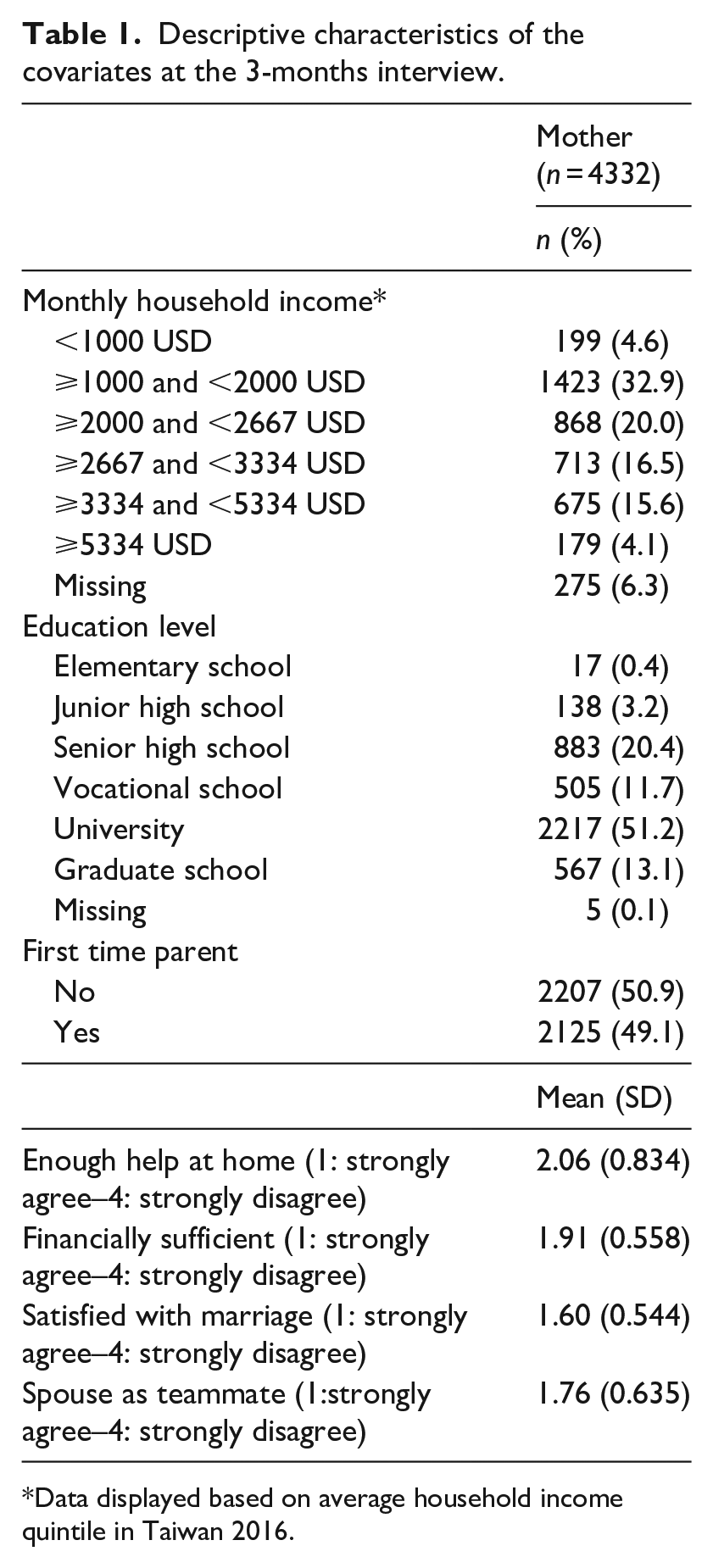
Data displayed based on average household income quintile in Taiwan 2016.
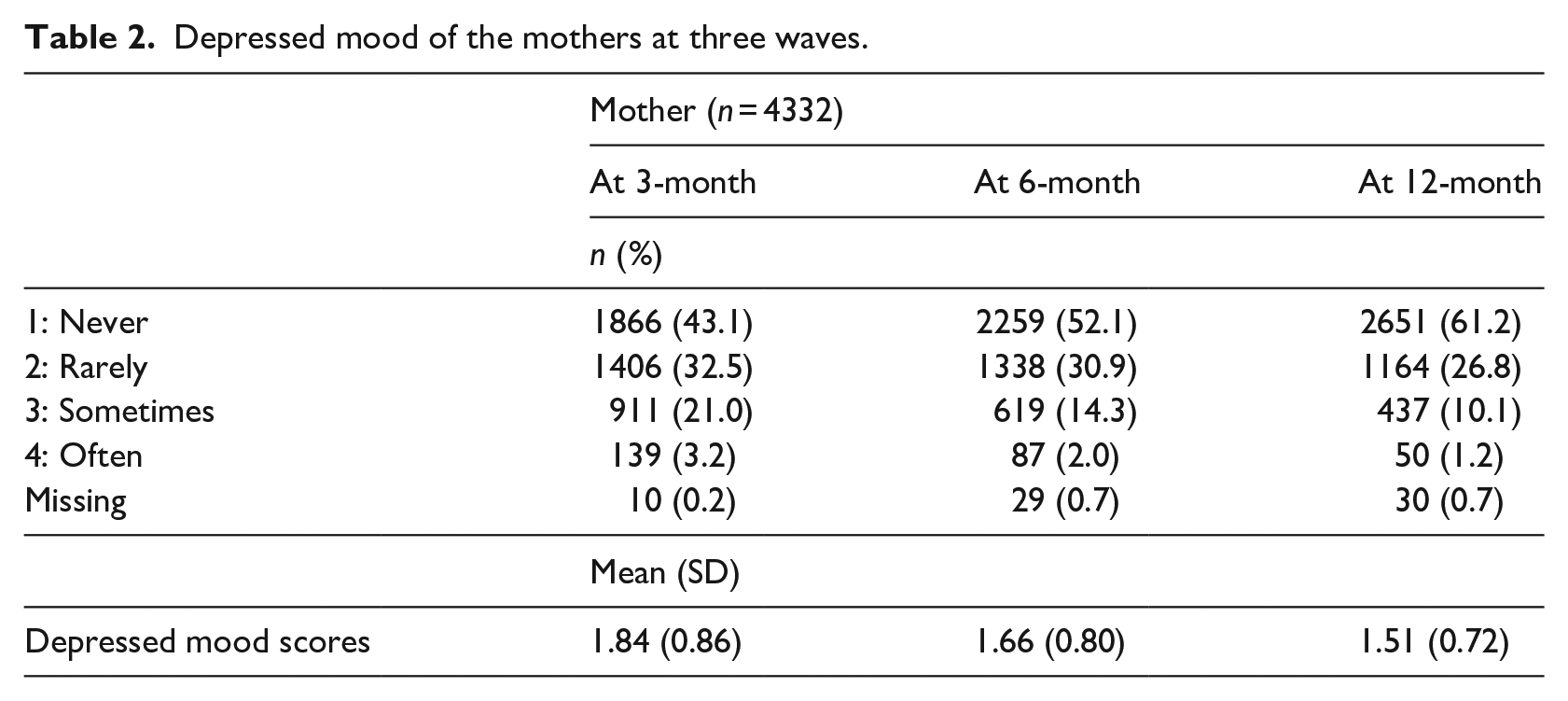
The original distribution and the mean scores of the mothers’ depressed mood at the three waves were shown in Table 2. About 24.2%,16.3%, and 11.3% of the participants reported feeling depressed sometimes or often at 3-, 6-, and 12-month postpartum, respectively. Overall, the mean scores of the mothers’ depressed mood were at the highest in the first interview, and the mean scores decreased over time.
Depressed mood of the mothers at three waves.
Mothers’ depressed mood trajectories
We compared two- to four-class models by carrying out unconditional LCGAs. The fit statistics were shown in Table 3. The BIC and the adjusted BIC scores were decreasing when the number of classes increased. The entropy score was at its highest in the three-class model. The LMR-LRT and the BLRT were both significant. Additionally, the four-class model resulted in one extremely small group. Based on the fit statistics and the parsimony and interpretability of the models (Jung and Wickrama, 2008), three-class model was selected. The depressed mood and the three distinct trajectories in the first year postpartum among mothers were shown in Figure 1.
Fit statistics of latent class growth analysis for mothers’ trajectories of depressed mood.
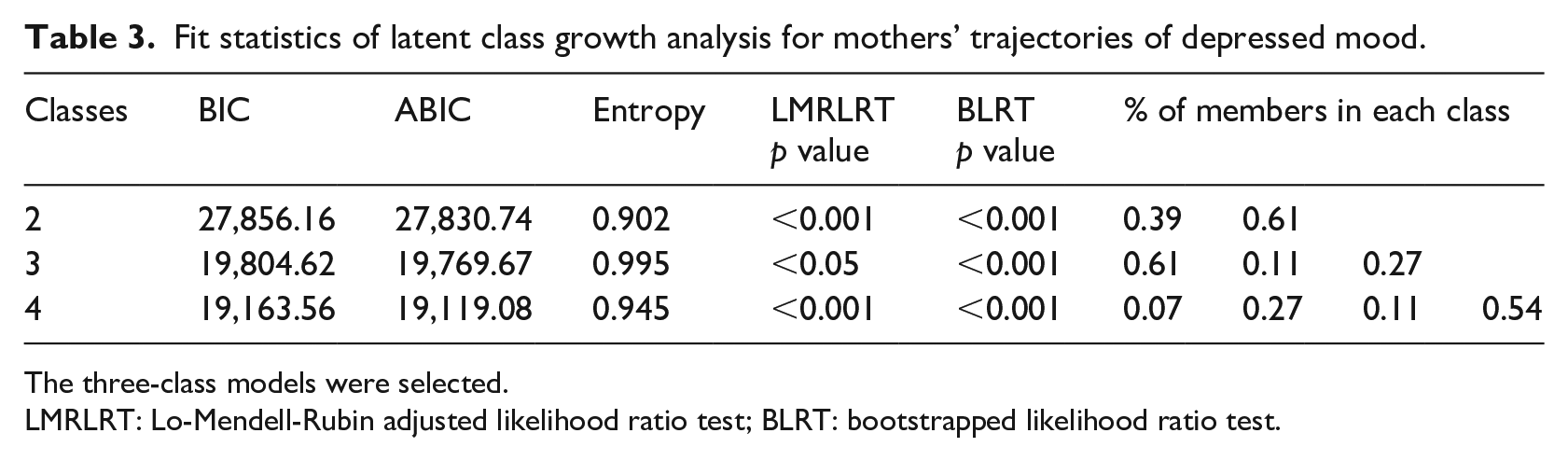
The three-class models were selected.
LMRLRT: Lo-Mendell-Rubin adjusted likelihood ratio test; BLRT: bootstrapped likelihood ratio test.
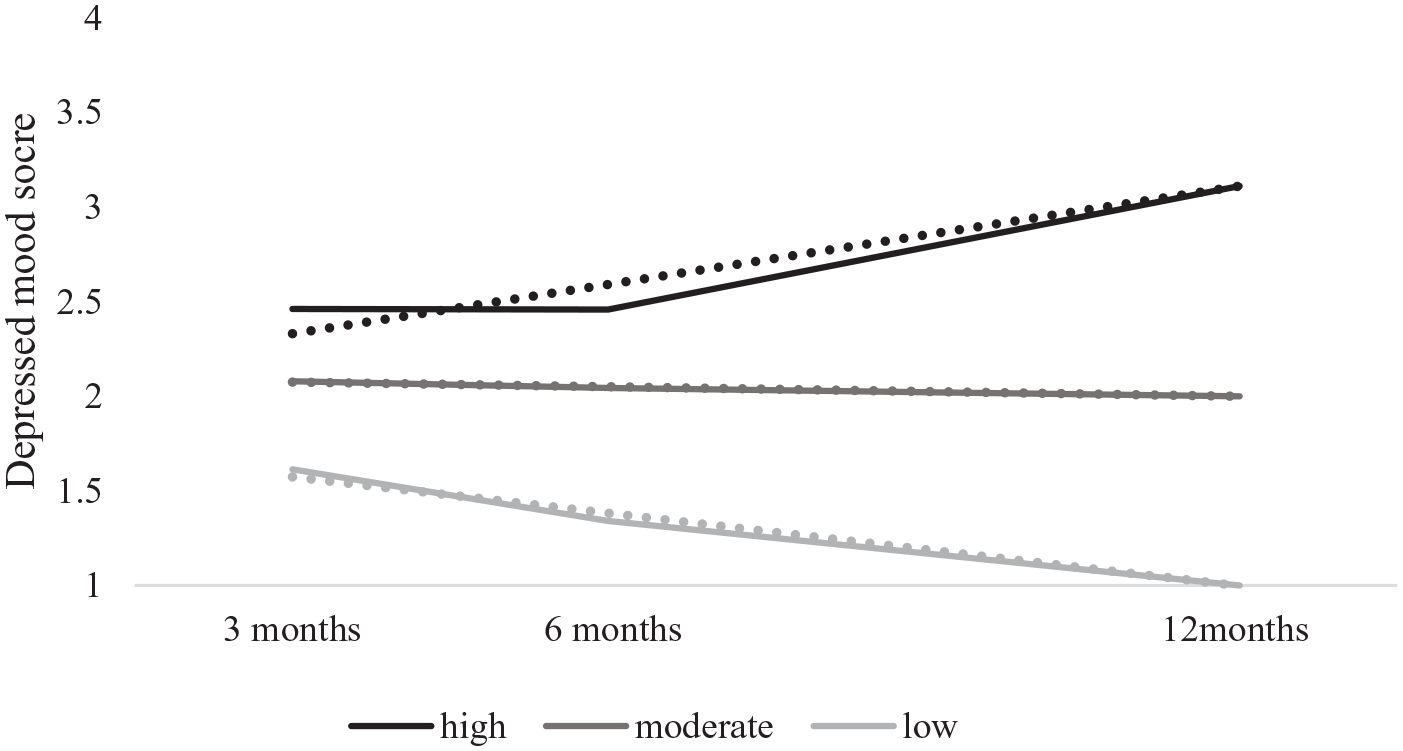
Estimated and actual mean trajectories of depressed mood among mothers. The solid lines indicate the actual mean of each class and the dotted lines indicate the estimated mean of each class based on latent class growth modeling.
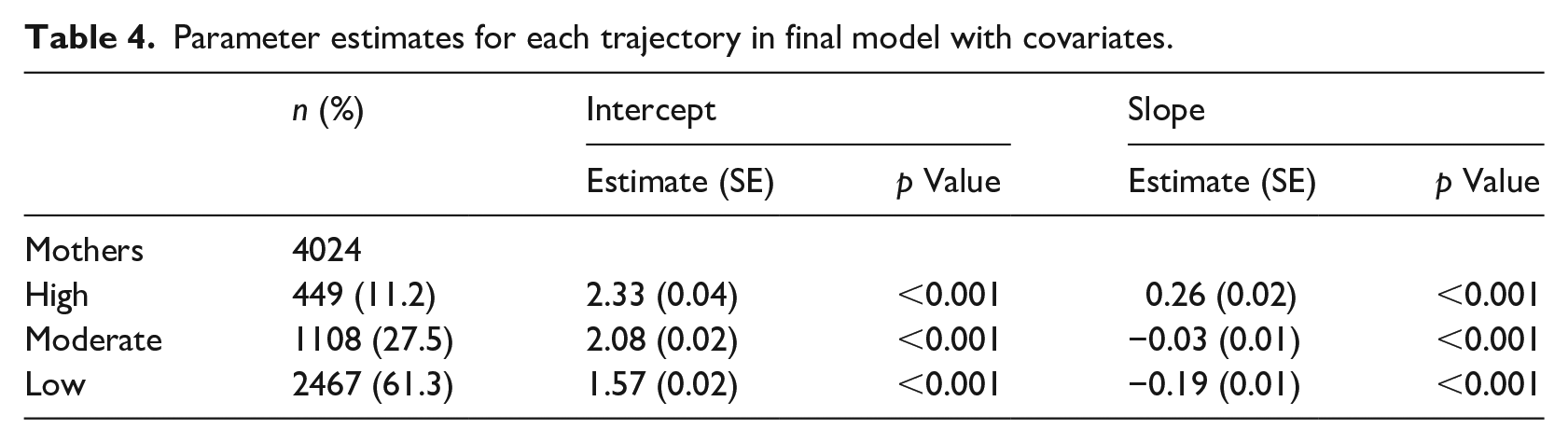
Next, a three-class conditional model with covariates was estimated. The size of each class and the parameter estimates were shown in Table 4. A total of 4024 mothers with complete information were included in the analysis of the conditional model. The first class comprised 11.2% (n = 449) of the participants, who had high initial scores and steadily increasing trajectory. The second class comprised 27.5% (n = 1108) of the participants, who had moderate initial scores and moderately decreasing trajectory; the third class comprised 61.3% (n = 2467) of the participants, who had low initial scores and steadily decreasing trajectory. The slope parameters were significant for all three classes.
Parameter estimates for each trajectory in final model with covariates.
Predictors of mothers’ depressed mood trajectories
As shown in Table 5, the higher educational level increased the likelihood of being in the moderate trajectory class compared with their likelihood of being in the low trajectory class (OR = 1.12). Regarding perceived support, financial stress, and marital satisfaction, mothers who did not feel their current financial status was sufficient to pay for their living expenses (OR = 1.27) and who did not feel they worked as a team with their spouses (OR = 1.41) were more likely to be in the high trajectory class compared with their likelihood of being in the low trajectory class. Moreover, mothers who did not feel that they received enough help at home were more likely to be in the moderate trajectory class (OR = 1.20) and the high trajectory class (OR = 1.46) compared with their likelihood of being in the low trajectory class. The mothers who were not satisfied with their marriage were more likely to be in the moderate trajectory class (OR = 1.45) and the high trajectory class (OR = 1.65) compared with their likelihood of being in the low trajectory class.
Logistic regression for predictors of trajectory class membership.
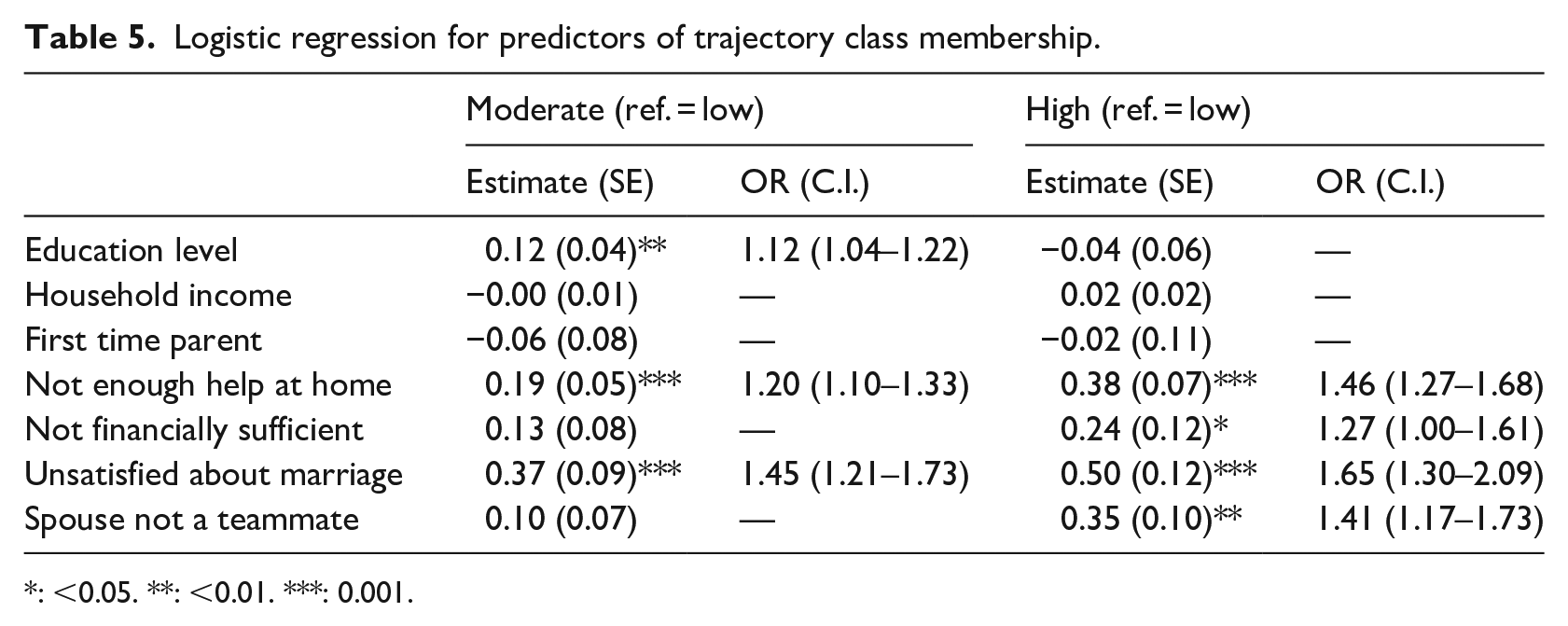
: <0.05. **: <0.01. ***: 0.001.
Discussion
The present study identified Taiwanese mothers’ depressed mood trajectories over the first year postpartum and examined possible factors associated with the depressed mood trajectories. The results from the LCGA revealed that there were individual differences in depressed mood trajectories among mothers. While most of the mothers reported a descending trajectory, those with a higher depressed mood score at 3 months postpartum reported an elevating depressed mood trajectory over time. We found three distinct classes of depressed mood trajectories for the mothers. The class with the lowest initial score and a moderately decreasing trajectory comprised the largest percentage of the participants; the finding is similar to what was found in Kiviruusu et al. (2020)’s study. The two classes with lower initial scores in our sample displayed a decrease in the depressed mood trajectories, indicating that for most mothers the depressed mood right after delivery gradually alleviated over time. In our study, 11.2% of the mothers reported having a higher initial score with an increasing trajectory. These mothers reported feeling more depressed at 3-month after the birth of their child, and the situation aggravated from 3- to 12-month postpartum. Vliegen et al. (2014) suggested that those who felt depressed earlier during the postpartum period were at higher risk to develop chronic depression. Tracking the progression of postpartum depressed mood among mothers helps us to identify the individuals who are at risk of developing chronic depression.
For mothers, depressed mood trajectories were associated with education level, financial stress, perceived support, marital satisfaction, and spouse as parenting teammate. According to the family stress model, economic hardship causes economic pressure, which may lead to parental psychological distress (Masarik and Conger, 2017). Empirical studies also showed that perceived financial distress and financial satisfaction had a more significant influence on an individual’s psychological well-being compared to the actual income and socioeconomic status (Assari, 2019; Sahrakorpi et al., 2017). Corresponding with previous research, our findings suggest that subjective evaluation of financial stress was a significant predictor of maternal depressed mood, while the actual family income was not. Nevertheless, we believe more studies are warranted to make more in-depth examinations of the interaction between actual income and subjective financial stress.
Besides financial stress, this study also found that perceived support at home and marital satisfaction were the strongest predictors of maternal depressed mood trajectories one year postpartum. Women feel constrained by the normative responsibilities regarding the need to provide childcare, and lack of support may result in women’s unhappiness (Haga et al., 2012; Lu, 2006). Although the actual support given to the mothers was not assessed in the original data, a previous study conducted by Haga et al. (2012) found that mothers’ need for support and perceived available support were significant predictors of maternal depressive symptoms, while actual support received from others and actual support seeking behaviors were not. Our result accompanying previous literature suggests that mothers’ subjective evaluation of social support may be more important than actual support received toward their psychological adjustment. However, the depressed mood might also influence individuals’ evaluation of social support from others (Maher et al., 2006) as well as their marital relationship (Rehman et al., 2008). In our study, the mothers who reported not receiving enough support and less satisfied toward their spouses at 3 months postpartum were more likely to be in the moderate and high trajectory classes. Since the perceived support, marital satisfaction, and depressed mood at the first interview were all rated by the mothers at the same time, we need to be aware of the potential problem due to the common method variance and cautious about the possibility that perceived support and marital satisfaction may be subjected to mothers’ depressed mood. Future studies may address this issue using different sources for the predictors and the outcome variables or using different types of measurement to address this issue.
Whereas our results focused on mothers’ depressed mood trajectories and associated factors, we cannot rule out the possible interaction between a couple’s depressed mood. On this topic, the current literature provides conflicting results. For instance, Matthey et al. (2000) found that the rate for couple comorbidity of depressive symptoms was low, and the cause of depressive symptoms differed by gender, especially right after the delivery. Conversely, Kiviruusu et al. (2020) found a significant correlation between a couple’s depressive symptoms. Since we were unable to examine the interaction and comorbidity between spouses, we suggest that future studies should investigate the reciprocal influence of psychological well-being between fathers and mothers. This investigation will be valuable to our knowledge of maternal depressed mood and symptoms and our views of maternal psychological well-being from a family system perspective. Men and women face different normative pressure, which would influence their psychological well-being. Being a parent is a different experience for men and women (Gross and Marcussen, 2017). Scholars continued to underscore the significance of gender in understanding parental stress and psychological well-being (Nomaguchi and Milkie, 2020). Although it is important to examine the fathers’ depressed mood trajectories, the number of fathers who completed the three interviews in this dataset is too small (n = 396); hence, it is inappropriate to conduct the analysis due to the smaller sample size and the low levels of depression among the fathers. More studies on fathers’ psychological well-being are needed in the future.
Strengths and limitations
The present study demonstrated several strengths. First, mothers’ depressed mood trajectories were analyzed with longitudinal data. The results highlighted the individual difference in the trajectories of maternal depressed mood over the first year postpartum. Moreover, we discussed how mothers’ depressed mood trajectories were associated with distinctive factors. Nevertheless, some limitations should be noted. First, all the questions were retrieved from a self-report questionnaire, therefore, the common method variance should be noted when interpreting the results. Second, the maternal depressed mood was measured by a single question; although we believe that the item was able to capture the construct of interest, this method certainly lacks precision. Third, we utilized secondary data, which were retrieved from a child-focused study; the analysis was based on the mothers who were the main caregivers of the child from the original study; therefore a generalization of our results should be treated with caution.
Conclusion
Our findings highlighted the individual difference in the change of maternal depressed mood in the first year postpartum, especially for mothers in non-Western countries. Nowadays, psychosocial resources and coping strategies are introduced to new mothers during perinatal care (Kwee and McBride, 2016). Examining women’s experiences toward motherhood helps us to understand the course of this transition in an individual’s life. Our study showed that some mothers are susceptible to depressed mood during the first year following the birth of their child, and there were heterogeneous types of trajectories of depressed mood among mothers. Perceived support, financial stress, and marital satisfaction were associated with the typology of the depressed mood trajectories among women. We believe that understanding these factors associated with mothers’ psychological well-being may help mothers to cope with the pressure that accompanies motherhood. Finally, we believe that promoting awareness toward maternal psychological well-being is important. Interventional programs that focus on improving maternal psychological well-being can benefit all family members.
Research Data
sj-csv-1-hpq-10.1177_13591053211049944 – for Depressed mood trajectories in the first year postpartum among Taiwanese mothers: Associations with perceived support, financial stress, and marital satisfaction
sj-csv-1-hpq-10.1177_13591053211049944 for Depressed mood trajectories in the first year postpartum among Taiwanese mothers: Associations with perceived support, financial stress, and marital satisfaction by Hsi-Ping Nieh, Li-Tuan Chou and Chien-Ju Chang in Journal of Health Psychology
Research Data
sj-docx-5-hpq-10.1177_13591053211049944 – for Depressed mood trajectories in the first year postpartum among Taiwanese mothers: Associations with perceived support, financial stress, and marital satisfaction
sj-docx-5-hpq-10.1177_13591053211049944 for Depressed mood trajectories in the first year postpartum among Taiwanese mothers: Associations with perceived support, financial stress, and marital satisfaction by Hsi-Ping Nieh, Li-Tuan Chou and Chien-Ju Chang in Journal of Health Psychology
Research Data
sj-pdf-3-hpq-10.1177_13591053211049944 – for Depressed mood trajectories in the first year postpartum among Taiwanese mothers: Associations with perceived support, financial stress, and marital satisfaction
sj-pdf-3-hpq-10.1177_13591053211049944 for Depressed mood trajectories in the first year postpartum among Taiwanese mothers: Associations with perceived support, financial stress, and marital satisfaction by Hsi-Ping Nieh, Li-Tuan Chou and Chien-Ju Chang in Journal of Health Psychology
Research Data
sj-pdf-4-hpq-10.1177_13591053211049944 – for Depressed mood trajectories in the first year postpartum among Taiwanese mothers: Associations with perceived support, financial stress, and marital satisfaction
sj-pdf-4-hpq-10.1177_13591053211049944 for Depressed mood trajectories in the first year postpartum among Taiwanese mothers: Associations with perceived support, financial stress, and marital satisfaction by Hsi-Ping Nieh, Li-Tuan Chou and Chien-Ju Chang in Journal of Health Psychology
Research Data
sj-sav-2-hpq-10.1177_13591053211049944 – for Depressed mood trajectories in the first year postpartum among Taiwanese mothers: Associations with perceived support, financial stress, and marital satisfaction
sj-sav-2-hpq-10.1177_13591053211049944 for Depressed mood trajectories in the first year postpartum among Taiwanese mothers: Associations with perceived support, financial stress, and marital satisfaction by Hsi-Ping Nieh, Li-Tuan Chou and Chien-Ju Chang in Journal of Health Psychology
Footnotes
Acknowledgements
This study used data that was provided by the “Kids in Taiwan: National Longitudinal Study of Child Development & Care (KIT)” (MOST103-2420-H-003-032-MY3 and MOST106-2420-H-003-014-SS3). The above projects were sponsored by the Ministry of Science and Technology, R.O.C., and conducted by the Center for Educational Research and Evaluation and the Department of Human Development and Family Studies, both from the National Taiwan Normal University. The authors appreciate the support of the institutes and individuals aforementioned.
Data sharing statement
The complete dataset used for all analyses, along with the syntax and output for the analyses are collected. These files are all available in the Figshare repository and as Supplemental Material via the SAGE Journals platform.This study is not registered. Data of Kids in Taiwan: National Longitudinal Study of Child Development & Care (KIT) are available upon request at Survey Research Data Archive, Center for Survey Research, Academia Sinica,  .
.
Declaration of conflicting interests
The author(s) declared no potential conflicts of interest with respect to the research, authorship, and/or publication of this article.
Funding
The author(s) disclosed receipt of the following financial support for the research, authorship, and/or publication of this article: This work was supported by the Ministry of Science and Technology (Taiwan, ROC) (grant numbers MOST103-2420-H-003-032-MY3, MOST106-2420-H-003-014-SS3).
References
Supplementary Material
Please find the following supplemental material available below.
For Open Access articles published under a Creative Commons License, all supplemental material carries the same license as the article it is associated with.
For non-Open Access articles published, all supplemental material carries a non-exclusive license, and permission requests for re-use of supplemental material or any part of supplemental material shall be sent directly to the copyright owner as specified in the copyright notice associated with the article.
