







Abstract
This study aims to examine the relationship between active coping and hope during the COVID-19 pandemic and investigate the underlying mechanism based on meaning making theory. We conducted a two-wave survey and recruited 521 Chinese adults (aged 18–65). Results show that all three active coping strategies (personal hygiene practice, support seeking, and positive reappraisal) at T1 was positively associated with T2 hope. Importantly, T2 meaning in life serves as a mediator between T1 active coping and T2 hope. Our findings suggest that active coping could be an effective approach to maintain mental health by making meaning and promoting hope.
Introduction
The emergence of coronavirus disease 2019 (COVID-19) has had a huge impact on people’s health, work, and study, because of its rapid transmission speed and high mortality rate (Liu et al., 2020). Experience of the overall pandemic and isolation can result in detrimental consequences, such as depression, anxiety, and loss of faith (Walsh, 2020; Wang et al., 2020). Thus, restoring hope during the pandemic has attracted increasing attention (Ippolito et al., 2020) because of its protective function for mental health (Ciarrochi et al., 2007; Satici, 2016). Hope stems from previous successful experience, achieving meaningful goals, and active coping (Einav et al., 2012; Snyder, 2002). Dijkstra and Homan (2016) found that active coping motivates people to adopt direct measures to deal with stressors and is positively associated with well-being. During the COVID-19 pandemic, active coping might help individuals become aware of their role in the prevention and control of the disease, which may be beneficial to living hopefully. Therefore, the current study aimed to explore the relationship between active coping and hope during the COVID-19 pandemic and investigate its underlying mechanisms.
Active coping for the prevention and control of COVID-19
Active coping was defined as taking direct measures to reduce the impacts of stressors (Carver et al., 1989). Kar et al. (2021) found that during the COVID-19 pandemic, individuals who had no idea of how to cope with the pandemic reported high levels of depression and anxiety. In contrast, the use of active coping proved to be a protective factor for mental health (Yan et al., 2021). Specifically, the current study focused on three forms of active coping frequently used in response to COVID-19, including personal hygiene practice, support seeking, and positive reappraisal.
To help people to cope with the pandemic, the World Health Organization (WHO) has provided advice on COVID-19 prevention and control, such as promoting respiratory and hand hygiene, and proper wearing of face masks. During the outbreaks of severe acute respiratory syndrome (SARS), similar coping strategies were used to address health threats (Cheng and Cheung, 2005; Lee-Baggley et al., 2004). Following this, personal hygiene practice has been widely adopted for the prevention and control of COVID-19, with particular importance given to personal hygiene by wearing masks and washing hands frequently (Cheng and Cheung, 2005).
In addition, support seeking has also been frequently used and was found to be effective in coping with COVID-19 (Samantaray et al., 2020). For instance, seeking informational support for the prevention of COVID-19 from healthcare professionals (Wang et al., 2020), and seeking emotional support from family members and friends (Zysberg and Zisberg, 2020).
Positive reappraisal refers to reframing stressors in a positive light (Folkman, 1997). Thinking about the positive side of stressful events is considered an active and adaptive coping strategy (Folkman, 1997; Skinner et al., 2003). Although individuals facing an outbreak of infectious disease are more prone to negative responses such as anxiety, depression, grief, and loss, they may also perceive positive changes and react to the stress positively (Chew et al., 2020). For instance, they may be more aware of love from others (Sirrine et al., 2021), find benefits in the improvement of social and mental functioning (Mancini, 2020), and perceive personal growth, relational growth, and existential growth (Poli et al., 2021).
The adaptive functions of active coping strategies have been reported during the COVID-19 pandemic. For instance, personal hygiene practices are negatively associated with anxiety, depression, and stress (Wang et al., 2020), and social support is positively associated with mental health (Zysberg and Zisberg, 2020). As for positive reappraisal, it is found to be positively associated with well-being (Kirby et al., 2021), and negatively related to anxiety and depression among the general population (Ferreira et al., 2021). Moreover, active coping strategies are not only beneficial to emotional state and well-being, but could also contribute to positive changes concerning adversity, such as perceiving post-traumatic growth (Poli et al., 2021; Rogan et al., 2013) and obtaining meaning in life (Zuo et al., 2021).
Active coping promotes meaning in life
Steger et al. (2006) defined meaning in life (MIL) as the presence of meaning (the sense that life was meaningful) and the search for meaning (the drive and direction to find meaning in life). Research has found that the presence of meaning is associated with life satisfaction and positive affect, whereas the search for meaning is associated with negative mental outcomes (Dogra et al., 2008; Steger et al., 2006). The current study only concerned the presence of meaning, and the MIL mentioned later in this study refers to the presence of meaning. MIL typically includes three facets: coherence (comprehensible and coherent sense of life experience and the world), purpose (central, valued, and clear life aims that drive behaviors, manage goals, and provide a sense of meaning), and significance (worth and importance of one’s life) (King and Hicks, 2021; Martela and Steger, 2016).
Given that the COVID-19 pandemic is an uncontrollable, threatening, and large-scale public health emergency, it may challenge an individual’s basic beliefs about the world (Walsh, 2020), such as what kind of world they live in and what the future might be like. The occurrence of traumatic events disrupts the coherent sense of the world, but also provides an opportunity to find meaning (King and Hicks, 2021). Early active coping plays an important role in the reconstruction of shaken basic assumptions (Tedeschi and Calhoun, 2004, 2012).
According to meaning-making theory (Park, 2010), when individuals’ appraisal of the stress differs from the global beliefs and goals, they perceive distress, which acts as the driving force of meaning-making. When the discrepancy between situational meaning and global meaning is reduced, it contributes to the restoration of the sense of meaningful life. Ekwonye and Truong (2021) suggest that problem-focused coping and positive reappraisal help to change global meaning in order to minimize the discrepancy between situational meaning and global meaning. In particular, positive reappraisal could not only enhance comprehension of the world, a major facet of MIL, but also help to restore MIL in response to traumatic events (Park, 2010). In the pandemic, active coping is regarded as a factor that could blunt the negative impact of COVID-19 (Ekwonye and Truong, 2021), and promote the coherence facet of MIL through enhancing perceived control (Trzebiński et al., 2020). Furthermore, social support and connections with significant others provide direction and goals for life (Davis et al., 2000), which enhance the purpose facet of MIL. Importantly, active coping can be rewarded by positive outcomes such as a decrease in influenza-like illnesses (Chinese National Influenza Center, 2020). Such positive life changes in an adverse context have been associated with enhanced personal worth perception (Ekwonye and Truong, 2021; Wang et al., 2018), which reflects the significance facet of MIL. However, as for the context of the pandemic, more evidence is needed to support the promotional role of active coping in enhancing MIL.
Relationship between MIL and hope
Both MIL and hope play important roles in positive psychology. Snyder et al.’s (1991) hope theory defines hope as a motivational state that consists of both agency (perceived capacity to realize desired goals) and pathway (channels derived to achieve these goals). Hope is positively associated with mental health, such as positive affect (Ciarrochi et al., 2007), subjective well-being (Satici, 2016), and decreased suicidal ideation (Tucker et al., 2013).
A growing number of studies have revealed a close relationship between hope and MIL (Dogra et al., 2011; Mascaro and Rosen, 2005; Yalçın and Malkoç, 2015). Furthermore, individuals who perceive high levels of MIL are more likely to set clearer goals and possess a stronger motivation in achieving these goals (Karaman et al., 2020; Vela et al., 2014). Specifically, MIL is positively associated with both state and dispositional hope (Dogra et al., 2011; Yalçın and Malkoç, 2015).
By definition, both MIL and hope are goal-directed (McKnight and Kashdan, 2009; Snyder et al., 1991). The purpose facet of MIL reflects the value of life brought by pursuing goals, which gives life direction and motivation (Martela and Steger, 2016). When individuals possess an integral meaning system, they gain enough motivation and perceive direction in life to live hopefully (Mascaro and Rosen, 2005). However, individuals with low levels of MIL are more likely to lose purpose in and control of their lives, and thus feel hopeless (Marco et al., 2016). The two-process model of MIL posits that the perception of MIL involves the selection of meaningful goals and the pursuit of those goals (Feldman, 2013). The former promotes the cognitive facet of hope, whereas the latter promotes the motivational facet of hope.
In addition, the positive role of MIL on hope can also be inferred from practical evidence. Identifying life goals, the major facet of MIL, has been regarded as a potential strategy to enhance hope (Weis and Speridakos, 2011). In line with this, meaning-centered psychotherapy has also proven to effectively promote hope (Breitbart and Masterson, 2016; Vos and Vitali, 2018). In the pandemic, MIL has been found to positively predict hope (Miao et al., 2021). These findings provide further empirical support for the positive role of MIL on hope.
The present study
An individual’s sense of hope is easily affected in the initial fight against stressors (Folkman, 2010). However, active coping could help individuals to foster hope, in which their capacities to address stressors are associated with determination and pathways to attain reasonable goals (i.e. agency and pathway thoughts of hope) (Folkman, 2010). Nevertheless, the underlying mechanism between active coping and hope is unclear, especially in the context of coping with COVID-19. The present study aimed to examine the association of active coping (i.e. personal hygiene practice, support seeking, and positive reappraisal) with hope, and investigate the mediating role of MIL between them. We hypothesized that:
H1: Active coping is positively associated with MIL and hope.
H2: MIL mediates the relationship between active coping and hope.
Method
Participants and procedure
Participants were recruited using an online questionnaire platform named Sojump, and they completed the questionnaires online. Data were collected at Time 1 in early February and at Time 2, a month later. Time 1 participants were 1075 adults from 25 provinces and four municipalities in China, of which, only 521 participants provided valid responses in Time 2 survey. Therefore, the final sample consisted of 521 participants (218 men and 303 women) aged between 18 and 65 years (M = 29.37, SD = 8.83). None of the participants had a confirmed diagnosis of COVID-19, but four of them reported suspected cases. Attrition analyses revealed no significant differences between those who completed both surveys (n = 521) and those who dropped out (n = 554), regarding gender (χ2 (1) = 0.72, p = 0.397), suspected infection (χ2 (1) = 0.80, p = 0.371), or personal hygiene practices (t = −1.29, p = 0.199). However, age (t = −5.22, p < 0.001), support seeking (t = −2.28, p = 0.023), and positive reappraisal (t = −3.80, p < 0.001) were lower in the final sample.
The present study was approved by the ethics committee of the first author’s university. Participants were required to provide an online informed consent before they completed the Time 1 survey. They were compensated with 6 yuan ($0.85) for completing the Time 1 questionnaire and another 5 yuan ($0.70) for the Time 2 questionnaire.
Measures
Active coping (including personal hygiene practice, support seeking, and positive reappraisal) was measured at Time 1, adopted from previous studies (Carver, 1997; Cheng and Cheung, 2005; Ji et al., 2004; Lee-Baggley et al., 2004) and the WHO’s COVID-19 advice for the public. Five items were used to assess personal hygiene practice (e.g. “wear a face mask,” “wash hands with soap and water or alcohol-based sanitizer”), and six items for seeking emotional and informational support (e.g. “seek emotional support from others,” “talk to someone to find out more about COVID-19”). Responses were given on a 5-point Likert scale (1 = never and 5 = always). The Cronbach’s alphas were 0.75 for personal hygiene practice and 0.82 for support seeking. Positive reappraisal was assessed with only one item (“Positive changes took place in my life since the COVID-19 outbreak”). Participants rated this on a 7-point Likert scale ranging from 1 (“strongly disagree”) to 7 (“strongly agree”).
MIL was captured at Time 2, using the 5-item presence subscale of the Meaning in Life Questionnaire (Steger et al., 2006). The Chinese version was adapted by Liu and Gan (2010) and demonstrates good reliability and validity. Participants responded on a 7-point Likert scale (1 = strongly disagree, 7 = strongly agree). Cronbach’s alpha was 0.92.
Hope was measured at Time 2 with the State Hope Scale (Snyder et al., 1996), which comprised six items (e.g. “Right now I see myself as being pretty successful”). Participants responded on a 7-point Likert-type scale (1 = strongly disagree, 7 = strongly agree). Cronbach’s alpha was 0.89.
Data analysis
First, we used confirmatory factor analysis (CFA) with maximum likelihood estimation by Mplus 7.0 to assess the extent to which the latent variables were represented by the items. Second, a structural equation model was conducted with Mplus 7.0 to examine the direct and indirect association of active coping (i.e. personal hygiene practice, support seeking, and positive reappraisal) with hope via MIL. The model fit was evaluated according to conventional cutoff values with χ2(df) and its p value, root mean square error of approximation (RMSEA) <0.06, comparative fit index (CFI) >0.95, Tucker–Lewis index (TLI) >0.95, and standardized root mean squared residual (SRMR) <0.08 (Hu and Bentler, 1999). We then used bias-corrected bootstraps with 95% confidence intervals to test the mediating effect of MIL.
Results
Descriptive statistics
Table 1 shows the variables’ means, standard deviations, and Pearson’s correlation coefficients. Results showed that personal hygiene practice, support seeking, and positive reappraisal were positively correlated with each other (p < 0.001). Personal hygiene practice (r = 0.23, p < .001), support seeking (r = 0.25, p < 0.001), and positive reappraisal (r = 0.29, p < 0.001) were positively associated with MIL. Personal hygiene practice (r = 0.21, p < 0.001), support seeking (r = 0.26, p < 0.001), positive reappraisal (r = 0.30, p < 0.001), and MIL (r = 0.70, p < 0.001) were positively related to hope. Considering that both gender and age were associated with the study variables, they were included as covariates in the model analyses.
Descriptive statistics and correlations between variables (n = 521).
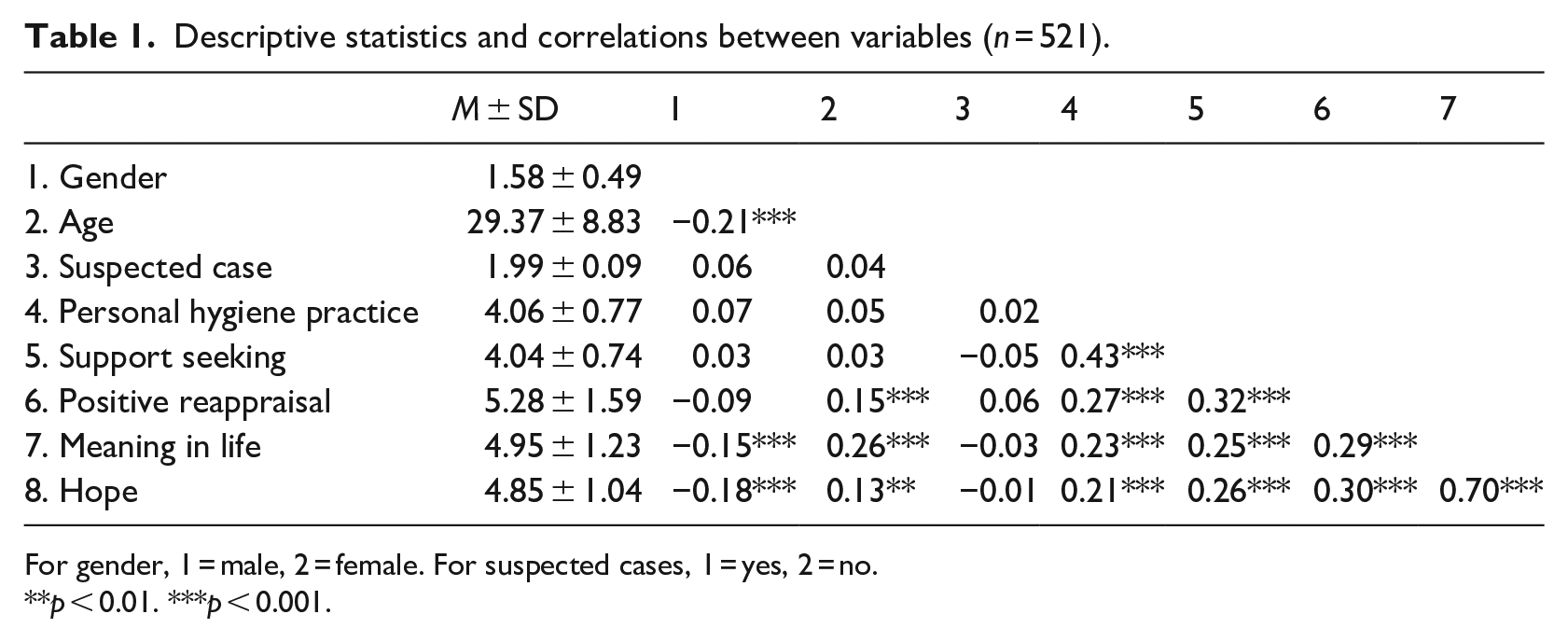
For gender, 1 = male, 2 = female. For suspected cases, 1 = yes, 2 = no.
p < 0.01. ***p < 0.001.
The mediation model testing
First, item parceling with contiguous factor loadings forming three parcels was used to simplify the measurement model, as this study aimed to test the relationships between active coping, MIL, and hope (Rhemtulla, 2016). Results showed an acceptable model fit: χ2 = 173.57, df = 56, p < 0.001, χ2/df = 3.10, RMSEA = 0.06, CFI = 0.97, TLI = 0.96, SRMR = 0.05. The standardized estimates for all items ranged from 0.51 to 0.93 (p < 0.001).
Second, the direct association between active coping and hope was examined, controlling for gender and age. Results showed that the model fit was acceptable: χ2 = 197.60, df = 48, p < 0.001, χ2/df = 4.12, RMSEA = 0.08, CFI = 0.94, TLI = 0.92, SRMR = 0.05. For hope at T2, the significant correlates included personal hygiene practices (β = 0.12, p < 0.05), support seeking (β = 0.15, p < 0.01) and positive reappraisal (β = 0.21, p < 0.001) at T1.
Next, MIL was added to the model to examine the indirect association of active coping with hope via MIL, controlling for gender and age. Results showed that the model fit was acceptable: χ2 = 229.83, df = 78, p < 0.001, χ2/df = 2.95, RMSEA = 0.06, CFI = 0.96, TLI = 0.95, SRMR = 0.05. As shown in Figure 1, active coping at T1 was positively associated with MIL at T2 (personal hygiene practice: β = 0.15, p < 0.05; support seeking: β = 0.13, p < 0.05; positive reappraisal: β = 0.19, p < 0.001). Our results indicated a significant mediating role of MIL at T2 in the associations between active coping at T1 and hope at T2 (personal hygiene practice: β = 0.11, p = 0.012, 95% CI (0.027, 0.200); support seeking: β = 0.09, p = 0.016, 95% CI (0.022, 0.175); positive reappraisal: β = 0.14, p < 0.001, 95% CI (0.062, 0.204)). However, the direct association between active coping and hope turned insignificant (ps > 0.05).
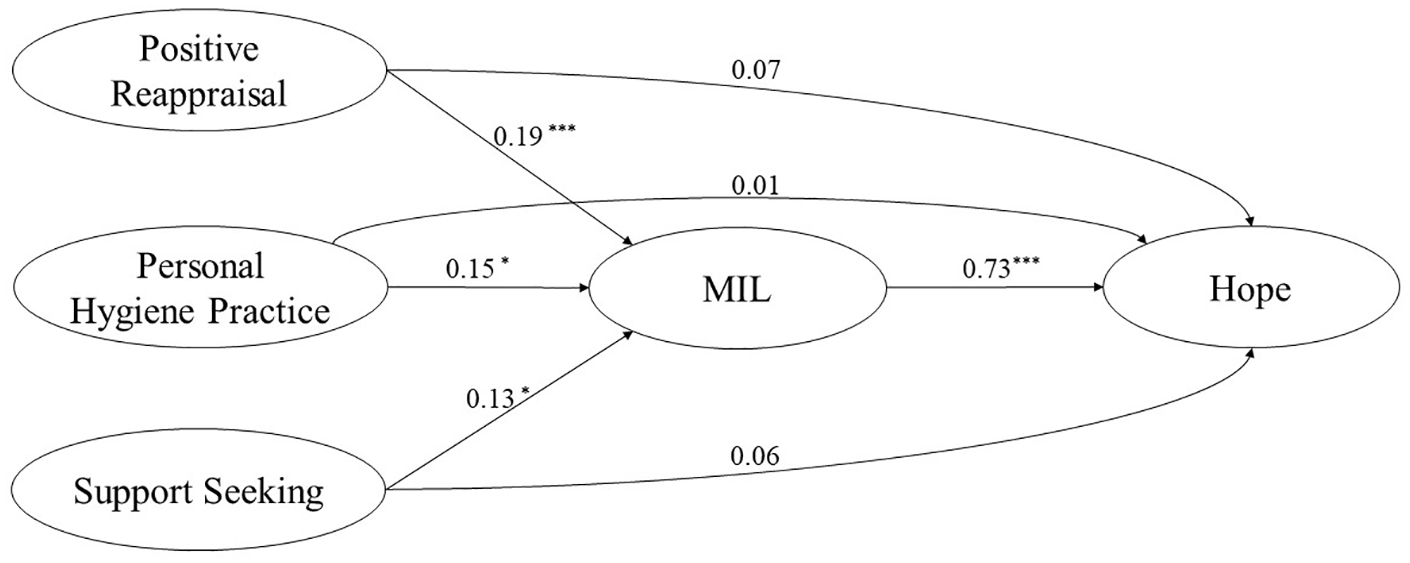
Mediating effect of positive reappraisal and meaning in life on the relationship between active coping and hope.
Discussion
The current study examined the relationship between active coping (i.e. personal hygiene practice, support seeking, and positive reappraisal) and hope. Results showed that active coping was positively associated with hope. Furthermore, MIL mediated the relationship between active coping and hope. Therefore, both H1 and H2 were supported.
Active coping and hope in the pandemic
The present findings showed that active coping was positively related to hope, while the mediation analyses found that none of the direct pathways from active coping to hope were significant. The COVID-19 pandemic, a global public health emergency, was different from common stressful situations since the disease is highly infectious, transmitted rapidly (Liu et al., 2020), and has negatively impacted public mental health (Wang et al., 2020). Furthermore, Wang et al. (2021) found a higher prevalence of depression, anxiety, and insomnia in the remission stage than in the outbreak stage. In early March, the pandemic in China receded but did not end, and the global spread continued. The threat and negative effects of the pandemic were persistent, such as the risk of unemployment, changes in working or learning styles, and the threat of infection (Feng et al., 2020). Therefore, people could not ensure that the pandemic would end, which might have led them to feel powerless (Wang et al., 2021). Although active coping can relieve anxiety and depression symptoms (Wang et al., 2020; Zysberg and Zisberg, 2020), it may not directly enhance hope; other positive mental resources (e.g. MIL) are needed to maintain hope.
The mediating role of MIL between active coping and hope
The results showed that the relationships between all the three forms of active coping and hope were mediated by MIL. During the COVID-19 pandemic, social support was negatively related to worry, depression, and poor sleep quality (Grey et al., 2020; Zysberg and Zisberg, 2020), and was beneficial in alleviating the negative impacts of the pandemic (Zhang and Ma, 2020). Moreover, social support is regarded as a vital resource in restoring meaning in tumultuous times since social connection is a major antecedent of MIL (King and Hicks, 2021). Social support can guide people to organize their life experiences and live with purpose, which in turn enhances MIL (King and Hicks, 2021). For instance, Zuo et al. (2021) found that perceived social support was positively associated with MIL and they explained that social support could increase people’s sense of belonging and self-worth, thus enhancing the significance facet of MIL. Care and support from family and friends can decrease loneliness and increase social connectedness, which is also important for a meaningful life (Humboldt et al., 2020). Therefore, individuals with high levels of support seeking could possess more MIL and live more hopefully.
Another coping strategy, personal hygiene practice, was also related to hope indirectly through MIL. Personal hygiene practices might not only protect individuals from infection but could also be beneficial to their mental state. According to King and Hicks (2021), when individuals engage in daily routines, they perceive high levels of MIL. During the COVID-19 pandemic, people who pay more attention to personal hygiene make good hygiene practices part of their daily lives, which could help to restore order and enhance the structures of life, thus restoring MIL.
Moreover, positive reappraisal was also positively associated with hope via MIL. Positive reappraisal is often related to better adjustment in the COVID-19 pandemic (Kirby et al., 2021). In coping with adversities, world assumptions and global meaning are undermined by traumatic events (Park, 2010; Tedeschi and Calhoun, 2004). Positive reappraisal was considered to be a typical coping strategy to change global meaning and finally promote meaning-making (Park, 2010). The belief that a positive life change is a reward for efforts reinforced assumptions of a predictable and controlled world, thus promoting MIL (Trzebiński et al., 2020). When the old scripts were shattered by stressful events, positive reappraisal facilitated the integration of the shattered world assumptions and restored a sense of meaning (Park, 2010).
Furthermore, MIL provides goals and pathways to enhance hope (Dogra et al., 2011). Marco et al. (2016) claimed that individuals with a high level of MIL were less likely to become hopeless. The purpose facet of MIL embodies future-oriented goals and motivation, which inspire individuals to focus on the future rather than the stressful events at present (Martela and Steger, 2016). Zuo et al. (2020) also claimed that MIL could promote the discovery of future goals and the enhancement of motivation. This trend is proving especially true during the difficult times of the COVID-19 pandemic, in which, even though they might be overwhelmed by the obstacles in their lives, people can live hopefully.
Implications
There are some important implications in the current study. First, because the COVID-19 pandemic is likely to continue for a long period, active coping is necessary to ward off viral infection and maintain mental health. Individuals could make more use of support seeking, personal hygiene practices and positive reappraisal to enhance their positive mental state. Second, MIL mediated the relationship between active coping and hope. The relationship between MIL and hope highlights the importance of possessing goals and motivation. Therefore, meaning-centered interventions could be implemented to help people find meaning in their lives, discover future life goals, and thus maintain hopeful thinking during the COVID-19 pandemic.
Limitations and future scope
This study also has several notable limitations. First, although this study used a two-wave longitudinal design, due to the observational design and the lack of repeated measures at more time points, drawing inferences about causal explanations requires caution. Second, attrition analyses revealed that participants who dropped out were older and showed higher levels of support seeking and positive reappraisal. Therefore, caution should be exercised when generalizing the results of this study to other groups, such as the elderly. Third, positive reappraisal was assessed with only one item, which could not generate any reliability indicator. More validated items could be used in future research to provide a more reliable assessment for positive reappraisal, for example, the positive reappraisal subscale of Coping Responses Inventory (Ebata and Moos, 1991). Fourth, all data collected in this study were self-reported. Future studies could collect data from multiple sources of information. Finally, Folkman (2010) proposed a dynamic and reciprocal relationship between coping and hope; although the direct association between active coping and hope was non-significant, bidirectional relationships between coping and hope are worth exploring in future studies.
Research Data
sj-docx-9-hpq-10.1177_13591053211062347 – Supplemental material for The relationship between active coping and hope during the COVID-19 pandemic: The mediating role of meaning in life
Supplemental material, sj-docx-9-hpq-10.1177_13591053211062347 for The relationship between active coping and hope during the COVID-19 pandemic: The mediating role of meaning in life by Shuai Jin, Lei Zheng, Jie Wen and Miao Miao in Journal of Health Psychology
Research Data
sj-pdf-3-hpq-10.1177_13591053211062347 – Supplemental material for The relationship between active coping and hope during the COVID-19 pandemic: The mediating role of meaning in life
Supplemental material, sj-pdf-3-hpq-10.1177_13591053211062347 for The relationship between active coping and hope during the COVID-19 pandemic: The mediating role of meaning in life by Shuai Jin, Lei Zheng, Jie Wen and Miao Miao in Journal of Health Psychology
Research Data
sj-rar-5-hpq-10.1177_13591053211062347 – Supplemental material for The relationship between active coping and hope during the COVID-19 pandemic: The mediating role of meaning in life
Supplemental material, sj-rar-5-hpq-10.1177_13591053211062347 for The relationship between active coping and hope during the COVID-19 pandemic: The mediating role of meaning in life by Shuai Jin, Lei Zheng, Jie Wen and Miao Miao in Journal of Health Psychology
Research Data
sj-rar-7-hpq-10.1177_13591053211062347 – Supplemental material for The relationship between active coping and hope during the COVID-19 pandemic: The mediating role of meaning in life
Supplemental material, sj-rar-7-hpq-10.1177_13591053211062347 for The relationship between active coping and hope during the COVID-19 pandemic: The mediating role of meaning in life by Shuai Jin, Lei Zheng, Jie Wen and Miao Miao in Journal of Health Psychology
Research Data
sj-rar-8-hpq-10.1177_13591053211062347 – Supplemental material for The relationship between active coping and hope during the COVID-19 pandemic: The mediating role of meaning in life
Supplemental material, sj-rar-8-hpq-10.1177_13591053211062347 for The relationship between active coping and hope during the COVID-19 pandemic: The mediating role of meaning in life by Shuai Jin, Lei Zheng, Jie Wen and Miao Miao in Journal of Health Psychology
Research Data
sj-sav-1-hpq-10.1177_13591053211062347 – Supplemental material for The relationship between active coping and hope during the COVID-19 pandemic: The mediating role of meaning in life
Supplemental material, sj-sav-1-hpq-10.1177_13591053211062347 for The relationship between active coping and hope during the COVID-19 pandemic: The mediating role of meaning in life by Shuai Jin, Lei Zheng, Jie Wen and Miao Miao in Journal of Health Psychology
Research Data
sj-sav-2-hpq-10.1177_13591053211062347 – Supplemental material for The relationship between active coping and hope during the COVID-19 pandemic: The mediating role of meaning in life
Supplemental material, sj-sav-2-hpq-10.1177_13591053211062347 for The relationship between active coping and hope during the COVID-19 pandemic: The mediating role of meaning in life by Shuai Jin, Lei Zheng, Jie Wen and Miao Miao in Journal of Health Psychology
Research Data
sj-spv-4-hpq-10.1177_13591053211062347 – Supplemental material for The relationship between active coping and hope during the COVID-19 pandemic: The mediating role of meaning in life
Supplemental material, sj-spv-4-hpq-10.1177_13591053211062347 for The relationship between active coping and hope during the COVID-19 pandemic: The mediating role of meaning in life by Shuai Jin, Lei Zheng, Jie Wen and Miao Miao in Journal of Health Psychology
Research Data
sj-spv-6-hpq-10.1177_13591053211062347 – Supplemental material for The relationship between active coping and hope during the COVID-19 pandemic: The mediating role of meaning in life
Supplemental material, sj-spv-6-hpq-10.1177_13591053211062347 for The relationship between active coping and hope during the COVID-19 pandemic: The mediating role of meaning in life by Shuai Jin, Lei Zheng, Jie Wen and Miao Miao in Journal of Health Psychology
Footnotes
Data sharing statement
The current article includes the complete raw dataset collected in the study including the participants’ dataset, syntax file and log files for analysis. These files are all available in the Figshare repository and as Supplemental Material via the SAGE Journals platform.
Declaration of conflicting interests
The authors declared no potential conflicts of interest with respect to the research, authorship, and/or publication of this article.
Funding
The authors disclosed receipt of the following financial support for the research, authorship, and/or publication of this article: We acknowledge financial support from the MOE (Ministry of Education of the People’s Republic of China) Project of Humanities and Social Sciences (Grant Number: 18YJC190016), Fundamental Research Funds for the Central Universities (Gran Number: BMU2021YJ018), and National Social Science Foundation of China (Grant Number: 20CSH073).

References
Supplementary Material
Please find the following supplemental material available below.
For Open Access articles published under a Creative Commons License, all supplemental material carries the same license as the article it is associated with.
For non-Open Access articles published, all supplemental material carries a non-exclusive license, and permission requests for re-use of supplemental material or any part of supplemental material shall be sent directly to the copyright owner as specified in the copyright notice associated with the article.
