







Abstract
This study examined the influencing mechanism underlying the relationship between the fear of COVID-19 and Chinese international high school students’ career maturity by investigating the mediating role of the intolerance of uncertainty. The results indicated that the fear of COVID-19 and the intolerance of uncertainty are negatively associated with international high school students’ career maturity. Moreover, intolerance of uncertainty plays a mediating role in the relationship between the fear of COVID-19 and career maturity. The findings contribute to the literature on mental health and have important practical implications for international high school students’ mental health and career development.
Keywords
Introduction
The global pandemic of COVID-19 is an unprecedented crisis that has caused severe disruption and harm to people’s physical and mental health worldwide. Having brought great uncertainty to multiple aspects of our lives, it affects our mental health, education and work, for we are unsure when the pandemic will end. Therefore, in the post-COVID-19 era, scientists have unanimously scrambled to research how the pandemic can be effectively treated while also showing concern about its impact on our mental health and career development (Cunningham et al., 2020; Marks, 2022). To date, studies on individual career development in the context of the COVID-19 global pandemic have focused on health care workers, medical students, and nursing students (e.g. Bai et al., 2021). In addition, some studies have also focused attention on college students (e.g. He and Yu, 2021). However, very little research has been conducted on high school students’ career maturity and development during the COVID-19 pandemic. One recent study (Maftei et al., 2022) explored the relationship between the fear of COVID-19 and high school students’ future career anxiety during the COVID-19 pandemic. Surprisingly, research on the career maturity and development of high school students attending international schools is absent.
With a huge number of high school students attending colleges abroad, China is the world’s largest source of overseas students globally. In China, there are nearly 1000 international private high schools and international departments (classes) in public schools, with a total enrollment of over 500,000 students (Chen, 2020). Studying abroad is an option in pursuing high-quality educational resources and a tool for privileged social classes to preserve their standing and for underprivileged social classes to climb the social ladder (Fan and Cheng, 2018). However, due to the outbreak and worldwide spread of COVID-19, countries have implemented border closures, lockdowns, quarantines and isolations to prevent the virus from spreading, thus increasing the uncertainty of university applications and living abroad and making cross-country travel more difficult. All of these challenges make change inevitable for international high school students’ career planning and preparation for studying abroad. Therefore, research on how the COVID-19 pandemic influences the career maturity of high school students in international schools provides theoretical and practical implications.
Career maturity is defined as the degree to which individuals are prepared to make good educational or vocational decisions (Marciniak et al., 2022; Super et al., 1996). High school students must decide whether to pursue higher education in their home country, study abroad, or find a job after completing their education. To make an optimal decision regarding one’s future career development, individual career maturity becomes critical. Therefore, exploring the factors that influence high school students’ career maturity is significant. Researchers have conducted extensive and in-depth research on the antecedent variables of career maturity among high school students. Research on factors influencing career maturity among high school students has focused on their human capital resources, social resources, psychological resources, and career identity resources (Bae, 2017; Hirschi, 2012; Marciniak et al., 2022). Despite considerable research on the career maturity of high school students, little is known about the specific career maturity of Chinese international high school students who, as an increasingly large group, are preparing to study at universities abroad. Given that their career plans are different from those of most high school students, how their career maturity attitude is affected remains unknown, particularly in the context of the COVID-19 pandemic.
The rapid global spread of the pandemic and the risks associated with viral exposure and infection have led to fears among students that threaten their mental health and behavior (Cummings et al., 2022). In many countries in Europe and the United States, online teaching is the new norm and is largely used in universities for students to take online classes at home. These factors can worry students and affect their original study plans. It is, therefore, reasonable to believe that the fear of COVID-19 may affect the career maturity of international high school students.
The fear of COVID-19 is an individual’s fear of being confronted with COVID-19 or information related to it, evidenced by symptoms such as fear, worry, nervousness, anxiety, and insomnia (Ahorsu et al., 2022). Fear is a primal emotion that originates in response to an actual or perceived threat. This emotion is typically accompanied by a fight or flight response with physiological symptoms such as blood pressure increase, muscle tension and accelerated breathing to prepare the body to react in the event of danger. It also induces cognitive changes, such as reduced levels of attention, attitude changes, and reduced positivity (Bakioğlu et al., 2021; Carleton et al., 2007). When experiencing a high level of fear, individuals may not think clearly or rationally when reacting in various ways during the COVID-19 epidemic (Ahorsu et al., 2022). This, in turn, may interfere with their plans for studying abroad. Therefore, the fear of COVID-19 can potentially affect the career maturity of international high school students.
There is much empirical evidence on the relationship between the fear of COVID-19 and career maturity or development among healthcare workers, medical and nursing students (Bai et al., 2021) and university students (He and Yu, 2021). These studies illustrate that the loss of survival, fear, and anxiety caused by the health and employment risks associated with the COVID-19 pandemic have affected the career planning of various people and the solutions to their career tasks. However, research on the relationship between the fear of COVID-19 and career maturity among international high school students is still in its infancy. To date, there is not enough empirical evidence in the literature to reveal a direct relationship between the fear of COVID-19 and career maturity. Recently, Maftei et al. (2022) found that the fear of COVID-19 increases future career anxiety among high school students. Therefore, it is plausible to propose that the fear of COVID-19 is correlated with the career maturity of international high school students.
Based on the above elaboration, we develop the following hypothesis:
Hypothesis 1: The fear of COVID-19 is negatively correlated with Chinese international high school students’ career maturity.
Fear is an immediate instinctive response elicited by a current threat and can have many consequences. Therefore, the effect of the fear of COVID-19 on career maturity may involve a dynamic process that is not always direct and may be mediated by other psychological constructs. Another aim of this study is to investigate the mechanisms underlying the fear of COVID-19 and career maturity from the perspective of intolerance of uncertainty (IU).
Uncertainty is an aversive state that individuals seek to avoid when they lack the necessary information about future events. For individuals, the future is uncertain most of the time, so they may have a persistent psychological IU, which underlies a tendency to fear the unknown and to worry excessively about potential future negative outcomes (He and Yu, 2021; Millroth and Frey, 2021).
IU is a coexistence issue that has been frequently studied in pandemics and mass traumatic events. The research literature shows that fear, depression, anxiety, stress, and IU are strongly experienced during pandemics (Millroth and Frey, 2021). Today, the fear of COVID-19 is widely studied in the mental health field and can lead to depression, anxiety, and stress. As with other traumatic experiences, the fear of COVID-19 is combined with other factors, such as stress during the epidemic, anxiety about the future, and intense feelings of uncertainty in an individual’s life caused by lockdowns. In fact, the higher the perceived severity of a catastrophic event is, the higher the fear in response to the event and the lower the sense of control and security. This increases the individual’s sense of uncertainty and challenges long-held beliefs about the self and the world, triggering negative perceptions about the self and the world, in turn leading to fear and worry (Quan et al., 2020).
In the context of the COVID pandemic, almost everyone is experiencing fear of the worst viral infection in history. While high school students’ perceived risks and resultant fears are relatively less severe than those of healthcare workers, their fears are unique. After the outbreak, China quickly activated response mechanisms for major public health emergencies and took emergency measures such as suspending work, business and school; isolating those in close contact or with suspected symptoms for medical observation; and treating patients with COVID-19 pneumonia. High school students must face the important career development task of higher education. Affected by the COVID-19 pandemic, they cannot pursue their studies as usual. Family members, schools, and society are all highly concerned about these students, putting them under greater pressure than other students. International high school students, faced with whether to study abroad and how to achieve this goal, are even more exposed to these concerns than general high school students.
Like everyone else, international high school students are afraid and worried that COVID-19 has an extremely high infection rate and a range of serious sequelae even after cure (Al-Aly et al., 2021). A small unseen virus has upset the entire world, shaking individuals’ beliefs about world peace and stability. In particular, international students have seen through various sources that international students like them must wear all kinds of protection when traveling abroad by plane and are exposed to risks, pressures and even stigmatization during their trips or upon arrival at a university abroad. This may cause international high school students to lament the world’s uncertainty and feel a sense of IU when studying abroad, making these factors a major part of their future career planning.
Based on these interpretations, this study proposes the following hypothesis:
Hypothesis 2: The fear of COVID-19 is positively correlated with the IU of international high school students.
IU influences the way individuals perceive, interpret, and react to uncertain future situations, predisposing them to perceive future situations as negative and to respond to them in a relatively stable negative manner, regardless of whether the outcome of the situation is positive or negative and how likely it is to occur (Carleton et al., 2007). Numerous studies have shown significant effects of IU on COVID-19-related depressive symptoms (Voitsidis et al., 2021), test anxiety (Li et al., 2021), and mental health (Zhuo et al., 2021).
Individuals high in IU have less confidence in their decision-making in high-risk scenarios with an immediate threat given limited but changing information (Jensen et al., 2014). Nevertheless, this confidence is indispensable for good career maturity. Individuals with a high IU prefer conservative solutions and have greater risk aversion. Thus, IU is associated with career decision-making difficulties (Arbona et al., 2021) and is negatively associated with career adaptability and the increased uncertainty caused by COVID-19 (Lee and Jung, 2021).
According to conservation of resources theory (Hobfoll, 1989), we argue that international high school students who are high in IU have fewer personal resources remaining. In this case, international high school students may not tolerate the threat of further resource loss or recover their resources to address their situations. Thus, when instability is unbearable, international high school students experience more powerlessness in their academic program planning and career development. Furthermore, when they experience anxiety and powerlessness, it leads to further loss of personal resources, difficulty engaging in their studies, and even the intention to change their plans to study abroad.
Therefore, we propose the following hypothesis:
Hypothesis 3: IU is negatively related to the career maturity of international high school students.
Individuals strive to acquire, retain, nurture, and protect what they value. When people’s resources are exhausted, they go into a defensive mode to protect themselves, which is often defensive and aggressive and can become irrational. In this case, the COVID-19 pandemic is a stressor that causes anxiety due to its enormous threat to people’s health, threatening what is most precious to them: life. Fear of the safety of life is a resource loss. Resource loss is more powerful than resource growth and affects people more rapidly and at an increasing rate over time, causing more resource loss (Hobfoll, 1989). Certainty is an important resource for people. A key feature of people’s feelings of uncertainty is the expression of a strong sense of aversion (Hillen et al., 2017). The fear of the COVID-19 epidemic may undermine people’s perceptions of themselves and world stability, and irrational attitudes and behaviors emerge.
When certainty as a resource is threatened for international high school students, other resource losses occur via stress, anxiety, and depression. In this case, they begin to focus their reduced energy resources away from their current academic planning (after all, it is not safe to study abroad) and toward finding new career planning options because safe access to higher education is a high-value resource that can satisfy many basic needs. Thus, an international high school student who is averse to uncertainty because he or she is anxious about COVID-19 diverts his or her remaining energy to consider other career planning options and prepare to avoid further loss of resources, that is, failure to study abroad or even damage to life safety. In other words, in considering alternatives to graduating to higher education, they are trying to compensate for the current uncertainty. Therefore, we propose that the relationship between the fear of COVID-19 and the career maturity of high school students in international schools can be explained by IU.
Combining the above arguments and Hypotheses 2 and 3, we propose the following hypothesis:
Hypothesis 4: The relationship between the fear of COVID-19 and international high school students’ career maturity is mediated by IU.
To our knowledge, no studies have examined the relationship between the fear of COVID-19 and career maturity among international high school students. Therefore, this study aims to provide a theoretical basis for promoting the mental health and career maturity of international high school students, as well as possible interventions, by examining the mechanisms by which the fear of COVID-19 affects their career maturity. Specifically, we empirically tested the relationship between the fear of COVID-19 and career maturity among high school students in international schools. In addition, we assessed the mediating role of IU in this relationship. These psychological factors are organized into an integrated mediating model, which allows us to explore the mechanisms by which the fear of COVID-19 affects career maturity.
Methods
Participants
A cross-sectional study was conducted using a web-based survey. High school students enrolled in international schools in mainland China were invited to participate in this survey. We distributed questionnaires with the help of administrators and teachers at the corresponding schools. The participants were mainly from economically active regions such as Guangdong Province, Shanghai and Beijing. They were identified by several items of demographic information. A total of 678 students completed the survey, and 568 valid questionnaires were obtained, for an effective rate of 83.78%. Among the participants, 177 (31.2%) were male, and 391 (68.8%) were female. The average age of the participants was 16.39 years (SD = 1.04). Of all participants, 338 (59.5%) were 10th grade students, 94 (16.5%) were 11th grade students, and 136 (23.9%) were 12th grade students.
This research was approved by the Research Ethics Committee of the respective university. The procedures used in this study adhere to the tenets of the Declaration of Helsinki. Informed consent was obtained electronically prior to the collection of data from participants. The data were collected and analyzed anonymously.
Measures
Fear of COVID-19
We used the Chinese version of the fear of COVID-19 scale (FCV-19S) developed by Ahorsu et al. (2022). It is a seven-item unidimensional scale. All items were scored on a five-item Likert-type scale, where “1” indicates “strongly disagree” and “5” indicates “strongly agree.” This scale has strong psychometric properties in Chinese student populations (Chi et al., 2022). The Cronbach’s alpha coefficient for the scale in this study was 0.87.
Intolerance of uncertainty
We used the Chinese version of the intolerance of uncertainty scale (IUS-12) developed by Carleton et al. (2007) to measure the students’ IU. This scale has 12 items in two dimensions—prospective anxiety and inhibitory anxiety—with six questions in each dimension. All items were scored on a five-item Likert-type scale, from 1 (not at all characteristic of me) to 5 (entirely characteristic of me). This scale has been demonstrated to have good reliability and validity in the Chinese student population (Wu et al., 2016). The Cronbach’s alpha coefficients of the two dimensions and the entire scale in this study were 0.71, 0.88, and 0.86, respectively.
Career maturity
We used the Chinese version of the career maturity scale (Crites and Savickas, 1996) adapted by Liu (2004) to measure the students’ career maturity. The scale has 30 items divided into two dimensions: career choice competencies and career choice attitudes. All items were scored on a five-item Likert-type scale ranging from 1 (very unlikely) to 5 (very likely). This scale has been demonstrated to be a reliable and valid measurement of career maturity for Chinese adolescents (Wang et al., 2018; Yan et al., 2020). In the present study, the Cronbach’s alpha coefficients for the two dimensions and the entire scale were 0.89, 0.89, and 0.93, respectively.
Data analyses
We used SSPS 25.0 for the descriptive statistics, correlation analyses, and reliability analyses. Mplus 8.2 was used to test the hypotheses of the mediation effect.
This study conducted a bi-factor model to test whether common method bias was serious. Model 1, with three latent factors (i.e. fear of COVID-19, IU, and career maturity), and Model 2, with four latent factors (three latent factors of Model 1 and an unmeasured latent methods factor), were compared. The results showed that the model fit indices of Model 2 (χ2/df = 1.89, CFI = 0.99, TLI = 0.99, SRMR = 0.02, and RMSEA = 0.04) did not greatly improve upon those of Model 1 (χ2/df = 5.00, CFI = 0.96, TLI = 0.94, SRMR = 0.05, and RMSEA = 0.08), which showed that common method bias was not serious in this study.
Results
Descriptive statistics analysis and correlation analysis
The results of the descriptive statistics and correlation analysis between the study variables are shown in Table 1. The fear of COVID-19 was significantly positively correlated with IU (r = 0.41, p < 0.001). The fear of COVID-19 (r = −0.27, p < 0.001) and IU (r = −0.34, p < 0.001) were significantly negatively correlated with career maturity. Gender was correlated with the fear of COVID-19 and career maturity and was, therefore, controlled in the subsequent analysis.
Descriptive statistics and correlations among the study variables.
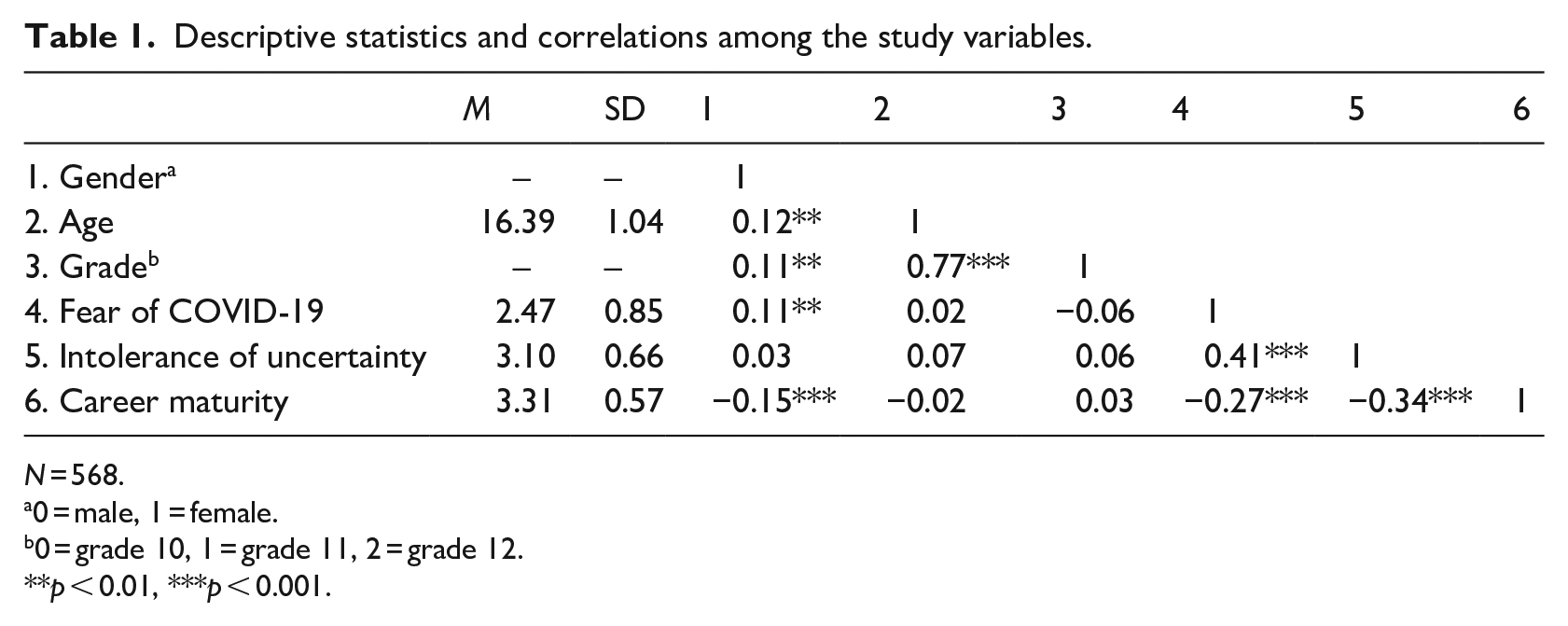
N = 568.
0 = male, 1 = female.
0 = grade 10, 1 = grade 11, 2 = grade 12.
p < 0.01, ***p < 0.001.
Hypothesis testing
We used structural equation modeling (SEM) to test the hypothesis model. The results are shown in Table 2 and Figure 1. First, we tested the direct effect of the fear of COVID-19 on international high school students’ career maturity. After controlling for the effect of gender, the model fit the data well (χ2/df = 4.09, CFI = 0.97, TLI = 0.96, SRMR = 0.05, RMSEA = 0.07). The fear of COVID-19 was positively related to career maturity (β = −0.31, p < 0.001), with a 95% bootstrap confidence interval of (−0.41, −0.22). Hypothesis 1 was thus supported.
Mediation of intolerance of uncertainty.
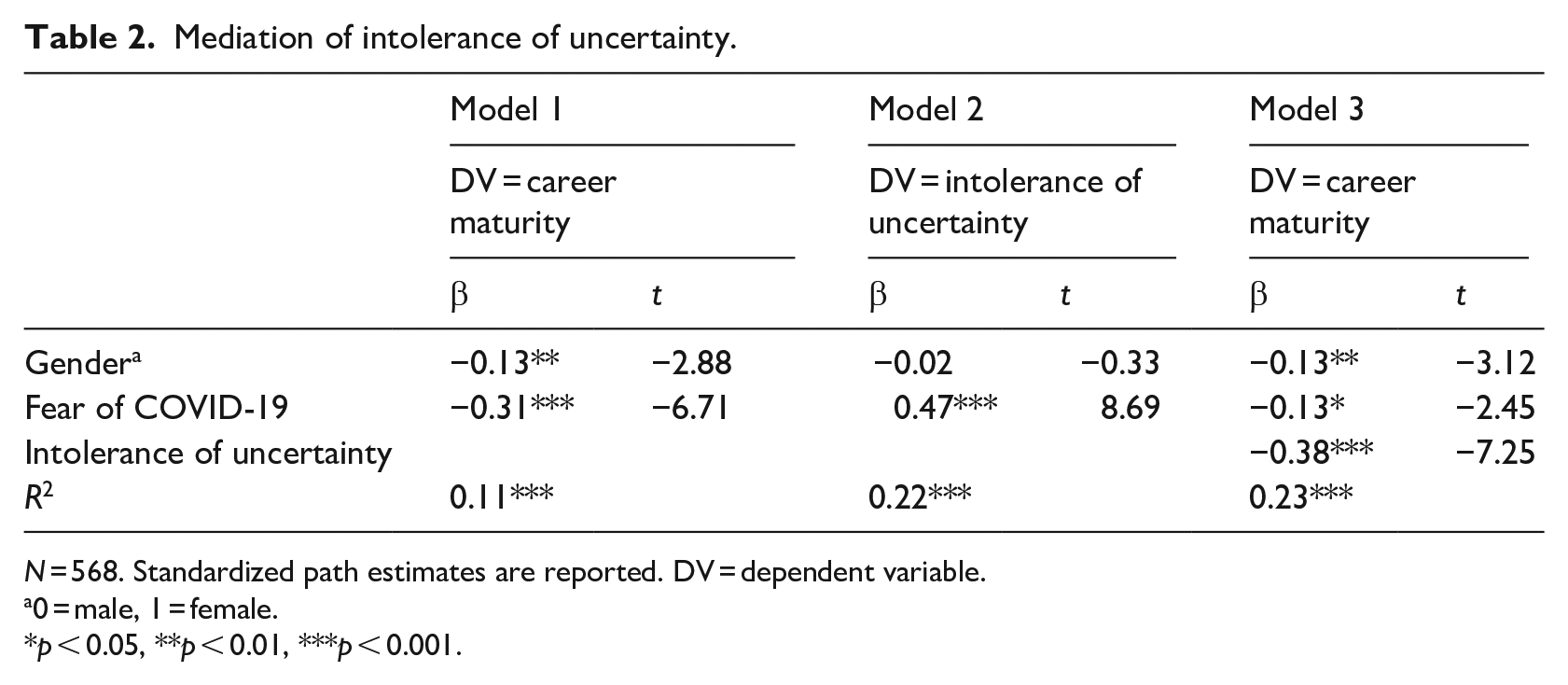
N = 568. Standardized path estimates are reported. DV = dependent variable.
0 = male, 1 = female.
p < 0.05, **p < 0.01, ***p < 0.001.
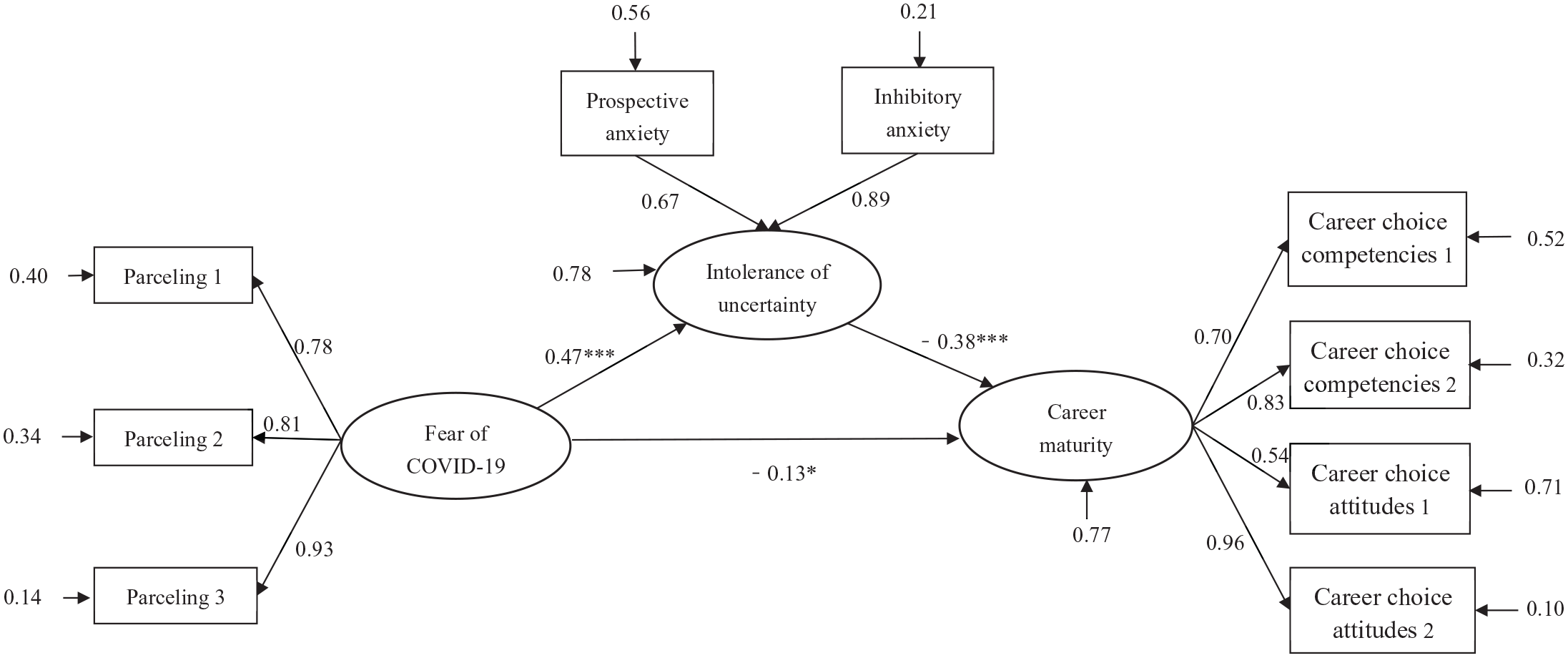
Path diagram of the mediation model.
Second, we constructed a mediation model to test whether IU served as a mediator in the relationship between the fear of COVID-19 and career maturity. The results show that the fear of COVID-19 had a direct positive effect on IU (Model 2: β = 0.47, p < 0.001). Hypothesis 2 was supported. Moreover, IU had a negative effect on career maturity (Model 3: β = −0.38, p < 0.001), and Hypothesis 3 was supported. After adding the mediator, the direct association between the fear of COVID-19 and career maturity remained significant (Model 3: β = −0.13, p < 0.05). The model fit the data well (χ2/df = 4.18, CFI = 0.96, TLI = 0.94, SRMR = 0.05, RMSEA = 0.08). The mediating effect of IU was significant with a 95% bootstrap confidence interval of [−0.31, −0.14]. Therefore, IU partially mediated the effect between the fear of COVID-19 and career maturity, with 57.61% of the mediating effect to the total effect. Thus, Hypothesis 4 was supported.
Discussion
This study explored the relationship between international high school students’ fears and career maturity in the context of unexpected environmental changes induced by COVID-19. We also identified the mediating effect of IU on the relationship between fear of COVID-19 and career maturity.
This study found that international high school students’ fear of COVID-19 was significantly negatively associated with their career maturity. This result is similar to Maftei et al.’s (2022) finding that the fear of COVID-19 increases students’ future career anxiety. Combining these findings, we can conclude that the higher the level of students’ fear of COVID-19 is, the more likely their career maturity will be negatively impacted. Unlike general high school students, who have a clear plan to take the college entrance exam and attend college in China after graduation, international high school students need to write various types of application essays to universities abroad, such as in Europe or the United States. Outbreak control policies, measures, and effectiveness vary from country to country. Given the high infection rate and relatively high mortality rate, studying abroad can expose students to the risk of infection and hence fear and worry. The fear of COVID-19 is a situational threat, and the more fearful and anxious high school students are about the COVID-19 epidemic, the harder it will be for them to focus on the stimuli that threaten their career development.
What is the process that underlies this effect? One possible cause is the fear of COVID-19 reducing career maturity by leading students to experience IU about themselves and the world. Students’ fear of COVID-19 can affect their career maturity not only directly but also indirectly through their IU. Fear of the epidemic causes individuals to make negative predictions about future developments and to perceive themselves as lacking the necessary coping resources and decision-making ability in the face of future career development, decreasing students’ career maturity.
Many studies have been conducted on the effects of the fear of COVID-19 and IU on individuals. Some studies (Millroth and Frey, 2021; Satici et al., 2020; Voitsidis et al., 2021) suggest that the impact of IU on individuals is mediated by the fear of COVID. However, more studies have proposed that IU is a mediator of the fear of COVID-19 with individual depression, anxiety, stress (Bakioğlu et al., 2021; Kardaş, 2021), positivity (Bakioğlu et al., 2021), cyberchondria (Wu et al., 2021), and procrastination (Doğanülkü et al., 2021). As Kardaş (2021) argued, setting the variable IU as a mediator rather than the emotion of fear may provide a more appropriate foundation for treating an outbreak’s psychological impact. This is one reason this study, like many of the above studies, proposes IU as a mediator for practical considerations. Furthermore, given that IU is a personal cognitive bias and a relatively persistent emotional state, it is reasonable to assume that it is influenced by individual fears triggered by a sudden epidemic pandemic. Fear is an immediate protective response in the face of a current threat, whereas IU is a form of anxiety and worry about an unknown future situation (Carleton et al., 2007). Specifically, fear is a reactive fight or flight response to an identifiable current threat (e.g. I just went out shopping and got infected with a virus), such as blood pressure increase and muscle tension. The emotion serves the current moment, as it requires eliciting a response to something perceived to be dangerous. IU among international high school students may result in anxiety and worry that their future plans to study abroad may change due to the epidemic (e.g. I may be infected by the virus during my flight to study abroad, or my visa may be denied due to the epidemic). In this process, international high school students’ career maturity is affected by both the fear of COVID-19 and IU, with the latter also mediating the impact of the former.
The findings of this study contribute to the literature on mental health. Via the SEM approach, this study provides an appropriate and timely exploration of the fear of COVID-19, IU, and career maturity among international high school students during the COVID-19 pandemic. Previous research has focused on the antecedent and consequence variables (e.g. Bae, 2017; Marciniak et al., 2022) of career maturity for high school students in general education contexts. However, few studies have examined the impact of mental health variables on the career maturity of high school students during the unprecedented COVID-19 pandemic, especially those enrolled in international schools. The impact on the physical and mental health of these students, whose career planning goals were to study abroad, was unique, significant and unprecedented during the epidemic. To our knowledge, this is the first study to explore the relationship between the fear of COVID-19 and career maturity among international high school students. The findings significantly contribute to the literature by illustrating the impact of this public health crisis on the mental health and development of a largely understudied population who is uniquely impacted.
The findings of this study have important practical implications for international high school students’ mental health and career development. With a large number of high school students in international schools in China, it would be detrimental to the students, their families, schools and the country’s talent development if their mental health and careers were negatively affected by the pandemic. Therefore, education authorities and international school administrators cannot passively allow the environment to change school teaching and learning. Instead, they should be proactive in understanding the potential impact that the COVID pandemic could have on students’ mental health and career maturity and developing effective responses to enhance students’ mental health and career maturity. For example, more scientific virus protection programs can be adopted to reduce students’ fears and anxieties. The mediating role of IU in the relationship between the fear of COVID-19 and career maturity suggests that in unpredictable and uncertain situations, such as the COVID-19 pandemic, dissipating fear and uncertainty and maintaining mental health are critical to students’ individual career development. It is necessary for international high school students to change their cognitive styles to alleviate fears, feel more stability and security in uncertain situations, and safeguard their mental health to better prepare for their education or career development. More importantly, it is essential to pay attention to individual differences in school education and counseling. Certain interventions can be made to enhance students’ IU to further reduce the impact that fear of COVID-19 has on individuals’ career development, especially among students with high levels of fear and anxiety due to the pandemic. For instance, schools should create a stable and safe environment and expectations for students in the learning process to reduce students’ IU and enhance their mental health and career maturity. Moreover, counselors can support students’ mental health education activities and guide them to make positive statements and form positive personal beliefs about peace and stability in the world to reduce IU and promote personal career development.
Despite the interesting results obtained, this study still has limitations that should be further explored in future studies. First, the sample of this study was limited to Chinese international school students. Therefore, it remains to be tested whether the relationships between the study variables can be extrapolated to other cultural samples. Future research should attempt to replicate our findings across cultures. Second, this study was cross-sectional, and no reliable inferences can be made about the causal relationships between the study variables. Future studies could apply a longitudinal design with at least three measurement time points to collect data and improve the validity of the results.
Footnotes
Author contributions
All authors made a significant contribution to the work reported, whether that is in the conception, study design, execution, acquisition of data, analysis and interpretation, or in all these areas; took part in drafting, revising or critically reviewing the article; gave final approval of the version to be published; have agreed on the journal to which the article has been submitted; and agree to be accountable for all aspects of the work.
Data sharing statement
The current article is accompanied by the relevant raw data generated during and/or analysed during the study, including files detailing the analyses and either the complete database or other relevant raw data. These files are available in the Figshare repository and accessible as Supplemental Material via the SAGE Journals platform. Ethics approval, participant permissions, and all other relevant approvals were granted for this data sharing.
Declaration of conflicting interests
The authors declared no potential conflicts of interest with respect to the research, authorship, and/or publication of this article.
Funding
The authors disclosed receipt of the following financial support for the research, authorship, and/or publication of this article: This research was supported by the 13th Five-Year Plan Research Project of Philosophy and Social Science in Guangdong, China (GD17XXL02).
Informed consent
All procedures followed were in accordance with the ethics standards of the responsible committee on human experimentation (institutional and national) and with the Helsinki Declaration of 1975, as revised in 2000 (5). Informed consent was obtained from all patients for being included in the study.
