







Abstract
This study investigated romantic partners’ undermining of weight management (i.e. hindrance of weight loss efforts) and how perceived motivations behind undermining were associated with weight loss progress. Data from 241 overweight individuals currently cohabiting with a romantic partner and trying to lose weight revealed two overarching undermining factors (i.e. verbal criticism/complaint, behavioral interference) and six perceived motivations (e.g. partner believed weight loss was unnecessary, partner relational fears, weight loss was an imposition on partner). Path modeling showed both undermining behaviors were negatively associated with weight management. Yet, only certain motivations (e.g. imposition on partner, weight loss was unnecessary) were linked to weight management, either directly or indirectly, through undermining. Specifically, whereas criticism/complaint mediated the associations between these motivations and weight management, interference only mediated the association between imposition and weight management. Findings are discussed in terms of the theoretical and practical value of distinguishing undermining behaviors and their underlying motivations.
For many people who are overweight or obese, weight loss endeavors are challenging (e.g. Montgomery et al., 2011; Moore and Williams, 2011). Recently, research has focused more on the role of family members (Kiernan et al., 2012; Sorkin et al., 2014), and specifically romantic partners (Burke and Segrin, 2017; Gorin et al., 2014), in helping individuals lose weight. Cohabiting romantic partners have interdependent schedules and activities (Pauly et al., 2021), and there is a high concordance between partners’ health indices (Meyler et al., 2007). As such, romantic partners can have a large effect on individuals’ health behaviors such as weight loss pursuits (Jackson et al., 2015).
Much of the research has focused on strategies partners use to support individuals’ weight loss (Butterfield and Lewis, 2002; Dailey, 2019; Gorin et al., 2014). These include emotional support, positive reinforcement, and co-participation in healthy behaviors (Arroyo et al., 2020; Butterfield and Lewis, 2002; Theiss et al., 2016). Importantly, Tucker and Mueller (2000) argued that the perceived motivation behind support was more influential in determining effectiveness than the behavior itself (e.g. whether the strategies were seen as controlling or concerned for the individual’s health). Research on social support also demonstrates that perceptions about partner behaviors might have stronger effects than partners’ actual behaviors (MacGeorge et al., 2011).
Partners, however, can also present barriers to engaging in healthy behaviors. In the current study, we assess partner undermining of individuals’ weight loss efforts. To date, research on partner undermining has largely been qualitative in nature (e.g. Mackert et al., 2011; Metzgar et al., 2015; Rydén and Sydner, 2011; Theiss et al., 2016; Whale et al., 2014) primarily revealing various behaviors that can thwart weight loss pursuits and the perceived motivations behind these behaviors. The current study thus seeks to quantitatively substantiate types of undermining behaviors and their perceived motivations in addition to assessing how undermining is associated with weight loss efforts.
Undermining weight loss efforts
We define undermining as the interference or hindrance of individuals’ healthy behaviors (c.f. Vinokur and van Ryn, 1993). We use this broader term given that related terms such as sabotage suggest a conscious intent to thwart healthy behaviors, whereas romantic partners could be unaware that their behaviors present barriers. Because this study takes the perspective of the individual enacting health change, undermining here involves various behaviors that are perceived as working against weight loss efforts. For example, partners might bring home unhealthy foods, refuse to eat healthy meals, or be critical or discouraging (Harp, 2013; Henry et al., 2013; Rydén and Sydner, 2011; Theiss et al., 2016). Other undermining behaviors might be less overt, such as not valuing a healthy lifestyle (Mackert et al., 2011) or refraining from supporting the weight loss efforts (i.e. nonsupport; Metzgar et al., 2015; Whale et al., 2014). Additionally, cultural factors might further impede weight management efforts. For example, McLaughlin et al. (2017) found that Mexican American women noted familism led to an expectation of putting family first over individual weight loss pursuits or pressure to eat at social gatherings. All of these behaviors can impede weight loss success.
Research indeed shows that undermining behaviors hamper healthy behaviors. Undermining by romantic partners has been linked with less healthy dietary behaviors (Henry et al., 2013; Novak et al., 2021), more health-related conflict (Novak et al., 2021), substance abuse (Oetzel et al., 2007), and compromised mental health and relational quality (Burke et al., 2012; Carels et al., 2020). Thus, just as support behaviors are associated with weight loss (Craddock et al., 2015; Gorin et al., 2014), partner undermining behaviors encumber individuals’ weight loss success (Mackert et al., 2011; Whale et al., 2014).
Measures of undermining
In examining undermining by social networks, Sallis et al. (1987) developed a measure of diet and exercise support that included scales of negative comments and sabotage (e.g. “offered me high-salt, high-fat foods,” “criticized me or made fun of me for exercising”). This measure has been employed in several studies (Ball and Crawford, 2006; Kiernan et al., 2012; Lindsay Smith et al., 2017; Sorkin et al., 2014); yet, its uses do not always distinguish among family members’ levels of influence despite cohabiting romantic partners having a greater influence on an individual’s health behaviors (Markey et al., 2007). More recent research suggests there might be additional dimensions to health behavior undermining, such as a lack of accountability (Metzgar et al., 2015) or lack of control regarding food environment (Theiss et al., 2016).
Harp (2013) empirically assessed romantic partners’ undermining behaviors derived from focus groups. This analysis revealed several factors: negative criticism and negativity (e.g. “My partner criticizes my efforts to lose weight”), interference (“My partner does things that get in the way of my weight loss”), fear of change (e.g. “When I’m trying to lose weight, my partner worries that I may leave our relationship”), and negative effects for partner (e.g. “My partner says that my weight loss makes him/her feel bad about his/her own struggle with weight”). Although this study was more comprehensive and methodologically rigorous, a review of the items suggests some of the factors pertain to perceived motivations of the undermining behaviors or outcomes for partners rather than being undermining behaviors themselves. For example, the fear of change and negative effects on the partner factors reflect partner insecurities about the relationship or the imposition the weight loss poses. Research indeed suggests undermining behaviors could be motivated by significant others’ own self-interest in not wanting the individual to engage in healthier behaviors (Coyne et al., 1988) or motivated by feelings of jealousy or guilt, not valuing a healthy lifestyle, or scheduling concerns (Mackert et al., 2011). As such, it is beneficial to distinguish undermining behaviors from their underlying motivations as this may provide a better understanding of the role of undermining in weight loss or health behavior change more broadly.
Associations among perceived motivations, undermining behaviors, and weight loss
Based on previous research on goals, motivations might be associated with undermining behaviors in different ways. In general, a multiple goals perspective suggests that individuals modify their messages to relational partners based on simultaneous, but sometimes conflicting, motivations (Dillard et al., 1989). This occurs in the weight management context as well (Burke and Segrin, 2017; Ray et al., 2019). Burke and Segrin found that individuals used different control strategies depending on whether they had individual (e.g. wanted their partner to improve their health) or mutual goals (e.g. wanted to co-participate in healthy behaviors). Further, individuals used less negative social control (e.g. invoked negative emotions) when they wanted their partners to improve their health but also perceived greater risks to the relationship in using such strategies. Individuals thus balance their desire for the other to be healthy and the risk of threatening the relationship. Similarly, from the perspective of the target, those trying to change their health behaviors might believe their partners’ motivations are differentially linked to undermining behaviors.
Research also reveals that the goals or motivations individuals infer about others’ behaviors have implications for health outcomes. In general, individuals draw inferences about others’ motivations (Palomares, 2008), and these perceived motivations are associated with the effectiveness of messages (Guntzviller et al., 2021; Nauta and Sanders, 2001). This parallels Tucker and Mueller’s (2000) conclusion that the perceived motivation underlying partners’ strategies for general health behavior change can shape strategy effectiveness. Research thus far regarding weight management and perceived motivations, however, has limited results. A couple of studies have assessed attributions about partners’ influence attempts to change individuals’ health behaviors such as concern for the individual’s health or to improve their appearance (Lewis and Butterfield, 2005; Novak, 2005). Although attributions were linked to emotional reactions to these influence attempts, the attributions did not moderate the associations between the influence strategies and behavior change. Regardless, these initial studies warrant additional research on motivations or attributions. In the current study, we position perceived motivations as underlying partner behaviors that impede weight loss efforts.
Current research objectives
Building on this extant literature, our goals are to: (1) quantitatively substantiate types of romantic partner undermining behaviors regarding weight management, (2) quantitatively identify perceived motivations for undermining weight management, (3) assess links between perceived motivations and undermining behaviors, and (4) assess how the perceived motivations and undermining behaviors are associated with weight management efforts. These objectives allow a distinction between individuals’ perceptions of partner undermining behaviors and their underlying motivations as well as an empirical assessment of how the motivations are associated with undermining behaviors and weight management progress.
Method
Participants and procedures
This study was approved by the University of Texas at Austin IRB (Protocol #2017-11-0052). Participants included 241 individuals: (a) actively trying to lose weight, (b) with a body mass index (BMI) over 25 (i.e. the classification for overweight), (c) currently living with their romantic partner, and (d) 18 years of age or older. In response to an open-ended question about sex, 68.9% reported being female (n = 166) and 31.1% reported being male (n = 75); a question about gender was not included, so it is unknown how many identified as non-binary. Participant ethnicities included white/Caucasian (n = 194, 80.5%), African-American/Black (n = 19, 7.9%), Hispanic or Latinx (n = 7, 2.9%), Asian (n = 6, 2.5%), Native American/Alaska Native (n = 1), 12 reported multiple ethnicities (e.g. white and Hispanic/Latinx, white and African-American), and two participants chose not to report their ethnicities. BMIs based on reported height and weight ranged from 25.06 to 68.19 and averaged 33.67 (SD = 7.46); 92 (38.2%) were within the “overweight” classification (BMI 25–30) and 149 (61.8%) were in the “obese” classification (BMI of over 30). Participants reported actively trying to lose weight for the past 18.46 months on average (SD = 37.47, Mdn = 6.00, ranging from 1 to 360 months).
Participants reported being married (n = 144, 59.8%), dating (n = 18, 7.5%), engaged (n = 21, 8.7%), or in a long-term, committed relationship (n = 58, 24.1%). Most were heterosexual relationships (97.9%); two were in same-sex female relationships and three were in same-sex male relationships. Relationship lengths ranged from 6 months to 48.25 years (M = 11.94 years, SD = 10.73, Mdn = 8). Length of cohabitation ranged from less than 1 month to 48.17 years (M = 10.28 years, SD = 10.71, Mdn = 6.25 years). A little over half of the sample reported having children (n = 140, 58.09%), the majority of whom (n = 128) reported at least one child currently cohabited with them.
Participants completed an online survey through Amazon.com’s Mechanical Turk. Participants were informed that their participation indicated their consent. Participants were each paid $0.50 for the 15-minute survey. To increase confidence in the data, two attention-check items were randomly presented (e.g. “please mark ‘1’ for this item”), and a final question asked participants whether they answered honestly and if their data should be deleted (without penalty; Rouse, 2015). Seven cases were deleted based on these methods and are not included in the sample size noted above.
Measures
Undermining behaviors
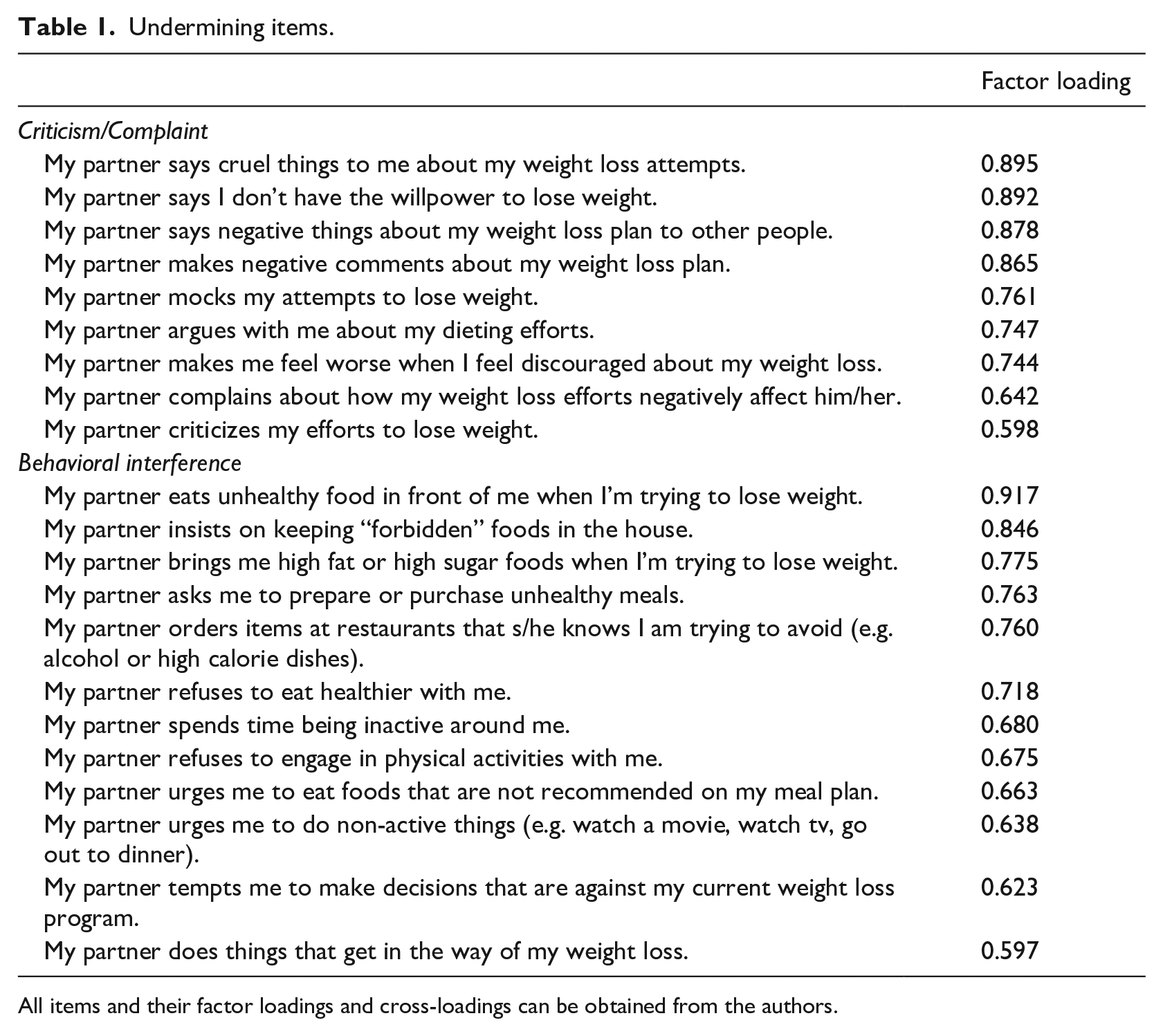
Items regarding undermining or sabotage were collected or were crafted from the qualitative themes derived from previous research (Ferrara, 2006; Harp, 2013; Mackert et al., 2011; Metzgar et al., 2015; Rydén and Sydner, 2011; Sallis et al., 1987; Theiss et al., 2016). Items that significantly overlapped or had the same wording were excluded. The resulting 41 items were worded or phrased so that they pertained to the romantic partner. See Table 1 for example items. Participants were asked to recall the past 30 days and rate the frequency with which their partner exhibited the undermining behaviors (1 = never, 7 = very often). Certain items were recoded so higher scores reflected more frequent undermining behaviors perceived from the partner.
Undermining items.
All items and their factor loadings and cross-loadings can be obtained from the authors.
Perceived motivation of undermining behaviors
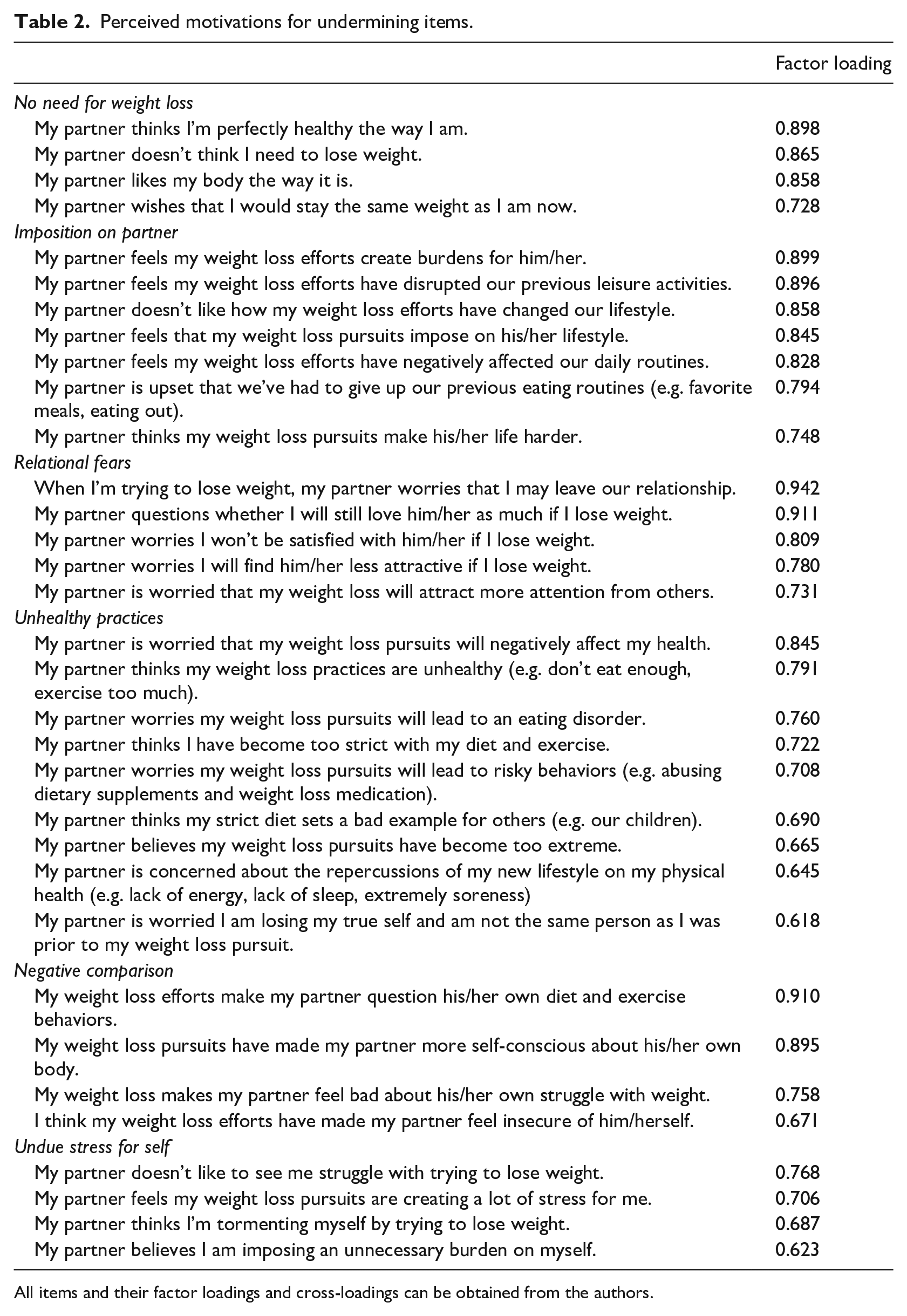
To assess perceptions of partner motivations for undermining behaviors, we developed 46 items based on Harp’s (2013) dissertation factors, themes that emerged (directly or indirectly) pertaining to undermining motivations in previous research (Mackert et al., 2011; Metzgar et al., 2015; Rydén and Sydner, 2011; Theiss et al., 2016), and additional brainstorming. See Table 2 for example items. The items were particularly worded to capture participants’ perceptions of their partner’s view of the weight loss pursuit. Respondents rated the items using a 7-point Likert scale (1 = strongly disagree, 7 = strongly agree).
Perceived motivations for undermining items.
All items and their factor loadings and cross-loadings can be obtained from the authors.
Diet and exercise behaviors
Respondents also completed a 28-item diet and exercise behavior scale (Jackson, 2006) assessing how frequently they enacted certain behaviors (1 = never, 7 = very often) in the past 30 days (e.g. “How often did you limit your sugar intake?”; “How often did you perform stretching exercises?”). Certain items were recoded so higher scores reflect more frequent diet (Cronbach’s α = 0.88, M = 4.76, SD = 0.95) and exercise behaviors (Cronbach’s α = 0.90, M = 4.76, SD = 1.24).
Goal accomplishment
Six items from Gore (2014) were used to assess the degree to which people felt they accomplished their weight management goals (1 = strongly disagree, 7 = strongly agree; e.g. “I was very committed to my weight loss goals,” “The work I put into my weight loss goals was effective”). Pertinent items were reverse coded with higher scores representing a higher degree of perceived goal accomplishment toward weight loss (Cronbach’s α = 0.83, M = 4.78, SD = 1.11).
Correlations among all the variables are provided in the Supplemental Material.
Statistical analysis
The 41 undermining behavior items and 46 motivation items were subjected to separate principal components analyses (PCA) with an oblimin (oblique) rotation in JASP (JASP Team, 2021). These analyses allowed us to reduce the items into similar sets of overarching types of undermining behaviors or motivations. Although types of undermining behaviors and motivations had been previously found (e.g. Harp, 2013; Sallis et al., 1987), we included items from existing scales in addition to newly created items from qualitative analyses and thus used an exploratory analysis to allow new types of behaviors to emerge. Initial criteria for retaining items were factor loadings greater than 0.60 and less than 0.40 on other factors.
To determine the direct and indirect associations between perceived motivations and undermining behaviors with weight management efforts, we conducted path models using the lavaan package for structural equation modeling in R (R Core Team, 2020; Rosseel, 2012). Partner motivations were modeled to predict the undermining behaviors which, in turn, were modeled to predict weight management efforts. Because the two undermining behaviors were moderately correlated (r = 0.60, p < 0.001), we ran separate models for each behavior. Covariances among the six perceived motivations were included. The three weight management indices (i.e. diet, exercise, and goal accomplishment) were also highly correlated and thus included as a latent variable. Model fit was assessed on the basis of CFI (⩾0.90), TLI (⩾0.90), RMSEA (⩽0.08 with 90% confidence interval), and SRMR (⩽0.10). Mediation (indirect effects) was assessed with bootstrapping (i.e. maximum likelihood with 1000 samples and 95% bias-corrected confidence intervals).
In considering potential control variables, only participant sex (0 = female, 1 = male) and how much the couple talked about weight management (i.e. assessed through one item: 1 = We never talk about weight management, 7 = We talk all the time about weight management) were related with the weight management indices and were included in the models. Being male and greater talk frequency were associated with more weight loss progress.
Results
Undermining behaviors and perceived motivations
Undermining behaviors
The undermining behaviors PCA yielded four factors with eigenvalues greater than one: 22.35, 3.61, 1.30, and 1.00. Examining the factor loadings revealed that only two of the factors were viable for retention; one had only one item and the other only had three items loading over 0.60 but they did not cohere and overlapped with the primary two factors (e.g. “My partner wastes my time when I start to do weight loss activities,” “My partner complains when I leave to exercise”). The two remaining factors had several items with factor loadings over 0.60 in conjunction with cross-loadings less than 0.40. These two factors explained 55.9% and 9.0% of the variance, respectively.
The first retained factor’s items represented verbal undermining in the forms of criticism and complaints (nine items retained; α = 0.96, M = 1.99, SD = 1.32). Two additional items loaded on this factor (i.e. “My partner prevents or discourages other people from helping me,” “My partner gives me misleading advice or information”); because these overlapped with the content of the second factor, these were excluded to focus on verbal criticism in the first factor. The second retained factor’s items represented actions or specific behaviors that made healthy choices difficult and is hereafter labeled interference (12 items; α = 0.95, M = 3.03, SD = 1.49). See Table 1 for a list of all the items retained in these two factors.
Perceived motivations
The perceived motivations PCA yielded six factors with eigenvalues greater than one: 22.68, 3.06, 2.68, 2.45, 1.59, and 1.41. Each factor had at least four items with factor loadings greater than 0.60 and cross-loadings less than 0.40. The six factors reflected perceptions that the partner: believed the individual engaged in unhealthy practices (nine items, variance explained = 49.3%; α = 0.94, M = 2.05, SD = 1.19), believed the weight loss pursuits were an imposition (seven items, variance explained = 6.6%; α = 0.95, M = 2.50, SD = 1.50), had relational fears (five items, variance explained = 5.8%; α = 0.95, M = 2.39, SD = 1.62), believed there was no need for weight loss (four items, variance explained = 5.3%; α = 0.88, M = 3.23, SD = 1.57), made negative social comparisons with the individual (four items, variance explained = 3.4%; α = 0.91, M = 2.86, SD = 1.65), and believed the weight loss efforts caused undue stress (four items, variance explained = 3.1%; α = 0.86, M = 2.73, SD = 1.39). See Table 2 for all the items retained in these factors.
Associations among undermining behaviors, motivations, and weight outcomes
Figures of the final models with only the significant paths are included in the Supplemental Material. For criticism/complaint, the initial model showed good fit with no modifications, χ2 (38) =71.35, p = 0.001, CFI = 0.969, TLI = 0.947, RMSEA = 0.060 (CIs, 0.038, 0.082), SRMR = 0.056. Because the perceived motivations might have a direct impact on individuals’ weight management efforts, a model in which the non-significant paths between the perceived motivations and criticism/complaints were replaced by direct paths to weight management was conducted. This model showed no direct, significant associations. As such, the original model was retained. This model suggests that when partners were perceived as feeling the individual did not need to lose weight, partners were also perceived as using less criticisms and complaints (β = −0.16, p < 0.01). Conversely, when partners were perceived as feeling the weight loss efforts were unhealthy (β = 0.57, p < 0.001) or imposing on their own lifestyle (β = 0.36, p < 0.01), they reported more criticisms and complaints by their partners. This type of undermining behavior, in turn, was negatively associated with weight management (β = −0.27, p < 0.001); the more individuals perceived criticisms and complaints from their partners, the less progress they made in their weight management goals. Mediation analyses suggested that criticism/complaint was a significant mediator between all three motivations and weight management efforts. The indirect effect for no need for weight change was 0.024 (CIs 0.009, 0.041, p = 0.005), the indirect effect for imposition was −0.055 (CIs −0.093, −0.020, p = 0.002), and the indirect effect of unhealthy practices was −0.111 (CIs −0.197, −0.047, p = 0.003). Hence, the effects of these three perceived motivations were channeled through individuals’ perceptions of partner criticisms and complaints.
For interference, the initial model fit well with no modifications, χ2 (43) =86.30, p < 0.001, CFI = 0.953, TLI = 0.920, RMSEA = 0.073 (CIs: 0.052, 0.093), SRMR = 0.059. Only one perceived motivation predicted interference; the more individuals perceived that their partners felt the weight loss was an imposition, the more partners were perceived to block their weight loss attempts (β = 0.59, p < 0.001). Interference was also negatively associated with weight management (β = −0.28, p < 0.001). As would be expected, imposition served as a significant mediator (indirect effect = −0.096; CIs −0.151, −0.046, p < 0.001).
A model in which the non-significant paths between the perceived motivations and interference were replaced with direct paths to weight management showed that two motivations (i.e. no need and unhealthy practices) had direct links to weight management, χ2 (38) = 80.71, p < 0.001, CFI = 0.957, TLI = 0.926, RMSEA = 0.070 (CIs: 0.049, 0.090), SRMR = 0.058. The perceived motivation of unhealthy practices was negatively associated with weight management (β = −0.19, p < 0.001), but perceiving the partner felt they had no need for weight loss was positively associated with weight management progress (β = 0.16, p < 0.05). Additionally, imposition was still positively associated with behavioral interference (β = 0.68, p < 0.001), which was negatively associated with weight management (β = −0.25, p < 0.001) (indirect effect = −0.100, CIs: −0.168, −0.022).
Discussion
From the perspective of those trying to lose weight, this study sought to identify perceptions of partner undermining behaviors and their underlying motivations. Principal components analyses revealed two main types of undermining as well as six different perceived motivations. Analyses revealed that both undermining behaviors—criticism/complaints and behavioral interference—were negatively associated with weight management efforts. Further, only certain motivations (e.g. imposition on partner, partner felt the weight loss was unnecessary or unhealthy) were linked to the weight management efforts, either directly or indirectly through undermining. General conclusions are discussed below.
Undermining behaviors
At least in terms of frequency, individuals trying to lose weight discern two major types of undermining behaviors by their partners: criticism/complaints and behavioral interference. These two factors parallel Harp’s (2013) criticism/negativity and interference factors, respectively. Whereas other measures or conceptualizations of interference include both criticism and interference together (Sallis et al., 1987; Theiss et al., 2016), this analysis combined with Harp’s emphasizes the need to partition verbal criticism from behavioral interference. Importantly, outcomes, as well as underlying motivations, might be related to these behaviors differently. For example, Henry et al. (2013) found that tempting the individual with unhealthy foods was negatively associated with dietary adherence, whereas disregard for importance of health was negatively associated with non-dietary behaviors (e.g. taking medications, exercise). Thus, although criticism/complaints and interference were moderately associated in the current study, they might have different predictors or effects that are important to consider.
Perceived motivations underlying undermining behaviors
This is the first quantitative analysis of a comprehensive set of inferred motivations underlying undermining behaviors. Items developed based on the amalgam of undermining research found six distinct factors which can be used as a foundational measure in future research. These motivations could be used to assess, for example, links to actual partner behaviors as well as different health goals. The means of these motivations were relatively low (typically between 2 and 3 on the 7-point scale) suggesting participants did not perceive that their partners had strong motivations for their undermining behaviors. Yet, this makes sense when considering that individuals often feel undermining is not intentional or malicious (Mackert et al., 2011; Newton-John et al., 2017).
Several perceived motivations overlapped with Harp’s (2013) undermining factors, such as fears about the stability of the relationship and the imposition that the health-related routines had on the partner. This parallels other research that shows those who lose weight can fear or experience negative consequences regarding the relationship, such as jealousy or concerns about relationship stability (Kluever Romo and Dailey, 2014; Rosas et al., 2019). The negative social comparison factor (e.g. partner feeling insecure or self-conscious about their own behaviors or body) also maps onto Mackert et al.’s (2011) motivations of partner guilt and jealousy.
Although undermining behaviors are typically perceived as negative and do present barriers in the mind of individuals managing their weight, some reasons were prosocial in nature. For example, perceiving that the partner did not believe they needed to lose weight was the highest rated motivation. In addition, participants reported that partners felt they were putting too much stress on themselves and did not wish to see them struggle. Participants also perceived that partners felt their weight loss pursuits involved choices that were unhealthy or too extreme. Hence, although undermining behaviors are typically framed as selfishly motivated, undermining might sometimes be intended to curb unhealthy or unnecessary practices. This highlights that research needs to consider both the beneficial and harmful effects of undermining.
Associations among perceived motivations, undermining behaviors, and weight management efforts
Previous research shows that negativity and inducing negative emotions are associated with poorer health outcomes (Craddock et al., 2015; Young et al., 2019). In addition, tempting or sabotage is linked with hindering healthy choices (Henry et al., 2013) and detracts from the support meant to facilitate weight loss (Kiernan et al., 2012). Our analysis further suggests that both verbal criticism and behavioral interference were linked with hampered weight management efforts.
Interestingly, certain motivations appeared more salient in understanding undermining and weight management progress. Specifically, perceiving the weight loss pursuits as unhealthy, unnecessary, or as an imposition were most related to weight loss outcomes, either directly or indirectly through criticism. Individuals losing weight felt that criticism and complaints stemmed from both prosocial and selfish motives. Whereas imposition was also linked with interference, the two prosocial motivations were not perceived to drive the partner’s behavioral interference. Rather, they were directly (and more weakly) associated with weight management efforts. Hence, undermining behaviors believed to be motivated by prosocial concerns might have less negative effects on health (or possible positive effects) as compared to undermining behaviors believed to be motived by selfish concerns (Tucker and Mueller, 2000). In addition, prosocial motivations could potentially have positive effects such as the positive link between perceiving partners to believe there was no need to lose weight and weight management progress. Perhaps feeling that one’s partner finds their current body size preferable boosts self-confidence and a desire to take care of oneself (Arroyo et al., 2020; Logel et al., 2014).
It is worth noting that relationship fears, negative social comparison, and undue stress were not related to either type of undermining behavior or weight management efforts in the path analyses. Although most motivations were related to the undermining behaviors and weight management indicators on a bivariate level (see the Supplemental Material), they were not related to undermining behaviors in the full model, likely due to their high inter-correlations. These motivations, however, might be associated with a lack or decreased levels of support (e.g. apathy) for weight loss rather than active undermining. Hence, these motivations need to be assessed within a larger model of partner support such as Butterfield and Lewis’ (2002) social ecological model or Lewis et al.’s (2006) interdependence model regarding health behaviors. In other words, given that sabotage and support can co-occur (Kiernan et al., 2012), support and undermining and their underlying motivations need to be simultaneously assessed to understand relational partners’ role in weight loss.
These findings could also have practical applications. The limited success of social support or couple-based weight interventions (e.g. Arden-Close and McGrath, 2017; Verheijden et al., 2005) might be enhanced by incorporating how perceived motivations of undermining (and support) could lead to different outcomes. Partners might also want to make their prosocial motives explicit to ensure more positive health outcomes. Further, couples could discuss the fears or imposition created by the weight loss to achieve more mutually beneficial results rather than impeding health goals.
Limitations and future research
In addition to those noted above, additional limitations should be considered. Given the lower means of undermining behaviors and motivations, participants who elected to complete the survey might have partners who were largely supportive of their endeavors. In addition, the undermining items were only assessed with regard to frequency; different factor structures might emerge if they are assessed in terms of the impact or tension created in the relationship.
The data are correlational, and thus, weight loss progress could lead to partner behaviors. Longitudinal research could address the direction of causality as well as how undermining behaviors fluctuate over time. Partners might be more supportive in the beginning of weight loss attempts but start to use undermining behaviors more frequently as time progresses. Further, identifying different trajectories can have important implications for weight-loss interventions and subsequent recommendations for overweight populations (Pauly et al., 2021). Undermining might also impact, or reflect, not only an individual’s weight loss effort but the quality of the relationship (Harp, 2013; Vinokur and van Ryn, 1993).
The current study aimed to assess individuals’ perceptions of partner behaviors. Yet, directly observing and comparing the two partners’ perspectives of undermining and its motivations would be particularly informative. For example, similarities or differences between partners’ reports on undermining could predict weight loss outcomes. Further, couples recognizing and resolving these different interpretations might lead to greater weight loss success.
The bulk of research on partner support or undermining of weight management has not addressed potential cultural or other sociodemographic factors (an exception being McLaughlin et al., 2017). Although crowd-sourcing data collection typically offers greater diversity of samples, it is difficult to verify the validity of data from MTurk and the current sample was predominantly white and female. Hence, more explicitly considering socio-economic status (e.g. Burkert et al., 2013), racial disparities (e.g. Lo et al., 2020), and cultural values (Mackenbach, 2014) would add explanatory power in understanding the perceptions and effects of partner support undermining.
Conclusion
Extending on the previous work, the current study distinguished between undermining behaviors and their perceived underlying motivations. Testing a comprehensive set of items, we found two overarching types of undermining, which corroborate previous research: verbal criticism/complaint and behavioral interference. We further found six perceived motivations—some more self-interested in nature (e.g. imposition, relational fears) and others more prosocial (e.g. no need to lose weight, perceived unhealthy practices). Given that this is the first study to explicitly and quantitatively assess perceived motivations of partner undermining, the items extracted also offer a foundational measure of these motivations. The analyses showed that undermining behaviors were negatively associated with weight management efforts and certain perceived motivations emerged as more relevant to the undermining behaviors. These findings highlight that individuals trying to lose weight link certain motivations with partners’ undermining behaviors but others are more directly linked to weight loss progress. As such, distinguishing undermining behaviors and their underlying motivations should offer both theoretical as well as practical insights. Future research assessing both supportive and undermining behaviors as well as obtaining reports from both partners would be beneficial next steps.
Research Data
sj-csv-1-hpq-10.1177_13591053221123842 – Supplemental material for Romantic partner undermining of weight loss: Links between overweight individuals’ weight management efforts and perceptions of their partner’s undermining motivations and behaviors
Supplemental material, sj-csv-1-hpq-10.1177_13591053221123842 for Romantic partner undermining of weight loss: Links between overweight individuals’ weight management efforts and perceptions of their partner’s undermining motivations and behaviors by René M Dailey, Rachel Lloyd, Suzanne Burdick, Zhengyu Zhang and Rebecca Kurlak in Journal of Health Psychology
Supplemental Material
sj-docx-2-hpq-10.1177_13591053221123842 – Supplemental material for Romantic partner undermining of weight loss: Links between overweight individuals’ weight management efforts and perceptions of their partner’s undermining motivations and behaviors
Supplemental material, sj-docx-2-hpq-10.1177_13591053221123842 for Romantic partner undermining of weight loss: Links between overweight individuals’ weight management efforts and perceptions of their partner’s undermining motivations and behaviors by René M Dailey, Rachel Lloyd, Suzanne Burdick, Zhengyu Zhang and Rebecca Kurlak in Journal of Health Psychology
Supplemental Material
sj-docx-3-hpq-10.1177_13591053221123842 – Supplemental material for Romantic partner undermining of weight loss: Links between overweight individuals’ weight management efforts and perceptions of their partner’s undermining motivations and behaviors
Supplemental material, sj-docx-3-hpq-10.1177_13591053221123842 for Romantic partner undermining of weight loss: Links between overweight individuals’ weight management efforts and perceptions of their partner’s undermining motivations and behaviors by René M Dailey, Rachel Lloyd, Suzanne Burdick, Zhengyu Zhang and Rebecca Kurlak in Journal of Health Psychology
Supplemental Material
sj-docx-4-hpq-10.1177_13591053221123842 – Supplemental material for Romantic partner undermining of weight loss: Links between overweight individuals’ weight management efforts and perceptions of their partner’s undermining motivations and behaviors
Supplemental material, sj-docx-4-hpq-10.1177_13591053221123842 for Romantic partner undermining of weight loss: Links between overweight individuals’ weight management efforts and perceptions of their partner’s undermining motivations and behaviors by René M Dailey, Rachel Lloyd, Suzanne Burdick, Zhengyu Zhang and Rebecca Kurlak in Journal of Health Psychology
Supplemental Material
sj-docx-5-hpq-10.1177_13591053221123842 – Supplemental material for Romantic partner undermining of weight loss: Links between overweight individuals’ weight management efforts and perceptions of their partner’s undermining motivations and behaviors
Supplemental material, sj-docx-5-hpq-10.1177_13591053221123842 for Romantic partner undermining of weight loss: Links between overweight individuals’ weight management efforts and perceptions of their partner’s undermining motivations and behaviors by René M Dailey, Rachel Lloyd, Suzanne Burdick, Zhengyu Zhang and Rebecca Kurlak in Journal of Health Psychology
Footnotes
Data sharing statement
The current article is accompanied by the relevant raw data generated during and/or analysed during the study, including files detailing the analyses and either the complete database or other relevant raw data. These files are available in the Figshare repository and accessible as Supplemental Material via the SAGE Journals platform. Ethics approval, participant permissions, and all other relevant approvals were granted for this data sharing.
Declaration of conflicting interests
The authors declared no potential conflicts of interest with respect to the research, authorship, and/or publication of this article.
Funding
The authors received no financial support for the research, authorship, and/or publication of this article.

References
Supplementary Material
Please find the following supplemental material available below.
For Open Access articles published under a Creative Commons License, all supplemental material carries the same license as the article it is associated with.
For non-Open Access articles published, all supplemental material carries a non-exclusive license, and permission requests for re-use of supplemental material or any part of supplemental material shall be sent directly to the copyright owner as specified in the copyright notice associated with the article.
