







Abstract
The study examined public perception in Israel of the severity of medical cannabis diversion, its morality, and normativeness. The sample included 380 participants who completed a quantitative questionnaire to respond to four scenarios about diverting medical cannabis to a person with/without a license and with/without a small payment (a 2×2 design). The findings show that although the participants received advance information about the severity of medical cannabis diversion as a drug trafficking offense, they perceived the severity of the offense as moderate, and as an act that is at least moderately moral and normative. The findings are explained based on moral theories. We discuss the implications of the findings in relation to the gap between public attitudes and legal policy.
Introduction
An extensive review of the research literature reveals that only a few studies have been conducted on the diversion of medical cannabis, although it appears to be a non-negligible phenomenon (Sznitman, 2017), and legally it constitutes a more severe offense than the diversion of other prescription drugs.
In Israeli law, cannabis is considered a dangerous substance, and its possession for medical purposes involves obtaining a license. Transferring cannabis to another person is considered a violation of the Dangerous Drugs Ordinance, according to which it is considered drug trafficking, which carries a sentence of up to 20 years in prison. The purpose of the present study was to examine public attitudes toward the diversion of medical cannabis in various situations, with the knowledge that this is a serious offense. To this end, we examined how the Israeli public perceives the seriousness of the cannabis diversion offense, its level of morality, and its normativeness in several circumstances.
Studies show that public opinion plays an important role in supporting, designing, and changing medical cannabis policy (Tandowski et al., 2019). Understanding public perceptions may lead to changes in policy and to narrowing the gap between public and legal perceptions (Sznitman and Bretteville-Jensen, 2015).
Prescription medicine diversion
Prescription drug diversion is a well-known phenomenon that has received widespread attention in the research literature (McCabe et al., 2014; Naudé et al., 2021; Stevens et al., 2022). It has been defined as the unlawful channeling of regulated pharmaceuticals from legal sources to the illicit marketplace (Inciardi et al., 2007). Although medicine diversion can cause significant health damage (Bardwell et al., 2021; Stevens et al., 2022) and increases the availability of stimulants for misuse (Garcia et al., 2022), it appears to be a widespread phenomenon. According to McCabe et al. (2014), one in five people in the US reported using prescription drugs without a prescription, and the prevalence of diversion and unauthorized use of drugs has been rising consistently over the years.
Most drug diversion studies have focused on opioid, sleep, and psychiatric medications (Bardwell et al., 2021; Garcia et al., 2022; McCabe et al., 2019), and only a few addressed medical cannabis diversion. According to Reed et al. (2020), there has been a trend of illegal exploitation of the legalization of medical cannabis, and many unlicensed people that use cannabis report access to medical cannabis from family, friends, and acquaintances. Tandowski et al. (2019) reported that the chance of using diverted medical cannabis has increased among people who have relatives and friends who are licensed for medical cannabis.
O’Connell et al. (2022) found that in 2016, 44% of cannabis-using youths (age 13–24) in Boston reported using diverted medical cannabis, compаred to 14.9% in 2013. Tandowski et al. (2019) found that of 1387 people that use cannabis in Israel, 70% reported using diverted medical cannabis at least once in their lifetime, but only 30% reported using 6 times or more. The main reasons for using diverted medical cannabis are for pleasure and for medical treatment, as a form of self-medication (Sznitman, 2017).
Cannabis diversion rates are high despite the recognition that it has serious medical, physical, and mental consequences. Studies have found that in the short term, the use of cannabis may lead to impaired memory and motor coordination (Volkow et al., 2014), impulsive behavior, and poor judgment. Prolonged use of cannabis, without medical follow-up, may cause neuro-psychological problems (Levine et al., 2017) and increases the risk of anxiety disorders, depression, and chronic psychotic disorders, including schizophrenia (Meier et al., 2015). Hence, even in the case of cannabis diversion between patients, the lack of medical supervision and monitoring regarding the cannabis use or the amount of cannabis consumed, may lead to harm to the patient.
Studies show that patients who have used cannabis for a longer time or use higher dosages are more likely to divert the cannabis and transfer it to others (Sznitman, 2020). But there are no studies examining the reasons why people divert medical cannabis (Tandowski et al., 2019).
Medical cannabis in Israel
The use of medical cannabis has been steadily increasing, both globally and in Israel (Chen et al., 2020; Isralowitz et al., 2021). Similarly to global developments, Israeli cannabis regulations have been changing in recent years. Israel has one of the longest-running medical cannabis programs, dating from the 1990s. It began with fewer than 100 patients and a single Ministry of Health employee in charge of the program (Sznitman, 2020). In time, it has evolved considerably, and the current number of patients licensed to use medical cannabis is estimated to be over 88,000 (Israeli Ministry of Health, 2021). Medical cannabis is often approved as a last resort for several medical problems, including nausea and vomiting caused by chemotherapy, pain due to cancer, neuropathic pain, inflammatory bowel disease, as well as post-traumatic stress disorder and epilepsy (Israeli Ministry of Health, 2021).
Following the sharp increase in the number of medical cannabis patients in Israel, together with the expected benefits of the consumption of medical cannabis, the phenomenon of diversion of medical cannabis between patients or for non-medical purposes has developed (Rozmann and Ne'eman-Haviv, 2023; Sznitman and Bretteville-Jensen, 2015; Zarhin, 2020). Despite knowledge about the existence of the phenomenon, there is no data on its prevalence.
As noted, the cannabis plant, in all its parts, is defined in Israeli law as a dangerous drug. Therefore, use of medical cannabis requires obtaining a license issued by the state (Zolotov et al., 2016). Unlike the diversion of other prescription medicines, which is considered a violation of the Pharmacists Ordinance and carries a maximum prison sentence of 3 years, the diversion of medical cannabis is considered a violation of the Dangerous Drugs Ordinance and drug trafficking, which carries a penalty of up to 20 years in prison (Isralowitz et al., 2021; Rozmann and Ne'eman-Haviv, 2023).
The present study examined the attitudes of the Israeli public toward the diversion of medical cannabis and asked whether the public perceived it as a serious offense. Treating an act as a serious offense is influenced not only by the related legal aspect but also by its moral aspect. Moral reasoning allows individuals to make morally acceptable decisions in response to given situations (Férriz Romeral et al., 2018). The research literature has shown that diverting medication is often done out of compassion and a desire to help another person (Sznitman, 2017), therefore the perception of this offense may involve a moral conflict. Theories of moral development, primarily Kohlberg’s classic theory, suggest that in cases of conflict between the law and personal values, which are perceived as superior, the person will choose to maintain his personal values, even at the cost of breaking the law and being punished for it (Kohlberg and Hersh, 1977; Miziara and Miziara, 2021). The question arises in which cases is public attitudes toward the diversion of medical cannabis more positive. This study examined whether public attitudes toward the diversion of medical cannabis are influenced by two questions: Was the medical cannabis diverted to a person with a medical cannabis license (yes/no)? and Was the diversion done for payment (yes/no)? To the best of our knowledge, no research has been conducted to date in Israel or elsewhere that examined public opinion on cannabis diversion.
Although scant scientific research exists on public opinion on medical cannabis policy, it has been noted that public opinion has played an important role in affecting the formation, modification, and support for medical cannabis policy (Sznitman and Bretteville-Jensen, 2015). Because of the interaction between public support and policy decisions, it is imperative to learn about public perceptions on the subject. The present study examined whether (and in which cases) the diversion of medical cannabis is perceived as a serious offense or as socially and morally acceptable.
Research hypotheses
Significant negative correlations exist between the perception of offense severity and its normativity and morality. The higher the severity of the offense, the lower its morality and normativeness.
There are significant differences in the perception of the severity of the act, the level of its morality and normativeness based on whether recipients have a license and whether the supplier received payment, so that the transfer of the substance to a licensed person without payment is perceived to be the least severe and most moral and normative, whereas the transfer to an unlicensed person for payment is perceived as most severe and least moral and normative.
Significant differences exist between those whose family members have a medical cannabis license and those whose family members do not have one, the former displaying more tolerant attitudes toward cannabis trafficking.
Method
Participants
The study sample included 380 participants, 130 (34.2%) men and 250 (65.8%) women, forming a convenience sample. The study was included only adult participants (18+). The age of the participants ranged from 18 to 72 (M = 34.21; SD= 13.25); 96.5% of the participants were Jewish, of whom 55.4% were secular, 26.5% traditional, and 18.1% religious. Participants’ mean education was 14.29 years (SD = 3.06). The quantitative convenience study was conducted using an online questionnaire distributed on social network sites during 2022: Instagram, WhatsApp, and Facebook groups.
Eleven participants (2.9%) reported that they owned a license for cannabis use, and 106 participants (27.9%) reported that they had family members holding a license for cannabis use. A total of 112 participants (29.5%) had a family member who was a licensed cannabis user or they themselves were licensed users.
Tools
The study was conducted using a quantitative questionnaire, which examined the perception of the severity, morality, and normativity of medical cannabis trafficking/diversion.
The questionnaire: Introduction
In the introduction to the questionnaire, participants were asked to read information about the number of cannabis licensees in Israel, the terms under which a medical cannabis license is granted, and the average monthly cost of cannabis (NIS 735) for a patient. Participants were referred to publications by the Israeli Ministry of Health. An explanation was provided about the fact that the cannabis plant is defined as a dangerous drug, registered under the Dangerous Drugs Ordinance, and therefore a license is required for its purchase and use. The license is personal, and transferring the substance to another person is a criminal offense of Drug Trafficking, punishable by up to 20 years in prison.
Attitudes toward medical cannabis diversion questionnaire
The questionnaire was developed for the purpose of this study. It included four scenarios involving cannabis diversion to a person with/without a license, and with/without the involvement of a small payment (a 2 × 2 design). Each scenario was followed by five questions about the severity, morality, and normativity of the behavior described. The scenarios were constructed based on a literature review of drug trafficking and on unstructured interviews with 18 medical cannabis licensees. Each participant in the study was asked about all four scenarios, but the scenarios were presented to the participants in random order, with the aim of neutralizing the influence of the order of presentation.
Example of a scenario: Michael is an oncology patient, with a medical license for about 35 grams of medical cannabis a month. Purchasing the cannabis costs Michael NIS 735 NIS a month. Michael’s relative, David, is also an oncology patient who holds a medical cannabis license. Michael does not use up all the cannabis available to him each month, whereas the amount of cannabis approved for David in his license is not sufficient for him for the entire month. Therefore, every month, Michael transfers 20 grams of the substance in his possession to David, to help him deal with the disease. Michael does not charge/charges David a small fee for the substance.
Dependent variables
Offense severity: Participants were asked to rate the severity of the offense presented in each of the scenarios on a scale of 1 (Not severe at all) to 5 (Very severe). The distribution of this ordinal variable did not deviate from normality and therefore it was used as continuous (overall skewness value = 0.06, SE = 0.06).
Morality: The questions about the morality of the act were taken from the article by Mentovich and Zeev-Wolf (2018). Participants were asked about their moral judgment in the case at hand using two items: “How moral or immoral is Michael’s act?” with answers ranging from 1 (Completely immoral) to 5 (Completely moral), and “How right is Michael’s act in your opinion?” with answers ranging from 1 (Not at all) to 5 (Completely right). The total score was calculated as the mean of the items, a higher value indicating greater morality of the act; overall r = 0.78 (p < 0.001) for the four scenarios.
Normativity: The questions about the normativity of the act were taken from Zeev-Wolf and Mentovich (2022) and adjusted to the current research topic. Participants were asked about the normativeness of the act using two items: “In your opinion, to what extent will most people in your community agree with Michael’s act?” and “In your opinion, to what extent will people think that Michael’s act is the correct thing to do?” Participants’ answers were given on a scale ranging from 1 (Not at all) to 5 (To a very large extent). The total score was calculated as the mean of the items. Overall r = 0.81 (p < 0.001) for the four scenarios.
Demographic questionnaire
Five demographic questions concerned participants’ gender, age, religion, level of religiosity, and number of years of education.
Procedure
The study was approved by the Ethics Committee of Ariel University.
It was stressed that the questionnaire was anonymous, that participation was voluntary, that it was intended for research purposes only, and that participants could stop answering the questionnaire at any stage. It was also clarified that there were no correct or incorrect answers to questions in the questionnaire, and participants were asked only to express their opinions. Participants received no payment for participating in the study.
Data analysis
Data were analyzed with SPSS ver. 28. We used descriptive statistics with the study variables, including means, standard deviations, and Pearson correlations. We calculated mixed hierarchical linear models for the study variables with main background characteristics, beyond scenario, to identify control variables. The participant was defined as the random variable. We examined the main study hypotheses for offense severity, morality, and normativity, using mixed hierarchical linear models with repeated measures by receiver’s license (yes/no) and payment (yes/no) (a 2 × 2 model). We used gender, years of education, and level of religiosity as covariates for control. Finally, we calculated mixed hierarchical linear models for the study variables by having licensed family members (yes/no), beyond scenario, and using the abovementioned background characteristics as control variables. In all cases the tables show raw means (SDs), while the text has the adjusted means (for the control variables), with their standard errors (SEs).
Results
Overall offense severity (M = 2.92, SD = 1.35), morality (M = 2.82, SD = 1.26) and normativity (M = 3.06, SD = 1.15) were, on average, moderate. High correlations were found between them, confirming the first hypothesis, with offense severity negatively related to both morality and normativity (r = −0.77, −0.59, p < 0.001, accordingly) and the last two positively correlated with each other (r = 0.69, p < 0.001).
In order to assess which background variables should be controlled for when examining the next, multivariate, study hypotheses, we looked at associations and differences in the study variables, by the background variables. Offense severity was found to differ by gender (1 = male, 0 = female), with women considering the offense as more severe than men (M = 3.00 SD = 1.34 vs M = 2.76 SD = 1.34, F(1, 378) = 4.82, p = 0.029, η2 = 0.013). Age was unrelated to the study variables (p = 0.414 to p = 0.696). Years of education, which correlated positively with economic status (r = 0.42, p < 0.001), correlated positively with morality (B = 0.04, SE = 0.01, p = 0.004) and normativity (B = 0.03, SE = 0.01, p = 0.031). All three study variables were found to differ by level of religiosity (1 = secular, 0 = partly religious and religious). Partly religious and religious participants tended to consider the offense to be more severe than did secular participants (M = 3.10 SD = 1.26 vs M = 2.76 SD = 1.39, F(1, 378) = 10.54, p = 0.001, η2 = 0.027). Along the same lines, partly religious and religious participants tended to consider the offense as less moral than did secular participants (M = 2.64 SD = 1.19 vs M = 2.97 SD = 1.31, F(1, 378) = 13.33, p < 0.001, η2 = 0.034), and as less normative (M = 2.92 SD = 1.10 vs M = 3.17 SD = 1.18, F(1, 378) = 9.41, p = 0.002, η2 = 0.024). Thus, we controlled for gender, years of education, and level of religiosity when examining the study hypotheses.
Differences by receiver’s license and payment
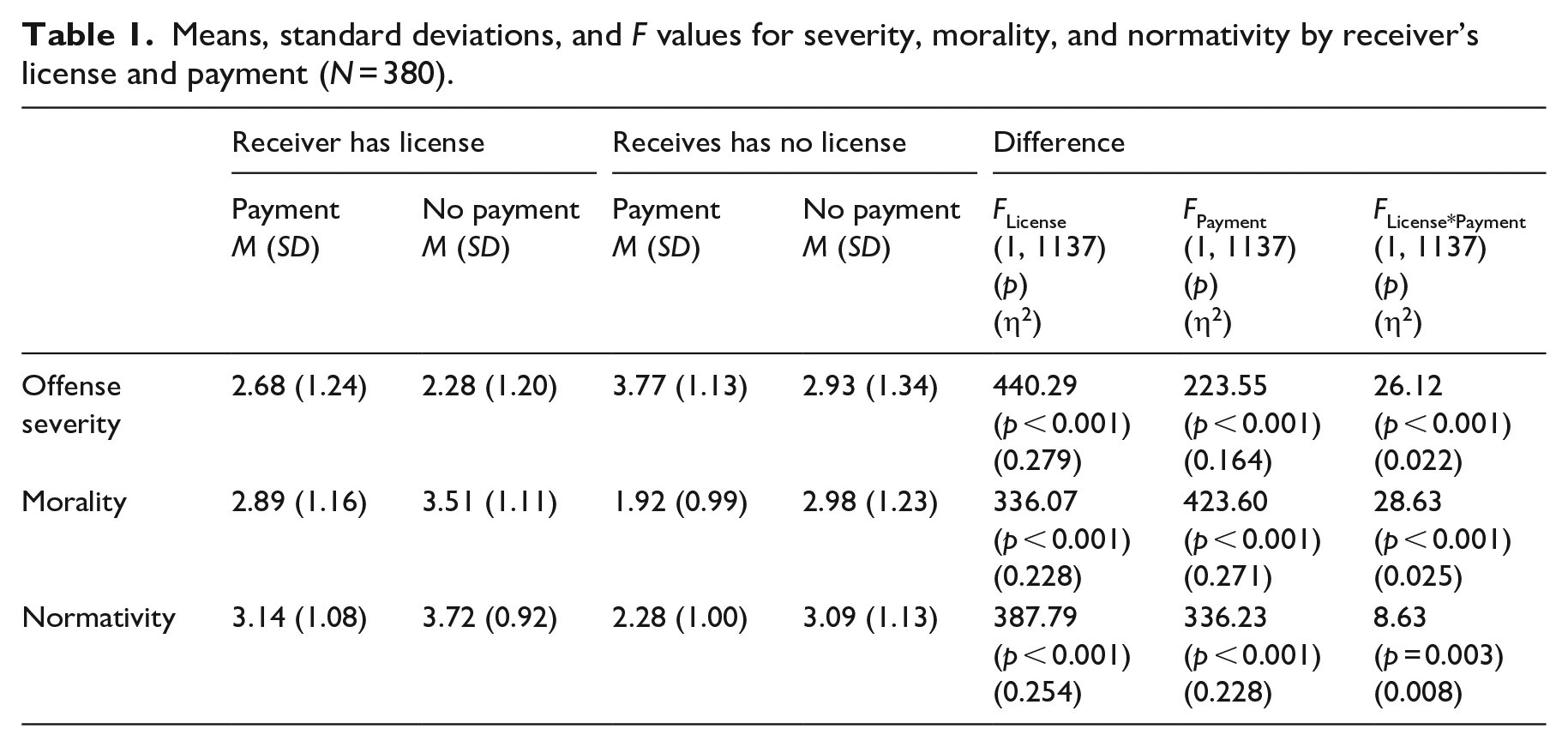
To test our second hypothesis, we examined differences in offense severity, morality, and normativity by the receiver’s license and payment using mixed hierarchical linear models with repeated measures, controlling for gender, years of education, and level of religiosity (Table 1).
Means, standard deviations, and F values for severity, morality, and normativity by receiver’s license and payment (N = 380).
Offense severity
Both main effects and the interaction term were found significant. Overall, the offense was assessed as more severe when the receivers had no license (Adjusted M = 3.35 SE = 0.05) than when they did (Adjusted M = 2.48 SE = 0.05), and when payment was involved (Adjusted M = 3.22 SE = 0.05) than when it was not (Adjusted M = 2.61 SE = 0.05) (F(1, 1137) = 26.12, p < 0.001, η2 = 0.022). Post hoc estimated marginal means revealed that pairwise comparisons of payment within license and license within payment were all significant, and showed different extents of discrepancies. The offense was considered more severe when payment was involved than when there was no payment, and more so when the receivers had no license (F(1, 1137) = 201.25, p < 0.001, η2 = 0.150) than when they did (F(1, 1137) = 48.42, p < 0.001, η2 = 0.041). Likewise, the offense was considered more severe when the receivers had no license than when they did, and more so when payment was involved (F(1, 1137) = 340.45, p < 0.001, η2 = 0.230) than when there was no payment (F(1, 1137) = 125.96, p < 0.001, η2 = 0.100). Thus, absence of license with payment was considered to be most severe, followed by no license and no payment and by license with payment, the least severe offense being in the case when the receiver had a license and no payment was involved.
Morality
Both main effects and the interaction term were found significant. The act was considered to be more moral when the receivers had a license (Adjusted M = 3.20 SE = 0.05) than when they did not (Adjusted M = 2.45 SE = 0.05) and when there was no payment (Adjusted M = 3.25 SE = 0.05) than when there was (Adjusted M = 2.40 SE = 0.05) (F(1, 1137) = 28.26, p < 0.001, η2 = 0.025). Again, pairwise comparisons of payment within license and license within payment were all significant, showing different extents of discrepancies. The act was considered to be more moral when there was no payment than when there was, and more so when the receivers had no license (F(1, 1137) = 336.23, p < 0.001, η2 = 0.228) than when they did (F(1, 1137) = 116.00, p < 0.001, η2 = 0.093). Likewise, the act was considered to be more moral when the receivers had a license than when they did not, and more so when there was payment (F(1, 1137) = 280.43, p < 0.001, η2 = 0.198) than when there was not (F(1, 1137) = 84.27, p < 0.001, η2 = 0.069). Thus, the act was considered most moral in the presence of a license and no payment, followed by no license and no payment and by license with payment, the least moral act being in the case when the receiver had no license and payment was involved.
Normativity
Results for normativity are similar to those for morality. Both main effects and the interaction term were found significant. The act was considered to be more normative when the receivers had a license (Adjusted M = 3.43 SE = 0.05) than when they did not (Adjusted M = 2.68 SE = 0.05) and when there was no payment (Adjusted M = 3.40 SE = 0.05) than when there was (Adjusted M = 2.71 SE = 0.05) (F(1, 1137) = 8.63, p = 0.003, η2 = 0.008). Regarding the interactions, the act was considered to be more normative when there was no payment than when there was, more so when the receivers had no license (F(1, 1137) = 226.29, p < 0.001, η2 = 0.166) than when they did (F(1, 1137) = 118.57, p < 0.001, η2 = 0.094), Likewise, the act was considered to be more normative when the receivers had a license than when they did not, and more so when there was payment (F(1, 1137) = 256.05, p < 0.001, η2 = 0.184) than when there was not (F(1, 1137) = 140.37, p < 0.001, η2 = 0.110). Thus, the act was considered to be most normative in the presence of a license and no payment, followed by no license and no payment and by a license with payment, and least normative in the case when the receiver had no license and payment was involved.
Figure 1 presents the significant license by payment interactions, for offense severity, morality, and normativity.
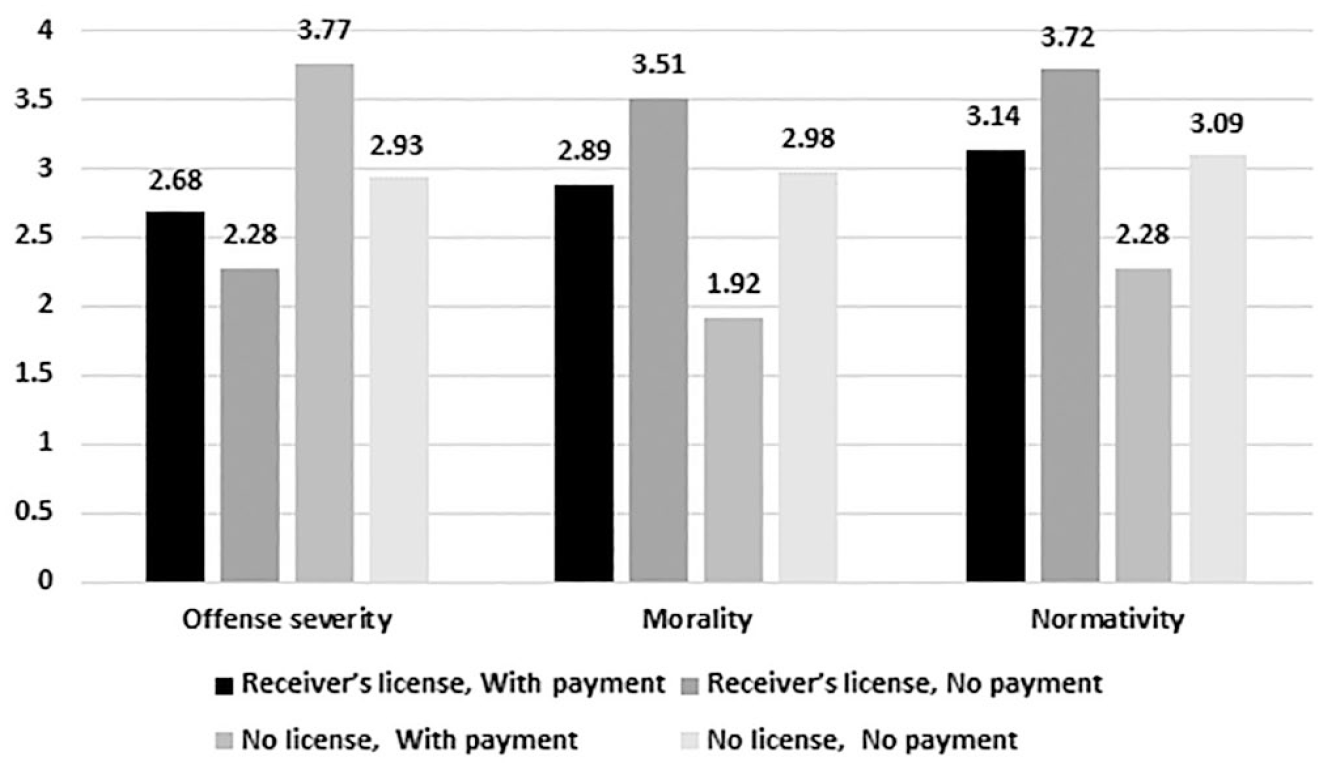
Offense severity, morality, and normativity by receiver’s license by payment.
Licensed family members and attitudes toward trafficking
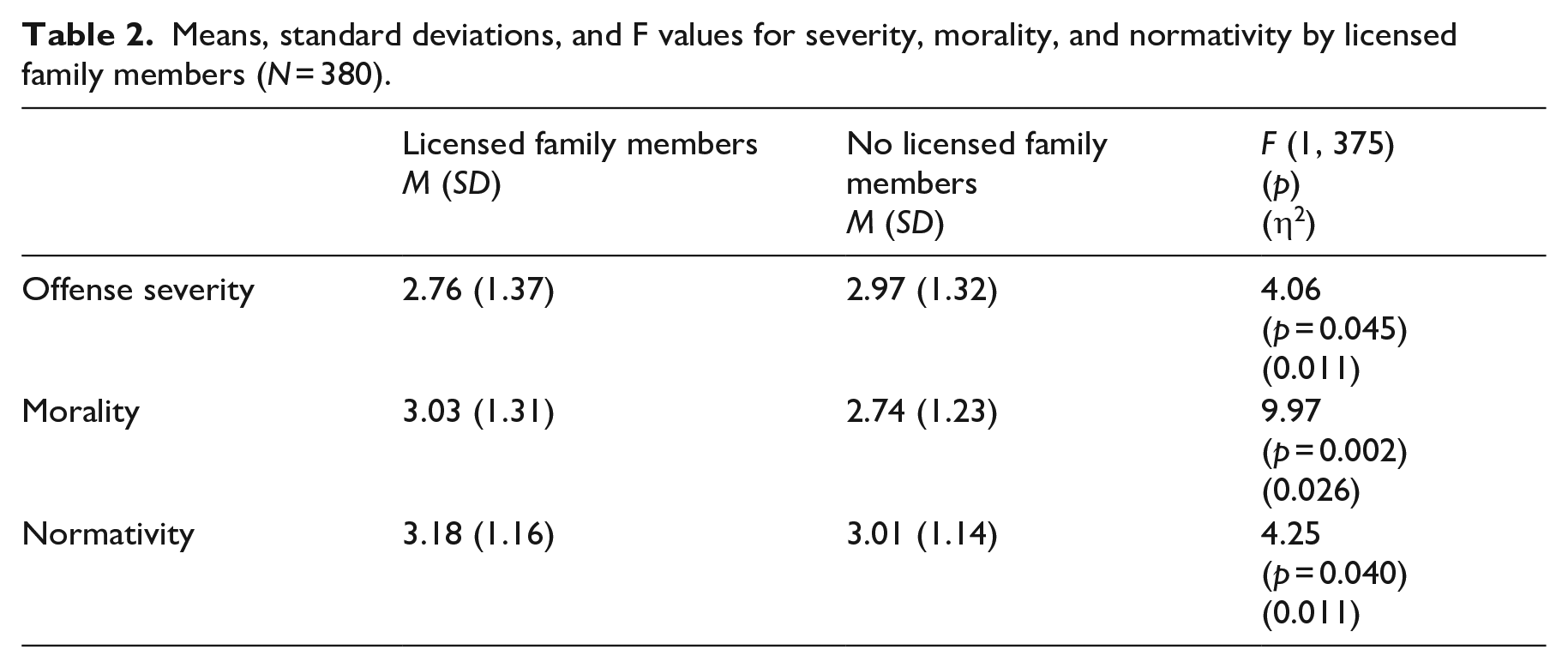
To examine differences in offense severity, morality, and normativity by licensed family members, we calculated mixed hierarchical linear models for the study variables, beyond scenario, by licensed family members (yes/no), and controlling for gender, years of education, and level of religiosity (Table 2). Significant differences were found, although showing small effect sizes. Participants who had family members holding a license for cannabis use showed lower mean scores for severity of the offense and higher mean scores for morality and normativity (Adjusted M = 2.75, SE = 0.09; Adjusted M = 3.04, SE = 0.08; Adjusted M = 3.19, SE = 0.07, respectively) than did participants who did not have licensed family members (Adjusted M = 2.97, SE = 0.06; Adjusted M = 2.73, SE = 0.05; Adjusted M = 3.00, SE = 0.05, respectively), confirming the third hypothesis (F(1, 375) = 4.06, p = 0.045, η2 = 0.011; F(1, 375) = 9.97, p = 0.002, η2 = 0.026; F(1, 375) = 4.25, p = 0.040, η2 = 0.011; respectively).
Means, standard deviations, and F values for severity, morality, and normativity by licensed family members (N = 380).
Discussion
The use of medical cannabis has become common in the last three decades and at the same time more acceptable socially (Isralowitz et al., 2021). Many studies have examined social attitudes toward the use of medical cannabis, but so far perceptions regarding its diversion have not been tested. By contrast, prescription drug diversion is a well-known phenomenon in the research literature (McCabe et al., 2014; Reed et al., 2020), but it has not yet been examined for medical cannabis, despite the knowledge that the use of cannabis without medical supervision may have serious consequences for physical and mental health in both the short and long terms. The present study fills this research gap. Public perceptions of medical cannabis diversion have significant effects on public behavior and are important for guiding policy regarding medical cannabis-related laws.
The findings of the study show that although participants received advance information about the severity of medical cannabis diversion as a drug trafficking offense that carries a prison sentence of up to 20 years, they perceived offense severity as moderate, and the perpetrators’ actions as moderately or more moral and normative. Furthermore, in accordance with the first hypothesis, a negative correlation was found between the perception of the seriousness of the offense and the perception of its normativity and morality.
Studies that have examined the relationship between attitudes toward law and compliance with the law have found that moral justification of the law and its conformity to social norms play an important role in predicting compliance with the law (LaRose and Kim, 2007; Wingrove et al., 2011). In a review of the literature, Tyler (2021) examined motivations related to compliance with the law or its violation and found five relevant psychological structures, two of which relate to the morality of the law or the offense and their normative perceptions. According to Tyler, people comply with the law if they believe that committing an illegal act is against their personal moral perceptions. Tyler also reviews several articles that have found a connection between social norms and intent to commit illegal acts (Tyler, 2021).
This connection also allows for the opposite interpretation: moral justification for committing an offense and norms that support it can lead to a violation of the law. For example, Heyes and Boardley (2019) examined the illegal use of prescription drugs to improve academic performance. In in-depth interviews they conducted with illegal users, they found that the moral justification of the offense and the perception of it by family and friends had great weight in the decision to make the illegal use. The implication of the present study is that a perception that cannabis diversion is a low-severity offense, together with its moral justification and a perception of social support, can lead to a significant diversion of medical cannabis and serious drug trafficking by normative individuals.
Two theoretical explanations, which combine the domains of content of law and morality, may be proposed for the normative and moral perceptions of medical cannabis diversion. The two explanations have to do with the fact that in some cases, as in the scenarios presented in this study, these offenses are committed out of compassion for another. It is possible that the diversion of medical cannabis to another sick person, or to alleviate a difficult financial situation following illness, elicited in participants a feeling of compassion toward the patients, causing the offense to be considered less severe. This is especially noticeable in the attitudes toward those who diverted cannabis for a fee as opposed to those who did it for free. The first explanation is based on Shaver’s defensive attribution theory (Shaver, 1970) and the element of similarity that evaluators or judges share with the person they evaluate. Judgment is made based on two types of similarity: situational and personality. Situational similarity concerns the likelihood of the judges finding themselves in the same situation or in a situation similar to that of the victim or offender (Levy and Rozmann, 2023; Rozmann and Levy, 2021). It is possible that in the case of medical cannabis diversion, study participants could picture themselves being ill or in need of medical cannabis, which affected their judgment.
The second explanation for the mitigating perceptions of medical cannabis diversion may be based on Kohlberg’s moral theory (Kohlberg and Hersh, 1977), according to which people at the postconventional level of morality agree to break the law when they sense a conflict between the law and their moral perceptions. Compassion for patients or those in need of medical cannabis may have overshadowed the notion that it is mandatory to comply with the law at all costs. There is no extensive research literature on cases where offenses are committed out of compassion, other than studies dealing with euthanasia (Miziara and Miziara, 2021). The present study provides another example of the conflict that arises in these cases, and identifies the need for further research on compassionate offenses. These theoretical explanations are reinforced by the significant difference between people whose family members are people with cannabis license and those who are not. Personal acquaintance with patients appears to have led to a higher sense of empathy and compassion toward them, which in turn led to more tolerant attitudes toward breaking the law in the case of medical cannabis diversion.
Limitations and future studies
The study distinguishes between participants who have relatives with a medical cannabis license and those who do not, establishing moral compassion as a variable that justifies breaking the law. Yet, the study did not examine the differences between recreational people that use cannabis and participants who do not use cannabis at all. It is possible that attitudes toward the diversion of medical cannabis are influenced by attitudes and the use of cannabis for non-medical purposes as well. This issue deserves to be examined further.
Another limitation concerns the external validity of the study. Although the study focused on Israeli law and the perceptions of the Israeli public, it is relevant to many other countries. The review of the literature shows that medical cannabis is diverted in many countries, including the US (Nussbaum et al., 2015; O’Connell et al., 2022) and South America countries (Fairman, 2016). However, the external validity of the study is limited, since its findings cannot be generalized to countries where the use of cannabis has been legalized or where medical cannabis is not authorized.
As mentioned, only a few studies have been conducted in the world regarding the diversion of medical cannabis. Further studies are also needed to investigate the prevalence of the phenomenon and the variables associated with it, especially for those who hold medical cannabis licenses. In addition, it is suggested to examine the public’s attitudes toward cannabis diversion in cases where the recipient does not need cannabis for medical reasons, as well as the effect of the subjects’ perception of risk (the chance that they will be caught and punished for this offense) on their attitudes.
In the Western world and particularly in Israel, the attitude toward medical cannabis and the official policy toward medical cannabis change frequently. The findings of the study lead to the conclusion that there is a significant gap between the public perception in Israel of the severity of medical cannabis diversion, its morality, and normativity on one hand, and the severity of the offense as expressed in the law and the punishment for violating it on the other. Policymakers should acknowledge the prevailing public perceptions and review policy compliance (Sznitman and Bretteville-Jensen, 2015).
Footnotes
Data sharing statement
The current article is accompanied by the relevant raw data generated during and/or analysed during the study, including files detailing the analyses and either the complete database or other relevant raw data. These files are available in the Figshare repository and accessible as Supplemental Material via the SAGE Journals platform. Ethics approval, participant permissions, and all other relevant approvals were granted for this data sharing.
Declaration of conflicting interests
The authors declared no potential conflicts of interest with respect to the research, authorship, and/or publication of this article.
Funding
The authors received no financial support for the research, authorship, and/or publication of this article.
Ethics approval
The study was approved by the Ethics Committee of Ariel University. approval number- au-soc-vnh-20220125
