







Abstract
Palestinians living under Israeli occupation experience significant political violence, resulting in high levels of post-traumatic stress disorder (PTSD) and traumatic stress. To effectively support Palestinians affected by trauma, it is essential to understand the culturally specific ways in which they interpret and cope with political violence. This study employs interviews conducted in 2022-23 with 20 Palestinian participants (mean age = 34.4 years, SD = 15.65, range = 19–73) who have lived under Israeli occupation. The research explores how Palestinians conceptualize trauma and the coping mechanisms they employ. A phenomenological analysis of interview transcripts, emphasizing participants’ subjective experiences, reveals four central themes: (1) narratives of trauma were not centered on individual suffering but rather on bearing witness to the suffering of others; (2) the establishment of trust and interpersonal relationships was critical to coping with traumatic stress; (3) participants reframed their trauma within the broader collective Palestinian narrative, often by contextualizing their experiences in relation to those who had suffered more severely; and (4) participants found agency through acts of resistance, particularly by educating others about Palestinian experiences under occupation. We interpret these findins through a comparative lens, contrasting the individualistic medical model of PTSD and trauma recovery with culturally sensitive approaches to trauma and resilience. The study underscores the significance of social support, sumud (steadfastness), and collective resistance in aiding in the management of traumatic stress. These insights have practical implications for therapists working with Palestinian populations and individuals from collectivist cultures, highlighting the importance of culturally informed coping mechanisms in such contexts.
Everyday Palestinian resistance, resilience, and recovery to violent Israeli occupation
Palestinian civilians are subjected to violent attacks by Israeli soldiers and Jewish settlers, as well as home demolitions, bombing, and forced displacement (Anera, 2022; Goleman, 2000). Since October 7th, 2023 violence against Palestinians has escalated, with reports of ethnic cleansing and the mass killing of civilians in Gaza. The persistent and unpredictable nature of political violence—including military assaults, bombings, and arbitrary arrests—undermines individuals’ sense of control and exacerbates symptoms of traumatic stress (Chen and Koenig, 2006). Living under a settler-colonial regime that seeks to displace Palestinians from their ancestral land results in profound psychological distress, including experiences of vulnerability, humiliation, and loss of dignity (Giacaman et al., 2007). The occupation inflicts both visible physical injuries and profound psychological wounds (Giacaman, 2018). The traumatic stress experienced by Palestinians can be understood through both Western psychological frameworks and indigenous conceptualizations of trauma, highlighting the need for culturally sensitive approaches to mental health and resilience.
From a Western psychological lens, individuals who have experienced an acute traumatic event resulting in debilitating and impaired life functioning are commonly diagnosed with Post-Traumatic Stress Disorder (PTSD) (American Psychiatric Association, 2022). The PTSD diagnosis was created to treat individuals such as soldiers returning from war and sexual abuse survivors (Herman, 2015). Unlike soldiers returning from war or abuse survivors, Palestinians do not experience the “post” component of the PTSD diagnosis because the traumatic stress of the occupation is ongoing (Helbich and Jabr, 2022). Furthermore, because Palestinian trauma is grounded in political violence, mental health workers and researchers have questioned whether biomedical diagnoses such as PTSD are applicable to the Palestinian experience given that the trauma they experience is not individual but is collective in nature (Afana et al., 2020; Giacaman, 2018). The diagnosis of PTSD poses a threat to the dignity of Palestinians by framing their experiences as a psychiatric disorder rather than addressing the political oppression that underlies their traumatic stress. Given that Western powers actively sponsor violence against Palestinians, the use of diagnostic categories developed in Western institutions further jeopardizes Palestinian self-determination by undermining indigenous knowledge systems for coping with trauma (Veronese, 2021; Veronese and Kagee, 2024).
The goal of this research is to contribute to the current understanding of trauma, recovery, and endurance in the context of political violence and collective trauma experienced by Palestinians. We examine the phenomenology of life under occupation and its psychological consequences through interviews with a sample of Palestinians. We ask how Palestinians interviewed make sense of their trauma. Additionally, we ask what mechanisms they use to cope with ongoing threats and violence targeted at them. Finally, we ask how can the experience of Palestinians living under settler colonial occupation expend Western understanding of trauma?
A brief background on Palestine
Following World War I, the British Empire gained control over Palestine (Dunning, 2019). The British subsequently issued the Balfour Declaration, which endorsed the establishment of a Jewish homeland in Palestine (Cohen, 2020). In 1948, Jewish leaders declared the establishment of the State of Israel, leading to the Nakba—a term meaning “catastrophe” —which refers to the mass displacement of Palestinian natives, forcing millions into refugee status across various parts of the world (Gluck, 2008). During the 1967 war, Israel seized control of the West Bank and Gaza Strip, placing these territories under military occupation (Pappé, 2017). For the past decades, Israeli authorities have maintained control over these areas, implementing policies that include extensive surveillance, checkpoints, arbitrary imprisonment, and mass arrests. The occupation has been marked by recurrent violence against Palestinians, including the use of lethal and non-lethal force—such as rubber bullets, grenades, and airstrikes—as well as ongoing displacement (Durante and Zhuravskaya, 2018). In the occupied territories, Israeli authorities impose severe restrictions on Palestinians, limiting access to essential resources such as water, electricity, housing, healthcare, and food (Anera, 2022). Since October 7, 2023, violence against Palestinians has escalated significantly. In Gaza, Israeli military operations have resulted in widespread destruction of homes, extensive civilian casualties, ground offensives, forced displacement, and actions described as genocidal. Simultaneously, Palestinians in the West Bank continue to experience intensified attacks by both settlers and Israeli soldiers, displacement from their homes, and what has been characterized as ethnic cleansing from their lands.
Trauma and recovery from a Western lens
Research using a Western medical lens finds high levels of PTSD among Palestinians (Marie et al., 2020). The PTSD diagnosis follows a traumatic event, such as exposure to physical assault, sexual assault, a natural disaster, or threatened death (American Psychiatric Association, 2022). Some symptoms that people with PTSD have include, “hypervigilance, sleep disturbance, avoidance, detachment, irritable behavior, and persistent negative emotional state” (American Psychiatric Association, 2022: 271). A large samples of quantitative studies of Palestinians indicate high levels of PTSD. Whereas only 8.7% of people in the United States experience PTSD symptoms (Marie et al., 2020), 57% of Palestinians in the West Bank, in Gaza 70% of adults and 91% of children report symptoms related to PTSD (Aghajanian and Finn, 2022; TRT World, 2021). One study with over 500 children from Gaza found that 98% reported trauma, such as seeing mutilated bodies and jet fighters, which later produced PTSD symptoms (Thabet and Thabet, 2015).
Judith Herman (2015) wrote one of the foundational texts about psychologists’ understanding of trauma, including PTSD and processes of recovery. Herman (2015) describes three distinct stages for recovering from traumatic stress: establishing safety, remembrance and mourning, and reconnection with ordinary life. In the first stage, Herman (2015) emphasizes the importance of restoring the client’s control over their environment in order to establish safety and empower the individual. The second stage focuses on retelling the trauma and mourning the person’s loss in that experience (Herman, 2015). This stage is essential because it helps the survivor both to transform a subjectively confusing trauma into one consisting of facts and to grieve what happened to them, eventually leading to healing (Herman, 2015). In the third stage individuals reconnect with their community by sharing their stories and helping others (Herman, 2015).
Local approaches to Palestinian trauma
Most Western approaches to trauma, such as research on PTSD and Herman’s (2015) model of trauma recovery, are focused on individuals. Individualized approaches to trauma have been critiqued by Palestinian researchers and mental health experts because using a biomedical approach can be reductive and decontextualizing. Such approaches can lead to the pathologization of victims as opposed to the oppressors who perpetrate brutal violence (Giacaman, 2018; Helbich and Jabr, 2022; Marshall and Sousa, 2017). In the context of political violence against a collective community, trauma is better understood as social suffering. The concept of social suffering can account for the collective aspect of violence and its impacts on the individual (Giacaman, 2018). Social suffering encompasses trauma that is caused by a traumatic event that directly harms an individual (e.g. being shot at or beaten by soldiers) as well as those that indirectly harm an individual such as bearing witness to traumatic events occurring to others (Giacaman et al., 2007). According to the social suffering model, life under occupation brings forth varying degrees of violence, humiliation, loss of dignity, vulnerability, and physical harm (Giacaman et al., 2011). Under these conditions, individuals oscillate within the ease and disease continuum (Giacaman, 2018). According to Giacaman et al. (2011), the ease end of the continuum associated with social and mental well-being is described by participants as a sense of safety at home and a sense of familial connection and love. The middle range of the same continuum is associated with feelings of unhappiness (mish mabsut) and low energy (mish habet). More negative themes at the disease end of the continuum, such as major shock (sadma), tragic loss (faji’a), and long-lasting traumatic events (musiba), may be related to ailments and diseases (Afana et al., 2020; Diab et al., 2023; Giacaman et al., 2011).
Researchers studying processes of trauma and recovery often note that marginalized populations face stereotypes that depict them as naturally strong when seeking treatment for trauma (French et al., 2020). In the case of Palestinians, they are often depicted as naturally resilient because of their endurance of over 70 years of occupation. Expecting Palestinians to be resilient obscures the violence of occupation, their suffering, and their humanity, and absolves international leaders from addressing the problem of Israeli occupation (Shwaikh, 2023; Veronese and Kagee, 2024). Instead of resilience, Palestinian mental health experts offer the concept of sumud to understand processes of endurance and resistance among Palestinians (Meari, 2014). Rita Giacaman (2020), a leading Palestinian mental health expert, writes: On the whole, we think that the notion of capacity to endure and resist is more applicable to or more explanatory than ‘resilience’ given our situation and our mindset. We think of it as a combination of agency, normalizing the abnormal, social support and social solidarity, the notion of Sumud (sticking to the land), the moral imperative being ours and the strength and power we draw from knowing that we are seeking justice for ourselves, our families and our nation (2020, p. e371).
Sumud is a value and cultural practice that plays an important role in endurance and recovery from trauma (Hammad and Tribe, 2021; Meari, 2014; Sheehi and Sheehi, 2021). Actions related to sumud correspond with radical forms of healing depicted by therapists working within the liberation psychology tradition (Marshall and Sousa, 2017).
Sumud and radical forms of healing highlight the importance of developing collective ties and social capital to endure trauma (Barber, 2001). From a liberation psychology perspective, the first stage of trauma recovery is developing dialogue and relationships to transform reality. In the second stage, there is an analysis of the conditions of oppression. Individuals develop an intersectional critical consciousness that understands individuals’ oppression as systemically and historically rooted (Jabr and Berger, 2021; Veronese and Kagee, 2024). Finally, resistance occurs through agentic actions such as sticking to the land, fighting back against racism, and colonial violence (French et al., 2020; Marshall and Sousa, 2017; Meari, 2014; Veronese et al., 2018; Veronese and Kagee, 2024).
Actions that help create sumud (steadfastness) among Palestinians include maintaining strong social ties (Afana et al., 2020; Veronese et al., 2023). Barber (2001) finds that strong social ties among families, in schools, and in a neighborhood (i.e. social capital) are buffers in protecting the mental health of children involved in the Intifada. Veronese (2021) interviewed 21 Palestinian women and found that family support was critical for these women’s coping; one interviewee explained, “marriage. sons. family. The important thing is that we are together. This is the positive effect of love, compassion, and cooperation” (Veronese, 2021: 19). The research shows how communicating with family and seeking support from people with whom individuals have a solid bond can help people facing intense hardships, including living in constant fear of losing their lives to an attack. Altogether, social support and social capital are critical to sustaining Palestinians’ sumud in the face of settler colonialism.
Sumud and radical healing frameworks highlight the importance of forming a critical consciousness among members of colonized communities that understands one’s experiences as historically grounded in interlocking forms of oppression (French et al., 2020). Research on sumud indicates that it is practiced by Palestinians through the construction of collective identity grounded in Palestinian history and heritage. Palestinian people of different generations construct their identity in relation to the trauma of the Nakba (the violent displacement of Palestinians from their homes in 1948). The loss of native lands, the ongoing dispossession, the ethnic cleansing, and the massacres form the Palestinian collective narrative that helps Palestinians make sense of their ongoing trauma and sustained perseverance (Giacaman, 2020; Hammad and Tribe, 2021). Veronese et al. (2023) explain how collective narrative functions across generations, the rhetoric of the refugee camp symbol the right of return to the raja’a (homeland), the keys conserved by the elders and evoking the homes of already destroyed villages enact collective processes of healing and remembrance that foster well-being and amal (hope) over three generations (p. 1821).
The Palestinian collective narrative serves as a form of critical consciousness that assists people of different generations make sense of the daily systematic trauma of life under occupation (Veronese et al., 2023). Barber (2008) compared Bosnian adolescents with Palestinian adolescents (both members of groups who experienced war and ethnic cleansing) and found that because Palestinian adolescents were equipped with a collective narrative that helped them make sense of their loss, they were less likely to experience mental health problems compared to Bosnian adolescents. Moreover, by understanding one’s trauma, not as personal, but as collective, Palestinians are able to engage in processes of social comparison accounting for the ways in which their personal trauma could have been worse (Hammad and Tribe, 2020). Understanding trauma through the lens of a collective narrative can assist in reducing maladaptive forms of trauma response such as self-blame and social withdrawal that are observed among members of populations who experience war in places such as Syria and Uganda (Amone-P’Olak and Omech, 2020; Khamis, 2021). Arising from the Palestinian narrative of indignity and dispossession due to Israeli occupation are traits related to sumud such as steadfastness, patience, dignity, and perseverance (Hammad and Tribe, 2021).
A final way in which sumud, in accordance with radical forms of healing, helps Palestinians cope with trauma is through agency and resistance (Veronese et al., 2017). When Nguyen-Gillham et al. (2008) interviewed over 300 high school students from 15 schools in the West Bank, they found that a common theme across participants was political participation, as displayed by throwing stones at Israeli soldiers, participating in street demonstrations, and fighting through education (Nguyen-Gillham et al., 2008: 295). Young Palestinians are motivated to resist the occupation not only to attain justice and freedom, but to integrate their identity as a member of a colonized and dispossessed group with a sense of personal agency (Barber, 2009). Participation in political activism in the Intifada (e.g. demonstrating, building barricades, helping injured protesters, and throwing stones) was associated with a greater sense of personal growth, religious commitment, and well-being (Barber and Olsen, 2009; Veronese et al., 2018). In a community-based study with Palestinian families, participants suggested that despite risks to their safety, engaging in Intifada activism helped protect them against internalizing oppression (Atallah, 2017). When discussing their well-being, Palestinians pointed to the importance of solidarity and collective self-determination in helping them cope with the occupation (Barber et al., 2016).
The present study
In this study, we examined the ways in which Palestinians make meaning of their trauma living under occupation and the processes with which they cope with settler colonial violence and injury. Our research questions are:
How do Palestinians make meaning of their traumatic stress in the context of settler colonial occupation?
Living under colonial occupation, what processes do Palestinians utilize to cope with traumatic stress?
How can the experience of Palestinian living under settler colonial occupation expend Western understanding of trauma?
To answer these questions, we conducted interviews with 20 people who were living in or had lived in Palestine. Through in-depth interviews with a diverse sample of Palestinians we identify themes in how Palestinian make sense of traumatic stress and cope with it.
Method
Ethics approval statements
This study received ethics approval from the California State University, Fullerton IRB (approval #HSR-21-22-3) on July 14, 2022. All participants provided written informed consent prior to enrolment in the study. At the onset of the interview participants were informed in writing and verbally by the interviewer that they can stop the interview at any time. This research was conducted ethically in accordance with the World Medical Association Declaration of Helsinki. All interviews were conducted on Zoom. All electronic data and raw audio recordings have been destroyed to protect participants; anonymized transcripts are stored on a secure, password-protected computer.
Participants
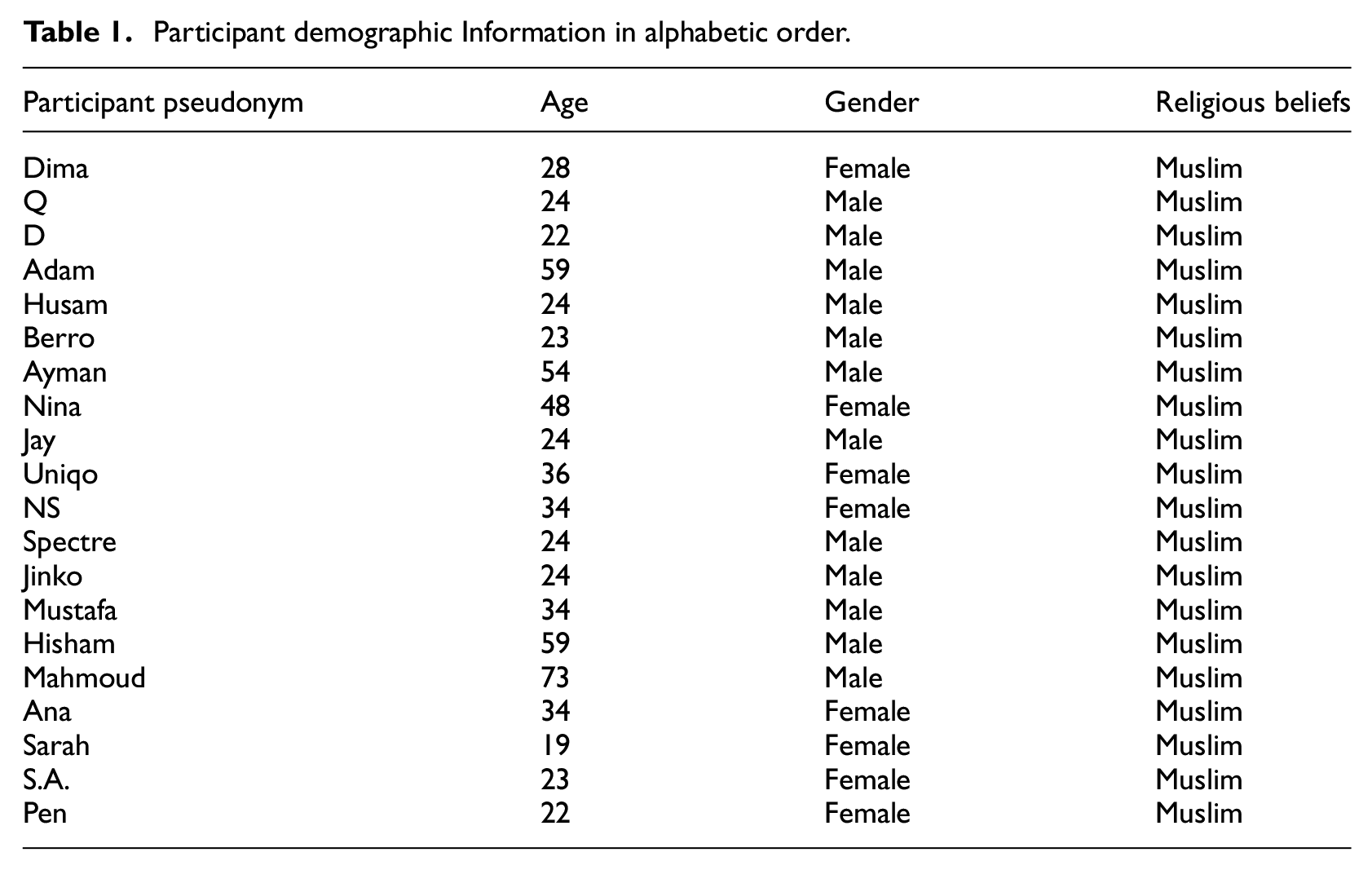
Interviews were conducted between July 2022 and July 2023. The 20 participants were recruited to interview through convenience and snowball sampling. Participants were recruited through a digital flyer, person-to-person solicitation, phone call, email, and social media. Many of the participants were recruited through a connection working in a local university in the West Bank and some through Palestinian community and family connections in California. The inclusion criteria for this study included being 18 years of age or over, fluent in English, of Palestinian descent, and of living under Israeli occupation at some point in their life. The ages of interviewees ranged from 19 to 73. Eight participants identified as women, 12 as men, and all interviewees identified as Muslim (see Table 1).
Participant demographic Information in alphabetic order.
Interview protocol
Interview questions were drafted by the first author based on a literature review and were reviewed and revised with the help of the second author. All interviews were conducted on Zoom in English. The interviews were audio recorded and transcribed verbatim. All interviews were conducted by the first author a Muslim Palestinian American woman. The interviewer is a Palestinian whose family were displaced from Jaffa and live in the US and Jordan. She visited but never lived in Palestine. Before beginning the interview, the participants were told that the research goal was to understand Palestinian coping mechanism while living under occupation. Participants were informed that they can stop the interview at any time if they felt uncomfortable. At the beginning of the interview, participants answered demographic questions (e.g. age and religious beliefs). In the second part of the interview was semi-structured, participants responded to questions regarding their experiences under occupation. For instance, “Tell me about an experience you lived through while in Palestine that has been difficult to overcome.” In the third part of the interview, participants answered questions regarding sources of resiliency in their lives, such as “What coping mechanisms did you partake in that you think helped you become more resilient when living in the occupied territory of Palestine?” [See interview questions in the supplemental files].
Steps of analysis
In this research, we followed interpretive phenomenological analysis (Smith, 2008). This approach was chosen because it allows for an in-depth understanding of how people make sense of their experiences. The first author read and reread an initial set of interviews paraphrasing statement made by participants. In the next stage, she coded interviewee transcripts based on meaningful statements. As she continued her analysis by adding more interviews to the sample, certain codes dropped, while other codes developed into superordinate thematic categories. The first author created a theme table that allowed her to analyze the commonalities among codes grouped together into a theme. Themes that became robust through analysis of all interviews are presented below. The first author conducted the analysis of the interviews with the aid of a research assistant. The first author received training and guidance on best practices in analysis from the second author.
Trustworthiness
Audit trail and engagement in data collection: To ensure trustworthiness (Merriam, 2002), we took several measures. First, the first author wrote extensive memos throughout the process that allowed her to reflect on her assumptions and monitor how they shifted through the analysis. For instance, when the first author began analysis, she initially thought religion would play a substantial role in how Palestinians cope with trauma. Being Muslim, she was surrounded by people who share the same beliefs as her, who would all state that resiliency comes from God and depends on faith. However, her position shifted to a focus on political resistance as an important way in which Palestinians cope with the occupation. Second, the data was analyzed carefully for over a year; emerging themes were carefully checked with subsequent interviews. Third, the first author conducted participant checks by sharing the study findings with the participants and asking for their feedback. Most of the participants were not interested in learning about the findings, but the three participants who did share their feedback reported overall agreement, with one suggesting the title of this study.
We engaged in reflexivity about our positionality. The first author is a Palestinian American, and the second author is a Jewish Israeli American. Both are politically committed to ending the occupation of Palestine and support Palestinian resistance, liberation, and self-determination. Their epistemological stance is grounded in IPA constructivist approach which emphasizes understanding participants’ experiences while recognizing that this understanding is shaped by the investigator’s own background knowledge and positionality. We acknowledge the subjectivity of our interpretation. To increase reflexivity, the first author, who led the analysis, maintained memos to document her understanding of the phenomena and how it evolved as she conducted and analyzed more interviews. The first author was also aided by a Brazilian research assistant who approached the occupation with a sensitivity to universal processes of suffering because they were not familiar with the history and present reality of the conflict. Finally, the positions of the first author as a Palestinian American clinician working in Western context and the second author as a social psychologist led them to be sensitive to experiences of identity and trauma across the sample.
Findings
The first theme we identified pertains to participants describing trauma not in personal terms, but in relation to others. The second theme highlights collective coping mechanisms, wherein participants navigate trauma by connecting with others who share similar experiences. The third theme reveals that participants reframe their traumatic experiences by drawing comparisons between their own hardships and those faced by others. The fourth theme, resistance through existence, reflects how Palestinian participants in our sample engage in everyday acts and disseminate awareness as strategies for coping with the traumatic stress of occupation.
Social suffering
The lives of Palestinians living under occupation and settler colonialism leads to ongoing life threatening as well as systematic intimidation, harassment and violence from soldiers and Jewish settlers. Our analysis of the interviews indicate that in their narratives participants tended to emphasize their fear of others safety rather than their own. Nina discussed how Israeli forces “terrorize [Palestinian] families, and the conflict is not handled humanely.” Rather than telling her personal narrative and experiences of trauma, Nina related her encounters with violence to others in the Palestinian community. Berro also mentioned, “It’s hard for us to see Palestinians get tortured and imprisoned, which I find hard to deal with at times.” In this quote, Berro framed the trauma as a collective experience, not a personal one. In telling about her trauma, Pen explained that she was 8 years old with her cousin, playing in a building before Israeli forces bombed it. Pen said, I saw the roof cave in, and everything was on fire, but that was nothing compared to seeing my cousin dead and crushed under the ceiling. I don’t know how I made it out alive, but my only thought was how I would go home to tell my family that my cousin was gone.
Like other Palestinians who have experienced trauma regarding others, Pen—who has experienced trauma firsthand—talks about the pain of her family rather than her own pain. Her thoughts throughout that experience were with her cousin and not her own traumatic experience.
Ana is of a higher socioeconomic status when compared to most Palestinians in the West Bank. Nevertheless, her relative wealth did not protect her from the trauma of occupation. In her interview, she recalled, My two daughters play soccer every Friday morning. While I was going to pick them up one day, I saw the soldiers throwing tear gas at the kids on the field. All of the kids started running in different directions. I don’t even know how to explain what I saw. One of the first kids who came out of the smoke was my daughter, coughing and running toward me.
The Palestinians interviewed didn’t center their own personal trauma but rather discussed their experience centering the trauma of others. Witnessing other family members suffer and having empathy for other members of the Palestinian community were salient in many participants’ descriptions of trauma.
Connection by shared experiences
Participants’ understanding of their trauma not in personal terms, but in collective terms, was important to the process of coping. Across all participants in our sample, a theme of sharing the trauma with others and seeking support from others was saliant. Participants, like Ana, described seeking help from people with similar lived experiences.
There are days when you just want to grab coffee with a friend or someone you could be vulnerable with. I think it’s been the most helpful thing: people opening their homes and being courteous.
Mahmoud expanded on this idea and explained how, People in Palestine inherit a certain culture. So, we have this mutual interaction with one another. It comes naturally and normally. You talk to someone, and they understand what you are talking about because they went through something similar.
The shared suffering experienced by Palestinians also creates a culture of mutual support and community that provides a safe space for people to share their painful accounts.
Another participant, Nina, highlighted the trust members of the Palestinian community feel toward one another. She said, “If someone in the neighborhood has a problem, then the whole community gets together to help them.” Spectre furthered this concept and discussed how “Palestinians take what [they] take every day and go through it together,” which he thinks creates resiliency. For the Palestinians interviewed, surviving ongoing trauma was made possible by developing collective trust and emphasizing collectivity. As Hisham summarized, “We survive all of this together.” The collectivization of suffering is not pathological for Palestinians, but produces a sense of support.
Comparison of trauma
Our readings of the interviews suggested an additional trend in which participants framed their experience of pain against the knowledge that other Palestinians suffer more. In many interviews participants reframed their experiences of trauma in a manner that highlighted their privilege and fortune. For instance, Jinko said “I had some troubles here and there, but everything is good, and mostly its fine. I didn’t face as many troubles as other people.”
Many of the participants in this study reflected on their experiences, saying, “other people have lived through worse.” In her interview, S.A. described how she learned to reframe her trauma by listening to her dad’s account of his life in an Israeli prison.
I knew, it wasn’t a good experience [for him] being there [in prison], but he thought other people went through worse, and he wanted to see the upside to his experience instead and laughed it off. I really tried to have this mindset and now I see my own experiences as eye-opening. I honestly feel like I’m blessed to be able to experience and understand what it means to be Palestinian and deal with the Palestinian conflict. Many other people were dying, and we could still escape that.
Despite the hardship S.A.’s father experienced and her own hardships, S.A. saw herself as blessed. Her strong collective Palestinian identity encompassed the suffering of others in her understanding of her experience which situated her as fortunate. Like S.A., Mahmoud recalled, I cannot compare [my traumatic experience of seeing the aftermath of my village being bombed] to what other people are going through [in Palestine]. Even though it was hard going through that, I think there are different levels of trauma, and my level isn’t as bad as other people’s levels.
Not seeing one’s sense of self in isolation but in relationship to other Palestinians and their experience of violence allowed people to reconsider the severity of their suffering. Our analysis indicated that many participants reframed their experiences of violence and dispossession trough a lens that also saw themselves as privilege.
Resistance through existence as a coping strategy
Another recurring theme that emerged as a coping mechanism for Palestinians under occupation was resistance. Participants described resistance as rooted in everyday actions and a deep commitment to remaining on the land. The resolve to endure and resist is closely associated with the concept of sumud, which embodies steadfastness, patience, and perseverance in the face of hardship. For instance, Dima explained that, for her, coping was intrinsically linked to staying on the land. She stated, “best resilience method is to just stick to the land no matter what happens and no matter what they do. Hundreds of homes have been damaged by the Israelis, but they still stick to their land, their villages, and they never leave.” Similarly, Husam also emphasized coping through resistance The Israelis see us as a danger to their existence and are struggling to contain us. They have more weapons and better technology, and yet we still fight them toe to toe. Throughout all of this, we are still standing, which means we are on the path to being free someday.
Through steadfastness, there is hope that, over time, Palestinians will overcome the occupation of their homeland. Ayman encapsulates this notion of resistance through existence in his statement: We are in a conflict zone, a country under occupation. We adapt, and we adjust. Palestinians are unique because we are adaptive and aligned with creating hope. We are fighting and living at the same time. We fight, not always in arms, but by staying on our land, raising our families, having universities and schools, and being in touch with the outside world.
By enduring and remaining steadfast under occupation, Ayman and other Palestinians interviewed embody the ethos of sumud. Related to resistance through existence is the importance of raising awareness about the occupation and talking about it on social media. Several participants described their activism focused on education. S.A. explained, I was young when my father and uncles were imprisoned because of how they would revolt against the Israeli forces. I only started to learn what it meant to be Palestinian after my dad went to jail. He always told me not to be afraid and to not worry about anything…he showed me it’s okay to be involved in this and to go against the occupation. I felt responsible for continuing this resistance, so I created a TEDx event to show the world what’s happening and how we’re defending our land. I never wanted to lose that connection to my land, so I started writing a book about what it means to live in Palestine.
Other participants, like Ana and Pen, said they are politically active on social media and post information to educate others on what is still happening in Palestine today. Their goal is to create more Palestinian allies and bring awareness to the occupation of Palestine. This political activism is linked to pride in their Palestinian identities.
Discussion
This study contributes to the existing literature by juxtaposing Western theories of trauma and recovery with an indigenous conceptualization of resilience. Our analysis of the interviews reveals that Palestinians in our sample frequently framed their experiences of traumatic stress in relation to the suffering of others rather than their own. To cope with chronic insecurity and existential threats, participants emphasized the importance of relationships and bonding with others who also endure the violent realities of the occupation. Our findings also suggest that participants tended to engage in downward social comparisons, perceiving themselves as relatively less affected than those who had suffered more severe hardships. Finally, we identified coping through everyday acts of endurance, steadfastness (sumud), and efforts to raise awareness of the Palestinian struggle.
The first theme we identified is the lived experience of social suffering, wherein participants experience trauma that is rooted in the suffering of others. This conceptualization extends beyond the individualized understanding of trauma, which is typically grounded in existential threats to the self (American Psychiatric Association, 2022; Herman, 2015), to encompass trauma derived from bearing witness to and experiencing ongoing social suffering (Giacaman, 2018). This finding aligns with research on Palestinian trauma, which demonstrates that Palestinians exhibit symptoms of depression as a result of witnessing traumatic events affecting others (Giacaman et al., 2007). It supports the conceptualization of Palestinian trauma as both individual and collective, in accordance with the concept of social suffering, which seeks to shift the theorization of Palestinian trauma away from biomedical and individualized frameworks toward a more collective understanding (Giacaman, 2018).
The second theme underscores the importance of social support—particularly from family, friends, and peers—for the Palestinians we interviewed, who described establishing a sense of safety through trust and the strengthening of social ties. Expanding on Western trauma models, which emphasize the creation of safety as crucial to trauma recovery, this finding suggests that, for Palestinians, a sense of safety is primarily rooted in social relationships (Afana et al., 2020; Veronese et al., 2017). This is consistent with the concept of sumud and radical approaches to healing, which emphasize the role of relationships and dialogue in the recovery process (Barber, 2001; French et al., 2020; Marshall and Sousa, 2017). Given that trauma erodes trust between individuals, sustaining mutual connection and solidarity serves as an antidote.
Another key finding emerging from the data is the importance of processing trauma in relation to the suffering of others. This finding expands on individualistic models of recovery, such as Herman’s (2015) model, which posits that the trauma narrative needs to be integrated into a sense of self. By contrast, our findings illustrate how the trauma narrative is constructed in relation to the trauma of others (Amone-P’Olak and Omech, 2020; Khamis, 2021). These findings align with other research on Palestinian trauma, which also underscores the significance of social comparison when reframing and narrativizing trauma (Hammad and Tribe, 2021b). A novel contribution of this study is its demonstration that, when individuals position themselves within a collectivist narrative, they find agency and strength by comparing themselves to others within the collective experience, particularly those who are less privileged. This theme has been relatively understudied and may offer valuable insights for therapists working with individuals who experience collective forms of social suffering and trauma.
The final theme is the importance of embodying the value of sumud and resisting through everyday existence and raising awareness (Giacaman, 2020; Veronese et al., 2023). Across interviews, collective pride practiced through “simply existing and education” was important for recovery. This theme is in line with research that suggests that resistance that integrates individuals’ trauma with their agency helps the recovery process for oppressed groups (Barber, 2008; French et al., 2020). Going through suffering and enduring dispossession and settler colonial violence leads to hope for sustain resistance. Additionally important to resistance is sharing the Palestinian collective narrative. According to Herman (2015), sharing one’s story with a community is an important component of trauma recovery. Our findings suggest that Palestinians understood sharing their collective stories to be a form of resistance.
Limitations
The sampling for this study employed snowball convenience sampling, encompassing a broad range of Palestinian experiences. Most participants resided in Palestine, though some had relocated to the United States or had not spent an extended period of time in Palestine. Additionally, the participants varied in age, with some in their 20s and others significantly older, resulting in diverse perspectives shaped by different historical events. The heterogeneity of our sample limits the possibility of conducting a more in-depth analysis of particular Palestinian experience. Future research should examine how age cohorts, as well as local versus diaspora contexts, influence Palestinian experiences of trauma and coping. The first author, who conducted the interviews and analysis, is a Palestinian American living outside of Palestine. As such, her ability to fully understand the lived experiences of Palestinians is inherently limited and is shaped by the authors positionality of conducting research from the United States. Additionally, due to security and ethical reasons, the first author employed a semi-structured interview approach, and when participants disengaged from certain questions, she allowed them to guide the interview and refrained from probing into potentially painful experience. Consequently, some interviews were shorter and less in-depth than others. While the themes identified in this study may offer valuable insights into psychological reactions to settler colonialism in other regions, they should be viewed as suggestive rather than generalizable. For instance, in countries without a strong collective narrative and culture, settler colonial violence may be constructed differently and have different psychological implications.
Conclusion
A key contribution of this research is its juxtaposition of individualistic and collective models of trauma and recovery. This study offers valuable insights for therapists trained in individualistic approaches by encouraging them to consider collective trauma and resilience. Our in-depth engagement with Palestinian experiences of trauma advances the existing literature by demonstrating how individuals’ narrative positioning within the collective story can foster a sense of strength and agency essential for trauma recovery. In other words, the ways in which individuals situate themselves within a collective narrative contribute to resilience and endurance. The processes of healing are deeply rooted in social relationships, social comparison, and the understanding of one’s experiences within a broader Palestinian narrative. The agency critical to healing is closely linked to resisting the occupation through existence and the act of sharing the Palestinian experience. While therapists and mental health practitioners can play a role in helping Palestinians cope with traumatic stress, the fundamental sources of Palestinian trauma will persist as long as the occupation continues.
Supplemental Material
sj-docx-1-hpq-10.1177_13591053251332705 – Supplemental material for Everyday Palestinian resistance, resilience, and recovery to violent Israeli occupation: An interview study
Supplemental material, sj-docx-1-hpq-10.1177_13591053251332705 for Everyday Palestinian resistance, resilience, and recovery to violent Israeli occupation: An interview study by Abir Ayesh and Ella Ben Hagai in Journal of Health Psychology
Footnotes
Acknowledgements
The authors would like to thank the participants for sharing their experience with us. We would also like to thank Dr. Barbara Cherry, Dr. James Garcia, Dr. Asya Harrison for their comments on earlier version of this research. Students in California State University Intersectional Consciousness Lab, especially Claudia Morris, and Kerri Phan who helped analyze data for this study.
Author contribution
Abir Ayesh conceptualized the study, designed the study, conducted the interviews, analyzed the data, and wrote the first draft of the manuscript including the finding section.
Ella Ben Hagai helped Abir construct the study questions and trained Abir in qualitative data analysis. Ben Hagai helped write parts of the Introduction, final version of the literature review and discussion sections. She also addressed the reviewers’ comments and suggestions.
Data availability statement
In compliance with IRB guidelines, all interview recordings have been destroyed. The interview transcripts, which have been anonymized, are stored on a password-protected computer and cannot be shared due to the sensitive nature of the topics discussed, including the involvement of individuals living under state violence. For privacy and confidentiality reasons, these transcripts are not publicly available. However, aggregate data and analysis may be accessed upon request for research purposes. All data requests will be reviewed in accordance with ethical guidelines and legal constraints.
Declaration of conflicting interests
The authors declared no potential conflicts of interest with respect to the research, authorship, and/or publication of this article.
Funding
The authors received no financial support for the research, authorship, and/or publication of this article.
Ethics approval
Study was reviewed by the Institutional Review Board IRB #: HSR-21-22-385.

References
Supplementary Material
Please find the following supplemental material available below.
For Open Access articles published under a Creative Commons License, all supplemental material carries the same license as the article it is associated with.
For non-Open Access articles published, all supplemental material carries a non-exclusive license, and permission requests for re-use of supplemental material or any part of supplemental material shall be sent directly to the copyright owner as specified in the copyright notice associated with the article.
