






Abstract
Vaccination against highly infectious diseases constitutes a major decision for the sandwich generation. However, a comprehensive understanding of the development of this critical decision is lacking. Toward this end, this study aims to investigate how two contrasting types of social influence, that is, compliance and conformity, distinctively shape the sandwich generation’s self-efficacy about vaccination for themselves, their children, and their parents. A moderated structural equation model was tested on the data collected from 590 voluntary subjects across China. The results reveal that the components of the sandwich generation’s self-efficacy: perceived safety, effectiveness, and trust in vaccines inflict differential effects on their vaccination decisions for themselves, their children, and their parents. Moreover, under high compliance, the sandwich generation shows a higher intention to vaccinate themselves and their parents than their children. Conformity weakens the effects of the sandwich generation’s self-efficacy on their vaccination decisions for the three targets.
Keywords
Introduction
Vaccination, which provides personal protection at an individual level and establishes herd immunity at a societal level, is an effective measure against infectious diseases (Rappuoli et al., 2002). The significance of herd immunity is particularly pronounced in front of highly contagious diseases from the perspective of public health management. Compared with other measures, such as social distancing and mask-wearing, vaccination is a reliable approach to establishing foreseeable immunity (McDermott, 2021). However, people’s willingness to vaccine shows another picture. A recent study investigated peoples’ willingness to take COVID-19 vaccination among 23 countries, and the willingness ratios displayed a large variation between 60% and 80% (Moehring et al., 2023). The highest ratio was still far below the roughly estimated threshold of herd immunity for COVID-19. Therefore, it is important to study how to enhance people’s vaccine acceptance.
Herd immunity upgrades vaccination from a personal medical decision to a social one. The social cognitive theory has thus been relied upon to guide vaccination research in this context. This theory proposes the cycle relationship among three elements, that is, individuals’ self-efficacy, their behavior, and the environment that surrounds individuals’ existence (Scott et al., 2022). Most existing studies on vaccination focus on a part of the social cognitive theory. For example, some scholars have explored how vaccine safety and effectiveness construct self-efficacy and affect the public’s intentions to vaccinate. Another stream of studies have investigated the impact of the environment on vaccination behaviors. Lin et al. (2022) proposed that social pressures change the public’s behavior toward vaccination, and Roy et al. (2022) summarized the differential factors affecting vaccination intentions across regions. However, the other parts of the theory, that is, how peoples’ decisions about vaccination affect the environment and how the environment alters their self-efficacy, have been less studied. The lack of those relations impedes understanding the social cognitive theory in cultivating vaccine acceptance and herd immunity.
This paper aims to close the loop of the social cognitive theory in vaccination decisions from the perspective of the sandwich generation. The sandwich generation refers to the adults who support elderly parents and dependent children and assume primary leadership and decision-making responsibilities in family issues (Chen and Zhou, 2022). The sandwich generation is the critical link connecting the social surroundings and their family matters and accordingly plays a pivotal role in vaccination decisions for their families (Kowal et al., 2020). They receive information from the environment to help them make vaccination decisions, which are not only for themselves but also for their parents and children, a part of the environment surrounding the sandwich generation. Specifically, this paper constructs a behavioral closure of the social cognitive theory: the sandwich generation’s development of self-efficacy about vaccination, the influence of the social environment on altering this development, and the sandwich generation’s vaccination decisions for their children and parents.
Various opinions and measures about vaccination emerge and eventually develop into collective beliefs about vaccination. These collective beliefs will inflict social influence on the construction of the sandwich generation’s self-efficacy about vaccination. Most of the extant literature recognizes the direct effects of social influence. For instance, social influence helps increase an individual’s willingness to vaccinate (Devonish and Dulal-Arthur, 2022). However, there is a dearth of research on the moderating effects of social influence on vaccination acceptance. The social influence theory posits that behavioral decisions in a given environmental context are highly correlated with two contrasting social influences: compliance with requirements by authoritative institutions and conformity to social norms (Pugsley and Acar, 2020). Compliance and conformity will bring about different levels of decision autonomy (Capuano and Chekroun, 2024), which governs decision makers’ evaluation of external information to develop their self-efficacy. This paper will explore how the two types of social influence differently tune the effects of the sandwich generation’s self-efficacy on their vaccination decisions.
Moreover, the sandwich generation is responsible for making vaccination decisions for their children and parents, two distinct groups within the social environment. They differ in custodial requirement and decision autonomy on critical decisions such as vaccination. Unfortunately, current studies on vaccination do not show much respect for differences but just examine vaccination for groups independently, for example, adults’ vaccination decisions for their children (Evans et al., 2021). Thus, it is necessary and meaningful to investigate those vaccination decisions from the perspective of the sandwich generation simultaneously. Furthermore, we would also like to investigate the heterogenous interactions between the two types of social influence and the two groups of subjects concerned by the sandwich generation.
Research model and hypothesis development
Research model
This study integrates the social cognitive theory and the social influence theory to construct a closed-loop interaction cycle among the sandwich generation’s self-efficacy about vaccination, the effects of the social influence, and the sandwich generation’s vaccination decisions for close family members, displayed in Figure 1.
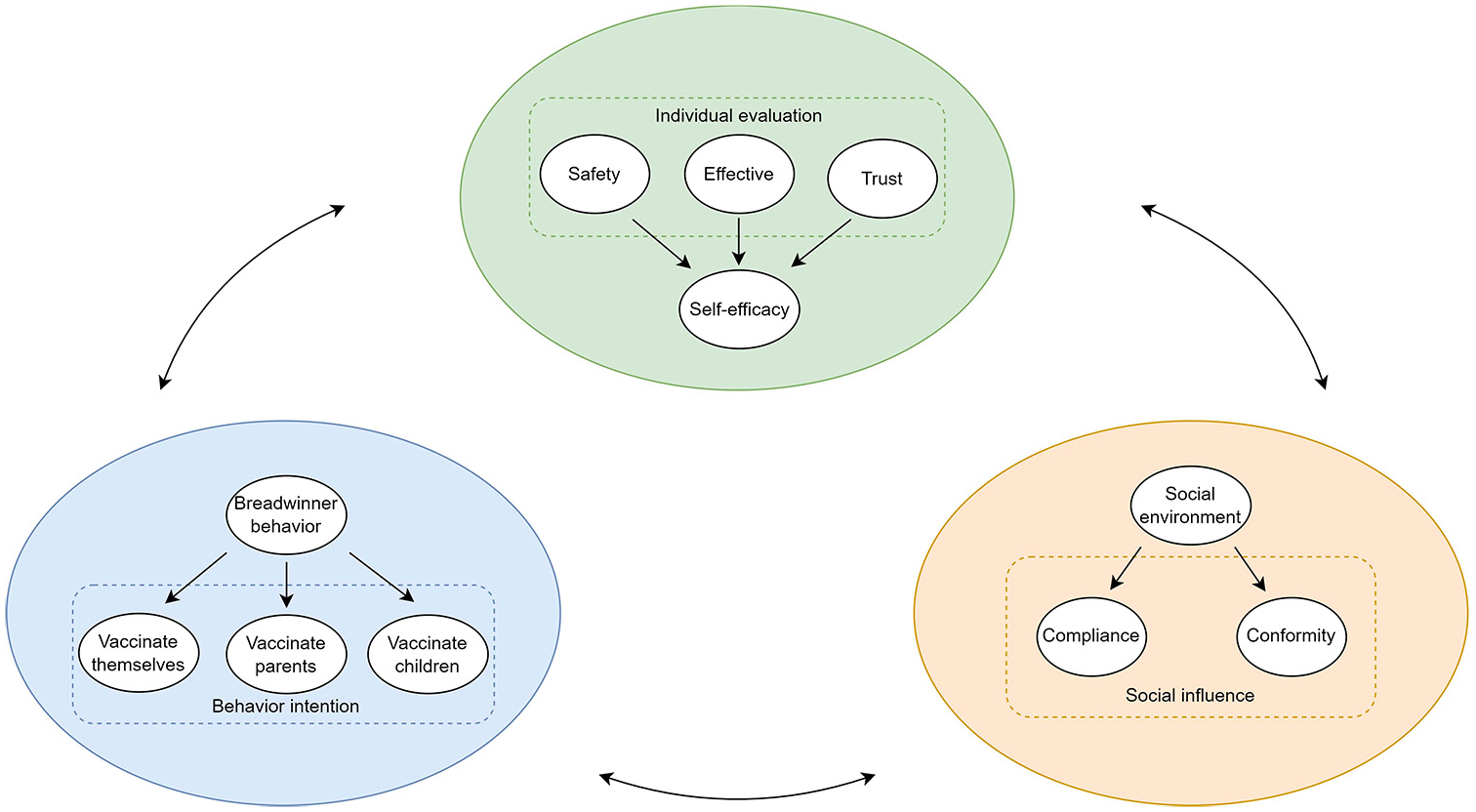
A conceptual framework for the sandwich generation’s vaccination decisions integrating social cognization and social influence theory.
Self-efficacy is treated as a process by which the sandwich generation evaluates external information to develop their own belief in vaccination decisions. Though it is often regarded as individuals’ subjective belief in their ability to make vaccination decisions (Graham, 2022), self-efficacy per se includes the assessment of one’s abilities to complete the behavior in question given available resources. Indeed, recent studies have suggested that self-efficacy is a decision-making process that involves judgments about the available information and actions to be taken (Milaković, 2021). This process view of self-efficacy enables to delineate how individuals assess relevant information to make up their minds on vaccination and how the environment affects the assessment to develop their self-efficacy about vaccination. Therefore, this paper views the sandwich generation’s evaluation of vaccine information as a self-efficacy-building process that triggers the intention to vaccinate.
Specifically, this paper will measure the sandwich generation’s evaluation of vaccine safety, effectiveness, and trust as a construction of self-efficacy (Rhodes and Hergenrather, 2003). On the one hand, safety, effectiveness, and trust encompass the comprehensive consideration of the costs and benefits of vaccination, thereby sustaining the ultimate motivation for individual vaccination behavior. On the other hand, these factors are also key predictors of vaccination intention (Fakonti et al., 2021). Then, this paper goes on to examine how the sandwich generation’s developed self-efficacy affects their willingness to vaccinate and, meanwhile, what vaccination decision they will make for their children and parents, given the intervening effects of the two types of social influence: compliance and conformity.
Effects of individual evaluation on vaccination intentions
Evaluating decision-relevant information as a cognitive element drives individuals to construct self-efficacy and is a key predictor of the emergence of corresponding behaviors or intentions (Graham, 2022). According to the value bias required by a specific situation, individuals selectively process and process the acquired information to form an evaluation result of specific affairs or behaviors. In this process, self-perception and evaluation result from belief in operational capabilities and control of behavioral results, promoting controllable outcomes. Clear and positive evaluation leads to accurate and intense behavioral efficacy judgments, reducing the inhibitory effects of negative experiences and enhancing behavioral control. In contrast, vague, negative personal evaluations impede the establishment of high self-efficacy. If people don’t have a solid understanding of what they’re doing and how far they’re going, they won’t know when, how much effort, and for how long they can get the desired return on value. The ambiguity of goals and the indiscernibility of behaviors will drive people to avoid matters beyond the scope of self-control and weaken the transformation of self-perception of efficacy into behavior.
The sandwich generation’s evaluation of information related to vaccination decisions mainly includes the safety, effectiveness, and trust in the vaccines (Fakonti et al., 2021; Pengo et al., 2022). Safety and effectiveness are the basic elements of vaccines, which bear a comprehensive balance of positive and negative consequences of vaccination. They are a focus of widespread public concern (Yu et al., 2022). Trust in vaccine research and clinical trials leads to higher vaccine acceptance (Sapienza and Falcone, 2022). In front of the threat of highly infectious diseases to their safety and that of their families, the sandwich generation urging their families to get vaccinated will not only protect themselves but also help isolate the spread of the virus throughout society. This creates a prosocial incentive for the sandwich generation to vaccinate their families because it ultimately benefits everyone. Obtaining positive results on vaccine safety, effectiveness, and trust assessment encourages the sandwich generation to reinforce the belief that vaccinations can help prevent the spread of viruses. This leads the sandwich generation to generate a better self-efficacy of vaccines, resulting in more people getting vaccinated, including parents and children, and ultimately reducing the spread of viruses within society. This self-efficacy generation process enables the sandwich generation to form a utility motivation to respond to specific situations, significantly affecting subsequent vaccination behavior.
Effects of social influence on vaccination intention
The sandwich generation’s self-efficacy will be shaped by the social influence which refers to the majority’s attitudes, beliefs, and behavioral tendencies in a given social space (Hollebeek et al., 2022). Social influence is categorized into compliance and conformity. Compliance refers to a response to specific regimes and requests, whereas conformity refers to changing one’s behavior to match others’ responses that provide a sense of belonging and benefit (Kashyap and Murtha, 2017). These two types of social influence drive the population to develop expected behavior through two different mechanisms, that is, coercion and voluntariness.
Meanwhile, the sandwich generation will take different positions toward two family members. They have a naturally inherited custodial responsibility for their children and place great expectations on their children; as a result, the sandwich generation will generally be particularly careful with their children’s affairs. By contrast, their parents’ autonomy in decision-making must be respected. Thus, it is expected that compliance and conformity will affect the effects of the sandwich generation’s self-efficacy on vaccination decisions for different targets differently.
Moderating effects of compliance
Compliance often arises from policies of local governments, regulatory agencies, or requirements from local groups and communities, urging individuals to respond in the desired manner (Dubey et al., 2018). Individuals compare rules of thumb extracted from previous experiences with specific needs in the current situation, and compliance produces inhibitory or de-inhibitory effects on violations of the requirements based on consistent judgments of comparison results (Cialdini and Goldstein, 2004). When inferring from previous direct experience that the external demands of the current environment will produce positive performance, the link between the actor’s perception of a particular cognition and the outcome of the behavior is strengthened. Thus, the violation of the request is inhibited by the cognitive guidance reinforced by compliance. Yet inconsistent cognitive cues can lead to conflict between personal experience and external demands. This can cause individuals to question the motives behind the demands and choose to violate them rather than comply (Schilling et al., 2023).
The term “compliance” in this paper refers to the requirements of grassroots governments, work units, or schools for public vaccination to meet their expectations. Vaccination as a useful way to stop the spread of viruses and protect oneself is a rule of behavior that has been obvious in past life experiences. If the sandwich generation has favorable views about the safety, effectiveness, and trust in vaccines and is required to get vaccinated, they are more likely to comply with external vaccination mandates. This is because their assessment of vaccination behavior aligns with the anticipated results of the requirements. Consequently, their belief in the ability of vaccines to safeguard them against the virus will rise, and their inclination to decline vaccination will decrease (Mello et al., 2020). In recent years, some countries have expanded compliance actions, such as compulsory vaccination, to address outbreaks of preventable diseases, resulting in increased vaccine coverage (Pastorino et al., 2021). Thus, with vaccination as the primary means of warding off outbreaks and achieving herd immunity, strong external requirements can serve as socially complementary information to reinforce the sandwich generation’s cognitive outcomes, that is, shaping their self-efficacy. Therefore, this paper argues that increasing compliance can strengthen the effects of the sandwich generation’s cognitive evaluations of vaccination on their intention to vaccinate themselves and their close family members in highly infectious disease vaccination contexts.
Moderating effects of conformity
Conformity is one of the most effective means of communicating values, attitudes, ideas, and patterns of behavior (Cialdini et al., 1990). By conforming to social roles and constructing identities, the public enhances their ability to experience different perspectives. This is achieved through observing and learning cognitive skills and behavioral patterns that guide our decision-making. Conformity also reduces the extent to which individuals deviate from societal norms, resulting in more homogeneous behavior (Kamijo et al., 2020). In concrete social practices, by observing the performance of other actors, individuals abstract and learn the rules, thus matching different environments and corresponding behaviors. Correlational cues play a crucial role in guiding an individual’s reasoning about the outcomes of adopting similar or identical behaviors. This helps reduce external pressures, minimizing the risks associated with uncertainty, and facilitating convergence of value judgments regarding the consequences of specific behaviors (Martínez-Ferrero and García-Sánchez, 2017). In this process, conformity can socialize an individual’s identity by making them obey valuable groups, which helps them maintain a positive self-evaluation and gain recognition from people with consistent judgments. As a result, an environmental strengthening effect that promotes the dominance of alternative experiences will be produced. Conformity has a significant effect on vaccination behavior when faced with highly infectious diseases. A reasonable degree of conformity can promote homogeneous vaccination behavior, thus saving social costs (Wang et al., 2020).
Conformity in this paper refers to people’s tendency to be vaccinated so that they match the behaviors expected by others. Information about vaccine types, side effects, etc. is more complex and specialized, and individuals need to pay a higher cost for information search and understanding to enhance their knowledge about vaccines. For instance, the urgent emergence of COVID-19 vaccines and the short clinical testing period make it difficult to ensure that individual subjective judgments will produce the desired consequences. Conformity raises the relative weight of alternative empirically guided behaviors. When making vaccination decisions for themselves and family members, the sandwich generation can alter their vaccination decisions by observing the consequences of vaccinating other similar individuals in the same context and standardizing their decision-making reference points (Zhang et al., 2021). When the majority of people believe in vaccines or have gained immunity to the virus through vaccination, adopting a strategy that aligns with others can lead to a sense of identity (Prato et al., 2019). Thus, the sandwich generation is more likely to observe the attitudes and behavioral consequences of others’ vaccinations to construct their perceptions of self-efficacy of the vaccination behavior. The greater the conformity, the more the sandwich generation expects to match their vaccination intentions for themselves, their parents, and their children with the behaviors of others, and the weaker the behavioral guidance of their evaluation results (Cui and Wu, 2013).
Based on the aforementioned theoretical development, this paper proposes the following research hypotheses,
Data and methods
Data collection
This study used a questionnaire survey method to collect data. The latent constructs include the perception of vaccine safety, effectiveness, and trust in vaccination (Quinn et al., 2019; Sapienza and Falcone, 2022). The moderating variables include compliance and conformity. In reference to the existing literature, this study also included a batch of control variables, such as the perceived severity of the pandemic, general attitude toward vaccines, and information adequacy (Harapan et al., 2020; Kraaijeveld et al., 2022; Lin et al., 2020). The measurement items of each variable were derived from the literature with adaptation to the current research context (Chaubey and Sahoo, 2021; Quinn et al., 2019; Ruan et al., 2022; Sherman et al., 2021). A Likert five-point scale was used to assess the degree of agreement with the statements in each measurement indicator, with 1 indicating “strongly disagree” and 5 indicating “strongly agree.”
Since the survey was conducted in China, two doctoral students in the field of management were invited to conduct a bilingual translation and comparison to ensure the semantic consistency of the measurement indicators in the Chinese context. A preliminary survey was conducted to test the initial scales used in the research. A “snowball sampling” method was employed. Ten sandwiched adults were invited to participate in the pre-survey. They are all responsible for educating children or supporting the elderly, and making key family decisions. Based on their relevant social networks, 200 questionnaires were distributed, and 179 valid questionnaires were collected, resulting in an effective response rate of 89.5%. Reliability and validity tests were conducted on the pre-survey sample. The results showed that the composite reliability values of the main latent variables ranged from 0.7 to 0.9, and the average variance extracted (AVE) values ranged from 0.5 to 0.8. The correlation coefficients between each pair of latent variables were lower than the square root of their respective AVE, indicating good reliability and validity of the scales.
Based on the criterion that each measure corresponds to at least 15 samples in the structural equation model (Bentler and Chou, 1987), the target number of questionnaires to be returned is between 405 and 550. Since this study was non-interventional, ethics approval was waived by the Ethical Committee of China University of Mining and Technology-Beijing. An authoritative questionnaire survey platform in China, WJX.cn, was employed to distribute electronic questionnaires to qualified sandwiched adults. The online survey lasted for 3 months in 2022, and a total of 590 questionnaires were received. All the participants gave their informed consent before filling in the questionnaire online. After excluding some invalid questionnaires, 545 valid questionnaires remained, including 532 on parents’ intentions and 507 on children’s intentions. The effective response rate of 85.93% exceeded the empirical threshold of 25%.
Descriptive statistics
Male and female samples accounted for 38.7% and 61.3% of the total sample, respectively. The age group of the sample is mainly distributed between 30 and 40 years old. At the same time, most of the samples have a bachelor’s degree or above, indicating that the demographic characteristics of the samples conform to the sample frame set in this paper.
Sample difference test
Before the structural equation analysis, ANOVA tests were performed for the different vaccination intentions. Significant differences exist between groups (F values=4.323, p<0.05), intending to vaccinate oneself significantly higher than the intention to vaccinate parents (ITSF-ITPR: diff=0.097, 95% Confidence Interval=[−0.003, 0.191], p<0.05) and children (ITSF-ITCH: diff=0.120, 95% Confidence Interval=[0.025, 0.216], p<0.05), but there was no significant difference between the intention to vaccinate parents and children (ITPR-ITCH: diff=0.023, Confidence Interval=[−0.073, 0.119], p=0.636).
Results
Measurement model analysis
The proposed research hypotheses were tested using a structural equation model (SEM) based on partial least squares regression. The seminr package in R software was utilized to calculate the structural equation model. This package is a modern computational program for partial least squares regression-based structural equation modeling, which incorporates the latest research advancements in this field.
Reliability test
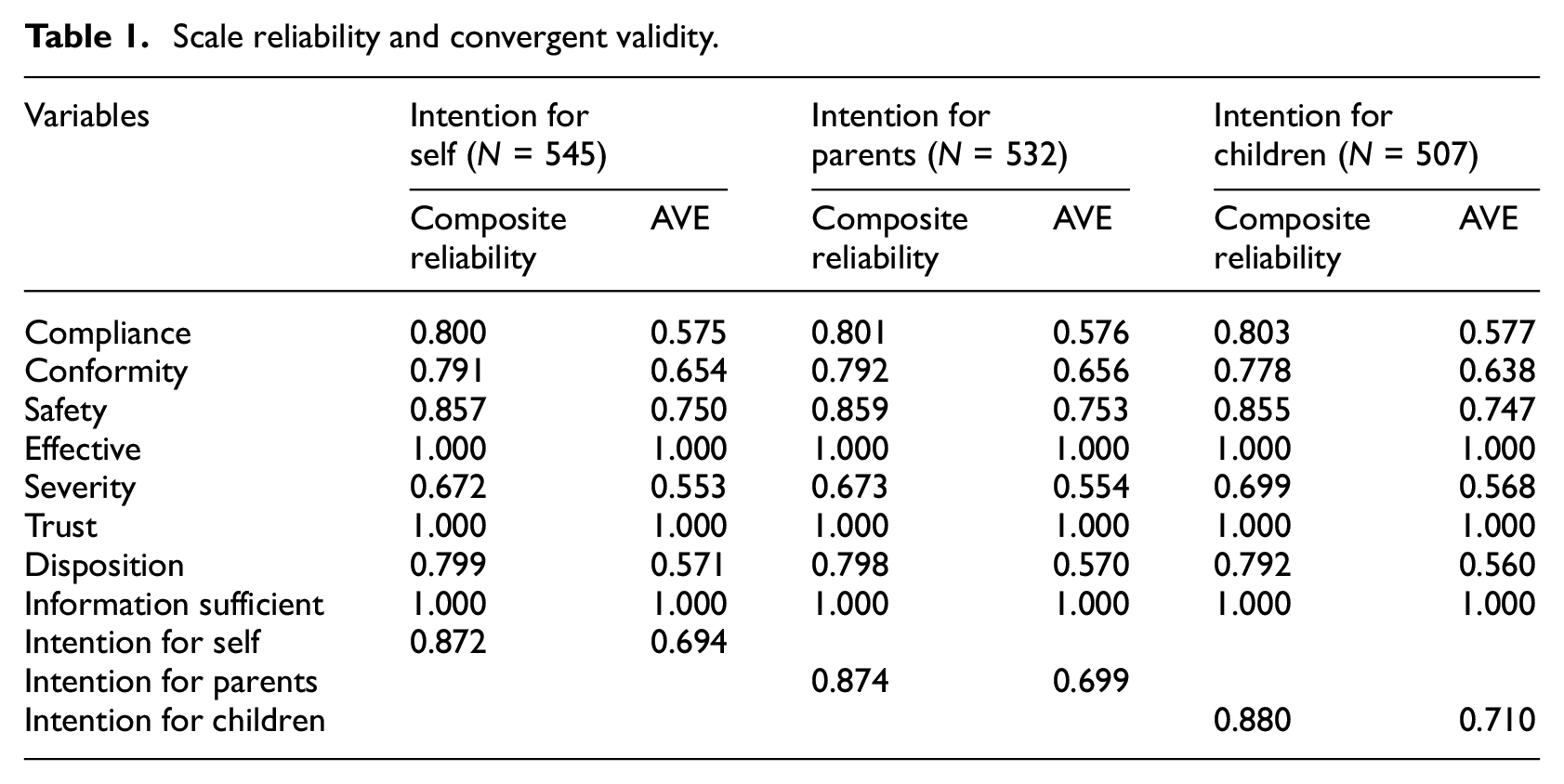
Composite reliability was used to test the consistency of the measurements of the different variables. The results of the reliability test are summarized in Table 1. The composite reliability of latent variables exceeds the critical value of 0.7, indicating that the scale developed in this paper has good reliability.
Scale reliability and convergent validity.
Convergent validity test
Convergent validity is usually tested by the Average Variance Extracted (AVE) of the corresponding measure of the latent variable. An AVE value greater than 0.5 indicates that the scale of the latent variable has good convergent validity. Table 3 shows that the AVE values of each latent variable are all above 0.5, reflecting a good convergent validity of the scale developed in this paper. Meanwhile, the factor loadings of the measures on the latent variables are higher than 0.6, which further confirms the good convergent validity of the scale.
Discriminant validity test
Discriminant validity reflects the degree to which a measure distinguishes between different latent variables and the Fornell-Larcker test is usually used. This method constructs a variable correlation coefficient matrix, and the diagonal elements are the square root of the AVE of each latent variable. When the square root of the AVE of each latent variable is greater than the correlation coefficient of that latent variable with all other latent variables, it indicates that the measurement model has discriminant validity. The square root of AVE of each latent variable is greater than 0.7 and the correlation coefficients with other latent variables. Thus, the Fornell-Lacker condition is satisfied and the scale has good discriminant validity.
Common method bias
Harman’s single-factor method was used to test for the potential presence of common method bias in the scale used in this study. This method examines whether a single factor can explain a substantial portion of the variance in the scale, and if so, it indicates the presence of significant common method bias. The test results in this study showed that the explicitly extracted first common factor accounted for only 30% of the variance, which is less than the threshold of 0.4 (Podsakoff et al., 2003). It indicates that no single dominant factor explains the majority of the variance, and therefore, the scale used in this study does not exhibit significant common method bias.
Structural model analysis
Individual evaluation and intention to vaccinate
Table 2 presents the effect of individual evaluations on intention to vaccinate. A bootstrap method with 2000 samples was used for analysis. The results show that vaccine safety has a significant positive effect on the intention to vaccinate for oneself (β = 0.292, p < 0.001), parents (β = 0.217, p < 0.001), and children (β = 0.351, p < 0.001), supporting hypothesis H1a. The influence of effectiveness on vaccinating oneself (β = 0.218, p < 0.001), parents (β = 0.209, p < 0.001), and children (β = 0.155, p < 0.001) is gradually diminished but remained significant, supporting hypothesis H1b. Similarly, trust in vaccines has a significant positive effect on the intention to vaccinate for oneself (β = 0.189, p < 0.001), parents (β = 0.203, p < 0.001), and children (β = 0.144, p < 0.001), but the effect is the smallest among the three, supporting hypothesis H1c.
Individual evaluation path coefficients and significance.
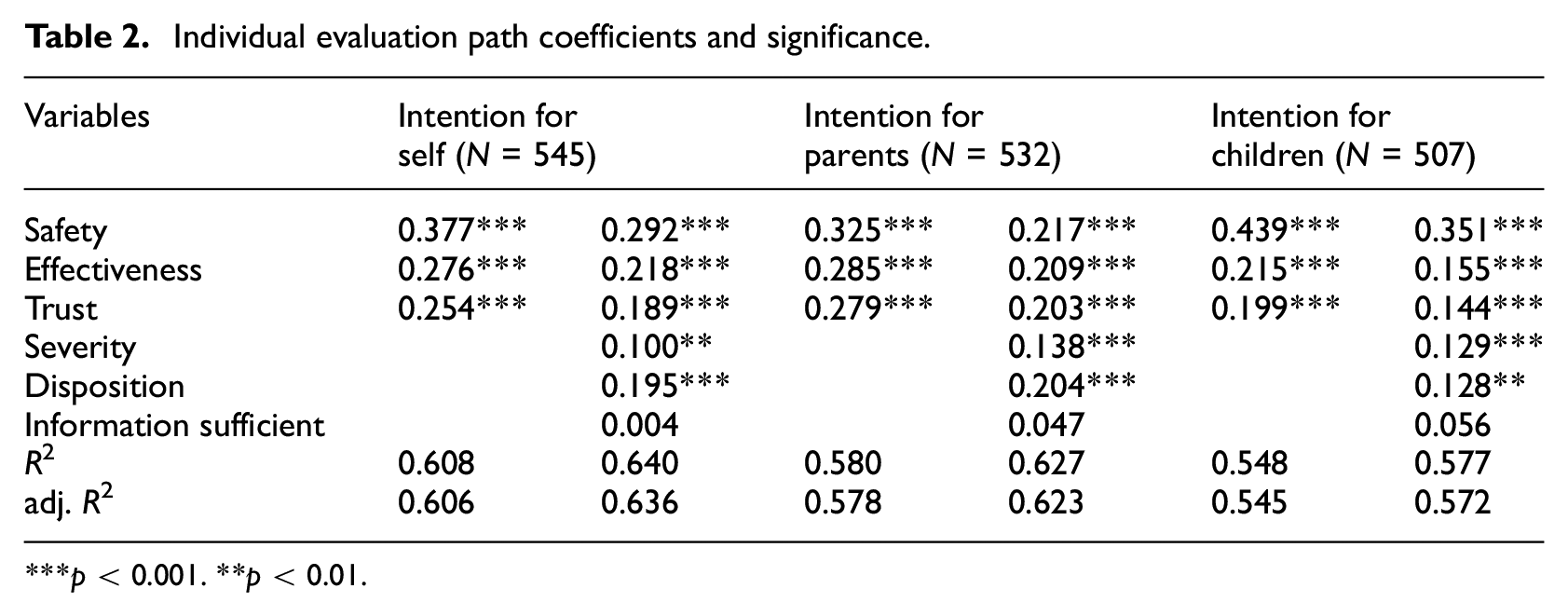
p < 0.001. **p < 0.01.
Moderating effects of compliance
The moderating effects of compliance increase the degree of variance that the model explains, as shown in Table 3. Compliance has a significant positive moderating consequence in the effect of safety (β = 0.097, p < 0.001), effective (β = 0.072, p < 0.05), and trust (β = 0.097, p < 0.01) on the sandwich generation’s vaccination intentions, and this effect is attenuated in the effect of safety (β = 0.085, p < 0.001), effectiveness (β = 0.047, p < 0.05) and trust (β = 0.058, p < 0.05) on their intention for parents, but the effect remains significant. Conversely, children are a special group, and compliance did not have any moderating effect on the three factors affecting the sandwich generation’s intention to vaccinate children. Thus, hypotheses H2a, H2b, and H2c are partially supported. Furthermore, our further exploration of the moderating role of compliance revealed that compliance exhibited different moderating effects when the sandwich generation had varying degrees of individual assessments of vaccine attributes. Specifically, when the sandwich generation perceives lower levels of vaccine safety, effectiveness, and trust, an increase in compliance weakens the impact of individual evaluation on vaccination intentions. Conversely, in the case of higher levels of individual evaluation, an increase in compliance exhibits a strengthening moderating effect. Figure 2 displays the interaction plot of compliance with the components of self-efficacy.
Test results of the moderating effects of compliance.
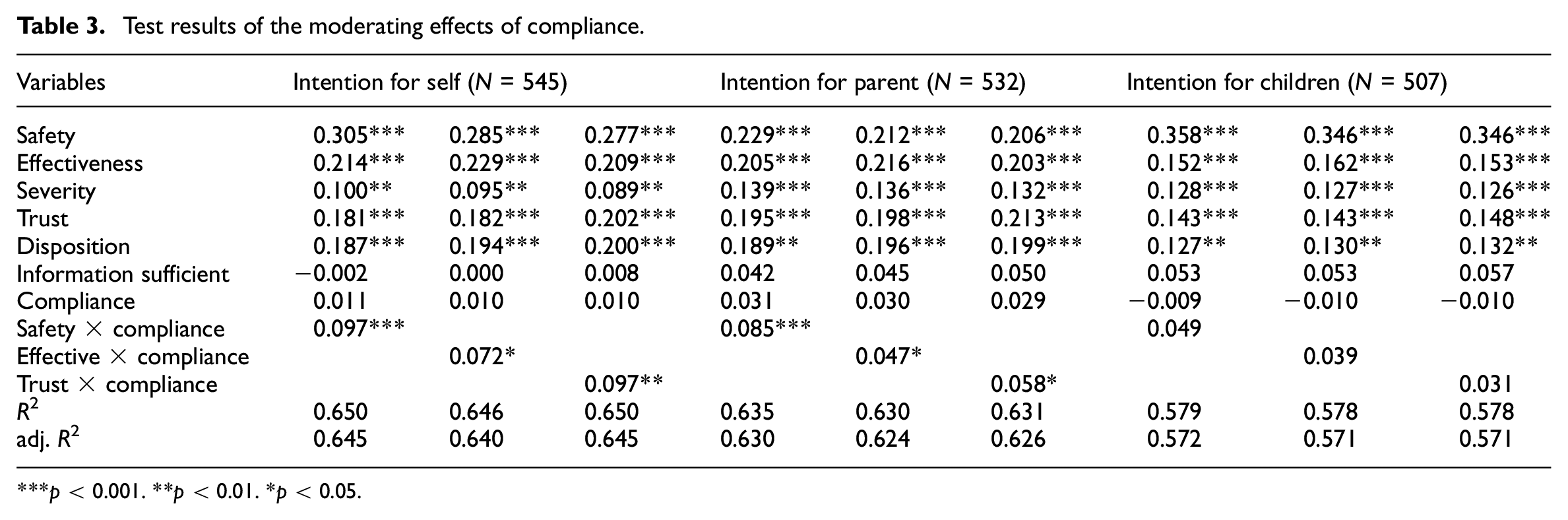
p < 0.001. **p < 0.01. *p < 0.05.
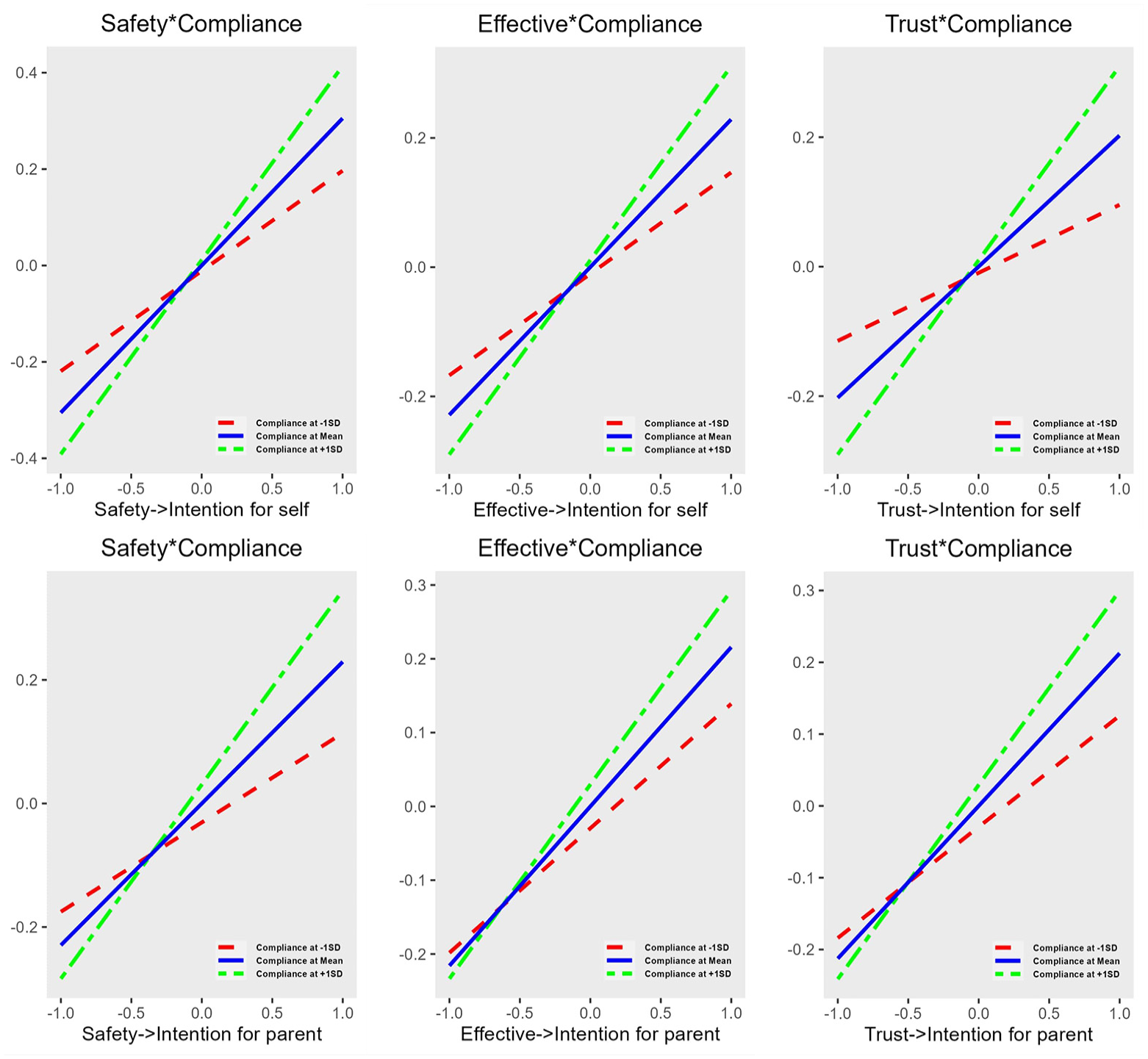
Moderating effects of compliance on the influences of safety and trust on the intention for self and parents.
Moderating effects of conformity
The model after adding conformity is shown in Table 4. Conformity has a different moderating effect in the model than compliance. In the effect of safety (β = −0.079, p < 0.01), effective (β = −0.053, p < 0.05), and trust (β = −0.083, p < 0.001) on own vaccination intention, conformity played a negative moderating role and hypothesis H3a holds. This effect is slightly attenuated in the effects of safety (β = −0.058, p < 0.05) and trust (β = −0.074, p < 0.01) on the sandwich generation’s intention to vaccinate parents but not in the effect of effectiveness (β = −0.018, p = 0.276) on intention to vaccinate, and hypothesis H3b is not entirely supported. Unlike compliance, conformity also played a significant negative moderating role in safety (β = −0.011, p < 0.001), effective (β = −0.079, p < 0.01), and trust (β = −0.066, p < 0.01) on the sandwich generation’s intention to vaccinate children, and hypothesis H3c holds. In addition, conformity has a significant direct positive effect on vaccination decisions for all three groups, which does not show the same differential moderating effect as compliance. Figure 3 displays the interaction plot of conformity with the components of self-efficacy.
Test results of the moderating effects of conformity.
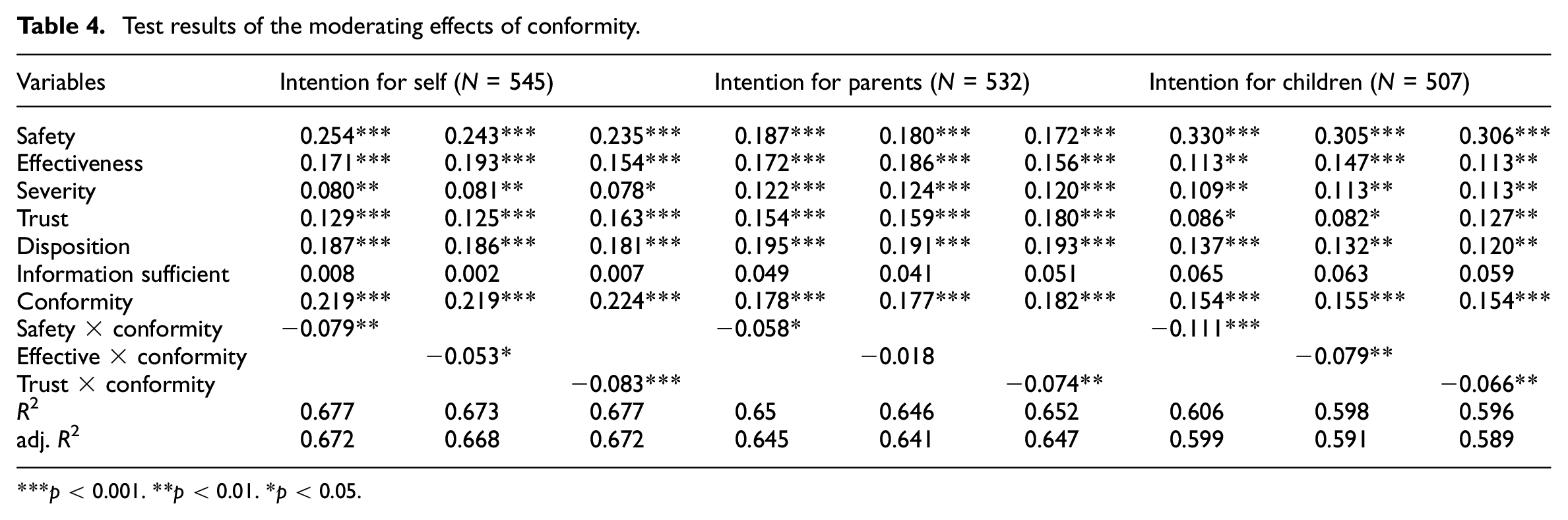
p < 0.001. **p < 0.01. *p < 0.05.
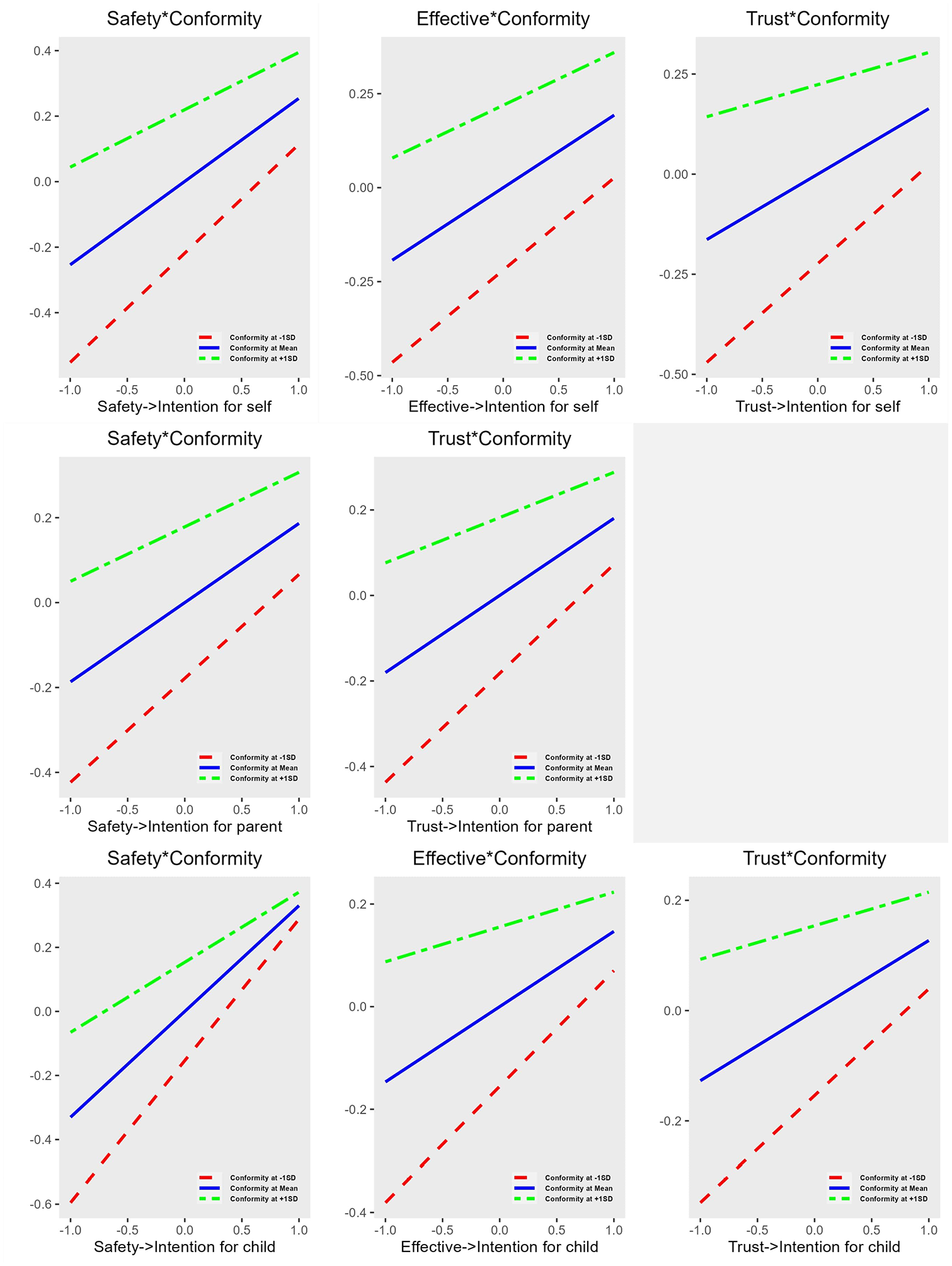
Moderating effects of conformity on the influences of safety, effectiveness, and trust on the intention for self, parents, and children.
Discussion
Main results
This study develops a decision-making process for vaccination for highly infectious diseases. The social cognitive theory is used to construct a ternary loop where social influences affect the sandwich generation’s cognition, which in turn impacts their behavior, and the resulting behavior then affects the social environment. The results show that compliance and conformity perceived by the sandwich generation moderate the effects of safety, effectiveness, and trust on the sandwich generation’s vaccination intention. Moreover, the moderating effects also extend to one’s decisional role for parents and children. Specifically, the moderating effects of compliance differ in impacts across the three groups, whereas conformity presents consistent influence. These findings hold both theoretical and practical and policy implications.
Theoretical implications
First, we find that the vaccination intentions are different, that is, the sandwich generation’s vaccination intention for themselves is significantly higher than for their parents and children. The sandwich generation’s influence on family members is substantial in a family. Thus, their intention for parents and children cannot be ignored. Previous studies discuss common individuals, while we focus on the sandwich generation and their decisional agents’ role in the family, suggesting a way to increase the sandwich generation’s intention for the whole family.
Second, safety, effectiveness, and trust are critical factors impacting vaccination intention, but with differentiated roles across the groups. Effectiveness is highlighted more for oneself, while severity and safety are seen as more important for children, which are consistent with previous findings (Hoogink et al., 2020; Pan et al., 2021). We further considered the parent group and found that trust, severity, and disposition are more critical than in other groups. For children, safety comes first, and for the sandwich generation themselves, effectiveness is prioritized. In contrast, more factors are comprehensively considered for the elderly.
Third, our findings illuminate the complex interplay between self-efficacy, compliance, and conformity in shaping the sandwich generation’s vaccination decisions for their family members. The social cognitive theory posits that though self-efficacy is a significant predictor of action, it is not effective in a social vacuum. Instead, external social forces such as compliance and conformity will alter the strength and even the direction of its influence (Capuano and Chekroun, 2024). Their dual role as caregivers and decision-makers amplifies susceptibility to normative pressures: compliance safeguards against the material risks of non-adherence (e.g. jeopardizing elderly parents’ health), while conformity sustains their identity as “responsible” stewards of intergenerational well-being.
Specifically, this positive moderation of compliance differs across the three groups. The effect is most significant for the self-group, less for the parent group, and none for the child group. The observed graded moderating effects of compliance can be further interpreted through the lens of moral hazard theory. Moral hazard arises when decision-makers are insulated from the full consequences of their actions, leading to riskier behavior (Probst and Warneken, 2025). For self-vaccination, compliance with public health recommendations creates a strong insulation: individuals trust that vaccine safety is institutionally guaranteed and adverse events would be medically managed, reducing perceived personal accountability (Fu et al., 2022). This allows high self-efficacy individuals to act decisively, as compliance validates their confidence while externalizing risk. For parental vaccination, moral hazard persists but is attenuated by partial insulation: ultimate accountability is shared with both the elderly parent and the healthcare system. Compliance modulates self-efficacy’s impact less powerfully, as the decision carries inherent uncertainty about an autonomous other’s health outcomes. Child vaccination eliminates moral hazard entirely due to non-delegable emotional liability. Even when compliance aligns with self-efficacy, the sandwich generation cannot externalize the emotional consequences of rare adverse events—no institutional safeguard can offset the irreplaceable loss of a child’s well-being.
Conformity, unlike compliance, is a favorable social influence in solving the vaccination problem. Conformity negatively mediates the effects of safety, effectiveness, and trust. As conformity strengthens, vaccination intention is less sensitive to the three factors, which is just needed in sudden infectious disease, as the three factors are all not getting high marks. Conformity’s influence is not diminished when it comes to the parent group and the children group. This suggests a path to improve vaccination intention. The promising result happens because the sandwich generation is not forced but voluntarily to accept vaccination for their family under conformity, for they might see an advantage from vaccination or other benefits.
Though this study is conducted in China, the findings can be extended to other geographical locations from the perspective of cultural norms. Compliance and conformity develop in societal groups and thus they are culturally bounded (Liu et al., 2022). Cultural norms, the shared standards that prescribe and proscribe behavior in various situations (Gelfand and Jackson, 2016), can greatly influence the sandwich generation’s tendencies toward compliance and conformity, thereby affecting their vaccination decision-making. In the tight culture exemplified by China which emphasizes strong norms and low tolerance of deviant behavior (Gelfand et al., 2011), the sandwich generation may exhibit greater compliance with health authorities and recommendations. Such a culture also emphasizes group harmony and social cohesion and thus heighten conformity, leading individuals to align their vaccination decisions (for self, parents, and children) with perceived community standards. Conversely, in the loose culture where individual autonomy is prioritized, the sandwich generation’s self-efficacy is allowed to play a more dominant role in vaccination intentions across all three generations.
Practical and policy implications
This proposed and verified closed-loop social cognitive theory in the sandwich generation’s vaccination decision-making holds practical and policy implications. First, recognizing that the sandwich generation makes decisions for both their children and parents, interventions can be tailored to address the specific concerns and informational needs of this group. This might involve providing clear, concise information about vaccine safety and efficacy for different age groups, addressing common misconceptions, and offering convenient vaccination options. Second, this study points out the differential influence of social forces on this key demographic by clarifying the moderation pathways of compliance and conformity. Public health campaigns can be designed to leverage trusted sources (like family members, friends, and community leaders) to promote vaccine confidence. This targeted approach is more likely to be effective than generic messaging. Third, this study provides policy makers a better understanding of vaccine decision-making from the perspective of social cognitive reasoning and thus help make vaccination promoting measures to better explore the social nature of the sandwich generations’ vaccination behavior. Mandatory policies, particularly those with penalties, can certainly boost compliance (Gravagna et al., 2020). However, it’s important to recognize that this increased compliance can have uneven effects on affecting the sandwich generation’s self-efficacy regarding vaccination intentions for themselves, their parents and children. Often, the latter two groups are the primary focus of such policies. Instead, policies grounded in evidence or behavioral insights are recommended, as they are more effective in fostering conformity and creating a supportive environment to encourage family members’ vaccination uptake. It thus provides a valuable reference for future large-scale vaccine management issues that may be similar or even more complex.
Limitations
Due to the availability of data, we examined the vaccination intention of the sandwich generation toward their close ones, but this cannot represent the complete individual feedback behavior of the society, and more detailed and specific studies need more data support. Second, the participants in the questionnaire were randomly drawn from a wide geographic area in China. Though China represents a typical tightness culture, nuanced cultural or value differences across countries can also have an impact on intention to vaccinate, causing a bias in the role of social influence, and therefore conclusions should be cautiously extrapolated to other countries with different cultural backgrounds (Courtney et al., 2022). Nevertheless, this study’s results lay a basis for exploring those differences in different social contexts. Third, this study utilized a cross-sectional method for data collection. Since the sandwich generation’s self-efficacy and perceived social influence evolve throughout a vaccination campaign, expanding the current model into a longitudinal framework would be advantageous to explore the long-term effects of these factors.
Conclusion
This research found that the sandwich generation’s opinions on vaccine safety, trust, and effectiveness impact their confidence in getting vaccinated. This decision-making process has a ripple effect on society, and social influence plays a role in shaping individual opinions. The paper proposes a social cognitive framework for vaccination against highly infectious diseases, which can be used as a reference for studying vaccine intentions in other diseases. In the future, scholars can continue to refine the specific path of the social cognitive theory of ternary interactions to deepen the impact of individual behavioral feedback on society.
Footnotes
Data sharing statement
The data that support the findings of this study are available from the corresponding author upon request.
Declaration of conflicting interests
The authors declared no potential conflicts of interest with respect to the research, authorship, and/or publication of this article.
Funding
This work was supported by the Yueqi Young Scholar Funds of China University of Mining and Technology-Beijing under [800015Z11A21]; and the Fundamental Research Funds for the Central Universities under [590121047].
Ethics approval
The Ethics Committee of China University of Mining and Technology-Beijing waived the need for ethics approval for this non-interventional study.
Informed consent
All study participants consented to participate in the study and signed informed consent documents.
Consent for publication
Consent for publication is not applicable as it does not contain any identifiable data.
