







Abstract
E-therapy adoption has grown in Taiwan; however, challenges, including limited awareness, persist. This study aimed to psychometrically validate a Chinese version of the E-Therapy Attitudes Measure (ETAM) and to investigate attitudes toward e-therapy among adults in Taiwan. This cross-sectional web-based survey was conducted, recruiting 1483 Taiwanese participants aged 18–60 years with depressive or anxiety symptoms. Measures included a translated Chinese version of the ETAM, the Revised Adult Attachment Scale, the PHQ-9, the GAD-7, and the Perceived Stress Scale. Confirmatory factor and correlation analyses supported the validity of ETAM, showing excellent internal consistency (Cronbach’s α = 0.92). Overall, 50.8% reported positive attitudes (M = 2.53, SD = 0.61). Further analyses revealed that higher e-therapy acceptance was associated with lower stress, anxiety, depressive symptoms, and attachment-related distress. This study successfully validates the Chinese ETAM and highlights the influence of psychological factors on the acceptance of e-therapy in the Taiwanese population.
Introduction
Background and challenges of e-therapy adoption
E-therapy, encompassing online therapy and web-based counseling, is an expanding area of psychotherapy that utilizes electronic communication to connect clients with therapists (Castelnuovo et al., 2003; Olasupo and Atiri, 2013). The growing adoption of e-therapy since the 1980s is attributed mainly to advances in technology and widespread internet access (Lee, 2010). By combining traditional therapeutic methods with modern technology, this approach offers both real-time (synchronous) and delayed (asynchronous) communication options (Castelnuovo et al., 2003). The practice of e-therapy relies on various technological tools, such as email, chat platforms, video conferencing, and shared hypermedia (Castelnuovo et al., 2001). Research demonstrates that Internet-based psychotherapeutic interventions can be as effective as traditional therapy, showing a medium effect size of 0.53 (Barak et al., 2008). Moreover, e-therapy can effectively reach populations that are often underserved by traditional in-person interventions, such as women, individuals with higher levels of education, employed individuals, and older adults (Postel et al., 2005). E-therapy shows promise in addressing various mental health concerns, including reducing alcohol consumption (Postel et al., 2010) and offering benefits for eating disorders (Loucas et al., 2014). Its integration into social work has also helped expand access to underserved populations (Wodarski and Frimpong, 2013), further underscoring its potential for broad applicability. Encompassing formats such as email counseling, self-help interventions, and virtual support groups (Castelnuovo et al., 2001), e-therapy offers notable benefits, including accessibility, convenience, and flexibility.
Despite its accessibility and flexibility, the adoption of e-therapy has been slower than expected due to concerns from various stakeholders (Payne et al., 2020). Additionally, e-therapy often encounters challenges, such as high dropout rates and varying levels of adherence (Donkin et al., 2011). These adherence levels, measured through metrics such as the number of logins and completed modules, can significantly impact treatment outcomes, particularly in psychological interventions (Donkin et al., 2011). Therefore, understanding the perspectives and attitudes of potential users is essential for addressing these concerns and overcoming barriers that limit broader adoption. Perceived usefulness and ease of use are central predictors of acceptance for e-therapy, while reliable access to electronic devices and the internet is essential for actual service utilization (Alhur and Alhur, 2022). A recent study on young adults (N = 413, aged 17–27) in Indonesia reported that perceived usefulness, ease of use, privacy, system quality, and service quality significantly predicted the acceptance of e-therapy services, with privacy emerging as the strongest determinant of adoption (Panduwiyasa and Wibowo, 2025). On the other hand, age may represent an additional factor influencing the uptake of e-therapy, with older individuals being less likely to participate, partly due to reduced access to digital devices. (Watson et al., 2022).
Recognizing this transformative impact, many mental health professionals acknowledge that the Internet is reshaping therapeutic practices, with some viewing e-therapy as a credible alternative to traditional mental health services (Graff and Hecker, 2012). As this field continues to develop rapidly, significant practical, ethical, and legal challenges have arisen. These challenges require careful consideration by professional organizations and practitioners to ensure the responsible and effective delivery of online mental healthcare (Graff and Hecker, 2012; Manhal-Baugus, 2001). Nonetheless, fundamental questions regarding the nuances of e-therapy remain, such as the extent to which a meaningful therapeutic relationship can be effectively established online in the absence of traditional non-verbal cues. This highlights the complexity of integrating technology into the therapeutic process and the ongoing need for research and thoughtful consideration of its implications.
Assessing public attitudes: The e-therapy attitudes measure (ETAM)
Recognizing the crucial role of public attitudes in the adoption of e-therapy, Apolinário-Hagen et al. (2017) developed the E-Therapy Attitudes Measure (ETAM), a 14-item questionnaire used in online and paper-based surveys in Germany. Using this questionnaire, they found that most participants at the time were unfamiliar with e-therapy. Their analysis identified three key factors shaping public attitudes toward e-therapy: “usefulness or helpfulness,” “relative advantage or comparability,” and “accessibility or access to healthcare.” The research team revised the questionnaire and expanded it into a 17-item version of the ETAM, which included an additional measure to assess preferences for e-therapy (Apolinário-Hagen et al., 2018b). Findings indicated that while participants generally agreed that e-therapy was useful, many still perceived in-person therapy to be more advantageous. Guided e-therapy was the preferred option, followed by video-conferencing psychotherapy and unguided e-therapy (Apolinário-Hagen et al., 2018b). A randomized controlled trial using the ETAM found neutral attitudes toward e-therapy, with participants acknowledging its usefulness but also expressing reservations about its relative advantages compared to traditional methods such as self-help interventions or face-to-face counseling (Apolinário-Hagen et al., 2018a). These findings underscore the importance of systematically assessing public attitudes to promote the effective use of e-therapy.
E-therapy in Taiwan: Current landscape and existing gaps
Taiwan has witnessed a significant surge in the demand for mental health services in recent years, particularly after the COVID-19 pandemic. In response to this growing need, Taiwan’s Ministry of Health and Welfare issued the Reference Guidelines for Telecommunication Counseling Services by Psychologists in 2019. In addition, the Taiwan Association of Clinical Psychology has developed its own comprehensive practice guidelines, covering key domains such as administrative skills, risk assessment, and ethical and legal considerations to help clinical psychologists navigate the new challenges of e-therapy. This concerted effort indicates a greater emphasis on e-therapy expansion. Despite this policy shift, practical challenges persist. Research suggests that more experienced and older Taiwanese therapists tend to view online counseling as more feasible, especially in terms of infrastructure and protocol readiness (Wan-Chen et al., 2023). However, issues such as unstable internet connections and insufficient regulatory frameworks remain obstacles to widespread implementation. During the pandemic, many counselors emphasized the need for updated regulations and targeted training to support the sustainable adoption of e-therapy (Yeh et al., 2021). While these professional guidelines have been developed to address the practical and ethical aspects of e-therapy, they lack a sufficient empirical basis for their clinical applicability, especially in high-risk or complex cases. Addressing this gap is paramount for the responsible and effective delivery of online mental healthcare in Taiwan.
Meanwhile, several Taiwanese studies have documented successful applications of telepsychology. For instance, virtual counseling networks have provided emotional support for isolated groups, such as quarantined soldiers (Chiu, 2022), and telehealth has been integrated into Taiwan’s long-term care system, supported by public trust and social connectedness (Hsieh and Tsai, 2020). Although establishing emotional connections can be challenging in virtual sessions, pre-existing face-to-face rapport has been shown to mitigate this issue (Hung, 2024). Emerging technologies such as artificial intelligence and virtual reality further highlight the potential for innovation in mental health delivery (Lancia et al., 2023). However, despite these advancements in professional practice, a significant gap remains in understanding the attitudes among the general public in Taiwan toward e-therapy.
Despite increasing acceptance, barriers persist in Taiwan. Cultural factors like the stigma associated with seeking psychological help (Lin, 2014) and the demanding lifestyles of Taiwanese individuals may negatively affect openness to both traditional and online mental health services. Given the cultural context of Taiwan and the limited understanding of public attitudes toward e-therapy, the adaptation and validation of a reliable instrument like the ETAM is crucial for informing the development and implementation of effective e-therapy services in this region. Therefore, it is crucial to address this gap in understanding public attitudes and recognize the need for culturally appropriate assessment tools. To this end, this study aims to develop and validate the psychometric properties of the Chinese version of the ETAM, focusing on its reliability, validity, and factor structure, to provide Taiwanese mental health professionals with a dependable and valid assessment tool. In addition to sociodemographic and psychological variables, individual attachment style has also been proposed as a potential predictor of attitudes toward internet-based therapies. Prior research suggests that attachment-related tendencies, particularly avoidance of emotional closeness, may shape help-seeking preferences and openness to guided internet-based interventions (Apolinário-Hagen et al., 2018b). Therefore, we included adult attachment style in our study to investigate its relationship with the acceptance of e-therapy among Taiwanese adults. This study also aims to explore further the relationships between psychological variables (such as anxiety, depression, stress, and attachment styles) and Taiwanese adults’ attitudes toward e-therapy, to identify better psychological factors associated with acceptance of this treatment modality.
Methods
Study design and participants
A cross-sectional web-based survey was conducted between June and August 2024 using Google Forms. Participants were recruited through convenience sampling via online platforms, including social media and university mailing lists. The inclusion criteria were as follows: individuals aged 18–60 years who reported noticeable depression or anxiety. Participants were excluded if they had a history of major physical, neurological, or psychiatric illnesses or related medical treatment. The eligible participants were Taiwanese citizens who were native speakers of Chinese and had fluent reading and writing abilities. This study was approved by the Institutional Research Ethics Committee. All procedures were conducted in accordance with relevant ethical guidelines and regulations, and informed consent was obtained from all participants.
Measures and procedure
Sociodemographic variables
Sociodemographic questions covered sex, age, marital status (single, married, or divorced), area of residence (northern, central, southern, or eastern Taiwan), educational level, and employment status. Internet usage duration was assessed using a single self-reported item, in which participants were asked to recall their usage time over the past week. Additionally, participants were asked to provide information regarding their history of psychotherapy and whether they had experienced any severe physical or psychological conditions, with psychotherapy history assessed by two single questions on prior in-person and online psychological therapy.
ETAM
The original version of the ETAM comprises 17 self-report items designed to assess participants’ attitudes toward online psychological therapy. It includes two subscales: Perceived Usefulness and Helpfulness (PU) and Relative Advantage and Comparability (RA). Responses are rated on a five-point Likert scale ranging from 0 to 4, where higher mean scores indicate more positive attitudes and greater acceptance (Apolinário-Hagen et al., 2017). The internal consistency of the ETAM was shown to be strong, with Cronbach’s alpha values of 0.89 for the total scale, 0.83 for PU, and 0.87 for RA (Apolinário-Hagen et al., 2017). More recent work reported Cronbach’s alpha values of 0.92 in a sample of university students (Özer et al., 2024).
After obtaining permission from the original author, the ETAM was translated into Traditional Chinese using a two-stage process. First, three licensed clinical psychologists independently translated the original English version into Chinese. The translated drafts were reviewed and compared in a consensus meeting, where discrepancies were resolved through discussions. An expert panel of clinical psychologists then reviewed the final version to ensure semantic clarity and cultural appropriateness. This process emphasized conceptual equivalence rather than literal translation to maintain the integrity of the original items in the Taiwanese cultural context.
Attachment style, perceived emotional distress, and perceived stress
To understand the factors affecting attitudes toward online psychotherapy, we used the Traditional Chinese Version of the Revised Adult Attachment Scale to assess participants’ attachment styles.
It is a self-reported questionnaire designed to evaluate interpersonal attachment tendencies among adults. The original version was developed by Collins (1996), and the Chinese translation was completed by Huang and Chen (2011). The scale consists of 18 items rated on a five-point Likert scale (1 = “strongly disagree”; 5 = “strongly agree”). The total scores range from 18 to 90. This scale assesses anxious and avoidant attachment styles. The Cronbach’s α for the subscales and the total scale were 0.85, 0.79, and 0.84, respectively, indicating good internal consistency. The test-retest reliability, measured 2 weeks later, was 0.85, 0.79, and 0.85 for the two subscales and the total scale, respectively, indicating good and stable reliability.
Patient health questionnaire-9
The Traditional Chinese version of the Patient Health Questionnaire-9 (PHQ-9) was obtained from Pfizer. The PHQ-9 is a widely used self-reported measure of depressive symptoms experienced over the past 2 weeks (Kroenke, 2021; Kroenke et al., 2001). The questionnaire includes nine core items and an additional item. For items 1 through 9, scores range from 0 to 3, where 0 = “not at all,” 1 = “several days,” 2 = “more than half the days,” and 3 = “nearly every day.” Higher scores indicate greater severity of depression. Item 10 assesses the impact of symptoms on work, family, and social interactions, with options ranging from “not difficult at all” to “extremely difficult.” The original scale has strong internal consistency, with a Cronbach’s α of 0.89. Prior studies of translated versions have demonstrated similar reliability (Cronbach’s α = 0.83–0.89; Farrahi et al., 2020; Kim and Lee, 2019; Saldivia et al., 2019), including in patients with psychiatric disorders (0.87; Beard et al., 2016).
Generalized anxiety disorder-7
The Traditional Chinese version of the Generalized Anxiety Disorder-7 (GAD-7) was obtained from Pfizer’s official PHQ and GAD screener website. This self-report questionnaire evaluates the frequency of anxiety-related symptoms experienced by participants over the past 2 weeks. The scale consists of seven items, each scored from 0 to 3: 0= “not at all,” 1 = “several days,” 2 = “more than half the days,” and 3 = “nearly every day.” Higher total scores indicate greater severity of anxiety. The GAD-7 has demonstrated excellent internal consistency, with a Cronbach’s α of 0.92 (Spitzer et al., 2006). The GAD-7 has been translated into multiple languages, and these versions consistently show good to excellent internal consistency, with Cronbach’s alpha ranging from 0.80 to 0.91 (Lee and Kim, 2019; Tiirikainen et al., 2019). Consistent with these findings, the GAD-7 demonstrated strong reliability in a psychiatric population (α = 0.88; Johnson et al., 2019).
Perceived stress scale
The Traditional Chinese version of the Perceived Stress Scale used in this study was translated by Chu and Kao (2005) and subsequently authorized for use in an online electronic format by the Mapi Research Trust. The scale demonstrates good internal consistency, with a reported Cronbach’s α of 0.85 (Chu and Kao, 2005; Cohen et al., 1983). This self-report questionnaire assesses the level of stress experienced by the participants over the past month. It consists of 14 items, including seven reverse-scored items, to calculate the total score. Responses are rated on a five-point Likert scale, with higher scores indicating greater perceived stress. Several translated versions of the GAD-7 have shown good reliability, with Cronbach’s alpha ranging from 0.73 to 0.87 across different countries (Eklund et al., 2014; Huang et al., 2020; Lesage et al., 2012; Trigo et al., 2010). In a psychiatric sample, the PSS demonstrated adequate internal consistency, with a Cronbach’s alpha of 0.80 (Hewitt et al., 1992).
Statistical analysis
Only surveys completed by participants who met the inclusion criteria were considered for data analysis. Descriptive statistics were computed to summarize participants’ sociodemographic characteristics and key study variables. To examine group differences in weekly internet use, attitudes toward e-therapy (ETAM-PU, ETAM-RA, and mean score), and psychological symptoms (PHQ-9, GAD-7, and PSS), we conducted independent samples t-tests for gender comparisons and one-way analyses of variance (ANOVAs) for age groups (18–30, 31–40, 41–50, and 51–60 years) and educational levels (high school or below, junior college, university, and graduate degree or above). Confirmatory factor analysis was then conducted to examine the structural validity of the translated ETAM. Spearman’s correlation analysis was used to assess the relationships among continuous variables. All statistical tests were performed using IBM SPSS Statistics version 26.0 and SPSS Amos 23.0.
Results
Descriptive analyses
An online survey yielded 1483 responses from participants aged 18–60 years (mean age = 37.4 years; SD = 8.7; median age = 35 years). Most respondents were women (58.4%, n = 866), and all were residents of urban areas in Taiwan. Of these, 51.3% resided in the northern region, 21.2% in the central region, 26% in the southern region, 1.3% in the eastern region, and approximately 0.1% on the outlying islands.
Participants exhibited varying levels of weekly internet usage, measured in hours. The most common weekly usage categories were 35 hours (15.46%), 56 hours (12.53%), and 42 hours (11.99%). Only a small proportion of participants (5.45%) reported extremely high usage exceeding 98 hours per week. In terms of mental health service utilization, 132 participants (8.9%) had received in-person psychological therapy, and 100 participants (6.7%) had engaged in online psychological therapy.
Table 1 summarizes the characteristics of the sample. Most participants had attained a bachelor’s degree (69%, n = 1023), 14.8% (220) had a master’s degree, 8% (n = 119) had an associate’s degree, and 7.1% (106) had a high school diploma. Only a small number reported junior high school (0.9%, n = 13) or elementary school or below (0.1%, n = 2) as the highest level of education. In terms of employment status, most participants were employed full-time (79.8%, n = 1180), while 7.1% (n = 106) were employed part-time. Smaller proportions were unemployed (4.2%, n = 63), students (3.6%, n = 53), or selected “other” employment status (5.1%, n = 76).
Participant demographics (N = 1483).
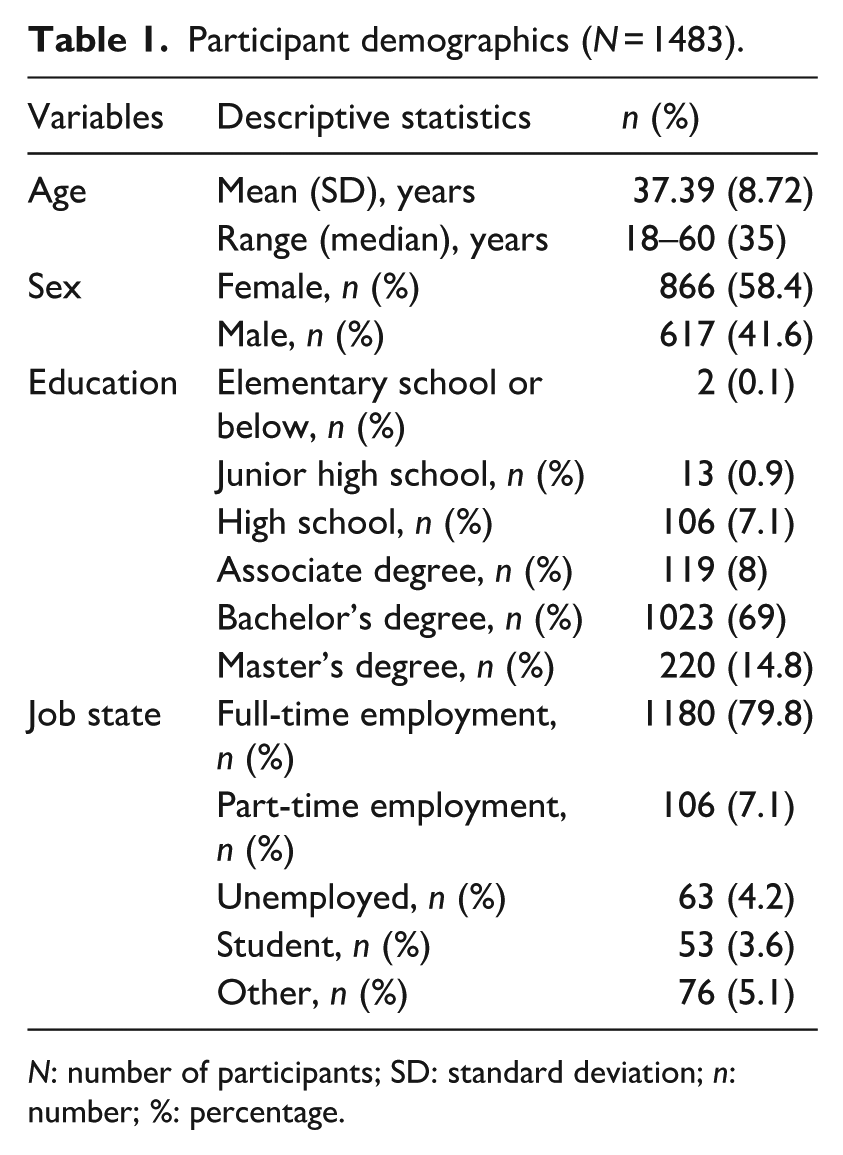
N: number of participants; SD: standard deviation; n: number; %: percentage.
Group comparisons by gender, age, and education
Independent samples t-tests were conducted to examine gender differences in key study variables. Significant differences emerged in the RA subscale of the ETAM, PHQ-9 score, and PSS score. Specifically, males reported significantly higher mean scores on ETAM-RA (M = 2.40, SD = 0.69) compared to females (M = 2.29, SD = 0.69), indicating more positive attitudes regarding the relative advantage and comparability of e-therapy (p = 0.005). Additionally, females reported significantly higher depressive symptoms (PHQ-9; M = 6.77, SD = 4.86) and perceived stress (PSS; M = 26.66, SD = 8.14) compared to males (PHQ-9: M = 5.58, SD = 4.32; PSS: M = 24.72, SD = 7.30). There were no significant gender differences in weekly internet usage, perceived usefulness, or the ETAM mean score.
Differences across age groups (18–30, 31–40, 41–50, and 51–60 years) were examined for weekly internet use, attitudes toward e-therapy, and psychological indicators. The analyses revealed no significant differences in weekly internet use, ETAM mean score, ETAM-RA, PSS, GAD-7, or PHQ-9 across age groups. However, a significant difference was found in ETAM-PU scores. Post hoc Bonferroni comparisons indicated that participants aged 18–30 years had significantly higher ETAM-PU scores (M = 2.87, SD = 0.64) than those aged 41–50 years (M = 2.74, SD = 0.62; p = 0.036). This finding suggests that younger adults may perceive e-therapy as more useful than those in midlife, although attitudes and psychological symptoms were otherwise stable across age groups.
One-way ANOVA results also indicated that both weekly internet use and the RA subscale of the ETAM differed significantly across education levels. Participants with graduate-level education reported the highest average weekly internet use (M = 50.29 hours, SD = 28.02), compared to university graduates (M = 42.54, SD = 28.91). Post hoc Bonferroni comparisons revealed that this difference was statistically significant (p = 0.002), whereas no other pairwise comparisons reached significance. Regarding attitudes, participants with graduate-level education also reported significantly higher ETAM-PU scores (M = 2.90, SD = 0.63) than those with a junior college education (M = 2.70, SD = 0.62; p = 0.002). These findings suggest that higher education is associated with both greater internet engagement and more favorable attitudes toward the usefulness of e-therapy.
E-therapy attitudes
General attitudes toward e-therapy
The overall mean score for the 17-item ETAM was 2.53 (SD = 0.61; n = 1483), indicating a generally high level of acceptance of e-therapy among participants. For the subscales, the PU subscale had a mean of 2.80 (SD = 0.64), reflecting high acceptance. The RA subscale had a lower mean score of 2.34 (SD = 0.39), reflecting a moderate level of acceptance. At the item level, most PU items (e.g. items 1, 3, 5, 6, 12, 14, and 15) were rated highly, with means ranging from 2.76 to 2.86. While RA items showed more variability, some items also reflected relatively high endorsement; for instance, item 9 (M = 2.55) and item 17 (M = 2.51) were rated in the high acceptance range. In contrast, several RA items were rated moderately, such as items 2, 4, 7, 8, 10, 11, 13, and 16, with mean scores ranging from 2.12 to 2.47, suggesting mixed perceptions of e-therapy’s relative advantage compared to traditional methods. Specifically, 4% of respondents demonstrated low acceptance and a negative attitude, 45.2% showed moderate acceptance with a neutral attitude, and 50.8% exhibited high acceptance and a positive attitude.
Psychometric Properties of the Chinese ETAM
The internal consistency and construct validity of the Traditional Chinese version of the ETAM were supported by several psychometric indicators. The overall Cronbach’s alpha coefficient was 0.92, indicating excellent internal consistency and closely aligning with the reliability reported in the original version (Apolinário-Hagen et al., 2018b). At the subscale level, the PU subscale was categorized as showing a high level of acceptance, with a Cronbach’s alpha of 0.88. The RA subscale demonstrated a moderate level of acceptance and showed strong internal consistency, with Cronbach’s alpha of 0.90.
The composite reliability (CR), average variance extracted (AVE), and standardized factor loadings were used to evaluate the convergent validity of the ETAM subscales (see Supplemental Table). The CR values were 0.89 for PU and 0.90 for RA, both exceeding the recommended threshold of 0.70 (Hair et al., 1998), indicating good internal consistency. The AVE values were 0.53 for PU and 0.48 for RA. While the AVE for PU met the commonly accepted cutoff of 0.50 (Fornell and Larcker, 1981), the slightly lower AVE for RA remained within an acceptable range, particularly given its high CR values.
All items showed standardized factor loadings above 0.50, supporting adequate item convergence. PU item loadings ranged from 0.57 to 0.80, with items ETAM_12 and ETAM_15 loading the highest. RA items showed similar strength, ranging from 0.57 to 0.78, with ETAM_10 and ETAM_11 loading most strongly. Together, these results provide strong evidence for the convergent validity and internal consistency of the two-factor structure of the Traditional Chinese version of the ETAM.
Confirmatory factor analysis
Based on the number of factors identified in the original study, a confirmatory factor analysis was conducted to evaluate the model’s fit (see Table 2 for results). The model fit indices were as follows: χ²/df = 11.81, GFI = 0.89, AGFI = 0.86, RMSEA = 0.085, RMR = 0.05, NFI = 0.89, and CFI = 0.90. These results indicated a marginal, but acceptable model fit. While GFI, NFI, and CFI approached conventional thresholds (⩾0.90), the RMSEA value slightly exceeded the recommended cutoff of 0.08, suggesting limited model misfit. The relatively high χ² value is likely attributable to the large sample size and degrees of freedom. Nevertheless, since all factor loadings were satisfactory and the two-factor structure was conceptually sound, the original model was retained without modifications.
The model fit indices of the Chinese version of ETAM.
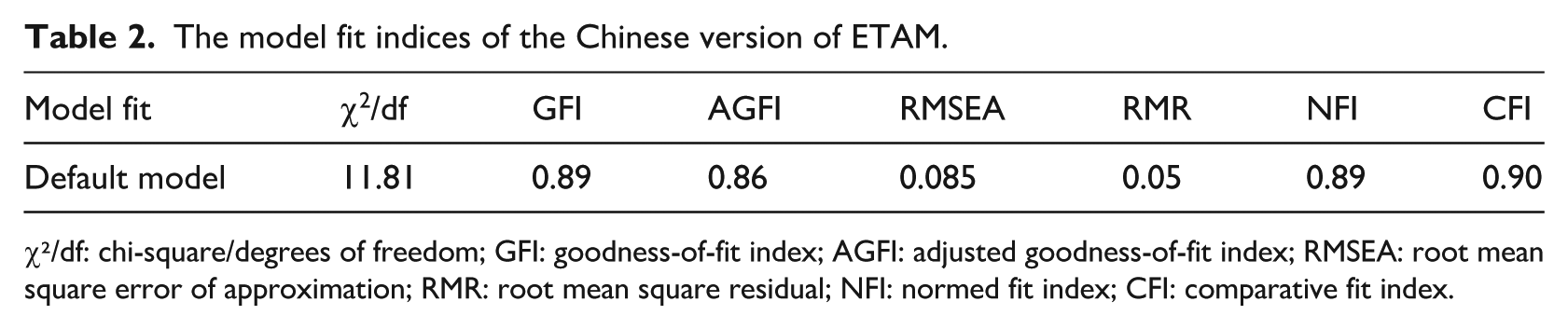
χ²/df: chi-square/degrees of freedom; GFI: goodness-of-fit index; AGFI: adjusted goodness-of-fit index; RMSEA: root mean square error of approximation; RMR: root mean square residual; NFI: normed fit index; CFI: comparative fit index.
Correlations with other variables
Pearson’s correlation analysis was conducted to examine the relationships between attitude questionnaire scores, its subscales, and other variables, including depression severity, anxiety severity, attachment styles, and perceived stress levels (Table 3).
Correlation between the variables.
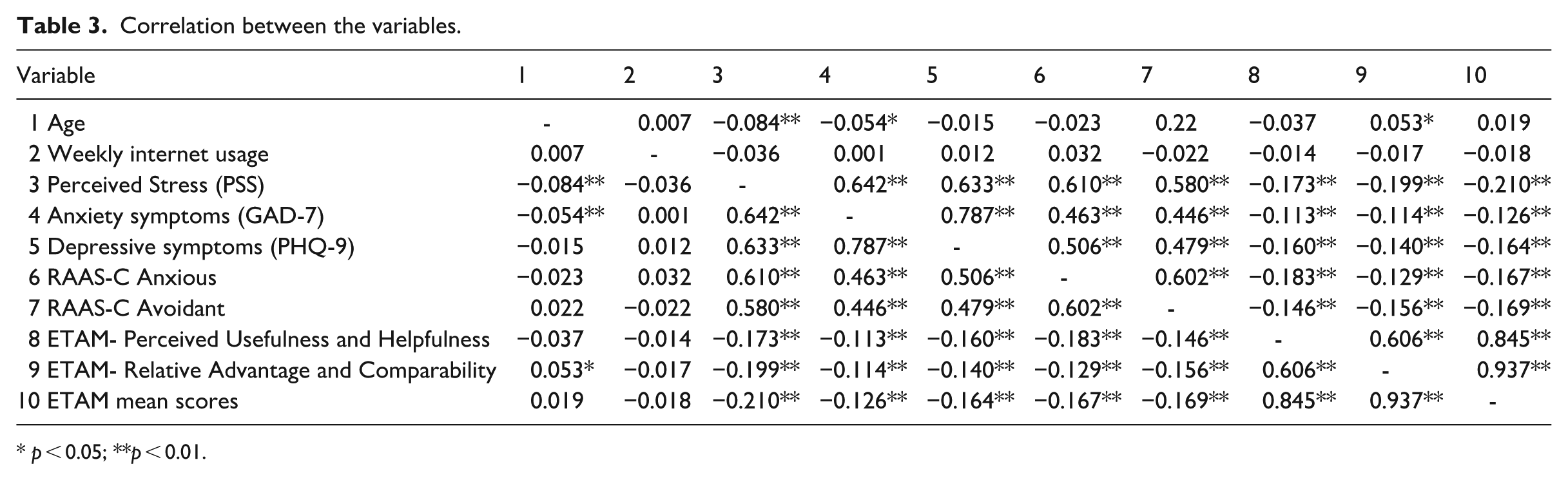
p < 0.01.
Correlations with other variables
Pearson’s correlation analysis was conducted to examine the relationships between attitude questionnaire scores, their subscales, and other variables, including depression severity, anxiety severity, attachment styles, and perceived stress levels (Table 3). Results revealed that higher ETAM scores were significantly associated with lower psychological distress and attachment insecurity. Specifically, the ETAM mean score was negatively correlated with perceived stress (r = –0.210, p < 0.001), anxiety symptoms (GAD-7; r = –0.126, p < 0.001), and depressive symptoms (PHQ-9; r = –0.164, p < 0.001). Similar patterns were observed at the subscale level: ETAM-PU was negatively correlated with stress (r = –0.173, p < 0.001), anxiety (r = –0.113, p < 0.001), and depression (r = –0.160, p < 0.001), while ETAM-RA showed comparable negative correlations (PSS; r = –0.199, PHQ-9; r = –0.114, GAD-7; r = –0.140, all ps < 0.001). In addition, both ETAM-PU and ETAM-RA were negatively correlated with anxious (r = −0.183 and −0.129, respectively) and avoidant attachment (r = −0.146 and −0.156, respectively), suggesting that individuals with higher attachment insecurity tend to have less favorable attitudes toward e-therapy. Age showed weak but marginally significant correlations with ETAM-RA (r = 0.053, p = 0.041), suggesting a minimal age-related difference in perceived advantage of e-therapy. In contrast, weekly internet use was not significantly associated with any ETAM scores.
Differences by attitude group
Based on the original research, participants were divided into three groups according to their overall ETAM scores: Low Acceptance, Negative Attitude, with scores below 1.49 (n = 59); Moderate Acceptance, Neutral Attitude, with scores between 1.5 and 2.49 (n = 671); and High Acceptance, Positive Attitude, with scores above 2.5 (n = 753).
To examine the differences between the attitude groups, a one-way ANOVA was conducted. As expected, there were significant differences across groups in ETAM-related scores. Participants in the HP group reported significantly higher perceived usefulness, relative advantage, and the ETAM mean score compared to those in the MN and LN groups. Regarding emotional distress, the HP group reported significantly lower levels of depression and anxiety symptoms compared to the MN group. They also reported lower stress levels than the LN and MN groups. These results suggest that individuals with more favorable attitudes toward e-therapy tend to experience fewer psychological symptoms and lower stress. For attachment patterns, individuals in the HP group reported significantly lower levels of both anxious and avoidant attachment than those in the MN group. Additionally, they showed lower attachment anxiety than participants in the LN group. No significant group differences were found in age or weekly internet use (see Table 4).
Differences among attitude groups across other variables.
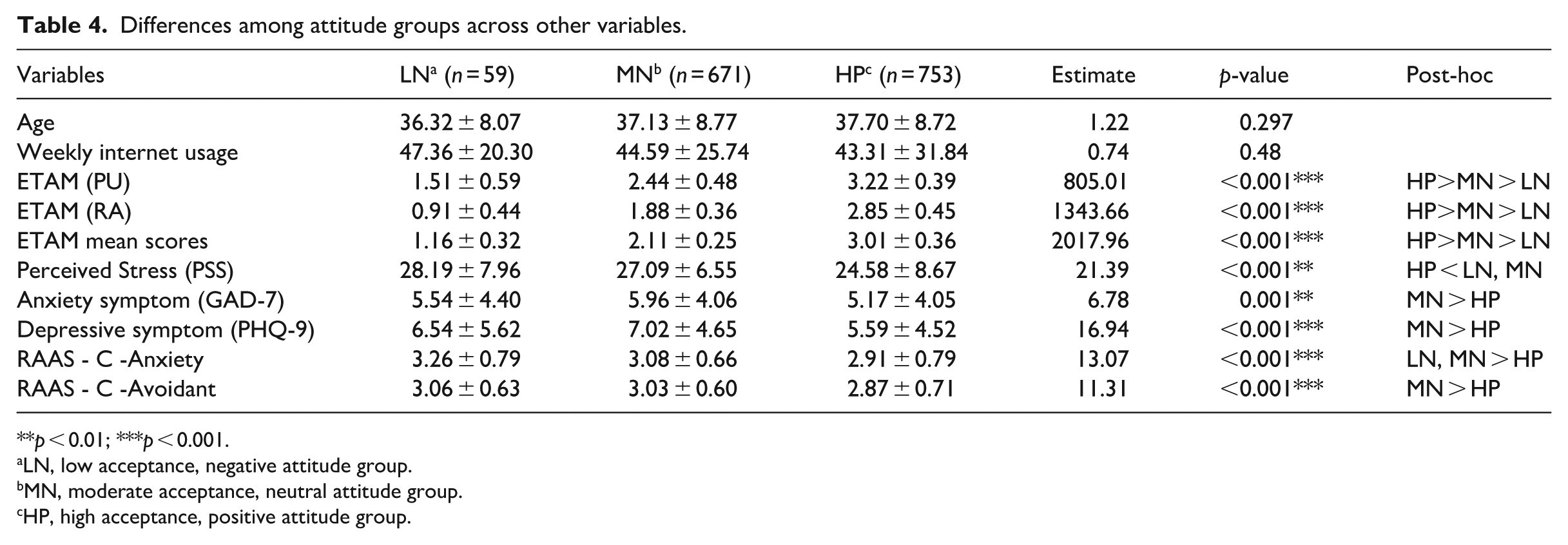
p < 0.01; ***p < 0.001.
LN, low acceptance, negative attitude group.
MN, moderate acceptance, neutral attitude group.
HP, high acceptance, positive attitude group.
Discussion
This study demonstrated that the Traditional Chinese version of the ETAM exhibits strong psychometric properties, supporting its reliability and validity for use in Taiwan. The overall Cronbach’s alpha of the Traditional Chinese version (0.92) matched the reliability of the original (0.92; Apolinário-Hagen et al., 2018b), the Turkish (0.92; Özer et al., 2024), and the Chilean (0.92; Jofré Bolarin, 2021) versions, supporting its cross-cultural reliability. At the subscale level, Cronbach’s alpha was 0.88 for Perceived Usefulness and Helpfulness (PU) and 0.90 for Relative Advantage and Comparability (RA), both indicating excellent internal consistency. Convergent validity was also confirmed, with composite reliability values of 0.89 (PU) and 0.90 (RA) and average variance extracted values of 0.53 (PU) and 0.48 (RA). Although the AVE for RA was somewhat lower, consistently high reliability estimates and satisfactory factor loadings ranging from 0.57 to 0.80 indicated adequate convergence (see Supplemental Table). Importantly, our confirmatory factor analysis supported the two-factor structure, yielding marginal but acceptable model fit indices, with all items loading significantly on their intended factors. This result is mainly consistent with the original study, which initially proposed a two-factor solution before extending to a three-factor model that included “e-accessibility” (Apolinário-Hagen et al., 2017). However, the third factor in the German version showed poor internal consistency (α = 0.30) and was essentially based on a single item, raising questions about its psychometric soundness. By confirming the two-factor model, our findings provide a more parsimonious and reliable structure for the Taiwanese context while maintaining conceptual equivalence with the original measure. In addition, the comparability of our reliability estimates with those of the original, Turkish, and Chilean versions further underscores the cross-cultural stability of the ETAM. Collectively, these results provide robust evidence for the psychometric validity of the Traditional Chinese ETAM, thereby strengthening its utility as an assessment tool for public attitudes toward e-therapy in Taiwan.
As a complementary finding, over half of the participants expressed high acceptance of e-therapy, with only a small minority (4%) reporting negative attitudes. The proportion of individuals with positive or neutral attitudes was higher than that reported for Germany in 2015 (Apolinário-Hagen et al., 2018b). This pattern contrasts with earlier findings on help-seeking attitudes among Taiwanese students. For instance, Yeh (2002) found that interdependent self-construal, collective self-esteem, and gender significantly influenced reluctance to seek professional psychological help, while Lin (2014) reported low utilization of counseling services among Taiwanese students. These prior findings suggest that cultural factors such as stigma and collectivist values have historically suppressed help-seeking behaviors in Taiwan. The higher acceptance rates observed in our study may reflect a shift in public perception, driven by increased mental health awareness, generational changes, or the rapid normalization of online services during the COVID-19 pandemic. These findings underscore the importance of revisiting cultural assumptions in the adoption of e-therapy and suggest that public attitudes toward digital mental health services may be evolving more rapidly than anticipated.
Our findings also revealed that attitudes toward e-therapy and related psychological indicators varied across demographic groups. Males reported higher scores on the ETAM-RA subscale, suggesting they may perceive e-therapy as more comparable to traditional therapy formats, whereas females exhibited higher levels of depressive symptoms and perceived stress—patterns consistent with prior research highlighting greater emotional burden among women (Girgus and Yang, 2015; Grigoriadis and Robinson, 2007; Matud, 2004). Age differences were modest; younger adults (18–30 years) reported greater perceived usefulness of e-therapy than midlife participants (41–50 years), potentially reflecting greater familiarity with digital platforms. However, other attitudes and psychological indicators showed consistency across age groups.
A recent study by Özer et al. (2024) also investigated university students’ attitudes toward internet-based mental health interventions and found that digital literacy significantly predicted more favorable attitudes, while demographic and psychological variables showed no significant association. Interestingly, although many students actively sought online mental health information, most were unaware of existing interventions and preferred options that involved human interaction, such as face-to-face guidance or video content. These findings underscore the importance of improving digital literacy and integrating user preferences into intervention design, particularly when targeting younger and more educated populations.
Educational differences were more pronounced: individuals with graduate-level education reported both higher perceived usefulness of e-therapy and more frequent internet use, aligning with existing evidence that links higher education to greater digital literacy and openness to novel therapeutic formats. Together, these findings suggest that while overall attitudes are generally favorable, individual differences in technology familiarity, psychological needs, and sociocultural factors may shape the acceptance of e-therapy among Taiwanese adults.
Pearson’s correlation analyses revealed consistent, though small-to-moderate, negative associations between e-therapy attitudes and psychological distress. Specifically, individuals who reported higher levels of perceived usefulness (PU) and relative advantage (RA) also tended to report lower levels of stress, anxiety, and depressive symptoms. Similar negative correlations were observed with attachment orientation: both anxious and avoidant attachment styles were associated with less favorable attitudes toward e-therapy. These findings suggest that psychological vulnerability and attachment insecurity may be linked to greater hesitation in endorsing digital mental health services. To further examine these patterns, we compared psychological indicators across groups categorized by e-therapy acceptance (low, moderate, and high). Results of these group comparisons were largely consistent with the correlational findings. Participants in the high-acceptance group reported lower levels of depressive and anxiety symptoms, reduced perceived stress, and less attachment insecurity (both anxious and avoidant) than those in the moderate- and low-acceptance groups. These converging results reinforce the idea that psychological readiness and interpersonal security play essential roles in shaping acceptance of e-therapy.
Our study also found that PU and RA were negatively correlated with perceived stress, anxiety, and depressive symptoms. This indicates that individuals with higher levels of stress, anxiety, and depressive symptoms are more likely to view e-therapy as less useful, advantageous, and comparable to traditional therapeutic methods. Similarly, anxious and avoidant attachment styles were negatively correlated with these perceptions, suggesting that attachment insecurity may further diminish positive attitudes toward e-therapy. Research indicates that attachment styles play a significant role in shaping attitudes toward and readiness for psychotherapy. Individuals with avoidant attachment often exhibit negative attitudes toward therapy and are reluctant to engage in personal disclosure (Black et al., 2005; Kealy et al., 2017). In contrast, anxious attachment is linked to distress, which motivates treatment-seeking behaviors (Kealy et al., 2017). Attachment orientation has been shown to predict attitudes toward therapy and anticipated help-seeking behaviors, with positive and negative attitudes mediating the relationship between attachment avoidance and the likelihood of seeking therapy (Millings et al., 2019). Interestingly, priming attachment security has been found to enhance attitudes toward various therapeutic approaches, particularly in individuals with fearful-avoidant attachment styles (Millings et al., 2019). In summary, attachment styles influence therapeutic attitudes and readiness, with avoidant attachment linked to negativity and reluctance, and anxious attachment driving treatment-seeking distress. Enhancing attachment security can improve attitudes, particularly among individuals with fearful-avoidant attachment styles, highlighting strategies to overcome attachment-related barriers.
In summary, the Traditional Chinese version of the ETAM demonstrated strong psychometric properties and cross-cultural comparability, confirming its utility for assessing attitudes toward e-therapy in Taiwan. Our findings revealed a generally favorable public acceptance of digital mental health services, suggesting a cultural shift toward greater openness to online interventions compared to earlier studies on traditional help-seeking. We found that younger adults and those with higher levels of education perceived e-therapy as more useful, which highlights the roles of digital literacy and generational factors. Additionally, the associations with psychological distress and attachment orientations underscore the importance of psychological readiness and interpersonal security in shaping acceptance. Taken together, our results suggest that successful implementation of e-therapy requires not only reliable measurement tools but also strategies that address individual differences in literacy, psychological vulnerability, and cultural context.
This study employed convenience sampling and online recruitment, which may have limited the generalizability of the findings to a broader population. Participants who are more familiar with or have access to internet-based tools may be overrepresented, potentially introducing a selection bias. Furthermore, self-report measures were used to collect data, which may have been influenced by social desirability or recall bias. The cross-sectional design also precluded causal inferences, thereby limiting the ability to establish directionality in the observed relationships. Finally, cultural or contextual factors unique to the study population may have affected the applicability of the findings to other settings, underscoring the need for further cross-cultural validation.
Supplemental Material
sj-docx-1-hpq-10.1177_13591053251392564 – Supplemental material for Psychometric validation of the Chinese version of the E-Therapy Attitudes Measure (ETAM) and associated psychological factors in Taiwanese adults
Supplemental material, sj-docx-1-hpq-10.1177_13591053251392564 for Psychometric validation of the Chinese version of the E-Therapy Attitudes Measure (ETAM) and associated psychological factors in Taiwanese adults by Fan-Chi Hsiao, Yu-Jie Chen, Yen-Feng Lin, Yi-Chen Wang and Lun-De Liao in Journal of Health Psychology
Footnotes
Acknowledgements
This research was supported by the Ministry of Economic Affairs through the “Innovative Therapeutic Product Development Validation Program for Whole Age Health” (Project Number: 113-EC-17-A-22-1906). Additional funding was provided by the National Health Research Institutes for the project “Addressing Trauma and Stress: Current Status and Effectiveness of Digital Psychological Interventions in Taiwan” (Project Number: NHRI-BN-113-EC-1906-02). We would like to acknowledge SHIN-RU LAI for their assistance with participant recruitment and data analysis. Consent has been obtained from all contributors acknowledged in this section. We would like to thank Editage ( ) for English language editing and journal submission support.
Ethical considerations
This study was approved by the National Chengchi University Research Ethics Committee (Approval Number: NCCU-REC-202406-E093). The research was conducted in accordance with the ethical guidelines and regulations outlined by the committee. All participants provided informed consent prior to their inclusion in the study.
Consent to participate
All participants provided written informed consent to participate in the study. The consent process was approved by the National Chengchi University Research Ethics Committee (Approval Number: NCCU-REC-202406-E093).
Consent for publication
Written informed consent for publication was obtained from all participants who were included in the study. Identifiable personal information has been omitted to ensure participant confidentiality.
Author contributions
Fan-Chi Hsiao: Conceptualization, Data curation, Formal Analysis, Methodology, Validation, Visualization, Writing-original draft and review& editing. Yu-Jie Chen: Data curation, Formal Analysis, Investigation, Methodology. Yen-Feng Lin: Conceptualization, Funding acquisition, Investigation, Validation. Yi-Chen Wang: Data curation, Formal analysis, Validation, Visualization, Writing-original draft. Lun-De Liao: Conceptualization, Investigation, Funding acquisition, Resources.
Funding
The authors disclosed receipt of the following financial support for the research, authorship, and/or publication of this article: This study was funded by the Ministry of Economic Affairs, under the Innovative Therapeutic Product Development Validation Program for Whole Age Health (Project Number: 113-EC-17-A-22-1906), and the National Health Research Institutes, under the project “Addressing Trauma and Stress: Current Status and Effectiveness of Digital Psychological Interventions in Taiwan” (Project Number: NHRI-BN-113-EC-1906-02).
Declaration of conflicting interests
The authors declared no potential conflicts of interest with respect to the research, authorship, and/or publication of this article.
Data availability statement
The data that support the findings of this study are not publicly available due to ethical restrictions imposed by the National Chengchi University Research Ethics Committee (Approval Number: NCCU-REC-202406-E093). Research Ethics Committee to protect participant confidentiality. Data may be made available upon reasonable request and with approval from the ethics committee. Please contact the corresponding author for inquiries.
Supplemental material
Supplemental material for this article is available online.
References
Supplementary Material
Please find the following supplemental material available below.
For Open Access articles published under a Creative Commons License, all supplemental material carries the same license as the article it is associated with.
For non-Open Access articles published, all supplemental material carries a non-exclusive license, and permission requests for re-use of supplemental material or any part of supplemental material shall be sent directly to the copyright owner as specified in the copyright notice associated with the article.
