






Abstract
‘Fitspiration’ is a popular social media trend focussed on sharing images and information to inspire users to engage in fitness and other health-related behaviours. As fitspiration typically portrays the thin-athletic ideal, it has been associated with negative impacts on body image and mood. This study aimed to determine the acceptability of different images displaying diverse body types or social media literacy messages, as approaches to mitigate the harmful effects of fitspiration. We held two focus groups in Victoria, Australia comprising a total of 15 women aged 18-29 to evaluate the acceptability of different intervention images. Participants expressed a preference for visual images with a positive framing, particularly those showing diverse bodies. Findings emphasised the importance of developing content alongside the target audience, to ensure that it is perceived as relevant and genuine. Recommendations are provided to inform the further development and testing of a fitspiration social media intervention.
Introduction
Fitspiration
The majority of young people use social media for health information, with fitness and exercise content being the most accessed type of health content (Australian Youth Digital Index, 2025; The Royal Children’s Hospital National Child Health Poll, 2025). ‘Fitspiration’ or ‘fitspo’ is a well-established social media trend where users share fitness-related content to inspire themselves and others to eat healthily and exercise (Boepple and Thompson, 2016; Carrotte et al., 2017; Raggatt et al., 2018; Tiggemann and Zaccardo, 2018). It is extremely popular, with over 70 million posts on Instagram and over 60 billion views on TikTok (Pryde et al., 2024). People who access fitspiration content report that fitspiration posts provide motivation to exercise and access to an online community with a shared interest in health and fitness (Raggatt et al., 2018). However, despite these reported positive intentions, fitspiration often depicts an unrealistic, idealised female body type and contains messages endorsing excessive exercise and dietary restriction (Boepple and Thompson, 2016; Carrotte et al., 2017; Tiggemann and Zaccardo, 2018). Evidence from an experimental study suggests that viewing fitspiration content is associated with adverse outcomes for mental health and body image, such as increases in negative mood and body dissatisfaction (Homan et al., 2012; Prichard et al., 2018, 2020; Robinson et al., 2017; Tiggemann and Zaccardo, 2015). Additionally, individuals who post fitspiration content on Instagram tend to score higher on measures of disordered eating and compulsive exercise compared to those posting travel images (Holland and Tiggemann, 2017). Conversely, there is mixed evidence about the impact of broader social media content on wellbeing and body image, with several studies finding mixed or neutral results (Goh et al., 2025; T’ng et al., 2024).
Several theories explain how social media images contribute to body dissatisfaction and appearance-focussed behaviours like disordered eating and compulsive exercise. The sociocultural model proposes that family, peers, and the media can place pressure on individuals to have a certain appearance based on norms and ideals (Keery et al., 2004; Ramme et al., 2016). Since the 1990s in Western countries, this has predominantly involved a cultural ideal of a slim, athletic appearance for women and a muscular ideal for men, endorsed by their peers and social media (Carrotte et al., 2017; Fredrickson and Roberts, 1997; Pryde et al., 2024). Internalisation or adopting the norms of this largely unattainable ideal leads to body dissatisfaction (Brownell, 1991; Homan et al., 2012). Social comparison theory further explains how people evaluate themselves by comparing their opinions, appearance, and abilities to their peers in order to belong to groups (Festinger, 1954). Making frequent comparisons to peers and celebrities on social media is associated with greater body dissatisfaction (Fardouly and Vartanian, 2015), suggesting that individuals who compare themselves to women in ‘fitspiration’ images may be vulnerable to body dissatisfaction.
Given the potential for fitspiration to negatively affect the mental health and body perceptions of viewers, it is important to explore strategies to counteract these harms. Below, we describe two strategies that are theorised to reduce the acceptance of and comparison to ideal images. This study draws upon related literature that has investigated strategies to address the effects of exposure to images of idealised beauty standards in the media.
Media literacy
Media literacy is the ability to think critically about the media, to assess whether an image is realistic (Bergsma and Carney, 2008; Jeong et al., 2012; McLean et al., 2016b). It is proposed that enhanced media literacy has a protective effect by reducing the persuasive influence of media. This then prevents internalisation and comparisons related to an unrealistic ideal and ultimately reduces body dissatisfaction (Bergsma and Carney, 2008; McLean et al., 2016b). This has been demonstrated in one study of adolescent girls, which found that individuals with higher media literacy levels had higher body satisfaction compared to individuals with lower media literacy levels (McLean et al., 2016a). Media literacy interventions that involve teaching these skills have been generally effective at increasing participants’ media literacy. However, their impact on body satisfaction and eating concerns remains mixed (McLean et al., 2016b). It has been suggested that media literacy alone may not attenuate the harmful effects of the media, and that they may be more effective when combined with other types of intervention such as those addressing peer comparisons of appearance (McLean et al., 2019).
Social media literacy extends traditional media literacy, focussing on analysing and evaluating commercial and user-generated content on social media (Tamplin et al., 2018). In particular, providing information on the motivations behind social media posts, including the selection or modification of images (Tamplin et al., 2018). School-based social media literacy interventions with adolescents have shown some improvements in body satisfaction, internalisation of the thin ideal, mood, disordered eating, and media literacy in girls (Gordon et al., 2021; Halliwell and Diedrichs, 2014; McLean et al., 2017), although only one intervention has shown improvements in both boys and girls, with small effect sizes (Bell et al., 2022). An alternative approach involves creating social media posts that promote critical thinking during exposure to fitspiration imagery, potentially mitigating its negative effects. Slater et al. (2019) reported that exposure to parody social media images highlighting the contrived and unrealistic nature of celebrity posts improved immediate mood and body dissatisfaction relative to thin-ideal images. However, the study found no improvements to social media literacy (Slater et al., 2019). In another study examined the impact of ‘Instagram versus reality’ images, a trend which compares idealised/edited images to unfiltered ‘real’ images. ‘Instagram versus reality’ images did not reduce body dissatisfaction more than the ‘reality’ images alone. (Tiggemann and Anderberg, 2020). These findings suggest that critiquing the construction of social media images may mitigate some of the harmful effects of fitspiration, yet further research is needed to understand its effectiveness.
Diverse images
Another strategy that may address appearance comparison norms is to feature images of women with different body types, shapes, and sizes on social media. It is hypothesised that diverse representations will shift perceptions of the ideal body, challenging the thin or athletic ideal and ultimately reducing body dissatisfaction (Owen and Spencer, 2013). The approach has similarities to body positive content (‘BoPo’) on social media, which aims to normalise bodies of different sizes and shapes and promote a broader conceptualisation of what is normal (Cohen et al., 2019). This hypothesis is generally supported by experiments in which participants exposed to images of women of average, healthy weight have lower body dissatisfaction and greater positive mood compared to those exposed to images of thin or athletic and thin women (Cohen et al., 2019; Fister and Smith, 2004; Homan et al., 2012; Owen and Spencer, 2013). Additionally, researchers have also compared the effects of exposure to traditional fitspiration images and fitspiration images of women with more body fat and less muscle tone, finding improvements in negative mood yet mixed results regarding changes in body dissatisfaction (Barnes et al., 2023; Cha et al., 2022). Similarly, these findings suggest that images portraying diverse appearances may be useful in protecting users from the harmful effects of fitspiration images, yet further investigation is warranted.
Study rationale and aims
In summary, there is modest support for both types of approaches; that is, interventions that draw attention to the contrived nature of social media images (Paxton et al., 2022), or present diverse, less idealised appearances (Rodgers et al., 2021). Nonetheless, few of the above studies engaged participants in intervention development. One classroom-based intervention reported piloting their intervention with 25 adolescent participants, with qualitative feedback leading to small modifications in implementation (Bell et al., 2022). Other researchers have utilised focus groups to reveal adolescent perspectives of the effects of social media use on their mental health and wellbeing, as well as any existing coping strategies to mitigate these effects (Burnette et al., 2017; Mahon and Hevey, 2021; Papageorgiou et al., 2022). Co-designing or including participants in the development of body image interventions has been identified as a way to capture the unique perspective of social media users (Jarman et al., 2022).
This study forms part of a broader program of work aiming to develop approaches to mitigate the negative effects of fitspiration content. It informs the development of a social media-based intervention that would utilise diverse body or media literacy images. Using a focus group methodology, this study aims to determine the acceptability of different styles and features of diverse body or media literacy images.
Methods
Human Research Ethics approval was obtained. We invited women aged 16–29 years to participate in one of two focus groups. We recruited focus group participants by emailing people who had previously participated in our research studies and consented to being contacted about future opportunities. Potential participants then contacted the researcher by email or SMS to indicate their interest. The researcher then phoned interested people to give further information about study involvement and confirm eligibility (identified as female, aged 16–29 years, and available to attend a focus group). The age range of consenting focus group participants was 18–29 years. In focus group 1 there were seven participants, in group 2 there were eight participants.
The research organisation held focus groups in December 2017, each lasting 90 minutes. We obtained written informed consent at the start of focus groups. Researchers informed participants that the aim of the focus group was to develop social media strategies to support healthy body image. We presented participants with examples of images featuring fitspiration (n = 10), women exercising (n = 10), motivational quotes (n = 6), and image-based posts related to social media literacy (n = 10) sourced from Instagram or created by the research team (Figure 1). The images were chosen as typical examples of the type of content they represented, based on researchers’ experience conducting multiple content analyses of fitspo and other social media content (Carrotte et al., 2017). No systematic criteria or standardisation was applied to the selection of images. This content was presented as still images, imitating the format of fitspiration images on social media sites that were common at the time of research. We used a semi-structured facilitation guide which focussed on the desirability, relevance and perceived effectiveness of the example images and messages at promoting positive body image. We also asked participants for feedback about a study design to test the intervention images including preferred frequency and timing of surveys, method of survey delivery, and suggestions to increase survey completion. Participants received $AUD 40 reimbursement. Researchers audio recorded and transcribed focus groups verbatim.
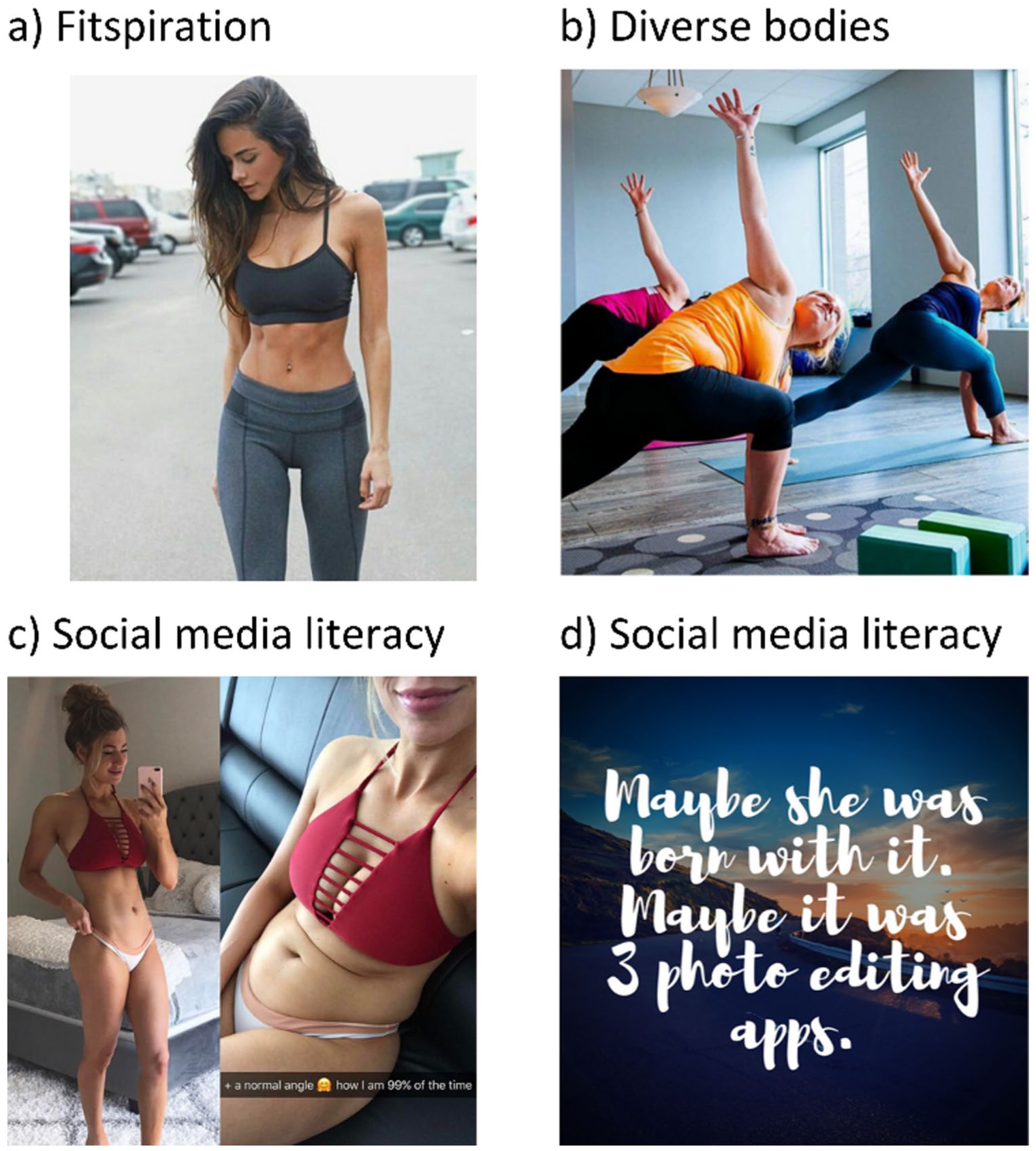
Examples of intervention images used. Sources from left to right. (a) Fitspiration (Hendrix, 2017). (b) Images of diverse bodies/women exercising (Dolan, 2015). (c) Social media literacy ‘before and after’ (@annavictoria, 2017). (d) Social media literacy text (generated by the researchers). Images were chosen by researchers as typical examples of the type of content they represented.
Two female researchers co-facilitated focus groups: a junior researcher with extensive knowledge of the field of fitspiration research but limited experience in conducting focus groups and a postdoctoral researcher with extensive training and experience in qualitative research, including conducting focus groups. Both were a similar age to the participants and were active social media users in their personal lives. This may have increased the participants’ comfort, discussing these topics with people they saw as peers rather than others. Two other female researchers (one in her 20s, one in her 30s) were involved in the analysis and interpretation of data. As all four researchers had personal experience as users of social media and targets of fitspo, we are likely to have interpreted participant data through a lens of our own similar experiences. We attempted to reduce the impact of this on our interpretation by questioning whether our themes were supported by raw data throughout the analysis process.
We used a thematic analysis approach following the steps by Braun and Clarke (2006). In inductive initial coding, the second author coded the basic segments in the data using short descriptive codes that both summarised and captured the meaning or idea of that piece of data. Then, she grouped similar codes together. Next, she looked for patterns in recurring codes that appeared across focus groups or were particularly salient within a focus group, for example, if there was strong discussion and agreement among participants within the focus groups. She then presented and discussed these codes with the other authors, and we collaboratively assigned these codes as the initial themes. With the data collated under each initial theme, the first author checked whether the data fit under each theme, whether the themes adequately captured the nuance of the data before refining final themes in discussion with the other authors. Where there was disagreement about assignment of data to a theme, this was reviewed further with the other authors to reach a consensus. Finally, the first author organised themes by image type: diverse bodies and social media literacy.
Results
Images of women with diverse bodies
Focus on enjoyment & activity
Regardless of the body types presented, participants preferred images of women who were actively doing physical activity, over images that were posed. When presented with images depicting women with diverse body shapes and sizes, we found that participants were heavily focussed on whether the women depicted appeared to be enjoying using their body. They preferred images where women had happy facial expressions over those with women overly posed.
It shifts the focus from their body to their enjoyment and the exercise as well (Focus group 1) . . . and even with the ones that are more like traditional fitspo with the really skinny person like I just I prefer them if they were smiling like the ones in the two corners even the one on the left. Like I like that one on the right bottom right corner cos she’s smiling, she happy (Focus group 2)
Diversity
Although more focussed on activity in images and facial expressions, participants were still very supportive of the posed images depicting women with diverse bodies. They professed that it was ‘good’ and ‘refreshing’ to see women with different appearance, sizes, and shapes. They felt that it was a positive contrast to the ‘glorified’ idealised fitspiration look they often saw on their social media.
I want to see positive messages I wanna see photos of different body types and different body shapes rather than messages with the same stuff that we constantly see (Focus group 2)
While participants were supportive of representation of diverse bodies, they demonstrated scepticism of the tokenism of representation used by companies in marketing. This was particularly highlighted around the inclusion of models of diverse ethnic backgrounds in posts by brands. Some participants believed some of these images of diverse women could come across as contrived and trying to ‘force’ diversity when it was obvious to them that people had been chosen from different backgrounds for the purpose of the photo. In these cases, participants’ scepticism of images that were perceived as artificially creating diversity undermined the benefits of showing different bodies.
P: I think don’t be too explicit about being like here is a diverse range of women like just be. . . P: that’s a massive roll your eyes for people like ‘we’ve presented you with a really diverse range’ P: don’t even bring up like race or different sizes at all just be like ‘here are some women’ and then be like cool P: it makes you roll your eyes the minute you read like ‘we’ve presented a diverse range’ P: yeah ‘look how multicultural we are’ **laughter** P: those like college multicultural college students sitting on the grass cos like you know there’s one black girl, an Asian girl like P: cos then it shifts the focus Many: yeah P: it does race rather than like healthy like (Focus group 1)
Social media literacy images
Obvious messages
Many participants reported being familiar with key media literacy messages included in our examples such as awareness of images being edited and portraying unrealistic body ideals. Participants reported that they had learnt this from classes at school but felt that media literacy messages were more important for younger women and girls who may not have been exposed. Participants reported finding familiar media literacy messages to be being patronising as though they were being talked down to about things they already knew.
P: I think it’s just the younger groups might not be able to distinguish between them but people older and our age group more older girls would know that that they’re photoshopped or edited or things like that” (Focus group 1) P: These statements are really swooping[sic]. I would find them boring they don’t have any examples I’m just like roll eyes, heard it before, do you think I’m stupid? Of course I know that media is not reality (P: yeah) tell me something new like this would just make me want to roll my eyes 40 times like we’ve been told this since high school P: yeah like I kind of get the same impression it’s just like why are you telling me something that I already know like why not instead of trying to push this message try and introduce (P: give context) the actual thing that you’re trying to tell us about (Focus group 2)
Nonetheless, other participants felt that ‘before and after’ style intervention images were useful in highlighting more subtle photo alterations due to editing or composition (e.g. lighting, facial expression), even for those who were aware of image editing practices.
. . . pointing to specific things and showing you know you might not of consciously thought about you know like you can see what they’ve done to that woman’s thighs on the left but you might [not] have noticed to what they did to her hands . . .” (Focus group 1) “I think it also reminds people that images are just like a snap in time so it’s like when you’re out and about and you’re with like real people nobody’s gonna be like sucking their tummy in all the time and just like always have perfect posture and like that. Most people are hunching most of the time *laugh* and that’s kind of easy to forget when it’s a still image.” (Focus group 2)
Supportive
Although participants generally disagreed that people should post deliberately unrealistic images, they did not support negative messages against the practice or the shaming of users who did. Participants reported that they want to see images that are supportive and encouraging of all women, even those that may post unrealistic images. When shown an image highlighting the heavily edited nature of online images, this was perceived as shaming people who post edited or unrealistic images on social media to improve one’s self-esteem.
P: I think that bottom one as well goes a bit into territory of like putting down something to make you feel better whereas it (mmm) should be more about the looking at the positive aspects P: yeah just minimising someone else to make yourself look better about you not looking like that (Focus group 2)
In contrast to negative and simplistic messages highlighting editing, participants advocated for content that was empowering and depicted a call to action. For example, participants expressed that they know images are edited but that they wanted to know what actions we can do to positively contribute to their social media communities.
P: I feel like they need like a call to action. It’s kind of like ok ‘don’t buy the lies’ . . . I kind of like the one on the left [which focuses on the lack of diverse representation of bodies in the media] a bit better. . . than just being like don’t buy the lies. Like there’s no what do you want me to do? P: this puts it back on you P: yeah. . . here’s some ways you can maybe facts or examples about like or places where I can take a media that doesn’t do this so that I can go alright cool here’s how I cannot buy the lies (Focus group 2)
Visually illustrative
Participants preferred images that visually illustrated key messages through images or photos. Posts containing text including short sentences, quotes or statistical facts were less engaging, and participants said they would be likely to ignore and dismiss these types of posts on social media.
P: I think it’s more important to actually portray it rather P: and show it P: than just say (Focus group 1)
Genuine, relatable, trustworthy
Participants wanted messages that were genuine, relatable and they could trust. Participants disliked images that compared or showed unedited; ‘realistic’ images as these were often made by people who were already perceived as very attractive; the unedited image could still be unrelatable and not reflective of all body types. Everyday people or athletes discussing or illustrating media literacy were perceived as more relatable compared to images or quotes from models talking about the unrealistic nature of social media. Statistics or facts alone were not trusted as participants stated that they needed to see a reference or link to the source of information. Participants also highlighted that statistics had the potential to be misinterpreted without all the contextual information. Participants critically evaluated statistics when presented with them. They questioned what they were based on, for example, the survey sample for this statistic.
P: I feel like the numbers don’t really mean that much to anyone especially if it’s just like 12% and I’m like is 12% Australians or the world and like it’s a survey and . . . you can’t trust it P: and also its Australian women P: it still it’s not like you don’t know if those percentages were based on what you’re seeing as well cos you’re- P: -what sort of people are answering these surveys you know P: it’s not as simple as the previous images I think (Focus group 1)
Discussion
This study aimed to determine the acceptability of different styles and features of diverse body or media literacy images. Both intervention types are designed to reduce the comparison to idealised fitspiration images that is supported by the sociocultural model and social comparison theory. Participants demonstrated awareness of these ideal norms and described the fitness influencers they typically see on social media as very skinny and unrealistic. Our findings suggest that showing diverse and positive imagery may be more effective at addressing these norms than posts which directly call them out.
Social media health and wellbeing interventions naturally compete with other social media content for user attention. Therefore they need to be carefully designed to attract engagement, which is a prerequisite for effectiveness. Findings from the formative focus groups offer useful insights for designing intervention content that aims to enhance social media literacy for fitspiration and body image. Firstly, the findings highlight the importance of designing interventions closely with the target audience to ensure that they have a visually appealing design, are relevant and original, not seen as contrived or condescending, and to identify and reduce unintended negative consequences. Images that are framed positively (i.e. not critical or only focussing on the negative aspects of social media), show people who appear to be actively exercising and enjoying themselves, and are genuine and relatable, are more likely to be well received by this group. These findings support the utility of ‘body functionality’ content that focuses on what a body can do, not what it looks like (Mulgrew and Courtney, 2022). It supports the potential impact of #BoPo content that emphasises appreciation of diverse bodies (Cohen et al., 2019). This is also consistent with research from the social media literacy and diverse bodies literature which suggests that interventions containing visual imagery are generally more effective than text (i.e. captions or comments) in protecting girls and women against the harmful effects of the thin and fit ideal on social media (Rodgers et al., 2021).
The social media literacy messages shared in this focus group were often perceived negatively. Many social media literacy messages were already familiar to this participant group, duplicating information they had received during their schooling. However, participants felt women younger than themselves would benefit more from such media literacy messages, which has also been found by Rodgers et al. (2019). Furthermore, these messages could also be seen as negative in that they were denigrating people who edit their photographs or pose in certain ways. Finally, the focus on appearance and appearance comparisons in our intervention content were still perceived negatively. This is supported by conclusions proposed by Cohen et al. (2019), that any focus on appearance whether well intentioned or not may be associated with greater self-objectification. We may be priming participants for self-objectification with any images that focus on bodies, even if they are well-intentioned. If a social media literacy approach was to be used it would need to be more positive and engaging; showing what we can do, not just what not to do.
Regarding intervention images that expose the edited nature of social media photos, participants stated that some aspects of these were helpful, but that overall, the message portrayed was ‘obvious’. Previous research by Tiggemann and Anderberg (2020), demonstrated that presenting the unedited (‘real’) image was as effective at reducing body dissatisfaction as presenting both unedited and edited images simultaneously. This supports the idea of using images of diverse bodies to improve body image and challenge the thin ideal (Owen and Spencer, 2013), rather than explicitly drawing attention to idealised representations.
It should be noted that focus group participants both endorsed and criticised the inclusion of racial and ethnic diversity in intervention images. We may have prompted this conversation in the focus groups by asking participants to rate the cultural and ethnic diversity of images, amongst other features. There is currently debate in online spaces about the increasing racial diversity of mainstream media, and racism-driven backlash to this (Gammon and Phan, 2024; Romano, 2022). Nonetheless, these discussions highlight that calling attention to what is seen as a forced attempt at diversity can be perceived negatively by consumers.
The still image format of intervention images used in this study, mimicking images that are often used in social media, could be easily embedded within social media platforms such as Instagram. This may be more effective at reaching target groups than other interventions in the form of an education package delivered in schools or a resource than is hosted on a separate website. However, the intervention would be delivered in a social media newsfeed saturated by idealised appearances, potentially limiting its efficacy. Research has found that benefits obtained from viewing diverse images can be undone by concurrent exposure to traditional inspiration images (Mulgrew et al., 2018). Additionally, if the intervention is delivered on social media, its success may be influenced by the platform and social perceptions and norms for engagement on that platform. For example, can one’s social network see their interaction with the intervention, and how does the target audience feel about others seeing their interactions. Social media interventions could consider involving peers posting their own content, as some participants reported they would be more likely to engage with posts if someone they knew had posted it. Previous research has shown that people in this age group also place high trust in celebrities, influencers, models, and personal trainers for health information on Instagram (Lim et al., 2022). However, they also equated health with appearance ideals, which may suggest that images that stray from these ideals, while appreciated, may not be as influential. Further development is required to determine whether these types of interventions impact effectiveness and engagement.
A strength of this study was its involvement of women aged 18–29 as experts in this topic, to evaluate the acceptability of intervention images and their potential effectiveness in reducing the impact of fitspiration (Jarman et al., 2022). This study also had limitations. Only still images were used, which does not represent the preponderance of video content now popular on social media. Furthermore, the images were not systematically selected and may not fully represent the types of content we sought to portray, particularly given that the images date from before 2017. We attempted to select a range of images that would spark discussion on different features of the content. Furthermore, this study was only able to consider user perspective. In recent years, algorithms play an oversized role in determine which content that users are shown. Developing health interventions now needs to include consideration of algorithmic success as well as acceptability and efficacy of content. Our sample comprised only those identifying as female, which has been highlighted as a weakness in body image intervention research generally (Bell et al., 2022). To protect participant anonymity, only details regarding participant gender and age were collected. As such, it is not known whether focus group participants represent diversity across socioeconomic, educational, and cultural backgrounds. Additionally, it was not possible to identify individual participants during the transcription process, hence, it is not clear where participant quotes originate from the same participant or from different participants. Despite these limitations, the insights from these focus groups provide clear direction for further research and health promotion. The above recommendations are intended to inform the design of a fitspiration social media intervention, followed by piloting in a randomised experimental design.
In conclusion, findings from the focus groups suggest that while social media literacy images can encourage critical thinking about fitspiration content on social media, users are more accepting of approaches which celebrate and normalise diversity in appearance. As seen previously, women in our study had a clear preference for visual images over text-heavy content, highlighting a clear opportunity for placement of intervention images on social media platforms. Further research is needed to incorporate these insights into an intervention and evaluate its effectiveness in mitigating the negative effects of fitspiration content on body dissatisfaction and associated symptoms.
Footnotes

Ethical considerations
The study had ethics approval from Monash University Human Research Ethics Committee (Project number: 11271).
Consent to participate
All participants provided written informed consent.
Consent for publication
Consent for publication is not applicable to this review article as no identifiable participant data are included.
Author contributions
MHR, CJCW, and MSCL conceived the study. MHR and CJCW collected the data. SE and MHR conducted data analysis. SE and MSCL drafted the manuscript. All authors contributed to editing and approved the final version of the paper.
Funding
The authors disclosed receipt of the following financial support for the research, authorship, and/or publication of this article: This project was funded by the Goldschlager Family Charitable Foundation.
Declaration of conflicting interests
The authors declared no potential conflicts of interest with respect to the research, authorship, and/or publication of this article.
Data availability statement
As a qualitative study, data may be identifiable and cannot be shared.