







Abstract
Guided by the consumer culture impact model and the integrated sociocultural model of body image, this cross-cultural study employs online surveys (N = 444) to explain why feminist identification may emerge as a risk factor for women’s body image. Results indicate that feminist identification was positively related to internalizing the material good-life ideal in the Chinese context, which was associated with higher internalization of the body-perfect ideal. Internalizing the body-perfect ideal was related to lower facial satisfaction, and internalizing both ideals was associated with more selfie editing. Cross-culturally, the link between internalizing the body-perfect ideal and body dissatisfaction was stronger among U.S. than Chinese college women, whereas Chinese women edited more selfies than U.S. women. Findings extend theoretical understanding of how feminism influences body image and offer practical implications for health communication. Limitations and directions for future research are also discussed.
Keywords
Introduction
Body image concerns have impacted young women globally (Hockey et al., 2021), leading to both physical and mental health risks (Rodgers et al., 2023). Meta-analyses have revealed that feminism can protect women from body dissatisfaction and self-objectification (e.g. Kvaka et al., 2024), but quantitative studies have not fully explained why such protection is limited and does not translate into behavioral outcomes (Myers, 2022; Yang et al., 2021).
The current study highlights the ambivalent role of feminism in shaping body image by drawing from Dittmar’s (2008) consumer culture impact model (CCIM), which posited that global consumer culture has propagated both the material good-life and body-perfect ideals as markers of success. Popular iterations of contemporary feminism—influenced by neoliberalism and consumerism—emphasize economic success (Banet-Weiser et al., 2020) and frame women’s body work as a pathway to empowerment (Johnston and Taylor, 2008). Thus, the current cross-cultural study hypothesizes that feminist identification negatively affects body image through the internationalization of the material good-life and body-perfect ideals among Chinese and U.S. college women. Specifically, the relationships between said internalization, facial and body satisfaction, and selfie editing—a technology use pattern that entails profound implications for body image in the digital age—are examined. Since China and the United States differ in gender equality, feminist movements, and the cultural emphasis on facial appearance versus body shape (Frith et al., 2005), we address Rodgers et al.’s (2023) call to illuminate how appearance is tied to power and privilege in different cultural contexts.
Literature review
Body image
Body image describes the mental representation of an individual’s body (Grogan, 2016). Among the cognitive, perceptual, affective, and behavioral dimensions of body image, internalization of beauty ideals and facial/body (dis)satisfaction are of particular concern of the current study, as they have been demonstrated to strongly correlate in Cafri et al.’s (2005) meta-analysis and predict behavioral outcomes (More et al., 2019; Thompson and Stice, 2001).
Body image has caused negative affect, lower self-esteem, and eating disorders among women around the world (Frederick et al., 2022). As interactions with sociocultural messages increased individual awareness of contemporary beauty ideals (Thompson et al., 1999), it is important to examine how sociocultural factors influence women’s body image. In the following sections, the theoretical frameworks are first introduced, followed by the conceptual links between body image-related constructs. The influence of feminism on women’s body image is then discussed, in relation to the cross-cultural differences between China and the United States.
CCIM
Dittmar’s (2008) CCIM has illustrated how media and societal values shape people’s views of their bodies and lives. Specifically, modern consumer culture has framed the attainment of both the good-life and body-perfect ideals as success (Ashikali and Dittmar, 2012). The process of realizing and endorsing these societal ideals is termed internalization (Guðnadóttir and Garðarsdóttir, 2014), the degree of which, in turn, reflects the impact of consumer culture (Dittmar, 2008). Consumer culture’s emphasis on physical attractiveness (Guðnadóttir and Garðarsdóttir, 2014) has echoed patriarchal beliefs that a thin body serves as a visible marker of women’s social value (e.g. Bordo, 2003). Therefore, women who embraced materialistic values characteristic of consumer culture were also more likely to seek a perfect body and regard attractiveness as capital to gain positive life outcomes (Teng et al., 2017). Following this rationale, we posit that:
To further understand the implications of internalizing societal ideals propagated by consumer culture, the integrated sociocultural model of body image (ISMBI) is introduced as follows.
ISMBI
Frederick et al. (2022) have integrated sociocultural theories (Thompson et al., 1999) with self-objectification theory (Fredrickson and Roberts, 1997) and proposed ISMBI. ISMBI argues that sociocultural pressures can lead to greater internalization of beauty ideals, which prompts body surveillance (Frederick et al., 2022). Defined as a habit of checking how one looks all the time (Fredrickson and Roberts, 1997), body surveillance heightens perceptions of appearance-related flaws relative to societal beauty ideals, thus producing body dissatisfaction, according to Saunders et al.’s (2024) meta-analysis. By incorporating the feminist framework of self-objectification theory (Kvaka et al., 2024), ISMBI has linked women’s individual body image struggles to societal beauty ideals rooted in systematic gender inequality in patriarchal societies. Therefore, ISMBI aligns with feminist aims of dismantling oppressive beauty standards and promoting bodily diversity (Rubin et al., 2004), and it is applied in the current study to examine how feminist identification is related to women’s internalization of societal ideals, which contributes to their negative body image.
Internalization of the body-perfect ideal and facial/body satisfaction
Guðnadóttir and Garðarsdóttir (2014) have revealed that body-perfect values influence young adults’ body surveillance and body dissatisfaction. Such dissatisfaction emerged when individuals—especially young women—cognitively perceived a discrepancy between their actual body and facial appearance and the beauty ideals (e.g. Warren, 2014).
As evidenced by Paterna et al.’s (2021) meta-analysis, body dissatisfaction and internalization of body-shape ideals were positively correlated, because such internalization might lead women to self-objectify and to view a perfect appearance as integral to their self-worth (Fredrickson and Roberts, 1997). As a result, women would experience heightened dissatisfaction with their body parts that fail to conform to beauty ideals (Saunders et al., 2019). So, we hypothesized that:
Kvaka et al. (2024) called for academic attention to newer forms of negative embodiment in relation to feminism. Accordingly, the present research investigates selfie editing, a behavioral indicator associated with negative body image (Wang et al., 2021).
Selfie editing as behavioral manifestation of body surveillance
Selfie editing, as a behavioral manifestation of body surveillance, allows individuals to digitally modify their “unfavorable” facial and body features (e.g. eyes, skin tone, face shape; e.g. Yang et al., 2021). The reciprocal relationship between selfie editing and negative body image (Wang et al., 2021) has warranted further research into the predictors of selfie editing. Accordingly, the current study explores how the internalization of two societal ideals and facial/body satisfaction affect selfie editing among Chinese and U.S. women college students.
Internalization of societal ideals and selfie editing
Frederick et al. (2022) highlighted the co-existence of multiple beauty ideals and their distinct impacts on women’s body image and health outcomes. So, drawing from CCIM, the current study investigates the influence of both body-perfect and good-life ideals on selfie editing. Because both external, material possessions and a perfect, thin body represent success (Guðnadóttir and Garðarsdóttir, 2014), women internalizing these ideals would like to pursue and present this positive social identity (Frederick et al., 2022), such as by editing their selfies. Given that Yang et al. (2025) and Wang et al. (2021) have both empirically demonstrated that internalization of prevalent beauty standards prompted selfie editing, we proposed the following hypotheses:
Facial/body satisfaction and selfie editing
In addition to the internalization of societal ideals, appearance dissatisfaction also motivated people to edit their selfies (Wang et al., 2021). When women compare themselves with the idealized images in media (Thompson et al., 1999), they seek to address the self-discrepancy caused by such upward comparison (Saunders et al., 2019). In cyberspace, picture editors have allowed women to more easily achieve the socially internalized beauty ideal (e.g. Yang et al., 2025). Therefore, women who are not satisfied with particular facial or body features can change how they look in selfies. Cross-cultural studies have confirmed the positive relationship between self-discrepancy and portrait editing (Yang et al., 2021). Therefore, we postulated that:
As women are susceptible to the pervasive cultural messages about beauty (Bordo, 2003), it is important to scrutinize the influence of potential sociocultural buffers against negative body image, such as feminism.
Feminism and women’s body image
While the aforementioned societal ideals of success and beauty can negatively shape women’s body perceptions, feminist counter-discourse may buffer women against body image concerns (Kinsaul et al., 2014). Despite differences across sociocultural and political contexts, the ultimate goal of feminism has remained ending sexist oppression (Hooks, 2000). Accordingly, feminist scholars have long critiqued unattainable beauty ideals in the patriarchal culture that subordinate women by associating their value with their bodies (e.g. Bordo, 2003). Because feminism promotes critical evaluation of social imperatives and encourages women to question beauty ideals (Rubin et al., 2004), feminists have scored higher on critical and open-minded thinking than non-feminists (Myers, 2022). Murnen and Smolak’s (2009) meta-analysis has confirmed a positive relationship between a feminist identity and body attitudes. By contrast, meta-analytic evidence has also suggested that adherence to traditional femininity was positively related to body dissatisfaction and self-objectification (Kvaka et al., 2024).
However, feminism provided only limited protection against women’s maladaptive body image-related behaviors. For instance, Kvaka et al.’s (2024) meta-analysis suggested that a feminist identity was not related to disordered eating attitudes. In the context of selfie editing, Yang et al. (2025) demonstrated that feminist identification did not influence selfie editing among a community sample of Chinese feminists. To reconcile the discrepancy between theoretical assumptions that feminism should effectively prevent women from behaviors due to negative body image concerns and empirical findings, Kinsaul et al. (2014) maintained that the influence of feminism on body image may be more complex than a simple direct effect. Therefore, we propose a serial mediation model—rather than a direct effect—linking feminist identification to the behavioral dimension of body image (i.e. selfie editing) in the current study.
Kinsaul et al. (2014) have demonstrated that specific components of feminism (e.g. self-efficacy) correlated with body image differently from the global feminism construct. Myers (2022) observed that those who were firmer feminist believers tended to desire the lifestyle of models in media and hold positive expectancies about the benefits of thinness. In line with this finding, we argue that the entanglements between feminism and consumerism have rendered body work and consumption a source of empowerment for women (e.g. Johnston and Taylor, 2008). In this achievement-driven society, feminists may protest against women’s powerlessness to regain control of their bodies and social power (Fredrickson and Roberts, 1997; Peterson et al., 2008), which leads them to pursue a good life. Moreover, against the backdrop of postfeminism, even self-identified feminists (Siegel and Calogero, 2021) might equate self-love with commodity purchases, disregarding the requirements from radical feminism to be critical of beauty ideology (Johnston and Taylor, 2008). Despite the dearth of quantitative research, we draw on the above theoretical assumptions to posit that:
Taken together, feminist identity functions as an interpretive, sensemaking framework, influencing how women evaluate themselves in relation to societal ideals and assign value to appearance-related practices. Thus, we link feminist identification directly to the internalization of the material good-life ideal and thereby indirectly to other dimensions of body image, including facial/body satisfaction and selfie editing.
Because sociopolitical contexts shape women’s body image, conducting a cross-cultural comparison can provide nuanced insights.
Cross-cultural differences in body image
China and the United States differ in gender equality indexes, ideal femininity, and culturally-based self-construal frameworks, all of which influence women’s body image. Firstly, feminism enjoys greater popularity in U.S. mainstream culture (Banet-Weiser et al., 2020), featured by the coexistence of multiple feminisms (Heger and Hoffmann, 2023). By contrast, radical feminists and feminist activists have been subjected to repressive crackdowns by the Chinese government (Xiong and Ristivojević, 2021). Therefore, Chinese feminists have lacked access to political channels to improve women’s social status. Given the stigmatization that labels them as career losers (Yang et al., 2023), Chinese feminists may feel more strongly motivated than their U.S. counterparts to prove their success, by embracing neoliberal feminism, which focuses on women’s personal choices and is often linked to buying products (Banet-Weiser et al., 2020). Based on the differences outlined above, it is hypothesized that:
Secondly, women from different cultural backgrounds have internalized varying beauty ideals. For instance, East Asian beauty ideals have been predominantly defined in terms of a beautiful face (Frith et al., 2005). By contrast, physique has been foregrounded in prevailing U.S. beauty ideals (Darwin and Miller, 2021). Therefore, when internalizing the body-perfect ideal, Chinese women should be more prone to facial dissatisfaction, whereas U.S. women experience more body dissatisfaction. More formally:
Thirdly, Chinese culture is characterized by interdependent self-construal, where individual behaviors are more attuned to their social context (Markus and Kitayama, 1991). By contrast, in U.S. culture, the self has remained relatively invariant over time and context; thus, more U.S. individuals adopt independent self-construal than do individuals in Chinese culture (Markus and Kitayama, 1991). This self-construal framework has influenced women’s body image, such that interdependent self-construal increases the pressure on Chinese women to conform to societal appearance norms. These cross-cultural differences undergird the following hypotheses:
The conceptual model is presented in Figure 1.
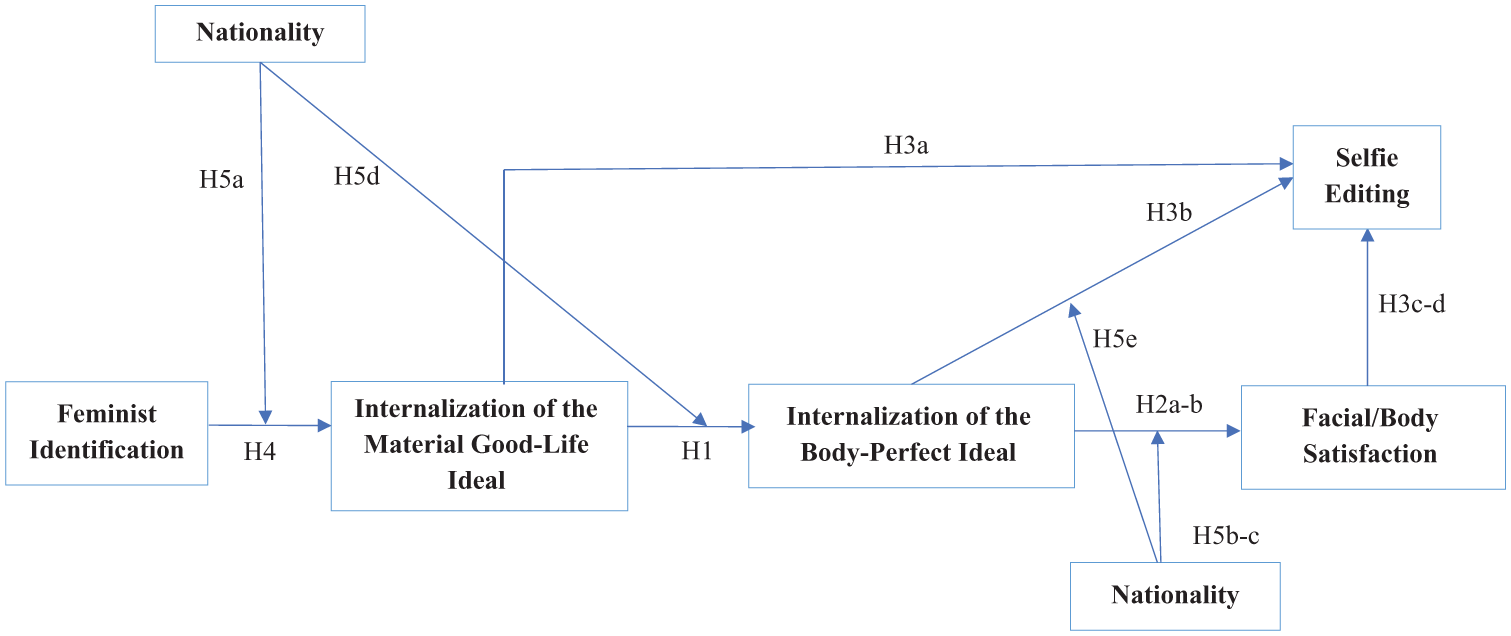
Conceptual model.
Method
Participants & procedures
The study protocol was approved by the first author’s institutional review board (IRB Record Number: X23–0480) before data collection. Online surveys were conducted based on a purposive sample consisting of college women enrolled in a northeastern U.S. university and a comparable university in China. Both universities recruit students from across their respective countries. Participants were compensated with course credit. All items were translated into Chinese by two bilingual researchers and then back-translated into English to ensure semantic validity (Behr and Shishido, 2016).
Given that the principles of feminism are dependent on sociopolitical contexts (Hooks, 2000), no definition of feminism was provided to participants in this cross-cultural study. Participants first reported their biological sex before answering the question, “Do you identify as a feminist?” Male respondents and non-feminists were excluded. College women were selected because they are more likely to suffer from negative body image and thus tend to edit their pictures (Yang et al., 2021). Respondents who had not resided in their home country for their entire lives were excluded. After the screening questions, respondents first reported their body and facial satisfaction, followed by the internalization of the material good-life and body-perfect ideals. They then answered questions regarding feminist identification, prior experience with selfie editing, and demographics.
After data cleaning, 208 U.S. and 236 Chinese responses were retained. A power analysis using G*Power (Faul et al., 2009) indicated that the sample provided over 90% power to detect medium-sized effects at α = 0.05. Among the U.S. respondents, 129 (62%) were White, 11 (5.3%) were Black, 27 (13%) were Latina, 28 (13.5%) were Asian, 1 (0.5%) was Native American, and 10 (4.8%) were biracial or multiracial. Among the Chinese respondents, 216 (91.5%) were ethnic Han.
Measures
Body and facial satisfaction
Body satisfaction was measured by asking participants how satisfied (1: completely dissatisfied, 7: completely satisfied) they were with each part of their body (Brown et al., 1990). A reliability test was run first to identify items that hurt the reliability of the scale, which were dropped. Responses across the remaining items were averaged to create a composite scale for body satisfaction (M = 4.24, SD = 1.25, α = 0.90), as was done for for all other variables measured with multiple items. Similarly, respondents also evaluated their satisfaction with a number of facial features (Warren, 2014; M = 4.91, SD = 1.07, α = 0.91). Higher scores indicate greater satisfaction with body features and facial appearance. All survey items are available at https://osf.io/4rdks/files/osfstorage?view_only=dfa7715a53f94e30944c58d1a7c3436b.
Internalization of the material good-life ideal
Participants assessed their level of agreement (1: strongly disagree, 7: strongly agree) with six statements adapted from the Material Values Scale (Richins, 2004). Example items include “I like to own things that impress people” (M = 4.59, SD = 1.05, α = 0.78). For both internalization variables, negatively worded items were reverse-coded before the reliability test was conducted. Items that lowered the reliability of the measure were excluded before the composite was computed. Higher scores on the measure suggest a greater tendency to incorporate the material good-life ideal into one’s self-concept.
Internalization of the body-perfect ideal
The scale from Heinberg et al. (1995) was adapted. Six items (e.g. “I often compare my appearance to the models in fashion magazines.”) were rated on a seven-point Likert-type scale (1: strongly disagree, 7: strongly agree; M = 4.14, SD = 1.32, α = 0.90). Higher scores indicate that respondents were more likely to base their sense of self-worth on the body-perfect ideal.
Feminist identification
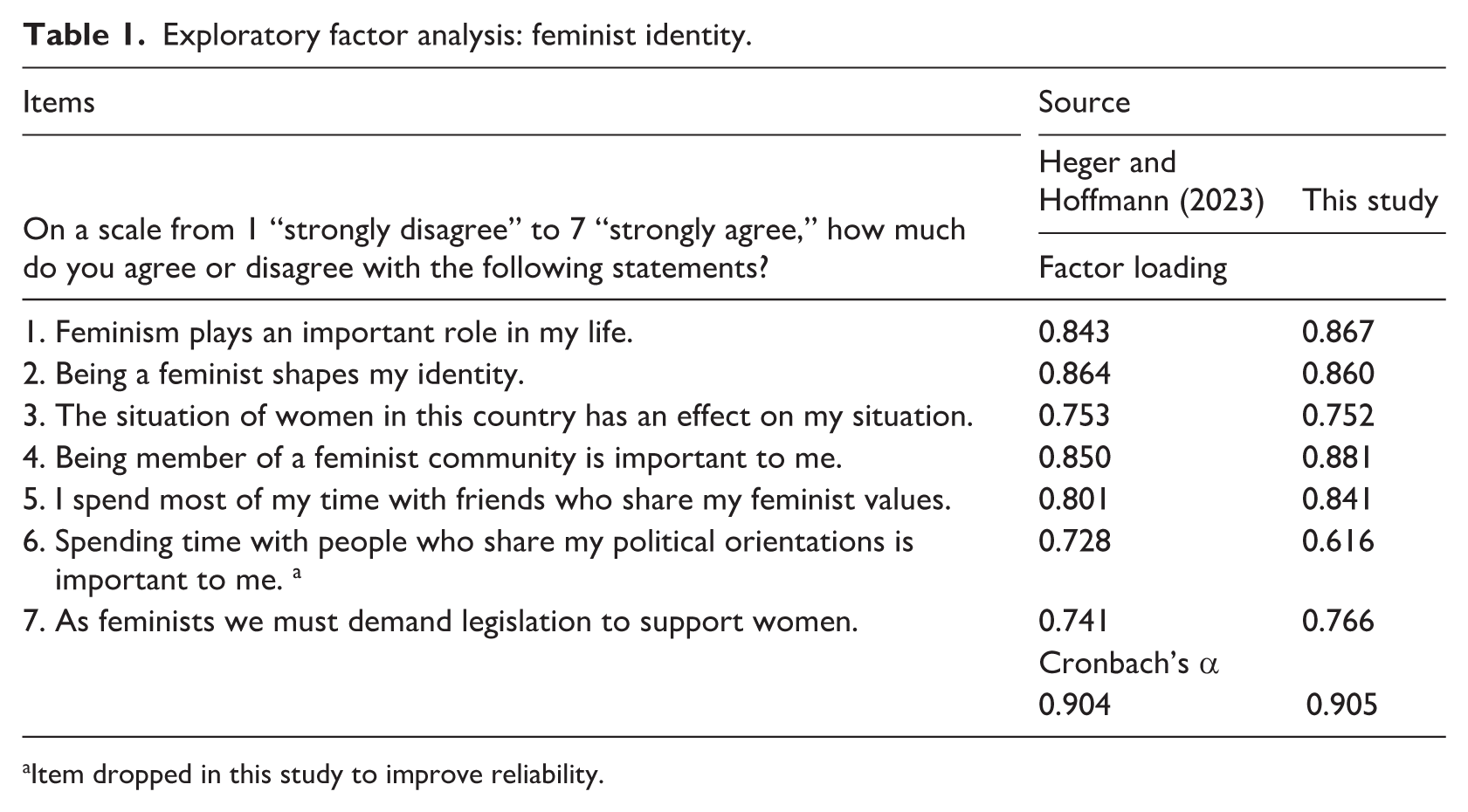
Operationalizing feminist identity and attitudes precisely has long been challenging, especially with the emergence of postfeminism (Siegel and Calogero, 2021). Siegel and Calogero (2021) have suggested in their critical review that, measures of feminist identity “should include items that distinguish between collective (feminist) and individualized (postfeminist) identities and attitudes” (p. 249), and the word “feminism” should be included in the scale items. To address these issues, Heger and Hoffmann (2023) developed a scale (see Table 1). In their original study with German samples, both the convergent and predictive validity of this measure have been established, as feminist identification was positively related to both third-wave feminist attitudes and feminist online political participation (Heger and Hoffmann, 2023). The scale has been applied to the Chinese context (Yang et al., 2025), providing support for its content validity and cross-cultural construct validity. Divergent validity has also been established in the Chinese context, as feminist identity negatively correlated with political conservatism (Yang et al., 2025). Furthermore, this scale does not define “feminism” or “feminist” and intentionally leaves the terms open to interpretation, which accommodates cross-cultural differences between the United States and China in their feminist agendas and stages of feminist development. Therefore, the scale likely captured the prevailing understanding of feminist identity in these two countries. Although this measure has not been used in studies conducted in the United States, given the cultural proximity in feminist landscapes between Western Europe and North America (Boulianne et al., 2025)—especially when contrasted with the more pronounced differences between Germany and China—we argue that this measure retains reasonable cross-cultural applicability.
Exploratory factor analysis: feminist identity.
Item dropped in this study to improve reliability.
An exploratory factor analysis was conducted, KMO = 0.90, Bartlett’s test of sphericity was significant (χ2 = 1940.62, df = 21, p < 0.001). Results yielded only one component with an eigenvalue of 4.51, explaining 64.39% of the total variance. As shown in Table 1, this one-factor structure of the feminist identification scale, derived from our combined Chinese and U.S. college female sample, successfully replicated findings from German samples with highly similar factor loadings (Heger and Hoffmann, 2023). Accordingly, factorial validity (i.e. a form of construct validity that tests the extent to which the underlying putative structure of a scale can be recoverable in other tests) has been demonstrated (Piedmont, 2014).
Additionally, the reliability of this seven-item scale was tested, yielding a Cronbach’s α of 0.905. Further analyses suggested that if Item 6 (“I spend most of my time with friends who share my feminist values”) was removed, the Cronbach’s α of this scale would increase to 0.913. Given that the item also loaded the lowest in the factor analysis, it was excluded from the final scale. Thus, the remaining six items were employed to measure respondent feminist identification using a seven-point Likert-type scale (1: strongly disagree, 7: strongly agree). The first three items more strongly reflect an individual identity, with the remaining items emphasizing the importance of membership in a collective of feminists. Composite scores were computed by averaging these items, with higher scores indicating stronger feminist identification (M = 4.65, SD = 1.20, α = 0.91).
Selfie editing
Following Chae (2017), the current study adopted a one-item measure for selfie editing: “How much have you edited your selfies before? (1: never, 7: always)” (M = 3.30, SD = 1.79).
Control variables
Prior research suggested that younger women (Hockey et al., 2021) from higher social classes (Rosenqvist et al., 2022) were more likely to suffer from negative body image. Thus, age (M = 20.21, SD = 2.02) and perceived socioeconomic status (i.e. “How well off do you think your family is? 1: Not at all, 7: Extremely.”) were collected as covariates (M = 3.20, SD = 1.28).
Results
Descriptive statistics and the zero-order correlation matrix are presented in Table 2. Independent samples t-tests suggest that U.S. female college students reported significantly higher facial satisfaction (Americans: M = 5.25, SD = 1.08, Chinese: M = 4.61, SD = 0.96; t (416.73) = 6.61, p < 0.001) and internalization of the body-perfect ideal (Americans: M = 4.59, SD = 1.32, Chinese: M = 3.75, SD = 1.18; t (417.54) = 7.01, p < 0.001), alongside lower internalization of the material good-life ideal (Americans: M = 4.41, SD = 1.19, Chinese: M = 4.75, SD = 0.88; t (376.21) = −3.35, p < 0.001) and selfie-editing frequency (Americans: M = 2.28, SD = 1.23, Chinese: M = 4.21, SD = 1.71; t (425.64) = −13.75, p < 0.001) than their Chinese counterparts. The U.S. sample was younger (Americans: M = 19.13, SD = 0.82, Chinese: M = 21.17, SD = 2.27; t (302.38) = −12.86, p < 0.001) and reported higher perceived socioeconomic status (Americans: M = 3.93, SD = 1.33; Chinese: M = 2.57, SD = 0.80; t (332.18) = 12.86, p < 0.001) than the Chinese sample. No cross-cultural differences existed in feminist identification (Americans: M = 4.69, SD = 1.27, Chinese: M = 4.61, SD = 1.14; t (442) = 0.67, p = 0.500) or body satisfaction (Americans: M = 4.13, SD = 1.44, Chinese: M = 4.33, SD = 1.06; t (376.09) = −1.61, p = 0.109). Collinearity diagnostics were conducted, with variables being included, which showed that the variance inflation factor values were all under 2.16, suggesting that collinearity was nominal.
Means standard deviations and correlations.
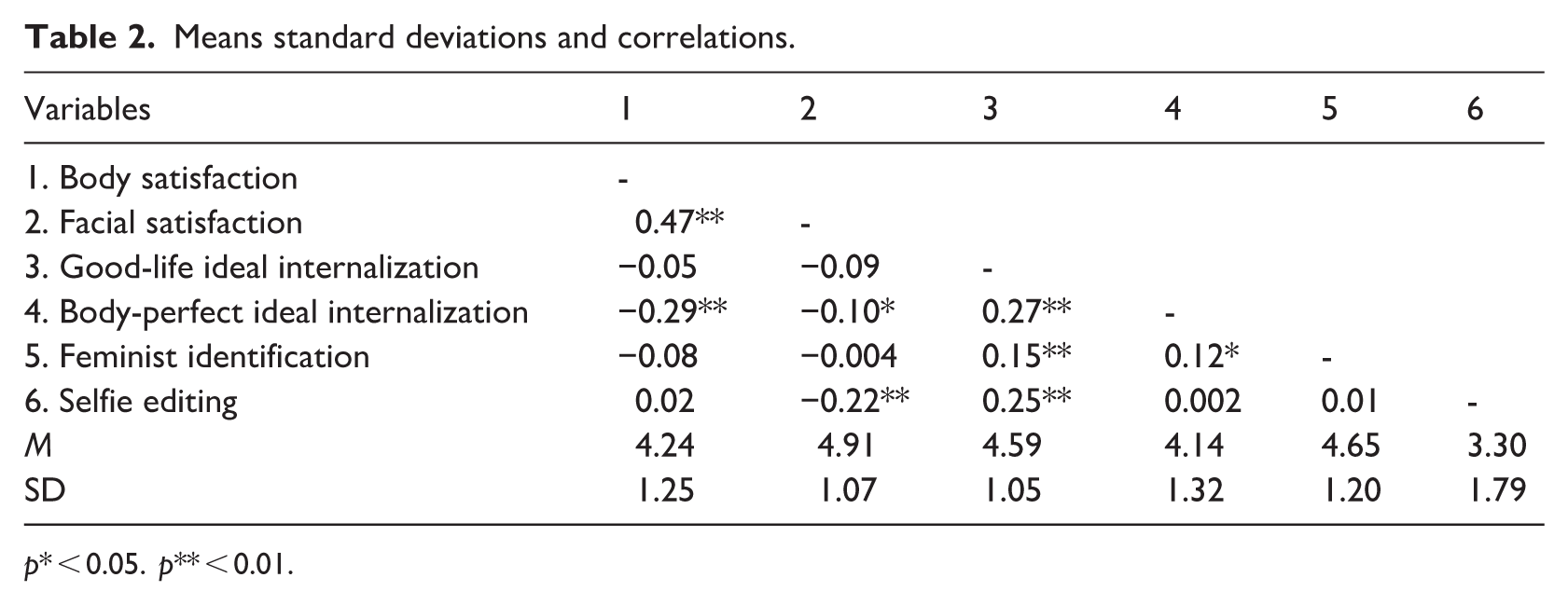
p* < 0.05. p** < 0.01.
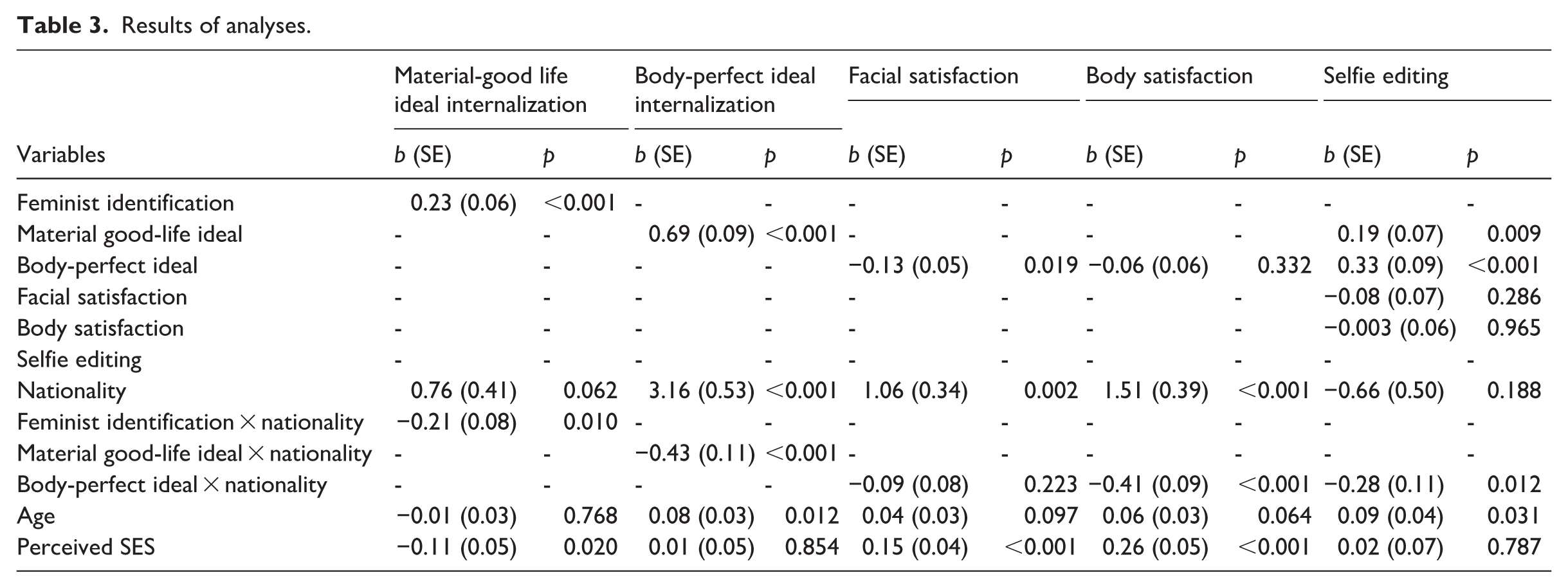
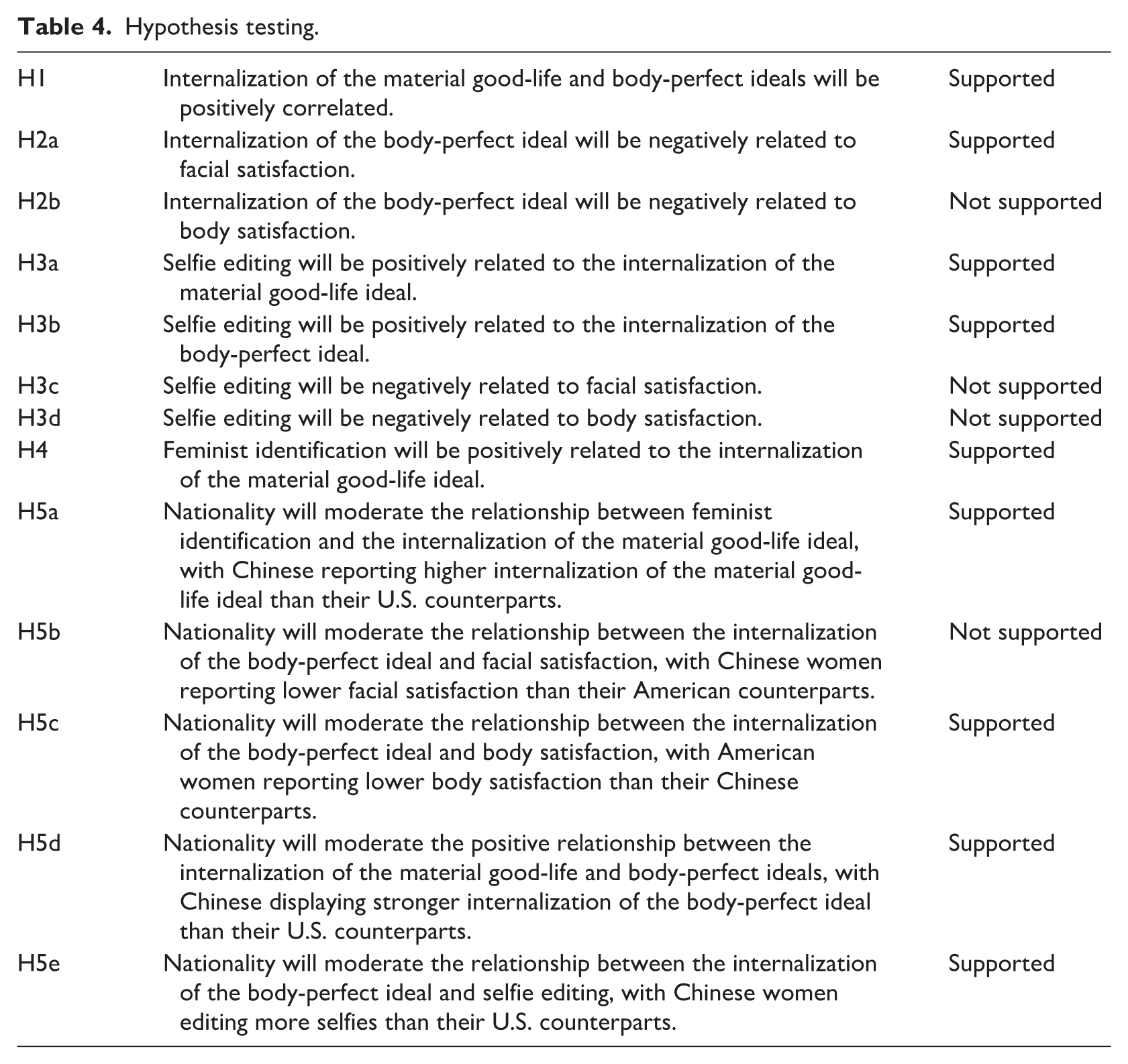
The proposed research model (Figure 1) was tested using the syntax function of Hayes’s (2017) PROCESS procedure 4.0. Two parallel models were run. Specifically, selfie editing was entered as the dependent variable (DV), with feminist identification being the independent variable (IV). Internalization of the material good-life ideal and body-perfect ideal served as two mediating variables between the IV and the DV. Moreover, facial and body satisfaction was entered into the two models respectively, linking the internalization of the body-perfect ideal and selfie editing. Nationality was treated as a moderating variable. Perceived socioeconomic status and age served as two control variables. Results of analysis are presented in Table 3. Hypothesis testing results are provided in Table 4.
Results of analyses.
Hypothesis testing.
Model 1: Facial satisfaction as a mediator
Predictors and effects of body image
When facial satisfaction was entered as a mediator, the entire regression model was statistically significant, F (7, 436) = 34.11, R2 = 0.35, p < 0.001. Specifically, H1 hypothesized that the internalization of the material good-life and body-perfect ideals would correlate positively. The relationship was significant, which validated H1 (b = 0.69, SE = 0.09, p < 0.001). H2a proposed that the internalization of the body-perfect ideal would be negatively related to facial satisfaction. The results confirmed this relationship (b = −0.13, SE = 0.05, p = 0.019), lending support to H2a. Moreover, H3a and H3b respectively hypothesized that selfie editing would be positively related to the internalization of the material good-life ideal (b = 0.19, SE = 0.07, p = 0.009) and the body-perfect ideal (b = 0.33, SE = 0.09, p < 0.001). Both H3a and H3b were supported. By contrast, H3c was not confirmed, with selfie editing being not related to facial satisfaction (b = −0.08, SE = 0.07, p = 0.286). H4 posited that feminist identification would be positively related to the internalization of the material good-life ideal; the effect was significant (b = 0.23, SE = 0.06, p < 0.001), confirming H4.
Cross-cultural differences
H5a predicted that nationality would moderate the relationship between feminist identification and the internalization of the material good-life ideal. This hypothesis was supported (b = −0.21, SE = 0.08, p = 0.010), such that feminist identification reinforced the internalization of the material good-life ideal among Chinese (b = 0.23, SE = 0.06, p < 0.001) rather than U.S. female students (b = 0.02, SE = 0.06, p = 0.674). Furthermore, H5d posited that nationality would moderate the relationship between the internalization of the material good-life ideal and internalization of the body-perfect ideal. This hypothesis was also supported (b = −0.44, SE = 0.11, p < 0.001), with Chinese college females reporting higher internalization of the body-perfect ideal (b = 0.69, SE = 0.09, p < 0.001) than their U.S. counterparts (b = 0.25, SE = 0.07, p < 0.001).
Moreover, H5b proposed that nationality would moderate the relationship between the internalization of the body-perfect ideal and facial satisfaction. However, no significant moderating relationship was found (b = −0.09, SE = 0.08, p = 0.223), leaving H5b unsupported. H5e further examined whether nationality would moderate the relationship between the internalization of the body-perfect ideal and selfie editing. Results lent credence to this hypothesis (b = −0.28, SE = 0.11, p = 0.012), with Chinese female students (b = 0.33, SE = 0.09, p < 0.001) editing selfies more than their U.S. counterparts (b = 0.05, SE = 0.08, p = 0.497).
Indirect effects of feminist identification
The indirect effect of feminist identification on selfie editing was tested using bootstrapping estimation with 5000 bootstrap samples and 95% confidence intervals (CIs). Results showed that an indirect effect via the internalization of the material good-life ideal was significantly positive for Chinese female students (b = 0.04, SE = 0.02, 95% CI (0.01, 0.09)), but not for U.S. female students (b = 0.005, SE = 0.01, 95% CI (−0.02, 0.03)). Moreover, another significant indirect relationship between feminist identification and selfie editing was identified, via the internalization of the material good-life and body-perfect ideals. Specifically, this indirect effect was significantly positive for Chinese female students (b = 0.05, SE = 0.02, 95% CI (0.02, 0.10)), but not for U.S. female students (b = 0.0003, SE = 0.002, 95% CI (−0.002, 0.004)). No additional indirect effects were found in Model 1.
Model 2: Body satisfaction as a mediator
When body satisfaction—as opposed to facial satisfaction—was entered as a mediator, the entire regression model was still statistically significant, F (7, 436) = 33.86, R2 = 0.35, p < 0.001. Statistics for H1, H4, H5a, and H5d remained the same, all being supported in Model 2. Similar to the findings yielded by Model 1, both H3a (b = 0.19, SE = 0.07, p = 0.010) and H3b (b = 0.35, SE = 0.09, p < 0.001) garnered support. Moreover, H3d posited that selfie editing would be negatively related to body satisfaction, which was not verified (b = −0.003, SE = 0.06, p = 0.965). Additionally, H2b proposed that the internalization of the body-perfect ideal would be negatively related to body satisfaction. This hypothesis was not validated (b = −0.06, SE = 0.06, p = 0.332). Furthermore, H5c examined whether nationality would moderate the relationship between the internalization of the body-perfect ideal and body satisfaction (b = −0.41, SE = 0.09, p < 0.001), and results confirmed that U.S. female students (b = −0.47, SE = 0.06, p < 0.001) indeed reported lower body satisfaction than their Chinese counterparts (b = −0.06, SE = 0.06, p = 0.332). Thus, neither H2b nor H3d was validated, whereas H5c was supported.
Regarding the indirect effect of feminist identification on selfie editing, similar to the results generated by Model 1, the indirect effect of feminist identification on selfie editing via the internalization of the material good-life ideal was significantly positive for Chinese female students (b = 0.04, SE = 0.02, 95% CI (0.01, 0.09)), but not for U.S. female students (b = 0.004, SE = 0.01, 95% CI (−0.02, 0.03)). Another significant indirect relationship—via the internalization of both the material good-life and body-perfect ideals—also existed among Chinese female students (b = 0.06, SE = 0.02, 95% CI (0.02, 0.10)), instead of their U.S. counterparts (b = 0.0004, SE = 0.002, 95% CI (−0.003, 0.005)). No additional indirect effects were identified.
Discussion
The current study has reconciled mixed findings on the impact of feminism on women’s body image in a cross-cultural context. The findings support CCIM and ISMBI, explaining the influence of sociocultural factors on college women’s body image concerns. Theoretical and practical implications are discussed below.
Theoretical implications
Extending ISMBI
Frederick et al.’s (2022) ISMBI has examined how pressure from family, peers, and media shapes the internalization of the thin and muscular ideals. Our study has incorporated the material good-life ideal as another major sociocultural factor that reinforced the internalization of body-perfect ideals. This extension has thus revealed the negative impact of consumer culture and a materialistic lifestyle on college women’s body image.
Furthermore, this study has contributed to existing literature by examining selfie editing as a behavioral manifestation of internalized societal ideals, whereas existing studies (e.g. Saunders et al., 2019) mostly linked such internalization to affective and cognitive dimensions of negative body image, such as body dissatisfaction and self-objectification. Notably, the internalization of the societal ideals translated into obsessive self-presentation behaviors on social media, which, in turn, perpetuated beauty standards in cyberspace (Yang et al., 2025). Thus, the role of selfie editing in prompting young women’s body surveillance should not be underestimated.
Less prior research has simultaneously examined how internalization and appearance satisfaction are associated with selfie editing, whereas the present study fills in this gap. Unlike the internalization of the two societal ideals, neither facial nor body satisfaction was related to selfie editing. This finding partially aligns with Wang et al. (2021), who discovered that body dissatisfaction did not increase subsequent selfie editing. In contrast, because internalization embodies individual active endorsement and pursuit of societal ideals (Cafri et al., 2005), selfie editing—as an intentional, sociocultural practice aiming to align one’s online image with such ideals—is more likely to be driven by internalization than appearance dissatisfaction, which is a negative emotion that can lead to avoidance (e.g. More et al., 2019). Similar to disordered eating (Myers, 2015), selfie editing may also represent an overt manifestation of women’s covert struggles with sexism. Future research should further address the differences between the cognitive, affective, and behavioral dimensions of body image in the cross-cultural context of online self-presentation.
Influence of feminism on body image concerns and behavior
A significant contribution of this study is that we have provided quantitative evidence that feminist identification can paradoxically perpetuate consumerist ideals of life and thus negatively affect body image, especially in China where empowerment of women is associated with aesthetic labor and professional success (Yang et al., 2023). For instance, Cecilia Yip—a 62-year-old Hong Kong actress—has regularly celebrated women’s strength and raised awareness of gendered ageism. She has expressed pride in every wrinkle she has earned, while joking that “No worries. Everyone can look beautiful, as we have picture editors” (China DragonTV, 2024). This anecdote reflects how selfie editing may be framed as empowering among some Chinese women. As demonstrated above, the internalization of both the material good-life and body-perfect ideals increased selfie editing. Therefore, feminist women may identify with successful figures who embody an idealized body and affluent lifestyle to experience vicarious power. Such vicarious empowerment echoes feminist consumerism and neoliberal feminism, which equate success with beauty and thus lead women to engage in body work to obtain agency (Johnston and Taylor, 2008).
Unsurprisingly, women can be trapped in a conundrum where liberation through consumption perpetuates patriarchal standards (Banet-Weiser et al., 2020). Contemporary feminism—entangled with post feminism (Siegel and Calogero, 2021)—may reinforce socially imposed beauty ideals. Feminist alignment with discourses on individualistic empowerment may pressure women to project an empowered and perfect self through esthetic labor such as selfie editing. Therefore, counterintuitively, identification with popular feminism may serve as a potential risk factor for women’s body image concerns.
Cross-cultural variability in body image
The current study sheds light on cultural variations in the internalization of materialistic and beauty ideals and the influence of such internalization on selfie editing. First, this study has discovered stronger links between feminist identification and consumerist ideal internalization among Chinese women compared to their U.S. counterparts. Relatedly, the positive relationship between the internalization of the material good-life and body-perfect ideals also emerged as more significant among Chinese than U.S. college women. Although not formally reported, we have found that the U.S. sample reported significantly higher levels of empowerment than the Chinese sample, despite their similar feminist identification levels. According to Peterson et al. (2008), empowerment as a result of feminist identity reduced self-objectification. Because liberal feminist attitudes did not empower women the same way as did radical or post-structural feminist attitudes (Heger and Hoffmann, 2023)—which are more common in the U.S. context—this finding provides indirect evidence that the prevailing feminist beliefs underpinning a feminist identity in China and the United States differ.
These cross-cultural variances can be attributed to the political climates faced by feminists in both countries. Specifically, Chinese feminists must constantly fight against state anti-feminism, stigmatization, and censorship (Xiong and Ristivojević, 2021), which have forced them to always vindicate themselves by proving their professional success and sticking to popular feminisms that do not challenge deep structures of inequities (Banet-Weiser et al., 2020). By contrast, the coexistence of more radical and intersectional feminisms in the United States has directed women’s attention toward systemic change and enabled women to more critically evaluate societal ideals (Darwin and Miller, 2021). Thus, feminist women in China may take material success and a perfect body as a pathway to empowerment, reinforcing hegemonic beauty standards. These cultural distinctions have deepened academic understanding of how sociocultural and political contexts influence women’s body image in different nations.
Notably, through higher levels of internalization of the material good-life and body-perfect ideals, feminist identification was indirectly associated with more selfie editing among Chinese college women, but not among U.S. women. This finding echoes existing literature that individuals in collectivist cultures (e.g. China) are more likely to engage in upward comparison than those in individualistic cultures, such as the United States (Chung and Mallery, 1999). As a result, Chinese women experienced higher levels of body image self-discrepancy than their U.S. counterparts (Yang et al., 2021). Unsurprisingly, Chinese women’s motivations to edit their selfies in order to achieve symbolic self-completion (Wicklund and Gollwitzer, 1982) appeared to be stronger than those of their U.S. counterparts. Given the reciprocal relationship between selfie editing and negative body image (Wang et al., 2021), this study contributes to the deprioritization of a White interpretive lens in body image research by dispelling the myth that women of color suffer less from body image concerns (Landor et al., 2024).
Practical implications
The present study highlighted the influence of the material good-life ideal on women’s body image, which offers practical implications on advancing gender equality and guiding health communication interventions. First, as women in higher social classes tend to internalize mainstream beauty standards and practice weight control (Rosenqvist et al., 2022), prevention programs should adopt an intersectional approach to bridge the racial and class divides to help women from all backgrounds develop positive body image. Second, although popular iterations of feminism (e.g. neoliberal feminism) and postfeminism emphasize personal choice (Banet-Weiser et al., 2020), body image prevention programs should prioritize feminist messages that challenge the socioeconomic structures that perpetuate hegemonic beauty standards (Johnston and Taylor, 2008) over individual self-empowerment messages, as it is hard for women to “love a body that society hates” (Darwin and Miller, 2021: 12).
Furthermore, in light of the cross-cultural differences in the internalization of societal ideals and in their ensuing influence on body satisfaction and selfie editing, training programs can be provided to health practitioners to cultivate their awareness of how different cultural values shape women’s perceptions of beauty standards and self-worth (e.g. Landor et al., 2024). Lastly, given the negative impact of social media use and selfie editing on body image (e.g. Wang et al., 2021), health campaigns can promote media literacy to raise public awareness.
Limitations and future directions
First, Heger and Hoffmann’s (2023) feminist identity measure does not assess the content underlying a feminist identity. Theoretically, not all feminisms are equally committed to challenging the naturalization of women’s subordination (Johnston and Taylor, 2008). As suggested by Siegel and Calogero (2021), given that postfeminism is prevalent, future researchers should examine feminist identification and feminist attitudes/beliefs in combination to comprehensively understand how feminism influences women’s life experience; future researchers should also gauge more ambivalent feminist identities or postfeminist identities explicitly in cross-cultural contexts. Second, our sample sizes might be underpowered to detect small effects (Faul et al., 2009), which should be addressed by future studies. Third, individual-level cultural dimensions (e.g. interdependent vs independent self-construal) should be measured in future studies to further account for potential cross-cultural differences. Lastly, although age and perceived socioeconomic status were controlled, the interaction effects between culture, age, and class on women’s body image warrant further attention in a global context.
Conclusion
Drawing from CCIM and ISMBI, the current study has reconciled previous mixed findings on the impact of feminism on young women’s body image in a cross-cultural context. Feminist identification is positively related to the internalization of the material good-life ideal, which is associated with higher internalization of the body-perfect ideal. This finding supports CCIM, which connects patriarchal beauty with success. The link between these two ideals proves stronger among Chinese than U.S. respondents. Moreover, the internalization of the body-perfect ideal is associated with lower facial satisfaction, whereas the internalization of both ideals is related to more selfie editing. Cross-cultural differences exist, with the positive relationship between feminist identification and the internalization of the material good-life ideal being stronger among Chinese than U.S. college women. By contrast, the relationship between the internalization of the body-perfect ideal and body dissatisfaction emerges as stronger among U.S. respondents than Chinese. Lastly, Chinese college women edit more selfies than their U.S. counterparts, and this difference is associated with greater internalization of the body-perfect ideal.
Footnotes
Author note
The authors have agreed to the submission and on the following authorship based on each author’s relative contributions: (1) Dongdong Yang, and (2) Yi Luo.

Ethical considerations
The study protocol was reviewed and approved by the first author’s institutional review board (IRB Record Number: X23-0480) before data collection.
Consent to participate
All participants were provided with an information sheet at the beginning of the online survey, where they indicated their informed consent to participate in this study by proceeding with the survey. Informed consent was obtained from all participants; those who didn’t consent to participate exited the study immediately.
Consent for publication
No identifying information was collected from any participants. All participants gave their consent for the publication of aggregated, anonymized data and findings from this research.
Funding
The authors received no financial support for the research, authorship, and/or publication of this article.
Declaration of conflicting interests
The authors declared no potential conflicts of interest with respect to the research, authorship, and/or publication of this article.