






Abstract
Excessive social media engagement has been linked to cognitive strain and sleep disruption among university students. This cross-sectional study examined associations between social media use, mental fatigue, and sleep quality among 762 undergraduate students in the United Arab Emirates (76.5% female; mean age = 22.07 years). Participants completed validated measures of social media use, mental fatigue, and sleep quality. Most participants reported moderate to high mental fatigue (82.5%), while 62.7% reported poor sleep quality. Higher social media use was associated with greater mental fatigue, and greater mental fatigue was associated with poorer sleep quality. Social media use was not directly associated with sleep quality after accounting for mental fatigue, although an indirect association was observed. Female students reported poorer sleep quality and higher mental fatigue, while older students reported greater fatigue and higher social media use. Findings are discussed in relation to stress processes, self-regulation, and sleep health.
Introduction
Social media has become deeply embedded in the daily routines of university students, shaping not only how they communicate but also how they study, relax, and manage their emotional lives. Importantly, social media engagement is not a unitary construct. Prior research distinguishes between functional domains of use, including academic, socialization, entertainment, and information-seeking purposes (Azizi et al., 2019; Gupta and Bashir, 2018; Ostic et al., 2021). These domains may differ in their cognitive demands and potential implications for fatigue and sleep, particularly in university settings where academic-related digital engagement often coexists with recreational use. While these platforms offer academic and social benefits including easier access to learning communities and timely information (Azizi et al., 2019), a growing body of research suggests that higher levels of social media use can carry significant cognitive and emotional costs. Among the most concerning are mental fatigue and sleep disturbances, two interconnected outcomes that can severely undermine students’ psychological well-being and academic functioning (Ostic et al., 2021; Alshoaibi et al., 2023; Qin et al., 2024; Yu et al., 2024).
Mental fatigue is a multidimensional state of cognitive and emotional exhaustion that may arise from sustained cognitive demands across multiple contexts, including but not limited to prolonged or intensive digital and social media engagement. In this study, mental fatigue is conceptualized as a general cognitive state rather than a platform-specific construct such as “social media fatigue,” which was not directly assessed. Mental fatigue has been associated with reduced attention, emotional dysregulation, and impaired academic performance, especially when social media use encroaches on study time or sleep (Karaduman et al., 2025; Malik et al., 2020). According to cognitive load theory (Sweller, 2011), the rapid task-switching and fragmented attention characteristic of social media engagement overloads working memory, draining cognitive resources and leaving users mentally depleted (Lepp et al., 2015; Vogel et al., 2014). This cognitive strain is further compounded by emotional demands and the compulsive nature of online interactions, which can mimic behavioral addiction (Aljawarneh et al., 2024; Griffiths et al., 2014).
Concurrently, sleep as an essential element for memory consolidation, emotional regulation, and executive function appears increasingly compromised among young adults engaged in nighttime social media use. Empirical studies have consistently shown that exposure to social media before bedtime interferes with melatonin secretion, prolongs sleep latency, and leads to fragmented, non-restorative sleep (Alonzo et al., 2021; Bányai et al., 2017). Poor sleep quality, in turn, has been linked to decreased cognitive performance, reduced academic success, and increased emotional reactivity (Almarzouki et al., 2022; Tomaso et al., 2021).
Importantly, recent literature highlights a distinction between adaptive and pathological patterns of social media engagement. While the former can support learning and social connection, the latter is marked by impaired self-regulation, addictive tendencies, and heightened psychological distress (Kennard et al., 2025). Emerging regional studies, including those from the United Arab Emirates, have revealed associations between problematic social media use and poor sleep quality, anxiety, and depressive symptoms in university students (Al Kazhali et al., 2023; Hasan et al., 2023), emphasizing the urgency of addressing these issues in higher education. However, much of the existing research treats social media use, mental fatigue, and sleep disruption as isolated phenomena. Few studies have examined how these factors interact—particularly whether cognitive exhaustion statistically account for the association between digital engagement and impaired sleep. This gap is particularly significant for cognitive psychology, as it limits our understanding of how modern digital habits shape attention, memory, and emotion regulation in young adults.
From a health psychology perspective, social media use can be conceptualized as a modifiable health-related behavior that interacts with stress processes, self-regulatory capacity, and recovery behaviors such as sleep (Baumeister et al., 2007; Cain and Gradisar, 2010). Frequent digital engagement may increase cognitive and emotional demands through attentional fragmentation, multitasking, and ongoing social evaluation, potentially taxing self-regulation and impairing recovery (Thomée, 2012; Twenge et al., 2018). Sleep quality represents a core health behavior and recovery indicator, while mental fatigue reflects cognitive strain that may co-occur with diminished recovery and sustained stress exposure (Ampofo et al., 2025; Brautsch et al., 2023). Framing these constructs within stress and self-regulation models provides a theoretical foundation for interpreting associations between digital behavior, mental fatigue, and sleep health in undergraduate populations.
Building on this framework, the present study adopts an exploratory, cross-sectional approach to examine the associations among social media use, mental fatigue, and sleep quality among undergraduate university students, using a health psychology perspective. Specifically, the study examined whether mental fatigue statistically accounts for the association between social media use and sleep quality, while acknowledging the cross-sectional and associative nature of the data. Rather than proposing a causal or mechanistic explanation, mediation is conceptualized as a regression-based indirect association intended to clarify patterns of association and inform hypothesis generation for future longitudinal and experimental research. Based on the literature, the study tested the following hypotheses: (H1) greater social media use is associated with higher levels of mental fatigue; (H2) greater social media use is associated with poorer sleep quality; (H3) higher mental fatigue is associated with poorer sleep quality; and (H4) mental fatigue statistically accounts for the association between social media use and sleep quality.
Methods
Design and sampling
This cross-sectional correlational study examined the cognitive consequences of social media use and its interplay with mental fatigue and sleep quality in undergraduate college students. Eligibility criteria included current enrollment as an undergraduate student and willingness to participate. Students who declined consent were excluded from study. Participants were recruited through convenience sampling. An a priori sample size calculation was conducted using G*Power software (version 3.1.9.7) for correlation analysis. Assuming a medium effect size (r = 0.3), an alpha level of 0.05, and power of 0.80, the minimum required sample size was 684. To compensate for a potential 10% nonresponse or dropout rate, the final target sample was increased to 752 participants. The study population consisted of undergraduate students enrolled at a single higher education institution in the United Arab Emirates (UAE) operating across multiple campuses and academic disciplines. A total of 814 students were approached, of whom 762 consented and met eligibility criteria, yielding a response rate of 93.6%. Participants ranged in age from 17 to 40 years and included both male and female students across all years of study and major fields. This diverse sampling frame was intended to capture variability in digital engagement, cognitive fatigue, and sleep quality within the undergraduate student population.
Data collection method
The study was conducted in the United Arab Emirates at the Higher Colleges of Technology, within a higher education institution enrolling students from diverse cultural, linguistic, and academic backgrounds. Study instruments were compiled into an online survey, which was piloted with 76 participants to assess reliability and contextual relevance. In this study, contextual relevance referred to evaluating item clarity, language appropriateness, comprehension, and suitability for use within a multicultural undergraduate student population. Pilot participants were not included in the final analytic sample. The pilot sample was recruited via convenience sampling. Cronbach’s alpha values for the pilot phase indicated excellent internal consistency for all instruments: Social Networking Usage Questionnaire (α = 0.943), Sleep Quality Scale (α = 0.927), and Mental Fatigue Scale (α = 0.923). Following the pilot phase, the final survey was distributed electronically using Google Forms. Prospective participants were invited in person, and informed consent was obtained electronically prior to participation. The survey required approximately 10 minutes to complete.
Measures
Demographic questionnaire
Participants provided demographic information including age, gender, marital status, academic major, year of study, grade point average (GPA), and campus location.
Social Networking Usage Questionnaire (SNUQ)
The SNUQ (Gupta and Bashir, 2018) measured the frequency and purpose of social media use across four domains: academic (seven items), socialization (five items), entertainment (four items), and informativeness (three items). Responses were rated on a 5-point Likert scale ranging from 0 (Never) to 5 (Always). Subscale scores were summed, with higher scores indicating greater social media use. The SNUQ demonstrated excellent internal consistency in the present study (α = 0.965).
Sleep Quality Scale (SQS)
The 28-item SQS (Shahid et al., 2011) assessed five domains of sleep: disturbance, satisfaction, daily dysfunction, efficiency, and supplementation. Items were rated on a 4-point Likert scale ranging from 0 (Few) to 3 (Almost always), yielding total scores ranging from 0 to 84. Scores between 0 and 42 were categorized as “good sleep quality” while scores between 43 and 84 indicated “poor sleep quality” The cut-off scores used to classify sleep quality were based on the original validation study of the scale, which established these thresholds for distinguishing good and poor sleep quality (Shahid et al., 2011). The SQS demonstrated excellent reliability in the present study (α = 0.980).
Mental Fatigue Scale (MFS)
The 14-item Mental Fatigue Scale (Johansson et al., 2010) was used to assess symptoms of cognitive exhaustion, including fatigue, recovery, concentration difficulties, sensitivity, and irritability. Each item is rated on a 4-point scale ranging from 0 (no problem) to 3 (serious problem). Total scores were calculated by summing item responses, with higher scores indicating greater mental fatigue. A cut-off score greater than 10.5 was used to categorize the presence of mental fatigue for descriptive and prevalence reporting. The cut-off score for mental fatigue was derived from the original validation work of the Mental Fatigue Scale and has been widely used to indicate clinically relevant levels of cognitive fatigue (Johansson et al., 2010). In the present study, the MFS demonstrated excellent internal consistency (Cronbach’s α = 0.948).
The Mental Fatigue Scale assesses general cognitive fatigue rather than platform-specific fatigue; therefore, findings related to fatigue in this study should be interpreted as reflecting overall mental exhaustion rather than social media–specific fatigue. For inferential analyses, total scores for social media use, mental fatigue and sleep quality were treated as continuous variables to preserve variability and statistical power. Categorical cut-off scores were used solely for descriptive reporting and were not applied in regression or mediation analyses.
Ethical considerations
This study was conducted in full accordance with the ethical principles outlined in the Declaration of Helsinki (World Medical Association, 2013). The study was granted ethical approval in September 2024 by the Research Ethics and Integrity Committee at the Higher Colleges of Technology (Reference: REIC2024-CAP05). Participants were assured of anonymity and confidentiality. No identifying information was collected. Participation was voluntary, and respondents were informed of their right to withdraw at any stage without penalty. Data were securely stored on a password-protected device accessible only to the research team. The study posed minimal risk to participants.
Data analysis
All data were analyzed using SPSS software (IBM SPSS Statistics, Version 29). Descriptive statistics were calculated in terms of counts and percentages for categorical variables and means and standard deviation (SD) for continuous variables. Analyses were conducted in a stepwise manner aligned with the study hypotheses. Descriptive statistics summarized participant characteristics and prevalence estimates. Pearson correlation analyses examined bivariate associations among social media use, mental fatigue, sleep quality, and age (addressing Hypotheses 1–3). Group comparisons by age and gender were conducted using independent samples t-tests and chi-square tests, as appropriate. Multiple linear regression analyses were performed to examine predictors of mental fatigue and sleep quality while adjusting for age and gender. Age and gender were included as covariates based on prior evidence linking demographic factors with digital engagement patterns, fatigue, and sleep outcomes among university students. Assumptions for parametric analyses, including normality, linearity, homoscedasticity, and absence of multicollinearity, were assessed and met prior to conducting inferential analyses. A p-value of <0.05 was considered statistically significant in all the analyses. Mediation analyses were conducted using a regression-based approach with bootstrapped confidence intervals (5000 resamples). Total social media use was specified as the independent variable, mental fatigue as the mediator, and sleep quality as the dependent variable, adjusting for age, and gender. Indirect effects were considered statistically significant when the 95% bootstrapped confidence interval did not include zero. To assess robustness and potential bidirectionality, a sensitivity analysis testing an alternative directional model (sleep quality → mental fatigue → social media use) was also conducted. To reduce multicollinearity and focus on overall digital engagement, regression and mediation analyses used the total social media use score rather than individual subscale scores.
Results
Descriptive and subgroup analyses are presented to contextualize patterns of social media use, mental fatigue, and sleep quality prior to hypothesis-driven regression and mediation analyses.
Demographic characteristics of participants
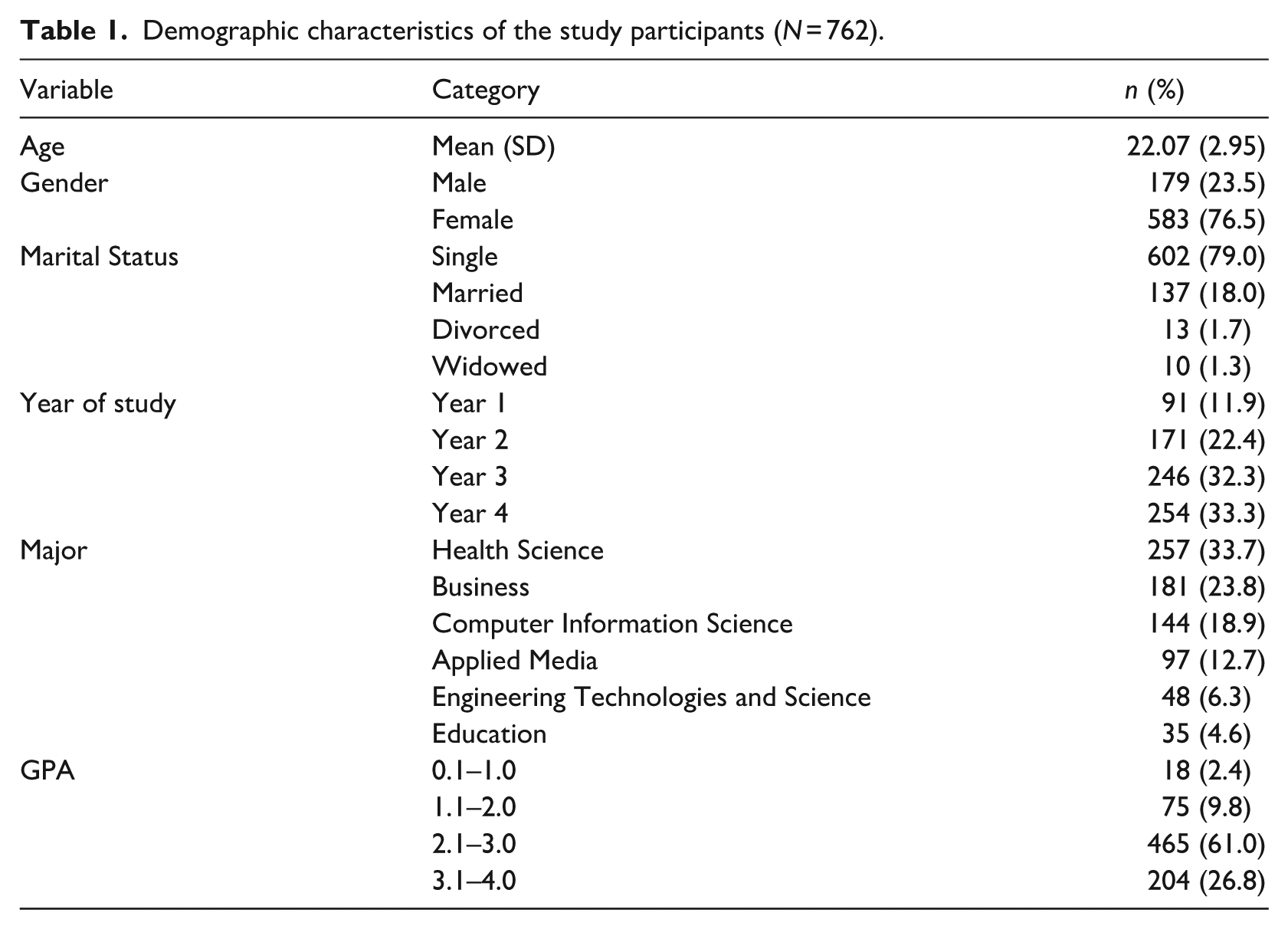
Participant demographic characteristics and descriptive statistics for key study variables are presented in Table 1. The final sample consisted of 762 undergraduate students. The mean age of participants was 22.07 years (SD = 2.95; range = 17–40). The sample included students from multiple campuses, academic disciplines, and years of study, with representation of both genders. Overall, a high prevalence of poor sleep quality and moderate to high levels of mental fatigue was observed in the sample.
Demographic characteristics of the study participants (N = 762).
Descriptive statistics on social media use, mental fatigue, and sleep quality
Social media use
Social media use was assessed across four domains: academic, socialization, entertainment, and information. Academic-related use showed the highest mean score (M = 29.44, SD = 5.19), followed by socialization (M = 21.23, SD = 3.75), entertainment (M = 16.86, SD = 3.12), and information-seeking (M = 12.64, SD = 2.35), indicating that academic-related activities were the most common form of social media engagement in this sample.
Mental fatigue
The mean Mental Fatigue Scale score was 20.76 (SD = 11.53), indicating moderate overall mental fatigue. Using established cut-off criteria for descriptive purposes, 82.5% (n = 629) of participants were categorized as experiencing clinically relevant levels of mental fatigue, while 17.5% (n = 133) reported minimal or no fatigue. Mental fatigue was treated as a continuous variable in all inferential analyses.
Sleep quality
The mean Sleep Quality Scale score was 50.22 (SD = 23.21). Based on established cut-off thresholds, 62.7% (n = 478) of participants were classified as having poor sleep quality, while 37.3% (n = 284) were categorized as having good sleep quality, indicating a high prevalence of sleep disturbance in the sample.
Correlation between social media use, sleep quality, mental fatigue, and age
Pearson correlation analyses are presented in Table 2. Age demonstrated a weak but statistically significant positive association with sleep quality (r = 0.194, p < 0.001), indicating that older participants reported slightly better sleep quality. Academic-related social media use, defined as the use of social media platforms for coursework-related communication, academic information sharing, and peer collaboration, was positively associated with mental fatigue (r = 0.161, p < 0.001). Social media use for socialization was weakly but significantly associated with both mental fatigue (r = 0.192, p < 0.001) and sleep quality (r = 0.099, p = 0.006). Information-seeking social media use was also weakly associated with mental fatigue (r = 0.167, p < 0.001) and sleep quality (r = 0.081, p = 0.026).
Pearson’s correlations between age, social media use, sleep quality, and mental fatigue (N = 762).
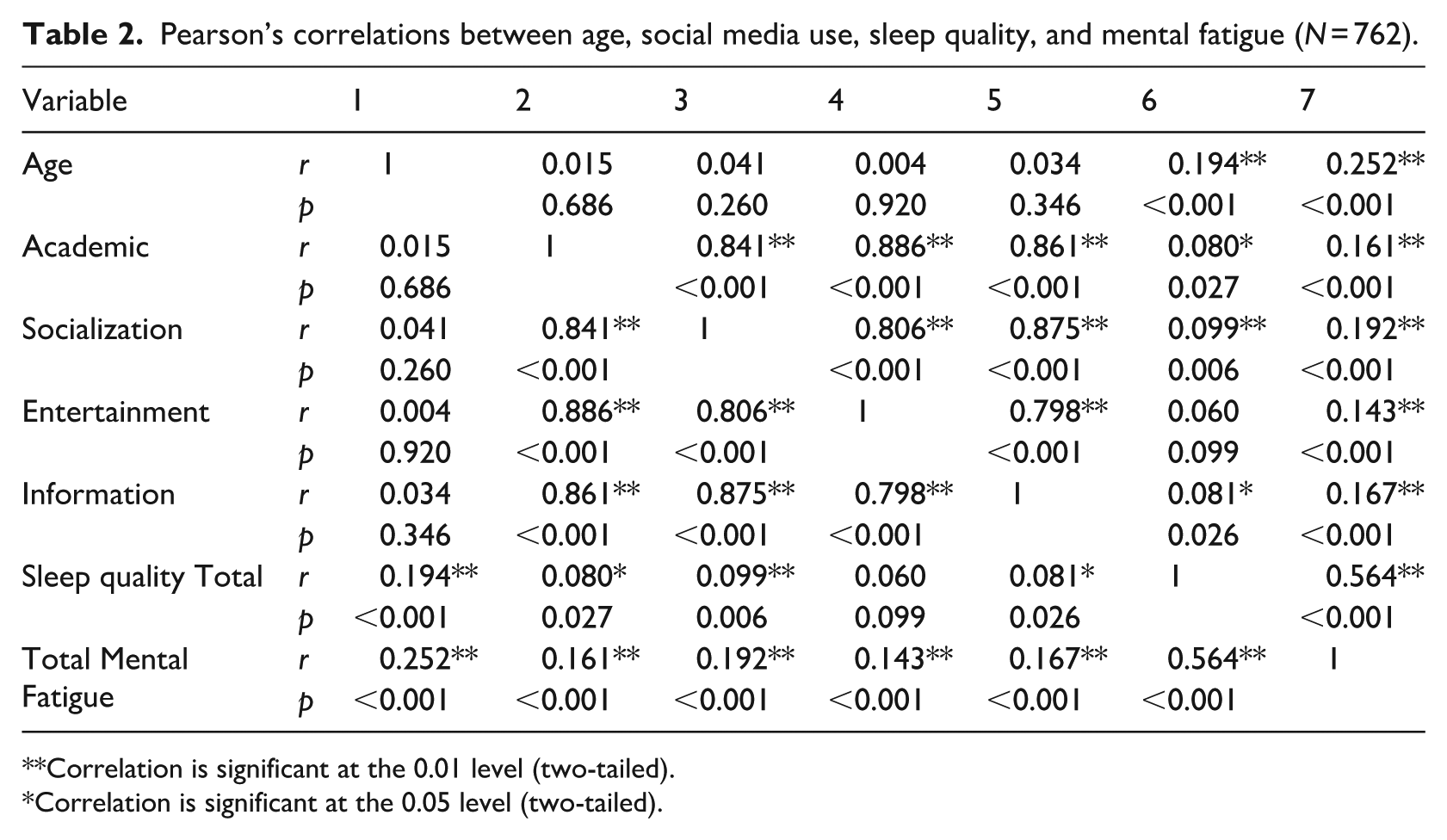
Correlation is significant at the 0.01 level (two-tailed).
Correlation is significant at the 0.05 level (two-tailed).
Age group differences in social media use, mental fatigue, and sleep quality
Independent samples t-tests were conducted to examine differences in social media use, mental fatigue, and sleep quality between two age groups (18–23 years and 24–29 years). Students aged 24–29 years reported significantly higher total social media use (M = 93.23, SD = 14.34) compared with those aged 18–23 years (M = 88.17, SD = 15.76), t(762) = −3.11, p = 0.002. A significant difference was also observed for social media use related to socialization, with higher scores among the older group, t(762) = −3.22, p = 0.001. However, no significant difference was observed in academic-related social media use between the two groups, t(762) = 0.78, p = 0.361. In contrast, mental fatigue was significantly higher among students aged 24–29 years (M = 22.50, SD = 11.02) compared with those aged 18–23 years (M = 18.76, SD = 10.53), t(762) = −3.78, p < 0.001. A statistically significant difference in sleep quality was observed across age groups (t(762) = −2.43, p = 0.015)), with students aged 24–29 reporting poorer sleep quality than those aged 18–23. However, the magnitude of this difference was modest, suggesting limited practical significance.
Gender differences in sleep quality, mental fatigue, and social media use
Chi-square analyses indicated significant associations between gender and sleep quality, χ2(1, N = 762) = 187.23, p < 0.001, with a higher proportion of female students classified as having poor sleep quality. Gender was also significantly associated with mental fatigue, χ2(1, N = 762) = 193.52, p < 0.001, with higher fatigue prevalence among female students. A significant association was observed between gender and overall social media use, χ2(1, N = 762) = 97.82, p < 0.001, although the linear-by-linear association was not significant (p = 0.212), suggesting non-linear differences across usage categories.
Regression analysis
Multiple linear regression analyses were conducted to explore the predictors of sleep quality and mental fatigue (Table 3). The first model predicting sleep quality was statistically significant, F(3, 758) = 119.59, p < 0.001, and explained 32.1% of the variance (adjusted R2 = 0.319). Mental fatigue emerged as the strongest predictor of sleep quality (β = 0.552, p < 0.001). Social media use was not a significant predictor (p = 0.674), while age showed a marginal effect (p = 0.074). A second regression model was conducted to explore reciprocal associations between mental fatigue and sleep quality, consistent with prior literature suggesting potential bidirectionality. The model was statistically significant, F(3, 758) = 139.36, p < 0.001, and explained 35.5% of the variance in mental fatigue (adjusted R2 = 0.353). Sleep quality was the strongest predictor (β = 0.525, p < 0.001), followed by age (β = 0.147, p < 0.001) and social media use (β = 0.128, p < 0.001).
Regression analysis predicting mental fatigue and sleep quality (N = 762).
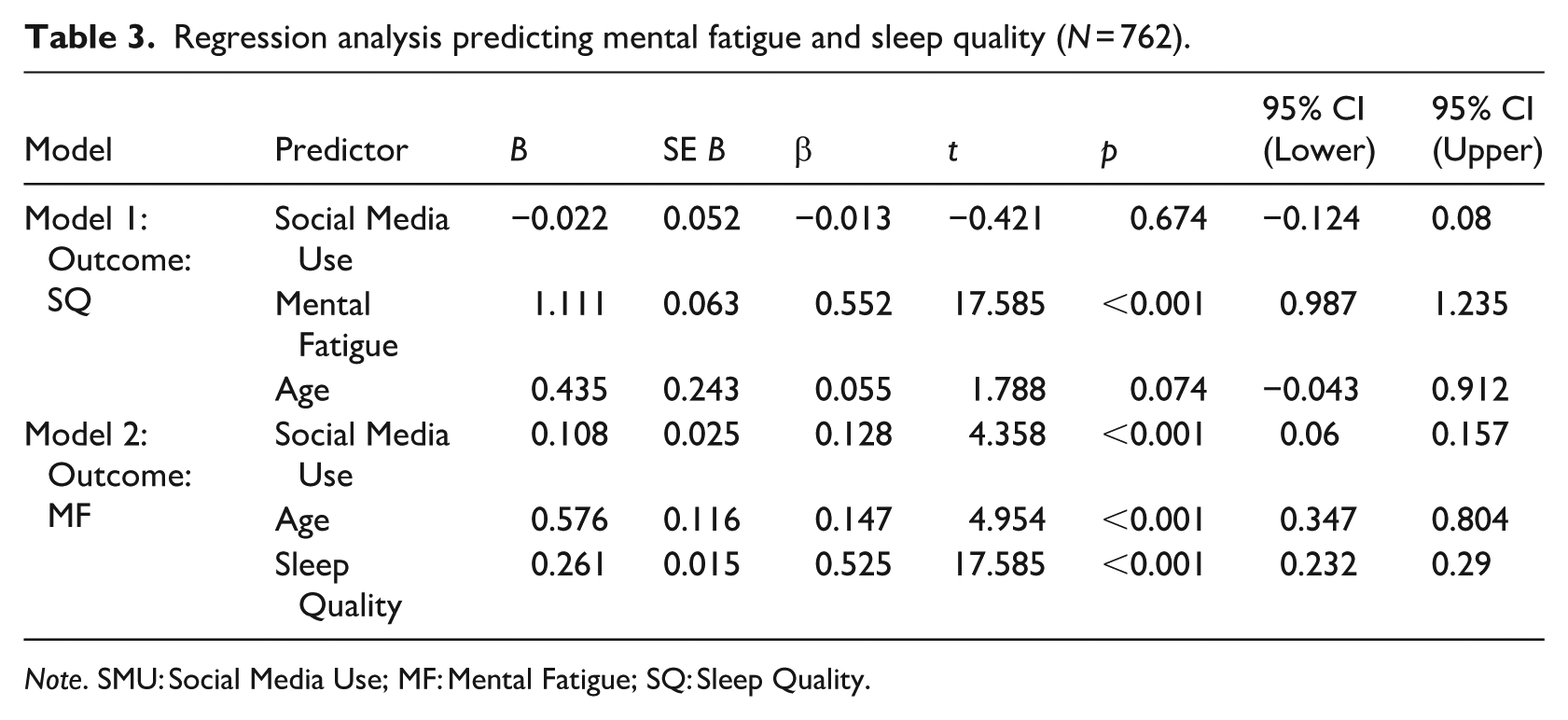
Note. SMU: Social Media Use; MF: Mental Fatigue; SQ: Sleep Quality.
Mediation and sensitivity analyses
Regression-based mediation analysis indicated that social media use was positively associated with mental fatigue (B = 0.13, p = 0.041), and mental fatigue was strongly associated with poorer sleep quality (B = 1.04, p < 0.001). The indirect association between social media use and sleep quality through mental fatigue was statistically significant (indirect effect = 0.14, 95% bootstrap CI [0.08, 0.20]). After accounting for mental fatigue, the direct association between social media use and sleep quality was not statistically significant (B = −0.02, p = 0.674). A sensitivity analysis testing an alternative directional model (sleep quality → mental fatigue → social media use) yielded a smaller indirect association (indirect effect = 0.06, 95% CI [0.03, 0.09]), suggesting asymmetry in the observed associations while acknowledging the cross-sectional nature of the data.
Discussion
This study examined the associations among social media use, mental fatigue, and sleep quality among undergraduate students adopting an exploratory cross-sectional design. The findings indicate that higher levels of social media use were associated with greater mental fatigue, and that greater mental fatigue was associated with poorer sleep quality. These findings are interpreted as associative rather than causal, consistent with the cross-sectional nature of the data.
A prominent finding was the high prevalence of poor sleep quality among participants, with more than 60% reporting poor sleep. This aligns with international evidence documenting widespread sleep disturbances in university populations. Comparable prevalence rates have been reported among students in Nepal (Shrestha et al., 2021), Iran (Jalali et al., 2020), and the United Arab Emirates (Abedalqader et al., 2019), suggesting that sleep problems among undergraduates represent a global concern rather than a context-specific phenomenon. In parallel, a large proportion of students reported moderate to high levels of mental fatigue, reinforcing concerns about increasing cognitive burden in contemporary academic environments.
The observed association between social media use and mental fatigue is consistent with previous research indicating that intensive information and communication technology use is linked to mental strain and psychological distress among young adults (Thomée, 2012). Social media platforms frequently require sustained attention, rapid task switching, and continuous cognitive engagement, which may contribute to subjective experiences of exhaustion over time. Notably, the present findings suggest that academic-related social media use, in addition to recreational use, was associated with higher mental fatigue. This supports emerging evidence that digitally mediated academic engagement may blur boundaries between learning and leisure, thereby increasing overall cognitive load (Junco, 2015).
Mental fatigue demonstrated a strong association with poorer sleep quality, consistent with established literature linking cognitive and emotional exhaustion to sleep disturbance. Previous studies have shown that heightened mental strain is associated with difficulties initiating and maintaining sleep, as well as reduced restorative sleep (Akerstedt et al., 2002; Cain and Gradisar, 2010). From a psychophysiological perspective, mental fatigue may be accompanied by heightened cognitive arousal and rumination, which can interfere with the downregulation processes necessary for healthy sleep.
Regression-based mediation analysis provided additional insight into the pattern of associations, indicating that mental fatigue statistically accounted for the relationship between social media use and sleep quality. Although social media use was not directly associated with sleep quality after accounting for mental fatigue, the indirect association suggests that cognitive experiences may represent an important correlate linking digital engagement and sleep outcomes. This statistical mediation should not be interpreted as evidence of a causal mechanism.
Beyond individual behavior, the broader digital environment should also be considered when interpreting these findings. Many social media platforms are intentionally designed to maximize user engagement through persuasive design features such as infinite scrolling, algorithmic may encourage prolonged and repetitive use, making disengagement more difficult for young users, and increasing cumulative cognitive and emotional demands over time. From an addiction research perspective, such reinforcement mechanisms share characteristics with other habit-forming digital behaviors. More broadly, the social media industry has been described as a commercial determinant of health, whereby corporate incentives may conflict with user well-being when engagement is prioritized over psychological health (Gong and Liu 2023; Zenone et al., 2022). This wider context suggests that mental fatigue and poor sleep may reflect not only individual self-regulation challenges, but also exposure to digital environments structured to sustain attention and consumption.
Sensitivity analyses testing an alternative directional model yielded a weaker indirect association when sleep quality was specified as the predictor of social media use via mental fatigue. While this does not exclude the possibility of bidirectional relationships, it supports a cautious interpretation of asymmetry in the observed associations. Prior longitudinal studies have demonstrated reciprocal relationships between media use and sleep problems (Exelmans and Van Den Bulck, 2016; Tavernier and Willoughby, 2014), underscoring the limitations of cross-sectional data for establishing temporal ordering.
Demographic patterns further contextualized the findings. Female students reported higher levels of mental fatigue and poorer sleep quality than male students, consistent with prior literature documenting gender differences in sleep disturbance and stress-related outcomes (Fatima et al., 2016; Twenge et al., 2018). Older students reported greater mental fatigue and higher academic-related social media use, potentially reflecting cumulative academic demands and prolonged exposure to digitally intensive learning environments. These findings are interpreted as contextual rather than hypothesis-testing and align with the exploratory aims of the study.
Several limitations should be acknowledged. First, the cross-sectional design limits causal inference and prevents conclusions regarding temporal ordering. Second, the use of convenience sampling may limit the generalizability of findings to the wider undergraduate student population. Students who chose to participate may have differed systematically from non-participants, including the possibility that heavier social media users or students experiencing fatigue or sleep difficulties were more motivated to respond. Accordingly, the findings should be interpreted with caution. In addition, reliance on self-reported measures introduces the possibility of recall bias, social desirability bias, and common method variance. Academic-related social media use may overlap with broader academic workload, multitasking demands, or general screen exposure; therefore, the present measures cannot fully disentangle whether observed associations reflect social media behavior specifically or overall academic digital demands. Assessing predictors and outcomes within the same survey at a single time point may also inflate observed associations. Nevertheless, the study is strengthened by its large sample size, use of validated instruments, and inclusion of mediation and sensitivity analyses that enhance interpretive rigor.
Implications and future directions
The findings of this study have several implications for student well-being and institutional practice. The observed associations among social media use, mental fatigue, and sleep quality suggest that digital engagement may represent an important contextual factor in students’ cognitive and sleep-related experiences. Accordingly, higher education institutions may benefit from increasing awareness of digital wellness and media literacy as part of broader student support initiatives, particularly in relation to managing cognitive load and sleep habits.
Rather than prescribing specific interventions, the findings highlight the potential value of encouraging students to reflect on their patterns of digital engagement, especially during periods of high academic demand or late-night activity. Educational initiatives that promote general awareness of healthy screen use, sleep hygiene principles, and stress management may be relevant in this context. Such initiatives should be framed as supportive resources rather than corrective measures, given that the present study does not establish causal effects or intervention efficacy.
Future research should prioritize longitudinal and experimental designs to clarify temporal ordering and causal pathways among social media use, mental fatigue, and sleep quality. Incorporating objective measures of sleep and digital behavior, alongside qualitative approaches exploring students’ lived experiences of digital fatigue, may further enhance understanding of how cognitive demands are navigated in digitally intensive academic environments.
Conclusion
This study found that higher levels of social media use were associated with greater mental fatigue, and that greater mental fatigue was associated with poorer sleep quality among undergraduate students. Regression-based mediation analysis indicated that mental fatigue statistically accounted for the association between social media use and sleep quality; however, this indirect association should be interpreted cautiously as exploratory given the cross-sectional design. Overall, the findings underscore the relevance of mental fatigue as a cognitive correlate in discussions of digital engagement and sleep health and provide a foundation for future longitudinal and intervention-based research aimed at supporting student wellbeing in increasingly digital learning contexts.
Footnotes

Ethical considerations
The study received the required ethical approval (Reference: REIC2024-CAP05) in September 2024.
Consent to participate
All participants have signed a written informed consent before participation in the study.
Consent for publication
Consent for publication is not applicable to this article as it does not contain any identifiable data.
Author contributions
Yousef M. Aljawarneh: Conceptualization, Methodology, Software, Formal analysis, Methodology, Project administration, Writing–review and editing. Saed Azizeh: Writing–review and editing, Data curation, Visualization. Marwa Badr: Data curation, Methodology, Writing–review and editing. Afrah Aldhuhoori: Writing- Original draft, Visualization, Methodology. Sohailah Alsereidi: Data curation, Software, Writing–review and editing. Abrar Alsereidi: Data curation, Investigation, Writing- Original draft. Mahrah Alsaadi: Conceptualization, Methodology, Writing- Original draft. Maryam Almsmari: Writing- Original draft, Visualization, Methodology. Samia Alghawi: Conceptualization, Methodology, Writing- Original draft.
Funding
The authors received no financial support for the research, authorship, and/or publication of this article.
Declaration of conflicting interests
The authors declared no potential conflicts of interest with respect to the research, authorship, and/or publication of this article.
Data availability statement
The data that support the findings of this study are available on request from the corresponding author, [YA]. The data are not publicly available due to privacy and ethical restrictions.