







Abstract
This article re-orientates work on the material culture of war by considering military material culture beyond conflict and demonstrating how military material culture has extended social lives and passes through value regimes, as do many forms of material culture. The article focuses on end-of-life military things, specifically the neglected field of naval vessels. It shows how the social and physical death of naval ships connects to residue military masculinities, particularly through the complexities of souvenir value. Drawing on ethnographic research with veterans’ associations, the authors chart how naval ships become ghostly and how this connects with the salvage of personal mementos, often of a military domestic; they go on to describe the ambivalence of these accommodations within a civilian domestic. The article shows how collective practices of ship memorialization disclose a hierarchy of souvenir value and how souvenir salvage constitutes a distributed sociality from the fragments of destruction to own the memory of what is being destroyed. The authors argue that visioning and visualizing the destruction of naval vessels makes ex-naval personnel witnesses to an object death and highlights the fact that resource recovery regimes need to be re-thought through reincarnation; they also show how the reincarnation of ‘great things’ does not always become them.
Keywords
This article seeks to advance the debate on military material culture in the context of civilian life. We do so by attending to the extended social lives of military things beyond conflict, their passage through value regimes to the point of their destruction, and by connecting end-of-life, or rubbish value, military objects to residue military masculinities in civilian life. Making this connection enables us to show the complexities of souvenir value in military material culture, particularly in end-of-life military objects. It also shows that the destruction of military things and their recovery as materials for recycling is open to salvage and souvenir creation. In this way, the article affirms recent arguments in material culture studies that read recycling through reincarnation (Norris, 2008) whilst arguing that reincarnation is not always affirming.
Research on war, warfare and soldiering has acknowledged a matériel culture (Schofield et al., 2002). However, whilst explosive ordnance and weapons have often driven the nomenclature and identities of military units and personnel, and military uniforms remain an arena of formalized ritual signification, the stuff of warfare is rarely considered as a cultural artefact. As Saunders (2004) argues, the material culture of war has been a neglected field in both material culture studies and conflict studies; he has addressed this lacuna in a series of books and papers that focus on the material culture of the First World War (Saunders, 2000, 2001, 2003, 2004). Allied to this, an emergent archaeology of war, focusing on battlefield reconstruction, the memorialization of wars and the rise of battlefield tourism, has addressed the material remains of warfare and its commemoration (Iles, forthcoming). Studies have examined a range of sites of conflict, dissecting official and unofficial commemoration and pilgrimage to scenes of conflict, preserved landscapes, lost landscapes, monuments at key sites and at a remove from such sites. They have highlighted biases in favour of victors, of combatants over non-combatants, of competing state-authorized narratives, and of combatant over local accounts (Cocroft and Thomas, 2003; Dobinson et al., 1997; Muzaini and Yeoh, 2005; Saunders, 2001). Of more relevance to this article, however, is work on how the matériel of war is transformed through the actions of soldiers and civilians into memorabilia, of which the most famous case is trench art (Saunders, 2003; Schofield et al., 2002). Saunders identifies three modes of salvaging war debris: its aesthetical reworking by military personnel; its transformation into raw materials for a souvenir industry directed towards battlefield tourism and pilgrimage; and debris appropriated in war zones as personal mementos, but subsequently re-worked by cultural intermediaries as domestic memorabilia. All three categories bring war, in the form of reworked debris, into the domestic, where its display is positioned by Saunders within Susan Stewart’s (1993) classic account of the souvenir and its articulation of absent presence and loss.
More recently, and building on this work, Harrison (2008) has tracked the biographies and types of artefacts taken by soldiers from fallen enemy in the Second World War, the bartering and exchange of artefacts between front-line and rear-echelon troops, and the spinning of narratives of (true or invented) associations around and through them for audiences back home. Dependent on whether they invoked a masculinized kudos, generic equipment or personal and identifiable effects were invested with legal and symbolic resonances; these artefacts became part of the symbolic resources for memory and stories told by veterans over subsequent years. Moves for the restitution and repatriation of such trophies and mementos render these artefacts as having the opposite effect of Maussian gifts. Rather than maintaining social relations, the sending home of these artefacts is seen as separation, as locking memories away. Looking at the less personal debris of war – in this case, shrapnel in the Second World War – Moshenska (2008: 120) has shown how this was appropriated by children into cultures of collecting, exchange and disposal, taking ‘its place alongside marbles, comics and trading cards in the cut-throat economy of the playground’. In this work, the debris of warfare is not bound up in the souvenir form, but circulates in the playground economy, gaining patina and falling out of exchange. War debris here becomes a means not for remembering but for making social worlds and domesticating warfare through its incorporation into everyday childhood practices. Other forms of debris persist for generations, with the detritus of combat still being retrieved as souvenirs from the Western Front nearly a century after the conflict (Iles, forthcoming). War debris, then, indicates that the social life of an artefact ‘does not always end with its destruction, quite the contrary. Slashed into pieces, recycled, transformed, it can continue to live in fragmented form and act as an intermediary onto which people can project their memories, frustrations or experiences’ (Van der Hoorn, 2003: 189–190).
Given that work on the material culture of war focuses on the re-appropriation and revaluation of war debris, it is both establishing its material culture credentials and making a tacit political point. To show how objects fabricated to maim and destroy human life can be recycled and rekindled in both memorial and everyday form, it must be established that the material culture of war has biographies and moves through value regimes much like any other commodity (Gregson and Crewe, 2003; Kopytoff, 1986; Myers, 2001; Thompson, 1979). The difference, however, is that this is military material culture. The political point in focusing on shrapnel and shells, then, is that these are the mass products of an armaments industry that has brought widespread death, destruction and disfigurement to civilian and military populations alike. Looking elsewhere in terms of the material culture of war runs the risk of glossing this, whilst potentially colluding in forms of commemoration that celebrate and fetishize combat equipment. Yet to focus on the debris of arms and armaments limits the study of military material culture to periods of warfare, and to particular conflicts at that, whilst promoting a view that much of this material culture is consumed in the course of conflict. Whilst this clearly does happen, much of military material culture is created in advance of and survives periods of conflict, or indeed never sees conflict. The material culture of war, then, is in a potential, rather than actual, relationship to conflict; the nuclear arsenals of the Cold War are a clear case in point (Solomon, 1988). Furthermore, to focus on war debris from times of conflict and the places where it occurred is to overlook the fact that armaments have required ever more elaborate platform technologies to transport, launch and direct them to targets and that much military hardware is concerned with the mundane reproduction of military life. Science and technology studies have considered the creation of platform technologies (Mackenzie, 1990; Spinardi, 1994) but not their obsolescence, decommissioning and destruction (although see Mort and Michael, 1998). Recognizing the multiple temporalities of the material culture of war and the contingent relation of military material culture to conflict is an important step for the development of the field.
In this article, we start from the extended social lives of military material culture and their relation to value regimes, the importance of platform technologies as part of military material culture, and the contingent relation of military material culture to warfare. Rather than focusing on a land-based military material culture, we turn to the sea. 1 All the objects that figure in this article are (from) ex-naval vessels. Less than the ‘battleships’ of popular imagination, these ships were all platform technologies, that is, support, or auxiliary, vessels, with the primary purpose of delivering equipment, supplies and personnel either to ‘the field (of action)’ or of keeping other vessels at sea. 2 Whilst they had all been involved in conflict operations (the Second World War, the Korean War, the Falklands/Malvinas War), all continued in active service for a period of decades pre and/or post conflict, before being decommissioned, mothballed and then, eventually, sent for scrapping. All the vessels were in the region of 50 years old at the time of the research, in itself an indication of their durability. They were all then in the throes of being demolished and reclaimed for their scrap value. In Thompson’s (1979) terms they were naval ships of rubbish value. Less the debris of warfare and more a remaindered military material culture, these ships afford the opportunity to examine a rather different matériel culture than has been addressed in the literature hitherto, one that speaks to the workaday cultures of military masculinities and their commemoration, rather than to military events.
The importance of the military as a site for theorizing masculinities was acknowledged at the outset of work in men’s studies through its connections to hegemonic masculinity, marked by aggressive, misogynistic and heterosexual performances, and rugged corporealities (Connell, 1995; Morgan, 1987). These accounts have been tempered recently by work that recognizes changing militarisms and masculinities (Adelman, 2009; Higate and Hopton, 2005); the heterogeneous masculinities involved in military activities (Barrett, 1996; Morgan, 1994), especially across the combat and support roles (Woodward and Winter, 2007); and the differences between the armed services. A key feature of recent research is the boundary drawn between military and civilian life. Although the permeability of the boundary is acknowledged, most of the interest is in how military life has been affected by gender and sexual politics since the 1970s and 1980s, especially the incorporation of women into front-line roles, and by the changing shape of militarism, in particular the enhanced humanitarian, peace-keeping and governance roles identified with the military in the 1990s and 2000s. ‘Traffic’ across the dichotomy therefore has been largely one way, about civilian values entering the putatively militarized realms. Indeed, in Morgan’s work, merely passing reference is made to ‘cautionary tales’ of veterans in a predominantly civilian society, ‘their deeds forgotten and their wounds and medals a source of embarrassment and boredom’ (Morgan, 1987: 175). By contrast, Higate (2000, 2001, 2003) has explored the ‘tenacity of military-masculinity’, or its residue, and its effect on post-military, civilian life. The focus in Higate’s work is the transition from army to civilian life; the minority of ex-army personnel who end up amongst the homeless; and the durability of military identities within civilian life, in both employment and the domestic realm. This work recognizes the lingering co-presence of military subjectivities in everyday life and their importance for understanding the heterogeneity of contemporary masculinities.
Firmly sociological, this literature has little to say about material culture. And yet, as we show here, for the navy, material culture is critical to an understanding of military subjectivities and identities. Here it is the ship – the artefact – in which military pride is instilled. Reinforced by patterns of posting that often entail extensive periods of time away at sea on one ship (typically up to 2 years) and by the complete dependency of human life at sea on that ship, this attachment persists into civilian life. Attachment and its persistence are visible in memorial sites; in the large number of associations formed around particular decommissioned naval ships; and in the manufactured souvenir. 3 Ex-naval ships forge a geographically distributed community of ex-service personnel, who materialize their sociality through the purchase of particular mementos, which bear the name or motto of that particular ship. As demonstrated in this article, the physical death of that ship reanimates this community, constituting a focal point for its sociality and the means to the circulation and exchange of ship-specific souvenir artefacts. We show how the physical destruction of the ship can become the focus for a complex process of souvenir salvage, memory and forgetting and how clear hierarchies of souvenirs, salvaged from that ship, emerge. At the same time, souvenirs of military material culture destabilize the boundary between civilian and military life. Salvaged souvenirs are collectable as well as collective and personal, but individual acts of souvenir salvage disclose that a military domestic disrupts current understandings of military material culture and military material culture disrupts the civilian domestic. In turn, these findings suggest that work on the souvenir in military material culture can be connected to the wider literature on souvenirs as tourism-related objects, in which hierarchical classifications, debates over provenance, the relationships of manufactured and personal mnemonic objects and souvenir display within the home have all figured strongly (Gordon, 1986; Habermas and Paha, 2002; Hashimoto and Telfer, 2007; Ramsay, 2009).
Materialising ex-naval identities and subjectivities 4
War memorials and military cemeteries are two of the clearest instances of the materialization of sacrifice and loss, constituting a distinctive focus within the body of work on death, memory and material culture (King, 1999; Rowlands, 1999). The focal issue in these sites is human death, sacrifice and loss, reconciliation and transcendence. Military memorialization and commemoration, however, are not confined exclusively to the human. Within the US Navy Memorial in Washington DC, for example, alongside the statuary and commemoration of key events and communities in US naval history, is a plaque wall dedicated to the memory of a few individuals, but mostly particular ships (Figure 1).
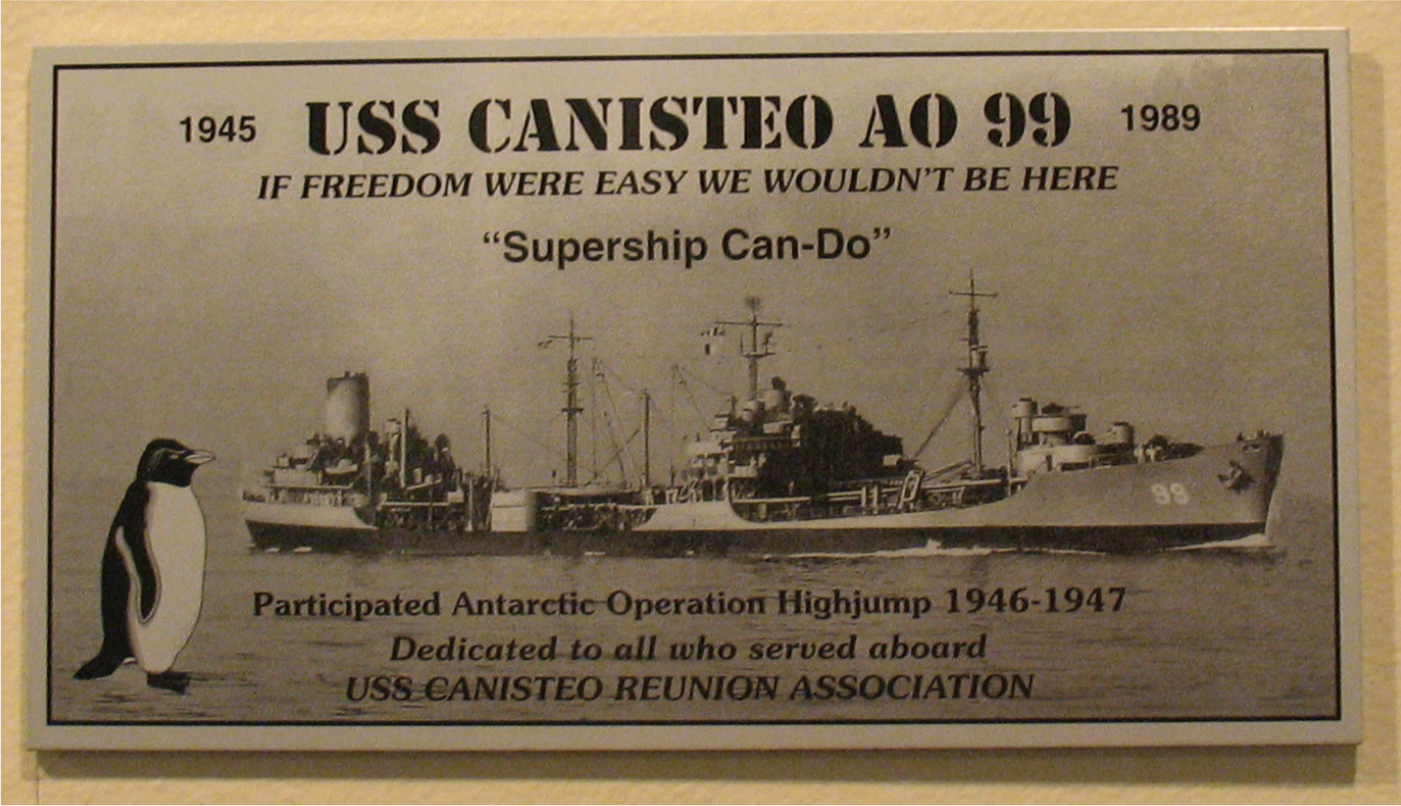
USS Canisteo memorial plaque, US Navy Memorial, Washington DC, USA.
Placed there by reunion associations in private ceremonies, these plaques typically include the name and an image of the ship, the dates of its commissioning and decommissioning, its motto and a key event in its military life. Dedication ceremonies include a virtual link to the ship and crew that bears the same name, if that name has been taken up again by the US Navy. Such acts of object commemoration and object–object connection are unusual in military memorialization, where preserved objects are primarily illustrative of a generic category. Notable examples include the guns, tanks, planes or armaments in most military museums or the objects restored by military preservation societies. Here though, it is a particular ship, its social and military life, and its connection to another ship with the same name that matters.
Memorial plaques are perhaps the clearest indication of the part-human status of the ship within naval military culture. Another is the Stanley Bleifeld statue The Lone Sailor in the same US Navy Memorial site (Figure 2).
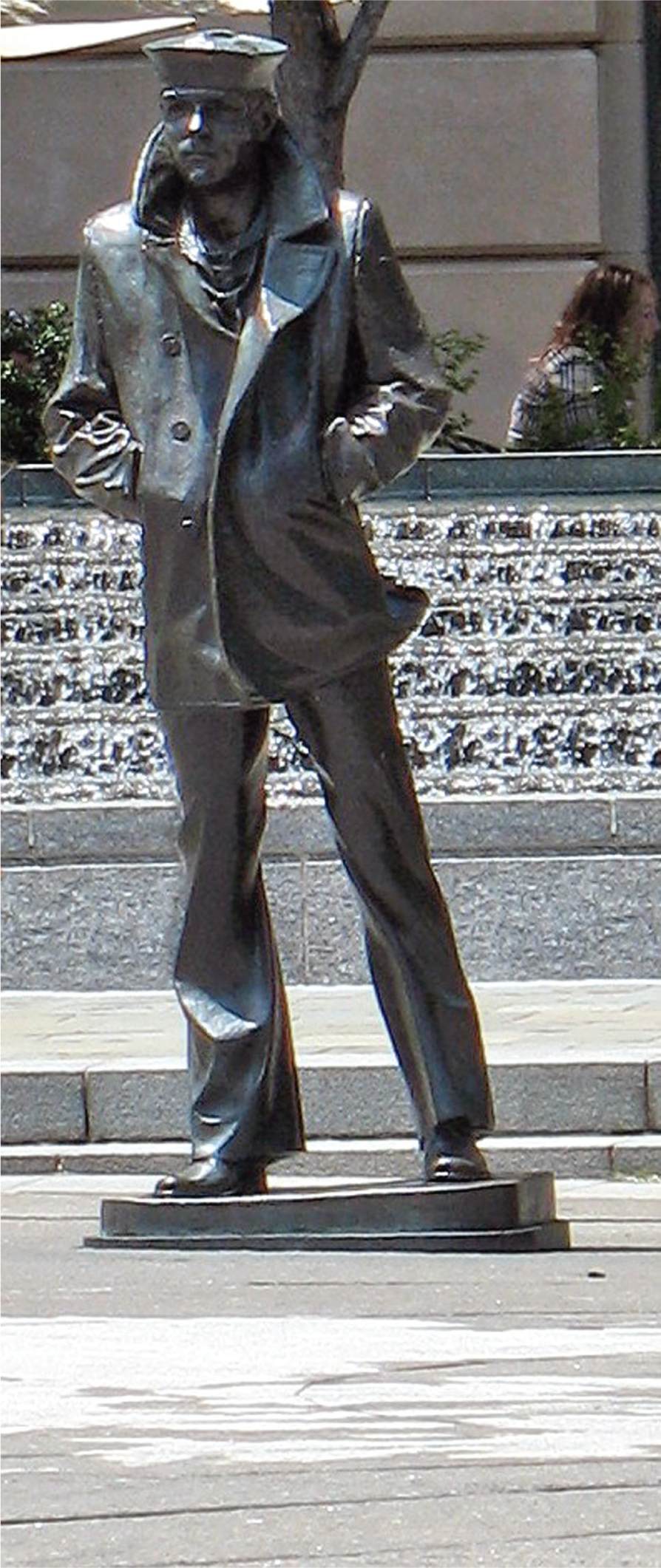
The Lone Sailor – Stanley Bleifeld, US Navy Memorial, Washington DC, USA.
A bronze sculpture of ‘the US Navy bluejacket, past, present and future’, the brief for this public art form resonates strongly with hegemonic military masculinities:
At 25 years old at most, a senior second-class petty officer who is fast becoming a sea-going veteran. He has done it all – fired his weapons in a dozen wars, weighed anchor from a thousand ports, tracked supplies, doused fires, repelled boarders, typed in quadruplicate and mess cooked … (http://www.navymemorial.org)
Yet, materially, the statue is more than this. The bronze of The Lone Sailor was mixed in casting with artefacts from eight US naval vessels spanning the history of the US Navy from the post-Revolution period through to a nuclear-powered submarine. Like Hans Haacke’s mixing of the earth from all the German Länder (federal states) in the foundation of the new Reichstag, showing the fusing of peoples (Wagner, 2007), this aesthetic move folds the collective naval seafaring body with the collective ship of the US Navy. It confirms that ships make naval identities, subjectivities and socialities.
The connection between ships, socialities, identities and subjectivities is also visible in the large number of naval veterans’ associations in the US and UK. Although not all decommissioned ships have associations, those that do constitute a distributed sociality of former crew. These scattered, virtual communities of ex-naval personnel are oriented to catching-up with old ‘mates’ and acquaintances. The Canopus Association, for example, is described as ‘a place where old friends and shipmates can come together and rehash old times’ (http://usscanopus.org), whilst the Intrepid Association is a forum for ‘old shipmates to pull up a bollard and swing a lantern’ (http://www.hmsintrepid.com). Such statements were reiterated in a focus group discussion comprising six HMS Intrepid Association members (denoted A–F in subsequent extracts):
To me the ship’s here [pointing to his heart and to his ‘mates’ around the table]
It’s about the social …
the camaraderie. There are guys that we see who are still joining the Association and still putting their name forward, and you think, ‘Bloody hell. Is he still around?’ You know.
Face-to-face meetings are normally focused around an annual reunion event – to which wives and partners typically come along – and public dates of military remembrance, notably Remembrance Sunday in the UK and Veterans’ Day in the USA. A second area of activity that all associations engage in is materializing their sociality through material culture. At one level, this is what memorial plaques are about. Indeed, the act of memorializing their ship is constitutive for associations. At another level, however, materialization connects with a sociality of the present. The means to this is through manufactured souvenirs, typically tie pins and lapel badges in the UK, and t-shirts and baseball caps in the US (Figure 3).
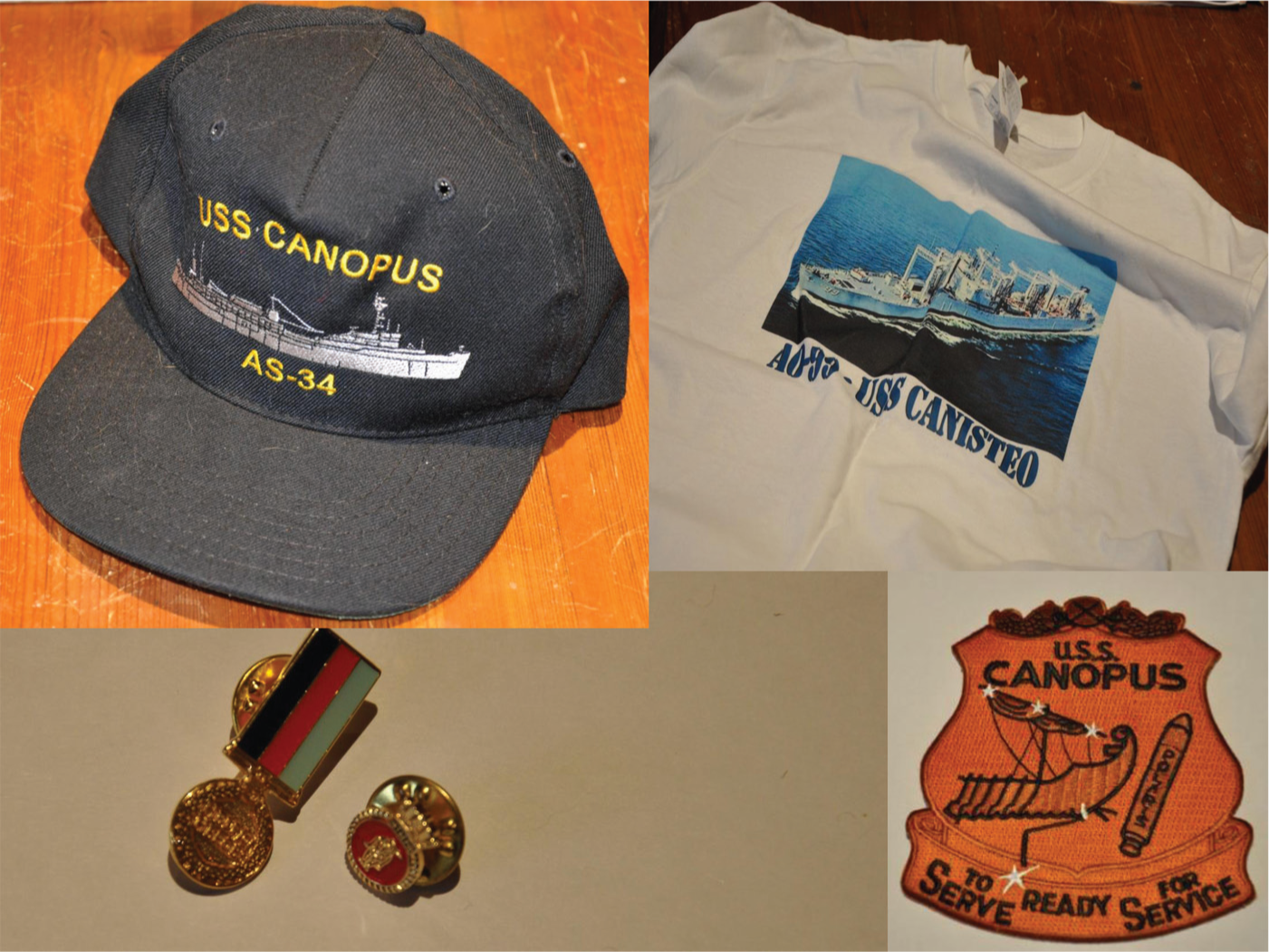
Manufactured memorabilia – USS Canopus, USS Canisteo, HMS Intrepid.
Manufactured souvenirs are worn by association members in an everyday sense – on work clothing or as leisurewear. The Intrepid Association members again:
What occasions would you wear these things on? Obviously a day like this when you’re all together
Remembrance Day […]
I wear mine with a jacket every day to work.
You wear it every day?
Yeah – I wear my veteran’s badge every day at work on my suit.
Would that be something that quite a lot of people do?
Yeah, I see quite a few when I’ve been going into companies – there’s a couple of the security guards that have got the …
And it’s the Veteran’s badge as well as the Intrepid badge […] people, you can see their eye being, and you can’t read the word Intrepid […] and then you would kind of explain, ‘I used to be in the Navy and that was the ship that I served in’, and that kind of breaks the ice.
In contrast, albeit as a source of pride, medals are only worn at association reunion events and on public memorial days. Stuffed in suitcases along with all manner of other family memorabilia (Hallam and Hockey, 2001), medals are a form of military material culture that does not sit easily in civilian life. And yet, clearly, there is a felt need on the part of ex-service personnel to materialize past military lives in present lives. It is this gap that the manufactured souvenir fills, enabling ex-service personnel to materialize these past identities and a naval sociality in workaday culture.
A naval ship’s decommissioning constitutes a social death. It animates a distributed, predominantly virtual sociality of former crew, who both commemorate that ship and mark its importance in their lives through the manufactured souvenir. As much as they indicate an absent presence, these souvenirs constitute workaday, and publicly acceptable, mementos of military masculinities and a public sociality of the present for ex-service personnel. The decommissioning of a ship, however, eventually connects to its physical destruction, although the temporal gap between social and physical death, first and second burial (Hertz, 1960), can be considerable. In the following section, we examine how physical death plays out within the dynamic of the souvenir and the association, focusing on the instance of HMS Intrepid.
Becoming ghostly: pilgrimage, souvenir salvage and destruction
One of the striking points about the USS Canisteo memorial plaque in Figure 1 is that, at the same time as this plaque was being photographed on a wall in Washington DC (May 2008), its physical referent was in Graythorp, Teesside (UK), where it had been since November 2003 (Figure 4), along with the USS Caloosahatchee, USS Canopus and USS Compass Island.
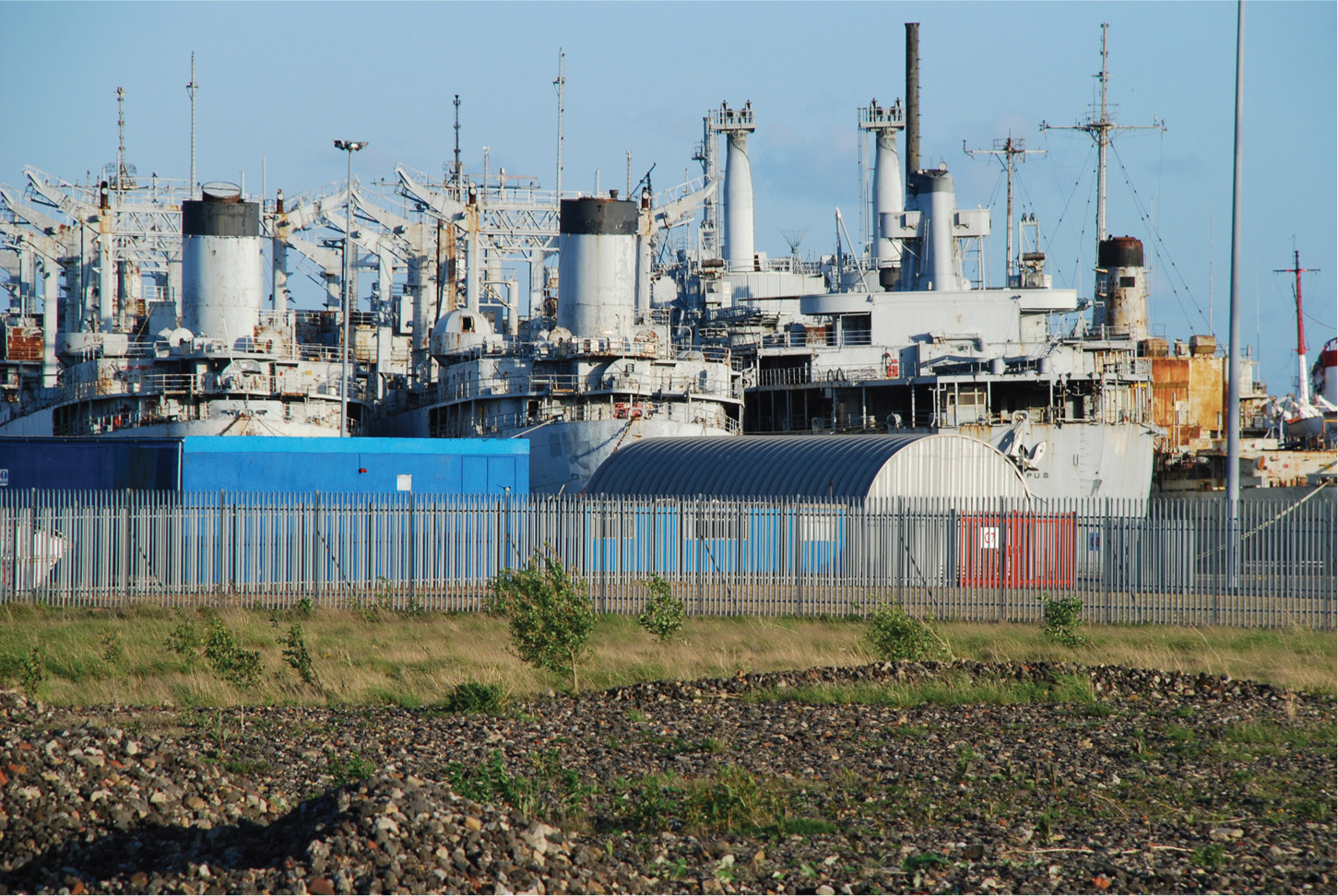
Becoming ghostly: USS Caloosahatchee, USS Canopus, USS Canisteo, USS Compass Island – Graythorp, Hartlepool, UK, 2008. © Photograph: Nicky Gregson.
Prior to that, the USS Canisteo, along with a large number of other vessels including Caloosahatchee, Canopus and Compass Island, had been languishing in the James River, Virginia (USA), as part of the US ghost fleet of mothballed ships, in a limbo of no longer sailing but not yet scrapped. Becoming ghostly is not acknowledged on memorial plaques, where what matters is to memorialize the active life of the ship and to separate this out from its physical end. Of critical importance to this article, however, is that the passage into ghostliness is one in which remaindered military material culture moves through distinctive value regimes; in this case, from sites where return is possible (in the case of these ships, the James River, or deep storage in Portsmouth) to sites where their military value has been stripped out and the remaining value is located in materials and their recovery for recycling. So, on Teesside, these ships are ships becoming metal/wastes, predominantly tonnes and tonnes of ferrous scrap, and lesser weights of stainless steel, copper and brass, and asbestos (Gregson et al., 2010; Hillier, 2009).
The passage of naval vessels through value regimes is no different to that which has been tracked in relation to textiles (Norris, 2008, 2010; Tranberg Hansen, 2000). Throughout much of the latter part of the 20th century, end-of-life US and UK naval vessels passed through various chains of ownership, eventually to be broken up. The breaking of ex-naval ships in often distant sites makes it difficult for ex-service personnel to re-enact their attachment to a particular ship at the point of its physical death. The latter, though, is a common desire. As military disposal authorities acknowledge, as well as animating a sociality of former crew, the slating for scrapping of any naval ship is likely to trigger a campaign to ‘save our ship’. Campaigns coalesce around a desire to preserve the vessel, usually by imagining it as a future museum, hotel or training ship. 5 On passing into the ownership of a breaking company, this attachment manifests again, typically in the form of requests to visit ‘their ship one last time’. Whilst some breaking companies regard requests for visits as an irrelevance and dismiss them, others permit them. The distinction maps into, on the one hand, businesses focused on the economics of scrap metal and, on the other, businesses that recognize that some of a naval ship has souvenir value. As we show here, the latter enables a re-affirmed sociality through acts of personal and collective souvenir salvage, memory and forgetting.
Ethnographic fieldwork examining the break-up of HMS Intrepid highlighted three phases of Association engagement with the ship’s ‘disposal’. The first is ‘the return’, distributed in this instance between Portsmouth and Bootle, Liverpool. This entailed witnessing the ship’s final tow from the site of its naval storage to the location of its physical destruction, and an Open Day there for Association members and their families, prior to the commencement of destructive work. The first practice echoes those of former shipbuilding communities, who would line coastlines to watch cruise ships and liners they had built ‘coming home to die’ (Rae and Smith, 2001); the latter is more akin to battlefield pilgrimage/tourism (Figure 5).
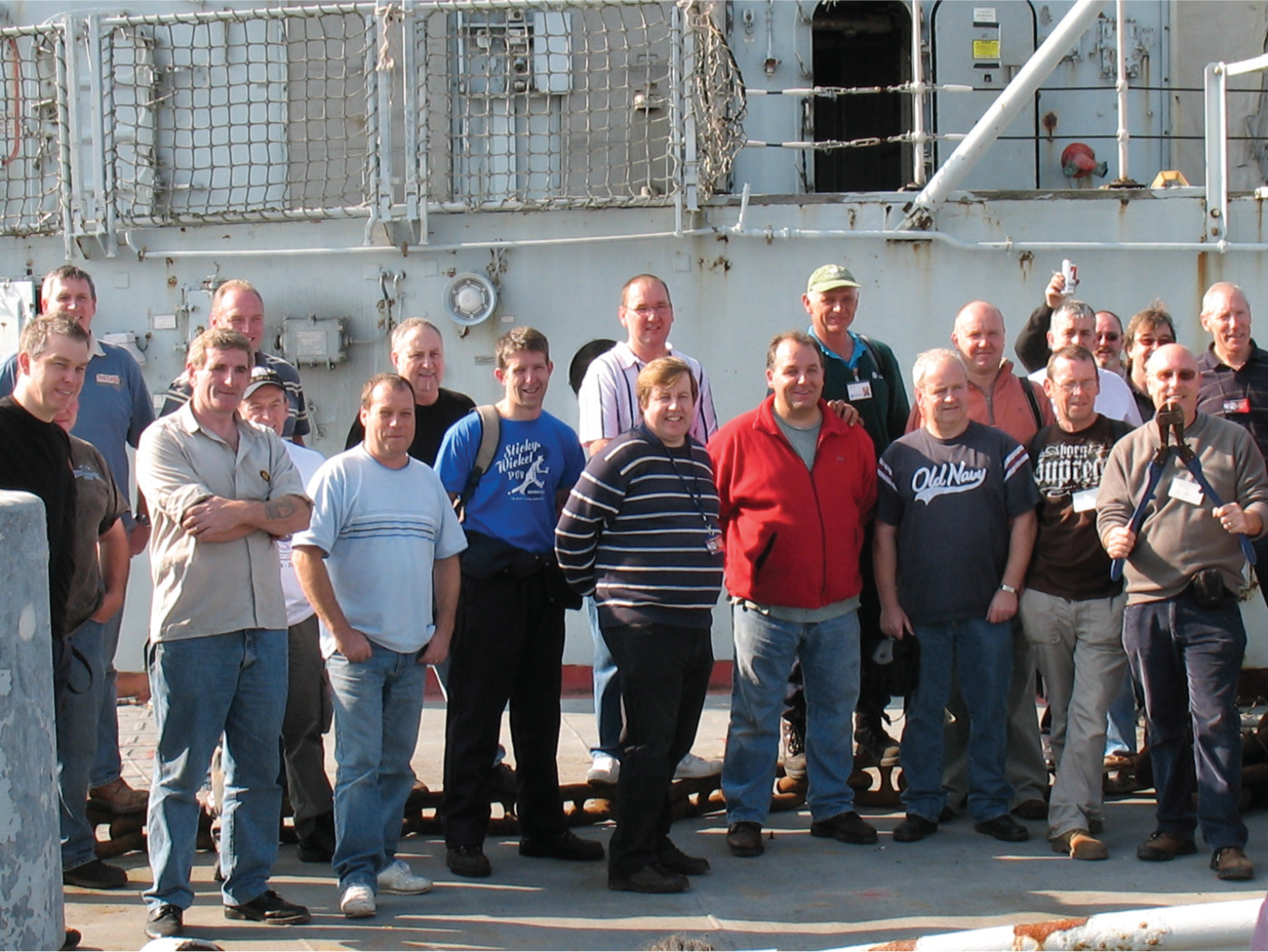
HMS Intrepid Association Open Day, September 2008. © Photograph: Helen Watkins.
Thus, the Association Open Day was characterized by still and camcorder photography, later posted on the Association’s website, and the widespread appropriation of small personal mementos, in return for a donation to a charity specified by the business concerned – in effect, a form of gift exchange in the interstices of the breaking business. The majority of the mementos salvaged were highly personal and indicative of the mnemonic importance of a military domestic rather than objects identifiably from this particular ship or even identifiably military. They were small items of signage or small objects identified with either mess decks (the equivalent of ‘home’ at sea) and/or sites of onboard work (Figure 6).
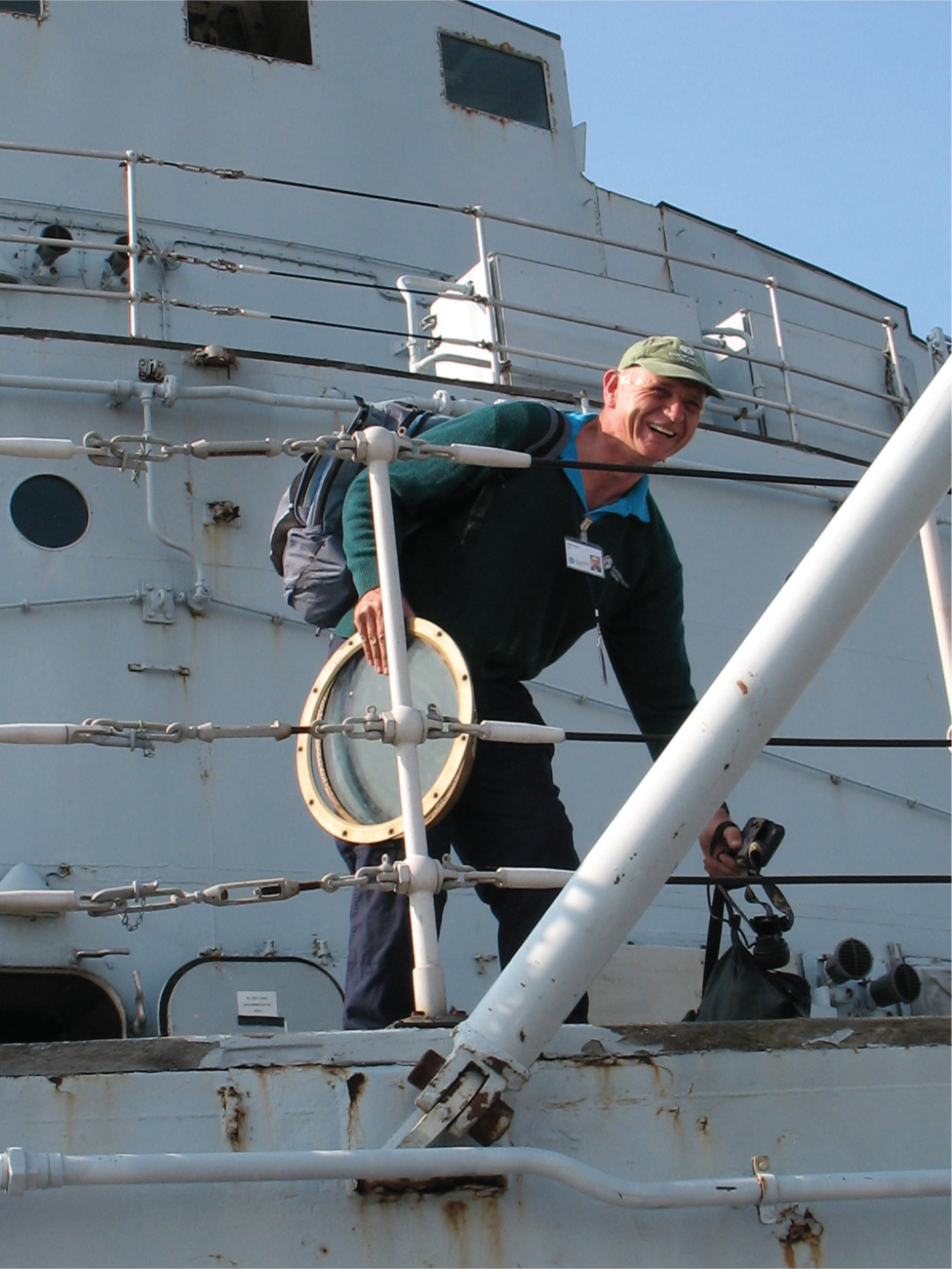
Souvenir salvage. © Photograph: Helen Watkins.
Distinctively different is the working of embodied memory. For Association members, a key memory of the Open Day was of their body’s remembering. Post after post on the Association’s website refers to the initial retracing of long forgotten but strangely familiar routes between distinctive locations onboard (bunk, mess deck and site of work, in that order). 6 To an onlooker unfamiliar with the ship, this appeared a veritable maze, navigated – it should be added – by the light of a torch beam, since a decommissioned ship is a ship with no power. This – and more – is captured vividly in the following extract, recorded accompanying one such journey back to a site of work, down in the tightly confined, bordering on claustrophobic, pitch-black depths of the ship’s boiler house:
… There are two steam driven turbines – they used to supply all the electricity – this brings back memories I tell you – the noise wasn’t too bad; there was a lot of screening ‘Whheeeee’ – you had ear defenders on, and it was just like a mosquito in your ear defenders. The heat – well, it’d depend on where you were in the world, but I did feel the heat. Somewhere in the world, the West Indies or that, the heat was unbearable sometimes. You’d stand on the supply fan and you’d open your overalls up, like that. Nothing on underneath and you’d be getting all the wind down your trouser legs!! Ohhhhhh. Massive! Great fun. That there was the clutch for the ballast pump, if I remember right. Yes it was. Was this the shaft or the main feed tank? (Question/comment – I don’t know how you know what you were doing down here, you must have spent years.) Well, we knew every single pipe – you actually, engineers used to learn it in a couple of weeks when you joined the ship; the first thing you’d get was a notebook and a pencil and you’d trace the systems around and you’d make a mental map of where everything was. You’d rely on your sketches as well – that’s a drain cooler that – there should be a salinometer around here somewhere – there it is – there’s the salinometer! How on earth did I remember that? How did I remember that?! I haven’t been on this ship in 26 years! (Camcorder footage, September 2008)
Here is a body remembering, delighting in that memory and in showing it, simultaneously making sense of a space and a socio-technical system, to a range of onlooker tourists, including his children, a business representative, other Association members (who until then had had no knowledge of this space onboard) and a researcher (HW). All look, attempt to record the moment visually, and gasp at his capacity to have worked in this space in those conditions; to know the intricacies of the labyrinth of its pipe work; and to be able to recall it all, in the dark, kinaesthetically, 26 years on. But what is also noted in post after post is corporeal time. Whilst the body remembers, time has simultaneously marked the body: squeezing through the kidney hatches – ‘were they really so small?!’; trying to slide down the gangways, and landing in a heap; the ladders’ effect on the knees. So, what this prompts is a nostalgic return to old photographs and postings in galleries, of pictures of much younger, then ‘skinny/scrawny’ ‘boys’ in naval uniforms, and an acknowledging and ‘ribbing’ of thicker girths and of agilities and fitness lost.
A second phase was the process of remediation and physical destruction, lasting 11 months, and the accompanying fissuring of the ship into distinct materials streams. The transformation of the ship from a singular, stabilized and coherent object into distributed objects and materials saw stuff transformed into a social world, of both people and things with a distributed sense of personhood, whilst artefacts became occasions for often shared recollection and reminiscence as well as private satisfaction. In Heideggerian terms, the process is an ‘ensemble of acts and efforts’ whereby human beings attempt to extract meaning from materials to unify the ‘scattered practices’ of a group (Trotter, 2008: 9). The process was effected by the posting of large numbers of items on eBay by the breaking company; a tactic to maximize the value in both memorabilia and objects for re-use and to constitute a market of the fragments from the ship. For several Association members this proved a temptation impossible to resist. Yet, in recreating one social world, these same artefacts clash with the contemporary social worlds of former sailors, as signalled by the post which relayed how, having bought a telephone exchange (Figure 7), the successful bidder was anticipating ‘the wrath of the Missus’.
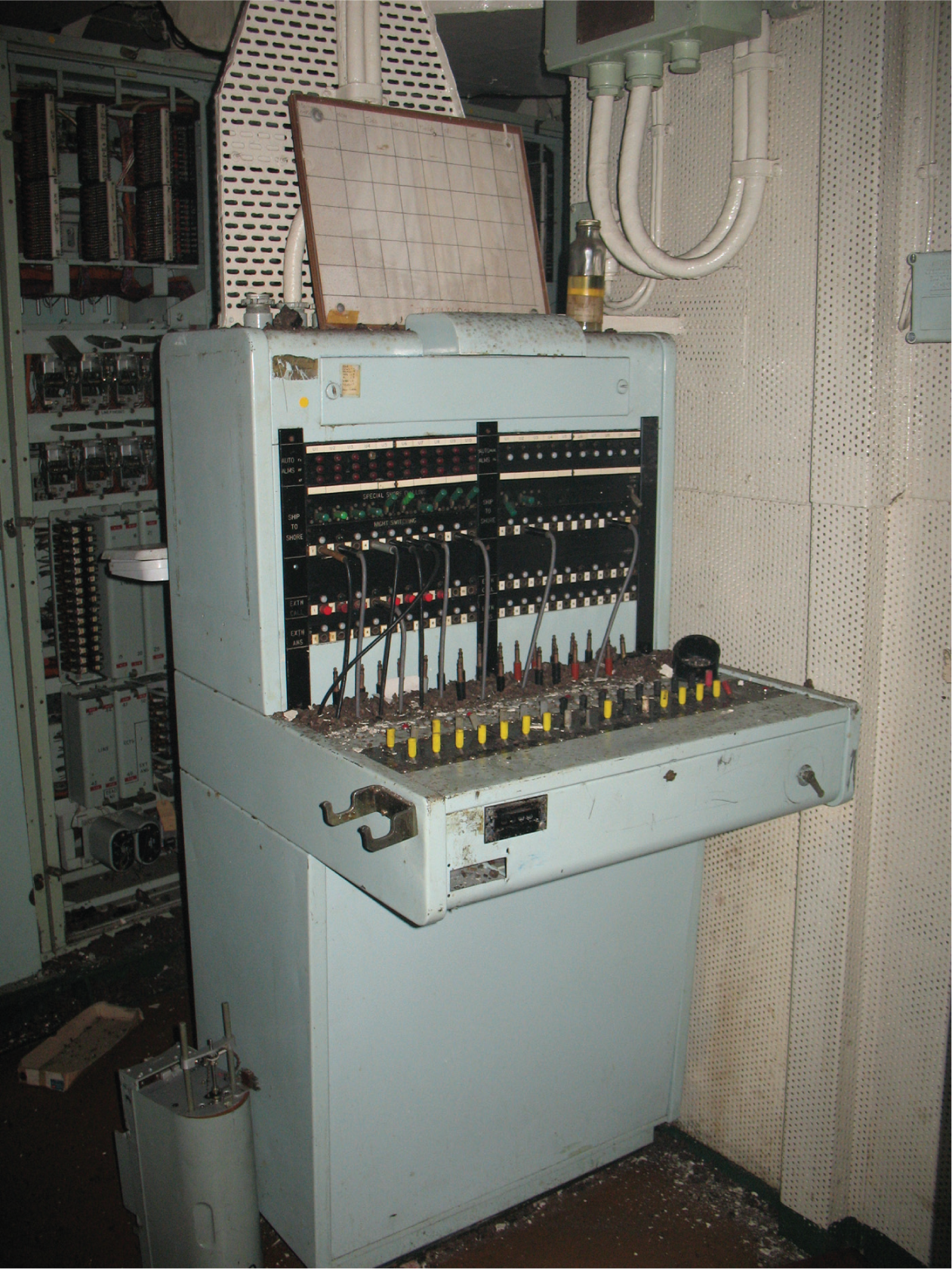
HMS Intrepid telephone exchange. © Photograph: Helen Watkins.
Rather more muted, but in the same register, is the following extract from the focus group discussion:
I don’t think my wife would like a big bulkhead! ‘Just bought a security gate’!!
You know the memorabilia that you’ve taken, where did you put it when you got back home?
I’ve only got a couple; one was a door sign – ‘Catering Coordinator’, and that’s going on a shelf quite literally where my globes are. Because, the first thing my wife said to me was ‘And where’s that going to go??!’ ‘Here!!’
Acquiring the personal souvenir from this ship, then, is one thing, accommodating it within the domestic setting of the family home and civilian life another. Thus, the one place the sign saying ‘Catering Coordinator’, with its connotations of unglamorous military domesticities, is not allowed is the kitchen. More generally, the fungibility of some artefacts renders them disruptive to their new locations, as do their ‘untamed’ memories. Indeed, unlike their First World War counterparts, these mementos of military material culture are admitted only into backstage areas, to storage areas of the home such as sheds and garages, and to rooms that are the preserve of the men themselves. Like medals, they are difficult items to admit into civilian life. At best, ambivalent accommodations within a familial home, we suggest that they are so not just because their military, functional aesthetic is discordant with prevailing home aesthetics, but because these objects are redolent with nostalgia and loss, symbolic of the home’s continued potential exposure to military sacrifice, and an all too tangible reminder (for these women) of other attachments and identifications outside the current civilian realm (Higate and Cameron, 2004).
Whilst much memorabilia acquisition was conducted personally, the stripping of potential sentimental value from the ship also precipitated a few acts of collective purchase by the Association. Nowhere is this more evident than in the case of one of the ship’s funnel badges (Figure 8).
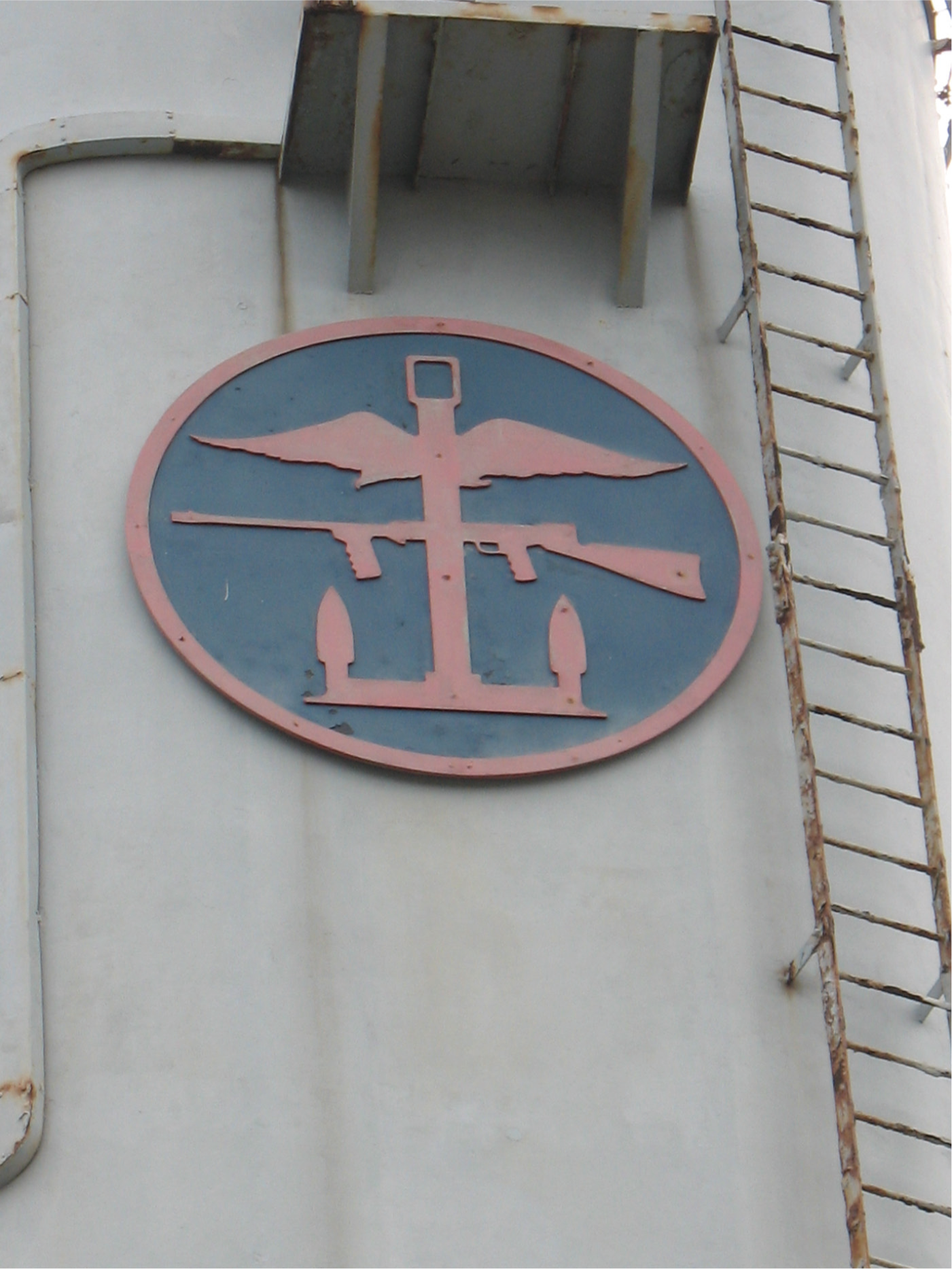
HMS Intrepid port side funnel badge. © Photograph: Helen Watkins.
This purchase was underpinned by a narrative whereby the Association members regarded themselves as the rightful collective owners of this highly symbolic object, countering their potential ownership to an imagined civilian, and by implication, undeserving, collector of military memorabilia (Gronberg, 1999). 7 Veterans’ associations, then, are able to forge a social economy of the fragments, grounded in collective rights that turn on identification, belonging and prior habitation, and they assert this within a market economy of the fragments located in property rights and the equivalence of exchange, even whilst having to operate within the market economy to secure an object that they regard as rightfully ‘theirs’. Their collective action reveals a hierarchy of souvenir value in the memorabilia emanating from the vessel, demarcated by the separation between the collective purchase and individual purchases and marked by the distinction between different orders of souvenirs. All the souvenirs salvaged are indexically linked to the ship, but those reinforced by bearing the ship’s name, or an identifiable symbol, on them (an inscribed provenance) stand above those that merely have an orally narrated provenance.
The process of exchange through eBay is a means to constitute and realize souvenir value, to memorialize this ship. It does so in ways that utilize the fragments acquired to own the memory of that which is being destroyed. It is important to acknowledge, however, that this was going on against the backdrop of the vessel’s physical break-up and gradual, inexorable disappearance (Figure 9, a–c).
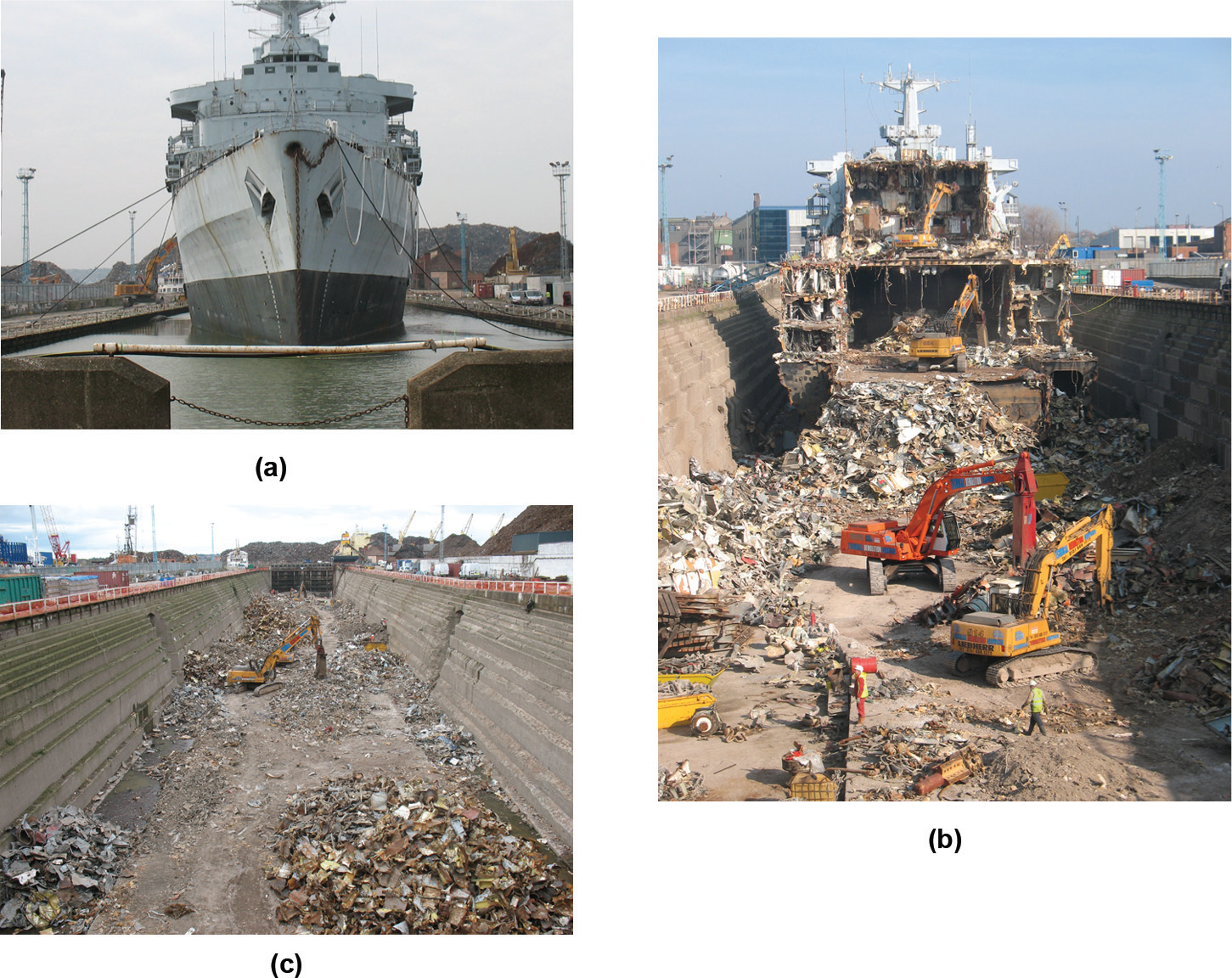
HMS Intrepid – October 2008. © Photograph: Helen Watkins.
There is little doubt that the posting of regular images of this brutal process on the Association’s web pages by some members was something that many found difficult to engage with yet unable to resist looking at. These feelings coalesced around the moment at which the ship disappeared as a recognizable form and transformed into piles of debris and scrap metal on the dry dock floor. The posts at this juncture are instructive:
Doesn’t get any easier looking at her being broken up. Won’t be long till all that’s left is our photos. Now that is sad, sad, SAD. To see that pile of junk sitting there where a fine ship once stood is sickening. Sad, sad pictures. Such a great ship and now just a pile of scrap at the bottom of a dry dock. Fair brings tears to the eyes.
The visibility and visualizing of the process of destruction and disappearance renders Association members collective witnesses of ‘their ship’s’ mutation from ‘great’ to ‘junk’ and of its transformation from ship to debris. Sadness and tears are palpable emotions here. What we are looking at, then, is surely a death, and a death which, in its violence and futility (in the eyes of Association members), is being thought of at least partially through sacrifice.
Further confirmation of this reading is provided by subsequent endeavours around the funnel badge. Purchased initially as an active marker of the collective rights of a former crew in the object of the ship, the funnel badge began to morph through the process of destruction to suggest itself as an appropriate memorial object: a means to achieve transcendence. The difficulty facing the Association, though, was how to effect this socially and physically. Initially, the intent was to place this object in the National Memorial Arboretum. This was refused because ship memorialization on this site is reserved for vessels lost in conflict and/or which have sunk involving loss of human life. It does not extend to include decommissioned ships. The intent should be read not for its error – to anthropomorphize and to conflate ship death with human death – but through its error. In attempting to memorialize ‘their ship’ through constituting a memorial from the funnel badge, the Association, and its members, are attempting to achieve what all public acts of memorialization attempt, to reconcile themselves with loss (in this case, of ‘their ship’). At the same time, their acts disclose the unique status of the ship within naval culture. The fact that, at the time of writing this article, they had yet to effect this materialization is both an indication of the difficulties of memorializing the quasi-object and of the social difficulties that public acts of remembrance and reconciliation entail (King, 1999). This constitutes the third phase identified by our ethnographic fieldwork. The ship has disappeared and become ghostly; souvenirs have been salvaged; but this is a destruction that has not yet been forgotten. Rather, it remains a painful sacrifice and a violent, strangely unbecoming death.
Conclusions
Extending work on the material culture of war to acknowledge the social lives of military things, the connection of end-of-life military things to resource recovery regimes and the importance of platform technologies as cultural artefacts within military material culture all have implications. By way of conclusion we make five points.
First, and following from our emphasis on the social life beyond conflict of military objects, we highlight that they cannot be thought of as inevitably connected to war debris. Rather, like most commodities, they move between value regimes. Significant here is that, in order for them to move between value regimes, military objects need to be stripped of both their deadly and ‘sensitive’ capacities. Thus divested and de-militarized, military material culture flows through international second-hand markets much like discarded fashion. But stripping naval objects of their military hardware does not strip them of their naval meanings. This is poignantly evidenced by the attachments of former crew to ‘their ship’, which remains ‘their ship’. Even when both object and people are no longer naval and no longer serve, the relics mean that the bond persists.
Second, focusing on the extended social lives of military things allows us to elaborate on existing arguments regarding souvenirs and military material culture. Current work in the field positions souvenirs in relation to an anterior debris. The souvenir of the material culture of war is wrought, manufactured or collected from debris. In our work, the souvenir is salvaged from that which is about to disappear. Its affinities are more with salvage’s connection to iconoclasm/destruction (Forty, 1999; Küchler, 2002) than to recyclia.
This connects to a third point: the potency of military material culture for residue military masculinities. Artefacts, acts of souvenir salvage and memorialization constitute things and practices that matter for many ex-service personnel. That they do so is indicative of the workings of material culture more broadly, where ‘material culture shoulders the larger responsibility of our personal and collective memory … [and where] … the decay or destruction of these objects brings forgetfulness’ (Buchli and Lucas, 2001: 80). In material culture it is the souvenir of this world apart, of a lost communitas, that makes memory portable and which enables a distantiated community. But it also introduces fractured belonging into home spaces. Thus, souvenirs drawn from a military domestic are an ambivalent accommodation with the civilian domestic, demonstrating a broader point that the transition from military to civilian life is as difficult for objects as sociological work has shown that it is for people.
Fourth, much of the literature on the biography of things acknowledges, but does not dwell on, the importance of geographical displacement to the re-enchantment of things. The biography of things is co-produced by the geographical mobility of things. But, in the case discussed here, value regimes crumple, wrinkle and fold in the confines of a single site, where souvenir salvage and memorabilia rub up against violent destruction, resource recovery and waste remediation work. One result is to render the destructive work of disappearance highly visible and to constitute ex-naval personnel as collective witnesses to this process. The identification with, and attachment forged to, naval vessels as part of naval culture means that, in the context of ship destruction, practices of commemoration and memorialization are coloured by melancholy. Here, the contradiction of recycling as creative destruction and the souvenir as preservation coalesce in the souvenir as artefact; the souvenirs salvaged here are not only mementos of former and present community, but also memento mori – of loss and death, and fractured belonging. Further, the naval ship as quasi-object opens up the category of object death as an under-examined yet important facet of the social life of things. But unlike human and animal death, object sacrifice and death form a category that is rarely acknowledged within Western societies and consequently hard to mark and to materialize publicly as part of the material culture of death.
A fifth and final point is signalled by an observation of several ex-service personnel, that somehow – if we are to paraphrase – ‘razor blades do not become her’. Resource recovery and recycling more generally tend to be thought through the lens of re-enchantment (Hawkins, 2006). They are, so the argument goes, technologies and transformations that open up possible futures; that work to revalue discarded stuff and move stuff out of rubbish value. And yet these technologies are also levelling technologies that rest on materialist foundations. They insist on the equivalence of objects and their potential futures. So, HMS Intrepid may not just become razor blades but anything that steel can be fabricated into, as well as distributed across a potentially infinite range of such objects, of variable value. This is seen positively within resource recovery regimes. For these ex-service personnel, though, such an imagined future is a strangely unsettling thought. It is not too much to say that ‘Intrepid the object’ now haunts their razor blades when they look in the mirror each morning as they shave. A less mundane, but connected, point is that resource recovery regimes may release ghosts. The rise of secondary materials as a basis for object manufacture rests on the destruction of objects and, as with Marx’s coat (Stallybrass, 1998), the allied stripping of meaning from objects to release the materials. But objects like those that figure in this article persist long beyond their disappearance and may even enhance their potency through the manner of their disappearance. They suggest that, as with other acts of iconoclasm, certain destroyed objects may not be forgotten; that – through recycling – they have the capacity to haunt others, that might just be them, in another guise; and that haunting can work through reincarnation as well as the absent presence and, in a distributed sense, across object categories and not just in relation to specific sites and singular objects. Sometimes, then, contra Tim Ingold (2007), materials do not always win out over objects in the end. The death of great naval ships may well be one of those occasions.
Footnotes
1.
There is a popular commemorative culture of volunteer groups restoring and preserving artefacts, particularly those associated with masculinity. Military heritage restoration is also strongly connected to volunteer groups, often without an experiential connection to conflict or to combatants. In these cases, a sense of communitas connecting previously unconnected individuals is produced through the labour of restoration, practices of re-enactment and the detailed knowledge and know-how associated with artefacts (Crang, 1996; Hunt, 2004; Wallace, 2006). Civilian industrial and transport heritage, especially trains but also seafaring and maritime heritage, are disconnected from the contemporary military but they, too, foster communities by mixing volunteers and professionals. However, they focus on the restoration or recreation of celebrated artefacts, rather than the debris from their demise (Laurier, 1998).
2.
The ships that figure here are: USS Caloosahatchee, USS Canisteo, USS Canopus and HMS Intrepid. They were, respectively, a fleet oiler (whose role is to transport bulk petroleum to refuel ships at sea); a fleet oiler (the ‘sister ship’ to Caloosahatchee); a submarine tender for the Polaris fleet of US nuclear submarines; and an amphibious assault ship/landing platform dock. The selection of these ships was determined by their then presence in some of the breaking yards that figure in our ethnographic work on the ship-breaking industry.
3.
Given the size of their full crew complement and years of active service, membership figures of more than 10,000 would not be unreasonable estimates for all the ship associations in this article. Membership comprised predominantly former junior ratings, rather than officers. Although it is not possible to generalize from this, it is thought that this pattern is widespread. Current membership figures for the two associations are more than 630 for HMS Intrepid and more than 460 for USS Canopus. They provide further evidence for residue military masculinities.
4.
This article is based on 12 months of ethnographic work in a breaking yard in the UK and parallel research with two veterans’ associations (USS Canopus and HMS Intrepid). The latter involved: attendance at reunion events in San Diego, Liverpool and Birmingham; a recorded focus group discussion with core members of the HMS Intrepid Association; and virtual ethnography, drawing on postings and discussion threads on members’ areas of association websites. The data on which we draw include: camcorder and still photography, analysed in conjunction with field notes, recorded interviews and web page posts.
5.
Similar campaigns and emotions have been stirred recently around the scrapping of the aircraft carrier HMS Invincible. When it was mothballed, there was a campaign to ‘Bring Invincible Home’ to Barrow in Furness where it was built, and a proposal that at least one of the three carriers of its type be turned into a museum, whilst press reports circulated of bids to turn it into a floating school in Guangdong, China. However, the end was more in line with that of Intrepid. It was sold for scrap with The Daily Telegraph (8 January 2011) bemoaning ‘the ignominious end for a ship’ and The Daily Mail (29 November 2010) deploring its ‘sorry end’ with the ‘final indignity’ of an ‘eBay style online auction’ leading to it being sold to yards in Turkey for breaking up into ‘thousands of one metre square blocks of steel’ before being made into girders, chairs or ‘even razor blades’. On the day Invincible was towed out of Portsmouth, the local paper recorded George Birkett, aged 65, who served as a chief mechanic on the ship from 1980 to 1982, commenting: ‘It’s hard to imagine her being chewed up for scrap. It’s going to be a sad day.’ On the shore were her former captain from the Falklands and a Royal British Legion standard bearer amidst a crowd of 50, defying the Ministry of Defence’s official line that there was ‘no point’ in any ceremony. Similar sentiments were aired in relation to the slating for scrapping of HMS Ark Royal (The Guardian, 4 December 2010).

7.
Similar views were expressed in relation to the ship’s bell, although this was purchased by a private collector.
Acknowledgements
This research was funded by the Economic and Social Research Council under the Waste of the World programme (RES 000230007). Thanks to members of the HMS Intrepid Association and the USS Canopus Association, and to Lucy Norris and two anonymous referees for their comments on an earlier version of the paper. The usual disclaimers apply.