







Abstract
At the end of 2010, the British Museum unveiled the final artefact in their exhibition ‘A History of the World in 100 Objects’: a portable solar-powered lamp designed for and sold to people living without access to mains electricity in Africa and Asia. Solar-powered lights have become iconic objects of social entrepreneurship in Africa and Asia and this article explores the work involved in producing them as humanitarian goods. Following the 100th object from its conception in a Stanford University classroom to points of sale and use in rural India, the article explores how it has been made to materialise both an ethic of care and an ethic of commercial interest. Drawing from traditions in the social study of technology and the conceptual vocabulary of Michel Callon, the author argues that the significance of objects like the ultra-affordable solar lamp lies in their capacity to make and define markets at the ‘bottom of the pyramid’.
The 100th object
At the end of 2010, the British Museum and the BBC unveiled the final artefact in their joint exhibition and radio documentary series, ‘A History of the World in 100 Objects’. The 100th object, they announced with much fanfare, was a solar-powered lamp and charger designed specifically for people living without access to mains electricity in Africa and Asia (see Figure 1). The director of the British museum, Neil MacGregor, told the BBC that they wanted to choose an object that ‘could only have been made in our times and that is changing lives around the world now’. ‘One object alone cannot definitively sum up the world today’, he said ‘but the aspiration to make clean, affordable power available to the most remote communities through the natural power of the sun is a story worthy of this generation.’
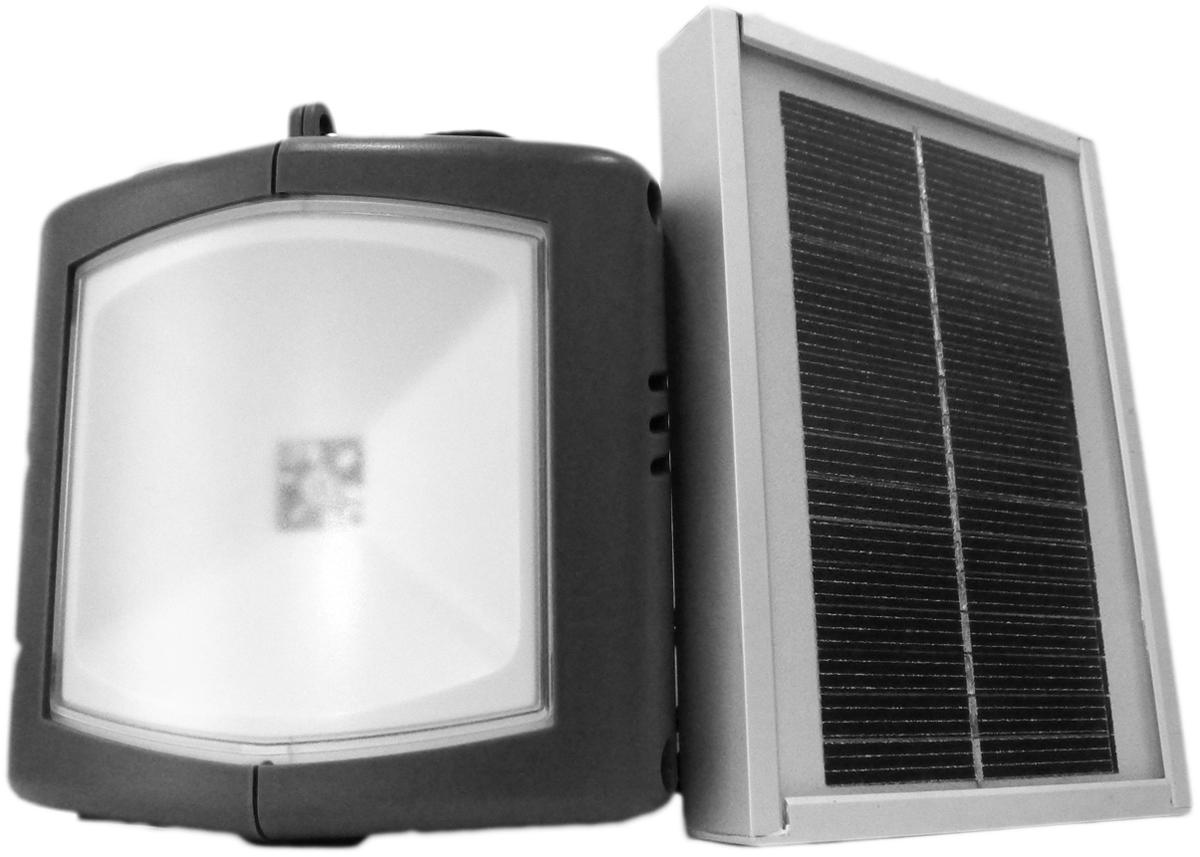
The 100th object: Nova S200 Lantern and Solar Photovoltaic Panel. © Photograph: Jamie Cross.
This well-planned and wide-ranging exhibition was designed to attract visitors to the British Museum at minimum cost by resurrecting a series of artefacts from its permanent collection and weaving them into a grand narrative of world history. To the museum’s director, this was a narrative of humankind’s technological ingenuity that began with the first object, a 2-million-year old basalt chopping-tool from Olduvai Gorge in Tanzania. The 100th object was to be a new acquisition for the museum’s permanent collection. Members of the public were invited to propose objects but the director himself selected and eventually decided upon the Solar-powered lantern (Jones, 2011).
In 2011, the 100th object could be seen on display in the Wellcome Trust Gallery, placed in a tall glass cabinet and accompanied by a piece of descriptive text. Visitors were informed that the lamp was manufactured in Shenzhen, Guandong Province, China, using a range of materials that have become widely available only since the 1980s, including plastics, rechargeable batteries, light-emitting diodes (LEDs) and the silicon-based photovoltaic cell; they were told that the lamp is designed for sale to people across the world living without electricity, with support from microfinance organisations that make the purchase feasible, and that it provides a cleaner, cheaper and more efficient alternative to kerosene, allowing people to study, work and socialise outside daylight hours, and vastly improving the quality of lives.
In a best-selling book to accompany the exhibition, MacGregor (2011: 655) gave a fuller description of the 100th object. ’The 100th object, he wrote:
is in fact a little kit, consisting of a plastic light containing a rechargeable six-volt battery and a separate, small photovoltaic panel. The lamp has a handle and is about the size of a large coffee mug, and the solar panel looks like a smallish silver photo frame – the sort you see on a desk or a bedside table. When the solar panel is exposed to eight hours of bright sun, the lamp can provide up to 100 hours of even, white light. At its strongest it can illuminate an entire room – enough to allow a family with no electricity to live in a quite new way. The whole kit sells [in India] for about 2,250 rupees ($45).
In the publications and visitor guides produced to accompany the ‘History of the World in 100 Objects’ exhibition, considerable care is taken not to identify the 100th object. The object is always referred to in non-specific terms and always photographed without distinguishing marks or signs. The 100th object, we are asked to accept, is not just one but many. It is presented as a generic technology: a solar light with qualities that make it the same or comparable to other kinds of solar-powered lighting devices designed for poor users without access to electricity and an object that can stand as representative of a growing niche of technologies that are being designed as solutions to problems of poverty.
Yet the light on display in the British Museum is not a generic technological artefact but a very specific object. It is also known as the Nova S200, one of three solar lighting models designed and patented by a for-profit California-based company called ‘d.light design’. For those who chose to investigate, this specificity is clearly marked on the surface of the object itself. On one side of the lamp’s plastic casing is the manufacturer’s brand name and corporate logo, comprising the letters ‘d.light’ in a white font beneath a simple, curving orange line that seems intended to invoke a rising sun, and stuck onto the other side is a black and white barcode with a universal product identification number. The 100th object, these marks remind us, is not just any solar-powered light but a brand name commodity, and its particular assemblage of qualities are claimed as the intellectual property of a small group of people.
Since the 1980s, social studies of science and technology have urged us to see an object like this as more than an assemblage of microelectronic components, and to engage with the complex array of knowledge practices, social relationships and meanings that enable the Nova S200 to convert sunlight into electrical energy and achieve its range of purported effects. Twentieth-century lighting technologies occupy a special place in this literature with histories of electricity networks (Hughes, 1983), the fluorescent tube light (Bijker, 1987, 1997, 2009) and solar home systems built in France for use in rural West Africa (Akrich, 1994) pivotal in establishing a social constructivist approach to technical things. As Madeleine Akrich put it, a fuller description of the 100th object might be a ‘de-scription’, that accounts for the assumptions, aspirations and values that are inscribed in its materials by designers and which its diverse users must negotiate (pp. 208–209).
Building on the legacy of this work, in this article I follow the 100th object from its conception in a Stanford University classroom to points of sale and use in rural India. In doing so, I argue that this particular object is interesting and important because it successfully assembles a wide array of concerns and interests, politics, moralities and ethics. The Nova S200 belongs to a distinct category of global technologies that, by design, express a concern for distant others. They are what Peter Redfield (2012) has called ‘life technologies’ or ‘humanitarian goods’. Yet as I emphasise here, these things are also commodities. They are mass produced technologies that are designed for mass consumption and built to deliver value for shareholders. The removal of all commercial signifiers from the 100th object on display in the British Museum suggests an attempt by the exhibition’s curators to distil its ethical qualities from its economic qualities and to produce a purified technological artefact. Yet the power of humanitarian goods, I will argue here, lies precisely in its power to materialise both an ethic of humanitarianism and an ethic of market exchange.
In charting the brief history of the Nova S200, I reflect on the meanings and relationships that are inscribed in a generation of things that are being designed for and sold to people living in conditions of global poverty. What is particularly important about these objects is that they conflate economic with ethical value and in this article I explore the work involved in constructing the 100th object as a health-giving, life-changing and profit-making light. To this end, I draw upon the work of Michel Callon (Callon et al., 2002; Callon and Calıskan, 2009) whose writings have challenged scholars to reconsider the materiality of markets. To date, Callon’s work has been invoked to examine Euro-American markets for consumer goods – cars, electricity and food (Callon et al., 2007) – as well as global markets for complex financial products (Mackenzie, 2009), commodities (Calıskan, 2010; Foster 2008a) and carbon (Mackenzie, 2008). However, as I show, his conceptual vocabulary is of immediate relevance and use in theorizing emerging markets for technologies like the portable solar lantern at what is increasingly called the ‘bottom of the global economic pyramid’ (Prahalad, 2009).
Qualification and the humanitarian good
In the 1970s and 1980s, the first attempts to build photovoltaic lighting systems for people living off the grid in Africa and Asia excluded the end user almost entirely from the design process. In her classic essay, Madeleine Akrich (1994) described how a group of French engineers built a photovoltaic solar lighting kit for use in rural Senegal. As she explained, their initiative was born out of a desire by the French government to promote the use of renewable energy and to help the French photovoltaic industry create a market for its products. In the design process she described the identity, personality, knowledge and practices of users was deemed to be irrelevant. As a result, the final kit represented little more than a set of technically delegated prescriptions, or a script, that was addressed from the designer to the users but which ultimately treated them as an instrument for building closer relationships to state funding agencies and the solar industry.
Today, as a corporate vanguard of large multinationals and small-scale entrepreneurs explore new ways of meeting the energy needs of poor people in un-electrified Africa and South Asia, we can bear witness to what Nigel Thrift (2007: 29–55) has called extraordinary invention and innovation in processes of capitalist accumulation. In these locations we can find new attempts to capture and shape the worlds into which solar lighting technologies are inserted, through alliances with micro-finance, credit and lending organisations (Roy, 2012). And we can find categories of consumption and production being reconfigured, so that the activity of consuming or using commodities becomes a process or practice through which new commodities are created (Foster, 2007, 2008a, 2008b). Framed by the influential writings of management scholar CK Prahalad (see Elyachar, 2012; Prahalad, 2009) poor users are being re-imagined as active, agentive consumers, incorporated as collaborators or co-producers into the design process and given an affective role in inspiring the creative responses or moral passions of inventors, designers and entrepreneurs.
In many respects, the 100th object is typical of a new category of ‘humanitarian goods’ (Redfield, 2012). Like portable filtration systems for people without access to clean drinking water, nutrition supplements for the malnourished and biodegradable bags for the disposal of human waste, d.light’s Nova S200 is an object that has been built as a response to the failures of states, markets and civil society to care for or safeguard the health of their populations and which expresses a humanitarian sensibility or an ethic of ‘concern for distant others’ (p. 180). Moreover, as an object that is powered by solar energy and that has been built as a renewable alternative to carbon energy infrastructures, the Nova S200 also expresses an ecological ambition and green conscience. 1 Like any other object, however, these humanitarian goods have vibrant social lives, careers or biographies (Appadurai, 1988, 2006), with different meanings and values attached to them as they move between contexts of conception and design, to contexts of use, consumption or display. A patented, brand-name electronic good like the Nova S200 might express an ethic of care as it moves or circulates but it is also designed to express an ethic of commercial or economic interest. ‘For-profit’ humanitarian goods are not only designed to do good, they are also designed to do well by generating economic value for their investors and shareholders.
In this sense, we might describe humanitarian goods as what Michel Callon has called ‘agencements’ (Calıskan and Callon, 2009). That is, as socio-technical assemblages with economic agency (Mackenzie 2009: 30–73). As Callon et al. (2002) have reminded us, the work of making and attaching meaning to things has enormous economic significance. If the life or career of a product is one of constant change, they argue, then we would do well to pay particular attention to the enormous effort that companies devote to creating meaning for and positioning the products that they design, produce, distribute and sell in relation to others. This is to see that commodities are implicitly mutable and that the definition of their properties or qualities is ‘always at stake’ and it is to recognise the considerable economic value that can be extracted from the meanings that stick to, cohere or stabilise around a particular object (see Foster 2007, 2008a, 2008b).
The social life of a technology like the 100th object can also be understood as an endless process of negotiation and debate over its meanings, characteristics and attributes. Like other kinds of goods that are designed as solutions to the challenges of global poverty, the success of the Nova S200 hangs on its ability to conflate ethical concerns and commercial interests (Cross and Street, 2009). If entrepreneurs are to derive any kind of commercial or economic value from the design of life-giving technologies that provide ‘minimalist forms of care’ (Redfield, 2012) for people in the absence of a state, they must also invest considerable time and effort to the production and attachment of ‘life-giving meanings’ to the objects themselves.
In Callon’s terms, we might say that this process is one of ‘qualification’ and ‘requalification’, as the list of qualities attached to humanitarian goods is repeatedly altered and modified. These qualities may include, as they do in regard to the Nova S200, battery life, recharge speed, energy efficiency and light quality (measured in lumens, units of illumination) that might be said to be directly contained within the object itself. But the list of qualities also extends beyond the object itself, to contexts of use or consumption. It also includes an array of life-giving qualities – like the capacity of a solar-powered lamp to serve as a replacement for kerosene, to improve health, educational outcomes, livelihoods, and to reduce C02 emissions. At particular moments, as Callon argues, the negotiations and debates over this list of qualities have stabilized, becoming temporarily closed or fixed. These are moments of stability or stasis in the life history of a product – moments of coherence or agreement when ‘everything hangs together’. These are the moments at which the product is transformed into the humanitarian good.
The 100th object represents a particular moment in the history or social life of applications for photovoltaic solar technology. Over the past 20 years, attempts to increase access to energy in contexts of international development have shifted away from the extension of large-scale public infrastructure for electricity towards support for small-scale renewable energy technologies that generate electricity off the grid. During the 1980s and 1990s, structural adjustment policies rendered the building or expansion of electricity infrastructures unviable and, in many parts of the developing world, state energy utilities were restructured or privatised, paving the way for corporate monopolies. Meanwhile, post-industrial, green visions of future energy infrastructures turned large-scale grids into ecological problems and championed decentralised or micro-level energy infrastructures. By the mid 1990s, however, there was an increased recognition that access to energy was critical for many development indicators. Against this backdrop, international financial institutions led by the World Bank and the International Monetary Fund began to fund projects and programmes aimed at creating consumer markets for renewable energy technologies (Jacobson, 2007; Miller, 2009).
At the end of the 1990s, these trends in international development assistance coincided with a transformation of the global solar photovoltaic industry. New developments in the production and manufacturing of photovoltaic materials and the diversification of Taiwanese and Japanese micro-electronic companies into the sector, saw a dramatic fall in the cost and a dramatic rise in the efficiency of solar cells or modules. As a small-scale technology that could provide decentralised electrical services to individual households or even single appliances, the photovoltaic solar cell proved enormously compatible with neoliberal policies that emphasised the role of the market in the delivery of energy services to people living off the grid (Jacobson, 2007: 145–146).
According to the International Energy Agency, there are an estimated 1.4 billion people living without access to electricity, many of whom use candles or kerosene lanterns to produce light at night. Two decades ago, it was difficult to imagine a solution to the challenges of improving access to electricity beyond the construction extension of large-scale national energy grids. Today, however, a consensus has emerged around a market-based approach to energy access. In Africa and South Asia, a diverse array of international development agencies and NGOs, multinational corporations, small social enterprises and cooperatives can be found championing the sale of low-cost solar home systems and portable solar-powered lighting applications as technological fixes to the health, education and wellbeing of poor people. The emergence of ‘bottom of the pyramid markets’ (Prahalad, 2009) for solar technology has been celebrated as decentralising and democratising because it is seen to take the ability to generate power out of the hands of state utilities and private monopolies and put it into the hands of individual consumers. ‘Power to the people’, as The Economist magazine (2010) put it, in an article about solar energy and development, alongside a picture of a Tanzanian man using a sewing machine by the light of the Nova S200.
In what follows then, I trace the economy of qualities through different design processes, exploring how the 100th object is constructed as a humanitarian good. The portrait I present has been built up from a range of sources – including media interviews, films, writings and documents produced by d.light design that are in the public domain, as well as my own fieldwork with social entrepreneurs in the energy sector and d.light’s partner organisations in India. In doing so, I demonstrate what critics of Callon’s work have argued (Fine, 2003) – that his focus on the marketing of goods to individual mass consumers has ignored the meaning making that is directed towards other kinds of consumers. As I show, the attachment of qualities to the Nova S200 has never simply been oriented towards its intended or imagined end users, the un-electrified poor. Rather, the attachment of qualities has also been oriented by those institutions who have bought into the light as a profitable and worthy business venture. These include the venture capital funds and social investment companies whose early investment in the object was a critical stage in its development; the aid agencies, charities and development organisations whose procurement policies make them turn the Nova S200 into a potentially lucrative business; and the individual business people, journalists, award judges and Euro-American publics whose recognition brings credibility and approval.
A lamp fuelled by profit
The Nova S200 was conceived by a group of students taking the graduate course ‘Entrepreneurial Design for Extreme Affordability’ at Stanford University’s Hasso Plattner Institute of Design (‘d.school’). Billed as a programme for people who believe in using the power of business to help the world’s poor, the course is rooted in the work of management scholar CK Prahalad and his influential arguments are its guiding philosophy. Students taking the course attend lectures on the fundamentals of design and on the economic, cultural and technological considerations of designing for people in developing world contexts. They are taught to see poor people in developing countries as consumers, with unmet needs, rather than recipients of aid or charity. And they are taught to see that carefully designed products that meet their needs can be sold to them in ways that are both affordable and profitable.
At the heart of the course is a group project in which the class is divided into multidisciplinary teams of engineering and business students, and tasked with developing a viable product and business plan that offers a solution to an identifiable problem facing people who live in developing countries. The spaces in which these projects are brought to life are far from the contexts they are intended for. Classes take place in colourful purpose-built rooms, with the benefit of coaches and breakout meeting spaces, littered with laptops. A profile of the course by CNN described a classroom space that looked like a high school workshop crossed with the lobby of the United Nations, with whiteboards covered with scenes of village life and subsistence farming from Africa, South and Southeast Asia (Copeland, 2009).
As they develop their project, the teams are paired up with a partner institution operating in Ethiopia, Rwanda, India, Nepal or Burma and they make an extended visit to these countries in order to test their ideas on potential customers. At the end of their assignment, they are expected to have developed a prototype and comprehensive business model. Students are encouraged to commercialise their plans, and the programme has ‘incubated’ a number of new companies. Their business strategies all hinge on the same premise: that affordable technologies for the poor can be financed by sales rather than by subsidies, charity or philanthropy.
In 2005, one of the teams brought together two MBA students (Sam Goldman and Ned Tozun) and three mechanical engineers (Erica Estrada, Gabriel Risk, and Xianyi Wu), who collaborated on designing an affordable lighting product that would offer an alternative to kerosene lanterns for people living in places without electricity. Over the following year, the team developed rough prototypes of a fast-charging, solar-powered LED lamp, which they called the ‘Forever-Bright’. And they took these prototypes on an exploratory field trip to Burma, through links to International Development Enterprises, a humanitarian organisation based in the USA.
The five members of the Forever-Bright team graduated from the class in 2006 and for the next few months they pursued different projects. But later that year, they reunited and agreed to work on a business plan for a company called ‘d.light design’ that would commercialize their classroom prototype as an LED-based source of light to replace kerosene in the developing world. In order to develop their prototype further, conduct market research and finalise a design, they needed capital. Each of the five put $1200 of their own money towards a business plan, and they added to this with a $1000 donation from a local church group and $1000 from the Stanford Business School. Without any independent financial resources or collateral, however, they could not convince any bank to lend them money and so were forced to enter a highly competitive search for venture capital.
In early 2007, Ned Tozun entered Stanford’s annual Entrepreneur Idol competition with a 60-second pitch for a solar-powered light for people without electricity. The competition was judged by the San Jose-based Technology Blog ‘VentureBeat’ and when they announced the results online, d.light design had won the $2000 first prize. The outcome caused consternation amongst those who had been awaiting the result. VentureBeat’s readers noted that there was nothing new about LED lighting products aimed at users in the developing world and they posted links on its blog to other products that had long since claimed to do the same thing as d.light’s (Marshall, 2006). These included the ‘Mightylight’, a waterproof, shockproof, battery-powered LED light, that was developed in 2003 by another team of Stanford University students, and the Tukimara or kerosene killer, an LED-based lighting system designed to be powered by renewable energy sources that was developed in Kathmandu by a team of Nepali engineers with support from the Swedish International Development Agency.
In response to the criticism, Ned’s co-founder Sam Goldman entered the fray and posted a reply to critics on the blog’s online forum. He was at pains to distinguish his team’s solar lamp from other apparently similar products and he argued that it was their commitment to a for-profit business model that set them apart. ‘This is not a new problem’, he wrote in 2009, ‘but we think our solutions are radical because for the first time they will be priced at a point where individuals in emerging markets can afford them without subsidies or charity, with a payback period of about three months.’
Over the following months, the team reiterated this argument to prospective investors. For a solar light to be ethically viable, they said, it had to be commercially viable and what made their solar lamps different from those being produced by other companies was that it could ‘do good’ by paying for itself. Other companies were not able to build and sell solar lights on a large scale, they argued, because they were crippled by limited funding or were heavily dependent on government subsidies and grants from aid agencies and NGOs. In contrast, they promised rapid growth and sales as well as significant returns for investors. Their strategy was to combine a high-volume, low-cost manufacturing operation in China with a distribution and sales strategy in South Asia and East Africa that operated through close alliances with NGOs and microfinance organisations, and an additional revenue stream that involved participation in a UN-backed carbon trading scheme. It was a strategy, they told investors, that could improve lives and make money. ‘We could have done it as a non-profit over a hundred years’, Sam later told journalists, ‘but if we wanted to do it in five or ten years, then we believed it needed to be fuelled by profit’ (Alboher, 2009).
If the idea for a LED-based solar-powered light was not particularly original, d.light’s ability to secure support revealed the importance of social networks for capitalisation and marketing. The company’s success was to hinge on its connections to place. The team leveraged their connections to California, adding symbolic value to their nascent brand by pitching their solar-powered lamp as a ‘Silicon Valley Technology’ and by advertising their company as a ‘Silicon Valley Start-Up’ in ways that made associations with and drew upon the success of other technology ventures. Even more important was their ability to mobilise the social network that connected Stanford University to global financial institutions. Business school alumni networks are an integral part of what graduates pay for when they sign up to take a degree and students are taught to see these connections in much the same way as Pierre Bourdieu did, as institutionalised relationships of mutual acquaintance and recognition that accrue to the individual as a potential resource and which can be converted, under certain conditions, into economic capital (Bourdieu and Wacquant, 1992: 119). As one social investment analyst in India explained:
There are companies that have been selling the same kind of product as d.light using pretty much the same kind of business strategy, and they haven’t got anywhere near the same kind of exposure that they got … but d.light have been able to tap people who know them because they had been to the same place and because they speak the same language.
A light that touches people deeply
On 18 May 2007 in California, the team incorporated under the name ‘d.light design’. ‘Our goal is simple’, they wrote in the new company’s mission statement: ‘to eradicate kerosene from earth. To do this we will become the market leader in delivering safe and affordable lighting solutions to over 1.6 billion people who currently do not have access to electricity.’ Their first steps were to register d.light as a trade-mark and to file a patent for a piece of low-cost circuitry that allows a sealed lead acid battery to be charged over a 4–5-hour period rather than a 20-hour period. The company’s founders saw this brand name and the patent as vital assets that would, as an early business plan acknowledged, increase its net worth in any future acquisition. Over the following year, however, it was the company’s ability to touch a wider sensory register, in ways that made their solar light more intimate and intuitive than others, that was to become their biggest asset.
In 2007, the new company produced two short films to publicise the Nova S200 and attract attention from potential investors. The difference between them offers a vivid illustration of the way that the company began to appeal to the emotions and feelings of investors, in ways calculated to make their product stand out from others. The first was filmed as a submission for the ‘AlwaysOn Clean Technology Competition’ run by Vator TV, a California-based website for entrepreneurs. The film is shot in a workshop space, where d.light design CEO Sam Goldman stands at a bench next to component parts, plastic cases and tools. In the first half of the film, he picks up a Nova S200 prototype and describes its physical, material attributes, its battery length, its brightness and its charging time. In the second half of the film, he lists the range of potential benefits that this light could have for users, emphasizing that it can help people to study and work at night, cleanly and safely. d.light’s film won the competition’s first prize and one of the company’s first early turning points came soon after, when the team won a high-profile venture capital competition, beating 14 other teams of entrepreneurs in the Draper Fisher Jurvetson Venture Challenge to secure $250,000 in venture capital.
The second film was a more carefully produced affair and was posted on Social Edge, a networking website for social entrepreneurs to publicise their activities by adding updates and news. In the film, Sam is recorded against a purple backdrop, speaking directly to the viewer and describing how the d.light Nova S200 has its origins in his personal experience as a young Peace Corp Volunteer in Benin, West Africa. He describes the everyday challenges caused by kerosene and diesel-powered lighting in the small, un-electrified village of Ginaguru, 25 kilometres from the border with Nigeria, where he spent four years. He recounts one event in particular, a horrific accident.
One day I returned from a trip … and I went to visit my neighbour, the director of a local primary school, and found that his son had been completely burned from head to toe. It had been a kerosene fire and he spent basically the next three months lying down, unable to move. This just lodged in my head and I started researching kerosene and learning that millions of people are dying due to it.
The problems facing the residents of Ginaguru, however, also illustrated the importance of electric lighting for village social life. In the film, Sam goes on to describe a late-night wedding ceremony in which a diesel generator hired to run the village’s fluorescent lights broke down.
There was sort of this hush for a moment and all the lights went out. So I pulled out this little tiny headlamp, it was in the palm of my hand, it runs on two double AA batteries and I turned it on, it lit up the entire area, the dancing started up again and basically the wedding continued. And I had this ‘Aha moment’ when I realised that this little thing that I had that only cost a couple of dollars could effectively replace kerosene which is burning and maiming children all over the world.
This film proved enormously successful. Sam’s personal narrative perfectly captured the list of qualities that d.light design were striving to attach to their flagship product: its social or humanitarian ethos as well as its commercial viability, and the company did so by appealing not just to the business interests of potential investors but also to their sentiments. In this way, they invested the company’s brand name and its light with new authority, credibility, legitimacy and value. By the second half of 2007, the company had secured US$1.5 million from a small group of angel investors. In 2008, they secured a further US$4.5 million from the sale of stock options in the company, enough to finance a full-scale rollout of the Nova S200 lamp. Their two largest investors were Nexus India, India’s leading venture capital fund, and the Acumen Fund, a US-based international venture capital fund that specializes in social enterprise financing. Other investors included Draper Fisher Jurvetson, Garage Technology Ventures, Gray Matters Capital, and the venture capital arm of one of India’s largest industrial houses, the Mahindra Group.
The key to this success was the company’s ability to condense the ethical and commercial value of their light into a strong and moving story that constituted an affective grip for their product. One of India’s regional managers for the Acumen Fund, one of d.light’s largest investors, explained how important storytelling was to their investment decisions. ‘At the end of the day’, she said ‘it’s powerful stories that count. It’s the sharp, structured story that we will lean towards. It’s how they tell stories not who tells them.’ Investment analysts in India’s energy sector put d.light’s success down to their story. ‘Other companies have been selling solar lights for several years’, one fund manager told me, ‘but they never had as good a story as Sam Goldman and d.light.’
Sam’s story reinforced the meaning of the light for the company’s burgeoning staff and employees as well as for budding social entrepreneurs. One of d.light’s own managers, a young woman with an MBA from a prestigious US university captured its affectiveness:
That video … the one where Sam talks about his ‘aha’ moment … is one of the most powerful statements of the company. He’s really worked up and emotional and you are really there with him, you are really carried with it … Without this story we would have been no one. No one! In the California Bay area this company has got an amazing name. Everybody’s heard the story of d.light. It’s the story of a social enterprise that will eradicate kerosene. And it’s a story that touches people deeply, even if they’ve never been to the developing world and even if they’ve never seen a kerosene lamp.
A light in which users have the final say
The third way in which d.light design has sought to differentiate the particular qualities of its solar light from others is through its claims to a participatory design process, or a commitment to co-production. Their research and design activities are deployed in ways that allow the company to claim its products are the outcome of a participatory process, that their solar lights do more than materialize an in-depth knowledge of its users but that they have been, in some sense, collaboratively designed, or even ‘co-produced’. Yet the ability of users to participate in this design process remained carefully managed and prescribed.
At Stanford, d.light’s original team members were immersed in a school of ‘user-centred design’ (Norman, 2002) and they were trained to focus on the needs and desires of end users at each point of the design process. As one of the company’s founding members, Erica Estrada, once explained, the team spent a long time thinking about their potential users as people with tastes and desires and sensory relationships to things. At the beginning of the design process, they invested considerable energy on imagining the end users they were designing for. ‘It was actually really hard to work on a light for somebody that doesn’t have access to electricity when you’re surrounded by electricity’, she told an interviewer. ‘And so we did a lot of things to immerse ourselves here in the US. A lot of times me and my team would say “OK, tonight let’s just all go home and we’ll study by candlelight, cook by candle-light, just to see what it was like”.’
This role-playing extended even further as the team tried to imagine how different kinds of end users might relate to their prototypes. Trying to imagine how a typical shopkeeper in rural India might relate to their model, they built a mock-up storefront using tables and PVC sheeting in their Stanford classroom, and re-enacted shop scenes to test the prototype. ‘What was great was that we were not only able to see what the human interactions were like’, she told Stanford media students,
but also the technical specifications, what kind of shadows does a candle emit on the goods, what kind of shadows does a florescent light put onto all the products that are there. So that we in real time are able to figure out what kind of light we would want. (Stanford Journalism, 2011)
This kind of user-oriented research has become central to d.light’s corporate identity, with the company frequently referring to what it calls an ongoing ‘design conversation’ with users. ‘Our design team spends hundreds of hours in the field, interviewing, observing and sometimes even living the lifestyles of our customers’, Dorcas Cheng-Tozun, the company’s communications manager and partner of founder Ned, told journalists. ‘We also engage in an extensive prototyping process that engages the end-users at every step, getting their feedback on every single aspect of the product. Our customers have the final say in how our products are designed’ (Keane-Cowell, 2011).
In 2007, the company’s first injection of investor capital gave them enough money to manufacture a few thousand lights in China, to set up offices in Delhi, Shenzhen and Hong Kong, and to conduct further market research and product tests. In India, they hired a market research company, the Drishtree Foundation, to map rural markets for them in India. Over six months, the foundation’s researchers surveyed 360 households and 72 shop owners in 36 villages across 6 districts in the Indian states of Chhattisgarh, Orissa and Uttar Pradesh to collect data on lighting needs, market size and price points. During a follow-up study, they returned and provided prototypes of the Nova S200 lamp to six households in rural Uttar Pradesh, returning at intervals over several months to observe how the lights had been used and to record the experience for users.
When d.light’s first office in India was opened in Noida, a throbbing satellite city on the edge of Delhi, its executives found that this urban neighbourhood offered a testing ground much closer than the villages of rural India. ‘We are fortunate to have an easily accessible laboratory to test our products and understand potential customers – the streets around our office’, Sam Goldman wrote on his blog. ‘Our staff has certain favorite neighbors – our chaiwalla, who makes delicious ginger, cardamom and masala spiced chai for us several times a day … and, of course, our samosa lady, Mrs Gupta.’
Mrs Gupta soon became a test user whose responses to the company’s products could be observed and recorded at first hand. ‘Five weeks ago’, he wrote in 2008,
our product development team gave Mrs Gupta a Nova S150 – our flagship solar-powered lamp – and watched. She immediately replaced her expensive [kerosene fueled] Petromax lamp with the Nova, charging it from her stall during the day, and switching it on as evening descended … She reported a number of improvements – softer bright light, ability to hang it from the corner of her cart and get a better lighting angle to see what she was doing … The last interesting tidbit is that the Nova acts as her cart’s ‘headlight’ as she wheels it back to her home each night. She couldn’t keep the Petromax turned on while moving the cart for fear that it would spill, but with the Nova lighting her route she feels safer and less likely to get hit along the road.
As d.light design has worked to establish itself as an agent of social development, these ‘design conversations’ have become legitimating devices. Test users – like the members of the six households in Uttar Pradesh and Mrs Gupta – appear outside the context of design conversations, in the company’s blog, on its website, on its YouTube channel and in its publicity shots, advertising the company’s design ethic to an international clientele of development organisations and shareholders.
Two years later, the company had translated and packaged this experience into a formal research methodology; d.light’s market research partners in India began to champion urban testing scenarios as an ‘initial design method’ that could alleviate the financial and logistical challenges researchers may face in conducting tests in rural areas. ‘Close proximity to testers allows for more touches and tracking of user modification that might have gone unnoticed with less contact’, they wrote in a 2010 report on ‘urban energy labs’.
Some of the outcomes of the company’s market research activities have been visibly reflected in their flagship Nova S200 lamp. Over the past three years, feedback from users has led the company to add their most significant innovation, a charging facility for mobile telephones, and to replace a wrist strap with a fixed handle strap. In response to consumer feedback, they also streamlined the plastic moulding, changed the colour from blue to green and then to orange, and eventually introduced an entirely new model that is built to stand or hang like a kerosene lamp. But while d.light’s users may be invited to participate in a conversation about the design of their solar lighting kits, these conversations take place within clear parameters. The conversation does not extend beyond questions of aesthetics and functionality, form and appearance, colour and size, switch options and charging preferences. People are invited to judge and evaluate the different models they are presented with but are not invited to creatively refine, adapt, or attune the lights themselves. The light is designed to be used as it is built. The technical assembly of the Nova S200 lamp is locked – discouraging users from opening it, tinkering with it, mending it, or re-engineering it. Indeed, the lamp is built so that it can only be recharged with the small PV panel that it has been sold with; a design that is aimed specifically, the company has written, at ‘preventing misuse and guaranteeing users do not connect the lamp to another power source’.
Here, then, we can apprehend the value of design conversations or market research to companies in emerging markets, as a recursive process through which users help to create, construct and shape themselves as consumers – a process that ‘uncovers and appropriates’ the meanings of commodities for users, in order that they can be re-presented and reflected back to them (Foster, 2008a: 97). As a result of their design conversations, d.light design have begun to build solar lamps that are objects of desire, status and display as much as functional lighting technologies.
A light that goes the last mile
The design of d.light’s rural sales and distribution networks in rural India have proved to be just as important to the qualification of the Nova S200 as its physical design. In India, d.light design has a multi-pronged sales and distribution strategy. It sells its lamps through conventional outlets – nationwide shopping chains, online shopping portals that supply small-town retail stores – and it also sells lamps through rural distribution networks in partnership with community-based organisations, NGOs and micro-finance institutions. These rural retail distribution networks – modelled on those pioneered by companies like Avon (Dolan and Scott, 2009) – have become important sites of contemporary development practice. In mainstream policy discourse, they are framed as income-generating activities that support rural livelihoods and can empower small-scale entrepreneurs. For anthropologists, however, they are more significant as mechanisms through which the networks and social relationships of poor consumers are appropriated and subsumed into projects of market development (Elyachar, 2005, 2010, 2012). These networks have proved crucial to the success of the Nova S200. As Sam Goldman once wrote on his blog:
The real challenge is how to get a product the last mile, into tiny villages, and there’s lots of value in finding out who’s done it. There are lots of organisations that have: NGOs and corporates. So we can build on what other entrepreneurs know and have developed. We can piggy back off each other’s models.
In June 2008, d.light design launched its Nova S200 in India and Tanzania, and within a year they claimed to have sold tens of thousands of lamps by combining traditional retail sales with door-to-door rural distribution networks. In 2009, one of d.light design’s business development managers attended a conference for social entrepreneurs in the Indian city of Bangalore. She had spent a good portion of the past six months attending workshops and conferences like this one across India, and she had come to the Bangalore event to meet representatives from two organisations, Zameen Organics and the Mushroom Development Foundation, whose links to farmers across South India the company hoped to enlist to its sales and distribution network.
One of d.light’s longstanding distribution partners in India is Sakhi Retail (which translates as Friend Retail). Sakhi Retail is part of a group of enterprises, including a micro-finance fund (SSK), a training network and a health trust, that are controlled by a large Mumbai-based NGO – Swayam Shikshan Prayog. Sakhi retail was initially established through a partnership with BP, by which they would exclusively stock and distribute BP’s smokeless biofuel stove (the Oorja) and it counted management guru CK Prahalad among its board members. When their commitment to BP ended, the company merged with another SSP company called Access Distribution that had been coordinating door-to-door sales of locally procured grocery products in Mumbai, and it re-launched as a specialist in ‘low-cost retail distribution solutions’ for companies targeting rural consumers in central and southern India. The new company quickly attracted a portfolio of clients with products designed and built for low-income markets, amongst them d.light design’s portable solar lantern.
Today Sahki Retail recruits, trains and handles a network of rural sales women – known as Sakhis – across South India. Women who want to join must have been in formal education until the age of 14 or 15, be able to demonstrate some knowledge of basic arithmetic, be a member of a local self-help group (SHG) and be able to make a minimum investment of 10,000 rupees, although they are invited to take out a loan from Sakhi Retail’s sister micro-finance company (SSK) to do so. On joining, the women become entitled to purchase the ‘goods’ produced by the company’s partner organisations at wholesale prices and sell them on. Sakhi Retail has a network of warehouses across the South Indian states of Karnataka and Maharashtra and can supply its network of women on demand. The system works on a ‘cash and carry’ basis. Women hand over payment in full for the goods that they collect from the van driver and sell them on to friends, relatives and neighbours. Saleswomen are not expected to be able to provide credit but the scheme links potential customers directly with the group’s own micro-financing organisation (SSK). This network also acts as a marketing channel and Sakhis regularly distribute advertising, hand-outs and banners for their partner organisations’ products.
As one of SSK’s managers put it to me in an interview:
The value of Sakhis is that they do business not like a business. They are not just selling products. Because of her connection to the companies she becomes a source of information. People don’t just come to her to know about products they come to her for information about health, about all kinds of problems.
For a company like d.light, these relationships and the work involved in building and maintaining them adds considerable value to their brand, enabling them to pitch their solar light to investors and development organisations as a social good that can go the last mile.
A light that displaces carbon
The significance of the solar light as a humanitarian good has come to hinge on the ‘problem’ of kerosene. The use of kerosene is now widely accepted as a major source of risk to health and wellbeing and solar light companies extract considerable value from their ability to replace or displace kerosene. d.light, for example, has invested considerable energy in research that demonstrates how the incomes of households without electricity get tied up in the high costs of kerosene and that the use of their solar-powered lamps can bring substantial cost savings over time. We might describe this as the work of problematisation – the delineation of a tangible, identifiable problem and the establishment of a particular product or commodity as part of the solution to it. But through their involvement in global carbon markets, d.light design have been able to turn the problem of kerosene into an opportunity, transforming the act of actually using a light into a further moment of value creation.
In 2007, d.light design initiated a process to have the use of its lights in two states of north India registered as a ‘project’ under the UN’s Clean Development Mechanism. This is a carbon trading initiative that enables countries, companies and consumers in the global north to offset the carbon they produce by purchasing credits (or Kyoto units) produced by registered projects that reduce carbon emissions in the Global South. Under the scheme, each ton of potential C02 emissions saved through projects can be converted into an emissions reduction credit and traded on global carbon markets. As scholars have shown, the socio-technical construction of these markets hinge on a diverse array of ‘material devices’ (Callon et al., 2007), from the accounting practices used to make carbon a fungible commodity (Bumpus et al., 2008; Lovell and Mackenzie, 2011; Mackenzie, 2008) to the project stories and narratives (Lovell et al., 2009)
CDM projects begin with the identification of a project boundary, in this case individual households within the north-Indian; states of Uttar Pradesh and Bihar. To be accredited under the CDM, d.light design had to identify a baseline level of greenhouse gas emissions within this boundary and demonstrate that the use of its lamps would reduce emissions beyond this baseline level. Furthermore, they had to demonstrate that, in the absence of their intervention, this baseline level of emissions would continue into the foreseeable future. And, finally, they had to be able to prove that they would not be able to support such a project without the income generated by producing and selling these credits.
The project registration process involving third-party assessment, validation and certification is extremely expensive and bureaucratic, and it took d.light design18 months at an estimated cost of US$500,000. The company began by contracting a specialist Dutch consultancy company, OneCarbon International, to check the project’s eligibility and viability, find buyers for their emission reductions, prepare a project design document and monitoring plan, secure approval from the Indian government, and steer their application through the CDM’s regulatory process.
The production of this evidence and the calculation of the carbon savings generated by specific projects require a complex interplay of natural science, accounting practices and measuring technologies. The result was a carefully managed and delimited story of greenhouse gas emissions that are displaced at the point of consumption, and entirely bracketed off from those that are created by the production of the lamp’s micro-electronic components and photovoltaic panel and their transportation to rural India. Using statistics collected by the Indian state, an analysis of the electricity sector and a survey of households in the project area, d.light’s consultants established a baseline percentage of households that depended on kerosene as the main source of fuel for lighting (74.9% of households in Uttar Pradesh and 89.4% in Bihar), a baseline lighting technology (the simple wick-based lantern), and a baseline figure for historic C02 emissions, that they could argue would continue into the future without the project’s intervention.
As an essential part of its submission, d.light design had to prove that capital from its investors would not have been forthcoming unless it was able to generate revenue from the trade in emissions reductions. To this end, the company submitted written statements from its original investors to show that, without the income from carbon trading, venture capital fund managers and social investment had considered their original business plan too costly and too risky. At least three of the funds that bought private equity in d.light design did so on the condition that the fledging business would be able to generate revenue from the global trade in carbon credits. ‘The financial incentives would not be there without the potential for Certified Emission Reductions [a carbon credit issued for a reduction in CO2 emissions achieved by projects under the Clean Development Mechanism]’, one of d.light’s largest investors wrote. ‘Without the contribution of carbon credits’, wrote another,
d.light won’t be able to substantially penetrate the very large market opportunity for providing lighting to families earning less than $2 per day because the cost of making and delivering lighting to those markets is just too high otherwise. Without access to that market, we could not project a return that would meet our threshold.
d.light’s project was approved under the CDM in November 2009, allowing the company to extend the list of social and economic benefits derived from its Nova S200. ‘Every d.light lamp purchased can completely replace one or more kerosene lamp’, they could now claim, ‘effectively reducing global carbon emissions on the scale of tens of thousands of tons.’ These emissions reductions began yielding returns immediately, helping to drive the company’s early growth. Over the first two years, the project stood to displace some 80,177 tons of C02. With each ton trading at an average price of US$15 between 2009 and 2010, d.light design was set to raise around US$1.2 million, helping the company to pay for marketing and distribution during its early expansion, and helping them to keep their Nova S200 ultra-affordable.
Conclusion: Enchantment and agency
As it sits in its glass display case in the British Museum, the Nova S200 appears to have reached a moment of temporary resolution and closure. This is a moment in which the solar-powered light has been successfully harnessed to a set of ethical concerns for human life and dignity and a commitment to the role of the market in addressing these concerns. It is a moment in which the object has come to exist as a convincing object of ethical and commercial value; a moment of coherence or agreement in which ‘everything hangs together’ and the thing ‘just works’. It has become a humanitarian good. As this article has shown, this moment is a considerable achievement and the successful attachment of diverse qualities, characteristics and attributes to it has required substantial work. This work has seen its designers, inventors and investors involved in debates about the purchasing power and consumer agency of poor users, the viability of selling solar technology to people without electricity, design paradigms, and about the outcomes on rural livelihoods and climate change that solar lights can bring about.
In a Marxist tradition, we might describe the 100th object as an enchanting technological artefact that, fetish-like, conceals the complex history of social and technical relations through which it has acquired value and meaning (Akrich, 1994). In this sense, the power of the 100th object lies less in its capacity to convert sunlight into electric light at low cost and more in its capacity to depoliticise the failure of governments to sustain life by providing essential goods and services (p. 222). The object’s success in naturalising this political economy would seem to be borne out by the director of the British Museum, Neil MacGregor, himself. In his (2010) book accompanying the History of the World in 100 Objects exhibition, for example, he concluded:
…there is surely something miraculous about this technology which brings such benefits in terms of health and safety, education, communication and business [and which] may be part of the answer to our current dependence on fossil fuels and their contribution to climate change. (pp. 656–657)
Our engagement with humanitarian goods, however, is limited if we imagine them only as fetishes: things that mystify and conceal. In one way or another, each of the objects chosen for display in the British Museum’s History of the World in 100 Objects might be said to naturalise and depoliticise what are complex social, political and material relationships. Indeed, the very work of curating such an exhibition is exactly that of translating such relationships into an array of enchanting artifacts for public consumption. In this regard, the exhibition’s explicit focus on things and its invitation to contemplate the relationships between them might be described as a deliberate and ‘self-conscious fetishism’ (Foster, 2008a: 23).
By bringing ‘actor-network theory’ to bear on economic sociology, Callon has provided an alternative vocabulary for exploring the social lives of commodities without reducing them to a Marxist metaphysics. In this article, I draw on this language to show how the 100th object brings together a diverse array of materials, relationships, knowledge practices, moral concerns and interests. In doing so, I traced the agencement ‘up’, exploring the kinds of qualities that are attached to a solar-powered light by its designers and their effects, as the company sought to attract investors. As I have argued, the 100th object is the sum of its parts: it takes on the qualities of all that it includes and the particular arrangement of these parts is what shapes the capacities of the whole.
Humanitarian goods materialise a dual commitment to an ethic of care and to market exchange as a mechanism for achieving moral ends. Just as the 100th object expresses an ethic of care for distant others, it also reminds us how difficult it has become to imagine ways of fostering life, or expressing a concern for others, without fostering markets. At the beginning of the 21st century, the market is a dominant mechanism or frame through which humanitarian concerns can be expressed. The 100th object is simultaneously a ‘greater common good’ and a ‘lesser private good’; it is public-spirited, in the sense that it is designed out of a real concern with excess energy, clean air and education, but it remains inextricably self-interested in that it is also designed to generate a financial return that can be extracted from the company by its owners and investors.
Humanitarian goods do things and the significance of an object like the Nova S200 is its power to make new kinds of action possible. The particular qualities and effects that are assembled together in this object bestow upon it particular capacities for action and the power to give meaning to action (Mackenzie, 2009). It is a particular combination or configuration of qualities that allies diverse people and institutions: from social investment funds, micro-finance organisations and non-government organisations, to a poor street vendor on the streets of Delhi and the director of the British Museum. Moreover, by making challenges of global poverty available to social entrepreneurs in new ways, the solar lamp is an iconic object that constructs a market and makes this market a space of humanitarian practice.
Bottom-of-the-pyramid markets in Africa and Asia for things like a low-cost solar light do not emerge: they are made. To think about the work that goes into making, imagining and constructing them demands a new engagement with their ‘material politics’ (Law and Mol, 2008) and a new engagement with humanitarian goods like the Nova S200.
Footnotes
Acknowledgements
Thanks in particular to one of the journal’s anonymous reviewers for their provocative but very generous engagement with the text. Earlier versions have been presented in India at the National Institute for Advanced Studies and in the UK at the Universities of Brunel, Sussex and Edinburgh. Special thanks to AR Vasavi, Jon Mitchell, Joshua Reno, Dinah Rajak and Alice Street for comments.
Funding
Research for this article was supported by an Early Career Fellowship from the UK’s Leverhulme Trust.