







Abstract
Protestants mobilize objects such as ‘Holy Land’ flowers, Jordan River stones, vials of Dead Sea water, sand from Lake Tiberias, and Golgotha soil as potent metonymic resources, promising a kind of direct access to the scriptural past and its sacred stories. This article uses this case of biblical landscape items to reflect on the historic ambivalence that characterizes Protestant relations with religious materiality. Building on scholarship that has demonstrated the prolific role of religious materiality in Protestant ritual and everyday lifeworlds, the author extends this analysis by asking: under what conditions do Protestants experience materiality as untroubled and under what conditions is a more anxious disposition activated? To differentiate among conditions, the author proposes that it is helpful to conceptualize Protestant engagements with materiality vis-à-vis legitimized frames (e.g. pedagogy, devotion, evangelism, entertainment). Drawing together archival and ethnographic data, primarily among US Protestants, the article argues that when Protestants function within legitimized frames they are prone to embrace biblical landscape items, but when they find themselves out of frame, their engagement with this particular species of materiality becomes troubled.
Introduction
In March 2017, I visited Amherst College in Massachusetts at the invitation of a colleague. We had been discussing the phenomenon of biblical gardens (Bielo, 2018), and he wisely suggested a visit to the library archives might yield some relevant materials. Two archivists, one older and one younger, listened politely as I explained my interest in biblical botanicals. The older archivist recalled a 19th-century book with Garden of Eden color plates, and disappeared to retrieve it. While visually stunning, it was not especially relevant. We returned it to the desk, preparing to leave, when the younger archivist handed us a folder. She had remembered and retrieved a different item, something from their Emily Dickinson collection. The following was written neatly in pencil across the folder’s top edge: ‘A Flower Message from the Holy Land’ n.d. (thought to be sent to ED by Abby Wood Bliss, wife of Daniel Bliss (AC 1852), from Jerusalem)
Inside the folder was a stack of identical pocket-sized paper cards. Attractive, though not overly elegant, the script printed on the front cover signaled their contents: ‘A Flower Message from the Holy Land. Collection of Natural Flowers which grow in the Holy Land’. The inside left at the bottom, in more decorative script, read ‘Flowers from the Holy Land’, written below a beautifully preserved dried flower. Hues of red, yellow, and green were faded but still vibrant. On the inside right were music notes and lyrics for ‘Song of Galilee, which is sung by tourists on the lake of Tiberias’. The back cover included the remaining lyrics and a Christmas greeting.
It took a moment to fully register. I was holding a pre-Hallmark/Season’s Greetings/flowers of the Bible card once held by Emily Dickinson. With some internet sleuthing, the story partially emerged. Abby Bliss was a lifelong friend of the renowned poet; they were born the same year and progressed through school together. Their friendship strained in 1850, when Wood experienced a born-again conversion and Dickinson, famously, resisted the region’s fervent Calvinist revival. Five years later, Wood married Daniel Bliss and the following year they left for missionary work in Lebanon. Daniel and Abby Bliss lived in the Middle East for the remainder of their lives, helping to found the American University of Beirut. Despite their geographic and spiritual separations, Abby and Emily remained long-distance friends. At some point, between 1856 and Emily’s death in 1886, Abby sent her friend these Flower Messages from the Holy Land.
The cards likely served several social functions in their relationship. Abby used them to keep communication open with her lifelong friend. The cards fed the pair’s shared love of botany, conjuring youthful excursions in New England woods to collect plant specimens. She may also have intended for them to bring a glimpse of a faraway place to the increasingly reclusive Dickinson. As much, or more, Abby’s flower message from the Holy Land served as an evangelistic outreach to a friend whose soul she feared for. In an 1850 letter, soon after her conversion, Abby expressed concern to a mutual friend following a visit with Emily in her Amherst home: What shall I say of our darling Emily? How can I tell you that she ridicules and opposes us, and shuts her own heart against the truth. But her very actions show that the Spirit of God is striving in her bosom, and she is perfectly wretched. I went there the other day & she treated me as if she were insane – Let us pray for her that she may not ‘grieve the Holy Spirit’ to depart from her. (quoted in Longsworth, 2009: 343)
Abby used the flower as a testimony of and from the land of the Bible, material evidence that the scriptural landscape was a real landscape, a botanical witness to the life of Jesus.
By mobilizing the natural world of the Bible in this way, Abby Wood Bliss participated in the historic, global phenomenon of circulating biblical landscape items. This article explores how items such as dried flowers, Jordan River stones, vials of Dead Sea water, sand from Lake Tiberias, and Golgotha soil function as potent expressive resources for Protestants because they promise a kind of direct access to the scriptural past and its sacred stories. Further, I demonstrate how this particular species of religious object provides valuable insight into the ambivalence that characterizes Protestant engagements with materiality.
The ambivalence of Protestant materiality
Protestant traditions maintain a complicated relationship with religious materiality. This social fact goes to the root of Protestant origins and its schismatic diversity. Keane (2007: 6–7) notes that ‘one of the core problems with which the Protestant Reformation wrestled was the role of material mediations in spiritual life’. As an anti-Catholic movement, the diverse Reformers were united by iconoclastic critiques, challenging the performative spiritual efficacy of church images, sacraments, and devotional relics. Protestants’ ‘flamboyant denial of the power of material things to mediate divine actions’ (p. 60) shaped their religious architecture, ritual choreography, and how the committed religious self was conceived. The ‘general devaluation of materiality’ (p. 64) became a Protestant cultural inheritance, influencing broader social phenomena such as a ‘fear of matter’ in Victorian science (Pels, 2008). Protestant iconoclasm has also been leveraged amid social and political conflict. For example, mid-19th-century nativist Protestants in the US produced an ‘explosion of anti-Catholic literature’ that targeted ‘image worship’ and ‘the veneration of relics’ as endemic problems among Catholic immigrants (Davis, 2001: 109–111).
However, purification projects are ‘never entirely successful’ (Keane, 2007: 23) and ‘the repudiation of the material is a selective process’ (Engelke, 2005: 119). The historical and ethnographic records do not reveal a neat and tidy separation, in which Catholic and Eastern Orthodox Christians embrace materiality and Protestants reject it. Even the Dutch Calvinist heritage that informs Keane’s analysis refused strict iconoclasm. For centuries, the craft tradition of painted biblical tiles (Delftware) was ubiquitous, sacralizing Dutch homes with scriptural aesthetics (Oczko, 2015). Despite early Reformation doctrines that stigmatized religious materiality, Protestants across cultures have continually integrated material culture into their religious lives.
Scholarship in lived religion has demonstrated how liberal and evangelical Protestants make prolific use of religious materiality in their everyday lifeworlds. For example, McDannell (1995) highlights the evangelistic and devotional uses of religious commodities; Morgan (1999) traces the evolution of Protestant ‘visual piety’, from touring panorama paintings to mass-produced Jesus portraits; and, Coleman (1996) argues that charismatic Christian worship is organized by an aesthetic logic that invests spiritual power in visual and material forms. Scholars working within the media turn in the study of religion have extended this analysis of Protestant materiality. For example, Blanton (2015) examines the diverse forms of material mediation that fill the everyday and ritual lives of Appalachian Pentecostals, from prayer cloths to the healing capacities of radio technology.
Ambivalence, then, is the most apt way to characterize the heritage of Protestant materiality; individuals and communities hold dispositions of rejection, acceptance, anxious hesitation, strategic use, and enthusiastic embrace in ‘unresolved’ tension (Promey, 2007: 76; cf. Promey, 2001). The question is not if Protestants mobilize forms of religious materiality; they obviously do. A more productive question is: under what conditions do Protestants experience materiality as untroubled and under what conditions is a more anxious disposition activated (cf. Engelke, 2005)? To address this question, I propose that it is helpful to conceptualize Protestant engagements with materiality vis-à-vis legitimized frames. Following Goffman (1974), frames play an integral role in social life because they enable participants to understand ‘what is happening here’, providing structures of expectation and scripts for appropriate action.
We can distinguish at least four frames from the historical and ethnographic records: (1) devotionally, Protestants use materiality for prayer, healing, and worship in both formal liturgical contexts and for saturating everyday life with sacred aesthetics; (2) pedagogically, Protestants use materiality for teaching and learning, be it for internalizing doctrinal tenets or fostering legitimized dispositions toward reading scripture; (3) evangelistically, Protestants use materiality as part of the imperative to bear witness to others. Abby Wood Bliss, for example, activated this frame when she mobilized Holy Land flowers in communication with Emily Dickinson; and (4) Protestants use materiality to foster goals of religious entertainment, from playing games that fuse fun and faith to creating immersive environments designed to replicate or conjure the biblical past.
The argument I build toward is that when Protestants function within legitimized frames they are prone to embrace religious materiality, but when they find themselves out of frame their engagement with materiality becomes troubled. Further, as Protestants learn to locate legitimized frames, they confront the matter of what kind of matter they are engaging with. In this way, the case of biblical landscape items presents a valuable species of object for addressing the ambivalence of Protestant materiality. On the one hand, these objects have historic associations with Catholic devotional relics, triggering the Protestant problem of how to assert a superseding claim to the Holy Land despite Catholics’ deeper presence in the places associated with scriptural history (Kaell, 2012: 139). On the other hand, these objects are attributed a ‘metonymic’ quality, ideologically linked to the biblical past as indexical fragments of nature. They transform the expansive and ungraspable ‘landscape’ of the Bible into an easily conceivable thing that one can hold, give, trade, keep, pray with, read with, and use for testifying to sacred truths. Like other landscape items (Harries, 2017), pieces of biblical nature entwine place, story, memory, materiality, imagination, and sensory experience. As physical objects, they act as empirical proof: testimonies that the mundane and miraculous events of scripture happened at an earthly somewhere and share a relation of direct proximity to the very object being engaged. Stones and soil and plants and water are nothing short of material conduits for engaging the divine mystery at the core of Christianity.
Testimonies of and from the Holy Land
To understand how Protestants mobilize multiple frames and ideologies of metonymic potency in relation to biblical landscape items, we must establish the historical patterns of how Protestants engage with the Holy Land as a place. This historical context is vital for explaining the durable – and, affectively and imaginatively rich – relationship Protestants create with the land of scripture. Christians from around the world seek to experience the land of the Bible through organized trips to Israel–Palestine. Among US Christians alone, at least a quarter of a million travelers make the journey every year, most for one to two weeks on guided bus tours (Kaell, 2014: 2). 1 Modern Holy Land tourism–pilgrimage can be traced back to the 1860s, when expanding communication and transportation technologies, combined with increasingly elaborate international travel infrastructures, made the trip possible for an unprecedented number of people. The way for mass travel to the Holy Land was paved, of course, by more than a millennium of Catholic and Orthodox pilgrims. But, it was also cleared by expeditions that united Protestantism and modern science.
A particular passion for the landscape of scripture was sparked in the mid-18th century. In a 1747 public lecture, Carl Linneaus identified Palestine as the kind of place that needed empirical exploration and promised to advance the emerging field of botany. Fredrik Hasselquist – a fellow Swedish Lutheran and devoted student of Linneaus – was in the audience and took the call seriously. At the age of 26, he began a four-year expedition throughout the Levant, collecting botanical samples and overseeing their transport back to Sweden. The journey claimed his life, he died of illness complications in 1752, but his work was not lost. The Queen of Sweden ordered his travelogue to be published and Linneaus himself arranged for the 1757 printing of Voyages and Travels in the Levant; In the Years 1749, 50, 51, 52. Containing Observations in Natural History, Physick, Agriculture, and Commerce: particularly On the Holy Land, and the Natural History of Scriptures (Hasselquist, 1766[1757]).
Hasselquist’s writing is not saturated with pious reflection, and reads as dismissive of Catholic Holy Land claims. In recording his arrival at the Jaffa port, he recounts an interaction with a Spanish monk who inquired ‘whether I came to visit the holy places out of devotion’ (p. 117). His response: ‘without ambiguity, No’. He was amused, even a bit exasperated by the inescapable sacredness asserted by Catholics: ‘Every thing, even to the table on which we supped, was holy. The wine we drank came from the holy desart [sic] where St. John dwelt; and the olives grew on the Mountain of Olives near Jerusalem’ (p. 117). While not overtaken by devotional zeal, Hasselquist was dedicated to documenting the natural world of the Bible. He writes in this same section that he would leave all of his belongings in the trust of the Spanish monk, except ‘a suit of cloaths [sic] and some books, to dry plants in, which were sent to Jerusalem before me’ (p. 117). Throughout, Hasselquist uses the details of native flora to reflect on the history and meaning of biblical texts, such as his sensory rich description of paliurus athenai: In all probability this is the tree which afforded the crown of thorns put on the head of Christ; it grows very common in the East. This plant was very fit for the purpose, for it has many small and sharp spines, which are well adapted to give pain; the crown might be easily made of these soft, round, and pliant branches, and what in my opinion seems to be the greatest proof, is, that the leaves much resemble those of ivy, as they are of a very deep green. Perhaps the enemies of Christ, would have a plant somewhat resembling that, with which emperors and generals were used to be crowned, that there might be calumny even in the punishment. (p. 289)
Hasselquist’s expedition sparked a lively tradition of creating encyclopedic accounts of the Bible’s natural world, insisting on an indelible bond between scriptural and botanical literacies. Hasselquist also anticipated other 19th-century Protestant journeys to Palestine that sought to promote scripture and science together. For example, Edward Robinson was an early leader in efforts to survey, map, measure, and excavate archaeological sites associated with scriptural events. 2 Published simultaneously in English and German, Biblical Researches in Palestine, Mount Sinai and Arabia Petraea (1841) inaugurated the fields of biblical archaeology and geography. Robinson traveled with a distinctly evangelical agenda. Infuriated by the increasing prominence of biblical textual criticism, Robinson dedicated himself to the archaeological and topographic verification of ‘the absolute authority of the Bible’ (Davis, 1996: 35). Accounts by Hasselquist, Robinson, and others helped establish the pedagogical frame for Protestant engagements with materiality, legitimizing the land and landscape extracts as object lessons.
Writing in a more popular register, William McClure Thomson – a missionary in Syria and Palestine for 45 years – published The Land and the Book in 1858. His exultation of the landscape is evident from the first sentences of the Introduction: ‘It is from this land we have received that marvelous spiritual language through which we gain nearly all true religious knowledge. Here it was devised and first used, and here are found its best illustrations’ (p. 1). Like Robinson, Thomson joined the broader Protestant commitment that facts of landscape promised to supplant centuries of Catholic claims to the Holy Land via built environments (e.g. the Church of the Holy Sepulchre) (Davis, 1996: 46; cf. Coleman, 2007: 336). In his Preface, Thomson (1858) proclaims his authorial authority by creating an affective isomorphism between himself and biblical rurality: A large part of these pages was actually written in the open country. On sea-shore or sacred lake, on hill-side or mountain-top, under the olive, or the oak, or the shadow of a great rock – there the author lived, thought, felt, and wrote, and place and circumstance have, no doubt, given color and character to many parts of the work. He would not have it otherwise. The Bible, at once his guide, pattern, and text, is pervaded with the air of rural life; and He who came from heaven to earth for man’s redemption loved the country, not the city. (pp. iv–v)
Nineteenth-century innovations in visual technology complemented the accounts of explorers, pilgrims, missionaries, and scientists by providing immersive ways to vicariously experience biblical lands. For example, the Holy Land was a widely prized representational subject in circular panorama paintings, beginning with Alexander Fink’s 1802 Jerusalem panorama in New York City (Comment, 1999: 55; cf. Davis, 1996). Writing of an 1887 Jerusalem cyclorama display in Berlin, a German writer lauded the integration of visual and material techniques: As soon as we stepped out on the platform we were taken in by an optical illusion so perfect that it had to be called to our attention: the painted ruins of an oriental mill are completed by actual blocks of stone that extend up to the platform in such a manner that the eye absolutely cannot distinguish the real pyramids of stone from the painted parts. There is no way to make out the borderline, and one feels immediately transported to the landscape. (quoted in Oetterman, 1997: 277)
If Holy Land panoramas provided 19th-century audiences with a surrogate experience of the biblical landscape, the handheld stereoscope was a technology that enabled imaginative travel without leaving the domestic parlor. Invented in the 1830s and popularized in the 1860s, the stereoscope was a ubiquitous form of household entertainment by the 1890s. Viewers placed rectangular cards printed with two images – each taken of the same spot, just a few inches apart – into the handheld device. The eyes adjust when looking through the device, achieving an illusion of a three-dimensional optical experience.
Stereoscope producers, wise to the appeal of both vicarious pilgrimage and immersive experience, began re-creating Bible-land trips in the late 19th century (Foliard, 2017: 157). TW Ingersoll – a popular Minnesota-based photographer – printed and sold a ‘Holy Land Series’ in 1904, which consisted of roughly 100 scenes.
Figure 1 – card #594 – takes viewers to ‘Mount Calvary’ in Protestant fashion. Implicitly, it denies the historical legitimacy of the Church of the Holy Sepulchre, supporting instead the claim to geographic accuracy of the Garden Tomb (first identified by Protestant explorers in 1867) located outside the boundaries of the Old City walls. Like panorama painters and biblical explorers before him, Ingersoll emphasized the land as a stage for scriptural history rather than a space of continued residence. Morgan (2007) writes about a similar photographic expedition in the 1880s: ‘what was considered authentic about the Holy Land … were sites purged of the living nuisance of inhabitations’ (p. 156). Contemporary tourist–pilgrims are prone to this same pattern of emphasizing land over people. In her ethnography of US Protestant and Catholic travelers to the Holy Land, Kaell (2014: 174) notes that in the keepsake photo albums they assemble and display upon returning home, human figures are few and far between. Contemporary inhabitants of the land along with fellow pilgrims are avoided in favor of documenting the ‘the place where [x biblical event] happened’. This is not to assume that the motivations of Protestant travelers have persisted unchanged for more than a century, but it is to highlight a deep cultural continuity wherein a Protestant gaze favors the land of the biblical past over the people of the contemporary present (Coleman, 2007: 338; Feldman, 2016).
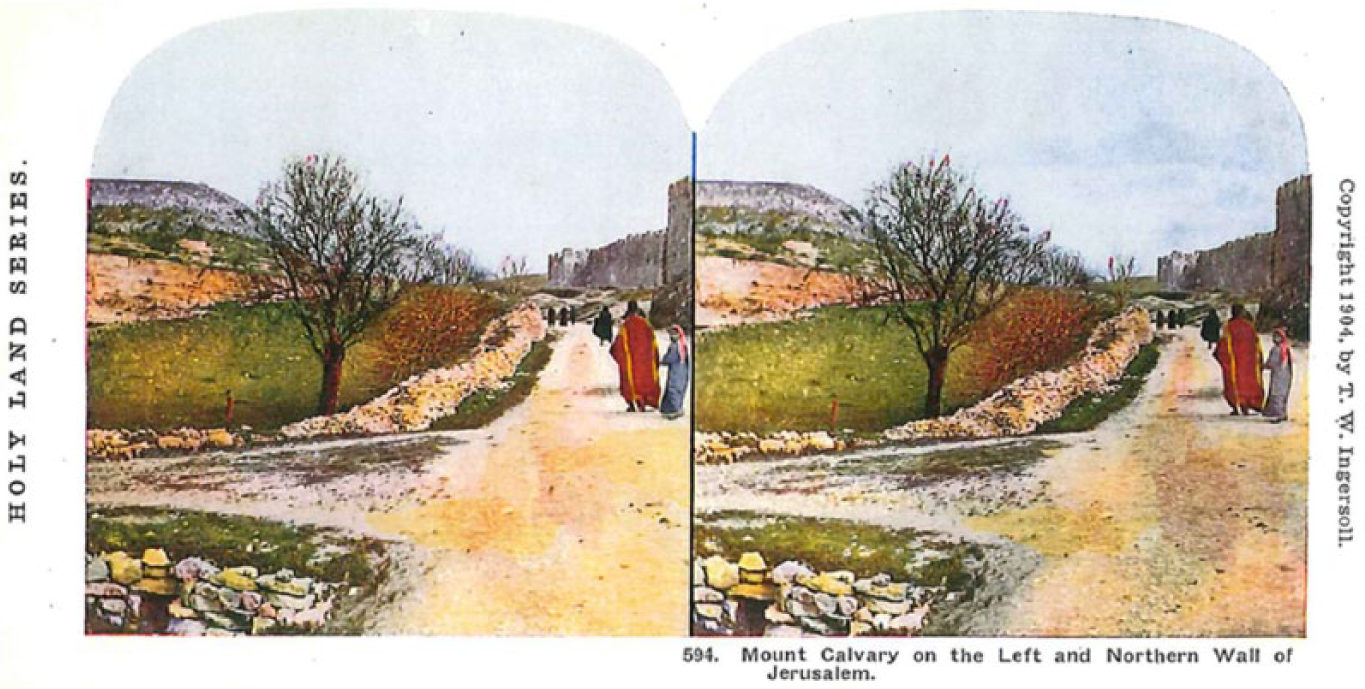
1904 stereoscope card from TW Ingersoll’s ‘Holy Land Series’. Author’s collection.
Visual technologies such as the panorama and the stereoscope helped establish immersive entertainment as a legitimized frame for Protestants to engage materiality. The practice of materializing replicas of biblical lands joined the frames of immersive entertainment and scriptural pedagogy. For example, consider Palestine Park at the Chautauqua Assembly in western New York state. Chautauqua was founded in 1873 by two leading Methodist figures to be an institution dedicated to training Sunday school teachers. One of the founders, John Heyl Vincent, was celebrated in the Sunday school movement for his ‘Palestine class’, a youth curriculum designed to immerse children in the land and culture of biblical history (Kimball, 1913). At Chautauqua, he expanded this immersive pedagogy by designing a landscape model of ‘biblical Palestine’. Constructed in collaboration with another influential Methodist, WW Wythe, the original Palestine Park stretched 170 feet in length (extended in 1879 to nearly 400 feet), and presented a scale topographic model of scriptural lands that marked the locations of cities and bodies of water. Vincent, much like Hasselquist and Robinson, trumpeted the need to develop a land-centered understanding of biblical history. In an 1884 Introduction to a popular Bible Atlas, he explains: Every Bible reader should be acquainted with the outlines of Biblical and geographical antiquities. Without such knowledge it is impossible properly to understand the divine word. How often, through ignorance of sacred archaeology, we overlook the force and beauty of the allusions which abound in the narrative, poetic and prophetic parts of Scripture. And there is, moreover, an air of reality imparted to all history by familiarity with the geography involved in it. (p. v)
Palestine Park relied on a bodily attunement to meet this geographical imperative, cultivated by the emplaced experience of walking between spots on a miniaturized replica. With Chautauqua Lake serving as the Mediterranean Sea, classes were brought to the model by boat and encouraged to imagine themselves stepping onto the land of the Bible. The park was ‘an immediate success’, teachers and visitors attended lectures dressed in Middle Eastern garb, adding elements of theatrical role-playing to the virtual reality fostered by the model (Davis, 1996: 89). As Long (2003: 30) observed about the park, ‘Realism was the driving aim, fantasy the enabling impulse.’
Wythe engineered a parallel attraction in 1879 for a different Methodist destination, a camp meeting in Ocean Grove, New Jersey. There, a scale model of 19th-century Jerusalem was created as a floor model that visitors could gather around for devotion or Bible study. While the focus was on the city, the model included a surrounding landscape, complete with rolling topography and 1,200 miniature trees (Messenger, 1999: 111). The immersive strategy of the landscape replica continues to retain Protestant appeal. For example, a scale model of 1st-century Jerusalem is on display at the Holy Land Experience in Orlando, Florida (a ‘living biblical museum’ founded in 2001 by a Christian Zionist ministry and purchased in 2007 by a charismatic mass media ministry). And a version reminiscent of Chautauqua’s model is in progress at the non-denominational evangelical Biblical History Center in La Grange, Georgia. Founded in 2006, this interactive museum integrates multiple elements to ‘help people encounter the ancient biblical world’: replicas of 1st-century agricultural and domestic technologies; scriptural flora; archaeological artifacts on loan from the Israeli Antiquities Authority; and biblical meals (cf. Ron and Timothy, 2013). 3 The attraction’s newest addition will be a 450-foot ‘walkable map of Israel’, directly reprising Palestine Park’s promise to transport visitors to the biblical past through scaled topography, landscape markers, and bodily attunement. 4
From botanical expeditions to the birth of biblical archaeology, visual technologies that promised vicarious pilgrimage, and landscape replicas, there is a durable continuity among Protestants to seek the land of scripture via sensory engagement. Through exploration, science, art, education, and technology, Protestants have fostered numerous practices to express and enact a unifying commitment: the landscape of the Bible is a powerful testimony to biblical history and material witness to scriptural truth. These engagements with landscape oscillate among multiple frames – from pedagogy to devotion, entertainment, and evangelism – and all mobilize imaginative and material resources to satisfy the imperative to cultivate an intimate bond with scripture. While this intimacy certainly promotes discursive forms of knowledge, the scriptural literacy being sought is grounded in multi-sensory ways of knowing. The history of the Protestant imagination of the Holy Land emerges from, and is inscribed in, the body.
Traveling testimonies
When hundreds of thousands of US tourist–pilgrims travel to the Holy Land, most bring home souvenirs as gifts and mementos. ‘Metonymic’ landscape objects are the most popular among Protestants, ‘actual pieces of the land [that] connect to Jesus’s own perceived mobility and practice’ (Kaell, 2012: 139). Tourist–pilgrims collect found objects (e.g. pocket-sized pebbles from the Garden Tomb; bags of sand from Sea of Galilee shores), and purchase commodified forms (e.g. olive-wood nativity carvings; bookmarks with dried wildflowers). In doing so, these travelers reproduce the Protestant celebration of biblical landscapes and engage with a long history of rendering this land as portable, tradable, and collectible items.
As long as there have been Holy Land travelers, biblical landscape items have circulated beyond the land itself. Wharton (2006) writes of this circulation beginning in the 4th century with Empress Helena’s trip to Jerusalem and proclamation of sites in the life of Jesus: ‘Jerusalem first circulated in the West in the form of its physical fragments – pieces of stone, drops of oil, bits of bone, particles of wood’ (p. 45). Diverging from later Protestant uses, early Catholics mobilized these fragments as devotional relics with performative efficacy: agentive objects for healing and protection, and enchanted materials re-contextualized to sacralize architectural projects (Sumption, 1975: 29).
Beginning with Rome’s Church of Santa Croce in the 4th century, the practice of consecrating new sites with biblical landscape items lasted for more than a millennium (Bartal et al., 2017). For example, the Camposanto of Pisa is a monumental cemetery begun in 1278, just north of the famous leaning tower. The cemetery is said to be built atop soil brought back from Jerusalem in 1188 by an archbishop. The earliest surviving written versions of this legend date to the 14th century, and reports disagree whether the earthen source was Golgotha or Akeldama (Bodner, 2015). In either case, the soil was said to possess miraculous properties, such as the ability to decompose bodies in three days and eliminate all foul odor. A similar story exists for the Sedlec Monastery, located roughly one hour’s drive east of Prague in modern day Czech Republic. As the story goes, a Cistercian abbot returned from the Holy Land in 1278 with a small jar of Golgotha soil, which he spread atop the cemetery grounds. This generated widespread attention, and tens of thousands of Catholic bodies from all over Europe were brought to the site for burial. This particular story of landscape materials thrives today because the site is a well-trafficked tourist destination. In 1870, the church hired an artist to arrange the ossuary’s overflowing skeletal remains into some kind of order inside the main chapel. The result was an elaborate series of artworks in which the bones of tens of thousands of Catholics are the medium.
With their ambivalent heritage in tow, Protestants have emphasized different uses for biblical landscape items. 5 For example, religious entrepreneurs like Robert Morris stressed the pedagogical potential of these metonymic materials. An influential Freemason, Morris popularized the ‘Holy Land cabinet’ in the 1870s as a teaching tool primarily among Sunday School movement audiences. Morris published the first Masonry travelogue of Palestine in 1876, Freemasonry in the Holy Land. Or, Handmarks of Hiram’s Builders. As a fundraising strategy to enable the journey that enabled this book, Morris sold ‘ten-dollar subscriptions for “Holy Land Cabinets,” each to be equipped with 150 sacred objects’ (Davis, 1996: 50). He returned in 1868 and immediately set about fulfilling the subscriptions, eventually circulating several hundred thousand samples. Morris reframed landscape materials from devotional relics with transformative properties into material props that could enliven the imagination of Bible readers, attuning scripture reading to cultivate a sensory intimacy with biblical history. Consider his description of a soil specimen from the Garden of Gethsemane: ‘an honest portion of Gethsemane; a portion upon which the Divine feet may have trodden, the Divine knees pressed, the Divine tears and sweat moistened’ (quoted in Davis, 1996: 51; emphasis in original).
Inspired by the success of the cabinets, Morris aspired to open a museum in LaGrange, Kentucky near Louisville, where he lived after accepting a position at the Masonic University in 1860. He was unable to do so because his massive stock of Holy Land materials was stored in Chicago and were a casualty of the 1871 fire that devastated three square miles of the city (Mitchell, 1887). Morris’s innovation did inspire others to engage biblical landscape items in the same pedagogical frame. For example, the Massachusetts-based School for Christian workers used a ‘Biblical Museum’ to help teach scriptural history. An 1890 example (available for sale on ebay for US$999.99 as of March 2018) features samples of anise, boxwood, brayed wheat, camphire, cassia, cumin, fitches, ground corn, husk, hyssop, incense, lentils, split lentils, manna, mint, mustard seed, myrrh, olive leaves, olive wood, oriental nuts, pulse, reed pen, rue, sackcloth, saffron, tares, tae powder, and ‘the most interesting coins of the bible’. The description of tae powder, for instance, explains that ‘the practice of painting the eyelids to make the eyes look large, lustrous and languishing is often alluded to in the Old Testament’, then directs readers to the story of Jezebel in 2 Kings.
As traveling testimonies, biblical landscape items continued to circulate in Protestant contexts throughout the 20th century in ways that combined frames of pedagogy and entertainment. At Palestine Park, a daughter of the Chautauqua Institution’s president in the 1920s returned from Palestine with a vial of Dead Sea water, which she placed in the park’s replica equivalent (Long, 2003: 37). Some 80 years later, Annabel Wharton (2006) reported that on a 2002 tour of Holy Land USA – a now defunct 250-acre park in southwestern Virginia that re-created biblical sites – the guide used a relief map of Israel to orient visitors. The map, hung on a wall in the Welcome Center, was ‘constituted of materials from the regions it depicts – sand from the Negev, soil from Jerusalem, earth from the Dead Sea basin’ (p. 233). When the Temple of Solomon in Sao Paulo, Brazil opened in 2014 (a Pentecostal complex featuring an outsized replica of the Old Testament temple, accompanied by Wilderness Tabernacle and Garden of Gethsemane replicas), it boasted eight million dollars’ worth of ‘Jerusalem stone’ as part of the Temple’s exterior construction, four date-palm trees, and a dried bush from Mount Sinai – all flown in from Israel–Palestine.
For replication sites, biblical landscape items help choreograph an immersive effect, aiming to transport visitors away from the here and now to a scriptural there and then. While this immersive affordance may have pedagogical benefits, the appeal of metonymic objects exceeds any particular teaching lesson. Integrating landscape items is about creating an aesthetic link to the Holy Land and the biblical past. At the Brazilian Temple of Solomon, the multi-million-dollar investment in Jerusalem stone is presented as a collective memory device. The stones are described by guides as ‘witnesses’ to the ancient Israelite past. 6 This link is also realized as an individual practice. In her ethnography of American tourist–pilgrims to the Holy Land, Kaell (2012: 141) presents the story of a United Methodist woman in her 70s who conducted a soil exchange. She brought dirt from her congregation’s newly planted garden with her, spreading it while in Galilee and then collected Sea of Galilee sand to bring home to the garden for its formal dedication. Such practices depart from the consecrating function among early Catholic pilgrims. The focus is instead on forging an aesthetic bond between home and the Holy Land, not transforming the physical properties of the re-contextualized site.
The next section turns to an ethnographic example from the US state of Kentucky. Here, we find a Protestant attraction mobilizing biblical landscape items, unambiguously appealing to the ideology of metonymic power. Yet, because of the attraction’s indeterminate framing, a more hesitant expression of the Protestant ambivalence toward materiality resurfaces.
Kentucky’s Holy Land
Covington is a small city in northern Kentucky, just across the Ohio River from Cincinnati. Tucked behind a working-class residential neighborhood on the city’s southwestern edge, at the end of a No Outlet road, set atop a steep rise that affords a gorgeously unobstructed view of the Cincinnati skyline, is a place called the Garden of Hope.
When it opened to the public on Palm Sunday 1958, the Garden realized the nearly 20-year vision of a Southern Baptist minister, Reverend Morris Coers. After three pastorates in Indiana, Illinois, and Michigan, and two terms in the Indiana state legislature, Coers accepted the senior pastor position at a Baptist church in Covington in 1945. Well-known at the time as a local radio minister, Coers’ ambition exceeded pulpits, politics, and mass media preaching. In 1938, he had made a pilgrimage to Jerusalem and was inspired to create a place that would be a beacon for all who could never make the trip themselves. In a 1956 interview with the Cincinnati Times-Star, Coers is quoted: ‘we expect to attract thousands of tourists from all parts of the world – persons who will never have the privilege of walking in the Holy Land.’ In this way, Morris Coers re-created a process established by cultural predecessors like John Heyl Vincent, who envisioned Palestine Park at Chautauqua in light of his own Holy Land travels.
After years of fundraising, Coers purchased the 2.5-acre hilltop plot in 1956 and began construction immediately. The Garden of Hope’s centerpiece is a portion of Protestant Jerusalem – a 1:1 scale replica of the Garden Tomb (see Figure 2).
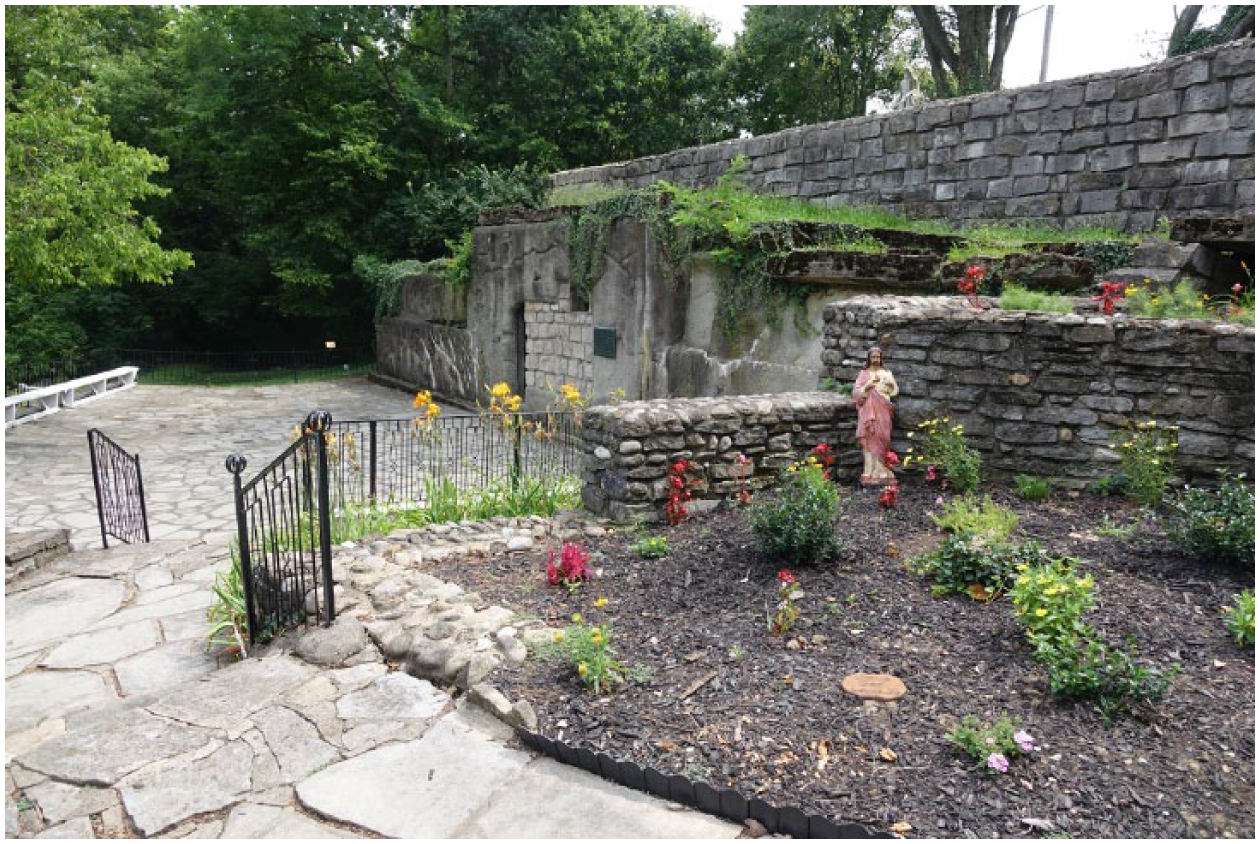
Garden Tomb replica at The Garden of Hope in Covington, Kentucky. © Photograph: James S Bielo.
The historical authenticity of the Garden Tomb is widely disputed. Many Protestants claim that the tomb, located outside Jerusalem’s Old City walls, is the site where Jesus was buried and resurrected. This claim is rejected by mainstream biblical archaeology and dismissed by the majority of the world’s Christians who claim that the Church of the Holy Sepulchre inside the Old City houses both Golgotha and the burial–resurrection site (Kaell, 2014: 78). The Garden Tomb emerged as a Protestant alternative in the 19th century: first identified in 1867, fully excavated in 1883, and purchased by a (mostly British Anglican) group in 1894 (Kark and Frantzman, 2010). While Garden Tomb supporters will sometimes recognize the disputed history – as an official Garden Tomb Association (1960[1944]: 17) guide book does when it admits ‘whether this particular tomb be the real Holy Sepulchre is a matter of conjecture’ – the site has constituted a more satisfying experience for Protestant pilgrim–tourists who favor the open-air atmosphere over the Old City Church, which is densely adorned with Catholic and Eastern Orthodox ritual elements and adherents (Bowman, 1991; Feldman, 2016; Ron and Feldman 2009).
As a thoroughly Protestant attraction, Kentucky’s Garden of Hope elides all traces of this disputed historicity. Neither the Church of the Holy Sepulchre nor archaeological arguments against the Garden Tomb’s veracity are ever mentioned in Coers’ late 1950s newspaper interviews, in the written text of on-site signage and visitor pamphlets, or in tour guide performances. The Garden of Hope’s appeal to authenticity happens through this process of erasure, and through the immersive ambition of creating a surrogate experience of biblical land in Kentucky.
In addition to his own Holy Land pilgrimage, Coers’ claim for the Garden of Hope’s ‘exact’ replication was his relationship with the Garden Tomb’s warden. From 1953 until his untimely death in 1967, Solomon Mattar helped care for the Tomb in Jerusalem and guided pilgrim–tourists. Coers noted in a December 1956 interview with the Cincinnati Enquirer: I have been collaborating long distance with the warden of the garden in Jerusalem. He arranged for an architect to draw exact plans of the tomb of Christ. I have arranged to have these plans followed in the minutest detail.
To accompany this architectural precision, Coers planted numerous botanical species indigenous to Jerusalem throughout the attraction. By mobilizing the sight, feel, and aroma of ‘cedars of Lebanon’, juniper, and different flowers, the Garden of Hope appealed to the natural world of scripture to help transport visitors.
Today, without Coers’ devotional labor, few of these varietals remain and the botanical aspect of the experience is lost from his original vision. However, Palestinian flora were not the only metonymic landscape materials Coers brought back from his pilgrimage. Scattered throughout the Garden are four stones, still residing where Coers placed them. Two are set in decorative wrought-iron cages near a grassy gathering area that includes several picnic tables (see Figure 3).
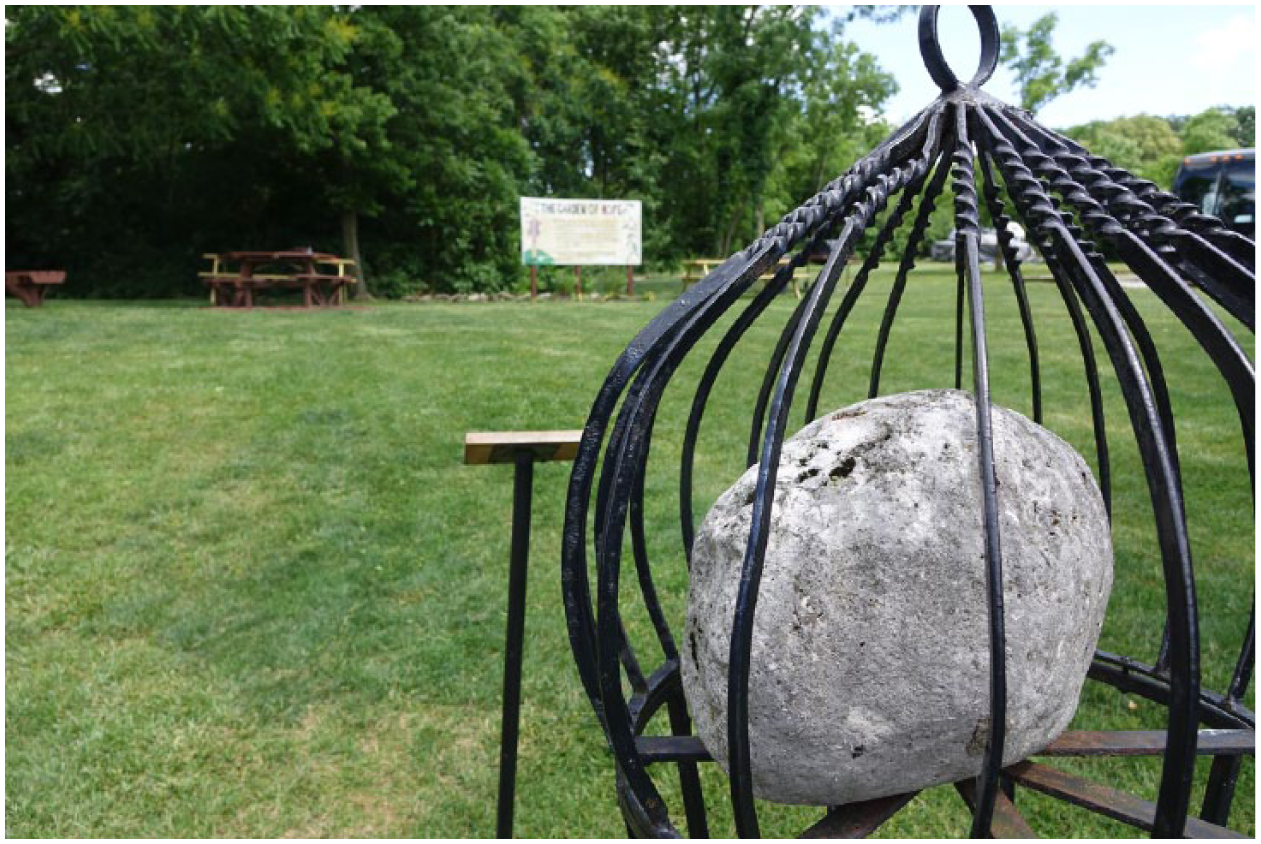
Holy Land stone exhibited at the Garden of Hope. © Photograph: James S Bielo.
Signage explains the first stone as ‘from Good Samaritan Inn, over 2,000 years old from Jerusalem’ and the second as ‘from Jordan River where Jesus was baptized over 2,000 years ago’. The third stone is positioned differently. It is embedded into the floor inside the Garden’s chapel, a replica of a 16th-century Spanish mission church. 7 Along with services of worship, the chapel was primarily intended for weddings, a practice Coers initiated in 1958 and that continues today. During the ceremony, couples stand atop a pink stone that signage explains ‘is from the Horns of Hatton where Jesus delivered the Sermon on the Mount’. The final stone, also set in an ornate iron cage, is located just beyond the chapel, at the end of a small downhill path. Signage presents it as, ‘from Solomon’s Temple, 500-pound block from Wailing Wall’.
Reverend Morris Coers realized his 20-year vision, but enjoyed it for only two years. He died in his sleep in February 1960. In an interview with the Cincinnati Post for a May 1957 story about the Garden, Coers reflected: I truly believe it will be an inspiration to all who come here. In fact I have called the point where the chapel is to be built Inspiration Point. From there you can see 18 churches in the valley of the Ohio and Licking Rivers – at Angelus time, the sound of the bells is thrilling.
Given this prized aural experience, one wonders if the construction of I–75/71, in full swing following the passage of the Federal Highway Act in 1956, below the hilltop location, was a death knell of disappointment. Today, the Garden’s soundscape is saturated by the constant rush of automobiles, washing out any other sound that might rise up from below – certainly the distant chiming of church bells.
After Coers’ death, the Garden fell into a lengthy cycle of sale, purchase, re-sale, disrepair, repair, natural erosion, and vandalism. Following a major restoration effort in 1998 by the church, the attraction re-opened to the public. In 2003, a volunteer tour guide was appointed who continues today. Steve, a 70-year-old Covington native, has ‘shown [the Garden] to over eight thousand people’ since he began guiding. In summer 2016, the Garden of Hope entered a new, and newly popular, phase of its life. The opening of Ark Encounter, a creationist theme park 40 miles south of Covington, has drawn large numbers of group bus tours to the area, primarily filled with conservative Protestants on a regional circuit of religious tourism. For example, the company Ohio Travel Treasures arranges tours that include Ark Encounter, a Ohio River cruise with gospel music, the Creation Museum (a creationist ministry open since 2007, located 20 miles due west of Covington), the Cathedral Basilica of the Assumption (a replica of Notre Dame Cathedral in Paris, located in downtown Covington), and the Garden of Hope.
Over the course of three months in summer 2017, I observed nine bus tours at the Garden. 8 Groups ranged in size from 25–50, and hailed from Protestant churches as distant as Wisconsin, Pennsylvania, Virginia, and Tennessee. With one exception (a youth group from a private Christian school near Milwaukee), the buses were primarily filled with middle–old and older adult visitors, the majority traveling as married couples. As I walked Garden pathways with these roughly 300 visitors, I was keenly interested in how these Protestants would engage the four stones as biblical landscape items. How did guides integrate the stones into their guiding performances? And how did visitors interact with them?
Guides do not spend as much time narrating the stones as they do the tomb replica, but with every tour they highlighted each stone individually and its link with Christian scripture. Steve’s well-honed routine includes a short game of biblical trivia for the Jordan River stone. For example, when guiding a 45-person group from Richmond, Virginia:
What’s the most significant thing that happened at the Jordan River?
Jesus’ baptism.
By who?
John the Baptist.
What was their relationship?
Cousins.
Yeah, they were cousins. I’ll give both of you the bronze star.
[Tour group laughs]
Steve performs this exchange with every group he leads, always fast-paced and always concluded with the same playful congratulations. Such quizzing is a common guiding strategy, ritually serving to confirm the cultural competence of visitors, build rapport, intensify attention, have fun, and, in Steve’s case, highlight visitors’ bond with scripture (Cohen-Aharoni, 2017).
Jim is a part-time assistant guide recruited by Steve. Also a Covington native, Jim and his wife stood atop the Hatton stone in 1977 when they were married inside the Garden’s chapel. Jim developed a renewed interest in the Garden and began guiding in 2016. Not as practiced a performer as Steve, Jim’s affection for the Garden is obvious and groups seem endeared when, sitting inside the Chapel, they hear his wedding story. When explaining the stones, Jim described all of them as ‘very special’, and among the ‘greatest treasures’ preserved at the Garden. With every group, he encouraged visitors to take pictures of the stones and explicitly invited them to touch the stones.
Visitors evinced consistent interest in the stones, but their engagement with them was marked by a visible hesitation. Most visitors approached the stones and took close-up pictures with smart phones, tablets, small point-and-shoot cameras and a few with more sophisticated cameras. In each tour group, select visitors opted to have their picture taken next to at least one of the stones and asked the guides questions about them. For example, in several groups someone asked how Morris Coers arranged for their transportation out of then-British Mandate Palestine. The guides have sketchy details to offer in response: general allusions to ‘paperwork’ verifying the authenticity of the stone’s geographic origins and Coers’ ‘connections’ in Palestine; an observation that such removal of large stones today would be ‘impossible’; and a reminder that Coers’ devotional labor to secure the stones and their undisturbed presence onsite adds to their ‘special’ character.
It was the invitation to touch that provoked hesitation. The most common scene following an explanation of one of the stones was for visitors to gather around it, lean in to inspect it closely with their eyes, take pictures, comment appreciatively (‘wow’, ‘hmm’), and move on after about 30 seconds. Very few visitors decided to touch and, among those who did, their manner of touching was notable. They would touch gently and briefly, and then retract their hand. Almost without exception, there was no sustained laying of hands on the stones. I observed no one using a stone as a tactile conduit for prayer. The only exception of extended touch that I observed came from a married couple from southeastern Virginia. Following the chapel presentation, a small line of visitors queued up to take turns viewing and photographing the Solomon stone. The last couple in line took each other’s picture next to the stone: right arms extending into the cage, palms down on top of the stone, faces smiling for the camera. I walked with them to the tour’s last stop and asked about their decision to reach in. They were both surprised that more visitors do not do the same. The woman remarked cheerily, ‘I don’t think I’ll be going to Jerusalem anytime soon’, and the man added in a pleased tone, ‘It’s neat’.
Given the explicit invitation to touch by guides, the historically secured metonymic ideology attached to biblical landscape items, and documented practices of touch among evangelical Holy Land pilgrims (Kaell, 2014: 93), visitors’ obvious hesitancy to tactilely engage with the stones captured my attention. What might explain this surprising pattern of practice? In light of the historical analysis in the first part of this article and my fieldwork at the Garden of Hope, I argue that this hesitancy traces to the jumble of frames operative at the Garden and, as a result, an uncertainty among visitors about how to properly engage with the stones as objects of religious materiality.
To begin, the Garden of Hope registers as a devotional environment with multiple Catholic elements (e.g. a Spanish mission replica), creating an encounter that is not intuitively comfortable for these conservative Protestant religious tourists. The Garden Tomb is unambiguously Protestant, but the pedagogical framing of the replica is unclear. Neither guides nor textual materials (e.g. signage, brochures) contextualize the tomb historically or spatially in the city of Jerusalem. The frame of immersion at the Garden is disrupted both internally and externally, from the co-presence of 16th-century Spain, contemporary Jerusalem, and ‘2000 years ago’ to the intrusive sound of Interstate traffic. The display of the stones conjures further frames. Rather than being positioned as in-situ replicas (e.g. the Jordan River stone set within a Jordan river replica), they are housed in cages and embedded in a chapel floor. On one hand, the cages produce a ‘look, but don’t touch’ reaction, akin to a museum experience where visitors are separated from objects by physical barriers (Berns, 2016). On the other hand, their placement in ornate – arguably, elegant and impressively crafted – cages evokes an art environment in which the cages both enhance the sacrality of the object on display and deflect attention to its own visual appeal. This jumble of frames leaves visitors without a clear cultural script to work with and, in turn, enables the more anxious expression of Protestants’ ambivalent relation to materiality to surface. The result is group after group of Protestant visitors consistently displaying an uneasy response to the invitation to touch.
Conclusion
This chapter has explored how Protestants engage with biblical landscape items: from Holy Land ‘flower messages’ to religious tourist attractions that integrate transported stones. Plants, water, soil, and stones serve as testimonies of and from the land of the Bible, promising direct access to scriptural events, courtesy of an ideology of metonymic attachment between the natural world and the biblical past. As a particular species of object, biblical landscape items help illuminate the historic ambivalence that characterizes Protestant engagements with religious materiality. While Protestantism emerged as an iconoclastic movement, the historical and ethnographic records overflow with accounts of Protestant communities using material culture to enhance their religious lives. The question is not if, or which, Protestants nurture an iconoclastic vestige, it is under what conditions do Protestants experience the ambivalence in ways ranging from unproblematic to anxious. Ultimately, I have argued that Protestants enthusiastically mobilize biblical landscape items when the frame(s) of engagement is(are) clear, but when a legitimized frame is absent or uncertain then Protestants struggle for proper footing.
The ambivalence of Protestant materiality has become an enduring research problem. Anthropologists (e.g. Blanton, 2015; Engelke, 2005; Meyer, 2010) and religious studies scholars (e.g. Morgan, 1999; Promey, 2001, 2007) have effectively demonstrated how Protestants can be prolific users of religious materiality despite iconoclastic traditions. With this article, I hope to advance this body of comparative work by providing further nuance regarding differentiating species of objects and delineating frames of interaction. To close, I highlight two areas where this analysis of biblical landscape items might complement existing research and encourage future scholarship.
First, while the focus here has been on matters of material culture, there are also insights to be drawn about Protestant biblicism more broadly. Textuality and materiality are interlaced, not separate, concerns. Practices of Bible reading and interpretation are dialectically related to the aesthetic and imaginative aspects of pilgrimage, replication, and the global circulation of biblical landscape items (cf. Kaell, 2014). For example, the historical project of biblical literalism has certainly been enhanced by Protestant efforts to map, re-present, re-create, and metonymically capture the land of scripture.
Second, the focus here on landscape fragments and frames of engagement may offer a fresh perspective on Protestantism’s splintering habit of schismatic diversity (cf. Bialecki, 2014). As Protestant variations emerge, one element of differentiation is the repertoire of frames that are legitimized for engaging materiality. For example, Blanton (2015) illustrates that, with the rise of charismatic Christianity and mass media ministries like Oral Roberts’, touch and various material technologies were ratified for a healing frame in ways that were quite foreign to other Protestants. Similarly, emerging churches throughout the Anglophone world sanctioned devotional materiality as part of a broader cultural critique of mainstream evangelicalism (Bielo, 2011: 70–97).
As Protestants continue to construct relations with scripture, and differentiate new Protestant identities, mobilizations of materiality will provide a valuable standpoint for observing these cultural processes. What I hope to have demonstrated here is that fragments of landscape are particularly revealing, drawing together durable ideologies, ritual practice, social relations, imagination, and ordered sensory engagement.
Footnotes
Acknowledgements
This article benefited from contributions by numerous friends and colleagues. William Girard’s keen instinct led me to Emily Dickinson’s ‘Flower Message from the Holy Land’. Hillary Kaell, Sally Promey, and participants in the Sensory Cultures of Religion Research group at Yale University offered invaluable feedback on an earlier manuscript draft. Two anonymous reviewers provided helpful critiques. And I have enjoyed many inspiring conversations about how Protestants engage with biblical landscapes with Jackie Feldman and Sara Williams. Claire Vaughn, Rebekka King, Crispin Paine, Rory Johnson, and Lawrence Bartel walked Garden of Hope pathways with me, each sharing incisive observations. Finally, I am grateful to Steve and Jim for being such gracious ethnographic collaborators.
Funding
This research received no specific grant from any funding agency in the public, commercial, or not-for-profit sectors and there is no conflict of interest.