







Abstract
Material culture forms a relational system of distributed reality – a thingworld. But how do we get beyond simply saying that all material culture is meaningful and entangled to understanding the internal structure of such systems? Is it a flat terrain among co-equal things? Or are some objects more important than others, as we might intuitively suppose? And if so, why? This article presents an initial discussion of the problem. Using vignettes from two thingworlds – one from early modern Iceland, one from Neolithic Europe– the authors discuss what were the central material things in each, and for what reasons. This suggests that objects may be systemically central in different ways, for instance things which connect and mediate relationships of different kinds, things which are non-substitutable, and things which span multiple roles and contexts.
Introduction: What makes objects important?
In A History of the World in 100 Objects, highlights of the British Museum are used to construct a quasi-world history (MacGregor, 2012). This compelling rhetorical manoeuvre has been widely imitated, but it conceals deep theoretical questions. While it reminds us of the role material culture plays in history, it also implies that these objects are the important ones, the real centrepieces of historical action. But are they? What makes an object important? Would a different choice of objects tell different stories?
Historical approaches to material culture often focus upon a single object, implicitly or explicitly asserting its importance. This is seen in the very popular studies on ‘the history of – ’ (insert object of choice), such as Riello’s (2013) history of cotton, Mintz’s (1985) history of sugar or Tsing’s (2015) study of mushrooms; single-object studies are almost the standard genre for writing material history. At the same time, a wide range of contemporary approaches (notably, ANT and ‘symmetrical archaeology’, but also assemblage theory and ‘entanglement theory’) underline the relationality of material culture (Hodder, 2012; Jervis, 2018; Latour, 2005; Olsen, 2010). 1 As a practical strategy in writing, such analyses often focus upon one object, but they use it as an example of relationality which could apply to any object. Such relational approaches underline the fact that material things can have meaning and act only within networks of people and other things. But they tend to reduce all material things to a flat level of equal importance. It is hard to know where to go analytically once one says ‘it’s an entangled network and everything is related to everything else.’ Indeed, the issue of centrality in such networks has tended to get stuck around endless debates on the (in-)equality of humans versus things (Hodder and Lucas, 2017; Olsen, 2010; Olsen and Witmore, 2015; Witmore, 2008) (though contrast Witmore, 2014). For us, a more interesting issue concerns the asymmetry between things, the fact that some objects matter more than others. Do relational approaches give a good basis for theorizing why one object may be more central than others or for understanding how material culture works as a differentiated system?
So our starting point is not to ask ‘can we trace relationalities out of object x?’ We always can, and such analysis will always reveal the world in a grain of sand, or all of social relations embedded in a paperclip. Instead, the relevant question is ‘if object x were made to vanish, what would happen? How far-reaching or profound would change be?’ In other words, are there different degrees of embeddedness within a system of relationalities? And what governs them? What are the general criteria that make an object important or central? And, as archaeologists, can we ask explicitly what were the important objects in prehistory or history?
The distribution of centrality
The idea that some things in a system have greater importance than others is not particularly novel. Arguably, art history and archaeology were the first disciplines to assume that some things, or properties of things, have greater social or cultural importance. This is implicit in archaeology’s broad chronological frameworks; the Three Age System explicitly elevated cutting tools of stone, bronze and iron as an index for millennia of human history, even if they were gradually superseded by more abstract notions such as modes of subsistence. Why? Possibly from inbuilt assumptions coloured by contemporary concerns, hard technologies such as cutting tools emerged as key objects for archaeology in the heyday of the industrial revolution, tinged by an androcentric bias in science (Maynes and Watner, 2012). Other periodizations were built upon criteria such as pottery styles; less significant but highly sensitive to change because of their usefulness to archaeologists, such objects can subtly take on greater importance to us, potentially leading us to neglect other items – a point made long ago by Taylor (1948: 131). Indeed, any classification will inevitably privilege some objects or properties over others, colouring our perception of what is and what is not important.
Contemporary material culture studies have also raised this issue. Most material culture scholars write ethnographies and histories of specific things, from Miller and Banerjee’s (2008) study of the sari to Schiffer’s (1992) study of the portable radio. The traditional mode of ethnographic and historical analysis (including phenomenology, materiality theory, ‘thing theory’, art history and theoretically eclectic approaches in history) usually focuses upon a centrepiece, a specific artefact. Moreover, some objects afford particular potential for exposition of a specific theoretical approach; not by accident is there a better developed phenomenology of monuments than of stone flakes, or more ethnographies of clothing and identity than of tin cans. Indeed, Ingold (2013) implies that such choices can actually help us re-think our theories, as in his own use of baskets and metaphors of weaving to understand the process of making. In such a mode, even in relational approaches, objects are important for their singularity, for how they can be lifted out of their wider material system to think through more abstract ideas.
But the theoretical reasons why one object might be given primacy or centrality are rarely discussed explicitly. Particularly in anthropology, discussions of why objects are important are often phrased in terms of meaning, psychological salience, or experiential interaction. Thus specific objects can take on great importance because they secure a sense of well-being (Bell and Spikins, 2018) or carry memories and act as bearers of our identity, our sense of self (Hoskins, 1996). In these cases, the specificity of the object is often idiosyncratic and unique to an individual and their life history, although evidently this can shade into more general social patterns of preference relative to class, gender, ethnicity and so on. Moreover, depending on the context, different things will matter more to some people than others; for example, Parrott’s (2005) study of people’s attitude to things while residing in a secure psychiatric unit showed a preference for clothing over room furnishings which solely related to their situation. From this perspective, the importance and centrality of objects will of course inevitably and always be relational to the specific social situation in which they are placed.
But there are also other reasons why objects can be central or important. Indeed, we argue below that in any thingworld, different objects, some of little concern to the participants, may be important for completely different reasons. Among such reasons, how objects relate to each other within a system of things is among the least investigated aspect, and it is the dimension we pursue here. There are some notable exceptions to this gap in research. Schiffer (see Schiffer and Miller, 1999) uses the concept of a ‘focal interactor’ to define any object that appears to choreograph the performances of other interactors in an activity, thereby giving impetus to the activity’s forward motion. This concept converges with Deleuze and Guattari’s (2004) concept of an ‘assemblage convertor’, which refers to an entity which is mobile and works as a key operator in many different assemblages (p. 325). Furthermore, network theorists have acknowledged the asymmetry in material systems, drawing on concepts of centrality and ‘hubs’ (highly connected network nodes) (Brughmans et al., 2016; Hodder and Mol, 2016; Knappett, 2011), although this work mostly focuses upon connections between places rather than objects. More concretely, Lemonnier (2012) discusses the role that certain mundane objects play in reproducing a society. His examples of ‘perissological resonators’ include traps and fences in a New Guinean society as integral to the way a community coheres. Through building fences, gender roles are maintained, and when a group stops building them, the social fabric starts to disintegrate. Lemonnier’s argument builds on the Maussian notion that exchange acts as the primary social glue; but it makes the point that objects can bind people together in ways that are constitutive of sociality without actually being circulated. Because these objects anchor sociality, removing them would have greater consequences than removing other objects would. This concept has close parallels with the ecological concept of a ‘keystone species’ which structures and regulates how other species in an ecosystem live (Paine, 1969). The cultural psychologist Ernst Boesch (1991) coined the term ‘core objects’ to define essentially the same phenomenon. Boesch’s study focuses upon what happens when a ‘core object’ is replaced with something different – in his case, steel axes for stone ones and enamel basins for calabashes.
These authors raise the question: how well-connected is an object and what else comes undone when it is removed? Except for Lemonnier (2012), however, the issue has usually been raised tangentially in passing. In this article, we aim simply to open it up for explicit discussion, asking whether we can develop some idea of why objects may be important within a material culture system and how to identify them. Doing so requires understanding the broader system those things inhabit; it is to deal with the singular or remarkable, but within a relational field. Our goal, then, is to try and understand the distribution of centrality within what we shall call thingworlds.
Thingworlds
The thingworld is the ensemble of objects made and used in a given society – its universe of things. By this neologism we want to highlight how material culture forms a system of relations. Although the term ‘thingworld’ sounds impeccably Heideggerian, Heidegger does not in fact use it, as far as we know; nonetheless, the notion of thingworld does resemble Heidegger’s [1962] concept of ‘equipmental totality’ or ‘equipmental world’, that is the contextual configuration or assemblage of things within which objects operate. For our discussion here, this has four straightforward but important implications:
Material culture derives its ability to act, and to structure human life and consciousness, from its cumulativity, from the ensemble of things rather than from any individual object, however important. Any object is arbitrary; its rationalization as something understandable and necessary originates in its coherence with other things. Material culture thus forms a system of distributed social reality.
As a system, the material ensemble is neither a random accumulation of unrelated stuff, nor a featureless plain of like objects; it has a differentiated internal structure.
Within a thingworld, different objects can act upon each other and upon people in qualitatively different ways.
The qualities of thingworlds may be historically specific; in spite of the tendency to write philosophically about material culture in a universalizing vein, people may interact with material culture not (only) generically qua people, but in modes or styles specific to a given historical context.
While it is common to write about specific objects, it is surprisingly rare to describe the general outlines of a thingworld, or to discuss how people interacted with different kinds of objects and how objects related to each other. Of course when tracing the particular relations of a thing, scholars also discuss the world around that thing; Tsing’s (2015) study of the Matsutake mushroom talks about Oregon pine forests, seasonal workers, roadside stalls, sorting warehouses and Japanese restaurants. But this is the world from the perspective of the mushroom and its journey through supply chain capitalism. By thingworld, we mean something broader; instead of seeing a material system through the lens of a particular object, we invert the process and attempt to begin with the thingworld, and from that discern what we call central objects. Hence, as food for thought, we offer two vignettes of thingworlds – one historic, one prehistoric. It probably goes without saying that, in fact, there are three thingworlds present in this article. Our own 21st-century thingworld forms an inescapable, implicit contrast to anything we write about how other people interact with their things. It is so familiar that it would be superfluous to describe it in detail here; but it is also historically so extraordinary that basing any implicit assumption about how people and things interact upon it is theoretically hazardous.
In these vignettes, we pay particular attention to the question ‘which objects are important, and why?’ As a rough guide to sorting out the internal ecology of a thingworld, we might pose several questions:
What were the key differences between things in rarity or ubiquity, material commitment, skill, contextual treatment and complexity?
What would have been the consequences of removing any single object from the thingworld? What do you really need, and why?
How did objects generate social relations through the ways they were made, used or disposed of? Did some do this to a greater degree than others?
Which objects were ideologically salient ‘key symbols’ (Ortner, 1972)? And how does ideological salience relate to other ways objects can be important?
These questions may be operationalized by looking at some relatively obvious or intuitive features of material culture, though such formal aspects must be tailored to the context. For example, in a monetary economy, an object’s ‘cost’ has a straightforward meaning; in a pre-monetary economy, an object might entail more or less time or social relations to produce, but there may be no direct correlate of the universal exchangeability implied by ‘cost.’
Central objects in an Early Modern thingworld
Between 2002 and 2007, Gavin was excavating a high-status settlement in southwestern Iceland – Skálholt, a bishop’s seat and school, dating back to the 11th century CE, though the focus was on the 17th and 18th centuries. To keep the crew engaged, he held a ‘find of the week’ competition, highlighting the most striking artefact unearthed the previous week. Though light-hearted, this testifies to a deep sense that some things will capture our attention more than others. No surprise that, most of the time, the objects selected were often shiny, decorated or unusual; no rusty, bent nails or plain potsherds ever graced the walls of the site hut. Indeed, during the 1980s–1990s, a more formal version of this practice designated some objects as ‘special finds.’ Grounds for defining a ‘special find’ were fuzzy, deriving in part from archaeological practice. Hundreds of potsherds or tile fragments from the same layer were grouped as ‘bulk finds’, but one metal brooch got tagged as a ‘special find’ and processed on its own. Why? Its rarity? Its mode of deposition? Its materials? Ultimately, it came down to the excavator’s intuition.
But, if we take seriously the present argument, then clearly this notion of a ‘special find’ goes far beyond simply deciding what looks ‘special’ in the field. Indeed, a find deemed unimportant in the field often turns out to be very special; at Skálholt, for example, a fragment from a Martaban jar made in southeast Asia was not recognized as such until years after it was excavated. But is what appears important or significant to an archaeologist necessarily of importance in a past thingworld? Of course these can coincide but, even if they do, it might be for different reasons: that rare imported jar might be significant to the archaeologist because of where it was made but, for the person using it three centuries ago, perhaps what it contained was the key thing. In other words, we can never take significance for granted. So, how do we begin to map the topography of past thingworlds such as at Skálholt, or its wider context of 17th–18th century Iceland and the North Atlantic?
At the heart of the matter, we need to ask which objects played a central role in sustaining or holding together the thingworld of Skálholt, and why. Phrased like this, one is not sure that the Martaban jar is so important anymore; so what is? What objects or things, if they were taken away, would threaten the integrity of this thingworld?
Object centrality has almost always been read in terms of meaning, and obvious contenders at Skálholt would be highly charged, numinous objects fundamental to Christian symbolism such as an illuminated Bible or a carved, gilded crucifix. Indeed, in a book rather reminiscent of McGregor’s A History of the World in 100 Objects (2012), but which originally came out in 1964 and showcases 100 objects from the collection of the Icelandic National Museum, five are from Skálholt and include a burse and superfrontal (both altar cloths), a chalice, a portrait of a bishop and a bishop’s stone sarcophagus (Eldjárn, 1994). But here we want to approach the question much more prosaically. One of the most important objects binding this thingworld together is also one of the least noticeable: nails. Iron nails were made from imported rods or stock, which were cut to the required length and hammered to a tapered point at one end and a head at the other. There was a blacksmith and forge at Skálholt, so it is likely many of the nails were finished on site; with an experienced smith, each nail would only take a few minutes to make. Wooden dowel pins or trenails were even simpler, carved from an available piece of timber into a tapering pin shape with or without a head. In the Skálholt excavations, nails comprised the most numerous find; more than 6,000 iron nails and around 100 wooden nails were recovered. If we judge importance by ubiquity, these finds top the scale. But ubiquity in this case is really just a proxy for something else: a generic binding agent. Nails acted to hold a multitude of other objects together. Both types of nails would have been used in construction, especially of internal furniture like beds, tables and benches. Since they primarily connected wooden things, they were not quite a universal glue, but they were possibly the closest thing to one. In many ways, this early modern thingworld in the North Atlantic was a wooden world. Anyone walking into an historic turf farmstead in Iceland today sees this immediately: wood is everywhere from floor to ceiling, from beds to chests, from storage containers to utensils. Even if earlier farms used less wood, given Iceland’s relatively treeless landscape and dependence on driftwood and imported timber, the high-status site at Skálholt was well supplied. The most imposing building at Skálholt in the 17th and 18th centuries was the massive stave-built wooden church – held together with nails. We are not suggesting that nails form a candidate for the ‘Object X that Defined the Modern World’ genre of thing ethnography, but rather that there may be other grounds for object centrality than ideological salience, social purpose or political strategy – in this case, their role as ubiquitous yet almost invisible mediators and connectors.
Yet a thingworld is nonetheless more than an empty shell of structures held together by nails; it is also a space of practices, of happenings – a social community. What other things held this community together? Here we can consider another meaning of ‘holding a world together’ – creating important coherences through shared practices. After nails, the most ubiquitous finds were fragments of pottery, glass vessels and clay tobacco pipes. Although some of the pottery was associated with cooking or storing food (like that Martaban jar), most vessels were associated with dining and especially drinking, such as glass goblets and porcelain tea bowls. What is more, many of these items clustered in communal living and sleeping spaces where students at the school, and the bishop and his staff, spent large parts of their time. The vessels were associated with both alcohol (ale and wine) and, in the 18th century, hot beverages (coffee and tea). These objects testify to commensal practices where smoking and drinking acted as a social glue, helping to bind a predominantly male community together (e.g. see Pollock, 2015). In the thingworld of 17th and 18th century Skálholt, glass goblets, porcelain tea bowls and smoking pipes occupied a prominent place, mediating iterative practices which bound this sociomaterial world together.
Nails, drinking vessels and pipes are ubiquitous at Skálholt; does this imply that the most common objects are the central ones in a past thingworld? While we should not ignore abundance, we also should not slip into thinking that this is purely a numbers game, inverting the concept of ‘special finds’ and defining importance not through the rare or unusual but through the common. In the larger thingworld of 17th and 18th century Iceland, iron nails, glass goblets, porcelain tea bowls and clay pipes also have something else in common: they are all imports. Iceland had no local production of glass or ceramics and, by c. 1500, most iron production had also ceased due to lack of sufficient fuel. If only because of the cost of transport and the need to produce surplus to obtain them, imports were likely to be objects of import. The main imports to Iceland were grain, clothing, alcohol and tobacco, but these imports largely ended up with the top strata of society, where they performed social functions. For most of the population, such imports were rarely encountered until the 19th century, and so the thingworld of an elite site like Skálholt would have been vastly different to the thingworld of an ordinary tenant farm. If Skálholt was thing-heavy, then most settlements were thing-light, much as Neolithic Europe (see below).
Yet imports also included things needed everywhere for functional reasons, such as nails and iron tools as well as timber. Sometimes these are less obvious to us. Even for a poor farm, there is usually one import always encountered: schist whetstones from Norway. Although some Icelandic stone can and has been used as whetstones, the vast majority of such items were imported (Hansen, 2011). For a farming society dependent on iron tools such as scythes for cutting grass, spades for cutting turf and knives for all tasks, keeping the blade sharp was essential. Take away whetstones and tools will lose their edge and eventually become useless, farmers can no longer cut grass for winter fodder, livestock will starve, the society will collapse – all for the want of a whetstone. As individual objects, these too are relatively numerous. At Skálholt, we found more than 120 and, in some rooms such as the school dormitory, we found 34; such high numbers strongly indicate most people would have carried their own, just as most probably they also carried a knife. As a set, the two formed an indispensable prosthetic to everyday life.
Finally, for a site so dependent on imports, it becomes clear that things which help other things move also played a central role; in Iceland, with no road system and hence no carts or wagons, these things are ships and packhorses. Horses are evident archaeologically through occasional bones and, more commonly, horse tack. Although these are nowhere near as abundant as nails or potsherds, the horse’s importance is well known; it was the only animal used for land transport, both of goods and people. We know that Skálholt demanded services as well as rent from its tenants, one of which was the loan of horses. The estate itself owned 18 horses and had the capacity to stable 40 while also owning large paddocks given over to horses on loan (Júlíusson et al., 2020). Archaeologically, ships are even rarer than horses – only one shipwreck from this period has been investigated in the waters around Iceland, a small trading vessel from the mid-17th century, whose unsold cargo included some fine Dutch tin-glazed plates (Lucas et al., 2021). But ships were an essential object in the wider thingworld of Iceland and the North Atlantic, connecting it to mainland Europe and serving as a means for economic and cultural contact. On average, during the 17th and 18th centuries, about 20 trading ships sailed every year back and forth between Iceland and mainland Europe; this may sound a small amount by contemporary standards of international freight but for its time and population size, it was enough (Gunnarsson, 1983: 60). Without such ships – which themselves were one of the most expensive commodities in Europe at this time (Ungur, 1997) – the whole history of Iceland would have been very different.
These almost anecdotal vignettes about central objects actually suggest several possible ways objects can be significant. First, thingworlds contain objects that are composite and require their parts to be held together to subsist; facilitating this are other objects – mediators and connectors, like nails – that act to affect this. Second, thingworlds are composed of ephemeral but iterative practices and some objects play a vital role in sustaining these practices – social mediators and connectors, like smoking pipes or drinking vessels. Third, thingworlds are also meshes or webs of relations; when objects act in such central ways, ensuring their supply becomes equally critical and any objects which sustain a central object also become central – such as ships and horses. Indeed, where alternative or local substitutes are lacking or deemed inferior, the function of objects like ships and horses mediating the supply chains becomes even more important. Where only Norwegian schist can sharpen a blade, or only a porcelain tea bowl will do to drink tea or coffee from, the objects that supply these objects become critical mediators.
Viewing this early modern, North Atlantic thingworld from today’s perspective, much of it seems familiar: commensal practices based around drinking, a dependence on transport networks to enable access to non-local resources, the role that small, often hidden, things play in holding larger objects together both materially and socially. But there are differences too – not only in the specifics, but also in the scale. Even if Skálholt was a thing-heavy world in comparison to most other contemporary settlements, by today’s standards it still appears thing-light. But what this means is that, if any of these things discussed here were removed, one feels they would have somehow got by: where a whetstone made of local stone replaced imported schist, where a broken cup or clay pipe was mended, where walking on foot instead of a horse was the only option. The issue here is perhaps one of substitution – the possibility of improvising with alternatives which, in a land of scarcity like Iceland, almost seems built into its culture. Maybe what really matters here is not that some things are more important than others in this particular thingworld but rather how closely tied such centrality is to the unique or singular properties of any one object in relation to the wider system of material culture, that is, its substitutability.
Centrality in a thing-light thingworld
About the same time as Gavin was excavating post-medieval Icelanders (see Figure 1), John was excavating 7000-year-old Neolithic village sites in southern Italy (see Figure 2). Here, and generally throughout Neolithic Europe, the material lives revealed were deeply unexciting; this is emphatically an archaeology of everyday life, free from eye-catching finds and big archaeological story lines (Robb, 2007). Indeed, Neolithic people seemed to actively thwart our attempts to make something interesting of their things. We found obsidian imported from distant volcanic islands, but they did not make anything special from it and discarded it as if it were of little importance. They used flint, sometimes imported, but they seemed less interested in it than archaeologists are! The figurines were small, roughly modelled and hardly worth dignifying by the name of ‘Prehistoric Art’; rather than being put on plinths or altars, they were broken casually and thrown in the midden. With rare exceptions fetishized by desperate archaeologists, this low-key material life is typical of Neolithic Europe. It was a thing-light world; it was probably richest not in objects, but in words, myth, stories, kinship and songs.
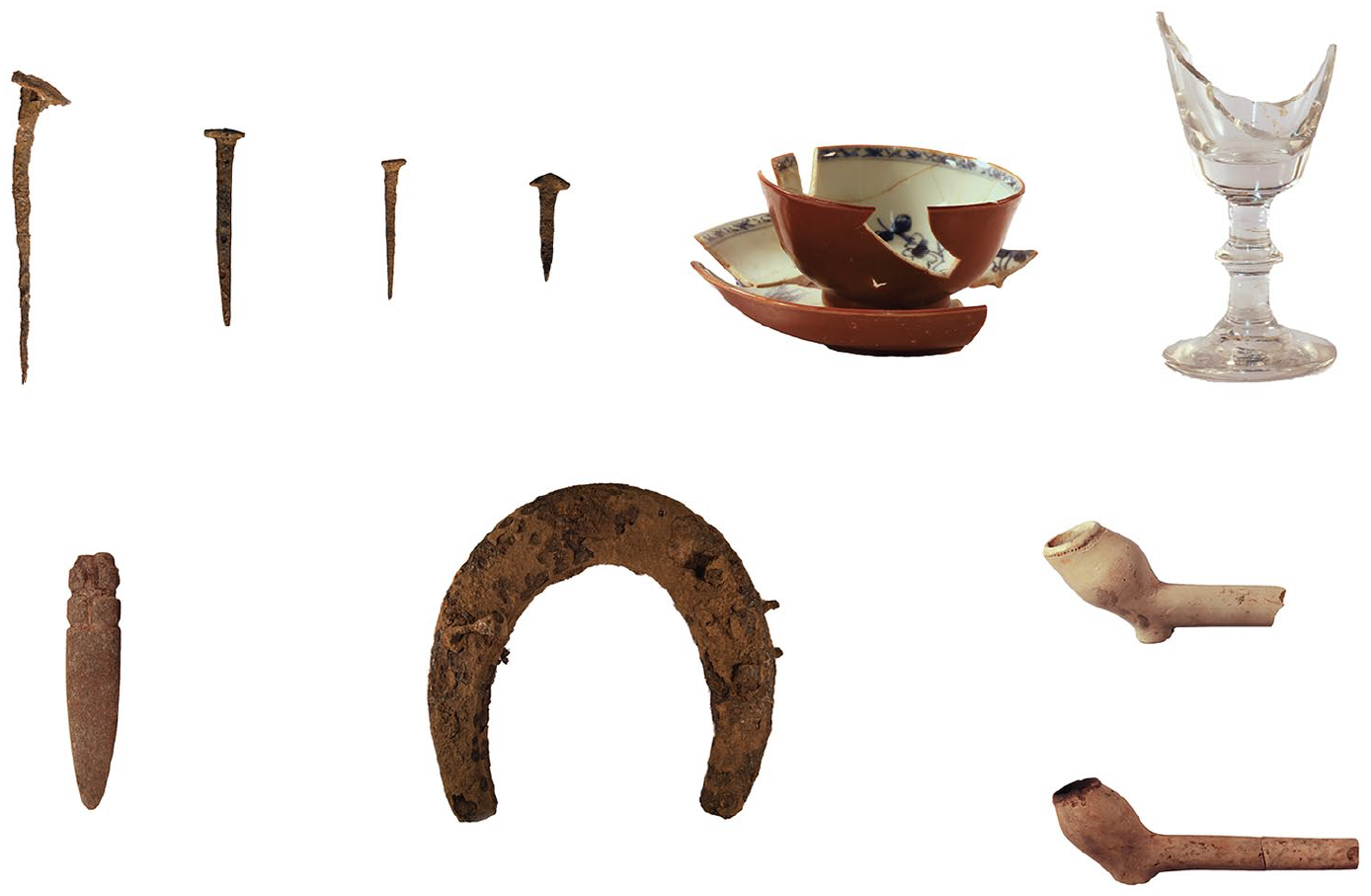
Objects from the thingworld of 17th to18th century Iceland. Clockwise from top left: iron nails; chinese porcelain tea bowl and saucer; glass goblet; schist whetstone; iron horseshoe; clay tobacco pipes. Objects not to scale. © Photograph: Gavin Lucas.
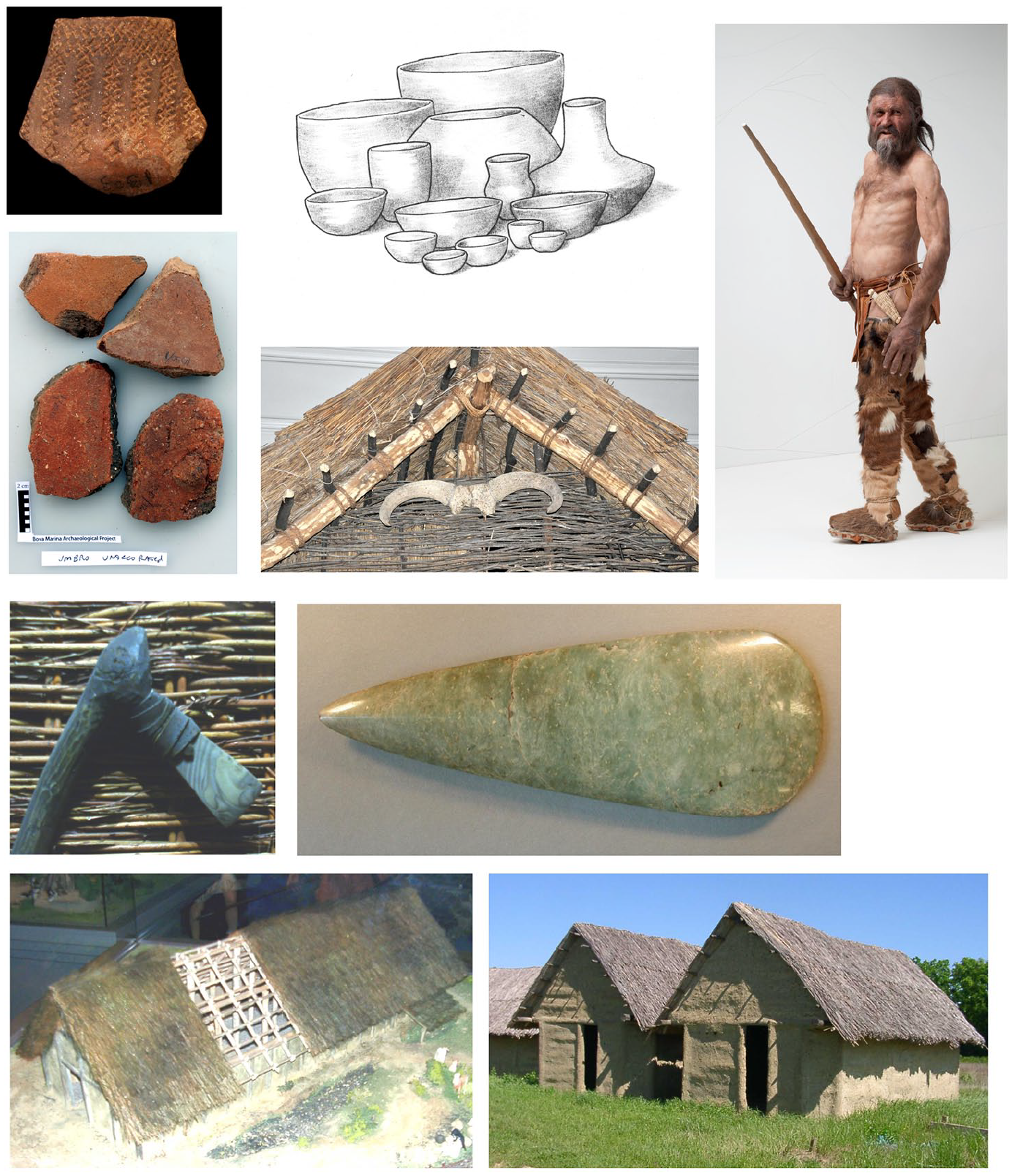
Objects from the thingworld of Neolithic Europe: (a) decorated pottery, Neolithic Italy; (b) undecorated body sherds, Calabria, Italy; (c) reconstructed vessels, Neolithic Italy; (d) Ötzi: a body wrapped in string; (e) String binding together Neolithic houses. Reconstruction: National Archaeological Museum, Budapest; (f) Axe of Alpine jadeite (image: British Museum); (g) Axe of banded flint (Museum of Archaeology, Krakow); (h) Neolithic longhouse (model: Museum of Archaeology, Krakow); and (i) Neolithic houses, reconstructed (Sopot, Croatia).
But perhaps we are looking at it through the wrong eyes. For example, pride of place among Neolithic finds is often given to highly decorated serving bowls and jars. We photograph and draw these; we typologize their microvariations and name archaeological cultures after them; we assume they are important. Meanwhile, the nemesis of Neolithic finds specialists is the Undecorated Body Sherd, whose name is legion. Many of these come from big storage jars. Big storage jars are lumpy, with careless irregular decoration or none at all. They show little interesting variation across a thousand kilometres. They are often dismissed as ‘crudwares.’ Then, one year, we tried experimentally replicating Neolithic pots. We found that an ordinary novice could learn to make a reasonable small decorated bowl in a day or two. You need an orange-sized lump of almost any clay mix. It involves a single small shape; shaping and decorating it took less than an hour. They stand a good chance of surviving the open-pit firing. Containing small amounts of food is undemanding and, if your bowl’s decoration is a bit amateurish, you can still eat out of it. Big storage jars were a different story. Making one takes 10 times more time and materials. They are mechanically delicate, composite forms built in sections, with the joins under a lot of stress. If your timing of building it over several days is not precise, the thick, heavy walls of wet clay sag and collapse. In firing, for anybody but real experts, they explode. And if they are flawed, pests or moisture attack your hard-won grain, or your water drips away. We had been unconsciously trying to force the decorated bowls into the ‘fancy consumer goods’ niche of our own thingworld; but if we think in terms of skill, necessity or investment, fancy decorated bowls are a low-budget distraction; ‘crudwares’ are where the real action is.
So how do we know what the important things really were? This is more challenging for Neolithic thingworlds than for modern ones, and not merely because we are less familiar with Neolithic things. The Neolithic universe of things was much smaller than ours. If we listed all the objects known from Neolithic Europe, we would probably not go beyond 200 kinds of objects. Within any group, it may have been fewer. Of course, our categories of identifiable things will not necessarily match those of Neolithic people, and we might lump together things they considered different. And we know only a few perishable objects, which are preserved only exceptionally in waterlogged sites or dry caves. But, even including known or inferable perishable objects, the repertory was limited. For comparison, Sillitoe (1988) catalogued every named object used by a small tribal group, the Wola of highland New Guinea. The total was 169 objects. A similar ethnography of a Native American group in Alaska came to about 350 items (Osgood, 1934). The Neolithic thingworld was probably on the same scale. A thingworld’s scale does not just reflect how much stuff people have but it also influences how they relate to things and how things relate to each other. In a world overflowing with things, we have a start on distinguishing central and less important things – to separate automobiles from rollerblades, computers from selfie sticks. As a thing-light world, the Neolithic probably had many fewer unimportant objects. Or, conversely, most Neolithic objects were important in some way, but it may have been in different ways. There is a large literature on Neolithic special objects – ritual paraphernalia, ‘art’, exotic objects – but few studies approached it from the point of view of a material culture as an integrated, working system.
What did you really need to act Neolithically? Here, we can peek into Ötzi’s pockets. Modern ‘preppers’ who anticipate catastrophic emergencies keep a bag containing necessities to take if you have to leave your home at five minutes’ notice; it usually contains food, water, basic tools, identity documents, first aid materials, weapons, and so on. What did Ötzi, the Late Neolithic/Copper Age Ice Man who died travelling in the high Alps, carry? A remarkably similar range of items – basic tools, weapons and fire-making kit. Perhaps the most unexpected is a 2m hank of string (Spindler, 1994). Neolithic string was made of twisted vegetable fibres such as tree bast. There is no indication that Neolithic people particularly prized string; unlike spinning thread in later times, we do not find iconography of people making string, or string-twisting gear in burials. Nor did it take much skill; one can learn to twine functional string in an hour or two. But string was the commonest connector in the Neolithic world. When you made something with more than one component, how did you attach them? There were mastics, glue, leather thongs and animal sinews, but these would all have required less common materials, more skill and effort, and longer chaînes opératoires. You might use them for hafting arrowheads and axes, or stringing bows, where something stronger and less elastic might be needed. Otherwise, string was used. In Ötzi’s kit, string turns up in about a dozen places: holding together his grass cloak and overshoes, binding sections of his garments, netting his innershoes and dagger sheath, mending his garments, among other uses. No wonder he carried a hank of it. It formed the basic material for netting bags and some garments. In bigger projects, to build a house, major timbers were pegged together to make the frame. But, after this, joining smaller timbers, creating the walls and roof frame, and attaching reeds or grass to thatch the roof, would all be done with string. If you planned to build a house, you might well start twisting the necessary string a year in advance. Twine may have been as uninteresting to Neolithic people as it is to archaeologists and anthropologists but, without it, the Neolithic world would have fallen apart. It was a connector, component, enabler, invisible and omnipresent.
What about ideological salience, a traditional criterion for important objects? Megalithic constructions clearly reflect social resources mobilized in the service of cosmology on a large scale, though they are found only in the 5th–3rd millennia BC and mostly in Western Europe. Similarly, the remains of the dead were sometimes considered powerful objects, but in patchy and heterogeneous ways. Figurines are found widely in southern and eastern Europe; they provided one avenue for female subjectification (see Meskell and Joyce, 2003) but were probably not the major vector for it, compared with bodily practices. Although archaeologists often consider them ‘art’, they were minor ritual paraphernalia possibly associated with gender-specific life-cycle rites, probably more comparable to a low-investment, disposable medical technology. The big unknown is costume and social presentation. Strikingly, almost half of Wola objects consisted of costume and adornments for different categories of people or different contexts. Except for shell, these were made almost entirely out of organic materials such as fibre and feathers (Sillitoe, 1988). For Neolithic Europe, except for shell ornaments such as spondylus armbands from the Black Sea or Aegean which were traded as far as Central Europe, we know little of costume and self-decoration; it may well have been equally extensive.
Across Europe, there is really only one widespread archaeological candidate for a symbolically powerful Neolithic object (Bradley and Edmonds, 1993; Gauthier and Petrequin, 2017; Pétrequin et al., 2012). This is the polished stone axe. Axes are found throughout Neolithic Europe. They were universal tools for cutting timber and working wood, and perhaps for cultivating soil. They were also a basic weapon – something reflected in cranial traumas showing the outline of axes. They were traded over very long distances, which reflects the patchy distribution of the hard metamorphic stone or high-quality flint needed to make them. But they were more than functional tools. Their appearance was clearly highly salient; they were worked with long hours of labour to produce gleaming, visually perfect surfaces in a way going beyond any imaginable functional need. They show typological diversification, with some made of particularly fine stone. The epitome of these are Alpine jadeite axes, of exceptionally hard material which is extremely difficult to work and which shines like green glass. Axes were deposited in ritual contexts. In the few Neolithic burials found with grave goods, axes are a common ‘male’ object. Both extra-fine Alpine jadeite axes and ordinary axes were sometimes deposited in megalithic tombs or special depositions. Unlike pottery, which was embedded in dense systems of local reference, axes also embodied a more decontextualized aesthetic, enabling them to link widely separated groups (Robb, 2015). Axes also turn up in iconography, in Breton rock art and as ‘male’ icons in the earliest (Late Neolithic) statue-stelae in France and Italy. These suggest a potential gendered connotation; ethnographic parallels from Melanesia and Polynesia show how axes can be both powerful gendered objects and objects of cosmological power (Battaglia, 1990; Lillios, 1999; McNiven, 2016). These rare, anomalous sensory qualities and special depositional contexts, combined with ethnographic parallels, suggest that, in specific contexts, axes may have had numinous qualities for ritual participants. Axes had complex social biographies: they were sometimes used to destruction, sometimes cached as social capital, sometimes exchanged, sometimes deposited ritually and sometimes given new lives (as when small axe fragments were refashioned into amulets to be worn). Each pathway represents a different context and network of social relations. With their geographic mobility, universally comprehensible visual aesthetic and complex social biographies, axes stood at the centre, defining and mediating relationships across and within groups.
Finally, did some objects generate social relations more broadly and effectively than others? Leaving aside the sociality of Neolithic cuisine (Robb, 2007: ch. 5), an obvious starting point is to look at big and complex objects. Which things integrated components from many sources, implying extended supply chains and layers of planning? Which things involved accumulating substantial resources, or demanded cooperation of many people? Boats are one possibility: for both ocean and river travel, these were dugout canoes, sometimes large and implying crews of 5–10 people. Ditches and palisades found sporadically around Neolithic settlements served an important integrative role. Megalithic monuments are another possibility, although the overwhelming majority of Neolithic people had no experience of megaliths, let alone the really big ones such as Stonehenge, Avebury, Carnac, or the Maltese monuments. Instead, throughout Europe, the Neolithic was the time of houses. For almost all Neolithic groups, houses are the largest archaeologically identifiable material project. North of the Alps, longhouses were massive undertakings, structurally overbuilt with dozens of oak timbers, wattle and daub infill and thatch roofing. Indeed, they have been considered almost as surrogate monuments. It would have taken enormous effort to assemble the materials needed to build one – piles of cut and transported timber, sheaves of smaller sticks (perhaps collected from coppiced trees), heaps of clay, straw and manure, bundles of reeds, pools of water and miles of string. They must have been erected by extended work gangs, perhaps brought together socially through a house-raising and feast. Once built, the longhouse probably housed multiple families, its length reflecting social importance. Even in areas where people lived in smaller, family-sized houses, building a house reflected a substantial, long-term project, the largest assemblage of materials and the most complex coordination of labour we can see archaeologically. Nor was the aim simply to provide shelter, which almost always could have been done more simply. Even without invoking structuralist models of ‘house societies’ (Carsten and Hugh-Jones, 2012), co-residence was probably the basal identity for many social roles, especially those involving close relations and shared knowledge and material lives. The work to produce a house itself may have been a means of integrating a group and sanctioning the unit using the house. Some confirmation of this comes from the fact that, in the Balkans and central Mediterranean, house biographies were often intentionally ended by burning them down well before their practical use-life was over. Similarly, LBK (Linearbandkeramik) Neolithic longhouses may have been abandoned before they were structurally unsound (Robb, 2007; Stevanovic, 1997). The ending of houses mirrored, and perhaps created, an ending of the social unit they brought together.
Realizing that axes and houses were important Neolithic objects will hardly be surprising, though few Neolithic specialists have ever contemplated the necessity of string. The key thing this discussion reveals is the nature of the Neolithic thingworld and why important things were important. The Neolithic shows us a stripped-down thingworld, without the glut of superfluous or derivative objects many later societies are awash in. In this, it may perhaps give us a glimpse of a baseline thingworld typical of much of human history. This may include styles of dealing with material things which were probably widespread in ancient worlds but deeply different from our own – for instance, accomplishing functional tasks not through specialized tools but by relying upon a few simple, general-use objects and the skill of experienced hands. For understanding differentiation within thingworlds, the main thing it teaches us is that all objects are not equal, but they cannot be simply arranged along a single continuum of ‘trivial’ to ‘important.’ Everything in it was important, but in a different way. And it poses the question of whether the thing-niches it afforded – connectors and enablers, ideological foci, integrative projects – are found stably elsewhere in human history, or whether such things evolve with the rest of human society.
Discussion: The terrain of thingworlds
If you are going to write ‘A History of the World’ in objects, which are the right ones? How do we know if an object was important, and why? The traditional answer to this is best summed up as ‘you know it when you see it.’ Our intuitions on the subject tend to merge potentially real data such as an object’s size, complexity, necessity and cultural elaboration with archaeological preconceptions (sometimes modernist, sometimes gendered). There is also a bias towards things that preserve, look fancy, and have historically been collected. While we applaud A History of the World in 100 Objects as a real success in drawing social history out of things, a cynic might add ‘which got collected by the British Museum and are sufficiently photogenic.’ The other tradition bedevilling the issue is typologism. When scholars have tried to differentiate material culture, we have often assumed a priori categories. For example, Binford (1962) divided objects into functional, social and ideological things. This formalization of common sense itself builds upon a tenaciously entrenched distinction between ‘material’ and ‘symbol’, ‘technology’ and ‘culture’, and ‘function’ and ‘style’ which has taken a generation of theoretical debate to deconstruct. Objects rarely conform to only one ‘category’ or ‘type’ and it is often not self-evident what an object really does.
Instead, if we think in terms of how things relate and how significance is distributed within a thingworld, it is clear that ‘centrality’ and ‘importance’ do not exist as unidimensional categories. In part because thingworlds vary greatly in their nature and in part because of the problems of typologism noted above, we do not think it useful to propose ‘universal’ categories which define important or central objects regardless of social or historical context. But this does not mean that every thingworld is unique, that importance or centrality is wholly relative and relational. Our argument is simply that it is worthwhile exploring commonalities or recurring motifs of different thingworlds because such comparisons will enrich our understanding of how things are related to each other. In this spirit, we offer four observations based on our vignettes:
These sources of significance do not have to coincide. Mediators and connectors (such as nails, string and paper) and things with non-substitutable qualities (such as Icelandic whetstones) are often not very culturally visible or elaborated as long as their basic provision is assured. Conversely, if culturally compelling objects were to vanish, there might be cultural trauma but little immediate practical consequence.
To the extent that thingworlds have recurrent structures and objects have recurrent affordances, there are likely to be family resemblances across thingworlds; personal apparel is often a medium for creating social identities, architecture for creating group identity and so on. But these parallels are contextually qualified, not rigid, and beloved archaeological categories such as ‘prestige goods’, ‘ideological symbols’ and so on are rarely useful as more than a loose descriptive shorthand. Objects rarely conform to single categories of practice. For example, what made Neolithic axes unique was the variety and density of relationships they accumulated, as practical tools and weapons, cosmologically powerful objects, objects of ritual and objects of exchange, making them mediators connecting multiple spheres.
This discussion has merely opened up the possibilities of understanding material culture through a thingworld approach, which combines investigation of specific objects with their place in systems of relationships. But it suggests some outlines of an emerging discussion. As this suggests, an object’s cultural importance emerges from a negotiation between multiple factors. The physical affordances of the material are important but not determining, as raw material for social process to transform. The internal structure of thingworlds and how objects interact is equally important; some objects may be invisible but essential, while others have an exaggerated capacity to generate social relationships. A third factor, even more rarely discussed, is a meta-style of how a society chooses to interact with material things. For example, native categories of power may defy formal criteria such as scarcity or cost; relatively common substances such as red ochre may have acted as ontological switches in Native North America (Zedeno, 2009). This raises the question of whether thingworlds have a universal or local nature. How is a world with hundreds of different things distinct from one with thousands, as in contemporary life in the West (Hahn, 2020). Is importance a limited quality so that, as things increase, we possess many more unimportant objects? Does a thing-heavy world necessarily result in entrapment and dependence (Hodder, 2012)? And does a thingworld result from unconscious cultural styles or historical, economic and political forces? Or does it also respond to conscious preferences, for instance unleashing social distinction or maintaining an egalitarian ethos?
Footnotes
Acknowledgements
We are grateful to three anonymous reviewers whose thoughtful comments have improved this manuscript.
Declaration of conflicting interests
The authors declared no potential conflicts of interest with respect to the research, authorship, and/or publication of this article.
Funding
The authors received no financial support for the research, authorship and publication of this article, and there is no conflict of interest.

Notes
Author biographies
Email: