







Abstract
This essay revisits Hal Foster's essay in Marcus and Myers’ The Traffic in Culture (1995), “The Artist as Ethnographer,” through the lens of the Danish-Vietnamese artist Danh Vo's practice of collecting historical material. While Foster problematizes Western artists’ “primitivist fantasies” in the 1990s world of “postcolonial and “multinational capitalism,” I will consider Vo’ 21st century method of acquiring objects through auction sales, negotiations with their owners, and excavating them from their sites of origin, as reversing the roles of “self” and “other.” In purchasing White House memorabilia dated to the Vietnam-American war at auctions and salvaging antique statues from Vietnamese Catholic churches as artistic practice, Danh Vo illustrates what Hal Foster considered the problem of “othering” the self instead of “selving” the other. This essay will consider how Vo could present a case of alterity that returns the gaze and projects Vietnamese history back to the Western viewer. In her review of Vietnamese-Danish artist Danh Vo's Guggenheim retrospective in February 2018, Roberta Smith hesitated to call the artist an artist Instead, she dubbed him, somewhat pejoratively, a “hunter gatherer” and called his collection of historical objects to be illustrative of the “usual fate of non-Western countries: the debilitating progression of missionaries, colonization, military occupation and economic exploitation.” The tone of her review is precisely the kind of attitude on the part of the contemporary art world that an artist such as Danh Vo, and others who have been marginalized from institutions such as the Guggenheim, have been fighting against Yet, Vo's very presence in a solo exhibition at the Guggenheim serves to disprove Smith's own “assumption of outsideness” (Foster 1995: 304).
Hal Foster's essay “The Artist as Ethnographer” which first appeared in George Marcus and Fred Myers’ volume The Traffic in Culture: Reconfiguring Art and Anthropology, begins with a reference to Walter Benjamin's plea to the artistic community to “transform bourgeois culture.” When Benjamin (1968) coined the phrase “The Author as Producer” in 1934, he was implicating artists in a project that was greater than their own creative talent; they were to contribute to social production at large. Since then, others (Alberro et al. 2018; Godfrey 2007; Khullar 2019; Lally 2013) have picked up on the trend and considered the many roles that artists can fulfill. Artists have been likened to “curators,” “fieldworkers, “tricksters,” “historians” and “ethnographers,” in the case of Foster. The artist as…fill in the blank, has been a common trope coined by scholars and curators looking for ways to expand artistic production beyond the studio. These similes suggest, like Benjamin intended, that an artist can and/or should take on more than one role. An artist is never just an artist
What is an artist ethnographer? To Foster, it is an artist who incorporates into their artistic practice elements from cultures that are not his or her own. In the 1990s, when Foster wrote his essay, he was questioning the potency of the proletariat artist identified by Benjamin, in an era embroiled in identity politics. In the nascent era of Post-Colonial Studies, he was challenging the authority of the Western artist to speak for the “other.” He was also pointing to a deficit in the field of art in its ability to speak about difference, the domain for which ethnography was more qualified. Why revisit Foster's essay “The Artist as Ethnographer” today? For one, the art world has undergone tremendous change since that essay was first published, especially in its diversity and inclusion of artists from the traditional sites of ethnography, the Global South. In the current era of decolonization, artists and scholars are pushing these issues further. I propose to revisit how an artist – whose position of alterity has shifted in the age of globalization toward inclusion in major art museums in the West – may challenge the ethnographic methods presented by Foster and reverse the paradigm of the “othered” self by presenting a “selfed” other (Foster's words). Ruth Philips, in her contribution to this special issue, also explores “how an exhibition of indigenous art can test the agency of Indigenous studies as a paradigm changing third term.” This essay explores the work of the Danish-Vietnamese artist Danh Vo (born Bà Rịa, Vietnam in 1975) through the lens of ethnography in a changed art world. The artist's practice, since 2005, of collecting and exhibiting historical artifacts as art objects is an ethnographic practice. And, it offers an opportunity both to investigate how an artist's methods of acquisition can overlap with those used by ethnographers and examine how the methods of art history can intersect with anthropology today. Manuela Ciotti observed that “since the mid 2000s, several scholars (mostly based in Europe) have focused on re-defining the relation between art and anthropology.” She noted “a shift in anthropology whereby art has become ‘less an object of enquiry ‘the anthropology ‘of’ or ‘on’ art’ and more of an analogous mode of investigating the world,’ with the focus on making rather than on an object's qualities and their significance in the world.” (Ciotti 2020) Danh Vo's practice of collecting as art is ethnographic in that it shifts the site of inquiry from the object to him as the selector of the object, and transfers the act of interpretation away from the viewer toward him. He becomes both the investigator and the subject of investigation. Her exploration of the art flows in which contemporary Indian artists figure also resonate with my study of Danh Vo.
Anthropologists have been interested in art in a variety of ways. Perhaps inspired by Bourdieu’s (1984) study of the relationship between social class and artistic taste, a number of anthropologists in the 1990s took interest in the institutions and systems that produce art and its audience. Marcus and Myers’ The Traffic in Culture, in which Hal Foster's essay appeared, as well as Myers’ own examination of the market for aboriginal painting in New York, is one example (Marcus and Myers 1995; Myers 1995). Alfred Gell theorized that art achieves agency through social relations (Gell 1998). He contended that the desire for art comes from society's institutions, be they museums, art galleries or the Western art market. They are providing the impetus for a work to be created. Both Myers and Gell studied the transformation of an object from its original context of creation outside of Western societies to something that one would call “art” in Western society, questioning whether what is produced in societies outside of the West, is in fact art? For Gell, an anthropology of art considers art as a by-product of the mediation of social life and the behavior in the context of social relations. This was the focus of the 2003 Clark Institute conference titled “Anthropologies of Art,” discussed in Ruth Phillips’ essay, that examined the intersections and divergences between anthropology and art history and how these disciplines understand the term “art” (Westermann 2005).
More recent anthropological studies of art have shifted the focus away from art in non-Western societies to the world of Global contemporary art. In one instance, Roger Sanso, sees parallels between the work on contemporary art curators and ethnographers, both creatures of wanderlust scouring the globe for objects of study (Sanso 2020). In others, anthropologists use ethnographic methods to look at networks of curators, collectors, artists, auction houses and museums (Fillitz and van der Grijp 2018). These studies view the contemporary art world as a system that relies on social relations unlike Foster's consideration of the art object itself and the inclusion of ethnographic, cultural and historic objects in a contemporary art framework or setting. The artist under study here, Danh Vo, also introduces objects of curiosity and historical importance into exhibitions. His retrospective at the Guggenheim museum will be discussed further. Exhibitions themselves have also become sites of inquiry in the fields of both Art History and Anthropology. Especially since the onset of globalization (Daniels 2019; Steads 2014). Similarly, Ruth Philips’ discussion of the role that museums and exhibitions play in the process of decolonization questions the suppression and erasure of Indigenous knowledges in these paradigms shifts.
If I attribute to Danh Vo the role of an ethnographer, I remove any inclination on the part of the viewer to study his objects on their own terms, and therefore effectively deny the viewer the option of considering them as objects devoid of context. I am imparting on the artist a role that is on par with my own area of expertise in order to engage in a dialogue with the artist and to consider him the primary investigator of the works that he has presented to his audience. Elsewhere, I have argued that art history as a method of inquiry can, at times, be deficient when it comes to studying artists and art works from Southeast Asia where archival documents are missing or have been destroyed, and ethnographic tools such as interview, observation, and oral history become more apt. (Taylor 2009, 2011) What I propose here is more complex as it advocates placing both the research and the artist in the ethnographic role, as decipherers of culture. I am extrapolating on the idea expressed in Hoskins’ (1998: 2) ethnographic study of things and acknowledge that people and their possessions are “so complexly intertwined they could not be disentangled.”
But, more than simply owning “things,” Vo acquires them through a process that is loaded with cultural, social and class significance: the auction. Vo's forays into the auction serve as a kind of investigative historical ethnography, exploring both alien and familial worlds inhabited by Western colonialism, Catholicism and imperialism. I propose to concurrently study the artist as an ethnographic subject without resorting to the paradigm of “outsidedness” and alterity. Other than the artist's practice, which consists rather exclusively of acquiring objects and placing them in an exhibition space, the artist's own biography, as a formerly colonized Catholic war refugee, presents a window onto the new Contemporary art world that has embraced such narratives.
This was lost on the New York Times art critic Smith (2018) who, in her review of Danh Vo's Guggenheim retrospective, perpetuated the idea that, because of his Asian origin, Vo was somehow outside of the realm of contemporary art. She even hesitated to call the artist an artist Instead, she dubbed him, somewhat pejoratively, a “hunter gatherer” and called his collection of historical objects to be illustrative of the “usual fate of non-Western countries: the debilitating progression of missionaries, colonization, military occupation and economic exploitation.” Smith sounds bored. As if she find this list of cultural associations is tedious and uninteresting. She seems to overlook that, in order to achieve the kind of success that Vo has in having a solo exhibition at one of the most important museums of contemporary art in the world, he must have overcome many of the obstacles which artists from non-Western countries have faced in the past when the art world was more Euro-American centric. It also reveals an ignorance of the global art world where artists such as Vo have long departed from the stereotypical situations that she describes. Vo is aware of that and his selection of objects that originate from a colonial and imperial context challenges such notions. Not once did Roberta Smith consider the specificity of Danh Vo's historical references – not to mention that most of them concern the fate of the United States’ policies toward Asia – or how history as a medium has been the focus of the work of so many artists from Southeast Asia precisely to recall, reclaim, reenact, rethink and recontextualize historical events. Furthermore, to call Danh Vo a hunter-gatherer conjures “primitive” practices rather than referring to a vocabulary inherent to the contemporary art world. Hal Foster also pointed to shortcomings with such labels. He expresses a problem with the “assumption of outsideness.” He states: “If it is true that we live today in a near-global economy, then a pure outside can no longer be presupposed” (Foster 1995: 304).
This applies to Vo as well. His omni-presence in art galleries and museums around the globe confirms his status as a global art star far from marginal to mainstream contemporary art. Vo's very practice both provisionally adopts and then undermines this “assumption of outsideness.” By carefully selecting objects that might be interpreted as ethnographic, he engages his audience in a conversation about how these objects may be viewed. He displays them in a way to emphasize their alterity. For example, If I were to climb the Himalayas Tomorrow, from 2009, discussed below, which consists of the artists’ father's Rolex watch, Dupont lighter and American military class ring, are presented in their original boxes in a vitrine as if to mirror how they would be showcased in a jewelry shop window or museum, highlighting their preciousness but concealing their source: deeply personal objects acquired by his father after leaving Vietnam. Foster's critique of the romanticization of the “other” by Western artists is countered by an artist who might return the gaze of the “other” and project history back to the Western viewer. Foster finds that the artist-ethnographer ends up “othering” the self more than it “selves” the other (Foster 1995: 304). Vo's presentation of objects is a strategy to situate himself as an ethnographer deliberately to “other” not himself, a diasporic Vietnamese and a refugee, but the viewer, the originator of the objects on display, the American who initiated the war on his country, or the art critic who sees these objects as biographical.
The artist as Danh Vo
Before he was an artist, Danh Vo was a person of Vietnamese descent, a child of Southern Vietnamese Catholics, a refugee, a boat person and an immigrant to Denmark. He was born Võ Trung Kỳ Danh in 1975, in Bà Ria, a town deep in the heart of the Mekong Delta, in what was the Republic of Vietnam or the US backed regime of what is commonly known as South Vietnam. The year of his birth is an infamous year in the history of Vietnam. On April 30 1975, the Liberation army from the North took over Saigon and effectively ended the war that had lasted nearly two decades. His family had originally come from the North but had converted to Catholicism for political reasons. His father supported Ngô Đình Diêm, a polarizing political leader sponsored by the United States in their fight against communism. Diêm had launched an unpopular campaign against Buddhists that drove several monks to self-immolate in protest He was eventually assassinated in a coup supported by the CIA. After 1975, owing to their support of Diêm, Vo's family feared persecution by the newly installed regime and, in 1979, they decided to leave the country by boat.
According to the artist's biographical accounts, his family's boat was rescued at sea by a Danish freight ship (Brinson 2018). After spending time in a refugee camp in Singapore, the family sought asylum in Denmark. His father believed in destiny and the good omen that had saved their lives. There were not many Asians, let alone Vietnamese living in the suburbs of Copenhagen where the family settled in the early 1980s. Thus began the artist's journey into otherness, both becoming an ‘other’ himself and viewing Danish school mates as others. The family learned Danish and their names were changed to conform to Danish customs of first name first and last name last Võ Trung Kỳ Danh became Trung Kỳ Danh Võ which he later changed to Danh Vo, without the diacritics. While it is common for immigrants to adapt their names to local appellation practices, Vo made a point of challenging certain Danish norms with an on-going performance piece, started in Denmark in 2003, that entailed marrying close friends and legally changing his name to reflect the union. Thus, after two marriages, Vo is now legally Vo Rosasco Rassmussen.
The artist explains this act as taking a stance against the heteronormative practice of women taking on their husbands’ names. As a gay man, in marrying these women, he performed an act of passing as a heterosexual. He was also making a gesture of asserting difference. The women he married were not Vietnamese, the names that he took were of European origin. If one were not aware that he was marrying under false pretenses, based on his name alone, one might assume that he was white or of a mixed race. Having a hybrid name nearly amounts to creating a hybrid identity for himself, performing an act of othering. He joins a slate of artists who have adopted identities for the sake of art, often in the form of disguises. Nikki S. Lee creates a series of “projects” that entailed immersing herself in a sub-culture and transform herself into a bar dancer, a school girl, a Latina, a lesbian or an elderly person. Cindy Sherman, Ming Wong and Tseng Kwong Chi took photographs of themselves in disguise, looking a part or subverting a stereotype, a gender or an icon. Some artists take aliases or reinvent themselves by adopting a new name such as Inder Salim who performs as a part-Hindu part-Muslim man or Ray Langenbach, an American man who assumes the identity of a Chinese woman named Lan Gen Bah. These are just a few examples. Vo's act stands out because it took the form of a document, the actual marriage license, which he has framed and exhibited in galleries and museums (Figure 1). The work resides not only in his passport but also on a piece of paper, the trace of the act itself. By preserving and showcasing the official document he maintains the act alive, suspending the event in time. This aligns with Schneider’s (2011) notion of a performance remain or the ghost of a past act that keeps the performance active rather than disappearing as soon as the performance ends.
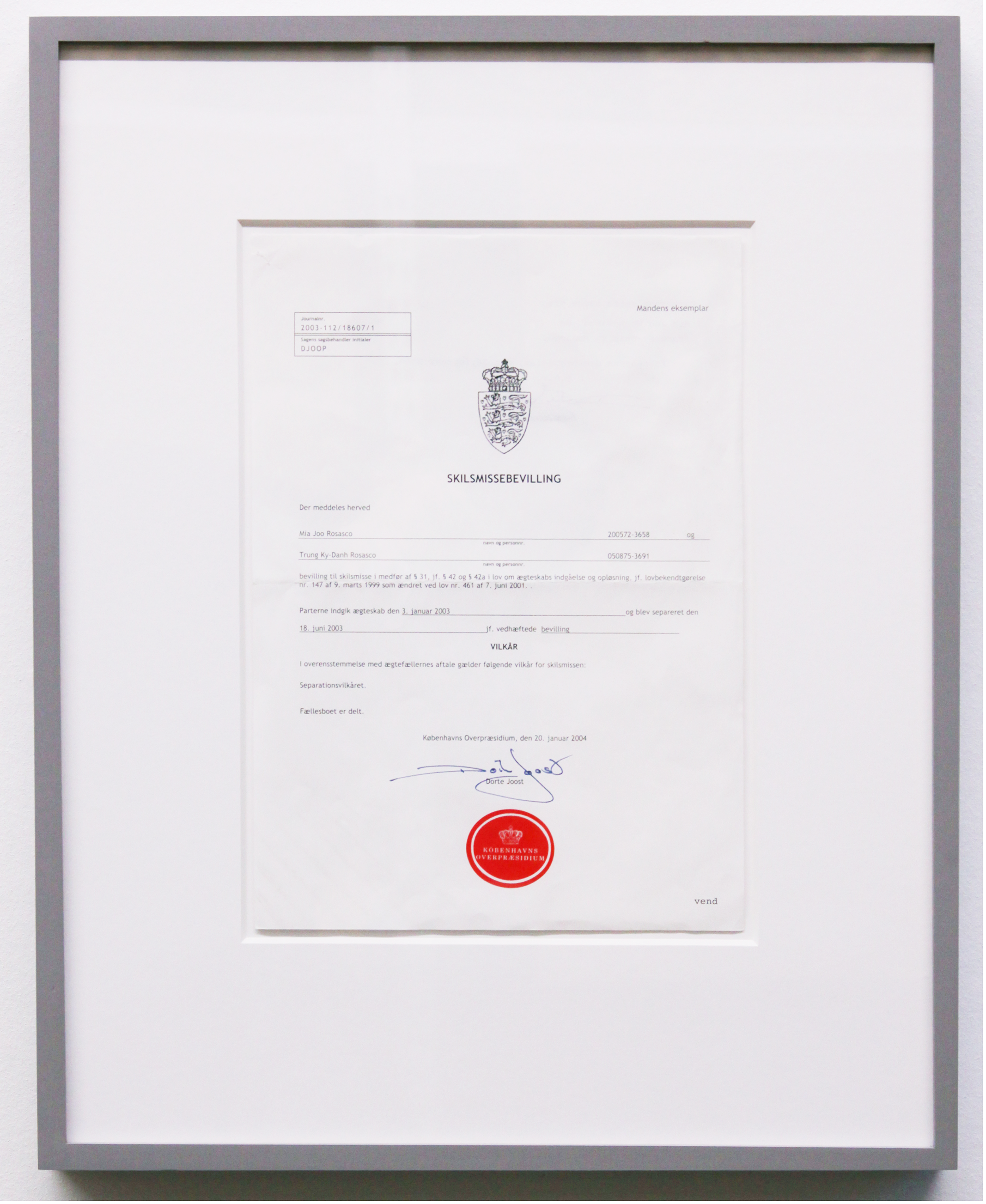
Danh Vo, Vo Rosasco Rasmussen, 2003, photograph Nick Ash, courtesy of the artist.
Lambert-Beatty (2009)'s examination of the parafictional in art or an art work that plays in the overlap between fact and fiction, the space between the fictional and the real also comes to mind. The document makes the marriage real but the artist does not claim to have truthful conjugal relations with the women that he marries, he does so in the name of art. In providing documentary “proof” of a union between a man and a woman, the artist mimics the heteronormative practice while subverting it whereby he, a gay man, takes the name of a woman by challenging the gendered practice of women who adopt their husband's name upon marriage. These conjugal acts say as much about matrimonial institutions as do about the artist’ view of them. Rather than becoming a producer, the artist thus followed the path of critically engaging with both his own history, the perceptions of that history and the culture of others and the context in which both overlap. This may be akin to a method of immersive fieldwork or ethnography or participant observation. James Clifford (1988: 34) has noted the paradox in “participant observation” in that it “serves as shorthand for a continuous tacking between the “inside” and “outside” of events: on the one hand grasping the sense of specific occurrences and gestures emphatically, on the other stepping back to situate these meanings in wider contexts.” He simultaneously performed an act of acculturation and appropriation by taking possession of a Danish name which could be interpreted as a gesture toward assimilation as an foreign subject.
Vo Rosasco Rasmussen prompted Vo to look closely at his own identity, both as Vietnamese and as a gay man. His marriages were acts of both coming out and concealment, the kind of double play that characterize his subsequent forays into auction items acquisitions. After studying art at the Royal Danish Academy of Art and moving to Frankfurt to study at the Städelschule, Vo found himself drawn to his family's story and mined his parents’ possessions as a source for his art practice. This included staging an exhibition in his parents’ apartment in the suburbs of Copenhagen in 2006, and creating a sculpture out of the items that were given to his grandmother when she arrived in Germany as a refugee. The resulting work that he titled Oma Totem (Figure 2), superimposed a television set on top of a refrigerator on top of a washing machine and adorned with a cross. Joshua Chambers-Letson (2018: 49) reads these objects as properly gendered commodities and “instruments of reproductive labor.” In superimposing these appliances, and thus constructing a totem pole as the title of the work implies, he is implicating them in a form of totemism, or turning them into symbols or stand-ins for his grandmother. He is not the one totemizing them, rather, the work seems to be taking a position against the manner in which his grandmother was reduced to her contributions to consumer culture. As Chambers-Letson (2018: 49) continues: “The encounter with the sculpture might leave the spectator with a flat, dead, cold feeling matching the commodities themselves. It doesn't tell the spectator much about who Nguyen (Vo's grandmother) was, save to describe the process through which she became a properly gendered, racialized, laboring subject of and for European capitalism.” In Chambers-Letson's view, the totem stands for the de-humanization of the artist's grandmother, but it also makes assumptions about class. To say that she was altered by the adoption of these appliances presupposes that she came from a privileged class that either didn't need these, as she would have had domestic help, or that she was of an agricultural class and would have considered these objects an upgrade. Regardless of her former status in Vietnam, they stand as emblems of acculturation, meant to transform Vo's grandmother into a proper German citizen. Or as Marshall Sahlins (1993: 20) recounts in his essay on tropes in anthropology, “modern culturalism includes the demand to have these things (refrigerators and television sets), or more precisely, to domesticate them.”

Danh Vo, Oma Totem, 2009, at the Guggenheim Museum 2018, photograph Nick Ash, courtesy of the artist.
According to Marshall Sahlins (1993: 19), this is the condition of the Modern world in an increasingly alienated environment. As he states, “in any local sector of the global system, the transformation assumes the dual appearance of assimilation and differentiation. The local people articulate with the dominant cultural order even as they take their distance from it, jiving to the world beat while making their own music.” In stacking his grandmother's possessions vertically, the artist is likening these objects to the monumental pillars carved with symbols or figures by the indigenous peoples of the Pacific Northwest coast of North America. The word “totem” is an Algonquian word meaning lineage or kinship group. These posts serve to commemorate ancestors, and the images that are carved on them often embody a historical narrative that is symbolic for the group that carved them. The Vietnamese people also practice forms of ancestral worship and build altars in their homes adorned with photographs of deceased relatives. On death anniversaries, descendants make offerings in the form of fruit, money and cigarettes and place them on the altars. Vo combined the Native American structure of venerating one's clan with the Vietnamese symbolic reverence for the elders married with European commodity fetishism. The ordinary possessions that form Oma Totem have the qualities of an altar, or a grave that contains items for spirits to take to the afterlife. To an outside viewer, and the refugee resettlement Catholic relief services, as Chambers-Letson stated, they are mundane commodities that signal a desire for an assimilated life in Germany. They are presented by the artist as evidence both of his grandmother's “othering” and acculturation precisely because she was not a working class woman in her home country.
Through the selection of these objects, Vo performed a second coming out, after his marriage work, this time as a refugee. While they pay homage to his grandmother who owned them, by re-possessing them and creating an art work out of them, he not only admitting to his own past as a migrant, no doubt a demeaning condition, but also examining them as such and encouraging the viewer to reflect on the dehumanization of refugees. As a now successful artist, he does not need these, they are useless to him, he has the luxury of repurposing them as sculpture, placing them on view. Oma Totem, as Chambers-Letson argues, is both a stand-in, a trope for commodity fetishism, and also more literally a stack of items that he inherited or borrowed from his family and then presented them to outsiders as art. Their re-posession transforms them into artefacts made by a former refugee, now artist In the process, the artist engages in a dialectical dialogue with the viewer over their interpretation, how he sees them versus how they might be read by others.
The object as a site of consumption and production
Vo's gesture of designating ordinary household objects as art would be familiar to his audience. Marcel Duchamp (1887–1968) famously exhibited a urinal at the Society of Independent artists exhibition in 1917 which was promptly rejected as “not art.” Afterwards, he began the process of exhibiting found objects as art using the term “readymade.” This included a bottle rack and a bicycle wheel. His idea was that the viewer made the work by recognizing it as an art work when exhibited in an art setting. The French curator and critic Nicolas Bourriaud extrapolated on this idea and stated that “Duchamp started from the principle that “consumption is simultaneously also production, just as in nature the production of a plant involves the consumption of elemental forces and chemical materials. Because consumption creates the need for new production, consumption is both its motor and motive. This is the primary virtue of the readymade: establishing an equivalence between choosing and fabricating, consuming and producing – which is difficult to accept in a world governed by the Christian ideology of effort (“working by the sweat of your brow”) or that worker-hero (Stakhanovism)” (Bourriaud 2000: 17).
After Oma Totem, in 2008, in an exhibition titled “Package Tour” at the Stedelijk Museum in Amsterdam, Vo displayed a Dupont lighter, a Rolex Watch and an American military class ring that belonged to his father (Figure 3). Like his grandmother's appliances did for her, to his father, these items stand for his flight out of Vietnam. His father purchased the Rolex watch from the proceeds of the sale of the gold that he carried with him on his trip out of the country; and he bought the Dupont lighter with the first profits he made after arriving in Denmark. The American ring was a gift from a US soldier. The curator of Danh Vo's exhibition at the Guggenheim museum in New York in 2018, Katherine Brinson (2018: XXVII), read these as representing the “incommensurable vagaries of lived experience and the flickering instability of the self.” Often renaming his works depending on the context in which they are exhibited, his father's belongings formed a work titled If you were to climb the Himalayas tomorrow when shown at the Guggenheim reinforcing the sense of unsurmountable loss that migration produces. Like Oma Totem, Vo's father's possessions act as synecdoches, parts that speak for a whole, fragments that come to represent his family's refugee experience. In both the New York and Amsterdam exhibitions, Danh Vo placed the watch, lighter and ring in their cases, open, behind a vitrine that conjures luxury retail display and take on a preciousness that, should the viewers not be aware of their context would appear as symbols of newfound wealth. In the Guggenheim, the watch and the lighter shone behind glass cases in a setting that would be at ease beside Joseph Cornell and Marcel Duchamp's boxes made of found objects that also contain references to time and space as if microcosms or worlds in miniature. But the artist stated that he was interested in what the objects meant to his father: “they are manifestations of desires from the time that his father was in Vietnam (Brinson 2018: XXIII).” According to him, these items ossify a set of fiercely patriarchal cultural values that are attached to them, the idea of masculinity and power: time, fire, war.

Danh Vo, If I were to climb the Himalayas tomorrow, 2008, at the Statens Museum for Kunst, Copenhagen, exhibition “Take my Breath Away,” 2018, photograph Nick Ash, courtesy of the artist.
Vo sees these objects as tropes, stand-ins for ideas which are not expressed explicitly -rather made implicitly -not literally but figuratively. The watch stands for time, the lighter for fire and the ring for war. But, they also point to cultural differences between where Vo came from and where he ended up, between his father's upbringing in Vietnam and his own in Denmark and between what is a commodity and what is a work of art. The social, political and cultural references embedded in both If you were to climb the Himalayas tomorrow, Oma Totem, and the subsequent works by Danh Vo, complicate, if not contradict, Bourriaud's notion of postproduction that defines the creative act as one of section over fabrication. Appropriation, according to Bourriaud, is already an act of production (Bourriaud 2000: 19). Vo's objects however, are neither the average readymades, because their historical associations make them symbolically loaded. Nor are they, according to the artist, appropriated. In 2008, when van Tuijin (2008) interviewed him for the journal Metropolis M, he responded to the question of whether he appropriated the cross that marked his grandmother's grave for another work Grave Marker for Maria Ngo Thi Ha, he answered: “I do not think it was an appropriation. I have a deep fascination for the identity lying in such objects. I mean, I had it on my balcony for a long time, at first I was in shock, I really saw it as a thing related to my grandmother. But in my projects, I always try to separate these things, to de-personify them. In reality, this object consists of traces of imperialistic influences: The alphabet from the French Christian Faith.”
With that statement, the artist suggests that the object is both a trope and not meant to be read literally, and, in saying that he always considered them mere “things belonging to his grandmother,” he also believes in their literalness. This dialectic reveals that the artist moves fluidly from the personal to the impersonal, from the “self” to the “other,” and alternates the roles of investigator and contemplator. On another occasion, at the Renaissance Society in Chicago in conjunction with his solo exhibition there in the Fall of 2012, when curator Hamza Walker asked him about his appropriation of objects, he corrected him. “I don't appropriate, I acquire (Vo 2012).” In denying that he performs an act of appropriation, he is omitting the process by which these objects become transformed by their mere display as works of art. Acquisition suggests the movement from one place to another, the auction house to his home. Appropriation entails re-purposing, using them for something other than what they are. Appropriation, as discussed in Karin Zitzewitz's contribution to this special issue, in regards to the India artist Navjot's collaboration with Adivasi craftspeople, entails naming
Manuel Vella Rago surmises in relation to Duchamp's readymades, that in appropriating, the artist runs the risk of annihilating its uncanniness. The artist expects a kind of aesthetic catharsis to take place on the part of the viewer when presented with the works on display. “The readymades seem to demand that, standing in front of them, the spectator lets a kind of equilibrium take place which, rather than filling – further endowing him with ideas on art and with interesting, theoretical and aesthetic connections – is emptying” (Vella Rago 2015: 97). Vo asks the viewer to view his objects both literally, for what they are – historical records or artefacts – and figuratively for what they might be interpreted to stand for. The difference with Duchamp is that a viewer in 2018, already familiar with art world protocols and vocabulary, would have no hesitation in identifying his objects as works of art. Yet, Vo still manages to implant doubt into the viewer's mind by virtue of his selection of objects and their association with history and by their specificity in relation to the artist's own history. The viewer thus hovers between wanting to associate them with the artist and reflecting on their own positionality vis-à-vis their historical context.
An example of this exists in the works that he acquired after Oma Totem when he transitioned from securing family heirlooms to purchasing historical artefacts at live auctions. Among the more spectacular objects are the three large chandeliers that hung above the tables where the Paris Peace accords were signed in the Hotel Majestic in 1973. How these grandiose decorative lighting fixtures came into his possession is not immediately discernable. Always interested in Vietnam's history, the chandeliers drew his attention when he came across the photograph of the signing of the treaty in a contemporaneous edition the New York Times and immediately took an interest in the disproportionally large glass object looming over the table. Upon further investigation, he discovered that the building had recently been sold to a Chinese corporation and would be subject to a comprehensive renovation. He initiated a complex chain of negotiations for the chandeliers, eventually purchasing all three and creating three separate sculptures with each titled according to the time and day that they were extracted from the ceiling. He kept two more or less intact and dismantled a third, showing it in exhibitions, disassembled in pieces, laid out like a skeleton or the remains of a fossilized dinosaur. These chandeliers are typical objects of choice for Vo. They are glamourous and luxurious and, once again, associated with masculinity, war and death. More importantly, they stand, this time, nearly literally, as witnesses to history.
He recounted that when he took his father to view the chandeliers before they were removed from the hotel, his father remarked that they must be like the ones hanging in the Danish royal palace and wondered how objects of such beauty could have stood at the site of betrayal. By making an association between the chandeliers and the Danish Royal family, his father was also recognizing the distance between himself and the monarchs of his adopted country, his status as a refugee and their wealth and authority. But, by calling them witnesses, he has also anthropomorphized them, given them eyes and agency in the loss of his country. They bore testimony to the act that sealed the fate of millions of South Vietnamese. Although inanimate glass and steel, they became actors in a historic event by association, by their presence at the same moment and place. As objects, chandeliers are heavy, unwieldy items to hold. As emitters and reflectors of light, they are intended to be viewed from a distance. Hanging from a ceiling above those standing on the floor, they are rarely seen at eye level. They were first exhibited at the Kunsthalle Basel dangling beneath a skylight in the center of the main gallery space. At the Guggenheim, they appear reduced in size and were hung from the short ceiling of one of the winding spaces near the ramp, raised only slightly above the tilted floor, offering viewers a close look at its armature, the nuts and bolts of its structure, looking even more like a body of flesh and bone (Figure 4). In lowering them to a human level, he has demoted them, brought them down from their lofty abode, secularized them, made them more human, more to his and his father's class level.
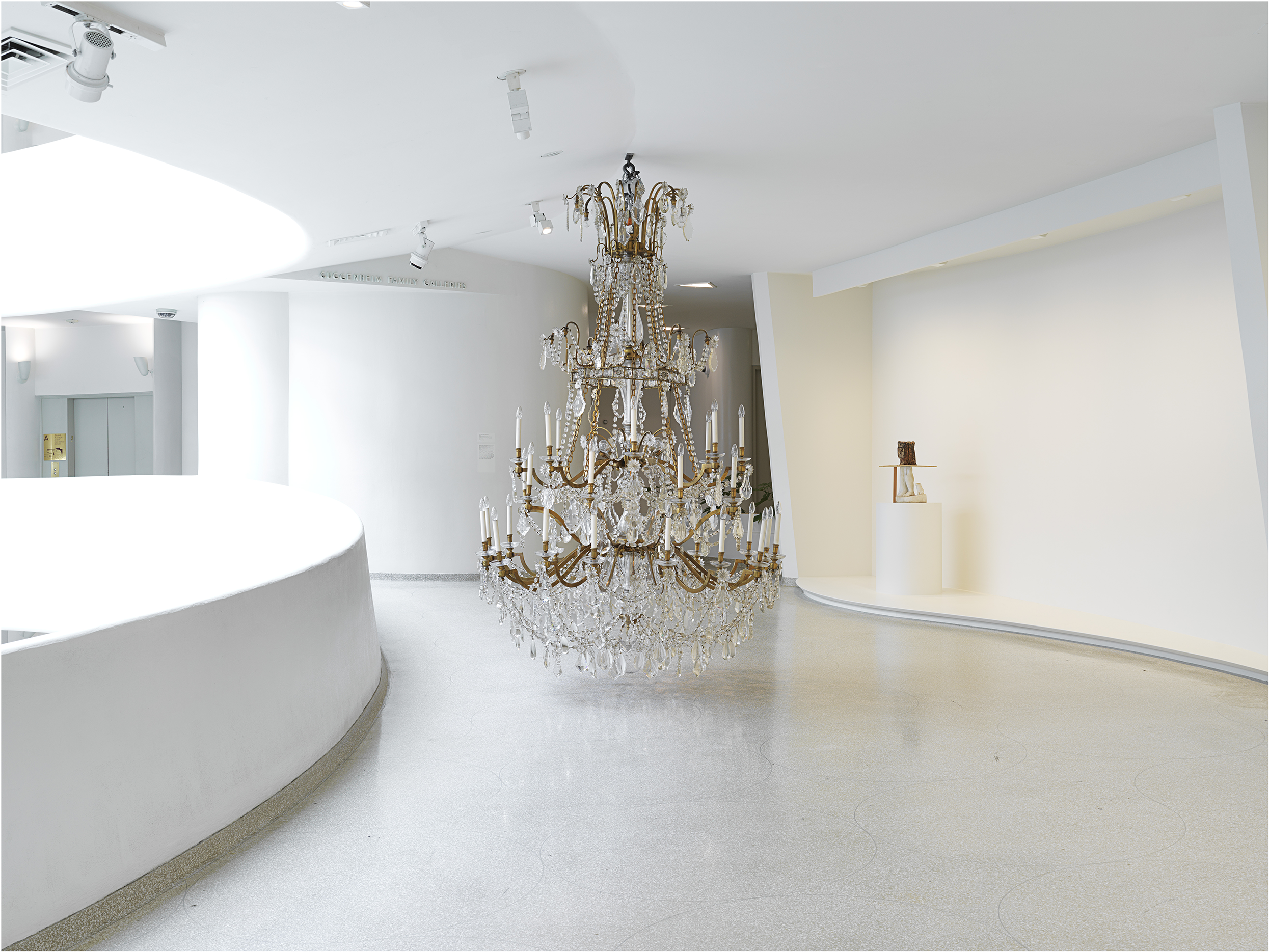
Danh Vo, 08:43, 26.05, 2009, at the Guggenheim Museum, photograph Nick Ash, courtesy of the artist.
Maho (2017: 17) has written about Vo's embrace of logistical and financial challenges. In discussing the monumental work titled We the People, Maho argues that in seeking funding for the fabrication of the replica of the Statue of Liberty, Vo evoked the history of diplomacy that led to the commissioning and gift of the original copper figure by Frédéric Auguste Bartholdi. Negotiations, such as those that Vo conducted for the purchase of the chandeliers, are part of the process of creation, Maho contends, as they mirror the historical environment whence they originated and the global circulation of goods. Through complex financial arrangements between Vo's gallery and potential buyers, 90% of We the people's overall cost has been funded. Since it was pre-sold in essence, Maho considers it to have been not exactly pre-purchased but rather re-purchased. Like his chandeliers and other artefacts that he buys at auction, that have changed hands several times, he, or a third party buys the works and re-sells them. This act of purchasing and reselling is what entitles him to claim authorship of the work and turn them into works of art. These are both the subjects of his investigation and presentation as art objects. During his conversation with Hendrik Folkerts at the School of the Art Institute of Chicago in the fall of 2018, he recounted how he acquired items belonging to former Secretary of Defense, Robert McNamara's estate by asking his gallery to place the bid on them (Vo 2018). Thus, he obtained several chairs that had been bequeathed to McNamara by President John F. Kennedy.
Like the Hotel Majestic chandeliers, the McNamara chairs act both as tropes for American imperialism and as chairs in a literal sense. John F. Kennedy sat in those chairs, Robert McNamara sat in those chairs, both made decisions regarding Southeast Asia while sitting in those chairs. They figure among a number of US war memorabilia that the artist purchased. He has collected letters signed by Henry Kissinger, typed on White House stationary, and photographs of young Vietnamese boys taken in Vietnam by Joseph Carrier, a former counter-insurgency analyst working for the Rand Corporation during the war. While these objects only peripherally took part in the cultural environment surrounding war, in taking possession of them, he may be wanting to own them as an act of retribution and in offering them to American art audiences for view, he is asking them to reckon with their role in this treacherous past
Vo's ethnographic method is revealed in how he identifies an object that he considers has aesthetic and symbolic significance. The object in question becomes a subject of research that the artist investigates and transforms before presenting it to a public as a work of art. In the process, the object becomes personalized, infused with the artist's self-reflection and commentary. It is “selfed” by the artist. For the viewer, however, the process becomes reversed. It is immediately read as art because it is presented as such. But, as the viewer begins the process of recognizing it as a historical document or artefact, it gradually detaches itself from the artist's own hand and takes on the characteristics of an object of curiosity, a talisman, a relic that might embody the artist's experience but is not his per se, as Roberta Smith assumed. The viewer may begin by seeking a personal connection between the artist and Henry Kissinger, for example, especially if they are familiar with the war in Vietnam and Kissinger's role in it. But, as they look more closely at the letter in question, its strangeness or uncanniness reveals itself. While the artist may “self” it, by exhibiting it as his own work of art, he is turning the object toward the viewer and inviting them not only to take part in their interpretation, but to reflect on their own possible association with it. In de-personalizing them, he is inferring that they belong to everyone. This process aligns with Vella Rago's understanding of the relationship between the object in Marcel Duchamp's readymades and the viewer's acknowledgement of the object as such, or as he states “the object's self-affirmation of its identity in a context of community” (Vella Rago 2015: 100). Vo thus emphasizes both the object's own historical value detached from the artist's biography, its collective identity, as well as the power inherent in the artist's acquisition of it.
Art as exploration and cultural translation
In this essay, I have been looking at how Danh Vo's practice centers not on the making of art but on the acquisition of historical artefacts and his dialogic relation to viewers who find ways of interpreting them on the basis of the artist's biography. Through the power of suggestion, by allowing them to behave and become tropes, the paraphernalia surrounding war and his family's migration can also be considered to reflect Small (2013)'s notion of the autopoietic, meaning auto- or self-producing. According to Small (2013: 124), “to approach works of art as autopoietic forms produced in relation to a multiplicity of a-specific mediums is to conceive of art's autonomy as operative, rather than merely ideological or aesthetic.” This would suggest that Vo is less interested in the form of the objects that he selects than their power of suggestion, allowing them to speak for themselves. But, as his selection also combines both extensive research and serendipity – he often narrates how the object came into his possession, how he found it and what he found in it – the object bears the imprint of an ethnographer. Such is the case of his collaboration with Joseph Carrier whom he met in 2006 during a residency at the Villa Aurora, a retreat for writers and artists in Pacific Palisades. As he explained to Tompkins (2018: 8) who wrote a profile of the artist for the New Yorker in 2018, he was struck by the 78 year-old man's correct pronunciation of his name, “Yan” since most non-Vietnamese would not know to replace the letter “d” with a phonetic “y.” Carrier told him that he had lived in Vietnam. The two men then struck a friendship that led to Carrier giving Vo his collection of black and white photographs to the artist Vo showed the photographs as part of a solo show in 2007 at the Isabella Bortolozzi gallery in Berlin called “Good Life.” Tompkins (2018: 9) sees the inclusion of Carrier's photographs in Vo's exhibition as one that gave him “permission to use ready-made material of all kinds, and to challenge the whole idea of aesthetic authorship.”
Tompkins may be oversimplifying the artist's intent. Vo is not trying to pass Carrier's photographs as his own since he includes Carrier's name as part of the work. Here is an example of how he did not appropriate them since her received them as a gift. He is not claiming to be the author of the photographs. Vo has borrowed Carrier's photographs not for themselves, or their specificity as Small would suggest, but rather for their potential. More precisely, he has borrowed Carrier's “eyes” in order to gaze at young Vietnamese boys. He might even consider himself to be one of those boys, reversing the gaze back to himself, the gazer becomes the gazed. Vo is not so much interested in being Carrier, but rather, it seems that, like in his Vo Rosasco Rasmussen, he wishes to inhabit the space between the other and the othering. The work is about exploring what it is like to be both the other and the one doing the othering. He is both Carrier and the Vietnamese boys that Carrier has photographed. This is akin to ethnographic exploration that becomes a means of cultural translation for the viewer. Like the other wartime objects, in exhibiting them, he is calling on the viewers to witness US imperialism and, in this case, homophobia and racism, first hand.
Ethnographers both immerse themselves in the culture that they study and stand at a distance to take a more objective look. Through tropes, figures of speech, word play in the form of objects, Vo positions himself as an observer of human behavior, turning the tables on the ways in which, usually white, ethnographers study non-white cultures. By acquiring objects that literally and figuratively objectify war, he also takes on the study of the way in which the Vietnam war has been orchestrated by American leaders, a war led by white men against his people. Because he collects these objects and exhibits them as “art” in art museums, he mimics and critiques the practices of collecting and exhibiting by art institutions. As Clifford (1988: 220–221) reminds us, “a history of anthropology and modern art needs to see in collecting both a form of Western subjectivity and a changing set of powerful institutional practices. The history of collections (not limited to museums) is central to an understanding of how those social groups that invented anthropology and modern art have appropriated exotic things, facts, and means. It is important to analyze how powerful discriminations made at particular moments constitute the general system of objects within which valued artifacts circulate and make sense.”
Conclusion
By way of conclusion, I am reminded of the 2006 exhibition held at the Vietnam Museum of Ethnology in Hanoi that drew the largest number of visitors of any exhibition in Vietnamese museum history. The exhibition Thời Bao Cấp, or The Subsidy Period, consisted of household objects, trinkets, make shift necessities, food rations and other material documents pertaining to life after war when the country's economy was at its lowest To furnish the exhibition, the museum curators had put out a call to the public to contribute any items that they may have saved from that era. It was, according to McLean (2008: 283), an exceptional event for many reasons. Besides its popularity and attendance, it was an exhibition that focused on the lives of “ordinary people,” unlike other kinds of exhibitions in Vietnam that either glorify the State or highlight the achievements of extraordinary artists, writers or national heroes. By virtue of holding an exhibition of artefacts that were in the possession of, and impacted, ordinary citizens, in a museum, it gave the historical period currency.
The Guggenheim Museum in New York is a very different environment from the Ethnographic museum in Hanoi. And Vo's exhibition has not attracted the same number or kind of visitors as the museum in Vietnam. But, there are some similarities in the way the two exhibitions bring large historical events into view through fragments. The Bao Cấp exhibition prompted memories of a time gone past, not one that was desired, but one that needed to be retold in order to better understand it and its present significance; how it led to the contemporary condition of ordinary people, how history got people where they are now. Vo's exhibition is full of broken bodies, metaphoric and ontological, that can never be whole but serve to explain the artist's family's history, and why they are here in Denmark today, reminding us that putting the pieces back together is an endless process of reconstruction. Instead of transforming the objects he has excavated from history into precious artefacts, Vo has transformed the museum into a site of memory, or a giant reliquary. As if the objects in themselves did not suffice to convert the museum into a shrine, he also intervened in the space in another way. He exposed the oculus, the glass ceiling designed by Frank Lloyd Wright in 1959, thus revealing the spatial atmosphere of the museum. The oculus is usually covered in fabric but in exposing it, Vo has infused his exhibition with natural light, a rare occurrence in the museum. As a Catholic, Vo may be conjuring divine light but, ever mindful of history, his intervention in the museum may be an opportunity for viewers to experience a kind of catharsis, bridging the past with the present. Like the Bao Cấp exhibition, Vo's exhibition reveals the complex relations between humans and their history of how objects serve to construct and reconstruct the past; how symbols of death and destruction can be given new life.
That Vo's objects are displayed in the Guggenheim, rather than an ethnography museum, illustrates my point. He does not allow them to stand merely for where they came from or what they are. Instead, he is demonstrating that he has the means of acquiring them. The art world capital that he has obtained makes him a very different kind of ethnographer than the one Foster described in 1995. He is not the Western artist who tokenizes otherness. The paradigm has shifted. He is the “othered” subject of colonial and imperial rule, marginalized by war and migration, who strikes back and converts the objects that were created during the historical period that led to his flight from his country into art by “othering” them. Through the process of his own investigation, acquisition (at auction no less) and exhibition, he becomes the interrogator and engages the viewer in a study of the historical acts that were committed in his country and the journey that he – and the objects in question – took to figure in a major retrospective at one of the most prestigious museums of contemporary art in the World. He is both spectacle and spectator, the very example of art flows that are the topic of this special issue.
Footnotes
Declaration of conflicting interests
The author(s) declared no potential conflicts of interest with respect to the research, authorship, and/or publication of this article.
Funding
The author(s) received no financial support for the research, authorship and/or publication of this article.
