







Abstract
In the context of historical and ongoing tensions between different ethnic groups, inter-ethnic marriages are increasingly prevalent in Indonesia today. This article explores the social materiality of memory objects (money and related household items) in the negotiation of shared lifeworlds within two inter-ethnic marriages between Javanese and Chinese Indonesians. The research is based on detailed fieldwork conducted face-to-face in East Java over a 10 week period, and supported with further online interactions with participating couples. We demonstrate how a focus on money and related material practices can offer new understandings of how couples respond agentively to inter-cultural tensions in their marriages and strive towards harmony. In doing so we demonstrate how values of cooperation and prudence are articulated through things and related practices, and in the process are harnessed to support couples efforts to build mutually supportive lives together. In the process we document how objects, including money, an onion peeling machine and food emerge in these relationships as both practical things and objects of care, cooperation and affection. This research demonstrates that whilst still of crucial importance, a focus on inter-cultural tensions and the conflicts these can cause can be complimented with a focus on couple's agentive efforts to manage and contain such tensions as they build culturally hybrid lives together.
Reflecting Simmel’s (1978 [1900]) seminal scholarship on the complex social functions of money and related monetary practices in human relationships, recent international research documents how cultural differences that surfice in inter-ethnic marriages not only contribute to conflicts, but can also lead to agentive efforts to cultivate a shared sense of affection and mutual responsibility (Lapanun, 2020), and support efforts to meet different cultural expectations (Sha, 2020). Money and its everyday materialities have been implicated in human beings forging particular ways-of-being and relationships with others (Lapanun, 2020; Kuchler, 2021; Simmel, 1978 [1900]; Sha, 2020). Building on this emerging scholarshp, this article approaches money as a multifaceted everyday mimetic object 1 that is implicated in the conduct of inter-ethnic marriages. Of central concern is how money, related objects, and practices are often implicated in the inter-cultural relational dynamics, tensions and culturally hybrid practices that emerge when persons cooperate to forge new lives together across their culturally-patterned and gendered differences (Mauss, 2002 [1950]; Sha, 2020; Yulianto et al., 2021, 2022). Through the clasification of money as a dynamic and multifaceted mimetic object that serves various particularised functions, including domestic-purposed money, recreational money, and gift money (Zelizer, 1989), we extend previous explorations of the subjective meanings, tensions, and negotiative practices that are central to the conduct of inter-ethnic marriages (Yulianto et al., 2021, 2022). Exploring the everyday use of money with research participants using various ethnographic and visual techniques also informs our understanding of the instrumental role of material objects in invoking meanings and feelings that are often difficult to articulate in words alone (Hodgetts et al., 2020).
It has been argued for some time that particular ‘things’ serve as everday memory objects that elicit recollections of specific moments and feelings of nostalgic, anchor ritualistic practices, and can provide a renewed sense of love and attachment (Avieli, 2009). When considering artefacts of everyday life such as money, it is important to note that the entire meaning of such objects is not simply abstracts and also include elements that emerge from the use of objects in everyday life. Correspondingly, stable meanings are not always encoded or inscribed into artefacts and as such cannot simply be decoded or excavated by researchers without interaction with the people who involve such objects in the conduct of their everyday lives. As such, the meaning of things is both ontological and epistemological (Cohen et al., 1997; Henare et al., 2007; Marschall, 2019). When adopting this perspective to research the experiences and recovery of tsunami survivor families in Sri Lanka, Cassim and colleagues (2015) document how particular materials objects, such as the dress that was worn by a daughter when the waves took her helped a surviving parent to re-member and maintain a strong sense of affective connection with her child. Such affective connections with things (Miller, 1998) also reflect how everyday household items can carry particular significance for particular people and represent aspects of the endogeneous being of householders. Congruently, theorists such as Latour (2013) have argued that everyday objects are not simply static or inannimate and can function as dynamic actors in inter-personal relationships, related social practices, and the rythyms of everyday life (Blue, 2019).
This research is particularly pertinent to Indonesia as a culturally diverse society that encompasses more than 364 ethnicities and features over 600 dialects and local languages (Arifin et al., 2015). Adding further cultural complexities and nuances into everyday life, it is estimated that approximately 10.7 per cent of the 47 million marriages in Indonesia are inter-ethnic (Utomo and McDonald, 2016). Althougth these marriages have not been the subject of much research in Indonesia, there are two main research traditions into inter-ethnic marriage internationally that remain pertinent to this study (see Gaines et al., 2015). The first is primarily quantitative and features a focus on the demographics and correlates/predictors of marital satisfaction and longevity. The second is more qualitative in orientation and explores the reasons why some persons enter inter-ethnic marriages and the opportunities and issues that affords them and their families. This article explores two detailed case exemplars of inter-ethnic marriage between Javanese and Chinese Indonesians in order to explore some of the cultural and material complexities involved. The locating of this exploration primarily within the second, qualitative, research tradition facilitates our focus on materiality and the everyday conduct of inter-ethnic marriage (see Marschall, 2019).
By way of further background, research from the first quantitative tradition tends to focus on how normatively, societies often depict inter-ethnic marriages in negative terms as being inappropriate (Duck and VanderVoort, 2002), prohibited (Roncarati et al., 2009), unstable (Bratter and King, 2008), problematic (Troy et al., 2016), and overly constraining (Choi and Tienda, 2017). The main findings of the research in this tradition are that inter-ethnic marriage is characterized by lower marital satisfaction compared to same-ethnicity couples because of such factors as lower values similarity (Hohmann-Marriott and Amato, 2008), lack of social support (Bell and Hastings, 2015), and higher rates of marital distress (Bratter and Eschbach, 2006). These clearly are important considerations for researchers trying to make sense of quantitative aspects of the complex relationships involving persons from different ethnic groups. However, many inter-ethnic marriages thrive and we would argue that researchers need to also focus more fully on the positive potential that comes with cultural diversity in intimate relationships.
A key issue with research from the first approach is also the preoccupation with trying to quantify problems experienced by couples. For example, the marital assimilation measurement (Qian and Lichter, 2001) was developed in an attempt “to capture” cultural assimilation in inter-ethnic marriage. In doing so, these authors reduce complex and dynamic socio-cultural phenomenon, such as ‘nativity’ to a collection of variables. As useful as such measurement efforts may be in bringing our attention to key problems that can occur within inter-ethnic marriages, what is offered is an overly restrictive orientation that has been associated with justifications for the subordination of some cultures to others (Kim, 2007).
What is also missing in the first approach are more holistic explorations of the everyday, dynamic, often messy, material, and paradoxical conduct of inter-ethnic marriages. Scholars such as Holzkamp (2016) have argued that such top-down, quantitative and abstract approaches to investigating relationships often offer limited perspectives on everyday relational experiences, and how people make sense of and adjust themselves to their interpersonal situations. We need to find out more about how people come to navigate the complexities involved in inter-cultural unions, and how key tensions and cultural negotiations manifest every day through the use of particular material objects in general and/or memory objects in particular (Marschall, 2019; Sha, 2020). Such a focus is important for documenting and extending present understandings of how people from different cultures can co-create lives for themselves and their children. This brings us into the domain of the second approach to researching inter-ethnic marriage.
The second tradition of research into inter-ethnic marriage began with two seminal papers, which employed ethnographic approaches to documenting reasons for such unions, including love and attraction (Porterfield, 1978; Rosenblatt et al., 1995). More recent research also foregrounds the importance of both tensions and conflict (Yulianto et al., 2021, 2022) and positively orientated explorations of participant experiences and narratives of love, compassion, and mutual care (Kuramoto, 2017; Lapanun, 2020). In also exploring such issues, our research is informed by social psychological scholarship on the conduct of everyday life, which explores how mundane and banal everyday social practices comprise acts of cultural re-membering 2 that reproduce particular ways of being with others (Hodgetts et al., 2020). From this perspective, everyday life is approached as a domain of relational encounters within which culturally patterned social practices are re-enacted, re-produced, modified, adapted, or changed. The everyday is where inter-ethnic couples come together to re-assemble their lives as inter-connected and enculturated beings who reproduce and innovate upon their familial traditions, often with recourse to various material objects (see Hodgetts et al., 2016; Yulianto et al., 2021, 2022).
To recap, this article focuses on money and related relational household objects employing Simmel's (1978 [1900]) principle of emergence to contribute to present understandings of how specific metonymic objects 3 and related material practices, reproduce aspects of the larger cultural traditions that partners bring into their unions. Our primary focus on money as an emergent memory object and much more, enables us to extend research into the social materiality of everyday objects and related practices in the everdyay conduct and management of tensions in inter-ethnic marriages.
The present study
In terms of the research setting, it is important to consider the broader histories of engagement and tensions between pribumi (indigenous), such as Javanese, and Chinese Indonesian people now increasingly engaged in inter-ethnic marriage. Historically there have been considerable tensions between the Javanese majority and the Chinese minority, which have periodically resulted in particularly violent consequences. For example, in 1965 anti-Chinese violence emerged with the collapse of the Sukarno regime and anti-communist forces (the army and Islamic group) associated Chinese Indonesians with Maoism and they were subject to considerable violence (Cribb, 2001). This anti-Chinese violence led to the deaths of more than 500,000 people, many also consisting of indigenous Indonesian members and alleged supporters of the Indonesian Communist Party (PKI) (Cribb, 2001). Further, the 1998 anti-Chinese violence on the resignation of the Soeharto regime also led to violent attacks and sexual assaults on Chinese Indonesian women (Purdey, 2006), demonstrating that pribumi and non-pribumi conflictual sentiments could easily be ignited. Although not as extreme today, these tensions remain part of the national psyche and offer an important context for understanding the experiences of Indonesians from these groups who choose to forge lives with each other across what has historically been an ethnic divide (Kuntjara and Hoon, 2020). For example, a recent Indonesia National Survey Project (Setijadi, 2017) asked Indonesian pribumi participants to respond to the following statement: “it is inappropriate for native Indonesians to practice inter-ethnic marriage with the Chinese-Indonesian”. Of the 1620 respondents 35.8 per cent disagreed, 30.6 per cent neither agreed or disagreed, and 33.7 agreed with the statement. These results reflect continued tensions between some Indonesians from these groups.
Given these tensions, it was important that we also included Javanese and Chinese scholars, and that the fieldwork for this project had input from both cultural groups. The lead author, a Javanese male, conducted the fieldwork for this project in the city of Nganjuk (1046 million population) in East Java over a 10 week period with 10 inter-ethnic married couples. He was assisted in the fieldwork with a Chinese Indonesian colleague and the authorships for this paper also include a senior Chinese scholar. The fieldwork for this project involved considerable face time establishing relationships with participating couples in accordance with both Javanese and Chinese cultural practices. Participating couples were recruited through a local kindergarten whose roll featured a high number of inter-ethnic children.
Given the rich and complex nature of the materials produced from this fieldwork, this paper is based on our engagements with two couples whose accounts and experiences resonated with the remaining eight participating couples. The first couple is the Bing (55 years old Chinese Indonesian husband) and Giatun (47 years old Javanese wife) household and the second is the Elly (53 years old Chinese Indonesian wife) and Jayadi (56 years old Javanese husband). These couples were selected for this article because of their lower socio-economic status and the emphasis they placed on monetary issues and related memory objects when narrating their relationships. The chosen households from such a background are foundational as the concept of hybridity often seen as esteemed, stylish, utopian, and associated to elite cosmopolitans and transnationals (Werbner, 1997).
These couples took part in multiple informal conversations and home visits with the first author and his Chinese Indonesian colleague prior to taking part in four enhanced formal interviews that encompassed biographical, go-along, and photo-elicitation techniques (Kusenbach, 2018). The first author also wrote 32 pages of fieldnotes that were also drawn upon in the analysis. Whilst the formal interviews were predominantly conducted with both partners in order to capture aspects of the ongoing negotiation of their relationships, the partners were also interviewed separately to discuss photographs that they had taken and that they considered more personal to themselves. Briefly, the fieldwork with these two couples generated 67 pages of transcripts written in Javanese and Bahasa Indonesia languages, more than 84 photographs, two photo albums containing more than 400 personal photographs, 4 genograms, and 32 pages of fieldnotes. Reflecting the importance of the research topic to participants, at the completion of the 10 week fieldwork period, these participants wanted to keep our engagements going. When the first author returned to New Zealand to complete his PhD, participants continued to send updates in the form of email reflections, photographs, revised genograms, and engaged the first author in online chats. We remain in contact in order to further discuss this research as it evolves, reflecting the importance of co-constructing knowledge with participants through immersive research engagements (Hodgetts et al., 2020).
Through an iterative and abductive process of engaging with the couples and the materials produced with them for the purposes of this reseach (Brinkmann, 2014), the research team approached each couple as a unique exemplar or case that spoke to broader issues of inter-ethnic marriage between these two ethnic groups (Hodgetts and Stolte, 2012). Constructing each case involved the process of bricolage (Levi-Strauss, 1966) by which field observations, notes, transcripts, photographs, genograms, drawings, comments from the Chinese-Indonesian colleague, conversation with a cultural elder, and further correspondence with the couples were inter-connected as key features. By emplacing all the materials as inter-connected elements within each case, we were able to consider the use of money and related material objects (e.g. jar for holding money, onion processing machine) within the context of the everyday conduct of inter-ethnic marriage within particular household settings. We also positioned such key objects that foregrounded tensions and cooperation as orientating points for exploring key inter-ethnic dynamics in these households and moving interpretively beyond the walls outwards to explore the broader conduct of these relationships and aspects of the participating cultures. This interpretive process has been referred to in resarch into the conduct of everyday life as a form of referential generalization (Hodgetts et al., 2020) which draws insights from Horkheimer (1941) who noted that, “The general contents is thus not dissolved into a multitude of empirical facts but is concretised in a theoretical analysis in a given social configuration and related to the whole of the historical process of which it is an insovable parts” (p. 22). The metaphor of climbing a rock face may be useful for some readers in further conceptualizing how we made sense of the materials generated with the participants with recourse to the broader historical context, existing empirical literature on inter-ethnic marriages by also drawing on various conceptual insights into the material conduct of everyday life. For example, previous research and theory offered recognizable conceptual hand holds for us to latch onto as we scaled the wall or developed our interpretation of these inter-ethnic marriages. As such, we worked with these abductively (Brinkmann, 2014) to document participant experiences and to generate an interpretation that contributed to existing knowledge.
Money as key material objects related to other objects and relations in the mariage
Money is a significant object in marriages that is embrioled within everyday economic, psychological, relational, and cultural practices (Simmel, 1900/1978) and associated meanings (Marschall, 2019; Henare et al., 2007). Money is an object that participating households found difficult to obtain and which functioned as a focal point for key inter-ethnic tensions in the negotiation of the shared marriage space. As such, money is an important object through which to explore aspects of the dynamics of inter-ethnic marriages. As we will show, striving to obtain and use money wisely encourages innovation. Couples strive to cooperate and attempt to cultivate a sustainable life together that allows for participation in key cultural events, such as Chinese New Year. Money is also linked to obtaining other material objects that feature in participant's everyday lives, such as onion processing machine, food and even houses.
In the following analysis we document the articulation and materialization of the Chinese value of prudence in turning ‘small money’ into ‘big money’ in everyday household practices. We document how from the Chinese Indonesian cultural perspective, Javanese patriachal practices associated with gifting money to build solidarity and support within the broader community is associated with ‘imprudence’. We then document how an onion processing machine manufactured through Chinese ‘prudence’ is employed somewhat harmoniously within the household to support a Javanese cooking business and cultural obligations of ‘imprudence’ to support the broader community. This leads to an exploration of how Javanese prudence in purchasing cheaper cuts of pork contributes to a couples ability to cook Bak Kut Teh (a Chinese Indonesian dish) and participate in the correct observance of Chinese New Year. These three sections document how seemingly contradictory cultural values and associated tensions can be brought into harmony through the emergent meanings experienced through the use of particular material objects in the conduct of their everyday lives together.
Small money in a can
In the Jayadi and Elly household, money offers a focal point for cultivating a sense of purpose in the marriage. Cooperation around money is also central to the couple being able to observe particular cultural practices that each partner brings to their union and for demonstrating their affection and love for one another (Miller, 1998). More than just a routine, the practice of saving in this family reproduces Chinese cultural values of being prudent, determined, and entrepreneurial that are employed to support the Javanese cultural value of gifting surplus money to the broader community.
Elly shared her experiences on how to manage money from a Chinese Indonesian perspective in a particularly excited and animated manner (Fieldnotes, January 3rd, 2020), repeatedly stating that the Chinese understanding and associated saving practice was one of the key lessons she had brought with her into the marriage with a partner who did not necessarily share this orientation. In the extract below, Elly begins by conveying her understanding of ‘small money’ and how the concept can be used to set in motion a chain of actions that generates more money and enables the couple to purchase important items, such as a freezer for their ice business. Elly then contrasts her Chinese approach to saving ‘small money’ and training her mind to think that she has no savings with the concept of ‘lost money’. Central to the account is the importance of saving ‘small money’ to accumulate it into ‘big money’, rather than spending it as she asserts Javanese people do. Through the account Chinese people are presented as being prudent with money in contrast with Javanese people who are presented as being ‘imprudent’: The way I manage the money is by setting my mind on ‘the lost money’. That is, if you get 100 rupiahs, what you can use is 25. The remaining of 75, save it and keep in mind that you do not have that money. From the accumulated ‘small money’, I purchased a freezer to make ice cubes. Then, you can sell the ice cubes. Save the money again. I can save until 8.5 million rupiahs from selling ice cubes to buy car wheels. For me, if I have money, I do not want to lose it. I will work to turn it into something real. If in a day I can get 20,000 rupiahs from the ice cubes, I can save the small money to buy something real… Do not ever use the babon (capital). You need to keep thinking that the babon is zero. You’re only allowed to spend using some of the profit… I know that this is overly rigid. But, what is rigid is what makes you succeed. I even make a list of my spending on a used piece of paper. I put it in my wallet (Figure 1). I can check if my notes and my actual money in the wallet is the same. I still keep the bank receipt every time I take some money from the Automated Teller Machine. This is different from a Javanese family that often has 50 rupiahs and spend all of the 50. In Chinese family, no! You should have a happy old life because you work hard since you are young and save the small money. From ‘small money’ it can become ‘big money’. I even save all the coins I get from selling mineral water in a can (See Figure 2). I save 400,000 rupiahs from that. Researcher: Is it different from what Jayadi (her husband) does? Elly: Different? He is too imprudent! When he goes to Warung (traditional Javanese coffee shop), he treats all of his [Javanese] friends for solidarity. But the thing is the money runs out. This is why he did not succeed with his previous marriage. Jayadi was not able to buy a house. Only when he married me, we could buy a house.
Elly repeatedly invokes the Chinese cultural construct of ‘small money’(xiaoqian), referring to how she has employed this understanding of money to accumulate enough to realize the couple's aspirations. In the midst of the interview, Elly showed the first author a can of newly saved coins (See Figure 2) and referred to these as saved ‘small money’ that when accumulated transforms into ‘big money’ (daqian) for purchasing large items, exemplifying the Chinese saying, “now it is a drop of water, but in the end, there will be a day when it is a bowl of water” (xianzai shi yidi shui, danzong hui you yitian shi yian shui) (McDonald and Dan, 2020).

The note of daily expenses kept in Elly's wallet.

Saving small money in a can (400.000 rupiahs).
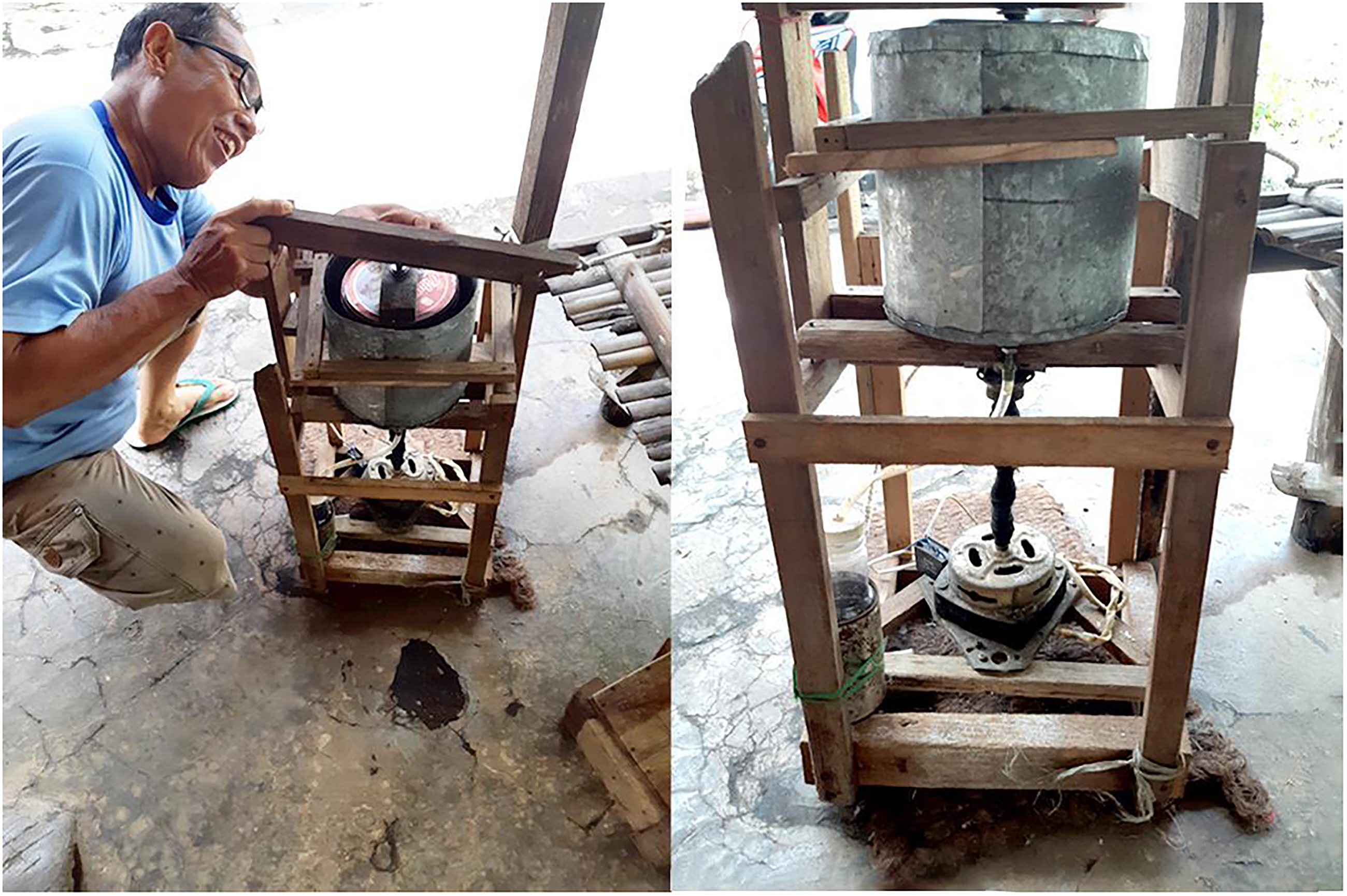
Bing demonstrates how The Onion processing machine works.
In this account saved ‘small and large money’ is presented as Chinese money culturally and in contrast to the ‘small money’ that becomes ‘lost money’ when in the hands of her Javanese husband. We can see how money manifests key cultural and gendered differences that both partners recognize and have learned to adjust to in realizing their aspirations as a couple to own a home. There are intercultural tensions here associated with the use of money that have been rendered more harmonious through the saving and sharing practices of this couple (Li, 2006; Magnis-Suseno, 1984). The Chinese wife sees money shared with the community as ‘lost money’ whereas the Javanese husband still maintains that this ‘shared money’ is important for maintaining community solidarity. In navigating this tension to achieve some harmony, the couple have agreed to transform ‘small money’ into ‘large money’ so that they can also share more with the community and purchase a house.
This exemplar can also be interpreted as illustrating how, as a material object, the meaning of money is negotiated inter-culturally as an object of both tension and cooperation within the dynamics of this relationship (Marschall, 2019). Some readers may also interpret this exemplar as an illustration of how a Javanese husband has simple given in or complied with the cultural practices of a Chinese wife, and that this does not resolve the inter-cultural tensions around money. There is some plausibility to this interpretation, at least initially. It is also important to note that people live with tensions in their relationships all the time and engage in some practices to which they are not fully committed psychologically. In this case these tensions were managed by the husband receiving an allowance and over time coming to appreciate the benefits of the wife's careful money management, which has enabled the couple to gain some financial security.
More broadly, this exemplar also reflects Simmel's (1978 [1900]) observation that money is integrated within human interactions as a focal point for negotiating tensions in the conduct of everyday relationships. Hence, to accumulate coins in cans also encompasses the accumulation of a sense of shared purpose over time and a contribution to the couple reaching their aspirations together (see Noble, 2004). What we also see here is how couples can work together in ways that enable one partner to convince another about the wisdom of their particular approach to money. The result is a more harmonious relationship, whereby according to both Confucian and Javanese teachings such harmony does not equate to sameness or absolute agreement (Li, 2006; Magnis-Suseno, 1984). Rather, we refer here to harmony is a process of working through differences and reaching mutual acceptance in ways that are functional for the couple, despite their ongoing cultural differences.
The key cultural difference and point of tension and some residual contradiction between these Chinese and Javanese partners raised by Elly is worth considering a little more. For Jayadi (Javanese), money is an instrumental tool for socializing, strengthening community relationships, and as Elly notes is used to demonstrate solidarity and a willingness to share, maintain relationships, and support others. This practice is exemplified in the Javanese proverb, Tuna Sathak Bathi Sanak, which means that it is no problem to lose a certain amount of money as long as we get new relatives and friends. As Jayadi states: If I meet my close friends in a warung, I often pay for their coffee and snacks. Treating friends is just normal for me. It is simply the way to show care, kindness, and how to maintain our friendships… Yes, we end up spending more, but this is for our relationships.
Briefly, from Elly's (Chinese Indonesian) somewhat instrumental perspective, tracking their daily expenses and keeping notes in her wallet enables her to gain a sense of progress and purpose towards reaching larger financial goals. In accounting for money in the relationship, Elly is able to enact a sense of herself as a good Chinese wife who exercises restraint, self-discipline, and responsibility (see The Chinese Culture Connection, 1987, for an overview on 40 Chinese Cultural values). Through using money in culturally expected ways, Elly reproduces herself as a Chinese Indonesian person and brings Chinese cultural aspects into the running of the household in a country that is dominated by Javanese cultural practices. This runs counter to research into inter-ethnic marriage that suggests that people from such minoritized ethnic communities will be assimilated and subordinated by the dominant culture (Qian and Lichter, 2001; Kim, 2007). By repeatedly saying “I want to have something real”, Elly invokes her personal agency in the relationship and emphasizes how money is not real until you generate something tangible from it. In the process, Elly's cultural monetary practices are also manifested in the relationship in a manner complementary to Jayadi realizing his cultural responsibilities to host, share and care for friends, and neighbours. Jayadi is also aware that once the household have gained further financial security he will be able to do more for others.
Narrating a shared response to financial hardship
In this section, we focus on how Bing and Giatun respond to financial hardship by using what money they have to purchase components that enable them to repair and manufacture devices that support their efforts to earn more money. In doing so, we document how money is interwoven in the obtaining, repair and use of other material objects that enable the family to not only get by, but to also to cultivate a more harmonious and prosperous life together. In exploring these material practices we extend our account of how inter-ethnic married couples can maintain cultural traditions, whilst also creating hybrid relational spaces of synergy and cooperation.
Both Bing and Giatun talked at length about the significance of their past experiences of financial hardship and how they have learned to cooperate to cultivate a more secure financial future for themselves and their children. For example, experiencing financial hardship has led Bing to also emphasize financial prudence and the need to learn to make do with what one has to hand. Bing understands and articulates his Chinese prudence and ability to repair objects and in doing so save money in relation to particular objects: It was a long time ago. Maybe 20 years ago… I really wanted to have a tool to help me harvest the rice paddy. But our financial situation as a couple was hard and we sold that again. I wanted to repair it by myself, but I did not have enough money…I also remember that I had a motorcycle. It did not work, and I brought it to the service center. I had to pay a very expensive amount of money and it made me upset. I came from a poor family. I was angry and decided to disassemble my motorcycle again to see how it worked, and I gradually picked it up. From then, I promised to learn everything by myself. Oh, now I have a hand-made tool. An onion processing machine. This is not perfect. I made these by myself. Giatun often gets orders to make fried onions and help the cooking for community meal. I will show you how this machine works (see Figure 3).
From the outside we might interpret Bing's onion processing machine in terms of its function to peel and cut onions. For Bing the machine holds this meaning and much more (see Henare et al., 2007; Marschall, 2019). It is an object of affection and cooperation that binds him and Giatun within the income generating practice of selling food. The onion cutter is invoked in the extract above and Figure 3 to manifest Bing's sense of cooperation and teamwork that Giatun also expressed throughout our interactions. Creating the device offered an instrumental way for Bing to demonstrate materially his assertion that “I am here to support your (Giatun) attempts in selling fried onions”. In talking to his partner in the interview about what the machine meant to him he also asserted that “we might not have money to buy a brand-new onion cutter, but I can create one for you”. The machine became, in part, an expression of inter-cultural cooperation and affection whereby this Chinese husband supported the Javanese cooking practices and sharing values of a Javanese wife.
The machine has also become integrated into Giatun's sense of self as a Javanese fried onion seller enacting a traditional gendered entrepreneurial role of cooking particular dishes for sale and sharing, and as being in a supportive and caring relationship with Bing. As Giatun states: Actually, I used to cut onions by myself manually. Then we reflected, this is just painful. We thought we want to buy peeled onions, but that is way too expensive. We won’t get much profit… Actually, if I had money, I want to buy a new tool. It is okay to me to access credit, but Bing refused. He insisted we save and only buy things with cash. No debt. As we know, being a woman, I need to be efficient. Making and selling fried onion is the way I contribute to the family… This is why Bing created the artisanal onion cutting machine for me.
In discussing the onion processing machine and its relationship to saving and generating money was extended through a discussion of other related objects. For example, Figure 4 depicts used items and parts that Bing stores in a corner within the house. Making and fixing machines using these items is associated with not only saving money, but also the cultivation of a shared sense of satisfaction for this couple. This material practice of making machines to aid the generation of income through the use of recycled objects is ongoing: The price of making this onion processing machine by ourselves is much cheaper compared to buying a brand new one. In working, my principle is that you must pay a little to get many… I learned how to make this tool from Youtube… It is not perfect… I got a used pipe and I want to make another machine. So the onions go through this way and out through that way [pointing to the object]… This is simple. I love to make all things handmade, by myself. It is efficient. We can save the energy, but also save money… I feel really comfortable every time I visit the used goods market… I can look carefully at what kind of things I can buy to combine with other things and create a new thing.

Used objects for making and repairing machines.
The Bak Kut Teh
As is evident in the sections above, in managing limited financial resources, household members strive to be as efficient and restrained as possible. Participants develop and employ shared and well-honed practices to get the best prices possible for goods and to preserve their resources. As well as meeting household needs, these practices also refract broader socio-cultural structures whereby one's situation in society necessitates agentive ways of making do (de Certeau, 1984; Hodgetts et al., 2020). These practices became particularly apparent as central in discussions of making food for special occasions and observing key cultural traditions (Lefebvre, 1991). For example, it is common for Chinese Indonesian families to invite the extended family to share specialist dishes during the Chinese New Year. These include Bak Kut Teh (pork ribs with salted vegetables), Tjap Cai (vegan dish containing 10 types of vegetables), and various fresh fruits (e.g. oranges and apples).
In relation preparing for and enacting such aspects of divergent cultural heritages, tensions can emerge between partners and are also negotiated. In the process, couples discuss how engaging in particular cultural traditions often requires a significant amount of money (Carroll, 2018). For example, Giatun talked about being reluctant to cook and eat Chinese Indonesian dishes at such times. Giatun realized how important these dishes are to Bing and repeatedly stated that Chinese Indonesian dishes were just too expensive. In evidencing or materializing this claim, she compares the cost of Chinese dishes with Javanese dishes, which she presented as being much simpler to make and better value for money. In this moment assertions of Chinese cultural prudence and Javanese imprudence are inverted: Chinese food is fancy because the ingredients are expensive. The meat is expensive. The spices are expensive. The liquid herbs are expensive. The cooking wine is expensive. The oyster sauce is expensive… The budget in making Chinese food is expensive. Now let’s say that you want to make a Chinese noodle. You should use the special noodle, shrimp, pork, and the specific sauce. Let us compare to Javanese noodles. You only need a soy sauce and garlic. Done.
In contrast to Giatun, Chinese New Year is special to Bing and an event that should be marked with the appropriate dishes. In justifying the expenditure and rehearsing ongoing negotiations with Giatun during the interview, Bing points out that he does not observe other Chinese Indonesian cultural events. As he notes, these include Cheng Beng (the tomb sweeping day) and so he should be able to enjoy special dishes, such Bak Kut Teh at New Year. Their ongoing deliberations do include considerable effort towards reaching practical compromises within the resource restraints that populate in their life together. This includes the Giatun's suggestion that they cook this dish during an alternative week when the meat and other ingredients come down in price due to reduced demand. In a subsequent interaction the first author followed up on whether or not this suggested compromise would be put into action. Giatun states: I have made an order to the pork seller. We will meet him in front of the church. I prefer to see him in person, rather than in the shop. Bing will accompany me. I usually buy pork from Roma’s mom. It cost us 80 thousand rupiahs per kg. But tomorrow we only need to pay 70 thousand rupiahs. Way cheaper.
The first author witnessed the purchasing event and noted that Giatun asked to buy pork's ears (see Figure 5). The pork seller, who is actually from another indigenous Indonesian ethnic group (Batak) understood the significance of Chinese people purchasing pork at this time of year and outlined that Giatun could pay as much or little as she wanted for the ears. Giatun paid only 10 thousand rupiahs (1 dollar) for a pair of pork ears (Fieldnote, 22 December 2019).
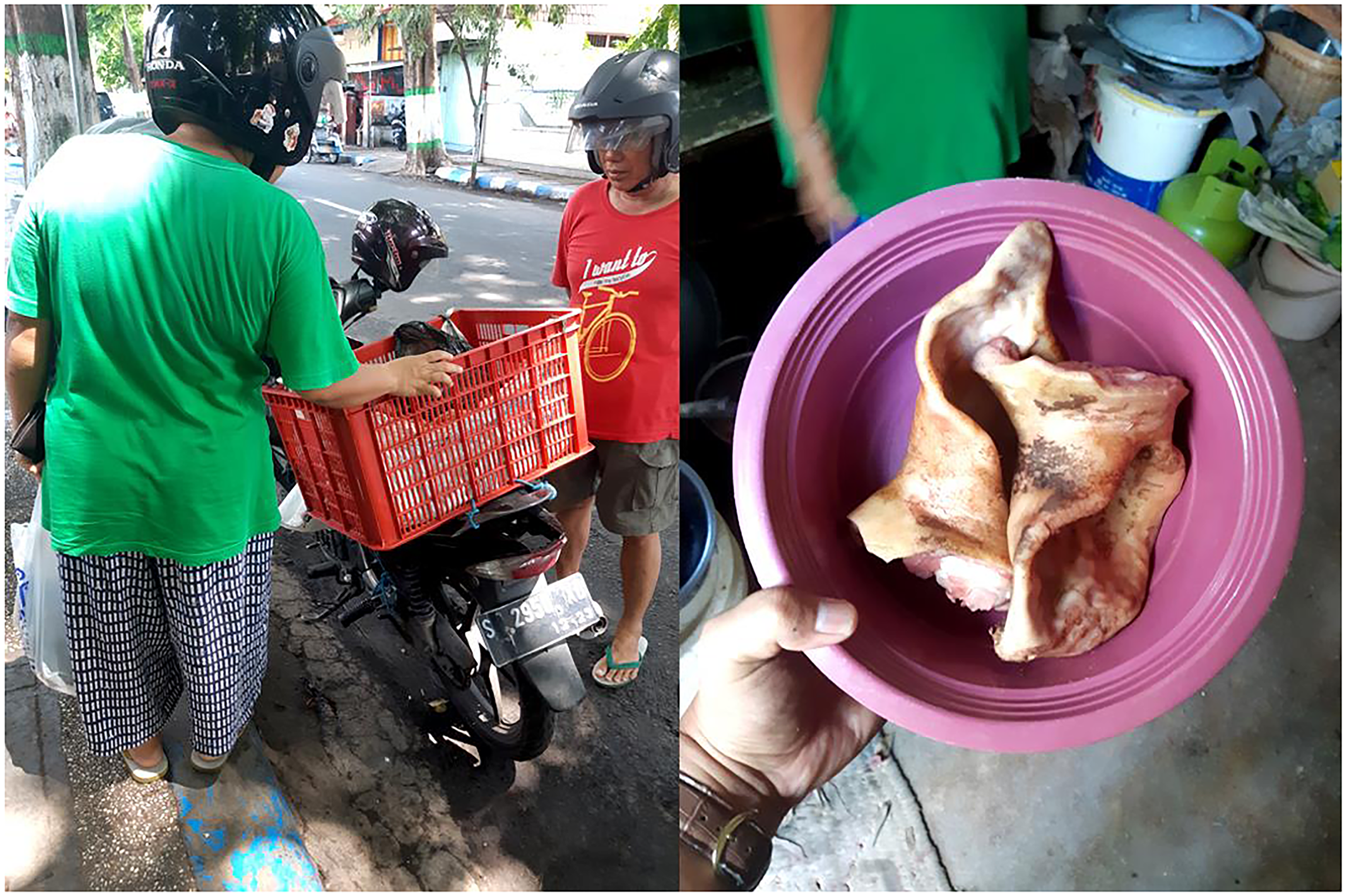
Meeting the pork seller on the street to buy cheap cuts.
Through such interactions, it becomes apparent that these couples often strive to reach inter-cultural compromises that ensure that their traditions are not lost Cultural events and practices can be observed in modified or adaptive ways for a more reasonable price with which they are both comfortable. In the example above, money is positioned as a means for Giatun to acknowledge Bing's Chinese-ness and need to participate in key cultural events. Bing is willing to compromise by not observing all such events and by modifying the ingredients for key dishes in order to reach agreement with Giatun. This exemplar also resonates with Miller’s (1998) observation regarding love as a material practice that often comes with obligations and responsibilities. This couple's efforts to negotiate when to cook the Bak Kut Teh and what to buy from the Batak seller can be seen as expressions of how they care for each other, which have consequences for what they purchase (Miller, 1998). The joint activity in planning the meal and sourcing specific ingredients for a lower price enables the couple to share in and enjoy this cultural event in a manner that is not undermined by inter-cultural tensions. In such situations we can witness how money becomes more multifaceted socially. It is no longer simply an object for transaction. Money becomes a celebratory object that can nurture these marriages.
Discussion
The analysis presented above documents how a focus on particular household objects can inform our understanding of everyday monetary life in two inter-ethnic marriages. Our analysis supports the view that inter-ethnic marriages comprise liminal or encounter spaces for cultural hybridity for participating human beings as they grapple with the material aspects of everyday life as well as their shared hopes, dreams, and at times differing cultural expectations. These two cases reveal some of the complexities of money and related objects within the everyday conduct of inter-ethnic marriages in Indonesia today. We have centralized the importance of considering a nexus of contextual concerns relating to culture and socio-economic status. These households, and the others participating in this study that we have not discussed here, varied in terms of their material adaptive strategies of inter-cultural compromise in building lives together. However, all shared an underlying process of defusing tensions as they cultivated lives together by developing particular practices. The articulation of these processes differed across households, but not the underlying willingness to care and share itself. Such instances of complementarity and tension diffusion are important as inter-ethnic marriages are often explored through the lens of ethnic difference feeding conflict and a lack of compromise (see Childs, 2014). Our analysis foregrounds some of the ways in which money as a dynamic socio-material object can be used within the everyday negotiation of inter-ethnic and religious priorities. For example, the account of purchasing pork suggests that although money can be a source of marital strife, it also provides a means of celebrating a partner's cultural tradition and nurturing the marriage (Miller, 1998).
Although everyday monetary practices are culturally informed, having cultural values that are seemingly contradictory and likely to create tensions between inter-ethnic married couples, does not necessarily result in intractable conflict. It can be a source of exploration and efforts to understand, accommodate differences, cooperate, and reach some resolution. Along the way, adaptive or hybrid cultural practices can emerge. For example, the concepts of ‘small money’, ‘big money’, ‘lost money’ and ‘shared money’ can become entwined within couple's conduct of everyday life. That is, by adopting the Chinese practice of saving ‘small money’ to transform it into ‘big money’ a couple are then able to more fully realise the Javanese practice of cultivating community solidarity by sharing with the broader community. Chinese Indonesian means can be used to meet Javanese culture ends, just as Javanese means can be employed to meet Chinese Indonesian ends.
This research suggests that key cultural differences can be rendered more harmonious and become woven together in the conduct of participant's everyday lives together (Kim, 2016; Latour, 2013; Lewis, 2018). In relation to the emphasis we place on harmony in this article, it is necessary to point out that just because some tensions can be managed and accommodated, does not necessarily mean that these are fully resolved. Correspondingly, we do not understand harmony as an absolute state devoid of tension or conflict. Our position reflects aspects of both Chinese and Javanese scholarly literatures (Li, 2006; Magnis-Suseno, 1984). According to Confucianists, for example, harmony does not require perfect agreement or equate to sameness (Li, 2006), but rather harmony is a process cultivated through mutual respect and a willingness to cooperate across differences. Whilst trying to achieve some degree of harmony, participating couples demonstrate deep understandings of their cultural and gendered differences, and a wiliness to cooperate and find ways to work around key tensions in order to make their marriages work.
Finally, this paper also speaks to the importance of a focus on material objects and practices to understand the everyday conduct of inter-ethnic marriages. Relatedly, our research demonstrates that money is a vital and highly indicative aspect of inter-cultural familial dynamics. Investigating domestic micro-economics and associated material practices offers new understandings of the wider social phenomena of tension management and success in inter-ethnic marriage. Further, we have demonstrated how household items can function as objects of commitment, compromise, cooperation and affection that help the couples articulate feelings of affection and care, and realize shared aspirations (Bell and Spikins, 2018). Also contributing to the extension of scholarship on cultural hybridity (Werbner, 1997), we have offered a more mundane and localized exploration of the culturally patterned use of everyday objects, including an onion processing machine. We have also considered some of the ways in which the participating couples demonstrate their efforts to address shared concerns such as their financial hardship by developing new hybrid responses. References to such household material practices and objects that populate these inter-ethnic marriages help participants to articulate some of the dynamics of the conduct of their relationships and cultivation of shared ways of being and practices of togetherness. These material practices also enable these couples to share personal memories and traditions from their pasts and cultivate new shared imaginations for their futures together (Parrott, 2005).
Footnotes
Acknowledgements
The first author acknowledges the support from the Massey University Doctoral Scholarship. We would like to thank Novensia Wongpy (Huang Fen Xia) and Agnes Christina (Chiang Ru Ping) for assisting the first author to conduct the interviews (NW) and for the helpful comments on the transcripts (NW, AC). We also thank two anonymous reviewers for helping us improving the paper.
Funding Statement
The author(s) disclosed receipt of the following financial support for the research, authorship, and/or publication of this article: This work was supported by the Massey University Doctoral Scholarship.
