






Abstract
One group of small artifacts from the Smithsonian National Air and Space Museum’s collection, astronaut chronographs, consumes more curatorial attention than any others thanks to a dedicated group of enthusiasts and collectors. The Omega Speedmaster Professional, featured in this article, was selected first for astronaut use during Project Gemini and remained in use for decades, particularly during spacewalks. Closely tracking time when consumables are limited combines physical necessities with the very human compulsion to mind the clock, so the chronographs linking astronauts, like us with our smart watches, in the observance of time. This article examines how astronaut chronographs fit into a larger historical narrative of timekeeping and exploration, and the extraordinary importance some astronauts put in these mechanical timekeepers. As objects of study and care for the Museum, they are a unique subset of materials that provoke questions about the cultural significance of time, planning for complex space missions, and caring for artifacts worn on the human body.
Introduction
Over the last two decades, the resale market for space-flown artifacts has shifted dramatically. Once an easy, low-cost way access to personal memorabilia of space adventures, it has become an active, high-stakes environment where rare items attract media attention in advance of auctions and millions of dollars of income for the owners of rare pieces of space history. One noteworthy sale of the 2010s energized space historians and watch collectors alike, making a simple looking watch the fourth highest auctioned space artifact to date. Apollo 15 Commander David Scott consigned his personal Bulova watch to RR Auctions of Boston in 2015 (Figure 1). Online bidding opened on October 15, and by the time of the live auction a week later, the price increased to $475,000. In barely 5 minutes of live bidding, that skyrocketed to over $1.3 million, with a final price of over $1.6 million (Nass, 2015). Scott, who claimed that his government furnished Omega Speedmaster Professional lost its crystal during his second moonwalk, used the Bulova as a substitute for the Omega sometime during the middle of the two-and-a-half-day stay on the Moon. Despite a lack of flight qualification for use outside a spacecraft, the rather curious and serendipitous availability of the Bulova makes it the only watch worn on a lunar extra-vehicular activity (EVA), or moonwalk, to ever go to auction.
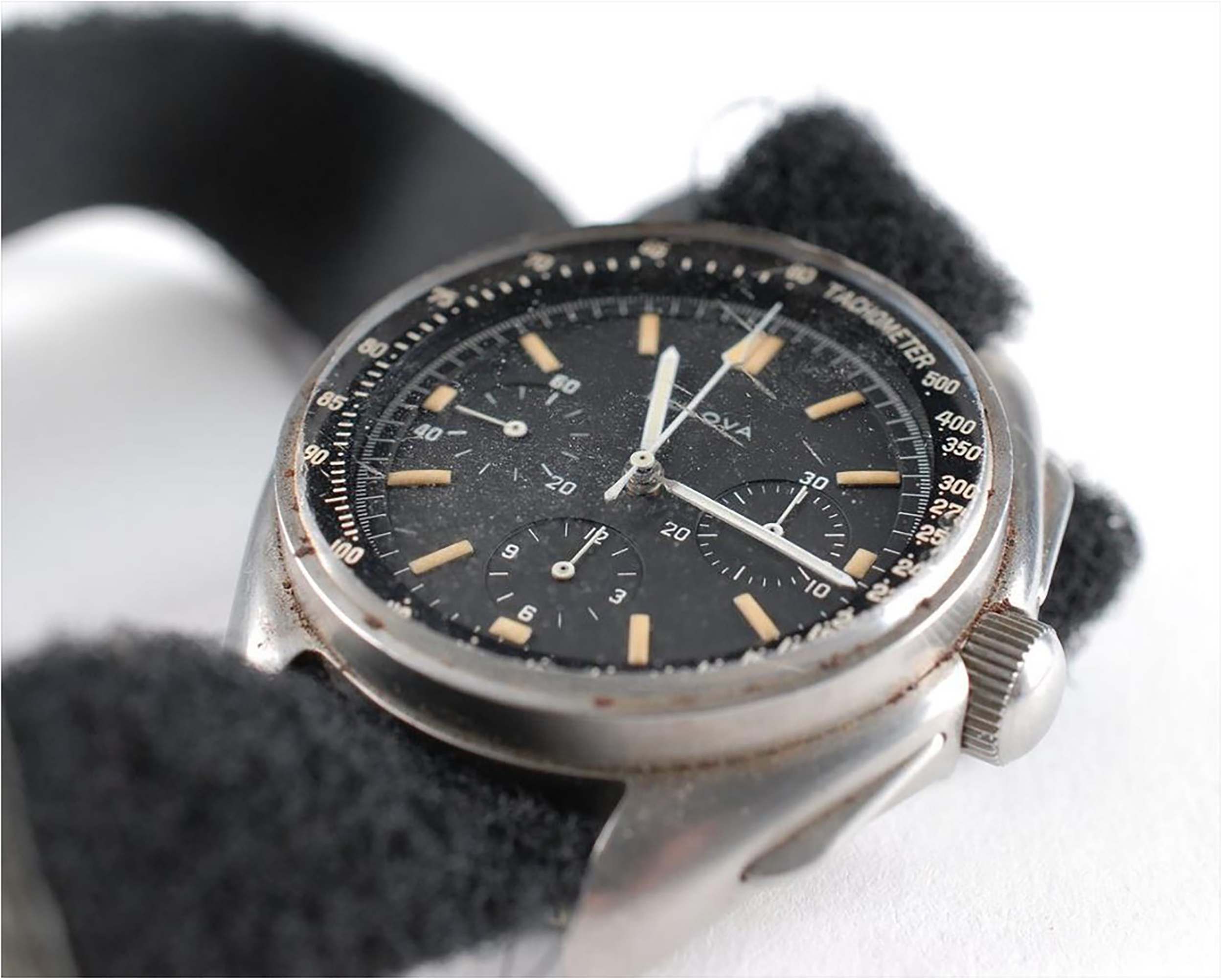
Bulova chronograph worn by astronaut David Scott during the Apollo 15 lunar moonwalks (Credit: RR Auctions).
This story raises important curatorial questions at the Smithsonian's National Air and Space Museum. Scott's Bulova falls outside of the nation's collection of NASA-issued Omega chronographs for astronaut use. Why, after over 40 years in his personal possession, would Scott want to sell this piece of history? Why did he feel a need to carry a back-up watch on the mission when NASA issued him an extensively tested chronograph? Who would want to spend that much money for a watch, and why (Balasaki, 2018)? Not all of those questions can be answered without an interview with Scott or the winning bidder, an unlikely proposition considering the financial nature of such a discussion. We can, though, interpret the meaning of the timekeeping devices to the astronauts and watch collectors without such a sensitive discussion. What can be understood is the meaning of timekeeping devices as tools of astronauts, as part of space material culture, and their significance to a variety of stakeholders. The sale of the Bulova is an opportunity to examine the intersection between these areas given the extensive historical and philosophical literature on timekeeping technologies. The intent here is to examine the purpose, use, and meaning of astronaut watches, particularly those with complicated histories.
Rarely does small astronaut equipment rise to a level of notice in other histories of human spaceflight, but in truth, devices such as chronographs are the heart of the materiality of spaceflight. Barely 600 humans have ever left Earth's atmosphere, giving most people scant opportunity to comprehend how microgravity or zero gravity change basic human functions. The way many connect with the experiences of astronauts is by examining the objects used to assist living life in space. This most often happens in museums or online sources for sharing interest in spaceflight. Objects may connect to memories and experiences of many stakeholders at once: astronauts, engineers, museum visitors, curators, exhibit designers, watch and space enthusiasts, or others, each interpreting the chronograph in different ways. Uncovering the meaning of chronographs to astronauts, NASA, and those now caring for them as historical artifacts requires an understanding of how work in space involves a distinctly personal awareness of time. To those who risked their lives to provide humanity with one of its crowning achievements, such objects of personal significance were also one of their life-saving devices, intimately linking survival, time, and precision with the individual users. Understanding astronaut life, the quest of many a museum visitor, may come in part from illuminating the nature of the selection, use, and disposition of chronographs. The story of NASA's Omega Speedmasters is one about the need for reliable and accurate timekeeping on missions, users with their own attachment to time and wearing watches, and a museum faced with a very invested and attentive collector community desirous of knowing every possible detail and seeing chronographs on public display.
Methodology and stakeholders
Before exploring the social meaning of time and astronaut chronographs as material culture, it is important to acknowledge the stakeholders in this story and the methodology employed here. Astronaut users are the primary group who interfaced with these objects. NASA assigned timepieces to each astronaut, recording serial numbers and tracking physical possession of this government furnished equipment from original delivery to collection from the astronauts for transfer to the Smithsonian. 1 NASA, in its establishment as a government agency, has no function to preserve its own history, though it retains historical properties and displays objects at visitor centers associated with many of its locations around the country. In 1967, NASA and the Smithsonian signed an agreement outlining how materials no longer needed for programmatic purposes would be offered to the Smithsonian for collection. While the agreement does not compel the Smithsonian to collect what was offered, and the process transitioned in 2009 to accommodate the needs of more museums and display locations, it reflects the intensity of public and historical interest garnered by space material culture from the 1960s through today. Museums, especially the Smithsonian National Air and Space Museum, became a stakeholder in the disposition, condition, and display of historic materials because of the public demand to see material evidence of space exploration, learning more and commemorating achievements.
Museum displays allow visitors and enthusiasts to view the artifacts that connect them to human spaceflight. Watches have had an especially intense collecting community even before the era of human spaceflight, so that was an existing set of stakeholders invested in the financial value, location, condition, and history of astronaut chronographs. Through online and in-person interactions, this community of amateur horologists shares a passion for a technology no matter its usage (Athwal, 2014). This makes wristwatches, as Jean Beudrillard suggested, an ideal candidate for understanding collectors and collecting because they objectify the self, thanks to a watch's relationship to time (Baudrillard, 2004). Collectors and their fanaticism for the astronaut chronographs are apparent stakeholders within this study because of their persistent emails to my Smithsonian email account and activity in online communities where they share insights and questions about some of the most famous wristwatches ever worn.
Scholarship on interpreting the material culture of space exploration has expanded in recent years. As an increased number of scholars look at public history as a professional opportunity, while internships and fellowships at museums connect archival research to the material legacy of the space program. Research by Margaret Weitekamp and Nicholas de Monchaux especially approached the subject in traditional historical fashion by but using evidence within the Smithsonian collections as jumping off points for their work on space memorabilia and spacesuits (De Monchaux, 2011; Weitekamp, 2022). Alternatively, recent projects to document the material culture of the International Space Station from an archaeological perspective are generating notice on social media and in scholarly circles (Walsh et al., 2021). Connecting to the lived experiences of astronauts orbiting or otherwise traveling outside Earth's atmosphere requires tangible evidence and interpretation of that work. Using one of the most personal items worn on the body, my examination of the history, care, and meaning of the astronaut chronograph collection will illuminate one way to understand the significance of timekeeping on space missions.
In all, the Smithsonian's collection of chronographs includes 63 Omega Speedmasters and Speedmaster Professionals, the vast majority of which arrived at the Museum in the mid-1970s following the last programs that utilized Apollo Program hardware. Documents held within the Museum's registrarial files reflect a protracted discussion about the ownership of the timepieces issued to astronauts for their missions. Less than a year after his move from NASA to the Smithsonian, director of the National Air and Space Museum and Apollo 11 Command Module Pilot, Michael Collins, received a letter in February 1972 from his former boss requesting the return of his government-owned chronograph (Slayton, 1972). 2 Collins wrote back days later to Deke Slayton, original Mercury astronaut and chief of the Flight Crew Operations Directorate, suggesting that instead of a direct return, Collins convey it to the Museum as part of the NASA-NASM Artifacts Agreement of 1967. Collins wanted to fulfill that requirement with these objects of potentially high monetary value frequently considered personal possessions by the former fighter pilots. Collins, in his position as Director and advocate for expansion of the Museum's collection and fulfillment of the NASA-NASM Agreement, became the source of a struggle inside NASA between management and the astronauts (which later transformed into a struggle between the astronauts and the Museum) over physical and legal possession of these potentially high value items. In the spring of 1977, 55 chronographs were offered and formally accepted by National Air and Space Museum curators, documents reflecting the arrival of the hand-carried shipment.
As the current Smithsonian curator for astronaut chronographs, I have served as their caretaker since late 2009. Responsible curators are the authority on their collections. We ensure electronic records include proper documentation of their acquisition and details such as dimensions, current display location, description of any special markings, as well information on their present condition. If an object is moved, incurs any damage, is requested for a loan, or is the subject of public inquiry, colleagues alert me. Most importantly, curators interpret objects for exhibit and online presentations in the form of labels. We are also welcome to support or carry out research on the collection and publish books, articles, or blog posts on the subject. Through the opportunity to undertake a conservation project with the Omega Museum from 2013 to 2018, I sought to understand their greater significance to the material culture of astronaut life in space and the wearers of them in their work at NASA. Telling stories about these objects, their context of use and present state as museum artifacts, and their meaning to their users, not only constitutes a significant part of my professional responsibility as a public historian, but also indicates a unique opportunity to find ways of connecting our lives on Earth to our surrogates in space.
In the years following their arrival at the Smithsonian, and as part of the understanding NASA had with the astronauts who begrudgingly returned their chronographs for transfer to the Smithsonian, some entered into loans with the Museum. Museum staff expressed in loan agreement planning and documentation, and later loan renewals, that such an arrangement should be temporary, and as federal property, the chronographs should be placed on display at a museum of the astronaut's choosing (Hinners, 1982). 3 Many did eventually accede to this request, though a handful persisted in personal possession until the early 2000s. The last two returned to via museum staff hand-delivery in November 2013. By that time, a project to inspect, clean, and conserve these chronographs was already underway as a partnership arrangement between the Smithsonian and Omega Museum in Bienne, Switzerland. The opportunity provided reason to reflect on the history of these timepieces, how NASA arrived at the purchase of Omega Speedmasters and Speedmaster Professionals for the astronauts, and what meaning can be inferred from the ongoing attachment between user and chronograph. As curator, I ensure that as artifacts, the chronographs receive proper care, storage, and when possible, display within exhibitions where visitors can connect to the experiences of keeping time in space. Fundamental to how that connection is built is by understanding that measuring time, as a regulated part of lives using mechanical devices, has origins in highly technical and scientific professions related to spaceflight.
Time measurement and society
Human life, intentionally or not, is intimately linked to the concept of time. Philosophers and social scholars have expounded on time as linked to our bodily functions and eventually the desire to find a scientific measurement of it. Ideas on the meaning of time often note the rise of time discipline to understand the transition from clocks as simple tools to scientific time measurement dominating Western cultures (Mumford, 1934; Nyíri, 2007; Thompson, 1967). To them, the rise of capitalism and industrial necessity brought about time discipline, but critics of this Western-centric argument have more recently broken down the concept of life dominated by the clock into one inclusive of cultural differences while highlighting scientists as the arbiters of exact time. As scholar Michael Sauter states, our understanding is that modern time discipline is the adherence to standards developed by those with unique knowledge and skills (i.e., scientists and technicians who create time-keeping machines) (Sauter, 2007). So while the widespread usage of clocks dates back to their installation in public spaces in cities across Europe in the eighteenth century, it was not until the miniaturization of that technology for portability in pockets or on wrists that calculating, regulating, or monitoring time on a personal basis became common.
The control and management of work time in the twentieth century centered on the development of scientific management principals, considered beneficial in allowing companies to maximize profits while minimizing wasted efforts by workers. These methods, promoted largely by Frederick W. Taylor, were broadly implemented in industrial work settings to identify the most efficient ways to organize each employee's efforts. The process included observing each employee's work routine (even down to photographic studies of their body movements), then analyzing the data at a management level to find where reorganization would provide more economical processes (Brown, 2005). The treatment of the worker within Taylorism's guidelines largely ignored personal choice and virtually all nuance in favor of a cookie cutter approach: any person with a certain skillset could just be slotted into a position to accomplish a task in the necessary timeframe. For the human spaceflight program, in much the same way, managers treated early astronauts as cogs in the machine, capable of being removed and replaced and to simply work at their tasks along an externally decided schedule. The manifestation of this in spaceflight can be seen in mission plans, timers, and clocks, never more obvious as a management tool than in the wearing of a chronograph on the wrist, carrying with it the awareness of time throughout the mission.
The connection to be made here between the origins of wristwatches as and their use in the context of astronaut work comes from a shift to personal reflection on time in the scientific and technical community itself (from which the work of astronauts arose). Twentieth century innovations for measuring time came through a collaboration between scientists, who determined time from the rapid movement of atoms, and the technicians, who built devices to represent those measurements. And measuring time over short periods required devices that could measure time in multiple ways, i.e., chronographs (Landes, 1983). Making those smaller and portable meant on the go, a soldier on the battlefield or pilot in the air above could measure time in relation to distance when navigating or using artillery. Chronographs include a standard display of the local time and at a minimum one secondary sub-dial for the stopwatch feature. Complex wrist-worn chronographs such as those used in a laboratory or by astronauts included a stopwatch with three sub-dials: one for hours, one for minutes, and one for seconds. Such precise measurements for science and engineering data may derive from capitalism's preference, as outlined in Taylorism, for the disciplined management of productivity (Landes, 1983). The human relationship to time, however, may look familiar in different workplaces as its passage has greater impact on personal health or well-being.
The clock time observed to carry out a human spaceflight mission is demanding and carries with it a human safety element. Adherence to clock time applies as well to those preparing ground equipment, launch vehicles, and spacecraft. Astronauts often run up against clock time when what they desire most, like many working professionals, is what can be called process time, a more organic relationship to time that allows for personal choice. In the world familiar to early American astronauts, though, personal choice rarely claimed a role within mission planning. Their lives as military test pilots informed their regulated, timed expectations and activities as astronauts (Hersch, 2012). As evidenced in mission documents from longer duration missions over many decades, less strict adherence to the clock was found to have significant positive psychological side effects.
In human spaceflight, Mission Control and staff for each human spaceflight program organize a set of flight rules prior to missions, largely to govern and expedite decision-making in time-sensitive moments (NASA and Dempsey, 2017). Such rules keep missions strictly organized from the ground, permitting little flexibility or improvisation for very good reason: space is a dangerous place not conducive to human life naturally. However, conflicts arose during some missions when that intense regulation of time took precedence over natural human perceptions of overwork. NASA rarely took kindly to such resistance, occasionally refusing additional flights to those that violated the mission rules, but such strain was rarely spoken of outside of the technical debriefings carried out immediately post-mission and in astronaut memoirs. Time pressure resulting in errors were stated delicately in the MA-8 flight report for example: “Flight difficulties occurring during this mission, however, have served to emphasize that the primary attention of the pilot should be devoted to management of spacecraft systems and detailed attention to operational functions” (Carpenter and Stoever, 2002; Kraft, 2001; NASA, 1962). 4 While astronaut Scott Carpenter attempted to explain why he was behind on his duties that precipitated his late reentry, violating mission rules took precedence and he was relegated to research duties and never flew in space again. Today's International Space Station crews confront ever-available screens scrolling their schedules from right to left, allowing a moment-by-moment view of the allocation of their time derived from massive spreadsheet-like schedules developed months or years in advance (NASA and Dempsey, 2017). The passage of time, the mission plan, and the monitoring of both together constrains activity for technical and logistical reasons, often to the detriment of improvisation, experimentation, and flexibility, something that many adults relish in their professional lives (Kelly, 2017). 5
The inability to ignore time comes at the potential expense of an astronaut's mental health. Responses to this reflect the relationship between the crews, Mission Control, and time itself. Astronauts work from carefully planned mission documents, the timeline laid out in increments of five to fifteen or more minutes usually. The Apollo 7 crew, for example, was scheduled to provide the world's first live television broadcast from space in 1968. Less than one day into their mission, the team of three pushed back against the intensely coordinated plan when head colds bogged down their work (Woods et al.). Mission commander Walter Schirra and the two first time astronauts, Walter Cunningham and Donn Eisele, defied their timekeepers in Mission Control and would never fly in space again. This early in the space program, neither crew nor managers had a method for balancing time, crew needs, and mission requirements. It would take until the long duration missions of the International Space Station program (2000 to present) for NASA to institute regular mental and physical well-being check for crews during flights.
In a much different situation, too long or too short of an engine burn could have sent a spacecraft on the wrong trajectory. On their way to the Moon, Apollo 13 astronauts James Lovell, Jack Swigert, and Fred Haise found themselves in dire circumstances when damage to their service module put their mission and lives at risk. Faulty wiring created a spark that ignited the pure oxygen in one of the vehicle's tanks. After powering down their entire spacecraft, including the computers, the crew needed to start and stop their engine by hand for course corrections on their return to Earth. This required the timing of engine burns by using their chronographs while eyeballing the vehicle towards a visual target to make it back to Earth (NASA, 1971). Here, with mission control giving the crew burn times and parameters and no other precision timing devices active in the spacecraft, chronographs played a vital role in crew safety and the mission's successful return.
A few years later, Skylab 4 astronauts faced runaway schedules when mission scientists and planners added unplanned work to the mission timeline. Evidence suggests that a lack of training and time to adjust to space (the crew was promised, as prior Skylab crews had gotten, up to ten days of time to settle into their environment) lead to the crew being overwhelmed by what they were asked to accomplish past their initial mission timeline (Uri, 2020). While the crew and mission controllers were able to civilly come to terms about a balance of time on task and time off, scheduling and monitoring mission tasks required devices by which astronauts monitor their work.
Crucial to adherence to schedules were government-tested and issued wrist-worn chronographs and timers or clocks otherwise installed at workstations around the spacecraft. As displays and recorders of time on the body of crewmembers, their Omega Speedmaster Professionals became symbolic of the astronaut's relationship with time: a means of ensuring health and safety through monitoring consumables but a constant reminder of pacing and adherence to a schedule determined not by themselves but those back on Earth.
Space time technology
Human spaceflight, both technologically and rhetorically, draws from the legacy of global exploration in the nineteenth century. Tall ships traversing the oceans at the end of the Age of Discovery benefitted from the development of the marine chronometer, promoting expansion of the British Empire and ensuring its dominance of the seas and colonial territories (Reidy and Rozwadowski, 2014). The chronometer, once set to Greenwich Mean Time (GMT) upon departure and wound daily, provided an accurate reference as the ships moved farther from the Greenwich Meridian. Comparing local noon to the GMT reference on the chronometer provided a longitude measure (Betts, 2017). Stellar observations provided latitudinal information. Marine chronometers were navigational tools that facilitated commerce, politics, and an expanded cultural understanding of the globe, and later, a scientific one as well (Reidy and Rozwadowski, 2014). Traveling to the Moon in particular likely provided a similar sense of the importance of chronometers and observation of position: astronauts on Apollo 8 even used their own stellar observations to confirm the abilities of their computer-run devices to pinpoint their location.
The professional roots of early astronauts ensured their familiarity with watches or chronographs as vital to navigation. Going back to at least World War I, the British War Office issued watches to Royal Flying Corps pilots, which were expected to be returned following each mission (Hillier, 2020). Former Smithsonian curator Glen Sweeting noted that catalogs of wartime aviation supplies show items of increasing sophistication through both World Wars, and he draws attention to watches first in his 1989 book chapter on the subject of miscellaneous equipment (Sweeting, 1989). Sweeting wrote that accurate watches were essential for solving navigational problems, and the types used through World War II came from a variety of US and international watch companies. Wristwatches were part of the kit of government-furnished equipment from World War II onwards for all pilots and more significantly, those training in experimental aircraft at places like Edwards Air Force Base and Patuxent River Naval Air Station (US Senate, 1945). 6 Those two facilities were where most early astronauts worked immediately prior to selection by NASA. Pilots turned astronauts, largely trained within the Cold War aviator culture, expected their employer to supply adequate equipment to perform timekeeping tasks fundamental to flight procedures.
By the time humans traveled to space, chronometers had long since moved from ships and aircraft instrument panels to the wrists of users in a vast commercial market. NASA engineers sought chronographs, a combination of Greek words meaning “time” and “recording,” as possible personal timekeeping devices for astronauts. The tool needed to be highly reliable, serve multiple potential purposes, and withstand the possible exposure to the vacuum of space. Astronauts and engineers recognized how vital time itself would be when utilizing rocket technology, combustible fuels, and maneuvering through space. Simultaneously, the world of watches experienced its own revolution of sorts, its own space age, so to speak. Craftsmanship and tradition made way for commercial appeal and quartz accuracy, giving everyone, “…access to the split-second accuracy once available only to scientists and technicians” (Stephens and Dennis, 2000). As historians Carlene Stephens and Maggie Dennis frame this period, astronaut wristwatch selection is part of a larger move towards a more electronic, digital world of the late twentieth century.
From the first solitary trips into space by Gagarin and Shepard to the latest spacewalks of space station astronauts, spacecraft clocks and personal wristwatches facilitate precise and accurate timing for operational maneuvers. All exploration depends on reliable equipment to determine time and location. Judging that based on location of the sun and stars aided in crossing the vast oceans, but traversing the skies and space depended on far more precise equipment. Many inside and the outside the watchmaking community held to a belief in the utility of mechanically operating timekeeping devices, and those became the most obvious candidate for NASA astronaut use. As Stephens and Dennis point out, time is intimately linked with science and navigation dating back to the seventeenth century. NASA even funded research into more energy-efficient watch circuits during the 1960s (Stephens and Dennis, 2000). The long history of mechanical chronographs appealed to an agency wanting well-proven technologies when it all possible.
Spacecraft clocks and astronaut chronographs served as a means of shaping a mission, one moment to the next, from start to finish. The recording of mission time (formally called Mission Elapsed Time) depended on quartz oscillating clocks built into the spacecraft's computers, which counted up from zero at the moment of liftoff. Mission operations counted along this timeline. An astronaut's sense of local time, the time back at Mission Control in Houston, required they set their chronographs to correspond to the Central Time Zone despite launching from the Eastern Time Zone. To keep things more straightforward, the International Space Station astronauts use Coordinated Universal Time (UTC or GMT) no matter where they are circling the globe. Selecting technologies to keep time has likewise shifted throughout the history of space travel.
The popularity of wristwatches grew tremendously during World War II, especially brands from Switzerland as they were able to continue consumer production through the war because the country remained neutral. Military and industrial production continued elsewhere, but without the level of quality seen in those from Switzerland. The beginning of the human spaceflight program was coincident with a time of technological transition in the watch industry from mechanical to quartz movements. Instead of the intervention by the user required by a mechanical watch (winding to tensions the springs on a regular basis), a quartz watch includes batteries to make the crystals inside vibrate to move the hands.
Immediately prior to the commercial sales of quartz wristwatches in the 1960s, NASA looked at chronographs with the same sense of required functionality as any commercial off the shelf (COTS) equipment, seeking proven and reliable technologies over what was cheap and disposable. Technologies such as computers were identified well in advance of space flights, often significantly dating the technology by the time of a launch. In this case, David Edgerton's characterization of Bruno Latour's (Edgerton, 2007) work is quite apt, “We worked with old and new things, with hammers and electric drills.” Mechanical chronographs were essentially the only choice for the early human space program as the technology had existed for over a century, continuing as the only option for astronauts until the end of the twentieth century despite more accurate digital options developed just after Neil Armstrong set foot on the Moon in 1969.
Experimentation ruled the days of Project Mercury, America's first human spaceflight program, which aimed to put one man in orbit. Learning how to get to space and actually do work there while accounting for the needs of human survival meant testing an array of options to see what equipment worked best for astronauts. The flights of Alan Shepard and Gus Grissom were hardly long enough to warrant anything more than the spacecraft's timing device, just over fifteen-minute sub-orbital parabolic flights. John Glenn carried a Heuer stopwatch on his Friendship 7 three-orbit mission in February 1962, worn on his right wrist over his spacesuit to serve as a backup to his spacecraft clock. The unusual construction of the timepiece suggests some ad hoc ingenuity, much like other equipment used on early human space flights. The Long Range Timer model 2915A appears to have an improvised fabric bezel attached to an elasticized cloth strap using adhesive (Figure 2). Such a feature would prevent the metal of a watch from scratching outer layers of the life-saving spacesuit or other delicate surfaces.
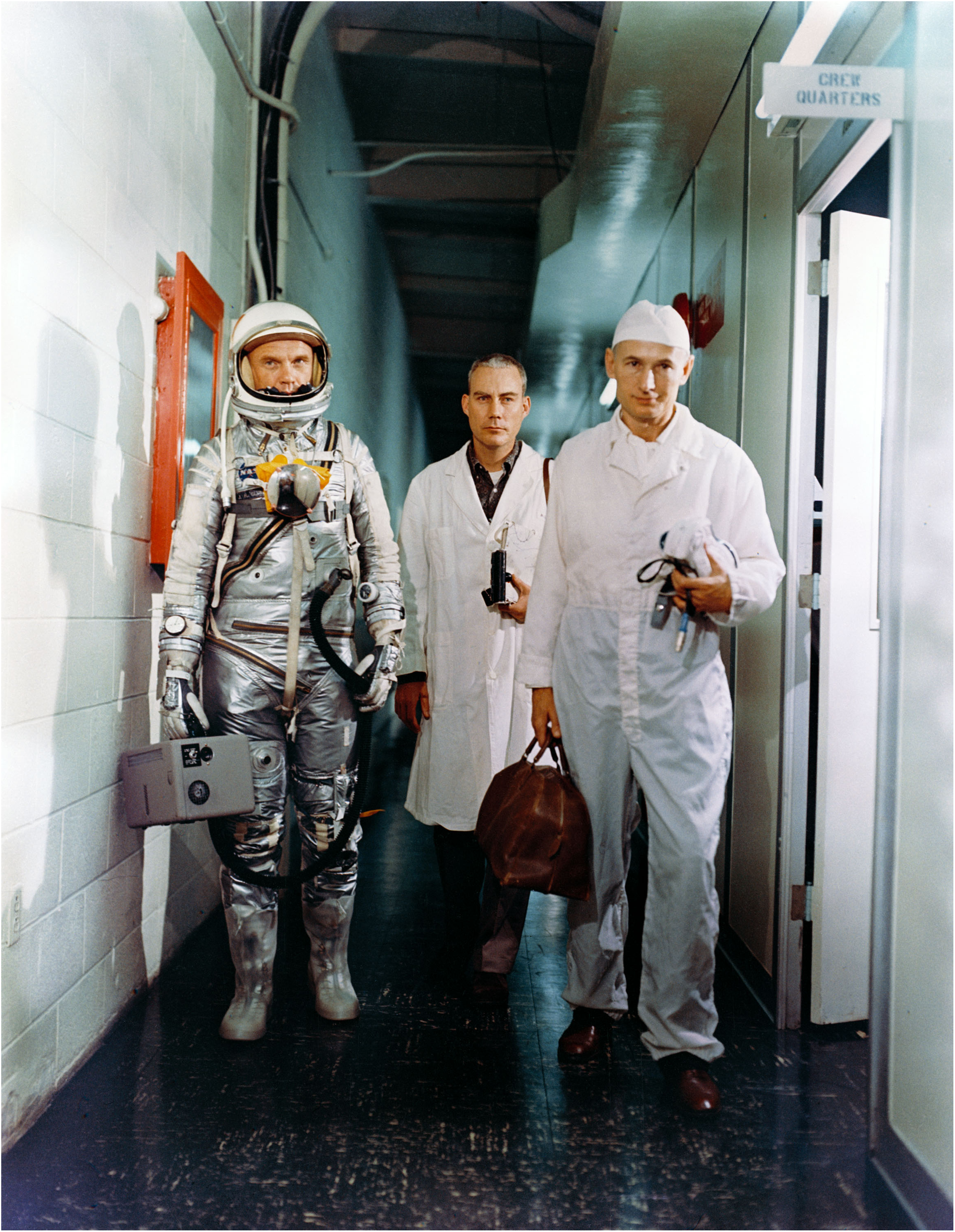
John Glenn departs the crew quarters with a flight surgeon and equipment specialist. He wears the Heuer stopwatch on the right arm, just above where his glove connects to his spacesuit, February 20, 1962 (NASA Photo S62-00330).
Scott Carpenter wore his own Breitling Cosmonaute Navi-timer on his Aurora 7 Mercury mission in May 1962, a leftover favorite from his days as a Naval aviator and test pilot. Put in charge of monitoring developments of onboard navigational equipment in the earliest days of Mercury spacecraft design, Carpenter bore some responsibility for considering backup timing devices as they related to navigation. Wristwatches or chronographs fall squarely into that category. Each astronaut tested timepieces of their choice, however, and Carpenter stuck with the Breitling. He even worked in advance of his mission to have the company redevelop the model to include a 24-h dial, potentially mitigating confusion during the rapid orbital transitions from day to night (Estlow, 2013). Ironically, Carpenter's spacecraft landed almost 250-miles off course, and his lengthy time awaiting rescue resulted in damage to the timepiece as ocean water ruined it. The perception permeated mission control that Carpenter wasted time taking pictures (and ignoring audio transmissions), missing the planned moment when he needed to fire his retrorockets to reenter the atmosphere and land near the recovery ship. This timing error cost NASA and the US Navy time and money, and Carpenter any chance of another spaceflight.
Wally Schirra, an Omega wearer in daily life, wore his personal one during his six-orbit mission. Gordon Cooper continued that tradition on his one-day flight in 1963 and added a new Bulova Accutron to compare the two timepieces (Nelson, 1993). Mercury astronauts would not go outside their spacecraft, however, which is where conditions drastically alter the operation of tools. Project Gemini would change the dynamic for most all small equipment as capsules would be opened to the vacuum of space, exposing crew and equipment to pressure and temperature changes. Environmental changes expected required increased pre-flight testing. NASA and its contractors had no time to reinvent devices, so modifications to many off the shelf tools were needed.
Early NASA engineers in the Flight Crew Operations division were charged with finding or developing tools for use both inside and outside the spacecraft. Amongst the millions of decisions needed to make human landings on the Moon possible, NASA and its engineers outfitted astronauts with small equipment to meet foreseen and unforeseen needs during these complicated endeavors. While working through simulated launches and missions, test conductors threw all manner of surprises at these test pilots, engineers, and scientists, with the possible failure of built-in spacecraft systems a common challenge. Traveling so far from home meant the inclusion of built-in redundancies or back-up tools. After all, there are no repair shops along the way for replacement parts or tools. Wrist-worn chronographs gave crewmembers a way to observe time apart from spacecraft control panels or Mission Control.
Testing, selecting, and issuing chronographs for a government program at NASA was far more complicated than just walking into a department store and purchasing a suitable timepiece. NASA put a call out to companies to provide candidate chronographs for its programs intended to take Americans to the Moon by the end of the 1960s. They required this tool to be reliable, have multifunction capabilities, and be able to withstand the dangers of space travel – pressure, temperature, and speed being the most relevant changes. NASA hired James Ragan in 1963 as an engineer, detailing him to the Flight Crew Operations division to help test and prepare crew equipment for use during Gemini and Apollo spaceflights (Figure 3). Ragan, a tough-talking Missouri native, fit right in with the cohort of aerospace engineers and pilots working out of old Air Force facilities at Ellington AFB during the construction of the Manned Spacecraft Center (later renamed Johnson Space Center) southeast of downtown Houston, TX. Testing and selection options for a watch or chronograph that met strict criteria was assigned to Ragan early in his career. The Gemini program, meant to test techniques needed for the Apollo lunar landing missions, also served as a platform for refining techniques and lessons learned from the Mercury missions. Though astronauts wore a variety of watches on those flights, NASA wanted to regulate what astronauts used in space, down to their most personal needs. Ragan solicited prominent watch manufacturers for examples to run through a selection of tests (Figure 4), finally putting three brands, Omega, Rolex, and Longines-Wittnauer, through his gauntlet (Bazemore, 2023). 7
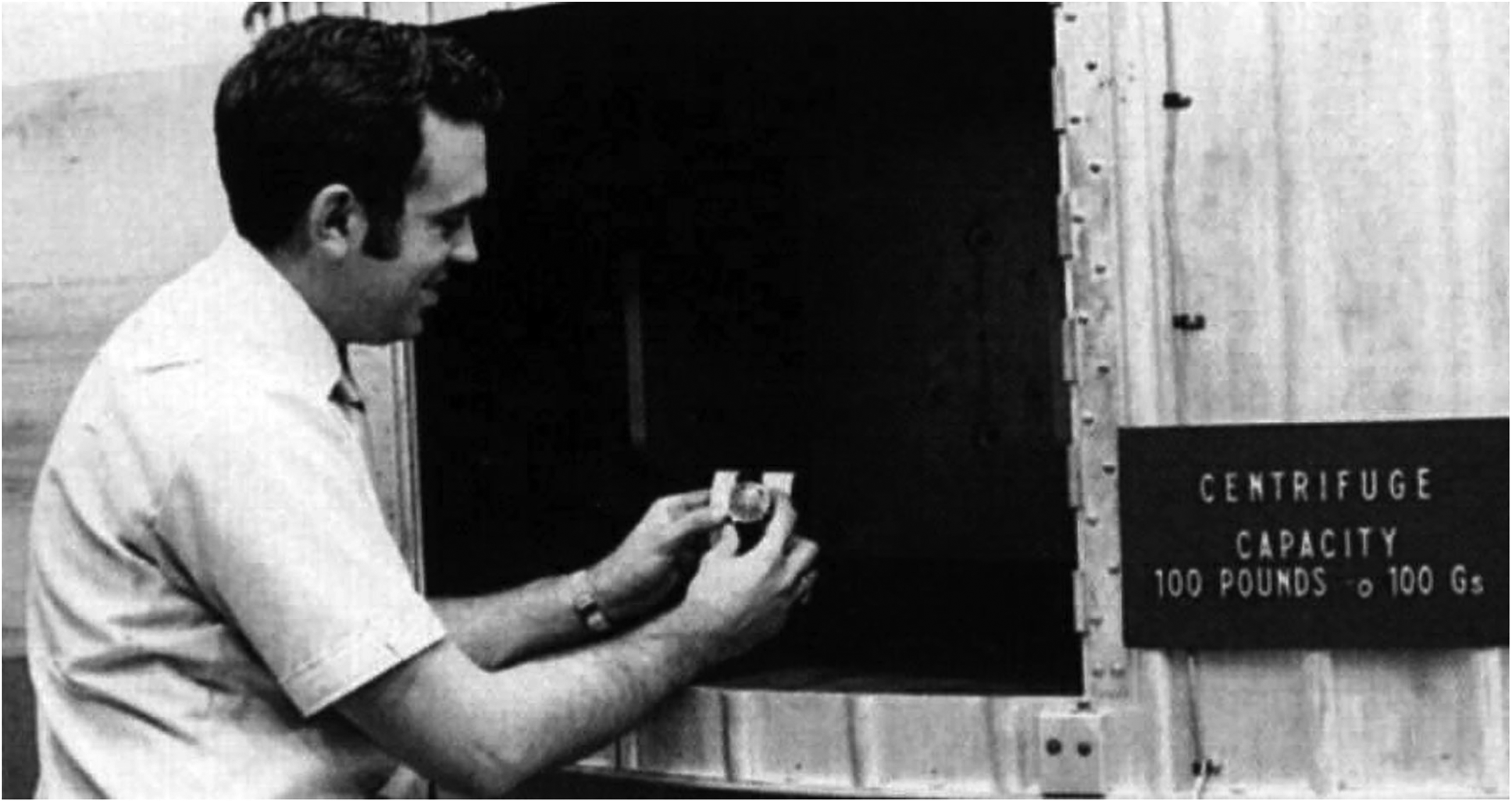
James Ragan, NASA engineer, inserts an Omega Speedmaster into a centrifuge for testing at the manned spacecraft center (NASA photo).
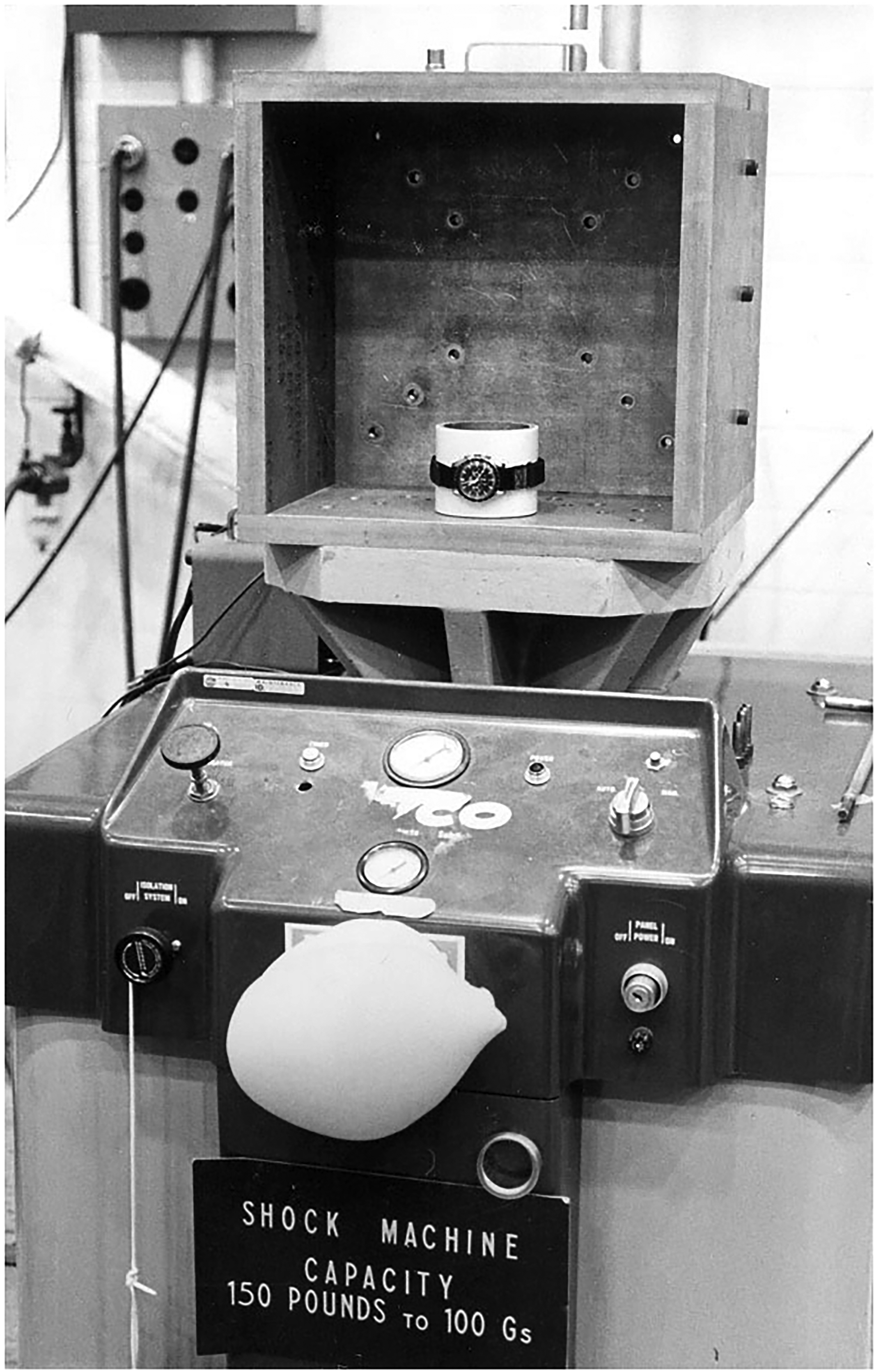
Testing equipment used by Ragan during chronograph evaluations (NASA photo).
What concerns about space travel prompted NASA to test simple wristwatches so thoroughly before selecting one? The device needed to be capable of functioning in the low gravity and variable temperature conditions of low Earth orbit, working in a vacuum during EVAs, and on the surface of the Moon as it was hammered by extremely high solar radiation levels (the Moon lacks a protective atmosphere). Through the US government's formal request for proposal (RFP) process, NASA issued a call to watch manufacturers for a wrist-worn chronograph that would suit the needs of astronauts (Ip, 2019). 8 As with testing the human body under the most extreme of circumstances, equipment such as chronographs also needed to be tested beyond the expected usage criteria. That meant pushing candidate pieces to the upper limits and to the point of destruction. Ragan tested three brands for their ability to survive in a total vacuum, resist temperature changes of nearly 500 degrees over a matter of minutes, resist shocks up to 40 Gs in six directions, tolerate high humidity (spacecraft landed in water), and endure sounds up to 130 decibels. 9 Nobody at NASA expected chronographs to experience these extremes, but pushing those boundaries would show which had the best chance of surviving extreme or surprising challenges. The Rolex stopped working twice and the Longines-Wittnauer failed temperature and decompression tests. Only one brand succeeded in passing all the tests: Omega (Ip, 2019).
The Omega chronograph NASA selected, the Speedmaster and later the Speedmaster Professional, were made in a style and construction typical for mechanical wristwatches. The stainless-steel case is rounded to hold a dial, bezel, Hesalite (synthetic crystal) lens, and the interior mechanisms (Figure 5). Four lugs, which look like legs, stick out from the top and bottom to serve as brackets for the bars that attach the wristband to the case. The left side of the case is plain, while the right side includes a crown connected to a winding stem, which is flanked by two pushers for starting and stopping (top pusher) and resetting the stopwatch (bottom pusher).

Layers of an Apollo era Omega Speedmaster professional (NASM2014-06338, images by Dane Penland, National Air and Space Museum, Smithsonian Institution).
Surrounding the crystal is a stainless-steel bezel with black enameling and silver numbering that compose the tachymeter, which allows a user to measure speed of activity per hour. The black dial is a coated brass disc lined with larger hash marks denoting the hours and smaller hash marks to signify the minutes. From the 1960s to well into the 1990s, Omega coated both hour marks and the hour, minute, and second hands with tritium paint (which is slightly radioactive) to make them glow in the dark. Printed at the top of the dial is the Greek letter “Omega” and the model's name under, either “Speedmaster” or “Speedmaster Professional” on two lines under the omega symbol. Inset in the dial are three smaller dials that make a chronograph stand apart from a standard wristwatch. At the 9 o’clock position is the minutes dial; at the 3 o’clock position is the seconds dial; and at the 6 o’clock position is the hours dial. The case back, also made of stainless-steel, features the imprint of a hippocampus, a sea creature with the head of a horse and the body of a fish from Greek mythology. This icon of Omega timepieces first came into use in the late 1950s as a symbol of their water resistance.
Etched into all chronographs purchased by NASA, whether flown or just used in training or testing, are standardized part and serial numbers like those used on other government property. Those begin with the designation “P/N SEB12100039-” followed by a series of three digits, either “001” for the first set of Speedmasters selected for Project Gemini missions or “002” for the Speedmaster Professionals issued mostly for Apollo, Skylab, and Space Shuttle astronauts. The assignment of serial numbers proceeded in numeric order through the batch purchased for Gemini and Apollo.
Inside the case are the complex mechanisms that operate the visible components on the dial. These layers of brass, stainless-steel, and jewels necessitate maintenance and servicing by qualified technicians, as well as by the users. Mechanical watches require winding since they do not have batteries. The winding of the exterior crown puts tension in a spring inside the chronograph, and the force of that tension turns gears that then turn a wheel and escapement (which stabilizes the wheel and allows the gears to move in turn). This action moves the hands in very precise fashion. The jewels inside, which are typically rubies or sapphires, help decrease friction and increase the timepiece's accuracy. The quality of the jewels also ensures longevity of the wheel's bearings by minimizing pressure and friction created by the movement. While modifications for spaceflight were minimal, the maintenance of chronographs continued throughout their time in service to astronauts. Their lives as museum pieces required far less attention, yet their lack of operation hardly indicates a lack of use.
The material culture of astronaut time
Wearing a watch daily represents personal and practical choices. People are conscious of time, regularly checking the time throughout a day. Habitual watch wearers know the signs and signals of each other and the decision to wear one is an intensely personal expression of an attachment to the passing of time. Astronauts treated their chronographs like their own personal watches, just as they had with military-issued watches from their service years. Some wore them constantly as a typical watch wearer would, and some used them only for work, favoring simpler watches in daily life (Figure 6). When worn on missions, some astronauts preferred one, others preferred one on each arm. There is even an instance of a crewmember wearing three on a single mission.
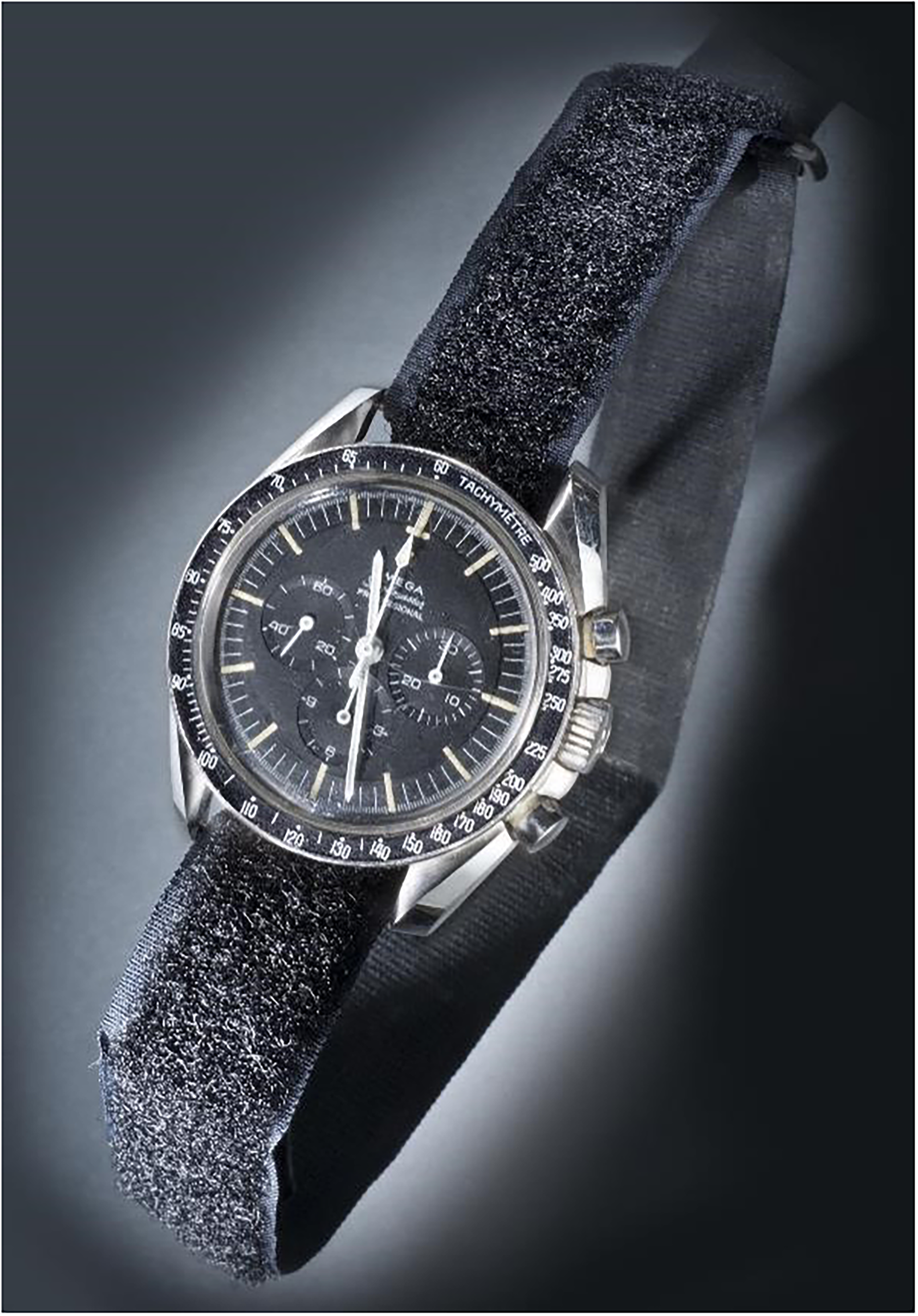
The chronograph Neil Armstrong used during the Apollo 11 mission (NASM2009-4802, image by Eric Long, National Air and Space Museum, Smithsonian Institution).
Watch wearers may understand why many astronauts did not relish the idea of returning their flown or training chronographs when NASA wanted them back. These timepieces meant something special to certain astronauts, physical manifestations of their memories of a signature aspect of their careers. Post-flight equipment processing procedures at NASA meant that used flight equipment went through inspection, repair, and sometimes refurbishment. Chronographs went through their own process. Government property rules required Jim Ragan to collect chronographs post-flight. He assigned staff to hand-carry them to an Omega-certified servicer in New York City, the Norman Morris Company. Since these were all mechanical units, they required winding, lubrication, and adjustments. Norman Morris's watchmakers were under strict instructions from Ragan not to inscribe their initials inside—a typical practice of watchmakers—–and to collect and return any lunar debris that accumulated on surfaces or penetrated the rubber gaskets. Ragan received the chronographs post-servicing and returned them to the crewmembers for continued use, recording these movements in logs just like any other government furnished equipment (Figure 7). Near the end of the Apollo program, however, changes occurred all over NASA, including what the astronauts were permitted to do with equipment.
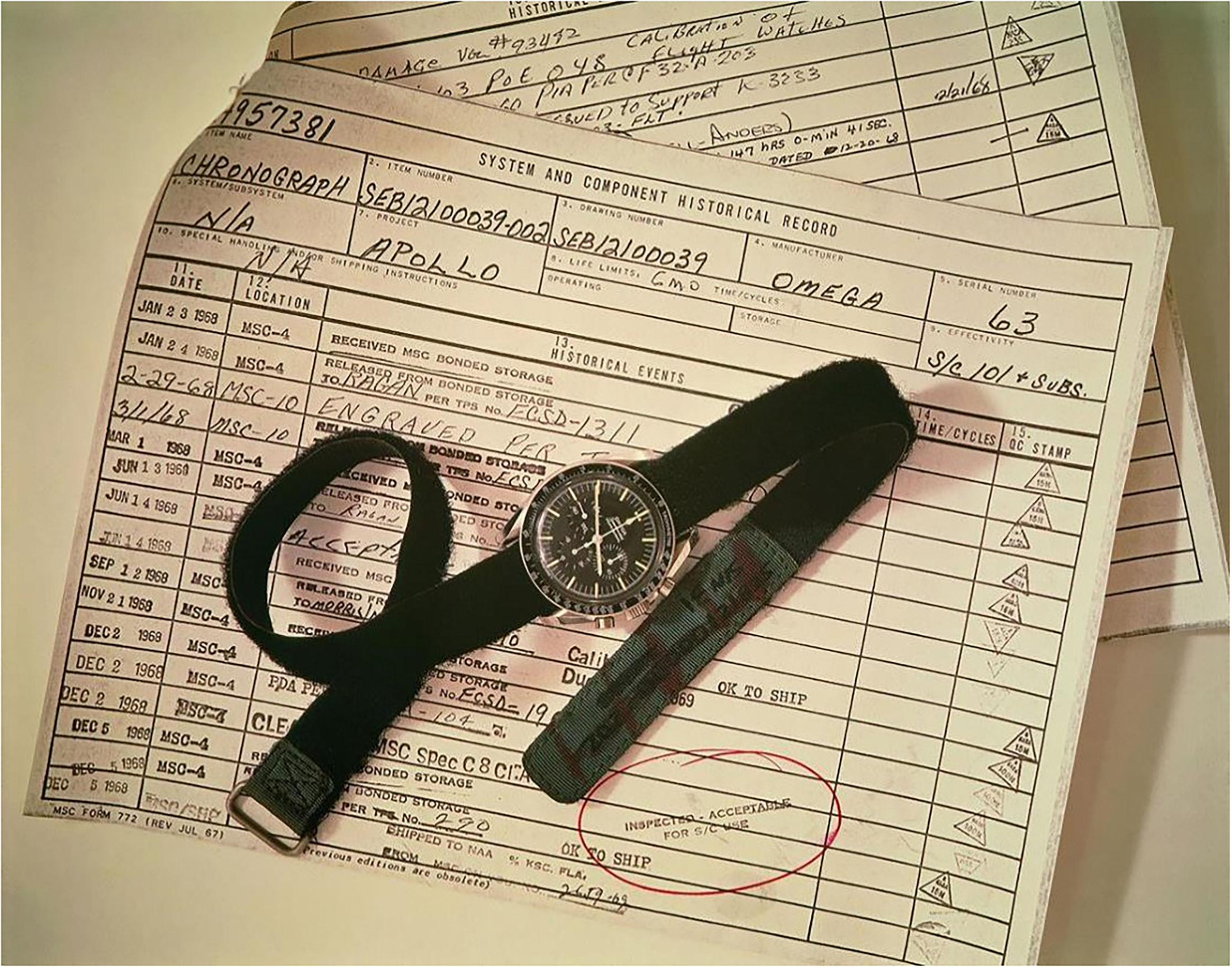
Documentation on the precise location of this chronograph was kept by James Ragan while working in the Flight Crew Operations division (NASA photo).
Of the dozens of chronographs purchased by NASA for astronaut from the Gemini through Skylab programs, equipment managers assigned at least one to each astronaut for each mission. In theory, that would mean for the ten Gemini missions, 12 Apollo missions (including the Apollo 1 crew killed in a fire during a launch pad test), three Skylab missions, and the Apollo-Soyuz Test Project astronauts, a total of 71 chronographs may have been issued, plus additional timepieces for testing, training, or other uses. Documents shared by Jim Ragan reflect the purchase of 31 for Gemini and 65 for Apollo and its successors Skylab and ASTP. Some flight issued chronographs were used multiple times and some were never fully accounted for when recalled by NASA. The final tally for transfer to the Smithsonian in 1977 came to 58. Procurement of chronographs, policies surrounding their use and return, and ultimately their disposition, changed significantly with the Space Shuttle and International Space Station programs. A limited number of additional Omegas were acquired, issued, and used by astronauts alongside other options for use inside the crew compartment only.
A sea change, however, came in NASA's perspective on property following the Apollo 15 flight of David Scott, Alfred Worden, and James Irwin. The three carried a large quantity of postal covers in their Personal Preference kits, later handing them off to a collector to sell on their behalf. The astronauts were promised a financial windfall that would provide security for their families. Their actions eventually formalized how astronauts could use their roles for financial gain. NASA had never been very strict about astronaut business dealings, allowing these national heroes to receive nearly free homes, vehicles, and other benefits. While permitted a specified amount of weight in their kits for mementos and other personal items, the Apollo 15 crew went beyond the usual permitted items into uncharted waters by adding dollar signs to items. Not wanting to repeat this with the highly collectable flight chronographs, Ragan gained the consent of Flight Crew Operations head Deke Slayton in 1972 to collect all chronographs issued through the Apollo-Soyuz Test Project of 1975. This is when Slayton and then Smithsonian National Air and Space Museum Director Michael Collins agreed those would be conveyed to the Museum according to an existing inter-agency arrangement. And so began a complicated story of use, re-use, and continued confusion and conflict.
Documents related to the acquisition of the Omega chronographs appear relatively complete, though property tracking information packets created for each unit by the Flight Crew Operations Division were disposed of either before or after the Smithsonian transfer. Not only do museum files include the original requests made by astronaut office leadership to return the chronographs for transfer to the Smithsonian, but also the response to what were likely verbal comments by astronauts who wished to continue using their chronographs. Michael Collins suggested in a 1976 letter to his former astronaut colleagues that personal loans were possible from the Museum. While the letter did not describe any loan conditions, almost a dozen astronauts contacted the Museum to establish loans, some of which went on even beyond the lifespans of those astronauts. These artifact loans were quite clearly for personal reasons, but unlike borrowing for a typical display, the astronauts were more than likely treating the chronographs as they had before: wearing them on a daily basis, evidence of which was seen in the 2013 pre-conservation project inspection. In a few situations, the Museum's files contain explicit evidence of their continued use. From a curatorial and material culture point of view, that symbolizes a significant connection to the past some sought to maintain through these timepieces.
Uncovering personal attachments between astronauts and their chronographs came in fits and starts, often in loan paperwork and email chains. The refinement of professional museum standards and practices over the course of decades reached new levels of attention after the turn of the twenty-first century. When I took over responsibility for early astronaut personal equipment at the Museum in 2009, staff committed to a policy change for personal loans of chronographs to astronauts. Efforts were underway from at least the 1980s to encourage astronauts to relocate chronographs from their personal possession to public displays at Museums or other institutions. The fact that the process took almost 30 years indicates the enduring attachment of astronauts to the timepieces they used in space.
Case studies and recent discoveries, unearthed mostly thanks to a conservation project that not only highlighted the challenges of resolving those loans, but also why they had continued for decades. This conservation program sought to assess, document, clean, and treat, if necessary, all chronographs physically accessible within the time allotted for the project. Inquiries about the astronaut chronographs sometimes arrive weekly. In the eyes of Omega, this project proved their ongoing commitment and dedication to their brand and its identity as part of space history. The project could then serve to answer questions from all stakeholders on their current condition, provenance, and history.
At the beginning of the conservation project, some timepieces were either in the hands of astronauts or their families. The first “recovered” chronograph, that of Apollo 8 lunar module pilot William Anders, presented the most complicated set of circumstances seen in our project. Anders is widely known for his color photograph Earthrise, one of the most iconic photographs of the twentieth century. Anders never returned his chronograph, serial number 44, to NASA before the 1977 shipment to the Smithsonian, and entered into a formal loan agreement. For the next three decades, Anders and the Museum went back and forth over ownership, Anders consistently arguing against the nature of his Speedmaster Professional as government furnished equipment. The loan agreement remained in place throughout that period, but Museum leadership drew back from the legal ownership position in 2002. Though legal title was transferred from NASA to the Museum in 1977, staff agreed to deaccession it to eliminate tension between Anders and Museum staff, shortly after, at the insistence of the Museum's director, it was reaccessioned. The director convinced Anders of this plan with a proviso that the chronograph would go on display at the U.S. Naval Academy, his alma mater (Needell, 2005). 10 When Anders founded his own museum, discussions began for a future loan when the Heritage Flight Museum built a secure enclosure.
In the case of Bill Anders, his personal connection to his Apollo 8 chronograph meant using it every day for years, in nearly every environment imaginable. Undoubtedly, his use of it immediately connected him to some important memories of his mission. According to verbal comments made by Anders' at meetings with Museum staff, he wore the chronograph throughout the 1980s, 1990s, and early 2000s while swimming, scuba diving, and flying. When Smithsonian staff retrieved serial number 44 in 2014 for the conservation project, its condition quickly became a “worst case scenario” for conservators and for Omega's master watchmaker (Figure 8). Both the winding stem and pushers showed an incredible amount of corrosion on their surfaces, leading to greater fears about what might have happened inside. Anders also signed the case back with a black marker, and for its previous display, small double-sided adhesive foam was placed on the case back to affix it to a clear acrylic stand. While all chronographs contained a rubber gasket to prevent penetration of water, dust, and debris into the watch mechanism, many of them in the Museum's collection deteriorated into a sticky mess over the years. It turned out the type of rubber installed during their last servicing prior to museum delivery degraded far faster than expected. The watchmaker, Museum conservators, and machine shop staff collaborated on a special mount to hold the chronograph case while the back was carefully pried off. The installation of new replacement gaskets ensured greater long-term stability. In the end, it took three visits by Omega to the Museum's Buehler Conservation Lab to complete a full conservation treatment of some seriously corroded screws and a few other parts.
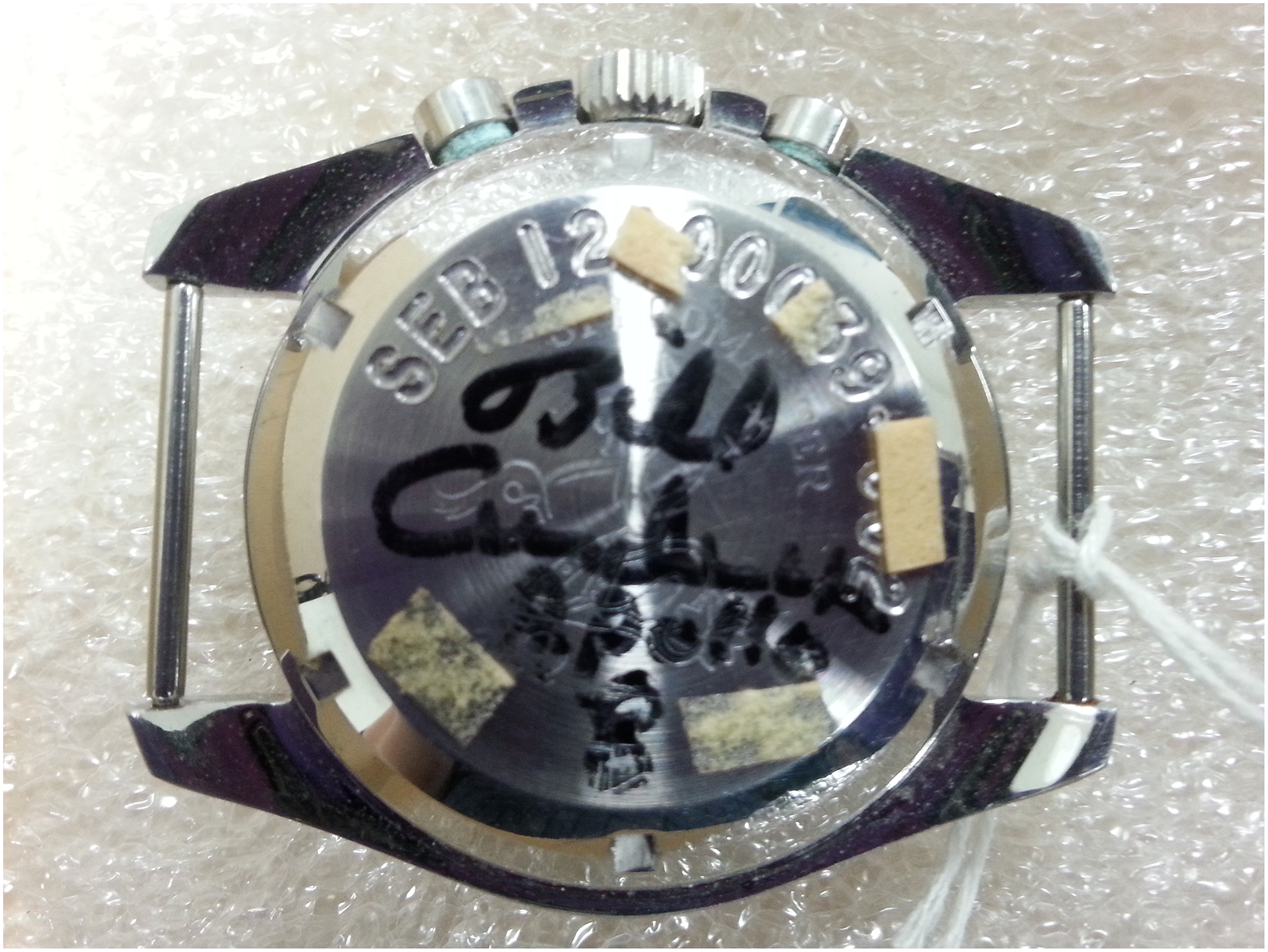
William Anders chronograph, serial number 44, prior to conservation treatment, A19780212000 (NASM Photo A19780212000d4).
Anders was the only astronaut kept informed of progress throughout the conservation project. Upon its conclusion, he was sent the final report, including photographs of the damage and conserved condition at the end of the process. A formal agreement was reached in early 2023 for the chronograph go on display at his museum near Burlington, WA, and the display was completed in October 2024 with the delivery of the chronograph. The unique story here is the interest Anders expressed in the condition and location of this artifact, valid concerns that are demonstrative of his connection through material culture to very intimate memories of the time he flew to the Moon and back.
Another instance of a long-term astronaut loan is that of Apollo 15 command module pilot Al Worden (Worden, 2013). Like the previous example, developing a collegial relationship prior to requesting return of the artifact yielded the chronograph's return. Through a shared status as alumni of the University of Michigan and expressing interest in his photographic work, I worked slowly towards a formal request for the object's return for our conservation project. When Worden agreed to return the loaned serial number 45, he admitted that the chronograph had been in his safety deposit box for years, but prior to that, he’d worn it for quite some time. After retrieval by a Museum staff member and hand-carry back to our lab, an assessment concluded its condition was not ideal, but not nearly as bad as that of Anders’. Signs of wear included pitting around the black bezel, corrosion around the pushers, scratches on the crystal, and surface debris. Serial number 45 thankfully required far less effort, allowing the Omega watchmaker to disassemble, clean, and put back together the object for long-term storage more easily. To bring this story full circle, staff permitted Worden to visit the conservation lab in 2018 to view the work completed on the chronograph, where he expressed his appreciation for the Museum's role in safeguarding the chronograph, and thus an important piece of his history. Again, attachment to an artifact seen through the user's eyes clarifies their connection to time, and the chronograph they wore, and is paramount to understanding the importance they place on connecting to their own history and memories.
Conclusion
The availability of wristwatches changed after the end of Apollo-era. James Ragan continued to purchase Omega Speedmaster Professional chronographs using a buyer in New York City. Government regulations still prevent the direct purchase of equipment from a non-U.S. manufacturer for government use. Speedmasters remained in service for decades, issued to astronauts but rarely serving as their primary wristwatch. NASA adjusted flight qualification standards, which permitted the use of quartz watches beginning in the Space Shuttle program, but only inside an orbiter. In NASA cataloging, they are frequently referred to as “crew preference watches,” generic terminology that may indicate the likelihood that the Speedmasters had outlived their utility to astronauts working in a pressurized compartment.
For spacewalking, Omega chronographs are still the only flight qualified option, and use continues through the latest International Space Station spacewalks. In recent years, Omega developed what it calls the Skywalker X-33 model, a hybrid LCD watch that operates on a quartz movement to keep the watch hands moving during a spacewalk but offers the complexity of a chronograph when the LCD screen operates inside the space station (the cold of space makes LCD screens inoperable). NASA transferred one of these to the Museum in the summer of 2022, so they remain quite rare outside of astronaut hands (anecdotal evidence suggests many were purchased at a discount from NASA by those who wore them in space). In the meantime, while astronauts incrementally move towards a return to the Moon, their timekeeping devices are also modernizing to meet their needs.
What can be made of the personal connections between astronauts and their mission-used chronographs? Omega Speedmasters and Speedmaster Professionals, as representative of the material culture of small astronaut equipment of the early human spaceflight program, intimately connected the astronauts to considerations of time and memory. This situation mirrors that of owners of jewelry worn regularly: a source of memories no user desires to relinquish. While some astronauts readily returned their flight chronographs and never requested personal loans, many felt quite strongly about their ongoing “possession” of these items. Through some form of customary practice, military pilots often kept watches issued to them during test pilot work. In the case of NASA, however, management felt a need to strictly control objects used on spaceflights, prompting the artifact agreement with the Smithsonian before Apollo astronauts ever left Earth. But are these astronauts wrong for pushing back, for taking a significant amount of interest in these items or seeking to put them on display at publicly accessible locations? Not by any stretch of the imagination. My curatorial job is to ensure the safety and well-being of the objects under my care, and if that includes ongoing communication and negotiation with American heroes or their families, the price is a small one to pay for both understanding their needs and the needs of objects crucial to maintaining a sense of time during their million-mile travels. These artifacts are perhaps the best way to connect to the needs and experiences of astronauts considering the near ubiquity of watch use on Earth.
Footnotes
Acknowledgments
The author wishes to thank Michael Neufeld, former curator at the Smithsonian National Air and Space Museum, for his skilled editorial eye on various stages of this article, and Carlene Stevens, curator at the Smithsonian National Museum of American History, for her keen observations that informed the shape of this article.
Declaration of conflicting interests
The author declared no potential conflicts of interest with respect to the research, authorship, and/or publication of this article.
Funding
The author received no financial support for the research, authorship, and/or publication of this article.

Notes
Author biography
Jennifer Levasseur is a Museum Curator at the Smithsonian National Air and Space Museum. Her primary area of research is human spaceflight material culture with responsibility for the collections of the Space Shuttle and International Space Station programs, astronaut chronographs, and astronaut cameras.