







Abstract
Drawing on ethnographic fieldwork – including participant observations, interviews, archival research, and netnography – this article traces the material and symbolic trajectories of festival tents. It explores how waste-making intersect with comfort, pleasure, and sociality, but also with postcolonial entanglements and global inequalities. Focusing on micro-moments of ‘wasteification’, the study examines how tents shift from valued sites of intimacy and identity to ambiguous, discarded matter. This transformation reveals competing and messy logics: some tents are abandoned due to material fatigue, planned obsolescence, or cultural scripts of disposability, while others are salvaged, cherished, and recommodified. By attending to the ontological multiplicity of festival tents, the article contributes to debates on disposability, waste infrastructures, and the politics of material culture. As ephemeral yet materially persistent objects, festival tents illuminate uneven global circuits of production, consumption, and abandonment, emerging as evocative actors in broader discussions on waste, inequality, and material ethics.
Plain language summary for video abstract
This article explores the material and symbolic journeys of festival tents using ethnographic methods, including participant observation, interviews, archival research, and netnography. It examines how tents shift from being valued spaces of comfort, intimacy, and sociality to becoming waste. The study focuses on moments of ‘wasteification’, highlighting how abandonment is shaped by material wear, planned obsolescence, and cultural norms of disposability, while some tents are salvaged or reused. The article contributes to debates on waste, disposability, and material culture, showing how tents reflect global inequalities and the complex politics of consumption, production, and abandonment.
Preludium
A man tragically lost his life during clean-up work at the Roskilde Festival in 2024. The Roskilde Festival is to Denmark what Glastonbury is to England and Coachella is to the United States: a well-established music festival that, over more than half a century, has become a significant cultural institution and phenomenon, even beyond the country's borders (Arnold, 2018; Flinn and Frew, 2014; Hjalager, 2009).
In their daily report on 12 July 2024, the Mid- and West Zealand Police wrote: ‘At 17:57: a 52-year-old man from Poland passed away yesterday after being struck by a tractor during clean-up following the Roskilde Festival’. The daily press further reported that the man had lived as a homeless person in Denmark and had been volunteering with Gaderummet – a grassroots organisation working with socially vulnerable individuals. In exchange for his labour, he was permitted to keep what he could find among the mountains of discarded belongings (Hansen, 2024a, 2024b)
On the day of the accident, the Danish Working Environment Authority issued a stop-work order to Gaderummet and later reported them to the police. By December 2024, the organisation was fined for violating workplace safety regulations. Roskilde Festival also came under criticism for what many saw as exploitative labour practices. Gaderummet had been contracted to carry out the post-festival clean-up – a task that typically spans over three months and involves 20–25 people working daily from 9:00 a.m. to 6:00 p.m., often seven days a week. For this work, the festival paid a symbolic sum of 500,000 DKK (approximately €67,000), raising public outcry. Critics accused Roskilde of relying on structurally underpaid, precarious workers to carry out the dirtiest, most essential tasks – what some described as a form of social dumping. Additional controversy erupted when it emerged that some volunteers, many of whom struggled with addiction, were compensated with leftover tobacco and alcohol (Hansen, 2024a, 2024b; see also Bernaciak, 2015; Wagner, 2019).
The homeless man had been assigned to help dismantle abandoned tents at the festival site, but during the process, he took an unscheduled break and sought shelter in one of them. Unfortunately, the tent had already been classified as waste by others. Here, the contours of a deeper struggle over values and definitions begin to emerge: What constitutes waste, and who has the right to decide? In another context, the man's actions might have been seen as an act of civil disobedience. But in the encounter between a vulnerable human body and an unyielding machine, the latter tragically had the final word.
Introduction – Making a case of festival tents
Controversies surrounding festival tents can, at times, become matters of life and death. Fortunately, the incident described above remains a rare and tragic exception. Most disputes involving festival tents are less visible and less dramatic. This article focuses on these quieter controversies, in which various actors seek to advance interests, assert perspectives, and define realities (Latour 1987). These disputes often unfold in parallel and are intricately entangled with broader questions of value, disposability, inequality, and postcolonial asymmetries. What began as an investigation into the material lives and afterlives of abandoned tents (Juel-Jacobsen, 2025) unfolds in this article into a deeper inquiry into the socio-material and political logics that underpin practices of discarding. The wasteification of the festival tent is not merely illustrative of a broader material culture of disposability and ephemerality that flourishes in festival settings. It is also, I argue, symptomatic of deeper and more pervasive global asymmetries.
This article is grounded in a multi-sited ethnographic study conducted in and around the Roskilde Festival. The fieldwork began in spring 2023, tentatively concluded in autumn 2024, and was supplemented by an additional iteration in June 2025. The study draws on dozens of hours of participant observation, semi-structured and unstructured interviews, archival and media analysis, and digital ethnography (netnography) on relevant platforms. Initially, the research aimed to map and illuminate waste production associated with festival tents, discussed elsewhere (Juel-Jacobsen, 2024). An estimated 250,000 tents are abandoned at U.K. music festivals each year, most ending up in landfills; and in Denmark, they are more often incinerated (Association of Independent Festivals, 2019; Roskilde Festival 2023; Roskilde Festival Gruppen 2024). A festival tent often completes an entire product life cycle in a matter of days; often being left behind on the festival grounds as trash after a brief period of use.
The festival tent serves as an analytically rich case – at once extreme, paradigmatic, and ordinary (Flyvbjerg, 2006). Its extreme and compressed lifecycle – cheaply produced, briefly used, and readily discarded – makes visible the underlying logics of accelerated disposability that underpin much of contemporary consumer culture. More than that, the tent functions as a material condensation of the political economy of popular consumer culture, bringing into view a dense web of global entanglements and postcolonial asymmetries. Its very ordinariness is also what makes the festival tent analytically powerful. As Flyvbjerg (2006) reminds us, the value of case studies lies in their capacity to reveal both complexity and contextual specificity. It is through such messy, situated material encounters that we can begin to trace the uneven geographies and politics of waste, value, and disposability (Figure 1).
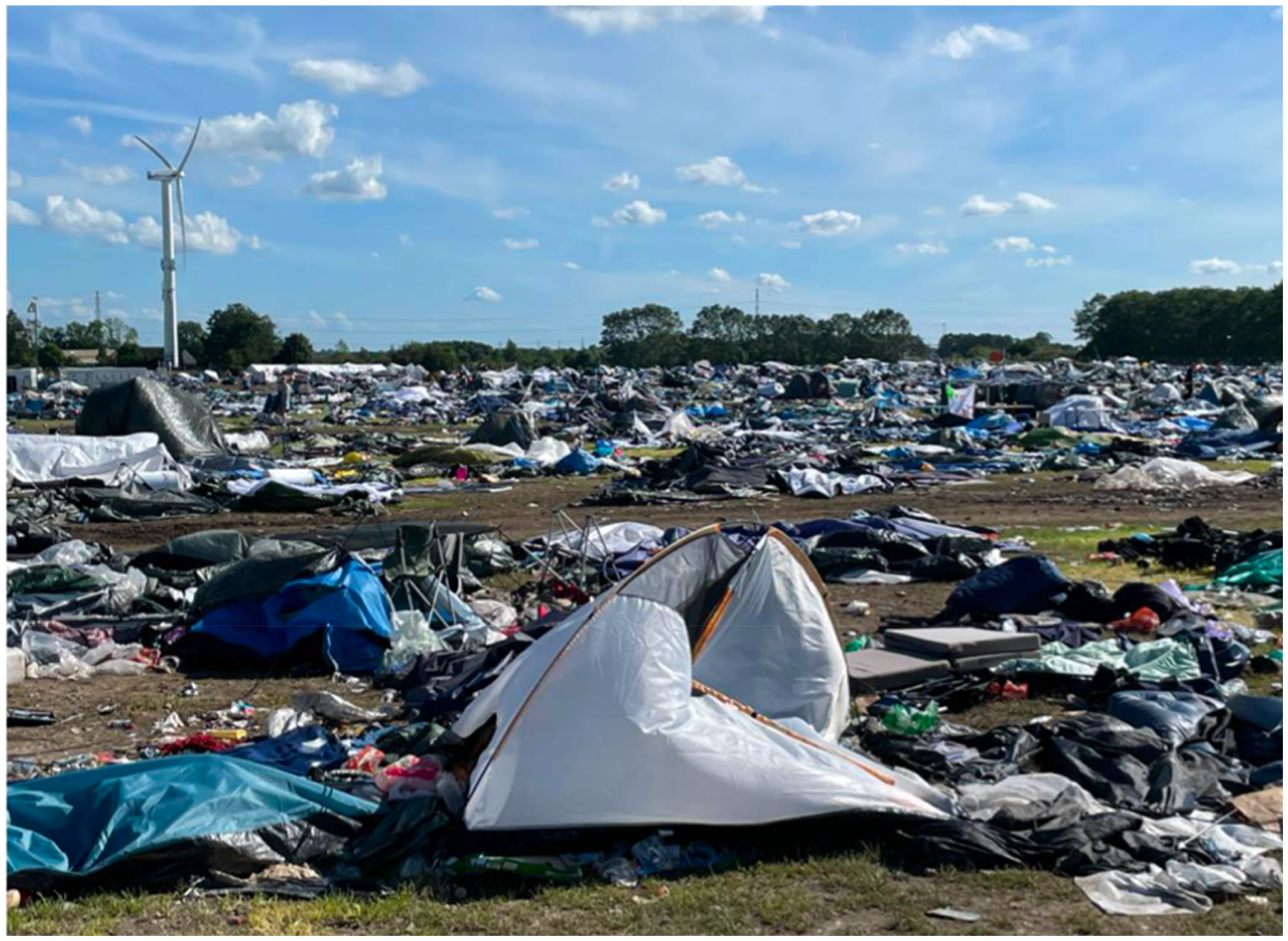
The Festival Tent, Roskilde 2024. © Lene Granzau Juel-Jacobsen
The case of festival tents both aligns with and extends insights from now-classical studies. This article is situated at the intersection of Mary Douglas' (1966) notion of matter out of place and Bruno Latour's (2004) concept of matter of concern. Douglas's seminal work shows that waste is not intrinsic but symbolic – it disrupts otherwise stable boundaries and unsettles social order. A tent is not discarded because it fails, but because it lingers after its moment has passed. It becomes out of place. Latour, by contrast, foregrounds the relational significance of objects as they circulate through networks of meaning, care, and controversy. During the festival, the tent is not waste: it is, among other things, a shelter. But as the music fades and people leave, its meaning collapses – the infrastructure that once sustained its value shifts or dissolves, withdrawing that value. The tent transitions from matter of concern to matter out of place – from valued companion to nuisance, increasingly prone to abandonment. This shift marks a particular moment of wasteification: when an object's social and affective value collapses, and its material presence becomes problematic. In this sense, wasteification is not merely a matter of material degradation, but of social unmaking of value.
Recent scholarship increasingly highlights that waste is not a fixed or inherent condition but is actively produced through intertwined chemical, social, and political processes. Scholars such as Gay Hawkins (2006), Zsuzsa Gille (2007), and Josh Lepawsky (2018) emphasise that waste is not simply a material end-state but a relational, socially constructed category shaped by political economy, cultural norms, and valuation practices. For instance, Hawkins illustrates how waste-making is embedded within ethical considerations and social relations, arising from ongoing negotiations about what societies deem valuable or disposable. Similarly, Lepawsky's research on e-waste and Gille's study of industrial by-products reveal how disposability is deeply embedded within global production, circulation networks, and cultural expectations. Yet, unlike infrastructure or industrial waste, festival tents occupy a unique position as consumer goods that blur the line between valued and discarded objects within a condensed temporal frame. Their rapid transition from cherished personal spaces to abandoned debris exemplifies the logic of ‘premature obsolescence’ (Slade, 2006) – a process by which products are designed or utilised to significantly shorten their lifespan, thereby encouraging frequent replacement and disposal.
Furthermore, the case of festival tents introduces a performative and collective dimension to waste-making, where shared cultural practices and communal experiences actively shape when and how objects become waste. This dynamic contrasts with the more individualised trajectories of consumption and disposal explored by scholars like Joshua Reno (2016), who investigates the afterlives of T-shirts, and Bissell (2020), who examines how individuals assign value to discarded objects. Their work reveals the complex; often contradictory social meanings attached to waste at the personal level. In comparison, festival tents entail distinctive temporalities and social dynamics in the politics of waste and disposability.
As the focus shifts from understanding waste as fixed or final to viewing it as a process of transformation – through which objects move between states of value, meaning, and use – waste emerges as an unstable, contingent category under continual negotiation. It reflects broader struggles over meaning, worth, and visibility. The festival tent, in this context, is both an object and a node within a transnational assemblage of production, consumption, and discard. Understanding wasteification thus requires attention to the infrastructural and affective work that transforms matter from useful to discardable. This relational view aligns with Annemarie Mol's (2002) notion of ontological multiplicity: the idea that objects do not have a single, fixed identity but are multiple, enacted differently through diverse practices. The festival tent constitutes a particularly vivid enactment of ontological multiplicity as it is a dynamic and shifting process subject to ongoing negotiation, in which materials and meanings are continually co-constituted.
A central argument in this article is that the disposability of the festival tent is closely tied to contested definitions and shifting matters of concern (Latour, 2004), which bring together a dense network of actors, practices, and controversies around consumption, disposability, and environmental impact. By tracing the tent's socio-material entanglements, this article offers a critically attuned reflection on how contemporary objects and infrastructures both mediate – and are mediated by – socio-cultural experiences, global inequalities, and political practices (Anderson, 2010; Appadurai, 1986; Douglas, 1966; Gille 2017; Gregson and Crang, 2010; Larkin, 2013; Liboiron, 2016a, 2021; Nixon 2011). In doing so, it contributes to ongoing debates in waste and discard studies (e.g. Doherty, 2021; Franklin-Wallis, 2023; Holmes and Holmes, 2024; Lupton, 2021; Reno, 2016), foregrounding how seemingly banal acts of use and abandonment of material objects and culture are saturated with contestations over value, responsibility, and visibility.
Tracing tents – A tent-centred ethnography of wastification
Latour (2012) invites ethnographers to decelerate, to ‘move as slowly as a turtle and as myopic as an ant’, in order to stay attentive to the dense and entangled social world. This methodological commitment to slowness and ontological flatness informed my fieldwork at the Roskilde Festival, where I followed the festival tent as an actor, foregrounding the intertwined agencies of both humans and non-humans in the making of waste. Rather than following a fixed path, the trajectory of the festival tent unfolded in what Gilles Deleuze and Félix Guattari (1987) describe as a rhizomatic manner – non-linear, entangled, and branching in unexpected directions (see also Marcus, 1995; Tsing, 2015). My fieldwork did not proceed chronologically or hierarchically but moved across practices, actors, and sites: from striving tent camps to abandoned tents on the festival grounds, to marketing campaigns, police reports, assembly instructions, tent manufacturers, and social media conversations. This rhizomatic unfolding of the field reflects the material and ontological multiplicity of the tent itself. It also resonates with other ethnographic studies of waste (e.g. Alexander and Reno, 2012; Hawkins, 2006; Liboiron, 2021; Reno, 2016), where researchers are drawn into the unpredictable routes through which objects move, decay, and are revalued. A rhizomatic approach enables the ethnographer to attend not only to discarded materials but also to the social and infrastructural relations that render them both possible and disposable.
Alongside thematic coding of qualitative interviews, informal conversations, and fieldnotes, I produced a series of low-tech network maps to trace associations between actors. In contrast to Tommaso Venturini's (2018) digitally rendered controversy maps, these hand-drawn cartographies emerged slowly and materially – through pen, paper, and the embodied pacing of the body. When the hand guides the pen, the body thinks differently. This analogue method fostered a sensitivity to detail, contingency, and embodied knowledge, encouraging what Annemarie Mol (2002) calls a praxiographic approach, that attends to how such objects come into being through the very practices that enact them. The tent becomes depending on context, network, and interaction. The mapping helped visualise how these transformations are not only material or practical but also embedded in controversies and disputes – some overt, others far more subtle. These tensions unfold at both micro and macro levels, reflecting broader struggles over responsibility, value, and legitimacy. The tent emerges not as an isolated object but as a shifting node within a dynamic assemblage of people, materials, substances, sounds, objects, and infrastructures.
Clearly, not all ground can be covered in an article of limited scope. Rather than narrowing the focus to a confined or self-contained local object, the tent is approached here as a relational and provisional assemblage (Deleuze and Guattari, 1987; Latour, 2005; Mol, 2002). Such a broad and wide-reaching analysis will inevitably leave loose ends, but these reflect the complexity of reality itself rather than indicating analytical flaws. They acknowledge the impossibility of imposing artificial neatness or finality on a phenomenon that is fundamentally messy, distributed, and contingent. On Monday, it's a bargain; by Thursday, a basic shelter; and by Sunday, it is waste. Or so it might seem. However, to understand the accelerated process of festival tents’ wasteification, we must zoom in on their transformation from matter of concern to matter out of place (Douglas, 1966; Latour, 2004), while also attending to the reverse process – and to the many ambiguous states, disputes, and becomings that occur in between. This requires slowing down and carefully deciphering why the tent matters in multiple ways; how it ceases to matter; and insist on openness to alternative pathways around and in between.
The many reasons why festival tents matter and the many ways in which they cease to matter
In a recent popular review of festival tents, one learns that ‘When it comes to festival camping, the dream is to have a tent that's spacious, weatherproof, and easy to put up’ (Loudersound, 2023, June 16). The review further recommends that tents be large enough to accommodate the full body length of all intended occupants and, ideally, offer additional space for storing personal belongings. As a basic form of shelter, the tent offers protection from the elements – this is the simplest reason why tents matter. Presumably, it was this same logic that led a homeless person to take shelter and an unscheduled nap in what appeared to be a convenient tent at the festival site. On any other day, this would have made perfect sense.
An additional key feature highlighted in the review concerns the tent's material construction and delegated convenience – qualities that may seem neutral but carry significant political and ontological implications. The tent's convenience, often praised in reviews, results from a specific configuration of materials and functions. For example, ‘sturdy plastic fibre poles’ are not merely passive components; they act as nonhuman agents, stabilising the structure while remaining lightweight and flexible. As the review notes about the highest-rated tent: ‘One of the best things about this tent is how easy it is to erect. Thanks to its automatic hydraulic system, it’ll pop open in seconds’. This ease is, in fact, the result of what Latour (1988) calls delegation, that is, the displacement of human labour onto nonhuman actors. What once required coordinated human assembly has been inscribed into the tent's hydraulic mechanism, transforming the labour-intensive construction of shelter into a brief and seemingly effortless gesture. However, this delegation is asymmetrical. While the tent generously offers near-instant setup, it withholds this generosity when it comes to disassembly. Assembly is designed to appear intuitive; disassembly is not. The process of folding and packing down the tent is often omitted from instruction manuals and instead demands patience, persistence, and as often observed at Roskilde Festival, even collaborative effort. In these moments, the tent's agency shifts from friendly and accommodating to resistant and unruly. It is no longer the user-friendly ally it initially appeared to be; it almost seems to resist re-entry into its compact, transportable form. Thus, while the tent may be erected with ease, it risks being abandoned in frustration (Juel-Jacobsen, 2025).
On the final morning of the festival, I observed a young couple attempting to fold their tent. He pushed one side down while she tried to twist the frame into a circle. The tent refused. It popped back open with a flailing motion that startled them both. They laughed, then sighed, and eventually gave up. ‘Let's just leave it’, she said, not angrily, but with resignation. What had once offered warmth, privacy, and respite now lay on the grass flattened, damp, uncooperative. In this moment, the tent was no longer a shelter. It was not (yet) waste either. It was an object whose identity and destiny were unsettled. The tent shifted from being a companion-object to a burden. Disposal does not occur in an abstract system – it happens in the rain, on sore knees, with a hangover and torn fabric. In the act of folding, the tent becomes too much, too unruly – what finally renders it disposable.
The absence of clear disassembly instructions, combined with the difficulty of cleaning and collapsing the tent, subtly enacts a material script that favours wasteification. The tent's resistance to repacking and reuse is not merely a design flaw but part of a broader material politics that promotes single-use and disposability. What seems like technical inconvenience is, in fact, an expression of a politics of matter, defining how things are meant to be used and when they are to be discarded. The festival tent, then, is not simply an object that becomes waste; it is, from the outset, ‘disposable by design’. The festival tent is often made to be temporary, assumed to be discarded. In this light, wasteification of festival tents may well become normalised.
Shelters of comfort; spaces of belonging
Another key feature of the festival tent is its capacity to comfort; perhaps even to console. While it shelters the body from the elements, it also serves as a soft architecture of withdrawal amid the sensory intensities of festival life. At Roskilde Festival, a young woman finds herself overwhelmed by music, lights, strangers, and the constant visibility and motion. She slips away and returns to her tent. The distance is short, but the shift is profound. She zips up the entrance, lies down, and, as she confesses, sometimes cries quietly. In the tent, one is neither fully alone nor fully exposed. The outside world is momentarily suspended. In this moment, the tent becomes a membrane between self and world, offering protection when stimulation tips into overwhelm. It offers what Deleuze and Guattari (1987) might call a space of minor becoming: a site of transformation where the overstimulated festival-goer can briefly retreat and recuperate. It is a matter of concern, entangled with care, emotion, and situated meaning.
Festival tents also matter as particular sites of attachment. They store personal and valuable belongings and offer users a space of temporary belonging. Often, tents are decorated, painted, or otherwise personalised, sometimes in harmony with surrounding tents, to signal affiliation and attachment. Clearly, the tent is more than a mere physical shelter. As Mol (2002) and Latour (2005) remind us, objects do not simply reflect social life; they help enact it. They participate in the shaping of space, relationships, and affect through their material affordances and limitations. Emotional attachment is typically associated with preservation and care: an old teddy bear that once offered comfort, a family heirloom retained out of respect, or a souvenir that evokes a particular time and place. These objects are kept not for their utility but because they are saturated with memory, identity, and affective investment (Appadurai, 1986; Miller, 1997, 2008). By contrast, the festival tent – decorated, inhabited, and at times even cherished – is often abandoned without prolonged hesitation. Its emotional entanglement does not guarantee preservation. In fact, it may heighten the sense of betrayal when the tent frequent disappoints or fails. The tent becomes waste not despite the attachments formed around it, but often through the collapse of the expectations they helped sustain. As those attachments may unravel under material and symbolic strain, the tent shifts from a space of belonging and retreat to a structure resigned to abandonment. Its disposability is not incidental, but rather the outcome of a fragile relationship between care and disappointment – a relationship shaped as much by affect as by design.
Hence, the investment in care and decoration is fragile and carries a high risk of disappointment. Some might even say that festival tents are deceptive. Many are not designed to last: zippers break easily, poles snap under light pressure, and seams or glued joints often come apart. These flaws may stem from a well-established capitalist production logic geared towards cost-cutting, rapid turnover, and profit maximisation. They are, in Slade's (2006) words, ‘made to break’. Planned obsolescence ensures that products are intentionally designed to fail or become outdated, encouraging repeat consumption (Figure 2).

Low-price tent advertisements from discount retail chain in Denmark, Harald Nyborg 2024 ©.
Retail chains like Harald Nyborg in Denmark (similar to Argos and ASDA in the United Kingdom) market ultra-cheap tents for as little as 50 DKK, that is, less than €8 (see Raemason (2025) for similar UK examples). Their products are often mockingly referred to as Harald Skrald (‘Harald Trash’, similar to ‘Walmart Waste’), a play on words suggesting that anything bought there is barely more than waste and essentially destined to be discarded. In this sense, the disposability of festival tents is not merely tolerated but anticipated. Even when users invest more – financially or emotionally – the tent still carries a high risk of disappointment. Padlocks may be added to zippers in attempts to secure belongings: a small gesture signalling a desire for protection and safety. Yet this is a fragile promise. Regardless of quality or price point, and despite marketing claims of durability, tents remain unreliable: the fabric is easily torn, burned, or cut. Once this fragility is revealed, the affective bond may collapse. Care becomes difficult. Disposability becomes a function of disillusionment.
A significant part of the disappointment some festival-goers experience with their tents may be connected to the tents’ origins. Most festival tents carry labels such as ‘Made in China’ or indicate production in other parts of the Global South, including Vietnam and Bangladesh. Together, these countries account for more than 75% of global tent production, while factory ownership is often concentrated in countries such as South Korea, Taiwan, and India (Factory and Kwang, 2003; Volza Global Export Data, 2025; World Bank, 2021). Low wages and liberal labour regulations in the Global South facilitate the production of inexpensive synthetic textiles, which are then assembled into tents that meet the pricing and turnaround demands of the Global North's appetite for disposable, pop-up products. In 2022, global tent exports surpassed $3.4 billion USD, with the United States, Germany, and Japan among the leading importers (Volza Global Export Data, 2025). Much like plastic goods more generally (Davis, 2019), the festival tent is embedded in capitalist logics from its earliest stages of production.
For many consumers, the ‘Made in China’ label unconsciously signals inferior quality, functioning as part of a broader cultural shorthand that associates goods from the Global South with cheapness, mass production, and disposability (Akdeniz and Kara, 2014; Schniederjans et al., 2011). Recent studies on country-of-origin bias reinforce this perception: stereotypes of poor quality, low safety standards, and unreliability continue to shape consumer attitudes (Nguyen et al., 2023). Labels such as ‘Made in China’ or ‘Made elsewhere’ often evoke associations with disposability, underpinned by enduring colonial and postcolonial discourses that devalue both the labour and material culture of the Global South (Escobar, 1995; Said, 1978; Stoler, 2008). As such, festivalgoers at Roskilde Festival may approach their tents with subtle belittlement or anticipatory disappointment – shaped by cultural distance, othering, consumer ethnocentrism, and media-fed stereotypes (Bankert et al., 2023; Ghemawat, 2001; Lionel, 2009; Verlegh and Steenkamp, 1999). In this context, ‘Made in China’ operates not merely as a geographic label but as a semiotic and affective actor within a broader cultural and economic network. It becomes a shorthand that organises expectations, priming consumers to anticipate poor quality and low value, even before the tent is unpacked. And when expectations are low, the tent is often treated accordingly: not cared for, but left unpacked, unfolded, unzippered, and abandoned, regardless of its continued functionality. Not because it has failed, but because it was meant to; a presumed disappointment that arrives before any actual breakdown. Through this self-fulfilling logic of disregard, the tent ultimately performs exactly as expected. It comfortably fulfils its script.
Leaking expectations and light promises
Disappointment with festival tents is not always rooted in poor craftsmanship, cultural stereotypes, or profit-driven shortcuts. It may also arise from more subtle material mismatches, stemming from the friction between the materials from which these tents are crafted and the environments into which they are placed.
Festival tents are typically manufactured in humid regions such as Vietnam and Bangladesh, using synthetic fabrics like nylon or polyester. These materials are chosen for their light weight, water resistance, durability, and low cost; qualities well-suited for mass production and efficient transport (Yu et al., 2020). However, these materials are not universally stable across different climates. Nylon, for instance, is commonly used for its favourable strength-to-weight ratio; yet it absorbs moisture and expands in humid environments, while contracting in cooler, drier air. This dimensional shift, which can reach up to 3–4% (Venoor et al., 2021), may cause tents to sag, strain at the seams, stick at the zippers, or bend the poles – making assembly difficult (Cecot-Scherer, n.d.). Even though polyurethane coatings significantly reduce nylon's moisture absorption (Cho et al., 2025), what fits neatly in one climatic context can pull awkwardly or misalign in another.
In other words, what is experienced as failure – tent fabric sagging under unexpected moisture, water leaking in – may result from materials behaving differently across climatic contexts. At the festival site, such breakdowns are rarely interpreted as isolated technical glitches. No festival-goers speak of humidity curves or fabric memory. Instead, they joke about ‘cheap junk’ from Harald Skrald, Wish, or Temu. One festivalgoer – let's call her HobbitHannah – posted ironically on Facebook a photo of herself beside a comically undersized tent at Roskilde Festival, captioned: ‘When you’ve ordered a tent from Wish  #hobbithouse #rf’. The next day, she posted an update, featuring a new tent: ‘The hobbits report all is well from Ros
  . The hobbithome had collapsed when we arrived on Wednesday, despite repeated rescue attempts from the young men we’re camping with. They helped us get this new castle on its feet …
  #wecandotentsoneday #happyhobbits.’ (HobbitHannah, 2019, June 26)
This seemingly trivial anecdote is, in fact, instructive – it anchors the tent within a moralised narrative of global consumption. Moments of failure are not neutral; they are interpreted, narrated, and often moralised or ridiculed. Users may blame ‘Harald Skrald’ or dismiss an object as ‘Made in China’, locating disappointment in the presumed inferiority of Global South manufacturing. In doing so, they obscure the more complex interplay at work, between material performance, environmental conditions, design choices, capitalist logics, and postcolonial narratives. As Anna Tsing (2015) reminds us, global encounters are always shaped by friction, not only between materials, but also between expectations, assumptions, and historical imaginaries. The fabric stretches; the tent leaks; the blame settles.
The tent is not a self-contained item that simply fails on its own; rather, it is a socio-material entity that fails with the user, with the weather, and with the assumptions placed upon it – about function, value, and durability. The tent stages encounters: between humans and nonhumans, climates and fabrics, expectations and materials, fibres and fantasies. It leaks or collapses not only under shifting weather conditions, but under the accumulated weight of layered expectations. Its ‘failure’ is shaped as much by affect and anticipation as by seams and stitching. It does not merely break; it is ruined in advance as Stoler (2008) might suggest by systems that expect failure, encode disposability, and devalue care. Such failure is not necessarily a flaw, but a moment in the tent's ongoing material becoming. In these entangled encounters, value is neither fixed nor intrinsic but enacted; stretching, leaking, resisting, folding under pressure, and ultimately being disposed of.
One concern is the leaking expectations surrounding festival tents; another is the light, idyllic promise of nature that accompanies them. According to advertisements, the tent will bring us closer to nature and connect us with a bygone era. Promising ‘reconnection’, ‘escape’, and the comfort of primitive simplicity, tents are often marketed as convenient shelters for authentic outdoor experiences (Figure 3). These messages evoke romantic images of pastoral freedom; a getaway from modern excess. Yet, embedded in the fabric lies a different material reality: a dense mesh of petrochemistry, extractive labour, ecological harm, and colonial entanglements.

Advertisements of serene, light, outdoorsy promises of reconnecting with nature. The Playground © (2024) and Woodside Lake Park © (2025).
Modern tents are anything but ‘natural’. The synthetic materials used in festival tents carry significant environmental and human costs, including microplastic pollution, toxic runoff, and health risks for factory workers (Dai et al., 2005; Kennedy, 2005; Lithner et al., 2011). These tents are composed almost entirely of synthetics such as nylon and polyester, that is, petrochemical derivatives that require highly energy-intensive industrial processes. Polyester alone accounted for 57% of global fibre production in 2023, consuming over 1.3 billion barrels of oil annually (Apparel Impact Institute, 2025; Changing Markets Foundation, 2024). Nylon and polyester are produced through the polymerisation of fossil-fuel-derived compounds: nylon from adipic acid and hexamethylenediamine, and polyester from terephthalic acid and ethylene glycol (Palacios-Mateo et al., 2021; Tonsi et al., 2023). These production processes emit substantial amounts of greenhouse gases; notably, the manufacture of nylon releases both CO₂ and nitrous oxide (N₂O) – a greenhouse gas nearly 300 times more potent than carbon dioxide (Davidson and Winiwarter, 2023; Shen et al., 2010). Moreover, polyester sheds microplastics when worn, washed, or weathered, polluting waterways, damaging marine ecosystems, and entering human food chains (Šaravanja et al., 2022; Thiemens and Trogler, 1991). The tent thus becomes an agent of environmental harm, with impacts that extend far beyond its brief period of use. Its footprint endures long after the festival ends.
Still, these facts remain largely invisible to the average tent user. I have yet to meet anyone at a festival who has read a material declaration on their tent. While such conscious consumers may exist, they appear few and far between. The toxic substances embedded in waterproof coatings and synthetic fibres rarely register in the affective or sensory experience of the user. In this context, Liboiron's (2016b) work is especially relevant. Microplastics, defined as plastic particles smaller than 5 mm, are not only materially pervasive but also politically deceptive. Their invisibility and ubiquity in ecosystems make them difficult to detect, regulate, or hold accountable. In their microscopic form, the environmental harm of tents may seem negligible or unremarkable, eluding both regulatory frameworks and consumer awareness.
The production of festival tents depend not only on petrochemical inputs, but on particular forms of labour and expertise, and it is often outsourced to places where both are cheap and expendable. The business model underpinning festival tents, driven by cost-cutting, rapid product turnover, and profit maximisation, necessitates production at such low costs that manufacturing is confined to countries with correspondingly low wages and lax labour protections. Most festival tents are now produced in countries like Vietnam, Bangladesh, and China. In these places, sewing synthetic fabrics is highly skilled, but poorly paid. Workers face chronic exposure to chemicals, inadequate ventilation, and minimal regulatory oversight (Haug et al., 2021; Smith and Smith, 2019). According to the International Labour Organization (2023), garment and textile fabric sector wages in Bangladesh average just €92 per month, while in Vietnam, labour protections are limited and enforcement weak.
The risks faced by workers producing festival tents in the Global South are of a profoundly different order than the inconvenience posed by condensation dripping on tent users in the Global North. This asymmetry reflects a contemporary iteration of toxic colonialism (Dalyell, 1992; Franklin-Wallis, 2023), now with a distinct but equally troubling character. Whereas toxic colonialism referred to the export of hazardous waste from the Global North to the Global South under the guise of aid or trade, it now extends to the global outsourcing of toxic production. A tent that promises ‘reconnection with nature’ is made possible by the unseen risk borne by others; the pleasure of one world depends on the disposability of another, often many miles from the festival site. What may sell as a modest shelter close to nature is, on closer inspection, a complex socio-material assemblage, entangling chemicals, labour practices, consumer demand, weather, imaginaries, and global inequality. It may signify ‘nature’, yet it performs the logics of industrialism and extractive capitalism (Strasser, 2015), and its apparent lightness is carried by a heavy chain of chemical residues, respiratory illness, and environmental degradation.
Crimes of indifference and controversies of territory
From a marketing perspective, the deceptive promises of the festival tent may not amount to a clear-cut crime, perhaps only a minor fraud: a light frame, heavy with implication. Yet the tent may be guilty of other offences. It shelters and protects, but it also conceals and implicates. At Roskilde Festival, the tent plays an unexpectedly prominent role in daily police reports. It is a recurring character: a silent witness, a frequent offender, and, at times, an accomplice. Its thin fabric provides practical shelter from wind and rain, but it also fosters an illusory sense of security, reinforced by flimsy padlocks intended to deter theft. Just as the tent walls yield easily to a stray knife or smouldering cigarette, so too does the illusion of privacy, seclusion, and ontological safety they appear to promise.
The thin fabric of festival tents conceals a wide range of illicit activities, from sexual assaults to drug stashes and stolen goods. Particularly in cases of theft, police reports (Midt- og Vestsjællands Politi, 2024, 2025) from Roskilde Festival reveal a paradoxical and troubling use of the tent: valuables are stored inside for presumed safety, yet so are stolen items. Bags, jewellery, and soundboks® systems are taken from tents across the festival grounds, only to be hidden in other tents. In this way, the stolen goods, the thief, and the victim all find refuge within the same kind of structure. One might say the festival tent has no morality; others might argue that it does not discriminate between its users. Yet it is not a neutral container. It is an actor in a distributed network, shaping what can be done, what can be hidden, and what – or who – can be blamed. It participates in controversy, drawing together affect, materiality, and social relations into a dense configuration where harm and care share the same infrastructure. It becomes, so to speak, a controversy in itself; a space where conflicting forces converge. In this sense, it is what Latour (2004) would call a matter of concern.
However, the function and materiality of the festival tent are increasingly unsettled by new technologies. AirTags and Bluetooth signals now pierce the tent's fabric as effortlessly as knives once did. While the tent may still obscure its contents from view, it offers no resistance to the invisible currents of wireless tracking. This year in particular, police reports and news coverage have given extensive attention to the recovery of stolen goods through discreet digital surveillance (e.g. Danmarks Radio, 2025; Midtjyllands Avis, 2025; Politiken, 2024). For example, on 7 July 2025, the Midt- og Vestsjællands Police reported recovering several stolen Soundboks® speakers during Roskilde Festival, each tracked using AirTags hidden inside. In one case, a 22-year-old festival-goer followed the signal from his stolen speaker to a private home nearly 50 km away. In other instances, police raided tents across the festival grounds, seising stolen equipment and identifying suspects who were fined or even expelled from Denmark with a two-year re-entry ban; others were held in custody and detained for weeks. Breaching the privacy and protection promised by the festival tent is clearly not taken lightly. In this way, new technology reconfigures the agency of the tent. Where it once acted as a silent accomplice, a concealer, a container of secrets, it now falters under the scrutiny of pervasive digital traceability. Bluetooth signals reorient the tent's function from a complicit mediator to a leaky intermediary in a Latour (2005) sense. It is no longer a reliable ally for those seeking cover-up.
Nevertheless, the tent continues to produce another veiled space. It shelters moments of intimacy and lovemaking while also shielding acts of violence and assaults beneath the same canopy. It offers cover without judgment or intervention. Its capacity to conceal makes it both a refuge and a potential instrument of harm. In this sense, the tent mediates ambiguity and through situated practice, the tent becomes an ambivalent actor: protecting intimacy, hiding vulnerability, enabling exploitation. It draws a boundary between public and private but offers no moral guidance or legal safeguard. It allows and enables certain actions while rendering others invisible. The tent is not responsible, but it is not innocent either. It does not act alone, yet it facilitates certain actions going unseen. It permits – and sometimes it must be remembered that indifference, too, can be a form of complicity.
For the average Roskilde festivalgoer, the value of the tent extends far beyond shelter or a simple hideout. When tents cluster together, they cease to be mere camping gear and instead form a kind of camp infrastructure. According to the Cambridge Dictionary, a camp is ‘a place where people live in tents or other temporary structures’, but it also refers to ‘a place where soldiers live when training or fighting a war’. The analogy is apt: while the camp may offer rest and refuge, it is never entirely free from tension; and at times, even hostility. With tent entrances turned inward, facing each other and arranged around a shared table or communal canopy, a distinct boundary is drawn. Often, this boundary is symbolically marked by a trench of sorts: an informal perimeter of empty tuna cans, used wet wipes, and crushed beer cups. There is an inside and an outside. In this sense, the tent acts as a gatekeeper or, as Latour (1992) might suggest, functions like a door: simultaneously opening to the world and shutting it out Figure 4.
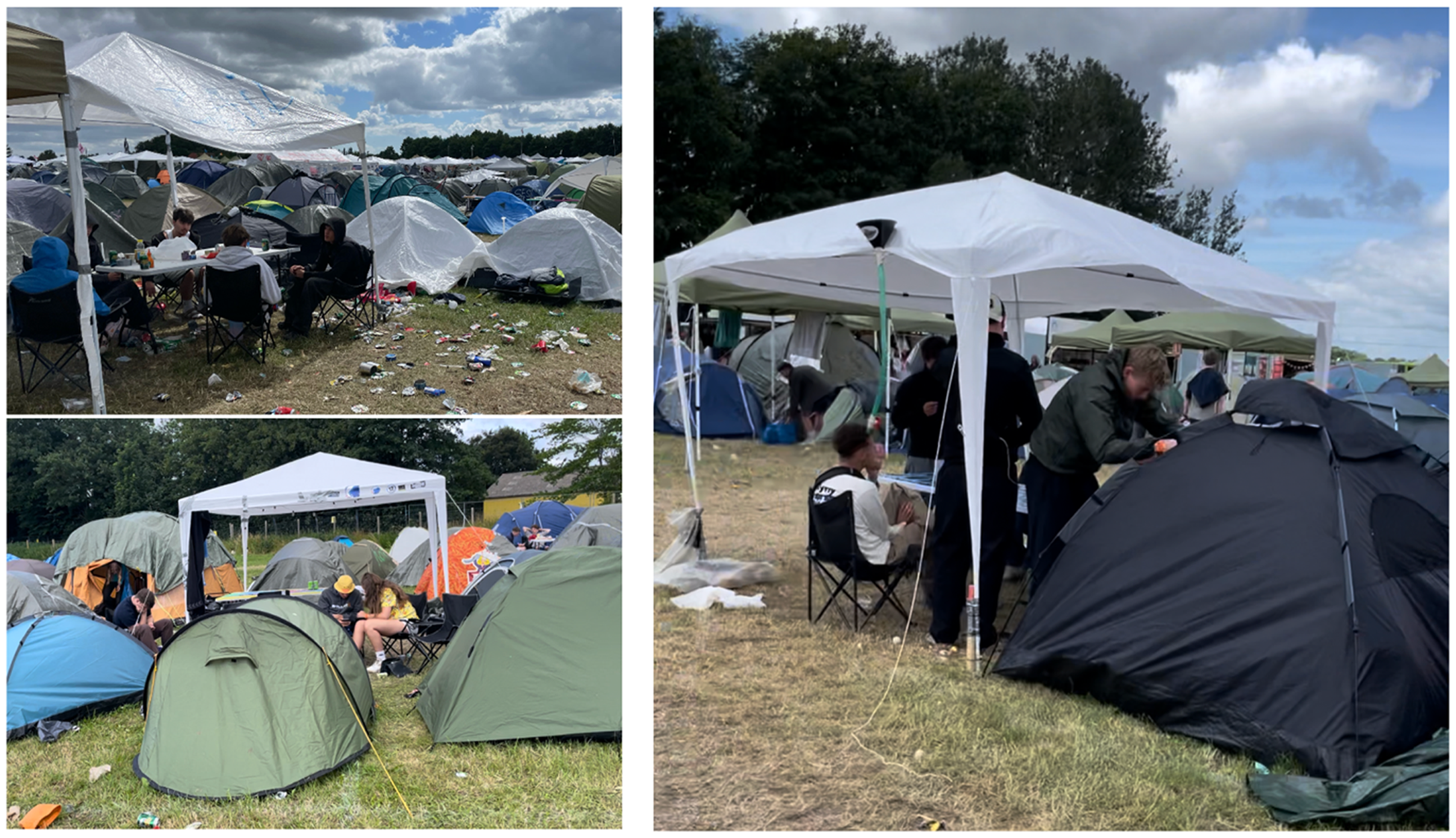
Tent Camps at Roskilde Festival 2023 and 2024 © author.
On the first day of the festival, I watched as a group dragging their gear through already-claimed territory near the train station. They hesitated at the edge of an open patch of grass; just large enough, though already partially encroached upon by a neighbour's guy lines and beer crates. Crucially, it was well away from the fence, which they knew would soon turn into an open-air toilet. After a moment of silent negotiation, one of them stepped forward and drove a tent peg into the ground. That gesture, the simple hammering of metal into soil, shifted everything. Blank grass became theirs. Bags were dropped. Poles were unrolled. A territory was enacted.
In this way the tent enables community formation as well as territory. It shapes the material and social landscape of the festival, becoming the basic unit through which space, belonging, and authority are negotiated. Festivalgoers often recount playful ‘wars’ between camps – usually involving water pistols and jokes, but those who have experienced the chaotic race for prime camping spots when the gates open know how serious this competition can become. People run, fall, shout, and stake ground. Injuries are not unheard of. Yet once a tent is staked and the flag planted, the conflict ends. The tent marks victory. It claims space and announces belonging. A line is drawn. Others are now on the outside.
What emerges is more than just a campsite; it is a fragile social order. Entry is informal but regulated. Can collectors and scavengers are often the only ones who dare to cross this threshold uninvited. In the weeks following the festival, Reddit threads fill with frustrated accounts of collectors entering camps, collecting bottles, or removing objects without permission. These tensions extend beyond lost deposits – they reflect deeper struggles over access, legitimacy, and informal hierarchies. Can collectors are seen as intruders, breaching an unspoken order in which the less privileged are expected to remain on the margins. The tent is central to this order; it is a material expression of sovereignty, defining who belongs and who must ask for entry.
As one Reddit user writes, ‘They collected bottles INSIDE our camp, and several times took unopened cans and poured them out 10 meters away’ (cnb842). Another adds, ‘It's been like this for nearly all 18 years I’ve gone. They’ll enter your camp unless you kick them out immediately’ (C-Gori). What is often framed as disrespect or theft is more accurately a contestation of entitlement. At the core of this anger seems to lie not the loss of an object, but the transgression of a boundary. The tent marks a zone of control, and when its threshold is crossed, the assemblage momentarily collapses. Reddit comments reflect this unease: ‘They don’t ask, they just take’, writes one user. ‘People had full drinks stolen in the camps, which were then poured out just for the deposit money’ (YouOk4940). These moments are experienced as petty theft but manifest also ethical breakdowns, that is, violations of assumed consensus around space, access, and civility. When collectors enter uninvited, whether to ask for leftovers or to gather recyclables, the breach is not just spatial but ontological. They unsettle the choreography of festival life. Strasser (1999) helps us understand why this transgression feels moral: waste labour, even when useful, has long been rendered suspicious, entangled with discourses of theft, dirt, and disorder. It is a marginal economic activity judged as socially suspect. The frictions and controversies surrounding can collectors and scavengers are signs of an order in flux. The tent affords privacy, asserts control, and mediates belonging. But it also excludes and conceals. In its silence, it anchors a world that feels stable and territorial – until it isn’t. This is precisely how Mol (2002) asks us to see things: not as fixed or stable, but as multiple, enacted through unfolding practices.
Ruination and the drift towards disposability
Festivalgoers often describe their camps as intimate, semi-private zones, bounded by social ties and tent walls as much as by a carefully curated network of objects: fairy lights, garlands, folding chairs, beer pong tables, and, inevitably, growing piles of refuse – wet wipes, crushed beer cans, cigarette filters, empty snus containers, pot noodle leftovers. These objects are not peripheral. They function as part of a temporary, affective infrastructure, helping to hold the camp together through material entanglements and shared rituals of use. At the centre of this infrastructure stands the tent: both a shelter and a device for orientation, division, and meaning-making. As the festival progresses – especially towards its end – this network begins to tire. This phenomenon might be termed network fatigue, akin to the infrastructural breakdowns observed within sociotechnical systems (Star and Ruhleder, 1996). In this sense, it describes a condition in which once-stable material and social alignments loosen under the pressure of exhaustion, ambiguity, and competing claims. Fatigue manifests in various ways at the campsite. Socially, it appears as affective withdrawal: conversations shift from euphoric to purely logistical, tent-mates sleep at irregular hours, and minor frictions take on disproportionate significance. It is equally visible in the half-collapsed tarp, still fluttering despite repeated efforts to secure it, guy lines slack with resignation. The once-neat ring of tents dissolves into a scattered sprawl as fabric tears, and early departures leave gaps that blur the camp's boundaries. Zip ties snap; fairy lights dim; speakers fall silent as power banks die. Lost property piles grow, becoming part of the landscape of neglect and wasteification. What was once curated turns provisional. Maintenance is deferred and ‘ruination’ (Stoler, 2013) sets in as a slow drift towards disposability. As tents collapse and objects scatter, the infrastructure of meaning frays and distinctions blur. The assemblages shaping the camp begin to fall apart. Humans grow tired or leave; nonhuman actants – tents, bottles, pavilions, etc. – circulate more freely, detached from earlier roles. This unravelling is especially visible in contested acts of scavenging.
By Saturday – the festival's final full day – the camp begins to unravel. One Reddit user recalls, ‘We caught some trying to steal Roskilde pavilions Saturday night. Luckily, we stopped them (Hour-Sky-7438)’. Another adds, ‘They stole anything they could reach, storming into our camp … even before people had left Sunday morning (Appropriate-Wind-573)’. Scavengers also tore down decorations not realising occupants were still inside. These decorations were more than ornamentation; they anchored the camp's identity, mediating presence and belonging. Their removal disassembled the fragile network holding space and care together. By Sunday morning, network fatigue peaks. Items still in use or meant to be taken home are mistaken for trash. Boundaries between mine, yours, and no one's blur. Occupied tents are presumed abandoned. As one user laments, ‘Just because we haven’t packed it yet doesn’t mean it's available’. In these final hours, tents lose their role as guardians of order. They no longer mark clear ownership but become contested, vulnerable to misinterpretation.
Taking a can or dismantling a pavilion is theft to some, but salvage, labour, or necessity to others. The tent becomes unstable, shifting from a vessel of enjoyment and belonging to an economic asset. The same object circulates across incompatible regimes of value – as shelter, waste, deposit, commodity, or environmental harm. The tent is many things, and these conflicting meanings clash in proximity. Ruination, as Stoler (2013) reminds us, is not a single event but a slow unravelling where systems fail incrementally, meaning dissolves, and material governance grows unstable. Objects enter a state of drift: a chair becomes scrap; a pavilion becomes currency or barter. The tent, once a clear boundary, becomes ambiguous, porous, and contested. It slips into uncertainty: Is this tent still occupied? Trash or treasure? Owned or abandoned?
Collectors do not merely ‘steal’ tents or cans; they also sort through the remnants of a leisure economy in which temporary autonomy for some depends on the labour of others. Yet their presence is often framed as invasion rather than participation. The same entrance ticket grants access to both festivalgoers and scavengers, but the experiences it buys are worlds apart. For some, it is about community, pleasure, and curated chaos. For others, it is about work, livelihood – and perhaps even survival. A Latourian lens resists simplistic narratives of ‘rude collectors’ or ‘selfish campers’, shifting attention instead to the destabilisation of the network. However, this perspective must not obscure existing inequalities and hierarchies. Often underlying the vilification of collectors is the act of othering; what Armiero (2021: 2) describes as ‘changing the nature of the other while using it to preserve a privilege’. At Roskilde Festival, collectors and scavengers are frequently racialized, migrant, or precarious labourers navigating a fraying landscape. Online discussions, particularly on Reddit, routinely draw distinctions between collectors from Eastern Europe and those from Africa, revealing underlying biases and the complex social dynamics that shape the festival environment. The tent camp is also a site where difference is policed, and structural inequality is reproduced.
As tents change hands, their function and value shift, and the ontology of the object collapses under the weight of competing interpretations. This breach is more than a violation of social norms; it unsettles the very being of the object. A tent is not just a tent; waste is not just waste. Amid network fatigue, the tent emerges as a material participant in ethical tensions – bearing social controversies and environmental harms it did not cause yet must mediate.
Conclusion: The wasteification of festival tents
The festival tent has many endings (and many becomings). What once enacted sovereignty becomes scavenged material. What was once a shelter becomes matter out of place. What was once nylon fabric becomes microplastic in the soil or CO₂ emissions from the local incineration plant thus posing risk miles away from the festival ground. The tent does not simply vanish at the festival's close. It dissolves into a contested field of action, where leisure meets labour, where temporary cultural autonomy collides with systemic social inequality, and where the surplus of laissez-faire pleasure is confronted with the afterlife of environmental harm. When examined ethnographically, the festival tent emerges both as a rich cultural artefact and symbol and as a densely saturated site of global inequities, moral contradictions, and socio-material politics. In the contemporary landscape of ecological crisis and extractive capitalism, the wasteification of festival tents is not an incidental by-product of leisure. The tent is a relational actor through which disposability, value, and inequality are co-produced. In this sense, the festival tent is a rich and productive prism through which aspect contemporary material life come into view. As this article has shown, its short-lived utility implies long-lived consequences: petrochemical production, exploitative labour, environmental harm, and ethical ambiguity.
The festival tent, far from being a trivial or transient object, exemplifies the mutable and relational nature of material things, enacted differently across shifting contexts: in shops, on muddy festival grounds, under rainstorms, or beneath the wheels of a clean-up tractor. It is not a fixed object, but an emergent one, a becoming – always in flux, always relational – its ontology shifting through the practices that sustain or abandon it. During the festival, it is intimate: a place of sleep, of laughter, of lovemaking. Some tents are abandoned due to material fatigue, anticipated obsolescence, or cultural scripts of disposability. Afterward, it may matter as a source of income, as an image problem to be solved, or a logistic headache. And those that do not re-enter circulation often return in more haunting forms – as emissions, microplastics, or residues buried in landfills.
This research contributes to waste and discard studies and material culture by foregrounding the festival tent as a dynamic object through which broader concerns of value, inequality, and environmental governance are made legible. By following the tent across its shifting social lives, situations and contexts, the study challenges linear lifecycle narratives and offers a rhizomatic, tent-centred framework for understanding how value is constantly undone and remade across fragmented, contingent, and transnational pathways. In doing so, it seeks to contribute to broader debates in waste infrastructure, environmental justice, and the ethics of material abandonment. The challenge, then, is not to assign blame, but to hold space for responsibility – and to deepen our understanding of these transitions: from a matter of concern to a matter out of place; from diverse use to repurposed value and discard in many forms – and to explore moments of becoming that may take a less wasteful direction.
The many moments of becoming of waste, or wasteification, that define the tent's lifecycle are not linear nor inevitable – they are structured through social practices, cultural narratives, and political economies that both value and devalue with unsettling ease. The messy coexistence of competing logics of waste and value is not a flaw of modern consumption but one of its defining features. Tents matter deeply – emotionally, socially, territorially – until they don’t. Their compressed transition from shelter to surplus reveals how disposability is not only designed but enacted through micro decisions, infrastructural limits, and global inequalities. By tracing the many reasons why festival tents matter and the many ways in which they cease to matter, this study calls for attention to the micro-moments of abandonment.
The festival tent ages rapidly; not so much materially as socially. In doing so, it becomes a powerful case for examining the accelerated processes of waste-making that characterise our time: objects (and people) are not only displaced but also consumed quickly and rendered obsolete with increasing speed. For many festivalgoers, the tent's value is brief – lasting not much longer than the event itself. The festival tent, thus, narrates a broader story of accelerated consumption, one in which value and materiality are rapidly transformed into waste, often with little reflection on the human or ecological costs. But materially, the tent resists this narrative of planned obsolescence. It does not vanish once discarded. It persists, often in unwanted forms and as such, the festival tent becomes a stubborn mediator: a thing that refuses to comply with the fantasy of clean, effortless disposal. The tent refuses to vanish. It lingers as income opportunity, as debris, as memory, as CO₂, as microplastic, as a burden we cannot shift elsewhere. It is in this way that the festival tent, in all its apparent simplicity, becomes a powerful analytical object. It challenges us to trace the complex and messy interplay between value, waste, and responsibility. It reveals diverse moments and conflicting modes of wasteification.
What defines these moments where value turn into waste, where matter cease to matter? The festival tent poses this question quietly but insistently. In this way, the festival tent asks us not only to rethink our consumption and waste practices, but to reconsider what – and who – we are willing to leave behind. The festival tent is a reminder that even the most seemingly insignificant and fleeting things can carry a deep and complex narrative about our time, our controversies, and our responsibility. In so doing, it speaks to the core concerns of material culture studies: the politics of matter, the ethics of value, and the deep entwinement of things with the structures that shape our world. Even the lightest thing, folded, buried, and forgotten, can weigh heavily on the world.
Footnotes

Ethical approval and informed consent statements
Ethical approval was not required for this study as it did not involve animal subjects, or sensitive personal data. All participants provided oral informed consent prior to their participation in semi-structured and unstructured interviews. To protect participant privacy, all data were anonymized, and identifying details were removed during the analysis and reporting stages.
Funding
The author received no financial support for the research, authorship, and/or publication of this article.
Declaration of conflicting interest
The author declared no potential conflicts of interest with respect to the research, authorship, and/or publication of this article
Data availability statement
Due to the nature of this ethnographic research, which involves participant information and the promise to maintain confidentiality, the raw data (e.g. interview transcripts, field notes and photos) cannot be shared publicly. Sharing such data could compromise anonymity. However, summarised findings or anonymized excerpts are available upon reasonable request from the corresponding author, subject to ethical approval and participant consent