







Abstract
The principal contention of this paper is that an ethnographic interview based on the mutual discussion of specific images or things can produce entirely different results from the more conventional interview based solely on language. The main example that will be presented comes from the ethnographic work that Craig Ryder conducted with political influencers in Sri Lanka. This example takes us to the vanguard of what is possible, because it involved data visualisations that included the interviewee's social media activities. This example is then generalised to other cases where the presence of visual and material forms within the interview contexts radically changes the results of those interviews, sometimes producing almost the opposite insights to conventional interviews based merely on questions and answers. The paper concludes by showing how augmentation makes three significant contributions: it grounds the interview, it displaces dominant discourses and it creates a more collaborative relationship between the interviewer and the interviewee.
Introduction
The principal contention of this paper is that there is a world of difference between conventional ethnographic interviews based entirely on language, and an interview mediated by the presence of material and visual culture. We will suggest that the augmented interview often represents a truly radical improvement upon conventional interviews. An augmented interview is when a researcher/subject discussion is advanced, or narrative developed, around a material thing or image directly present at the interview itself. The main example that will be presented comes from the ethnographic work that Craig Ryder conducted with political influencers in Sri Lanka. This example takes us to the vanguard of what is possible, because it involved using digital technology to actually create the images that allowed Ryder to engage in these discussions. During the interview, both he and his research participants tried to interpret what these images represented as a visualisation of the phenomenon he was studying.
The first reason why these augmented interviews represent such a profound difference from conventional interviews is not necessarily because of the properties of either the objects or the images, although as Ryder's example will show these are certainly important. It is just as much an acknowledgement of the problematic nature of conventional interviews, surveys and questionnaires that are primarily based on language and how people talk about themselves. The first problem lies in the way ‘talk’ tends towards specific alignments with ideology, discourse and legitimation. All of which mitigate against the role of language as evidence or even explanation for what people actually do. Anthropologists have always recognised that language as a medium has its own quite specific relationship to ideology, normativity and power (e.g., Bourdieu, 1991), and there has developed a sub-field specifically concerned with language ideology (Schieffelin, Woolard and Kroskrity, 1998; Stevenson and Mar-Molinero, 2006). The suggestion that people are liable to reiterate dominant ideologies has obvious implications for our understanding and interpreting of interviews (Laihonen, 2008). This has become one facet of a larger concern with the specific nature and role of the interview as integral to anthropological research, with perhaps the most comprehensive discussion found in Koven (2014). It should be noted that within linguistic anthropology there are also many discussions around these problems that appreciate the variety of forms of interview (Perrino and Pritzker, 2022) or as in Labov's work on variationist sociolinguistics (Tagliamonte, 2012), the variations within language. So, we are not suggesting that an unacknowledged problem but rather that in some cases there may be alternatives.
The second problem is that it assumes people have an accurate knowledge of what they are doing and why? In a project published by Miller and Venkatraman (2018), the researchers investigated whether people know what social connections they were making through Facebook. The method started by asking people who they thought they mainly connected with through Facebook. Then Venkatraman, a professional statistician as well as an anthropologist, used computational analysis to find out who actually mainly liked or commented on their posts. But because the researchers didn’t know who those people were they then returned to the research participants and asked them to identify these same people and then why they thought those people had turned out to be their most frequent interactions. Generally, the research participants were absolutely fascinated to see the marked discrepancies between how they thought they were interacting in their social network and the result of Venkatraman's analysis. This allowed both the researcher and the researched to develop a far better understanding of what was really going on. But this also confirmed to both sides that many people had very different assumptions about what they were doing, from what emerged through the research. For example, they might think that they were mainly interacting with family when this was not at all the case.
There is a third problem with the conventional interview. The premise of most anthropology is that society tends to the normative; that is, there is a collective sense of what is appropriate and opposed to inappropriate things to say. The interview as artifice is likely to present the normative, incorporating the pressures from a state to accord with certain political views or the pressures from society to accord with certain views regarding sensitive matters such as gender and ethnicity. The self-consciousness of the interview is likely to exacerbate our tendency to use language as a form of legitimation; a repeating of narratives that people feel they are supposed to accord with. This is one facet of the wider problem that the self-consciousness created by the interview may lead the speaker to present a version of events that puts them in a good light. They may hope to use the interview to demonstrate that they are decent, reasonable people. As such, the interview forms part of the much wider mode of practice through which people justify themselves, as studied, for example, in the field of economic sociology (Boltanski and Thévenot, 2006).
In response to all this, the augmented interview may help make explicit a contention that underlies ethnography itself, whenever anthropologists advocate for ‘participant observation’; a phrase which surely implies a certain discomfort with over-reliance on the conventional interview as a constructed speech event (Koven 2014: 500). There are two primary reasons for this. The first is that we see anthropologists as the sole representatives of what could be called ‘life-as-lived’ research. No anthropologist is likely to agree that this means we are capable of some kind of pure objective truth. But with all our caveats, we may still acknowledge that the reason we spend 16 months in a field site rather than a few weeks, derives from an aspiration towards such veracity as we might hope to accomplish. From this perspective, an interview, as also a survey or questionnaire, is always an artificial intervention that is then framed by our awareness that we are engaged in artifice. Many of us assume that a formal interview is quite different from what people would be saying if one encountered them in a more natural setting such as going on a walk with them around their farm, or while waiting for something to start.
An interview can still have excellent results and may help people to be thoughtful and reflective about a topic that might not be the case within day-to-day conversation. One of the best uses of interviews is thereby as a method to elicit normative discourse itself. For example, Ruckenstein (2024) used interviews to examine how people feel about algorithms in general and what kind of moral issues and values emerge when considering this relationship. But the method is likely to be less useful as a study of what people are actually doing with algorithms.
Given its centrality to anthropological research there is an extensive literature on the ethnographic interview. Mostly, however, this focuses on the personal relationship between the interviewer and interviewee. It has always been recognised that in some ways the interview constructs a certain kind of reality (Skinner, 2012) as part of public discourse (Briggs, 2007). Populations will differ considerable as to the degree to which an interview bears any relation to other forms of speech event in their society (Koven, 2014). An obvious concern has been the comparison between relationships of reciprocity in the back-and-forth of questions and discussion and how this compared to the back-and-forth of everyday conversation (e.g., Rapport, 2012). Although Hockey (2002; Hockey and Forsey 2012) has been at pains to insist that the interview be considered in its own terms, rather than simply as an aspect of either participant observation or ethnography, the idea of something called ‘the ethnographic interview’ has become common in disciplines outside of anthropology (e.g., Byram, Duffy and Murphy-Lejeune 1996, Rinaldo and Guhin 2019, Trundle, Gardner and Phillips 2024). We can discern certain trends in anthropological discussion of the interview. One has been an increasing focus on the individual and how the interview can take on the role of biographic narrative (Svašek and Domecka, 2012), as for example, in Shostak's (1981) influential book ‘Nisa: The Life and Words of a !Kung Woman’. More recently, discussion has increasingly turned to issues of positionality (Glas, 2021; Reyes, 2018) – something previously implied by suggestions for an anthropology of interviewing (Briggs 1986, 2007) – and concerns about who the interview speaks for or about (Comaroff and Comaroff, 1992).
Augmentation through digital data
We will start with an extended example and then complement that with a range of other forms in which material and visual culture can be used for the augmented interview. The extended case study is based on Ryder's 18-month ethnographic study of political life in Sri Lanka, before, during and after the Aragalaya protests of 2022, a popular movement that led to a change in government. Given Sri Lanka's gruelling recent history, including the long bloody civil war between the state and Hindu Tamil separatists that only ended in 2009, and the devastating Easter Sunday bombing in 2019 and waves of anti-Muslim backlashes, the Aragalaya presented a profound shift in the island nation's political participation. During the Aragalaya, translated to ‘the struggle’ in local language Sinhala, thousands of people from Sri Lanka's diverse ethnic communities united under the banner of ‘system change’ and committed to a four-month continuous occupation of Galle Face Green, one of Colombo's most iconic landmarks. The target of the protest was the corrupt Rajapaksa regime, led by brothers-in-power, President Gotabaya Rajapaksa and Prime Minister Mahinda Rajapaksa. In one of modern time's most extraordinary expressions of people's power, both Rajapaksa's were eventually ousted by the pressure of protests and fled the country.
While we should be careful not to overstate the role of digital media in the Aragalaya, smartphone technology was instrumental in orchestrating protests, exposing fake news and granting the Aragalaya's message reach and international exposure (Ryder, forthcoming a). Many of the leading protesters were highly active social media users, particularly on Twitter, with tens of thousands of followers granting them ‘influencer’ status (Ryder, forthcoming b). In 2022, due to ongoing pandemic restrictions, Ryder had been tracking and interviewing some of these influencer-activists via video conferencing calls, but the technological limitations of digitally mediated communications were seriously inhibiting his ability to conduct deep ethnographic fieldwork. In order to try and figure out a way of doing anthropology from afar, Ryder started dabbling in basic computational methods (Ryder, 2024). He thought that by extracting data from the Twitter database around the Aragalaya hashtag (‘#aragalaya’) he might somehow create a novel route into his research interest on how influencers on social media were organising protest in real life (a legitimate possibility thanks to Twitter granting ‘academic access’ to its Application Programming Interface. 1 Ryder discovered that by entering digital data into open-source data modelling program Gephi and using algorithmic spatialisation techniques he could produce beautiful but beguiling visualisations of social media interactions, with rather outlandish and revealing findings. For example, one graph clearly showed that the tweets of several senior politicians, including the incumbent Rajapaksa brothers, were being amplified by many highly active bots. Bots are much less sophisticated than they would seem and most on social media are set up to post repeatedly, or spam, using pre-programmed scripts (Howard and Woolley, 2016; Howard, Woolley and Caloc, 2018). Ryder could also see how scores of other bots were creating noise around the Aragalaya hashtag, therefore, potentially supporting the cause of the people's protest. Whilst Ryder learned that these visualisation methods were well established in the data science circles (Perriam et al., 2020; Rogers, 2019), to an ethnographer, the opacity of the process was galling – one would basically upload the data, press a button and out comes a representation presumed to have some relationship to the original data. His confusion piqued when the black boxed algorithms would produce completely different graphics from identical datasets.
When working with large-scale data networks, analysts work under the expectation that the node on a graph – that is an individual user – is (1) positioned according to their connectivity to other nodes (users); (2) sized proportionally to their importance; and (3) colour-coded to a specific community (see Venturini et al., 2015). Ryder then determined that these data visualisations might perform an interesting function as a research prosthesis, because rather than producing any solid evidential qualities, the graphs ambiguity could become their strength as they required local activist collaboration to help in being deciphered. Because the graphs clearly identify who are the most interacted-with users in the Sri Lankan Twittersphere, he could make broad stroke inferences about who are the most influential operators, and who are the nodes most likely to have greatest understanding and investment in how social media relates to the protests in downtown Colombo and vice versa. Once pandemic restrictions were lifted, and Ryder was permitted to travel to Sri Lanka for long-term traditional ethnography, the graphs he had made during lockdown became useful tools for augmenting his interviews.
The first Sri Lankan that Ryder conducted augmented interviews with was Lahiru, a highly visible and influential activist with close to 50,000 Twitter followers. In fact, Lahiru's follower numbers had doubled through the Aragalaya (and therefore the fieldwork period) as he became one of the leading voices in the occupation against the Rajapaksa regime. He had first turned to Twitter five years previously after being arbitrarily detained by the police for being on the street without his official ID. He had initially taken to social media to raise awareness of the injustice and found an online Sri Lankan community, local and diasporic, receptive to political debate. His political participation on Twitter grew through his 30s, coinciding with a successful career in marketing and communications which equipped him with the skills to produce content that caught the public's attention. As his followership, public persona and influence grew, Lahiru also became increasingly politicised, becoming an active and senior member of Sri Lanka's United Socialist Party (USP).
Sitting under a fan at the office of the USP, Ryder presented Lahiru with the data visualisations he had prepared as part of the interview. Ryder found it hard not to compare the kaleidoscope of colours on a jet-black background to the Milky Way (see Figure 1), but Lahiru was rather less interested in the aesthetics of the piece. As one of the most prominent activists in the Aragalaya protests that ousted the incumbent President Gotabaya and Prime Minister Mahinda Rajapaksa, Lahiru's relationship with the data visualisations stemmed from his deep involvement in what was being represented here. As the largest green node on the graph, Lahiru's presence is clearly visible, portraying him as the most influential activist in the entire Sri Lankan Twittersphere, closely related to the country's leading politicians and the major English-speaking media outlets.
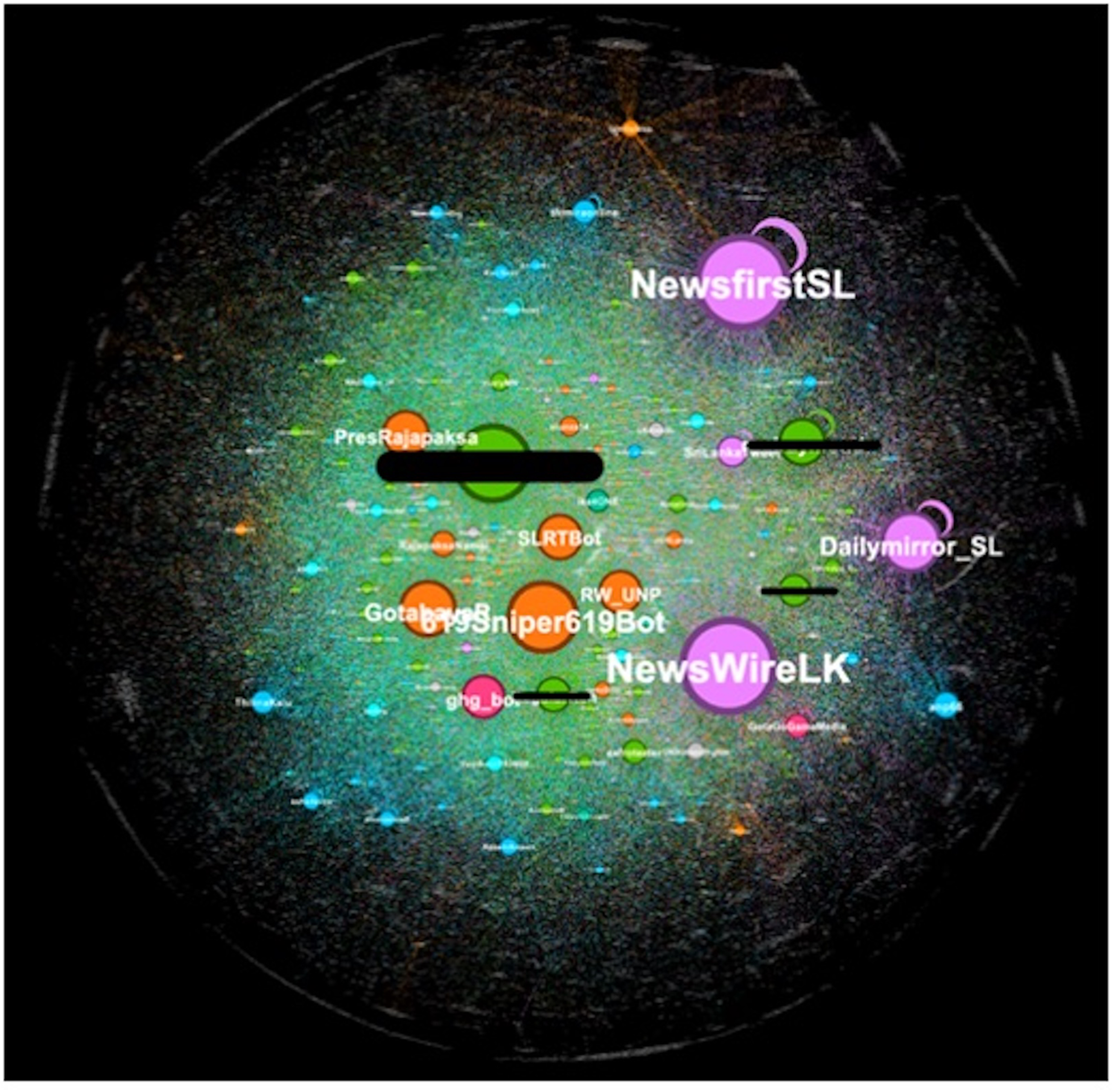
Data visualisation of all users’ interactions under the hashtag #aragalaya. On face value, the large nodes on the right side appear to be the mainstream media (i.e., NewsWireLK, DailymirrorSL) and the large nodes on the left side are the Sri Lankan government (PresRajapaksa, RW_UNP, GotabayaR). The other large nodes are the information influencers of my study. We have removed the names of these users to protect their identity.
Unsurprisingly, Lahiru was heavily invested in the graphics, leaning into Ryder's laptop screen, commentating on who's who in the Sri Lankan Twittersphere and explaining why different users may be connected. In this case, it was his deep knowledge of what lay behind these graphics that made him the ideal interpreter of their content. In this augmented interview with Lahiru, the graphs indicate that his Twitter activity is closely aligned with a group of activists he called ‘the anti-Rajapaksa gang’. But then he continued that ‘not everyone here [in the activist cluster on the graph] is revolutionary, as some are more affiliated to capitalist or reformist parties’. He then added that the Aragalaya began as a cross-class-and-age movement, but because of the growing influence of a controversial left-wing political party, many of the middle-class and older folk had lost interest in the Aragalaya and moved towards more centre, safer politics. The party in question, the Janatha Vimukthi Peramuna, or ‘JVP’ for short, are infamous for their extremist Marxist ideology and violent insurrections in 1971 and through 1987–89 – known locally as the Bheeshanaya (‘The Terror’) (Hughes, 2013). Without Ryder asking a question, Lahiru was providing a narrative history of not just what the data visualisation supposedly represented in the fixed time-period, but decades of intra-group politics that had preceded the Aragalaya. In previous interviews, Ryder had previously asked him specific questions about the Aragalaya's political make up vis-à-vis historic Sri Lanka politics but had received less coherent answers.
With the click of the ‘filter’ button on the spatialisation software, the complexity of the graphs can then be reduced so only one community cluster (nodes who interact a lot and are coloured to indicate their proximity) is shown (see Figure 2). From this filtered view, Lahiru, very clearly, could identify some of the most important political operators in Sri Lanka, including the incumbent president at the time of the conversation in February 2023, known locally as simply ‘Ranil’. Closely linked to Ranil on the graph was the son of ousted Prime Minister Mahinda Rajapaksa and rising political star, Namal Rajapaksa. This time the data visualisations got Lahiru talking about what had ensued in the aftermath of Aragalaya with the installation of Ranil Wickremesinghe to the presidency and the complex inter-relations of Sri Lanka's powerful elites.
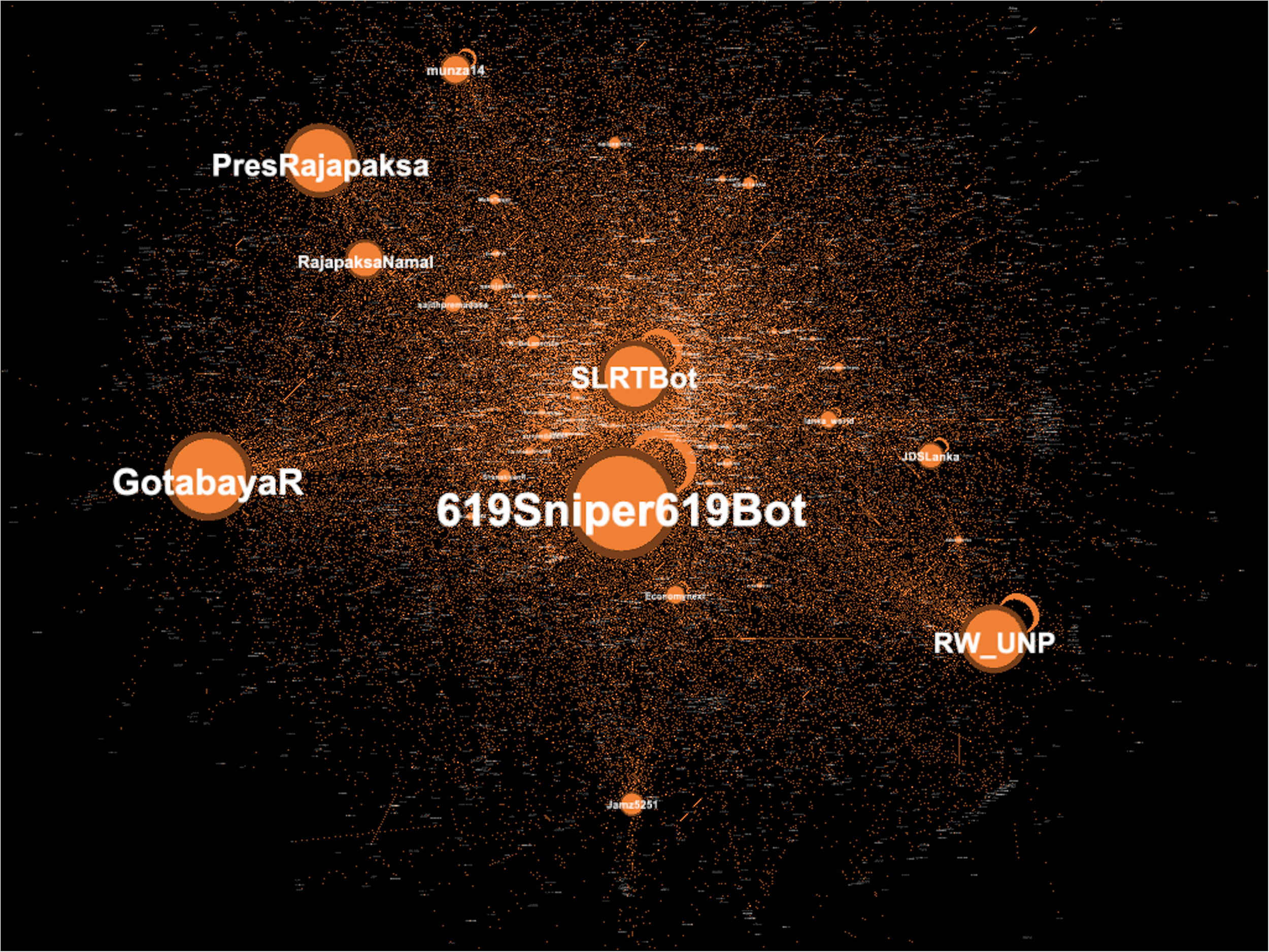
Filtered VNA to display most influential users in the ‘political elite’ community cluster. The VNA suggests Ex-President ‘PresRajapaksa’, ex-Prime Minister ‘GotabayaR’ and current President ‘RW_UNP’ (Ranil Wickremesinghe) are connected to several highly active bots (‘619Sniper619Bot’ and'SLRTBot’).
The other two most conspicuous nodes on the visualisation were two prominent bots called 619Sniper619 and SLRTBot. Previous research on Twitter using computational methods found that 50% of tweets on Twitter were posted by bots, and these visualisations appear to support the claims that when we think about contemporary political communication, and the public sphere more broadly, we must be prepared to consider ‘the politics of algorithms and automation’ (Howard and Woolley, 2016, 4882; Howard, Woolley and Caloc, 2018).
The data suggested that these two bot accounts were the most active nodes in the entire Twittersphere under the Aragalaya hashtag, and, as the visualisation displays, they are closely aligned to elite politicians. Ryder had made these initial inferences himself via the visualisations and was excited about this revelation. Lahiru, however, with his expert knowledge of the local social media ecosystem, was unmoved, explaining that he would expect this kind of activity, that bots are everywhere, and the Rajapaksas rely on them to amplify their message and curtail dissent. To make his point, he went to his phone, made a couple of requests in his operating system, and bought up the LinkedIn profile of the man who, he says, is behind the bots. The man onscreen was a software engineer, skilled in various coding languages and programs. Almost instantaneously, the augmented interview had brought about the humanising of the opaque and murky material world of Sri Lanka bot farms.
While these examples have already shown some major advantages of the augmented interview one dimension of our argument is yet to be substantiated by this case study. In the introduction, we claimed that the augmented interview can produce entirely different results to what was expected or initially understood about a cultural phenomenon. It is to this claim that we now turn via the third data visualisation that Ryder asked Lahiru to help make sense of. This time the filtered view on the graph made visible hundreds of active nodes in the Sri Lankan Twittersphere with the word ‘Anon’ in the username (see Figure 3). Ryder had inspected several of the ‘Anon’ user profiles and had found that the majority had the insignia of the international hacker network, Anonymous; that is, the Guy Fawkes masks made famous by the comic book and popular movie ‘V for Vendetta’. Presumably, he inferred, this was all non-inconspicuous shorthand for affiliation to Anonymous, the group who had infamously trolled Hollywood actors, lambasted Scientology and supported the Arab Spring (Coleman, 2014; Postil, 2018). To Ryder, this was compelling evidence that Anonymous were somehow involved in the Sri Lankan protests that took down the government in summer 2022. To put it mildly, Ryder was delighted about this major new possibility. Previously, the anthropologist Gabriella Coleman (2014) had written extensively about Anonymous's involvement in the Arab Spring. In late 2010, before the Arab Spring had officially become a chain reaction of dictatorial downfalls across the Middle East and North Africa region, Anonymous released a press release explicitly stating their displeasure with the Tunisian government and President Ben Ali's offensive against information freedoms (Coleman, 2014, 148). In early 2011, Anonymous claimed responsibility for taking down the various digital networks and infrastructures of the Tunisian government, creating the conditions for the protests to successfully snowball across the region (ibid. 152–153). The global mass media somehow overlooked these seismic details, choosing rather to memorialise the Arab Spring as the ‘Twitter Revolution’, underwritten by social media from Silicon Valley, not a shadowy anti-corruption hacker group. However, Coleman was conducting ethnography with members of the global hacker group at the time of the brooding crisis and had collected fieldnotes on Anonymous’ specific involvement (ibid. 143–173). Whilst he was much less close to the action, Ryder had thought he had stumbled upon similar evidence through his data visualisations. Anonymous had no prior record of involvement in Sri Lankan politics but his graphs seem to suggest that hundreds of Anonymous agents were actively interacting around the Aragalaya hashtag. Ryder was excited for Lahiru to confirm his suspicions.
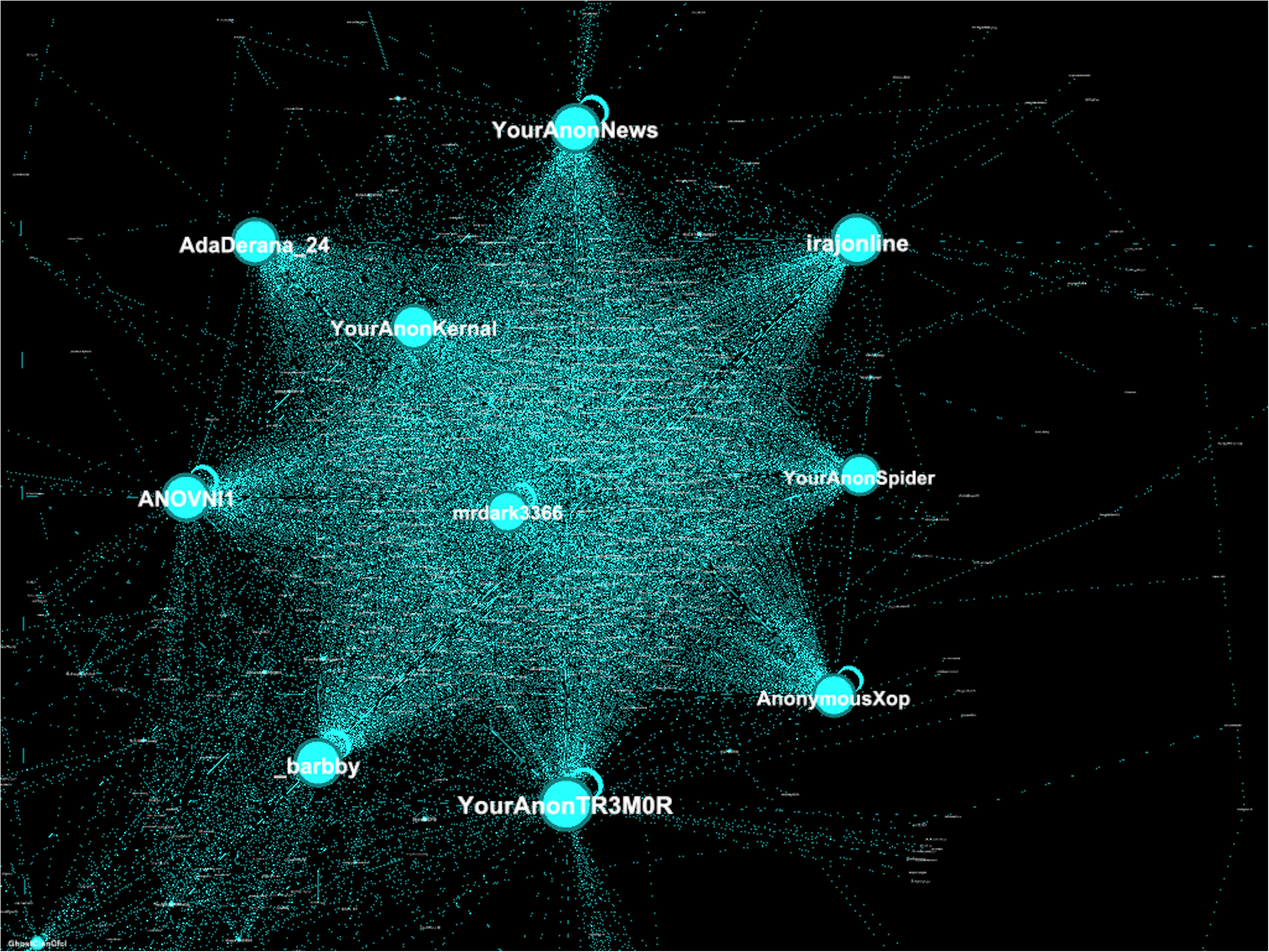
Filtered VNA of the community cluster identified as the international hacker network, ‘anonymous’. Co-production of knowledge with local information influencers suggests these accounts are fake and operational on the behalf of the ‘Political Elite’.
But Lahiru's take was entirely different. To him, the nodes on the graph were another example of the government and their supporters being up to their ‘old tricks’. The Anonymous accounts were all bots, designed and deployed to DDoS the Aragalaya hashtag’. A Distributed Denial of Service (DDoS) is a popular hacker method of overwhelming a digital artefact with interference to destabilise its functionality. During the Arab Spring for example, Anonymous had DSoSed the Tunisian government's website by ordering thousands of hackers to access the website at the same time, forcing it to crash. The DSoSing of Aragalaya hashtag saw thousands of bots interacting with the hashtag with arbitrary nonsense or false information, preventing the hashtag from becoming a more credible site a protest. When Ryder asked, why would the government masquerade as Anonymous? Lahiru simply smiled and said, ‘to fuck with us’.
Other forms of augmentation
It is important for this paper to be clearly delineated in its scope. We are not trying to consider the very many ways in which interviews relate to the wider world, because almost all do so. An interview may systematically consider a series of locations where an activity took place. It may discuss in detail the properties of a car, the postings on social media or the gifts given at a wedding. Almost all interviews have material and visual points of reference. The concerns of this paper are, however, more precise than these. What Ryder was doing was to present a set of visual forms directly to his interlocutors so that they could jointly discuss the material that was right in front of them during the interview. That is the sub-set of interviews that we are calling the augmented interview. The immediacy of the material and visual forms sets a different kind of parameter than enforces a focus. It is not objects or processes as we recall them or imagine them but as they are found directly in front of both the interviewer and the interviewee during the interview itself.
The boundaries between these are admittedly fuzzy. An ethnographer may be present throughout a process, and interviewing right through, so the relevant actions or objects are in front of them. This could be the case, for example, in observing and discussing stages in a technological process as in the chaînes opératoires studied by Coupaye, which includes having to relate the etic perception of the observer with the emic understanding of interlocutors (Coupaye, 2009). Or it might involve taking people from one place to another in order to look at and discuss what each building or place elicits in historical memory, because they are actually there (Liber, forthcoming). But our concern remains more specific, concerning the presence of the material and visual in the midst of the interview itself.
Woodward has written extensively on the methodology of material culture studies including what we are here calling the augmented interview. Part of her own research, which focused on women's relationship to their clothing included a form of augmented interview (Woodward, 2007). The interviews consisted of jointly examining the clothes that were hanging in each woman's wardrobe. By going through one item after the next, she was able to ascertain which clothes formed what might be thought of as an active wardrobe – clothes that are being selected and worn at that time. As opposed to other categories, such as those that are retained historically or those intended for special occasions. A person just looking at the wardrobe would never be able to differentiate these various categories. But they are essential in understanding what that wardrobe is. These interviews not only produced insights into the nature of wardrobes but as part of ethnography they led to a much wider appreciation of why women wear what they wear. The same method can apply to a specific form of clothing as when Sassatelli (2011) interviewed women about their blue jeans they were wearing in relation to sexual identity in Milan. Similar forms of interviewing pertain when one is examining collections, for example, a person's record collection or people who see themselves as collectors (Pearce, 1994), when commonly the interview goes through these piece by piece. The object grounds the interview and is its focus.
In her more general discussion of methodology, Woodward considers various forms of object interview which may be where the focus is on the object itself and object elicitation where the object is being used to elicit information about something else such as family relations. In both cases, the object or visual form is the anchor of the interview. Woodward also makes suggestions about how to conduct such augmented interviews in practice. Woodward notes that one of the more established examples of augmented interviews come from people jointly examining photographs, citing Harper (2002). This practice of jointly discussing an image held by the interviewee is the closest precedent to Ryder's case. An early example would be Collier (1957). A core part of this genre was the practice of returning images, taken from museum collections and other sources, back to the people from who families or regions they had originally been appropriated (Bell, 2010; Geismar and Herle 2010; Wright 2013). Buckley (2014), in parallel to Woodward, discusses the various forms of elicitation that may develop from such interviews. As analogue photographs developed into digital photography, the interview may include single images, but transforms more naturally into people scrolling back through their social media accounts as part of the interview, so that texts also become visual images being foregrounded and discussed (Robards and Lincoln, 2017; Ross 2019).
Many of the points that have been made so far come together in the study of smartphones. This was because in many instances ethnographers found that conventional language-based interviews usually repeated the common negative discourse that is found, not just in local media but also in everyday conversation about smartphones (Miller et al. 2021: 27–54). People would complain that everyone is focused on screens at the expense of their relationship to people, and how people were now rude because at a restaurant they were talking on their phone rather than the person next to them. What the ethnographers called the ‘death of proximity’. They often suggested they use their smartphones far too much and that this was the reason young people had become too superficial or selfish, something exemplified by the word selfie, implying that taking a picture of the self means one is self-absorbed, although the research showed most selfies included other people. Conventional language-based interviews stressed smartphone addiction and smartphones as the means by which corporations or fake news or filter bubbles had caused harm to individuals and to society at large. All such examples conform to traditions in Western ideology that assumes each new technology detracts from humanity. These values are clear in philosophical traditions (e.g., Adorno and Horkheimer 1977; Heidegger 1977). So, when the internet first developed it was constantly categorised as the virtual and opposed to the real. It is not surprising that conventional interviews reiterate such views because they are discourses repeated daily in our media.
It followed that if research had depended entirely upon non-augmented interviews, then it would have simply followed from this dominant discourse and presumed that the populations themselves were thoroughly negative about their phones and the consequences of phones for their lives. But in Miller's (2016) co-authored research with eight fellow ethnographers, in region after region, it was equally clear that this was simply not true. That people were using these smartphones more and more and finding them enormously helpful in a vast range of activities, from taking holidays, to organising their daily activities to socialising with friends who were living elsewhere. To balance these, the team of ethnographers developed a programme of augmented interviews, that they called app surveys. Examples include Walton (2021: 89–104), Garvey and Miller (2021: 113–127) and Wang (2023 128–150).
These augmented interviews focused on the phone itself resting on the lap of the interviewee. They started by documenting every single app that could be found on an individual's smartphone. They then went through these apps one by one, asking research participants about any recent uses of the app, reasons why the app was present and other reflections or stories that related to the app. When focusing on individual apps such as WhatsApp, Google Maps, shopping, health, travel, weather, social media, music, work, sport and all the other apps, the team found a remarkable transformation. Those moralising discourses largely disappear, and the conversations turned instead to the actual use of smartphones, which is always in practice the use of particular apps, and the various capacities that these provided. Mostly, views then became very positive as people talked about knowing when the bus was coming, being able to share photos with friends, being able to shop from home, booking holidays, check health and a hundred other possibilities that had become taken for granted.
Such interviews include both what Woodward called object interviews and elicitation interviews. Without this comprehensive survey of what is actually on the phone, one simply would not have known that some of these apps on older people's phones are not even theirs. They are leftovers from when a younger person bequeathed them the phone because they purchased a more modern phone. Or are there because grandchildren have added them to play with when they come to visit. But equally having the app in front of interlocutors during the interviews elicits numerous stories about the times they have been used and frequently an app has never been opened. An interviewee may then go further and, for example, display a particular section of chat on WhatsApp in order to illustrate a point being made. To conclude, comparing non-augmented interviews with augmented interviews on the exact same device – the smartphone – produced pretty much the opposite array of views and evidence.
Prior to working with this team, Miller has carried out quite a number of different versions of augmented interviews. Starting with standing alongside interlocutors in the middle of kitchens within state housing to understand how they had been transformed (Miller 1988), then later examining all the decorative objects and furnishings within a room or house (Miller, 2008). In a study of loss and grief, the authors (Miller and Parrott 2009) noted that the role of objects in helping extend the relationship to people who have died was almost absent in the literature which led to research based on discussions of these particular genres of objects. In his later work within digital anthropology, Miller continued this form of augmented interview. For example, for a book called Visualising Facebook, Miller and Sinanan (2017: 185–200) extracted images from Facebook profiles and anonymised them. They then showed these images to a range of ten research participants to ask them what they saw, and why they thought these had been posted on Facebook. This method allowed them to understand the diversity that exists in what people ‘see’ in the same image and then even greater diversity in their opinions as to why people might have posted such images.
Conclusion
The conclusions we want to draw from Ryder's study are not about the degree to which Anonymous was or was not involved in the Aragalaya. Our concern here is methodological. The way in which the augmented nature of these interviews changed their nature and content. We fully recognise that there is no clear boundary between the augmented and non-augmented interview, and there are hundreds of ways in which ethnographers have included augmented elements to their past studies. They might make reference as they are talking to a farm they are walking through, to a technique they are observing, to the objects related to the past that surround them, to religious texts, to photographs or to their shopping. In this paper, we have narrowed the concern to interviews where the object of image is within the interview space and the focus of the discussion.
We are not limiting our discussion to digital forms as were used by Ryder. Our evidence demonstrates considerable continuity with older forms of augmented interviews around objects and photographs. But Ryder's example does suggest new possibilities for the future, including the generation of images precisely for this purpose, something that is likely to become more important thanks to AI. Or the integration of multimodal elements such as memes, text and photographs that emerge together when scrolling through smartphones during an interview because the smartphone is a constant presence and resource, even when it is not itself the subject of that interview. It is becoming as natural to bring out the smartphone in the course of an interview as during every other activity during the day. We suggest this should be encouraged.
Our first conclusion concerns the way augmentation grounds the interview. Instead of being able to make general claims about why one is not supposed to approve of smartphones, interlocutors who are going through the apps on their phone one by one in the presence of the researcher will instead provide a host of positive stories about their experiences in using that particular app. The graphics displayed by Ryder not only leads to the interpretation of particular nodes and who they might or might not represent but act to retrospectively re-engage with the period they derive from and lead to more detailed narratives about what transpired. Exactly what the anthropologist is trying to figure out. The narratives are not limited to the particular objects or images presented because these are often the starting point for stories and memories. For example, in the study of grief and loss (Miller and Parrott 2009), the discussion of an item of clothing or a piece of homework led to an overall history of how the objects associated with a loved person became instrumental in how someone processed their grief over an extended period.
The second conclusion returns us to the beginning of this paper, which was less concerned with the advantages of the augmented interview and rather more with the problems of language and discourse as the alternative basis for an interview (Koven 2014; Laihonen, 2008). A suspicion of language itself as the primary medium of enquiry (Bourdieu 1991) that derives from a long tradition of material culture studies. The way in which general questions around almost any topic may evoke the reproduction of dominant ideologies and official accounts that are derived from more normative sources, such as the media. Our point was not to dismiss such interviews. They are an ideal form of investigation into dominant discourses. The moral discussion that follows the mere mention of the smartphone has become itself a clear property of the smartphone, just as much as an app or a genre of deployment. The reiteration of moral discourse is something that smartphones now clearly produce. But these are of very limited value when it comes to either describing or explaining practices associated with the smartphone and are problematic to the degree that they are taken to be descriptions of practice. What this paper has argued for is a complementary relationship between different methods of interview because of the different results they elicit. As in the case of smartphones, the results can be extraordinarily discrepant. A key insight from this paper is that the augmented interview can produce the opposite results from the non-augmented interview.
There is, however, a third equally important result of augmentation. One of the key observations that emerged from these experiences is that almost invariably our interlocutors became far more involved and animated by our discussions. In many cases, they clearly enjoyed them or became quite excited by them. This is very evident in the more extended discussion of Ryder's interactions with Lahiru. But were equally clear when Venkatraman and Miller showed people their evidence for who they were mostly interacting with on Facebook. Their research interlocutors were particularly fascinated by any unexpected results and their ability to then account for these discoveries. Even talking about a picture on a wall, a posting on social media or why an app is where it is on a phone, can become of interest as they excite curiosity as to what lies behind this evidence for their own lives. This in turn changes the relationship between the interviewer and the interviewee.
For a considerable time, there have been strident criticisms of the power dynamics of conventional ethnography including the interview. These have emerged from feminist perspectives (e.g., Stacey 1988; Torres 2019) and decolonial perspectives (Manning 2018) on ethnographic practice, including the interview. We would not have the temerity to suggest that the ideas in this paper equate with the much wider aspirations and issues that follow from these critiques. Yet our experience has been that augmentation does contribute in a small way to a more collaborative and inclusive relationship between ethnographers and interlocutors that are one of the demands emergent from this critique. Buckley (2014) makes a similar point with respect to photo elicitation. Instead of simply one person asking questions of another, two or more people have the feeling that they are collaborating in a joint project of interpretation and explanation. The interlocutor becomes as engaged in trying to explain their own actions as the interviewer. Augmentation can also become a source of sensitive displacement as when it allows for a more indirect means of considering long-term grief for the death of a child.
The possibilities of a more collaborative form of scholarship (Rappaport, 2008) are more likely to emerge when there is a shared creative purpose. As has also been argued around collaboration in the creation of a film (Hong 2021). After all, it has always been likely that the people we work with would have a keen interest in understanding the exact same things that most anthropologists want to account for, since they are the subjects of these studies. The augmented interview directly presents our interlocutors with a particular thing that the researcher does not know about and invites a story leading to a shared discussion around explanation. Potentially this can become part of the much wider shifts that should follow from feminist and decolonial critiques of conventional ethnographic methodology.
These three conclusions: that augmentation grounds the interview, displaces dominant discourses and creates a more collaborative relationship between the interview and the interviewee are all significant contributions. To which we can add the finding that in some cases, such in the study of smartphones and Ryder on the role of Anonymous, the augmented interview can lead to such dramatically different results from the conventional interviews or previous interpretations. All this amounts to an argument that could apply to almost any ethnographer, who might then consider the ways in which augmented interviews might complement their other research techniques when carrying out research in the future and thereby also acknowledging the contribution of material culture studies.
Footnotes

Ethical considerations
This study was conducted in accordance with the ASA Ethical Guidelions, and the protocol was approved by the SOAS ethics committee in September 2022.
Consent to participate
Informed written consent was obtained from all subjects involved in the study.
Funding
The authors disclosed receipt of the following financial support for the research, authorship, and/or publication of this article: This work was supported by the Chase Studentship. Craig Ryder’s PhD research is funded by the Consortium for Arts and Humanities South-East England (CHASE) studentship c/o Arts and Humanities Research Council.
Declaration of conflicting interests
The authors declared no potential conflicts of interest with respect to the research, authorship, and/or publication of this article.