







Abstract
Across urban landscapes shaped by austerity, redevelopment, and dispossession, trees play key roles in practices of resistance, embodying continuity, rootedness, and contested attachments between people and place. Drawing on ethnographic research in working-class housing estates in West London and Belfast, this paper examines how trees operate as material and symbolic anchors for residents confronting displacement amid prolonged economic decline in the UK. Despite distinct historical trajectories, both sites reveal how residents mobilise trees and practices of care to claim spaces otherwise targeted for extraction and erasure. In West London, Mayanka explores a council estate where residents plant and nurture trees to challenge official claims of ‘uninhabitability' used to legitimise demolition and emptiness. In Belfast, Anna examines a ‘fairy tree’ – a culturally significant hawthorn that has withstood redevelopment pressures – alongside more contentious practices of place-making, including the burning of wooden pallets in Twelfth of July bonfires. Together, these cases foreground how care for trees is neither politically neutral nor uniformly benign, but embedded within antagonistic social relations shaped by class and colonial histories. Written in the shadow of the Israeli genocide in Palestine, the paper engages with scholarship on olive trees as sites of resistance to settler colonial violence, using this comparative lens to unsettle liberal paradigms of care that render it apolitical. Focusing on the material qualities of trees – their durability, flammability, rootedness, and vulnerability – we analyse how care can operate as a form of refusal, attachment, and contestation within, rather than outside, capitalist relations. By attending to practices that may involve harm, recklessness, or violence, we challenge romanticised accounts of care and urban nature, presenting them instead as contested terrains of material struggle, political antagonism, and uneven survival.
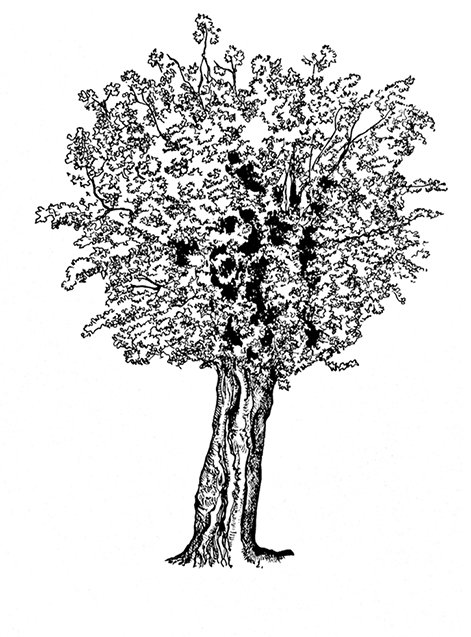
You know … round here they say that while the tree survives, Sandy Row will survive. If the tree dies, Sandy Row will die. When they were doing the redevelopment, a digger, a fella with a digger was going to uproot it and he took a heart attack and died.
- Billy, speaking about the fairy tree that lives in the Sandy Row estate, Belfast
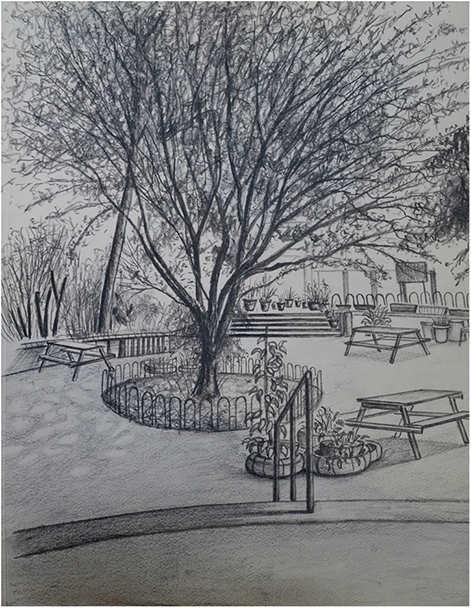
Aunty Una died recently, aged 82, and it was her last wish that her ashes be scattered as close as possible to the tree outside of the Madigan flat …
- Excerpt from John Dorling's letter to Clarion, the landlord of Sutton Estate, London
Introduction
This paper draws on two ethnographic case studies that explore how residents of urban estates in the UK confront the threats posed by redevelopment plans and potential displacement. While the specific historical trajectories and political struggles of these sites differ, shared themes emerge in the intimate, embodied practices through which people claim and care for contentious spaces – spaces which risk being absorbed into singular narratives of urban development and heritage. Our focus is on the practices of care as sites of social reproduction, revealing how these practices embody contradictory imaginaries of belonging, rootedness, and resistance.
Our central argument is that the way in which people respond to the threat of displacement is not always straightforward. Instead, the everyday practices through which people sustain home and community – what we term ‘care practices’ – are complex, often fraught, and sometimes contradictory. We ask: Can discourses of care open up space for resistance? Can care be unruly or ‘not too careful’? What if local expressions of care also entail recklessness, harm, or violence? By ethnographically tracing care, we aim to complicate dominant understandings that frame care as inherently nurturing, apolitical, or outside of capitalist relations.
This analysis is grounded in a materialist understanding of social reproduction – the diverse processes through which life itself is sustained and reproduced, including emotional, physical, and material care work. These processes are deeply shaped by capitalist relations, state policies, and uneven geographies of austerity and precarity. Drawing on contemporary scholarship in social reproduction theory (SRT), such as the works of Tithi Bhattacharya (2017) and Vivian Rodríguez-Rocha (2021), we see care practices as embedded in wider systems of capitalist crisis and urban transformation. In particular, Rodríguez-Rocha's work highlights how social reproduction is spatially and ecologically situated, shaped by financialisation, environmental crises, and global inequalities. Our paper extends this critical lens to the urban landscapes of Belfast and London, showing how care practices emerge as forms of ‘life work’ that sustain communities under threat of erasure.
These issues take on an urgent political dimension as we write in 2024, amid the ongoing and violent displacement of Palestinians from Gaza. In January, the International Court of Justice found plausible grounds that Israeli actions in Palestine constitute violations of the Genocide Convention. Homes, attachments, and entire landscapes are being obliterated by settler-colonial violence. In such grave circumstances, anthropology must grapple with how care and rootedness are enacted in contexts of forced removal and erasure. Palestine is thus not a distant analogy, but a critical analytic that sharpens our ethnographic focus on the material politics of care and place. Decolonial ethnographies from Palestine reveal how attachments to land are made through daily, embodied acts of tending, resisting uprooting, and holding ground in landscapes marked for violent displacement. These forms of care inform our understanding of ‘staying put’ as a radical, embodied mode of social reproduction under conditions of dispossession.
Our ethnographic fieldwork was conducted between 2017 and 2019 in two urban estates: A working-class estate in the centre of Belfast (Anna), and a dilapidated council estate in London's Kensington and Chelsea borough (Mayanka). Mayanka's fieldsite, known as Sutton Estate, sits in one of the UK's wealthiest boroughs, where the wealth disparity is starkly visible. Local residents referred to the borough simply as ‘Chelsea’, frequently invoking the ‘two faces of Chelsea’: Luxury mansions alongside declining social housing. Following the Grenfell Tower fire – an event that exposed the deadly consequences of infrastructural neglect and state violence – housing conditions and policies came under intense scrutiny. At the time of Mayanka's research, the future of Sutton Estate was uncertain: The managing Housing Association, Clarion Housing, had applied for planning permission to demolish and redevelop the estate into mixed-rent housing. This proposal was justified on the grounds that the flats were ‘unliveable’. Residents contested this claim, arguing that ‘unliveability’ was produced through intentional neglect – repair works ignored or outsourced to cheap contractors, and flats slowly decanted of its residents through excuses of ‘health and safety’ – as part of a broader strategy of dispossession and gentrification.
In response, residents enacted practices of material care, notably through a weekly gardening ritual. Gardening became a site of nurture, community-building, and political assertion – a way of embodying care as resistance to erasure and the financialisation of their homes. These material care practices are forms of social reproduction that sustain life and community amid the pressures of neoliberal urban development and austerity. By tending to gardens and green spaces, residents reasserted their claims to place and belonging, contesting the state's narrative of decline and unliveability. This is in line with Insa Koch's (2014) ethnographic analysis of the narratives of abandonment articulated by residents of the estate where she did her fieldwork. Her key argument, which informs Mayanka's framework, is that the local community and the state are not in a dichotomous relationship, refuting long-held portrayals of working-class communities as self-contained entities (Koch, 2014). Rather, she argues that residents of the council estate she studied ‘expect the state to be involved in an on-going effort to build respectable homes and communities’, and therefore link abandonment to a wider failure of the part of the State. Similarly, Mayanka's interlocutors perform material practice of care in the garden as a form of dialogue with the State to counter the declarations of ‘unliveability’.
In Belfast, Anna's fieldwork centered on Sandy Row, a historically Protestant and loyalist working-class neighbourhood. The area is deeply shaped by the legacies of the Troubles and ongoing political and economic marginalisation. Urban regeneration initiatives following deindustrialisation transformed Sandy Row from a vibrant commercial district to one of the city's most deprived areas. Here, care and rootedness take on a different form: The building and burning of bonfires during the 12th of July Protestant celebrations. These bonfires serve as spectacular, material claims to space and community belonging through the elemental power of fire.
Contrasting with the quiet, life-affirming work of gardening and tree-tending, bonfires embody care that is sometimes reckless, exclusionary, and destructive. This unsettling ethnographic case complicates dominant, often romanticised, discourses of care as gentle and nurturing. Instead, it reveals care's ambivalence and its entanglement with contested political identities and histories. This juxtaposition between gardening and bonfires underscores our argument that care is multiple and contradictory, shaped by uneven power relations and historical antagonisms.
Across the two sites, programmes of urban regeneration and proposed demolitions produced anxieties about a future where our participants could not see themselves, leading to a profound sense of both spatial and temporal displacement. In both field sites, the metaphor of rootedness is most obviously manifested through the presence and upkeep of trees. Trees have often been evoked against urban regeneration across the UK. Paul Cloke and Owain Jones (2004) looked at Arnos Vale, a Victorian cemetery in Bristol, focusing on the role of trees in claims made over a public space that was being gradually privatised. Drawing on the socially constructed dimensions of place, they discuss how specific trees can act as potent material presences which can ‘soak up’ a place and become key place markers, so much so that ‘when felled, by others who did not share or care about such associations, it is as if the place itself is being unwoven’ (2004: 93). Trees emerged as significant protagonists while also generating insights about what it means to build roots into a place.
We examine trees through three interrelated lenses: Discursive, political, and material.
Discursively, trees reframe our focus onto the study of ‘immobility’. The ‘mobilities turn’ (Cidell, 2012) within anthropology led to a disproportionate focus on movement of people and things to better understand a globalising world. In contrast, our ethnographies revealed participants who want to stay put and remain where they feel their ‘roots’ are, with a large proportion of our participants living in the same home for several years, and often with or near their parents. In fact, the Report from the Centre for Research in Social Policy (Hill and Hirsch, 2019) shows that in the UK, 63% of single adults between the ages of 20 and 29 live with their parents, as do just over half of 25–29-year-olds. To add to this, in the context of the UK's austerity, no real wage rise, rapidly increasing cost of living and the growing financialisation of housing, Andy Green (2017) describes the effects of the housing crisis in London on young people through the term ‘boomerang children’, which refers to adults, roughly 29% of young men and 18% of young women in 2011, who return to their parents’ home after trying to navigate the private rental market. These figures serve to reiterate the importance of focusing on ‘staying’ as an ethnographic reality to counter the overemphasis on mobility.
Second, politically, trees link our UK cases to wider struggles of land-based resistance under racial capitalism and settler colonialism. Olive trees in Palestine epitomise this nexus. As Simaan (2017) and Braverman (2009) document, olive trees are at once material, political, spiritual, and ecological actors central to Palestinian resistance against Israeli apartheid and land dispossession. Their longevity, drought resilience, and deep-rootedness make them symbols of survival and place-keeping. But, as Braverman warns, trees are not inherently benign: The Zionist state has extensively planted pine trees to remake the landscape, erase Palestinian histories, and assert settler presence. This duality cautions us against romanticising trees as symbols, urging an attention to their material traits and political uses.
Third, materially, the specific qualities of trees – longevity, groundedness, aliveness – imbue them with metaphorical power and enable acts of care and resistance. Trees in our field sites were cared for not only as symbols, but as living beings entwined with residents’ life worlds. Their destruction or neglect was experienced as a form of dispossession.
In tension with trees’ regenerative symbolism, the bonfires of Sandy Row invoke fire as an unruly, dangerous, and sometimes violent element. The ritual burning enacts care through a logic of exclusion and contestation, revealing care's complex affective and political registers. This ethnographic contrast reveals the multiple, sometimes contradictory ways that social reproduction unfolds in contested urban spaces. Together, these ethnographies illuminate how care, as a material and social process, unfolds under conditions of capitalist crisis, urban austerity, and racialised displacement. By bringing together trees, soil, and fire, our paper charts alternative temporalities and geographies of care, rootedness, and resistance that challenge dominant narratives of urban development that are premised on the systematic removal of the poor from cities.
Finally, our decision to foreground Palestine within this paper is not only as a gesture of political solidarity. Rather, we draw on Palestinian struggles to sharpen our methodological sensitivity to place, rootedness, and the material politics of care. In particular, decolonial ethnographies of land-based resistance in Palestine reveal how attachments to place are not always abstract, symbolic, or nostalgic. They are enacted through daily, embodied acts – tending to olive trees, resisting uprooting, and holding ground in landscapes marked for erasure. These practices inform our own attention to what it means to ‘stay’ in the midst of urban redevelopment in Belfast and London. Palestine, then, is not an analogy, but an analytic: It demands that we pay attention to how care is enacted through material engagements with land, and how staying put can be a radical act in contexts of imposed mobility or planned displacement. By bringing Palestine into conceptual dialogue with our UK-based field sites, we aim to trouble the presumed exceptionalism of both. This is especially pertinent in our focus on trees, whose symbolic, material, and political lives have long been central to Palestinian resistance (Simaan, 2017; Braverman, 2009), and whose presence in our field sites likewise complicates liberal narratives of urban nature and of care itself.
Trees, belonging, and rootedness
In a post-pandemic world, ‘urban nature’ in the form of parks and gardens has gained new currency through the linking of mental health and wellbeing with available green spaces in cities (Surico, 2020). Residential parks have been heavily class-based spaces in the UK, despite many of them being technically classified as public parks. The disparity in access to green spaces was made explicitly apparent over the lockdowns in the UK. As a category, ‘urban nature’ is fiercely political. In August 2019, a teenager was stabbed near St Luke's Church (Maighna Nanu, MyLondon, 14th August 2019) in Chelsea, not far from Mayanka's fieldsite. As the roads were cordoned off by the police, the teenager and his friends were in search of a place to take refuge. While Chelsea is full of green spaces, most of them are only accessible to rich residents who have a key to unlock the garden gate. Many locked-up gardens sit empty, bordered by second homes on all four sides. The group ultimately found shelter in the Sunken Garden at the Sutton Estate, which welcomed them with an open gate into its safe sanctuary. The head of the garden club, Dorinda, said to the journalist that she was happy to know that the garden was seen as a place of solace and safety. When asked about her motivations behind starting the gardening group, she recalled her favourite saying: ‘Plant a garden if you believe in tomorrow. If you do plant something, you can’t get depressed because you’re waiting every day to let it grow’.
The material and temporal resonances of trees, and their entanglement to place, are especially obvious when we consider the widespread and contentious felling of trees to make space for new urban developments. For instance, new housing development in the London borough of Hackney resulted in the cutting down of the 150-year-old Happy Man Tree. The tree had been named Tree of the Year by the UK's Woodland Trust following a public campaign and petition to save it. In a similar instance, in October 2020, the 250-year-old Cubbington Pear Tree was cut down to make space for the HS2, a controversial high-speed railway running between London and Birmingham. A local campaign group that had been set up to protest against the HS2 also rallied around the tree, organising walks so that people could see it. In both these examples, the symbolic and material value of trees over time turns them into ‘the focus of individual and social resistance based around a particular place’ (Cloke and Jones, 2004: 331).
However, some trees manage to survive the forces of redevelopment. One such tree – a tiny hawthorn tree that grows deep within the Sandy Row estate in Belfast – became central to Anna's fieldwork. It sits in a small opening that was once occupied by one of the estate's Victorian terrace houses; today, the gap is a green anomaly. Moving at the speed of wood, over the years the tree witnessed several cycles of construction and destruction. Nowadays, the hawthorn – known locally as the fairy thorn – is surrounded by a low fence, with a gate embellished with two fairies and a dainty sign which welcomes you to the Fairy Thorn Garden. A short path winds through the grass and around a wishing well. A large mural of grinning fairies and imps surrounds the enclosure. Sitting in the middle of the Sandy Row estate, right next to an austere Protestant church, the garden is a whimsical oddity. Within it, three child-sized signs explain the lore of the fairy-themed park. As is often the case with folklore, these tales are directed at children: And yet, the fairy thorn lived in Sandy Row long before Belfast City Council surrounded it with colourful murals and a wishing well. When redevelopment reached this area of Sandy Row in the 1980s, the tree was to be removed alongside the surrounding rows of houses. Story goes that locals fiercely opposed its removal. There is one recurrent tale of a worker who, after cutting one of its branches, suffered an accident. In some versions, he broke a leg; in another, he eventually died. Either way, the stories confirm that harming the hawthorn spells misfortune. During the redevelopment of Sandy Row, even the construction workers did not dare touch it, so the planning authorities eventually decided to spare it and demolish the buildings around it instead.
According to one resident, the redevelopment affected the tree to the point that it stopped flowering for several years. Billy is a youth worker and has lived in the area his whole life. He remembers how the tree and its environment changed over the years. His childhood home was one of the many houses that were demolished at the time. It used to sit right behind today's Fairy Thorn Garden. The fairy thorn used to be Billy's playhouse – he used to walk along his home's back wall and jump off it and right onto the tree's knotted branches. ‘I used to play on it all the time … maybe that's why I have no luck!’, he adds, laughing. ‘You know … round here they say that while the tree survives, Sandy Row will survive … if the tree dies, Sandy Row will die’. Many tales of sudden misfortune start with the cutting, or damaging, of a hawthorn. People the world over acknowledge the presence of supernatural, ancestral spirits that are deeply embedded in the landscape. In Ireland, these are known as the sídhe, the ‘little folk’. Some places, such as fairy mounds, are imbued with their presence. These often feature a lone hawthorn tree, marking the entrance to the otherworld and sacred to the fairy folk, who can be vengeful protectors of the land (Figure 1).

The fairy tree in full bloom. Sandy Row, 2019. Photograph by Bill Kirk
Walking past the fairy thorn garden, eight-year-old Jay-Lee glances at it: ‘Oh mummy, I hate that tree. It's so scary!’ Wide-eyed, she explains that it is cursed. ‘It gives me the creeps … we don’t go near it!’ It seems that to at least some primary school children – the target group for the Fairy Thorn Garden – cautionary tales about trees, fairies, accidents, and curses are more powerful than fanciful decorations. And when it comes to fairy mounds and trees, even while scoffing at superstition, many people in Ireland prefer to err on the side of caution. For instance, road plans may be diverted to avoid removing hawthorns growing along the planned route. In Sandy Row, the seemingly unstoppable force of urban redevelopment was bettered by the threat of a supernatural power, forcing infrastructural plans to adapt around it. However, the fairy thorn is the exception to an otherwise familiar truth: Streets and houses are not literally set in stone. Hundreds of houses in Sandy Row were demolished, and many of its streets survive only in people's memories. The effects of redevelopment on a once bustling area reverberate from the abandoned shop fronts, the empty spaces, the eerily quiet evenings. In such an environment, the tree engenders permanence and survival. Tales of the tree not flowering while the area was being redeveloped further suggests a sense of its aliveness and health being rooted in the continuity, permanence and well-being of Sandy Row as an urban community. By extension, caring for the tree is open to appropriation by alternative imaginaries for the area – as evidenced by the city council's ‘regeneration’ efforts.
Similarly, the sunken garden in Mayanka's field site holds a special place in the resistance against the ongoing regeneration and contains powerful threads entangling the worlds of the living to the worlds of the dead. The cherry tree in the garden marks the site where the ashes of one of the former residents have been scattered. John Dorling, one of Mayanka's participants, travelled all the way from Wales to scatter his aunt's ashes in the garden to mark the place where she grew up. He had written multiple letters to the Housing Association, requesting for permission to scatter his aunt's ashes in the garden of the Estate, and additionally, requesting for that particular part of the garden to remain unchanged in his aunt's memory. Just as the ashes mixed inseparably with the soil, the two pleas in Dorling's letter posed the continuity of a person's life as enmeshed within the continuity of a place. This is why the letter was picked up by the campaigners of Save-Our-Sutton, who were petitioning to save the Estate from the proposed demolition. Fragments of the letter were shared in the hope of emphasising the continuity of attachments and the rootedness of the residents. While in Anna's site, keeping the Fairy Tree alive and well is linked to keeping the community alive, in Mayanka's fieldsite, death itself becomes part of the resistance in the form of ashes that lay buried beneath the tree. The trees thus evoke both life and death as modalities of asserting belonging to a place.
Our two ethnographic case studies step away from studying urban nature through a purely ecological lens, and instead bring attention to the ways in which trees are made use of by people living in contested spaces
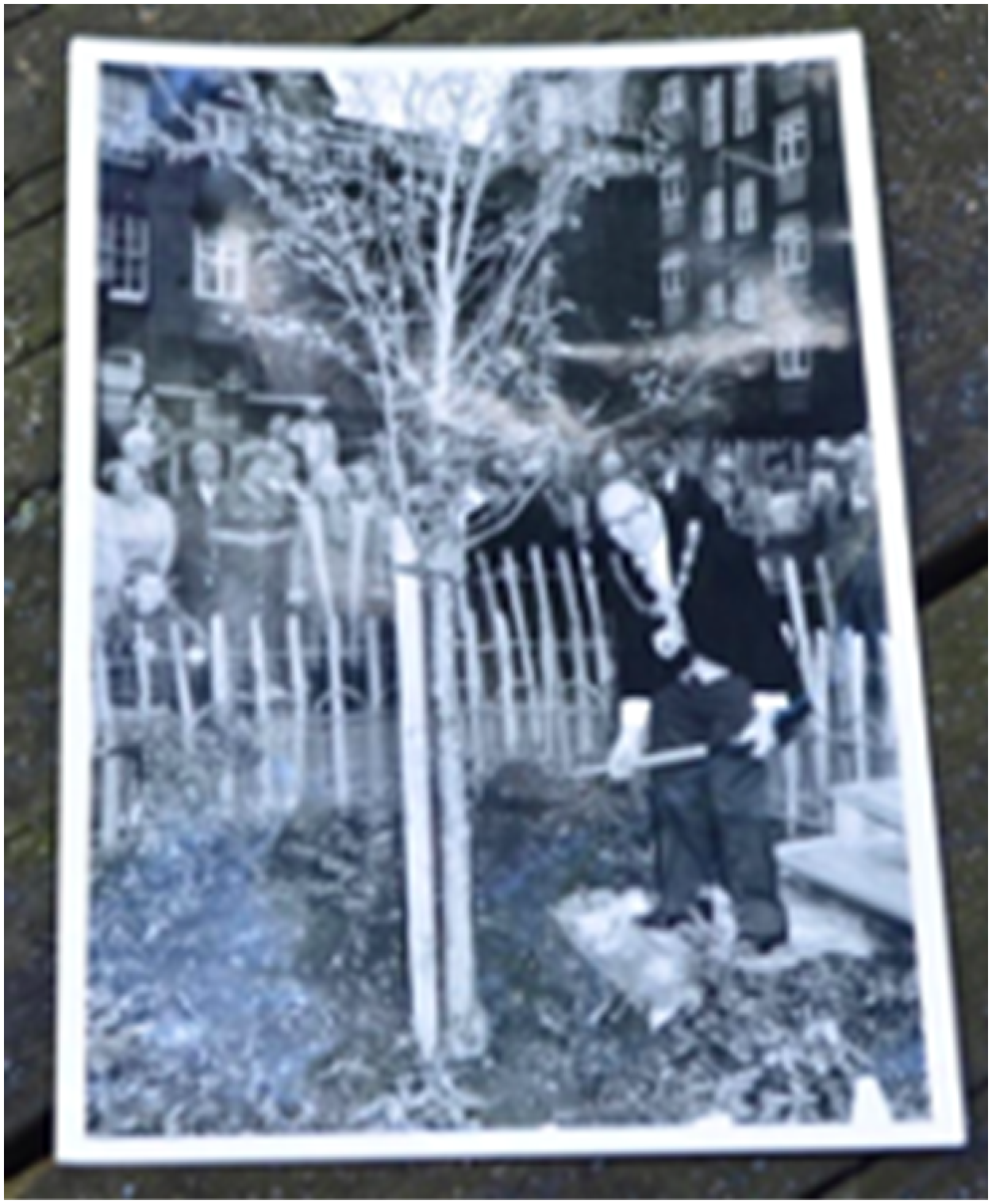
Black and white photograph of a Labour Councillor in 1970 planting a tree at the centre of the Sunken Garden. Photograph by Mayanka Mukherji
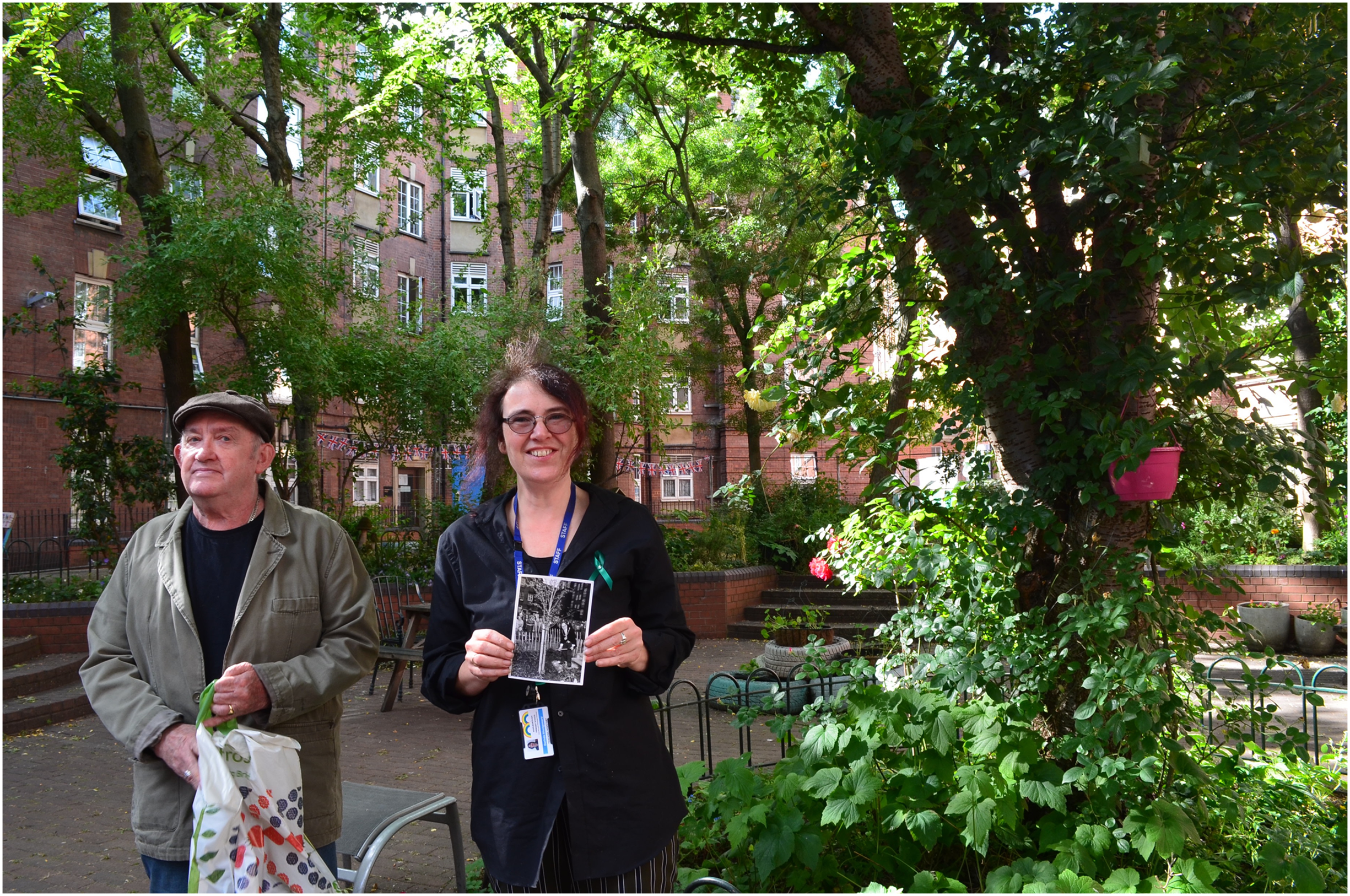
Dorinda holding up this photograph against the background of the tree in its present form in 2017. Photograph by Mayanka Mukherji

A week after bonfire night, Sandy Row, Belfast (2019). Photograph by Anna Poloni
In the context of urban nature, trees have generally been studied from the point of view of conservation. This paper stems from a slightly different angle: While we acknowledge that the conservation of place and people are tied up with one another, our focus is not purely ecological. Rather, we are interested in how the specific material configurations of trees are co-opted within place-based resistance. We are drawing here on the work of Irus Braverman who argued that trees need to be taken more seriously in the active role they play in war and the project of nationalist identities. Her work also shows that we need to pay attention to the specific material configurations of specific trees and how these qualities allows them to be embroiled within particular political projects.
We also draw on Yael Navaro-Yashin's (2009) concept of affective spaces in our conceptualisation of ‘urban nature’ as featured in our fieldsites in London and Belfast. These are not just sites of physical degradation but charged environments shaped by loss, anticipation, and political abandonment. In her work on postwar Northern Cyprus, Navaro-Yashin shows how ruins and appropriated houses exude a melancholic atmosphere – named maraz – that is not merely felt by individuals but emerges from the entanglement of material decay and subjective experience. Similarly, in our field sites the looming threats of demolition and displacement generate a pervasive atmosphere of dread and disorientation, evoking both present neglect and speculative futures. These affective landscapes do not just reflect political processes; they are political – manifesting the uneven violence of redevelopment and the weight of interrupted futures. Rather than treating affect as ineffable or depoliticised, as some strands of the affective turn risk doing, we follow Navaro-Yashin in insisting that affect is embedded in material histories and struggles over place. Affective spaces, in this sense, allow us to trace how feelings of exhaustion, care, and resistance are shaped not only by human actors but by the very textures and temporalities of urban ruin.
Furthermore, our shared focus across London and Belfast is on people who stay rooted, as it were, in one place and fight to not move – thus countering the recent anthropological tendency to prioritise the study of mobilities as focus and method (Elliot, Norum and Salazar, 2017). Trees, in this sense, become important ethnographic objects that stay put. They are connected to the ground. Tales of the fairy tree not flowering while Sandy Row's housing was being demolished exemplifies trees as the outward manifestations of the well-being of a place: Their condition depends entirely on the condition of the place into which their roots rest and breathe. Furthermore, not all of our participants were guided by ecological motivations, thus revealing the complex contradictions underlying various practices of care for a place.
While there are several studies pointing to the positive aspects of urban nature, the case of Sandy Row also reveals the more inconvenient – and even destructive – aspects of care and belonging within the urban landscape. This particular instance comes in the form of the large bonfires that, once a year, are burned in Protestant-Loyalist neighbourhoods across the city. Across the north of Ireland, burning bonfires is a deep-rooted yearly commemorative practice through which the Protestant/Unionist community reaffirms its values (Jarman, 2004: 108). On the eve of the 12th of July, huge stacks of wooden pallets and tyres are decorated with effigies of the Irish/Nationalist community. These are then set on fire in front of a jubilant crowd of revellers. In Belfast, bonfires are generally built within Protestant working-class neighbourhoods by young men and boys. Aside from its obvious sectarian motivations, the practice also sparks contestation and tensions surrounding the use and ownership of urban space. As empty plots of land within the city are developed, bonfire builders are constantly on the hunt for derelict spaces. The fires are sometimes built on roads or very close to buildings. One year, a bonfire was burned in the then-empty and abandoned space inhabited by the fairy tree, setting it on fire. According to Billy, one-half of the tree remained charred and lifeless for several years after the accident.
This tale introduces the fairy tree and bonfires as having shared material configurations while still possessing divergent symbolic lives. Where the tree and its wood evoke aliveness and care for the continuity of the urban community, the stacks of wooden pallets that, year after year, are built to be destroyed illustrate a more destructive and inconvenient practice of care. This illustrates the complex motivations behind care; it is impossible to look at trees without looking at their life-stages, as they are embedded within an ecological continuum. The following section will discuss bonfires as material configurations that are made up of wood and other polluting materials. This is not an obvious link to the participants, but it became obvious in the instance in which the tree caught fire, as it reveals the shared materiality of the tree and the wood fuelling the fire. Because of this, our focus is not only on the symbolic value of trees but also their material configurations: How, then, do the specific material configurations of trees allow for particular place-based claims? How can trees help us transition between the material and metaphorical realms within our sites, and how does that relate to local imaginaries of care?
An ethnographic critique of care
Over the last two decades, the anthropology of care has emerged as a vibrant field, illuminating how care practices shape social relations, identities, and moral worlds (Mol et al., 2010; Puig de la Bellacasa, 2017; Tronto, 1994). These studies have broadened understandings of care beyond the domestic sphere to encompass political, ecological, and global dimensions. Care has been celebrated as a ‘bottom-up’, ‘grassroots’, or ‘ground-level’ practice capable of creating alternative, more just forms of sociality. However, these conceptualisations often carry liberal undertones: Care is framed as inherently positive, apolitical, and outside the reach of structural power, sometimes reduced to an ethical stance or a ‘sweet antidote’ to domination. Such framings risk depoliticising care, obscuring the material struggles and power relations embedded in caregiving labour, as well as the social antagonisms underpinning capitalist relations of production.
Our work engages critically with this literature by foregrounding a materialist and SRT perspective on care. Building on the insights of Marxist-feminist scholars such as Tithi Bhattacharya (2017) and Vivian Rodríguez-Rocha (2021), we understand care not merely as an ethical practice but as labour integral to the reproduction of social life under capitalism – a labour that is unequally distributed, often invisibilised, and intimately entangled with capitalist exploitation, dispossession, and state violence. SRT insists on care as a site of both reproduction and resistance, where relations of production are contested through embodied, material practices. Care thus becomes a terrain where structural antagonisms between those who own and control resources and those who labour to sustain life unfold.
Within this framework, our ethnographic critique challenges the apolitical and technocratic uses of care language found in policy and institutional settings, especially in neoliberal urban regeneration contexts. Terms such as ‘bottom-up’, ‘community engagement’, and ‘grassroots participation’ have become buzzwords that risk reducing agency to symbolic gestures or bureaucratic box-ticking exercises. On Sutton Estate, for example, residents expressed alienation and frustration toward endless feedback forms and consultation sessions organized by the Housing Association – mechanisms that aimed to visually demonstrate community involvement while often sidelining real influence. In Sandy Row, institutional efforts to foster ‘community engagement’ with development plans were frequently dismissed as performative and disingenuous.
While these institutional attempts abstract ‘ground level’ into an intangible ideal, our ethnographic focus returns literally to the ground itself – its soil, trees, and fire – as material sites where care and resistance are enacted. These objects are not passive recipients of care; they are dynamic, precarious, and active participants in ongoing social and political struggles.
Our ethnographic critique of care not only challenges the liberal and technocratic framings of care as inherently benign or outside power, but also refuses the pull of reactionary forms of place-making – where local rootedness becomes mobilised against migrants, outsiders, or perceived threats to tradition. As Doreen Massey (1994; 2005) warns, place is often nostalgically imagined as bounded, authentic, and static – an illusion that can fuel exclusionary and nationalist politics. In the UK context, where the rhetoric of protecting the ‘local’ is increasingly weaponised by both right-wing media and by the current Labour government to legitimise anti-migrant policies, such framings must be actively resisted. Massey reminds us that the ‘local’ is never pure or self-contained; rather, places are constituted through wider social relations and global flows – including colonial histories, racialised dispossessions, and capitalist restructuring. Instead of treating place as a site of fixity, we follow Massey in approaching it as ‘a meeting place’ – a dynamic and open constellation of trajectories that are always in motion, always unfinished. This orientation allows us to understand care not as a retreat into parochialism or cultural essentialism, but as an active, situated, and often conflicted practice shaped by translocal processes of displacement and resistance. Our ethnographies in London and Belfast trace how (Figure 5).
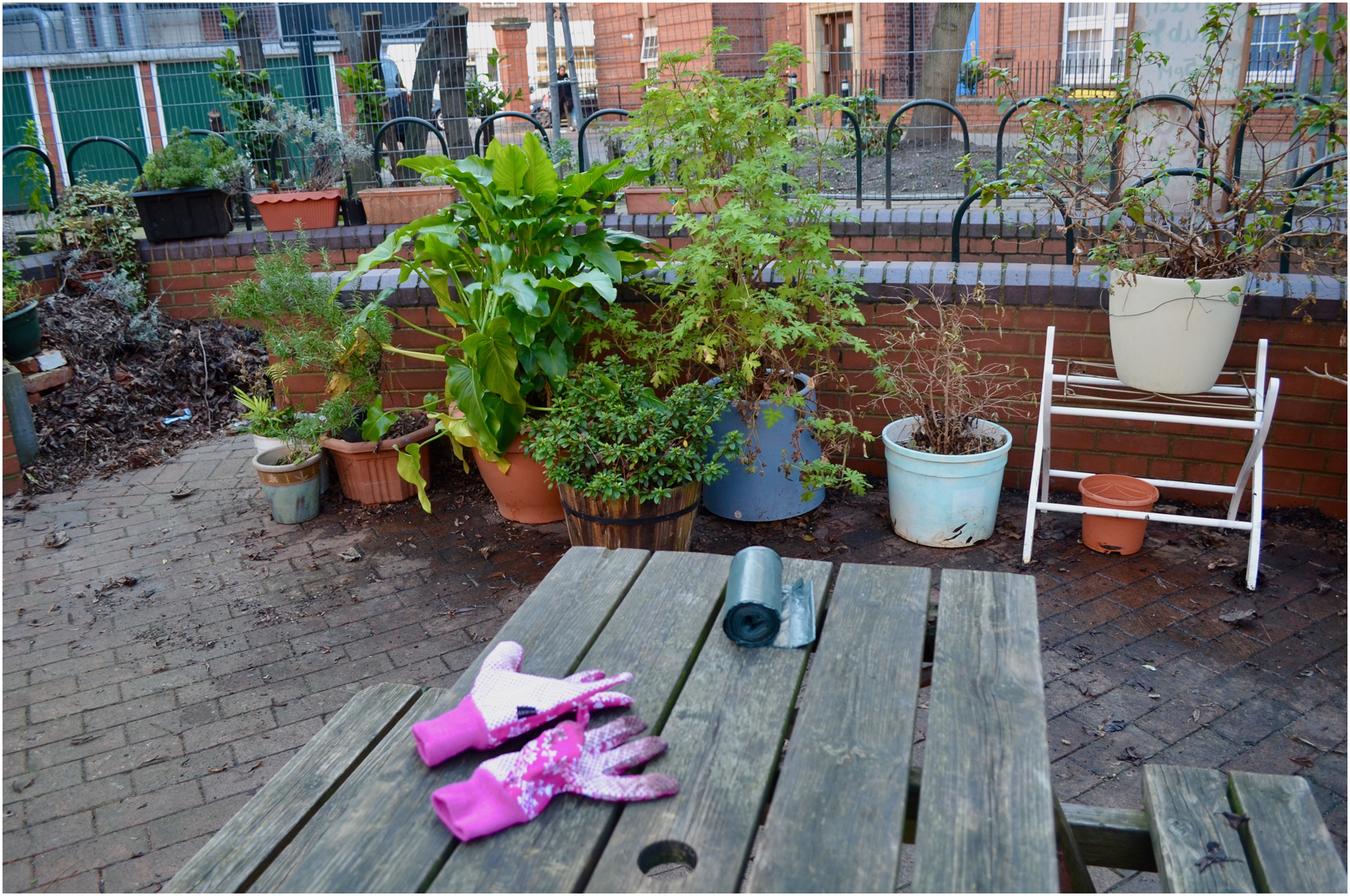
Dorinda's gardening gloves in Sutton Estate. Photograph by Mayanka Mukherji
care emerges in these entangled conditions – not as a nostalgic claim to place, but as a fraught and situated response to the pressures of redevelopment, speculative erasure, and contested futures. In doing so, we align with Massey's call for a progressive politics of place – one that acknowledges its porousness, embraces multiplicity, and foregrounds its role as a site of both struggle and possibility.
Two analytical frameworks guide our critique of care as a dynamic and material practice: Material fragility (Denis and Pontille, 2015) and fluidity (Laet and Mol, 2000). Denis and Pontille argue that vulnerability is not merely about lacking solidity or durability but is intrinsic to how care unfolds in everyday maintenance and attention to fragile materials and relations. Laet and Mol's notion of fluidity emphasises adaptability and responsiveness over rigidity – qualities that make care practices resilient and meaningful in unpredictable contexts. Applying these ideas, we argue that care practices in our field sites are not about maintaining stable continuity but about negotiating the precarity and transformation of place, objects, and social relations.
Our ethnographies illustrate how care is materially situated and physically alters the ground on which people live. In Sutton Estate, weekly gardening sessions involve tactile, embodied labour – loosening soil, mixing compost, planting seeds – that manifests care as both material transformation and political assertion. In Sandy Row, bonfire rituals physically scar the landscape with ashes, nails, and pollutants, simultaneously enacting belonging and conflict in a space marked by sectarian tension and regeneration pressures. These transformations are neither fully intentional nor fully predictable, underscoring the contingent nature of care.
In Sutton Estate, soil was central to many discussions in the garden. It became a metric to measure the health of the place. Against the charged backdrop of urban regeneration and accusations of uninhabitability of the Estate, soil became a site to physically demonstrate that habitability and uninhabitability were not fixed conditions, and that habitability can be created through care, just as ‘bad soil’ could be turned into ‘good soil’. Dorinda, the founding member of the gardening group, explained how good soil can be distinguished from bad soil. ‘The trick is simple’ she said, ‘just poke a stick into the ground like you do with cake batter, and if it comes out moist, it's good soil. If the stick is dry, it means that you can’t grow anything in it’. Such conversations shifted smoothly between the realm of the material, the symbolic and the political.
Bad soil turned into symbols of neglect towards the estate, and in contrast, good soil symbolised the possibilities opened up when care is provided. This tied into the overarching political debate on whether the flats were empty because they were uninhabitable or whether they were made uninhabitable by keeping them empty and neglecting them. While the Housing Association justified the proposed demolition based on the logic of the former, the gardening group operated on the logic that habitability is an ongoing process of material negotiations between people and places. Maria Puig de la Bellacasa (2017: 2015) looks at the practices of ‘soil care’ to explore alternative frameworks of thinking about care that counter logics of technoscientific futurity. She extends an ethnographic and ontological critique of scientific conceptions of soil that view it as a resource to be extracted. Instead, she poses it as a ‘living world’, revealing various forms of embodied engagements with soil.
In a similar vein, countering absolute notions of habitability and uninhabitability that were weaponised by the Housing Association to make their case for demolition, the gardening group at Sutton Estate illustrated the dynamic quality of habitability through their modes of engagement with soil. Dorinda and Chris travelled to a nursery in Barking, from where they bought seeds and bags of good soil. Patting the soil firmly into the ground, Dorinda spoke about how she prefers not to use gardening gloves while working with soil. She spoke of the importance of touch when it comes to the art of gardening. Dorinda's insistence on removing her gloves while handling soil resonates with Bellacasa's study of the affective relationship between farmers and soil - the farmers speak with empathy reserved for family members as they speak about soil, the life it contains and how to go about ‘tasting soil’ or developing a ‘feeling for the soil’ (de la Bellacasa, 2015: 704).
Along with acting as a physical interface that enables a tactile, ‘hands-on’ engagement with place, soil is in itself a complex material. It is made up of smaller particles that allows it to hold other objects within itself – cigarette butts, seeds, leaves, ashes etc. Through practices of gardening and grieving, the soil in the garden is imbued with physical remains of the past (ashes) and physical possibilities of the future (seeds), thus holding multiple temporalities, as described by Bellacasa, that serve to counter the linear logic of urban regeneration. Dorling's aunt's ashes resting in the soil highlight the potency, richness and ambiguity associated with different bits of soil, even if they all look the same to the naked eye. The material and metaphorical are thus suspended and entangled within the soil of the estate – its poetry waxing and waning depending on the levels of perceived threats of displacement. Our aim is to not fetishise soil as an inherently affective object, taking a note of caution from Navarro-Yashin (2009). She, in her study of ruins in Northern Cyprus, argues that these spaces are not affective on their own but its the people who ‘put the ruins into discourse, symbolize them, interpret them, politicize them, understand them, project their subjective conflicts onto them, remember them, try to forget them, historicize them, and so on’ (Navarro-Yashin, 2009: 15), it is people who make these spaces and objects affective (Figure 6).
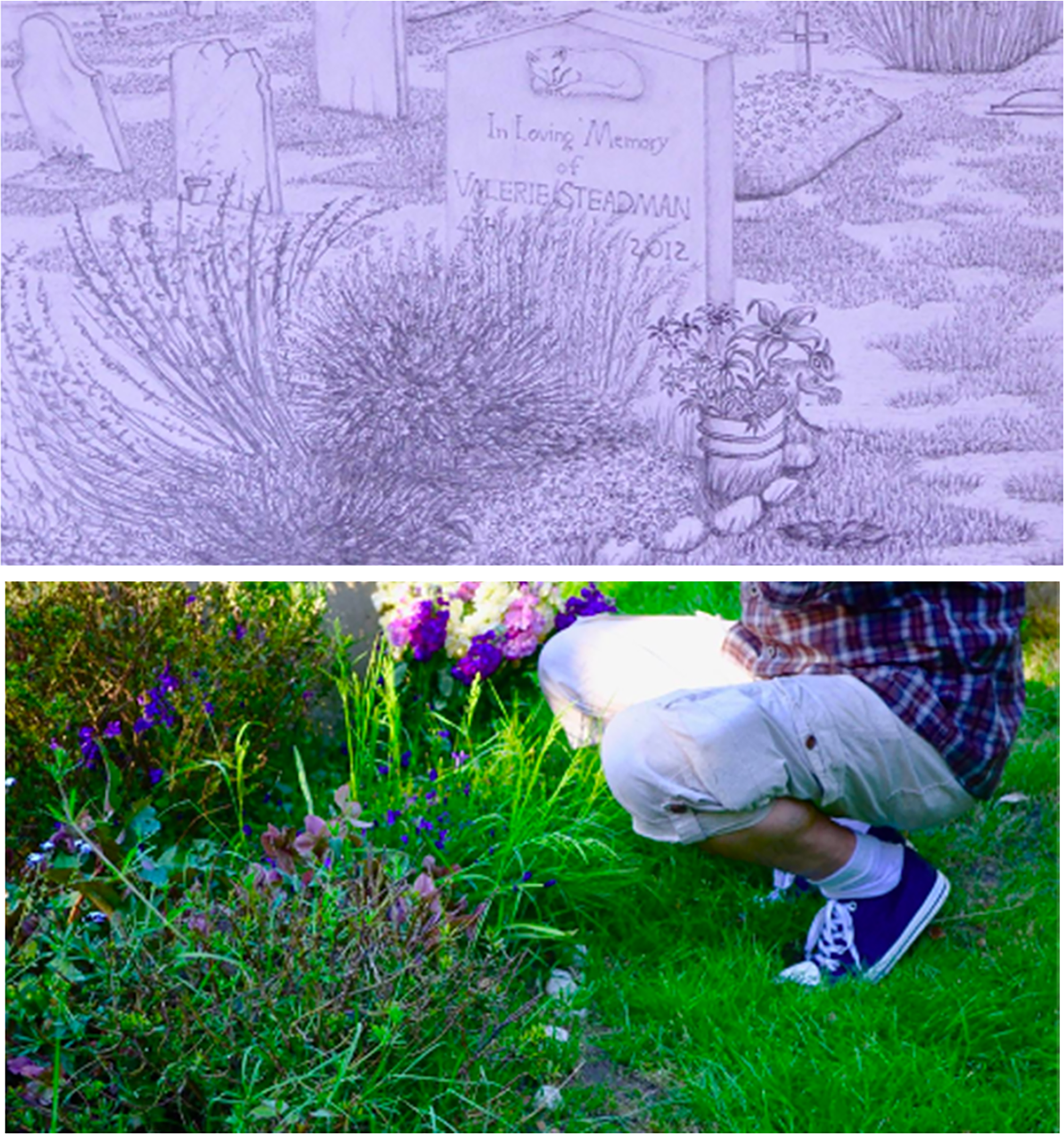
Chris's sketch of his mother's grave, emphasising the dents in the mud (Sketch by Chris Steadman); and Chris, kneeling on the very same spot (Photograph by Mayanka Mukherji)
As well as the texture and quality, the residents also emphasised another attribute of soil – its ability to hold impressions. For instance, some of the Sutton Estate residents visited the nearby Brompton cemetery where their relatives lay buried. Much like John Dorling's letter, the cemetery visits were recounted to Mayanka as a way of emphasising generational attachment to the area and evoking ancestors that lay buried in the soil to make claims over a place. Chris, a member of the gardening group, would pluck a handful of thyme from the garden, which was his mum's favourite herb, and carry it to the Brompton cemetery. He would kneel beside the grave, and the regularity of his visits had left behind two dents in the soil. He proudly pointed to these dents that were material testimonies of his dedication to his mother. In the drawings of the gravehe emphasised these dents firmly, revealing the ability of soil to hold the layers of belonging carved into a place. As Dorinda peels away her gloves and dips her hands into the soil to check its moisture, as John's letter requests for his aunt's ashes to be scattered in the garden, and as Chris emphasises the dents in the mud left by his regular visits to his mother's grave, soil becomes a physical interface in the relationship between people and places. Mayanka's fieldwork in Sutton Estate revealed soil as a material configuration embedded within multiple and non-linear temporalities, its fluidity and transformations entangled with localised expressions of care and belonging. This contributes to the broader debates within anthropology on how the concept of ‘place’ is shaped through materiality and social practices (Hetherington, 1998), as well as more specific anthropological studies on practices of ‘marking’ in response to modes of displacement, such as Mitch Rose's (2012) claim that ‘dwelling is marking’ and Mark F. Hau's (2016) study of how Catalanist actors mark parts of Barcelona through flags and inscriptions.
Trees similarly play a role in pushing back against the narrative of uninhabitability. The trees of the garden become objects of pride, their longevity an evidence against claims of the estate being uninhabitable. In fact, a similar line of observation also features in the powerful anti-colonial ethnography by Juman Simaan (2017) who looks at the role played by olive trees in the occupied lands within Palestine. Based on his long-term engagement with olive-growing families in West Bank, he argues that one of the key claims by the occupying forces is that of the ‘unworked land’ (Simaan, 2017: 516) – a basis for land confiscation – which involves the uprooting of trees. This claim of the ‘unworked land’ links closely to Mayanka's category of uninhabitability, which is further tied up to the neoliberal imagination of land and value, and often weaponised to justify displacement of poor people as part of projects of improvement (Li, 2007).
By contrast, in their fieldsite in Belfast, Anna's encounter with fire offers a starkly different understanding of what it means to care for a place. Both field sites are similarly affected by market-led land speculation and redevelopment. However, the bonfires on the eve of the 12th of July illustrate how, in contrast with the more positive resonances of care discussed in the case of the garden in Sutton Estate, claims to place and rootedness in the face of displacement can also be highly charged and divisive. As in many other predominantly Protestant working-class districts of Belfast, Sandy Row becomes peppered with several bonfires on the run-up to the 12th of July celebrations. Some are small, some are huge. Same as everywhere else, they are made of stacked wooden pallets which are sourced in the weeks and months before the big night. The largest often contain car tyres (their fumes another city-wide source of controversy). Another bonfire is built next to a business park, intimidating its employees, and burning the owner's trees, instead. Finally, the most spectacular and (in)famous is the one built and burned near Hope Street, on an empty site which partially separates Sandy Row from the politically ‘neutral’, affluent city centre. Every year the Hope Street bonfire attracts a large crowd of both residents and visitors. One year, the bonfire was so close to a nearby apartment building as to shatter many of its windows: A billowing column of fire pushed revellers back past the building, while the already-present fire brigade and police intervened. The complaints resulted in some tightening of the rules around the construction of the bonfire, negotiated by the likes of a ‘Community Safety Officer’ and enforced by local residents and community workers.
These perceptions and tensions are managed by the likes of Billy, a youth worker and lifelong resident. Each year, in the weeks running up to the Eleventh, Billy surveys the construction of the Hope Street bonfire, ensuring both the safety and best conduct of the young lads building it. As both a local man who grew up building bonfires as well as the manager of the local Youth Charter, Billy is something of a role model to many of the younger residents of Sandy Row. His presence at the bonfire site is as much an act of care for them as it is for Sandy Row. ‘People don’t understand bonfires. Way back, when I was growing up, every street had a bonfire. And they weren’t high, they were maybe fifteen, twenty foot’. As with the proposed regeneration for Sutton Estate, the land on which the Hope Street bonfire is built has attracted the attention of developers and speculation. Currently, it is owned by the Northern Ireland Housing Executive and in 2018 a housing developer announced that it had been selected to deliver social housing on it as part of a wider regeneration project. However, the area's future remains uncertain and remains ‘wasted space’ in the eyes of both public and private stakeholders. As a space in which behaviour commonly viewed as anti-social, disruptive, and sectarian takes place, the Hope Street bonfire site goes precisely against the normative desires of future-oriented redevelopment projects. Being a loud, highly visible, and blatantly confrontational appropriation of the urban landscape, bonfires also exacerbate the very narratives of marginality which earmark deprived areas such as Sandy Row for commercial regeneration programmes. As a place-making practice, bonfires also expose the tensions surrounding what is deemed as having value or is deemed an act of care. They are an expression of territorial control and belonging that is even more charged in the context of urban redevelopment and the uncertainties of infrastructural change.
Centering material fragility in our understanding of care strongly resonates with the inherently ephemeral, destructive, and regenerative qualities of fire. From the air-bending heat of a blaze to the mellow light of a candle, fire is one of humanity's oldest technologies. Aside from cooked food, light, and warmth, its destructive/regenerative qualities have long been harnessed to fertilise soil and to keep us safe from danger. In this sense, fire and soil are materially intertwined and imbued with regenerative qualities. In the past, the regenerative power of Eleventh Night bonfires was more obvious, as urban residents living in tiny spaces took the opportunity to get rid of unwanted furniture. Back then, bonfires were small and haphazard piles of burning materials. Nowadays, their attendant practices and qualities – the gathering of materials, their location, and the conspicuous destruction of effigies of that which is deemed a threat – result in a material practice that is as dramatic as it is confrontational. Adding to a bonfire's efficacies and contentious nature is also what it leaves behind: Fumes, burnt sediments, ashes, and blackened marks on the ground (Figure 8)
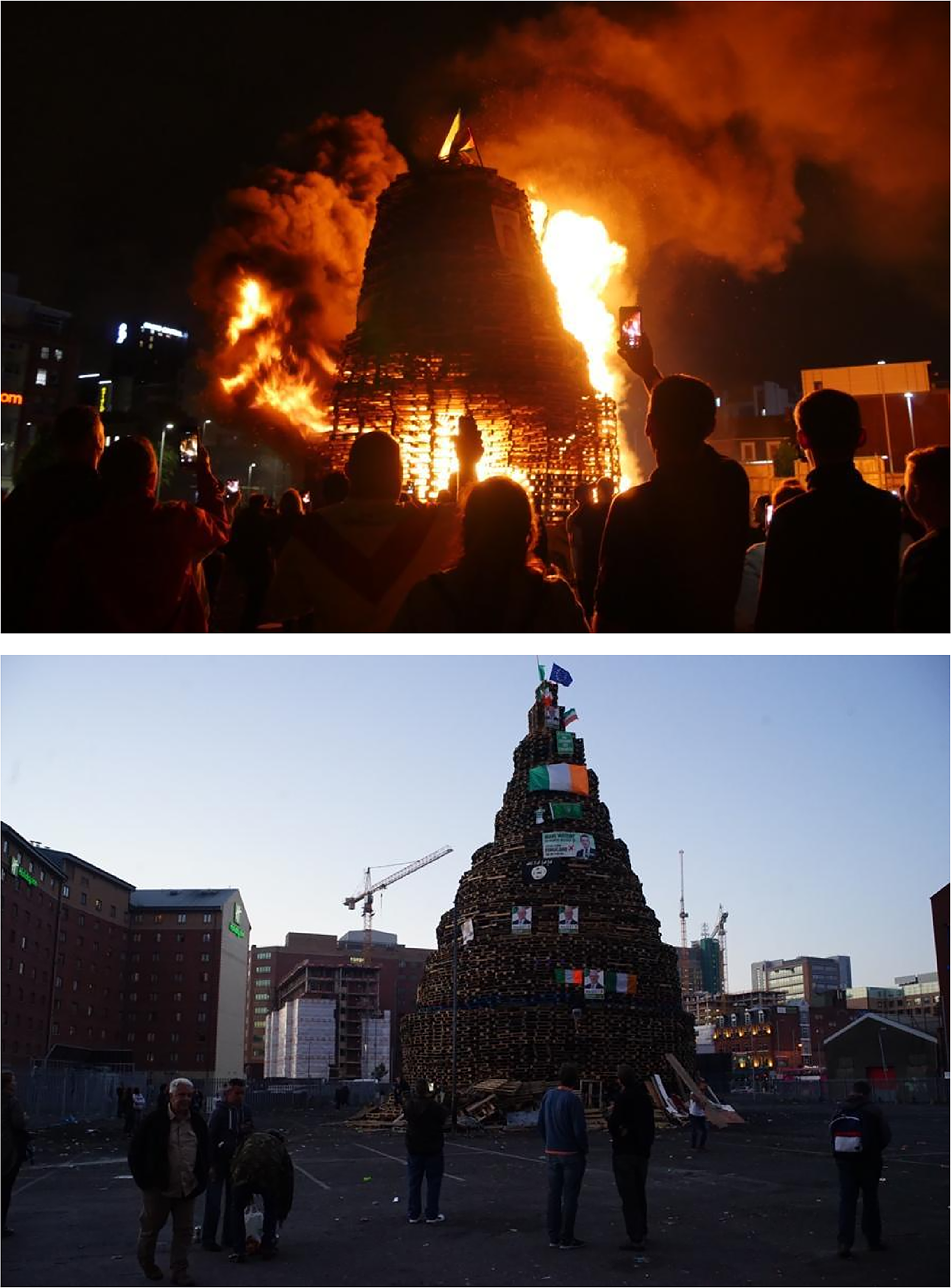
The Sandy Row bonfire burning shortly after midnight (top; Photograph by Anna Poloni) and earlier that day (bottom; Photograph by Bill Kirk). Some of the effigies burned include Irish flags and Sinn Féin electoral posters as well as the flags of ISIS, Palestine, and the European Union
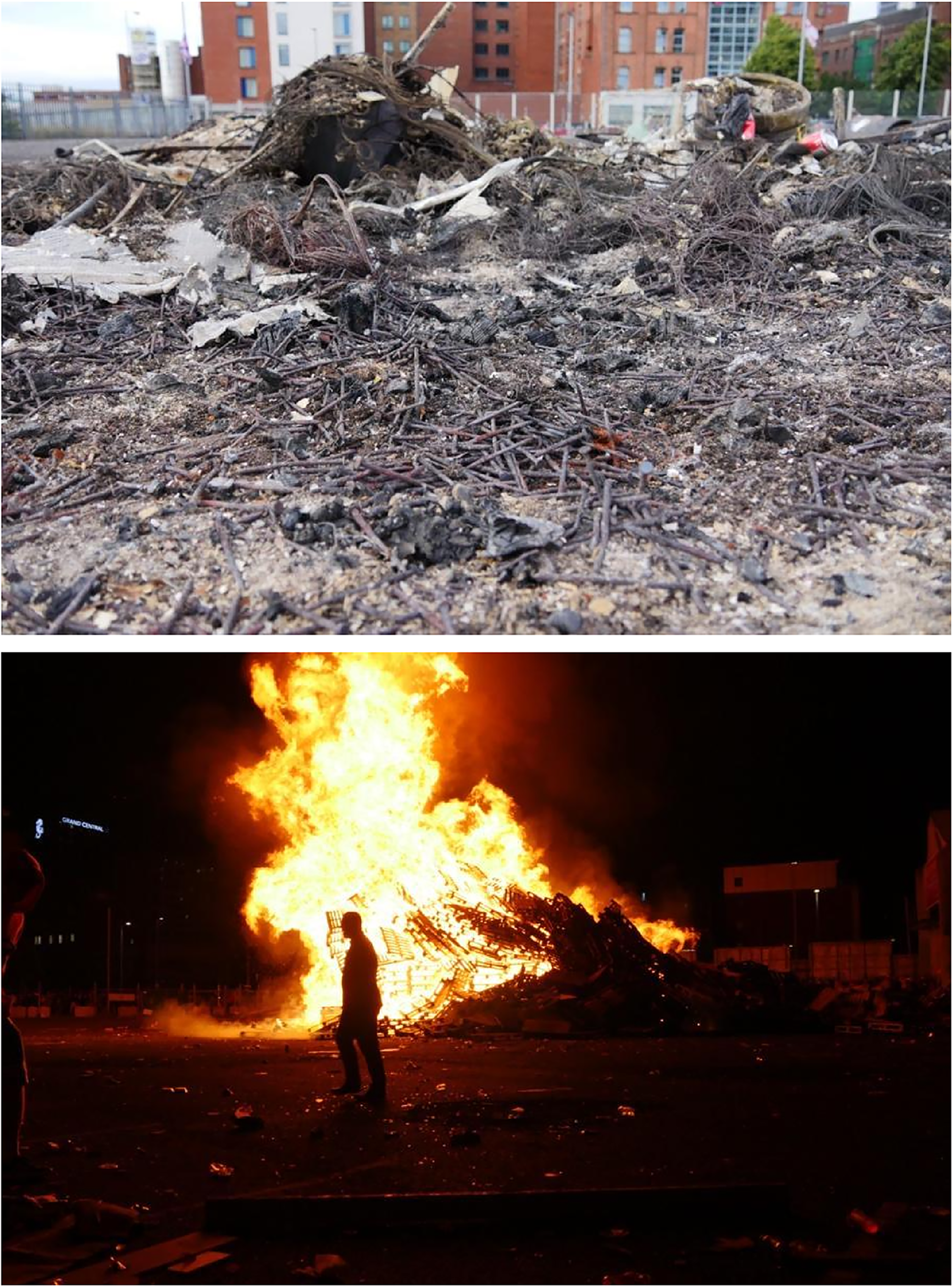
The charred remains (top) from the flames of the previous day (bottom). Photographs by Anna Poloni
Bonfires embody the fluidity and fragility of care, their form and social impact unpredictable yet deeply embedded in seasonal rhythms and communal histories. They confront dominant redevelopment visions with a disruptive, visceral claim to place – even as they reproduce divisions and exclusion. Together, these ethnographies reveal care as a material and political practice integral to social reproduction under capitalist urbanism – practices that contest displacement through rootedness, nurture, and confrontation. By centring the material fragility and fluidity of trees, soil, and fire, we complicate depoliticised notions of care and illuminate its contradictions as both sustaining and disruptive.
Conclusion
In an era where ‘care’ is increasingly abstracted from the material needs of people, and where the notion of the ‘local’ is fetishised into a hollow category, this paper has foregrounded place as a physical and contested terrain. By comparing housing estates in London and Belfast, we have argued that it is vital to attend to the ways people engage with and anchor themselves in place amid escalating abstractions, speculative urban planning, and political disregard. Given that capitalism on its own terms seems to be failing, in terms of no real growth in wages or quality of life in the UK despite the growing number of billionaires, our paper takes the declining line on the graph as a literal provocation to look downwards. We take ‘ground-level’ seriously, tracing how people embed themselves in the literal and metaphorical ground through care practices involving trees, soil, and fire. These materials are not merely symbolic: They carry weight, texture, memory, and presence – becoming both mediums and markers of endurance and resistance.
We finalised this paper in the wake of Labour's electoral victory in 2025, a moment many hoped would offer reprieve from over a decade of austerity. But this hope has proved short-lived. Starmer's Labour has quickly extended the violence of previous administrations: By prioritising warfare over welfare – sending arms to Israel in a context of genocide – and by introducing further cuts to benefits, particularly affecting disabled people. A hardened anti-migrant sentiment has also been mainstreamed, making the politics of place and belonging even more fraught. Against this backdrop of deepening precarity, the need to understand how ordinary people stay rooted becomes urgent. Through our focus on trees, soil and fire, we have examined how people craft durable attachments to place – attachments that are not always linear, redemptive, or even comfortable, but that nonetheless constitute real forms of staying put under threat.
Trees emerged as particularly significant figures across both London and Belfast. Not only do they grow in compromised soils and contested spaces, but they also anchor multi-scalar struggles over land, heritage, and futurity. We draw inspiration from scholarship on Palestine that shows how trees – especially olive trees – become active participants in resistance, not simply as metaphors of rootedness but because of their material properties, longevity, and emplacement (Braverman 2009). Our sites similarly reveal how different trees carry distinct political meanings. Some are cared for quietly as markers of permanence; others, like fast-growing pines in settler contexts, reveal how trees can also be used in service of erasure. Urban trees, in this light, are never just ‘nature’; they are historical and political actors that register, resist, and sometimes reproduce the spatial injustices around them. This unsettles the coherence of ‘urban nature’ as a category, and prompts us to ask: Where does the urban end, and where does nature begin? Our paper responds by showing that these boundaries are porous and contingent – shaped by ongoing struggles over land, memory, and identity.
This intervention also contributes to anthropological debates on care. We have argued that care must be understood as multiple, situated, and materially grounded. In our field sites, care is expressed through tending to garden soil, standing by long-rooted trees, or setting fire to pallets in a bonfire ritual – practices that are at once intimate, destructive, regenerative, and political. These modes of care disrupt the ‘one-size-fits-all’ frameworks often imposed by state policies, and they call for an anthropology attentive to care's contradictions. In spaces marked by dislocation and temporal uncertainty, care may emerge not as continuity but as rupture – a strategy for remaining in place even when the ground is shifting beneath one's feet.
Footnotes

Funding
The authors disclosed receipt of the following financial support for the research, authorship, and/or publication of this article: Poloni's research was funded by the AHRC.
Declaration of conflicting interests
The authors declared no potential conflicts of interest with respect to the research, authorship, and/or publication of this article.