






Abstract
This article explores the enduring presence and shifting meanings of outdated media and communication technologies (MCTs) in everyday life. Based on 30 in-depth interviews conducted in Istanbul, it examines how individuals retain objects such as Walkmans, vinyl records, and early mobile phones – devices no longer widely used, yet still materially and emotionally significant. Rather than approaching these items as nostalgic collectibles, the study reframes retention as a materially mediated practice through which attachment, memory, and critique are enacted. Bringing material culture studies, science and technology studies, and domestication theory into conversation, the article argues that outdated MCTs act as mediators of identity and memory and enable alternative engagements with time, value, and media. Istanbul's urban ecology – marked by repair networks, second-hand circulation, and layered temporalities – further supports these practices. The article contributes to debates on materiality by showing how old devices persist as materially active participants in everyday urban life – culturally re-signified and affectively charged artefacts rather than passive remnants of past use.
Keywords
Introduction
Living and working in Istanbul, I encounter old media and communication technologies 1 (MCTs) on an almost daily basis. Before leaving my home in Üsküdar to go to work in Beyazıt, I have breakfast facing a vacuum-tube radio that I inherited from my grandfather. When I step outside, I notice a dusty rotary phone waiting to be sold in the display window of a small second-hand shop on the corner of my street. Then I take the ferry across the Bosphorus and, after getting off in Sirkeci, I walk past rows of computer and mobile phone repair shops just opening their shutters, their workbenches already covered with dismantled screens, tangled wires, and spare parts.
As I make my way through the faculty building in Beyazıt, where I work, I pass glass display cases lining the corridors that still hold the remnants of a former communication museum, quietly displaced by the pressure of space. At lunchtime in a café at Beyazıt, as I drink my coffee, another radio stands across from my table as a decorative object. Later in the day, after work, I cross over to Kadıköy, where I browse second-hand bookshops in which vinyl records, postcards, and posters circulate alongside paperbacks and magazines. Next door, in neighbouring junk shops and antique shops, cassette players, record players, radios, and other electronic devices are stacked on shelves, piled in boxes, and occasionally plugged in to be tested. These objects do not appear merely as remnants of the past or as memories confined to display cases. Instead, they are woven into the everyday life of the city, moving with it, ageing with it, and inhabiting its material fabric (Figure 1).

A gramophone and vinyl records placed directly on the pavement outside a repair and resale shop in Kadıköy, Istanbul. It illustrates how outdated media devices physically inhabit contemporary urban space. Photograph by the author.
In these spaces, old devices circulate through everyday practices. They are handled, tested, repaired, negotiated over, and sometimes returned to everyday use. Record players are carried across neighbourhoods, set up in students’ flats, repaired when their needles break, and reinstalled in living rooms. Mobile phones are opened on workbenches, cleaned, rewired, and resold. Cassette players and radios on shelves are dusted daily, turned on from time to time, and kept as quiet companions of domestic life. Taken together, these everyday encounters point to a broader condition of urban life: outdated MCTs do not simply fade away or disappear. On the contrary, they remain materially and visibly present within the city's everyday environments.
Experiencing this persistent presence of outdated devices in everyday urban life led me to ask a more basic question: What actually becomes of MCTs after they are considered outdated? As Steven Jackson (2014: 234) observes, dominant technological imaginaries tend to privilege moments of innovation and adoption, while systematically neglecting what happens afterwards – when devices accumulate as e-waste in attics, drawers, and landfills. This article turns its attention to these technological afterlives and follows the prolonged social and material trajectories of devices that are expected to disappear. As technological development continues to accelerate, countless devices that were once integral to everyday life are rendered obsolete and discarded. Yet, as this study suggests, some people choose not to let go of these objects. Instead, they keep, store, repair, and continue to live with outdated media technologies by attributing to them new meanings and uses.
When people keep cassette players on their shelves, repair broken mobile phones, or reinstall record players in their living rooms, these devices clearly exceed their original technical functions. They are not merely used; they are lived with, cared for, and woven into everyday routines. Technologies, when understood as technical objects, are therefore not simply tools with fixed and singular purposes. Their material affordances – derived from qualities such as size, texture, interface, weight, and design – enable practical uses and shape how users interpret and emotionally engage with them (Gibson, 1986: 134–135). In this sense, users do not simply operate old media devices; they form relationships with them that embed memory, identity, and personal meaning. The essential function of an artefact cannot be determined solely by its design or intended purpose, since meanings and uses evolve through social practices (Oudshoorn and Pinch, 2003: 1–25).
MCTs, in particular, offer especially compelling examples of such technical objects because of their layered material and symbolic nature. Their material presence is inseparable from the content they once transmitted, recorded, or displayed. MCTs operate not only as tools but also as media – vehicles through which meaning is communicated, remembered, and shared (Silverstone and Hirsch, 1992: 15). This dual character enhances their affective and mnemonic capacities, allowing them to function as more than obsolete machines. Their specific designs and material qualities afford users multiple ways of interacting with them, enabling personalization and the layering of new meanings through the interplay between their material form and the content they carry. For this reason, old media devices often persist as intimate companions of everyday life rather than as redundant or replaceable objects.
This article traces three interrelated ways in which outdated MCTs continue to inhabit everyday life: as tools for crafting the self, as infrastructures of memory, and as subtle forms of resistance enacted through retention. These modes of engagement are grounded in participants’ everyday encounters with outdated devices. Returning to the everyday scenes described at the beginning of this article, they foreground how old devices are actively lived with in domestic spaces and personal routines.
Conceptual repertoire for outdated MCTs
The practices of keeping, repairing, storing, displaying, and occasionally reusing outdated MCTs examined in this study can be situated within intersecting theoretical traditions concerned with materiality, mediation, and value. This section places these practices in conversation with material culture studies, science and technology studies (STSs), and domestication theory. Considered together, these perspectives provide a conceptual repertoire for understanding how technological objects shift in meaning once their central functional role has diminished, and how they remain embedded in everyday life beyond the cycles of replacement.
Material culture scholarship has long demonstrated that ordinary objects mediate identity, attachment, and social relations (Douglas and Isherwood, 1996; Hebdige, 1979; McDonnell, 2023; Miller, 1987, 1998, 2010; Woodward, 2007). Objects do not simply reflect social life; they participate in its formation through practices of use, care, display, and narration. This scholarship has also examined how media devices such as vinyl records, radios, and tape recorders acquire renewed cultural value over time (Bartmanski and Woodward, 2015; Chivers Yochim and Biddinger, 2008; Li et al., 2025; Skuse, 2005). As Vannini (2009: 3) observes, material culture and technology studies share contiguous concerns in their attention to everyday sociomaterial entanglements. This overlap becomes particularly visible when technologies are approached not as isolated tools, but as embedded elements of lived environments.
From an STS perspective, technologies are understood as sociotechnical artefacts shaped through processes of co-construction (Bijker et al., 1987; Pfaffenberger, 1988, 1992a; Winner, 1977, 1993). They are embedded in systems of power, mediation, and meaning, and actively participate in structuring social relations. Pfaffenberger's (1992b: 282–312) notion of technological drama is especially useful here, as it highlights how technologies move between competing interpretive frames. Devices once celebrated as innovative may later be dismissed as outdated, reclaimed as authentic, or mobilized as critiques of disposability and acceleration. Obsolescence thus appears less as a purely technical condition than as a culturally negotiated status shaped by shifting regimes of value.
Domestication theory extends this perspective by tracing how media technologies become woven into everyday routines over time (Haddon, 2000, 2003, 2004, 2006; Morley, 1986, 2000, 2003; Silverstone and Haddon, 1996; Silverstone and Hirsch, 1992). Importantly, domestication does not end when a device is replaced by a newer model. Practices such as storing a cassette player, repairing a record player, keeping an early mobile phone in a drawer, or maintaining an analogue archive can be understood as extensions of domestication rather than residues of past use. In urban contexts where repair workshops, second-hand markets, and informal exchange networks remain embedded in everyday life, as in Istanbul, these extensions unfold not only within domestic interiors but also across neighbourhood spaces and commercial infrastructures. The urban environment thus becomes part of the sociotechnical field within which outdated technologies continue to circulate.
A commodity-biographical perspective further clarifies how value is reconfigured across time (Appadurai, 1986; Hoskins, 2006; Kopytoff, 1986). As objects move through contexts of exchange, inheritance, storage, repair, and memory, they accumulate layered biographies that exceed their original market logic. In participants’ accounts, devices shift from commodities to mnemonic anchors, from functional tools to ethical statements or affective companions. Rather than signalling termination, obsolescence marks a transformation in regimes of value, as objects are re-situated within new social and symbolic frameworks (Douglas and Isherwood, 1996; Woodward, 2007).
Taken together, these perspectives provide a conceptual vocabulary for analysing retention not as passive inertia, but as an active engagement with technological time. Outdated MCTs emerge as objects whose meanings are continually negotiated across material, social, and symbolic contexts. This framing grounds the analysis that follows, tracing how retention operates through practices of self-making, remembering, and everyday resistance within Istanbul's urban ecology.
Empirical encounters
The analysis presented here draws on interviews conducted with 30 (15 women and 15 men) Istanbul residents who continue to live with MCTs that have long fallen out of everyday use. Many of these devices remain stored in drawers, displayed on shelves, kept in closets, or occasionally brought back into use in domestic settings. The interviews were carried out between February and December 2022 and were informed by sustained observation of outdated media technologies across the city. Repeated encounters with such devices in cafés, repair workshops, second-hand markets, museum spaces, and neighbourhood streets helped situate the participants’ accounts within the broader material environments in which these technologies continue to persist.
Participants were identified through personal and community networks, as well as through a public call circulated via social media platforms. In each case, interviewees were individuals who had retained MCTs already in their possession – often for many years – rather than having re-acquired them through retro markets or nostalgic consumption. What brought these participants together was not a shared enthusiasm for obsolete technologies, but the continued presence of outdated devices within their domestic environments after their primary functional role had diminished.
In this study, outdatedness is approached as a culturally and temporally situated condition in which MCTs are no longer widely used, manufactured, or supported by dominant technological systems, and have been functionally replaced by newer, more integrated or efficient alternatives. This does not necessarily imply that a device no longer functions or holds value for its users; rather, obsolescence is shaped as much by shifting norms, trends, and infrastructures as by technical performance. For instance, while cassette players, rotary phones, or VHS recorders may be considered outdated within mainstream global markets, in Istanbul – as in many other urban centres – they continue to circulate in second-hand shops, family homes, or local repair networks. In this context, outdatedness marks not complete abandonment but a transition into new forms of cultural, emotional, and practical relevance, where a decline in market presence is accompanied by a reconfiguration of social meaning.
With the exception of three interviews conducted online, all interviews took place face-to-face in various districts of the city, most commonly in cafés and, in two cases, in an auto repair workshop. The cafés functioned as accessible meeting points located in central neighbourhoods such as Kadıköy, Beyoğlu, and Beyazıt. While these locations were chosen primarily for their convenience and ease of access, they also revealed dense material environments in which old technologies were already embedded in the everyday flow of urban life. In this sense, the urban setting itself became part of the field. Against this backdrop, the city can be understood, in the terms of repair scholars, as an urban repair ecology – a dense infrastructure of workshops, markets, second-hand shops, and informal expertise through which technological objects are continuously maintained, reworked, and kept alive (Denis and Pontille, 2015: 355; Graham and Thrift, 2007: 1–2; Jackson, 2014: 225). Following Christopher Henke's (2000: 75–76) sociology of repair, these sites can be understood not merely as technical service points but as infrastructures of everyday order, where material breakdowns, social relations, and urban routines are continuously negotiated and restored.
Importantly, these locations were not selected because of their association with old MCTs. Rather, their material qualities emerged through what can best be described as serendipity: repeated encounters with outdated devices as ordinary features of Istanbul's material ecology. The presence of old technologies in cafés, workshops, and museum cafés was not staged or curated for the purposes of the research; it was encountered as part of the city's ordinary social and material environments. For example, one café in Kadıköy used old household objects as part of its interior decoration, including a rotary landline telephone that remained visible throughout the interview. Another interview, conducted in the café of the Pera Museum in Beyoğlu, took place in a space that permanently exhibits historical measuring technologies and is located only a few streets away from Orhan Pamuk's Museum of Innocence – a globally recognized institution dedicated to the material culture of everyday life. These spatial proximities and material encounters were not methodologically planned, yet they repeatedly foregrounded the visibility of technological pasts within the contemporary city (Figure 2).

Interview setting in a café in Beyazıt, Istanbul, where an old radio placed on one of the bookshelves appears as part of the everyday material environment. Photograph by the author.
Two interviews were conducted in an auto repair workshop located in Ataşehir, one of Istanbul's emerging metropolitan centres rather than its historic core. Situated behind the district's high-rise business towers, in a part of Ataşehir that has not yet fully undergone urban transformation, the workshop occupies a hybrid zone where older urban fabrics coexist with new metropolitan developments. This setting exemplifies how repair cultures and the circulation of outdated MCTs extend beyond the city's traditional districts and remain embedded within the infrastructures of Istanbul's increasingly polycentric urban landscape.
The workshop itself constituted a particularly rich ethnographic site. Owned by two brothers who specialize in assembling and modifying vehicles from rare and customized parts, the space also functioned as an informal exhibition of outdated mobile phones. One of the brothers stores old media devices in a private depot at home, while the other is an avid mobile phone enthusiast whose collection largely consists of devices he previously used himself or acquired through long-term personal and professional networks. In the workshop, they built a glass display cabinet dedicated entirely to their collection of old mobile phones – all in working condition. These devices frequently served as conversational anchors, opening up stories about technological change, personal histories, and everyday repair practices. In this context, outdated MCTs were not passive background objects but active social mediators that structured interaction, memory, and storytelling. Such workshops exemplify what anthropologists of technical labour describe as repair cultures, where knowledge, memory, and material practice are inseparably intertwined (Henke, 2000: 75–76; Orr, 1996: 1–13).
Participants were living with a range of retained communication devices – from cassette players and record players to analogue cameras, early mobile phones, and media carriers such as tapes or CDs. Some also considered postcards or letters as part of their personal communication archives. In many accounts, retention was narrated alongside loss: devices had sometimes been discarded during moves, displaced due to limited storage space, or disposed of by other household members. These absences formed part of the participants’ ongoing engagements with outdated technologies.
In clarifying the scope of the study, it is important to distinguish retention from other related practices such as collecting, hoarding, or mere accumulation. While collecting and hoarding involve deliberate and systematic acquisition, and accumulation refers to unselective keeping of objects (Belk, 1995: 65–68), the practices observed here are better described as retention – long-term, often unconscious maintenance of certain communication devices after their functional primacy has diminished. This framing highlights retention as an ongoing practice of attachment, memory, and continuity, rather than as a response to temporary cultural or market trends.
Practices of retaining, repairing, and revaluing outdated MCTs do not appear uniformly across social contexts. The forms of engagement analysed here are most visible among participants who possess the cultural capital, spatial resources, and technical familiarity required to keep, store, or repair old devices beyond their functional lifespan. This does not suggest that such practices are absent in other social strata; rather, it indicates that the meanings attributed to outdated technologies, and the motivations for engaging with them, may vary depending on social, economic, and symbolic conditions. In a city such as Istanbul – where repair infrastructures and second-hand circulation networks serve diverse populations – outdated MCTs may function in some contexts as objects of ethical critique or aesthetic attachment, while in others as elements of everyday necessity. This study focuses primarily on the former modes of engagement, while acknowledging that forms of technological endurance shaped more directly by economic constraint or infrastructural dependency fall beyond the scope of the present analysis and constitute an important area for future research.
Crafting the self
The objects we possess shape our capabilities and identities. Csikszentmihalyi and Rochberg-Halton (1999: 94) suggest that home belongings form a symbolic ecology that directs our attention, reflects our intentions, and fosters individuality. They classify domestic objects into action objects and contemplation objects, loosely aligning these categories with Hannah Arendt's concepts of vita activa and vita contemplativa. Unlike action objects, which serve immediate functional purposes, contemplation objects derive meaning from memories and personal connections (Csikszentmihalyi and Rochberg-Halton, 1999: 96–98).
Yet this distinction does not fully capture the role of outdated MCTs. As the present study demonstrates, such devices rarely fit neatly into either category: they simultaneously afford practical engagement and reflective attachment. Old MCTs emerge not only as contemplation objects of memory but also as sites of competence, play, and creativity. Users maintain, repair, and adapt them – transforming these objects into material companions through which self-making is practiced, technical skills are cultivated, and belonging is sustained. In this sense, outdated devices expand Csikszentmihalyi and Rochberg-Halton's (1999: 96–98) framework by showing how action and contemplation often converge within the same material artefacts.
From the users’ perspective, outdated devices often appear as contemplation objects, yet their use is rarely limited to passive remembrance. Interviewees maintained, repaired, and adapted their devices, transforming them into sites of skill-building and creative practice. In this sense, bodily and material engagement becomes a form of non-verbal communication (Lemonnier, 2012: 133–134), where manuality and care enact competence, attachment, and cultural meaning without words. From another angle, Vilém Flusser (2014: 1–9) reminds us that such bodily engagements can be understood as gestures – meaningful, communicative movements that transform technical interaction into cultural expression. The act of inserting a cassette, adjusting a needle, or coding on an old computer is not merely functional but a gesture that condenses ritual, skill, and identity.
In participants’ accounts, this convergence of action and contemplation unfolded along several intertwined dimensions of self-making. Devices became resources for cultivating competence – where repair, tinkering, or upgrading conferred not just functionality but also technical identity. At the same time, they were channels of cultural encounter, shaping individuality through the music, films, and texts they carried. Finally, they anchored personal continuity, linking users to formative life stages and intimate histories. These dimensions rarely appeared in isolation: when one participant described his Walkman as a way of choosing his own musical path, another recalled the pride of mastering computer games inaccessible to peers, or a third spoke of keeping a parent's phone as an irreplaceable keepsake, each account wove together skill, cultural content, and temporal continuity. In this sense, outdated media were not inert remnants but active collaborators in the crafting of self.
For some, the ability to select and engage with cultural content was central to individuality. One participant described his Walkman as a medium of autonomy, a way of resisting external expectations and asserting independence: “My Walkman means choosing my musical taste and getting some freedom. In those days, there was a father figure; there were social norms, we didn’t know ourselves because we were under the pressure of superego. Walkman, on the other hand, meant to me, ‘no, I will not listen to this, my friend! I will go to the music shop and choose myself. I will choose this time.’ Maybe that is why I keep the Walkman.” (K.K., 31, Male)
Here, self-making unfolded through both the content – the ability to choose one's own music – and the embodied practice of listening, which materialized autonomy. Following Flusser (2014: 1–9), the ritual of inserting a cassette or pressing play was not simply technical but dramatized individuality, performing a personal break from parental or social authority. Crucially, this gesture was inseparable from the material qualities of the device itself: its portability, the personal use of headphones, and the ability to select and access content (cassettes) based on personal preference rather than centralized sources such as the radio. In Flusser's (2014: 1–9) sense, these gestures condensed technical action into cultural meaning, transforming the Walkman into a stage for enacting selfhood.
In other accounts, this embodied autonomy unfolded through movement across the city. One participant recalled how his Walkman accompanied him during his daily commute while preparing for university entrance exams: ‘I still remember which songs I used to listen to. I would walk from Üsküdar to Kadıköy to go to my prep school. In Haydarpaşa, I had Metallica in my ears’. (G.M., 40, Male)
Here, the Walkman mediates not only sound but urban experience itself. The act of walking across neighbourhoods and passing through transport hubs becomes synchronized with the rhythm of music. The device turns the city into a personal soundscape and transforms the commute into a formative ritual of self-discipline, aspiration, and emotional endurance.
A similar form of urban companionship emerged in another participant's account, in which the Walkman accompanied her daily bus journeys to school: ‘When I was going to and from school, my Walkman was always with me. There was music in the background, and the city was flowing past the window’. (A.Ö.,38, Female)
Other accounts emphasized how competence and self-presentation were equally entangled with identity. One participant recalled using his computer to distinguish himself from his peers: “I was constantly showing off with it (his computer). I was bringing the subject to computer games that I knew could not be played on their computers. For example, I asked my friends, ‘Do you have Time Commando?’ so I can be different.” (C.C.C., 42, Male)
Here, the computer operated not only as a technical device but also as a prop in what Erving Goffman (1959) describes as the dramaturgy of everyday life. Technical competence, the ownership of specific games, and the ability to demonstrate both became resources for identity work, transforming material possession into a visible performance of distinction. Mary Douglas and Baron Isherwood's (1996: xxi) classic argument that consumption is a system of communication resonates here: media devices, like clothing or food, signal difference, status, and belonging. In this case, the computer was a medium through which individuality was staged and social boundaries were drawn.
Repair and maintenance also emerged as sites where competence and affect fused. Participants highlighted how fixing a broken device created a sense of intimacy, turning technical labour into a form of attachment. One participant explained: ‘I fixed my broken record player and that process made me feel more connected to it. The effort I put into fixing it built a kind of bond between us’. (K.K., 32, Male)
For him, repair was not only a technical act but a material gesture of care. The device, once fragile and obsolete, became reanimated through touch and skill. This gesture of care was not detached from the urban infrastructures that made such repair possible. The participant traced the story of his record player back to its acquisition in the first year of university, when he bought it at the Beyoğlu Sahaf Festival (a long-running Istanbul fair organized by second-hand and antiquarian booksellers, known locally as sahaf, offering books as well as posters, postcards, photographs, records, and turntables) in 2011. The journey of acquiring, transporting, installing, and repairing the device was itself remembered as a formative experience: the difficulty of carrying it across the city, setting it up at home, and later repairing its mechanical parts became inseparable from the value of the object itself.
In this sense, the city is not merely a background to technological attachment but an active component of it. Fairs, second-hand markets, and informal nostalgia events function as material nodes within Istanbul's urban ecology, where outdated technologies circulate, are revalorized and re-enter everyday life. The record player is thus not only a domestic object but also an urban artefact, whose biography is shaped through movement across neighbourhoods, public spaces, and repair cultures. The effort invested in acquiring and maintaining the device becomes part of its meaning: difficulty, labour, and persistence are not obstacles to attachment but the very conditions through which attachment is produced.
Beyond moments of repair and technical mastery, outdated devices also remained present through quieter, more routine forms of care. Another participant described his Commodore computer as an enduring companion: “My computer is at our summer house now, displayed because I have space there. Back when it was in my room, I would dust it daily and take care of it like it was still in active use. I would sometimes turn it on and play games. Even 30 years later, I could still write code on it. That's how actively I used it.” (C.C.C., 42, Male)
Here, care is expressed not through repair alone but through repetition, attention, and presence. Dusting the computer daily, keeping it visible, and occasionally turning it on are not acts of technical necessity but of affective continuity. The device remains part of everyday life even when it is no longer functionally required.
These accounts resonate with Miller's (1987: 85–109) notion of the humility of objects. Miller (1987: 85–109) argues that material objects exert their strongest influence not in moments of spectacular display but in their quiet, background presence. In this study, outdated MCTs – whether cassette players, old phones, or Commodore computers – sustained identity precisely in this modest way. Dusting them, repairing them, and keeping them visible on a shelf were not grand symbolic gestures but ongoing, almost unnoticed practices that anchored continuity. Importantly, participants often emphasized that such arrangements were less about showing the devices to others than about reminding themselves who they were and where they came from.
Beyond acts of repair and maintenance, this quiet power of objects was equally evident in how participants lived with media they no longer used but could not part with. One participant described how his DVDs remained central to his sense of self even when rarely used: “I don’t watch DVDs, but I keep them. I recently tried to make space for new books and asked myself whether I should get rid of the DVDs. But I said no. It's satisfying to see them there. Because there is Tarantino, there are Fellinis. They are a whole collection for me and make me whole.” (Ö.P., 44, Male)
This is a further expression of what Miller (1987: 119) describes as the profound yet humble role of objects in shaping identity – not through visibility but through steady presence. The collection does not fade into insignificance; on the contrary, its persistence makes it indispensable, anchoring selfhood through the steady reminder of tastes, values, and personal history.
The distinction between shared and personal devices further clarified how selfhood was anchored. Unlike household appliances such as televisions, which rarely became cherished possessions, smaller and more personal devices – such as mobile phones or MP3 players – were often preserved long after their obsolescence. One interviewee remarked:
‘We didn’t keep our old TV, but I still have my father's phone. It doesn’t work, but I’d never throw it away’. (K.K., 32, Male) This statement illustrates a shift from shared, collectively used household devices to personally meaningful and emotionally charged possessions. While the family television – a communal and impersonal object – was not retained, the father's phone was preserved despite its functional obsolescence. Here, the movement from ‘we’ to ‘I’ reflects more than a change in ownership; it signals a deepening of attachment through individualization. The mobile phone, once a tool of daily communication, becomes a vessel of memory and intimacy, imbued with the presence of a loved one. In Douglas and Isherwood's (1996: 39) terms, such an object does not merely signify but anchors social relationships, embodying emotional bonds that transcend utility and endure across time.
Taken together, these accounts show that outdated devices are not inert relics but active participants in crafting the self. They enable competence, dramatize individuality, and materialize continuity through embodied gestures, cultural content, and intimate attachment. Their affordances – ritualistic, tactile, and symbolic – generate intimacy and sustain identity across time. As Douglas and Isherwood (1996: xv) observed, ‘goods are neutral, their uses are social; they can be used as fences or bridges’. In the case of outdated MCTs, users mobilized them as bridges between skills and identities, past and present, and self and others in everyday urban life.
Materializing memory
Individuals use objects to shape their relationship with time – whether to preserve memories, distance themselves from the past, stay current, or move forward (Attfield, 2000: 169–170). Attfield's (2000: 169–186) work highlights that objects serve as mediators through which individuals emotionally and cognitively engage with time, emphasizing their role in shaping temporal experience. The material qualities of the old MCTs and the affordances (Gibson, 1986; McDonnell, 2023: 201–204) they offer play a crucial role in the materialization of memory. For example, pressing the physical buttons of analogue devices, feeling the mechanical movement of cassettes, and experiencing the tactile nature of these devices enable users to establish an embodied and sensory relationship with memory. The materiality of objects emphasizes how their physical and sensory qualities actively shape the formation and reactivation of memories beyond purely mental processes. These material characteristics allow memories to be reactivated not only mentally but also through bodily and social practices. Remembering, as described by Emanuele Prezioso and Nicolás Alessandroni (2022: 11), transcends mere cognitive processing; it involves actively engaging with and through objects, representing an extended, semiotic, and contextually situated activity. Like memorials and museums that facilitate collective memory, personal objects support autobiographical recollection. These theoretical insights are echoed in the ways participants described their relationships with old media devices, revealing how affective and practical dimensions often co-exist.
Participants frequently distinguished between emotional attachment and practical usability, while also stressing that these dimensions were not mutually exclusive. Many accounts revealed a hybrid form of engagement: a device might be preserved for its sentimental value yet still occasionally used, or conversely, kept in daily circulation while simultaneously serving as a symbolic anchor of memory. This hybridity demonstrates how outdated technologies are sustained not only as functional artefacts but also as affective companions, blending pragmatic utility with enduring emotional resonance.
In this context, old MCTs function as potent memory objects that anchor specific temporal moments for their users. One participant describes the old devices that she keeps, prominently displayed in her living room, as ‘time machines’, serving ‘both as memory and teleportation tools’. (Y.E.B., 33, Female) This description suggests an imaginative, temporal traversal that connects different moments across the life course, indicating that mnemonic engagement can be spatial and performative, not merely cognitive or affective. Their mnemonic power is not inherent to the objects themselves; rather, it is activated through sustained human practices – remembering, displaying, repairing, and narrating. Participants teach younger generations to use Walkmans and cassette players, retrieve tapes under the guise of cleaning to reconnect with the past, and even creatively recombine analogue parts, demonstrating embodied skills and community practices. These devices function both as artefacts and mnemonic tools, linking individuals to personal histories and facilitating ongoing narrative engagement. This significance often extends beyond individual memories to encompass shared family histories and collective memory. Radios, gramophones, and turntables inherited from grandparents become symbols of intergenerational bonds: “If that radio was not there, I think I would be cut off from the past because we listened to it with my late grandmother once.” (M.B., 49, Male) “(This radio) is a metaphor for me. It symbolizes a long family history. Going backwards me, my mother, father, grandmother, and the rest. It is an instrument where we can still find all these people together. I absolutely will not allow this radio to be thrown away.” (H.A., 46, Male)
This biographical layering demonstrates that old MCTs transcend mere utilitarian function to become vital components of memory and temporal continuity. Acquisition narratives are as significant as daily use in defining objects as memory tools. Family heirlooms, even when non-functional, are nearly impossible to discard and are often acquired with special permission from relatives. Over time, these devices may pass between family members, intertwining acquisition stories with broader family histories and reinforcing mnemonic value. Similarly, gifts are rarely discarded, linking objects to enduring social and emotional relations.
When participants reference specific locations in their narratives about old devices, they embed rich descriptions of Istanbul's urban landscape, including neighbourhoods, streets, shops, and even the weather on the day of purchase. In this way, Istanbul forms a vivid backdrop that situates the memory objects within the city's spatial and temporal context. These objects become entangled with both personal trajectories and fragments of the city's social and material history. Through such accounts, devices take on a dual mnemonic role, anchoring not only autobiographical memory but also the lived experience of Istanbul's urban environment: “My Game Boy was a gift from my father (…)I remember that day clearly. We went to Şiribom Kebab (a once-popular restaurant) in Caddebostan.I remember it, it's usually these sudden moments — like my dad driving, me sitting in the back seat with the window slightly open and the mild wind blowing in.” (C.C.C., 42, Male) “I was nine years old. In Etiler (a neighbourhood in Istanbul) they’ve built a residential complex there now called Alkent. Back then, it was an empty field. We had a detached house nearby, and I used to go out and walk around those fields—where Alkent is now—listening to music with my headphones.” (D.A.,55, Male)
This account also reveals how portable media became embedded not only in memory but in the body itself, forming a long-term sensory habit that persisted across technological generations. The participant traced this experience back to an even earlier moment, when his aunt brought him a small pocket radio from Germany in the late 1970s – a single-battery AM device that could fit into a pocket. Only a year later did he discover the tiny socket on its side and realize that the radio could be used with earphones. This discovery transformed his everyday experience of the city and inaugurated a new mode of urban inhabitation: “I went out into the street in 1977 with music in my ears. It was unbelievable. There was another world around me, but also another world in my ears—and I was walking freely. I used to walk around there listening to the radio, passing empty fields and a football pitch, then heading down towards Akatlar (a neighbourhood in Istanbul). That feeling—that I could be anywhere while listening to music—was utopian. The same feeling returned later with the Walkman, but this time intensified, because with medium wave radio I could not choose what I listened to, whereas with the Walkman I could insert the cassette I wanted and listen to exactly what I chose.” (D.A., 55, Male)
For this participant, portable listening did not remain a fleeting childhood experience but developed into a lifelong bodily practice. He later explained that he still keeps five different Walkman devices and described his attachment to this mode of listening in the language of dependency, comparing it to a form of addiction. What began with a pocket radio evolved into a sustained sensory routine: walking through the city with a private auditory world, inhabiting two parallel environments at once – the surrounding urban landscape and an intimate inner soundscape.
In this sense, the devices function not merely as memory objects but as infrastructures of embodied remembrance. The city of Istanbul – its empty fields, neighbourhood streets, football pitches, and later its transformed residential complexes – becomes inseparable from the experience of listening. Memory is not stored in the device alone, but in the repetition of walking, listening, and inhabiting space through sound. The object anchors a temporality that is both personal and urban, binding together childhood landscapes, technological transitions, and bodily habit into a continuous mnemonic practice.
The effort invested in obtaining an object – saving money, seeking a specific model, or acquiring a first-generation device – strengthens attachment and increases retention likelihood. Memories associated with acquisition, ownership, and first encounters directly influence the status of an object as a memory tool. Not all daily-use objects become memory objects; participants actively identify those that hold significant temporal or relational meaning. One participant described her criteria: “I can collect anything that carries the trace of a certain person or a moment on it. For example, a glass is not just a glass; not all glasses are special either, of course, but some are not just glasses. I remember where every crack came from, where it was, and even the scent of that day. I have a Walkman with squashed corners. I haven’t gotten rid of it. I love seeing that corner. It's like opening and reading a diary.” (A.Ö.,38, Female)
The display of old devices reinforces their mnemonic role. These objects are often kept in visible spaces, akin to souvenirs or photographs. Even devices stored away due to spatial constraints are engaged with through deliberate acts of viewing. Participants frequently handle or gaze at their objects, with touch and sight imbued with memory: “I keep my cassette tapes in a dressing room where I put them in a backpack. I take them out from time to time, dust them, look at them. Dusting them is almost an excuse to find a reason to look at them. I gaze at them and discover memories.”(H.A., 57, Female)
This ritualized engagement constitutes a personal memory practice. Andrew Jones (2007) discusses the dialogic relationship between a person and an object that triggers memories. According to Jones (2007: 61–62), ‘material culture evokes the past through its physical and sensory characteristics, interacting with and affecting the individual’. In this case, this dialogic relationship is sustained through memory practices such as regular display or periodic viewing and handling, as illustrated in the above example. Memory is thus sustained through ongoing interaction, display, and handling, rather than passively residing in the object.
Remembering unfolds through embodied routines at the individual level and, at times, through collective interactions. Practices such as teaching younger generations, repairing devices, and creatively repurposing analogue parts demonstrate that memory is simultaneously social, embodied, and skill-based. While affectively charged engagements sometimes appear as nostalgia – serving as a positively valenced reflection on the past or as reminders of good times by evoking fondness for the past (Holak and Havlena, 1998: 218; Sedikides et al., 2004: 204–205) – it should be understood as one register of broader memory practices, rather than the sole defining feature. Indeed, affect interacts with material engagement and social practice to sustain the continued relevance of outdated MCTs. Everyday interaction with old devices continually reinforces temporal continuity, embedding past experiences within the rhythms of daily life. Revisiting a Walkman she had used during university exam preparation and now keeps stored in a box at home, one participant reflected: “Sometimes I get tired quickly, I say ‘I won’t study anymore, that's it!’ In those moments, I have a box. It reminds me. It helps me remember where I came from, the path I’ve taken.” (N.S., 33, Female)
Ritualized engagement with objects provides motivation and resilience, embedding individual trajectories within wider communities of practice. This persistence is further amplified by the social life of things (Appadurai, 1986) as participants actively negotiate meaning and repair, and share devices across generations. Appadurai's (1986: 14–15) concept of the social life of things elucidates how objects acquire layered meanings and histories as they circulate through social contexts, not just through initial production. Each interaction – whether through display, touch, or storytelling – reinforces memory and social bonds, materializing temporal continuity across households and communities.
What emerges from the participants’ narratives is that old MCTs serve to materialize memory while sustaining temporal continuity. Through ongoing handling, display, repair, teaching, and storytelling, these objects remain active participants in memory practices. They connect individual and intergenerational recollections, providing tangible, enduring links across time. Their significance lies not in nostalgia alone, but in their role as living infrastructures of memory, facilitating the work of remembering, narrating, and sustaining social, cultural, and personal connections. Beyond sentimental value, these devices exemplify how material objects operate as central mediators of temporal and social experience, demonstrating the enduring cultural relevance of old technologies.
Enacting resistance
The interviewees in this study revealed a nuanced relationship with outdated MCTs that complicates conventional assumptions about attitudes towards technological change. Although they actively follow technological developments through magazines, advertisements, and user experiences, they rarely update or replace their own devices. This practice reflects not technophobia or resistance to innovation but rather an effort to extend the lifespan of devices until they reach functional limits, coupled with reluctance to discard still-working objects. In this way, participants highlighted not a rejection of technology itself but a critical stance towards the cycles of mass production and accelerated consumption that dominate contemporary economies.
As Arjun Appadurai (1986: 15) argues, commodification arises at the ‘intersection of temporal, cultural, and social factors’. In Appadurai's (1986: 6–16) formulation, objects acquire and lose value by entering these intersecting regimes of meaning, which propel them into commodified circulation. Here, however, interviewees’ practices diverged: instead of reinforcing commodification, they sought to suspend or counteract it. By maximizing the lifespan of technologies, participants resisted their reduction to commodities. Even when devices became impractical, disposal was resisted, since it was associated with complicity in consumerist cycles. Retaining old devices thus evolved into a form of individual activism – one that interrupted dominant cycles of commodification and resonated with contemporary philosophies such as technological minimalism.
In Henke's (2000: 75–76) terms, retention can be read as a form of everyday repair through which technological and social order are continuously reproduced. Seen through the lens of repair and maintenance studies, these practices also resonate with what Jackson (2014: 221) describes as ‘broken world thinking’, where technological life is sustained not through constant innovation but through ongoing acts of care, repair, and endurance (see also Graham and Thrift, 2007: 2–5). In this context, retaining outdated devices is not a nostalgic gesture but a form of everyday material politics that challenges dominant regimes of disposability.
The comparison between old and new technologies went beyond technical distinctions such as analogue versus digital. Interviewees framed obsolescence itself not as a natural outcome of technological progress, but as a marketing-driven construct that artificially devalues still-functional objects. By retaining older communication devices, they not only rejected the prevailing logic of disposability but also underscored the enduring value of objects. As one participant explained: “This shows that its value is actually generated by the market. It can still play beautiful music, and it should be valuable because it can do its job. But it is thought that it is not valuable because the new model is out. It is not acceptable to me for something to lose value just because it is old or to be considered less functional” (K.K., 31, Male).
From a broad perspective, this critique targets the serial production and consumption patterns that characterize the modern era. George Basalla (2002: 187) identifies these as evolutionary hallmarks of technology, whose defining logic lies in endless cycles of mass production and replacement. Interviewees explicitly criticized this self-replicating capacity, contrasting it with their own practices of long-term use. Their strategies resonate with broader critiques of consumer culture yet remain grounded in everyday tactics of retention.
In this way, old devices were framed not only as practical tools but also as carriers of moral and symbolic systems embedded in earlier modes of production. Another interviewee stressed: ‘I used to assess objects based on the ethics of their production process, the morality of materials used, and the ethics of engineering. Objects should endure without deterioration, providing long-term comfort without frequent replacement. Such values are rare nowadays!’ (İ.S.A., 42, Male). Similarly, others contrasted the polished but soulless qualities of digital streaming with the analogue sound of vinyl records, which they described as more authentic and emotionally resonant. Such accounts highlight how sensory and material affordances are invested with moral weight: tactility, durability, and sonic texture are not only aesthetic preferences but also statements about value, endurance, and authenticity. As another participant succinctly put it: ‘I believe it still retains a soul’ (K.K., 31, Male).
This sense of attachment often extended to eras not directly experienced. Several participants described feeling fundamentally out of step with the present, associating older devices with slower rhythms and more enduring forms of life. As one explained: ‘I feel like I don’t belong to this era. Ever since I can remember, the pace of life has spiritually and mentally exhausted me. I don’t know how to explain it, but I live like it's the 60 s. That's why I have this old sound system’ (E.T., 25, Female). In such accounts, old devices became conduits not only for lived memories but also for imagined alternatives, where the material qualities of technology embodied critiques of modern acceleration.
Importantly, the critique voiced by participants was not directed at technology itself. All interviewees saw technology as a tool to enhance human potential. What they resisted was the relentless pace of technological change and the pressures of accelerated consumption. One interviewee highlighted this temporal demand vividly: ‘Developing technology constantly demands attention – “look at me, engage with me.” It often feels like it pulls us away from the world we truly desire’ (Y.E.B., 33, Female). Similarly, another participant shared: ‘We live fast-paced lives, which deeply disturbs me. This constant rush exhausts me. A digital archive with millions of movies doesn’t excite me. On the other hand, I find meaning in old movie CDs I keep because they’re tied to my experiences and relationships. That's how I view time through my technology’ (H.A., 46, Male). In this sense, outdated media became symbolic counterpoints to the speed and disposability of contemporary consumer culture.
Many participants engaged in hybrid practices, combining old and new devices in everyday use: vinyl players connected to digital files, legacy communication devices kept alongside smartphones, and old sound systems integrated into stylish, up-to-date home set-ups. These practices were not only practical but also symbolic acts of resistance to obsolescence. As Geert Lovink (2024) suggests with his concept of perma-hybridity, contemporary technological culture is increasingly defined by the coexistence of old and new rather than linear replacement. In fast-paced urban contexts such as Istanbul, where novelty and connectivity are constant social pressures, these types of hybrid practices can be read as attempts to reclaim agency over technological rhythms and daily life. Crucially, Istanbul's layered cultural fabric provided infrastructures that sustained these engagements: participants highlighted the accessibility of second-hand shops, electronics markets, and repair services concentrated in neighbourhoods such as Sirkeci (known for its electronics markets) and Kadıköy (famous for its second-hand bookshops, record shops, antique shops, and dense networks of electronics repair workshops), as well as Taksim, where participants recalled visiting second-hand markets and even attending sahaf festivals – recurring urban fairs in Istanbul that, while centred on second-hand books, also bring together records, cassette tapes, postcards, photographs, magazines, and occasionally even turntables and radios, forming dense sites of media circulation and exchange. These examples illustrate how outdated media circulate not only through individual attachment but also via collective networks of exchange and appreciation within the city. Other neighbourhoods, such as some smaller districts across Istanbul, further reinforced this ecology, offering dense spaces of interaction where the old and new coexisted in material and symbolic form (Figure 3).
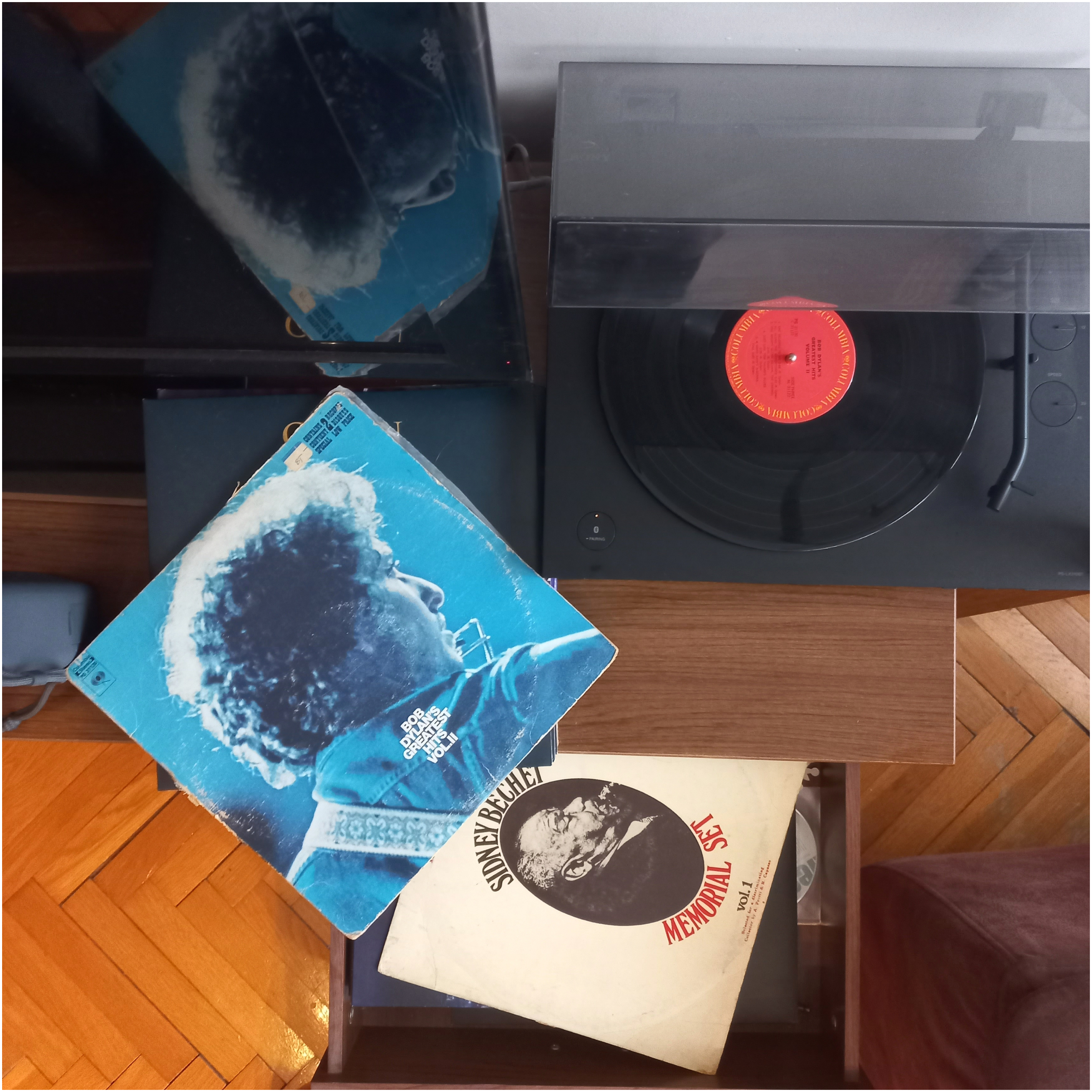
An interior view of a domestic media corner in Istanbul. A contemporary record player features a Bob Dylan vinyl record from 1971 inherited from the owner’s parents. In the lower drawer of the television unit, a second-hand Sydney Bechet record sleeve and a music CD are also visible. The image captures the enduring presence and layered material histories of media technologies in everyday domestic life. Photograph by the author.
Building on this idea, the practices of participants demonstrate how hybrid media ecologies emerge in everyday contexts. These ecologies are not simply technical juxtapositions of devices from different eras but socially and symbolically charged arrangements. They enable users to resist the assumed linear temporality of progress, while creating new modes of belonging and cultural participation. In Istanbul's dense urban environment, where globalized consumer rhythms collide with localized repair economies and second-hand markets, such perma-hybrid practices acquire political significance: they challenge the inevitability of obsolescence by showing that outdated devices can remain productive nodes in networks of meaning, memory, and resistance.
Through these hybrid engagements, outdated devices also acquired new meanings. Pfaffenberger's (1992b: 282–285) concept of technological drama is useful here: repurposing outdated devices creates counterstatements that challenge dominant discourses of innovation. As one participant remarked: ‘Spotify and YouTube are clean, yes—but too polished, too open to everyone. I feel like that song on YouTube has been touched by too many people but when I listen to the same song on cassette, it feels like it belongs to me’ (Y.E.B., 33, Female). Such accounts illustrate how old media embody counter-values – ownership, ritual, and tactility – that oppose the symbolic order of digital platforms.
Affordances further illuminate these practices. Physical affordances refer to tangible features – pressing buttons, flipping tapes, and feeling mechanical feedback – that invite slower, more deliberate interaction. These bodily rituals contrast sharply with the instant, intangible nature of streaming. Socially constructed affordances, meanwhile, emerge through cultural and symbolic contexts, enabling private rituals, ownership, and resistance. For example, handling a Walkman may evoke habitual memories, while also shaping users’ values around slow media consumption.
Together, physical and social affordances bridge empirical use and symbolic meaning. This helps explain how outdated technologies afford alternative rhythms of engagement that challenge the dominant logic of immediacy and disposability. In this sense, the framework resonates with Pierre Lemonnier's (2012: 18–20) view that technologies are always embedded within broader technical systems – ensembles of materials, skills, and cultural practices – so that their significance cannot be reduced to isolated objects. It also aligns with Peter-Paul Verbeek's (2005: 123–131) argument that technologies actively mediate human–world relations, shaping not only perception, practice and temporal experience but also, as Verbeek (2005: 212) suggests, ethical orientation. Outdated devices, when retained and repurposed, thus participate in Lemonnier's (2012) systemic view of technology while exemplifying Verbeek's (2005) notion of mediation, showing how material affordances can generate alternative modes of living and valuing beyond dominant consumerist rhythms.
Affordances, in this regard, become a vital component of analysis. Originally conceived as the action possibilities latent in objects, affordances – especially in sociotechnical contexts – are not merely material or functional, but deeply cultural and interpretive. The outdated devices discussed here afford users a slower, more reflective engagement with technology, enabling alternative modes of living and perceiving time. These affordances are not neutral; they are socially and symbolically charged, shaped by memory, emotion, and critique. By foregrounding both counter-signification and affordance, we highlight how resistance emerges not only from symbolic attachment, but also from the embodied, situated possibilities that old technologies uniquely offer.
Taken together, these accounts demonstrate that retaining outdated devices represents an active critique of consumer culture, a search for slower rhythms, and an effort to construct alternative value systems. Through re-signification, counter-signification, affordances, and hybrid engagements rooted in Istanbul's cultural infrastructures, outdated devices remain relevant as anchors of identity, memory, and resistance, interrupting dominant narratives of innovation and acceleration. In this sense, such hybrid engagements resonate with Lovink's (2024) idea of perma-hybridity, not merely as the coexistence of old and new, but as an interruption of technological linearity. They allow users in Istanbul to reclaim agency over their temporal experience, turning outdated devices into instruments for imagining alternative futures. This form of media creolization – where the old and the new are woven together – is not only technically significant but also culturally and politically meaningful.
Conclusion
This article has examined the enduring materiality and evolving meanings of outdated MCTs. Drawing on interviews with individuals who continue to retain such devices, the analysis has highlighted three interrelated dynamics through which outdated MCTs continue to matter in everyday life. First, outdated MCTs operate as tools for crafting the self, enabling practices of identity, skill, and ritual that extend beyond functionality. Second, they act as infrastructures of memory, materializing personal and familial histories and providing continuity across temporal, spatial, and generational boundaries. Third, their retention constitutes a subtle but consequential form of resistance – not against technology itself, but against the acceleration, disposability, and market-driven construction of obsolescence. Together, these dynamics reveal how old devices remain active participants in everyday life, long after their mainstream utility has faded.
Theoretically, the study contributes by integrating insights from material culture studies, STS, and domestication theory, showing how outdated technologies are simultaneously sociotechnical artefacts, cultural commodities, and affective mediators. It advances debates in material culture by foregrounding the political and ethical dimensions of retention, in STS by demonstrating how technological dramas unfold through counter-significations of obsolescence, and in domestication studies by tracing how once-integrated devices acquire renewed significance after their displacement from daily routines. In this sense, outdated MCTs exemplify how affordances are not only material but also symbolic and moral, affording slower rhythms, reflective practices, and alternative value systems.
Conceptually, the findings position retention as distinct from collecting, hoarding, or nostalgic revival. Retention here emerges as an everyday tactic that resists commodification while sustaining personal and cultural attachments. Practices of hybrid use – what Lovink (2024) terms ‘perma-hybridity’ – further demonstrate how users creatively weave old and new technologies into hybrid media ecologies. These practices complicate linear models of technological change, embedding older devices into contemporary life as counterpoints to acceleration and immediacy.
At the same time, the Istanbul context highlights how infrastructures of repair, second-hand exchange, and cultural venues sustain these practices collectively rather than individually. While grounded in Istanbul's specific urban history, the dynamics discussed here resonate with broader patterns of retention and repair observable in cities where second-hand economies remain active. This situates retention within a broader urban ecology that both supports and legitimizes non-linear technological practices.
Importantly, Istanbul's layered cultural fabric – where global consumer rhythms collide with local repair economies, flea markets, and second-hand shops – makes visible how global dynamics of obsolescence are refracted through specific urban infrastructures. In this sense, the practices observed here contribute not only to individual temporalities but also to collective forms of urban resilience, where outdated devices circulate as shared resources of memory, critique, and creativity. This resonates with wider global debates on sustainability, demonstrating how local repair and reuse economies in cities such as Istanbul offer models of resistance that are both culturally embedded and politically significant. In this context, Istanbul's well-known economies of nostalgia and antiquarian circulation do not simply aestheticize the past, but also sustain everyday infrastructures of repair, reuse, and technological endurance. As scholars of maintenance and repair have argued, such urban economies are not peripheral to technological life but constitute its material backbone, enabling objects to circulate beyond regimes of novelty and planned obsolescence (Denis and Pontille, 2015: 355; Graham and Thrift, 2007: 1–2; Jackson, 2014: 225).
In closing, the dynamics of retention traced here point beyond the specific case of outdated MCTs. They illuminate how material practices can open alternative trajectories of technological engagement – ones that privilege repair, continuity, and affective attachment over novelty and replacement. Such practices are not only personal but also political, hinting at broader struggles over value, sustainability, and temporality in late-capitalist societies. They suggest that the politics of technology are not confined to moments of innovation or crisis but instead unfold quietly in the routines of everyday life, where decisions to keep, repair, and repurpose become subtle yet consequential interventions. In this sense, the study demonstrates how material culture research can reveal everyday acts as quiet but powerful reorientations of what it means to live with technology – and how such practices might prefigure alternative technological futures grounded in endurance, care, and collective possibility.
Footnotes
Ethical statement
Informed consent was obtained from all participants through written consent forms and recorded verbal agreements, ensuring clarity and transparency in the consent process. Given the low-risk and non-invasive nature of the research, ethical approval was not sought from an institutional review board. However, the study was conducted in accordance with ethical guidelines for research involving human participants.
Funding
The author received no financial support for the research, authorship, and/or publication of this article.
Declaration of Conflicting Interests
The author declared no potential conflicts of interest with respect to the research, authorship, and/or publication of this article.
