







Abstract
While Cage’s 4’33 opens an audience’s ears to how much we silence sounds, we also miss much of what silences convey. It seems Cage’s piece could be entirely about listening. Silence is where we listen from. In what ways can we consider silence in music therapy work? The article revisits PhD research examining the detailed occurrence and management of silences during free improvised musical duets and silences in everyday conversation. This research made use of both musical microanalysis and conversation analysis, identifying similarities and also important differences between verbal and musical exchanges. These findings are still relevant today and provide a solid base from which to consider music therapy improvisatory silences. Applied music and psychoanalytic theory are included, as a way to view and review music psychotherapy work in the area of silence, with two clinical vignettes illustrating the application of these theoretical threads. It is shown that fundamental to an appreciation of silence in therapeutic work is the acknowledgement of a deep, layered listening presence.

The image above represents where sunlight peeks through a crevice. It integrates the Japanese character for door (or gate) with the character for sun. Not just a door, but a door with a space that is open to light, suggesting somewhere with potential for creativity, growth, freedom and insight. This is the concept of Ma, a kind of space-time we experience ourselves in, with energy, sensations and feelings that relate to potential. It is somewhere between the beginning and end of something, also linked to the interval between two or more spatial or temporal things or events – like a pause. Ma is linked to silence and to how essential experiences of silent spaces both outside and within ourselves are. Ma describes something ineffable about human interaction, and while an eastern concept, it holds a truth that can be found across the world.
In music therapy, this includes the silence framing an improvisation, the silence between notes, what Winnicott referred to as potential space and somewhere where something unexpected can open up (Odgen, 1985). It also includes what is not sounded and what cannot yet be heard. In terms of therapeutic presence, it indicates the importance of ‘staying with’ in therapeutic work. Out of this kind of presence, dreams may occur, where we might dream ourselves anew, in the sense that we are in a state of constantly becoming, and in our experience of going-on-being. This is fundamentally a dimension that music opens up, as Grotstein (2007) noted: Dreaming constitutes a continuous sensory (usually visual) process whereby the sensory stimuli (internal and/or external) of emotional experience undergo a transformation and an aesthetically honed re-configuration, making them suitable for being experienced affectively, thought about cognitively, and recalled in memory. (p. 266)
What Grotstein also draws our attention to is the possibility of sounded dreams within any music psychotherapy improvisation, and I suggest, also within any psychoanalytic session, where the auditory channel is active.
This article explores silence in music psychotherapy, an area that has been neglected within the published literature, as it is much more common to read about the sounds that are made in music psychotherapy. A re-visiting of doctorate research is given, with music therapy vignettes and established theories about silence in both music therapy and psychoanalytic work. These three contexts open up a Ma space for the reader, where dialogue and play might emerge with varying ideas about silence in relational work, and the musical dimensions we can discover. The following text invites the reader to create a space as if in the opening in a gate, from which their own thoughts and experiences of and about silence in music psychotherapy might be illuminated.
If we are to consider silence, we are focused on listening: to those around us and to ourselves as we listen. Aware of how psychotherapists work, the poet and writer Al Alvarez (2005) noted, . . . the therapist is listening, like a poet or a critic, to the overtones and undertones, alert to the false notes, to whatever is off-key or flat, distinguishing between the genuine emotions and the fake, monitoring when and how and why he is moved and – equally important – when and why he is bored. (p. 18)
Alvarez reminds us of the undercurrents and overtones of music psychotherapy work, where there can sometimes be a more conscious focus on sounds rather than silences and on action rather than being. Through our experiences of living in the music therapy space, we hone our capacity to listen as we grow as therapists. Over time, we tend to ‘be’ more than we ‘do’. This marks an increasing familiarity with the significance of our therapeutic presences, out of which all else emerges.
Like music psychotherapy, psychoanalytic work can be said to be one of construction involving improvisation, in the sense that every meeting is different, unique and unforeseen (Williams, 2007). This is possible because of the psychoanalytic frame, with its sounds and silences occurring within a consistent setting and a set, regular time. As Alvarez observed, within such a frame one becomes aware of undercurrents, which can be thought of as having meaning in different ways, and at different registers, including a musical dimension. One might think about the patient in psychoanalysis, being concerned with how and when they speak; how they use and understand words; how, when and whether they are silent; how their words are put together; the ease of difficulty in speaking; and the mood and pace of their speech. At the same time, the therapist/analyst listens to their listening, attentive to their own responses to the patient, and the content of their narrative in many, detailed, layered ways. This is a musical dimension of psychoanalysis akin to musical listening (De Backer and Sutton, 2014, 2019, 2020).
A number of analytic authors have noted such musical dimensions (Alvarez, 2012; Ashton and Bloch, 2010; Feder, 1993; Grier, 2021; Nagel, 2013; Rose, 2004; Sabbadini, 2006, 2014, Sapen, 2012; Williams, 2007; Zepf, 2013). This is often explored through a study of musical forms (precomposed music, opera, songs, orchestral and chamber music), with enquiry oscillating between the music, the composer, the listener and in the case of music with words, noting the connections between words and music. Authors tend to write about the affective resonance music provokes, and most pay regard to symbolism and how awareness of a musical dimension locates music as part of primary process material. A small number of authors have identified musical phenomena or musical components, for example, Alvarez’s concept of the anacrusis (Alvarez, 2012) and Rose’s thoughts about musical temporality, rhythm, metre and melody (Rose, 2004). These varied psychoanalytic explorations of music also reveal how music is defined in different ways by different authors: for some, it is a noun (something we study) and for others, a verb (we music), the latter being a central stance taken by free improvising musicians and music psychotherapists.
Research by analogy
This article focuses on my doctoral research conducted in 2001 (Sutton, 2001); the central question was, is improvisation like conversation? To investigate this analogy, 10 free musical improvisations by established, well-known musicians were examined, 1 comprising a cross-section of experienced free improvisers whose music spanned several decades. It was decided to focus on duets, because these more obviously reproduced the conditions where verbal duets (everyday conversation) took place. For free improvisers, live performance is not always the prime objective, and a range of different attitudes were included, such as music communicated to an audience via audio recording alone (e.g. tape, vinyl, CD or audio broadcast) as well as during a live concert. With or without an audience, the musicians improvised their music ‘live’ and did not re-work the pieces once created in this way.
Two types of microanalysis were used: motivic analysis of the selected free improvised musical improvisations and Conversation Analysis (CA), which is focused on the management of verbal material. A brief explanation of CA follows, including references suggested for further exploration. A fuller explanation of CA can also be found in my doctoral thesis. 2
CA
CA studies social interaction within conversation (talk-in-interaction) in detail and is an accepted method for looking at the ways in which participants manage their interaction, without the need for understanding or meaning-making. It has had an important influence on the humanities and social sciences (e.g. linguistics). Through analysing spontaneous or natural conversation, 3 CA researchers identified commonly occurring patterns and features observed when two people talk together, in improvised verbal duets. 4
This literature has documented in different ways what conversation is, what its rules are seen to be and how the interaction between speakers is central to this process. Patterns recurring in natural conversation are dependent on what happens between speaker and listener. These rules reveal something about how conversations work, including the underlying, fundamental human interaction taking place. Such rules can be used to uncover the presence of communicative processes during musical improvisation. Focusing on what can be heard during conversation, a part of a larger picture of communication as a whole becomes apparent, while delineating a clear area of study when examining musical improvisations.
Studying the improvisations
Following the CA model, the improvisations were first studied via repeated listening, then a transcription was made for each, so that every improvisation could be explored in its entirety, to identify motivic features and to log the ways these were taken up by the musicians (e.g. if a motif appeared more than once, how and in what ways it was used, or varied or developed). The overall research cycle is represented in Figure 1. The diagram outlines the sequence followed through different cycles for each improvisation, which was then re-checked and revisited.
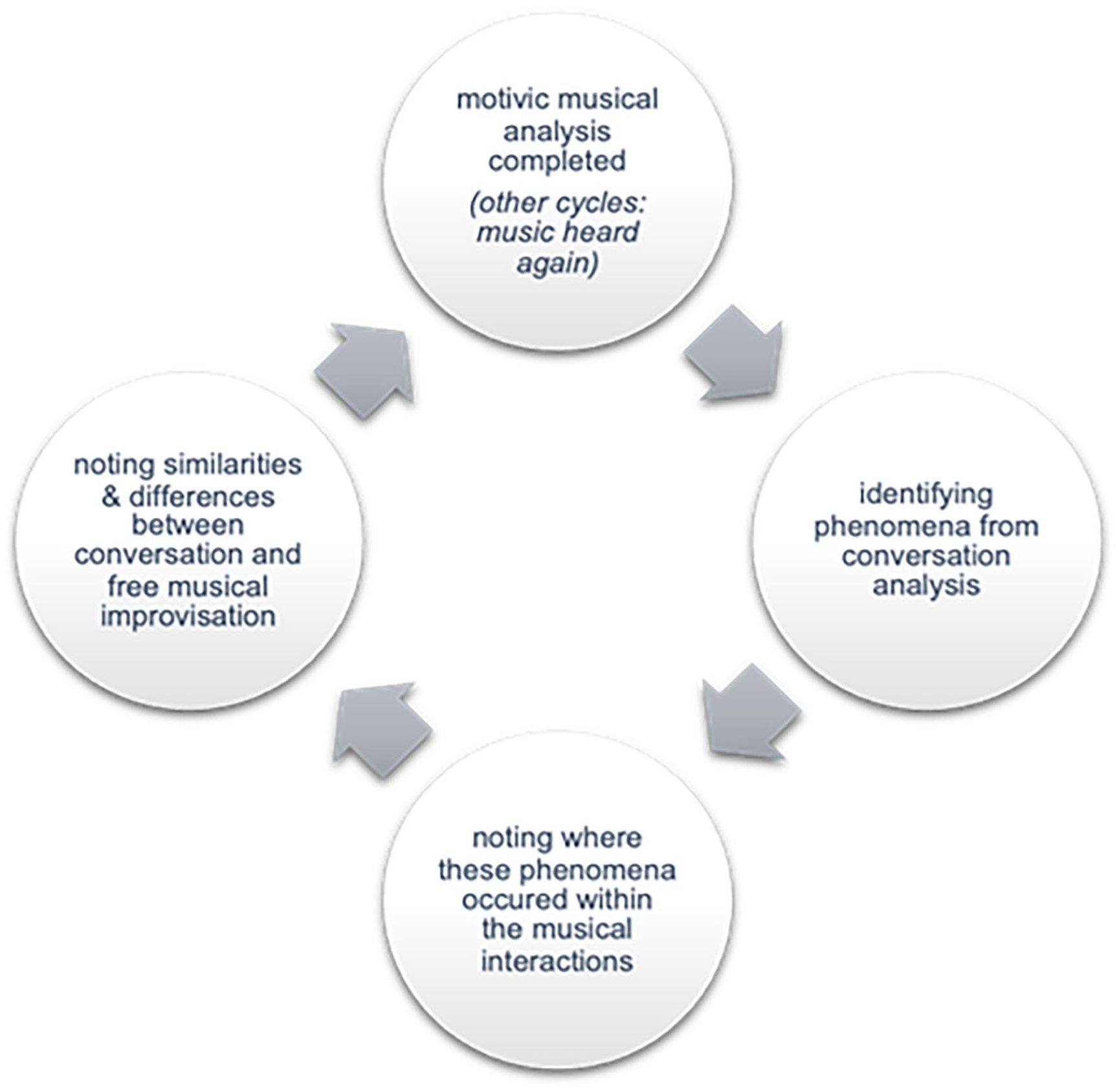
Overview of the research cycle.
As stated, this used a method that identifies the mechanism of interaction without having to be concerned with meaning. It proved fruitful, giving freedom for questions such as:
Who has the floor?
Who dominates?
Who listens?
Who interrupts?
How are turns taken or negotiated?
As the research progressed, four main topics emerged, which were common to CA: beginnings, 5 endings, 6 turn taking 7 and silence. 8 Following this model, the improvisations were analysed with reference to patterns of interaction, as seen in everyday conversation (a form of improvised talk). In comparison with the other focus areas, the topic of silence more dramatically highlighted unexpected differences rather than similarities between talk-in-interaction and music-in-interaction.
Some findings about silence
It was in the management of silence-in-interaction that most of the unexpected findings occurred. In addition to other forms of exchange (how conversations begin and end, or how turns are taken), CA researchers have also identified various kind of silences within conversations, with a distinction drawn between different types of silence, each with different roles. 9 Figure 2 delineates the main categories identified in the CA literature (after Jaworski, 1993; McLaughlin, 1984; Sacks et al., 1978).
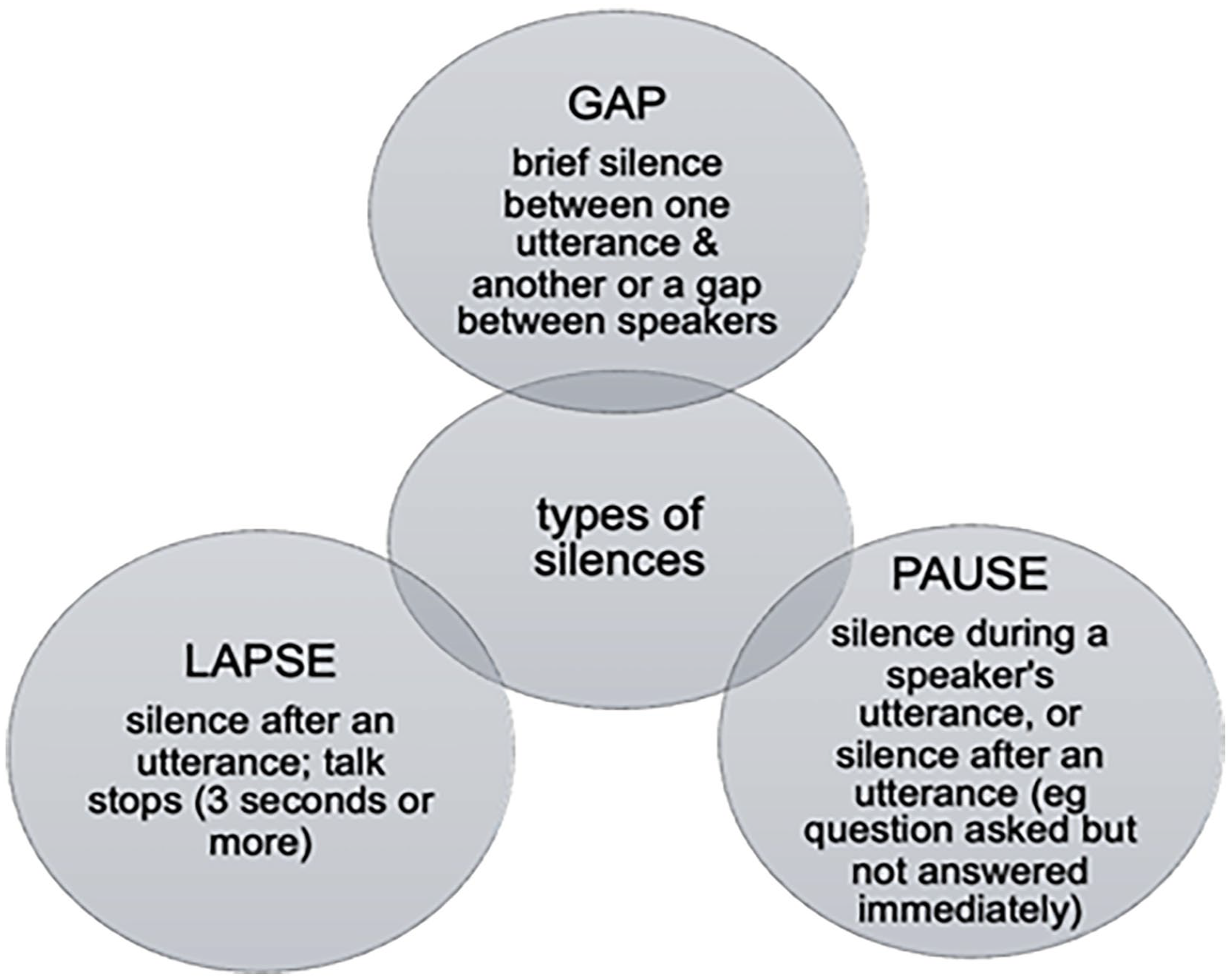
Different categories of silences in CA.
Lapses threaten the integrity of the conversation, and there is agreement that silences can only go on for so long before this happens. Lapses in music use this feature to catch and maintain the attention of the listener and thus provide cohesiveness. Pauses can be further delineated, such as a hesitation pause (occurring during an utterance) and switching pauses (occurring just before or after utterances). The CA literature indicated how silences created problems in keeping conversations going. My research showed verbal conversational silences are far shorter than those occurring in free musical improvisations and that musicians not only tolerate silence for longer, but they make active use of them as part of intersubjective communication in a variety of ways.
The descriptors used in CA depend on the ways verbal material occurs between speakers and how the exchange of material is managed. My research demonstrated how music differs and opens up new views of silences, such as within the concept of hesitation pause, where I identified five further musical categories:
Emphasis point (silences between notes that accentuate or emphasise the sounds occurring either side of the silences)
Rest point (the space between one motivic utterance and the next)
Turn point (where one player has echoed the other after a silence, by repeating their musical motif)
Linking point (after a silence, a player links the next utterance with material from before the silence)
Breath point (relating to momentary pauses for breath, heard most clearly in the playing of wind instruments, and also relating to phrasing, etc.)
In the improvisations I examined, I found parallels with the concept of switching pause, hesitation pause and lapse from CA. 10 The musical analysis also revealed three further musical categories of types of silence: micropauses (functional or technical), pause points and fermata. While technical micropauses were due to the physical action of playing the instruments (e.g. breath points for a wind player), functional micropauses could be used repeatedly during a passage to slow down the overall pace of the music. Pause points were closely related to the structure of the music, with the longer fermata occurring commonly at the ends of pieces, and thus shared silences, with silence being integral to musical structure.
With regard to the findings within my research, the following statements can be made about silence in music:
Music researchers have rarely considered the importance of silence when thinking about what passes between musicians;
Silences in musical composition have related to creating or easing tension, which in turn has a direct impact upon the listener;
Silence in conversation can be perceived as a threat to the further progress of talk, but in music, the feature of ‘threat’ is made use of to keep the listener’s attention 11 ;
How we react to and perceive silence in different contexts will influence the meaning we put on that silence;
It is difficult to define the quality of a silence in a clear-cut sense.
Silences are also frequently ambiguous, as Jaworski (1993) noted, ‘[silence] is probably the most ambiguous of all linguistic forms. It is also ambiguous axiologically: it does both good and bad in communication’ (p. 117). Jaworski’s point is relevant because it appears that with silences in musical duets, ambiguity is less uncomfortable than it is in verbal duets and thus may also be more meaningful, in terms of the ineffable nature of music and the ways it contains and expresses human experiences. While we can interpret or put a meaning to the ambiguous qualities of silence, we can also note that a silence can serve more than one function. This is clear in my research, where silence marked both an exchange of turn between musicians and also a structural point in the music. 12 Similar observations have been made about conversation, when different levels of interaction area analysed, including nonverbal and paraverbal levels.
These phenomena are familiar and also exist in composed music. Clifton gave one such example, from the last movement of Hadyn’s String Quartet Opus 33 No. 2 (the ‘Joke’), describing a use of silence as leaving time to allow the beat to ‘flatten out’, adding that the effect is of the silences becoming ‘progressively more undifferentiated and homogenous’ (Clifton, 1976: 170–171). Changes in the pacing of the sounded music add to the unpredictability and result finally in a humorous ending to the piece, as if of ‘the quartet’s seeming inability to recognise its own ending’ (Clifton, 1976: 170). Clifton hypothesised that this mixing of musical time, and the effect upon each audience member of experiencing themselves in that context, contributed to the inevitability of a slowly concluding piece of music: This inflation of an ending process is one factor which tends to cut off any reverberation of silent pulses; another factor . . . is the deliberate mixing of a musical time and the time of our own bodily continuity, in which the musical time is unfolded. It is the interaction of two times, combined with all the feelings and beliefs about the musical events themselves, which again contributes to the pulseless quality of these closing silences. (Clifton, 1976: 171)
Clifton’s observations provide further evidence for the common occurrence of varying uses of silence in managing the flow and pace of musical compositions, including relating to structural points, and as my research showed, how this also frequently occurs within improvised music.
A summary of my research findings and some further thoughts
My exploration of the conversation-improvisation analogy revealed both a stylised and an interactive use of silence in the music of free improvised duets. The stylised use of silence most likely developed out of compositional techniques, 13 with the improvisers influenced by training, exposure to pre-composed music and previous experiences of improvising. The interactive use of silence has its roots in direct communication as a shape-finding, improvisatory experience between people and could well be a unique feature of improvised music, yet at the same time implicit in any performance, in the sense that an underlying communicative context and intent will always be present.
Therefore, the broader function of silence in musical interaction can be said to not only close a period of sounded communication, but also open this up. 14 Lengthier rest points in improvised music are where silence can change in quality, function and meaning as time goes on. We can track this in the following example, where a silence has begun to unfold after a 10- to 15-minute imagined improvisation, which could come from a performance or a music psychotherapy session.
Example
A silence begins. There is an experience of sound ending, and then expectation of something drawing to a close, without knowing what might follow. The experience of musicians stopping playing hangs in the air. There is uncertainty. Will something else happen? Are they going to play again? Is the music over? There is alertness to the silence and its quality. In time the silence resolves the tension created by the abrupt end of the sounds. There is an eventual realisation that the piece has ended, or this section of the music has ended. There is a further relaxation of tension.
This example demonstrates how silences are not static and that they do not have a single function. Meaning-making is a process of to-and-fro between what we experience internally and what we respond to externally across time, and the interaction between these two aspects. In public performance, when music ends quietly and slowly, there is a tension in the silence after the last sound is heard that can last for many seconds before it is broken by applause. Some audience members may wait even longer, perhaps holding the silence internally. In extended symphonic works, the conclusion of a slow movement can also effect an audience in this way. Composers and performers harness the power of such collective silences. 15
While music does not have words to carry potential meaning, it does share the aspect of negotiation between people. In talk, this negotiation is related to what the words used might mean in relation to the speaker’s intention and how this is received at different cognitive and emotional levels. In music literature, there has been much debate about meaning, including the applied use of music in music therapy work. In the improvisations studied in my research, negotiation was in relation to the musicians’ discovery of shape, form or order. It is likely to be in the two areas of form and emotion that improvised music can inform other relational contexts, including the verbal.
The free improvising musicians whose music I studied had utilised both forward and backward references to musical material, for instance, as well as developing motifs in ongoing music-making, there was also restatement at a later stage of motivic material from an earlier section of the music. This is also true of conversations, but was also a surprise to find in improvisations, which are often thought of as created in forward-moving moments. However, the phenomena of silence also carried distinct differences that revealed underlying communicative aspects of the management of material within improvisations. In the free improvisation literature, musical silence is heard as part of, and integral to, the whole (Bailey, 1992; Cardew, 1969; Hodgkinson, 2000; Prévost, 1995; Ratte, 1997). Musicians hear silence as not only part of the music but also as a reference point out of which music emerges. This introduces the concept of both time and space into a musical work, where a silence can encompass a space-time that has the kind of presence the concept of Ma represents. In many conversations, there is an active resistance towards silence, where some participants will feel the need to fill silences with words – as if words communicate but silences do not. For free improvisers, silence in improvisation is part of the music, with a musical role and function.
Silence at the beginning of performance signifies preparation and readiness for the music to come. Performers and audience members alike share this state of expectancy, and concerts begin when this communal state is established. Silence is therefore linked with a potential (Ma) space for something to take place. Framing performance in this way, silence is also part of the psychotherapeutic frame, marking the boundaries of every meeting. Performance in conversation (in the sense that something is beginning between two people) is usually framed through noting cues such as quality, intensity, tone and intonation of voice, and markers such as the use of ‘well . . .’. Longer silences also fulfil this function in a similar way to that described as occurring in music. 16
Our heightened awareness of silence is used intentionally in verbal interaction in some professions. A journalist utilises the intensity of silence to cause the interviewee to break the tension and expand upon what they have been saying, even though previously they had finished speaking. The journalist is in the dominant position, controlling the interview and provoking a further response through the growing intensity of the silence. We can also observe some politicians avoiding silences in their bid to gain control of an interview, including speaking over the journalist or interrupting them before they have finished speaking. A psychoanalyst actively makes use of the quality of silence in the consulting room as a means of reaching deeper levels of experience and mental state. This is a different method because it can open up space for thought and reflection in both analyst and patient. The analyst works with the silence, allowing it to unfold and attending to its changing quality. There is attention towards making space for thinking and a possible understanding of how the silence evolved and what this might mean for the patient. Newman (1995) summarised Winnicott describing this process: Silence is the basis for all sounds, and is prior to sound. Out of silence, a word might be said or done. Silence is a way of not-knowing, and the stillness [in this] is the greatest and most disciplined of a half-way decent therapist. (pp. 332, 383)
For the psychoanalyst, silence is weighted with meaning and is a vital aspect of therapeutic work; these silences, too, serve a function. They can be more powerful than words (Akhtar, 2013). For these different professions, the context for, and quality of, listening is key. Bringing this awareness to verbal conversation – as the psychoanalyst does – has potential to reveal more of what is meant in the interaction between two people. Silence is shared actively by both participants, and the words that follow will carry meaning in relation to this. Apart from some rare exceptions exploring aspects of silence, 17 in music psychotherapy, we have yet to fully consider in what ways these relational experiences are sounded or if they are occurring within shared silences.
This also raises questions about how music psychotherapists listen and whether or not this is similar to psychoanalytic listening, as previously identified. Music psychotherapist authors have shown awareness of interactive, shared experiences (and their associated phenomena) particularly within anecdotal case study reports (Bruscia, 1991; Chesner and Lykou, 2020; De Backer and Sutton, 2014; Hadley, 2003; Meadows, 2011). If sounded dreaming is part of this work, the therapist’s presence is closer to that of Ma.
Taking place in the spaces where music psychotherapy and psychoanalysis occur, the following vignettes explore the application of some of these findings in relation to therapeutic work when silence occurs. Both vignettes come directly from clinical work. The first example is from a music therapy session, and the second from analytic session, with a musical and psychoanalytic listening dimension explored for both. The vignettes describe forms of silence that vary across space-time and illustrate how new thoughts and insights can open up when we dream about the silences into which sounds might (or might not) occur.
Vignette 1: a child’s silence from the beginning of a music psychotherapy session
Has come into the room and sat down at the opposite end of the room to her therapist. C is motionless, silent, with her back to her therapist.
(Sitting quietly at the piano at the far side of the room) is aware of the child’s presence, the distance she has made between them and the sight of her back. Begins to play very quiet, very slow pentatonic chords on the piano, creating an open auditory environment in the room.
Turns her head very slightly towards the piano, then turns back to her previous position.
Notices this movement, reflects it with a brief, slow, 3-note motif echoing the shape and speed of C’s movement, meanwhile continuing to provide the overall quiet mood with slow pentatonic chords.
Picks up a drumstick and looks at it.
Continues the slow, quiet chords
Holds the stick up and out in front of her and looks at it
Quietly reflects this movement by making a small melody rise upwards
Moves the stick down to the floor, then up again, looking at it
Makes a musical link to C’s movement, all within the same mood as the ongoing pentatonic music
Gradually C becomes more active, but in a solitary, self-focused way. There are also signs of C’s slowly dawning awareness of something outside her, with an occasional brief turn of her head towards the general direction of her therapist. After some minutes, C moves her head from side to side, with these movements in time with her therapist’s music for a short while. This oscillated with more solitary movements, but gradually C’s body is moving more frequently, and in different ways, with a gradually growing range of movements. As the session progresses, a more mutual exchange grows between C and her therapist, as she manipulates her drumstick as if conducting her therapist’s music. With her therapist picking up a growing energy in C’s body, the music intensifies into a kind of dance-like form, which C responds to by getting up and dancing around the room, using her drumstick in different ways, sometimes like a fairy wand, sometimes a conductor’s baton, sometimes making it dance, as she does.
A psychoanalytic dimension might include the following thoughts:
It appears that C is engaged in a solitary activity. The drumstick seems to become an object of some interest, but at the same time something to keep away any contact with the therapist – a focus other than the therapist. It gradually becomes a link to the outside world, where something seems to be connecting with her (the sounds her therapist makes). C’s therapist appears to have offered a particular environment and mood, one that is calm and non-threatening. C tends to withdraw after her therapist has made a musical link with her movement; C indicates some awareness of this link by glancing towards her therapist, although it is not clear whether she sees the therapist as a whole object or something vaguer but of interest. The to-and-fro happens at C’s pace and seems to gradually build up a narrative between her and her therapist. There are signs after a while that C no longer feels alone, isolated or set apart from her environment. This makes one consider whether or not C experienced very early attachment difficulties leaving her feeling very frightened and unsafe. C seems more aware of the music her therapist makes. She also seems to passively accept this, with periods of withdrawal. It is possible that C’s therapist has sensed not to intrude too much and to give C time to settle. C then begins experimenting and reaching out towards her therapist with her drumstick, as if it is an extension of C or a part-object. C is able to get her therapist to make changes to her music, with periods of less activity, providing digesting spaces for these new experiences of being attuned to. It is striking that later in the session, C’s drumstick changes in terms of what it might represent, no longer being an extension of her arm, but something occupying an intermediary space between her and her therapist. Not only is C more connected with her environment but also her own body, and she is clearly more comfortable being with her therapist. A potential space seems to have been created, where play has become possible.
While music psychotherapy is a different method from psychoanalysis – and vice versa – this vignette demonstrates how detailed attunement can be, both in sounds and silences, and without words. C’s therapist made musical choices from an embodied musicianship, with awareness of C’s past traumatic life experiences, as well as her current environment as a looked-after child. The musical medium can be flexible and elastic, and can make possible a stretching of time enabling more space for the kind of attunement shown in the vignette, including opportunities for repair of previously broken intersubjective strands. Psychoanalysts are aware of these underlying processes in every consulting room meeting. These are frequently unsounded, but can be heard, as Akhtar (2013) has observed.
The second vignette details the silence before a patient speaks at the beginning of an analytic session.
Vignette 2: silence at the beginning of a psychoanalytic session
Is on time, comes into the room slowly, glances at the analyst, says nothing, then goes to the couch without a pause. There is then a silence of around 6–8 minutes.
Experiences the silence initially as empty, blank and without affect. Gradually, a different awareness changes the quality of the silence. There is awareness of a diffuse anxiety and of a concern for the patient, who is motionless on the couch, there but not really present. There is a sense of fear of growing intensity. There is a pressure to speak, and it is not clear if this is to reassure the patient, the analyst or both. The analyst is curious why they feel pressure to speak and if this indicates something being defended against. As the analyst has this thought, something settles, and the silence is experienced as a more open space, as if something has relaxed, changed or moved. It is as this point, the patient speaks.
begins to talk about the journey to the session, during which they had become aware of anxiety and worry, without being clear why.
A musical dimension might include:
The silence has no pulse or expressive quality. There is no sense of time moving forward, nor of a dreamlike timelessness. Time itself seems empty and blank, as does the space in the room. It is without the possibility of even the presence of a metronome marking fragments of time passing. The texture of the silence thickens with a strand of an anxious timbre, as if a new voice in a musical score. The analyst/musician now feels pressured to make a sound, to place a sound into this silence. This indicates how a space to make a sound has emerged, yet it is unclear whose sound this should be or when it should be. A thought bubbles up: perhaps both analyst and analysand must wait and listen in different ways. It is as if something has passed between patient and analyst in this textural change in the silence, a shift dependent on how each of them are listening. The texture changes again into something more spacious, where there is now potential for a sound to be placed.
This vignette helps us think about the content of a silence as it changes across time during the first part of an analytic session. Drawing upon musical components that enable sounded dreaming, a musical analysis then offered another strand of potential meaning that remained within primary process material, 18 at the same level as the patient. This enabled a close tracking of the changing nature of a silence that at first felt blank and was possible to track through awareness of musical phenomena in an intersubjective context. It is a form of embodied listening and provides support for Sapen’s thoughts about the kinds of attunement not yet concerned with representation, that patients can find helpful (Sapen, 2012). It also opens up a space for reflection upon experiences within a silence as another means of being aware of and processing countertransference.
Ma and sounded dreams
Grounded in the relational exchange described within CA, this exploration of the ways in which silences occur in interactions has also referred to the musical dimensions of therapeutic work. Through these contexts, spaces open up, from which to view – and dream about – experiences of silence in music psychotherapeutic work. Silence has been shown to be a varied, variable and flexible medium that can carry more than sounds. Being open to silence in this way informs and underpins all therapeutic work.
In terms of Ma, music can place us ‘in between’ aspects of life: in between words and that which comes prior to words; in between experience and meaning; in between what we know and do not know; in between ‘me’ and ‘not-me’. In Japanese Noh Theatre, that which lies beneath the surface (yugen) and the essence or soul of characters is of importance.
19
The aesthetic of Ma means what the actor does not do is interesting (senu tokoro ga omoshiroki). This statement also gives silence its place in music therapy: the silences framing improvisations; the silences within improvisations and within each participating musician; the varying, changing qualities of these silences; and the silenced aspects of human experience that we may sense are also active, in the sense that silence both communicates and hides. As Akhtar (2013) has noted, these experiences are not limited to therapeutic work, but occur everywhere, reminding us of the frequent, common defensive use of silences and silenced aspects of life: Parapraxes, lapses of memory, gross mispronunciations, awkward pauses, and clever ‘sliding of meanings’ [occur] during cocktail parties, political speeches, news reports, or celebrity interviews . . . (Akhtar, 2013: 147)
Ma is a conceptual way of experiencing and exploring silence, which encourages us to open ourselves to that which makes music possible, beginning with listening from the silence into which every sound might be made. This is similar to Bion’s (1962, 1963, 1984) ideas about reverie (of being open to all the client brings) and to Winnicott’s potential space (Winnicott, 1971). It is clear that in our individual listening silences, Music Psychotherapists understand some of what some psychoanalysts do. It is in our own combinations of such shades and colours found in our working lives and applied theories that we find the musical ‘in-betweeness’ of our embodied listening. Green (2010, in Grassi, 2021: 109) put this well, in stating that . . . there are things that music can express, but that psychoanalysis has not much to say about . . . Music meets psychoanalysis ‘mainly in rhythm, time and musical phrasing. There is a phrasing, a sort of breathing, that only analysis can give some idea of’.
20
Perhaps such analysis needs to be made up of as much as we are open (and capable) of listening to, and the music we are able to make, with and for those we work with. This is not only in sound, but especially in, and from, silence.
What we encounter in silence encompasses at least as much as we sense from sounds. Silences can open up or close down communication, may be static and/or fluidly moving, and both constant and/or changing. As a form of Ma, silences focus us on our therapeutic presence, and our listening to ourselves as we listen to those we work with. The internal silences of therapeutic presence are on the edges of dreams. Silent spaces are where a process of dreaming can surface, including the sounded dreams that come from music psychotherapy improvisations. The final words are those of Shakespeare’s Caliban, reminding us of the deep significance of our dreams
21
: Be not afeard; the isle is full of noises, Sounds, and sweet airs, that give delight and hurt not. Sometimes a thousand twangling instruments Will hum about mine ears; and sometime voices, That, if I then had waked after long sleep, Will make me sleep again: and then, in dreaming, The clouds methought would open, and show riches Ready to drop upon me that, when I waked, I cried to dream again.
